
Crypto World
MSTR Shares Fall as MicroStrategy Weighs Potential Bitcoin Sale

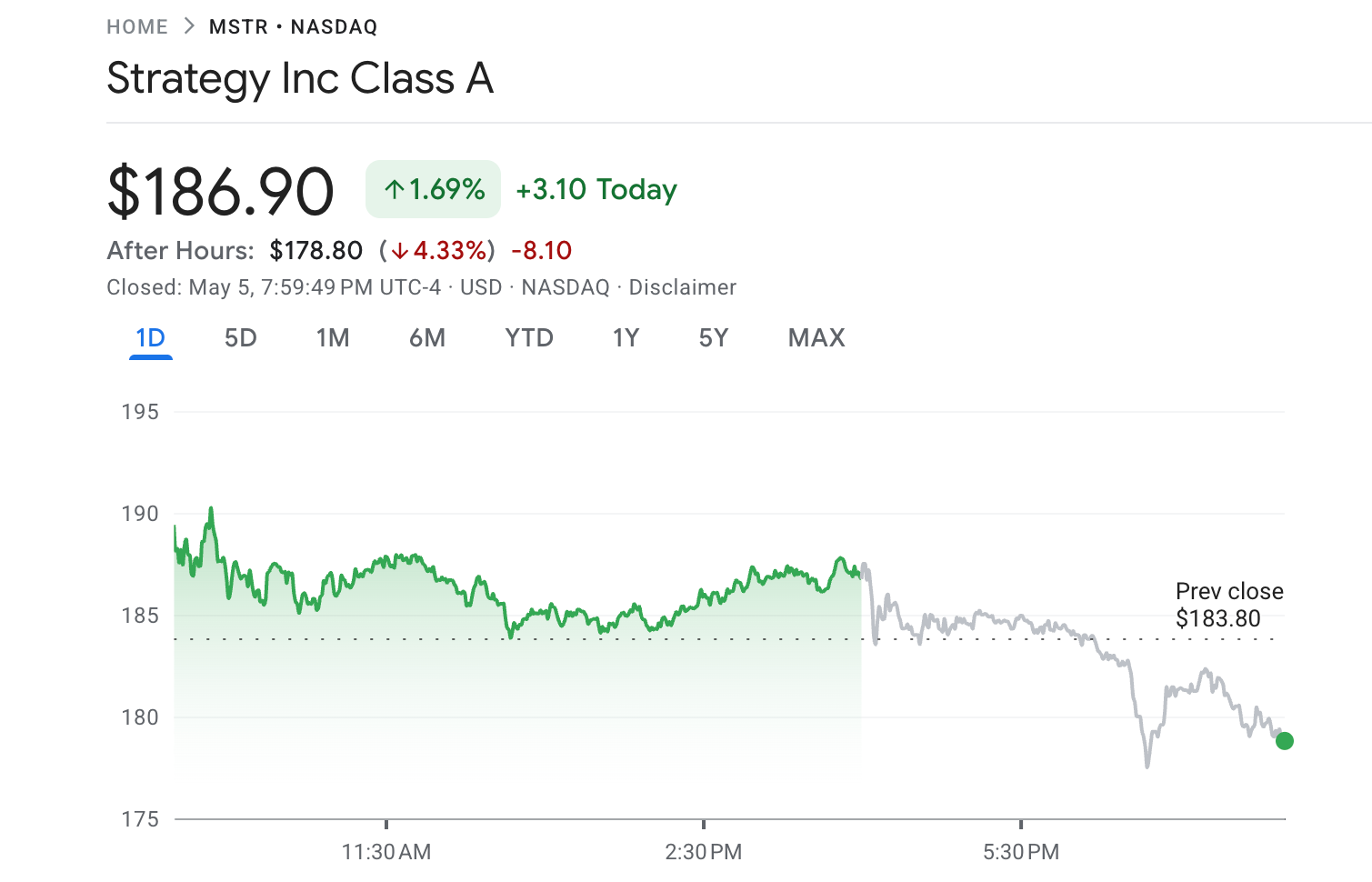
MicroStrategy shares fell after executive chairman Michael Saylor suggested that the firm may sell some Bitcoin (BTC) to fund dividend payments.
“We will probably sell some Bitcoin to pay a dividend just to inoculate the market and send the message that we did it,” he said.
Saylor explained that the strategy involves using credit to accumulate Bitcoin, allowing the asset to gain value over time, and then liquidating a portion when needed to fund dividend payouts.
“You buy bitcoin with credit, you let it appreciate, and then you sell bitcoin to pay the dividend,” he added.
The remarks reverse the company’s longstanding “never sell” position. The shift came during a Q1 2026 earnings call where Strategy reported a $12.54 billion net loss.
Follow us on X to get the latest news as it happens
MicroStrategy CEO Says Bitcoin Sales Are on the Table When Accretive
Meanwhile, CEO Phong Le said the firm would also consider selling Bitcoin “when it’s advantageous to the company.” He stressed that the company remains focused on being a net Bitcoin aggregator while prioritizing growth in Bitcoin per share, which he believes will be the most accretive to MSTR stock’s long-term value.
“Our ability to sell bitcoin either to buy U.S. dollars or sell bitcoin to buy debt if it’s accretive to bitcoin per share is something that we would consider doing going forward,” Le said. “We’re not going to sit back and just say, We’ll never sell the bitcoin.”
Google Finance data showed that MSTR closed up 1.69% at $186.9 on Tuesday. Shares reversed sharply after markets closed. MSTR dropped more than 4% in after-hours trading.

Strategy holds 818,334 BTC at an average cost of about $75,537. The firm is the largest publicly traded corporate holder of the asset. Polymarket traders now price a 48% chance that Strategy sells any of its BTC by December 31, 2026.
Subscribe to our YouTube channel to watch leaders and journalists provide expert insights
The post MSTR Shares Fall as MicroStrategy Weighs Potential Bitcoin Sale appeared first on BeInCrypto.

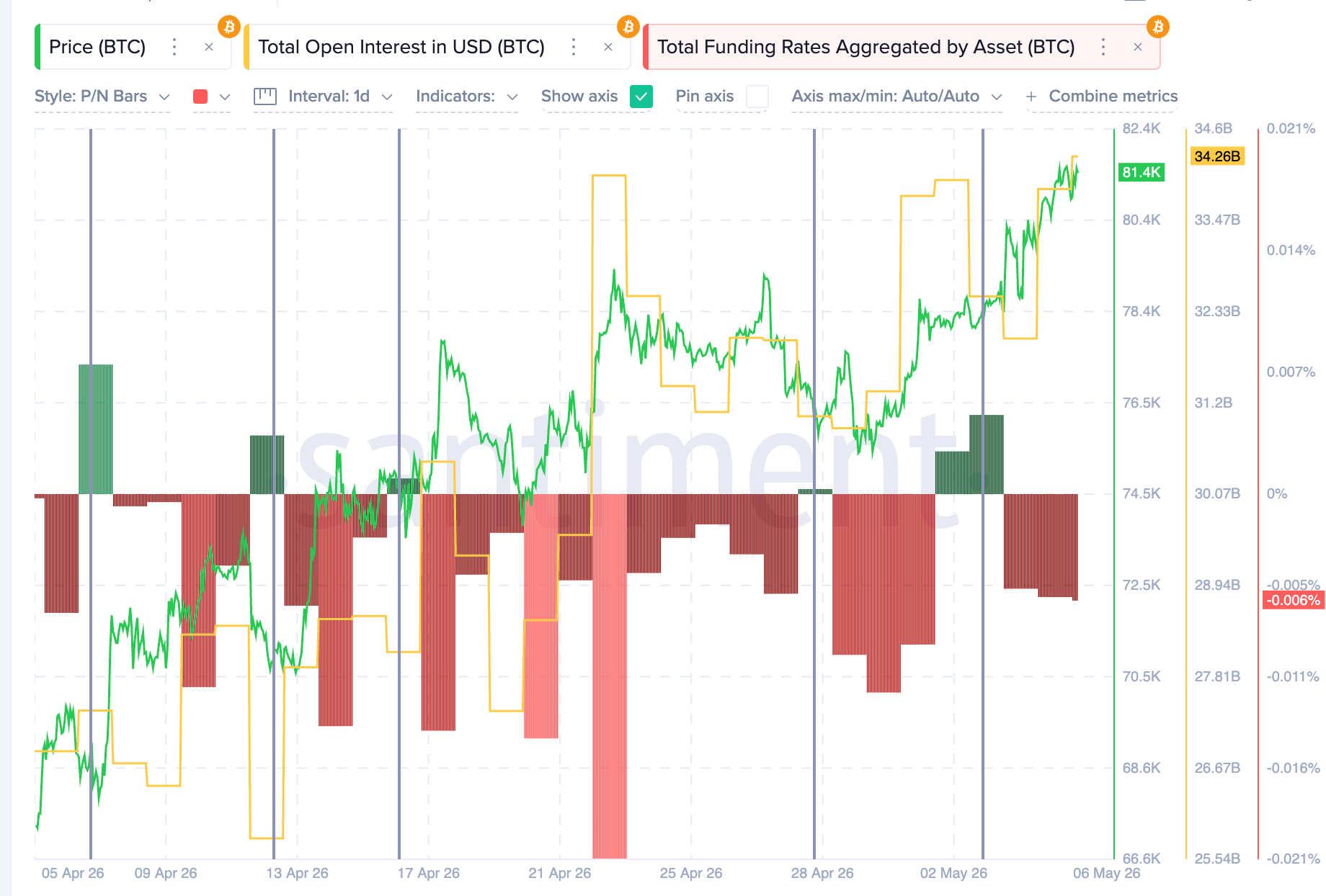
Bitcoin price is up 20%+ over the past month, but the structure underneath that rally reads differently than the price tape suggests.
Derivatives traders are positioned short. Whales are selling into the strength. The momentum profile signals a counter-trend bounce, not a new uptrend. The price tape says bullish. The structure underneath says bearish.
The Derivatives Data Reads Bearish Despite the Rally
Most rallies in recent quarters have been built on the same pattern. Long traders pile in early, leverage stretches across the perpetual futures market, funding rates flip aggressively positive, and the rally extends until a sharp wick flushes the over-leveraged longs and resets the cycle. The pattern is so familiar that most active rallies trigger immediate skepticism about the size of the long crowd waiting to be cleared.
This Bitcoin rally is not following that script as over the past month, the 20% rally phase, longs have only appeared sparingly.

Total Bitcoin open interest has climbed from $30.88 billion on April 30 to $34.26 billion by May 6, an increase of more than 11% across just six trading sessions. But the direction of those new positions is what matters for the read.
Funding rates sat at -0.011% on April 30 and remain at -0.006% as of May 6. A negative reading this persistent across a 20% rally is rare, and it confirms the rising open interest is mostly fresh shorts, not fresh longs.

The 8-hour chart adds the spot confirmation. We use the 8-hour timeframe to read short-term trend behavior, and the volume profile underneath this rally has been thinning. Between April 14 and May 6, Bitcoin price has trended steadily higher while volume has trended steadily lower. The rally is not running on spot demand. It is running on disbelief and possibly the continued liquidation of the shorts.

With no over-leveraged long crowd to flush, there is no obvious wick risk that has capped recent rallies before. But the absence of euphoric long positioning also means there is no spot bid converting through resistance. The rally is structurally fragile.
Whale Flows and RSI Divergence Confirm the Bearish Read
The lack of conviction shows up cleanly in two independent on-chain signals.
Want more token insights like this? Sign up for Editor Harsh Notariya’s Daily Crypto Newsletter here.
The cohort of smaller Bitcoin whales, the wallets holding between 1,000 and 10,000 coins, held 4.27 million Bitcoin on April 18, 2026. By May 6, that figure had dropped to 4.19 million Bitcoin. The 80,000 BTC reduction across an 18-day window matches the timing of the rally itself. Whales are not buying this move. They are using the strength to sell.

The daily chart adds the third bearish signal. The Relative Strength Index (RSI), a momentum indicator captures the divergence cleanly. Between January 5 and May 5, Bitcoin price has formed a clear lower high while the RSI over the same window has formed a higher high.
This pattern is hidden bearish divergence, which occurs when price makes a lower high but the momentum trends higher. In a broader downtrend context, hidden bearish divergence signals continuation of the existing downtrend, not reversal. The 20% rally off the February low reads as a counter-trend bounce within a broader corrective structure. The bearish divergence invalidates if the BTC price crosses $81,854.

Three signals stack consistently. Derivatives positioning says traders expect a pullback. The 80,000 BTC whale cohort drop says spot conviction is missing. RSI hidden bearish divergence says the broader trend is still down. The 20% rally is technically defensible because it lacks the long crowding that broke past rallies, but it lacks the spot demand that completes trend reversals.
The market is not euphoric.
Bitcoin Price Levels Where the Bearish Read Resolves
Bitcoin (BTC) trades at $81,326 with the immediate resistance band sitting between $81,810 and $81,854. That zone is the line that decides whether the disbelief rally extends or rolls over.
A daily close above $81,854 confirms the rally has the strength to push higher and opens the path to $90,460 as the next major technical level. The $90,460 zone aligns with the descending trendline that has capped Bitcoin since the January peak. A break above $90,460 would invalidate the broader downtrend structure and signal a true trend reversal.

The downside levels are stacked tightly. A rejection at $81,810 to $81,854 sends Bitcoin toward $76,656, the 0.236 Fibonacci level, which is the first major support and a likely zone for a retest. Below $76,656, the path opens to $73,467 (0.382 Fib), $70,891 (0.5 Fib), and $68,314 (0.618 Fib). A break below $64,645 would expose the long-term floor at $59,972.
The negative funding setup means any rejection at the resistance band would be amplified. With shorts dominant in the perp book, a failed breakout would not produce mass long liquidations to slow the drop. The path back to $76,656 could be quick.
The level math is binary. A confirmed close above $81,854 opens $90,460. A rejection sends Bitcoin back to $76,656.
The post Why Bitcoin’s 20% Price Rally Reads Bearish Underneath appeared first on BeInCrypto.
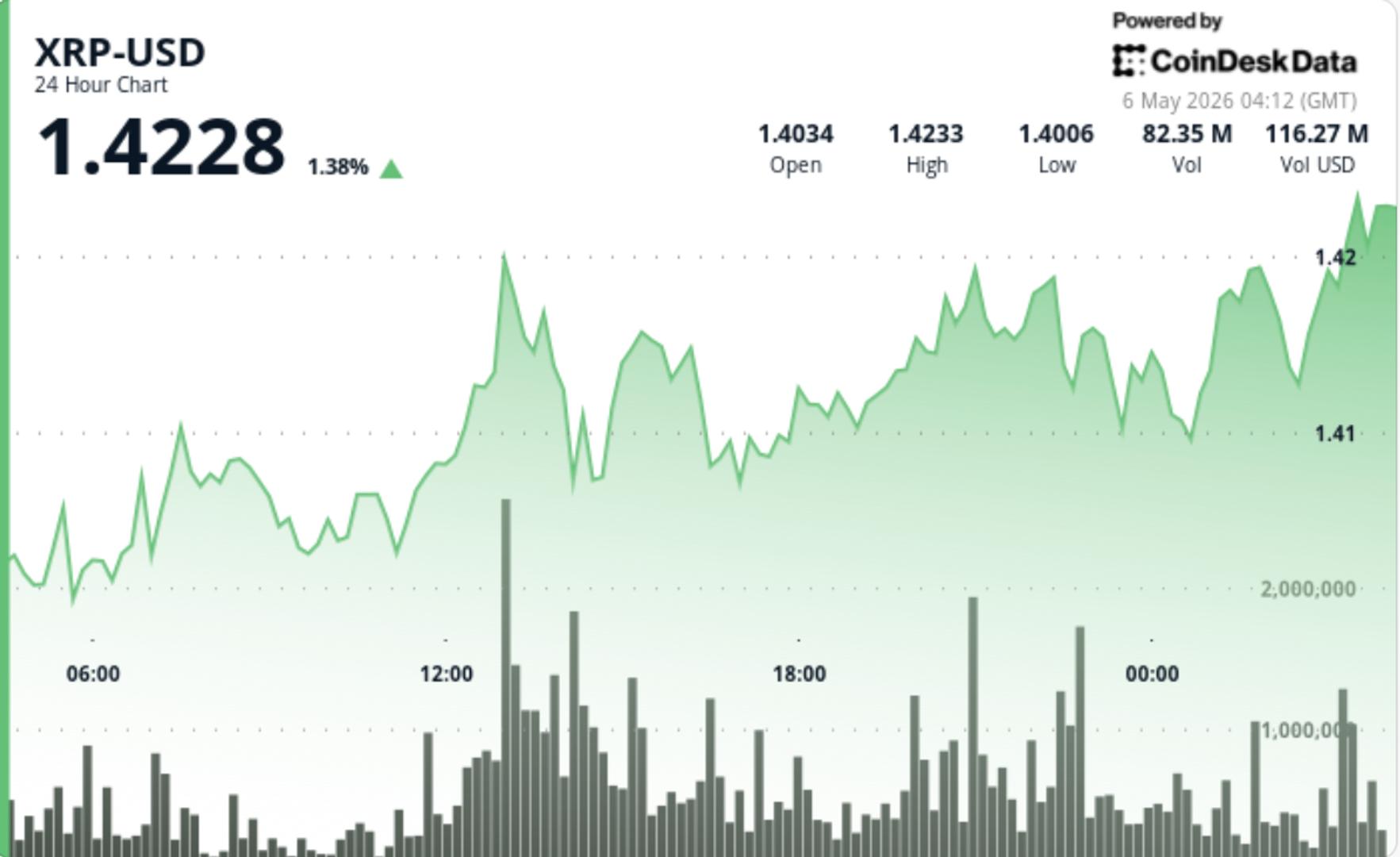
XRP is back above $1.42, and traders are starting to focus on a chart setup that sent XRP up 66% in less than two weeks when it appeared in 2025.
News Background
• Analysts flagged a repeating XRP chart fractal from 2025, when a breakout from a multi-week bull flag triggered a rally toward all-time highs above $3.
• A bull flag is a pattern where price jumps sharply, then moves sideways or slightly lower for a while before potentially breaking higher again. Traders usually see it as a pause in momentum rather than a full reversal.
• Current price action again shows XRP breaking out of a bull flag while the 20-day and 50-day moving averages approach a bullish crossover.
• Some traders now view holding above $1.40 as critical, with the level acting as both psychological support and the upper boundary of the recent flag structure.
Price Action Summary
• XRP climbed from $1.4011 to $1.4184, extending its weekly gain to nearly 9%.
• A 74.6M volume spike at 13:00 pushed price to $1.4207 before momentum cooled into consolidation.
• The token spent the final hours stabilizing between $1.417-$1.420 after repeated tests of the $1.422 resistance zone.
Technical Analysis
• XRP continues building higher lows, keeping short-term bullish structure intact above $1.40.
• The repeated tests near $1.42 matter because resistance weakens each time sellers fail to force a deeper rejection.
• Liquidity on Binance has fallen to its lowest level since 2020, which historically creates conditions for outsized moves once ranges finally break.
• The broader setup resembles the 2025 breakout structure where XRP compressed for weeks before accelerating sharply higher.
What traders should watch
• $1.42 remains the key breakout level. A clean move above it opens the path toward $1.47-$1.50.
• Holding above $1.40 is equally important because failed breakouts often turn into fast reversals once momentum fades.
• If the range finally resolves lower, $1.34-$1.37 becomes the first major support zone traders watch.


Colombian President Gustavo Petro said the country’s Caribbean coast could become a Bitcoin mining hub if it uses clean energy and brings local communities into the plan.
Summary
- Petro says Colombia’s Caribbean coast could use renewable energy to attract Bitcoin mining investment soon.
- The plan mentions Wayúu co-ownership, but no mining partner or launch date has been confirmed.
- Paraguay’s hydro-powered mining growth gives Colombia a model as political timing creates fresh doubts ahead.
Petro pointed to Barranquilla, Santa Marta, and Riohacha as possible sites. He said the region could follow countries such as Venezuela and Paraguay, where low-cost energy has attracted Bitcoin mining investment.
Petro made the comments in a post on X while responding to a discussion on Bitcoin mining in South America. He said the Caribbean region could receive “an immense boost” from mining tied to renewable energy.
The president also called for talks with the Wayúu community. He said the Indigenous group should be involved as possible co-owners of future projects. The Wayúu mainly live in La Guajira, where Colombia has strong wind and solar resources.
Paraguay model draws attention
Petro’s remarks referred to Paraguay’s growing role in Bitcoin mining. The country has used surplus hydroelectric power to attract miners, including large firms building sites near the Itaipu dam.
As featured in earlier coverage, HIVE Digital acquired Bitfarms’ 200 MW hydro-powered Yguazú site in Paraguay for $56 million. The company said the deal lifted its planned Paraguay mining infrastructure to 300 MW.
That deal shows why energy-rich countries have become more attractive to Bitcoin miners. Mining firms often seek cheap and steady power, while host countries look for ways to turn unused electricity into revenue.
Colombia’s renewable base supports the proposal
Colombia already gets a large share of its electricity from clean sources. The World Bank said the country generates as much as 75% of its power from renewable energy, more than twice the global average.
That energy mix could help Petro frame Bitcoin mining as part of a clean power plan. He has also warned that crypto mining powered by fossil fuels could worsen climate change.
The Caribbean coast may play a key role because of its wind potential. Reuters reported that state oil firm Ecopetrol bought the Windpeshi wind power project in La Guajira, with operations expected by 2028.
Election timing leaves questions
Petro’s proposal faces a tight political timeline. His presidential term ends in August, and Colombia is set to hold a presidential election on May 31. He cannot run again because of term limits.
The next government will decide whether the idea moves forward. Current leading candidates have not made clear public plans on Bitcoin mining or digital assets.

TLDR:
- Strategy reported a $12.54 billion Q1 net loss tied to a decline in bitcoin’s market price this quarter.
- Michael Saylor proposed selling bitcoin to cover $1.5 billion in annual dividend and debt obligations.
- Strategy holds 818,334 BTC at an average cost of $75,537, with roughly 18 months of dividend coverage left.
- MSTR stock fell over 4% after hours while bitcoin slipped below $81,000 following Saylor’s announcement.
Strategy, the world’s largest publicly traded corporate bitcoin holder, is considering selling a portion of its bitcoin to meet dividend obligations.
Executive Chairman Michael Saylor disclosed during the company’s Q1 2026 earnings call. The firm reported a $12.54 billion net loss for the quarter.
Strategy currently holds 818,334 BTC at an average acquisition cost of $75,537 per coin. The announcement triggered a sharp market reaction almost immediately.
Saylor Proposes Bitcoin Sales to Meet Dividend Commitments
Saylor outlined a straightforward model for managing the company’s dividend responsibilities. The approach centers on using credit to acquire bitcoin, holding it until the asset appreciates, then selling portions selectively. He explained it plainly: “You buy bitcoin with credit, you let it appreciate, and then you sell bitcoin to pay the dividend.”
Strategy carries roughly $1.5 billion in annualized dividends and debt obligations. The firm estimates it has approximately 18 months of coverage based on current USD reserves. That runway gives the company some flexibility, though the market clearly viewed the news with caution.
Saylor described the plan as both practical and symbolic. He said the company would “probably sell some bitcoin to pay a dividend just to inoculate the market.”
The goal, according to him, was to demonstrate that the model works — not to signal a retreat from its bitcoin strategy.
The preferred stock dividend structure has long been part of Strategy’s financing approach. Selling bitcoin to service those obligations would mark a notable operational shift. Still, the company framed it as a calculated move rather than a sign of financial distress.
Market Reacts Sharply to Bitcoin Sale Announcement
Following the earnings call, Strategy’s stock dropped more than 4% in after-hours trading. Bitcoin also slid below $81,000 shortly after the announcement.
Investors responded quickly to the possibility of increased selling pressure from one of bitcoin’s largest corporate holders.
The Q1 net loss of $12.54 billion reflected the decline in bitcoin’s price during the quarter. Strategy’s large BTC position means its financials are closely tied to the asset’s market performance. A drop in bitcoin’s value directly affects the company’s reported earnings.
Despite the loss, Strategy maintained its overall bitcoin acquisition strategy. The firm did not announce any immediate plans to reduce its total holdings. The proposed bitcoin sales were framed specifically around dividend obligations, not a broader exit.
The market reaction points to how sensitive bitcoin’s price is to large institutional moves. Even the suggestion of a sale from Strategy was enough to push prices lower. Traders and analysts will likely monitor the company’s next moves closely in the weeks ahead.


Binance Expands Regional Communication Channels
Binance has launched seven regional WhatsApp channels targeting users in India, Ukraine, Kazakhstan, Mexico, Peru, Colombia, and Russian-speaking regions. The channels are one-way communication tools designed to distribute verified updates and educational content related to blockchain, Web3, and cryptocurrency.
The exchange aims to improve accessibility and reduce misinformation by providing region-specific content in native languages. Each channel carries verification through Meta, which helps users identify official sources. Binance also advised users to rely only on verified channels to avoid scams and impersonation attempts that circulate on messaging platforms.
The rollout reflects Binance’s effort to strengthen engagement in markets with growing crypto adoption.
New Contracts Introduced with Limited Market Reaction
Binance has added new perpetual futures contracts, including AMD/USDT, QCOM/USDT, and USAR/USDT. These products offer leverage of up to 10x, giving traders additional tools for derivatives trading.
Despite the launch, the listed assets showed minimal price volatility following the announcement. This response contrasts with earlier cases where similar listings triggered sharp price increases. Market participants appeared to adopt a cautious approach, possibly reflecting changing sentiment toward leveraged products.
The introduction of new contracts aligns with Binance’s ongoing strategy to expand its derivatives portfolio. The exchange continues to introduce instruments that cater to both retail and institutional traders while maintaining risk controls.
Binance Confirms Removal of Selected Trading Pairs
Binance will remove 12 spot trading pairs on May 8, including AVA/BTC, ENA/BTC, and MAGIC/BTC. The action forms part of its routine review process, which evaluates liquidity, trading volume, and overall market quality.
The delisting will also affect automated trading bots tied to these pairs. Users must update or cancel such tools before the removal date to avoid disruptions. The underlying tokens will remain available through other trading pairs where applicable.
Binance conducts periodic reviews to maintain a stable trading environment. These actions aim to reduce risks linked to low-liquidity markets and improve user experience across the platform.
For more details, see the Binance Support Announcement.


Brad Garlinghouse has warned that recent Senate progress on the CLARITY Act still leaves a narrow window for the bill to move forward.
Summary
- Brad Garlinghouse said the CLARITY Act could lose momentum if the Senate does not act within the next two weeks.
- Senators Thom Tillis and Angela Alsobrooks reached a stablecoin yield compromise that removes a key hurdle in the bill’s progress.
According to Brad Garlinghouse, the next two weeks will determine whether the digital asset market structure bill can advance, as delays risk pushing the issue into the political cycle ahead of the 2026 U.S. midterm elections.
Speaking at the Consensus crypto conference, the Ripple CEO said the bill’s chances would “drop precipitously” if lawmakers fail to act within that timeframe, adding that campaign pressures could turn the legislation into “too much of a loaded issue.”
His remarks stand in contrast to his earlier timeline. At XRP Las Vegas on April 30, Garlinghouse had said he expected the CLARITY Act to reach President Donald Trump’s desk before the Memorial Day recess, after previously assigning an 80% probability of April passage during a February appearance on Fox Business.
Data tracked by crypto.news placed market expectations lower, with Polymarket pricing 2026 passage near 46%, while Galaxy Research and TD Cowen offered similar or weaker odds.
Stablecoin deal clears a key hurdle, timeline remains tight
Garlinghouse’s comments followed a compromise on stablecoin yield announced by Senators Thom Tillis and Angela Alsobrooks. The agreement restricts crypto platforms from offering interest-like returns on stablecoins that resemble bank deposits, while still allowing rewards tied to payments and platform activity.
As reported by crypto.news, the yield dispute had delayed the bill since January, with disagreements centred on whether third-party platforms could distribute returns on stablecoin balances. A White House Council of Economic Advisers report found that a full ban could cost consumers $800 million annually, a finding Garlinghouse cited as part of the path toward compromise.
Despite the breakthrough, industry voices have pointed to remaining uncertainty. According to Daniel Reis-Faria, the agreement reduces one barrier for investors but does not address concerns about how future rules will be applied. Reis-Faria said institutional players remain cautious because implementation details, expected from regulators within a year of passage, are still unclear.
The CLARITY Act has already passed the U.S. House of Representatives and cleared a Senate Agriculture Committee markup in January, but it still requires approval from the Senate Banking Committee before a full chamber vote. Crypto.news has tracked at least five remaining steps, including committee approval, a 60-vote threshold in the Senate, and reconciliation with both the Agriculture version and the House bill.
Ripple executives, including Garlinghouse, have participated in discussions between White House officials, crypto firms, and banking groups as negotiations progressed. The bill also intersects with ongoing coordination between regulators, after the U.S. Securities and Exchange Commission and Commodity Futures Trading Commission signed a memorandum of understanding in March to align oversight approaches for digital assets.
Garlinghouse acknowledged that the legislation remains imperfect but argued that regulatory clarity outweighs continued uncertainty, describing the outcome as a set of necessary compromises rather than a complete solution.

Kelp DAO is moving its restaking token, rsETH, away from LayerZero’s cross-chain framework and toward Chainlink CCIP after the April exploit that exposed a vulnerability in the DeFi infrastructure. The decision comes as the project, LayerZero and the wider ecosystem debate who bears responsibility for the breach and how best to secure fast-moving cross-chain activity. The incident—one of the largest security shocks this year—saw 116,500 rsETH stolen from a LayerZero-powered bridge and later used as collateral on Aave v3 to borrow wrapped Ether. Kelp said the migration to Chainlink CCIP is a step toward restoring trust and security for rsETH holders and users.
Key takeaways
- Kelp DAO will migrate rsETH to Chainlink CCIP following the April LayerZero exploit, citing security concerns and a desire to harden cross-chain reliability.
- The attack involved the theft of 116,500 rsETH from Kelp’s LayerZero-enabled bridge on April 18, with the tokens subsequently posted as collateral on Aave v3 to borrow wrapped Ether (WETH).
- LayerZero released a postmortem blaming Kelp’s DVN configuration (a single verifier path) for the breach, while Kelp pushes back, saying the 1/1 setup is a common default and that many protocols rely on similar configurations.
- LayerZero announced it will no longer validate cross-chain messages for apps relying on a single DVN and will migrate affected protocols to a multi-DVN model, signaling a broader shift in how cross-chain security is approached.
- The dispute has intensified ongoing concerns about DeFi security, adding fuel to conversations about accountability and best practices in cross-chain architectures, alongside other high-profile incidents such as the Drift Protocol breach.
Cross-chain architecture under scrutiny
The Kelp episode has thrust LayerZero’s cross-chain architecture into the spotlight. LayerZero’s postmortem contends that the breach occurred due to an inadequate DVN (decentralized verifier network) configuration—specifically, relying on a single DVN as the verified path for cross-chain messages instead of requiring multiple independent checks. LayerZero maintains that it advised against this setup, emphasizing that the risk lies in depending on a single chain path for critical asset transfers.
In response, Kelp DAO characterized the postmortem as incomplete and contested LayerZero’s framing of the vulnerability. The project pointed to data suggesting that a substantial portion of LayerZero users operate with a single DVN, a situation Kelp said is not unusual in practice. The DAO argued that the default configurations have historically included multi-DVN setups and that Kelp’s own changes to DVN configuration were not unusual for production environments. The exchange further argued that LayerZero had been aware of the configuration issues and did not provide timely warnings about the associated risks.
The broader debate hinges on whether a single-verification path should ever be acceptable for bridge-like functionality, even if widely used. The incident underscores how quickly a vulnerability in cross-chain messaging can translate into real value loss and liquidity disruption across DeFi protocols tied to the asset. It also highlights the tension between ease of deployment and robust security controls in a rapidly evolving cross-chain landscape.
Kelp’s pivot to Chainlink CCIP and what it means for rsETH
In the wake of the exploit, Kelp DAO said it would migrate rsETH to Chainlink CCIP to strengthen security and reduce exposure to cross-chain messaging risks. The move signals a broader appetite among DeFi projects to diversify or upgrade cross-chain infrastructure after major breaches, especially when tied to restaking mechanisms that rely on cross-chain bridges to facilitate fast, liquidity-efficient operations.
rsETH was designed to represent staked ETH that can be restaked across networks and used as collateral on lenders like Aave. The April incident saw the stolen rsETH being used to back a borrowing position on Aave v3, illustrating how compromised cross-chain liquidity can propagate through DeFi money markets. By transitioning to CCIP, Kelp aims to restore a layer of assurance around asset integrity and cross-chain message validation while maintaining the restaking utility that rsETH offers to users.
The development matters for investors and users who rely on rsETH as part of yield strategies or liquidity provisioning. It also raises questions for builders about how best to architect cross-chain flows that combine speed, security, and resilience. Chainlink CCIP’s approach—emphasizing a trusted, globally verifiable oracle network—offers an alternative that some teams may see as better aligned with enterprise-grade security standards, particularly for critical collateral and staking flows.
LayerZero’s response and the path forward
LayerZero’s leadership contest this narrative with a focus on the security architecture, stating that moving away from single-DVN configurations is a prudent, long-term step for the ecosystem. The company announced it would stop validating or approving cross-chain messages for any application relying on a single verifier and that it is actively migrating protocols using the single-DVN setup to a multi-DVN model. The aim is to reduce single points of failure and improve the integrity of cross-chain message delivery.
LayerZero’s co-founder and CEO, Bryan Pellegrino, publicly pushed back against some of Kelp’s claims, describing portions of the DAO’s narrative as inaccurate. He noted that Kelp’s rsETH had originally operated with multi-DVN defaults and that a later manual change to a 1/1 configuration was not recommended for production systems. Pellegrino argued that the defaults cited by Kelp—multi-DVN paths and, in some cases, DeadDVN configurations that are effectively non-usable—reflect the evolution of LayerZero’s recommended security posture, and he signaled that an external, independent postmortem would soon be published to shed additional light on the incident.
The disagreement has not cooled expectations that more external audits and third-party security analyses will accompany post-incident transparency. The industry has long argued that independent, external reviews are essential for validating internal postmortems and restoring user trust after major cross-chain breaches.
Broader ripple effects in DeFi
The Kelp breach has reverberated through the DeFi ecosystem, reinforcing concerns about how interconnected lending, staking, and cross-chain protocols can become fragile in the face of cross-network attacks. Cointelegraph’s coverage has described the event as a notable episode of contagion that affected the broader crypto lending market and raised the stakes for risk management across bridges and restaking mechanisms. The incident sits alongside other high-profile security events this year, including the Drift Protocol attack that was linked by investigators to North Korean-linked actors, underscoring a pattern of sophisticated cross-chain exploits targeting DeFi liquidity and collateral flows.
As the industry digests these developments, observers will be watching not only the outcomes of Kelp’s migration but also the broader adoption of CCIP versus LayerZero’s approach, and how major protocols balance ease of integration with stringent security controls. The regulatory and market implications—ranging from risk disclosures to the appetite for more end-to-end security guarantees—could shape how new cross-chain solutions are evaluated and deployed in the months ahead.
Meanwhile, Kelp has pledged that a complete external postmortem by independent security firms will be published, which could provide valuable, objective insights into the breach and the efficacy of the surrounding defenses. Until then, investors and builders alike should monitor how rsETH’s transition unfolds, how LayerZero and CCIP-scale cross-chain security strategies evolve, and what practical lessons emerge for securing restaking and collateral flows in a highly interconnected DeFi ecosystem.
As the dust settles, the core question remains: will the cross-chain security debate translate into lasting architectural changes that fortify DeFi, or will it spur a continual cycle of migrations and reconfigurations as protocols chase the latest, seemingly safer, standards? Readers should watch the upcoming security reviews and the continued evolution of cross-chain messaging standards for concrete, actionable guidance in the near term.


The Tennessee Bankers Association has named Stablecore as a preferred digital asset technology provider, giving member banks access to stablecoin, tokenized deposit, and crypto-backed lending infrastructure.
Summary
- Stablecore will help Tennessee banks add stablecoins, tokenized deposits and crypto-backed lending through existing systems.
- The endorsement opens Stablecore to 175 member institutions seeking digital asset tools without in-house builds.
- Stablecoin reward rules remain contested as banks warn yield products may pressure local deposits nationwide.
The move gives Stablecore a path to serve more than 175 member institutions in Tennessee. It also shows how regional banks are looking at digital assets through outside providers instead of building systems from scratch.
In a Tuesday announcement, Stablecore said the partnership will let Tennessee banks offer digital asset products inside their existing banking systems. The company supports stablecoin accounts, payment acceptance, digital asset accounts, on- and off-ramps, tokenized deposits, and asset-backed lending.
Tennessee Bankers Association President and CEO Colin Barrett said infrastructure partners play a role as banks adjust to new customer needs. He said customers would benefit from digital asset tools inside the “secure and trusted environment of their local bank.”
Stablecore CEO and co-founder Alex Treece said banks need a way to offer these services while staying compliant. He said “operationalizing digital asset programs” is an important step for banks this year as they try to retain customers.
Stablecore expands through banking networks
The Tennessee deal follows Stablecore’s entry into the Jack Henry Fintech Integration Network. That network gives fintech firms a faster route to connect with Jack Henry’s bank and credit union core clients.
Jack Henry said the network supports direct fintech connections to its core platforms and helps banks deploy new services faster. It also noted that membership in the network does not mean Jack Henry recommends or endorses each fintech product.
Stablecore’s earlier announcement said the Jack Henry link gives it access to about 1,670 bank and credit union core clients. It also connects to more than 1,000 institutions using the Banno Digital Platform.
Stablecoin rules remain under debate
The bank endorsement comes as U.S. lawmakers continue talks over digital asset market structure and stablecoin rules. Banks and crypto firms have focused heavily on whether stablecoin rewards could pull deposits away from traditional lenders.
In related coverage, banking groups warned that a stablecoin yield loophole could drain deposits from Main Street banks. They urged Congress to close paths that allow crypto platforms to offer yield-like rewards through third parties.
Another recent report said Coinbase opposed Senate language that could restrict stablecoin rewards. Banking groups argued that such rewards may weaken deposits, while crypto firms said rewards remain part of their business model.
For smaller banks, the Stablecore deal offers a way to test digital asset services without running separate crypto systems. That approach may appeal to community lenders that want new products but lack large internal technology teams.


Lawyers seeking to seize $71 million in frozen ether for victims of North Korean terrorism changed their legal strategy Tuesday, arguing in a new court filing that the April 18 rsETH exploit was not theft but fraud, directly countering Aave’s attempt to void a restraining notice blocking the release of the assets.
In a 30-page opposition brief filed in the Southern District of New York, a lawyer representing the North Korean terror victims argues the exploit was not a smash-and-grab theft but a fraudulent lending transaction, and that under longstanding U.S. law, fraudsters who acquire property through deception can obtain legal title to it, even if that ownership is later reversible.
“What actually happened is that North Korea borrowed assets from users of the ‘Aave Protocol’ and did not pay it back, and when the ‘Aave Protocol’ sought to liquidate North Korea’s collateral, the ‘Aave Protocol’ unhappily discovered that the collateral was worthless,” the new filing reads.
“The law is crystal clear that a fraud victim passes title, not merely possession, to a fraudster… Charles Ponzi obtained, through his now-eponymous scheme, ‘defeasible title’ to his victims’ cash,” it continues.
The dispute traces to a cross-chain bridge exploit last month that drained roughly $230 million from Aave, the largest decentralized lending protocol by total value locked.
An attacker, widely attributed to North Korea’s Lazarus Group by forensics firms including Chainalysis and TRM Labs, minted unbacked rsETH tokens, used them as collateral on Aave’s lending markets, and borrowed real ether against the worthless deposits.
Developers tied to the Arbitrum blockchain later intercepted about $71 million before it could be cashed out.
The filing also escalates the dispute beyond New York property law, invoking the Terrorism Risk Insurance Act (TRIA), a post-9/11 federal law that allows people who win court judgments against state sponsors of terrorism to collect those judgments from any U.S.-held property belonging to the country in question.
If the court accepts that theory, Aave’s earlier arguments about New York property law may matter less.
The filing also asks whether Aave has legal standing to challenge the freeze at all, citing the company’s own terms of service, which state that it does not have “possession, custody or control” over user assets, a core aspect of decentralized finance.
Lawyers also pointed out in the filing that the affected users may not need the frozen ether at all. DeFi United, an industry-led recovery fund Aave itself is part of, has raised $327.95 million as of Tuesday morning — more than four times the disputed $71 million.
A hearing is scheduled for Wednesday, May 6, in a Manhattan federal court.


Microsoft’s 2026 Work Trend Index Annual Report shows workers are moving ahead with artificial intelligence (AI) tools. Yet, in many cases, employers fail to redesign systems, incentives, and metrics to capture the value.
The report identifies a “Transformation Paradox.” It suggests that forces driving AI adoption are simultaneously suppressing it.
A Sharp Divide in Workplace AI Readiness
Microsoft analyzed trillions of anonymized Microsoft 365 productivity signals. It also surveyed 20,000 workers across markets, including the US, UK, India, and Japan.
The findings show a sharp gap between individual and organizational readiness. About 58% of AI users say they now produce work that was impossible a year ago. That figure rises to 80% among Frontier Professionals.
“A growing share of workers are using AI in advanced, resourceful ways. The problem? Most organizations aren’t keeping up. In many cases, people are ready. The systems around them are not,” the report read.
Frontier Professionals represent 16% of surveyed AI users. They run multi-step agent workflows, redesign processes, and create shared standards across teams.
Follow us on X to get the latest news as it happens
The Numbers Behind the Paradox
The report highlighted that about 65% of AI users fear falling behind without quick adaptation. However, 45% admit it feels safer to focus on existing goals than to redesign workflows.
Only 13% of workers say their employer rewards reinventing work with AI when results fall short. Meanwhile, just 26% say their leadership is consistently aligned on AI strategy.
“19% of AI users are in the Frontier, the sweet spot where organizational capability and individual readiness are both reinforcing each other. 31% of AI users are misaligned. The rest are still emerging, where both individual AI capability and organizational conditions to support it are still taking shape,” Microsoft said.
The report also noted that the strongest driver of AI impact at work is not the individual, but the organization around them. Organizational factors like culture, manager support, and talent practices account for 67% of AI’s reported impact. By contrast, individual mindset and behavior contribute only 32%.
Therefore, the findings suggest that firms redesigning their operating models now will learn faster and compound advantages over competitors.
Subscribe to our YouTube channel to watch leaders and journalists provide expert insights
The post Microsoft Finds Just 13% of Firms Reward AI-Driven Workplace Reinvention appeared first on BeInCrypto.

Day 5 – Financial Conversations | Financial Planning for Families

Strictly’s Tasha Ghouri feels like she’s in an ‘invisible box’ in call for deaf community ‘changes’

PNB shares jump 4% after Q4 results but Jefferies, Motilal, other brokerages are cutting target prices; here’s why

Manchester United reach agreement with Casemiro over contract clause amid transfer speculation

US brings back mandatory military draft registration

Steven Gerrard disagrees with Gary Neville over ‘shock’ Chelsea and Arsenal claim | Football


-
 Business6 days ago
Tesla Officially Registers Elon Musk’s Stock: What Investors Need to Know
-

 NewsBeat3 days ago
Channel 5 – All Creatures Great and Small series 7 new post
-
 Tech5 days ago
Trump’s 25% EU auto tariff breaches Turnberry Agreement that also covers semiconductors and digital trade
-

 Entertainment6 days ago
Insider Claims Reason Behind Key & Peele Split
-
 Sports4 days ago
Paul Scholes issues Marcus Rashford reality check as agreement emerges over Man United star
-

 Business7 days ago
Barclay Brothers Avoid Bankruptcy: HSBC Drops High Court Petitions After IVA Deal
-

 Entertainment4 days ago
Met Gala 2026 Rumored Guest List Is Turning Heads
-

 Entertainment6 days ago
Celebrities Who Are Attending the 2026 Met Gala Event
-

 Tech7 days ago
Texas Instruments made a new flagship graphing calculator: the TI-84 Evo
-

 Crypto World6 days ago
Meta (META) starts stablecoin payout to creators in Circle’s USDC on Polygon, Solana via Stripe
-

 Business6 days ago
Strait of Hormuz Remains Heavily Restricted on April 29 Amid Iran Conflict
-
Business5 days ago
Strait of Hormuz Blockade Persists Amid US-Iran Standoff, Sending Oil Prices Soaring
-
 Sports4 days ago
David Benavidez responds to team Canelo saying the fight will never happen
-
Entertainment5 days ago
New on Prime Video in May 2026 — Full List of Movies and Shows
-

 Sports4 days ago
Cavaliers vs. Raptors Game 6 live score, updates, highlights from 2026 NBA playoffs first-round series
-

 Entertainment4 days ago
Kylie Jenner Hit With Second Lawsuit From Ex-Housekeeper
-

 Sports4 days ago
Plane crash in Wimberley, Texas kills 5 pickleball players at tournament
-

 Sports6 days ago
Saudi Arabia set to withdraw LIV Golf funding after 2026 season, per reports
-

 Sports6 days ago
Arsenal, Atletico Madrid share draw after penalty drama in Champions League semi-final
-

 Business5 days ago
Two Powerball Tickets Split $143 Million Jackpot in Indiana and Kansas
You must be logged in to post a comment Login