
Crypto World
Nasdaq Embraces Crypto-Style Trading With 23-Hour Market Plan


Nasdaq plans to add overnight stock trading from 9 p.m. to 4 a.m. ET in December 2026, subject to SEC approval and other technical requirements.
BitGo CEO Mike Belshe and crypto analyst Nate Geraci say the move shows traditional markets are adopting ideas that crypto exchanges have used for years.
Nasdaq Plans 23-Hour Trading Five Days a Week
Nasdaq is seeking regulatory approval to run a nearly continuous trading week, 23 hours a day, five days a week. The plan adds an overnight session from 9 p.m. to 4 a.m. ET, on top of the extended hours Nasdaq already runs, from 4 a.m. to 9:30 a.m. and 4 p.m. to 8 p.m, with the core 9:30 a.m. to 4 p.m. session staying the primary pricing window, and the opening and closing crosses still setting official prices.
The overnight session runs from 9 p.m. Sunday through 8 p.m. Friday, with a one-hour daily pause for processing. Nasdaq is targeting Sunday, December 6, 2026, for the launch, pending SEC approval and readiness of the industry’s Securities Information Processor.
Some order types, including unpriced market orders and opening and closing auction orders, won’t be available overnight, and any order still open at 4 a.m. gets canceled automatically. Nasdaq Texas, PSX, and Nasdaq’s options exchanges keep their current schedules.
Geraci posted his reaction to the announcement, writing on X that traditional finance exchanges are now “playing by crypto’s rules” and predicted that major exchanges could eventually move toward 24/7 trading.
Belshe made a similar argument. He pointed to longer stock-market hours, perpetual futures, stablecoins, and tokenized loans as examples of crypto ideas that are finding applications in traditional finance.
“Even if you are skeptical about crypto,” the BitGo CEO wrote, “you can’t deny our industry’s innovations have already made real change in traditional markets.”
Crypto Markets Already Trade Beyond Traditional Hours
The comparison comes as crypto platforms expand access to traditional assets, with a recent CryptoQuant report revealing that equity perpetual futures reached $250 billion in monthly volume in July, up from roughly $15 billion in April.
Binance accounted for about 76% of that activity. The products give traders exposure to selected stocks through contracts that trade continuously, although activity remains concentrated in technology and semiconductor-related names.
Tokenized equities are another part of the shift. As CryptoPotato reported earlier in the year, Nasdaq has been working with Kraken on tokenized stocks, with Kraken’s xStocks infrastructure intended to support Nasdaq issuer-sponsored equity tokens.
Stablecoins are also moving deeper into mainstream payments, with PayPal reporting $486.4 billion in payment volume for the second quarter and placing stablecoins under its expanded digital asset strategy. However, its PYUSD stablecoin has about $2.75 billion in supply, down from more than $4 billion in March, with the entire stablecoin market cap at just over $300 billion per DefiLlama.
Nasdaq’s move does not make stock markets 24/7. Still, its proposed 23-hour schedule puts a traditional exchange closer to the always-on model that crypto markets have operated under for years.
The post Nasdaq Embraces Crypto-Style Trading With 23-Hour Market Plan appeared first on CryptoPotato.


The third-largest corporate holder of BTC has revealed additional details about its planned US expansion, which will see it invest 2,100 BTC and $2.5 million in cash into Super League Enterprise.
The transaction will transform the Nasdaq-listed entity into Superplanet and will become a US Bitcoin treasury platform operating under the ticker SUPA.
Superplannet Is Coming
Metaplanet is expected to control approximately 95.7% of the company’s common stock and voting power following the deal. The newly published investor presentation explains the broader strategy in which the Japanese company wants to replicate its Asian BTC treasury model in the considerably deeper US capital market.
It described the structure as “two listed issuers, two currencies, in two of the world’s largest capital markets.” The company will continue accessing yen-denominated capital in Japan, while Superplanet will attempt to raise USD in the States. All the BTC accumulated by the newly-renamed entity will remain within the Metaplanet group and be consolidated into its overall holdings.
A key part of the strategy could involve issuing USD-denominated perpetual preferred shares to raise additional capital and increase Superplanet’s common share count. The firm plans to use the proceeds to acquire more BTC.
In the hypothetical example provided in the presentation, Metaplanet said if Superplanet raises preferred capital equal to the value of its initial BTC holdings, it will use all of it to purchase more portions of the cryptocurrency. This would double the initial treasury from 2,100 BTC to 4,200 units and increase attributable bitcoin per fully diluted Metaplanet share by approximately 4.7% without issuing additional common shares, the statement explained.
Metaplanet will also have the option to invest another $210 million into Superplanet and receive long-term warrants potentially covering up to 381 million shares.
It’s worth noting that the deal remains subject ot shareholder, Nasdaq, and other regulatory approvals. If it receives the green light, it’s expected to commence in the final quarter of the year
43,000 BTC
Metaplanet adopted the BTC treasury strategy last year and made several major acquisitions. However, it paused its purchases for months as market prices unraveled in 2026, before resuming them in early July. As of press time, it holds 43,000 BTC, making it the third-largest publicly listed corporate holder of the cryptocurrency, trailing Twenty One Capital (43,514 units), and Strategy (840,447 BTC).
The post Metaplanet Unveils US Bitcoin Expansion: Here’s What It Plans to Do With Superplanet appeared first on CryptoPotato.
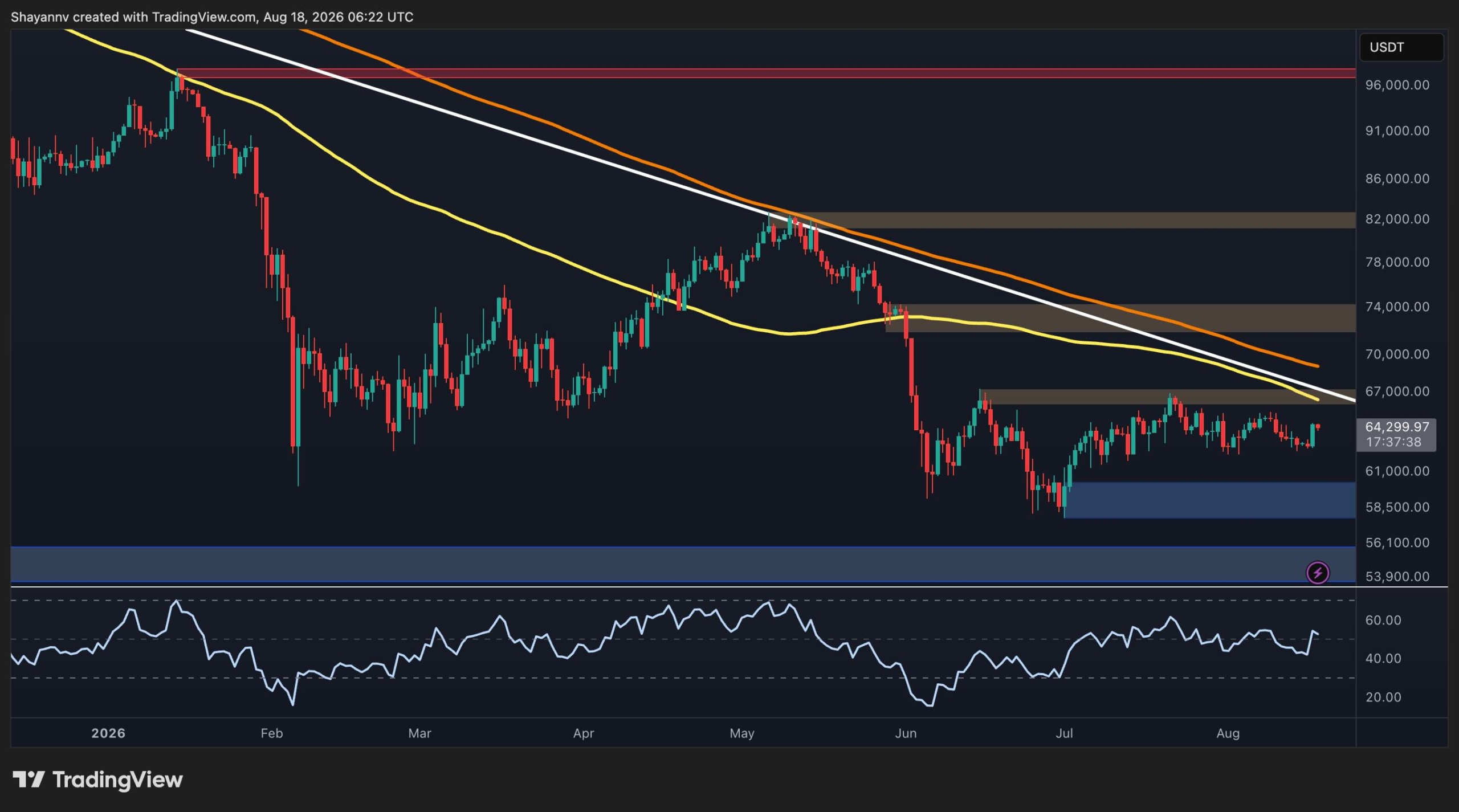
Bitcoin remains trapped in a broad corrective structure, with the price currently near $64.3K after failing to reclaim several important resistance levels. The daily chart shows a persistent bearish trendline and weakening momentum, while the 4-hour structure suggests that the asset is compressing inside a narrowing range. Meanwhile, NUPL has fallen sharply from cycle-high territory, indicating that aggregate unrealized profits have been significantly reduced.
Bitcoin Price Analysis: The Daily Chart
Bitcoin’s daily chart remains technically cautious. The price is trading below the descending white trendline and the 100-day and 200-day moving averages. This alignment keeps the broader trend tilted to the downside until BTC can reclaim these dynamic resistance levels.
The most immediate horizontal resistance sits around the $67K zone, where the descending trendline and a horizontal supply area converge. A daily breakout above this region would be an important improvement in market structure and could open the way toward the $72K-$74K resistance zone. Above that, the $82K area represents another major supply region.
On the downside, BTC is currently holding above the $60K demand zone. A loss of this area would weaken the consolidation structure and could expose the deeper $55K support region. Therefore, the $60K zone remains particularly important for the bullish case.
BTC/USDT 4-Hour Chart
The 4-hour chart provides a somewhat more constructive short-term picture. BTC has been forming a tightening symmetrical triangle structure between an ascending lower trendline and a descending upper trendline, effectively creating a compression pattern.
The price is currently near $64.3K, approaching the upper boundary of this structure. The first major hurdle is the $66K-$67K resistance zone, which also coincides with the longer-term descending channel. A decisive breakout above this region would favor a continuation toward the key $72K area.
Conversely, a breakdown of the triangle pattern from the upper trendline could send BTC back toward the $60K area rapidly. The 4-hour RSI has also surged toward the upper end of its recent range, showing a clear improvement in short-term momentum. However, the indicator is also approaching overbought territory, meaning a rejection near resistance could trigger another pullback before a breakout attempt.
Overall, a compression structure is usually resolved with an impulsive move, depending on the direction of the subsequent breakout. Therefore, the upcoming sessions can be crucial in determining BTC’s trend in the short-term.

On-Chain Analysis
The NUPL chart shows a significant deterioration in Bitcoin’s unrealized profit conditions. NUPL has fallen from above 0.5 during the earlier stages of the cycle to approximately 0.18 currently. The indicator is therefore sitting well below the 0.25 level highlighted on the chart and close to the lower end of the historical range shown.
This decline indicates that the aggregate unrealized gains held by Bitcoin investors have been substantially compressed. Importantly, the current NUPL reading is much closer to the capitulation/low-profit regions seen during previous major corrections than to the elevated levels associated with euphoric market conditions.
While NUPL data does not support a euphoric late-cycle interpretation at present, it also does not provide a standalone bullish signal. The technical charts still need to confirm a structural recovery, particularly through a breakout above $67K and the long-term descending trendline.

The post Bitcoin Price Analysis: BTC’s Rally Means Nothing Until It Reclaims This Key Level appeared first on CryptoPotato.


The CFTC has opened a 45-day comment period on proposals that would double the small-pool exemption threshold to $800,000 and ease registration rules for some fund advisers.
Summary
- The CFTC proposal would create a CPO exemption for qualifying SEC-registered investment advisers.
- A related change would extend registration relief to certain commodity trading advisers.
- The small-pool capital threshold would rise from $400,000 to $800,000.
- Comments will remain open for 45 days after publication in the Federal Register.
CFTC proposal would reduce duplicate fund registration
The Commodity Futures Trading Commission said in an Aug. 18 regulatory announcement that it had proposed amendments to Part 4 of its rules, which govern commodity pool operators, or CPOs, and commodity trading advisers, known as CTAs.
Under the proposal, certain investment advisers already registered with the Securities and Exchange Commission could avoid separate CPO registration for qualifying commodity pools. The exemption would apply only when the pool meets several conditions, including limits on who may invest.
A commodity pool combines money from multiple participants to trade futures, options, swaps, or other commodity interests. Its operator generally must register with the CFTC unless an exemption applies, while a person who provides trading advice may also have to register as a CTA.
SEC-registered advisers can fall under both regulatory systems when the private funds they manage trade commodity interests. According to the CFTC, requiring full registration under both systems may produce overlapping compliance duties without providing enough additional regulatory benefit.
“By continuing to address overly burdensome and duplicative rules for its registrants, the CFTC is delivering on its mandate to promote U.S. market competitiveness,” CFTC Chairman Michael S. Selig said.
Selig added that the agency intended to reduce compliance costs for American businesses while preserving market integrity.
The proposed exemption would not remove all regulatory requirements. Advisers seeking relief would still need to satisfy the SEC’s rules under the Investment Advisers Act, including applicable conduct, examination, disclosure, and reporting requirements.
CFTC exemption would cover pools for sophisticated investors
Proposed Regulation 4.13(a)(4) would limit the CPO exemption to SEC-registered investment advisers operating eligible pools for defined groups of sophisticated investors.
Natural-person participants would generally need to fall within Qualified Eligible Person categories that do not require them to pass the CFTC’s portfolio test. Eligible entities could include QEPs and certain accredited investors listed under the SEC’s Regulation D.
Rather than changing the financial thresholds used to qualify as a QEP, the proposal uses existing investor categories to determine which pools may receive registration relief.
The CFTC previously increased the portfolio thresholds attached to some QEP categories in 2024. Under the updated standard, a person subject to the test may qualify by owning at least $4 million in securities and other assets, holding at least $400,000 in required margin and option premiums, or meeting a combination of the two tests.
Published in September 2024, the final rule doubled the previous thresholds of $2 million and $200,000. Compliance with the new amounts began six months after the rule appeared in the Federal Register.
Separate conditions in the new proposal would require interests in eligible pools to remain exempt from Securities Act registration. Public marketing in the United States would generally be restricted, although pools using Rule 506(c) could conduct general solicitation when every purchaser is an accredited investor and the issuer takes reasonable steps to verify that status.
Where SEC rules require a Form PF filing for an eligible private fund, the adviser would also need to file that form to claim the proposed CFTC exemption. Form PF supplies regulators with information used for investor protection and systemic-risk monitoring.
The CFTC and SEC already operate under a memorandum of understanding that allows them to share Form PF information. The commission said the arrangement could preserve access to fund data without making advisers submit overlapping reports to both agencies.
Eligible advisers would still have to file an exemption notice through the National Futures Association’s online registration system. Annual notices would be required to confirm continued reliance on the exemption, along with updates when filed information becomes inaccurate or incomplete.
Proposed rules would formalize temporary CFTC relief
The plan would place parts of existing staff relief into the CFTC’s regulations, giving qualifying advisers a formal rule instead of leaving them dependent on a no-action position.
CFTC Market Participants Division Letter 25-50, issued in December 2025, provided interim registration relief for certain SEC-registered advisers managing pools restricted to QEPs. The letter covered some advisers who would otherwise need to register as CPOs or CTAs and also allowed eligible firms to withdraw existing registrations.
Staff issued the relief after the commission had removed a similar QEP exemption in 2012. The earlier exemption, adopted in 2003, allowed operators of certain privately offered pools to avoid registration when participation was restricted to qualifying investors.
According to the new proposal, applying Letter 25-50 alongside National Futures Association processes proved complex and time-consuming. Converting the policy into Regulation 4.13(a)(4) would establish a public set of eligibility conditions adopted through the federal notice-and-comment process.
The CFTC said a final rule would supersede specified no-action positions, including relief provided through Letters 25-50 and 26-06. Until the commission adopts a final rule, however, the proposal does not itself replace the current registration framework or the staff letters.
A related amendment to Regulation 4.14 would extend CTA registration relief to qualifying advisers serving pools covered by the proposed CPO exemption. The CFTC described the CTA change as a limited expansion because many affected advisers already qualify for relief when serving other permitted clients.
Small-pool exemption threshold could double
For smaller fund operators, the proposal would raise the maximum gross capital contributions allowed under the small-pool exemption from $400,000 to $800,000.
Regulation 4.13(a)(2) currently permits an exemption for operators whose pools have no more than 15 participants and whose total gross capital contributions across all operated or planned pools do not exceed $400,000, subject to exclusions for certain contributions.
The commission last adjusted the monetary limit in 2003, when it doubled the threshold from $200,000 to $400,000. Using the Consumer Price Index for All Urban Consumers, the agency calculated that $400,000 in January 2003 had the same purchasing power as approximately $735,097 in July 2026.
Rounding that figure to $800,000 would provide a simpler limit for fund operators, according to the proposal. The 15-participant cap would remain unchanged, as would existing rules that exclude specified contributions from the calculation.
Operators using the expanded exemption would still need to complete initial and annual notice filings. Anti-fraud provisions of the Commodity Exchange Act would also continue to apply to exempt pools.
Crypto policy remains on another CFTC track
The Part 4 proposal does not create a registration system for cryptocurrency platforms or change the CFTC’s authority over digital-asset spot markets. Crypto-focused private funds may still be affected when their trading activity makes them commodity pools, but eligibility for relief would depend on the same conditions applied to other qualifying funds.
Meanwhile, crypto.news previously reported that the CFTC’s first Innovation Advisory Committee meeting will take place on Aug. 20. Its agenda includes crypto assets, artificial intelligence, and prediction markets, with public statements accepted through Aug. 27.
The committee’s crypto session will examine federal market-structure questions, overlapping regulatory authority, customer protection, and market integrity. It will not vote on the CPO and CTA proposal or adopt binding digital-asset rules.
Congress is considering separate legislation that could alter how the SEC and CFTC divide digital-asset oversight. A May review of the CLARITY Act explained that the bill would give the CFTC authority over specified digital commodities while leaving investment-contract assets under SEC oversight.
For the Part 4 rulemaking, written comments must identify RIN 3038-AF61 and reach the Commission within 45 days after the proposal is published in the Federal Register. The CFTC has requested feedback on the proposed exemptions, their eligibility conditions, expected costs and benefits, and the increase in the small-pool capital limit.


This year, TIME and Statista have published the first edition of America’s Best Incubators and Accelerators 2026. It identifies the most outstanding hubs offering incubator and accelerator programs in the United States, based on a multi-stage research process combining an open application, structured alumni feedback, track record analysis, and expert recommendations.
Methodology
The process began with an application phase running from January to April 2026. TIME published an announcement article, and the call for entries was promoted across social media channels and shared by InBIA, a global nonprofit organization focused on advancing entrepreneurship and supporting innovation ecosystems. In addition, Statista independently identified several hundred potential candidates through databases and other publicly available sources and invited them to participate via email and LinkedIn. To be eligible, incubators and accelerators had to be physically located in the United States, offer at least one incubation or acceleration program, and have been in operation since at least 2022. During the online registration, participants provided general information about their organization, including the number of employees and the number of startups or alumni per program cohort, along with contact details.
Following the registration phase, all eligible incubators and accelerators were asked to reach out to their alumni who had participated in programs between 2020 and 2025. More than 2,000 alumni responded and evaluated their experience. Each alumnus provided a general recommendation on a scale from 0 to 10 and rated six specific aspects on a scale from 1 to 5, with an additional “not relevant” option. These aspects covered Mentoring & Training, Infrastructure, Legal Assistance, Funding Opportunities, Networking Opportunities, and Business Development Advice. Furthermore, alumni answered questions about the application process, funding, and post-program support.
Statista also reviewed publicly available information and data on the track record of incubators and accelerators, that were evaluated by their alumni, specifically with regard to the five most successful startups that had participated in one of their programs. This information was collected through desk research using official and publicly available sources, including organization websites, public presentations, and online media articles. Where justified by the available data, these organizations were also included in the ranking.
The data collected was then analyzed to produce four distinct subscores. The general alumni recommendation accounted for 40% of the total score, while the six subcriteria from the alumni evaluations accounted for 45%. The Track Record Score was derived from information that incubators and accelerators provided about the top five startups that had participated in one of their programs. The Expert Score was based on recommendations from startup investors and entrepreneurs who were asked to name the Incubators and Accelerators they know and regard highly.
The final overall score was calculated as a weighted average of these components: the general alumni recommendation contributed 40%, the six alumni subcriteria 45%, the Track Record Score 10%, and the Expert Score 5%. This weighting ensures that the ranking is primarily driven by the direct experience of program participants while also accounting for measurable outcomes and the broader reputation within the entrepreneurial community.
Wall Street fears Nvidia (NVDA) is quietly turning into a bank for the AI boom. Bank of America (BofA) says that fear is exactly why Nvidia stock trades at up to a 50% discount, and it kept its $350 target.
Analyst Vivek Arya made the call as Nvidia guaranteed up to $105 billion in leases for an OpenAI data center in Ohio. Earnings arrive on August 26.
Why Investors Fear Nvidia’s New Role as AI Financier
On Monday, Nvidia agreed to backstop up to $105 billion in leases at a new Ohio data center campus. SB Energy, a developer backed by SoftBank and OpenAI, will build and own the site.
The campus sits on a Cold War-era uranium enrichment site in Pike County. OpenAI signed a 20-year lease for the facility, according to Nvidia’s announcement.
The worry is easy to grasp. Nvidia sells chips to OpenAI, has pledged to invest up to $100 billion in the company under a 2025 partnership, and now backs its rent. Critics call the money loop circular.
However, Arya says the market is misreading the deal. Nvidia does not guarantee OpenAI’s full rent. It covers only the leftover gap if OpenAI defaults and the site is re-leased or sold. Even then, the bill is capped at $105 billion, well below the $250 billion floated in earlier reports.
There is also a prize for taking that risk. Nvidia becomes the exclusive AI compute provider on the campus, locking rivals out of scarce land and power. CEO Jensen Huang put the logic plainly in the release, saying
“land, power and shell have become vital in the age of AI.”
Follow us on X to get the latest news as it happens
BofA Sees Nvidia Stock at a 34% to 50% Discount
Arya values Nvidia piece by piece on its free cash flow. Even after loading in every financing risk, his math shows the shares trading 34% to 50% below fair value.
“Nvidia’s ecosystem investments, especially into disruptive frontier labs and neoclouds, are critical to accelerating the [artificial-intelligence] cycle, though they risk lower earnings quality and a depressed trading multiple,” said Arya in his latest note.
Neoclouds are smaller cloud firms built to rent out graphics processing units (GPUs). In plain terms, Arya thinks the deals speed up the AI boom, even if they scare shareholders today.
His fix is simple. Nvidia puts only about half of its free cash flow into buybacks, while peers return 75% to 100%. A bigger program would hand cash back, ease doubts about earnings quality, and could lift the multiple.
Wall Street Consensus and the August 26 Test
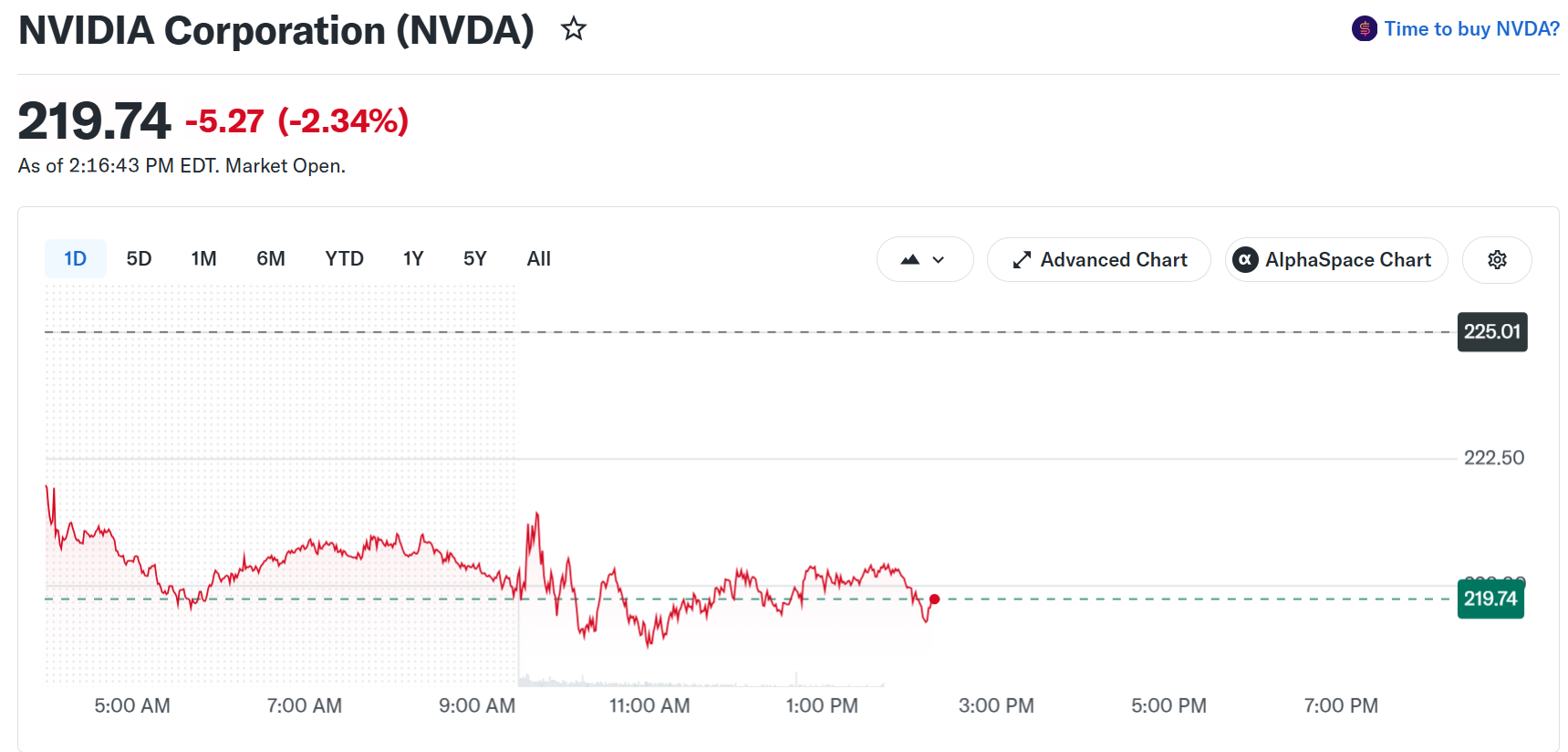
Nvidia stock, NVDA, traded for $219.74 as of this writing. A run to $350 means roughly 59% upside, or about $3 trillion in added value on its $5.45 trillion market cap.

Arya is bullish but far from alone. TipRanks data shows 36 of 37 analysts rate the stock a Buy, with an average target of $309.94. Even the lowest target on the Street, at $250, sits above the current price.

The risks are real, though. If AI demand cools, re-leasing a giant Ohio campus becomes much harder. The stock has also dropped after past earnings six times since August 2024.
Arya expects Nvidia to detail its off-balance-sheet commitments on August 26. If that disclosure lands well, the discount he sees may finally start to close.
The post Bank of America Thinks Nvidia Stock Could Go 50% Higher appeared first on BeInCrypto.

A staff member sorts Kweichow Moutai liquor at a supermarket in Yongnian district of Handan, North China’s Hebei province, Jan 9, 2025.
Cfoto | Future Publishing | Getty Images
BEIJING — Walk down most streets in China and you’ll find a liquor store advertising premium spirits brand Moutai, along with posters of resale prices by vintage year.
It’s a testament to how intertwined the red-and-white-labeled bottles have been with China’s economy in recent decades. The 53% alcohol content “baijiu” was long a staple at government and business dinners for toasts and sealing deals, so much so that Moutai’s stock became a market bellwether.
But the spirits company is now struggling, as China’s business world adapts to the tech-heavy artificial intelligence era.
Kweichow Moutai’s half-year report this month showed a rare drop in net profit, down by 1.95% to 44.5 billion yuan ($6.6 billion). It was the first decline for the first six months of a year since 2014, and only the second such drop based on data going back to 2002, according to Wind Information data.
The latest results followed a decline of 4.5% in net profit for all of 2025 — the first annual decline on record, data showed.
It’s all related to changes in the economic environment, said Ye Yuhua, fund manager at Ba Luo Fund. That’s according to a CNBC translation of Mandarin.
When the real estate sector thrived, there were naturally more scenarios involving premium baijiu consumption, he said. Now with the economic shift to high-end tech, Ye noted the people involved with this emerging industry aren’t as inclined to drink baijiu.
“It’s an irreversible trend,” he said. “Baijiu has become a saturated market.”
China’s anti-corruption crackdown has intensified in recent years, contributing to drag on retail sales. In 2020, Chinese authorities also tightened restrictions on real estate developers’ ability to borrow heavily for growth, clamping down on a construction-heavy sector that had come to determine a quarter of the economy.
Stock drop
Moutai was the largest listed company in mainland China by market capitalization from 2020 to 2023, according to Wind Information data.
Shares briefly fell Monday after the weekend release of its semi-annual financial report, driving its year-to-date losses to 5.7% as of Tuesday. The stock is has declined on an annual basis for four consecutive years.
The half-year report also showed China’s state funds Central Huijin and China Securities Finance, sometimes dubbed part of the “National Team,” were no longer among the 10 largest holders of Moutai stock.
Institutional investor sentiment likely troughed given the exit of Huijin and China Securities Finance from its top 10 shareholders in the second quarter, Citi sad in a report.
The most significant signal from the baijiu company’s latest financial report is that the value of Moutai in business negotiations is shrinking, said Dongfang Li, an independent stock analyst.
However, he pointed out that Moutai’s high 90% gross margin, its profitability and stable dividend continue to attract institutional funds. Li expects institutional allocation to persist.
Citi analysts attributed the decline to the company’s transition from wholesale to direct-to-consumer sales rather than soft demand. The bank maintained its “buy” rating on Moutai.
They expect Moutai to benefit from a recent rotation back into China’s consumer sector, with global long-only investors cautiously returning to high-quality, large-cap consumer staples.
Morningstar similarly said in a report that a mix shift toward direct-to-consumer sales likely distorted Moutai’s payment line, while underlying demand appeared stronger than reported revenue growth. More broadly, it said Moutai is its preferred pick within China’s baijiu sector, citing its competitive position and deepening market-oriented reform.
Shifts to watch
Looking ahead, both Citi and Morningstar mentioned the upcoming Mid-Autumn Festival in their reports. Citi said Moutai may have been incentivized to shift some inventory supply from the second quarter to the third, when the Mid-Autumn Festival falls, to capture the full benefit of its second round of price hikes, which took effect on July 18.
Morningstar, meanwhile, said recent price hikes and seasonally stronger Mid-Autumn Festival sales should support a gradual earnings pickup from the second half. It expects Moutai’s net profit to grow at an 8% compound annual growth rate from 2025 to 2030.
Moutai has implemented two rounds of price hikes for its flagship liquor this year.
Investors, meanwhile, are still waiting for the baijiu market to recover before making strategic moves, said Wenjie Ding, investment strategist for global capital investment at China Asset Management.
She noted ETF data showed net outflows for the better part of this year from food and beverage companies with significant baijiu weighting, although sentiment could have improved modestly this month.
As Beijing has left real estate behind in pursuit of technological development, will Moutai be replaced by another stock as well, signaling a changing of the old guard for good?
Li pointed out that since the beginning of the year, several Chinese tech names have surpassed Moutai in market value at different points. He noted memory chip company CXMT that listed last month has a market capitalization about 2.5-times that of Moutai.
“The market is shifting from the traditional economy’s logic of steady growth to high growth potential and global competitiveness brought about by technological innovation,” he said in Chinese, according to a CNBC translation.

South Korea has decided to block domestic access to Polymarket after authorities determined that its services facilitate activities considered illegal gambling under local law.
The Korea Media and Communications Commission announced on August 18 that its Communications Deliberation Subcommittee had reviewed the platform and approved an access-blocking corrective measure.
South Korea Blocks Polymarket
According to a report by local media, the platform came under scrutiny in South Korea in late May, when police began investigating users on suspicion of gambling. The country’s media watchdog subsequently opened its own review on July 6. In reaching its decision, the commission said Polymarket’s structure, combined with wagers on events outside users’ control, “encourages gambling behavior.”
Polymarket, on the other hand, argued that it was outside South Korean jurisdiction after removing Korean-language services and disabling payments denominated in Korean won. The commission rejected that position and said that technical changes or service methods do not remove a platform’s obligation to comply with domestic law.
South Korea is not alone in restricting Polymarket. France blocked the platform last month over concerns about user losses and potential betting manipulation, while Australia and Germany imposed access restrictions in 2025 after classifying it as an illegal gambling service. More than 30 countries, including Italy, Indonesia, and Argentina, have also blocked or restricted Polymarket.
More Legal Trouble Emerges
The pressure on prediction markets as a whole is also building in the US, although the legal questions vary by jurisdiction. In Baltimore, officials, for instance, have taken aim at both Polymarket and Kalshi.
As reported by CryptoPotato, the city and Mayor Brandon M. Scott filed separate lawsuits on August 13, accusing two platforms of effectively offering sports betting without the licenses required in Maryland. The complaints also allege that both companies presented their products in ways that could leave consumers with the impression that they are legal and properly regulated.
Baltimore argued that calling them “event contracts” or prediction-market trades does not change their underlying nature. The city is seeking penalties, consumer restitution, disgorgement, and other legal remedies. Meanwhile, Kalshi is also facing a separate legal fight with New York officials over its operations in the state.
The post Polymarket Hit With Access Block in South Korea Over Gambling Allegations appeared first on CryptoPotato.


The U.S. Securities and Exchange Commission has proposed two registration exemptions, including a $75 million annual pathway, under its new Reg Crypto framework for certain crypto investment contracts.
Summary
- The larger exemption would allow qualifying issuers to raise up to $75 million in 12 months.
- A separate pathway would permit offerings of up to $5 million across four years.
- The proposal includes a conditional safe harbor and disclosure requirements for participating issuers.
- Stakeholders will have 60 days to submit comments on the proposed framework.
SEC Reg Crypto rules create two offering exemptions
The SEC said in an Aug. 18 press release that Regulation Crypto Assets would establish a tailored framework for certain investment contracts involving digital assets. The proposal follows the Commission’s March 2026 interpretation of how federal securities laws apply to crypto assets and related transactions.
Under the first exemption, an eligible issuer could offer up to $5 million in crypto investment contracts during a four-year period without completing the standard registration process under the Securities Act of 1933. The pathway would provide smaller projects with a route to raise capital while remaining subject to the framework’s conditions.
A second exemption would cover offerings of up to $75 million during any 12-month period. Issuers using the larger pathway would face extra obligations, including financial statement requirements and continued reporting after an offering.
Both routes would require issuers to provide investors with narrative disclosures based on principles specified in the proposed rules. Describing the common requirement, the Commission said issuers would need to make “certain principles-based narrative disclosures” available to their investors.
The SEC has not presented either exemption as an automatic exclusion for all token sales. Each route applies to qualifying crypto investment contracts and depends on compliance with the conditions set out in the proposal. The release does not suggest that every crypto asset or transaction would become exempt from federal securities law.
Before the proposal emerged, the Commission had scheduled an Aug. 14 open meeting to consider the offering framework. The agency later canceled the meeting because of what it called an unforeseen scheduling issue and did not immediately provide a replacement date.
As crypto.news previously reported, the rulemaking package had already entered the White House review process under RIN 3235-AN38 before the meeting was canceled. Its publication now moves the plan into the public rulemaking process rather than putting the exemptions into immediate effect.
Conditional safe harbor could change token treatment
Alongside the two offering exemptions, Reg Crypto proposes a conditional safe harbor from the term “investment contract” within the definitions of a security under the Securities Act of 1933 and the Securities Exchange Act of 1934.
Under the proposal, a crypto asset initially connected to an investment contract could cease to receive that treatment when the arrangement satisfies the safe harbor’s conditions. The framework therefore addresses the legal agreement surrounding a token rather than treating the asset as permanently tied to one securities classification.
The approach follows the SEC’s March interpretation, which addressed when a crypto asset may be sold as part of an investment contract and when that contractual relationship may end. Earlier coverage of the interpretation noted that the SEC and Commodity Futures Trading Commission presented the guidance as a complement to congressional work, not a replacement for legislation.
For U.S. token issuers, the distinction affects how projects could structure fundraising and later transactions. Investors would also receive different levels of information depending on which exemption the issuer uses, with the $75 million pathway carrying financial statements and ongoing reports.
The Commission further proposed overriding state registration and qualification requirements for offers and sales covered by the exemptions. According to the release, the preemption would also reach certain secondary-market transactions that meet the framework’s requirements.
Such federal preemption would reduce the need for qualifying issuers to complete separate securities registration processes in individual states. The proposal would not, however, remove every state-level rule that could apply to a project, because its stated preemption concerns registration and qualification requirements for covered transactions.
SEC rules cannot replace the CLARITY Act
Reg Crypto arrives while the Digital Asset Market Clarity Act remains pending in the Senate. The two measures cover overlapping parts of U.S. crypto policy but rely on different legal routes and do not have the same scope.
Using its existing authority, the SEC can set exemptions and reporting conditions for investment contracts governed by federal securities laws. Congress would have to change the statutory division of authority between the SEC and CFTC or establish a complete market structure regime for digital assets.
The CLARITY Act would address that division by defining categories of digital assets and assigning oversight between the two regulators. Reg Crypto concentrates on securities offerings, issuer disclosures, and the circumstances under which an investment-contract relationship may end.
Recent CLARITY Act coverage reported that the Senate left for its August recess without holding a floor vote. Senate Majority Leader John Thune filed cloture before the break, leaving the chamber to consider the procedural motion after lawmakers return.
The House passed its version of the legislation by a 294–134 vote in July 2025. In the Senate, the measure needs 60 votes to overcome a filibuster before lawmakers can proceed to the remaining stages of consideration.
Reg Crypto would not settle every issue covered by the bill, including the full boundary between securities and commodities oversight or a federal framework for spot crypto trading. The SEC proposal instead provides an agency-led route for a narrower group of transactions while the congressional process remains unfinished.
Public comment will shape the final SEC framework
Stakeholders will have 60 days to comment on Reg Crypto after the proposal enters the prescribed publication process. Issuers, investors, trading platforms, legal professionals, and other members of the public may submit responses addressing the exemptions, disclosures, and safe-harbor conditions.
The proposed rules are not yet final and do not immediately change the registration duties of crypto issuers. After reviewing the submissions, the SEC may revise the text before deciding whether to adopt a final version.
Separately, the Commission has been developing an Innovation Exemption for tokenized securities and onchain trading. White House meeting coverage cited Galaxy Digital research head Alex Thorn as saying he expected the SEC to publish Reg Crypto, the Innovation Exemption, or both within weeks, regardless of the CLARITY Act’s outcome.
The Innovation Exemption would require its own regulatory process and is not part of the two fundraising exemptions announced under Reg Crypto. The SEC has not included a final implementation date for that separate framework in the Reg Crypto release.
Crypto World
Robinhood CEO urges U.S. to clear path for tokenized stocks as overseas markets advance


Vlad Tenev says tokenized stocks could bring real-time settlement and 24/7 trading, but U.S. rules remain a hurdle.


Cypherpunk Technologies has acquired a 4.2 GSol/s Zcash mining fleet for $33.33 million, giving the Nasdaq-listed company about 18% of the network’s total computing power.
Summary
- The acquired Bitmain Z15 Pro fleet produces roughly 7,800 ZEC per month.
- Cypherpunk paid through a pre-funded warrant covering 43.29 million common shares.
- The equipment operates at hosting facilities across the United States.
- Cypherpunk holds 323,394 ZEC, equal to about 1.92% of the circulating supply.
Cypherpunk Technologies said on Aug. 18 that it had launched Cypherpunk Mining after purchasing the equipment and related hosting agreements from entities affiliated with Winklevoss Capital.
The fleet consists of Bitmain Z15 Pro machines already operating at facilities across the United States. With an aggregate Equihash computing capacity of about 4.2 GSol/s, the company described the operation as the largest active Zcash mining fleet in the world.
About 43,800 ZEC are distributed to miners across the network each month, according to the company. Cypherpunk’s 18% share of the current hashrate puts its estimated production at roughly 7,800 ZEC per month, although the actual amount can change with network difficulty and competing computing power.
Will McEvoy, chief investment officer at Cypherpunk, said in an Aug. 18 X post that the business was already generating positive cash flow. He added that the company entered the operation without debt and plans to add its own data center and power assets over time.
Cypherpunk paid with a warrant tied to 43.29 million shares
An Aug. 18 SEC filing identified the seller as Moria Mining LLC and the receiving entity as Cypherpunk Mining LLC, a wholly owned subsidiary of Cypherpunk Technologies. Winklevoss Treasury Investments LLC, an affiliate of Moria Mining, also signed the asset purchase agreement.
Under the agreement, Cypherpunk acquired the mining machines, their associated hosting contracts, and other rights attached to the operation. The buyer also assumed liabilities connected with the purchased assets from the Aug. 17 closing date, excluding liabilities specifically left with the seller.
Rather than paying cash, Cypherpunk issued Winklevoss Treasury Investments a pre-funded warrant to purchase 43,290,042 common shares. The warrant carries an exercise price of $0.001 per share, while the transaction valued Cypherpunk stock at $0.77 per share.
Exercise of the warrant is subject to a 19.99% beneficial ownership ceiling. Winklevoss Treasury Investments may adjust the limit after giving the company notice, but it cannot raise the cap beyond 19.99%, according to the filing.
Cypherpunk must also seek shareholder approval at its next annual meeting before issuing more than 5,377,442 shares through the warrant. The threshold represents about 4.99% of the common stock outstanding before the purchase agreement was signed and addresses restrictions under Nasdaq listing rules.
If shareholders do not approve the proposal at the first meeting, the filing requires Cypherpunk to continue seeking approval at later annual meetings. Winklevoss Treasury Investments must vote its eligible Cypherpunk securities in favor of the proposal.
“Up until now, investors have had limited options for Zcash mining exposure,” Cameron and Tyler Winklevoss said in the company announcement.
Zcash mining adds tokens to Cypherpunk’s treasury
Mining gives Cypherpunk a second route for increasing its ZEC holdings without relying entirely on purchases in the open market. The company currently owns 323,394.38 ZEC, representing about 1.92% of the cryptocurrency’s circulating supply, and has set a target of reaching 5%.
Cypherpunk began building that position after the former biotechnology company Leap Therapeutics changed its name and business strategy in 2025. As crypto.news previously reported, the company initially used $50 million from a Winklevoss Capital-led private placement to acquire 203,775 ZEC.
A later purchase took its holdings to 314,185 ZEC by May 2026. At the same time, Cypherpunk invested $5 million in Zcash Open Development Labs, an organization working on the Zcash protocol and the Zodl wallet alongside backers including Coinbase Ventures, a16z crypto, and Paradigm.
The acquired mining fleet increases the company’s exposure to both the price of ZEC and the economics of producing it. Cypherpunk said the operation can supply tokens for its treasury, fund investments in privacy technology, and provide cash for additional expansion.
According to McEvoy’s post, one megawatt of current-generation Zcash machines produces about $450 in revenue per megawatt-hour under current market conditions. He compared the figure with approximately $223 for AI data center colocation and $133 for Bitcoin mining.
McEvoy also put the equipment cost for one megawatt of Zcash mining capacity at about $2.4 million, compared with roughly $10 million to $12 million for AI infrastructure. The figures are company estimates and remain sensitive to changes in ZEC’s price, mining difficulty, equipment performance, hosting charges and electricity costs.
Cypherpunk’s announcement placed the addressable annual Zcash mining market above $250 million at current token prices. The company said current production costs remain below the spot price of ZEC, although its SEC disclosure classified future hashrate, mining income, profitability, and comparative economics as forward-looking statements.
U.S. investors gain listed exposure to Zcash production
Because Cypherpunk trades on the Nasdaq Capital Market under the ticker CYPH, American investors can obtain indirect exposure to Zcash mining through a publicly listed stock. The company’s share price, however, remains tied to operating costs, warrant dilution, ZEC price movements, and risks affecting the underlying network.
Regulated Zcash exposure in the United States may also expand through Grayscale. In May, the asset manager filed to convert its existing Zcash Trust into a spot exchange-traded fund on NYSE Arca under the ticker ZCSH.
The proposed fund held 391,103.89 ZEC worth about $99.4 million as of March 31, according to its filing. Unlike shielded Zcash users, the trust would keep its tokens in transparent custody with Coinbase Custody, while BNY Mellon would serve as administrator.
Zcash and companies tied to the token remain exposed to network-specific risks. In June, disclosure of a critical flaw in the Orchard shielded pool sent ZEC down as much as 45% and pulled Cypherpunk shares 37% lower. A subsequent security report said the vulnerability could have allowed undetectable counterfeit ZEC before developers deployed an emergency repair.
Shielded Labs said it found no evidence that anyone used the flaw on the main network, but Zcash’s privacy design prevented researchers from proving that exploitation had never occurred. Developers later restored Orchard with corrected code through a network upgrade.
Cypherpunk has appointed Kevin Zhang as head of mining to manage the new operation. Zhang began mining Bitcoin in 2014 and Zcash in 2016, later building mining facilities in North America and helping Foundry develop its Bitcoin mining pool and crypto mining operations.

Children’s stunted lungs show recovery in ultra low emission zone
Metaplanet Unveils US Bitcoin Expansion: Here’s What It Plans to Do With Superplanet

Big Brother Update: Devens Gives Drew Secret Advantage & Birthday Chaos





-

 Fashion4 days ago
Weekend Open Thread: Ann Taylor
-
 Sports5 days ago
This U.S. Amateur is a glimpse into golf’s future in more ways than you think
-

 Sports4 days ago
Birmingham 2026: Day 6 Timetable for Irish Athletes
-
 NewsBeat4 days ago
Myanmar says over 300,000 Rohingya refugees verified for repatriation as exodus enters ninth year
-
 Tech5 days ago
11 Ways to Rank Your Videos
-

 Politics4 days ago
SEQ Code: The Three Letter Boarding Pass Code That Could Give You The Worst Seat
-
 Entertainment7 days ago
Keke Palmer Subtly Hints At Sean Evans Drama With Cryptic Post
-
 Crypto World7 days ago
XRP bridge drained after software mistook fake deposits for real ones
-

 Tech5 days ago
DeepSeek Harness launches as open source rival to Claude Code, alongside V4-Pro on API with higher prices
-

 Sports6 days ago
DeQuan Jones in ‘high spirits’ after successful leg surgery
-
 Crypto World6 days ago
Perplexity AI Predicts an XRP Scenario Few Analysts Are Discussing
-

 Tech7 days ago
SpaceXAI’s Grok Bot turns agents into persistent digital coworkers that can operate your apps for $120-per-month
-

 Crypto World1 day ago
OCC Greenlights Trump Family Crypto Firm for Trust Charter
-

 Politics7 days ago
How Average Are You In The UK?
-
 Entertainment6 days ago
2026’s Most Ambitious Fantasy Movie Officially Scores Sequel Update
-
 Entertainment6 days ago
All 10 Hayao Miyazaki Fantasy Movies, Ranked
-

 Business7 days ago
Evolv Technologies Holdings, Inc. (EVLV) Q2 2026 Earnings Call Transcript
-
 Tech7 days ago
A Zoom Screen-Sharing Bug Let Anyone Take Over Other Devices On a Call
-
 Entertainment6 days ago
Travis Kelce Breaks Silence On ‘Crazy’ Taylor Swift Wedding
-

 Fashion6 days ago
Wednesday’s Workwear Report: Stretch-Cotton Pleated-Waist Top
You must be logged in to post a comment Login