

Crypto World
Nasdaq listed Korean Media firm that once wanted to buy 10,000 bitcoin sells all its BTC, pivots to AI

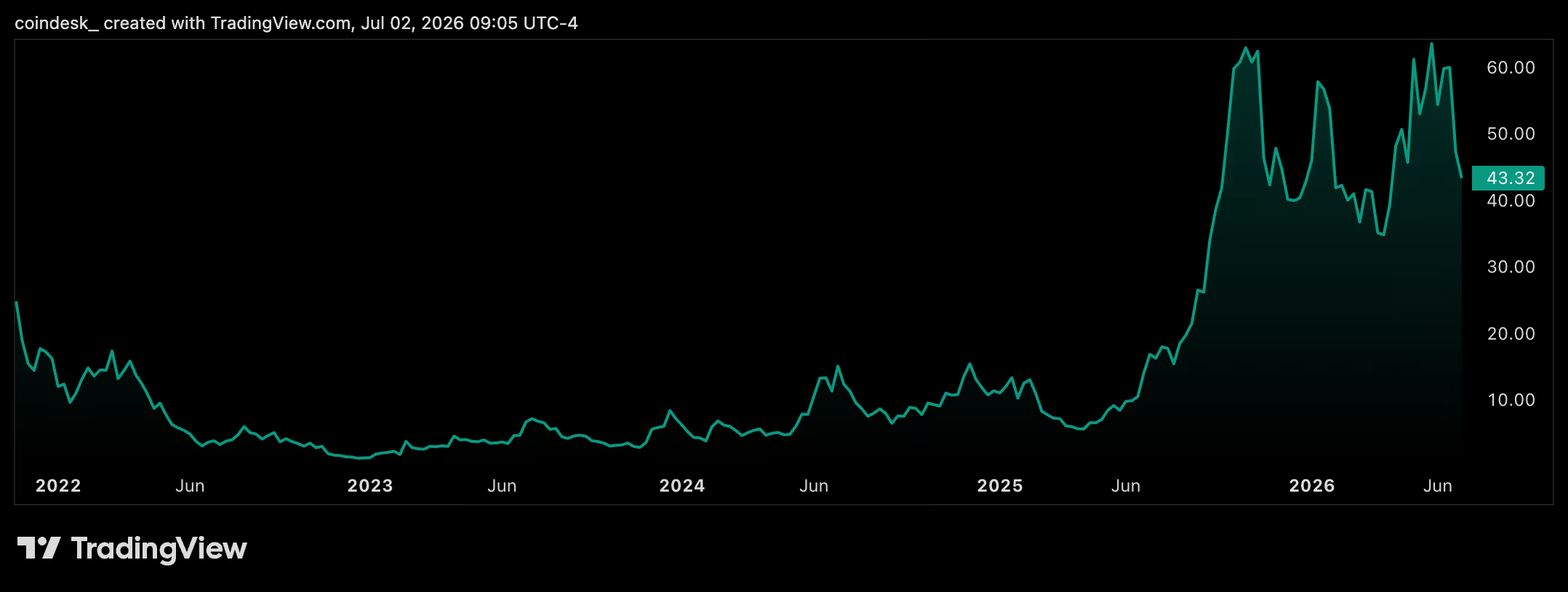
It is moving from a weak position. Shares closed near 16 cents on June 29, and Nasdaq has twice warned the company this year that it no longer meets listing rules, in January for trading below $1 and again in June because its publicly held shares are worth less than the $15 million minimum.
K Wave is considering a reverse stock split, which combines shares into fewer, higher-priced shares to raise the quoted price. The $250 million it hopes to raise is many times its entire market value.
The retreat fits a pattern followed by bitcoin miners.
These firms have sold more than 15,000 bitcoin from peak holdings and signed over $70 billion in AI computing contracts, chasing steadier margins than mining offers, and treasury companies are now joining that rotation. And it worked for some of the struggling miners, as their stock rallied from their lows. For example, IREN, a previously bitcoin mining company that pivoted to AI, saw its shares surge more than 200% after languishing since 2022.

It is the same shift of money out of crypto and into the AI trade that has weighed on bitcoin through a losing first half.
Whether the switch works remains unproven so far. AI infrastructure is capital-heavy and crowded with better-funded rivals, and K Wave has to stay on Nasdaq long enough to spend what it raises.



President Donald Trump renewed his pro-crypto message by questioning whether Bitcoin should be taxed like a traditional investment while defending his financial disclosure, which revealed substantial crypto-related earnings.
Speaking to reporters at Joint Base Andrews before departing on Air Force One late July 2 into July 3, Trump also praised the stock market, reaffirmed support for digital assets, and addressed concerns about his business interests.
Trump Says Bitcoin Shouldn’t Face Capital Gains Tax
During the informal press gaggle, Trump argued that Bitcoin has evolved into a form of money and questioned why users should pay capital gains tax on everyday purchases.
Using a coffee purchase as an example, Trump said a friend recently pointed out that Bitcoin transactions should not trigger taxes if the asset functions as money, a view he said he agrees with.
The remarks echo Trump’s campaign-era calls for friendlier crypto regulations and come as his administration continues positioning the United States as a global leader in digital assets.
‘Crypto’s a Big Deal,’ Trump Says
Trump doubled down on his support for the industry, calling crypto “a big deal” and insisting the United States should lead the sector.
“Anything we do, we want to be number one,” Trump said, framing digital assets as a strategic technology race rather than simply an investment trend.
His comments reinforce the administration’s broader pro-crypto agenda, including support for digital asset innovation and efforts to strengthen America’s position against competing financial hubs.
Financial Disclosure Draws Questions
Reporters pressed Trump after his latest annual financial disclosure highlighted significant crypto-related income alongside broader investment gains.
Trump responded by distancing himself from the day-to-day management of his businesses.
“My kids run my business. I’m not involved,” he said, adding that professional managers oversee his investments.
He also defended his wealth, saying he has “always made money” while reiterating that he does not personally manage investment decisions.
Fed, Growth, and Markets Remain in Focus
Beyond crypto, Trump commented on Federal Reserve Chair Kevin Warsh, saying the Fed board is “a little bit hostile” while adding that Warsh “has to do what he has to do.”
The president also praised the stock market and expressed confidence that U.S. economic growth could eventually exceed 4%, suggesting it could reach 12% or 13% under the right conditions.
What’s Next?
Trump’s latest remarks reinforce that cryptocurrency remains central to his economic messaging. While no immediate policy changes were announced, his renewed criticism of Bitcoin taxation is likely to fuel debate over digital asset tax reform in Congress.
Investors will now watch whether the administration translates its pro-crypto rhetoric into concrete legislation, particularly around capital gains rules and broader regulatory reforms that could influence Bitcoin adoption and market sentiment.
The post Trump Defends Crypto Fortune, Says Bitcoin Shouldn’t Be Taxed Like Stocks appeared first on BeInCrypto.
Chris Larsen, co-founder and executive chair of Ripple Labs, was reportedly among those backing the financial venture of US Senator Kirsten Gillibrand’s son as negotiations over a significant piece of crypto-related legislation continue in the Senate.
According to a Thursday Politico report, Larsen was one of a handful of investors backing the American Perpetuals Exchange Corp. (APEC), founded by Theodore Gillibrand. Although Larsen’s exact contribution was not included in the report, the majority of investors contributed between $5,000 to $10,000 each into the derivatives platform, which reportedly raised $30 million.
The investment comes as the New York lawmaker is involved in negotiations over ethics provisions in the Digital Asset Market Clarity (CLARITY) Act, legislation expected to have a significant impact on crypto companies operating in the US, including Ripple. Gillibrand said in May that no one would be voting for the bill without addressing ethics:
“[T]he truth is, is that we cannot allow members of Congress, senior administration officials, presidents or vice presidents, to get rich off of these industries because of their insider status. It is the worst form of pay for play.”
A spokesperson for the senator referred Cointelegraph to her June 18 statement saying that her son was “a grown adult starting his own independent business” and she had “no involvement in it whatsoever.” Cointelegraph reached out to APEC for comment but did not receive an immediate response.
Related: Fed chair nominee pressed on potential conflicts of interest, independence
Democratic lawmakers have been pushing Republicans, who hold a majority in Congress, to support efforts to add ethics language to the CLARITY Act, citing US President Donald Trump’s ties to the crypto industry. Republican leaders in the Senate are expecting the bill to pass the chamber in July, with Senator Cynthia Lummis saying in June that lawmakers were “working a little bit on ethics,” decentralized finance and illicit transactions as part of negotiations.
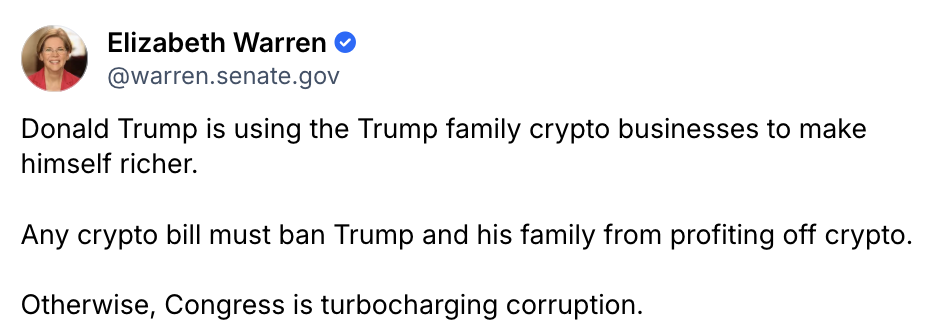
Source: Senator Elizabeth Warren
Senate Republicans hold a slim majority in the chamber, meaning they will need some Democratic support to meet the 60-vote threshold for CLARITY to pass.
Congressional schedule squeezes window for CLARITY bill
Lawmakers in the US Senate are on state work periods for the Independence Day holiday. Scheduled to return to session on July 13 and leave for another month-long state work period in August, the window to pass crypto market structure is closing before US election day, which is expected to result in additional delays.
Magazine: AI is banking the unbanked in Africa… faster than crypto


Securitize began trading on the New York Stock Exchange Thursday under the ticker SECZ and simultaneously put its own newly listed common stock onchain, according to a press release the tokenization firm distributed via PR Newswire. Eligible U.S. investors can access tokenized SECZ through… Read the full story at The Defiant

Ethereum Institutional was announced on Wednesday as a new independent non-profit to serve as a neutral front door for institutions navigating Ethereum, its layer-2s, tokenization, stablecoins, and on-chain markets.
The new organization has been founded by the former Ethereum Foundation Enterprise team, David Walsh, Matthew Dawson, and Marius Smith, with funding coming from Bitmine, Sharplink, and Consensys CEO Joseph Lubin.
It comes at a crucial time for Ethereum, which is under an avalanche of FUD and trading at multi-year lows.
Nevertheless, there is still a great deal of momentum and interest in keeping Ethereum the foundation of future finance.
A Credible Front Door
“What’s been missing is a credible, independent front door: one that represents the full Ethereum ecosystem, without bias, and that institutions can engage with directly,” said the team.
The organization centers on five areas: institutional engagement, intelligence, ETH marketing, requirements discovery, and events, to translate institutional needs into Ethereum deployments during a key period when institutions are making infrastructure decisions.
1/ Announcing Ethereum Institutional
An independent non-profit dedicated to accelerating the institutional adoption of Ethereum, its L2s, applications and overall ecosystem. pic.twitter.com/XUeViH6rrq
— Ethereum Institutional (@ethereuminsti) July 1, 2026
“For years, Ethereum has had the most credible, neutral, liquid, and battle-tested base layer in crypto,” said David Walsh, former Ethereum Foundation Enterprise lead.
“What it lacked was a neutral party responsible for the wider ecosystem’s institutional GTM [Go-To-Market], someone in the room with institutions, representing Ethereum as a whole rather than any single product or vendor.”
“What we heard, again and again, was that institutions valued having an honest, neutral counterpart they could actually call … So we’re scaling it, independently,” he added.
“As institutional adoption accelerates, Ethereum Institutional takes that work and makes it permanent, with long-term backing.”
“Ethereum Institutional will play a central and key role as a neutral entity bringing institutional adoption to Ethereum,” said Bitmine chair Tom Lee.
The move comes just a week after the launch of Ethlabs, another nonprofit founded by Ethereum developers and backed by Ether treasury companies.
EF Publishes Guide For Govts
The Ethereum Foundation — which has seen a funding and staffing crisis recently — published “Ethereum Basics for Governments and Institutions” on Wednesday.
It serves as a non-technical primer explaining Ethereum’s mechanics, governance model, and value as credibly neutral public infrastructure compared to centralized systems prone to outages, breaches, and weaponization.
“Ethereum Basics for Governments and Institutions is our effort to help these stakeholders understand the basics of Ethereum, and how it differs from other infrastructures,” said the EF.
The post Ethereum Execs Launch Non-Profit to Accelerate Institutional Adoption appeared first on CryptoPotato.
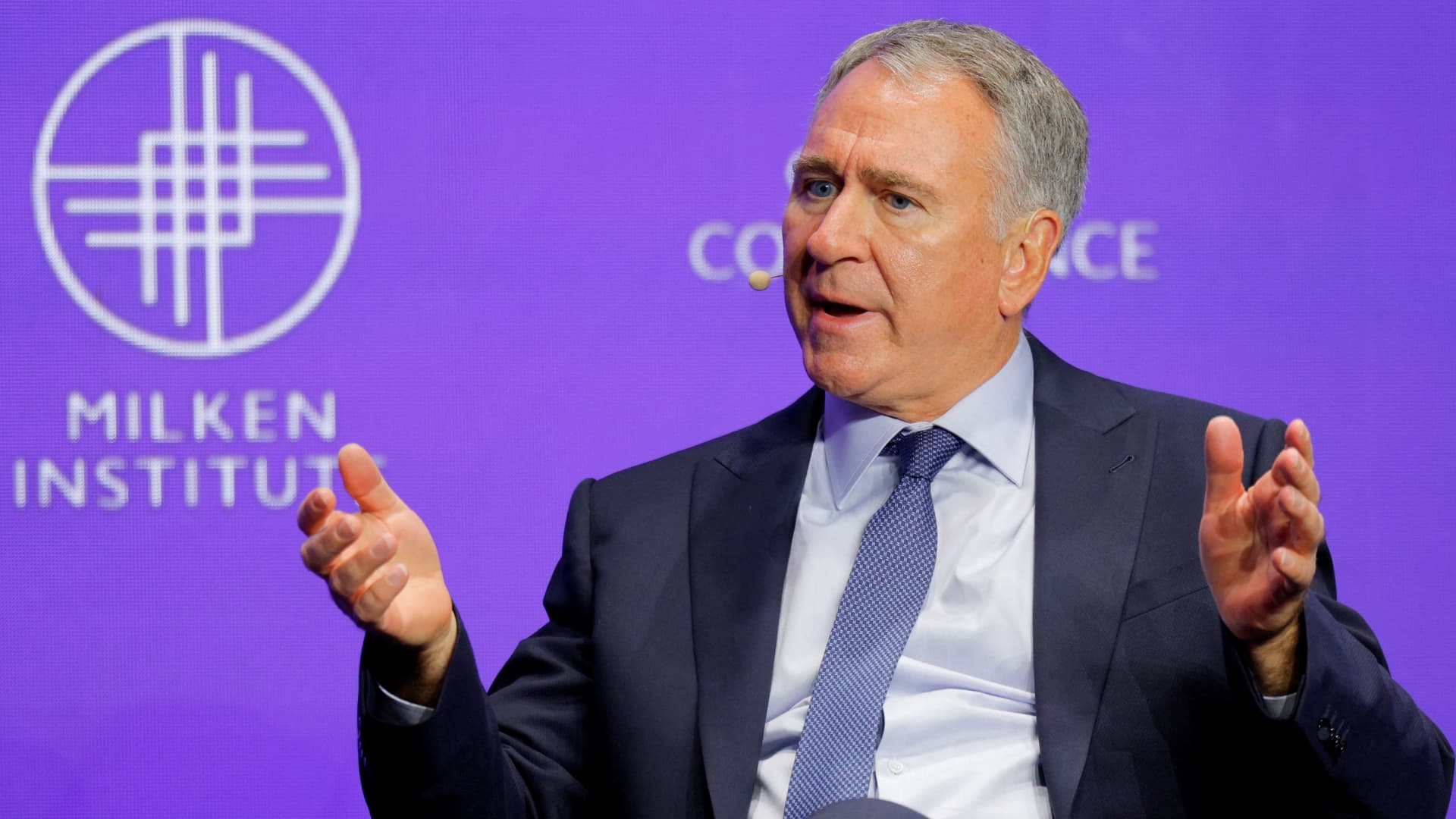
CEO of Citadel Ken Griffin is interviewed Chairman of the Milken Institute Michael Milken (not pictured) during the Milken Institute Global Conference 2025 in Beverly Hills, California, U.S., May 7, 2025.
Mike Blake | Reuters
Ken Griffin’s Citadel posted positive returns across its various hedge fund strategies in the first half of 2026, led by double-digit gains in its tactical trading and equities funds.
The hedge fund firm’s tactical trading fund, which combines discretionary equity investing with quantitative strategies, climbed 14.3% through the end of June after gaining 3.1% in June alone, according to a person familiar Citadel’s returns who asked not to be identified because the information is private.
Citadel’s tactical trading fund also weathered a late-June shakeout in quantitative investing. Quantitative investing relies on mathematical models, statistical analysis, machine learning and algorithms to identify investment opportunities, build portfolios and manage risk.
Earlier this week, Goldman Sachs’ prime brokerage unit told clients that between June 23 and Monday, systematic long-short strategies had just suffered their worst five-day stretch since December 2023, hurt largely by the unwinding of crowded trades and momentum positions on the short side.
Citadel’s tactical trading strategy avoided that latest sell-off, the person familiar said.
Citadel’s equities fund returned 11.2% in the first half after rising 3.5% in June, while its flagship multistrategy Wellington fund, the firm’s largest, gained 5.7% through the end of June following a 1.8% advance in June, the person said.
The firm’s global fixed income fund rose 1.7% in June, leaving it little changed for the year.
Citadel’s gains came during a volatile first half for financial markets. The S&P 500 climbed 9.6% through June, with the benchmark rebounding to fresh record highs after sliding for five straight weeks in February and March.
Investors first grappled with spikes in oil prices during the Iran conflict, questions over whether massive artificial intelligence spending will be sustained and shifting expectations for Federal Reserve policy, before the rally recently broadened out beyond just the largest technology stocks.
Citadel managed about $69 billion in assets as of June 1.
Citadel declined to comment.
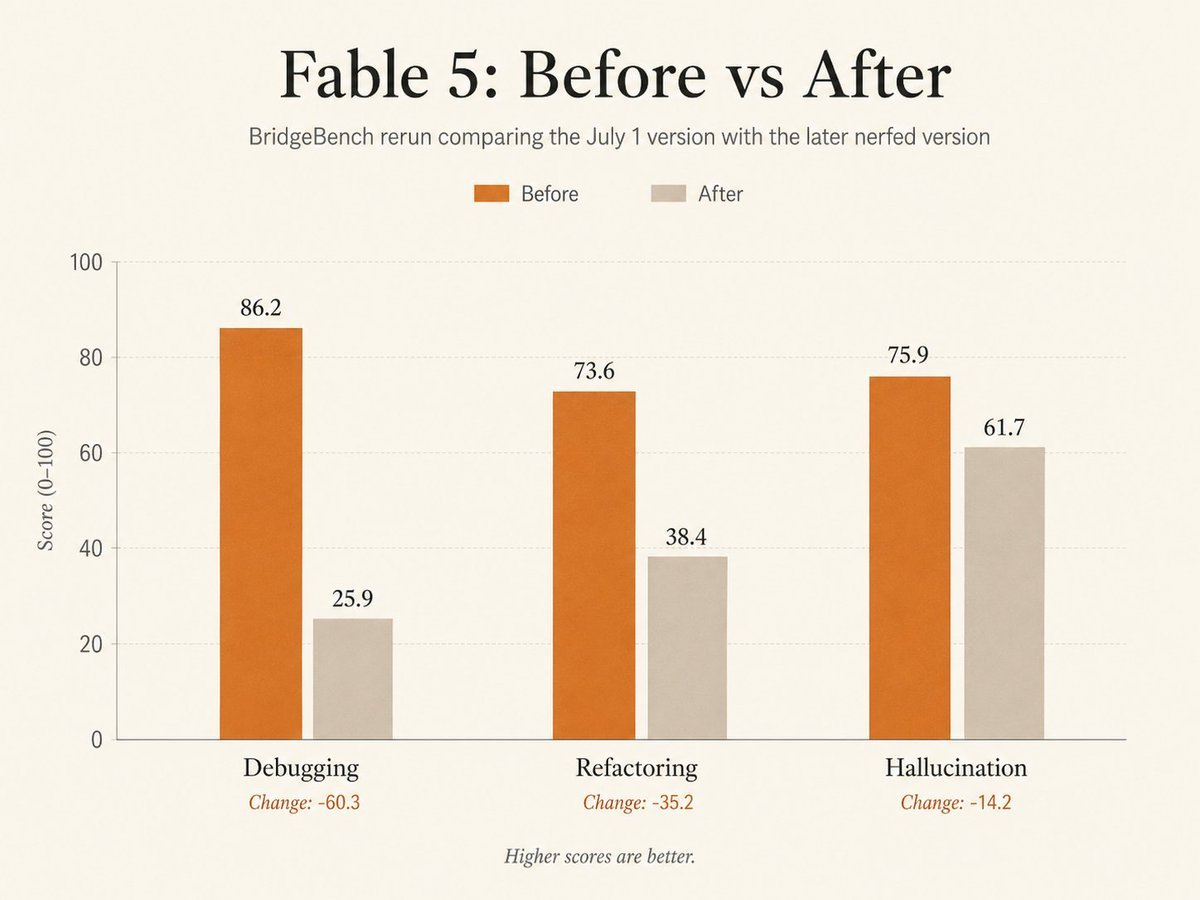
Anthropic’s Claude Fable 5 faces growing backlash after its July 1 re-release. Users claim stricter guardrails have crippled the flagship model’s coding, debugging, and agentic performance.
Benchmark group BridgeMind reported steep score drops across its BridgeBench suite. Meanwhile, Anthropic maintains the underlying model is unchanged and attributes the friction to tighter safety classifiers.
Claude Fable 5 Benchmark Scores Collapse After Re-Release
BridgeMind re-ran the July 1 version of Fable 5 and recorded sharp declines. Debugging fell from 86.2 to 25.9, refactoring dropped from 73.6 to 38.4, and hallucination handling slipped from 75.9 to 61.7.

The mechanics behind those numbers matter. Only three of 12 debugging tasks were completed without falling back to Claude Opus 4.8, and every fallback scored zero.
Therefore, the collapse reflects blocked tasks rather than weaker reasoning.
BridgeMind stressed that Fable 5 matches its June form when a task runs to completion.
“The model did not get worse. It got caged,” they indicated.
Follow us on X to get the latest news as it happens
The timeline explains the tension. Anthropic launched Fable 5 on June 9, and Washington pulled it offline three days later. Regulators lifted its export controls on June 30, four days after they restored Mythos 5 access for roughly 100 US institutions.
Restored access also carries limits. Fable 5 draws from just 50% of weekly usage caps through July 7, then shifts to paid usage credits.
Anthropic Defends Its Wider Safety Margin
Anthropic addressed the trade-off in a June 30 statement. The company said it deliberately widened its safety margin, meaning classifiers now block requests that are probably benign. An improved filter stops the bypass technique, Amazon researchers reported in over 99% of attempts.
Blocked requests route to Opus 4.8, and users receive a notification. However, Anthropic conceded the filter flags more legitimate coding and debugging work than before.
Its own tests also showed Fable 5 posed no unique risk. Rival models, including GPT-5.5 and Kimi K2.7, identified the same vulnerabilities.
Anthropic says US Commerce Department researchers tested both safeguard versions and judged them extraordinarily strong.
The stakes reach beyond one product cycle. The suspension pushed Europe to court Anthropic, while Chinese AI models gain ground on US frontier labs.
Anthropic is now drafting a jailbreak severity framework with Amazon, Microsoft, and Google. Whether classifiers shed false positives quickly may determine whether power users stay or defect.
The post Claude Fable 5 Backlash Grows as Users Say Anthropic ‘Caged’ Its Flagship AI appeared first on BeInCrypto.

Quick Overview
-
Ondo introduces blockchain versions of IVV ETF and Micron stock following SEC guidelines.
-
Each digital token maintains 1:1 correspondence with traditionally custodied U.S. securities.
-
Broadridge integration enables proxy voting capabilities for token holders.
-
Platform leverages Ethereum infrastructure while maintaining regulated asset custody.
-
Initiative represents significant expansion of Ondo’s U.S. tokenized securities operations.
Ondo has introduced blockchain-based representations of BlackRock’s iShares Core S&P 500 ETF and Micron Technology stock for U.S. investors. The offering operates within a third-party custodial framework outlined by the SEC in January 2026. This development integrates tokenized U.S. securities into established regulatory and market infrastructure.
Ondo deploys tokenized S&P 500 ETF within U.S. regulatory framework
Ondo has released an Ethereum-based tokenized product tracking BlackRock’s iShares Core S&P 500 ETF. This offering mirrors IVV, a major exchange-traded fund benchmarked against the S&P 500 index. The actual ETF shares continue residing within conventional U.S. custodial arrangements.
Oasis Pro TA, operating as Ondo’s SEC-registered transfer agent subsidiary, creates the corresponding digital tokens. Every token maintains complete 1:1 correspondence with its underlying ETF shares. Qualified custodians secure the tokens, while traditional financial custodians safeguard the physical securities.
This architecture aligns with the SEC’s January 2026 guidance regarding tokenized securities. That guidance outlined an approach where third parties maintain securities while issuing associated crypto instruments. Ondo applied this regulatory blueprint to deliver an operational U.S. tokenized ETF offering.
Micron stock joins Ondo’s tokenized equity portfolio
Ondo has simultaneously introduced a tokenized representation of Micron Technology stock using identical structural principles. Micron shares remain within standard U.S. custody infrastructure. Token holders gain exposure through Ethereum-recorded ownership positions.
The Micron offering advances Ondo’s broader initiative into tokenized equities with full regulatory compliance. This approach eliminates offshore issuance requirements and functions independently of individual issuer sponsorship. Implementation occurs through pre-existing broker-dealer, transfer agent, and custody relationships.
Transfer restrictions operate via participating broker-dealers, custodians, and the transfer agent network. These mechanisms ensure token transactions align with prevailing regulatory standards. Consequently, Ondo bridges blockchain settlement capabilities with traditional U.S. securities frameworks.
Broadridge enables shareholder voting for tokenized equity owners
Broadridge facilitates the rollout by delivering governance infrastructure for tokenized equity participants. Token holders gain access to issuer communications and regulatory filings through conventional distribution channels. Additionally, they can exercise voting rights via ProxyVote.com for blockchain-recorded proxy votes.
Ondo indicates token holders obtain shareholder rights and safeguards comparable to traditional brokerage account owners. These privileges encompass issuer notifications and voting participation linked to underlying securities. This configuration strengthens tokenized securities’ integration with public market governance structures.
The initiative also provides context for Ondo’s comprehensive real-world asset approach. Beyond U.S. borders, its Global Markets infrastructure handles over $1 billion in tokenized securities. That platform encompasses more than 430 equities and ETFs across various supported jurisdictions.
Ondo has simultaneously grown through strategic collaborations in recent periods. In June, the company partnered with Exodus to establish Exodus Markets on Solana. This platform provides qualified users with tokenized stock, ETF, and real-world asset access.
This recent product launch positions Ondo more prominently within U.S. tokenization markets. The implementation merges Ethereum-based issuance with conventional custody, voting mechanisms, and compliance frameworks. This integration creates a more defined pathway for tokenized securities under current U.S. market regulations.

Key Highlights
-
Microsoft shares increased 1.86% following the announcement of its Frontier AI business division worth $2.5B.
-
The division will assist corporate customers in selecting and implementing AI technologies.
-
6,000 Microsoft employees will be stationed at client locations through this initiative.
-
The strategy emphasizes adaptable AI frameworks and integration with proprietary client data.
-
This initiative intensifies Microsoft’s competition in the corporate AI consulting market.
Microsoft (MSFT) shares advanced 1.86% to reach $391.42 as the technology company announced plans to expand its corporate AI offerings. After opening lower, the stock reversed course and maintained gains close to its session peak. The upward movement came after Microsoft revealed its intention to establish a $2.5 billion AI-focused business division.
Tech Giant Establishes Frontier Division for Corporate AI Solutions
Microsoft announced the creation of Microsoft Frontier Company, a new operational division designed to assist enterprises in navigating AI technology selection and implementation. The division will serve prominent clients such as Unilever and Novo Nordisk, concentrating on AI frameworks that deliver measurable returns and practical business applications.
The Redmond-based company is allocating $2.5 billion to this initiative as corporate appetite for AI solutions continues expanding. The plan involves deploying 6,000 personnel directly at client sites through a forward deployed engineering model. These deployment teams will comprise technical advisors, customer support professionals, account managers, and vertical market experts.
Rodrigo Kede Lima, previously overseeing Microsoft’s operations across Asia, has been appointed as president of the division. The organization will merge Microsoft’s current AI consulting teams with on-site engineering resources. This shift represents Microsoft’s evolution from merely selling software to actively assisting clients in constructing operational AI infrastructures.
Strategy Focuses on Multi-Model AI Implementation
Enterprise organizations increasingly deploy multiple AI frameworks rather than relying exclusively on a single vendor. Numerous corporations now blend Microsoft platforms, third-party models, and open-source solutions tailored to distinct operational requirements. Consequently, AI implementation has become more expensive and complex to administer.
The Microsoft Frontier Company will guide customers through selecting, integrating, and transitioning between various AI frameworks. Additionally, the division will facilitate connections between these frameworks and each organization’s confidential internal information. Importantly, clients will retain ownership of all outputs and associated intellectual property within their own infrastructure.
Microsoft developed this methodology based on lessons learned from Copilot and other enterprise AI offerings. Initially, the company depended substantially on OpenAI’s technology when developing its AI assistant. However, emerging frameworks from Anthropic, Google, DeepSeek, and competing providers have driven demand for platform-agnostic solutions.
Shares Rise Amid Intensifying AI Consulting Competition
Microsoft’s equity value increased following the disclosure, though shares have struggled year-to-date. The corporation has allocated substantial capital toward data center expansion and generative AI capabilities. Despite these investments, certain AI products have experienced modest uptake among business customers.
This new division positions Microsoft in direct competition with Amazon, Palantir, OpenAI, Anthropic, Accenture, and EY. Amazon recently announced a comparable $1 billion field engineering program targeting AI customers. Palantir has established expertise deploying engineering personnel to serve government agencies and corporate accounts.
Microsoft currently generates income from enterprise consulting and channel partner programs throughout its software portfolio. The company disclosed approximately $2.1 billion in enterprise and partner services revenue during the March quarter. As such, the Frontier division represents an expansion of proven business practices into the broader AI services marketplace.


Digital-first Erebor Bank has entered fundraising talks that could value the lender at at least $8 billion, nearly doubling its $4.35 billion valuation from the end of last year.
Summary
- Erebor Bank is seeking a new funding round that could value the digital lender at at least $8 billion.
- Deposits have grown from $1.1 billion to over $4 billion since March, with nearly 400 new customers added.
- The bank’s crypto-focused strategy and national bank charter have strengthened its position among AI and technology firms.
Bloomberg, citing people familiar with the discussions, reported that the proposed funding round comes as Erebor’s deposits have expanded rapidly only months after the bank began operating. If completed at the reported valuation, the raise would rank among the largest recent funding events for a U.S. digital bank serving the technology and crypto sectors.
Founded by Oculus creator Palmer Luckey, Erebor has attracted backing from major Silicon Valley investors including Andreessen Horowitz, Peter Thiel’s Founders Fund, and Lux Capital.
The bank has focused on defense technology companies, hard-tech businesses, artificial intelligence infrastructure, and crypto firms, offering services such as blockchain-enabled payments, crypto-backed lending, and financing for industrial projects.
Deposit growth has strengthened Erebor’s fundraising case
According to Bloomberg, customer deposits have climbed to more than $4 billion from $1.1 billion at the end of March. During the same period, the startup added nearly 400 customers, giving investors fresh evidence of early demand for its banking platform.
Luckey told Bloomberg that the recent increase in deposits has come from hundreds of new customers rather than companies he controls, pushing back against suggestions that growth depended on affiliated businesses.
The funding discussions follow the bank’s launch earlier this year, with the reported deposit expansion becoming a central factor in its latest fundraising effort. Bloomberg noted that the proposed round remains under discussion and no final terms have been announced.
National charter cleared the path for crypto banking services
Erebor’s fundraising talks also come after the bank secured regulatory progress that allows it to expand its business under a federal banking framework.
As previously reported by crypto.news, the Office of the Comptroller of the Currency granted Erebor preliminary conditional approval for a national bank charter, positioning the lender to serve the innovation economy, including crypto and AI startups. The approval made Erebor the first de novo bank to receive such authorization since Comptroller Jonathan V. Gould took office in July, 2025.
In a statement released by the OCC, Gould described the approval as part of his commitment to maintaining a “dynamic and diverse federal banking system.” He also said the regulator would not place “blanket barriers” on banks engaging in digital asset activities, provided they operate in a “safe and sound manner.”
Earlier this year, Erebor received approval to become the first new national bank chartered during President Donald Trump’s second term, further strengthening its regulatory position as it expanded its digital banking business.
With its focus on crypto companies, AI infrastructure developers, defense technology firms, and industrial businesses, Erebor has sought to fill part of the gap left after the collapse of Silicon Valley Bank, offering banking and lending products tailored to sectors that have often faced limited access to traditional financial services.
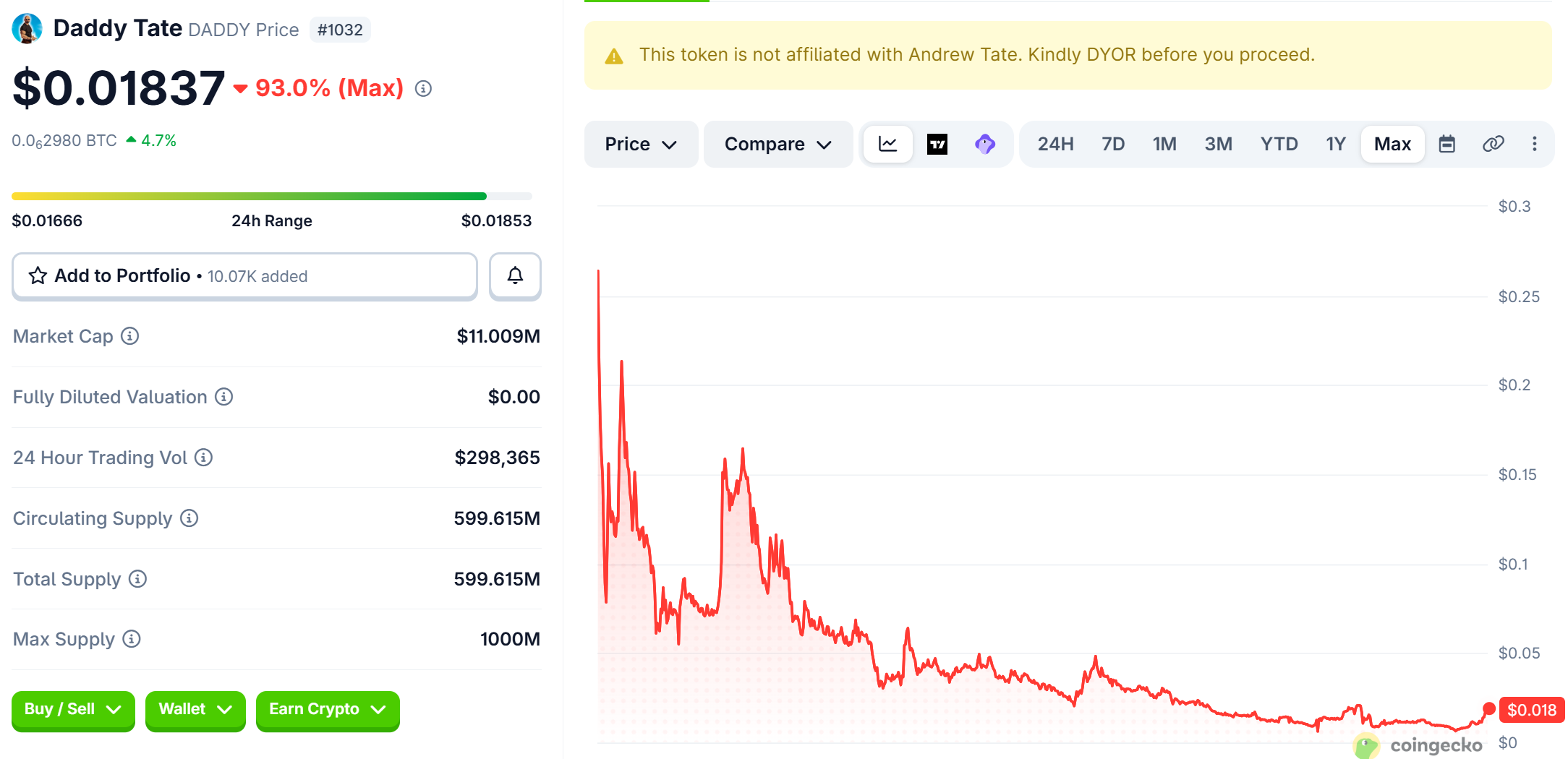
Andrew Tate sold his entire 650 million $TATE token airdrop for roughly $23,000, on-chain data shows. The sale contradicts his repeated public pledges to hold, burn, and never sell tokens sent to his wallet.
The exit adds to a punishing run for the influencer, who lost about $95,000 on a 40x leveraged Bitcoin (BTC) position in June.
Diamond Hands Vow Ends in a $23,000 Exit
On-chain tracker WhaleInsider reported that Tate’s wallet swapped the full allocation through Jupiter for $23,264. The tokens represented roughly 65% of the total supply.
Follow us on X to get the latest news as it happens
A stake covering two-thirds of the supply cleared for less than $24,000, pointing to almost nonexistent liquidity. The exit also clashes with Tate’s no-sell persona, a stance he repeated in October and April posts.
“Sell it for what? Money? lol I dont Jeet. Diamond Hands -” Tate wrote in December 2024.
During the $DADDY era, he also pointed to his public wallet as proof he had never sold.
Traders See Echoes of the $DADDY Playbook
Some traders noted that Tate reposted the same image he shared before $DADDY’s community takeover and rally. They argue the cleared seller overhang leaves room for a rebound. However, past celebrity token crashes show such recoveries rarely hold.
The precedent cuts both ways. DADDY peaked at $0.29 in June 2024 and has since lost about 94% of its value, CoinGecko data shows.

Experts have repeatedly flagged the risks of celebrity meme coins, citing thin liquidity and concentrated supply.
The dump also follows Tate’s fresh 40x Bitcoin bet, a $3.76 million long that Hyperliquid liquidated eight times in 24 hours. He closed the position at a $95,478 loss. Lookonchain data places his career record at 107 liquidations and roughly $800,000 in cumulative losses.
The coming days will show whether the cleared supply revives $TATE or confirms its brief run has already topped.
The post Andrew Tate Dumps 650 Million $TATE Tokens Despite ‘Diamond Hands’ Vow appeared first on BeInCrypto.
Will Declan Rice play for England against Mexico? Tuchel provides update as midfielder says he’s in ‘terrible pain’ ahead of FIFA World Cup clash

A new attack uses a BioShock-style puzzle to convince AI browsers they're not in the real world

Chicane on B1248 Beverley Road in Norton being removed


-

 Fashion6 days ago
Weekend Open Thread: Staud – Corporette.com
-

 Politics7 days ago
The House | Manchesterism won’t survive the painful trade-offs unless it gets citizens on board
-

 Crypto World3 days ago
Strategy authorizes up to $1.25B in Bitcoin sales under new capital plan
-

 Politics7 days ago
Potential 2028er World Cup attendee leaderboard
-

 Business7 days ago
Asia stock markets slide as tech shares slump
-

 News Videos4 days ago
MAJOR BITCOIN & MARKET UPDATE!!!! (MUST WATCH ASAP!!!)
-

 Crypto World5 days ago
Coinbase, Circle Deepen Crypto Stock Losses Despite Resilient S&P 500
-

 Tech3 days ago
Anonymous researcher drops 0-day ‘exploitarium’ repo
-

 Business3 days ago
Australia treasurer says alleged access of prime minister’s bank data ’incredibly concerning’
-

 Crypto World6 days ago
Kraken's xStocks Opens Bending Spoons IPO Registration to EEA Retail
-

 Crypto World7 days ago
Bitcoin Sparks $600M Hourly Liquidations With $65,000 Set To Become Resistance
-

 Sports6 days ago
FIH Pro League: India defeat Pakistan 7-1, register biggest win of campaign | Other Sports News
-

 Tech5 days ago
Bluekit phishing kit adopts browser-in-the-middle for login theft
-

 Tech5 days ago
Russian hackers now target Signal backup recovery keys
-
Crypto World6 days ago
Hyperliquid Named on Singapore MAS Investor Alert Register
-

 Crypto World6 days ago
RTX holders must register wallets before token distribution begins
-

 Crypto World7 days ago
Tether (USDT) Passes Ether in Market Cap as ETH Drops Toward $1.5K
-

 Sports1 day ago
Broncos roster: OL Ben Powers (No. 74) entering final year of contract
-
 Business3 days ago
The AI boom won’t burst all at once. It will pop in ‘rolling bubbles’: Macquarie
-

 Tech5 days ago
Silicon Valley paid to kill AI regulation, now it wants the rules back
You must be logged in to post a comment Login