

Crypto World
Natural Gas: key support amid renewed escalation

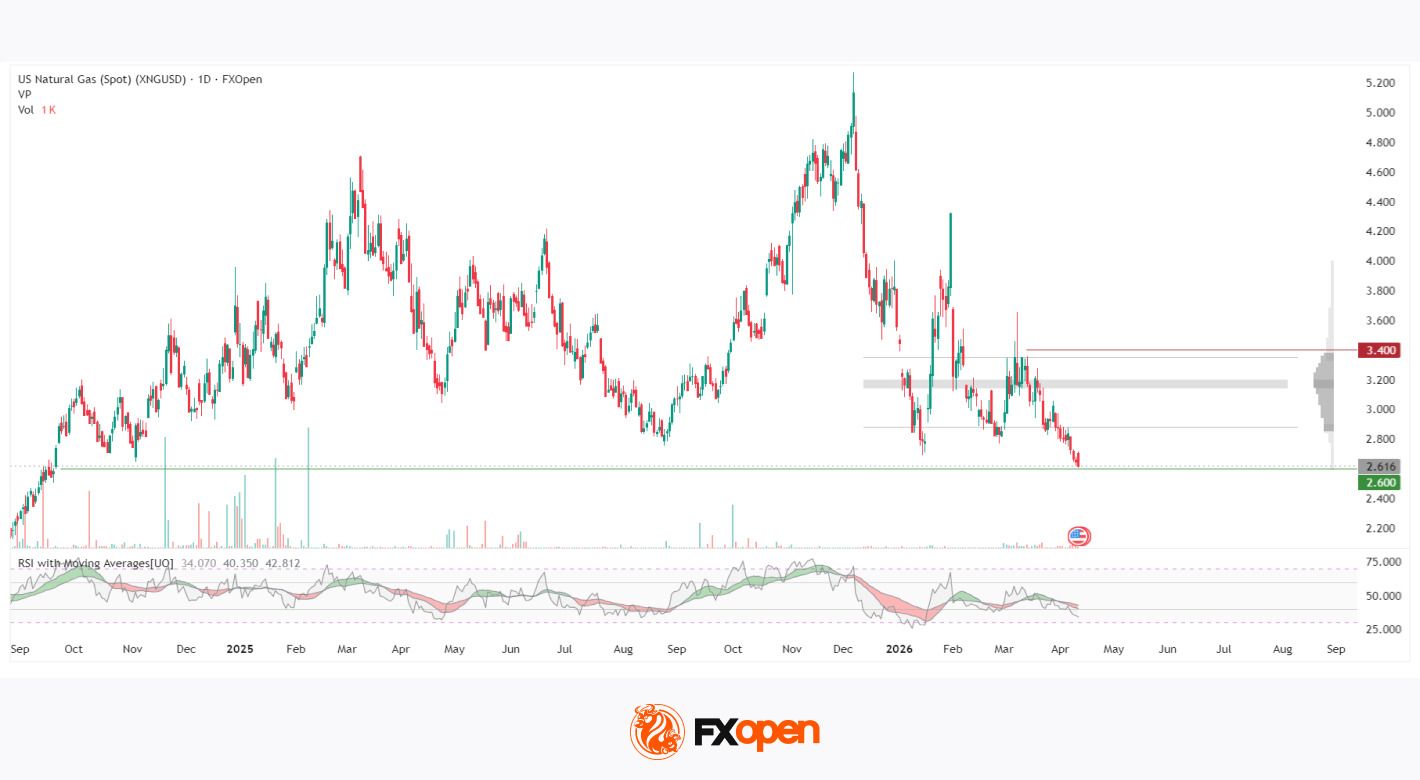
A key development on 13 April was the start of a naval blockade of Iranian ports, a direct consequence of the collapse of negotiations in Islamabad on 12 April. The blockade covers all vessels entering and leaving Iranian ports in the Persian Gulf and the Gulf of Oman. Around 20% of global natural gas trade passes through the Strait of Hormuz, and the renewed escalation has once again heightened risks to global LNG supplies. European TTF has previously reacted with sharp widening spreads during earlier flare-ups, while the Asian JKM benchmark also remains sensitive to regional disruptions.
Against this backdrop, natural gas as an asset class is caught between two opposing forces: a geopolitical risk premium is providing price support at the global level, while a structural supply surplus — record production, accelerated injections into storage, and an unusually warm spring in the Northern Hemisphere — is weighing on prices from a fundamental perspective.
Technical picture
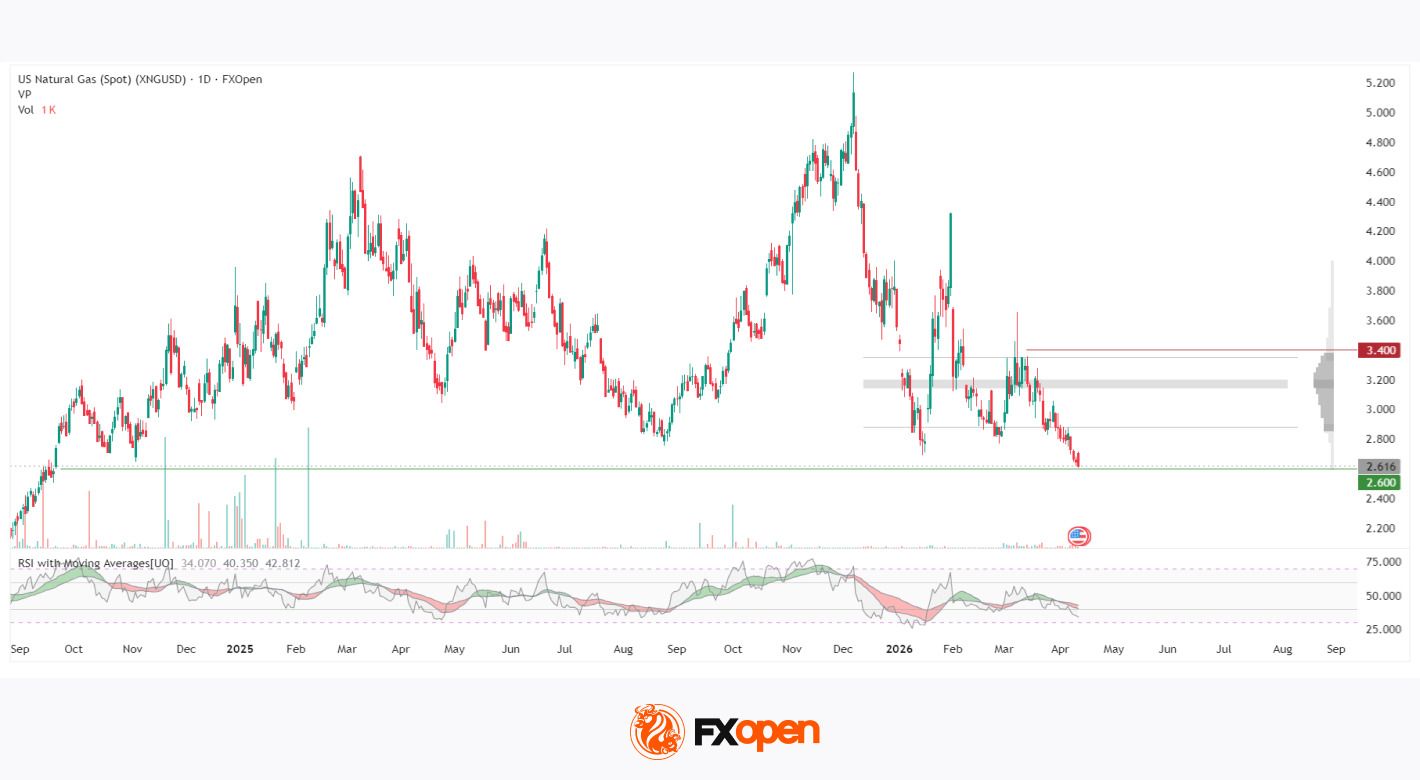
On the daily chart of XNGUSD, the move from the December 2025 high near 5.200 remains downward but structurally uneven: the sequence of interim highs and lows does not form a classic trending impulse. Volatility is compressing, and each rebound is shorter than the previous one, indicating a gradual loss of selling momentum as price approaches a key support level. Quotes are now trading close to the psychological 2.600 level, which has acted as an important reference point since late 2024.
The volume profile shows a Point of Control (POC) in the 3.150–3.200 range, where the bulk of trading activity is concentrated. This zone acts as the first major barrier to any recovery. The 3.400 level remains the next significant resistance above.
The RSI with Moving Averages reads 34 / 40 / 42, with all three metrics remaining below the neutral 50 level and the moving averages pointing lower, signalling continued downside pressure.
Summary
Natural gas prices are approaching the key psychological level of 2.600, the lower boundary of a consolidation range that has been in place since late 2024, while the blockade of Iranian ports keeps global energy markets in a state of heightened uncertainty. The RSI with Moving Averages remains below the neutral threshold across all three readings.
Start trading commodity CFDs with tight spreads (additional fees may apply). Open your trading account now or learn more about trading commodity CFDs with FXOpen.
This article represents the opinion of the Companies operating under the FXOpen brand only. It is not to be construed as an offer, solicitation, or recommendation with respect to products and services provided by the Companies operating under the FXOpen brand, nor is it to be considered financial advice.

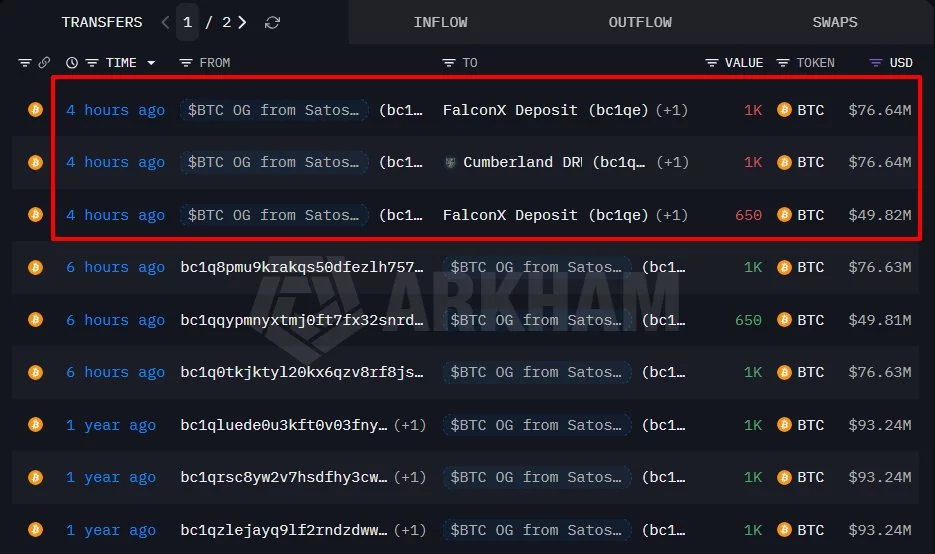
A Satoshi-era Bitcoin whale has transferred more than $200 million worth of BTC to crypto trading firms FalconX and Cumberland as exchange inflows and ETF outflows continue drawing attention across the market.
Summary
- A dormant Bitcoin whale moved 2,650 BTC worth about $203 million to FalconX and Cumberland in three transactions.
- Onchain Lens said the wallet still holds nearly 6,000 BTC valued at around $462 million.
According to blockchain analytics provider Onchain Lens, citing Arkham data, the dormant whale moved 2,650 BTC, valued at roughly $203 million, to FalconX and Cumberland through three separate transactions on Sunday.
Data shared by the analytics firm showed the address still holds nearly 6,000 BTC, currently worth around $462 million.
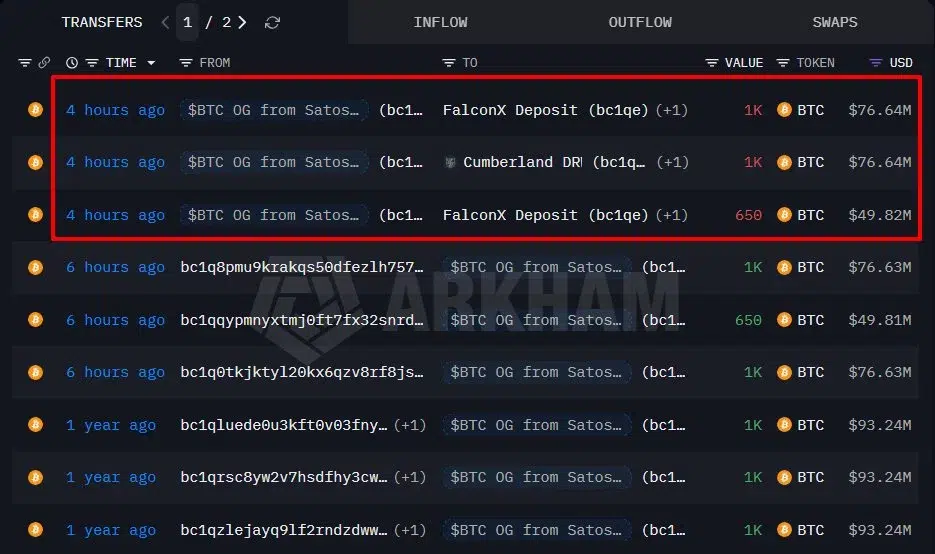
Whale transfers to FalconX and Cumberland. Source: Arkham Intelligence.
Although the transfers do not confirm an immediate sale, large wallet activations tied to early Bitcoin holders often attract market attention because traders watch for signs of additional supply entering the market.
Transfers to firms such as FalconX and Cumberland can sometimes be linked to over-the-counter transactions designed to avoid disrupting spot prices on public exchanges.
However, retail traders frequently interpret dormant whale activity as a bearish signal regardless of whether the coins are sold directly into the market. As such, concerns surrounding a possible liquidity event could increase precautionary selling and expose Bitcoin to another test of the recent $74,600 support level.
Whale transfers emerge as exchange inflows continue rising
The latest whale transaction has appeared during a period of growing concern over rising Bitcoin inflows to exchanges and trading desks.
Earlier this month, another dormant Bitcoin address moved 500 BTC worth about $40.6 million after remaining inactive for more than 12 years. Separately, a different whale transferred nearly $20 million in BTC to Binance last month.
As previously reported by crypto.news CryptoQuant analyst Darkfost said Binance recorded almost 10 consecutive days of elevated Bitcoin inflows.
Binance’s weekly average BTC inflows climbed from 378 BTC on May 16 to 1,190 BTC in less than 10 days.
Darkfost also reported that Binance registered a daily inflow exceeding 3,600 BTC on May 18, while exchange reserves increased from 616,000 BTC on April 24 to 632,000 BTC within one month.
According to the analyst, investors typically move Bitcoin onto exchanges when preparing to sell, reduce exposure, or secure profits during periods of uncertainty. Darkfost linked the inflow trend to market weakness tied to geopolitical tensions and softer appetite for risk assets.
Spot Bitcoin ETFs have also recorded sustained withdrawals during the same period. Crypto.news previously reported that U.S.-listed spot Bitcoin ETFs logged net outflows for six straight trading sessions between May 15 and May 22, with total redemptions reaching $1.26 billion across 11 funds.
While analytics platform Santiment said past ETF outflow streaks have occasionally appeared before long-term accumulation phases, the firm added that weaker ETF demand combined with rising exchange inflows can reduce visible buyer support in the short term.
Bitcoin (BTC) traded around $77,220 at the time of reporting, according to crypto.news price data. After briefly falling to nearly $74,600 on Saturday, the asset recovered modestly but remained well below its October 2025 all-time high near $124,900.
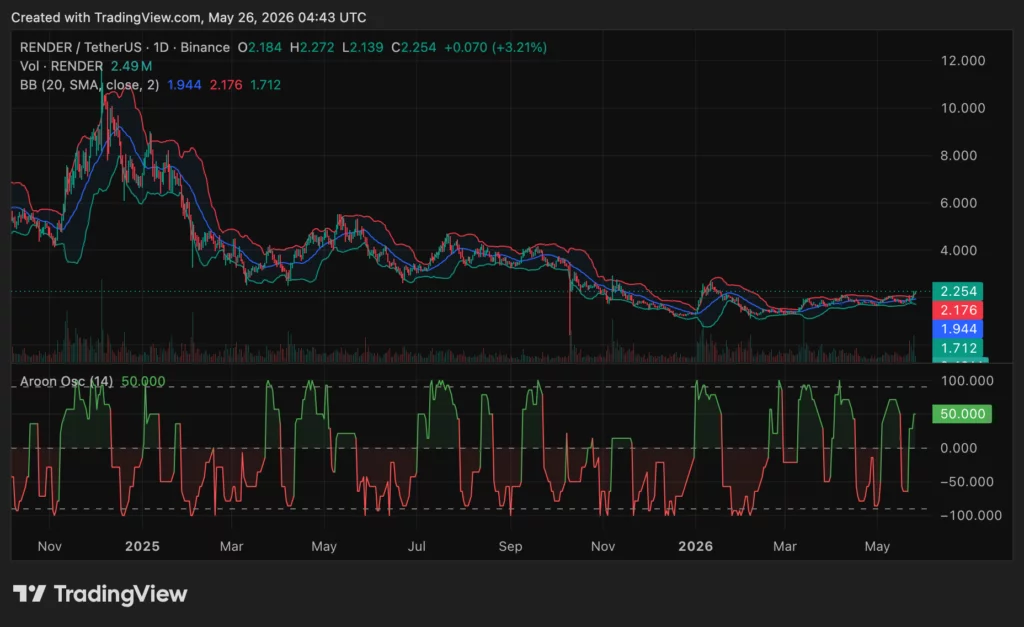
Render rose to $2.25 on May 26, gaining 13.16% over 24 hours and 24.16% over seven days, according to crypto.news price data.
Summary
- Render rallied above $2.25 as daily active addresses and new wallets hit 12-week highs together.
- Derivatives volume rose 126.52% while open interest climbed 47.27%, pointing to stronger trader activity.
- Render’s AI compute narrative gained attention as GPU demand stayed central to the 2026 market.
The token traded between $1.99 and $2.26 during the same 24-hour period, while trading volume stood at $219.35 million.
The move came as Santiment reported a sharp rise in Render’s on-chain activity. The analytics platform said daily active addresses climbed to 394 in one day, while 118 new wallets were created. Both figures reached their highest levels in 12 weeks.
Santiment said “Render’s on-chain activity has seen a major breakout in late May.” The firm added that the token moved back above $2.25 for the first time in more than four months.
The increase in active addresses shows that more wallets used the network during the move. The rise in new wallets also points to fresh users entering the Render ecosystem during the latest price rebound.
AI demand keeps Render in focus
Render has remained closely tied to the artificial intelligence trade because its network supports decentralized GPU computing. The project connects users who need computing power with distributed GPU providers that can process rendering, machine learning, and AI-related workloads.
Santiment linked much of Render’s 2026 momentum to demand for AI infrastructure. It said Render has positioned itself as a decentralized GPU computing network that can support AI training, machine learning, and advanced rendering tasks.
That theme also fits broader crypto.news coverage of AI-linked tokens. A previous crypto.news report described Render as a token linked to GPU scarcity and decentralized rendering demand, noting that the market often connects RNDR with AI compute and distributed GPU use cases.
The same report also noted that Render can benefit when investors focus on persistent GPU bottlenecks and distributed rendering power. However, it also listed competition from cloud providers and other DePIN GPU networks as a risk for the sector.
Bollinger Bands show a stretched breakout
Technical data showed Render trading above the upper Bollinger Band at $2.176. The middle band stood near $1.944, while the lower band was around $1.712.
A move above the upper band often shows strong short-term buying pressure. It can also mean the move is stretched if buyers fail to hold the breakout zone. For Render, the $2.17 to $2.18 area now serves as the first key level to watch.
If Render stays above that range, the breakout structure remains active. A clean push above $2.27 would give buyers stronger confirmation because it would clear the recent high area.
If price falls back below $2.17, the setup would weaken. In that case, the middle Bollinger Band near $1.94 would become the next major support zone on the daily chart.
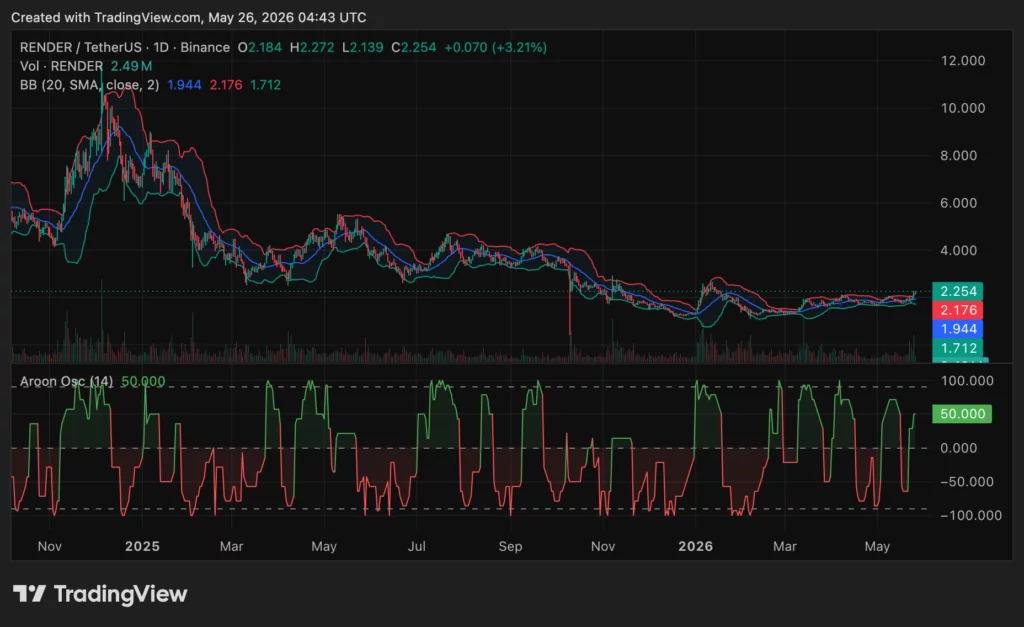
Volume also increased during the upward move. The chart showed volume near 2.49 million, which supported the breakout attempt. Still, volume did not reach the kind of extreme level seen during larger past moves.
The Aroon Oscillator stood at 50, showing positive momentum but not full trend strength. The recovery from negative territory showed that buyers had regained short-term control.
Derivatives data shows stronger trader interest
Derivatives data added another layer to Render’s move. According to Coinglass data, trading volume rose 126.52% to $302.39 million, while open interest increased 47.27% to $112.82 million.
Rising open interest means more futures positions were active during the move. When open interest climbs with price, it often shows that traders are adding exposure instead of only closing old positions.
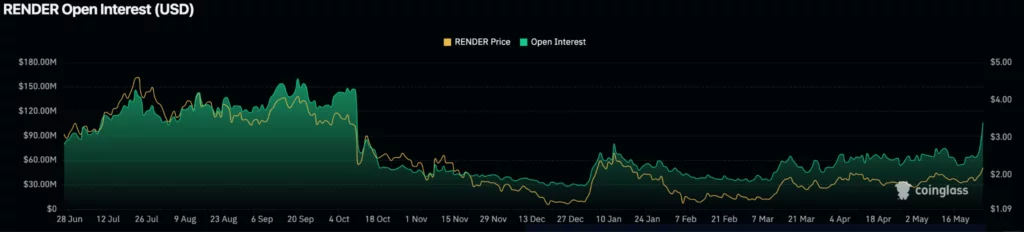
This does not confirm that all new positions are bullish. It only shows that more capital has entered Render-linked derivatives markets. That makes the next price move more important because crowded positioning can raise volatility.
Render’s market capitalization stood at $1.16 billion, with a fully diluted valuation of $1.20 billion. The token ranked #63 by market cap, while its circulating supply stood at 518.74 million tokens.
Despite the latest rally, Render remained far below its all-time high of $13.53, set on Mar. 17, 2024. crypto.news data also showed that Render was still down 53.61% over the past year, even after gaining 24.71% over the past 30 days.
The current setup leaves Render at a clear short-term test. On-chain activity has improved, AI demand remains part of the market story, and derivatives activity has expanded. Price now needs to hold above the breakout zone to keep the rebound intact.
Disclosure: This article does not represent investment advice. The content and materials featured on this page are for educational purposes only.


OKX’s Ethereum-compatible Layer 2 network X Layer has introduced Exchange OS, a protocol upgrade that lets developers, institutions, and ecosystem teams deploy their own trading venues.
Summary
- X Layer launched Exchange OS to let developers create spot, perpetual, and outcome markets.
- The first venue will test 2026 World Cup outcome markets when it launches in June.
- Related reports show OKX has expanded X Layer through Aave, Uniswap, and payment tools.
The system supports spot markets, perpetual markets, and outcome markets using infrastructure tied to OKX’s exchange stack.
The X Layer team said “Exchange OS is designed to address one of the biggest structural limitations in onchain finance today: fragmented infrastructure.” The upgrade aims to place exchange functions such as matching, margining, liquidation, settlement, and risk controls closer to the protocol layer.
Builders can launch custom markets
Exchange OS is designed to let venue operators choose their own assets, oracle systems, revenue models, market structures, and compliance settings. A regulated institution could build a KYC-enabled venue, while a Web3-native team could run a permissionless market on the same shared infrastructure.
X Layer said deployers will need to stake OKB in the X Layer Staking Contract before creating a venue. A previous crypto.news report said OKB had become the only gas and native token for X Layer after OKX moved deeper into its X Layer migration plan.
World Cup outcome market arrives in June
The first venue built on Exchange OS will launch in June with 2026 World Cup Outcomes, a simulated outcome market deployed on the new infrastructure. The X Layer team said it wanted to build on the system before opening it more widely to other market creators.
OKX’s Outcomes FAQ describes outcome trading as an event contract product where users buy Yes or No shares tied to real-world events. It also says current coverage focuses on World Cup-related events, while noting that FIFA-related references do not mean endorsement by FIFA.
X Layer builds on recent OKX expansion
The Exchange OS rollout follows several X Layer updates covered by crypto.news. In January, Uniswap launched on X Layer, giving users access to swaps, liquidity provision, and native markets such as xBTC, USDT, and USDG through its app, wallet, and API.
In March, Aave launched on X Layer, allowing OKX Wallet users to lend, borrow, and earn yield directly on the network. That report said X Layer had about $25 million in total value locked at the time, showing that OKX was still working to grow on-chain activity.
OKX has also added payment infrastructure linked to X Layer. A recent crypto.news report said OKX’s Payment SDK lets developers integrate one-time, batch, and pay-as-you-go transactions using X Layer with low or zero gas costs.

Nathan Allman, the founder and CEO of Ondo Finance and one of the pioneers of blockchain tokenization, has died aged 32.
“It is with profound sadness that we announce the unexpected passing of Nathan Allman, Ondo’s founder,” Ondo Finance said in an X post on Monday. “Our hearts are with his family and loved ones.”
“Nate’s brilliance, humility, and drive shaped every part of what Ondo is today,” Ondo said. “His belief in the power of technology to create a more open, accessible financial system lives on in everything we build. The impact he had on this industry, and on all of us personally, cannot be overstated.”
Allman was key in helping Ondo bring $3.86 billion worth of tokenized real-world assets on-chain in the form of US Treasuries, stocks and commodities. More than 111,680 token holders own a tokenized RWA issued by Ondo.

Nathan Allman (left) speaking at the Ninth Annual Fintech Conference in Philadelphia in November. Source: YouTube
The tokenization movement that Allman contributed to by founding Ondo in 2021 helped capture the attention of Wall Street giants such as BlackRock, who see potential in the technology to make trading and settlement more efficient.
Allman previously worked in Goldman Sachs’ digital asset team prior to founding Ondo. Before that, he founded the crypto hedge fund ChainStreet Capital, which focused on algorithmic, event-driven trading.
Ondo said that the company’s president, Ian De Bode, would serve as CEO.
“It’s been an incredibly sad day for Ondo Finance,” De Bode told Cointelegraph. “Nate was not only an incredible founder and visionary, but also a very close personal friend. He will be missed dearly.”
“The mission of Ondo, Nate’s mission, has not changed,” he added. “If Nate were here, he would want to continue executing with excellence. We will make him proud.”
Ondo vice president and head of marketing, Ben Grossman, said Allman “was a once-in-a-generation founder and visionary. He was absolutely brilliant, with a vision and drive that shaped the industry and everyone around him. He will be enormously missed.”
Ondo did not share further details on Allman’s death. An Ondo spokesperson said that Allman’s family has requested privacy at this time.


Cross-chain router Squid distanced itself from a third-party Gnosis Safe module, SquidRouterModule, after attackers drained about $3.2 million across Ethereum and Base.
Blockchain security firms flagged the exploit that affected 86 Gnosis Safe accounts in roughly 2 hours.
Squid Disowns $3.2 Million SquidRouterModule Exploit
Blockaid highlighted that the attacker swapped stolen tokens into Dai (DAI) through attacker-controlled Uniswap V3 pools.
Separately, security firm PeckShield said the attacker was originally funded with 2.1 ETH from Tornado Cash. Moreover, the firm added that the exploiter’s wallet 0xA447…54859 contained the stolen assets.
Follow us on X to get the latest news as it happens
Squid moved fast on X to separate its protocol from the exploited contract. The team said the “contract shares our name but is not our code.” It also stressed that none of its users were affected.
“Early public reporting may reference ‘SquidRouter’ due to the contract’s verified name on Basescan. The accurate framing is: a third-party SquidRouterModule was exploited, not Squid’s Router contract,” the team said.
On Basescan, the compromised contract carries the name “SquidRouterModule,” which sparked early confusion. Squid said the team had no role in writing the contract or pushing it on-chain. It described the module as a third-party smart-wallet product that integrated with multiple protocols, including Squid.
Squid’s actual router sits at 0xce16F69375520ab01377ce7B88f5BA8C48F8D666 and runs on a different design. That contract was not affected by the attack, and existing user balances, approvals, and platform integrations all remain safe.
“The exploit worked because the third-party module accepted a caller-supplied constant string as proof that a message was secure. If you pass in this string (which is publicly available in the verified contract’s code), then you can execute an array of arbitrary calldata, stealing funds at will. The victims’ Safes had added this faulty contract as a trusted Safe Module, which gives the contract the ability to spend any tokens in the Safe without signatures,” the protocol explained.
The episode is one of several crypto exploits to hit protocols this month. DefiLlama tracked more than 20 exploits in May 2026.
Subscribe to our YouTube channel to watch leaders and journalists provide expert insights
The post Squid Distances Itself From $3.2 Million Hack of Lookalike Third-Party Contract appeared first on BeInCrypto.
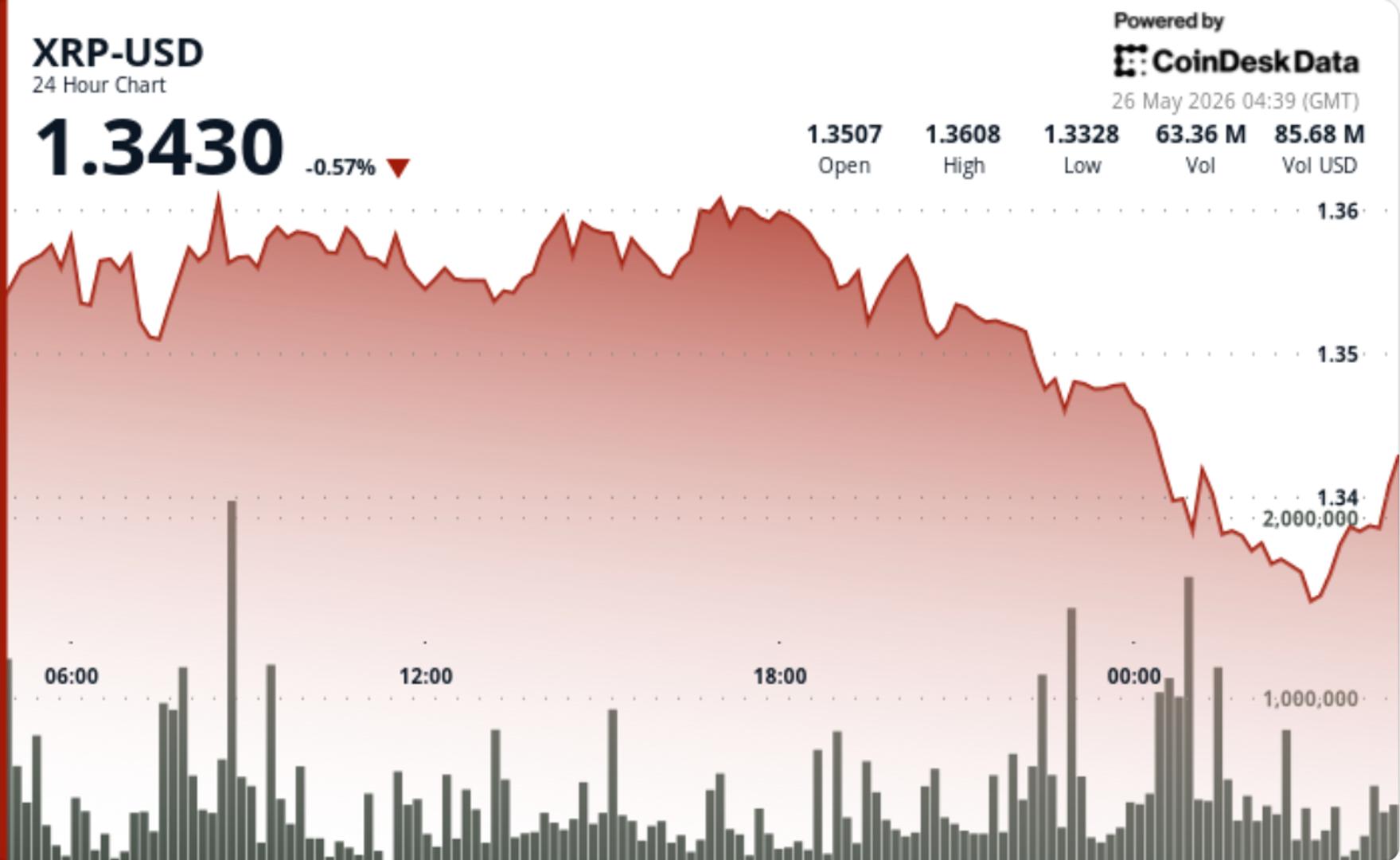
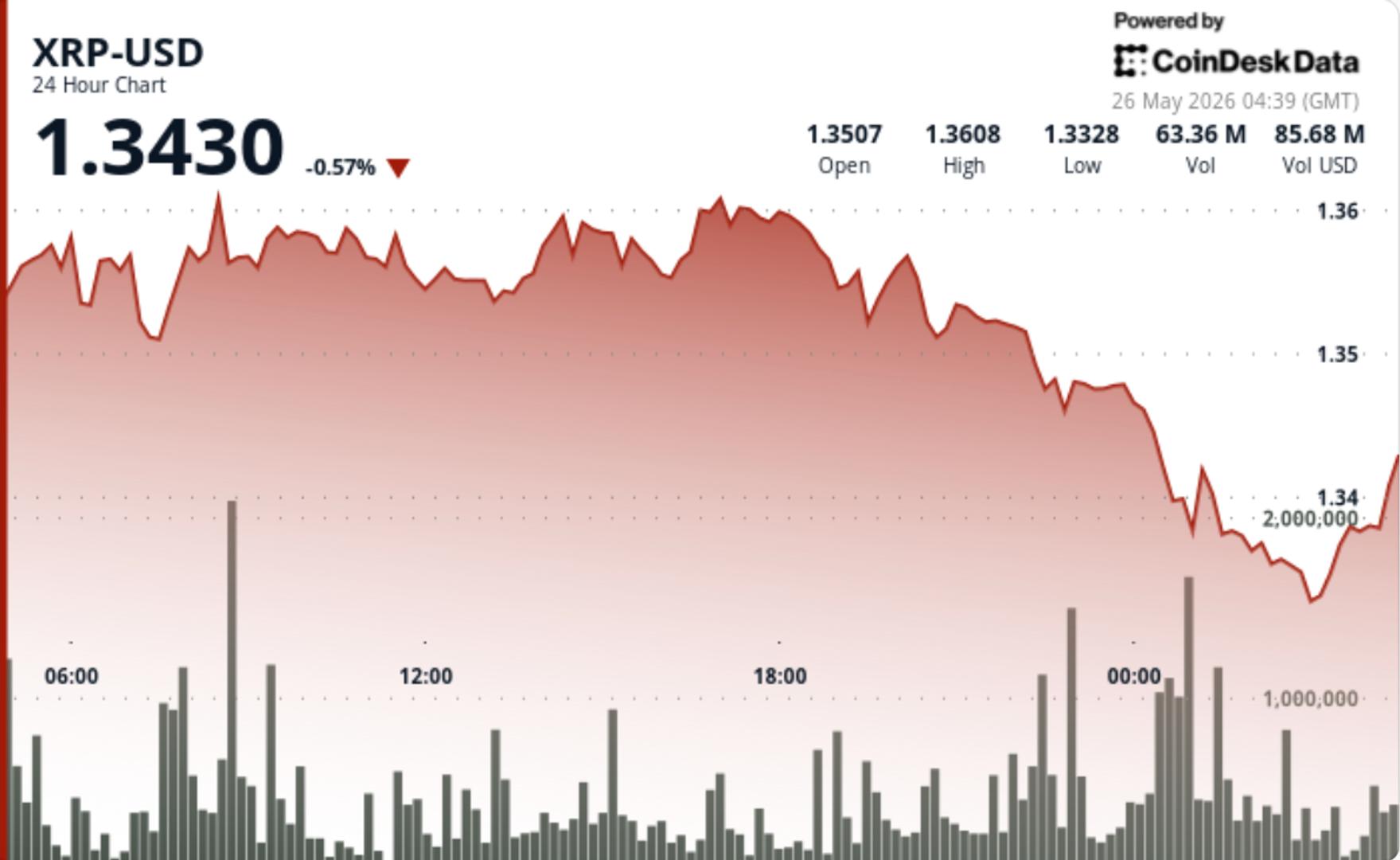
XRP spent weeks tightening into a narrow range, but the market finally started leaning lower after another failed push above resistance near $1.36. The move matters because repeated tests of support tend to weaken buyers over time, and XRP is now drifting back toward the same $1.30 area traders have treated as the line between consolidation and broader breakdown risk.
News Background
• Analysts remain split on XRP’s structure, with some calling the latest move a confirmed triangle breakdown while others still frame it as late-stage compression before a larger breakout.
• CME Group is preparing to launch 24/7 XRP-linked futures trading later this month, adding another layer of institutional exposure to the token.
• Whale activity also cooled sharply during the period, with large transaction counts falling more than 57% over nine days.
Price Action Summary
• XRP fell from $1.3457 to $1.3366 during the 24-hour session while trading inside a relatively tight 1.9% range.
• The largest move came after a failed breakout attempt near $1.3620, where elevated volume quickly reversed into selling pressure.
• XRP later broke below the $1.35 level and consolidated near session lows around $1.336 into the close.
Technical Analysis
• The breakdown below $1.35 reinforced short-term bearish momentum after weeks of tightening price action.
• XRP is now trading beneath several key moving averages, while resistance near $1.36 continues to reject upside attempts.
• Some analysts view the recent move as a confirmed symmetrical triangle breakdown with downside risk toward $1.14.
• Others still argue the broader structure resembles compression rather than outright collapse, especially while XRP remains above the critical $1.30 support area.
What traders should watch
• $1.30-$1.31 is now the key support zone. Losing it would likely accelerate downside momentum.
• $1.35 becomes the immediate resistance area XRP needs to reclaim to stabilize near-term structure.
• CME’s upcoming XRP futures launch could increase volatility and improve liquidity once trading begins later this month.
Crypto World
HYPE briefly overtakes Dogecoin, privacy tokens slide as US strikes on Iran rattle markets


Privacy tokens gave back the loudest share of the gains crypto markets had been holding onto.
Zcash (ZEC) dropped 5.2% over 24 hours to $619, the biggest pullback among the top 20 by market cap, though the token is still up 8.2% over the past seven days, per CoinDesk data. Monero (XMR) fell 4% to $378.
Both have been among the strongest performers across crypto over the past several weeks, with ZEC drawing institutional attention after Multicoin Capital’s stake disclosure earlier this month and the broader narrative around privacy tokens.
A 5% drop after that kind of run reads as profit-taking rather than fresh selling, since the structural buyers in privacy tokens have been adding through the rally, not distributing into it.
Hyperliquid’s HYPE token traded above Dogecoin’s market cap during Asian hours before pulling back, with HYPE down 4% to $59 and off 0.8% to $0.1009. HYPE is still up 23.6% over the past seven days on the back of last week’s SpaceX pre-IPO perpetual launch on Hyperliquid.
Tron (TRX) was the lone gainer among the top 10, up 2.6% to $0.3739 and 4.8% over the past seven days. Bitcoin held near $76,500, ether sat at $2,087, and Solana traded at $83.97, all in tight ranges with no major move in either direction.
The macro backdrop drove the cautious tone. US Central Command confirmed strikes on missile launch sites in Iran and boats attempting to place mines in the Strait of Hormuz, describing the action as defensive.
Brent crude rose almost 2% to $98 a barrel, bouncing back from Monday’s 7% slump when London and New York were closed for holidays. The dollar strengthened against all G-10 peers, gold pulled back 0.6% to $4,545, and S&P 500 futures held a 0.6% gain after Monday’s US market closure.


BitMine Immersion Technologies has appeared on the preliminary list for Russell 1000 inclusion, according to Fundstrat’s Tom Lee.
Summary
- BitMine made Russell 1000 preliminary list, raising passive-flow hopes for Ethereum treasury-linked BMNR shares now.
- Crypto.news reported BitMine holds 5.28 million ETH after adding 71,672 tokens in one week recently.
- FTSE Russell says reconstituted indexes take effect after market close on June 26, 2026 officially.
The move has drawn attention because BMNR is one of the largest public Ethereum treasury plays.
Lee said FTSE Russell published its preliminary index additions and deletions on May 23. He added that BitMine’s market value was above the roughly $5.7 billion minimum for large-cap inclusion. Current market data places BMNR’s market capitalization near $8.58 billion.
BitMine enters Russell 1000 watch
FTSE Russell started its June 2026 semi-annual Russell U.S. Indexes Reconstitution by publishing preliminary lists of companies expected to enter or exit the Russell 3000 and Russell Microcap indexes. The changes will take effect after U.S. markets close on June 26.
The Russell 1000 cutoff has also moved higher this year. LSEG data shows the smallest Russell 1000 company had a market capitalization of $5.7 billion as of April 30, 2026.
Lee said many active managers only buy stocks inside the Russell 1000. He also said passive index funds and ETFs often hold an estimated 20% to 25% of a company’s market cap.
Passive funds may add BMNR exposure
Index inclusion can matter because funds that track Russell indexes may need to adjust holdings after the reconstitution becomes final. FTSE Russell said preliminary lists are updated through May and June before the new indexes take effect after the market close on June 26.
That timeline makes BMNR a stock to watch through the final reconstitution window. The listing is not only a stock market event. It also brings attention to BitMine’s Ethereum-heavy balance sheet.
Crypto Banter framed the setup as a possible “hated rally” trade because Ethereum sentiment remains weak. The comment refers to a market where bearish sentiment is high, but positioning or forced flows can still support a rebound.
BitMine holds 5.28 million Ethereum
Crypto.news reported that BitMine added 71,672 ETH in one week, raising its holdings to 5.28 million ETH. The position represented about 4.37% of Ethereum’s total supply at the time of the report.
The same report said BitMine had staked 4.71 million ETH, creating estimated annualized staking revenue of $289 million. The company has continued adding ETH even as the market has traded below stronger resistance levels.
Meanwhile, the Russell update comes as Ethereum faces pressure from weak price action, ETF outflows, and doubts around large ETH treasury positions. Crypto.news reported that ETH was struggling to reclaim $2,150 while leverage clusters sat near $2,000 and $2,150.
At the same time, Ethereum’s network activity remains part of the bullish case. Arbitrum’s 2025 transparency report showed more than 2.1 billion cumulative transactions, about $20 billion in total value locked, and nearly $10 billion in stablecoins.
Vitalik Buterin’s latest comments also added to the Ethereum treasury debate. Crypto.news reported that Buterin said the Ethereum Foundation will sell less ETH and focus its remaining resources on long-term survival, privacy, security, and protocol goals.
Buterin also said the foundation holds only about 0.16% of ETH supply, while nearly 90% of his own net worth remains in ETH.


Strategy added no Bitcoin between May 18 and May 24, according to Lookonchain’s weekly report.
Summary
- Strategy bought no Bitcoin last week as Michael Saylor’s firm focused on bonds instead.
- BitMine also added no Ethereum after slowing purchases near its major ETH treasury target.
- Four public firms still bought 612 Bitcoin despite weaker stablecoin liquidity and DEX volumes.
The pause came during a week when stablecoin liquidity fell by $687 million and spot and perpetual trading volume on decentralized exchanges also declined.
The update followed a separate report that Strategy bought bonds instead of Bitcoin during the same period. Michael Saylor said on X that the company bought bonds, not Bitcoin, while crypto.news reported that Strategy moved to repurchase nearly $1.5 billion in convertible notes.
Strategy still remains the largest public Bitcoin treasury company. crypto.news reported that the firm held 843,738 BTC, worth more than $65 billion, after years of steady accumulation.
The latest pause does not erase its long-term buying record. However, it shows that the company used last week to focus on debt and capital management instead of adding more Bitcoin.
BitMine adds no Ethereum
BitMine also made no new Ethereum purchase during the same week, according to the Lookonchain report. The pause followed a period of rapid ETH accumulation by the Tom Lee-linked company.
Earlier reports showed that BitMine had already slowed its Ethereum buying pace. crypto.news reported on May 12 that the firm bought 26,659 ETH in the prior week, down from more than 100,000 ETH in each of the three earlier weekly periods.
BitMine’s slowdown came after the firm built one of the largest Ethereum treasuries among public companies. The company had amassed more than 5.2 million ETH, equal to about 4.31% of Ethereum’s circulating supply.
The company also staked more than 4.7 million ETH, making staking rewards part of its treasury model. The latest weekly pause therefore appears tied to a slower buying phase rather than a new sale.
Four public firms still buy Bitcoin
While Strategy and BitMine paused, four public companies added 612 BTC worth about $47.5 million. The buyers were Strive, The Smarter Web Company PLC, DDC Enterprise Limited, and Hyperscale Data.
The four firms together held 21,525 BTC, valued at about $1.67 billion, after the purchases. The data shows that corporate Bitcoin buying did not stop, even as the two most-watched treasury names stayed quiet.
Strive has also drawn attention in recent Bitcoin treasury coverage. A separate crypto.news report said Strive’s SATA raised enough capital to buy 537 BTC in one week, showing how smaller treasury vehicles are using capital markets to build Bitcoin exposure.
That shift matters for market watchers because treasury demand is no longer limited to Strategy. Smaller public firms are still adding Bitcoin, even when the largest buyer pauses.
Stablecoin liquidity weakens
Lookonchain’s weekly report also showed that stablecoin market cap fell by $687 million. The same report said DEX spot and perpetual trading volumes declined during the May 18 to May 24 period.
The weaker liquidity backdrop came as Bitcoin and Ethereum traded lower on crypto.news price pages. Bitcoin was near $76,559, while Ethereum was near $2,089 at the time of writing.


BlackRock has recorded more than $1 billion in Bitcoin sales over the past week as U.S. spot Bitcoin ETFs posted their largest weekly outflow of 2026.
Summary
- Arkham Intelligence data showed BlackRock-linked Bitcoin sales reached nearly $1.01 billion last week, coinciding with $1.26 billion in total U.S. spot Bitcoin ETF outflows.
- Bitcoin briefly fell below key support levels during the sell-off before recovering to around $77,443, while institutional investors reportedly reduced exposure amid rising market uncertainty.
- Despite ETF outflows, BlackRock recently filed a second Securitize-powered tokenized fund with the SEC after BUIDL grew to roughly $2.3 billion in assets.
According to data shared by Arkham Intelligence on Monday, BlackRock sold Bitcoin every trading day last week, bringing its total weekly disposal to nearly $1.01 billion. The withdrawals came during a sharp downturn across crypto markets, with Bitcoin and major altcoins remaining under pressure for most of the week.
Arkham Intelligence data showed the outflow was BlackRock’s biggest weekly Bitcoin reduction since November 2025. At the same time, the entire U.S. spot Bitcoin ETF market recorded combined weekly outflows of roughly $1.26 billion, suggesting BlackRock accounted for most of the capital leaving the sector.
The sell-off unfolded as market volatility intensified following renewed weakness in crypto prices and fading appetite for risk assets. Bitcoin briefly slipped below key support levels during the week before staging a modest rebound heading into Monday trading.
Why are institutions pulling money from Bitcoin ETFs?
Several analysts and market trackers linked the ETF withdrawals to defensive positioning by institutional investors as uncertainty continued to weigh on digital assets.
According to the original market data referenced by Arkham Intelligence, institutions appear to be reducing exposure amid concerns that bearish momentum in Bitcoin could deepen if macroeconomic conditions worsen. Bitcoin (BTC) was trading near $77,230 at press time, relatively neutral over the previous 24 hours, though still well below levels seen earlier this month.
Meanwhile, the decline in ETF demand comes after months of strong inflows that helped push Bitcoin toward new highs earlier this year. As reported earlier by crypto.news, spot Bitcoin ETFs had previously attracted steady institutional allocations during periods of easing inflation expectations and improving market sentiment.
Recent outflows now indicate that some large investors are choosing to rotate capital away from crypto-linked products while waiting for clearer market direction. Data from CoinGlass and SoSoValue over the past several weeks has also shown weakening momentum across derivatives markets, including softer open interest and fluctuating funding rates during major price swings.
How does BlackRock’s crypto strategy continue beyond Bitcoin ETFs?
Even as BlackRock trims Bitcoin exposure through its ETF operations, the asset manager continues expanding into blockchain-based financial products elsewhere.
BlackRock recently filed a second tokenized fund application with the U.S. Securities and Exchange Commission using infrastructure developed by Securitize. The filing follows the rapid growth of BUIDL, BlackRock’s tokenized U.S. Treasury fund launched with Securitize in March 2024.
BUIDL has grown to around $2.3 billion in assets and currently stands as the largest tokenized Treasury fund globally. Securitize, which operates as both an SEC-registered transfer agent and broker-dealer, provides the compliance and tokenization framework supporting the fund.
The new filing signals that BlackRock is continuing to develop blockchain-based investment products even while institutional demand for spot Bitcoin ETFs weakens. At the same time, firms including Franklin Templeton, Fidelity, and State Street are also exploring tokenized asset products as competition in the real-world asset sector accelerates.
The filing also comes as the CLARITY Act moves toward a full Senate vote after clearing the Senate Banking Committee in a bipartisan vote earlier this month.

Dormant Bitcoin whale transfers 2,650 BTC to major crypto trading firms

“Not My Decision”: Yash Dayal Counters RCB Official Over IPL 2026 Absence Statement

99% of executives expect AI to trigger layoffs within two years, survey finds

US brings back mandatory military draft registration

Steven Gerrard disagrees with Gary Neville over ‘shock’ Chelsea and Arsenal claim | Football

Register Renaming | Hackaday

Forza Horizon 6 – 100% COLOSSUS AFK MONEY/XP! | Crash & Controller FIX!

XRP PRICE DROPS WHERE’S THE BOTTOM? – RIPPLE MAKES CNBC DISRUPTOR LIST! – $589 NO LONGER A DREAM?

Ripple , China Russia Bypassing SWIFT & XRP Scarcity Shockwave
-

 Crypto World4 days ago
Blockchain.com files with SEC for U.S. IPO
-

 Fashion3 days ago
Holiday Weekend Open Thread – Corporette.com
-

 Business4 days ago
Dell Technologies DELL Stock Surges 15% on AI Server Momentum and Analyst Upgrades in 2026
-

 Crypto World4 days ago
Bitcoin Accumulation Weakens as BTC Realized Losses Hit $600M
-

 Crypto World4 days ago
Space X IPO Is ‘Bad News’ for Tech Stocks: But What About Bitcoin?
-

 Politics3 days ago
Makerfield: a tale of two social-media histories
-

 Crypto World3 days ago
Robinhood crypto COO Tanya Denisova exits
-

 Crypto World4 days ago
MicroStrategy’s Saylor Says Miners No Longer Set Bitcoin Price, Another Force Has Taken Over
-

 Business1 day ago
NYT Strands Answers May 24 2026 Revealed for Puzzle No. 812 Theme Summer Essentials
-
 Tech4 days ago
A 0.12% parameter add-on gives AI agents the working memory RAG can’t
-

 Crypto World4 days ago
AI infrastructure race heats up as IREN pitches full-stack strategy, WhiteFiber lands $160M deal
-

 Tech4 days ago
WhatsApp ads could make Irish debut after discussions with DPC
-

 Tech4 days ago
You Can Now Add ChatGPT To PowerPoint
-

 Business4 days ago
Trump Invests $1M-$5M in Kura Sushi USA Chain With 27 California Locations
-
 NewsBeat5 days ago
Charity run by Reform leader Malcolm Offord accused of ‘law breaking’ over Scottish registration
-

 Sports4 days ago
2026 CJ Cup Byron Nelson leaderboard: Brooks Koepka finds putting stroke in Round 1
-

 Crypto World5 days ago
Exa Labs raises $250 million in funding led by a16z
-
Business4 days ago
Goldman Sachs reinstates Ageas stock coverage with neutral rating
-

 Crypto World4 days ago
Trump Media’s Bitcoin Stash Shrinks Again as 2,650 BTC Lands on Crypto.com
-
 Business4 days ago
Marine engineering firm Avantis eyeing expansion on equity boost
You must be logged in to post a comment Login