

Crypto World
Netflix Stock Sinks After Third-Quarter Revenue Guidance Misses Estimates

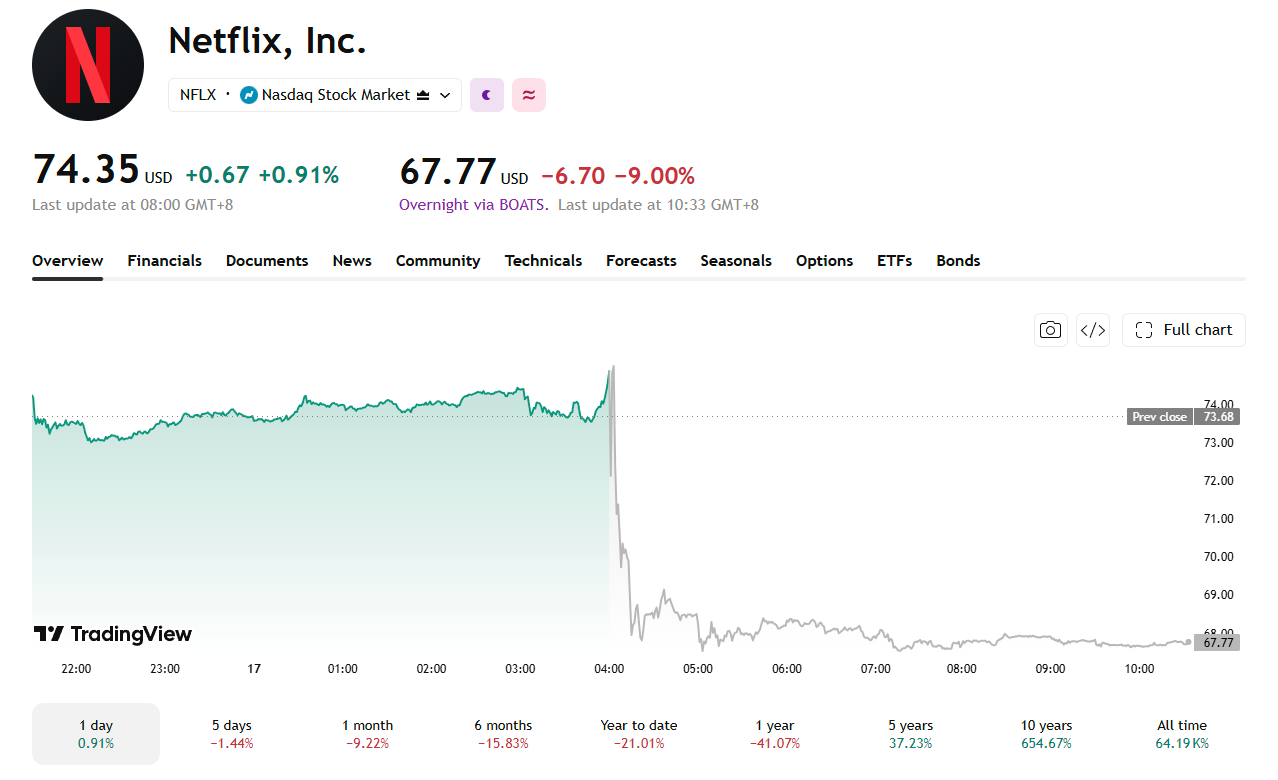
Netflix (NFLX) forecast third-quarter revenue of $12.86 billion, short of Wall Street’s $13 billion estimate. Shares sank nearly 9% in after-hours trading Thursday, July 16.
The guidance overshadowed second-quarter results that beat earnings estimates but fell just short on revenue. Investors are weighing slowing subscriber growth against a maturing streaming business heading into the back half of 2026.
Shares Slide Toward a Two-Year Low
Netflix shares closed Thursday’s regular session at $74.35, up 0.91%. The stock then fell 8.98% to $67.78 in after-hours trading once the guidance landed, per TradingView data.

The stock is down more than 21% year-to-date has fallen 41% over the past twelve months. It sits far from its all time high of around $133 set in June 2025.
The drop lands during a stretch of bank earnings season that has already tested investor patience. Fed Chair testimony on rates added to the volatility this week. The Nasdaq and S&P 500 have swung on similar earnings-driven volatility this cycle.
Analysts See a Maturing Growth Story
PP Foresight analyst Paolo Pescatore described the outlook as “a naturally maturing growth profile.” He said this does not signal deterioration in the business, but added that Netflix now has less room for error given persistently high expectations.
Netflix also said it would cut its viewing-hours report to once a year, starting in January 2027. The company wants to keep the focus on revenue and operating profit.
The company reiterated plans to roughly double annual advertising revenue to $3 billion. Engagement also grew 2% in the first half of 2026.
Netflix reports third-quarter results on October 20. Investors will watch whether the advertising and live-events push can offset slowing subscriber gains.
The post Netflix Stock Sinks After Third-Quarter Revenue Guidance Misses Estimates appeared first on BeInCrypto.

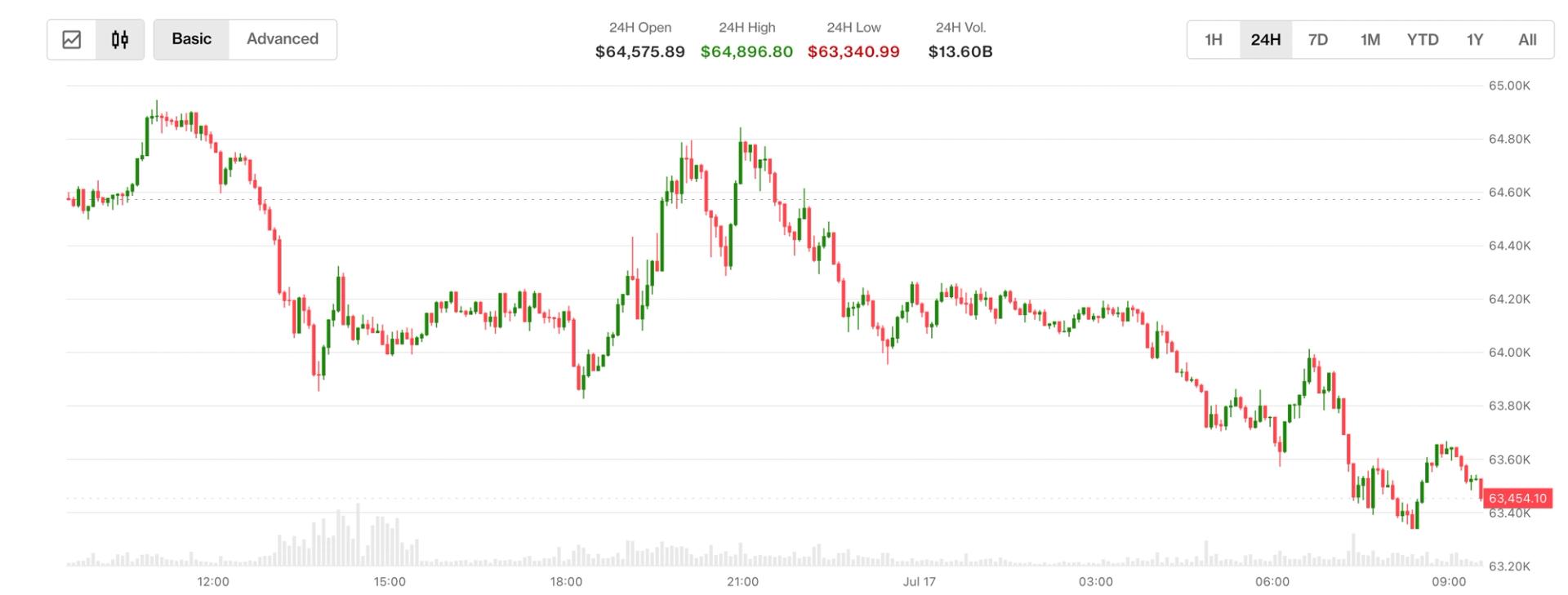
Bitcoin and Asian stocks fell Friday after fresh U.S. airstrikes on Iran raised geopolitical uncertainty. Additionally, President Donald Trump’s allegations that China tampered with the 2020 election hurt risk sentiment, sending the Australian dollar lower.
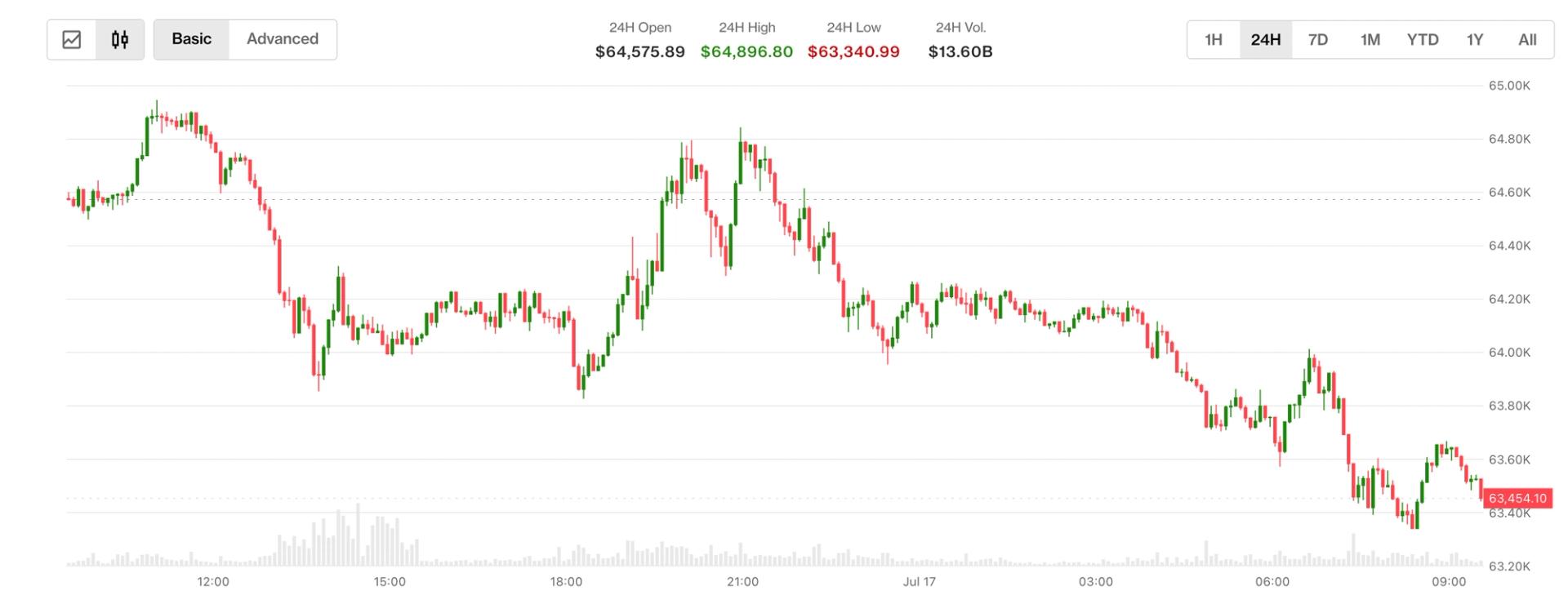
BTC, the leading cryptocurrency by market value, slipped to $63,600, extending Thursday’s nearly 1.4% slide from $65,000, according to CoinDesk data. As of this writing, the cryptocurrency traded just below its 50-day simple moving average, the widely-tracked gauge of near-term momentum.
Asian equity markets wilted, with Japan’s Nikkei trading nearly 3% lower at its lowest in over a month. Australia’s ASX 200 slipped by 0.5% alongside a 0.8% drop in futures tied to Nasdaq. Wall Street’s tech-heavy index fell by over 1.6% on Thursday.
Iran’s semi-official Fars news agency quoted Hormozgan Province Governorate, saying that U.S. airstrikes have hit five bridges in the southern Hormozgan province. A missile strike also hit Iran’s Chabahar maritime control tower. Surprisingly, WTI oil futures held steady at around $79 per barrel, ignoring the geopolitical stress from the fresh wave of U.S. attacks on Iran.
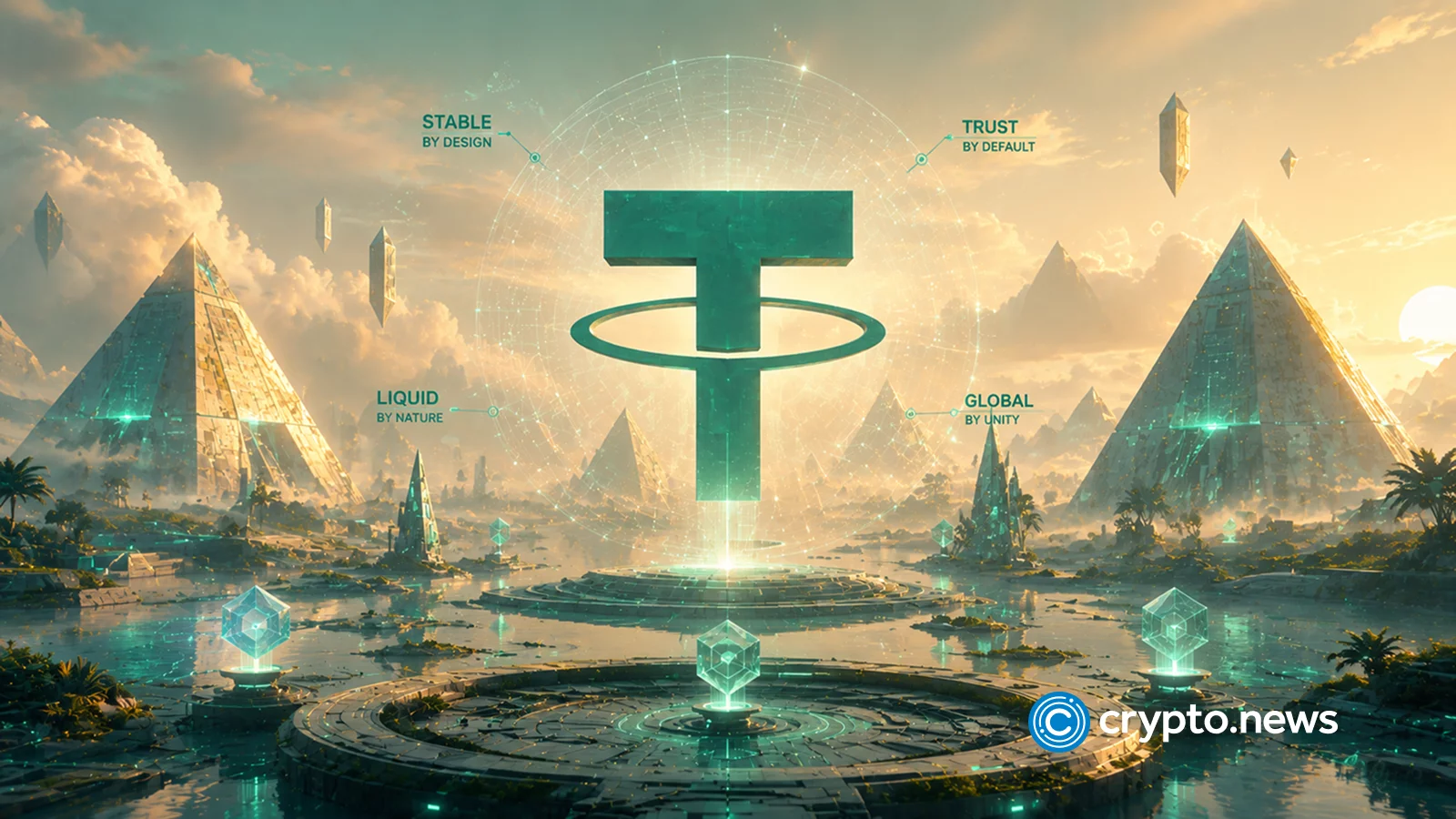
Venezuela’s USDT market is handling volumes that now rival one of the country’s largest sources of foreign currency.
Summary
- Venezuela’s Binance P2P market handled 1.389 billion USDT between June 11 and July 13 alone.
- Ecoanalítica estimated the volume equaled 75% of Venezuela’s monthly oil export value during the period.
- USDT traded near 840 bolivars, around 15.5% above Venezuela’s official exchange rate in mid-July 2026.
Ecoanalítica estimated that 1.389 billion USDT changed hands on Binance’s peer-to-peer market between June 11 and July 13, equal to about 44 million USDT per day.
The research firm estimated that the volume represented about 75% of Venezuela’s monthly oil export value. However, a separate calculation using June crude exports and the average price of Merey crude places the ratio closer to 52%, showing that the comparison depends on the method and reference period used.
Binance P2P becomes a major foreign-currency channel
Ecoanalítica developed a method to estimate the size of Binance’s P2P market in Venezuela. According to the firm, the results show how the platform has moved from a small alternative market into a major channel for buying and selling dollar-linked value outside the traditional banking system.
The 1.389 billion USDT volume also equaled about 64.2% of the $2.163 billion in foreign currency supplied by the Central Bank of Venezuela during June, based on figures cited by CriptoNoticias.
The central bank increased its supply by 36% from May as it sought to reduce pressure on the bolivar. Ecoanalítica placed the comparison at 88%, although it did not publish enough detail to verify the difference.
USDT trades at a premium to Venezuela’s official dollar rate
Meanwhile, USDT traded around 840 bolivars on local P2P markets, about 15.5% above the official exchange rate of 727 bolivars per U.S. dollar on July 16. The spread remained narrower than earlier in 2026, when the difference between official and alternative rates stood near 30%.
Ecoanalítica director Alejandro Grisanti said Binance had gone “from being a marginal market to becoming one of the main channels for buying and selling foreign currency.” He also said P2P activity could slow if formal banks regain more capacity to supply foreign currency. As a result, users could shift some transactions back to traditional financial platforms.
Oil figures leave the 75% estimate open to question
Venezuela exported about 1.2 million barrels of crude per day in June, while the average price of Merey crude fell to $71.13 per barrel from $82.77 in May. Using those figures, monthly crude export value would stand near $2.56 billion, putting the reported USDT volume at roughly 52% rather than 75%.
The difference may reflect another export price, reference period, or method used by Ecoanalítica. However, Grisanti did not provide the full calculation behind the 75% figure. Therefore, the oil comparison remains an estimate, while the reported Binance P2P volume stands at 1.389 billion USDT for the period.
Stablecoins remain tied to Venezuela’s oil and dollar market
The latest figures add to a longer shift toward stablecoins in Venezuela. As crypto.news previously reported, state oil company PDVSA had been gradually moving some crude and fuel sales toward USDT as U.S. sanctions made conventional payment channels harder to use. That development connected the country’s oil trade with the same dollar-linked token now widely traded in its domestic P2P market.
More recently, as crypto.news reported in April, Tether said it had frozen more than $344 million in USDT linked to sanctions evasion and criminal networks in cooperation with U.S. authorities. The report also noted earlier concerns about PDVSA’s use of USDT. The latest P2P estimates now place stablecoin trading at a scale comparable with major official and export-related foreign-currency flows.
Crypto World
India’s biggest IPO this year rakes in bids worth $31 billion, powered by institutional frenzy
Signage for SBI Funds Management Ltd. at a news conference in Mumbai, India, on Thursday, July 9, 2026.
Bloomberg | Bloomberg | Getty Images
India’s biggest public market offering this year, SBI Fund Management, has garnered bids worth 2.97 trillion rupees ($30.7 billion), underscoring the liquidity available in the market ahead of the much larger issues anticipated in 2026.
SBI Fund Management, which is a joint venture between State Bank of India and Europe’s Amundi Group, was in the market to raise 97.9 billion rupees ($1 billion). Its initial public offering was oversubscribed 41.6 times, owing to an enthusiastic response from institutional investors.
The portion reserved for qualified institutional buyers was subscribed 140 times, with most of the bids coming from domestic institutional investors such as banks and insurance companies. Participation by retail investors was relatively muted, with subscriptions at 3.6 times the offer that closed on Thursday.
Institutional interest is good news for public issues of India’s largest stock bourse, the National Stock Exchange, and the country’s biggest wireless telecommunications company, Jio Platforms, expected to hit the market later this year.
Both companies are estimated to raise more than $3 billion each, according to Mumbai-based IPO intelligence firm Prime Database.
India has been the most prolific IPO market in the world over the last two years, with the highest number listings, but activity was subdued here during the first half of the year.
Rising energy prices due to the Iran war have squeezed the Indian economy, taking the sheen off its domestic consumption story. That has coincided with a global investment rally in AI stocks, an industry where India has no champions.
As a result, since the start of the year, the Indian benchmark Sensex has lost over 9.4% and has been among the worst-performing large stock markets. The broader Nifty 50 is down 7.9% so far this year. In June, after a ceasefire between Iran and the U.S., the Indian market recovered partially, and companies started announcing fundraising plans.
Stock market offerings worth $50 billion could flood the Indian markets this year, though the continuation of the Iran war remains a key risk.
Investors will be keeping a close watch on the listing of SBI Fund Management next week, as strong post IPO gains would increase appetite for new issues. SBI Funds is India’s largest asset management company and, as of March 2026, it had 29.5 trillion rupees ($395 billion) under management.

It was October 2025 when the primary cryptocurrency shot to an all-time high above $126,000. In the months that followed, however, the euphoria faded, and the bears took control. The situation only worsened at the start of the summer, when BTC dropped well below $60K, while in the past few days buyers stepped in and recovered the price to the current $64,000.
There’s a heated debate on X over whether the asset has reached its cycle bottom and is poised for a major bull run, or if the worst is yet to come. On that note, we decided to ask three of the most popular AI-powered chatbots what is more likely to happen this year: a collapse to $30,000 or a pump to $100,000.
ChatGPT’s Take
OpenAI’s platform estimated that a rise to the $100K milestone sometime in 2026 is the more likely scenario, given current price levels and the recent stabilization driven by better-than-expected US CPI data.
Recall that inflation in America dropped to 3.5%, triggering an evident upswing across the entire crypto sector. Such a reaction makes sense, since the lower figure eases the pressure on the Federal Reserve to hike rates and even raises the prospect of cuts in the months ahead – a development that typically favors riskier assets.
At the same time, ChatGPT stated that an explosion to $100,000 will not be easy, since Bitcoin remains highly dependent on geopolitical tensions, monetary policy, and institutional interest. Data show that spot BTC ETFs have been bleeding heavily over the past several months, indicating that conservative investors such as pension funds and hedge funds have reduced their exposure to the asset. In the past, institutional appetite has been crucial for Bitcoin’s performance and often aligned with its rallies.
The chatbot claimed that a plunge to $30,000 later this year is not entirely out of the question, though it is much less likely and would require a black swan event such as the potential meltdown of a crypto giant or a global recession.
In conclusion, it estimated roughly a 45% chance that BTC will climb toward $100,000 before New Year’s Eve, a 15% probability of a crash to $30,000, and a 40% likelihood that neither scenario will unfold.
“My most realistic year-end range would be approximately $70,000–$90,000, with $100,000 becoming realistic if BTC reclaims $75,000–$80,000 and ETF demand strengthens,” it added.
More in Favor
Perplexity shared ChatGPT’s theory, but said neither outcome is the most possible scenario for the remaining months of the year. It stated that the maximum “reasonable” price BTC can reach in 2026 is around $70,000-$80,000. For its part, Google’s Gemini said a jump to $100K is “mathematically and structurally” more likely than a collapse to $30K.
“For Bitcoin to fall to $30,000, it would have to trade roughly 30% below the collective cost basis of almost every investor in the market. This has only happened during brief, systemic black swan events (such as the March 2020 COVID crash),” it explained.
The post Crash to $30K or Jump to $100K: 3 AIs Speculate What Is More Likely for BTC in 2026 appeared first on CryptoPotato.
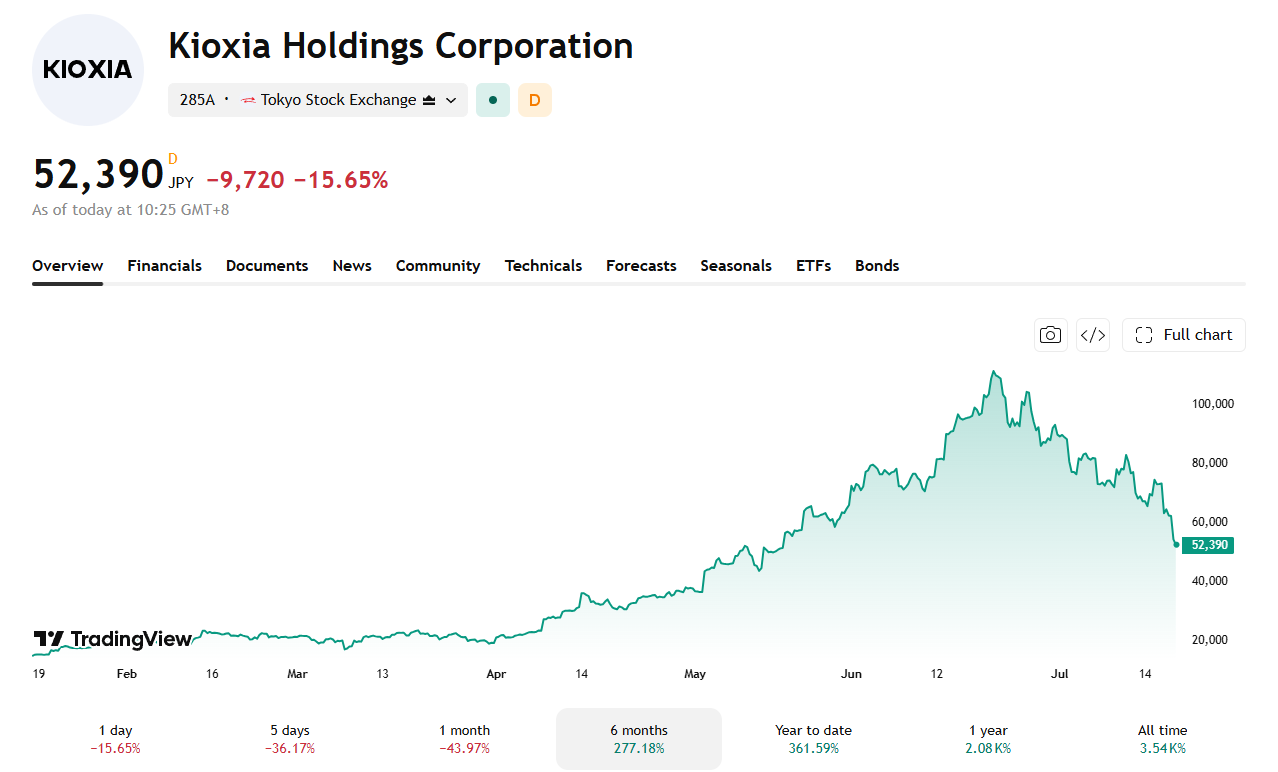
Japan’s Nikkei 225 sank as much as 4.4% on Friday, July 17, leading a broad Asian tech selloff. Investors dumped chip stocks tied to the artificial intelligence boom. The index fell to 63,896.48, extending losses from earlier in the week.
Chip-equipment maker Advantest and tech investor SoftBank each lost around nine percent. Taiwan’s Taiex shed four percent as TSMC retreated more than three percent, even after posting record quarterly profit. However, the big story for Japanese stocks is Kioxia
Kioxia’s Reversal
Kioxia, the memory chipmaker plunged near 16% on Friday alone. That extends a slide that has erased 44% of its value in a single month.

A rally of more than 600% since January pushed Kioxia briefly past Toyota to become Japan’s most valuable company in mid-June. It has since dropped to fourth place. The slide has wiped out roughly ¥30 trillion, or $185 billion, in market value.
Daiwa Securities chief strategist Yugo Tsuboi said the chip sector remains prone to boom-bust cycles.
“The chip sector is vulnerable to the silicon cycle, and we’ve seen this pattern many times before.”
Tsuboi pointed to rising scrutiny of Chinese memory chipmakers as one factor. He also noted signs that global memory prices may be stabilizing, which makes further earnings upgrades harder to justify.
Cracks Beneath the Rally
Other factors are adding to the pressure that Kioxia has faced in the relative short term. Last week, Bain Capital exited its entire position in the memory chipmaker. Many investors saw that as a signal that the chip cycle is peaking. Japanese retail traders also hold heavy leveraged positions, which leaves the stock exposed if selling accelerates.
Kioxia only listed in 2024. Since then, its shares became the best performer on the MSCI World Index before this month’s reversal.
Despite the collapse, analysts still forecast roughly a 118% return for Kioxia over the next 12 months. The Topix index’s October reshuffle should also draw fresh passive fund inflows into the stock.
A Warning for the Wider AI Trade
Kioxia’s reversal mirrors a broader repricing across the sector. A Wall Street gauge of chip stocks slumped more than four percent Thursday and concerns over TSMC’s AI spending overshadowed an otherwise solid earnings outlook.
Traders have grown more skeptical of the AI trade in recent months. They are rotating out of richly valued chip names and into sectors that have lagged. The episode follows a similar pattern to Japan’s broader AI selloff earlier this month.
The Nikkei has shed trillions of yen in value over three weeks.
The post As Nikkei Bleeds, Kioxia’s Boom-to-Bust Highlights Dangers of This AI Cycle appeared first on BeInCrypto.
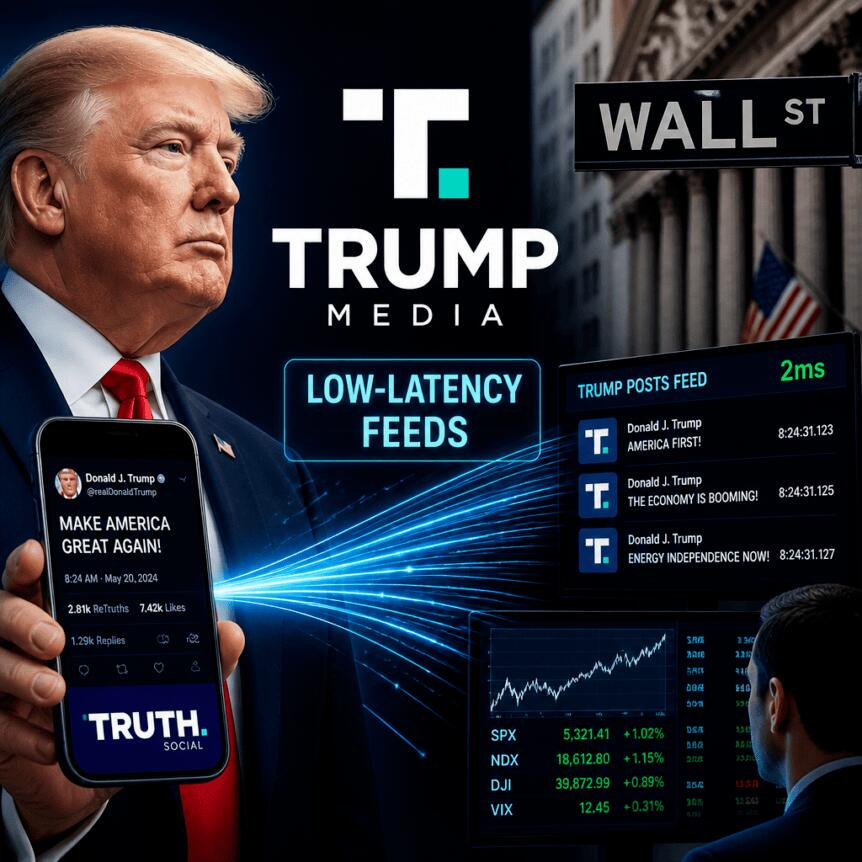
Trump Media & Technology Group (TMTG), the company behind the Truth Social platform, says it is preparing to launch a paid API that will let institutional Wall Street users pull posts from selected high-impact Truth Social accounts in real time.
In a filing with the U.S. Securities and Exchange Commission, TMTG states the “Truth API” is expected to be available to institutional customers starting Aug. 1, 2026. The service is designed for low-latency, machine-readable access—useful for high-frequency and algorithmic trading firms that want faster integration than manual browsing or slower data collection methods.
Key takeaways
- Trump Media is launching a paid Truth Social API aimed at institutional customers and market data workflows.
- Availability is targeted for Aug. 1, 2026, with a focus on real-time, licensed content from influential accounts.
- The API is intended for algorithmic and high-frequency trading that prioritizes low latency and machine readability.
- TMTG says scraping prior approaches violate its terms and that the company wants to increase friction for non-direct data collection.
- Truth Social posts have previously been cited as market-moving, including posts connected to U.S.–Iran developments.
A licensed, real-time feed for institutions
According to TMTG’s SEC filing, the Truth API is positioned as a direct, licensed channel for retrieving posts from Truth Social’s most “market-moving” accounts. The company is explicitly pitching the product to professional trading and market data users that need data in a format that systems can ingest quickly.
The filing emphasizes that the API is meant to deliver a real-time feed, tailored for scenarios where timing matters—especially for automated strategies. That framing matters to investors and market participants because it acknowledges a practical reality: social-media headlines and posts can influence how quickly traders react, and the gap between posting and data availability can affect execution.
Low latency and “friction” for scraping
In comments tied to the rollout, TMTG’s interim CEO Kevin McGurn said that Truth API provides a direct licensed stream of the platform’s “most market-moving Truths,” while also supporting the company’s goal of monetizing proprietary assets through recurring revenue.
The company also drew a line around how data should be obtained. In the filing, McGurn says companies have previously attempted to scrape Truth Social data, which he characterizes as a violation of the platform’s terms of service. He adds that Truth API is expected to “create a lot of friction” for those who do not come to the company directly.
For market participants, this shift is significant. Scraping-based approaches typically come with reliability and compliance risks—such as sudden changes in access patterns, blocking, or disputes over licensing. A formal API, by contrast, signals a more structured data pipeline that may be easier to incorporate into regulated or vendor-driven workflows.
Which accounts are in scope
TMTG’s announcement highlights that the API is intended to deliver posts from influential accounts, including Donald Trump (as President and as the operator of the Truth Social account named in the filing). The SEC documentation also references other major figures on the platform, including Donald Trump Jr, Eric Trump, and FBI Director Kash Patel.
Separately, the company points to prior instances where posts from Trump’s Truth Social account were associated with market attention. The article notes examples tied to the ongoing conflict between Iran and the U.S.—a reminder that Truth Social content is being watched not only as political commentary, but as a potential driver of market narratives.
Even with the API’s focus on “market-moving” accounts, investors should consider a key uncertainty: the SEC filing and the accompanying description do not spell out—within the provided text—exactly how “market-moving” is determined, how frequently the account set could change, or what latency benchmarks will be provided to customers.
Why an API matters for trading workflows
Social-media data has long been used in trading, but the quality of that data pipeline—particularly speed, structure, and licensing—often determines whether it can be reliably used for automation. By targeting low-latency delivery to institutional users, TMTG is effectively positioning Truth Social as a more integration-ready source of information for quantitative systems.
Just as importantly, the company’s approach frames the business model: rather than relying on incidental discovery or indirect data access, TMTG is attempting to convert platform influence into a recurring, licensed data service. The “high-margin, recurring revenue stream” language in McGurn’s statement suggests the API is intended to become a durable line of monetization, not a one-off product experiment.
As Aug. 1, 2026 approaches, market observers will likely watch for more operational details—especially how the API will handle access controls, content eligibility, and real-time performance expectations for institutional customers. Those specifics will determine whether Truth API becomes a practical component of algorithmic strategies or remains largely a compliance-first licensing alternative.


Trump Media, the company that operates the Truth Social network, said Thursday it was launching a new paid-for API that gives Wall Street firms “the fastest” access to posts from the most influential Truth Social accounts, including US President Donald Trump.
The API is targeted to be available to institutional customers from Aug. 1, 2026, and is aimed at high-frequency and algorithmic trading firms that require a low-latency, machine-readable feed, said the company on Thursday.
“Markets already move on Truth Social posts,” said Kevin McGurn, interim CEO of TMTG in a statement. “Truth API delivers a direct, licensed, real-time feed of the platform’s most market-moving Truths while advancing our strategy to monetize proprietary assets through a high-margin, recurring revenue stream.”
Posts from Trump’s Truth Social account have moved markets, with the most recent examples being his posts relating to the ongoing conflict between Iran and the US. Other major accounts on Truth Social include Donald Trump Jr, Eric Trump and FBI Director Kash Patel.
“Companies have previously tried to scrape data from Truth Social, which is in violation of its terms of service,” McGurn said, according to CNN.
“We’re going to create a lot of friction for those folks that aren’t coming to us directly,” he added.
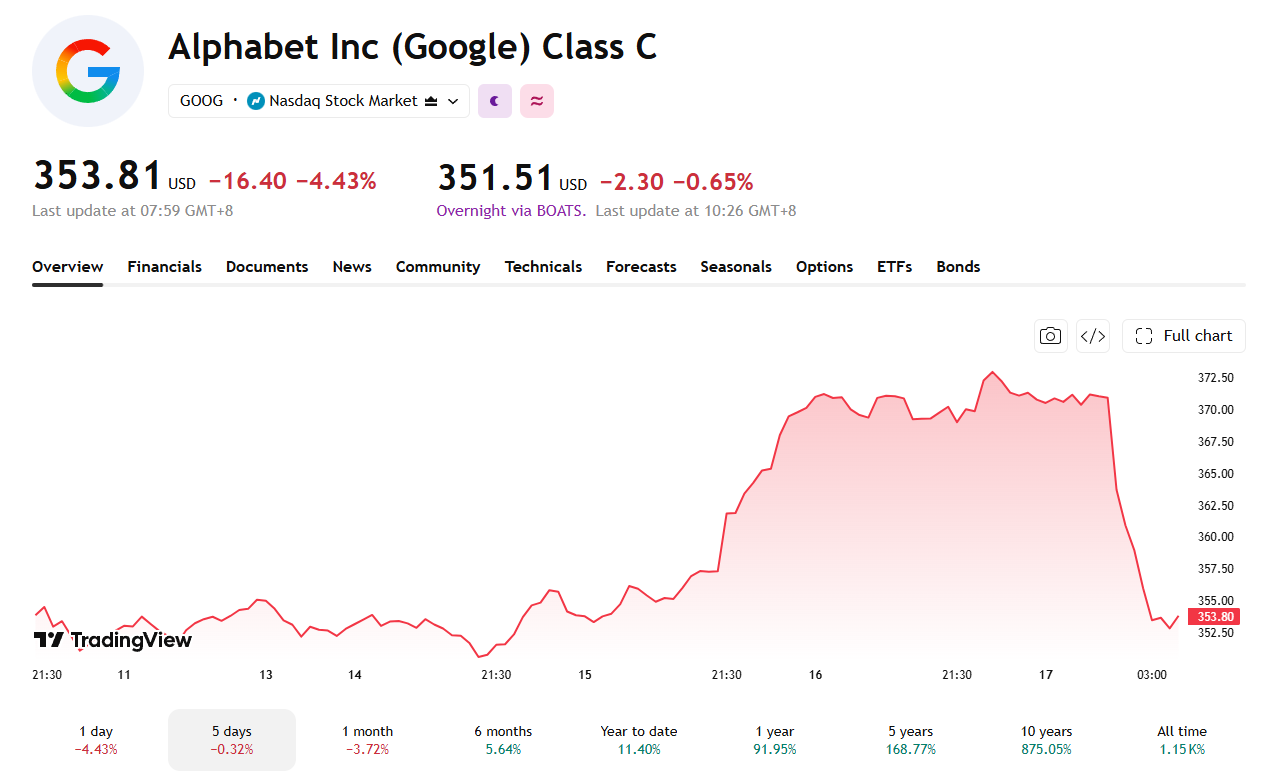
Alphabet stock fell over 4% after the European Union ordered Google to open Search and Android data to rivals. The order adds to concerns over a delayed Gemini 3.5 Pro launch.
The pullback erased most of a rally sparked days earlier by Warren Buffett’s public endorsement of the stock. Shares changed hands near $353 on Thursday, down from above push toward $370 days earlier, per TradingView data.
Gemini Delay Meets a Costly AI Buildout
Alphabet is reportedly facing delays in launching Gemini 3.5 Pro, its next flagship AI model. CEO Sundar Pichai had signaled a June release. Engineers are said to still be working on coding performance and now, some researchers reportedly worry rival models now outperform Gemini on enterprise benchmarks.

The delay lands as Alphabet guides to $180 billion to $190 billion in capital spending this year alone. That buildout already forced the company into reversing its buyback strategy. It also drove an $80 billion equity raise that Berkshire helped anchor.
Wall Street expects Alphabet to post second-quarter earnings per share near $2.86, up nearly 24% year over year when it announces on July 22. Google Cloud grew 63% last quarter to nearly $20 billion. That figure is what investors will watch most closely for evidence AI spending is converting into revenue, after Alphabet’s stronger earnings reaction than rivals last quarter.
Regulators Add to the Pressure
The European Commission ordered Google on Thursday, July 16 to open 11 Android features to rival AI assistants. It also ordered Google to share anonymized Search data with competitors, including OpenAI, under the Digital Markets Act. The Android changes take effect with the next major Android version in July 2027. Search data sharing begins in January 2027.
Google objected to the order in a statement.
“Europeans’ private searches would be exposed to unfamiliar companies, without adequate anonymization of the data and without user knowledge or consent. This would weaken citizens’ privacy, risk business trade secrets, and endanger national security,” he said in a statement.
Separately, The EU could issue Google a fine next week in a related Digital Markets Act investigation. That would mark a second, distinct regulatory action within days. US antitrust litigation over Google’s search dominance is also drawing fresh institutional attention.
Buffett’s Vote of Confidence
Against this backdrop, Buffett’s endorsement stands out. Speaking with CNBC’s Becky Quick, the Berkshire Hathaway chairman confirmed he built the position. Successor Greg Abel did not initiate the trade, he said.
Berkshire’s stake now tops $31 billion, ranking behind only Apple and American Express among its holdings. Buffett tempered the praise, though. He said Alphabet is not among his four or five favorite Berkshire-owned businesses.
He also flagged the same capital intensity worrying the broader market. Buffett called the AI spending race “real money.” His comments in his CNBC interview echoed the same caution about chasing near-term results over real returns.
The post Alphabet Stock Slips on Gemini Delay and EU Order Despite Buffett Bet appeared first on BeInCrypto.


Trump Media & Technology Group has launched a paid data feed called Truth API. It gives banks and trading firms faster access to Donald Trump’s market-moving Truth Social posts.
The service goes live August 1 and already has signed customers, the company said.
Why Speed On Trump’s Posts Matters
Trump’s Truth Social posts have repeatedly jolted global markets. Recent examples include his “Liberation Day” tariff announcements and trade threats against China.
On April 9, 2025, Trump said he would pause many new tariffs for 90 days. US stocks turned sharply higher within minutes of the post.
Truth API will cover the 10 most influential Truth Social accounts and archive posts back to 2022. The platform’s most-followed users include Trump himself, his sons Donald Trump Jr. and Eric Trump, and allies like Dan Bongino and Sean Hannity.
TMTG’s interim CEO, Kevin McGurn, said the feed targets firms with the most to lose from delayed information.
“We’re going to create a lot of friction for those folks that aren’t coming to us directly.”
— Kevin McGurn, Reuters
Conflict Of Interest Questions
The Donald J. Trump Revocable Trust holds roughly 41% of TMTG stock. Trump’s children oversee that trust, which manages his investments. The presidents close ties to the company, and his immense influence, puts him in a position of power to move markets with his social account.
Senator Ron Wyden, the top Democrat on the Senate Finance Committee, criticized the launch. He has also previously criticized the ‘Trump Family Greed‘ in relation to crypto profit disclosures. Wyden said of the new API that it would enrich the Trump family and “make Wall Street traders rich.”
Despite the criticism, and the apprent conflict of interest, Dynamis law firm partner Robert Frenchman said tiering access does not break federal securities law. However, he noted the practice still creates uneven odds for smaller traders.
“It certainly does not seem fair, but yes, a tech platform can tier its distribution of information without violating federal securities laws,” Frenchman said.
TMTG has accused unnamed firms of scraping Truth Social data for months. It calls that a breach of its terms of service. The company has previously batted down other Truth Social monetization rumors, including talk of a meme coin.
The launch adds to a pattern of Trump-linked market moves drawing scrutiny over who profits from information timing. Regulators have not said whether tiered access to a president’s posts raises new disclosure concerns.
The post Trump’s Truth Social Posts Will Hit Wall Street First, Giving a Financial Edge appeared first on BeInCrypto.
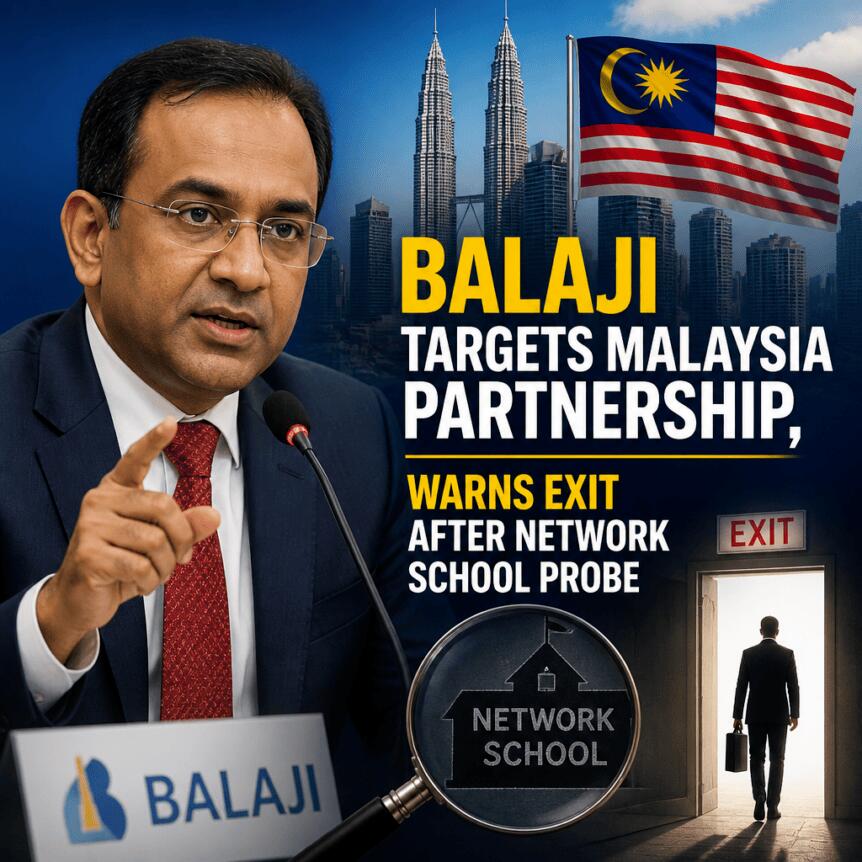
Network School founder Balaji Srinivasan says he is seeking a memorandum of understanding with Malaysia after Malaysian authorities probed his Forest City tech community over allegations that it may have hosted Israeli citizens using second passports. Malaysia’s Home Affairs Ministry said it is investigating the start-up community in Johor following claims that Israelis were present in violation of immigration rules.
The situation underscores a challenge for crypto-adjacent “digital utopia” projects: even when communities aim to build their own institutions and economies, they still rely on conventional nation-states for legal certainty. Srinivasan has linked the next phase of his Malaysia expansion plans to getting that assurance.
Key takeaways
- Malaysia’s Home Affairs Ministry is investigating Network School in Johor after allegations of Israeli nationals using second passports.
- Authorities’ initial checks reportedly found that 266 foreign residents held valid documents.
- Srinivasan is asking Malaysia for written assurances—possibly a memorandum of understanding or changes tied to a special economic zone.
- He says further investment in Malaysia, including a $122 million expansion plan, is on hold pending “sufficient assurance” that issues won’t repeat.
Malaysia investigation follows immigration-related claims
Malaysia’s Home Affairs Ministry said Tuesday that it is investigating Network School’s operations in Johor after claims surfaced alleging that the community included Israelis who may have breached immigration laws. In an early review, the ministry said it found no immediate documentary irregularities—reportedly confirming that 266 foreigners under the initiative had valid documents.
According to the ministry’s statement, the probe is tied to specific allegations rather than a blanket rejection of the project. Still, the inquiry puts Network School’s continued ability to attract and house foreign participants under closer scrutiny.
Srinivasan pushes for written legal certainty
Srinivasan said the reason for pursuing an agreement with Malaysia is to provide Network School with “legal certainty” that would allow it to continue investing and operating in the country. Without such a document, he suggested, the community could redirect its capital elsewhere.
In a video addressed to Malaysian Prime Minister Anwar Ibrahim, Srinivasan said he wants more than general statements welcoming tech; he wants personal, written confirmation that Network School will be considered welcome. He also indicated he is open to different legal mechanisms, including a memorandum of understanding or modifications tied to a special economic zone provision.
While Srinivasan did not lay out specific terms publicly, his messaging focused on predictability: investors and community operators need clarity about the legal status of participants, not just broad political signals.
He also said he is pausing any further investment in Malaysia, including a planned $122 million expansion, until he receives “sufficient assurance” that the immigration issues raised during this episode do not recur.
How the allegations surfaced
Claims that Network School was harboring Israeli citizens were traced back to an Instagram post from “Malaysian Protest 4 Palestine,” an activist group that accused the school of becoming a “gathering place for Israeli entrepreneurs.” In its course of action, the post helped spur immigration scrutiny that then moved to the Malaysian Home Affairs Ministry.
Malaysian policy on entry for Israeli passport holders is central to the dispute. The article notes that Israeli passport holders are forbidden from entering Malaysia, a Muslim-majority country, without written permission from the Malaysian Ministry of Home Affairs—reflecting Malaysia’s lack of diplomatic relations with Israel and its stated position of not recognizing Israel.
Importantly, while the investigation is ongoing, the ministry’s initial checks reportedly did not find immediate evidence—at least at the documentation level—that foreign residents lacked valid paperwork. That creates a key uncertainty going forward: authorities may still need to determine whether the allegations relate to residency status, identity verification, the use of alternate travel documents, or other aspects not covered by “valid documents” alone.
Why this matters for crypto-linked community models
Beyond the specifics of one tech community, the episode reflects a recurring tension for crypto-leaning projects that describe themselves as building new social and economic systems. Such initiatives often emphasize borderless or community-driven norms, but they still require host governments to provide stable, enforceable rules—especially when the project involves foreign nationals and long-term operations.
For investors and participants, the difference between informal tolerance and formal assurance can determine where capital goes next. Srinivasan’s decision to pause a large expansion plan suggests Network School is treating immigration uncertainty as a material risk to its business continuity, not a temporary public-relations issue.
If Malaysia provides the kind of written clarity Srinivasan is requesting, the project could regain confidence for future fundraising and staffing. If not, the story hints at a broader pattern: even when “build-first” communities develop successfully, compliance and policy certainty may become the bottleneck.
Readers should watch for what Malaysia’s Home Affairs Ministry concludes in the investigation, and whether any formal agreement—such as a memorandum of understanding or changes tied to existing special economic zone rules—emerges that addresses the specific compliance concerns raised in this case.

York Italian restaurant La Piazza Antica set for changes

China hits out at British Steel nationalisation

Bitcoin under $64,000 after new U.S. strike on Iran and Trump’s China allegation


-

 Fashion6 days ago
Weekend Open Thread: Nutriplenish Leave-In Conditioner
-
 NewsBeat13 hours ago
London Mayor Sadiq Khan handed a peerage by Keir Starmer alongside 15 other Labour figures… just days before the PM leaves No10
-

 Crypto World1 day ago
CFTC blocks Kalshi from unwinding Michigan trades after court order
-

 Sports7 days ago
Super Eagles star Moses Simon opens up on Liverpool transfer regret
-

 Business1 day ago
Nvidia Stock Slips After Big Tuesday Rally as Huang Confirms Vera Rubin Chip Is Now in Production Today
-

 Politics2 days ago
Young campaigners urge incoming PM to act on outdoor junk food ads
-

 News Videos2 days ago
XRP BOMBSHELL… XRP OMBOARDED FOR TRANSACTIONS!!!
-

 Tech3 days ago
Get Your ESP32 Sunny Side Up With This Solar Dev Board
-
 Entertainment1 day ago
Disney’s Most Ambitious Failed Star Wars Attraction Is Coming to SDCC
-

 Tech2 days ago
Dark Secrets Emerge When Jailbreaking LLMs
-

 Crypto World7 hours ago
Injective Submits SEC Transfer-Agent Registration to Onchain Ownership Records
-
 Sports1 day ago
New Cornerback Enters Vikings Trade Rumor Mill
-

 News Videos4 days ago
how to make coin bank box with cardboard #scienceproject #money #diy #shorts
-
 Tech3 days ago
Cloudflare Precursor Watches Your Mouse and Keyboard To Decide If You Are Human
-

 Business3 hours ago
Banco Bilbao Vizcaya Argentaria, S.A. (BBVA) Discusses Global Macro Environment and Economic Outlook for Core Markets Transcript
-
Crypto World3 days ago
Ripple, Coinbase, Circle Join Linux x402 Foundation to Help Shape AI Payments
-
Business4 hours ago
Nephros, Inc. (NEPH) Discusses Evolving Water Safety Strategies and Expansion Beyond Filtration Transcript
-
 Entertainment1 day ago
Vicki Gunvalson Defends Discussing Heather Dubrow’s Money
-

 Crypto World6 hours ago
Claude Fable 5 Slips to Second in AI Coding Leaderboard
-

 Business2 days ago
ACCC warns AI could lift insurance costs in risk-prone areas
You must be logged in to post a comment Login