
Crypto World
New York Sues Polymarket over Alleged Illegal Gambling Business



The action filed by state lawmakers followed a similar lawsuit against prediction markets company Kalshi in July that alleged the platform was running an illegal gambling operation.


Ripple CEO Brad Garlinghouse has stunned the XRP community with a surprising admission. He revealed that he personally holds Solana tokens alongside his XRP position. The comment challenges the idea that Ripple’s chief backs only XRP.
Garlinghouse Breaks From XRP Maximalism
Garlinghouse told a podcast audience that he does not push people toward XRP alone. Instead, he encourages a broader approach to crypto holdings. He suggested buying the top five cryptocurrencies by market cap and holding for five years.
That basket currently includes Bitcoin, Ethereum, Tether, BNB, and XRP. Garlinghouse’s remarks show he still values XRP as part of a diversified strategy. However, he made clear that XRP does not stand alone in his personal portfolio.
The Ripple CEO also stressed that he supports multiple blockchain projects for different reasons. He does not view himself as loyal to a single token. This stance marks a shift from the maximalist image often tied to Ripple leadership.
Solana Enters Garlinghouse’s Portfolio
Garlinghouse confirmed he owns a modest amount of Solana. He explained that he does not see Solana as a rival to XRP. Rather, he framed both networks as capable of succeeding together.
He pointed to Solana’s meme-coin activity as a factor driving fresh liquidity to the chain. This activity, he noted, strengthens Solana’s broader ecosystem over time. Garlinghouse added that he expects both XRP and Solana to perform well long-term.
Ripple’s leader also said his firm’s real competition comes from elsewhere. He named other blockchain projects as bigger threats to XRP’s market position. Still, he expressed support for Solana’s continued growth and adoption.
Market Context Around The XRP And Solana Remarks
XRP has long carried a reputation shaped by loyal supporters and cross-border payment use cases. Ripple has spent years building partnerships tied directly to XRP adoption. Garlinghouse’s comments do not change that underlying business focus.
Solana, meanwhile, has grown through fast transaction speeds and a thriving meme-coin culture. The network has attracted developers and traders seeking lower fees. Garlinghouse’s disclosure adds a notable voice to Solana’s growing credibility.
For XRP holders, the statement signals that diversification does not equal disloyalty. Garlinghouse continues to back XRP as part of his five-year basket strategy. His comments simply widen the conversation beyond XRP alone.
Ultimately, the remarks reflect a broader shift toward multi-asset crypto strategies among industry leaders. XRP remains central to Garlinghouse’s outlook, even as his portfolio expands. The market now watches how this balanced stance shapes future XRP and Solana sentiment.


IBIT’s expected volatility sits near the bottom of its 12-month range, according to Saxo Bank’s analysis of options data from Sept. 23.
Crypto World
Crypto’s Split Screen: Washington Tightens the Rules as Markets Wobble and Hackers Strike Again


Article by: CryptoMan
Cryptocurrency had one of those days this week that captures the industry’s entire identity crisis in miniature: regulators in Washington were busy building guardrails for an asset class that keeps proving, hack after hack, why it needs them, while traders shrugged off a nine-figure exchange breach and kept their eyes on bond yields instead.
On Thursday, the Federal Reserve unveiled a long-awaited proposal spelling out capital, redemption and disclosure requirements for stablecoin issuers operating under its supervision — the clearest sign yet that Washington intends to treat dollar-pegged tokens less like speculative curiosities and more like the payment infrastructure they’re becoming. The same day, crypto exchange Bitget confirmed that roughly $351.6 million had been siphoned out of its hot wallets, forcing a temporary halt to withdrawals. Meanwhile, Bitcoin held a shaky line near $84,000 as the 10-year Treasury yield touched levels not seen since 2007, and the Commodity Futures Trading Commission quietly rewrote its own rulebook after Congress once again failed to pass comprehensive crypto legislation.
Taken together, it’s a snapshot of an industry maturing on two tracks at once — one where federal agencies race to fill the vacuum left by a gridlocked Congress, and another where the everyday hazards of running billions of dollars through digital wallets haven’t gone away.
The Fed lays down the law on stablecoins
The Fed’s proposal is its first major step in implementing the GENIUS Act, the law that already requires stablecoin issuers to back their tokens one-to-one with cash, bank deposits or short-term Treasurys. What the Fed added Thursday is the fine print: an operational-risk capital charge scaled to an issuer’s size — 2% on the first $20 billion in stablecoins outstanding, 1.5% on the next $30 billion, and 1% above that — plus additional buffers tied to credit and operational risk. Issuers would generally have to honor redemptions within two business days, and if their reserves ever dip below full backing, they’d be required to notify the Fed immediately and either top up the shortfall or start liquidating and redeeming tokens.
Transparency is baked in too. Issuers would have to publish monthly reports on their outstanding tokens and reserve composition, independently audited and personally certified by their CEO and CFO. A companion proposal would open a formal application pathway for Fed-supervised banks that want to issue stablecoins through subsidiaries.
Fed Governor Michael Barr backed the plan but made clear the job isn’t finished. “Stablecoins will only be stable if they can be reliably and promptly redeemed at par in a range of conditions,” he said, flagging market stress and issuer-specific strain as the real tests of any framework. Barr also pushed for stronger, universal redemption rights in the final rule and warned against language that would limit the Fed’s ability to act on anti-money-laundering failures unless they’re deemed “significant or systemic.”
The proposals now face a 60-day public comment period. The GENIUS Act itself is set to take effect January 18, 2027, or 120 days after final rules are issued — whichever comes first.
Congress stalls, so regulators move on their own
The stablecoin push arrived just days after the Senate failed to advance the Digital Asset Market Clarity Act, the bill meant to finally settle which agency — the SEC or the CFTC — has jurisdiction over which corner of the crypto market. With that effort stalled and few expecting Congress to revisit market-structure legislation before 2027, both regulators are simply proceeding without it.
The CFTC updated its guidance on tokenized assets and blockchain recordkeeping this week, clarifying that registered entities can invest customer funds in tokenized assets as long as those tokens carry legal and economic rights equivalent to the traditional version, and signaling it won’t object to blockchain-based recordkeeping. CFTC Chair Michael Selig framed the move as an effort “to provide regulatory clarity for the crypto industry,” even as he stopped short of tying it directly to the Senate’s failure. The SEC, for its part, has already floated its own rules on crypto investment contracts, with Chair Paul Atkins saying the agency is “ready, willing, and able” to act without Congress.
A reminder that the risks haven’t disappeared
If regulators are trying to make crypto safer on paper, Bitget’s breach was a reminder of how exposed the industry remains in practice. The exchange said its security systems flagged unauthorized transfers from a limited number of hot and warm wallets Thursday evening, prompting an immediate withdrawal freeze. CEO Gracy Chen said cold wallets were untouched, user balances remained accurate, and the entire stolen sum falls within the exchange’s $464 million User Protection Fund — effectively an insurance backstop meant to make customers whole. Bitget said it has flagged the addresses involved to law enforcement and onchain investigators and promised a full incident report within 24 hours, though it has yet to say how the attackers got in.
It’s the kind of incident that, a few years ago, might have sent shockwaves through crypto markets. This time, prices barely flinched — arguably because investors had bigger macro worries on their minds.
Bitcoin caught between yields and yield-chasers
Bitcoin spent Thursday oscillating around $84,000, briefly dipping below $83,000 before clawing back, as the 10-year Treasury yield climbed to 5.18% — its highest since July 2007 — and the 30-year hit 5.46%. Higher yields make government debt more attractive relative to non-yielding assets like Bitcoin, and the pressure was compounded by a weakening Japanese yen edging toward levels that could trigger intervention, which economist Mohamed El-Erian warned could add further strain to an already jittery Treasury market.
Even so, Bitcoin has managed to extend its August rally, defying predictions tied to its traditional four-year boom-bust cycle. Elsewhere in the market, the tokenized real-world-asset project Ondo Finance was a standout gainer, with its token reclaiming the $0.50 level for the first time since December as BlackRock-backed “Ondo Intelligent Portfolios” launched on Ethereum and BNB Chain — another sign that tokenization of traditional financial products keeps advancing even as legislative clarity lags behind.
And on the infrastructure side, a smaller but telling development: DoubleZero rolled out a dedicated fiber market-data feed for the decentralized exchange Hyperliquid, giving professional trading firms the kind of fast, institutional-grade access to order-book data long taken for granted on venues like the CME or Nasdaq. As Hyperion DeFi CEO Hyunsu Jung put it, onchain markets aren’t becoming traditional exchanges so much as adopting their plumbing — a quiet but steady sign of an industry professionalizing in the background, even as its regulatory foundation is still being poured.
Cryptocurrency is gaining ground as a valid payment method. New laws should provide stability and build user trust in stablecoins as an alternative currency.
The altcoin crypto payment space is generating very interesting opportunities and one of those is DAPAhe, a privacy-focused cryptocurrency built on a BlockDAG architecture; their website is hosted at dapahe.com.

Unlike standard blockchains that store transactional details in plain text, DAPA uses an account-based model secured by a layer-1 Twisted ElGamal homomorphic encryption and Zero-Knowledge Proofs.
This structure allows users to instantly check their balances by querying only the most recent block, providing full network anonymity without requiring a complete blockchain sync.
I checked the webwallet DAPA offer, and it’s a good functional wallet with a history of all transactions and a very easy setup. For me, one of its best features is the sync: once done, you don’t need to do it again unless you leave the browser you see;
🔐 Initializing Secure Balance Decryption
Starting cryptographic table initialization…
Aave has announced a Base equities market designed to accept seven Coinbase-issued tokenized stocks as collateral for USDC loans, with an initial borrowing cap of $21 million.
Summary
- Seven tokens tied to U.S. technology stocks are included in Aave’s Equities Hub.
- Borrowers can pledge the stocks for USDC, while lenders supply the market’s dollar liquidity.
- AAVE traded near $146.80, up 2.4% over 24 hours, according to CoinGecko.
- Coinbase’s stock tokens remain restricted to eligible users outside the United States.
According to a Sep. 25 X post, the Equities Hub covers tokens tied to Apple, Amazon, Alphabet, Meta, Microsoft, Nvidia and Tesla. Eligible holders can deposit the tokens and borrow USDC against them without selling their stock exposure. Aave’s published Base deployment proposal lists the same seven assets, but still sets out governance votes as steps before deployment.
Aave V4 sets separate limits for each stock
Within the proposed market, the seven stocks serve only as collateral. Users cannot borrow the equity tokens or borrow one stock token against another, according to Aave’s governance materials. USDC is the sole borrowable asset.
Aave has set a $32 million limit on USDC supplied to the main lending market and a $21 million limit on USDC borrowed. Its risk provider, LlamaRisk, put the combined initial stock collateral cap at roughly $29 million. The limits describe how large positions can become; they do not measure deposits or loans already made.
Each stock also has its own borrowing limit relative to its collateral value. Aave’s published factors range from 65% for Meta and Tesla to 79% for Microsoft, with Apple at 78%, Alphabet at 76%, Amazon at 73%, and Nvidia at 70%. The amount a user can borrow therefore depends on which tokens they deposit, even when several stocks sit in the same position.
Aave’s V4 design places the equity positions in a dedicated Equities Hub with a shared USDC reserve. Suppliers who put USDC into that hub take exposure to loans backed by the seven stock tokens, while the equity market’s risks remain separate from Aave’s other Base markets. A separate supply-only route is intended for USDC vaults and aggregators.
Stani Kulechov, founder and CEO of Aave Labs, described the lending use:
“Until now a tokenized stock was something you could hold or trade. Today it becomes something you can borrow against.”
Aave’s governance materials describe the Base deployment as a proposal requiring an offchain Snapshot vote followed by an onchain vote.
Chainlink feeds price the collateral around U.S. stock hours
Chainlink supplies the feeds Aave plans to use when valuing each stock token. LlamaRisk says the initial feeds publish from Sunday evening through Friday evening Eastern time and retain their last published value over weekends and market holidays.
Loans can operate around the clock, but the shares behind the tokens trade during U.S. market sessions. According to LlamaRisk, information released while the stock market is closed may appear in the feed as a single price change when publication resumes. The risk provider says that gap matters when setting collateral factors and liquidation terms, because a borrower’s position may have less room to absorb a sharp reopening move.
Chainlink expects to provide continuous feeds for the tokens later, LlamaRisk said. The risk provider plans to review market settings once those feeds are operating. For now, its published design uses the existing schedule and monitors the equity tokens and external markets.
Coinbase’s stock products reached Base before the Aave announcement. In August, the exchange introduced four tokens tied to Apple, Alphabet, Meta and Nvidia; September additions brought its lineup to 10. The seven selected for Aave’s market are all tied to publicly traded U.S. technology companies. As crypto.news reported on the initial rollout, Coinbase describes the tokens as beneficial interests backed by underlying shares, rather than products that only track stock prices.
U.S. investors remain outside Coinbase’s current offering
Coinbase issues the products through an Abu Dhabi-based entity, while Alpaca Securities acts as broker and custodian for the underlying public shares, according to the token prospectus reviewed in the earlier report. The tokens are offered to eligible non-U.S. users and are not registered under the U.S. Securities Act. Their connection to Apple, Nvidia, and other American stocks does not make the products available to U.S. investors.
The distinction also applies to the new borrowing use. Base Head of Growth Antonio García-Martínez said eligible customers outside the United States can use the tokens to borrow USDC, while suppliers of USDC can earn interest. The Equities Hub announcement does not change Coinbase’s stated geographic restrictions.
The Securities and Exchange Commission has separately opened a conditional, five-year route for certain tokenized U.S. stocks to trade on qualifying permissioned venues. In coverage of the SEC relief, analysts identified Coinbase as a company that could seek to use the route, while noting that its existing offshore products would need to meet the applicable U.S. conditions. The Aave announcement concerns lending against Coinbase’s current tokens on Base, not authorization for those tokens to be offered to U.S. persons.
Aave is also pursuing another tokenized-asset lending market. On Sep. 16, it outlined an Avalanche credit hub where institutions would borrow Tether’s USA₮ against tokenized assets. The Base proposal instead names seven Coinbase stock tokens as collateral and USDC as the loan asset.
AAVE price approaches $155 resistance
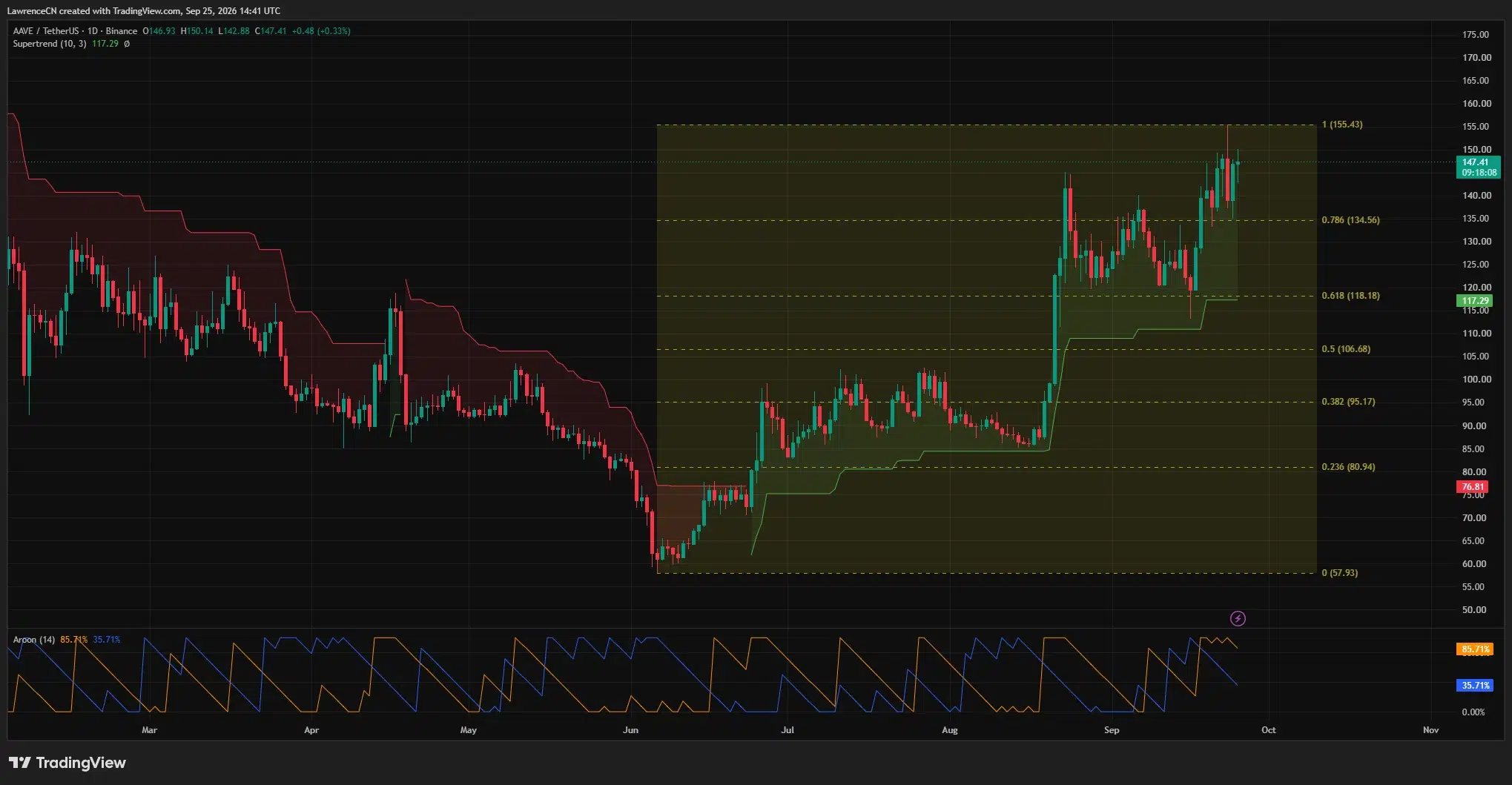
On the daily chart, AAVE rose slightly to $147.41 after reaching $150.14 during the session. The token traded above its Supertrend line at $117.29, while the Aroon Up reading of 85.71% exceeded Aroon Down at 35.71%, pointing to a stronger upward trend. AAVE now faces resistance at $155.43; the nearest marked support is $134.56.
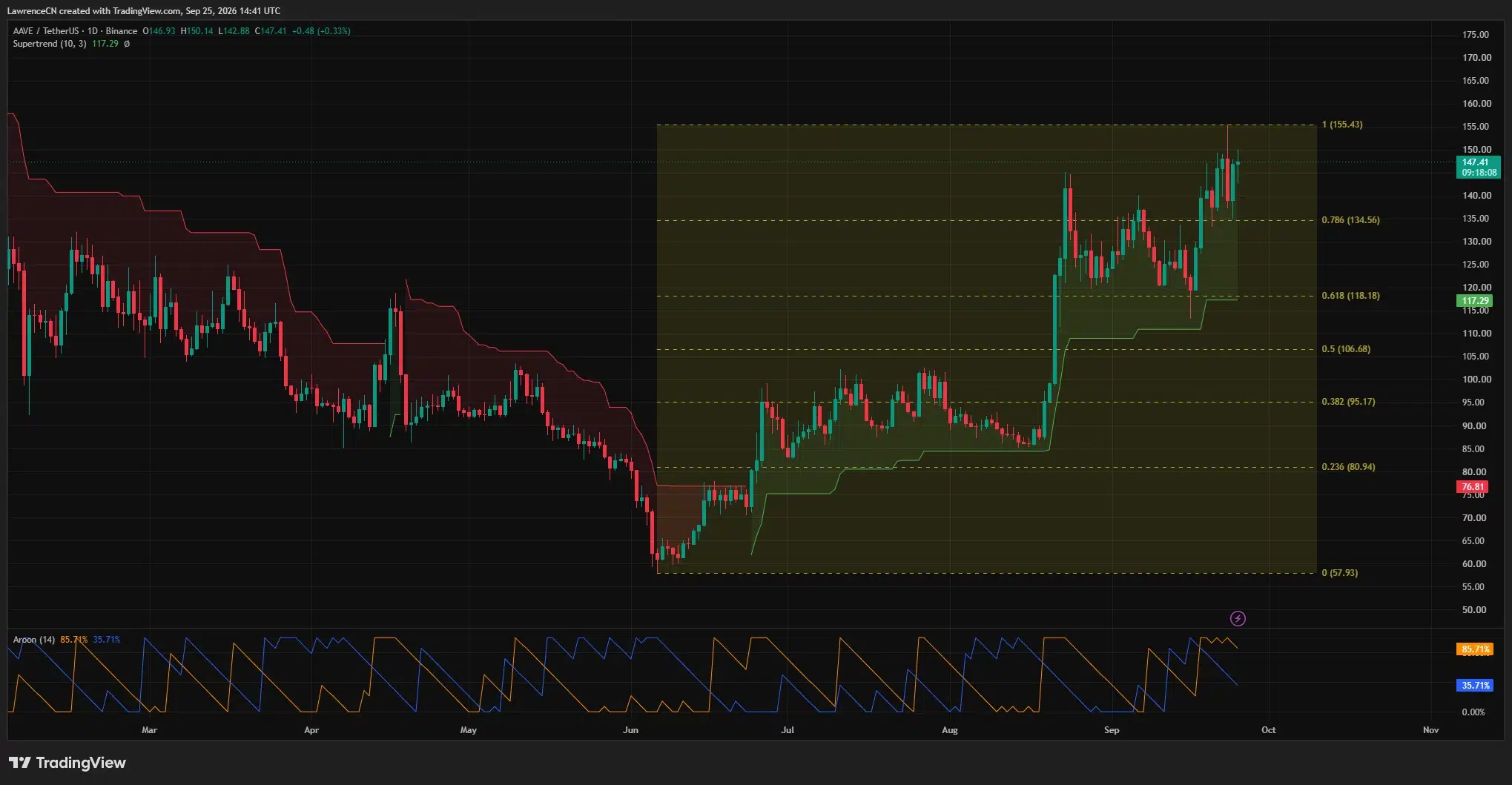
The next marked level above the price is $155.43. A daily close above it would put AAVE beyond the upper boundary shown on the chart. If the price pulls back instead, the marked levels below are $134.56 and $118.18, with the Supertrend line near the latter.
Disclosure: This article does not represent investment advice. The content and materials featured on this page are for educational purposes only.
Strategy is asking shareholders to approve daily dividends across its four U.S. listed preferred stocks, STRF, STRC, STRK and STRD.
The largest corporate holder of bitcoin proposed that dividends would accrue every calendar day, including weekends and holidays, and be paid on the next business day.
The proposal changes payment timing, but leaves dividend rates and total regular dividend amounts unchanged. Shareholders are due to vote on Oct. 28. If approved, STRC’s first daily dividend would be paid on Nov. 2.
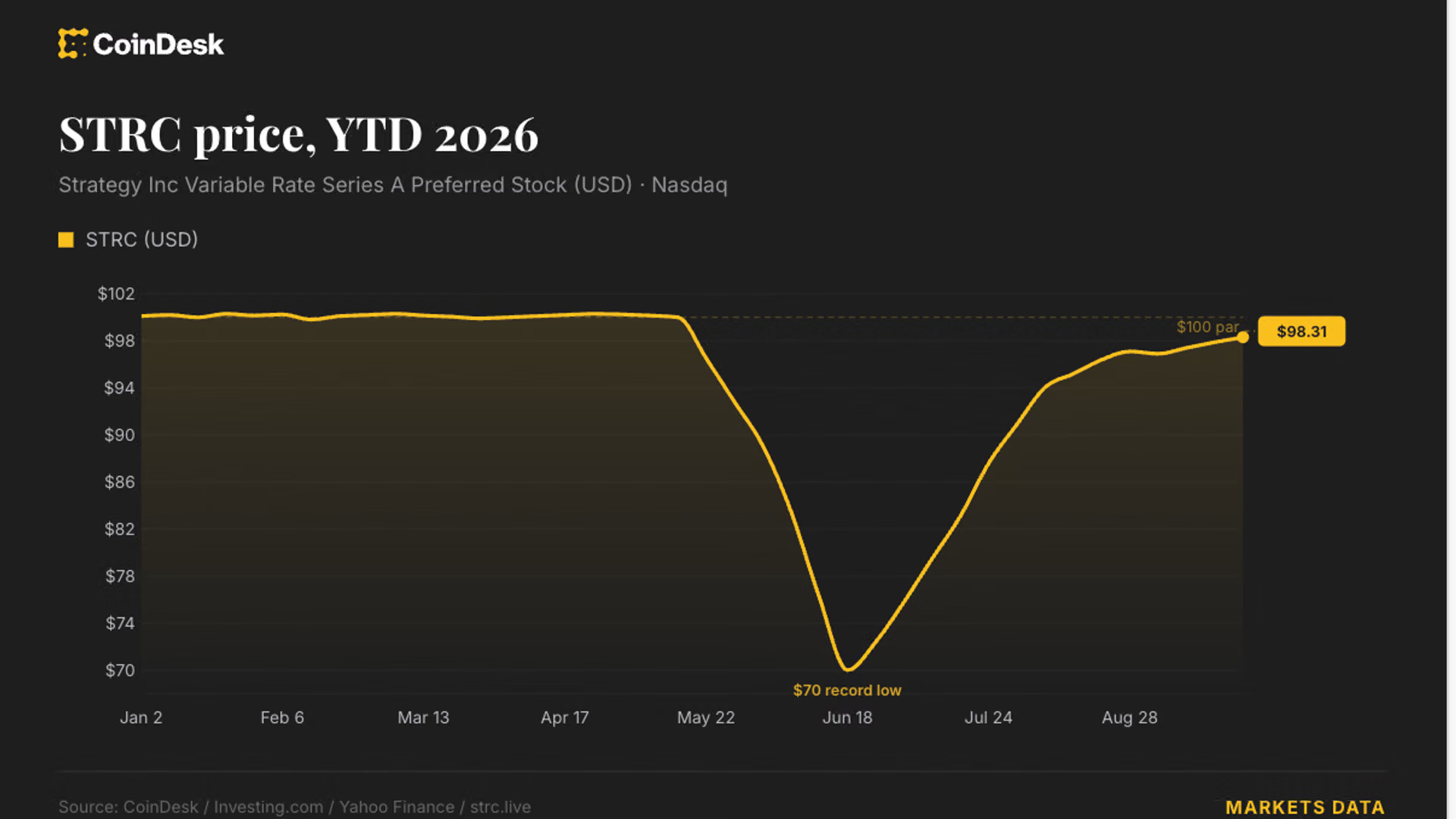
This move to daily dividends would be primarily targeted at STRC, which went from monthly to bi-monthly payments in June. STRC has still struggled to return to its $100 stated value since May, and fell to as low as $71 during bitcoin’s selloff back in June. Its annual dividend rate is currently 12%.
Daily payments could make STRC more attractive to income investors by reducing the wait to receive and reinvest dividends, while smoothing price moves around payment dates. Strategy says supporting a trading price close to $100 is the aim of the change.
Crypto World
Altcoins Steal the Spotlight as Bitcoin Dominance Fades After $87K Rejection: Weekly Crypto Recap
It was a rather interesting and unexpected week for the cryptocurrency markets, especially since the setbacks suffered just ten days ago.
Recall the market update from last Friday, in which we reported that BTC had somehow crossed the $80,000 barrier despite the failure of the CLARITY Act in the US Senate and the Fed’s subsequent interest rate hike. The cryptocurrency slipped to $75,000 after both of those developments, but rebounded swiftly and reclaimed the key $80,000 level by Friday afternoon. It hasn’t been below that level since.
Although it was initially stopped at $82,000 during the previous weekend after more bad macro news, this time on the two major war fronts, BTC started the current business week with one of its most impressive rallies this year. It defended the $80,000 support and the bulls drove it higher by $7,000 in less than 24 hours. As such, the cryptocurrency topped $87,000 for the first time since late January on the heels of massive ETF inflows.
It pulled back to $85,000 almost immediately, but the bulls initiated another leg up to $87,300. However, the rejection scenario repeated, and BTC has been unable to recapture its momentum since then. Moreover, it dipped below $83,000 on Thursday before it found support and bounced off to $85,000 earlier today.
The bears were more persistent once again, stopping its progress there and pushing it south to $83,500 as of press time. This means that the largest cryptocurrency is still 5% up weekly, but its performance has dwindled compared to most alts. The graph below will show the clear winners, led by BTW’s massive 73% weekly surge. ENA (52%), NEAR (45%), ONDO (40%), SUI (39%), BCH (32%), and AVAX (29%) follow suit.
Among the largest alts, XRP, LINK, and ADA stand out as the top performers, with gains of 17%-18%. Naturally, this has driven the BTC dominance metric south hard, losing roughly 2% in a week.
Market Data

Market Cap: $3T | 24H Vol: $113B | BTC Dominance: 56.5%
BTC: $83,500 (+5%) | ETH: $2,685 (+5.9%) | XRP: $1.57 (+17%)
This Week’s Crypto Headlines You Can’t Miss
This Signal Has Flipped to Altcoin Season as Crypto Rally Spreads Beyond Bitcoin. We continue with the altseason narrative as Glassnode’s Altcoin Cycle Signal flipped from BTC season to one dominated by altcoins this week, which was not the case during the August rally.
Bitcoin Just Broke Its Correlation With Gold, Stocks, and the Dollar: What Changed? Meanwhile, BTC’s relationship with the largest asset classes such as US equities and the precious metal market has deteriorated as most have failed to follow the cryptocurrency’s resurgence.
Zcash Tops $1,600 After Europe’s First ZEC ETP Debuts. The popular privacy coin continued its impressive ascent in the past several days, surging past $1,600 for the first time in a decade. The latest move higher came after 21Shares launched the first ZEC ETP in Europe.
Bitget Reports $351M Hot Wallet Breach, Says User Funds Are Covered. The week didn’t go by without a major incident as Bitget reported an incident in which bad actors swiped over $350 million in various cryptocurrencies. The exchange promised that every dollar of that loss falls under its User Protection Fund, so customers’ balances will remain whole.
Ondo Finance Unveils BlackRock-Backed On-chain Portfolios for Investors. Ondo launched three new on-chain portfolio products based on BlackRock strategies, aiming to integrate traditional portfolio management with blockchain. Perhaps it’s no surprise that its native token is among the top gainers over the past week.
Strategy’s Bitcoin Stash Hits 846,000 After Fresh 950 BTC Purchase. After another pause, this time a smaller one of just three weeks, the world’s largest corporate holder of bitcoin resumed its purchases, accumulating 950 BTC for $75.7 million. Interestingly, Strive made an even more impressive buy this week, scooping 1,355 units for $107.7 million.
The post Altcoins Steal the Spotlight as Bitcoin Dominance Fades After $87K Rejection: Weekly Crypto Recap appeared first on CryptoPotato.
Source link

The debate is no longer whether blockchain technology might someday reach traditional capital markets. The question is how existing markets will incorporate it and what rules will govern that transition.
Andrew Cuomo is the former Governor of New York, and a board member of OKX.
Tokenization does not eliminate financial risk, nor does it make the basic responsibilities of regulators obsolete. Quite the opposite. Markets ultimately function on trust, and new technology succeeds only when investors have confidence that ownership is real, transactions are reliable, markets are fair and bad actors will be held accountable.
I learned that lesson from the other direction.
As New York attorney general during the financial crisis, I saw what can happen when innovation and financial engineering move more quickly than oversight and risk management. Subprime lending and increasingly complex mortgage securities were promoted as innovations that expanded access to credit and distributed risk. Instead, bad underwriting and inadequate safeguards helped transmit risk throughout the financial system.
The lesson wasn’t that financial innovation should stop. It was that innovation and regulation have to develop together.
That appears to be the approach the SEC is taking now.
Its exemption isn’t a free-for-all. All trading venue participants must be permissioned. Tokenized shares traded under the exemption must provide investors the same rights and privileges as the traditional shares of an equivalent class. Trading venues face limits on the number and volume of tokenized securities they can trade. Issuers can object to the trading of their shares when tokenized by unaffiliated third parties. Smart contracts must be auditable and deployed on public blockchains, and trading in a tokenized security must stop when trading in the underlying security is halted.
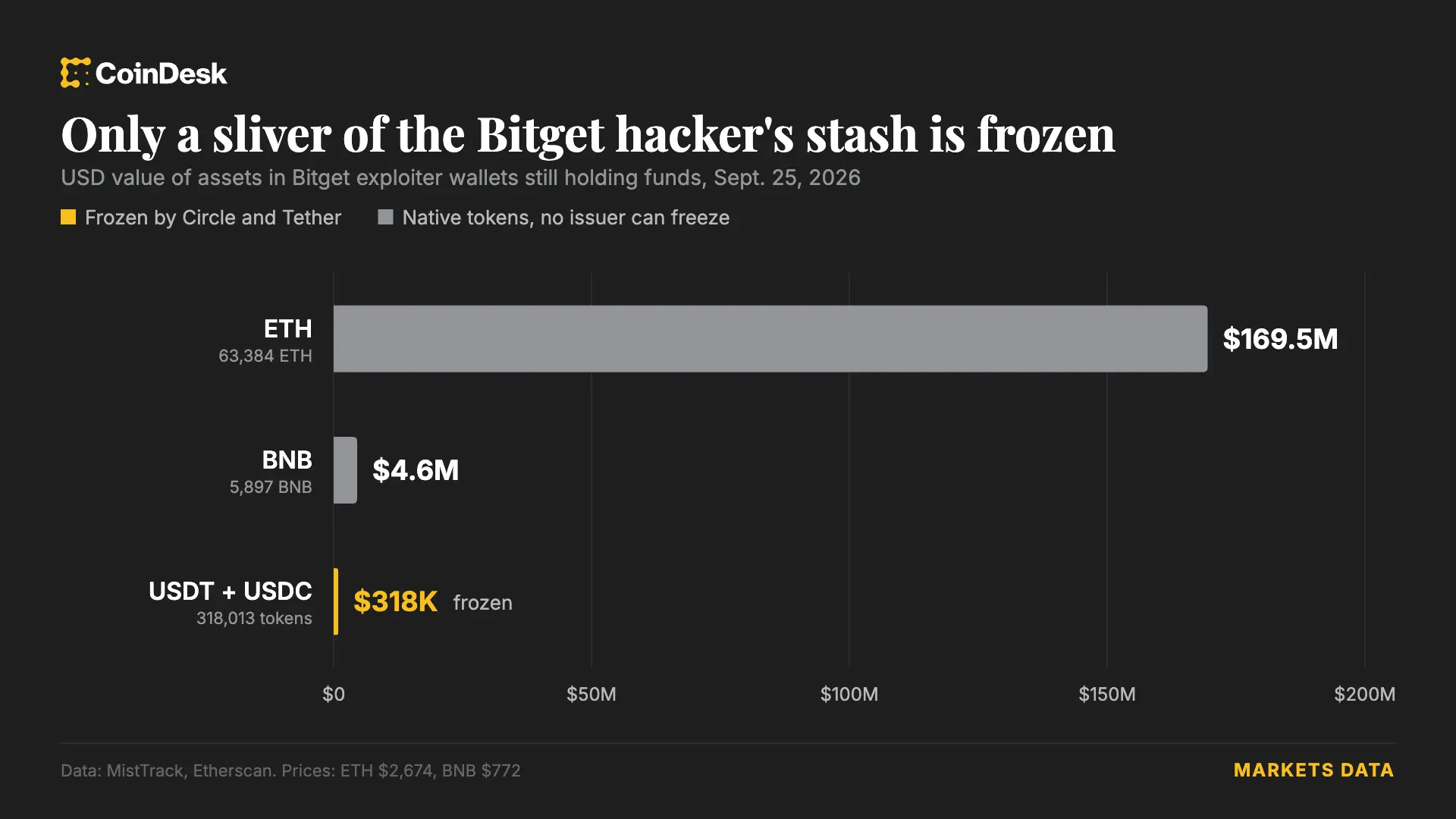
Circle and Tether have frozen stablecoins in a wallet linked to Thursday’s $351.6 million Bitget hack, though the amount is a small fraction of the total.
Circle blacklisted the address, which Etherscan labels “Bitget Exploiter 8,” at 05:00 UTC Friday, onchain data shows. The wallet holds about 170.47 ETH, 218,023 USDT and 99,990 USDC. Blockchain security firm MistTrack said Tether has since banned the wallet too.
That leaves roughly $318,000 in stablecoins stuck. MistTrack’s tracker shows other exploiter addresses still holding more than 63,000 ETH, which no issuer can freeze.
Bitget CEO Gracy Chen said attackers compromised a backend system in the exchange’s wallet infrastructure, spoofed transaction data and triggered its authorization process to move funds out. She ruled out a private key compromise. Chen said Bitget’s user protection fund, which holds over $464 million, covers the loss.
Circle’s quick action contrasts with its response to April’s $285 million Drift hack. In that case, the attacker moved about $232 million in USDC from Solana to Ethereum using Circle’s own cross-chain transfer protocol. Critics including ZachXBT said Circle could have moved faster to blacklist wallets and freeze funds. Circle said it freezes assets when legally required.

Stablecoin issuer Tether said it has very little exposure to a lender seized by U.S. authorities on Thursday.
Tether said assets it holds at EQIBank represent less than 0.034% of its total assets, after the Dominica-licensed lender was caught up in a U.S. asset seizure that it said could force it into liquidation, according to reports by the Financial Times and The Information.
“Tether had no knowledge of the conduct by Capstone alleged by the Department of Justice,” a Tether spokesperson told CoinDesk via email. The company said assets held at EQIBank were limited to “less than 0.034% of the assets of the group,” but did not disclose the exact dollar amount.
Based on Tether’s June report of $187.75 billion in group assets, the percentage the spokesperson said was at risk would put the EQIBank exposure at roughly $64 million.
EQIBank used Capstone, a U.S. payment processor, to hold funds and move customer money through accounts at Wells Fargo and JPMorgan Chase, according to court filings. U.S. prosecutors seized money from those Capstone accounts and filed a civil forfeiture case, alleging that Capstone misrepresented its business to banks.

Bitcoin’s September 25 quarterly options expiry has put an enormous open-interest figure beside a much smaller and less visible question: which contracts produced payments? The exchange rules tell us what a winning holder receives. They do not turn a pre-expiry headline into a verified account of money transferred at settlement.
Summary
- Deribit’s September quarterly Bitcoin options expired at 08:00 UTC on September 25, with a 30-minute settlement-price window.
- A September 23 report cited roughly $16.1 billion of Bitcoin options open interest, a snapshot before the deadline rather than a settlement bill.
- Inverse Bitcoin options settle cash flows in BTC; USDC linear options can produce USDC cash flows under a different contract design.
- An option’s strike and settlement price determine its intrinsic value, while premiums and prior hedges affect each trader’s net result.
- A reliable total of funds transferred requires contract-level positions and clearing data that the public headline does not provide.
Bitcoin options worth billions of dollars have reached their quarterly expiry, but the advertised amount has not been paid from one side of the market to the other.
Deribit’s published expiry schedule puts the September quarterly contracts on the final Friday of the month at 08:00 UTC. Its delivery-price policy uses an index time-weighted average between 07:30 and 08:00 UTC. That is the price reference for automatic exercise and settlement of qualifying contracts. A pre-expiry estimate describes positions still open at an earlier observation time. It cannot be read as a receipt for the 08:00 settlement.
A September preview of the combined expiry cited approximately $18.1 billion across Bitcoin and Ether as of September 23, with Bitcoin accounting for about $16.1 billion in the snapshot it reported. An earlier $16.6 billion combined estimate appeared on September 15. Neither figure is a timestamped count of contracts that remained open at the cutoff, much less the cash or coins exchanged by winners and losers. The amount changes as positions are opened, closed or rolled, and as the underlying Bitcoin price changes the dollar translation of BTC denominated contracts.
There are three separate ledgers behind the headline. Open interest measures the outstanding contract position before expiry. Intrinsic settlement measures the value of options that finish in the money at the prescribed price. Net trading profit adds the premium paid or received and the results of any hedge put on before settlement. They are different numbers, potentially recorded in different assets. Collapsing them into one figure makes a market event sound more like a mass transfer than the contract terms support.
The big number measures outstanding positions
An option gives its buyer a right linked to a specified strike price, while its seller has the corresponding obligation. A call benefits from a settlement price above its strike. A put benefits from a settlement price below it. Open interest counts outstanding positions, ordinarily one long and one short for each open contract. Counting those two sides as separate piles of wealth would double-count the economic exposure. Counting every dollar of notional as a payout makes a different mistake: an option can expire without value, or finish only a small distance beyond its strike.
The reported $16.1 billion Bitcoin component was a pre-expiry estimate of outstanding positions, not the amount of premium paid when those positions were first traded. Option premiums can be a fraction of the notional exposure and vary with strike, maturity and implied volatility. Nor is the estimate the maximum loss of every buyer. A buyer generally risks the premium paid, while a short option can have a very different risk profile, subject to margin and any offsetting trades.
The exchange and the publication also define the scope of the estimate. A figure drawn from Deribit data does not automatically include every venue’s Bitcoin options, over-the-counter positions or listed futures used as hedges. Even within one venue, a dollar presentation can translate BTC contract sizes using an underlying price that differs from the eventual delivery price. To audit a headline, a reader needs its observation timestamp, currency, contract universe and calculation method.
The September 23 snapshot preceded expiry by almost two days. Some positions could have been closed through a trade, reducing open interest; others could have been opened or shifted into later maturities. A trader rolling a September call into October does not receive the September notional as cash. The exchange offsets the old position in a transaction and the trader opens another position at a different premium. Exchange volume during that process is real trading activity, but it is distinct from the final exercise amount.
Deribit’s contract specifications also distinguish inverse, BTC settled options from linear options whose results are settled through USDC products. A dollar sum across instruments may be a convenient scale measure, yet it does not identify a single pot of dollars ready to move at 08:00. The legal contract and its settlement currency determine the ledger entry. The quoted notional alone cannot.
The contrast has appeared in earlier coverage. After an August expiry of roughly $9.6 billion of options, the market could still trade on funding, spot flows and macroeconomic news. The fact that a large maturity arrives on a calendar does not isolate its price impact. It does, however, eliminate the expiring option positions and may change how dealers hedge any positions that survive in other instruments.
The 08:00 price sets exercise, not trading volume
Deribit’s delivery-price documentation specifies an index time-weighted average during the 30 minutes ending at 08:00 UTC for the relevant expiry. This matters because a single last trade at 08:00 is not the settlement price. A headline saying Bitcoin briefly touched a strike cannot show whether a call or put settled in the money. The exchange’s published delivery price, for the correct underlying and date, is the relevant reference.
For a conventional European-style option, exercise at expiry depends on the relationship between that delivery price and the strike. A call struck at $80,000 is worth $5,000 per BTC of underlying at a hypothetical $85,000 delivery price before premiums and contract-specific currency conversion. A call struck at $90,000 has no intrinsic value at the same price. A put struck at $90,000 has $5,000 per BTC of intrinsic value. Those values do not tell us how much any holder made: the holder could have paid $6,000 for the first call and lost $1,000 after the exercise value.
That $85,000 is an illustrative price, not a claim about September 25’s actual delivery price. It lets us separate the unit of notional from the unit of payment. Consider a holder of one BTC equivalent of the $80,000 call. The holder’s $80,000 strike exposure is not transferred at expiry. On these assumptions, the gross intrinsic value is $5,000. For a corresponding inverse BTC cash-settled calculation, a $5,000 USD value converted at $85,000 per BTC is approximately 0.058824 BTC. The exact exchange debit and credit must follow the instrument’s own payoff specification, including contract size and rounding.
Change the hypothetical delivery price to $80,100, and the same call has just $100 per BTC of intrinsic value. Leave it at $79,900, and the call has none. The advertised notional attached to the open position could look broadly similar in all three cases just before settlement, while the actual exercise value changes dramatically. Near-the-money concentration is therefore more informative for settlement than a single aggregate notional.
Deribit’s inverse options specifications describe automatic exercise of in-the-money options and cash settlement in BTC. Cash settlement means an account is credited or debited under the contract; it does not require delivery of physical Bitcoin in exchange for a strike payment, nor a purchase of one BTC in the spot market for every expiring call. Its delivery procedure pauses trading in expiring instruments around the event and updates balances. The clearing system nets obligations by account and contract. Public open interest, which consists of outstanding longs and shorts, does not reveal that account-level netting.
Some traders may have exchanged premiums minutes or weeks earlier. A customer can buy a call from a market maker, and the market maker can hedge by buying spot Bitcoin or futures. When the option expires, that hedge may be reduced, maintained for another exposure or transferred to a new maturity. A spot purchase before expiry and a sale after expiry are actual market trades, but neither should be labeled the option settlement cash flow. An observed burst of spot volume requires a separate attribution to identify whose hedges changed.
Two contract designs can pay in different assets
The BTC inverse option and a USDC linear option may both appear in a dashboard of Bitcoin options exposure. Their payoff plumbing differs. Deribit’s inverse option uses BTC as the settlement currency. Its value expressed in dollars at the delivery price is translated into a BTC account change. A participant receiving BTC can choose to sell it later, but the settlement itself is an exchange-account credit in the contract currency, not automatic evidence of a sale into dollars.
Deribit’s current linear-options documentation says the USDC product exercises into a future and that the resulting position is cash settled in USDC. The exchange introduced this two-step arrangement in April 2026. At expiry, therefore, describing every Bitcoin option as simply paying BTC would be incorrect. The exercise may create an offsetting futures position before the USDC settlement step. The relevant futures specifications say profit and loss is transferred in USDC. A reporter has to inspect the instrument code before calling the payment BTC, USDC or a spot-market purchase.
The term cash settled can confuse readers because it does not necessarily mean a bank-wire transfer in fiat currency. On a crypto derivatives venue it refers to a ledger cash flow in the contract’s specified unit, potentially BTC or a stablecoin account balance. These credits and debits are real economic transfers between counterparties through the clearing venue. Their total gross value is not published merely by reporting options open interest.
The conversion creates a subtle accounting issue. If a BTC-settled inverse option has a fixed USD intrinsic value in a hypothetical payoff, the number of BTC credited depends on the delivery price used for conversion. Summing BTC credits across strikes and translating the result at a different spot price later would give another dollar figure. A claim of an exact amount “changing hands” must identify its unit and valuation time. The same headline can otherwise conflate the option’s reference exposure with coins delivered, dollar-valued settlement and exchange volume.
This distinction matters to risk as well as to journalism. A trader receiving BTC from a winning inverse option can have more BTC exposure after settlement unless another position offsets it. A USDC linear payout adds a different balance and may leave no equivalent BTC holding. If the goal is to infer buying pressure from expiry, one would need to observe how recipients traded those balances, what sellers did to cover obligations and whether market makers unwound hedges. The settlement rules alone do not establish a directional spot flow.
Max pain is a model, not a clearing result
Expiry coverage often quotes a “max pain” strike, the price at which the aggregate intrinsic value of open call and put positions would be minimized under a specified snapshot and simplified assumptions. The number can be recalculated when positions change. It does not dictate the actual delivery price, and it is not an amount transferred. The method also assumes open-interest holders have similar interests, while real accounts can combine options at several strikes, futures, spot positions and exposures on other venues.
An options seller might welcome a given strike finishing out of the money in isolation. The same trader may have bought an offsetting option, sold futures or hedged spot inventory, changing the net economic result. An observed concentration of calls at one strike does not tell us whether the holders are retail buyers, institutions hedging a different position or market makers long an option against a short elsewhere. The published distribution does not identify the beneficial owners or their net books.
The weakness becomes obvious with distant strikes. Coverage of far out of the money Bitcoin puts described hundreds of millions of dollars of notional at a $20,000 strike in a prior expiry. Such positions can alter a chart of outstanding risk without implying a payout at a market price many times higher. They may be cheap catastrophe hedges, parts of spreads or inventory. The strike distribution, not simply the headline sum, determines which portion finishes with intrinsic value.
Even a complete strike-by-strike open-interest table just before the cutoff would not tell the whole story. It could support an estimate of gross intrinsic value if paired with the verified delivery price and exact contract specifications. But it would still lack every trader’s paid premium, offsets and cross-market hedges. It also might not reveal bilateral position netting or whether a venue applies particular rounding and exercise rules. An estimate of gross exercise value is a narrower, defensible claim than a claim of total market profit.
A market maker’s delta hedge can produce buying or selling before the delivery window. As the underlying moves toward a crowded strike, the option’s sensitivity to small price moves may change rapidly, especially near expiry. The direction of the hedge depends on whether the dealer is net long or short the relevant options and what other positions are in the book. Public open interest is not a sign map of dealers’ net exposures. Assertions that “max pain pulled the price” or that billions of expiring calls forced a rally need evidence of positioning and hedge trades, not a strike chart alone.
There is also an adverse-case argument: because the expiry is known in advance, dealers and customers may have managed much of their exposure days earlier. A large option notional can disappear at 08:00 while the spot market barely notices. Conversely, a smaller expiring book can matter if it is concentrated near spot and the hedges are highly sensitive. Both outcomes are consistent with the mechanics. Neither can be predicted from the largest headline number.
A trade, an exercise and a hedge leave different traces
An option trade before the cutoff exchanges an option at a premium, generally opening, closing or transferring a position. A buyer may pay that premium when the contract is acquired. If the buyer sells the option to someone else before expiry, the first buyer realizes a trading result without holding through settlement. If both original sides close, open interest falls. Trading volume can rise substantially while open interest declines because old positions are being unwound.
An exercise at the cutoff is a different event. For an option that finishes in the money, the venue calculates its contractual value against the delivery price and posts the appropriate balances. An out-of-the-money option expires worthless in intrinsic terms, though its writer may have collected the premium earlier. The short side’s liability at exercise is paired with the long side’s receipt under venue clearing, with account-level collateral and netting governing what is actually posted.
A hedge is a third event. If a seller sold a call and bought BTC to hedge, that earlier BTC purchase was a spot trade. The seller might sell the BTC as the call expires or might use it against another short call. An unrelated institution could simultaneously buy spot BTC. A price chart around 08:00 is the net result of all trading motives, so a directional move does not automatically reveal the expiry’s cause. To identify hedging, analysts need timestamped flows, order-book behavior and credible information about dealer positioning.
This is why the question “what changed hands?” has two defensible answers. Mechanically, the expiry extinguished expiring option rights and obligations and posted contract-defined BTC or USDC results for positions that qualified. Numerically, the aggregate BTC and USDC transferred across all accounts cannot be extracted from the public pre-expiry notional estimate. There is no verified total settlement payout in the sources reviewed for this article. A precise figure would require the exchange’s final delivery price, position distribution by instrument and strike, and a method for aggregating its clearing entries.
Coinbase’s institutional Deribit migration shows why venue context also matters. Deribit became part of Coinbase’s institutional derivatives business, but a platform ownership story does not change each listed contract’s payoff rule. One must still identify the actual exchange product, margin currency and settlement method before aggregating amounts. Offshore venues, OTC dealers and U.S. listed products may have different expiries and clearing systems, so a claim about the entire Bitcoin options market needs an explicit venue universe.
The evidence needed for a real settlement tally
A reproducible calculation would begin with Deribit’s final September 25 delivery price for BTC, as published by the exchange, and a timestamped inventory of expiring instruments immediately before 08:00 UTC. Each row would need the option type, strike, contract size, denomination, settlement currency and outstanding count. Applying the correct payoff formula would produce an estimate of gross intrinsic exercise value by contract. Adding those figures after converting at a stated reference price would give a comparable dollar estimate, not a count of independent market trades.
A second layer would check actual exercise records, trading halts, expiration adjustments, fees and clearing balances. If the research question is the amount of BTC and USDC credited, the analyst should keep the asset totals separate rather than quietly converting everything into dollars. If the question is net transfer by customer or liquidity provider, account-level books are necessary, and public strike totals will not suffice. If the question is profit, historical premiums, fees and hedges must be included.
As of this feature’s preparation on September 25, no independently verified, complete 08:00 UTC contract-level snapshot and exchange-wide payout tally were available to us. We therefore do not substitute the September 23 $16.1 billion Bitcoin estimate for a settlement total or manufacture a cash-flow figure by applying an assumed percentage. The hypothetical $85,000 scenario above is a mechanics illustration only. The actual delivery price and resulting aggregate exercise value should be checked against the exchange’s final record before anyone publishes a precise payout claim.
There is a practical reason to keep the uncertainty visible. The largest expiry number rewards a dramatic statement, yet the size of the realized transfer is governed by distance from strikes and the positions still open at the cutoff. Two investors can both have a profitable option exercise while one loses money after its premium and the other makes money. A dealer can lose on an option and gain on its hedge. Counting the exercise alone would report the contract’s settlement correctly but misstate who gained from the whole trade.
Nor can exchange settlement identify the day’s net impact on Bitcoin’s price. If delta hedges were adjusted gradually ahead of the cutoff, little buying or selling need occur afterward. If positions were concentrated at nearby strikes and dealers had to unwind quickly, flow could appear before or after 08:00. Macro news, leveraged futures, ETF creations and spot demand also move the price. An event study would compare order flow around the delivery window with comparable trading periods and still need caution about attribution.
The most useful post-expiry update is therefore not another round number. It is the exchange’s published delivery price; a timestamped table of expiring open interest by strike and product; the estimated intrinsic value split between calls and puts, BTC and USDC; and an explicit statement that the calculation is gross settlement, not net investor gains. That would answer a smaller question accurately. The much larger question of who bought or sold Bitcoin because of expiry would require independent evidence of trades and hedge positions.
The expiry cleared contracts, not the headline billions
The September quarterly expiry removed a known set of dated options from the order book and resolved the exercise rights of positions that survived until 08:00 UTC. It did not cause the entire stated $16.1 billion Bitcoin notional to change owners as cash, Bitcoin or stablecoins. Some contracts finished without intrinsic value; those in the money received contractual account credits according to their instrument design. Earlier premiums and hedges belong to other transactions and other times.
A reader can use the size estimate to understand that the event was substantial and that traders had a reason to watch a narrow settlement window. It cannot tell the reader how much was paid, who profited or whether an observed Bitcoin move was caused by forced hedging. The honest answer to the headline is a set of actual ledger mechanisms plus a missing public aggregate, rather than a single dollar total borrowed from open interest.
What to watch
- Deribit’s published delivery price: Use the September 25 BTC index value based on the 07:30 to 08:00 UTC window.
- Final open interest by strike: Compare an 08:00 expiry snapshot with earlier estimates before calculating exercise value.
- Product and currency split: Separate inverse BTC options from linear USDC options when reporting settlement.
- Gross exercise estimate: Show the strike-level payoff calculation and label it separately from traders’ net profit.
- Timestamped spot and futures flows: Check actual trades and hedges before attributing a later Bitcoin price move to expiry.
These observations could support a settlement estimate. Public order flow alone would still not identify every account that bought or sold Bitcoin because of expiry.
FAQ
What time did the Bitcoin options expire?
Deribit’s September 2026 quarterly contracts expired at 08:00 UTC on Friday, September 25. Its delivery-price policy uses the index time-weighted average from 07:30 to 08:00 UTC for the corresponding instrument.
Did $16.1 billion in Bitcoin change hands?
No such conclusion follows from the September 23 open-interest snapshot. It estimated outstanding Bitcoin option exposure ahead of expiry, not the value exercised or balances transferred at settlement. An exact later payout needs final contract and clearing data.
What happens to an option that expires out of the money?
It has no intrinsic exercise value at the delivery price. The buyer’s earlier premium is still a cost and the seller’s earlier premium is still part of its trade result. Other offsets or fees can change either party’s total result.
Are winning Bitcoin options paid in BTC?
Deribit’s inverse BTC options are cash settled in BTC. Its USDC linear option design can exercise into a future that is subsequently cash settled in USDC. The contract’s instrument type determines the unit of payment.
Is the settlement price Bitcoin’s last trade at 08:00?
Deribit’s documented delivery price uses a time-weighted index over the preceding 30 minutes. A single exchange print or a fleeting touch of a strike does not establish the contract’s exercise value.
Does max pain predict where Bitcoin will trade?
It is a calculation of aggregate intrinsic value at hypothetical prices under an open-interest snapshot. It is not a binding settlement target. The positions, hedges and delivery price may change its relevance before the cutoff.
Did dealers have to buy Bitcoin after expiry?
The public notional estimate does not show dealer net positioning or hedge behavior. Some dealers may have adjusted earlier, held offsetting trades or used futures. Establishing a post-expiry purchase requires evidence of actual trading flows.
What would verify the total amount paid?
A final delivery price, complete expiring instrument counts by strike and type, exact contract specifications and exercise or clearing records would support a reproducible gross payout calculation. Premiums and hedge trades are needed for net profit.
Disclaimer: This article is for information and educational purposes only and does not constitute financial or investment advice. Figures reflect regulatory filings and reporting available at the time of writing and change with each disclosure. Nothing here is a recommendation to buy, sell, or hold any security or asset. Always do your own research. Information is accurate as of September 25, 2026.

Ripple CEO Admits He Owns Solana, Says XRP Isn’t His Only Bet

Ed Sheeran’s Next Two Shows On His Loop Tour Have Been Cancelled
Under the Radar Vikings Trenchman is “Happy but Not Satisfied”




-

 Fashion7 days ago
Weekend Open Thread: Talbots – Corporette.com
-

 Crypto World3 days ago
Goldman Sachs and Deutsche Bank Agree: The S&P 500 Rally Isn't Over
-

 Tech5 days ago
Researchers escape OpenAI Codex sandbox to run commands on host
-

 Fashion1 day ago
8 iPhone Accessories That Add Personality
-

 Crypto World5 days ago
Who Needs CLARITY Anyway? ARB Could See 70X Increase: Hodler’s Digest
-

 Crypto World7 days ago
Circle launches Arc Studio AI agent for building onchain apps
-

 Crypto World7 days ago
Trading Bitcoin on Robinhood? Why 2% Spread Has Traders Worried
-
 NewsBeat7 days ago
Trump says US has reached an agreement to take permanent control of Greenland’s security
-

 Tech6 days ago
Trump suggests rebranding AI with a new name, says he’s also creating an AI Force
-

 Business5 days ago
Analog Devices (ADI) Bets $1.35 Billion on Chips that Let Machines Think for Themselves
-

 Crypto World7 days ago
Bitcoin price breaks channel as RSI climbs to 63
-

 Crypto World5 days ago
Coinbase, Robinhood, Circle Seen as Tokenized-Stock Winners
-

 Tech4 days ago
Google’s $899 Googlebook is a bet that you’ll buy a new laptop for Gemini
-

 Crypto World2 days ago
This Bearish Netflix Stock Trade Can Cash In On Video Streaming Giant’s Woes
-
 Crypto World3 days ago
Trump-Xi Polymarket Odds for Handshake Hit 50%
-
 Business3 days ago
Oil Price Today (September 23): Crude oil below $100 on hopes of US-Iran talks. What did Trump say?
-

 Crypto World2 days ago
Crude Oil Prices Pressured by Diplomatic Hopes in the Middle East
-

 Entertainment2 days ago
These 17 Fall Amazon Dresses Seriously Look Like Anthropologie
-

 Crypto World7 days ago
World Money launches in 150+ countries with Stripe
-
 Crypto World2 days ago
Bitcoin Threatens Sub-$84,000 Breakdown as Long Liquidations Spike
You must be logged in to post a comment Login