

Crypto World
New Zealand Dollar Weakens After Central Bank Decision

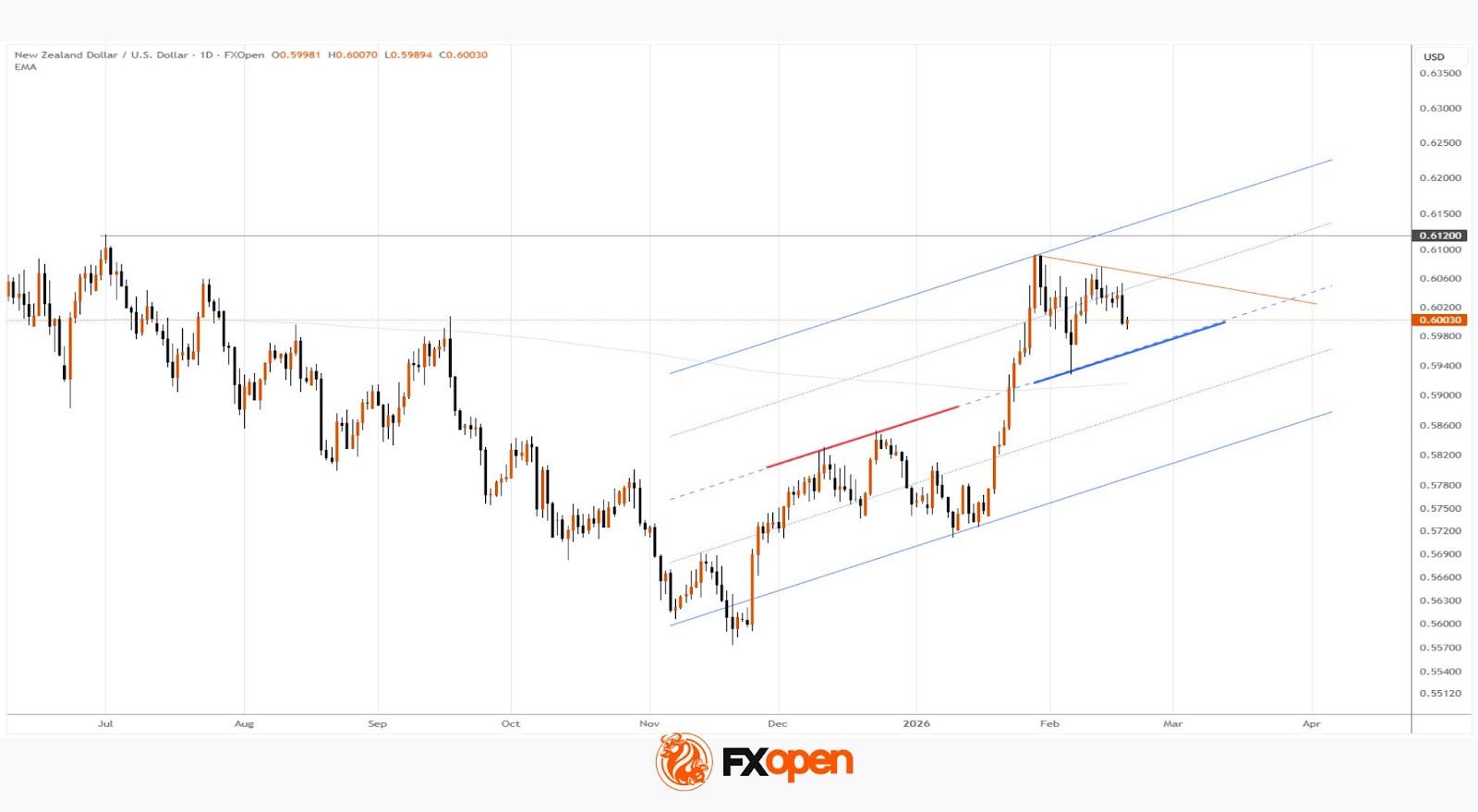
The New Zealand dollar weakened today after the Reserve Bank of New Zealand (RBNZ) announced its decision to keep interest rates unchanged.
While the decision itself was widely expected, the accompanying forecasts drew attention due to their dovish tone. According to the official statement:
→ monetary policy is likely to remain accommodative for some time, although the possibility of a rate hike in the fourth quarter was not ruled out;
→ inflation is returning to the target range.
The currency market reacted by pushing the NZD lower against major counterparts. NZD/USD, for example, fell to its lowest level in nearly two weeks.
Technical Analysis of NZD/USD
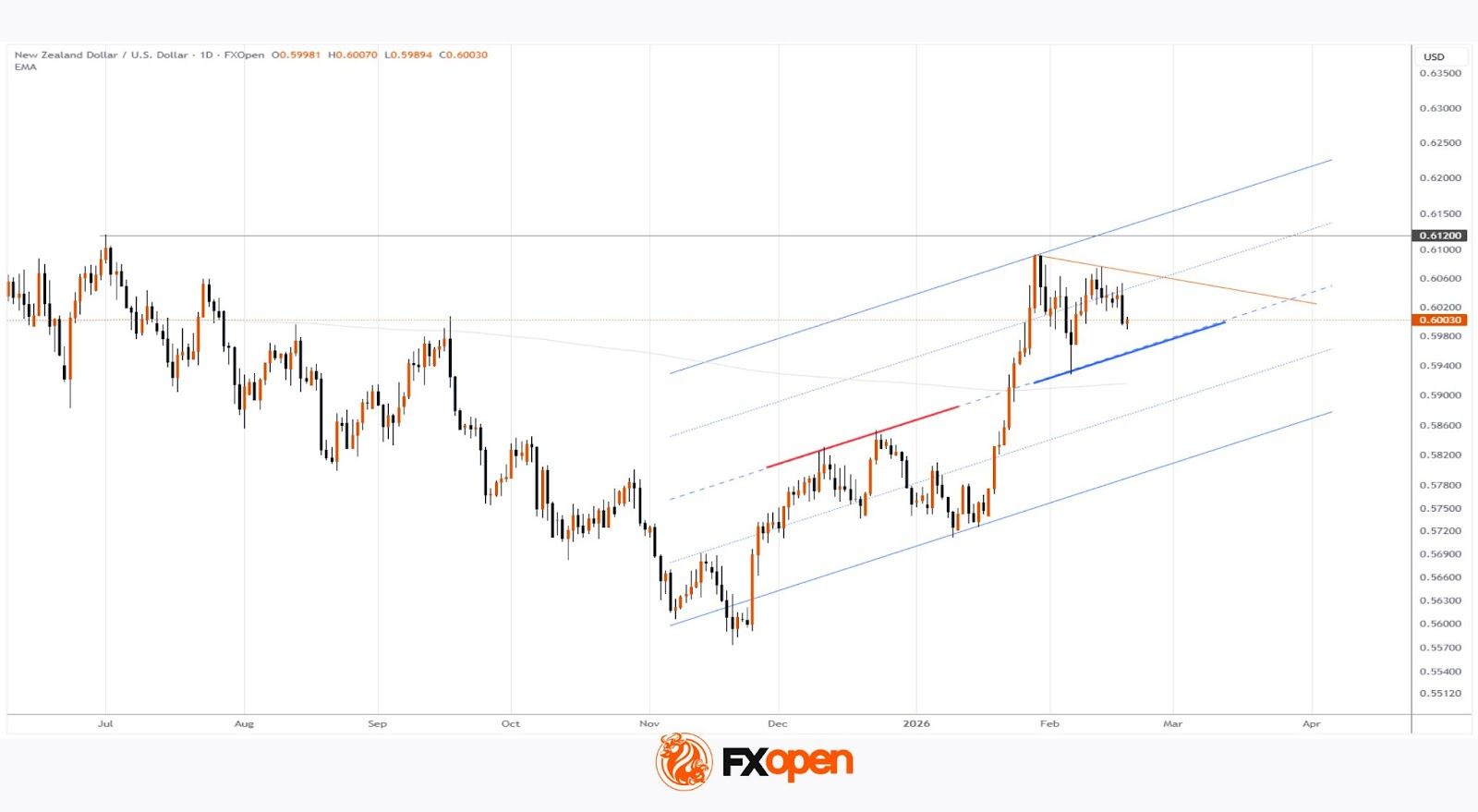
The New Zealand dollar had been showing bullish momentum since late autumn 2025, resulting in the formation of an ascending channel. Notably, the channel’s median line shifted from acting as resistance to serving as support (highlighted by the thicker lines).
It is worth noting that the reversal from the 21 January peak — where price touched the upper boundary — occurred in a sharp manner. Near the 2025 high, bears appear to have regained confidence and seized the initiative.
→ From a bullish perspective, the aforementioned median line may provide support.
→ From a bearish standpoint, a descending trend line drawn through the lower high of 12 February may act as resistance.
Against this backdrop, it is reasonable to assume that the market could enter a consolidation phase over the coming weeks.
Trade over 50 forex markets 24 hours a day with FXOpen. Take advantage of low commissions, deep liquidity, and spreads from 0.0 pips (additional fees may apply). Open your FXOpen account now or learn more about trading forex with FXOpen.
This article represents the opinion of the Companies operating under the FXOpen brand only. It is not to be construed as an offer, solicitation, or recommendation with respect to products and services provided by the Companies operating under the FXOpen brand, nor is it to be considered financial advice.

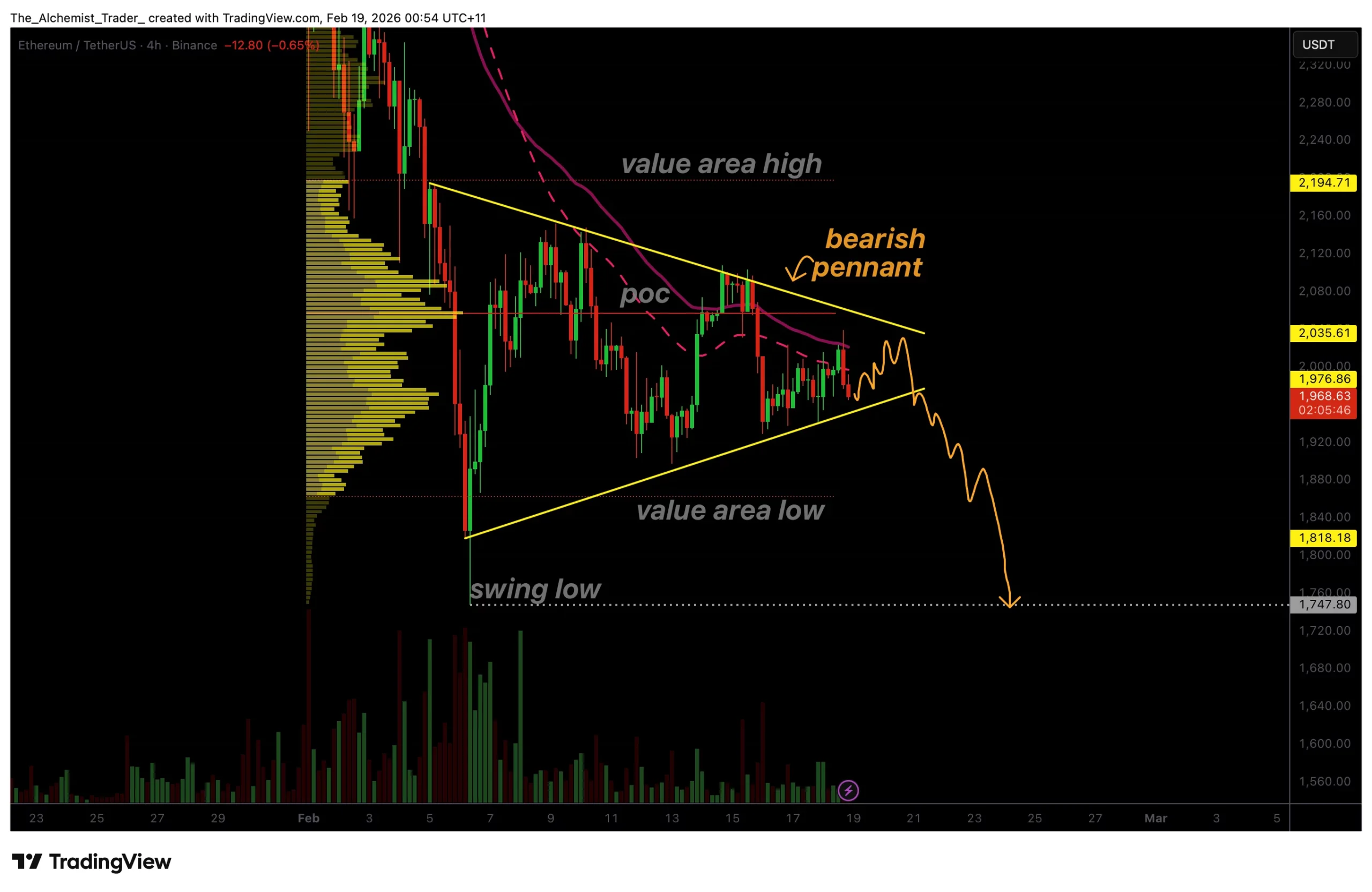
Ethereum price is compressing into a tight bearish pennant, with declining volatility and converging structure signaling that a decisive move is approaching as downside risks continue to build.
Summary
- Bearish pennant structure suggests continuation risk, not reversal
- Volume expansion is required to confirm a valid breakdown
- $1,740 swing low is the key downside target, if support fails
Ethereum (ETH) price action is approaching a critical inflection point as the market compresses into a well-defined pennant structure. Periods of tightening range and declining volatility often precede strong directional moves, and in Ethereum’s case, the broader technical context leans bearish. The prevailing trend remains to the downside, with the market printing consecutive lower highs and lower lows before entering consolidation.
This consolidation phase is not random. Instead, it reflects a pause in momentum as buyers and sellers temporarily reach equilibrium before the next expansion. Given the bearish trend preceding this structure, the current pennant formation increases the likelihood of downside continuation rather than a reversal.
Ethereum price key technical points
- Bearish pennant structure is clearly defined, with converging support and resistance
- Prevailing trend remains bearish, favoring downside resolution
- $1,740 swing low is the key downside target, if breakdown is confirmed
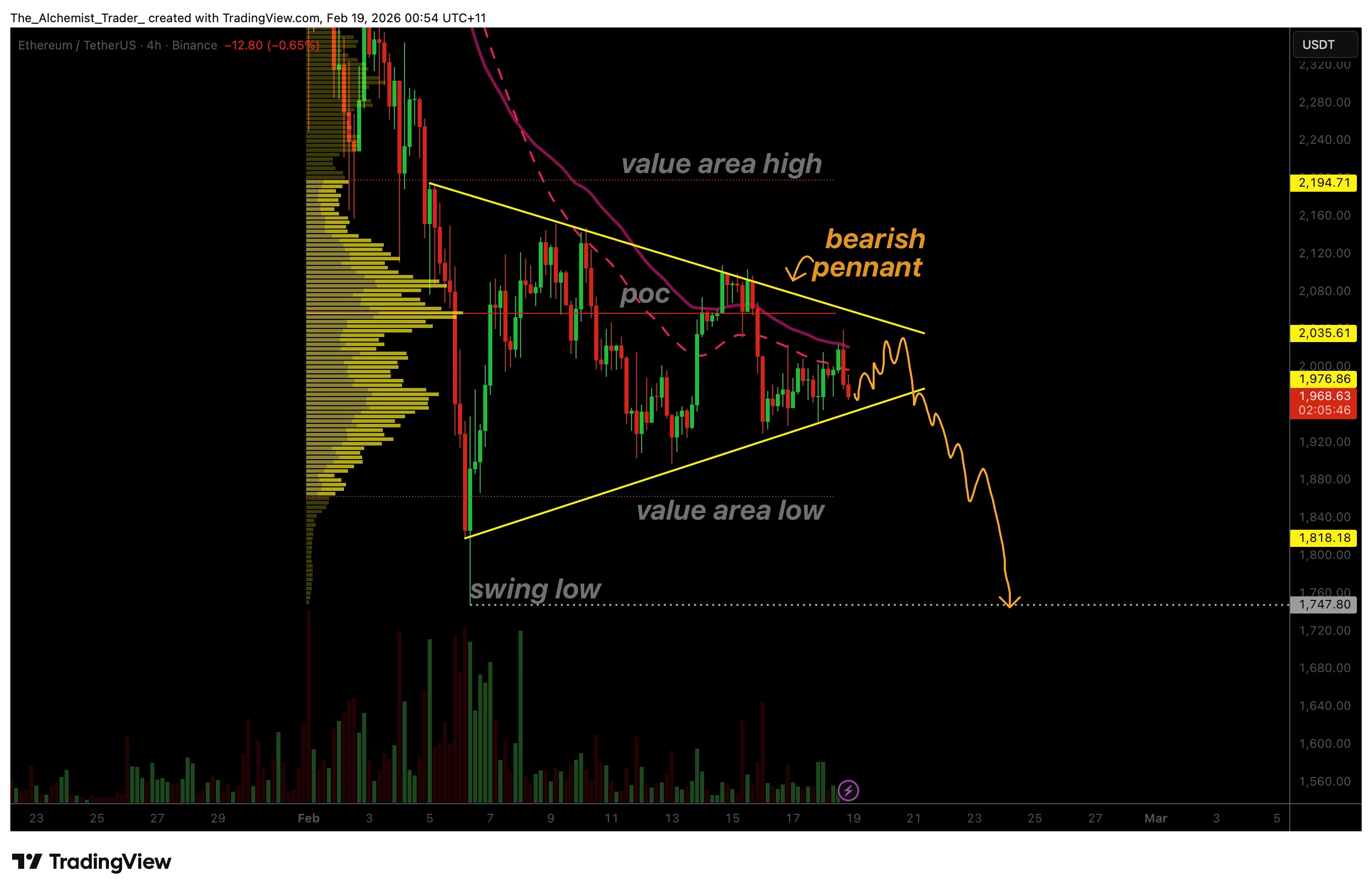
Ethereum’s current structure fits the classic definition of a pennant formation. Support and resistance are converging, forcing price into a tightening range that is approaching an apex. This compression phase reflects declining volatility, which is often visible on both price action and the volume profile.
Historically, pennants tend to resolve in the direction of the prior trend. In Ethereum’s case, the move leading into this consolidation was clearly bearish, marked by sustained selling pressure and weak follow-through on relief rallies. As a result, the probability favors a continuation lower once the structure resolves.
The closer price trades toward the apex, the more likely it is that volatility will return abruptly. Pennant breakouts are often sharp, leaving little room for reaction once the move begins.
Volume behavior is the key confirmation signal
One of the most important factors to monitor during pennant formations is volume. Ethereum’s consolidation has been accompanied by declining volume, which is typical during compression phases. This contraction in volume reflects reduced participation as traders wait for confirmation of direction.
For a bearish breakdown to be considered valid, it must be accompanied by increasing bearish volume. A strong expansion in sell-side volume would confirm that sellers are regaining control and that the breakout is not a false move. Without this confirmation, any break risks being short-lived or reversing back into the range.
Volume, therefore, will be the deciding factor in determining whether Ethereum’s next move develops into a sustained trend or a temporary spike.
$1,740 swing low comes into focus
If Ethereum breaks down from the bearish pennant with volume confirmation, the next major downside target sits at the $1,740 swing low. This level represents the most recent structural low and a natural magnet for price if downside momentum accelerates.
Markets often revisit prior swing lows during corrective or continuation phases to test demand and clear remaining liquidity. A move toward $1,740 would align with the broader bearish structure and reflect a continuation of the prevailing trend.
How price reacts at that level will be critical. A sharp rejection could lead to a short-term bounce, while acceptance below it would expose Ethereum to deeper downside risk.
Market structure remains bearish
From a market structure perspective, Ethereum has not yet shown signs of reversal. Lower highs remain intact, and no meaningful reclaim of resistance has occurred. Until price breaks above the upper boundary of the pennant and holds with volume, rallies should be treated as corrective rather than trend-changing.
This reinforces the idea that the current pennant is more likely a continuation pattern than a base for reversal. Structural confirmation will only come after the market resolves decisively out of compression.
What to expect in the coming price action
From a technical, price action, and market structure perspective, Ethereum is approaching a moment of expansion. The bearish pennant suggests that the market is storing energy for a directional move, with downside continuation favored due to the prevailing trend.
In the near term, traders should expect increased volatility as price reaches the apex of the structure. A breakdown backed by strong bearish volume would legitimize a move toward the $1,740 swing low. Conversely, a lack of volume or a failed breakdown would signal continued consolidation.
Until proven otherwise, Ethereum remains vulnerable to downside continuation, and the next breakout from this pennant is likely to define short-term market direction.


Hyperliquid (HYPE), a blockchain-based exchange that processed more than $250 billion in perpetual futures trading last month, has launched a U.S. lobbying and research arm aimed at shaping how lawmakers regulate decentralized finance (DeFi).
The Hyperliquid Policy Center, a Washington, D.C.-based nonprofit, will focus on regulatory frameworks for decentralized exchanges, perpetual futures and blockchain-based market infrastructure, according to a Wednesday press release.
Jake Chervinsky, a prominent crypto lawyer and former policy head at the Blockchain Association, will serve as founder and CEO.
The launch comes as Congress and federal agencies debate how to oversee crypto trading platforms and derivatives markets. Perpetual futures, which allow traders to hold leveraged positions without an expiration date, are widely used on offshore venues but remain a gray area under U.S. law.
The arrival of a new group also represents just the latest entrant into a Washington crypto-policy scene that’s jammed with similar organizations, including the DeFi Education Fund and Solana Policy Institute, in addition to the broader groups such as the Digital Chamber, Blockchain Association and Crypto Council for Innovation. And the new organization lands as negotiation is well underway on Senate legislation that may set U.S. DeFi policy.
Hyperliquid operates a decentralized exchange that lets users trade perpetual futures directly on blockchain rails without a central intermediary. Instead of routing trades through a traditional broker or clearinghouse, transactions settle onchain.
The platform has emerged as one of the fastest-growing venues in crypto derivatives. It handled more than $250 billion in perpetual trading volume and $6.6 billion spot volume over the past month, DefiLlama data shows.
“Financial markets are migrating onto public blockchains because they offer efficiency, transparency and resilience that legacy systems cannot match,” Chervinsky said in a statement.
“Now the United States must choose: We can either adopt new rules that allow this innovation to flourish here at home, or we can wait and watch as other nations seize the opportunity,” he added.
The new policy group plans to brief lawmakers, publish technical research and advocate for rules tailored to decentralized systems, the press release said.
The Hyper Foundation, which supports the Hyperliquid ecosystem, is contributing 1 million HYPE tokens, worth roughly $29 million, to fund the launch. While that’s less than was committed to the launch last year of the Ripple-backed National Cryptocurrency Association, it’s much more than the $5.6 million the Digital Chamber spent in 2024 or the $8.3 million spent by the Blockchain Association, according to public filings.


BitMEX co-founder Arthur Hayes says bitcoin’s recent 52% crash from its October all-time high is flashing a critical warning signal — but the crypto could ultimately soar to new records once the Federal Reserve responds to an AI-driven banking crisis he believes is imminent.
In his latest essay, “This Is Fine,” Hayes argued that bitcoin’s divergence from traditional tech stocks reveals its role as the “global fiat liquidity fire alarm.” While the Nasdaq has remained relatively flat, bitcoin has plunged from $126,000 to its current $67,000, pricing in what Hayes describes as a massive credit destruction event that equity markets have yet to acknowledge.
“Bitcoin is the most responsive freely traded asset to the fiat credit supply,” Hayes wrote. “The divergence recently between bitcoin and the Nasdaq sounds the alarm that a massive credit destruction event is nigh.”
Hayes models a scenario where artificial intelligence displaces just 20% of America’s 72.1 million knowledge workers, triggering approximately $557 billion in consumer credit and mortgage defaults — about half the severity of the 2008 financial crisis. This AI-driven shock would devastate regional banks and force the Federal Reserve into “the biggest money printing in history,” he predicts.
“Deflation is bad, but ultimately good for fiat credit-sensitive assets like Bitcoin,” said Hayes. “First, the market prices the impact … Then … the monetary mandarins panic and press that Brrrr button harder than I shred pow the morning after a one-meter dump.”
Hayes noted gold’s recent gains, particularly against bitcoin, as another red flag, stating that “a surging gold versus a slumping Bitcoin clearly tells us that a deflationary risk-off credit event within Pax Americana is brewing.”
Hayes said that once the Fed intervenes with emergency liquidity measures — similar to the March 2023 response to regional bank failures — bitcoin will “pump decisively off its lows” and the expectation of sustained money printing will drive it to new all-time highs.
That doesn’t mean there won’t be more pain ahead for the foreseeable future, said Hayes. He warned bitcoin could fall further before the Fed acts, potentially breaking below $60,000 as political dysfunction delays the central bank’s response. Crypto investors, he advised, should stay liquid, avoid leverage, and “wait for the all-clear from the Fed that it’s time to dump filthy fiat and ape into risky assets with wanton abandon.”


The stablecoin is built in collaboration with M0 and returns T-bill yields to ecosystem applications.
Upcoming Layer 1 blockchain Nexus has unveiled its native rewards stablecoin, USDx.
USDx will serve as the Nexus ecosystem’s native dollar and will implement a Global Yield Distribution System (GYDS), under which applications that hold USDx earn a share of protocol revenue based on their users’ USDx holdings.
The design is intended to provide yield as a revenue stream for the ecosystem’s application layer, incentivizing each underlying protocol to integrate USDx.
Through USDx, Nexus aims to unify its ecosystem around a shared currency layer that aligns its applications and incentivizes them to drive conversions of USDT and USDC to USDx.
Nexus focuses on “verifiable finance,” where every layer and transaction in the ecosystem can be independently verified via cryptographic proofs without sacrificing privacy. The design is built on Nexus’ zero-knowledge virtual machine (zkVM), enabling verifiability without disclosing individual users’ sensitive information.
Nexus raised $27.2 million over two investment rounds between December 2022 and June 2024, with a seed round led by Dragonfly, and a Series A led by Pantera and Lightspeed.
CEO Daniel Marin told The Defiant that USDx is fully backed by U.S. Treasuries, but did not disclose an exact formula for how the yield will be distributed. “Applications and users that receive USDX-generated yield will do so according to their contributions to the protocol, such as TVL and volume, and as determined from time-to-time by the protocol’s monetary policy,” Marin said.
Marin did not directly explain why the yield is distributed to the application layer rather than to users who exchange their legacy stablecoins for USDx.
“USDx gives us the opportunity to create a new kind of economic design that allows Nexus to support decentralized governance, onchain activities, as well as yield streaming, all with the goal of building a system that aligns incentives for the protocol, developers, and users,” he said.
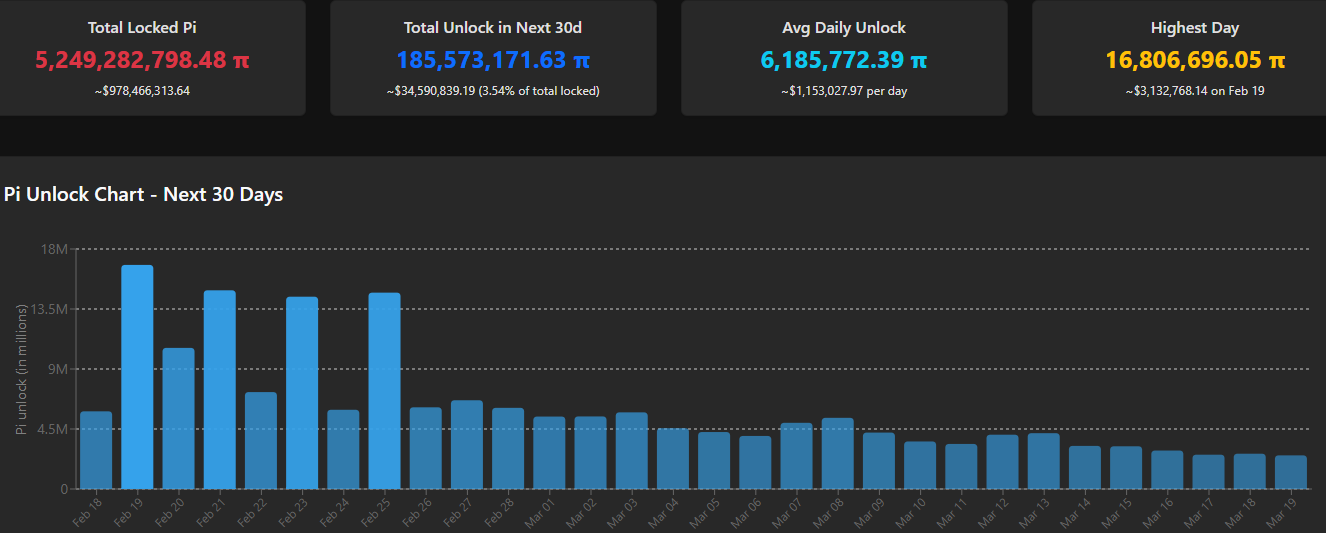
We will also review the latest price performace of the PI token, which has been rather impressive after last week’s crash.
The Core Team issued an important reminder about a deadline that has now past and the community is expecting updates on the nodes front.
We will also take a look at some of the criticism of the project, as well as the PI’s price resurgance.
Pi Network’s Latest Deadline
Recall that at the end of the previous business week, the team behind the protocol issued an important reminder for Pi Network nodes, describing them as the “fourth role” in the ecosystem. The reason for the February 15 deadline is because the team promised a new series of upgrades to be introduced soon. Nodes had to comply by that date; otherwise, they risked being disconnected from the network.
All nodes were prompted to use laptops or desktops instead of mobile phones. Although the deadline has passed now, the team has yet to publish any additional information about the number of nodes that have completed the necessary step or provide any extensions.
Criticism Grows
On the first Friday of February, the Core Team said they celebrated Pi Network moderators. They published a designated video praising this vital part of the overall ecosystem, indicating that moderators are volunteers not employed or paid by the official Pi Network team, who help moderate chats, answer Pioneers’ questions, monitor Pi apps and products, report bugs, and test new features.
The project’s community, though, was not in a celebratory mood. Many criticized the Core Team for a lack of transparency, clear planning, and failure to implement working KYC solutions. Some urged the team to “speed up the progress” and stop messing around with “all that superficial nonsense.” Others said they had been waiting for over seven years to migrate their Pi coins to no avail.
Separately, one user going by the X handle ‘pinetworkmembers’ addressed the PI token’s massive price calamity and drop to new all-time lows of $0.1312 last week. They blamed the team for failing to introduce a “functioning mainnet after years of promises, no real-world utility beyond ‘keep the app open,’ and a whole lot of mobile mining theater.”
You may also like:
PI’s Revival
As mentioned above, the project’s native token was hit hard during the broader market’s correction last week, plunging to a fresh low. However, while the cards were stacked against it, PI went on an impressive run in the following days and rocketed to over $0.20 during the weekend, prompting other Pioneers to celebrate the revival.
One popular analyst predicted a massive 500% surge, and hinted about buying some PI “for the midterm.” As of press time, PI remains the top performer on a weekly basis, having jumped 40% despite retracing to under $0.19.
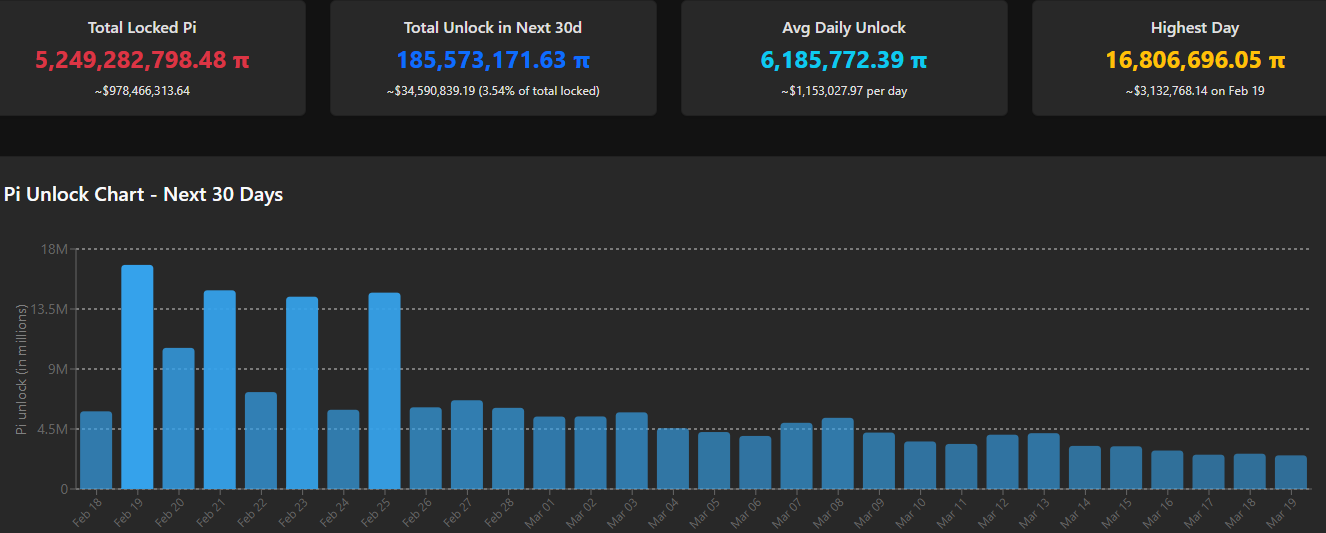
PiScan data shows a sizeable reduction in the number of coins to be unlocked on average in the following month, down to under 6.2 million daily from well over 7.5 million last week. This could further ease the asset’s immediate selling pressure.
SECRET PARTNERSHIP BONUS for CryptoPotato readers: Use this link to register and unlock $1,500 in exclusive BingX Exchange rewards (limited time offer).
Disclaimer: Information found on CryptoPotato is those of writers quoted. It does not represent the opinions of CryptoPotato on whether to buy, sell, or hold any investments. You are advised to conduct your own research before making any investment decisions. Use provided information at your own risk. See Disclaimer for more information.


Investment manager Brevan Howard’s cryptocurrency fund fell almost 30% last year as the bitcoin bull run faltered, the Financial Times (FT) reported on Wednesday.
The BH Digital Asset fund lost 29.5% of its value, its worst performance in a calendar year since its inception in 2021, according to the report, which cited people familiar with the fund’s performance. The fund underperformed bitcoin, which lost 6% in the period.
BH Digital Asset, which invests in crypto tokens and digital asset-related companies, enjoyed gains of 43% and 52% in 2023 and 2024, respectively, as the crypto market recovered from the lows of 2022 and the bitcoin price eclipsed $100,000 in December 2024.
“There are a lot of private equity and venture capital type instruments [in BH Digital Asset],” said one hedge fund investor, according to the FT’s report. “They have underperformed bitcoin but to give them credit, last year was terrible for crypto.”
Brevan Howard did not immediately respond to CoinDesk’s request for further comment.


It was only a matter of time before “vibe-coded” smart contracts led to a significant loss of funds and on Sunday, an oracle misconfiguration led to users of DeFi lending platform Moonwell being liquidated for a total of 1,096 Coinbase Wrapped Staked Ether (cbETH).
The protocol was also saddled with $1.8 million worth of bad debt as a result.
The error was introduced in pull request 578, submitted by Moonwell core contributor “anajuliabit” and co-authored by Claude Opus 4.6.
Including this incident, Moonwell has suffered three oracle malfunctions in the past six months, leading to over $7 million in bad debt.
Read more: Claude AI plugins can now vibe code smart contracts
cbETH = $1.12
Moonwell’s post-mortem report states that, this time, the issue lies in calculating the dollar price of cbETH.
“The oracle used only the raw cbETH/ETH exchange rate. This misconfiguration caused the oracle to report cbETH’s price as approximately $1.12 (reflecting the cbETH/ETH ratio of ~1.12) rather than the intended market value of roughly $2,200,” the report explains.
As a result, the error “wiped out most or all of the cbETH collateral for many borrowers.”
A total of 1,096 cbETH was liquidated. In turn, $1.78 million worth of bad debt was generated for the protocol.
Monitoring systems picked up the discrepancy and strict borrow and supply caps were set to prevent further interaction.
Despite this, liquidation of existing positions continued. Any oracle correction requires “a five-day governance voting and timelock period, which could not be bypassed.”
Trading Strategy’s Mikko Ohtamaa pointed out that “regardless of whether the code is written by an AI or by a human, these kinds of errors are caught in an automated integration test suite.”
He highlights that Claude can even write these tests itself, but that in this case “there was no test case for price sanity.”
Others highlighted the contributor’s GitHub profile which shows an extremely high workrate, over 1,000 commits in the past week.
Read more: Clawdbot creator Peter Steinberger: ‘Crypto folks, stop harassing me’
The dark side of the moon
Moonwell is a lending protocol active on the Base, Optimism, and Moonbeam networks. It holds around $90 million in total value locked (TVL), according to DeFiLlama data, down from a peak of $380 million in August last year.
Since then, the project has suffered a number of hiccups.
DeFi commentary account “Yieldsandmore” details two further incidents in recent months. The first came during last year’s infamous October 10 crash, when a pricing discrepancy between Chainlink feeds and decentralized exchanges on Base led to $12 million in liquidations and $1.7 million of bad debt.
The second came less than a month later, on November 4, when the $129 million Balancer hack had a knock on effect on Moonwell’s market-based wrsETH/ETH oracle, leading to $3.7 million of bad debt.
The two incidents were apparently exploited by the same attacker, who is “clearly constantly scanning Moonwell for extractable value.”
Previously, 2022’s $190 million Nomad Bridge hack devastated the protocol’s Moonbeam deployment, its sole instance at the time.
The incident saw TVL drop 80%, from over $100 million to just $21 million.
Got a tip? Send us an email securely via Protos Leaks. For more informed news, follow us on X, Bluesky, and Google News, or subscribe to our YouTube channel.

[PRESS RELEASE – Panama City, Republic of Panama, February 18th, 2026]
Sai today launched Sai Perps, a perpetuals trading platform built to be as fast and intuitive as a centralized exchange with the transparency and self-custody of on-chain settlement. The platform features gasless transactions, removing friction for traders while maintaining full on-chain security.
Sai also unveiled Let’s Go Saicho, a one-month on-chain trading competition running from February 18 through March 19, 2026, with $25,000 in total prizes. The campaign is structured in two phases designed to reward both performance and participation: a PNL competition for profitable traders, followed by a first-come, first-serve “Be Early” phase for traders who engage early and hit a minimum volume threshold.
“On-chain markets shouldn’t require traders to compromise between speed and self-custody,” said Matthias Darblade, a Sai contributor. “Sai Perps is designed for active traders who want a clean, CEX-like experience, while still getting the transparency and settlement guarantees that only on-chain infrastructure can provide.”
Why Sai vs. Other Perps DEXs
Sai Perps is built around the premise: trading should be accessible without the usual friction of on-chain perps. Compared to existing perpDEXs, Sai stands out in many ways:
- CEX-like UX, on-chain settlement: A streamlined trading experience designed to be fast and familiar, with trades settling on-chain for transparency and verifiability.
- Infrastructure built for deep, smooth markets: Sai has focused heavily on liquidity, risk systems, and oracle design to support more consistent execution and robust market integrity.
- Accessible to both new and experienced traders: A platform experience optimized for speed and clarity, without sacrificing advanced trading capability.
- Roadmap beyond crypto perps: Sai’s planned expansion includes stocks, commodities, and FX markets, plus user-focused capital efficiency features like Sai Savings (yield on deposits), and cross-chain deposits.
Let’s Go Saicho: $25,000 Trading Competition (Feb 18 – Mar 19, 2026)
Let’s Go Saicho is a one-month competition rewarding trading on Sai across two two-week phases:
- Phase 1 (Feb 18 – Mar 4): PNL Competition | $20,000 prize pool, 50 winners
- Phase 2 (Mar 5 – Mar 19): Be Early (First Come First Serve) | $5,000 prize pool, 50 winners
All markets listed on Sai are eligible in both phases. Traders may go long or short on any listed pair using supported collateral (e.g., USDC and other supported assets such as stNIBI, as available on Sai). For more details on Sai’s Trading Competition, visit here.
About Sai
Sai is a new perpetuals trading platform designed to feel as easy and fast as a centralized exchange, while still settling fully on-chain. Sai’s mission is to make advanced trading accessible without sacrificing transparency or self-custody.
Sai is focused on finalizing its core trading infrastructure and user experience, building liquidity and risk systems for smoother execution, and laying the groundwork for yield features that help users earn on idle collateral. Next on the roadmap: expanded markets (stocks, commodities, FX), Sai Savings, cross-chain deposits, and smart accounts for gasless trading.
SECRET PARTNERSHIP BONUS for CryptoPotato readers: Use this link to register and unlock $1,500 in exclusive BingX Exchange rewards (limited time offer).

The European Central Bank (ECB) is moving closer to a pilot for a digital euro, with Executive Board Member Piero Cipollone outlining plans to begin selecting payment service providers (PSPs) in early 2026, ahead of a 12-month test scheduled for the second half of 2027.
Cipollone on Wednesday held an executive committee meeting of the Italian Banking Association. He said the pilot would involve a limited number of payment service providers, merchants and Eurosystem staff. Selection of participating providers is expected to start in the first quarter of 2026.
Cipollone said the digital euro will be designed to ensure it protects European card schemes and keeps banks at the core of the Eurozone payments system, according to Reuters.
Pilot could give PSPs an early start
European Union-licensed PSPs will be at the core of digital euro distribution, Cipollone said. For participating PSPs, the pilot offers an early-readiness advantage ahead of a potential broader rollout, including hands-on experience with onboarding, settlement and liquidity management.

He added that it also provides clearer visibility on future infrastructure, compliance and staffing costs, helping companies plan investments more accurately.
With direct Eurosystem support and the ability to feed into the design process, participants should gain both operational insight and influence over how the digital euro ultimately takes shape.
Stablecoins are not the only threat to banks, says Cipollone
The digital euro pilot is also intended to protect domestic European payment projects, such as Italy’s Bancomat card network and Spain’s Bizum peer-to-peer system.
“Banks could lose their role in payments not just because of stablecoins but also due to other private solutions,” Cipollone said, pointing to Europe’s heavy reliance on international card networks like Visa and Mastercard.

He added that the digital euro would be structured to preserve the competitiveness of local systems.
“The cap on the fee that merchants will pay on the digital euro network will be lower than what the international payments network, normally the costlier, charge, but higher than what domestic payments scheme, normally the cheapest, charge,” Cipollone said.
Cointelegraph contacted the ECB for comment on the PSP selection but had not received a response by publication.
Related: Lagarde early exit report puts ECB succession and digital euro in focus
The news marks a milestone in the digital euro pilot after the ECB officially moved to the next phase of the project in October 2025, targeting a launch in 2029.
The central bank then projected that a pilot exercise could start in 2027 if legislation is put in place during the course of 2026.
Magazine: Is China hoarding gold so yuan becomes global reserve instead of USD?
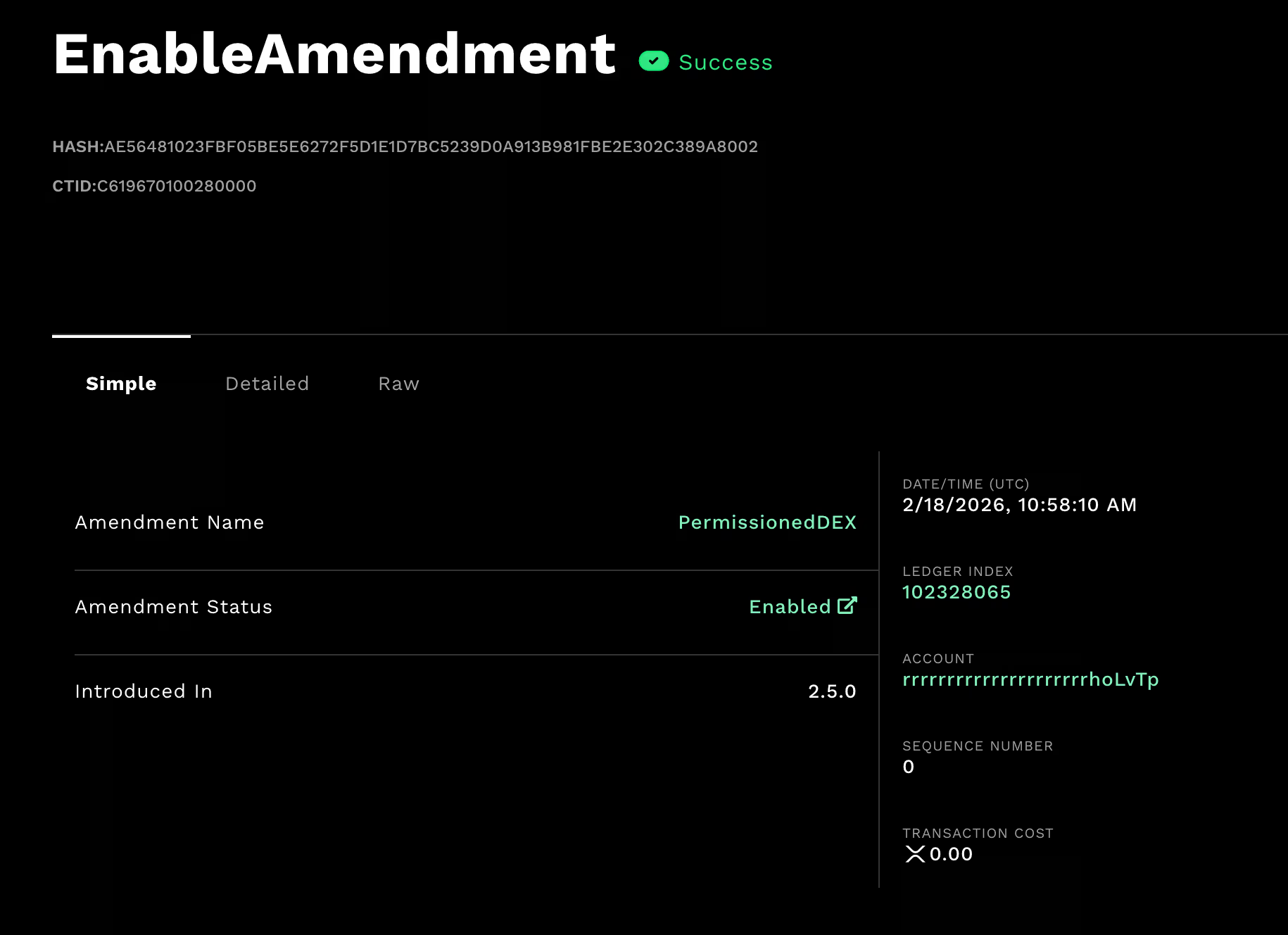
The XRP Ledger has activated a new “Permissioned DEX” amendment, a technical upgrade designed to let regulated institutions trade on XRPL without opening markets to everyone.
The change, known as XLS-81, allows the creation of permissioned decentralized exchanges that work like XRPL’s existing built-in DEX, but with a key difference.

A permissioned domain can restrict who is allowed to place offers and who is allowed to accept them, creating a gated trading venue where participation can be tied to compliance requirements such as KYC and AML checks.
Think of it as a ‘members only’ marketplace, while still keeping the trading mechanics native to the ledger.
The feature is aimed at banks, brokers and other firms that may want onchain settlement and liquidity but cannot interact with fully open DeFi markets. For these players, the ability to control access is not optional but forms the minimum requirement.
The activation also adds to a growing set of “institutional DeFi” primitives XRPL has been rolling out this month. Token Escrow, or XLS-85, went live last week, extending XRPL’s native escrow system beyond XRP to all trustline-based tokens and Multi-Purpose Tokens, including stablecoins such as RLUSD and tokenized real-world assets.
Together, the two upgrades create a more complete toolkit for regulated finance on XRPL. Token escrow allows conditional settlement for assets issued on the network, while the permissioned DEX provides a controlled venue for trading them.
That combination is central to use cases like tokenized funds, stablecoin FX rails, and regulated secondary markets for tokenized assets.
While the changes are unlikely to matter to most retail traders day to day, they signal XRPL’s direction. It is building infrastructure for institutions first, even if that means leaning into gated markets rather than the fully open DeFi model that defined the last cycle.

Amazon delivery driver rescued after GPS sends van onto UK mudflats

Ethereum price prints bearish pennant as breakdown risk grows

Alexandra Vivona: The fear and loathing in Gorton and Denton


-

 Sports7 days ago
Big Tech enters cricket ecosystem as ICC partners Google ahead of T20 WC | T20 World Cup 2026
-

 Video2 days ago
Bitcoin: We’re Entering The Most Dangerous Phase
-

 Tech4 days ago
Luxman Enters Its Second Century with the D-100 SACD Player and L-100 Integrated Amplifier
-

 Video5 days ago
The Final Warning: XRP Is Entering The Chaos Zone
-
 Tech1 day ago
The Music Industry Enters Its Less-Is-More Era
-

 Sports1 day ago
GB's semi-final hopes hang by thread after loss to Switzerland
-

 Crypto World1 day ago
Can XRP Price Successfully Register a 33% Breakout Past $2?
-

 Business15 hours ago
Infosys Limited (INFY) Discusses Tech Transitions and the Unique Aspects of the AI Era Transcript
-

 Video1 day ago
Financial Statement Analysis | Complete Chapter Revision in 10 Minutes | Class 12 Board exam 2026
-

 Tech6 hours ago
Retro Rover: LT6502 Laptop Packs 8-Bit Power On The Go
-
 Crypto World5 days ago
Bhutan’s Bitcoin sales enter third straight week with $6.7M BTC offload
-
 Crypto World7 days ago
Pippin (PIPPIN) Enters Crypto’s Top 100 Club After Soaring 30% in a Day: More Room for Growth?
-

 Video6 days ago
Prepare: We Are Entering Phase 3 Of The Investing Cycle
-
 NewsBeat3 days ago
The strange Cambridgeshire cemetery that forbade church rectors from entering
-

 Business6 days ago
Barbeques Galore Enters Voluntary Administration
-

 Business8 hours ago
Tesla avoids California suspension after ending ‘autopilot’ marketing
-
 Crypto World6 days ago
Ethereum Price Struggles Below $2,000 Despite Entering Buy Zone
-
 NewsBeat3 days ago
Man dies after entering floodwater during police pursuit
-

 Crypto World5 days ago
Kalshi enters $9B sports insurance market with new brokerage deal
-

 Entertainment2 hours ago
Kunal Nayyar’s Secret Acts Of Kindness Sparks Online Discussion