
Crypto World
North Korea terror victims escalate fight to seize $71 million from Aave hack



Lawyers seeking to seize $71 million in frozen ether for victims of North Korean terrorism changed their legal strategy Tuesday, arguing in a new court filing that the April 18 rsETH exploit was not theft but fraud, directly countering Aave’s attempt to void a restraining notice blocking the release of the assets.
In a 30-page opposition brief filed in the Southern District of New York, a lawyer representing the North Korean terror victims argues the exploit was not a smash-and-grab theft but a fraudulent lending transaction, and that under longstanding U.S. law, fraudsters who acquire property through deception can obtain legal title to it, even if that ownership is later reversible.
“What actually happened is that North Korea borrowed assets from users of the ‘Aave Protocol’ and did not pay it back, and when the ‘Aave Protocol’ sought to liquidate North Korea’s collateral, the ‘Aave Protocol’ unhappily discovered that the collateral was worthless,” the new filing reads.
“The law is crystal clear that a fraud victim passes title, not merely possession, to a fraudster… Charles Ponzi obtained, through his now-eponymous scheme, ‘defeasible title’ to his victims’ cash,” it continues.
The dispute traces to a cross-chain bridge exploit last month that drained roughly $230 million from Aave, the largest decentralized lending protocol by total value locked.
An attacker, widely attributed to North Korea’s Lazarus Group by forensics firms including Chainalysis and TRM Labs, minted unbacked rsETH tokens, used them as collateral on Aave’s lending markets, and borrowed real ether against the worthless deposits.
Developers tied to the Arbitrum blockchain later intercepted about $71 million before it could be cashed out.
The filing also escalates the dispute beyond New York property law, invoking the Terrorism Risk Insurance Act (TRIA), a post-9/11 federal law that allows people who win court judgments against state sponsors of terrorism to collect those judgments from any U.S.-held property belonging to the country in question.
If the court accepts that theory, Aave’s earlier arguments about New York property law may matter less.
The filing also asks whether Aave has legal standing to challenge the freeze at all, citing the company’s own terms of service, which state that it does not have “possession, custody or control” over user assets, a core aspect of decentralized finance.
Lawyers also pointed out in the filing that the affected users may not need the frozen ether at all. DeFi United, an industry-led recovery fund Aave itself is part of, has raised $327.95 million as of Tuesday morning — more than four times the disputed $71 million.
A hearing is scheduled for Wednesday, May 6, in a Manhattan federal court.

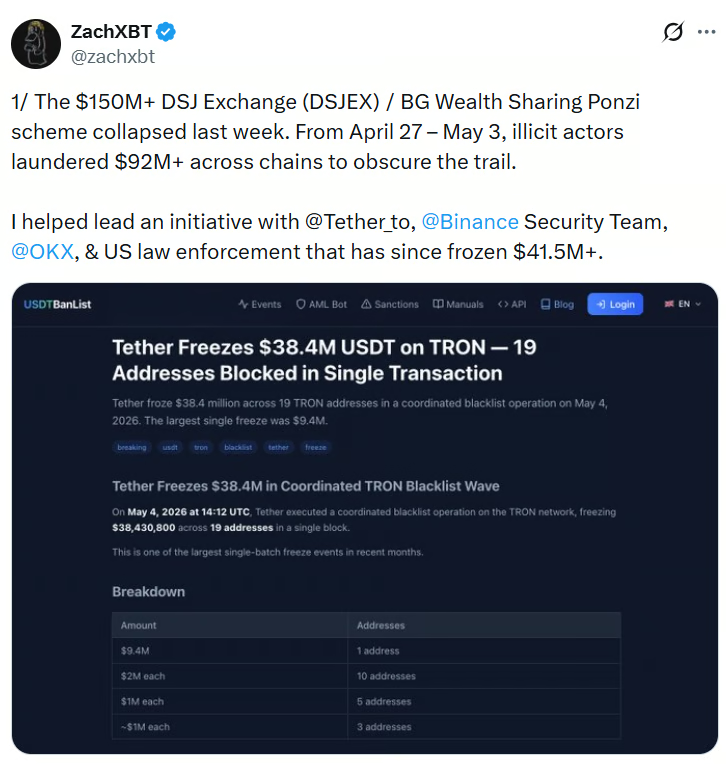
Investment group BG Wealth Sharing, a suspected $150 million crypto Ponzi scheme, has had its domain seized by law enforcement days after allegedly rug-pulling users.
Onchain sleuth ZachXBT said on X on Tuesday that “illicit actors” connected to the group tried to launder more than $92 million in crypto between April 27 and Sunday, but he helped lead an initiative that froze more than $41 million, working alongside Tether, Binance, OKX and US law enforcement.
He also said the scheme was likely responsible for losses greater than $150 million, given it’s been operating since 2025 and the “thousands of victim exchange withdrawals identified.”
“While these Chinese investment frauds are obvious to most, they purposely target unsophisticated retail investors via social media,” ZachXBT added. “Reading through victim posts, many still seem to be in denial that they were scammed.”
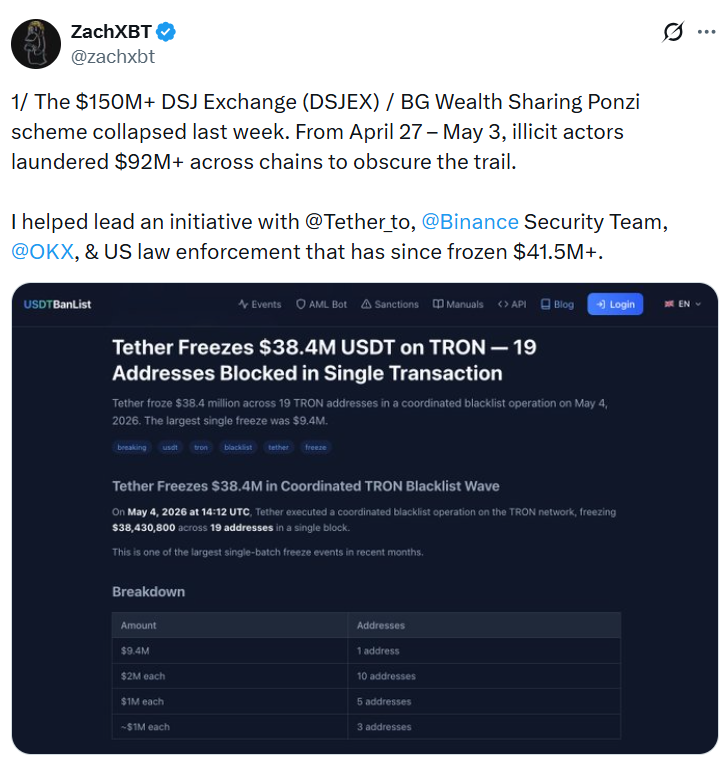
Source: ZachXBT
The US Federal Bureau of Investigation reported in April that American victims lost $21 billion to cyber-enabled crime last year, with crypto investment scams accounting for a large share of the losses.
BG Wealth Sharing domain seized by US law enforcement
As of Wednesday, the BG Wealth Sharing website displays a notice that it was seized by US law enforcement as part of a joint operation between Operation Level Up and the Scam Center Strike Force.
Several regulators had warned that BG Wealth Sharing was an unlicensed entity and advised caution since 2025. In April, the Central Bank of Samoa said it was an investment scam and advised investors to avoid the company.

A domain linked to BG Wealth Sharing has been seized by US authorities. Source: BG Wealth Sharing
BG Wealth Sharing, according to authorities, claimed to provide guidance on crypto trading, advertised heavily on social media and offered “daily profit opportunities,” referral commissions, rank-based bonuses and a daily yield of 1.3% to 2.6%.
Related: Google Cloud flags North Korea-linked crypto malware campaign
One last rug pull before going offline, users say
Before BG Wealth Sharing went offline, purported CEO Stephen Beard told users in a video address Saturday that its DSJ Exchange was on the cusp of an initial public offering and that a 12% tax on account balances was required as part of the regulatory process.

BG Wealth Sharing CEO Stephen Beard told users a 12% tax on account balances was required as part of an initial public offering process. Source: ZachXBT
By Sunday, users warned on social media that the whole scheme was a rug pull in progress. On Monday, the Washington State Department of Financial Institutions issued a similar warning.
In an update to its earlier post about BG Wealth Sharing, the regulator said it had received complaints from investors and warned that it was likely a scam.
“A company that requires an investor to deposit additional external funds in order to withdraw their investment is highly likely to be operating an advance fee scam.”
Magazine: DeFi’s billion-dollar secret: The insiders responsible for hacks

Anchorage Digital is rolling out an agentic banking infrastructure designed to let AI agents access and move money across both traditional financial rails and crypto payment networks. Announced by Anchorage co-founder and CEO Nathan McCauley, the move aims to give autonomous agents the kind of programmable financial access that proponents say will underpin a new wave of AI-enabled commerce—an opportunity some insiders estimate could reach into the trillions of dollars.
Speaking at Consensus 2026 in Miami, McCauley framed the development as part of a broader shift toward automation in treasury, payments, and procurement—performed by systems that weren’t built for non-human actors. The launch coincides with a strategic partnership with Google Cloud, which will provide an intelligence layer that enables AI agents to discover, negotiate, and coordinate with one another. McCauley described the project as a foundational step toward a future where agents can transact across both fiat and crypto rails, with governance and compliance baked in from the start.
Key takeaways
- Anchorage’s agentic banking infrastructure enables AI agents to transact with verifiable IDs, preset spending limits, permissions, and auditability to support regulatory compliance.
- The collaboration with Google Cloud supplies the intelligence layer that allows agents to discover, negotiate, and coordinate across financial ecosystems.
- Industry observers highlight a broader trend of banks, labs, and hyperscalers partnering to embed AI and automation into regulated financial infrastructure—moving beyond human-only processes.
- Parallel initiatives across crypto and fintech show multi-chain and cross-rail experimentation, including Solana’s gateway with Google Cloud for API payments in stablecoins and AI-enabled usage of USDT via virtual cards.
- Analysts and industry participants acknowledge substantial uncertainty around regulation, risk, and scale but emphasize the potential for a new market segment, potentially worth trillions of dollars, if adoption accelerates.
Anchorage’s agentic banking infrastructure
At the core of Anchorage’s announcement is a banking service designed to formalize what McCauley described as a shift toward agentic finance. AI agents would receive a verifiable identity and operate within predefined constraints — including spending limits, permissions, and policies — while maintaining robust auditability to satisfy regulatory expectations. In effect, the system aims to bridge non-human automation with traditional compliance frameworks, a balance many institutions have struggled to achieve as they explore automation across treasury, payments, and procurement.
“Institutions are experimenting with automation across treasury, payments, and procurement, but they’re doing it on top of systems that were never designed for non-human actors,” McCauley wrote, underscoring the gap the new service seeks to fill. The added layer of governance, coupled with the ability to transact on both fiat and crypto rails, could unlock new efficiencies for corporate treasuries, payment service providers, and AI-driven platforms seeking to streamline operations without sacrificing control.
The alliance with Google Cloud is central to this strategy. The two companies intend to give AI agents the tools to identify opportunities, negotiate terms, and coordinate actions with other agents in a trusted, auditable environment. The practical upshot is a more scalable, programmable financial fabric in which automated agents—not just humans—can initiate and complete transactions within a regulated framework.
Analysts familiar with Anchorage’s approach note that the combination of custody-grade security and AI-enabled automation could reshape how enterprises manage liquidity, settlement, and procurement. The emphasis on verifiable identity and policy-driven access is a deliberate attempt to address concerns around non-human actors operating in financial ecosystems, an area that regulators have flagged as critical as automation grows.
Industry momentum and ecosystem moves
The Anchorage unveiling sits within a broader wave of experimentation around agentic finance. In parallel, the Solana Foundation announced a gateway service with Google Cloud that enables AI agents to pay for APIs using stablecoins on the Solana network, extending the concept of AI-driven payments into another major blockchain ecosystem. The integration signals increasing interoperability among cloud providers, blockchains, and AI agents as developers explore scalable, programmable money flows.
Within the crypto wallet space, other initiatives are advancing the practical use of AI-enabled spend. Oobit, a Tether-backed wallet, rolled out a Visa-enabled virtual card enabling AI agents to make online purchases with USDT for business purposes. The card is funded directly from Tether’s treasury, allowing agents to operate with capital without repeatedly topping up through fiat on-ramps or currency conversions. Taken together, these developments illustrate a trend toward operationalizing agentic payments across multiple rails and formats.
Industry chatter around the pace and scale of such activity often references the potential demand from AI agents. Some industry observers, including Stripe, have argued that blockchains and associated infrastructure will need to handle a far larger volume of transactions per second to support AI-driven automation. While projections vary, the underlying argument is that agentic commerce could drive demand beyond the capacity of traditional networks if not scaled appropriately. McCauley’s own projection at Consensus 2026 framed the sector as a major trend for the coming decade, describing it as a trillion-dollar opportunity where agents pay other agents, pay merchants, and are paid themselves.
Oliver Segovia, a Ripple Labs researcher and former head of product marketing, commented on the collaboration’s broader implications. He suggested the trend signals closer cooperation between labs, regulated banks, and cloud-based infrastructure, with banks gradually building intelligence atop core systems while labs push automation deeper into regulated spaces. Such synergies could redefine who the primary ecosystem builders are in an era of AI-augmented finance.
Implications for investors, users, and builders
What Anchorage, Solana, and Oobit are unfolding is not just a single product launch but a signal of how future financial infrastructure could operate. For investors, the potential payoff hinges on adoption: will AI developers and corporations embrace agentic banking as a standard mechanism for automated operations, and will regulators keep pace with rapid innovation without stifling safety?
For developers and builders, the emphasis on identity, permissions, and auditability offers a model for designing autonomous financial agents that can operate transparently within legal and compliance boundaries. Such an approach could lower the friction for institutions to experiment with AI-driven treasury and payments workflows, while also introducing new kinds of risk management and oversight requirements that must be codified into product design.
From a regulatory perspective, the growing overlap between AI, automation, and regulated financial activity will likely attract heightened scrutiny. The challenge will be to establish standards that protect consumers and institutions without impeding innovation or creating unnecessary friction for compliant actors. Observers will be watching how these early pilot deployments interact with existing frameworks for programmatic money movement, identity verification, and anti-money-laundering controls.
Meanwhile, the market will be watching for tangible milestones: further integrations with major clouds, additional cross-rail expansions, and real-world use cases that demonstrate measurable gains in efficiency or security. If the trillion-dollar forecast outlined by McCauley materializes, it could redefine which players set the standards for interoperable, AI-enabled finance and how users access and manage funds across both traditional and crypto ecosystems.
What remains uncertain is how quickly financial institutions will embrace fully autonomous, policy-governed money movement at scale and how regulators will codify the responsible use of AI agents in payments and custody. Yet the wave of partnerships and pilot programs underway suggests a deliberate push toward more intelligent, automated financial infrastructure—one that could redefine how money moves in a rapidly evolving digital economy.
Readers should keep an eye on how these alliances evolve: whether more banks and fintechs adopt similar agentic frameworks, how AI agents manage risk across rails, and what regulatory guardrails emerge to safeguard both institutions and end users as automation becomes a core feature of everyday finance.
Crypto World
Crypto custodian Taurus moves straight into EU capital markets with MiFID license in Cyprus


Cryptocurrency custody firm Taurus has been granted a MiFID II investment license in Cyprus under the regulatory ambit of Mediterranean island’s regulator, the Cyprus Securities and Exchange Commission (CySEC).
The license enables Taurus to offer MiFID-regulated investment services for tokenized financial instruments to banks and asset managers across the European Union (EU), as well as secondary trading for tokenized bonds, fund shares, equities, and structured products, according to a press release on Wednesday.
“Banks like to face fully regulated entities that are similar to the one they used to work with,” Sébastien Dessimoz, co-founder and Managing Partner at Taurus, said in an interview.
“All the brokers in Europe are MiFID licensed firms, and Taurus is a broker also and now a MiFID licensed firm. So those banks and institutions can be sure we are subject to all the necessary guarantees – on top of that we’re onshore in Europe, which is also highly appreciated,” he added.
MiFID II (Markets in Financial Instruments Directive II) is the European Union’s core regulatory framework for investment services, trading venues, and financial assets such as equities, bonds, derivatives, and structured products. It is designed for traditional capital markets, meaning a MiFID license effectively allows firms to operate as regulated investment service providers across the EU.
The license, therefore, will help Taurus bridge its crypto-native infrastructure with the regulatory perimeter used by banks and asset managers, allowing it to offer tokenized securities to institutional clients in their preferred format.
Taurus already works on crypto custody and tokenization with the likes of Deutsche Bank, ClearBank, KBC, Santander, State Street, CACEIS, Pictet, and Swissquote. The firm also has a licence from Swiss regulator FINMA, and an EU Markets in Crypto Assets (MiCA) application is in the pipeline too, said Dessimoz.
As a fully regulated entity incorporated in Europe, Taurus can offer classical investment services for transferable securities, Dessimoz said, and also give clients the possibility to buy or sell distributed ledger technology (DLT) financial instruments such as tokenized equity, tokenized debt, tokenized fund shares; in other words, crypto-assets that qualify as MiFID financial instruments.
Several other firms, such as OKX, Gemini, Crypto.com, Kraken, Bitstamp, and Perpetuals.com, hold MiFID II licenses.

Key Takeaways
- Lumentum (LITE) surpassed Q3 projections with earnings per share of $2.37 versus analyst expectations of $2.26, while revenue hit $808.4 million—a 90% jump from last year.
- Shares declined 5.6% in extended trading despite robust performance, as market participants focused on long-term debt ballooning to $3.24 billion.
- Profitability metrics showed significant improvement, with adjusted gross margin reaching 47.9% and operating margin expanding to 32.2%, compared to 42.5% and 25.2% in the previous quarter.
- Fourth-quarter projections exceeded Wall Street forecasts, with EPS outlook of $2.85–$3.05 versus consensus of $2.69, and revenue projected at $960 million–$1.01 billion against estimates of $917.3 million.
- Year-to-date, LITE shares have surged approximately 164.8%, dramatically outperforming the S&P 500’s 5.2% advance during the same timeframe.
Lumentum (LITE) delivered what executives called their strongest quarterly performance ever on Tuesday, featuring 90% year-over-year revenue growth and earnings that handily exceeded Wall Street’s projections. Yet shares tumbled 5.6% in after-hours trading.
The optical technology company announced adjusted earnings per share of $2.37 for its fiscal third quarter ending March 28. This result exceeded the Street’s consensus forecast of $2.26 and marked a significant leap from $0.57 reported during the comparable period last year.
Quarterly revenue reached $808.4 million, topping analyst projections of $802.94 million. This represents substantial growth compared to the $425.2 million generated in the year-ago quarter.
Despite exceeding expectations across key metrics, investor sentiment turned negative. Market participants fixated on a dramatic escalation in the company’s current portion of long-term debt, which skyrocketed from $10.6 million to $3.24 billion within a single quarter. This substantial increase stems from funds raised through a convertible preferred stock offering completed in March 2026.
Chief Executive Michael Hurlston emphasized achievements beyond revenue acceleration. “While our top line growth continues to garner headlines, the more impressive part of our recent performance has been our margin expansion,” he stated.
Profitability Metrics Show Meaningful Improvement
Adjusted gross margin advanced to 47.9% from the previous quarter’s 42.5%. Meanwhile, adjusted operating margin improved to 32.2% from 25.2%. Hurlston credited these gains to disciplined pricing strategies, operational efficiency initiatives, and a favorable product portfolio mix featuring laser chips, pump lasers, and narrow linewidth laser assemblies.
Such consecutive quarterly margin improvements typically draw investor interest—though they also prompt questions regarding sustainability.
The 5.74% earnings beat extends an established pattern. Lumentum has now exceeded EPS estimates in each of the past four quarters. The preceding quarter delivered an even larger 18.44% surprise.
Forward Guidance Significantly Exceeds Expectations
For fiscal Q4 2026, Lumentum provided earnings guidance of $2.85 to $3.05 per share, with a midpoint of $2.95. Analyst consensus had called for $2.69.
Regarding revenue, management projected a range of $960 million to $1.01 billion, with a midpoint of $985 million—considerably above the $917.3 million consensus estimate.
Current full-year analyst expectations stand at $7.69 in earnings per share on $2.91 billion in total revenue.
Shares of LITE have climbed roughly 164.8% year-to-date, dramatically outpacing the S&P 500’s 5.2% return during the identical period.
Zacks Research presently assigns LITE a Hold rating (Rank #3), indicating expectations for market-inline performance in the near term.
The Communication – Components sector, where LITE operates, currently ranks within the top 10% among more than 250 industries tracked by Zacks.

Forward Industries and RockawayX have backed a $5 million funding round for OnRe, a startup building reinsurance infrastructure on the Solana blockchain.
Summary
- Forward Industries and RockawayX have co-led a $5M funding round for OnRe to build reinsurance infrastructure on Solana.
- Forward Industries plans to invest up to $25M into a Solana-based yield token tied to the platform.
- OnRe is working to move risk transfer processes on-chain using tokenization and smart contracts to attract institutional capital.
According to a statement from the companies, the two firms co-led the Series A round, with Forward Industries planning to commit up to $25 million into a Solana-based yield token issued through the platform. Capital from the raise is expected to support platform development and draw institutional participants into on-chain reinsurance markets.
OnRe’s model centres on moving parts of the reinsurance process onto blockchain systems, where insurers can transfer risk to third parties using tokenized structures and smart contracts. The company said this setup is designed to handle underwriting and capital allocation through automated, on-chain mechanisms.
Reinsurance, a sector where insurers pass portions of risk to external entities, represents a large segment of global finance. Industry estimates place the market size above $600 billion, while total premiums are closer to $2 trillion, driven by demand for risk transfer solutions.
Forward Industries’ involvement ties the effort closely to the Solana ecosystem. Industry data shows the Nasdaq-listed company holds more than 7.01 million SOL, making it the largest corporate holder of the token. Market data from Yahoo Finance showed Forward’s shares rose about 5.8% during Tuesday’s regular session before giving back most of those gains in after-hours trading, while SOL traded at $86.61, up about 2.7% at last check.
Blockchain-based reinsurance platforms are being tested as a way to replace manual workflows with shared ledgers that allow real-time tracking, underwriting, and claims processing. Developers in the space argue such systems can improve efficiency, though adoption remains limited.
OnRe is entering a field that already includes other blockchain-native projects. Re, a decentralized reinsurance protocol, is also working to connect institutional capital with insured risk while offering tokenized yield exposure. Additional protocols have emerged to cover smart contract and decentralized finance risks, though most remain in early development stages.
Experiments are not limited to startups. Insurance broker Aon has tested stablecoin payments for insurance premiums as part of its digital asset initiatives. Tim Fletcher, CEO of Aon’s financial services division, said tokenized assets are likely to become increasingly integrated into traditional financial systems.

Key Takeaways
- Q1 2026 earnings from AppLovin arrive May 6, with options markets indicating a potential 12.52% post-report move.
- Consensus estimates point to EPS between $3.44 and $3.64, with revenue projected at $1.77–$1.78B, representing ~20% annual growth.
- Key focal points include the Axon AI advertising platform and expansion into e-commerce verticals.
- The company maintains a perfect revenue beat streak spanning the last two years.
- Analysts set an average target of $62.73, suggesting potential upside of approximately 37.7%.
AppLovin approaches its Q1 2026 financial disclosure scheduled for May 6 with APP stock trading near $45.60, reflecting a 17% climb over the previous three-month period.
The options market anticipates a 12.52% swing in either direction following the announcement — indicating elevated investor expectations and significant market uncertainty.
Consensus estimates from Wall Street analysts project quarterly earnings between $3.44 and $3.64 per share, marking substantial growth from the $1.67 reported in the year-ago quarter. Revenue forecasts cluster around $1.77–$1.78 billion, representing approximately 20% year-over-year expansion from the $1.48 billion recorded previously.
These projections are ambitious. Yet AppLovin has consistently delivered, surpassing revenue expectations in every single quarter throughout the past 24 months.
The Axon Platform Remains Central to Investment Thesis
Analyst focus centers squarely on Axon, AppLovin’s artificial intelligence-driven advertising platform. Market observers are keen to assess whether Axon 2.0 continues generating substantial improvements in advertising effectiveness, and whether company leadership indicates sustained performance through the latter half of 2026.
Wedbush research anticipates AppLovin will “continue delivering on sequential revenue growth with a staggering profit margin.” Achieving 84% EBITDA margins once again would demonstrate that the Software Platform division maintains its scalability.
While the Apps segment will receive attention for revenue stability, the Software Platform business remains the primary growth driver for the investment narrative.
E-Commerce Push Gains Strategic Importance
Beyond its established gaming advertising foundation, AppLovin’s expansion into e-commerce advertising channels has captured investor interest. The company’s self-service platform, Axon Ads, is anticipated to achieve full general availability within the first half of 2026.
Seeking Alpha analyst The Alpha Sieve identifies this tool as a potentially transformative development, forecasting 30–50% year-over-year revenue expansion across the upcoming 10 quarters assuming successful e-commerce penetration.
Wedbush adopts a more conservative perspective. The research firm observed that investors anticipating dramatic e-commerce revenue contributions in the previous quarter faced disappointment, and anticipates management will maintain tempered guidance regarding deployment timelines.
“We believe it underscores AppLovin’s deliberate focus on perfecting before scaling,” Wedbush stated, suggesting this methodology should support sustained expansion over multiple years.
Seeking Alpha analyst The J Thesis highlighted the broader mobile application ecosystem as a long-term growth catalyst, observing that AppLovin is “well-placed to benefit from expanding user engagement and industry growth.”
Analyst consensus data shows APP holds a Strong Buy rating supported by nine Buy recommendations and three Hold ratings issued within the last 90 days. The consensus price target of $62.73 indicates potential appreciation of approximately 37.7% from present trading levels.
AppLovin has exceeded earnings per share projections in each of the previous eight consecutive reporting periods. Notably, no downward estimate revisions occurred for either EPS or revenue during the three months preceding this earnings event — all adjustments moved estimates higher.

Key Highlights
- Strategy disclosed a massive $12.54 billion net loss in Q1 2026, primarily due to paper losses as Bitcoin declined 23.8% during the period
- In a notable shift, Michael Saylor indicated the firm might liquidate portions of its Bitcoin holdings to meet dividend requirements
- Strategy’s Bitcoin treasury consists of 818,334 BTC with an average purchase price of $75,537, currently valued at approximately $66.7 billion
- The corporation maintains about 18 months of reserve capacity to cover $1.5 billion in yearly dividend and debt commitments
- MSTR shares declined more than 4% in extended trading; Bitcoin dipped under $81,000 following the disclosure
Strategy, recognized as the largest publicly listed corporate Bitcoin accumulator globally, disclosed a staggering $12.54 billion net loss for Q1 2026. The overwhelming majority of these losses stemmed from unrealized depreciation on the company’s cryptocurrency portfolio as Bitcoin’s value plummeted 23.8% throughout the quarter.
During the quarterly earnings discussion, Executive Chairman Michael Saylor delivered an unexpected revelation. For the first time in the company’s Bitcoin acquisition history, he acknowledged that Strategy might liquidate a portion of its cryptocurrency reserves to satisfy dividend obligations.
“We will probably sell some Bitcoin to pay a dividend just to inoculate the market and send the message that we did it,” Saylor stated.
This represents a dramatic departure from Saylor’s historically unwavering position against selling Bitcoin under any circumstances—a philosophy he’s championed publicly for years.
Just weeks earlier in February 2026, Saylor informed CNBC that Strategy planned to “buy Bitcoin every quarter forever.” During that same interview, he confidently asserted the corporation could weather a Bitcoin crash to $8,000 without requiring any asset liquidation.
Strategy’s cryptocurrency treasury currently consists of 818,334 Bitcoin acquired at an average entry point of $75,537 per unit. At current market valuations, this position represents approximately $66.7 billion in total holdings.
The enterprise faces roughly $1.5 billion in combined annual dividend distributions and debt service requirements. According to Saylor’s calculations, Strategy maintains approximately 18 months of financial runway using its existing cash and USD-denominated reserves.
Saylor characterized the company’s operational framework as a credit-driven strategy: secure financing to accumulate Bitcoin, allow the asset to appreciate over time, then strategically liquidate portions to fulfill financial commitments.
Perpetual Preferred Shares and the Stretch Financial Product
Strategy has been deploying dividend-bearing perpetual preferred equity instruments, particularly its proprietary Stretch offering, to bankroll its ongoing Bitcoin acquisition campaign. The Stretch product has been instrumental in financing a substantial portion of the 145,834 Bitcoin that Strategy has accumulated throughout 2026.
Saylor expressed his ambition for Stretch to evolve into the “biggest credit instrument in the world.” He emphasized that expanding assets under management would enhance market liquidity and generate powerful network effects.
Numerous Bitcoin-centric decentralized finance platforms, including Pendle and Saturn, have started tokenizing the 11% monthly dividend distributions from Stretch. This innovation enables these yields to be exchanged on blockchain networks, significantly enhancing trading liquidity.
Bitcoin-Collateralized Yield Products Coming Soon
Saylor projected that digital banking platforms will soon introduce Bitcoin-backed interest-bearing accounts to consumers. He suggested these products could deliver yields approaching 8%, which he contends surpasses typical stablecoin return rates.
“Check back in 12 more weeks, I think we’ll have some exciting news,” Saylor teased.
He highlighted that approximately three dozen related projects have launched within recent weeks, compared to zero activity just two to three months prior.
In the aftermath of the earnings announcement, Strategy’s equity price tumbled 4.33% during after-hours trading, settling at $178.80.
Bitcoin’s price also retreated below the $81,000 threshold immediately following Saylor’s comments.
Despite the difficult first quarter, Strategy appears positioned for improved Q2 performance, with Bitcoin climbing nearly 20% to $81,250 since the beginning of April.

During a recent LBank X Space, BeInCrypto served as a special media observer as the exchange hosted a keynote-style conversation on crypto growth, culture, and user onboarding.
The session featured Muha, Head of Social, Community, and Partnerships at LBank, who has spent nearly five years building the exchange’s social presence.
Crypto Growth Relied Too Much on Market Waves
Muha opened with a view of how crypto adoption has worked across past cycles.
“For most of crypto and Web3 history, growth was kind of an accident,” he said. “We had token pumps, someone told a friend, the friend opened an account, and that cycle repeated for years.”
In his view, many crypto platforms benefited from users who were already inside the market. Exchanges, launchpads, and projects often rode the same waves of attention as users chased new tokens, new trends, and new communities.
“The user just showed up and the numbers went up,” Muha said.
He argued that this model has become weaker as attention cycles compress. AI agent tokens peaked and faded within weeks, while meme coin runs can now last days. For builders, this creates a harder environment for long-term growth.
“If your entire growth model depends on a narrative you did not create and cannot control, you don’t have a growth model,” he said. “You have pure luck.”
LBank Started Asking a Different Growth Question
According to Muha, LBank’s internal realization developed over time. The team watched attention fragment across crypto and began asking why growth should depend on the next market wave.
He pointed to LBank’s existing base of more than 20 million users and more than a decade in the market as reasons to think beyond cycle timing.
“Why are we waiting for permission from the market cycle?” Muha said. “Are we going to wait for the bull market? Are we going to wait for a new AI agent narrative?”
That question pushed LBank to examine the barrier between Web3 and outside audiences. Muha said the answer was culture and education.
Culture Creates User Attachment
The strongest theme of the Space was culture. Muha acknowledged how often crypto marketing uses the term.
“A fee structure gets you a transaction,” he said. “Culture gets you a person.”
For LBank, culture means shared references, humor, identity, and the feeling of belonging. Muha said users may join for incentives, but long-term attachment comes from recognition.
He compared crypto platforms to consumer brands and sports teams. People support them because they feel part of something, even during weaker periods.
“You’re still representing that team,” he said. “There’s culture, and we don’t see that in Web3 enough.”
Punky Became LBank’s First Major Culture Test
Muha described LBank’s Punky campaign as one of the exchange’s first major experiments with crypto-native culture. He said he personally pushed for the collaboration because Punky already had a strong community and recognizable personality across Web3.
“Punky is not just a mascot,” Muha said. “It’s a cultural artifact.”
He described Punky as a character rooted in crypto humor, risk appetite, and community language. Some internal concerns existed around linking a serious exchange with a meme-driven IP, but Muha viewed the campaign as a way to speak directly to crypto-native users.
According to the discussion, the campaign generated more than 10 million impressions across social media. Muha said the larger result was the quality of user attention.
“They arrived with context,” he said. “They already knew the language. They already had a relationship with the culture.”
Nobody Sausage Opened the Door to Outside Users
While Punky targeted crypto insiders, Nobody Sausage was designed for a wider consumer audience.
“Nobody Sausage was about opening the door for outsiders to come to Web3,” Muha said.
He described the character as a globally recognizable internet IP with a large TikTok and Instagram audience. The campaign was built on the idea that many future crypto users will come from outside crypto communities.
“If you want to reach somebody who hasn’t opened a trading app, you cannot lead with trading,” Muha said. “You have to lead with something they already love.”
According to the Space, the campaign helped drive 500,000 registered users and a 27% traffic spike on April 13. Muha said the response showed a different kind of onboarding behavior.
“They were talking about the character, not the prize pool,” he said.
LBank Brings Live Culture Into Trading
The Space also covered LBank’s product direction, including real-time scrolling comments on trading charts.
Muha said trading has often felt isolated. One user watches one chart alone. Younger users, however, grew up with Twitch, YouTube, TikTok, and live chat culture. They are used to shared digital spaces where commentary, reaction, and activity happen at once.
“For this generation, chaos signals presence,” he said. “It shows that other people are there.”
That thinking supported LBank’s decision to bring live comments into the trading interface. Muha said the goal is to make users feel present with others while they trade.
The Open Question Is User Progression
Muha ended with the challenge LBank is still working through. The exchange can attract users through culture, but the next step is guiding curious newcomers toward active, informed trading while still serving experienced crypto users.
“We know how to bring people in,” he said. “What we are still mapping is how to move them from curious to active trader.”
For Muha, the next decade of crypto will depend on inclusion as much as trading sophistication.
“The next decade of crypto will not belong only to those who understand leverage,” he said. “It will belong to anyone who finally feels included.”
The post LBank’s Muha Says Crypto Growth Now Runs on Culture, Identity, and Inclusion appeared first on BeInCrypto.
Crypto World
Bitcoin price crosses $81K, but derivatives and network activity remain low: check forecast


- Bitcoin (BTC) holds above $81,000 as short-term momentum strengthens.
- Weak network growth signals cautious market participation.
- BTC faces major resistance at $89,500.
Bitcoin has climbed above $81,000, extending its monthly recovery and testing its highest trading range in roughly three months.
At press time, BTC was trading around $81,467 after gaining 5.2% over the past seven days and 17.6% over the last 30 days.
The latest move places Bitcoin in a critical technical zone, with several underlying metrics suggesting the rally is still developing under cautious conditions rather than broad market conviction.
Network activity and derivatives participation remain muted
While Bitcoin’s spot price has improved, on-chain data point to weaker user participation than during previous major rallies.
Active addresses and transaction activity have not increased at the same pace as price, signalling that retail demand remains limited.
This divergence between price and blockchain activity often suggests that current momentum is being supported more by institutional demand and large investors than by widespread organic adoption.
Notably, institutional participation through spot Bitcoin ETFs has surged, with billions in capital inflows helping stabilise prices above key support zones.
However, derivatives market participation has remained relatively restrained compared to previous breakout cycles, with lower speculative leverage and softer futures activity indicating traders are cautious.
In addition, the Crypto Fear & Greed Index currently reads 50, placing sentiment in neutral territory.
This reflects a market that is neither euphoric nor fearful, reinforcing the idea that Bitcoin’s recent strength has not yet triggered widespread speculative enthusiasm.
Technical indicators show bullish momentum
Bitcoin’s short-term technical structure remains positive, with 12 out of 23 major technical indicators leaning bullish currently.
Furthermore, BTC is trading above its 10-day, 20-day, 50-day, and 100-day exponential moving averages, which support continued bullish momentum.

However, Bitcoin remains below its long-term 200-day EMA, showing that macro resistance is still intact.
The 14-day Relative Strength Index stands at 69.5, placing BTC just below overbought territory.
While this suggests strong momentum, traders should closely watch for possible exhaustion if RSI breaks above 70 without stronger volume.
Post-halving cycle points to late-stage expansion
Bitcoin’s fourth halving took place in April 2024, reducing miner rewards to 3.125 BTC per block.
The asset is now approximately 25 months into its post-halving cycle.
Historically, this stage has often aligned with stronger price expansion, heightened volatility, and eventual cycle peaks before larger retracements.
Previous Bitcoin bull cycles reached new all-time highs roughly 1,405 to 1,477 days apart.
Based on this pattern, the current cycle may still have room for further upside, though historical trends also suggest increasing risks of correction as the cycle matures.
Short-term Bitcoin forecast remains cautiously bullish
Looking at the current market structure, the immediate resistance zone sits at $89,479.
A confirmed close above that level could open the path toward the next resistance near $90,975.
However, in case of a pullback, especially if the oversold region is reached, then the key support level sits at $75,109.
A break below $75,109 would likely weaken the bullish structure and raise the probability of deeper corrections.
Moving ahead, traders should carefully monitor the Bitcoin ETF inflows, whale accumulation, and RSI behaviour, for clearer confirmation of whether the current move can develop into a larger sustained rally.
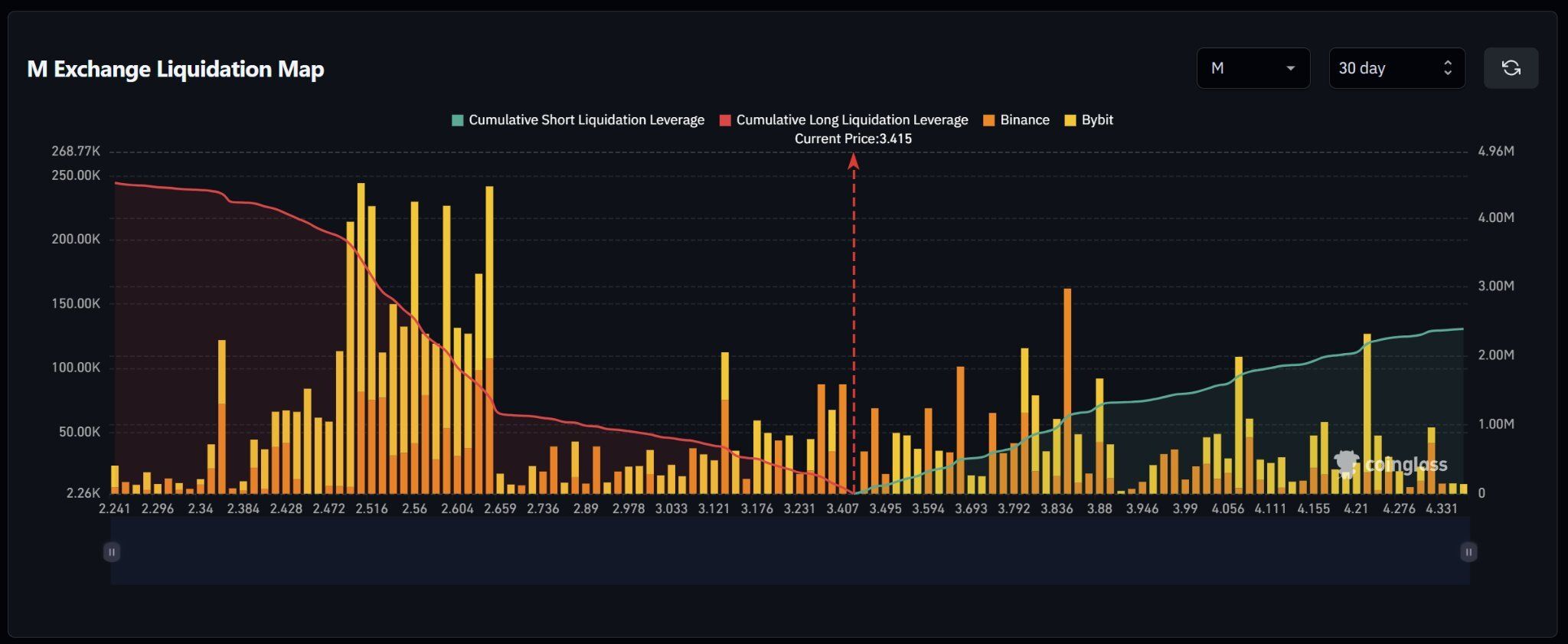
MemeCore (M) jumped 25% on Tuesday to reclaim $3.38 after retesting the 0.382 Fibonacci support at $2.59, signaling that buyers stepped back at the key correction level.
The bounce drives M into a thin liquidity pocket near $3.40, where short liquidation clusters start stacking. A clean break opens the path toward $3.88 and potentially $4 in the coming sessions.
Short Liquidation Clusters Stack Above $3.50
The M Exchange Liquidation Map from Coinglass reveals dense short positions beginning at $3.49 and thickening between $3.69 and $3.88. A second wave sits higher at $4.05 to $4.27.
Long liquidation pockets below price concentrate at $2.51 to $2.60, forming the biggest magnet zone on the 30-day map. That same area triggered the prior reversal when leveraged longs got flushed.

According to analyst @ScalpingX, the current price at $3.41 sits inside a thin liquidity layer between $3.40 and $3.50. A clean break above $3.50 could accelerate the move toward $3.88 first, then extend to $4.27.
Holding the $3.41 pivot remains the bullish trigger. Losing it shifts the bias to $3.12, with the deeper magnet zone at $2.60 becoming the next downside target.
Resistance at $3.68 Caps the Bullish Push
The 4-hour timeframe confirms aggressive spot buying at the $2.65 low, where M printed a 39% green bar on the highest volume reading of the past 30 days.
However, price stalled at $3.68, a level that acts as both flipped support-turned-resistance and the 0.618 Fibonacci retracement of the recent decline. The move mirrors the prior rally that lifted M back toward its all-time high.

RSI has reclaimed the 50 line and entered bullish territory without reaching overbought, leaving headroom for continuation. MACD flipped positive with growing green histogram bars across recent candles.
A 4-hour close above $3.68 unlocks $4.50 as the next mid-term target. Rejection here returns M to the $2.60 demand zone, aligning with the deepest long liquidation cluster on the 30-day map.
MemeCore Price Prediction Eyes $4 Pivot
The daily chart shows a textbook retest of the parabolic ascending curve. M tagged the 0.382 Fib at $2.59 on May 4 with a record-volume spike, then bounced 25% the next session with a wick into the 0.618 Fib at $3.46.
A daily close above $3.46 opens the 0.786 Fib at $4.07 as the first major target, followed by the all-time high near $4.86. The break from the parabolic curve was expected and now leaves a healthier base structure in place.

Daily RSI has reset from overbought conditions and is now curling back up. MACD remains in negative territory, but the histogram has begun turning higher, suggesting downside momentum has run its course.
Invalidation sits at the $2.60 horizontal support. A break below that level cancels the bullish thesis and reopens the $2.05 zone, the 0.236 Fib retracement, echoing prior on-chain warning signs that flagged demand exhaustion.
The 30-day liquidation map suggests this binary outcome resolves quickly. With thin liquidity above and a magnet zone below, M is set up for a sharp move once the $3.68 pivot decides direction.
The post MemeCore (M) Rebounds 25% Off 0.382 Fib, Eyes $4 Breakout appeared first on BeInCrypto.

What working-class boys need to succeed at school: respect and open conversations

Ramsdens boosts profit expectations but sounds caution on jet fuel worries

Braves sink Mariners on Matt Olson’s ninth-inning HR

Manchester United reach agreement with Casemiro over contract clause amid transfer speculation

US brings back mandatory military draft registration

Steven Gerrard disagrees with Gary Neville over ‘shock’ Chelsea and Arsenal claim | Football


-
 Business7 days ago
Tesla Officially Registers Elon Musk’s Stock: What Investors Need to Know
-

 NewsBeat3 days ago
Channel 5 – All Creatures Great and Small series 7 new post
-

 Entertainment6 days ago
Insider Claims Reason Behind Key & Peele Split
-
 Tech5 days ago
Trump’s 25% EU auto tariff breaches Turnberry Agreement that also covers semiconductors and digital trade
-
 Sports5 days ago
Paul Scholes issues Marcus Rashford reality check as agreement emerges over Man United star
-

 Business7 days ago
Barclay Brothers Avoid Bankruptcy: HSBC Drops High Court Petitions After IVA Deal
-

 Entertainment5 days ago
Met Gala 2026 Rumored Guest List Is Turning Heads
-

 Entertainment6 days ago
Celebrities Who Are Attending the 2026 Met Gala Event
-

 Business5 days ago
Strait of Hormuz Blockade Persists Amid US-Iran Standoff, Sending Oil Prices Soaring
-

 Tech7 days ago
Texas Instruments made a new flagship graphing calculator: the TI-84 Evo
-

 Crypto World7 days ago
Meta (META) starts stablecoin payout to creators in Circle’s USDC on Polygon, Solana via Stripe
-
Business6 days ago
Strait of Hormuz Remains Heavily Restricted on April 29 Amid Iran Conflict
-
Entertainment5 days ago
New on Prime Video in May 2026 — Full List of Movies and Shows
-
 Sports4 days ago
David Benavidez responds to team Canelo saying the fight will never happen
-

 Sports4 days ago
Cavaliers vs. Raptors Game 6 live score, updates, highlights from 2026 NBA playoffs first-round series
-

 Entertainment4 days ago
Kylie Jenner Hit With Second Lawsuit From Ex-Housekeeper
-

 Sports6 days ago
Saudi Arabia set to withdraw LIV Golf funding after 2026 season, per reports
-

 Sports4 days ago
Plane crash in Wimberley, Texas kills 5 pickleball players at tournament
-

 Sports6 days ago
Arsenal, Atletico Madrid share draw after penalty drama in Champions League semi-final
-

 Tech6 days ago
Mark Zuckerberg Says Meta Is Working On AI Agents For Personal And Business Use
You must be logged in to post a comment Login