
Crypto World
Nvidia (NVDA) Tumbles 4% Amid Rising Competition from Google and Amazon Custom Chips


Key Takeaways
- Nvidia shares declined over 4% Thursday even as major tech companies announced significant AI infrastructure spending hikes
- Google revealed intentions to commercialize its proprietary TPU chips for external clients, intensifying competitive pressures
- Amazon highlighted accelerating growth in its proprietary chip division
- Top four hyperscalers collectively plan AI infrastructure investments reaching $725 billion in 2026
- Nvidia’s B300 server pricing in China has surged to approximately $1 million following stricter smuggling enforcement
Nvidia shares tumbled over 4% Thursday, defying the broader narrative of explosive AI infrastructure spending commitments from technology’s biggest players. The decline signals mounting investor anxiety about a critical question: can Nvidia maintain its market leadership as its largest clients develop competing chip solutions?
The downturn followed earnings reports from Meta, Alphabet, Microsoft, and Amazon, each announcing elevated capital expenditure forecasts for 2026. Meta increased its projection by $10 billion, targeting a range of $125 billion to $145 billion. Alphabet boosted its guidance by $5 billion, potentially reaching $190 billion. Microsoft indicated its fourth-quarter capital spending alone would exceed $40 billion.
Combined, these four cloud computing giants are projected to deploy up to $725 billion on AI infrastructure throughout the year. With Nvidia commanding approximately 90% of the AI accelerator market, this investment wave should theoretically benefit the semiconductor manufacturer substantially.
Yet market sentiment doesn’t always align with positive fundamentals.
Alphabet’s TPU Commercialization Triggers Market Concerns
Investor apprehension stemmed primarily from Alphabet’s strategic announcement. The company disclosed plans to market its proprietary Tensor Processing Units — TPUs — to external clients who can deploy them within their own infrastructure environments.
Historically, TPUs functioned exclusively within Google‘s ecosystem. By commercializing these chips, Alphabet positions them as a viable, albeit specialized, competitor to Nvidia’s GPU offerings. While TPUs typically lack the versatility of Nvidia’s solutions, they deliver superior cost efficiency for specific artificial intelligence applications.
Amazon similarly emphasized expansion in its proprietary chip initiatives during its quarterly earnings presentation. While both organizations remain significant Nvidia clients, the strategic trajectory is unmistakable.
Nvidia has historically downplayed threats from custom chip development, emphasizing the superior versatility its GPUs provide for AI application developers. However, maintaining this position without encountering market skepticism is becoming increasingly challenging.
Chinese Market Sees B300 Server Prices Approach $1 Million Mark
On supply dynamics, pricing for Nvidia’s advanced B300 server systems in China has escalated to approximately 7 million yuan, representing a sharp increase from roughly 4 million yuan in late 2024. This translates to nearly $1 million per system.
Intensified enforcement against semiconductor smuggling operations in China — which previously sustained a parallel market for export-restricted hardware — has substantially constrained available supply. The B300 represents one of Nvidia’s most sophisticated AI server configurations and remains subject to US export restrictions in the Chinese market.
Meanwhile, Thursday’s trading session delivered mixed results across the semiconductor industry. Qualcomm surged 9% following announcements of expanded data center initiatives. Memory sector players Sandisk, Western Digital, and Seagate also posted gains after Microsoft and Meta highlighted increasing expenditures for storage and memory infrastructure.
Regarding investment activity, Nvidia’s venture division NVentures contributed to a $50 million extension of Swedish AI legal technology company Legora’s Series D funding round, establishing a $5.6 billion valuation and bringing aggregate capital raised to $600 million.
Nvidia shares were trading near $200.84 Thursday afternoon, representing an approximate $8.41 decline for the session.


Crypto World
Hassett says Powell’s reappointment could delay Fed rate cuts, with crypto watching closely


Kevin Hassett warns that reappointing Jerome Powell to the Fed Board could delay or dilute Trump-era rate cuts, keeping crypto traders fixated on personnel-driven monetary policy.
Summary
- White House NEC Director Kevin Hassett warned that Jerome Powell’s reappointment to the Fed Board could sway the timing and depth of interest rate cuts.
- The Fed has held its benchmark rate at 3.5%-3.75% in Powell’s final meetings as chair, with markets split over how quickly incoming leadership will ease policy.
- Crypto traders now see Fed personnel politics as a key variable for Bitcoin, Ethereum, and broader digital asset liquidity.
White House National Economic Council Director Kevin Hassett said that Federal Reserve Chair Jerome Powell’s reappointment as a governor “may affect interest rate cut decisions,” injecting new uncertainty into the path of U.S. monetary easing. His comments land just as the Fed keeps its target rate in a 3.5%-3.75% band and as Powell chairs his final policy meetings before stepping down in mid-May.
In recent remarks relayed by U.S. media, Hassett has repeatedly argued that “there is ample opportunity to reduce rates in the upcoming months,” while also acknowledging that the composition of the Fed Board will shape how aggressively cuts are delivered. At Powell’s last meeting as chair, officials again voted to hold rates steady, with four members dissenting—the highest level of disagreement since 1992—underscoring a deeply divided Federal Open Market Committee (FOMC).
Why Powell’s seat matters for crypto
The friction is not just academic: Powell’s reappointment as a governor would keep a seasoned moderate on the Board at the same time President Donald Trump is set to install Kevin Warsh as the next Fed chair, a figure seen as more open to faster easing but constrained by inflation and politics. As Axios reported, Trump officials have recently “softened” their public pressure for immediate cuts, signaling they may “wait for new chairman Warsh and let him lead the next cycle,” a stance Hassett has echoed.
For crypto markets, this tug-of-war over the pace of cuts directly feeds into liquidity, risk appetite, and dollar strength. When the Fed cut rates in late 2025, Bitcoin (BTC) and Ethereum (ETH) both saw renewed inflows as lower real yields pushed investors out the risk curve, a pattern tracked across multiple crypto.news stories. With the federal funds rate still anchored at 3.5%-3.75% and no cuts yet in 2026, major tokens have traded in tighter ranges despite sporadic rallies in Bitcoin and Ethereum.
If Powell’s continued presence tilts the Board toward a slower easing path, that could cap near-term upside for high-beta assets like altcoins even as long-term crypto adoption remains intact. Prior crypto.news coverage of Fed transition risks in this story and of macro-driven sell-offs in another story has shown how quickly Bitcoin and DeFi tokens can reprice when rate expectations shift.
Traders are now closely watching communications from Hassett, Warsh, and Powell for clues on the first cut’s timing, with futures markets still pricing only modest reductions in 2026 despite Trump’s preference for “substantially lower” rates. Any surprise acceleration or delay in cuts—driven by Powell’s reappointment dynamics—will likely move not just Treasurys and equities, but also the entire digital asset complex.
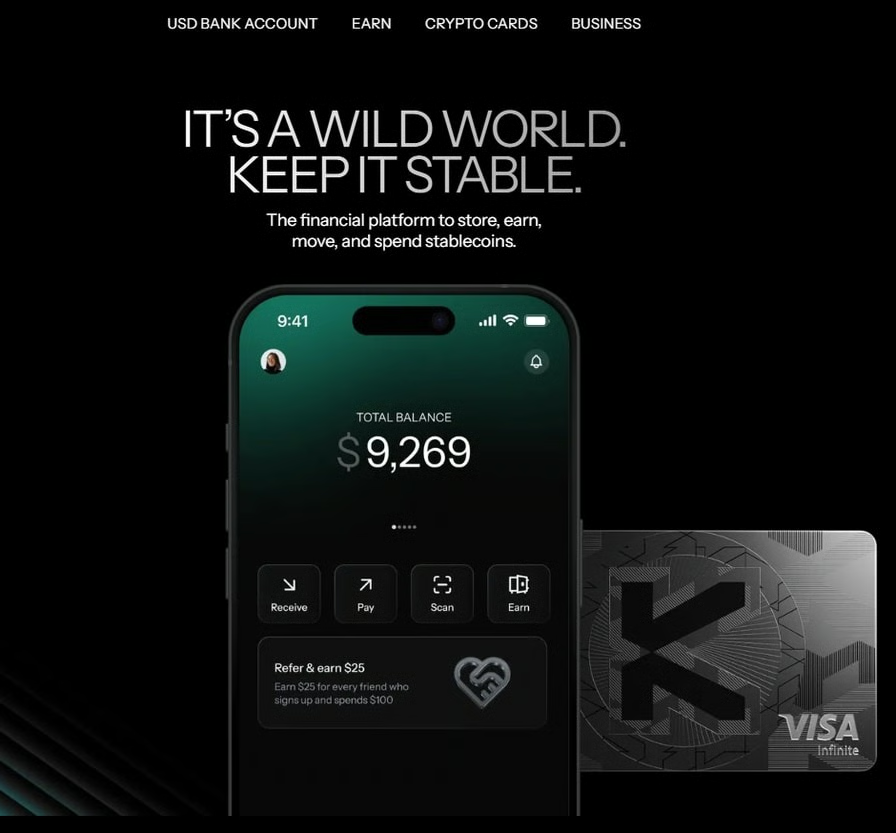
Stablecoin payments company Kast Kast has hired former US Securities and Exchange Commission (SEC) communications official Stephanie Allen as head of corporate and policy communications, as the company builds out its licensing and policy operation following an $80 million funding round last month.
Kast said Thursday that Allen will work with senior leadership on policy and communications as the company prepares to launch Kast Business and expand further across North America, Latin America and the Middle East. The company said the hire is tied to its next phase of growth and regulatory engagement.
Allen previously served as acting director of the SEC’s Office of Public Affairs and earlier held senior media relations and speechwriting roles at the agency. Kast said she also advised the SEC’s Crypto Task Force, though that role does not appear in the SEC’s public biography of Allen.
The hire reflects how stablecoin companies are adding policy and communications talent as they move closer to regulated financial services and try to expand across multiple jurisdictions. For Kast, the appointment comes as it pushes deeper into business accounts, cross-border payments and compliance-heavy growth markets.
“We’re excited to welcome Stephanie to the Kast team,” said KAST’s chief corporate affairs officer, Brad Jaffe. “Her knowledge of the policy and regulatory landscape stemming from her leadership position at the SEC and deep U.S. public and private sector experience will help drive KAST’s momentum.”
The hire comes over a month after Kast raised $80 million to fund the expansion of its payment infrastructure platform, reaching a $600 million valuation.
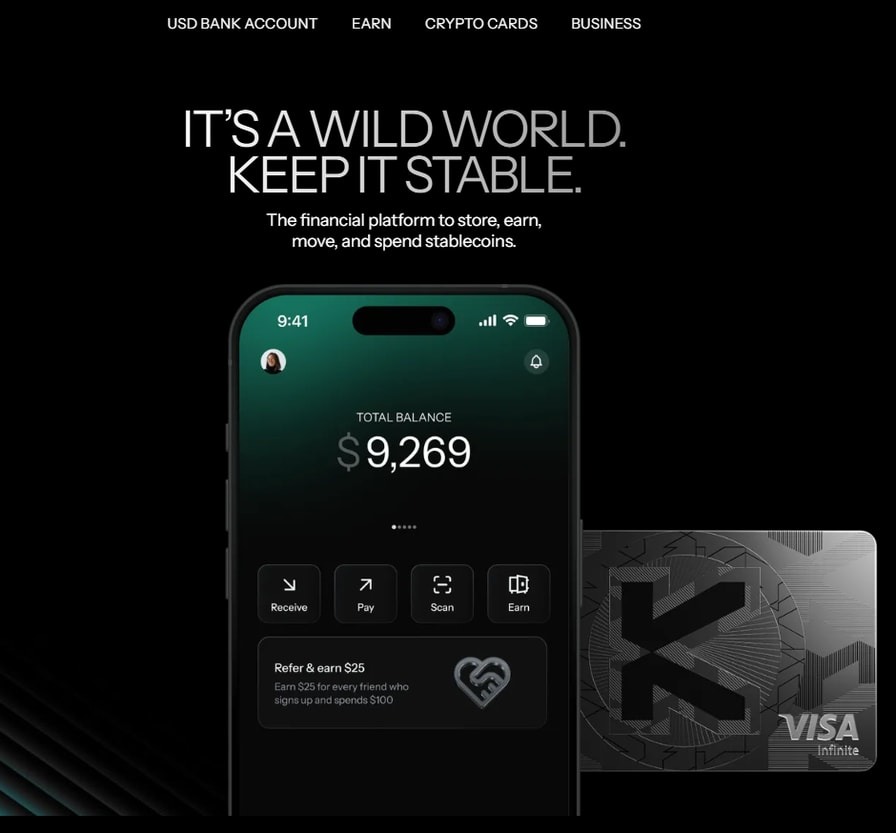
KAST stablecoin payment firm, homepage. Source: Kast.xyz
Kast offers payment cards and US dollar-denominated accounts to users in over 150 countries, with plans to launch savings and remittance products under its neobank interface.
Related: Fireblocks launches tool for institutions to earn yield on stablecoins
Stablecoin momentum cools
Stablecoin transfer volume dropped 19% to $8.31 trillion over the past month, while stablecoin market capitalization rose 2.06% to $305.29 billion over the same period, Cointelegraph reported Tuesday, citing data from RWA.xyz.
The data suggests that the growing value held in dollar-denominated stablecoins does not translate to growing onchain activity, as fewer dollars are being moved across blockchains despite the growing stablecoin supply.
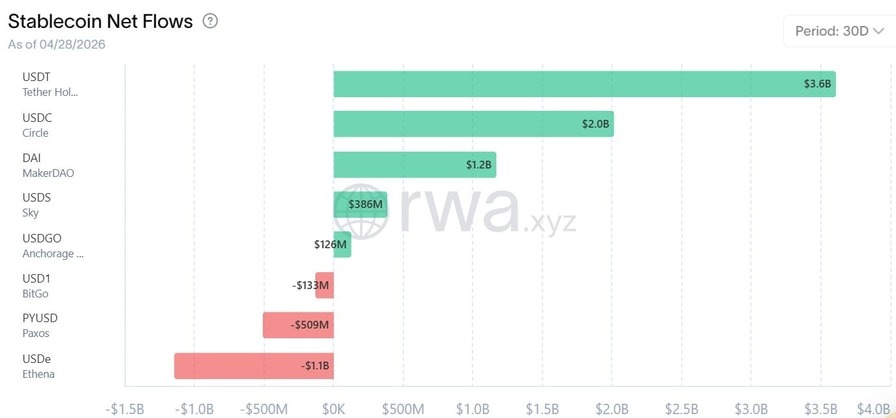
30-day stablecoin net flows as of April 28, 2026. Source: RWA.xyz
Still, asset manager Fidelity’s Q2 Signals Report showed that Ethereum’s stablecoin transfer values had recently exceeded historical averages, with transfer value over the past 12 months surpassing $18 trillion.
Fidelity said that the network activity signals that stablecoins are increasingly being used for payments, settlement and onchain access to US dollars, despite the broader crypto market sentiment.
Stablecoin transfer volume reached a record $1.8 trillion in February, according to data provider Allium.


Polymarket is rolling out an onchain integrity monitor with Chainalysis to detect insider trading and manipulation across its prediction markets and reassure regulators and institutions.
Summary
- Polymarket is launching an on-chain market integrity monitoring system, built with Chainalysis, to police insider trading and manipulation across its DeFi prediction markets.
- The system will run real-time analytics on trades, positions, and settlements on public blockchains to flag suspicious behavior and support enforcement of platform rules.
- Polymarket says the move aims to set a new compliance benchmark for prediction markets and reinforce its role as a trusted source of market information for crypto and traditional finance.
Polymarket has unveiled a comprehensive on-chain market integrity monitoring solution designed to track trading behavior across its platform and enforce strict market conduct rules. The system is being developed in partnership with blockchain analytics firm Chainalysis and will cover the full DeFi lifecycle on Polymarket, including real-time analysis of trading flows, user holdings, and settlement data, with a particular emphasis on detecting insider trading and market manipulation.
According to Polymarket, every transaction on the platform already settles on a public blockchain, and this new framework is meant to weaponize that transparency rather than treat it as a mere byproduct. By layering multi-stage monitoring over open ledgers, the platform aims to automatically surface anomalous patterns—such as suspiciously timed position builds ahead of key events or coordinated wash trading—so they can be investigated and sanctioned under its market rules.
The company stresses that the collaboration is also aimed at external stakeholders, not just internal policing. Because activity is on-chain, the enhanced monitoring is expected to help regulators and law enforcement obtain verifiable evidence of misconduct, potentially speeding up investigations and making enforcement more robust. Polymarket says this combined toolkit is intended to establish “a new compliance standard in the predictive market field,” framing the platform less as a regulatory outlier and more as a testbed for transparent, auditable market structure.
Founder and CEO Shayne Coplan reiterated that the platform has prioritized transparency and traceability since launch, arguing that prediction markets can only influence serious capital and institutional users if their order flow is both visible and credibly monitored. He said the Chainalysis partnership will further entrench Polymarket’s position as a “trusted source of market information,” especially as crypto-native prediction markets increasingly inform pricing in broader risk assets, including equities, rates, and major tokens like Bitcoin and Ethereum.
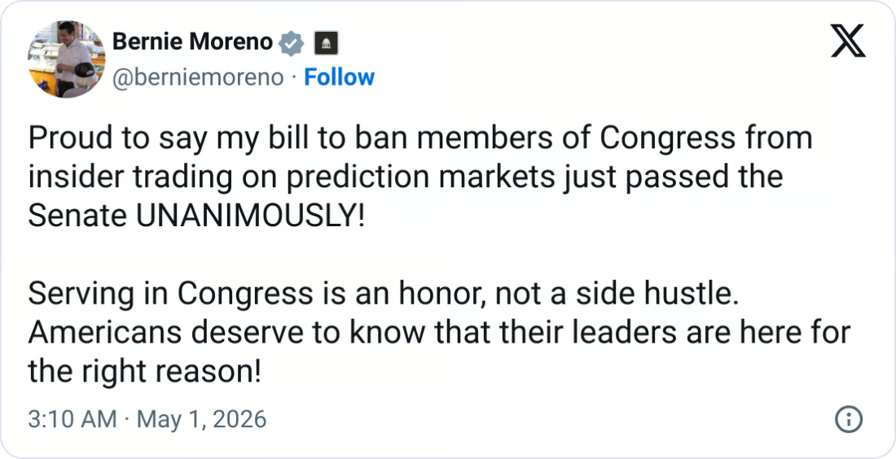
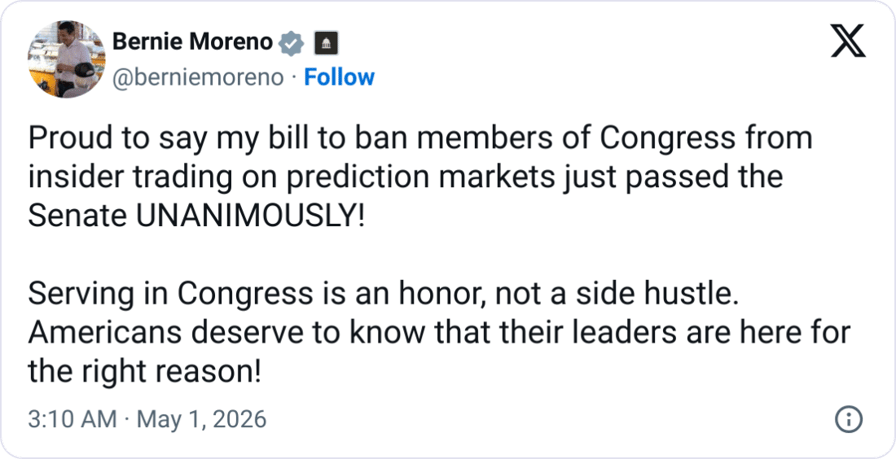
The US Senate on Thursday unanimously approved a resolution banning its members and staff, who are often exposed to sensitive information, from using prediction markets.
The resolution, passed by unanimous consent, changed the Senate’s rules and took immediate effect.
“Engaging in any way in a prediction market or trying to place bets where we might have inside information deteriorates the confidence that our constituents have in us,” Republican Senator Bernie Moreno, who introduced the resolution, said on the Senate floor.
“By changing the standing rules of the Senate, what we’re doing is allowing our constituents to know, once and for all, that no member of the United States Senate, no member of the staff of the United States Senate, can ever use that inside information as a way to monetize this job whatsoever,” he added.
Source: Bernie Moreno
The resolution comes after a special forces soldier involved in the plan to capture former Venezuelan President Nicolás Maduro was charged last week, on April 23, with using classified information to make bets on Polymarket, as lawmakers also air concerns over well-timed bets on the Iran war. He has pleaded not guilty.
Senate Democratic leader Chuck Schumer said on the Senate floor that “of all the issues we debate in Washington, this falls clearly in the category of a ‘no-brainer.’”
“We must never allow Congress to turn into a casino where members representing the public can gamble on wars, or economic crises, or elections,” he said.
Related: Insider trading backlash forces Polymarket to step up surveillance
“We should go further; this is a good start, but not enough,” Schumer said. “The administration and its employees must apply these very same rules too, particularly this administration, which shows such a troubling affinity to corruption and self-dealing.”
Republican Representative Ashley Hinson posted to X that she would introduce a similar resolution to ban the use of prediction markets in the House.
Polymarket posted on X that it fully supported the Senate resolution and its terms of service “already prohibit such conduct, but codifying this into law is a step forward for the industry.”
Tarek Mansour, co-founder and CEO of rival prediction market platform Kalshi, also celebrated the resolution in a post on X, adding that it “already proactively blocks members of Congress and enforces against insider trading.”
Magazine: How to fix suspected insider trading on Polymarket and Kalshi

Spain appears to be the strongest retail market for Circle’s euro-pegged stablecoin EURC on the Brighty platform, with Brighty data indicating a clear regional concentration in 2025 and the first quarter of 2026. In that period, Spanish activity accounted for roughly 36% of EURC transactions and about 25% of EURC-related volume, a signal that euro-stablecoin usage for everyday payments is taking hold in select European markets. According to Brighty data reviewed by Cointelegraph, this pattern positions Spain as a leading early adopter in euro-stablecoin retail usage within the broader MiCA-era regulatory landscape.
“For Spanish users, EURC functions essentially as a standard euro on a card with no exchange rate friction when transacting against USDC,” Brighty co-founder Nick Denisenko said. The observation underscores how EURC can simplify euro-denominated payments for retail customers, particularly when paired with card-based spending and stablecoin yield features.
Cointelegraph’s review of Brighty’s dataset also highlights a broader market dynamic: euro tokens remain a minority segment relative to USD-pegged stablecoins like Tether’s USDt and Circle’s USDC, even as policymakers push to expand the euro’s role in crypto markets. The data offer an early glimpse into how euro stablecoins may be used in European retail payments as regulatory frameworks like MiCA come into force.
Key takeaways
- Spain accounted for about 36% of EURC transactions and 25% of EURC volume in 2025 through the first quarter of 2026, signaling a retail-oriented adoption pattern.
- EURC is the largest euro-pegged stablecoin by market share, representing around 49% of the euro-stablecoin market cap (approximately $887 million) according to CoinGecko.
- Spain shows the clearest retail usage of EURC with low average transaction sizes—about 49 euros per payment—compared with other European markets that display more mix between retail and higher-value transfers.
- Italy ranks second in EURC activity (about 15.5% of transactions and 18% of volume), followed by Germany (roughly 13% of transactions and 19% of volume), while France is notable for higher average transactions (~€171).
- Denisenko argues that Spain’s combination of early adoption, retail-focused usage, and broad institutional awareness makes it the clearest early hub for euro-stablecoin activity under MiCA.
Spain as a retail EURC hub
Data from Brighty shows Spain leading EURC activity within the platform’s footprint, with a clear tilt toward everyday, low-value transactions. The typical EURC payment in Spain is around €49, placing the euro-stablecoin usage squarely in the realm of consumer purchases, P2P transfers, and other retail payments rather than large-scale transfers or institutional settlements.
Denisenko notes that Spanish users have been among the earliest adopters of EURC on Brighty and have shown robust engagement with yield features tied to stablecoins. This combination—early adoption, retail-friendly transaction sizes, and active use of yield mechanics—helps explain why Spain stands out in Brighty’s euro-stablecoin analytics.
From a regulatory and market-structure perspective, the Spanish pattern aligns with a broader intention to normalize euro-stablecoin usage within a MiCA-ready environment. The MiCA framework seeks to bring regulatory clarity to crypto-asset service providers and issuers of asset-backed tokens in the European Union, potentially smoothing the path for banks and payments ecosystems to integrate euro-stablecoins into everyday retail flows.
Cross-country usage patterns and value segmentation
Italy ranks second in Brighty’s EURC metrics, accounting for about 15.5% of EURC transactions and 18% of EURC volume. The data imply a mix of retail and higher-value use cases in Italy, rather than a narrow retail-only pattern. Germany follows with roughly 13% of transactions and 19% of volume, where the average EURC payment size stands at about €105 ($123).
France stands out for its comparatively higher average transaction size of roughly €171 ($186) per EURC payment, indicating a greater share of larger transfers or higher-value payments within the country’s EURC activity. This contrast suggests a diversification of EURC use cases across Europe, from everyday consumer purchases to larger-value transfers that may involve corporate or high-net-worth clients.
Despite these country-specific dynamics, euro-stablecoins in Europe remain a relatively small slice of the broader stablecoin market when viewed against USD-pegged tokens. The euro-stablecoin segment’s total market capitalization sits well below the USD-backed tier, a gap that policymakers and market participants have been monitoring as MiCA implementation progresses and as banks explore euro-stablecoin integrations.
Regulatory and institutional implications for euro-stablecoins in Europe
The Spain-centric retail pattern observed on Brighty has notable implications for compliance, licensing, and cross-border operations within the European Union. Under MiCA, euro-stablecoins face a regulated environment designed to standardize issuance, disclosures, and safeguarding of user funds, with potential licensing prerequisites for issuers and service providers operating across member states. Spain’s apparent readiness—both from consumer familiarity with crypto and from the apparent willingness of local banks to engage with euro-stablecoins—could serve as a case study in how MiCA compliance and banking integration might unfold in practice.
Brighty’s experience in Spain, including interactions with major Spanish banks where staff demonstrate a high level of competence, suggests that institutional readiness may accelerate the deployment of euro-stablecoin-based payments and yield features for retail users. This aligns with a broader European push to expand the euro’s role in digital finance while maintaining robust regulatory oversight and consumer protections.
Where EURC and other euro-stablecoins fit within the MiCA framework remains a key question for operators, banks, and policymakers. The ongoing evolution of licensing regimes, cross-border oversight, and interoperability with fiat rails will shape how euro-stablecoins scale in retail channels. The comparative patterns across Italy, Germany, and France provide a preliminary map of how different market segments may respond to MiCA’s regulatory contours, with Spain potentially serving as an early operational benchmark for compliance-ready, retail-focused euro-stablecoin activity.
Closing perspective
The Brighty dataset paints a valuable early picture: Spain stands out as the clearest retail-focused hub for EURC within Europe, reflecting a combination of consumer familiarity, institutional readiness, and a regulatory environment moving toward MiCA-aligned clarity. As MiCA-backed euro-stablecoins continue to gain traction, observers should monitor how cross-border EU usage develops, how banks expand euro-stablecoin integrations, and how transaction sizes and channel mix evolve beyond Spain’s initial lead. The coming quarters will reveal whether Spain’s early lead translates into broader regional patterns or remains a selective, country-specific anomaly shaped by local financial ecosystems.
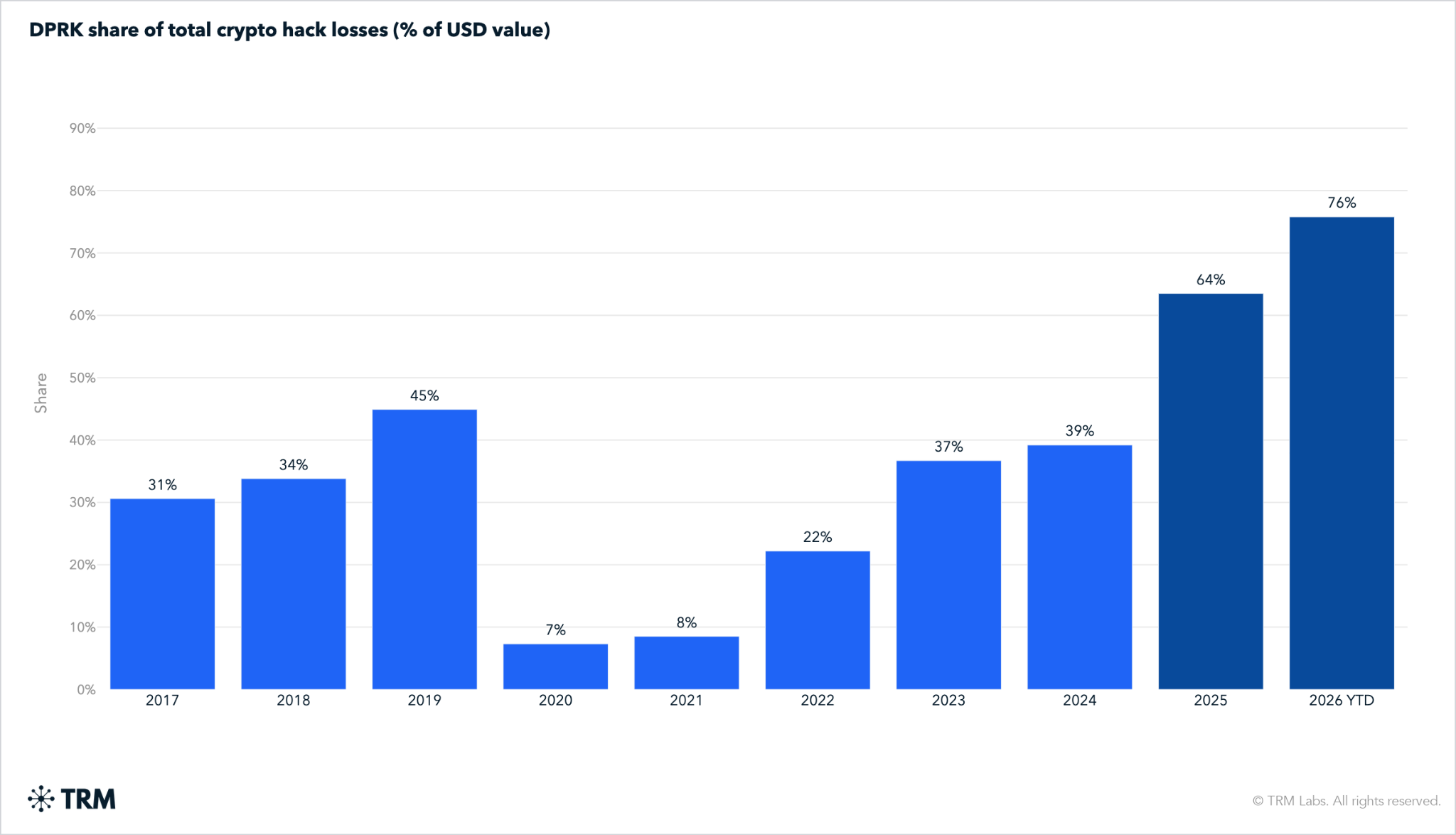
North Korean hackers accounted for 76% of all crypto hack losses through April, according to TRM Labs.
The report revealed that hackers from two distinct groups stole roughly $577 million across two attacks in 2026.
2 North Korean Heists Drove 76% of 2026 Crypto Hack Losses
The Drift Protocol breach and the KelpDAO bridge exploit landed in the same month. Together, they accounted for just 3% of this year’s incident counts, but the bulk of the stolen value. Notably, both these hacks are attributed to North Korean actors.
“North Korean hacking groups accounted for 76% of all crypto hack losses in 2026 through April — not because North Korea launched a wave of attacks, but because two attacks totaling USD 577 million dwarfed everything else,” TRM Labs wrote.
The Drift exploit on April 1 cost the Solana-based perpetual exchange $285 million. In a follow-up incident report, the Drift team noted that the attack was the outcome of a six-month intelligence operation tied to North Korean actors. The fallout reached well beyond Drift, impacting several protocols.
Solana yield platform Carrot was among them. The team announced its shutdown on April 30. Carrot has set May 14 as the final deadline for users to withdraw remaining balances from Boost, Turbo, and CRT positions before forced deleveraging begins.
Follow us on X to get the latest news as it happens
Meanwhile, on April 18, attackers drained 116,500 rsETH, worth roughly $292 million, from KelpDAO’s cross-chain bridge. This has become the largest DeFi hack so far this year.
Investigations suggested that the Lazarus Group’s TraderTraitor was the likely actor behind the hack. The aftermath spread across the space. Aave and the broader DeFi TVL plunged sharply after the exploit.
North Korea’s Share of Crypto Theft Keeps Climbing
North Korean groups have become the dominant force in crypto theft. They drained at least $2.02 billion in digital assets during 2025 alone.
Their share of total hack losses has risen sharply over recent years. The figure sat below 10% in 2020 and 2021, climbed to 22% in 2022, then reached 37%, 39%, and 64% in the years that followed. The 76% reading through April 2026 marks the highest sustained level on record.
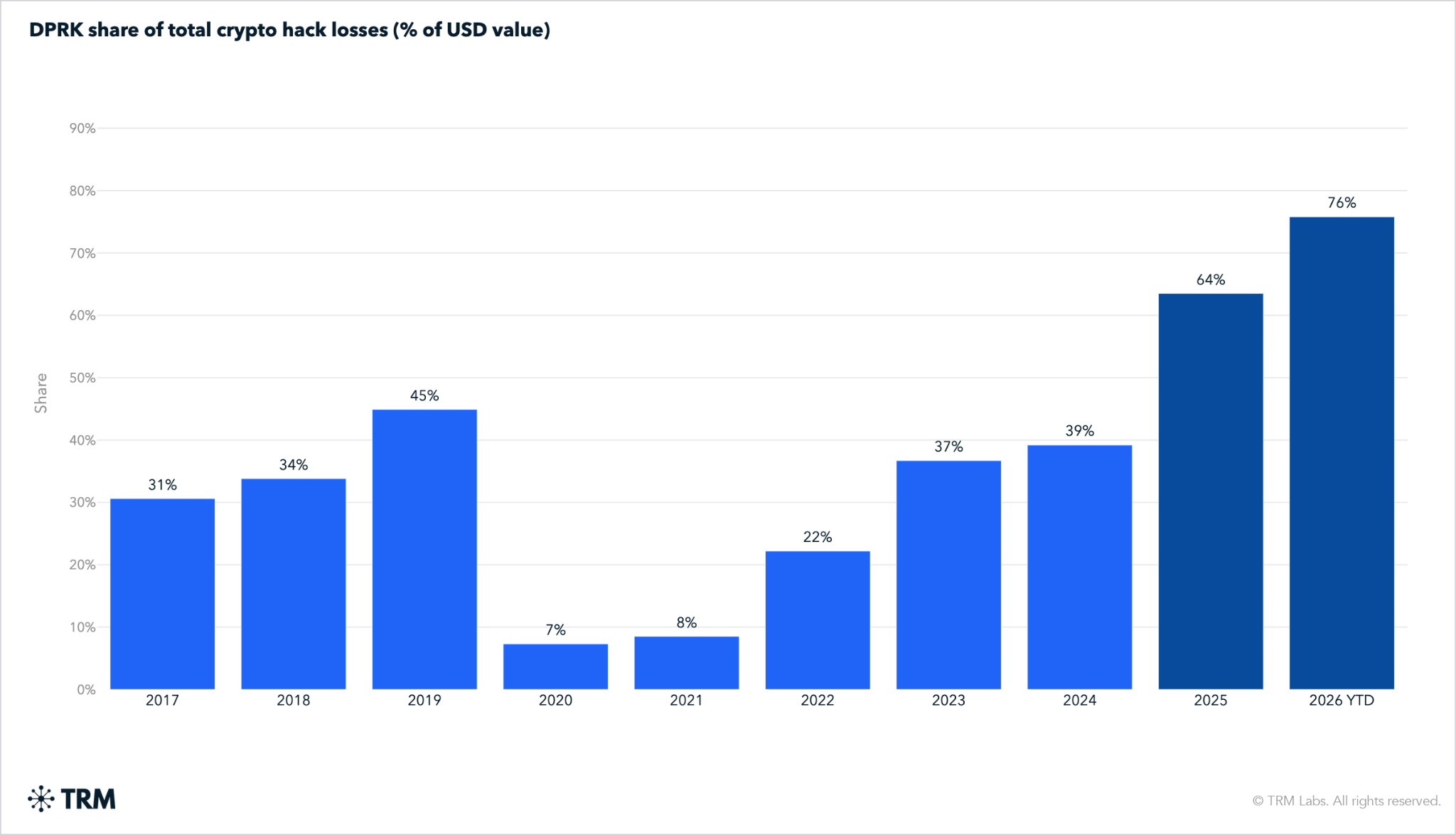
TRM analysts note that the attack frequency has not increased. Pyongyang’s top hacking teams still run a small number of carefully chosen operations each year, choosing precision over volume.
What has shifted is the “sophistication of the attacks.” TRM suggests that North Korean operators may be integrating AI tools into reconnaissance and social engineering operations.
“TRM analysts have begun to speculate that North Korean operators are incorporating AI tools…a development consistent with the increasing precision of attacks like Drift, which required weeks of targeted manipulation of complex blockchain mechanisms, rather than North Korea’s traditional emphasis on simple private key compromises,” the report read.
The development raises pressing questions about AI-driven attack capabilities and whether crypto protocols can keep pace with this new threat vector.
Subscribe to our YouTube channel to watch leaders and journalists provide expert insights
The post North Korea Claims 76% of 2026 Crypto Hack Losses in Just Four Months appeared first on BeInCrypto.


TRM Labs says North Korea-linked hackers have stolen about $577m in 2026 so far—76% of all crypto hack losses—driven by massive hits on KelpDAO and Drift Protocol.
Summary
- TRM Labs reports that North Korea-linked actors account for roughly 76% of global crypto hack losses in the first four months of 2026, or about $577 million.
- Pyongyang’s share of global crypto theft has surged from 22% in 2022 to 76% in 2026, with total illicit takings since 2017 now above $6 billion.
- Two April exploits on KelpDAO and Drift Protocol alone accounted for nearly all 2026 losses so far, underscoring protocol-level risk for DeFi and markets.
A new report from blockchain intelligence firm TRM Labs finds that organizations linked to North Korea were responsible for roughly 76% of all global cryptocurrency hacking losses in the first four months of 2026, stealing an estimated $577 million. The report, cited by The Block, warns that North Korean operations have become the dominant source of on-chain theft as state-aligned groups refine their tactics against exchanges, DeFi protocols, and cross-chain infrastructure.
According to the analysis, North Korea’s share of global crypto theft has climbed relentlessly over the past five years: 22% in 2022, 37% in 2023, 39% in 2024, 64% in 2025, and 76% so far in 2026, pushing cumulative illicit profits since 2017 above $6 billion. TRM Labs ties this growth to increasingly sophisticated tooling, better laundering pipelines, and a clear state incentive to bypass traditional sanctions via digital assets.
The report highlights two April incidents as the primary drivers of 2026 losses to date: a roughly $292 million exploit targeting KelpDAO and a separate $285 million theft from Drift Protocol. Together, these two attacks alone account for nearly the entire $577 million total so far this year and about 3% of all recorded hacking incidents in the same period, suggesting that a small number of high-impact exploits continue to dominate loss statistics.
For crypto markets, the concentration of large-scale thefts in DeFi and restaking protocols underscores the structural risk in smart contract and bridge design. Each $200 million–plus drain not only hits token prices for the affected projects, but also tightens liquidity across interconnected ecosystems as market makers, lenders, and LPs de-risk exposure.
This trend also feeds into regulatory and institutional responses. As more of the loss profile is attributed to a single sanctioned state, global authorities will likely intensify pressure on centralized exchanges, OTC desks, and mixers to block known laundering channels, raising compliance costs for the entire industry. For traders in Bitcoin, Ethereum, and other majors, repeated headlines of nine-figure hacks tied to North Korea translate into higher perceived tail risk, wider risk premia, and occasional systemic bouts of deleveraging when large exploits force on-chain liquidations.
Overall, TRM Labs’ findings paint a picture of a crypto market where protocol innovation and capital inflows continue, but where the “crypto war chest” of a sanctioned state is now a central macro variable, not a side story—one that will increasingly shape both policy and risk pricing across digital assets.
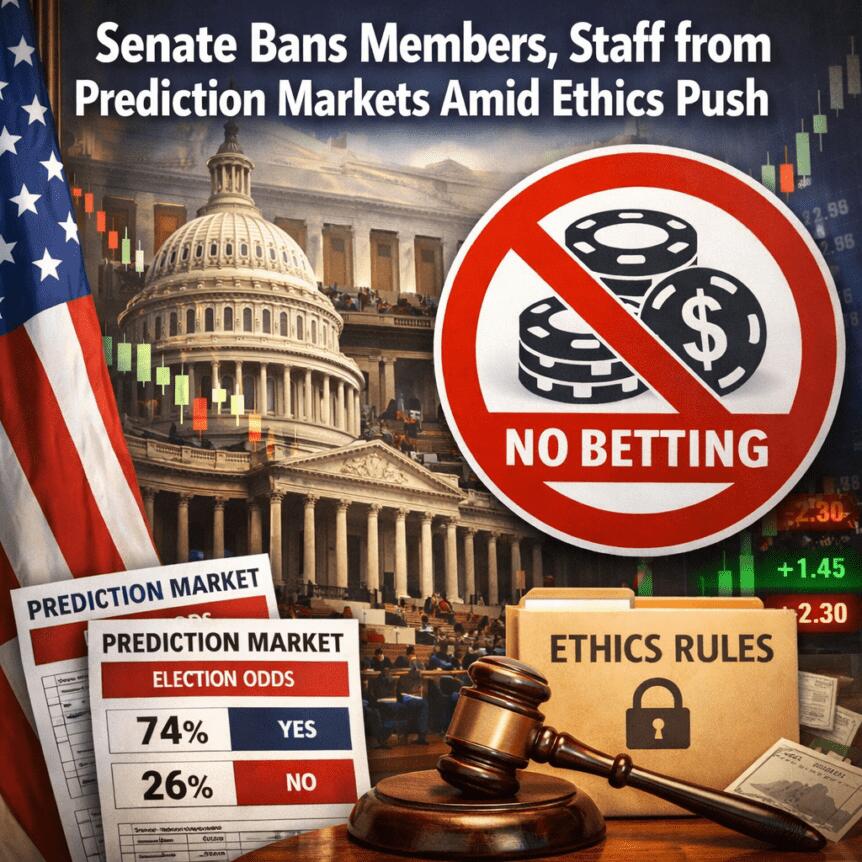
The US Senate moved to tighten its stance on inside information and financial speculation on prediction markets, unanimously approving a resolution that bars members and staff from participating in such markets. The rule change—made by unanimous consent and effective immediately—aims to preserve public trust by preventing potential monetization of sensitive information.
Engaging in any way in a prediction market or trying to place bets where we might have inside information deteriorates the confidence that our constituents have in us.
The measure was introduced by Republican Senator Bernie Moreno, who has framed the reform as a straightforward step to ensure that lawmakers and their aides cannot leverage privileged information for personal gain. He stated on the Senate floor that the rule change will make clear to constituents that no member of the United States Senate or Senate staff can monetize insider information through prediction markets.
Source: Bernie Moreno
The resolution arrives amid heightened scrutiny of prediction-market activity linked to political and national security matters. In a separate but related development, a special forces soldier was charged on April 23 with using classified information to place bets on Polymarket, a case that has fed lawmakers’ concerns about insider trading risk in such platforms. The defendant has pleaded not guilty.
During the floor debate, Senate Democratic leader Chuck Schumer endorsed the measure as a straightforward safeguard against conflicts of interest. He argued that Congress must not resemble a casino where lawmakers could gamble on wars, economic crises, or elections, and urged further steps beyond the initial rule change.
Related: Insider trading backlash forces Polymarket to step up surveillance
Schumer also indicated that broader measures should extend to the administration and its employees, signaling that the executive branch may come under similar scrutiny to ensure consistent ethics standards across government activity.
Republican Representative Ashley Hinson indicated that she will introduce a counterpart resolution in the House to prohibit House members from using prediction markets, signaling a potential expansion of the policy beyond the Senate.
Reaction from the prediction-market ecosystem was swift. Polymarket publicly supported the Senate resolution and noted that its terms of service already prohibit such conduct, describing codification as a positive development for the industry. Kalshi, a direct competitor, welcomed the move as well, with its co-founder noting that the platform already blocks congressional participation and enforces against insider trading.
These developments are part of a broader pattern of regulatory and industry focus on governance, compliance, and market integrity in crypto-adjacent spaces. Cointelegraph’s coverage has highlighted ongoing debates around insider betting detection and the governance of prediction-market platforms, underscoring the legal and regulatory implications for operators, financial institutions, and public institutions alike.
According to Cointelegraph, the heightened attention to insider trading in prediction markets dovetails with broader regulatory and enforcement efforts across the sector, including the need for robust AML/KYC frameworks, licensing considerations, and cross-border policy alignment. The incident and ensuing legislative response illuminate how public institutions are balancing innovation with governance and accountability in a rapidly evolving market structure.
Key takeaways
- The Senate unanimously approved a resolution that bans members and staff from using prediction markets, with the rule change taking effect immediately.
- The action seeks to prevent potential monetization of inside information and to preserve public trust in governmental institutions.
- There is expectation of broader discussion, with a House counterpart already anticipated to pursue a similar prohibition.
- Industry actors have publicly welcomed codification, asserting existing internal controls and surveillance mechanisms align with the new policy.
- The episode underscores ongoing regulatory scrutiny of prediction markets and related crypto-enabled trading from multiple authorities and jurisdictions.
Unanimous reform and immediate effect
The resolution’s passage by unanimous consent marks a clear stance from lawmakers that insider information must not be monetized through prediction-market channels. By amending the standing rules of the Senate, the chamber signaled an approach that emphasizes ethical governance and transparency in legislative operations. The immediate effect removes any potential window for noncompliance, reducing the likelihood of later procedural disputes over timing or enforcement.
Insider information, cases, and market surveillance
The drive for reform follows public concern over cases where insiders may have exploited privileged information. The reported charge against a special forces soldier—linked to bets on Polymarket—illustrates real-world risk vectors that policymakers fear could erode public confidence in government institutions and in market protocols. While the defendant has pleaded not guilty, the incident has intensified calls for clear rules and rigorous enforcement to deter insider trading in prediction markets.
Regulatory and industry implications for crypto markets
From a policy and compliance perspective, the Senate action reinforces the imperative for rigorous governance frameworks around crypto-enabled markets and related services. Although MiCA governs the European Union, the move aligns with a global trend toward stricter oversight of market integrity, disclosure obligations, and conflict-of-interest protections. For U.S. and global financial institutions, this raises considerations for internal risk controls, staff training, and cross-border regulatory expectations that could influence licensing, reporting, and supervisory priorities. The episode also highlights the importance of clear enforcement signals to deter insider trading and to maintain a level playing field for market participants, including traditional exchanges and crypto-native platforms.
Industry reaction and potential policy spillovers
Industry responses have framed the Senate action as a constructive step that formalizes existing best practices while reducing ambiguity for participants. Polymarket welcomed the codification, noting that their platform already prohibited such conduct and implied that formalizing the ban into law strengthens industry standards. Kalshi’s leadership echoed a similar sentiment, emphasizing proactive compliance measures and the removal of insider-trading risk from the regulatory horizon. The prospect of a House counterpart suggests that policy momentum could extend beyond the Senate, potentially shaping a broader regulatory baseline for prediction markets and similar platforms.
As policymakers weigh additional safeguards, observers will monitor how enforcement indicators evolve—whether through targeted investigations, licensing prerequisites for operators, or enhanced cross-agency coordination among financial regulators, national security authorities, and anti-corruption units. The developing narrative may influence how institutions structure compliance programs, monitor for improper information flows, and implement governance protocols that withstand scrutiny in both domestic and international contexts.
Closing perspective: The Senate’s action formalizes a boundary between public service and speculative activity tied to privileged information, signaling that policy makers view prediction markets as a space where integrity must be safeguarded to protect democratic legitimacy and market stability.
Key takeaways:
- Spot Bitcoin ETFs saw $490 million in net outflows over three days, signaling a recent dip in institutional demand.
- Rising inflation is eroding real yields on fixed income, likely fueling long-term demand for scarce assets like BTC.
Bitcoin (BTC) faced three consecutive days of outflows from US-listed spot exchange-traded funds (ETFs). The outflows coincided with a failed attempt to reclaim $78,000. Traders fear more downside, but heightened US inflation will likely act as a catalyst for further bullish momentum.
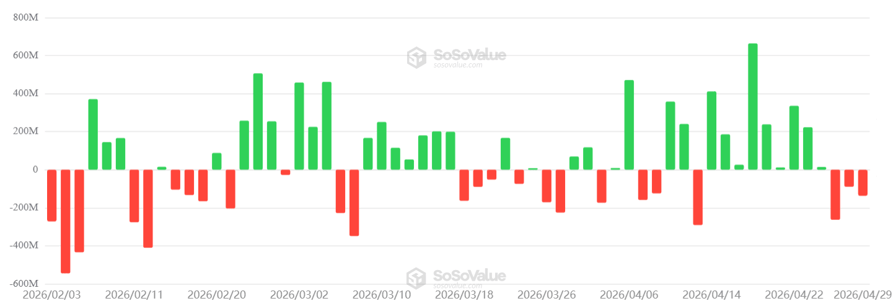
US-listed Bitcoin spot ETFs daily net flows, USD. Source: SoSoValue
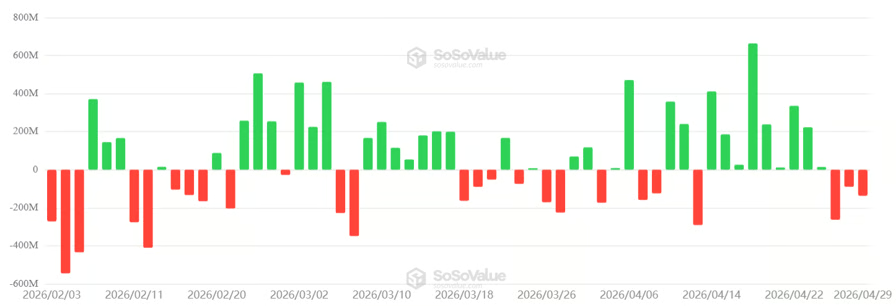
The US-listed spot Bitcoin ETFs saw $490 million net outflows between Monday and Wednesday, reversing the trend from the prior two weeks, which indicates a decline in institutional demand. Still, a longer-term perspective shows $3.3 billion net inflows since March.
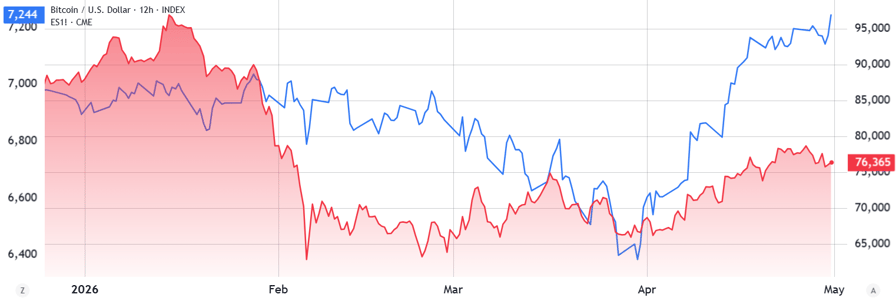
S&P 500 futures (left) vs. Bitcoin/USD (right). Source: TradingView
Part of the lack of confidence among traders can be attributed to the 14% year-to-date decline in Bitcoin’s price, while the S&P 500 soared to an all-time high. However, the tech sector came under scrutiny as quarterly earnings releases failed to impress investors. Meta (META US) faced a 9% correction on Thursday, while Microsoft (MSFT US) shares dropped 4%.
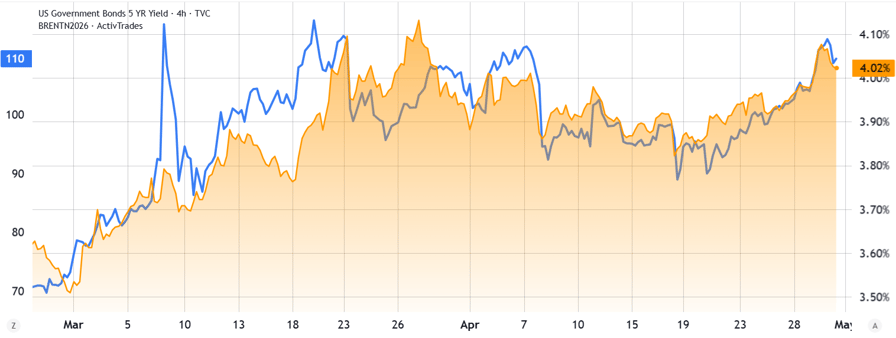
Brent crude oil (left) vs. US 5-year Treasury yield (right). Source: TradingView
Since the war in Iran started in late February, oil prices have been a major driver for risk appetite. The latest Brent crude oil rally to $126 coincided with yields on the US 5-year Treasuries jumping to 4.02%, up from 3.51% two months prior. Traders demanded higher yields on government-backed bonds amid upward pressure on inflation, triggering risk-off sentiment.
Higher inflation favors Bitcoin’s bullish momentum
Bitcoin’s lack of bullish momentum near $78,000 can also be pinned to worsening economic conditions. The US Commerce Department reported that gross domestic product grew at a 2% seasonally adjusted annualized rate in the first quarter, slightly below the 2.3% rate economists projected, according to CNN.
Related: Most crypto investors believe Bitcoin is undervalued–Coinbase survey
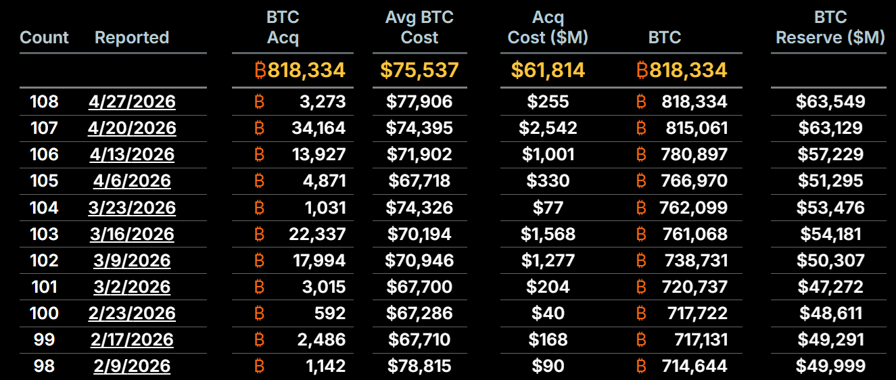
Strategy (MSTR US) latest Bitcoin acquisitions. Source: Strategy
Strategy, the company led by Executive Chairman Michael Saylor, announced the acquisition of 56,235 BTC in the first four weeks of April, driving its average cost to $75,537. Traders fear that the Bitcoin price could suffer if the Strategy accumulation pace does not hold up, even if only temporarily.
US President Donald Trump’s family’s activities in the cryptocurrency market have also hurt the industry’s appeal. Three US Senators demanded an inquiry into Trump and his family’s profits from their cryptocurrency ventures.
The risks of higher inflation and lower economic growth are unlikely to dissipate in the near term, but the mere three-day sequence of net outflows from Bitcoin ETFs should not be a source of concern. Ultimately, reduced returns on fixed income, when adjusted for inflation, will likely drive demand for scarce alternative assets. Thus, the Bitcoin path to $80,000 remains intact.


The social media giant has rolled out USDC payments via Stripe on Solana and Polygon.

You guys are not alone

I’ve made thousands of pizzas for slice-loving customers, and the Gozney Arc Lite is a near-perfect pizza oven for beginners

China, US economic chiefs raise complaints in ’candid’ call ahead of Trump-Xi summit

Manchester United reach agreement with Casemiro over contract clause amid transfer speculation

US brings back mandatory military draft registration

Steven Gerrard disagrees with Gary Neville over ‘shock’ Chelsea and Arsenal claim | Football


-

 Tech3 days ago
Register Renaming | Hackaday
-

 Fashion6 days ago
Weekend Open Thread – Corporette.com
-
 Crypto World5 days ago
Hyperliquid $HYPE Rally Builds Momentum as AI Sector Enters Prove-It Phase
-

 Politics3 days ago
Drax board avoid their own AGM, accused of greenwashing & environmental racism
-
 Sports5 days ago
IPL 2026: Ruturaj Gaikwad registers slowest fifty of the season, enters all-time unwanted list | Cricket News
-

 Tech3 days ago
Images of Samsung’s rumored smart glasses have leaked
-

 Tech4 days ago
Why Blue Badges Disappeared From Toyota Hybrids
-

 NewsBeat5 days ago
LK Bennett closes all stores after entering administration
-

 Fashion2 days ago
Kylie Jenner’s KHY Enters a New Era with ‘Born in LA’
-

 Crypto World7 days ago
Michael Saylor says BTC winter is over. Market analyst disagrees, says bitcoin was in a pullback
-
 Entertainment5 days ago
Mariah Carey Slams Deposition Claims In Brother’s Lawsuit
-

 Business2 days ago
Most Commercial Energy Audits Miss the Real Losses
-
 NewsBeat7 days ago
Trump threatens to review UK’s claim to Falkland Islands and punish Nato allies over Iran war disagreement
-

 Business4 days ago
(VIDEO) Charlize Theron Climbs Times Square Billboard to Promote New Netflix Thriller ‘Apex’
-

 Business7 days ago
Jeanine Pirro announces closure of Federal Reserve building cost probe
-

 Tech5 days ago
OpenAI’s Sam Altman apologizes for not reporting ChatGPT account of Tumbler Ridge suspect to police
-

 Tech5 days ago
Microsoft to roll out Entra passkeys on Windows in late April
-

 Crypto World3 days ago
CFTC’s AI will review U.S. crypto registration applications, chairman tells CoinDesk
-
 Crypto World6 days ago
Nvidia (NVDA) Stock Jumps 5% as Intel Earnings Ignite Semiconductor Rally
-

 Tech5 days ago
OpenAI CEO apologizes to Tumbler Ridge community
You must be logged in to post a comment Login