
Crypto World
Nvidia Stock Extends Winning Streak Ahead Of Two Key Reports| Investor’s Business Daily

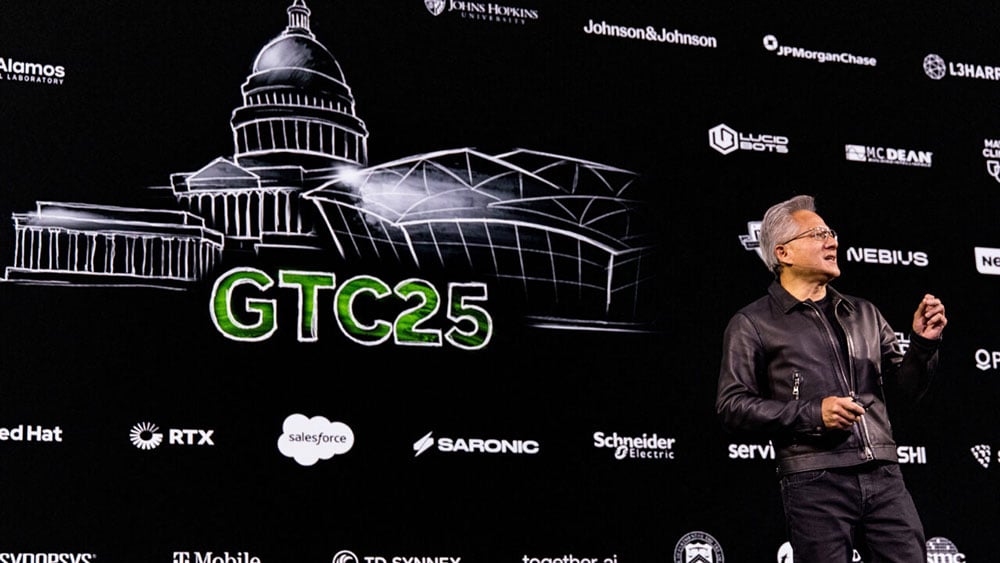
Nvidia (NVDA) extended gains Tuesday even as the broader stock market fluctuated following the U.S. imposition of a blockade on ships in the Strait of Hormuz after peace talks between the U.S. and Iran failed. Shares are on track for matching their longest string of advances made on Nov. 14, 2023, when they marked 10 consecutive wins. Is Nvidia stock…

Crypto World
Bitcoin Price Today: Pepeto Exchange Targets 100x as BTC Posts Strongest April Since 2021 With $2.44B in ETF Inflows
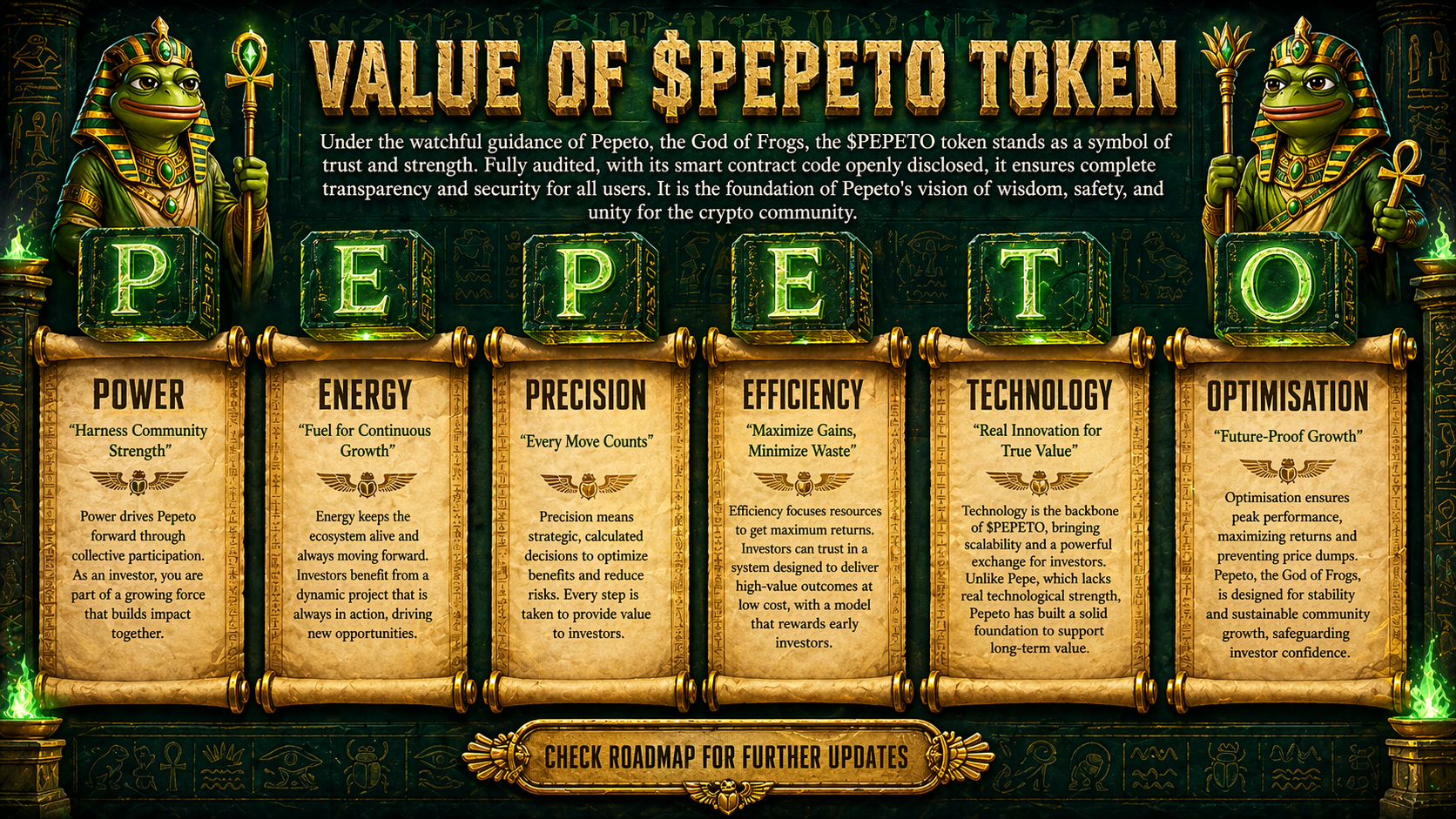
The bitcoin price today shows BTC trading near $78,411 after Cointelegraph reported an 11.87% rally in April backed by $2.44 billion in spot ETF inflows, the strongest monthly performance of 2026, and when Bitcoin posts its best month since early 2021 while institutional money flows in at record levels, the bull run is building strength.
The market consolidates below $80,000, but consolidation is exactly where the projects at presale pricing with real exchange infrastructure prepare to deliver 100x when the breakout arrives.
BTC Rallies 11.87% in April With $2.44 Billion ETF Inflows as Bulls Target $84,000 Breakout
Cointelegraph reported Bitcoin rallied 11.87% in April with $2.44 billion in spot ETF inflows, while May 1 alone saw $630 million with BlackRock’s IBIT pulling $284 million. Bulls now target $84,000.
When BTC holds strong on the best monthly inflows since October 2025, presale entries with exchange tools capture the buying wave first.
What Crypto Should You Enter as the Bitcoin Price Today Holds Strong After the Best Month of 2026?
Pepeto: The Exchange Presale That Smart Capital Is Loading While the Bitcoin Price Today Consolidates
BTC at $1.5 trillion already sits at a valuation where even a strong breakout past $80,000 delivers single digit percentage gains, and while those gains are real, they are not the kind that change your financial position in months. The 100x entries in crypto have always come from projects that are still building before the listing gives them a market price, and that is exactly what is happening with Pepeto right now.
Over $9.79M in capital already flowed into the presale, showing the kind of commitment that only appears when traders believe something real is being built. A full SolidProof audit covers every contract, and the founder behind the original Pepe token, a project that reached $7 billion, leads the build.
Due to the rapid growth and strong attention the project is receiving, Pepeto has faced a domain attack on its original website. The team responded fast and launched Pepeto as the provisory active domain where investors can enter the presale safely right now.
The timing matters. April’s 11.87% rally confirms crypto demand is building, not fading. That momentum creates the perfect conditions for an exchange that brings Ethereum, BNB Chain, and Solana under one roof, charges nothing on trades, and shows risk scores before any money moves.
Staking rewards at 175% APY compound daily right now. A $10,000 position produces about $1,458 in monthly returns flowing into your wallet while the listing approaches. The traders already inside are building positions during this consolidation and compounding returns every single day, not watching from the outside hoping for a signal, and 2026 is quickly becoming the year where this single presale entry could change everything for those who recognized it in time.
Bitcoin (BTC) Price Today at $78,411 as Bulls Push Toward $80,000 Resistance
Bitcoin (BTC) trades near $78,411 with the bitcoin price today showing strength after the strongest April since 2021 according to CoinMarketCap.
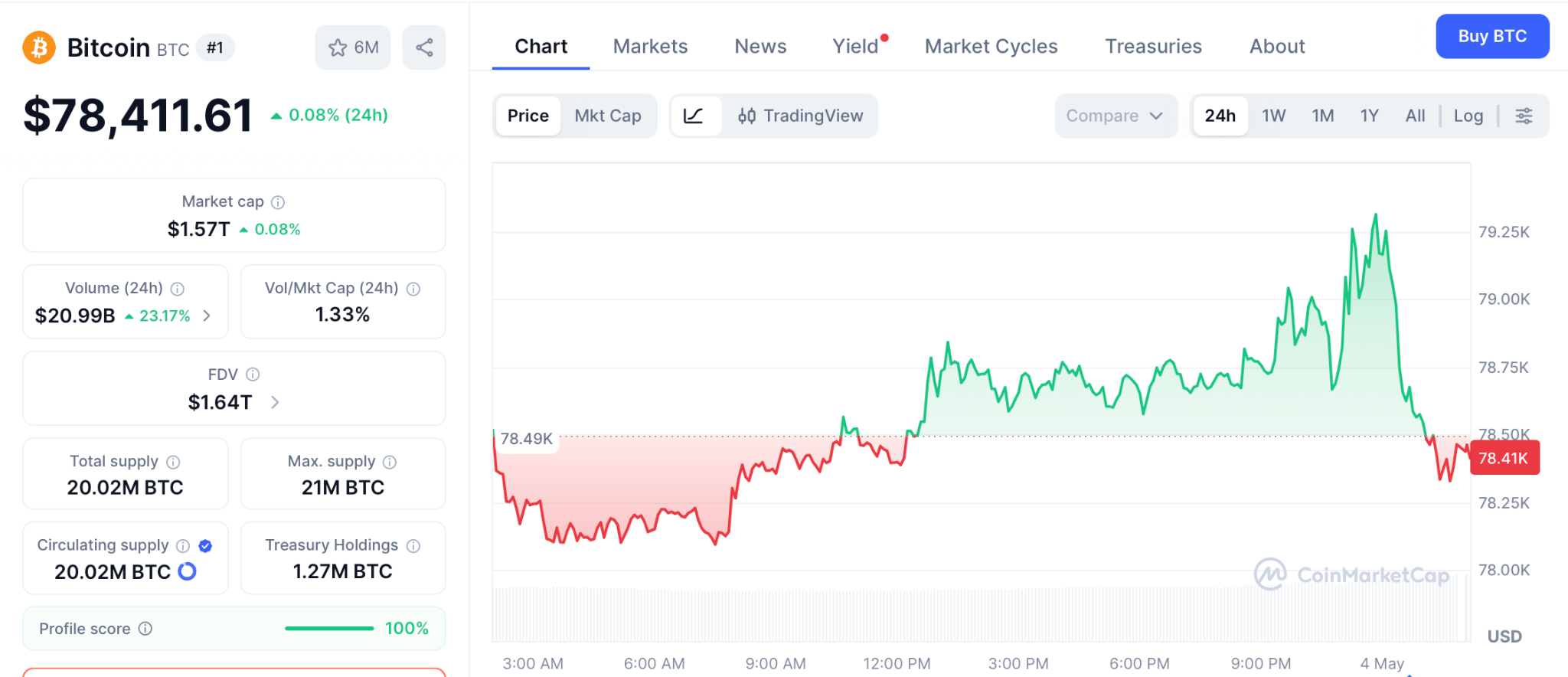
Support holds at $75,800 with a target of $84,000 if bulls flip $80,000. At $1.5 trillion market cap, BTC offers 8% upside to $84,000, not the 100x returns that presale entries deliver at Pepeto.
Dogecoin (DOGE) Price at $0.109 as DOGE Lacks Exchange Tools and Depends on Meme Culture
Dogecoin (DOGE) holds near $0.109 with support at $0.10 and resistance at $0.12. DOGE reached an all-time high of $0.74 in May 2021 and sits 85% below that peak, with recovery depending entirely on social energy returning.
BTC holds strong but DOGE at this level offers hope while Pepeto at presale pricing offers exchange backed growth with a verified audit that meme coins cannot match.
Conclusion:
The strongest April in years just confirmed that the bull market is building, and the widest gap between a presale price and a listing price in this entire market sits inside Pepeto right now. Each round closes quicker than the last, 175% APY is growing positions daily while most traders watch the $80,000 level and wait for a signal, and the listing will shut this window permanently.
Visit Pepeto and enter the presale now, because the moment the exchange goes live and the bitcoin price today sends fresh capital into every connected chain, the price you see right now becomes a memory, and 2026 delivers its biggest returns to the traders who got in while others were still looking at charts.
Click To Visit Pepeto Website To Enter The Presale

FAQs
What is the bitcoin price today in May 2026?
The bitcoin price today shows BTC at $78,411 after an 11.87% rally in April with $2.44 billion in spot ETF inflows, the strongest month of 2026. Visit Pepeto.
Why is Pepeto a better entry than Dogecoin right now?
Pepeto has a full exchange in development with a SolidProof audit and $9.79M raised, while Dogecoin lacks infrastructure and depends entirely on meme sentiment for any price recovery from its current 85% distance below all-time highs.
Disclaimer: This is a Press Release provided by a third party who is responsible for the content. Please conduct your own research before taking any action based on the content.

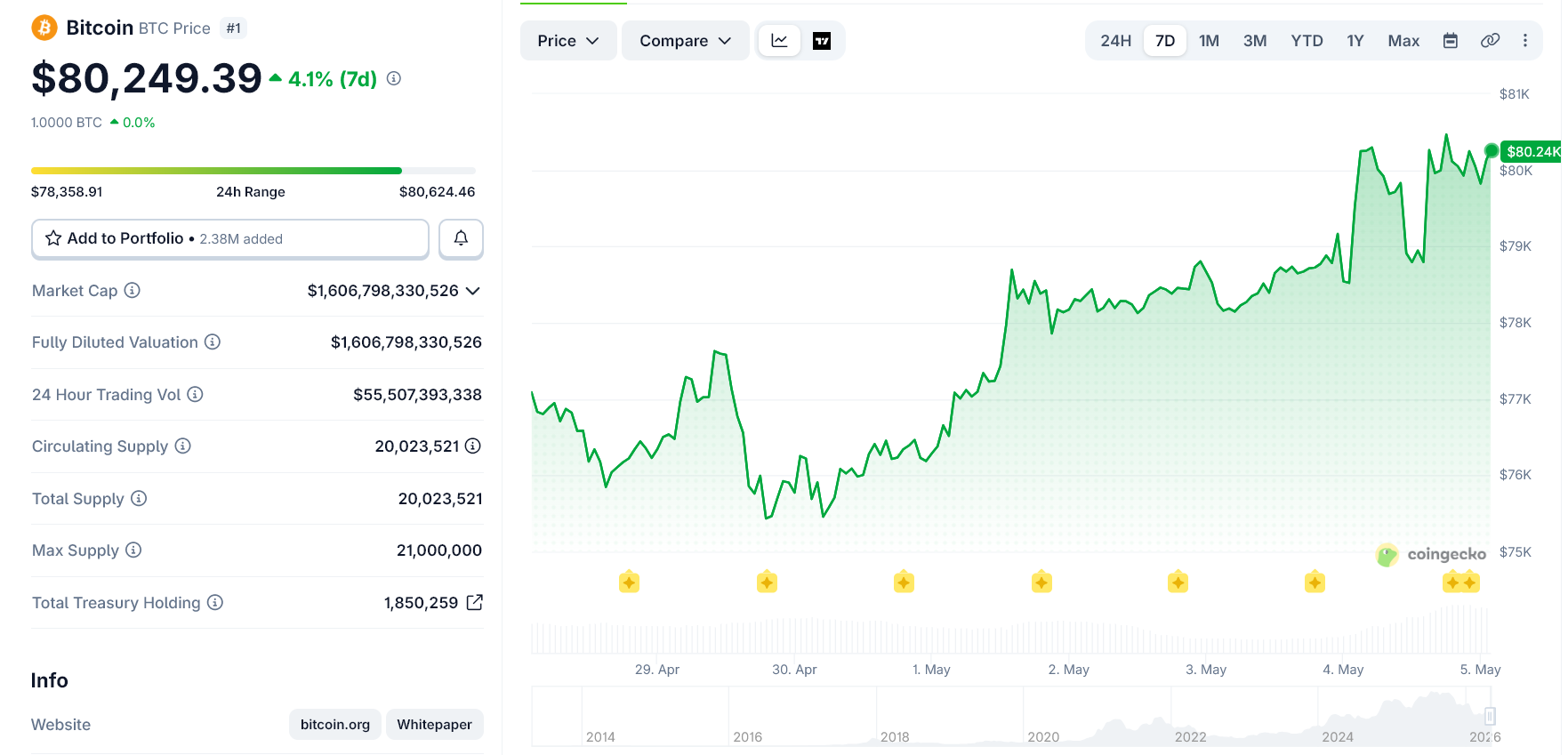
Bitcoin (BTC) has reclaimed $80,000 for the first time since January 31, ending a three-month price drought. The breakout flips a key level back into support and shifts the focus to $85,000 as the next major test.
Daily indicators have turned constructive, yet the lower timeframe still flashes warning signs. A breakdown from a multi-week ascending channel suggests bears have not been fully cleared from the picture.

Bitcoin Daily Chart Confirms Breakout Above Descending Trendline
BTC bounced off the $75,000 area, which acted as resistance throughout February and March, and is now pushing higher with support from the 20-day moving average. The move marks the first daily close above $80,000 in more than three months.
The breakout also completes a clean reclaim of the descending trendline drawn from the April 13 swing high. The Relative Strength Index (RSI) has trended steadily higher and now sits just below overbought territory, with no bearish divergence on the daily timeframe.
The Moving Average Convergence Divergence (MACD) has flipped with a bullish crossover.
Immediate resistance sits at the 0.382 Fibonacci retracement near $85,000. A clean break above that level would open the path to the 0.618 retracement at $100,900, broadly in line with the bullish outlook flagged earlier this month.

Van de Poppe Sees $86,000 As First Resistance Target
The bullish daily setup aligns with commentary from analyst Michael van de Poppe, who shared a daily BTC/USDT chart pointing to fresh institutional demand. He flagged $600 million in spot BTC ETF inflows on the first trading day of May, consistent with the strong inflows recorded throughout April.
Van de Poppe described the recent consolidation as relatively shallow, suggesting that buyers absorb dips quickly while inflows continue to build. He highlighted the $79,000 zone as the level that needs to break and hold before the next leg higher.
“Strong consolidation on $BTC… The $79K area is a crucial zone. That needs to break. If this breaks, I’m assuming we’ll see more upwards momentum and I’ve got $86-88K as first resistance area and $92-94K as the crucial one.”
His roadmap places $86,000 to $88,000 as the first overhead resistance and $92,000 to $94,000 as the more decisive zone. That layered map closely tracks the support levels flagged in earlier BeInCrypto coverage.

BTC 4-Hour Chart Flags Possible Drop to $75,000
The lower timeframe complicates the bullish daily story. On the 4-hour chart, RSI has pushed into overbought territory, and MACD prints higher green momentum bars.
However, volume has been declining throughout the most recent leg up, which suggests the stronger move may still be ahead.
A bearish scenario also remains on the table. Since March 26, BTC has traded within a parallel ascending channel, breaking down from the lower band on April 27. The current price action looks like a retest of that broken channel from below.
If the lower band rejects price as resistance, BTC could slide back toward $75,000, where bulls would need to defend the 0.236 Fibonacci retracement and the rising 50-day moving average. A loss of that area would invalidate the broader bullish thesis and could echo earlier patterns when ETF flows cooled and the price retraced.
The next 24 to 48 hours look pivotal. A decisive 4-hour close back inside the broken channel would invalidate the bearish setup and clear the road to $85,000.
A sharp rejection here would shift attention to the $75,000 floor.

The post Will Bitcoin Reclaim $85,000 Next? Daily Chart Confirms Breakout appeared first on BeInCrypto.


Bitcoin is beginning the Hong Kong trading day under $80,000, according to CoinDesk market data, as the market once again tests a level that has repeatedly capped upside in recent sessions.
Price action remains rangebound just below the $80,700 short-term holder realized price, a key on-chain level now acting as near-term resistance, Glassnode said in this week’s market update.
The issue is not just another rejection near $80,000. Presto Research’s April timezone data shows Asian trading hours consistently dragged on returns, while U.S. and European sessions drove most of the gains.
Hong Kong’s three spot Bitcoin ETFs — ChinaAMC, Bosera Hashkey, Harvest — have gone effectively dormant. Net assets sit at $319.48 million, with daily turnover routinely under $2 million and net creations at zero on most April sessions.
At the same time, capital in the region appears to be rotating elsewhere. Hong Kong’s IPO market raised roughly HK$110 billion in the first quarter, its strongest start in five years, with a heavy concentration in mainland China AI and technology listings. With over 400 IPO applications in the pipeline, the Hong Kong exchange is effectivley full for the year.
For regional investors, those deals offer a competing high-growth narrative that may be drawing dollars for risk assets away from crypto.
The market is testing whether BTC can hold near $80,000 without broader global participation, market maker Enflux wrote in a note to CoinDesk.
“if Asian participation stays absent, any sustained push above $80K requires European and US sessions to keep carrying the load without the overnight liquidity buffer Asia normally provides,” Enflux wrote.
That dependency is becoming more visible in the flow data. U.S. spot bitcoin ETFs swung to $783.4 million in net outflows last week, while trading volume fell 13.45%, according to Glassnode. Spot cumulative volume delta, which tracks whether buyers or sellers are initiating trades, dropped 28.6%, pointing to weaker buying pressure.
Together, the data suggest the demand that drove April’s rally is no longer building, leaving bitcoin pressing into resistance without a clear second leg of support. With traders also clustering expectations in the $78,000 to $82,000 range, according to Enflux, the market is treating $80,000 less as a breakout level and more as the top of a band.
Friday’s U.S. payrolls report is the next key catalyst. A strong print could give Western flows enough momentum to push higher again. A miss would leave bitcoin testing support without the global participation that typically underpins sustained rallies.
BILL-USD pair to launch once liquidity is ready.
Summary
- Coinbase has confirmed it will launch spot trading for the Billions (BILL) token, with a BILL-USD pair scheduled to go live once liquidity conditions are met.
- Users in supported regions can already generate BILL deposit addresses on coinbase.com, the Coinbase app, and Coinbase Exchange, though deposits remain paused until the issuer unlocks transfers.
- The listing follows Coinbase’s earlier decision to add BILL to its public asset roadmap ahead of the Billions Network token generation event (TGE) on May 4.
According to Coinbase’s latest listing update, the exchange “will launch BILL (Billions) spot trading” and expects to open the BILL-USD order book later today in supported trading regions, contingent on sufficient liquidity and market-maker support.
The company has already enabled users to generate deposit addresses for BILL on its website, mobile app, and Coinbase Exchange, but has stressed that “deposits of BILL will not be available until the asset issuer unlocks transfers,” meaning on-chain deposits and trading will only begin after the project lifts transfer restrictions.
Third-party coverage notes that once BILL goes live, Coinbase plans to offer at least a BILL-USD trading pair, with some reports suggesting additional pairs such as BILL-USDT and BILL-EUR may follow, depending on demand and regional approvals.
The listing comes shortly after Billions Network announced its token generation event for May 4, 2026, positioning the Coinbase spot launch as one of the project’s first major centralized exchange listings.
In earlier communications, Coinbase added Billions (BILL) to its official listing roadmap, a procedural step the exchange says “signals that we are exploring the asset” but does not guarantee trading; historically, however, most roadmap assets have progressed to full listings once technical and compliance checks cleared.
A recent crypto.news briefing described the roadmap addition as “a significant visibility boost” for Billions, noting that being on Coinbase’s list often catalyzes liquidity and community interest ahead of an actual trading launch.
Another crypto.news overview highlighted how the project timed its TGE to coincide with the Coinbase listing window, aiming to funnel initial token distribution directly into a large, regulated spot venue.
A separate crypto.news analysis pointed out that by gating deposits until the issuer unlocks transfers, Coinbase is trying to reduce technical risk and ensure that on-chain flows into BILL-USD order books start only once the token’s contract is fully live and stable.


Bitcoin price broke above $80,000 on May 4 for the first time since January 31, reaching the level as Consensus 2026 opened in Miami and $630 million in US spot Bitcoin ETF inflows on May 1 gave the move institutional backing.
Summary
- April’s $1.97 billion in spot Bitcoin ETF inflows was the highest monthly total of 2026, setting the stage for the $80,000 reclaim.
- CryptoQuant analysts said the rally is driven by ETF inflows and leveraged longs, not broad-based spot buying, a pattern historically linked to fragile gains.
- Polymarket odds put the chance of Bitcoin reaching $90,000 in May at just 23%, reflecting low conviction about further upside.
Bitcoin price climbed above $80,000 on May 4, the day Consensus 2026 opened at the Miami Beach Convention Center. As crypto.news reported, April’s $1.97 billion monthly ETF total was the strongest of 2026, and the move also came alongside improved geopolitical risk sentiment after Trump’s “Project Freedom” military operation lifted risk appetite across global markets. 21Shares chief market strategist Adrian Fritz said $80,000 is “quite a resistance” and that a confident break above it “could spark some momentum” as recent buyers return to profit.
As crypto.news documented, US spot Bitcoin ETFs logged eight consecutive days of net inflows totalling $2.1 billion through April 23, with BlackRock’s IBIT responsible for roughly 75% of all capital entering the category.
CryptoQuant noted the April rally was “powered by buyers who don’t fully trust” the level, with perpetual futures demand dominating over spot accumulation. Strategy, the largest corporate Bitcoin holder, paused its weekly purchases ahead of its May 5 earnings report.
As crypto.news tracked, Bitcoin had previously tested $80,000 twice in 2026 and been rejected both times. Polymarket’s implied probability of $90,000 in May stands at 23%, placing the market in the “possible but not expected” category.
Consensus 2026 runs May 5 to 7 at Miami Beach Convention Center with 20,000 or more attendees, covering tokenisation, stablecoins, and CLARITY Act developments. CCN reported that the conference gives those themes a public stage just as Bitcoin attempts to turn $80,000 from a headline level into support..

Bitcoin extended a fresh rally, testing the $80,000 level for the first time in three months as miners’ profitability improves and large ETF inflows buoy sentiment. The move came with about $270 million in liquidations on leveraged short futures, signaling near-term buying pressure even as risk assets move in tandem with tech shares.
Across markets, Bitcoin still trades well below its October peak around $126,200, keeping investors wary of a full-blown breakout. Yet the latest data points suggest a constructive setup for bulls: rising on-chain profitability for miners, a rebound in market share versus altcoins, and renewed institutional demand into BTC and ETH ETFs. The Bitcoin-to-altcoin dynamic appears to be shifting back toward BTC as investors reassess risk and liquidity conditions in the space.
Key takeaways
- Mining profitability has improved to about $37 per day for a one pentahash/second unit, the highest in months, even as total hashrate has declined roughly 13% in the past quarter.
- Bitcoin dominance reached its strongest level since mid-2025, signaling waning appetite for many altcoins and a focus on BTC-led exposure.
- CoinShares data show combined assets under management for BTC and ETH exchange-traded products at about $147 billion as of April 27; Solana and XRP ETFs remain well under $3 billion each, underscoring concentration in the largest blue-chips.
- Options data points to cautious optimism: call premiums on Deribit outpaced puts by roughly 24% on Monday, suggesting more appetite for upside bets than earlier in the week.
- Friday’s roughly $630 million net inflow into US-listed spot BTC ETFs reinforces renewed institutional demand alongside ongoing mining and hash-rate dynamics.
Mining profitability underpins BTC resilience as hash power retreats
Bitcoin’s latest price action comes amid a rebound in miners’ economics. The measured daily return for a one pentahash/second (PH/s) unit climbed to about $37, a level not seen since late January, highlighting a shift toward profitability even as the network’s total hasrtable contracted by around 13% over the last quarter. The improvement matters because it can alter miners’ behavior—reducing the incentive to liquidate reserves and supporting network security during periods of lower hash power.
Publicly listed mining companies have been balancing debt management with expansion into other growth areas. Notably, Riot Platforms disclosed a sale of Bitcoin worth about $250 million in the most recent quarter, a move that underscores ongoing pressure to optimize balance sheets in a sector characterized by rapid infrastructure costs and shifting capex needs. The combined effect of stronger profitability and selective selling suggests miners may be better positioned to weather downturns while continuing to invest in capacity and energy efficiency.
On-chain and market data add nuance to this narrative. Data from BGometrics indicates miner reserves were at multi-year lows, a proxy for the potential for future selling pressure if reserve tap points rise. Yet the recent profitability rebound helps mitigate that risk, offering a potential counterweight to any renewed reserve release. Meanwhile, hash price, a real-time profitability indicator that blends price and network health, has continued to move in a positive direction, aligning with broader risk-on sentiment.
Taken together, the mining sector’s current momentum is a key piece of the BTC puzzle. It provides a more favorable backdrop for miners to sustain operations and for the network to maintain security as the hash rate fluctuates. When miners are more profitable, the incentive to sell lessens, which can support price stability even amid macro headwinds.
BTC leadership and institutional demand reshape the altcoin narrative
Bitcoin’s market leadership is reflected not only in its price action but also in where institutional capital flows. Bitcoin and Ether exchange-traded products (ETPs) now command about $147 billion in assets under management, according to CoinShares data published this week. By comparison, similar products tracking Solana and XRP struggle to surpass $3 billion each, underscoring the heavy tilt toward the largest two crypto assets among institutional buyers. Collectively, BTC and ETH account for roughly 95% of that market, highlighting a persistent concentration risk and a growing perception that the most liquid, regulated vehicles remain the preferred route for large investors.
The tilt toward BTC is mirrored in on-chain dynamics. Bitcoin’s dominance—measuring BTC’s share of total crypto market value excluding stablecoins—has risen to its highest level since mid-2025 as demand for alternative tokens softens. This shift occurs amid a broader cooling in DeFi activity and ongoing concerns around governance tokens, memecoins, and certain decentralized exchange ecosystems following notable security incidents. While the altcoin complex has drawn some attention for diversification, the prevailing appetite among cautious institutions appears to favor BTC-backed exposure and blue-chip assets within the sector.
Market participants have also keenly watched call and put activity in the options market. Deribit data shows call premiums outpacing put premiums by about 24% on Monday, marking a shift from weekend sentiment and signaling greater willingness to bet on upside moves in the near term. While this does not guarantee a sustained rally, it suggests a tilt toward a more constructive risk posture and a willingness among traders to probe higher price levels with defined risk via options.
Equity-style flow data reinforce the story. On Friday, US-listed spot BTC ETFs attracted roughly $630 million in net new money, a sizable vote of confidence from institutional buyers that complements the mining and on-chain improvements driving sentiment. The combination of higher miner profitability, stronger BTC dominance, and robust ETF inflows paints a picture of a crypto market that is rotating back toward BTC leadership after a period of broader altcoin focus.
What to watch next in a BTC-led market backdrop
As investors weigh the ongoing dynamics—mining economics, reserve behavior, ETF demand, and the evolving options curve—the path for Bitcoin will hinge on whether momentum can sustain through broader macro cycles and regulatory developments. A few key watchpoints emerge: how long mining profitability remains supportive as energy costs and efficiency continue to evolve; whether miner balance-sheet strategies shift in response to price movements and reserve levels; and how institutional appetite for BTC and ETH ETFs evolves as new products and regulatory clarity emerge. If the current combination of profitability, dominance, and inflows persists, a move toward new highs or a test of key resistance levels could be on the horizon, with some analysts viewing $85,000 as a plausible milestone should momentum hold.
In the near term, readers should monitor ETF flow data, miner activity, and option-market signals for corroborating evidence of the sentiment shift. Altcoins could remain under pressure if BTC strength broadens, but any sustained improvement in mining profitability and ETF demand would likely keep BTC in the spotlight as the sector navigates a mixed but improving risk environment.
This article reflects data and reporting from Cointelegraph and its referenced sources, including BGometrics, Riot Platforms, HashrateIndex, CoinShares, and Deribit. Readers are advised to conduct their own research before making investment decisions.


Crypto has become one of Iran’s most practical economic tools as war, sanctions, and financial isolation continue to squeeze the country’s access to global markets.
The pressure intensified again on May 4, 2026, after Iran claimed it fired missiles at a US Navy vessel near the Strait of Hormuz.
Washington denied the strike and said Tehran had fired only warning shots. The clash came as the US launched “Project Freedom,” a naval operation to guide ships through the strait with destroyers, aircraft, drones, and about 15,000 service members.
Oil prices surged, with Brent crude hitting $120. Bitcoin, meanwhile, reclaimed $80,000.
Sanctions Turned Crypto Into Iran’s Payment Rail
For Iran, this is the broader point. Oil remains central to state revenue, but crypto has become central to daily business survival.
Ebrahim Mello, an Iran and Middle East expert and member of the BRICS+ Consortium Business Council, told BeInCrypto that it’s now difficult to imagine Iranian domestic or foreign trade without cryptocurrency.
Sanctions, the lack of Visa and Mastercard, and limited access to SWIFT have pushed businesses and individuals toward digital assets.
According to Mello, many Iranians can convert rials from local bank accounts into crypto and send funds abroad.
Payments can move to Russia, Turkey, the Arab states, and even North America through wallet transfers. Bitcoin prices now appear on exchange boards, while some high-end restaurants in Tehran accept crypto payments.
“Sanctions and restrictions pushed people to look for creative solutions. Iranians found alternative channels, and crypto became one of them. At one point, everyone in Iran was mining. Mining equipment appeared in factories, schools, and even mosques. Electricity was cheap, but the pressure became so large that the country started facing serious power shortages,” Ebrahim Mello told BeInCrypto
Mining also grew because of Iran’s cheap electricity, backed by its oil and gas reserves. Mello estimated that mining one Bitcoin in Iran can cost roughly $1,000 to $1,500.
That created incentives for mining in factories, schools, mosques, and private buildings.
However, the boom created pressure on the power grid. The government has tried to control illegal mining, but enforcement remains difficult across homes, businesses, and industrial sites.
Crypto Moves Money, But It Cannot Replace Trust
Still, crypto does not remove Iran’s trade problems. Mello said Iranian firms often rely on handshakes, cash, pro-forma invoices, and wallet transfers.
That creates friction in markets such as Russia, where contracts, labeling rules, certificates, and formal banking trails matter.
The result is clear. Crypto helps Iranian businesses move money when formal systems are blocked. But it cannot replace legal structure, market knowledge, or trust in cross-border trade.
The post Bitcoin Instead of Oil: How Crypto Keeps Iranian Business Moving appeared first on BeInCrypto.
Ripple Custody entered a strategic partnership with Kyobo Life Insurance on April 15, making Ripple Custody Korea’s first blockchain-based government bond settlement platform for a Tier 1 insurer, targeting a compression of the standard T+2 settlement cycle to near real-time execution.
Summary
- The pilot uses Ripple Custody to hold, transfer, and settle tokenised Korean government bonds, with stablecoin payment rails also under exploration through Ripple’s RLUSD stablecoin.
- Jin Ho Park, Senior Executive VP at Kyobo Life, said the partnership is “not simply about digital assets” but about validating how traditional financial instruments can operate on blockchain.
- SBI Holdings, Ripple’s long-term Japanese partner, is also an investor in Kyobo Life, linking Ripple’s Japan and Korea strategies through the same financial network.
Ripple Custody signed its first deal with a Korean insurance institution on April 15, partnering with Kyobo Life Insurance, one of the country’s three largest life insurers with approximately $92 billion in assets.
As crypto.news reported, the arrangement targets a compression of Korea’s standard T+2 bond settlement cycle into near real-time on-chain execution. The official Ripple press release confirmed the partnership as a “landmark strategic partnership” and the first of its kind in Korea’s insurance sector.
Jin Ho Park, Senior Executive Vice President at Kyobo Life, said: “Our partnership with Ripple is not simply about digital assets — it’s about validating how traditional financial instruments can operate securely and efficiently on blockchain.”
As crypto.news documented, Ripple added a second Korean institutional deal on April 27, partnering with KBank, the country’s first internet-only lender and Upbit’s exclusive banking partner, to test blockchain-based cross-border remittances.
The two April deals confirm Ripple is building a connected institutional stack across insurance, banking, custody, and stablecoins in Korea. As crypto.news tracked, the partnership does not use Ripple’s On-Demand Liquidity product and does not create direct XRP purchase demand from settlement itself, though the RLUSD component could generate XRP Ledger throughput over time.


Bitget, the world’s largest Universal Exchange (UEX), has recorded a new milestone in its CFD business, with daily trading volume reaching $8 billion, less than half a month after surpassing $6 billion in March.
The surge comes amid a broader rise in global gold demand and trading activity. Investment demand for gold increased 84% year-on-year to a record level in 2025, while prices have continued to hover near historic highs, surpassing $5,000 per ounce in early 2026 as investors respond to macroeconomic uncertainty and geopolitical tensions.
This environment has translated into heightened activity across gold-linked instruments on Bitget. XAUUSD accounted for approximately 95% of the incremental volume during the period, underscoring gold’s role as a primary driver of cross-asset trading demand. As market-moving events increasingly impact multiple asset classes at once, traders are turning to gold CFDs to adjust exposure in real time.
Growth has also been broadly distributed across regions. China contributed 42% of the incremental volume, followed by Europe at 27% and Southeast Asia at 16%, together accounting for 85% of the increase. The pattern reflects a global shift in trading behavior, where participation is expanding simultaneously across multiple markets rather than being concentrated in a single region.
“Gold has always been a reference point when markets become uncertain,” said Gracy Chen, CEO of Bitget. “What’s changing is how users access it. Trading is becoming more continuous and more connected across markets, and platforms need to reflect that.”
Bitget’s CFD offering allows users to trade contracts linked to commodities, forex, and indices while maintaining margin in USDT, enabling capital to move efficiently across asset classes within a single account. Combined with competitive spreads and a streamlined interface, the platform is increasingly being used as a gateway for gold CFD trading.
The trend also reflects a broader evolution in investor behavior. In major markets, demand for gold as an investment asset continues to rise, with retail participation increasing alongside institutional flows. As access to global markets becomes more immediate, users are shifting toward platforms that enable them to respond quickly to macro developments without operational friction.
Within Bitget’s Universal Exchange model, where crypto and traditional assets are integrated into a unified trading environment, the growth of CFD activity highlights a broader convergence in how markets are approached. As users move between asset classes based on opportunity rather than category, Bitget continues to expand its role as a platform for multi-asset trading at scale.
About Bitget
Bitget is the world’s largest Universal Exchange (UEX), serving over 125 million users and offering access to over 2M crypto tokens, 100+ tokenized stocks, ETFs, commodities, FX, and precious metals such as gold. The ecosystem is committed to helping users trade smarter with its AI agent, which co-pilots trade execution. Bitget is driving crypto adoption through strategic partnerships with LALIGA and MotoGP™. Aligned with its global impact strategy, Bitget has joined hands with UNICEF to support blockchain education for 1.1 million people by 2027. Bitget currently leads in the tokenized TradFi market, providing the industry’s lowest fees and highest liquidity across 150 regions worldwide.
For more information, visit: Website | Twitter | Telegram | LinkedIn | Discord
For media inquiries, please contact: media@bitget.comRisk Warning: Digital asset prices are subject to fluctuation and may experience significant volatility. Investors are advised to only allocate funds they can afford to lose. The value of any investment may be impacted, and there is a possibility that financial objectives may not be met, nor the principal investment recovered. Independent financial advice should always be sought, and personal financial experience and standing carefully considered. Past performance is not a reliable indicator of future results. Bitget accepts no liability for any potential losses incurred. Nothing contained herein should be construed as financial advice. For further information, please refer to our Terms of Use.
The post Bitget CFD Volume Surges to $8B as Gold Trading Drives Accelerated Growth appeared first on BeInCrypto.


Paradigm Bitcoin general partner Dan Robinson published a proposal on May 1 for Provable Address-Control Timestamps, or PACTs, a system that lets dormant Bitcoin holders privately timestamp proof of key ownership before quantum computers arrive, creating a potential rescue path for Satoshi Nakamoto’s estimated 1.1 million BTC.
Summary
- PACTs use three steps: a secret salt, a BIP-322 ownership proof, and an OpenTimestamps commitment anchored on-chain, all without any public on-chain transaction.
- If Bitcoin later implements a quantum sunset soft fork, PACT holders can submit a STARK zero-knowledge proof to reclaim coins while keeping their keys hidden.
- Robinson wrote that Satoshi revealing keys in any forced migration would mean having to “tell the world that they are alive and still in possession of their keys.”
Robinson published PACTs on May 1, framing the design as a hedge against what he calls the Satoshi Problem inside Bitcoin’s quantum threat discussion. The official Paradigm post outlined the dilemma: if quantum computers arrive before Bitcoin adapts, old addresses with exposed public keys face theft.
If Bitcoin rushes a sunset soft fork to freeze those addresses, dormant holders face a forced, public coin migration. PACTs offer a third path, letting holders timestamp proof of ownership silently in 2026 without doing anything further until a rescue mechanism is standardised.
As crypto.news reported, approximately 1.7 million BTC remain in quantum-exposed address types, including Satoshi-linked wallets worth roughly $75 billion.
The proposal builds on BIP-361, authored by Casa CSO Jameson Lopp, which defines a phased migration away from legacy signatures after which unmigrated coins would be frozen.
Bitcoin.com noted that Robinson acknowledged multisig, complex scripts, and hardware wallet support would all require further standardisation, and that Bitcoin may never implement a quantum sunset.
As crypto.news documented, Bitcoin’s quantum debate has been intensifying in 2026 after Blockstream CEO Adam Back argued at Paris Blockchain Week for optional, opt-in quantum-resistant upgrades rather than forced wallet freezes, directly challenging the BIP-361 approach PACTs are designed to complement.
As crypto.news tracked, Naoris Protocol CEO David Carvalho warned that dormant wallets including Satoshi’s would be “ripe for the picking” once quantum computers reach sufficient capability, and that a quantum hack on Bitcoin “would lead to a real loss of trust” in the asset.

British pubs closing at a rate of almost two per day in 2026

Bitcoin Price Today: Pepeto Exchange Targets 100x as BTC Posts Strongest April Since 2021 With $2.44B in ETF Inflows

Young and the Restless 2-Week Spoilers May 4-15: Billy Panics & Michael’s Ruthless Plot!

Manchester United reach agreement with Casemiro over contract clause amid transfer speculation

US brings back mandatory military draft registration

Steven Gerrard disagrees with Gary Neville over ‘shock’ Chelsea and Arsenal claim | Football


-

 Business6 days ago
Most Commercial Energy Audits Miss the Real Losses
-

 Fashion6 days ago
Kylie Jenner’s KHY Enters a New Era with ‘Born in LA’
-

 NewsBeat1 day ago
Channel 5 – All Creatures Great and Small series 7 new post
-
 Tech3 days ago
Trump’s 25% EU auto tariff breaches Turnberry Agreement that also covers semiconductors and digital trade
-
 Sports3 days ago
Paul Scholes issues Marcus Rashford reality check as agreement emerges over Man United star
-

 Crypto World7 days ago
CFTC’s AI will review U.S. crypto registration applications, chairman tells CoinDesk
-

 Business6 days ago
Barclay Brothers Avoid Bankruptcy: HSBC Drops High Court Petitions After IVA Deal
-
 Business5 days ago
Tesla Officially Registers Elon Musk’s Stock: What Investors Need to Know
-
 Crypto World7 days ago
Robinhood Phishing Scam Exploits Gmail Dot Feature to Bypass Security
-

 Tech7 days ago
Get Ready for More Brain-Scanning Consumer Gadgets
-

 Crypto World7 days ago
Gmail Dot Trick Underpins Robinhood Phishing, Sending Real-Looking Emails
-

 Business4 days ago
Two Powerball Tickets Split $143 Million Jackpot in Indiana and Kansas
-

 Tech5 days ago
Texas Instruments made a new flagship graphing calculator: the TI-84 Evo
-
 Crypto World4 days ago
CoreWeave (CRWV) Stock Climbs 8% Despite $45M Insider Share Dump
-

 Business7 days ago
Top 10 AI Companies Leading New Zealand’s Tech Boom in 2026
-
Business2 days ago
Winning Numbers Drawn as Jackpot Resets to $20 Million
-

 Tech7 days ago
Bambu Lab H2C review: the Cadillac of 3D printers
-

 Tech7 days ago
Robinhood account creation flaw abused to send phishing emails
-

 Business7 days ago
General Motors (GM) earnings Q1 2026
-
 Crypto World7 days ago
Solana Clients Introduce Post-Quantum Solution Falcon
You must be logged in to post a comment Login