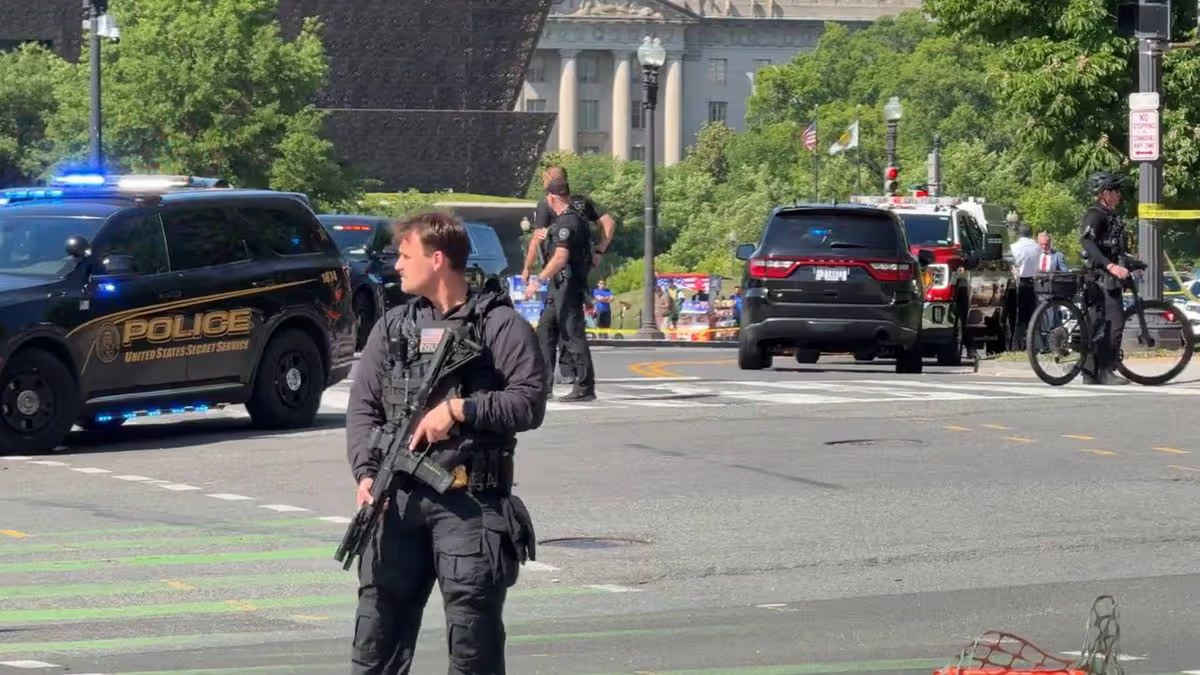
The White House was briefly placed on lockdown after a Secret Service shooting near the Washington Monument, moments after JD Vance’s motorcade had passed through the area. A young person was taken to hospital with non-life-threatening injuries.
Olivia Beeson UK & World News Reporter and Callum Hoare
00:41, 05 May 2026
The White House was placed on lockdown following a shooting near the Washington Monument.
A suspicious individual was identified and, after opening fire on Secret Service officers, was shot.
Advertisement
The incident occurred just moments after JD Vance had passed through the area, according to Deputy Director Mathew C Quinn.
At the time, the Secret Service said: “U.S. Secret Service personnel are on the scene of an officer-involved shooting at 15th Street and Independence Avenue in Washington, D.C.
“The incident resulted from a confrontation between an armed individual and Secret Service Police,” a further statement from the Secret Service confirmed,
A young person was wounded in the incident and taken to hospital, with injuries reported as not life-threatening.
Advertisement
The shooting occurred across the National Mall, approximately a mile from the White House.
Despite the distance, the White House was briefly evacuated before the ‘all clear’ was issued.
Washington DC’s Metropolitan Police Department (MPD) confirmed in a statement that an investigation is under way.
“MPD is on scene of this investigation at 15th Street and Independence Ave, SW. The scene is secure.
Advertisement
“Avoid the area as roads will be closed for several hours. Additional updates to come as information is confirmed,” the department added.
The incident comes just over a week after an alleged gunman, Cole Tomas Allen, attempted to storm the White House Correspondents’ Dinner with Trump in attendance. Allen faced charges of attempted murder of the President alongside two firearms offences.

The British Beer and Pub Association (BBPA) warned the 161 closures so far this year equate to the loss of around 2,400 jobs
Robert Dalling and Henry Saker-Clark Press Association Deputy Business Editor
03:33, 05 May 2026
Wales was the only part of Great Britain to report a rise in pub numbers across the UK, according to industry figures. It comes as around two pubs closed each day in the first three months of the year amid pressure from higher taxes and regulatory costs.
Advertisement
The British Beer and Pub Association (BBPA) warned the closures equate to the loss of around 2,400 jobs with a particular hit to younger workers.
Figures from the trade organisation show that 161 pubs closed across Britain in the first quarter of the year. For the biggest stories in Wales first sign up to our daily newsletter here.
It represents a 26% jump against the same period last year with local pubs having come under pressure from rising labour costs, taxes, and caution among consumers.
Early this year the UK Government announced business rates support for pubs in England after warnings from the sector further tax changes could lead to more closures and job losses.
Advertisement
A 15% tax relief for pubs and music venues came into effect last month.
However measures from last November’s budget, such as an increase in the minimum wage, still added to a significant jump in business costs for pubs and brewers with that change also applying in Wales.
The BBPA said the latest closure figures highlight a need for longer-term changes to business rates and a wider overhaul of taxes on the hospitality sector.
Emma McClarkin, chief executive of the BBPA, said: “The scale of these closures is avoidable because pubs are doing a brisk trade but their profits are wiped out by a disproportionate tax burden and huge costs.
Advertisement
“For too many the sheer weight of taxes and regulatory costs have forced them to shut up shop which will only hurt communities, workers, and the wider economy.
“This underscores why [the UK] Government’s business rates relief was so necessary and the support such a welcome relief.
“We want to work with government to establish a permanent long-term plan that will deliver permanently lower bills, a fairer system, and ultimately protect this treasured sector.”
It comes after a 336 drop in British pub numbers last year to 44,656. It meant more than 2,000 pubs had closed since the outbreak of the coronavirus pandemic in 2020.
Advertisement
Wales was the only part of Great Britain to report a rise in pub numbers in the latest data while Scotland witnessed the heaviest fall in numbers.
Here are the number of closures in each British region:
East of England – 16 closures to 3,682 pubs
West Midlands – 11 closures to 3,910 pubs
South West – 13 closures to 4,582 pubs
North West – 18 closures to 5,145 pubs
Yorkshire and The Humber – 10 closures to 4,235 pubs
South East – 26 closures to 5,643 pubs
London – 17 closures to 3,432 pubs
North East – two closures to 1,926 pubs
East Midlands – 10 closures to 3,579 pubs
Wales – three pubs gained to 2,901 pubs
Scotland – 41 closures to 4,188 pubs
The UK Spirits Alliance, which represents hundreds of distillers across Britain, urged the UK Government to carry out a “proper review” of excise duty as hospitality is “fighting for our very survival”.
Neema Rai, spokeswoman for the group and co-founder of Westminster-based Tamesis Dock and the Battersea Barge, said: “Pubs have been hit hard in recent years and we’ve just been hit by yet another excise duty hike.
“Spirits offer higher profit margins and help keep us afloat yet we have the highest rate of excise duty in the G7.
“The [UK] Government needs to carry out a proper review of excise duty if it’s serious about supporting hospitality because we’re fighting for our very survival.”
Advertisement
Get daily breaking news updates on your phone by joining our WhatsApp community here. We occasionally treat members to special offers, promotions and ads from us and our partners. See our Privacy Notice.
It had been a hopeless first half, but it ended on a note of serious concern. A Chelsea corner was allowed to bounce inside the box, and as Derry and Abbott both went for it there was a sickening clash of heads. The Forest player, making only his second league start, left the field unassisted but Chelsea’s teenage debutant required lengthy treatment on the pitch before being removed on a stretcher.
Despite Sunday’s (May 3) wet conditions Newby Hall’s Spring Sports Cars in the Park event attracted large numbers of rain-soaked enthusiasts, admiring the array of vehicles on show.
Among the cars displayed, there were a variety of two and four-wheeled exhibits, including classic UK and European makes such as Lamborghini, Ferrari, Audi, and Lotus, of different eras.
Display of classic Sports Cars against the backdrop of Newby Hall, near Ripon (Image: Stuart Boulton – The Northern Echo)
Newby Hall Spring Sports Cars in the Park (Image: Stuart Boulton – The Northern Echo)
Ignoring the, at times, incessant rainfall, petrol-heads and casual visitors alike marvelled at the collection, in the surrounds of the 16th and 17th Century country hall and colourful gardens, on the banks of the River Ure, near Ripon.
Advertisement
The bedraggled eventgoers could seek shelter in the magnificent opulence of the hall, itself, among whose architects was no less than Sir Christopher Wren.
There were also the delights of a wander around the award-winning gardens as a counter attraction to car collection.
A beautiful park in Cambridge offers an opportunity for people to escape the hustle and bustle
A hidden gem park off a busy road in Cambridge offers a true beauty spot to venture for a peaceful stroll or even a picnic. Alexandra Gardens lies just off Carlyle Road, a busy road in the Chesterton area.
Advertisement
This small, restful park was created in 1887 on the site of a former Victorian brickworks. In 1891 and 1892 an epidemic of diphtheria in the New Chesterton area held up the purchase of land.
In 1904 Chesterton Rural District Council bought the land for £425. It was agreed the land on Carlyle Road should be made into a public recreation ground.
The park formally opened in 1907 and interestingly, the original planting and landscaping remains. Known for its colourful flowerbeds, expansive green space, and serene atmosphere, the park offers a calming retreat for walkers, nature enthusiasts or even for those looking for some quiet solitude.
With the hustle and bustle surrounding the majority of the city, it can be hard to remember that there’s a whole world just waiting to be adventured outside of your phone and the chaos.
Advertisement
The best spots, that can be hard not to keep a hidden secret, are the ones that remind you of this. Alexandra Gardens offers a green space to quiet all the outside noise and truly enjoy the nature, the flowers and the amenities.
The site also hosts a children’s play area so little ones can run off while the adults can bask in the sun in a prime location, steps away from shops, pubs, and cafes.
The Department for Work and Pensions (DWP) has confirmed a wider six-part evidence and engagement programme for the review of Personal Independence Payment (PIP)
Linda Howard Money and Consumer Writer
03:00, 05 May 2026
Individuals claiming Personal Independence Payment (PIP) will have multiple opportunities to share their views beyond a written consultation. It follows the UK Government’s confirming an expanded approach to collecting evidence for its comprehensive review of the benefit.
The Department for Work and Pensions (DWP) announced the Timms Review will be underpinned by a six-part “evidence and engagement programme” intended to ensure it captures “as many perspectives and experiences as possible”.
Advertisement
The review, headed by Sir Stephen Timms, marks the first complete examination of PIP since its launch in 2013 and is anticipated to deliver its findings later this year. It will assess how the benefit is functioning and whether it remains suitable for future needs. Timms Review of Personal Independence Payment
In addition to the current Call for Evidence, which remains open until 28 May, the DWP has now detailed further avenues through which disabled people, carers and organisations can participate.
Beyond written responses, the programme will feature a new nationally representative survey, commissioned via independent research organisation NatCen, to gather a broader spectrum of claimant experiences, reports the Daily Record.
There will also be organised workshops and discussion sessions with charities, specialists and those with lived experience to examine issues more thoroughly.
Advertisement
To broaden engagement even further, the DWP is launching a “workshop in a box” toolkit, enabling organisations and community groups to facilitate their own sessions and submit findings to the review. The DWP will also draw upon existing research, including academic studies and data already held by the UK Government, to develop a more comprehensive understanding of how PIP is functioning in practice.
Further engagement activities, incorporating accessible formats and face-to-face opportunities, are planned to ensure participants can contribute in ways that best suit their individual needs.
In a statement published on GOV.UK, the review team indicated that the approach is designed to go beyond conventional consultations by combining statistical evidence with first-hand experiences of the benefits system.
PIP is intended to assist with the additional costs associated with living with a long-term health condition or disability, and is paid irrespective of whether the recipient is in employment.
Advertisement
A successful PIP claim is currently worth between £30.30 and £194.60 per week, equating to between £121.20 and £778.40 every four-week payment period.
The number of individuals receiving PIP has climbed to more than 3.9 million, with expenditure forecast to continue rising, prompting ministers to commission a full review.
The DWP has confirmed that no decisions have yet been reached regarding potential changes, and any recommendations will be guided by the evidence gathered throughout the review process.
A steering group comprising disabled people, charities and policy experts is also providing support for the review, with the government stating that the work is being co-produced alongside individuals with direct experience of the system.
Advertisement
The Call for Evidence remains open until 28 May, with findings anticipated to inform recommendations later in 2026. Ultimate decisions on any potential reforms will be made by ministers following the publication of the review’s report.
He was asked whether he thinks Patrick Kielty will stay on as host amid no confirmation of a contract renewal
Pat Kenny has said it’s his “instinct” that Patrick Kielty “probably won’t stay on” as Late Late Show host.
Advertisement
There has been much speculation surrounding the Co Down comedian’s future as host of RTÉ ‘s flagship chat show as his three-year contract with the broadcaster has come to an end without news of a renewal.
Pat, who hosted the Late Late between 1999 and 2009, thinks changes in Patrick Kielty’s personal life since joining the show may influence whether or not he stays on as presenter.
“I wouldn’t necessarily expect him to confide in me, I don’t know him that well, but the fact that he didn’t say ‘yeah’, obviously he was either still in negotiations or there was some reluctance [on his behalf].
“His domestic arrangements are somewhat more complicated since he split up from Cat [Deeley] – the kids are over in London and he’s up in Northern Ireland, so that must be very gruelling, so I think it’s up to him.
“He has done it for three years, but he wasn’t split up at the beginning, so it may be just wearing him down, though he doesn’t show it on air.
“My instinct is that he probably won’t stay on. Maybe it’s too constrictive. If you don’t have kids, you can carry on regardless.”
Advertisement
When asked if it was time for RTÉ to call a day on The Late Late Show, Pat said it would be “commercially crazy” to do so.
He told the publication: “When Gay Byrne left after 37 years, it was my job to keep the brand alive, which I did for 10 years, and then Ryan Tubridy took over, and it was his job to keep the brand alive.
“But I do know it’s more difficult now. The Late Late Show should be like a rowdy Irish dinner party.
Advertisement
“Someone would sing a song, someone would tell the jokes, there would be a row – that’s the recipe – and of course, there has to be a bit of stardust.
“It gets harder and harder to get the stardust to walk into the studio. The big international stars are more reluctant to travel than they ever were.
“They can do it by Zoom, or they go into a hotel in London and give 20 interviews.”
He told viewers at home: “That is it from us for tonight, and for this season, we hope you have a fab summer. This has been The Late Late Show, I’ve been Patrick Kielty, and playing us out tonight, this is Westlife! Goodnight.”
RTÉ sources told the Sunday Independent this weekend that the general consensus is that Patrick will stay on as host. However, there has been no official confirmation on his future as of yet.
As the show wrapped up on Friday night, a spokesperson for the national broadcaster said: “As The Late Late Show reaches the end of another successful season, we look forward to the programme returning for its 65th year in the autumn.”
A new spanner was thrown into the works of the title race on Monday evening as Everton held Manchester City to a surprise draw.
Pep Guardiola’s side had been in fine late-season form and were quickly closing in on league-leading Arsenal.
They came into this match with two games in hand and a six-point gap to close, there was no margin for error as City visited the Hill Dickinson Stadium for the first time.
They led 1-0 at half-time thanks to Jeremy Doku’s opener, but three goals in 13 minutes from Thierno Barry and Jake O’Brien left them staring a rare defeat in the face.
Advertisement
Erling Haaland pulled one back late on before Doku added a stunning equaliser to save his side a point, but City once again find themselves on the back foot in the title race.
City do still have a game in hand, which they will make up when they host Crystal Palace on May 13, but they are back in the familiar position of waiting for Arsenal to slip up if they are to claw back any territory in the table.
Here’s how the run-in looks for both title contenders…
Arsenal remaining Premier League fixtures
Advertisement
Crystal Palace (A), May 24
Man City remaining Premier League fixtures
Crystal Palace (A), May 13
How many points do Arsenal need to win the Premier League title?
Advertisement
After drawing at Everton, Man City can now win no more than 83 points this season.
Arsenal presently sit on 76, meaning they require seven points from a possible nine in their last three matches to confirm their status as Premier League champions.
After City’s defeat by Everton, Arsenal have a comfortable advantage on goal difference, should the two teams finish level on points. Their score of +41 gives them a comfortable cushion to City’s +37.
City do have a game in hand still to play, against Crystal Palace on May 13, but also have the added wrinkle of an FA Cup semi-final ahead of the final Premier League matchday. Similarly, Arsenal remain in contention for the Champions League, with a semi-final second-leg to be played this week.
Lively also posted on Instagram about the judge’s move, writing: “The last thing I wanted in my life was a lawsuit, but I brought this case because of the pervasive RETALIATION I faced, and continue to, for privately and professionally asking for a safe working environment for myself and others,” she wrote.
Kim Kardashian wore a sculpted bronze breastplate to the 2026 Met Gala (Picture: Mike Coppola/Getty Images)
This year, the Met Gala wasn’t about subtle glimpses of nipples through sheer dresses, but about sculpted, moulded, and engineered busts as the unapologetic center of attention.
If Fashion Is Art was the brief, then apparently the body itself became the canvas — or more specifically, one very particular part of it.
Afterall, one thing most great sculptures of the human form have in common? Prominent nipples.
Leading the charge, unsurprisingly, were the Kardashian-Jenner dynasty, who arrived in three entirely different outfits that all somehow landed on the exact same… point.
Advertisement
Kim Kardashian opted for a corseted look that leaned into exaggerated, cone-like structure, courtesy of artists Allen Jones and Whitaker Malem — a duo known for turning the human form into something closer to statue than clothing.
Meanwhile, Kylie Jenner took a more illusion-based route in a painstakingly detailed Schiaparelli Haute Couture gown by Daniel Roseberry.
Kim’s was a cone-shaped leotard of sorts (Picture: Mike Coppola/Getty Images)
Kylie followed suit in a nude coloured bodice (Picture: Matt Winkelmeyer/MG26/Getty Images for The Met Museum/Vogue)
The gown was designed by Schiaparelli (Picture: Jamie McCarthy/Getty Images)
It featured thousands of pearls, hand-painted scales, and enough embroidery to make your head spin, but the real trick was in the barely-there bodice, engineered to mimic the body beneath.
Then there was Kendall Jenner, who turned a humble white T-shirt into something that would make a museum curator weep.
Designed by Zac Posen for Gap, her look referenced classical sculpture, specifically the Winged Victory of Samothrace, proving that even ancient marble knew the power of a well-placed contour.
Advertisement
Kendall Jenner kept things more subtle, only revealing on fake nipple (Picture: Matt Winkelmeyer/MG26/Getty Images for The Met Museum/Vogue)
And just in case you thought this was a family-only phenomenon, Hailey Bieber arrived in a cobalt Saint Laurent gown complete with a gold moulded bustier that was specifically molded to her body.
At this point, it stopped being a coincidence and started feeling like an exhibit in the Vatican Museum.
One user on X wrote: ‘Okay they all look good but so far 3/3 of the kardashain looks have all included their nipples like did they plan that was there a group chat’
Another posted: ‘The way Jenner sisters are matching the NIPPLES detail.’
A third posted a picture of Kendall’s look, captioning it: ‘best dressed of the Kardashian Jenners, but what’s this trend of fake nipples.’
Advertisement
Hailey Bieber was an honorary Kardashian for the evening in a similar look (Picture: Dimitrios Kambouris/Getty Images for The Met Museum/Vogue)
Of course, this isn’t fashion’s first flirtation with the idea.
Designers have been toying with sculptural busts for decades — from Jean Paul Gaultier’s infamous cone bra to Thierry Mugler’s hyper-moulded silhouettes.
It was clear that the most popular interpretation of the Met Gala’s theme was wearable statues, creating a red carpet full of bodies reimagined, exaggerated, and polished into something just slightly uncanny.
Got a story?
If you’ve got a celebrity story, video or pictures get in touch with the Metro.co.uk entertainment team by emailing us celebtips@metro.co.uk, calling 020 3615 2145 or by visiting our Submit Stuff page – we’d love to hear from you.
The tapes were recorded in 1991 during private conversations with her friend James Colthurst and formed the basis of Andrew Morton’s biography, Diana: Her True Story.
In them, the late Princess of Wales reflects on her marriage to Charles, her struggles with bulimia, and her views on what was then his ongoing relationship with Camilla.
They also include personal thoughts on her sons, Prince William and Prince Harry, as well as comments about Sarah Ferguson and Andrew Mountbatten-Windsor.
Advertisement
The Radio Times reports that in the 30 years since her death, less than an hour of this material has been made public.
The new docuseries, Diana: The Unheard Truth, will air in 2027 to mark 30 years since her death and will include never-before-heard recordings.
Love Monday TV said: “The series will challenge the reductive narrative that has too often framed Diana as a victim of her circumstances.
“Instead, it will show a resilient, perceptive, and relatable young woman, finding herself in the brightest of global spotlights, and navigating the challenges with grace, self-awareness, and determination.”
The three-part series has been created by Love Monday TV, which has secured full access to the archive tapes in partnership with Morton and Colthurst, who also feature in the series.
Advertisement
No broadcaster or streaming platform has yet been confirmed.
The series will also include interviews with those who knew her best.
Recommended reading:
Contributors will include school friend Delissa Needham, hairdresser Sam McKnight, and astrologer Penny Thornton.
Advertisement
Other voices featured are dancer Wayne Sleep, former bodyguard Ken Wharfe, royal press secretary Dickie Arbiter, photographer Kent Gavin, and journalist Richard Kay.
The programme follows a recent episode of ITV’s Reporting History, which shared previously unbroadcast footage of Princess Diana’s famed visit to Angola in January 1997.
Will you be interested in watching Diana: The Unheard Truth next year? Let us know in the comments.

You must be logged in to post a comment Login