
Crypto World
NYSE Lifts Crypto Options Cap Across 11 BTC and ETH ETFs


Two NYSE-affiliated venues have scrapped the 25,000-contract cap on options tied to 11 crypto ETF options, a move the exchanges filed with the Federal Register on March 10. The Securities and Exchange Commission acknowledged the rule alterations on Sunday by waiving the standard 30-day waiting period, meaning the changes are now in effect. The initiative removes price-discovery restrictions and the position-limit cap that had governed crypto ETF options since their November 2024 debut.
The policy shift ushers crypto ETF options closer to the regime applied to other commodity ETFs, potentially boosting institutional trading flexibility, liquidity, and ease of entry and exit. The development also paves the way for FLEX options—customizable terms such as non-standard strike prices, expiration dates, and exercise styles—to be applied to crypto ETF options.
Among the 11 crypto ETF options affected are major listings from BlackRock, Fidelity, and ARK, including BlackRock’s iShares Bitcoin Trust (IBIT), Fidelity’s Wise Origin Bitcoin Fund (FBTC), and ARK 21Shares Bitcoin ETF (ARKB). The notice also covers Bitcoin and Ether ETFs issued by Bitwise and Grayscale, expanding a footprint that has grown since the initial option-limits regime was put in place.
In parallel, the SEC’s acknowledgment of the rule changes adds a note of continuity to an ongoing regulatory arc around crypto ETF products. The latest action follows a July decision that removed the 25,000-contract limit for the Grayscale Bitcoin Trust ETF (GBTC), signaling a broader regulatory openness to easing constraints on crypto-derived derivatives.
Beyond the NYSE venues, another development looms: Nasdaq’s options arm, Nasdaq International Securities Exchange, has filed to raise the contract position limit for BlackRock’s IBIT to 1 million. That proposal remains under review by the SEC as of a February 27 notice, underscoring an industry-wide interest in expanding capacity for crypto-based hedging and trading instruments.
The shift comes against a backdrop of heightened attention to liquidity and transparency in crypto markets, with exchanges and issuers seeking to improve price discovery and provide more robust hedging tools for institutional participants. While the core economics of crypto ETFs and their options remain subject to market forces, removing artificial caps can enhance capital efficiency for institutions, market-makers, and sophisticated retail participants alike.
Key takeaways
- The NYSE Arca and NYSE American have removed the 25,000-contract limit and price-discovery restrictions on options linked to 11 crypto ETF options, effective after SEC’s waiver of the standard 30-day waiting period.
- The change brings crypto ETF options closer to the handling of traditional commodity ETF options and enables FLEX options with customizable terms.
- 11 crypto ETF options are affected, including BlackRock’s IBIT, Fidelity’s FBTC, and ARK’s ARKB, with Bitwise and Grayscale’s BTC-related offerings also covered.
- The development follows earlier regulatory moves, including the SEC’s July decision to remove the 25,000-contract cap for GBTC, signaling a gradual easing of previous constraints.
- Nasdaq ISE is seeking to lift its own cap for IBIT to 1 million contracts, a proposal still under SEC review as of late February.
Regulatory steps and what changed
NYSE Arca Inc. and NYSE American LLC filed three rule changes with the Federal Register on March 10 to eliminate the 25,000-contract position limit and price-discovery restrictions on options tied to 11 crypto ETF products listed on their exchanges. The actions mark a notable shift from the framework established when crypto ETF options first began trading in November 2024, when broad caps were designed to curb market manipulation and volatility.
The SEC’s decision to waive the usual 30-day waiting period means the amendments are now in effect. This waiver eliminates a standard cooling-off period that typically gives market participants time to react to regulatory changes, accelerating the practical impact of the rules for exchanges, brokers, and traders.
From a structural perspective, the moves align crypto ETF options with the broader approach applied to commodity ETF options, potentially improving liquidity by enabling more complete hedging and arb opportunities. The removal of the cap also dovetails with a push to offer more flexible trading tools, including FLEX options, which permit non-standard strike prices and expiration dates and more diverse exercise styles.
Which products are affected and why it matters
While the notice does not list every instrument in detail, it confirms that 11 crypto ETF options are covered. The set includes high-profile offerings from BlackRock, Fidelity, and ARK, notably the iShares Bitcoin Trust (IBIT), the Wise Origin Bitcoin Fund (FBTC), and ARK 21Shares Bitcoin ETF (ARKB). The scope also extends to Bitcoin- and Ether-focused ETFs issued by Bitwise and Grayscale, underscoring a broadening ensemble of crypto-linked options now subject to a more permissive regime.
For investors, the implications are tangible. Fewer constraints on contract size and governance around price discovery can translate into deeper liquidity and more efficient entry and exit for complex hedging strategies. Market-makers gain additional flexibility in pricing and risk management, which could reduce spreads and improve execution quality in volatile periods. Traders who rely on precise volatility hedges or sophisticated spreads may find the availability of FLEX options particularly advantageous, enabling strategies that were previously constrained by standard exchange rules.
From an issuer perspective, these changes could support more robust options markets around crypto ETFs, enhancing the attractiveness of listed products for institutions that require scalable hedging and leverage management. The broader regulatory signal—easing limits while maintaining oversight—also matters for credibility and institutional onboarding within the crypto asset space.
Nevertheless, observers should note that the crypto ETF landscape remains a function of evolving market structure, regulatory sentiment, and product demand. While the caps are lifting, liquidity will still hinge on actual trading volumes, market-making capacity, and the availability of reliable underlying data for price discovery. The market will likely watch volumes and bid-ask dynamics closely in the coming quarters to gauge the real-world impact of the change.
Broader context and what to watch next
The SEC’s posture toward crypto-based options continues to unfold. The Nasdaq ISE’s bid to raise IBIT’s position limit to 1 million contracts illustrates a broader ambition to expand trading capability for crypto ETFs beyond the NYSE-anchored venues. As regulators weigh these proposals, the interaction between rule changes, liquidity, and market integrity will be a focal point for investors and issuers alike.
Market participants should also monitor how providers respond to the new FLEX options framework. Customizable terms could unlock nuanced hedging structures that align with institutional risk management needs, but they may also introduce additional complexity that requires careful governance and risk controls.
In short, the current move by NYSE Arca and NYSE American marks a meaningful step toward normalizing crypto ETF options with traditional derivatives markets. If liquidity improves as anticipated, more investors may incorporate crypto ETF options into diversified hedging programs, potentially deepening the role of listed crypto products in mainstream portfolios. The coming months will reveal how the market consumes these changes and whether further regulatory shifts follow.
Readers should keep an eye on trading data for IBIT, FBTC, ARKB, and related Bitwise and Grayscale ETFs as well as any developments from the SEC or Nasdaq ISE regarding contract limits, price-discovery mechanics, and the broader trajectory of crypto derivatives regulation.



Aave Labs is set to receive a massive capital injection following the approval of a strategic roadmap designed to scale the protocol.
Summary
- The Aave DAO has approved a $25 million stablecoin grant and a 75,000 AAVE token allocation for Aave Labs to fund ongoing protocol development.
- Aave Labs will transition to a DAO-funded operating model where revenue from specific products flows directly into the treasury rather than being retained by the core team.
- The approved framework establishes Aave V4 as the long-term technical foundation and introduces a new governance structure to manage the protocol brand and institutional expansion.
According to the governance dashboard, the Aave DAO voted on Saturday to grant the development team $25 million in stablecoins and 75,000 AAVE tokens. The funding, part of the “Aave Will Win” framework, passed with roughly 75% support.
The stablecoins will be distributed over the next 12 months to cover operational costs, while the token package will vest over a four-year period to keep developers incentivized.
This decision changes how the protocol handles its finances. Under the new model, revenue from products like Aave Pro will go directly to the DAO treasury rather than staying with Aave Labs.
In exchange, the DAO takes over the responsibility of funding the lab’s core operations. The protocol, which currently holds over $25 billion in total value locked, also officially recognized Aave V4 as its long-term technical architecture.
Founder Stani Kulechov described the move as a defining moment for the ecosystem.
“Aave Will Win is the most important proposal in Aave’s history and it just passed with a landslide,” Kulechov shared on X.
“If you own AAVE, you own not just the economic rights of the protocol, but the brand, the users, and the integrations,” he added.
Aave Labs noted that the industry is changing as traditional fintech firms and institutions move on-chain. With regulatory clarity improving in several regions, the team plans to focus exclusively on Aave-linked products to stay ahead of the competition. They believe the winners of the next decade will be the ones who can capture new markets quickly.
Despite the successful vote, the path to approval was not without tension. Some community members questioned the sheer size of the $25 million package and the voting power tied to the 75,000 tokens. These disagreements previously led the Aave Chan Initiative, a prominent delegate, to scale back its involvement with the DAO, citing concerns over how the proposal process was handled.
Looking ahead, the framework also includes plans for a new foundation to manage the Aave brand. This follows a failed attempt in January to transfer intellectual property to the DAO, a topic that has sparked ongoing debate about how much control the community should have over the protocol’s identity. Future grants for specific product launches will still require separate votes from the DAO.


Polkadot’s (DOT) bridged token on Ethereum has reportedly fallen victim to an exploit. According to reports, an attacker minted 1 billion bridged DOT.
Onchain tracker Lookonchain noted that after this, the attacker dumped the entire supply in a single transaction, netting 108.2 ETH (approximately $237,000).
Follow us on X to get the latest news as it happens
Blockchain security firm CertiK flagged the exploit targeting the Hyperbridge gateway contract. An attacker used a forged message to gain unauthorized control. According to the firm, the attacker was able to manipulate the admin role of a Polkadot token contract on Ethereum, enabling the minting of 1 billion tokens.
The attack did not compromise Polkadot’s native relay chain or the DOT token on Polkadot itself. It targeted only the bridged, or wrapped, representation of DOT.
The incident raises fresh concerns about crypto security. Neither Polkadot nor Hyperbridge had issued an official response at the time of writing. This is a developing story, and further details will be updated as more information becomes available.
The post Bridged Polkadot Reportedly Hit by Exploit as Attacker Mints 1 Billion DOT Tokens appeared first on BeInCrypto.


The European Central Bank has thrown its weight behind a proposal to give the EU’s markets watchdog direct control over the continent’s largest crypto firms.
Summary
- The European Central Bank has endorsed a plan to transfer oversight of large crypto firms and cross-border trading platforms to the European Securities and Markets Authority.
- The central bank warned that centralized supervision is necessary to prevent financial shocks from migrating into the traditional banking system as the two sectors become increasingly linked.
- Implementation of the new regime faces opposition from member states like Malta that argue the current regulatory framework is too new to be overhauled.
The ECB issued a formal opinion on Friday stating that it fully supports moving the oversight of “systemically important” cross-border entities, including major trading platforms and crypto-asset service providers (CASPs), to the European Securities and Markets Authority (ESMA).
According to the central bank, these proposals “constitute an ambitious step towards deeper integration of capital markets and financial market supervision within the Union.”
While the opinion does not legally bind lawmakers, it provides significant political momentum for what would be the most substantial change to EU digital asset rules since the Markets in Crypto-Assets (MiCA) framework began its rollout in 2023.
Curbing “forum shopping” in the crypto sector
Under current MiCA rules, crypto firms can obtain a license in a single EU member state and then “passport” those services across the entire bloc. This setup has led to a fragmented landscape where companies select specific countries based on favorable local oversight.
For instance, Kraken operates out of Ireland, while Coinbase and Bitstamp are based in Luxembourg. Bitpanda maintains its primary presence in Austria, though its asset management division is registered in Germany.
The central bank argues that “transferring authorisation, monitoring and enforcement powers for all CASPs” from national bodies to ESMA would “ensure supervisory convergence, reduce fragmentation and mitigate cross-border risks in crypto-asset markets, thereby supporting financial stability and the integrity of the single market.”
Opposition to the change has emerged from countries like Malta, a prominent hub for digital asset firms. Critics there argue the move is premature, noting that specific MiCA requirements for service providers only became fully active in December 2024.
The ECB, however, pointed to the growing ties between traditional lenders and the crypto industry as a reason for urgency. It warned that banks offering crypto services or partnering with digital asset firms could allow volatility to transmit “shocks into the financial system.”
To prevent this, the bank highlighted “the need for a centralised Union supervisory regime for CASPs, capable of addressing the systemic risks posed by CASPs with significant activities, preventing risk migration into the banking system and safeguarding financial stability.”
For the plan to succeed, the ECB noted that ESMA must receive enough funding and personnel to manage the increased workload of policing the sector. The proposal now moves to a period of negotiation between EU governments and lawmakers, meaning it will likely be several months before the changes are finalized in law.
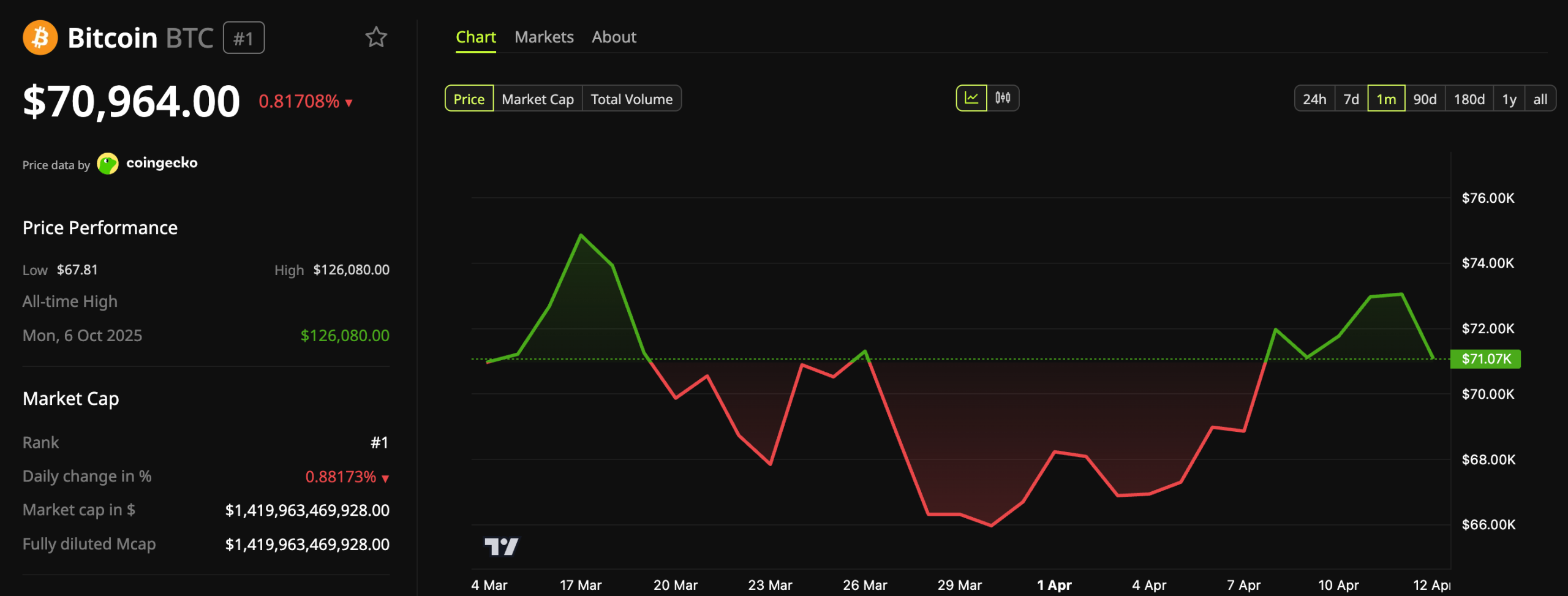
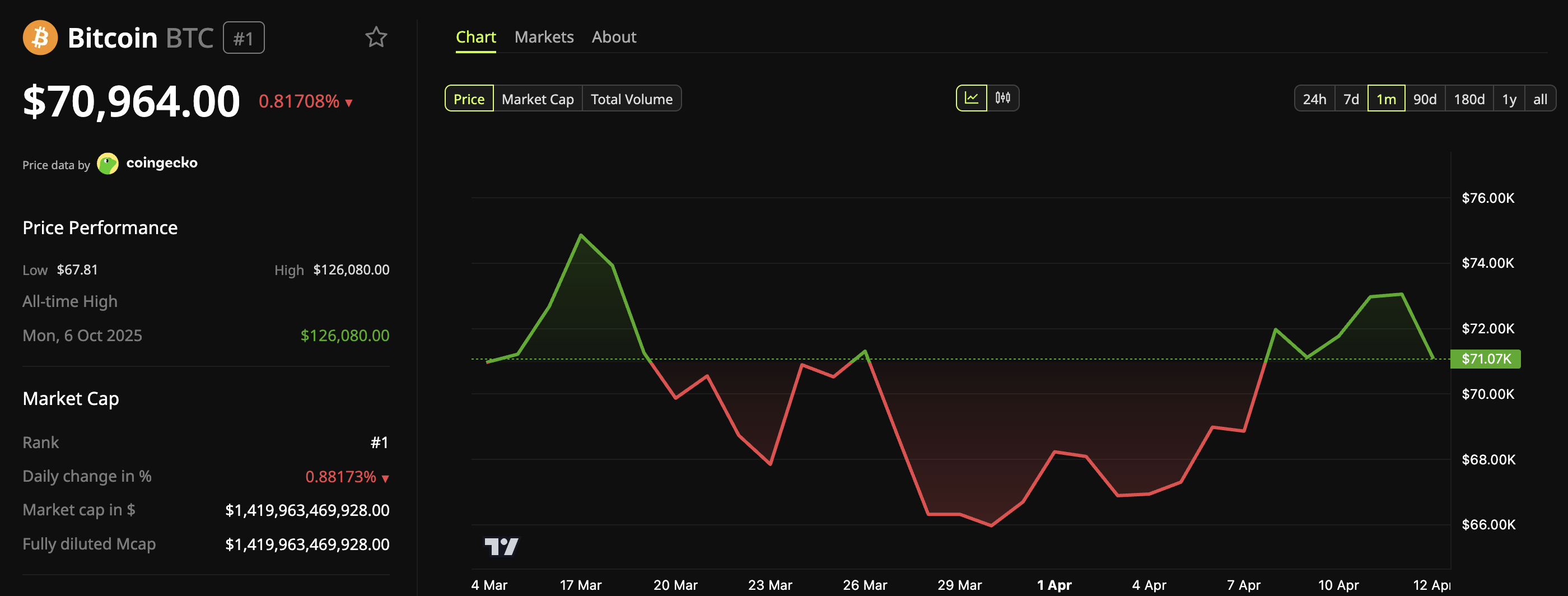
Bitcoin’s (BTC) price dropped nearly 3% since the weekend after US-Iran ceasefire talks failed in Islamabad.
The largest cryptocurrency slipped below $71,000 today. It was trading at roughly $70,960 at press time.
On-Chain Data Reveals a Wealth Transfer as Bitcoin Drops on US-Iran News
However, on-chain data tells a different story beneath the surface-level panic. According to an analyst, the military tension spooked retail investors, but institutional capital kept buying. Five key metrics support this thesis.
First, Bitcoin’s Total Netflow on Binance (SMA-30) registered an average of roughly -1,350 BTC, worth about $96 million. Negative netflow indicates coins leaving Binance at an aggressive pace.
Follow us on X to get the latest news as it happens
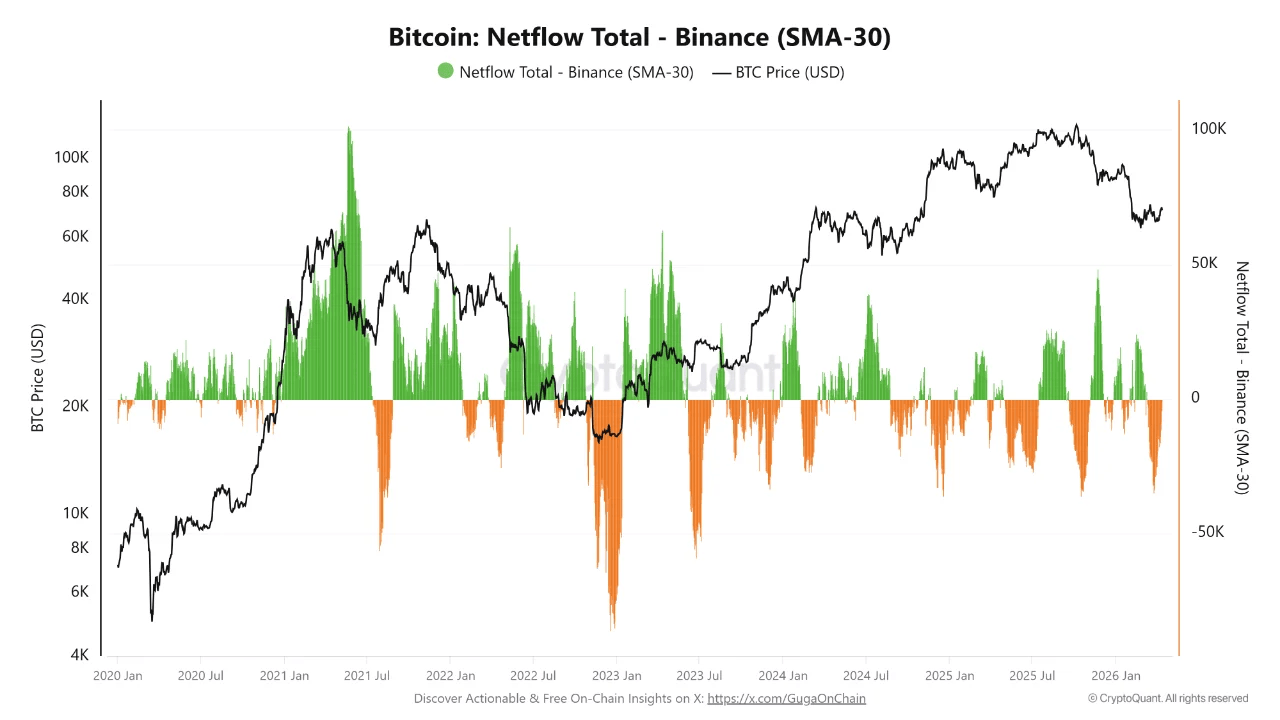
Second, the Short-Term Holder Spent Output Profit Ratio (SOPR) across all exchanges sits at 1.0018.
“The mathematical verdict is irrefutable: realizing losses predominated over the last 182 days, of which 148 (81.32%) were below 1.00. Today, these investors liquidate their positions practically at ‘breakeven’ to escape the volatility, delivering cheap liquidity into the hands of those who dictate the rules of the game,” the analyst wrote.
Third, global exchange reserves fell to about 2.69 million BTC, sitting below the seven-day moving average. That gap represents roughly 4,500 BTC, about $316 million, withdrawn to cold storage during peak geopolitical uncertainty.
“The scenario proves that today’s drop is not a trend reversal, but a brutal wealth transfer disguised as macroeconomic panic. The data shows that betting against the market in the face of this structural liquidity drought is putting yourself in front of an institutional steamroller,” the post added.
Bitcoin Whale Behavior Confirms the Shift
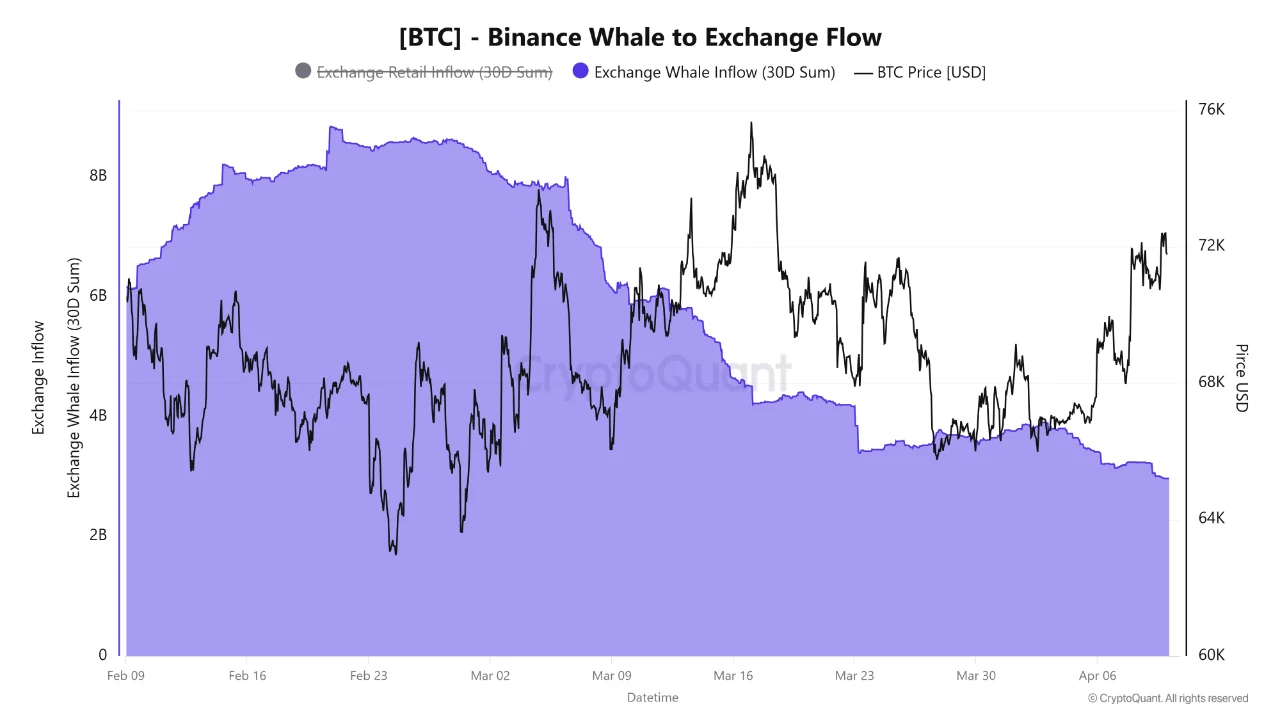
A separate analysis by Amr Taha reinforced this reading. The 30-day whale inflow to Binance fell to $2.96 billion. The inflow fell below $3 billion for the first time since June 2025.
Declining whale inflows suggest large holders have stopped sending BTC to exchanges for potential sale.
At the same time, Long-Term Holder (LTH) Realized Cap Change over 30 days rose to $49 billion on April 9. That marked its second return to that level since March 26.
Meanwhile, Short-Term Holder (STH) Realized Cap Change fell to -$54 billion, its third drop below -$50 billion since early March. According to the analyst, weaker holders distribute while long-term holders absorb available supply.
Whether this accumulation translates into a price recovery will depend on whether the US-Iran stalemate escalates further or yields a diplomatic breakthrough in the days ahead.
Subscribe to our YouTube channel to watch leaders and journalists provide expert insights
The post 5 On-Chain Signals Suggest Bitcoin’s War-Driven Dip Masks a Quiet Wealth Transfer appeared first on BeInCrypto.
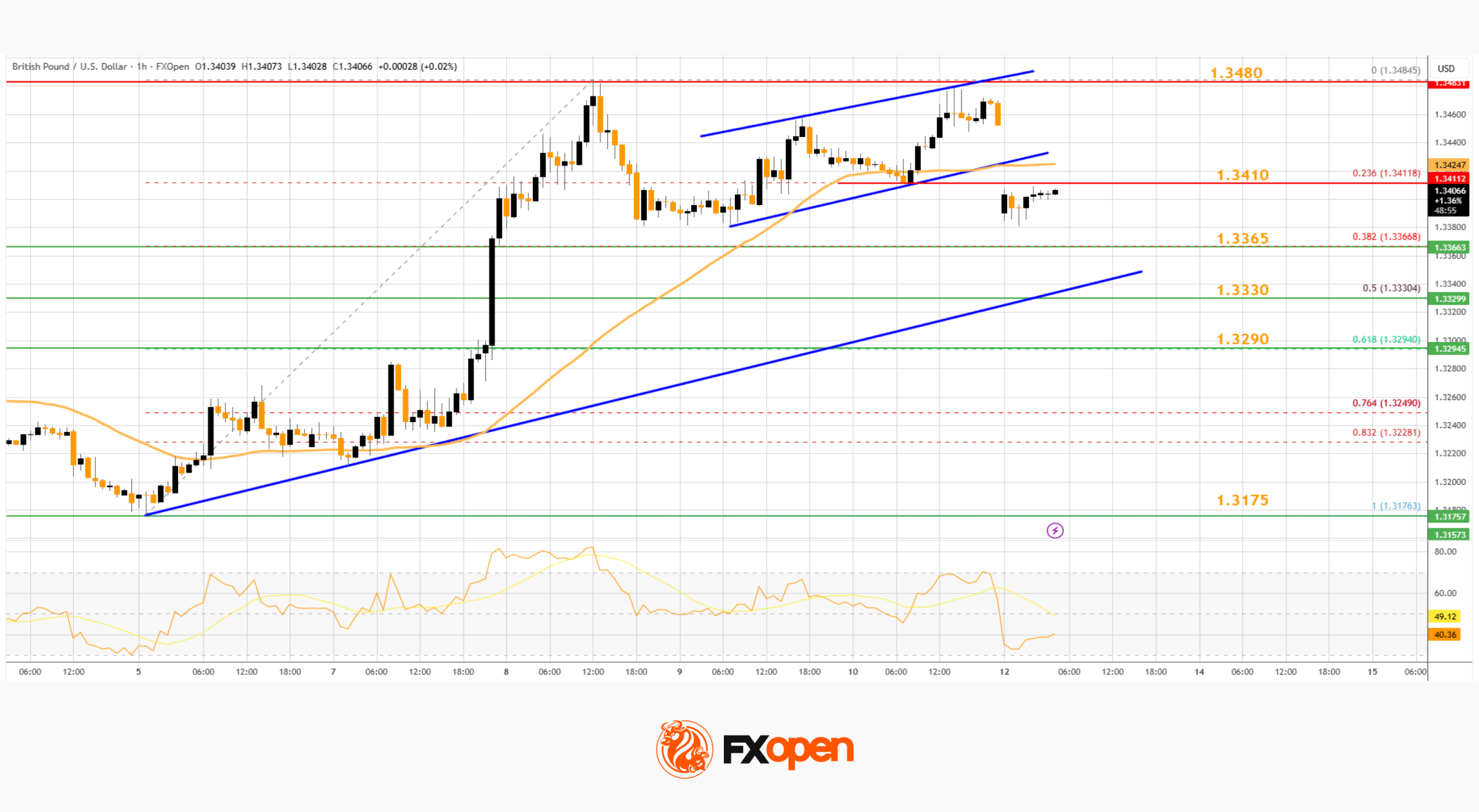
GBP/USD started a downside correction from 1.3480. USD/CAD is gaining bullish momentum and might clear 1.3880 for more upside.
Important Takeaways for GBP/USD and USD/CAD Analysis Today
· The British Pound rallied toward 1.3500 before the bears appeared.
· There was a break below a rising channel with support near 1.3410 on the hourly chart of GBP/USD at FXOpen.
· USD/CAD is showing positive signs above the 1.3835 pivot zone.
· There was a break above a key bearish trend line with resistance at 1.3830 on the hourly chart at FXOpen.
GBP/USD Technical Analysis
On the hourly chart of GBP/USD at FXOpen, the pair gained pace for a move toward 1.3300. The British Pound even climbed above 1.3450 before the bears appeared against the US Dollar.
A high was formed at 1.3485, and the pair started a minor downside correction. The pair traded below 1.3440, a rising channel, the 50-hour simple moving average, and the 23.6% Fib retracement level of the upward move from the 1.3176 swing low to the 1.3485 high.
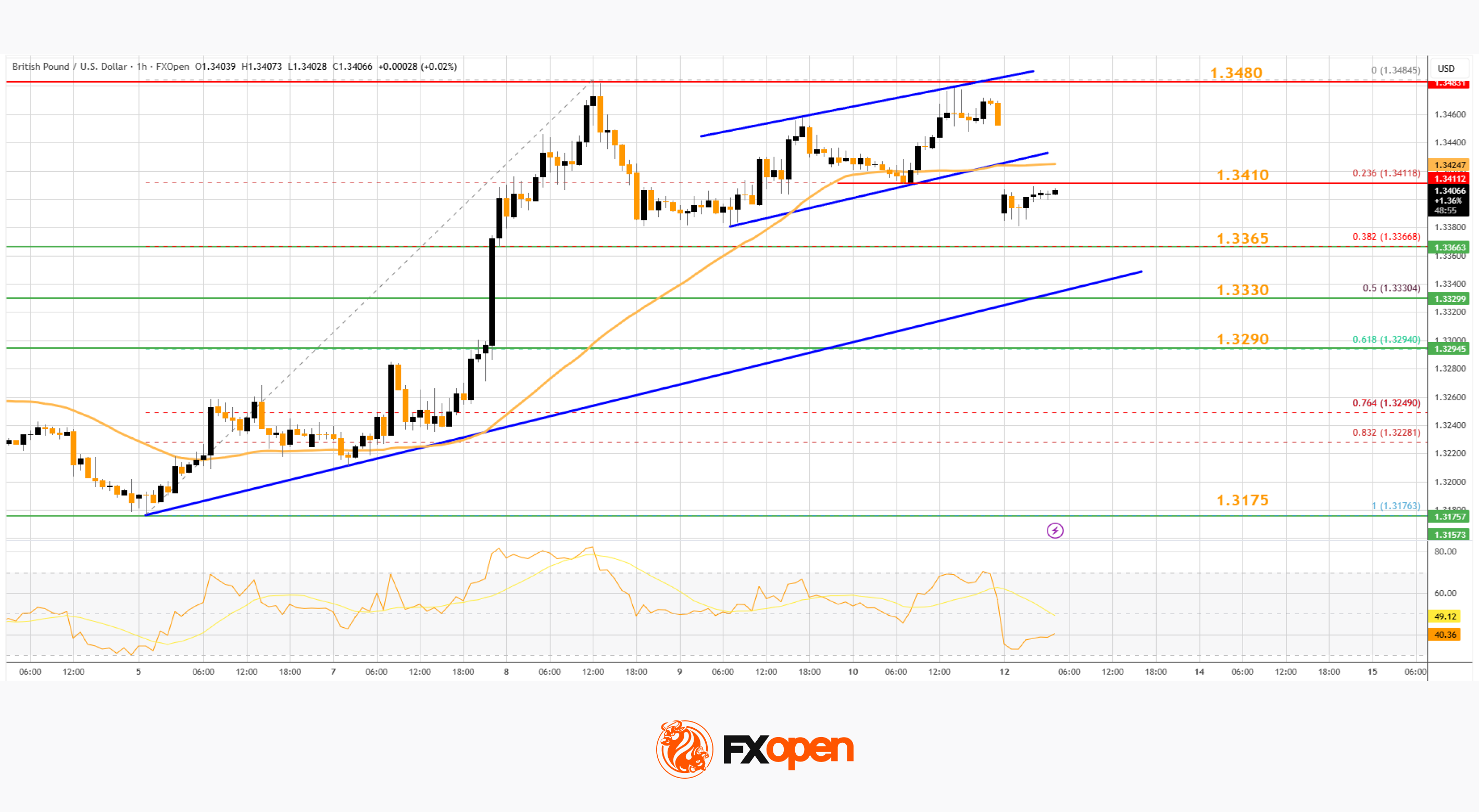
Finally, the bulls appeared near 1.3380, and the pair started a consolidation phase. Immediate hurdle on the upside is near 1.3410 and the 50-hour simple moving average.
The first major resistance is 1.3480. The main sell zone sits at 1.3500. A close above 1.3500 might spark a steady upward move. The next stop for the bulls might be near 1.3620. Any more gains could lead the pair toward 1.3650 in the near term.
If there is a fresh decline, initial bid zone on the GBP/USD chart sits at 1.3365. The next major area of interest could be 1.3330, the 50% Fib retracement, and a connecting bullish trend line, below which there is a risk of another sharp decline. In the stated case, the pair could drop toward 1.3175.
USD/CAD Technical Analysis
On the hourly chart of USD/CAD at FXOpen, the pair formed a strong base above 1.3800. The US Dollar started a fresh increase above 1.3820 and 1.3850 against the Canadian Dollar.
More importantly, there was a break above a key bearish trend line with resistance at 1.3830. The pair even climbed above the 50% Fib retracement level of the downward move from the 1.3928 swing high to the 1.3799 low.
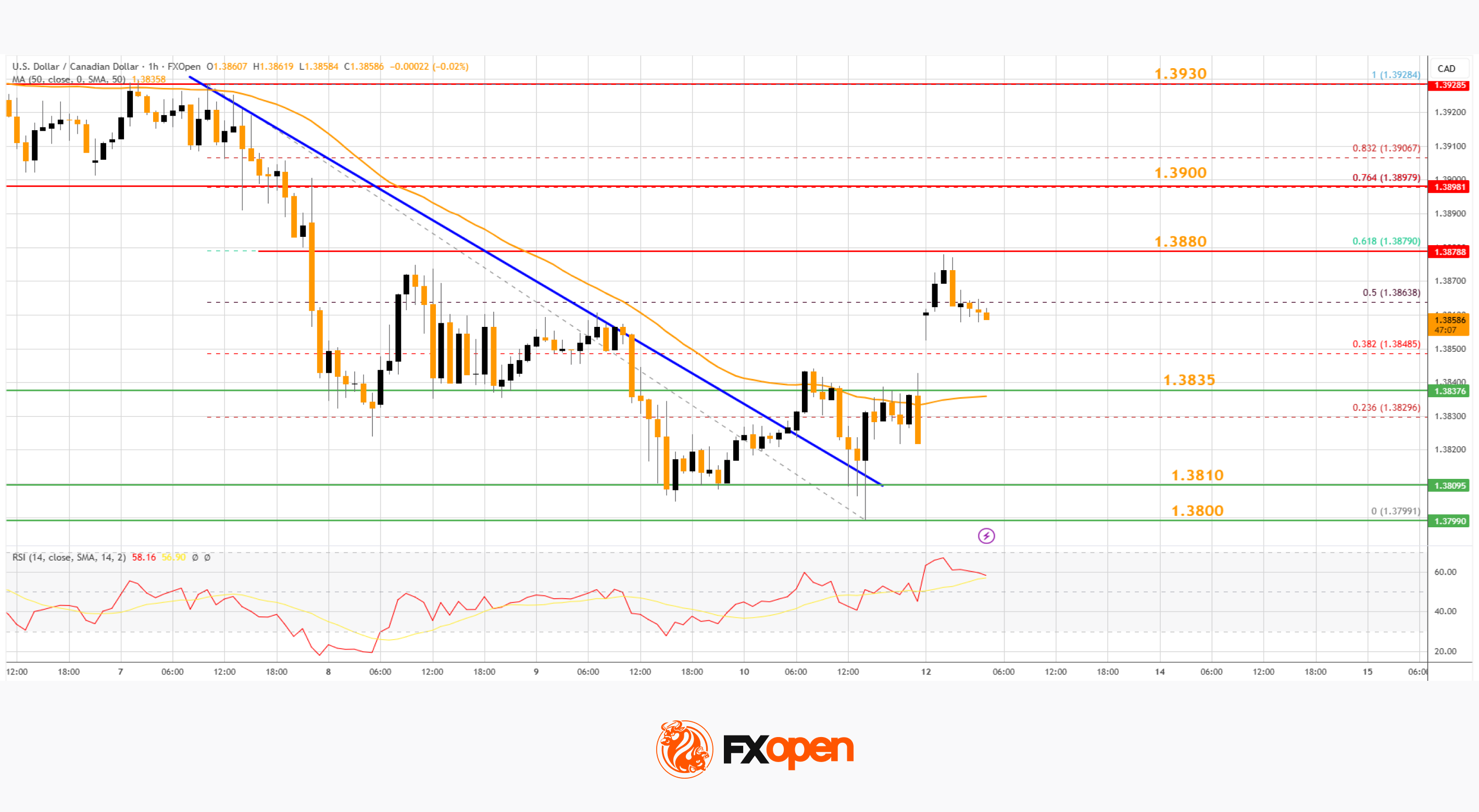
The pair is now consolidating above the 50-hour simple moving average. If there is another increase, the pair might face hurdles near 1.3880 and the 61.8% Fib retracement.
A clear upside break above 1.3880 could start another steady increase. In the stated case, the pair could test 1.3900. A close above 1.3900 might send the pair toward 1.3930. Any more gains could open the doors for a test of 1.3980.
Initial support is near the 50-hour simple moving average and 1.3835. The next key breakdown zone could be 1.3810. The main hurdle for the bears might be 1.3800 on the same USD/CAD chart.
A downside break below 1.3800 could push the pair further lower. The next key area of interest might be 1.3765, below which the pair might visit 1.3720.
Trade over 50 forex markets 24 hours a day with FXOpen. Take advantage of low commissions, deep liquidity, and spreads from 0.0 pips (additional fees may apply). Open your FXOpen account now or learn more about trading forex with FXOpen.
This article represents the opinion of the Companies operating under the FXOpen brand only. It is not to be construed as an offer, solicitation, or recommendation with respect to products and services provided by the Companies operating under the FXOpen brand, nor is it to be considered financial advice.


escalated its dispute with Justin Sun into a potential legal fight late Sunday, as tensions over its recent loan to a connected DeFi project spilled into public confrontation.
“Does anyone still believe @justinsuntron?” the project wrote on X. “We have the contracts. We have the evidence. We have the truth. See you in court pal.”
Does anyone still believe @justinsuntron ?
Justin’s favorite move is playing the victim while making baseless allegations to cover up his own misconduct.
Same playbook, different target. WLFI isn’t the first.
We have the contracts. We have the evidence. We have the truth.
See…
— WLFI (@worldlibertyfi) April 12, 2026
The legal threat came after Sun accused the Donald Trump-linked WLFI team of treating its users as personal ATMs after the latter deposited 5 billion WLFI tokens as collateral on the DeFi lending platform Dolomite to.borrow about $75 million in stablecoins.
“Every action taken by the WLFI team to extract fees from users and to treat the crypto community as a personal ATM is illegitimate,” Sun wrote on Sunday.
In September, Sun had his WLFI tokens frozen with the project alleging the Tron founder attempted to sell the tokens to cash out early. Sun denied the allegations, and on-chain data backs him up.
“Whoever is hiding behind this official account, step forward and identify yourself,” Sun wrote back to WLFI.
Whoever is hiding behind this official account, step forward and identify yourself. Every action taken by the WLFI team to secretly implant backdoor controls over user assets, to freeze investor funds without disclosure or due process, and to treat the crypto community as a…
— H.E. Justin Sun 👨🚀 🌞 (@justinsuntron) April 12, 2026
“As the largest investor in this project, I demand that those responsible come forward by name, instead of hiding in the shadows,” he continued.
The clash marks a sharp escalation in a feud between WLFI and one of its earliest backers, shifting the dispute from governance and capital use into open legal territory.
This animosity between the two is a start contrast from last year, where WLFI credited Sun at Consensus Hong Kong with helping lift the project out of a slow start.
“This guy,” WLFI co-founder Zak Folkman said on stage at Consensus, “saw that regardless of the outcome, this project is a monumental move forward for the entire crypto community.”
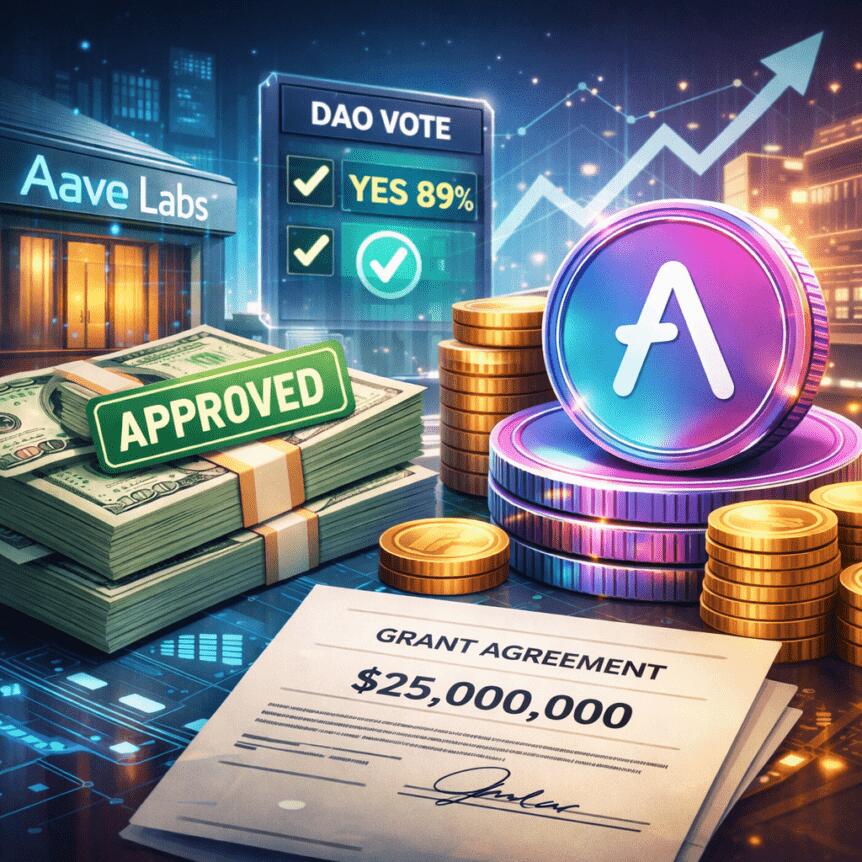
Aave Labs, the core development team behind the Aave protocol, has secured a substantial financing package from its own DAO to accelerate growth and product development. In a governance vote that closed with strong support, the Aave community approved a plan that allocates $25 million in stablecoins to Aave Labs, complemented by a grant of 75,000 AAVE tokens. The framework, dubbed “Aave Will Win,” envisions a shift toward a DAO-funded operating model with revenue generated by Aave products flowing into the DAO treasury.
The proposal passed on Saturday with nearly 75% in favor. Under the terms, the stablecoins will be disbursed over 12 months, while the 75,000 AAVE tokens will vest linearly over four years. The governance dashboard confirms the timing and vesting schedule, marking a formal reconfiguration of how Aave allocates resources for development and growth.
In announcing the decision, Aave founder Stani Kulechov used social media to frame the moment as a watershed for the protocol. “Aave Will Win is the most important proposal in Aave’s history and it just passed with a landslide,” he wrote on X. “If you own AAVE, you own not just the economic rights of the protocol, but the brand, the users, and the integrations. This is the direction we are committing to, a multi-year journey. The foundation is set. Now it’s time to build. Aave will win.”
Beyond the immediate funding, the framework sets out a broader reorganization. Aave V4 is designated as the protocol’s long-term technical foundation, and a new foundation would steward the Aave brand. Aave Labs would focus exclusively on Aave-related products, while the DAO treasury would receive revenue from products such as Aave Pro, ensuring ongoing financial support independent of the centralized development entity.
In parallel, the framework provides room for separate governance proposals to fund growth and development tied to product launches and milestones. These could take the form of targeted grants or milestone-based disbursements, allowing the community to steer investments toward specific features or initiatives without reworking the core operating model each time.
Historically, Aave’s governance has been a balancing act between centralized development control and decentralized decision-making. The current plan marks a notable shift: it moves the funding engine from Aave Labs’ balance sheet toward a DAO treasury funded by the protocol’s own activity, explicitly tying future success to broad community governance and alignment of incentives among developers, users, and builders.
Key takeaways
- DAO-backed funding of Aave Labs: $25 million in stablecoins disbursed over 12 months to support operations and growth.
- Incentivized ownership: 75,000 AAVE tokens vest over four years to align developer incentives with long-term protocol success.
- DAO treasury model: Revenue from Aave products would flow to the DAO treasury, signaling a shift toward a DAO-funded operating model.
- Aave V4 and brand stewardship: The framework codifies Aave V4 as the core technical foundation and creates a separate foundation to manage the brand.
- Process and governance dynamics: The proposal followed a historical arc of governance debates, including prior concerns about funding size, token allocations, and revenue definitions.
What the vote changes for Aave Labs and the broader DAO
The core aim of the Aave Will Win framework is to de-emphasize centralized control in day-to-day operations while expanding the community’s role in funding and guiding development. By moving revenue from products such as Aave Pro into the DAO treasury, the community gains a more direct stake in the protocol’s ongoing evolution. This could translate into faster iteration on user-facing tools, tighter alignment between feature delivery and community priorities, and potentially more resilient funding during market downturns, as treasury resources are not solely dependent on a single entity’s balance sheet.
At the same time, the plan introduces new governance dynamics. The 75,000 AAVE tokens carry voting power and represent a tangible commitment by the community to align incentives with long-term outcomes. Some participants voiced concerns during the lead-up to the vote about the size of the funding package and the concentration of voting power in tokens, which could influence future protocol decisions. The governance process also flagged questions about how revenue is defined and counted for treasury allocations.
Looking back, the path to this moment included earlier tensions within the Aave ecosystem. A major governance delegate, the Aave Chan Initiative, stepped back from the DAO due to governance standard concerns and voting dynamics. Earlier in the year, a proposal to transfer brand assets and intellectual property to a DAO structure likewise failed, underscoring the challenges of translating aspiration into an operational model that the entire community can rally around. The team has argued that the new structure would streamline operations, accelerate development, and position Aave to compete more effectively as fintechs and institutions increasingly move on-chain in regulated environments.
Implications for investors, users, and builders
From an investor and builder standpoint, the framework represents both opportunity and risk. On the upside, a formalized, DAO-backed funding mechanism could unlock more aggressive product development cycles, improved coordination across teams, and clearer long-term incentives for engineers and product teams. For users, the potential is a faster cadence of feature releases, improved risk management tools, and more robust integrations with on-chain products as the ecosystem matures around a centralized yet widely distributed governance model.
However, the transition is not without uncertainties. The DAO treasury’s performance will hinge on the protocol’s revenue streams and the community’s ability to govern effectively in a broader regulatory and macroeconomic context. Governance fatigue, misaligned incentives, or disputes over future revenue definitions could complicate execution. Market participants will want to watch how the separate grants tied to specific product launches are structured and how quickly they translate into tangible deliverables.
Macro context matters as well. Aave remains one of DeFi’s largest players by total value locked, with DeFiLlama data showing a multi-billion dollar footprint. A successful transition to a DAO-led operating model could serve as a blueprint—and a test case—for other major DeFi projects exploring similar governance and funding arrangements in an increasingly regulated, investor-driven landscape.
What comes next
With the “Aave Will Win” framework approved, attention shifts to the execution phase. The DAO will need to translate the approved funding and vesting schedules into concrete operational milestones, establishing governance processes for ongoing treasury management, grant distribution, and product roadmaps. The community will also be watching for how the new Aave foundation and the renamed or restructured Aave Labs interface with product teams, risk management, and compliance-related considerations as markets evolve.
As Stani Kulechov signaled, the foundation has been set for a multi-year journey. The coming quarters will reveal how effectively the protocol can scale its governance-driven model without sacrificing speed and user-centric innovation. Investors and builders should remain attentive to how the DAO governs revenue definitions, how milestones are operationalized, and how the broader ecosystem responds to a more decentralized yet financially empowered Aave.
Overall, the vote represents a deliberate step toward embedding the protocol’s growth within a community-led framework. If the model succeeds, it could recalibrate expectations for how DeFi projects fund development and align incentives across developers, users, and strategic partners in the years ahead.
Watch for forthcoming governance proposals that will detail the distribution of growth and development grants, the specifics of the Aave V4 roadmap, and the formal establishment of the new foundation to steward the brand. The coming updates will indicate how quickly this ambitious transition translates into measurable product outcomes and wider market adoption.


Bitcoin price dropped to a session low of $70,617 as investors reacted to the announcement of a naval blockade from the White House after peace talks between the United States and Iran failed to reach a meaningful resolution.
Summary
- President Trump confirmed an immediate naval blockade of the Strait of Hormuz after diplomatic negotiations in Pakistan collapsed over Iran’s refusal to terminate its long-term nuclear program.
- Oil prices jumped to $105 per barrel as the U.S. Navy received orders to destroy Iranian naval mines and intercept commercial vessels attempting to pay illegal transit tolls.
The sudden decline coincided with a message from U.S. President Donald Trump on Truth Social, where he confirmed that the blockade would be implemented immediately. This move follows a total breakdown of diplomatic efforts in Islamabad last week.
Despite Pakistan brokering high-stakes talks between U.S. and Iranian officials, the negotiations collapsed over a fundamental disagreement regarding Iran’s uranium enrichment levels.
The peace process was further strained by reports of ceasefire violations occurring almost as soon as the initial window opened. After a final 21-hour meeting, President Trump signaled that the talks had failed specifically because Iran would not dismantle its long-term nuclear program.
Regarding the failed negotiations, Trump stated that the nuclear issue was the only point that “really mattered.”
The economic fallout of the conflict became evident as U.S. futures markets opened this morning. Oil prices surged nearly 10% to hit $105 per barrel, placing further downward pressure on Bitcoin as traders moved away from riskier assets.
The Strait of Hormuz remains a critical flashpoint, as the narrow waterway handles approximately 20% of the world’s oil trade.
Beyond the nuclear dispute, Iran has introduced several demands, including billions in war reparations and the release of frozen assets held in international bank accounts.
The situation has been complicated by reports that Iran is using naval mines to intimidate commercial ships and demanding transit tolls—some of which were allegedly requested in Bitcoin.
Trump has rejected these terms, characterizing the tactics as “world extortion.” In response, he has authorized the U.S. Navy to intercept any vessels paying these tolls and to actively destroy any mines found in the shipping lanes.
While Bitcoin has since recovered slightly to trade above $71,000, market analysts warn of continued volatility. The $70,000 mark remains a significant psychological floor for the asset. If the price fails to hold above $68,000, analysts suggest a deeper correction could be on the horizon, potentially pushing the market down toward the $62,000 range.
Crypto World
Strategy signals another bitcoin buy as company needs just 2% annual BTC growth to cover dividends


Strategy co-founder Michael Saylor signaled an imminent bitcoin purchase on Sunday, posting “think bigger” alongside the company’s BTC acquisition tracker that has preceded every major buy since 2020.
The company has made 105 bitcoin purchases since it began accumulating in August 2020. Its most recent, on April 6, added 4,871 BTC for $329.8 million. Total holdings stand at 766,970 BTC acquired at a blended cost basis of $75,644, roughly $5,000 above the current market price and representing $14.5 billion in unrealized losses that Strategy disclosed in a first-quarter SEC filing.
MSTR is buying at a pace that dwarfs new supply. Strategy accumulated 46,233 BTC in March, while miners produced approximately 16,200 BTC, meaning a single company absorbed nearly three times the bitcoin that the entire global mining network generated in the same period.
Meanwhile, Saylor also disclosed that Strategy’s breakeven annual return rate on its STRC preferred equity product is approximately 2.05%. If bitcoin appreciates faster than that over time, the company can cover its preferred dividends indefinitely without issuing new MSTR shares.
The number quantifies both the appeal and the fragility of the funding model. A 2% hurdle is low by historical bitcoin standards, but it assumes bitcoin never goes sideways or down for an extended period while the dividends keep compounding.
STRC is the mechanism that makes the buying machine run. The preferred equity product saw hundreds of millions in new inflows around its recent ex-dividend date, providing the capital for continued accumulation. Strategy keeps buying as long as investor appetite for STRC holds.
Bitcoin traded at $71,800 on Monday, according to CoinDesk data, up 7.9% on the week and holding above $70,000 for the fourth consecutive day since the Iran ceasefire was announced.
Whether Saylor’s “think bigger” translates into a purchase large enough to move the market depends on the size. At Strategy’s recent pace of 40,000-plus BTC per month, the next filing could push total holdings past 800,000 before the end of April.
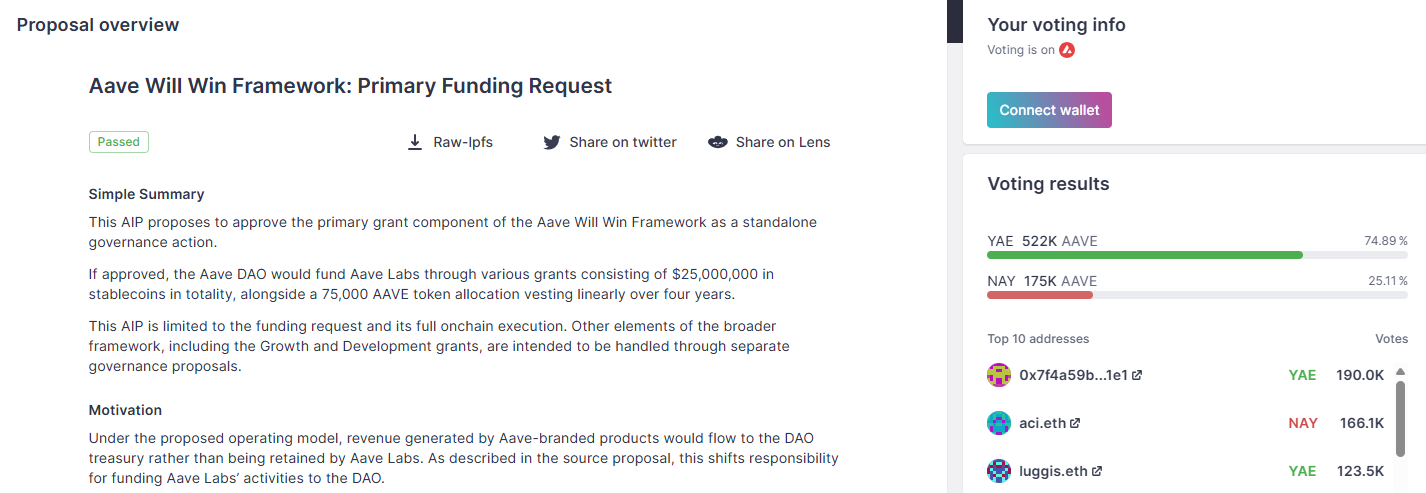
Aave Labs, the core development team behind the Aave protocol, has been granted $25 million in stablecoins, alongside a token allocation of 75,000 AAVE by its decentralized autonomous organization (DAO) as part of the “Aave Will Win” framework.
The vote passed Saturday with nearly 75% in favor. The stablecoin allocation will be paid in installments over 12 months, while the 75,000 AAVE tokens will vest linearly over four years, according to the governance dashboard.
The Aave Will Win framework aims to accelerate the protocol’s growth, with the DAO funding development and Aave Labs focusing on building and scaling. The stablecoins directly fund Aave Labs’ operations, while the token allocation serves as an incentive for developers to help grow the protocol.
Other elements of the framework, including the growth and development grants tied to specific product launches and milestones, will have separate governance proposals.
Aave is one of the largest DeFi protocols in the industry, with its total value locked exceeding $25 billion, DeFiLlama data shows. The framework marks a major shift in funding allocation.

Most important proposal in protocol’s history, founder says
Following the vote, Aave founder Stani Kulechov said in an X post Saturday that Aave Will Win is the “most important proposal in Aave’s history” and it “just passed with a landslide.”
“If you own AAVE, you own not just the economic rights of the protocol, but the brand, the users, and the integrations, he added. “This is the direction we are committing to, a multi-year journey. The foundation is set. Now it’s time to build. Aave will win.”

Under the framework, which passed on April 5, Aave Labs would shift to a DAO-funded operating model, with revenue generated by Aave products, such as Aave Pro, flowing to the DAO treasury rather than being retained by Aave Labs.
The proposal also sought ratification of Aave V4 as the protocol’s long-term technical foundation and outlined plans for a new foundation to steward the Aave brand. Aave Labs would also focus only on Aave-related products, with the goal of streamlining operations, accelerating development and building more competitive offerings.
“Fintechs are entering DeFi, institutions are coming on-chain, and regulatory clarity is emerging in certain markets that allows us to go directly to consumers,” Aave Labs said.
“The protocols that win the next decade will be those that move fast, build great tools and products and capture new markets before competitors,” it added.
Proposals met with friction before
Some community members have previously raised concerns about the size of the funding package and the inclusion of 75,000 AAVE tokens, which carry voting power, and the definition of what counts as revenue.
Related: Chaos Labs taps out as Aave’s risk provider, decision ‘not made in haste’
The Aave Will Win framework passed a temperature check on March 1, and soon after, a major governance delegate, the Aave Chan Initiative, announced it would wind down its involvement with the DAO due to concerns about governance standards and voting dynamics during the proposal process.
In January, another proposal to transfer control of Aave’s brand assets and intellectual property to its DAO failed, prompting debate within the Aave community over the protocol’s long-term direction and governance structure.
Magazine: Bitcoin quantum-safe without upgrade? CZ’s 2031 crypto vision: Hodler’s Digest, April 5 – 11

US military warns it will blockade Iranian ports

Nicola Forrest’s Coaxial swoops on Freo Trades Hall

Aave DAO approves $25 million funding and V4 roadmap for Aave Labs


-

 Politics2 days ago
US brings back mandatory military draft registration
-

 Fashion3 days ago
Weekend Open Thread: Veronica Beard
-
 Sports3 days ago
Man United discover Nico Schlotterbeck transfer fee as defender reaches Dortmund agreement
-

 Tech5 days ago
How Long Can You Drive With Expired Registration? What Florida Law Says
-

 Politics16 hours ago
World Cup exit makes Italy enter crisis mode
-

 Crypto World4 days ago
Canary Capital Files SEC Registration for PEPE ETF
-

 Fashion7 days ago
Massimo Dutti Offers Inspiration for Your Summer Mood Board
-

 Business2 days ago
Tesla Model Y Tops China Auto Sales in March 2026 With 39,827 Registrations, Beating Cheaper EVs and Gas Cars
-

 Fashion6 days ago
Let’s Discuss: DEI in 2026
-

 Crypto World5 days ago
Bitcoin recovers as US and Iran Agree a Ceasefire Deal
-

 Politics3 days ago
Malcolm In The Middle OG Turned Down ‘Buckets Of Money’ To Appear In Reboot
-
 NewsBeat8 hours ago
Pep Guardiola and Gary Neville agree over Arsenal title problem that benefits Man City
-

 Business3 days ago
OpenAI Halts Stargate UK Data Centre Project Over Energy Costs and Copyright Row
-

 Business2 days ago
Ireland Fuel Protests Enter Day 5 as Blockades Spark Shortages and Government Prepares Support Package
-

 Tech7 days ago
Italian court says Netflix must refund customers up to $576 over price hikes
-

 Tech7 days ago
Haier is betting big that your next TV purchase will be one of these
-

 Tech7 days ago
Gamer Restores the Original PlayStation Portal From Two Decades Ago
-

 Tech7 days ago
The Xiaomi 17 Ultra has some impressive add-ons that make snapping photos really fun
-

 Tech7 days ago
Samsung just gave up on its own Messages app
-

 Tech7 days ago
Save $130 on the Samsung Galaxy Watch 8 Classic: rotating bezel, sleep coaching, and running coach for $369
You must be logged in to post a comment Login