Connect with us

Crypto World

Oil Leaves Bitcoin and Gold Behind Ahead of Wednesday's Fed Decision

Published

on

Oil Leaves Bitcoin and Gold Behind Ahead of Wednesday's Fed Decision

Crude oil climbed on Monday while crypto and gold sank. Global markets are splitting ahead of Wednesday’s Federal Reserve rate decision.

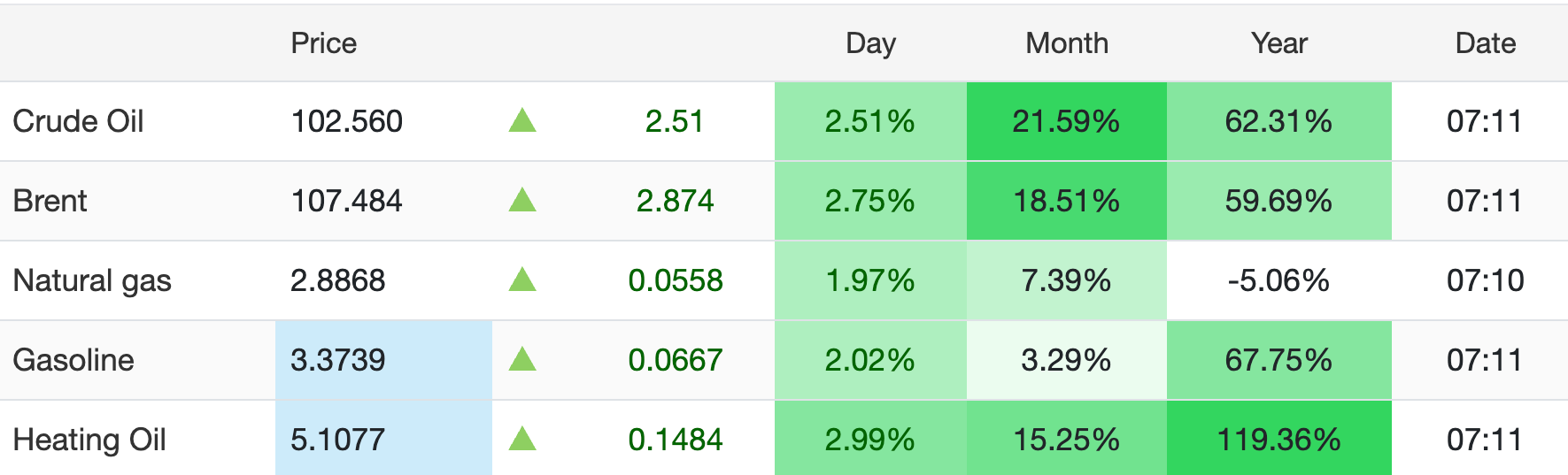
Brent crude rose 2.75% to $107.48, and West Texas Intermediate gained 2.51% to $102.56. Bitcoin (BTC), gold, silver, and copper all moved the other way.

Oil Prices Rising Ahead of the Fed Decision. Source: TradingEconomics

Supply Shock Lifts Crude Into Fed Week

Saudi Arabia shut its East-West pipeline late last week after drones launched from Iraq damaged it. The route lets the kingdom ship exports without passing through the Strait of Hormuz.

Reuters reported the outage threatens up to 4% of global oil supply. Fresh Houthi strikes on Saudi soil and an attack on a vessel in Hormuz deepened the squeeze.

Yemen’s Houthis also reached Perim island on Friday, tightening their grip on Bab el-Mandeb. That corridor carries 4% to 5% of the global supply.

Advertisement

Crude gained 8% on the week, clearing $100 for the first time since July. The move extends a rally that began in July.

“Looking ahead, unless this week’s talks in Oman produce something operational … the risk is that crude oil continues to extend its gains toward the $119.48 high of early March.” Tony Sycamore, market analyst at IG, in a Sunday note. 

Gulf states and Iran had planned to meet in Oman on Monday. Omani Foreign Minister Badr Albusaidi said that the meeting was postponed.

Follow us on X to get the latest news as it happens

Hike Odds Squeeze Crypto and Metals

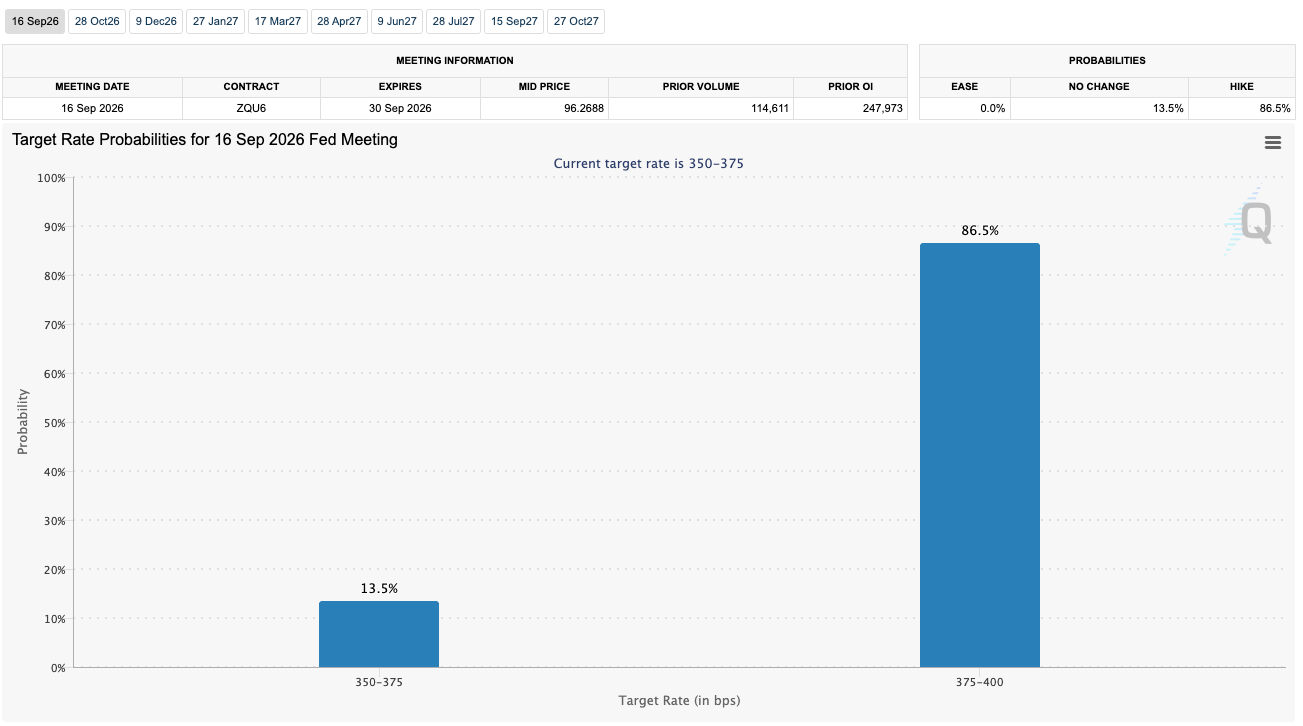
Hotter-than-expected US inflation data hardened the case for tightening. Traders now price in an 86.3% chance the Fed lifts its target to 375-400 basis points. That reading sat at 59.4% a week ago and 33.9% a month ago.

Advertisement
Fed Rate Hike Odds in September.
Fed Rate Hike Odds in September. Source: CME FedWatch 

Crypto took the hit. Total market capitalization fell 4.32% to $2.62 trillion in 24 hours. Bitcoin traded near $76,718 after a 4.4% weekly slide. Ethereum (ETH) slipped 1.79% to $2,478.43.

Metals offered no shelter. Gold eased 0.22% to $4,340.58, silver lost 0.25% to $64.11, and copper dropped 1.08% to $6.40. The moves echo last week’s gold and crypto selloff.

Crude now trades on supply headlines, while crypto and metals trade on the Fed. Wednesday’s decision will show whether those two forces stay apart.

Subscribe to our YouTube channel to watch leaders and journalists provide expert insights

The post Oil Leaves Bitcoin and Gold Behind Ahead of Wednesday's Fed Decision appeared first on BeInCrypto.

Advertisement

Source link

Continue Reading
Click to comment

You must be logged in to post a comment Login

Leave a Reply

Crypto World

Bitcoin’s Biggest Week of 2026 Is Here: Fed and CLARITY Vote Take Center Stage

Published

on

Although there are several major economic events taking place in the following five business days, the reality is that only a handful of them could (and most likely will) impact the cryptocurrency market. That impact, though, is expected to be quite vicious in either direction.

The Kobeissi Letter highlighted an auction of 20-year securities, August retail sales, and, most importantly, the Federal Reserve’s September interest rate decision on Wednesday. The latest data shows that markets assign an 85%-90% probability that the central bank will hike rates by 25 basis points, following contrasting economic data.

Fed in Focus

The Fed setup has changed dramatically in just a few weeks, starting with the August employment data from early September, which showed that the US economy had added 162,000 jobs last month, triple expectations. Later on, the PPI numbers indicated that the annual producer inflation had accelerated to 5.4%. Last Friday’s CPI report subsequently confirmed headline inflation at 3.4%, with monthly core CPI slightly hotter than expected.

This combination, plus the fact that oil prices remain above $100 and diesel hit a new record in the States, has strengthened the Fed’s case for tighter policy.

Advertisement

Bitcoin and the altcoins have already demonstrated their sensitivity to this shift, dropping sharply following Fed Chair Kevin Warsh’s speech from Jackson Hole several weeks ago, and again as rate-hike odds increase after the latest economic data.

The only question is whether this highly expected rate hike has been priced in, with BTC sliding from $82,400 to under $78,000 as of now. As such, investors will closely watch Warsh’s press conference after the meeting for clues as to whether the Fed’s decision on Wednesday is a one-off adjustment or the start of another tightening cycle.

The Tuesday Test

Before all eyes turn on the Fed on Wednesday, the crypto industry has another major event on Tuesday. The Senate’s cloture vote on the CLARITY Act is scheduled for 2:15 P.M. that day, and it requires 60 senators to advance the debate on the key bill.

The CLARITY Act aims to establish a comprehensive US crypto market structure and shed further details on the respective roles of the SEC and the CFTC.

Advertisement

Republicans released an updated text last week, adding new rules for non-decentralized DeFi protocols and clarifying how credit unions can deal in crypto. Moreover, they published their “last, best, and final” draft of the legislation on Sunday, including an ethics proposal backed by the POTUS.

The post Bitcoin’s Biggest Week of 2026 Is Here: Fed and CLARITY Vote Take Center Stage appeared first on CryptoPotato.

Source link

Advertisement
Continue Reading

Crypto World

Tom Lee Explains Ethereum's Killer Application as ETH Bucks Market Downturn

Published

on

Tom Lee Says ETH/BTC Breakout Signals Crypto’s Big Comeback

Fundstrat co-founder Tom Lee says Ethereum (ETH) is becoming the settlement layer for Wall Street and artificial intelligence (AI). He repeated the claim as ETH held up better than most major cryptocurrencies over the past week.

Lee, who chairs BitMine Immersion Technologies (BMNR), made the comment in a reply on X. A trader had asked why Ethereum was outperforming nearly every other top ten coin during a broader crypto pullback.

The Wall Street and AI Thesis

Asked directly why Ethereum was holding its ground, Lee pointed to the network’s emerging role as financial plumbing.

“$ETH is the future settlement rails for Wall Street and AI.”

— Tom Lee, in a reply on X

Advertisement

The reply echoes arguments from Lee’s bullish crypto outlook for the next 12 months. He ties Ethereum’s case to two forces, Wall Street’s tokenization of traditional assets and the rise of agentic AI. Agentic AI refers to autonomous software that can transact without human input.

Lee has also framed the recent ETH/BTC ratio breakout as evidence the market is pricing in that shift. BitMine has backed the thesis with purchases, pushing toward a 5% ether stake. The position still sits underwater on a cost basis.

Whether this reflects Lee’s thesis taking hold, or just short-term positioning, remains unclear. The answer may come clearer if Ethereum’s outperformance extends as other coins dip.

Advertisement

Ether Holds Up While Rivals Slip

Ether was among the few top-ten assets to trade higher over the past seven days. Tron (TRX) was the only other gainer, with stablecoins excluded. Bitcoin (BTC), BNB, XRP, Solana (SOL), Zcash (ZEC), and Hyperliquid (HYPE) all posted weekly losses, several exceeding 3%.

Ether changed hands around $2,518 on Monday, down roughly 0.1% over 24 hours. Bitcoin traded near $77,100, off more than 1.5% for the day.

The post Tom Lee Explains Ethereum's Killer Application as ETH Bucks Market Downturn appeared first on BeInCrypto.

Source link

Advertisement
Continue Reading

Crypto World

Trump Demands Lower Rates Even as Hike Odds Rise: Is He Worried About the Midterms?

Published

on

Trump Demands Lower Rates Even as Hike Odds Rise: Is He Worried About the Midterms?

President Donald Trump said on Sunday that the United States should pay the world’s lowest interest rates, no matter the data, days before the Federal Reserve’s Wednesday meeting.

Fresh Consumer Price Index figures posted their largest increase in four months. That has pushed traders to raise their bets on a rate hike this week.

Hike Odds Climb as Trump Pushes the Other Way

Markets now assign roughly an 86% probability that the Fed lifts its benchmark rate from 3.5% to 3.75%. That would mark the first increase in three years.

Odds have climbed as the next meeting looms. Image Source: CME

Inflation has also been fueled by tariffs and rising energy costs tied to the war in Iran.

Trump made the remarks at the Irish Open golf tournament in Ireland. He spoke even as his own pick for Fed chair, Kevin Warsh, faces mounting pressure to tighten policy.

Advertisement

“I know more about formulas than anybody, and with the best credit in the world, we make other countries rich.”

Two weeks ago, Trump escalated his pressure campaign in public, threatening to halt trade with deficit countries unless rates come down.

Midterms Add Political Weight to the Decision

The Fed’s meeting lands weeks before midterm elections that could decide control of Congress. A hike risks deepening voter frustration over affordability.

Jeremy Siegel says Trump’s midterm pressure campaign is one of the few forces still blocking a hike. That is despite hike odds going over 850 as of last week’s inflation print.

National Economic Council Director Kevin Hassett said Trump would defend Warsh’s independence regardless of the outcome. He added Trump would not be pleased if rates rise anyway.

Advertisement

Whether the Fed hikes Wednesday may depend less on Trump’s demands than on Warsh’s political room to maneuver.

The post Trump Demands Lower Rates Even as Hike Odds Rise: Is He Worried About the Midterms? appeared first on BeInCrypto.

Source link

Advertisement
Continue Reading

Crypto World

US Republicans Submit Final CLARITY Act Offer to Democrats

Published

on

Crypto Breaking News

US Senate Republicans have released revised text of the CLARITY Act, aiming to win Democratic support ahead of a procedural vote scheduled for Tuesday at 2:15pm ET. The updated 635-page proposal, led by Senate Banking Digital Assets Subcommittee Chair Cynthia Lummis along with Chairs John Boozman and Tim Scott, makes notable changes to ethics rules for federal officials and expands related provisions touching stablecoin rules and the Blockchain Regulatory Certainty Act (BRCA).

The bill’s timing is close: the procedural vote is intended to determine whether the Senate can move the measure toward floor consideration. Republican aides have characterized Sunday’s release as a “final offer” to Democrats, signaling a last round of adjustments before lawmakers decide whether the text can advance.

Key takeaways

  • The revised CLARITY Act includes new ethics provisions that would restrict federal officials and their spouses from holding or engaging in certain significant digital-asset financial interests.
  • State attorneys general would gain enforcement authority for those ethics-related restrictions, including rules against exchanges listing assets that violate the bans.
  • Civil penalties in the ethics framework could reach $500,000 or 20% of the amount received in a prohibited transaction, whichever is greater.
  • The updated BRCA would extend “safe harbor” style protections beyond prior exclusions to cover miners and validators, while removing references tied to unlicensed money-transmitting offenses.
  • Stablecoin-related provisions would require Treasury to introduce restrictions on certain rewards if community banks are losing deposits at a substantial scale, with that authority set to expire 18 months after enactment.

Ethics provisions become the centerpiece of the final text

In explaining the revised draft, Lummis said the current language reflects a year of bipartisan negotiations and includes 126 changes made at the request of Democrats. Her statement also asserted that the ethics changes had been agreed to by President Donald Trump.

According to Lummis, the revised ethics rules are designed to address government participation in the digital-asset sector. Under the new framework, state attorneys general would be able to enforce prohibitions on covered federal officials—along with their spouses—issuing, sponsoring, or holding significant financial interests in digital assets, along with related restrictions connected to exchanges listing assets that would be in conflict with those bans.

The text also requires covered individuals to either divest significant financial interests or place them into a “qualified blind trust.” Penalties for violations are set at either $500,000 or 20% of the amount received in the prohibited transaction, whichever is greater. The ethics provisions are scheduled to take effect 360 days after enactment, though they could begin earlier if implementing regulations are finalized.

Advertisement

The procedural vote timing suggests the ethics overhaul is intended to reduce political friction around the bill’s advancement. If the Senate permits the measure to move forward, this would mark a shift from earlier drafts toward a tighter government-conflict approach that may be central to how Democrats evaluate the bill on the merits and on governance concerns.

Stablecoin yield rules: Treasury gets conditional authority

The revised proposal also revisits stablecoin oversight. Lummis said the Treasury Secretary would be required to develop rules limiting rewards, if Treasury determines that community banks are losing deposits on a substantial scale.

Importantly for industry participants, this authority would not be permanent. The power to impose those restrictions would expire 18 months after the bill becomes law, meaning any yield-related stablecoin restrictions would be time-bound unless Congress acts again or the rulemaking process produces continuing effects under other legal authorities.

For stablecoin issuers, exchanges, and other intermediaries, the key practical question will be how Treasury defines “substantial” deposit loss and what enforcement mechanism accompanies any reward limits. The bill text’s narrow trigger suggests targeted intervention rather than a broad, immediate crackdown, but the short expiration window may still concentrate risk and uncertainty into a relatively limited regulatory period.

Advertisement

BRCA revisions broaden protections for infrastructure actors

Beyond ethics and stablecoin provisions, the Senate’s updated CLARITY Act text modifies the BRCA. Lummis indicated the revised BRCA would keep protections intended to prevent developers from being treated as money transmitters or financial institutions under the Bank Secrecy Act.

In a change from earlier versions, the revised BRCA would extend those protections to miners and validators—groups previously excluded. That expansion matters because it shifts how certain participants in blockchain infrastructure might be evaluated under US anti-money-laundering and related compliance frameworks. While the precise boundaries of any safe harbor will depend on the final statutory language and follow-on rulemaking, the explicit inclusion of miners and validators is a significant narrowing of the government’s ability to characterize them as regulated financial intermediaries.

The updated BRCA would also remove references to Section 1960 of Title 18 of the US Code, which addresses prohibitions on unlicensed money transmitting businesses. Removing those references could affect how existing criminal and compliance interpretations are applied alongside the new regulatory structure described by the bill.

In addition, the revised proposal is described as including other changes aimed at conflict-of-interest and trading safeguards at digital commodity exchanges, brokers, and dealers, along with clarifying how consumer protection laws apply in the digital-asset context.

Advertisement

What happens next for the Senate

With Tuesday’s procedural vote approaching, the revised CLARITY Act text becomes the immediate focus for lawmakers assessing whether the Senate can move toward broader consideration. The most closely watched elements likely remain the ethics enforcement model—particularly the role of state attorneys general and the scope of the divestiture or blind trust requirement—as well as the BRCA’s expanded coverage for miners and validators and the time-limited stablecoin reward restrictions tied to Treasury’s community bank deposit findings.

Risk & affiliate notice: Crypto assets are volatile and capital is at risk. This article may contain affiliate links. Read full disclosure

Source link

Advertisement
Continue Reading

Crypto World

Yen Up Near 4% This Month: Why a Fed Hike Could Force BOJ's Hand

Published

on

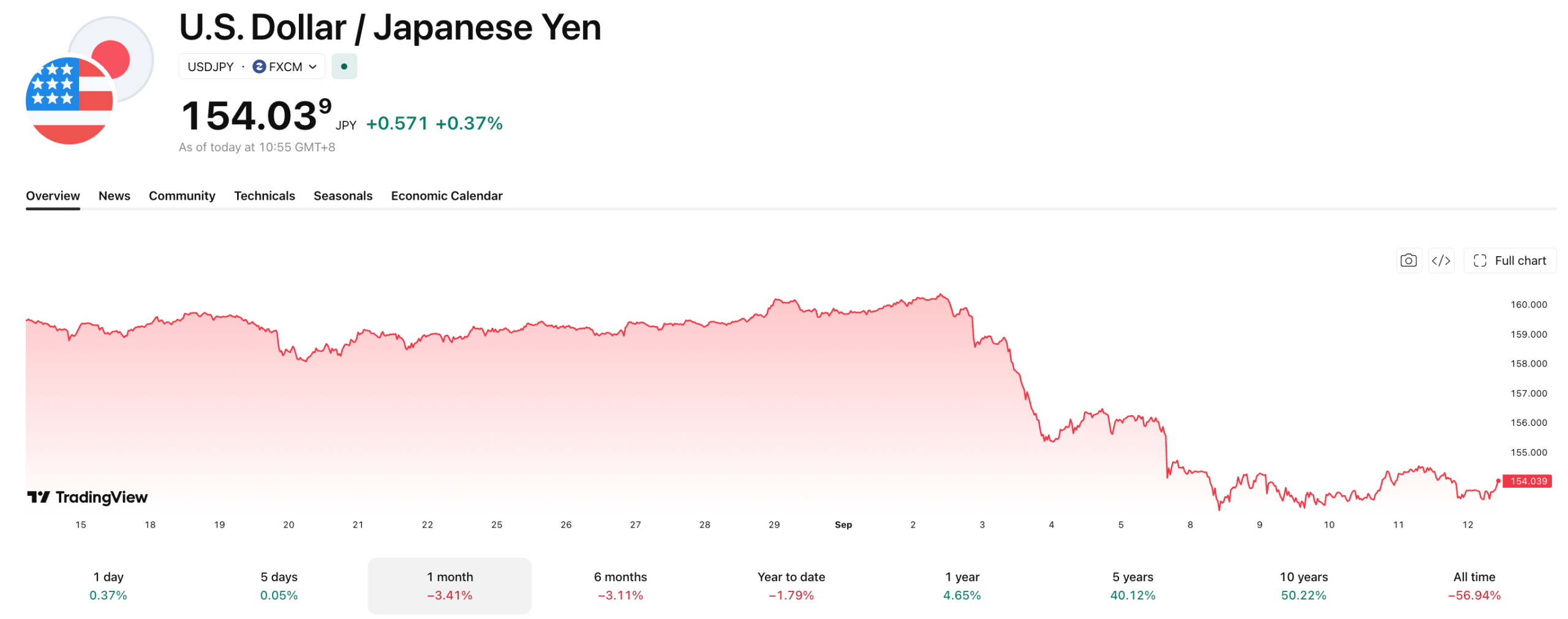
The Yen has held onto its gains made since the unprecedented US intervention.

The yen’s four-week climb collides with the Federal Reserve’s Wednesday rate decision. The size of the Fed’s move could decide whether Tokyo’s currency gains hold or reverse.

The yen traded at 153.49 per dollar on Monday, just off the 152.89 seven-month high reached last week. Speculators turned net-long on the yen for the first time since February, marking a shift in positioning.

Why the Fed Comes First

Consumer prices in the U.S. accelerated in August, based on data released Friday. Traders now price Fed rate hike odds at 86% for Wednesday. That figure comes from the CME FedWatch tool, which estimates odds using futures pricing.

The Bank of Japan meets two days later, on Friday. MUFG analysts said a quarter-point hike is already largely priced into markets. However, the bank said the yen needs a signal of faster future hikes to strengthen further.

Advertisement
The Yen has held onto its gains made since the unprecedented US intervention.
The Yen has held onto its gains made since the unprecedented US intervention. Image Source: Trading View

A different risk applies if the BOJ leaves further hikes off the table for October and December. TD Securities therefore said that scenario could send dollar/yen back toward the 157 to 160 zone.

The Stakes Reach Beyond Tokyo

Hedge funds have already adjusted carry trade positioning as the yen’s moves ripple beyond Tokyo.

The pressure extends beyond Tokyo as well. The U.S. dollar index held steady at 99.15 after two weeks of declines. Meanwhile, the European Central Bank raised rates last week, and the Bank of England is expected to hold Thursday. Yet that vote looks close.

James Athey, a fixed-income portfolio manager at Marlborough, described the stakes bluntly:

“Not hiking would be a catastrophic error. Not communicating robustly will be a significant own goal.”

Athey also pointed to repatriation flows and asset allocation shifts at GPIF, Japan’s giant public pension fund. Those forces are already pulling money back into the yen, separate from the rate decisions this week.

Advertisement

This month’s yen advance has almost reached 4%, adding to the pressure on Tokyo. Still, the bigger signal may come from Tokyo rather than Washington. Whether those gains hold depends less on the Fed’s Wednesday move than on the BOJ’s signal two days later.

The post Yen Up Near 4% This Month: Why a Fed Hike Could Force BOJ's Hand appeared first on BeInCrypto.

Source link

Advertisement
Continue Reading

Crypto World

US Republicans Release Final CLARITY Act Text

Published

on

US Republicans Release Final CLARITY Act Text

Senate Republicans on Sunday released revised text of the CLARITY Act aimed at swaying Democrats ahead of a procedural vote on Tuesday, featuring major changes to rules relating to government officials’ involvement with digital assets.

The 635-page proposal, released by US Senate Banking Digital Assets Subcommittee Chair Cynthia Lummis alongside Chairmen John Boozman and Tim Scott, also includes changes to the Blockchain Regulatory Certainty Act (BRCA) and provisions governing stablecoin yield. Lummis said the new ethics provisions had been agreed to by US President Donald Trump. 

“After a year of intense daily bipartisan negotiations, this bill is ready,” she said. “President Trump voluntarily agreed to unprecedented ethics restrictions, holding every federally elected official, judge, and their spouses to some of the toughest ethics restrictions in US history.”

The new bill text comes just two days before a procedural vote on the CLARITY Act on Tuesday at 2:15pm ET, which will determine whether the Senate can advance the bill toward floor consideration. The proposal has been described as a final offer on the bill, a Republican aide told reporters on Sunday.

Advertisement

Key changes in final CLARITY Act text 

Lummis said the final bill text reflects a year of bipartisan negotiations and 126 changes made at the request of Democrats. 

The revised ethics rules would allow state attorneys general to enforce bans on federal officials issuing, sponsoring or holding significant financial interests in digital assets, and on exchanges listing assets in violation of those bans. 

Covered individuals would also be required to divest significant financial interests or place them in a qualified blind trust. Violations would carry civil penalties of $500,000 or 20% of the amount received in the prohibited transaction, whichever is greater, with the ethics provisions taking effect 360 days after enactment, or sooner if implementing regulations are finalized.

Related: Treasury Secretary Bessent urges CLARITY Act passage after Senate returns

Advertisement

On stablecoins, the Treasury Secretary would be required to introduce rules restricting rewards if they determine that community banks are losing deposits on a substantial scale, though the authority would expire 18 months after the bill becomes law. 

Meanwhile, the revised BRCA would retain protections against treating developers as money transmitters or financial institutions under the Bank Secrecy Act and extend the protections to miners and validators, which were previously excluded. 

It would also remove references to Section 1960 of Title 18 of the US Code, which relates to the prohibition of unlicensed money transmitting businesses.  

Other changes would strengthen safeguards around affiliate trading and conflicts of interest at digital commodity exchanges, brokers and dealers, and clarify how consumer protection laws apply. 

Advertisement

Magazine: Crypto’s biggest week ever? Swarm fears prompt AI slowdown: Hodler’s Digest

Source link

Continue Reading

Crypto World

CFTC Opens Three Insider-Trading Probes on Polymarket

Published

on

Illustration of three open case folders under a desk lamp with a magnifying lens, in a flat amber and slate-blue editorial style

Join Our Telegram channel to stay up to date on breaking news coverage

The Commodity Futures Trading Commission has opened at least three previously unreported investigations into suspected insider trading on Polymarket, according to a WIRED report.

Chairman Michael Selig approved the first investigation in early May, targeting pardon-related markets. It followed an NPR report that a trader earned more than $300,000 after correctly predicting several preemptive pardons. A second investigation, approved at the end of May, covers Iran-related contracts. That one followed a 60 Minutes report on accounts that reportedly earned $2.4 million with a 98% win rate.

In July, the CFTC approved a third investigation into suspected insider trading involving Google’s 2025 Year in Search ranking. An agency official said that probe would examine additional individuals and that the Southern District of New York is running a parallel investigation. CFTC enforcement officials said the Google matter is separate from an existing case against former Google engineer Michele Spagnuolo, who allegedly made more than $1.2 million trading Polymarket contracts on confidential information about the rankings.

Advertisement

Probes land on a young US operation

Polymarket, a prediction market where users trade event contracts on real-world outcomes, only relaunched in the United States in late 2025. The relaunch followed its acquisition of QCEX and put its event contracts under CFTC oversight. The new investigations test that arrangement before it is a year old.

Previously, the Justice Department and the CFTC examined whether Polymarket circumvented restrictions on US traders imposed under a 2022 settlement, a probe that ended in July. Polymarket itself is not reported to face exposure in the new insider-trading probes, and no outcome in any of the three has been announced.

Join Our Telegram channel to stay up to date on breaking news coverage

Advertisement

Source link

Continue Reading

Crypto World

3% of Polymarket Traders Capture 27% of All Profits, Yale Study Finds

Published

on

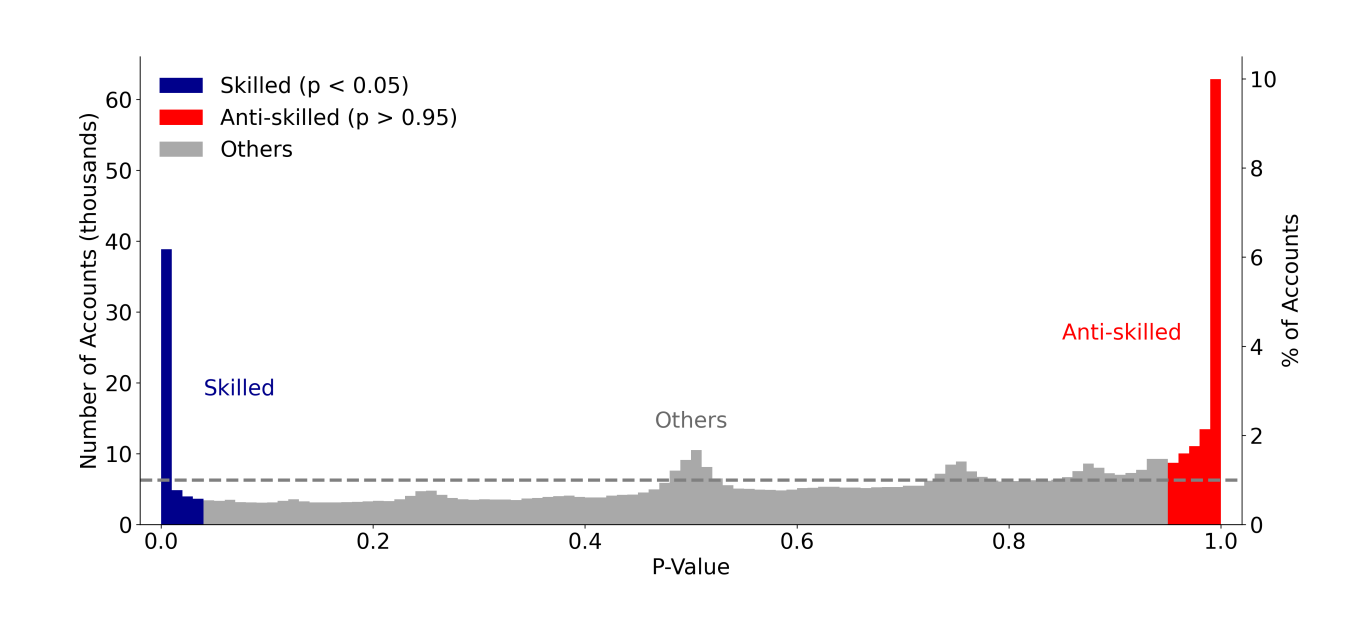
P-value distribution shows a small cluster of skilled traders (blue) and anti-skilled traders (red) standing out from the bulk of accounts showing no consistent edge (gray).

A small slice of Polymarket traders captures most of the platform’s profits, a new academic study finds. Roughly 3% of accounts collected 27% of all dollar profits, and Wall Street competition is now narrowing that edge.

The working paper, co-authored by researchers at Yale and the London Business School, examined two years of Polymarket trades. It covered 1.72 million accounts and 210,322 markets.

Why Polymarket Traders’ Edge Is Shrinking

The authors used a statistical test that reruns each trader’s history thousands of times to separate skill from luck.

Theis Jensen is a Yale economist and co-author of the study. He expects the share of skilled traders to fall from roughly 3% to below 1% as competition increases.

Advertisement
P-value distribution shows a small cluster of skilled traders (blue) and anti-skilled traders (red) standing out from the bulk of accounts showing no consistent edge (gray).
P-value distribution shows a small cluster of skilled traders (blue) and anti-skilled traders (red) standing out from the bulk of accounts showing no consistent edge (gray). Image Source: Yale

He explained that more competition improves pricing.

“If you have a lot of skilled people, then they compete, and in doing so, they make prices more correct.”

Jensen, Yale School of Management

Julie Hoover, a Bank of America equity analyst, said tighter spreads make mispricing harder to find. She said smaller specialists could still hold an edge in niche markets. She added that the platform’s wide range of contracts lets specialists build deep, narrow expertise.

Jensen added that large institutions tend to avoid low-liquidity markets. Small orders there can erode an institution’s own edge, leaving room for specialists.

A Fairer Gamble for Everyone Else

Traders without a lasting edge could still benefit from more accurate pricing. Better prices reduce the odds of repeatedly taking the wrong side of a bad bet.

Advertisement

Federal Reserve researchers found that Kalshi’s macroeconomic contracts matched or beat standard forecasting benchmarks. Its headline inflation forecast even outperformed the Bloomberg consensus.

Greater institutional volume also expands transaction fee revenue for prediction market platforms. Better-calibrated prices can strengthen their use as hedging, forecasting, and market-data tools.

As institutional money keeps flowing in, the edge is likely to concentrate further among specialized firms. The paper’s authors say only the largest, most sophisticated funds may consistently beat the odds.

The post 3% of Polymarket Traders Capture 27% of All Profits, Yale Study Finds appeared first on BeInCrypto.

Advertisement

Source link

Continue Reading

Crypto World

Cramer Draws 2018 Parallel to Today's Market: Any Danger of History Repeating Itself?

Published

on

The ECB’s Rate Hike Could Force the Fed’s Hand

Jim Cramer says he sees a parallel between market conditions in 2026 and those that preceded 2018’s brutal stock selloff. The CNBC host stopped short of predicting a full repeat.

On his CNBC show, Mad Money, he mapped out the parallels investors are watching. Then he explained how he thinks people should position for what comes next.

A 2018 Parallel Emerges

Both 2018 and 2026 fall in the second year of a Trump term. Stocks rallied hard in both periods.

Oil prices and Treasury yields climbed in 2018, and they are climbing again now. Inflation also sits above the Federal Reserve’s target in both periods.

Advertisement

Back in 2018, the S&P 500 fell roughly 20% between its September peak and Christmas Eve. A hawkish Powell helped trigger that slide.

The index recovered fast. Powell then cut rates three times, and the S&P 500 closed 2019 up close to 30%.

This time, the pressure sits with Fed Chair Kevin Warsh, who took over from Powell in May. Oil trades near $100 a barrel, and the 10-year Treasury yield is approaching 5%.

Traders now price rate hike odds near 90% for this month’s Fed meeting.

Advertisement

Trim, Don’t Sell

Cramer isn’t calling for investors to exit the market.

“I’m not saying you should just sell everything because history’s going to repeat itself.”

Cramer

Instead, he wants people to trim winning positions and raise cash.

His own Charitable Trust has pushed cash into the mid-teens as a share of the portfolio. That is higher than usual. A bigger cash pile gives him room to buy quality stocks back if prices fall.

Advertisement

Cramer thinks Warsh is unlikely to repeat Powell’s 2018 mistakes. He also thinks markets understand this administration’s pressure on the Fed better than they did in 2018.

Still, he called the parallels eerie enough to watch. History may not repeat exactly, he said, but it could rhyme.

The post Cramer Draws 2018 Parallel to Today's Market: Any Danger of History Repeating Itself? appeared first on BeInCrypto.

Source link

Advertisement
Continue Reading

Crypto World

Amodei's AI Slowdown Warning Rattles Futures: Will Stocks Open Lower?

Published

on

AI Job Displacement Concerns Pushes US Senators to Demand Action

US stock futures fell sharply Sunday night after Anthropic CEO Dario Amodei published an essay calling on AI companies to slow the pace of frontier model development.

The essay landed hours before OpenAI CEO Sam Altman ruled out an initial public offering (IPO) this year, citing similar safety concerns.

Why Futures Are Under Pressure

Nasdaq 100 futures fell 1.2% in Sunday evening trading. In contrast, Dow Jones Industrial Average futures slid a smaller 0.4%, while S&P 500 futures lost 0.6%.

The declines extend a rough week for equities. The Dow just posted its worst weekly loss since March.

Advertisement

Amodei’s essay, titled “We Must Pace the Frontier,” urged AI firms to slow model capability gains.

“We must slow the pace at which we improve the capabilities of AI models.”

— Dario Amodei, in an essay

However, the delay does not scrap OpenAI’s IPO entirely. OpenAI CFO Sarah Friar said last month the company still expects to go public in 2027 or sooner, according to CNBC. The sudden alignment among AI leaders on slowing down adds fresh uncertainty for investors.

Advertisement

What Could Shape Monday’s Stock Open

No major earnings reports or economic data are due Monday. Still, traders have little to weigh beyond the AI headlines and this week’s Federal Reserve meeting.

Fed funds futures point to a roughly 85% chance of a rate hike Wednesday, based on the CME FedWatch tool. Therefore, a hawkish surprise at that meeting could deepen Monday’s early losses.

Meanwhile, the debate over AI safety has spilled into Washington, where lawmakers are weighing calls for tighter oversight.

If futures losses hold into the opening bell, AI-linked stocks that led this year’s rally look most exposed. Whether the pullback deepens or fades by midday may hinge on how seriously investors treat Amodei’s warning.

Advertisement

The post Amodei's AI Slowdown Warning Rattles Futures: Will Stocks Open Lower? appeared first on BeInCrypto.

Source link

Continue Reading

Trending

Copyright © 2025