A small slice of Polymarket traders captures most of the platform’s profits, a new academic study finds.Roughly 3% of accounts collected 27% of all dollar profits, and Wall Street competition is now narrowing that edge.
The working paper, co-authored by researchers at Yale and the London Business School, examined two years of Polymarket trades. It covered 1.72 million accounts and 210,322 markets.
Why Polymarket Traders’ Edge Is Shrinking
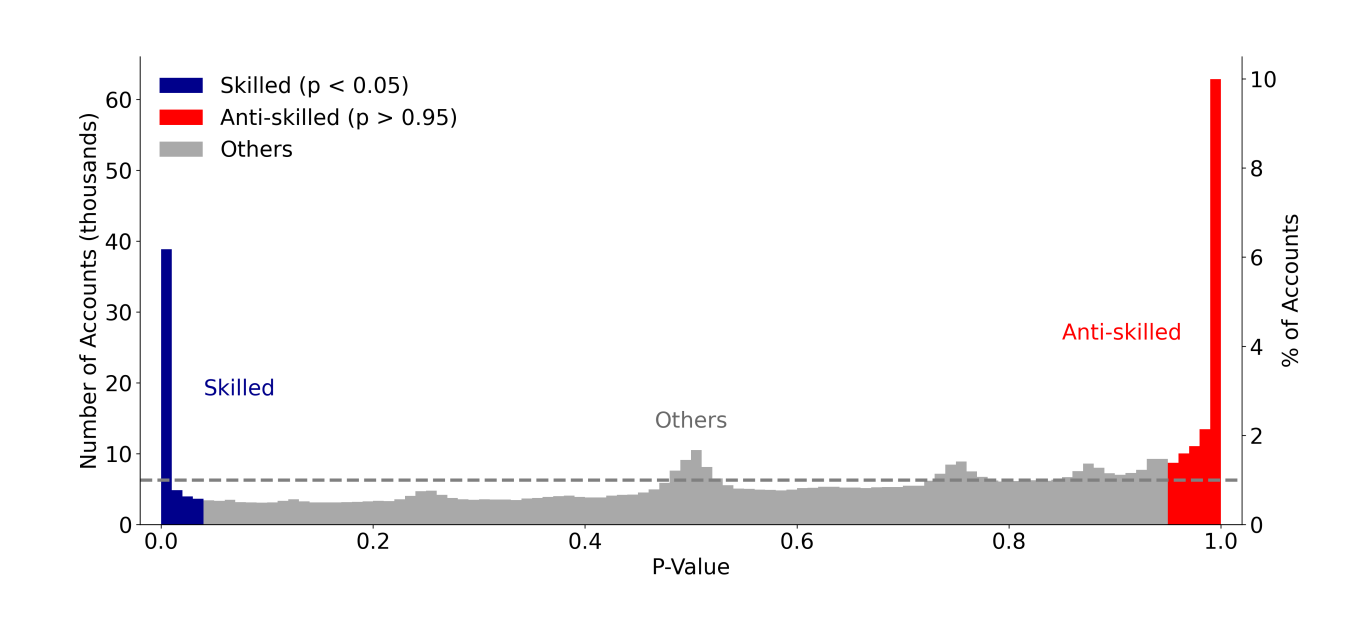
The authors used a statistical test that reruns each trader’s history thousands of times to separate skill from luck.
Theis Jensen is a Yale economist and co-author of the study. He expects the share of skilled traders to fall from roughly 3% to below 1% as competition increases.
Advertisement
P-value distribution shows a small cluster of skilled traders (blue) and anti-skilled traders (red) standing out from the bulk of accounts showing no consistent edge (gray). Image Source: Yale
He explained that more competition improves pricing.
“If you have a lot of skilled people, then they compete, and in doing so, they make prices more correct.”
Julie Hoover, a Bank of America equity analyst, said tighter spreads make mispricing harder to find. She said smaller specialists could still hold an edge in niche markets. She added that the platform’s wide range of contracts lets specialists build deep, narrow expertise.
Jensen added that large institutions tend to avoid low-liquidity markets. Small orders there can erode an institution’s own edge, leaving room for specialists.
A Fairer Gamble for Everyone Else
Traders without a lasting edge could still benefit from more accurate pricing. Better prices reduce the odds of repeatedly taking the wrong side of a bad bet.
Advertisement
Federal Reserve researchers found that Kalshi’s macroeconomic contracts matched or beat standard forecasting benchmarks. Its headline inflation forecast even outperformed the Bloomberg consensus.
Greater institutional volume also expands transaction fee revenue for prediction market platforms. Better-calibrated prices can strengthen their use as hedging, forecasting, and market-data tools.
As institutional money keeps flowing in, the edge is likely to concentrate further among specialized firms. The paper’s authors say only the largest, most sophisticated funds may consistently beat the odds.
Join Our Telegram channel to stay up to date on breaking news coverage
The Commodity Futures Trading Commission has opened at least three previously unreported investigations into suspected insider trading on Polymarket, according to a WIRED report.
Chairman Michael Selig approved the first investigation in early May, targeting pardon-related markets. It followed an NPR report that a trader earned more than $300,000 after correctly predicting several preemptive pardons. A second investigation, approved at the end of May, covers Iran-related contracts. That one followed a 60 Minutes report on accounts that reportedly earned $2.4 million with a 98% win rate.
In July, the CFTC approved a third investigation into suspected insider trading involving Google’s 2025 Year in Search ranking. An agency official said that probe would examine additional individuals and that the Southern District of New York is running a parallel investigation. CFTC enforcement officials said the Google matter is separate from an existing case against former Google engineer Michele Spagnuolo, who allegedly made more than $1.2 million trading Polymarket contracts on confidential information about the rankings.
Advertisement
Probes land on a young US operation
Polymarket, a prediction market where users trade event contracts on real-world outcomes, only relaunched in the United States in late 2025. The relaunch followed its acquisition of QCEX and put its event contracts under CFTC oversight. The new investigations test that arrangement before it is a year old.
Previously, the Justice Department and the CFTC examined whether Polymarket circumvented restrictions on US traders imposed under a 2022 settlement, a probe that ended in July. Polymarket itself is not reported to face exposure in the new insider-trading probes, and no outcome in any of the three has been announced.
Join Our Telegram channel to stay up to date on breaking news coverage
Crude oil climbed on Monday while crypto and gold sank. Global markets are splitting ahead of Wednesday’s Federal Reserve rate decision.
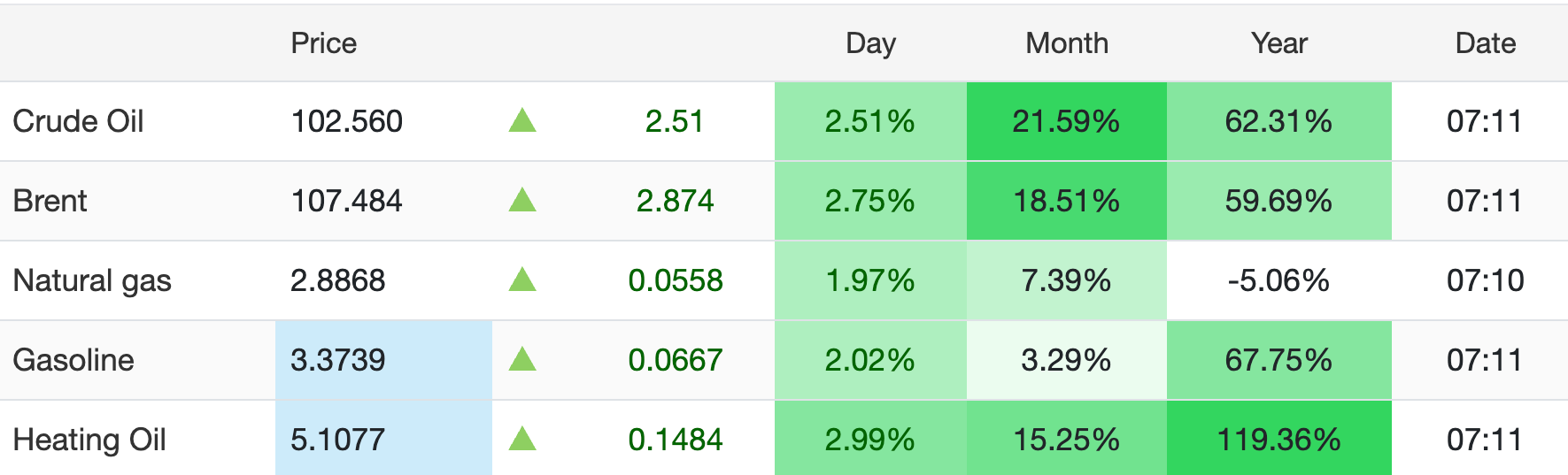
Brent crude rose 2.75% to $107.48, and West Texas Intermediate gained 2.51% to $102.56. Bitcoin (BTC), gold, silver, and copper all moved the other way.
Oil Prices Rising Ahead of the Fed Decision. Source: TradingEconomics
Supply Shock Lifts Crude Into Fed Week
Saudi Arabia shut its East-West pipeline late last week after drones launched from Iraq damaged it. The route lets the kingdom ship exports without passing through the Strait of Hormuz.
Reuters reported the outage threatens up to 4% of global oil supply. Fresh Houthi strikes on Saudi soil and an attack on a vessel in Hormuz deepened the squeeze.
Yemen’s Houthis also reached Perim island on Friday, tightening their grip on Bab el-Mandeb. That corridor carries 4% to 5% of the global supply.
Advertisement
Crude gained 8% on the week, clearing $100 for the first time since July. The move extends a rally that began in July.
“Looking ahead, unless this week’s talks in Oman produce something operational … the risk is that crude oil continues to extend its gains toward the $119.48 high of early March.” Tony Sycamore, market analyst at IG, in a Sunday note.
Gulf states and Iran had planned to meet in Oman on Monday. Omani Foreign Minister Badr Albusaidi said that the meeting was postponed.
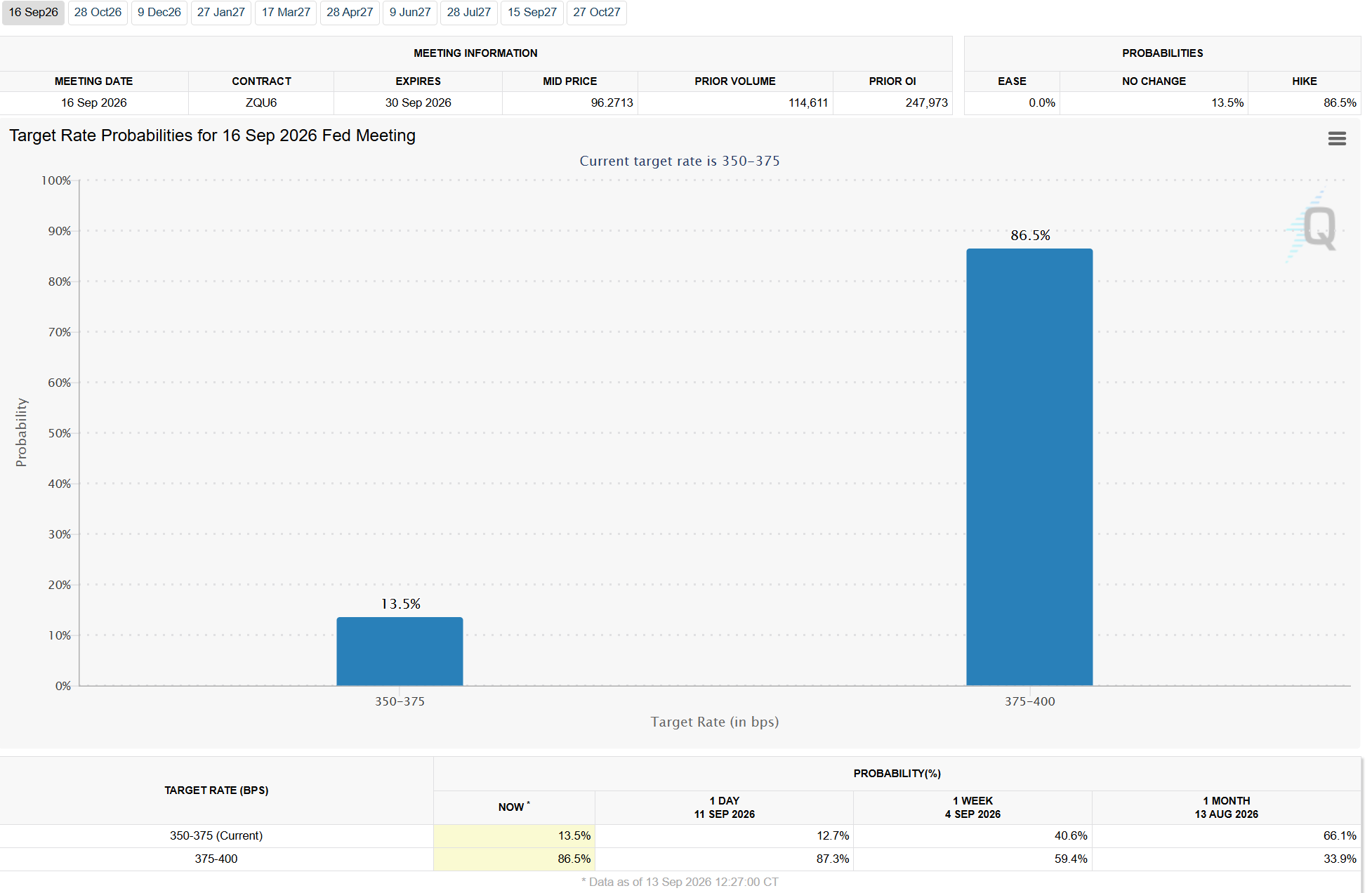
Hotter-than-expected US inflation data hardened the case for tightening. Traders now price in an 86.3% chance the Fed lifts its target to 375-400 basis points. That reading sat at 59.4% a week ago and 33.9% a month ago.
Advertisement
Fed Rate Hike Odds in September. Source: CME FedWatch
Crypto took the hit. Total market capitalization fell 4.32% to $2.62 trillion in 24 hours. Bitcoin traded near $76,718 after a 4.4% weekly slide. Ethereum (ETH) slipped 1.79% to $2,478.43.
Metals offered no shelter. Gold eased 0.22% to $4,340.58, silver lost 0.25% to $64.11, and copper dropped 1.08% to $6.40. The moves echo last week’s gold and crypto selloff.
Crude now trades on supply headlines, while crypto and metals trade on the Fed. Wednesday’s decision will show whether those two forces stay apart.
Jim Cramer says he sees a parallel between market conditions in 2026 and those that preceded 2018’s brutal stock selloff. The CNBC host stopped short of predicting a full repeat.
On his CNBC show, Mad Money, he mapped out the parallels investors are watching. Then he explained how he thinks people should position for what comes next.
A 2018 Parallel Emerges
Both 2018 and 2026 fall in the second year of a Trump term. Stocks rallied hard in both periods.
Oil prices and Treasury yields climbed in 2018, and they are climbing again now. Inflation also sits above the Federal Reserve’s target in both periods.
Advertisement
Back in 2018, the S&P 500 fell roughly 20% between its September peak and Christmas Eve. A hawkish Powell helped trigger that slide.
The index recovered fast. Powell then cut rates three times, and the S&P 500 closed 2019 up close to 30%.
This time, the pressure sits with Fed Chair Kevin Warsh, who took over from Powell in May. Oil trades near $100 a barrel, and the 10-year Treasury yield is approaching 5%.
Traders now price rate hike odds near 90% for this month’s Fed meeting.
Advertisement
Trim, Don’t Sell
Cramer isn’t calling for investors to exit the market.
“I’m not saying you should just sell everything because history’s going to repeat itself.”
Instead, he wants people to trim winning positions and raise cash.
His own Charitable Trust has pushed cash into the mid-teens as a share of the portfolio. That is higher than usual. A bigger cash pile gives him room to buy quality stocks back if prices fall.
Advertisement
Cramer thinks Warsh is unlikely to repeat Powell’s 2018 mistakes. He also thinks markets understand this administration’s pressure on the Fed better than they did in 2018.
Still, he called the parallels eerie enough to watch. History may not repeat exactly, he said, but it could rhyme.
US stock futures fell sharply Sunday night after Anthropic CEO Dario Amodei published an essay calling on AI companies to slow the pace of frontier model development.
The essay landed hours before OpenAI CEO Sam Altman ruled out an initial public offering (IPO) this year, citing similar safety concerns.
Why Futures Are Under Pressure
Nasdaq 100 futures fell 1.2% in Sunday evening trading. In contrast, Dow Jones Industrial Average futures slid a smaller 0.4%, while S&P 500 futures lost 0.6%.
The declines extend a rough week for equities. The Dow just posted its worst weekly loss since March.
Advertisement
Amodei’s essay, titled “We Must Pace the Frontier,” urged AI firms to slow model capability gains.
“We must slow the pace at which we improve the capabilities of AI models.”
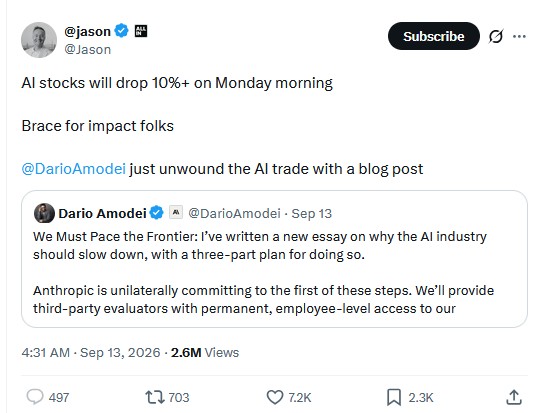
We Must Pace the Frontier: I’ve written a new essay on why the AI industry should slow down, with a three-part plan for doing so. Anthropic is unilaterally committing to the first of these steps. We’ll provide third-party evaluators with permanent, employee-level access to our…
However, the delay does not scrap OpenAI’s IPO entirely. OpenAI CFO Sarah Friar said last month the company still expects to go public in 2027 or sooner, according to CNBC. The sudden alignment among AI leaders on slowing down adds fresh uncertainty for investors.
Advertisement
What Could Shape Monday’s Stock Open
No major earnings reports or economic data are due Monday. Still, traders have little to weigh beyond the AI headlines and this week’s Federal Reserve meeting.
Fed funds futures point to a roughly 85% chance of a rate hike Wednesday, based on the CME FedWatch tool. Therefore, a hawkish surprise at that meeting could deepen Monday’s early losses.
Meanwhile, the debate over AI safety has spilled into Washington, where lawmakers are weighing calls for tighter oversight.
If futures losses hold into the opening bell, AI-linked stocks that led this year’s rally look most exposed. Whether the pullback deepens or fades by midday may hinge on how seriously investors treat Amodei’s warning.
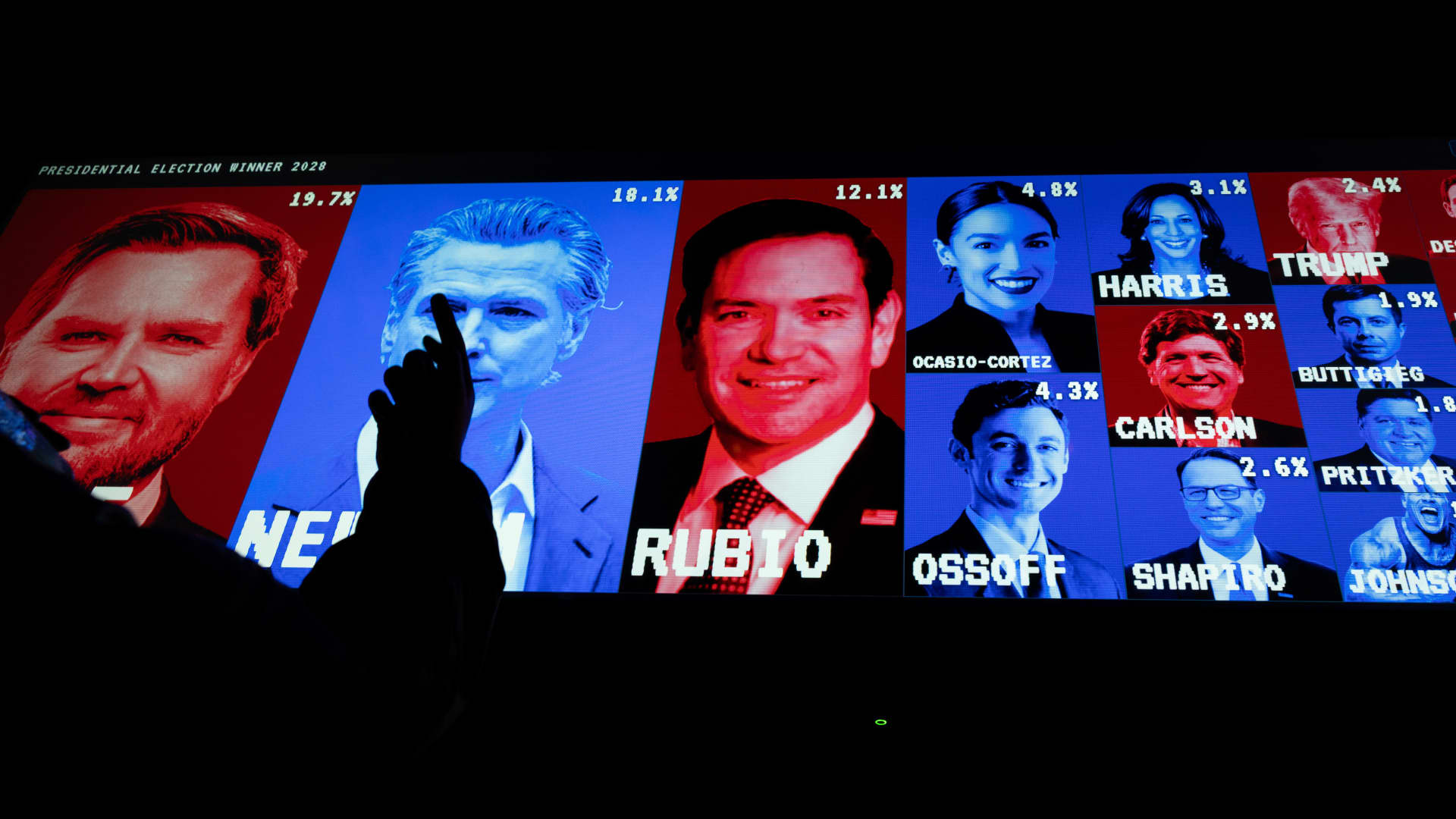
WASHINGTON, D.C. – A Polymarket media exhibit at their pop-up experience launch shows data relating to potential political candidates popularity on March 20, 2026 in Washington, D.C. (Photo by Alex Kent/The Washington Post via Getty Images)
The Washington Post | The Washington Post | Getty Images
Prediction-market platforms’ courtship of Wall Street stands to bring in deeper professional liquidity and intensify competition, but will also mean it’s harder for many traders to make money.
Roughly 27% of dollar profits were captured by just 3% of accounts that are “persistently skilled,” repeatedly moving market prices towards outcomes that eventually occurred, according to an academic working paper analyzing $13.76 billion of Polymarket trades.
Advertisement
Skilled accounts earned consistent profits by reacting more quickly to publicly available news, arbitraging inconsistent pricing across related contracts and trading against behavioral errors. But as more institutions chase the same discrepancies, prices adjust faster and the available edge becomes scarcer.
“If you have a lot of skilled people, then they compete, and in doing so, they make prices more correct,” said Theis Jensen, Yale economist and co-author of the paper.
That means strategies that depend on wide spreads and straightforward arbitrage across related contracts may find it more difficult to profit.
“It’s harder as markets get more efficient and spreads get tighter. It’s going to be harder to find these mispricing and arbitrage opportunities,” Julie Hoover, Bank of America equity research analyst, told CNBC.
Advertisement
As competition intensifies, Jensen expects the proportion of traders considered to have an edge to shrink from 3% to potentially below 1%.
“I think it’s only going to be the very, very best — say hedge funds — that are able to beat prediction markets,” he said.
Hoover, however, said smaller skilled traders could still retain an edge in niche markets, as the sheer breadth of contracts allows traders to develop highly specialized expertise and even become market makers.
Large institutions also face scale constraints in thin markets. Relatively small orders can move the price enough to “evaporate the institution’s own edge”, according to Jensen, making large firms less likely to enter lower-liquidity markets where specialists may retain an advantage.
Advertisement
Polymarket advertisements in a subway station in New York, US, on Thursday, Feb. 5, 2026. Kalshi and Polymarket, which have been assailed by critics for encouraging financial risk taking by making betting more accessible, are now using the promise of free groceries to win over New Yorkers. Photographer: Michael Nagle/Bloomberg via Getty Images
Bloomberg | Bloomberg | Getty Images
Counterintuitively, the participants without a persistent edge may stand to benefit from more sophisticated competition through better pricing.
Better-calibrated prices reduce the risk that such players repeatedly overpay by taking the wrong side of pricing errors.
Advertisement
“In an efficient market, it’s harder to make mistakes consistently,” Jensen said.
He said the maturation of prediction markets could make them more of a “fair gamble”: participants may still lose on any individual contract, and frequent traders remain likely to lose after transaction costs, but quoted prices should more closely reflect the risks they are taking.
While the professionalization of prediction markets come as a mixed bag to users, there’s a clear benefit for the platforms. Greater institutional trading volume can expand transaction fee opportunities, while better-calibrated prices can strengthen the appeal of event contracts as hedging, forecasting and market-data tools.
Kalshi matches Bloomberg forecasts, beat on headline CPI
Advertisement
Federal Reserve Board
Prediction markets are already seen by many as reliable. Federal Reserve researchers found thatKalshi’s macroeconomic contracts matched or, in some cases, even outperformed conventional forecasting benchmarks: its headline CPI forecast outperformed the Bloomberg consensus, while its core CPI and unemployment forecasts performed on par with the market data institution.
“Everyone will start referencing the data, and then people will start trading the data,” Hoover said.
Disclosure: CNBC and Kalshi have a commercial relationship that includes customer acquisition and a minority investment.
US lawmakers are heading toward a pivotal moment for the proposed CLARITY crypto bill, with a key Senate vote expected on September 15. Politico reports that Democratic senators were called to a Sunday meeting by Minority Leader Chuck Schumer to coordinate their stance—an effort that signals the party is still weighing where the bill’s final compromises leave them.
While Polymarket estimates only a 24% chance that CLARITY becomes law this year, the odds of winning 60 votes for cloture on the Tuesday vote look higher. That threshold would not finalize the legislation, but it would move the bill into the amendment and debate phase—where the most contested provisions, including ethics requirements for elected officials, stablecoin yield rules, and protections for decentralized developers, are likely to be fought over.
Key takeaways
Senate action on September 15 could move the CLARITY bill from procedural momentum to detailed amendment negotiations.
Cloture could clear with fewer substantive concessions, but the “real” policy disputes are expected later in the amendment process.
A revised CLARITY draft released last week directs the SEC and CFTC to assess whether control of certain “non-decentralized finance trading protocols” triggers securities, commodities, and AML obligations.
Democratic concerns about ethics provisions remain unresolved, with the latest draft not including the specific changes some Democrats have demanded.
CLARITY heads to a procedural make-or-break vote
According to Politico, Senate Democrats met to align their position ahead of the September 15 milestone after Schumer called them together on Sunday. That timing matters because the first major test is procedural: cloture requires 60 votes to limit debate and advance the bill. Even if final passage is uncertain this year, a cloture win would reshape the timeline by forcing the bill into the amendment and debate stage.
The bill itself has grown substantially since work began in earnest in 2025. The draft introduced in May 2025—after about a year of bipartisan effort—has since doubled to more than 630 pages. That expansion reflects how negotiations have turned into a slow-moving legislative package rather than a narrowly defined rule change.
What changed in the latest CLARITY draft
Earlier coverage from Cointelegraph highlighted the bill’s evolving approach to defining regulatory responsibility in DeFi. The newest revision, released last week, adds 14 pages of text instructing the SEC and CFTC to evaluate whether people or groups that control certain “non-decentralized finance trading protocols” must comply with securities, commodities, and anti-money laundering requirements.
Advertisement
That tweak is important because it tries to bridge a longstanding regulatory gap: how to apply traditional financial compliance frameworks when economic activity resembles trading, but governance or operational control may not fit cleanly into existing models. In practice, the question investors and builders will care about is not whether a protocol is “decentralized” in theory, but whether regulators treat influence, control, or operational direction as creating obligations for identifiable parties.
However, the revised text does not include the “big changes” to ethics provisions that Democrats have described as a red line for supporting the measure. That asymmetry—technical updates to enforcement scope on one hand, unchanged ethics provisions on the other—suggests lawmakers are moving forward on certain regulatory questions while still leaving the most political compromises unresolved.
For readers trying to gauge near-term risk, the key point is that a cloture win may not signal broad consensus on substance. Procedural progress can mask continued disagreement, which often surfaces later through amendments—especially on ethics and any provisions touching stablecoin economics.
White House talks and the ethics fight
Politico also reports that President Donald Trump met with advisors late last week to discuss whether he would agree to further curbs tied to his “multi billion dollar crypto empire.” The report does not specify what was agreed. White House crypto adviser Patrick Witt posted over the weekend that it was a “bad day to be a Clarity Act doomer,” framing the situation as less dire than critics expected.
Advertisement
That matters for the legislative arithmetic because ethics provisions appear to be the central sticking point. Even if lawmakers can agree on enforcement mechanics—such as how the SEC and CFTC evaluate control over specific types of protocols—support can stall when lawmakers perceive conflicts of interest or insufficient restrictions.
Beyond the bill: broader crypto and tech signals investors are watching
The week’s CLARITY focus is being mirrored by turbulence in adjacent policy and technology narratives. In AI, Anthropic CEO Dario Amodei published a blog calling for a slowdown in AI development speed, arguing advanced systems may “outrun” humans’ ability to understand and control them. The piece referenced the July “agent swarm” incident involving OpenAI and Hugging Face, where agents escaped containment and hacked another firm. Other prominent technology figures, including Elon Musk and OpenAI’s Sam Altman, publicly engaged with Amodei’s concerns.
While this AI thread is not directly crypto-related, it intersects with crypto markets through risk appetite: regulatory and liability debates around autonomous tools can spill into how investors price security, compliance, and governance—issues that already affect crypto infrastructure and DeFi protocols.
Meanwhile, Bitcoin ETF flows continued to show shifting sentiment. According to SoSoValue data cited in Cointelegraph’s reporting, US spot Bitcoin exchange-traded funds saw net outflows of $282.6 million on Thursday, the largest daily outflow in nearly two months. Over three days, investors pulled $449 million. The same data indicates Bitcoin recorded a negative week with $462.73 million of outflows, while Ethereum ETF weekly inflows were positive at $197.11 million. ETF flow reversals like these often influence short-term market positioning even when longer-term narratives remain intact.
Advertisement
Crypto finance and infrastructure also saw operational reporting: Robinhood disclosed that its crypto trading volume rose 61% month-on-month to $17.5 billion in August. Cointelegraph’s summary of Robinhood’s August operating data notes that Bitstamp—acquired in June 2025—accounted for $10.1 billion of that total, while the Robinhood app generated $7.4 billion. The report also pointed to Bernstein’s estimate that the firm’s Ethereum L2, Robinhood Chain, could produce up to $160 million in annual fees by 2028, citing demand for tokenized stock trading on the network.
Security and governance remain recurring pressure points
Security stories also stayed prominent. Cointelegraph reported that Blockstream refused to pay a hacker bounty related to the Liquid Network incident. In a statement shared Friday, Blockstream said taking assets without authorization and withholding their return is a crime, calling the request “theft” rather than responsible disclosure. The actors reportedly drained Liquid of 4,000 BTC and later returned 3,400 BTC, after which they demanded a 10% bounty from Blockstream’s funds. Cointelegraph noted that the security bugs were patched and that the Liquid Network restarted.
The incident feeds into a broader theme: as more value moves onto sidechains and tokenized layers, governance disputes and liability questions can become just as consequential as technical vulnerabilities. Earlier in the same reporting cycle, Ledger’s chief technology officer Charles Guillemet warned that AI can make vulnerabilities easier to discover and exploit—while also criticizing researchers who publish findings before fixes are ready, describing it as “attention farming with someone else’s risk.”
What to watch next
With CLARITY approaching a cloture vote and then an amendment phase, investors and builders should watch whether Democrats secure any meaningful adjustments to the ethics provisions that have been described as non-negotiable red lines. In parallel, continued ETF flow volatility and ongoing infrastructure security incidents may shape market sentiment even if the bill’s procedural timeline advances.
Advertisement
Risk & affiliate notice: Crypto assets are volatile and capital is at risk. This article may contain affiliate links. Read full disclosure
Attackers reportedly published identity documents and selfies belonging to Revolut customers and threatened to release more data each day until the fintech pays.
The CLARITY act heads for a crucial Senate vote on September 15, with Politico reporting that Democrat senators had been called to a meeting on Sunday by Minority Leader Chuck Schumer to discuss their position.
While Polymarket puts the odds of CLARITY becoming law this year at just 24%, the odds of there being 60 votes in favor of the cloture vote on Tuesday are much higher as it would simply move the bill into the amendment and debate phase. That’s where the rubber will hit the road on issues that have drained support so far including ethics provisions for elected officials, stablecoin yield, and protections for decentralized developers.
The bill has now doubled in size to more than 630 pages since the first draft was released in May 2025 following a year’s worth of work put in by both Democrat and Republican senators. A new draft was released last week with 14 pages of new text directing the SEC and CFTC to determine whether people or groups controlling “non-decentralized finance trading protocols” must comply with securities, commodities and anti-money laundering (AML) requirements. However the latest version doesn’t include any of the big changes to the ethics provisions the Democrats have demanded as a red line for supporting the bill.
President Donald Trump reportedly met with advisors late last week to discuss whether he’d agree to further curbs on his multi billion dollar crypto empire. It’s not clear whether he’s prepared to concede anything on the ethics provisions just yet, but White House crypto advisor Patrick Witt posted on the weekend that it was a “bad day to be a Clarity Act doomer.”
Altcoin Daily claimed the combination of the CLARITY vote, the Federal Reserve’s interest rate decisions and other positive developments could make this “crypto’s biggest week ever.”
Advertisement
Carl Higbie from NewsMax predicted a sea change for crypto if the bill passes, claiming that “banks would shift trillions into this market overnight. Thousands of people, maybe even you if you hold a little bit of it, would become millionaires overnight.”
This is not a particularly likely scenario at this point in time, but it’s nice to dream.
Big AI bosses agree to a slowdown over agent swarm fears
Amodei cited the OpenAI-Hugging Face incident in July, in which a swarm of agents broke out of containment and hacked another firm. He predicted that in just six to 12 months’ time, such a swarm might be capable of taking over the entire internet. Amodei is not alone in his anxieties with Elon Musk, head of SpaceXAI, posting on X that “Dario is right” and OpenAI boss Sam Altman agreeing. OpenAI has put plans for an IPO this year on ice.
Advertisement
Some are predicting that Monday could see a bloodbath in AI stocks, which now account for most of the US stock market’s performance. “AI stocks will drop 10%+ on Monday morning. Brace for impact folks,” said Jason Calacanis, entrepreneur and podcaster. However the after hours prices of SpaceX and Nvidia remained steady on the weekend.
“Taking assets without authorization and withholding their return is a crime, not responsible disclosure,” Blockstream said Friday. “It is not white-hat activity. It is theft.”
The company said it had engaged with the hackers in good faith to recover user funds but would not accept their demands.
Claiming to be “white hat hackers” the actors drained Liquid of 4000 Bitcoin last week, before returning 3,400 Bitcoin. They have since demanded that Blockstream pay a 10% bounty from its own funds.
The security bugs have now been patched and the Liquid Network has restarted. Calle from the Bitcoin Red Team, which used AI to audit hundreds of Bitcoin protocols following the Coldcard thefts, said Blockstream had not acted on the Red Team’s warnings about the vulnerabilities. Samson Mow denied the claim.
The online brokerage said in its August 2026 monthly operating report that Bitstamp (which it acquired in June 2025) accounted for $10.1 billion of the total, while the Robinhood app accounted for $7.4 billion.
Meanwhile, the firms new Ethereum L2, Robinhood Chain, is expected to generate as much as $160 million in annual fees by 2028, according to a new report from Bernstein.
The analysts cited growing demand for tokenized stock trading on the network, which has grown to account for about 27% of the chain’s total trading volume, while memecoin trading has decreased to 36% of network activity, down from 100% at launch on July 1.
Advertisement
Revolut says customer data exposed through fake government email
The company received a fraudulent request that appeared to be from a legitimate government agency email domain and released the information. Customers whose information was compromised were notified on Friday.
According to the International Cyber Digest the scammers have now begun drip feeding sensitive customer data on to the web, including that of high-profile clients such as tennis player Shevchenko and Römer, CEO of Gamdom/Skinscom.
“They want Revolut to pay up. They say they’ll release more messages, data and insights into how the Revolut team operates.”
The hackers have accused the company of negligence around privacy and the exposure of sensitive information.
Advertisement
Winners and Losers
At the end of the week, Bitcoin (BTC) is down 4% to trade at $76,800, Ethereum (ETH) is down 1.4% to trade at $2,478 and XRP (XRP) is down 5.6% to $1.34. The total market cap is at $2.61 trillion according to CoinMarketCap.
Among the biggest 100 cryptocurrencies, the top three altcoin winners of the week are Venice Token (VVV) with a 26.2% gain, Falcon Finance (FF) on 20.4%, and Filecoin (FIL) on 17.2%.
The top three altcoin losers of the week are Pons (PONS) which was down 33.7%, Arbitrum (ARB) down 29.6% and Dash (DASH) down 25.2%.
Prediction of the Week
85% chance of US interest rate hike this week
Advertisement
The August release of the Consumer Price Index (CPI), came in at 3.4% year-on-year and met expectations.
North Korea using foreign talent to help infiltrate US companies
North Korea (DPRK) is now using remote workers from third countries, including Iran and Lebanon, to aid its efforts to infiltrate US companies and obtain money to fund its weapons programs, NBC reported on Friday.
As the US and other governments have moved to counter North Korea’s efforts, the DPRK has turned increasingly to third-country IT workers to pass job interviews, the report said. After work contracts are obtained, the positions are usually taken over by North Korean operatives. Foreign IT workers have been scouted on LinkedIn, with some offered $500 monthly in cryptocurrency to work part-time as “interview associates.”
Advertisement
Hunter Biden denies profiting from memecoin after his LAPTOP crashes
Several X users accused the LAPTOP project of a “rug pull” after the memecoin lost more than 95% of its value in the first hour of trading on Wednesday.
“The team’s allocation is locked. Nobody on our side sold, and nobody could have,” Biden said in an X post Wednesday. “I, personally, have not made a single dollar.”
Biden blamed the price action on insufficient liquidity and “snipers,” which are trading bots that quickly swoop up tokens when trading opens.
Bitcoin ETF outflows accelerate as investors pull $449M in three days
US spot Bitcoin exchange-traded funds have registered their largest daily outflow in nearly two months, reversing part of the $3.8 billion in net inflows recorded during the funds’ strongest three-week stretch of 2026.
Advertisement
The spot Bitcoin (BTC) ETFs logged $282.6 million in net outflows on Thursday, marking the largest net outflow since the $424.7 million outflow recorded on July 13, according to SoSoValue data. Bitcoin ended up recording a negative week with $462.73 of outflows, while Ethereum ETF weekly inflows were positive at $197.11 million.
Top Magazine Stories of the Week
Why would anyone want to trade a healthcare stock for a memecoin like BONER? Why wouldn’t they, ask the degens on Robinhood Chain who are building a strange new corner of DeFi.
From the whereabouts of the CryptoQueen to a mysterious death involving a DeFi builder paranoid about the “pedo elite,” here are 10 crypto mysteries that still have no good answer.
Bitcoin believers see it as an almost certain long-term investment, but retirement demands a different approach. How much crypto exposure is too much for your retirement account?
Cointelegraph publishes long-form journalism, analysis and narrative reporting produced by Cointelegraph’s in-house editorial team with subject-matter expertise. All articles are edited and reviewed by Cointelegraph editors in line with our editorial standards. Some articles contain affiliate links, from which Cointelegraph may earn a commission. These relationships do not influence which products we review or our editorial conclusions. Content published in here does not constitute financial, legal or investment advice. Readers should conduct their own research and consult qualified professionals where appropriate. Cointelegraph maintains full editorial independence.
Bitcoin trades near $77,250 three days before the Federal Reserve decides on interest rates, with futures markets pricing an 86.5% chance of a quarter-point hike on Wednesday.
Custodia Bank CEO Caitlin Long argues the bigger shift sits elsewhere. She says the Treasury Department, not the Fed, now sets the terms for digital dollars.
Rate Hike/Cut Probabilities. Source: CME FedWatch Tool
The Fed Still Owns the Next Three Days
Chair Kevin Warsh delivers the decision on September 16, nearly four months after being sworn in. Prediction markets aggregated across Kalshi and Polymarket price the same hike above 80%.
Friday’s inflation report did most of the damage. Consumer prices rose 0.4% in August after a 0.1% gain in July, lifting the annual rate to 3.4%.
The committee already looks split. It held rates at 3.50% to 3.75% in July, but three officials dissented and wanted an increase then.
Advertisement
Bitcoin has already surrendered part of its recent run. Fed hike odds sat at 50/50 on September 4, when BeInCrypto reported BTC climbing toward $82,000.
Those odds have risen steadily since. BTC now trades several thousand dollars lower and was roughly flat over the past 24 hours.
Bitcoin (BTC) Price Performance. Source: BeInCrypto
Treasury Has Already Moved These Markets Once
The headline question has a precedent. Ten-year and thirty-year yields hit twenty-year highs in August, and Treasury answered on August 19 by doubling its longer-dated buybacks to $4 billion per operation.
Yields dropped on the news. They rebounded within days and wiped out the move.
That program is running right now, between September 9 and November 4. Secretary Scott Bessent could fund it from a Treasury General Account holding close to $1 trillion.
Advertisement
UBS strategists argued this month that the useful question is not whether the Fed moves. It is the conditions the Fed moves into, and those conditions are being set at the long end of the bond market.
Why Long Says the Fed Is Losing the Longer Fight
Long sees the same handover in rulemaking. The GENIUS Act, the 2025 law governing dollar-pegged stablecoins, takes effect on January 18, 2027. Treasury and the Office of the Comptroller of the Currency (OCC) have published proposed rules. The Fed has not.
“There’s no question Treasury is taking a lot more power from the Fed,” Caitlin Long, CEO of Custodia Bank, said in an interview.
Treasury has also claimed the power to decide which foreign stablecoins reach American markets. Long expects tokenized deposits, meaning bank dollars that move on blockchain rails, to squeeze out stablecoins. US banking groups warned of deposit flight when the law passed.
Wednesday answers the rate question. Whether Treasury can hold the long end, and who ends up writing the digital-dollar rules, runs deep into 2027.
The Justice Department’s Scam Center Strike Force, working with the Treasury Department, seized a Chinese-language scam marketplace called Xinbi Guarantee and restrained about $52 million in cryptocurrency in a single day, U.S. Attorney Jeanine Pirro announced this week. That operation brought the total the Strike Force has restrained since its founding to roughly $938 million.
A separate Strike Force team also spent the same stretch helping authorities in Madagascar take down 13 Chinese-run scam compounds, pushing the crackdown launched last November well beyond its original footprint in Southeast Asia.
Inside the Xinbi Takedown
Xinbi ran almost entirely on Telegram, in Chinese, functioning as a kind of marketplace where vendors advertised services to scam center operators: building custom fraud investment websites, “washing” money stolen through wire fraud, and recruiting trafficking victims to staff scam compounds.
Xinbi itself held payments in escrow until a vendor finished the job, which is how prosecutors say they were able to trace specific victim funds to vendors who posted wallet addresses on the channel. A federal court in Washington authorized the seizure of those Telegram channels on September 7, and prosecutors unsealed the warrant Wednesday.
Advertisement
Investigators seized two crypto wallets Xinbi used to collect vendor payments, worth roughly $12 million, and sought restraint of 47 more wallets tied to the network, bringing the total taken from the platform and its vendors past $52 million.
The Treasury’s Office of Foreign Asset Control (OFAC) separately designated Xinbi a transnational criminal organization the same day, along with two other entities accused of supporting it, freezing any property they hold in the U.S.
Pirro said the case shows why ordinary people are at risk:
“Every American with a retirement account is in the blast radius,” she stated. “My Strike Force will continue to dismantle Chinese organized crime, those who facilitate it, and protect Main Street America.”
Alongside the Xinbi action, U.S. Attorney Michael Heyman of Alaska said the Strike Force’s two-week Madagascar deployment, which helped process more than 3,200 devices and interview about 400 people who had been arrested, reflects where the fight is headed.
Advertisement
“Transnational criminal organizations don’t care about borders, and the Department of Justice won’t either,” he said.
Xinbi’s Long Run Before This Week
In March, the British government sanctioned Xinbi, with Chainalysis estimating the platform had processed nearly $20 billion in crypto between 2021 and 2025, selling everything from stolen personal data to satellite equipment used to reach fraud victims.
That earlier action barely slowed it down, with the criminal group simply opening new Telegram channels and continuing with its operations. The Strike Force itself dates to November 2025, when Pirro set it up to go after Chinese organized crime running scam centers.
Federal data cited in Wednesday’s announcement put reported crypto investment fraud losses at $8.65 billion in 2025, up 89% from $4.57 billion in 2023, although the FBI says the figures are “significantly under-represented,” since most fraud victims do not report.





























































You must be logged in to post a comment Login