

Crypto World
On-Chain Commodity Trading Takes Root, Liquidity Remains a Hurdle


Onchain commodity trading is attracting sustained attention as a viable channel for macro risk exposure, yet the market still wrestles with liquidity gaps that keep it from fully rivaling traditional venues. A new milestone for Hyperliquid’s HIP-3 market shows the trend toward broader onchain adoption, while observers flag key bottlenecks that could determine whether this momentum endures.
Key takeaways
- HIP-3 posted an all-time volume high on March 23, with about $5.4 billion in perpetual futures across commodities and macro assets, according to Artemis Analytics. Silver led the pack with roughly $1.3 billion in activity, followed by WTI crude ($1.2B), Brent ($940 million) and gold ($558 million).
- Traders are increasingly seeking macro-style exposure onchain. The shift isn’t limited to crypto-native participants; traditional finance actors are entering via personal accounts, expanding weekend and off-hours participation.
- Price discovery onchain is gaining traction during weekend and after-hours periods, but liquidity depth and price reliability on onchain venues remain weaker than centralized traditional exchanges.
- Liquidity depth, tighter spreads and clearer regulatory frameworks remain the main hurdles for broader institutional participation, according to market observers.
- The onchain macro narrative is expanding beyond commodities, with market participants anticipating broader asset classes to follow the same weekend-discovery dynamic as volatility shifts.
Onchain activity hits new highs as macro exposure gains traction
Data from Artemis Analytics shows a clear spike in onchain macro trading, centered on Hyperliquid’s HIP-3 market. On March 23, HIP-3 recorded a fresh all-time high, tallying roughly $5.4 billion in perpetual futures volume that spanned commodities and macro assets. The standout drivers were silver, oil and gold, with silver accounting for about $1.3 billion, West Texas Intermediate (WTI) crude around $1.2 billion, Brent crude at $940 million, and gold near $558 million. Equity indices, including the Nasdaq and S&P 500, also reflected notable flow on the platform.
Industry participants describe the surge as a signal not merely of higher trading activity, but of shifting intent: more market participants are seeking real-time, onchain access to macro trends. “Previously, onchain commodity futures were mostly a venue for crypto-native investors; that is no longer the whole story,” said Iggy Ioppe, chief investment officer at Theo. “The real tell isn’t just the volume; it’s who is trading and when they show up.”
“The real tell is not just the volume, it’s when the volume shows up and who is showing up to trade.”
— Iggy Ioppe, chief investment officer at Theo
Ioppe emphasized that onchain oil futures markets are now processing more than $1 billion in daily volume over weekends, a period when traditional exchanges are closed. He attributed part of the shift to individual traders from traditional finance who are accessing these markets via personal accounts. “Geopolitics does not stop on Friday afternoon, and markets are starting to adapt to that fact,” he observed.
In a broader sense, the data underscore a larger trend: traders are becoming more comfortable accessing macro-style exposure onchain, with gold and oil leading the development. While the current wave is anchored by commodities, observers anticipate similar patterns proliferating into other asset classes as volatility evolves.
Weekend price discovery creates a notable edge for onchain venues
A defining characteristic of onchain trading, according to industry voices, is the ability to operate around the clock. With an approximately 49-hour gap between the close of traditional markets on Friday and their Sunday reopening, decentralized platforms have become among the few places where traders can respond to macro developments in real time. This dynamic is already influencing how prices are formed beyond regular trading hours, even though traditional venues still provide the lion’s share of liquidity.
“Onchain is the price discovery layer when the rest of the market is asleep. TradFi remains the depth layer when size matters most,” said Sergej Kunz, co-founder of 1inch. The contrast highlights a structural gap: while onchain venues can react instantly to headlines, the ability to execute large trades without slippage still hinges on deeper liquidity and tighter spreads available in traditional venues.
Comparisons to established markets illustrate the scale difference. On the CME, crude oil futures regularly trade between 1 million and 4.5 million contracts daily, translating to roughly $100 billion to $300 billion in notional volume. These figures reflect the vast depth and execution quality that onchain platforms have yet to match on a practical, institutional scale.
Liquidity depth and market structure: the remaining hurdles
Even as weekend and off-hours activity gains traction, liquidity depth remains a central constraint for broader adoption. Experts point to two intertwined challenges: pricing reliability and market structure maturity. “Traditional venues still dominate when it comes to liquidity, execution quality, and institutional-scale pricing depth,” noted Sergej Kunz. He argued that unless onchain venues offer materially deeper liquidity and tighter spreads, sizable trades risk moving prices unfavorably and deterring large players.
Shawn Young, chief analyst at MEXC Research, added that while there are signs of behavioral shifts—more traders seeking macro exposure onchain—gaps in liquidity and price aggregation persist. He cautioned that commodity tokenization represents a real, but early-stage, development that will require maturation in pricing, data quality and regulatory clarity before it becomes a steady alternative to legacy markets.
Beyond commodities: a broader onchain macro narrative
Despite early-stage constraints, the trajectory appears to point toward broader macro participation onchain. Kunz framed it as a larger trend: “The broader direction is clear: traders are becoming more comfortable accessing macro-style exposure onchain.” While gold and oil currently dominate the flow, industry observers expect analogous patterns to emerge across other asset classes as market volatility continues to evolve.
As weekend pricing gains legitimacy and trust in onchain price formation grows, more market participants—especially those who already trade in traditional markets—may begin to rely on onchain venues for off-hours exposure. This could gradually contribute to higher open interest and more robust price discovery over time, reinforcing a feedback loop that strengthens the credibility of onchain valuations.
For now, the line between onchain and traditional markets remains clearly drawn: the former offers around-the-clock access and rapid reaction to macro events, while the latter provides depth, reliable execution, and institutional pricing power. Observers say continued progress will depend on improving liquidity, refining price aggregation, and navigating evolving regulatory expectations.
Related coverage from industry reporting highlights emerging milestones like S&P Dow Jones’ licensing of S&P 500 perpetuals for Hyperliquid, signaling growing mainstream engagement with onchain derivatives. As the landscape evolves, market participants will be watching whether expanded weekend activity and broader macro exposure onchain translate into lasting open interest gains and deeper liquidity across asset classes.
For readers tracking the trajectory of onchain futures, Artemis Analytics remains a key data touchstone for measuring volume and asset mix. The latest data point—an all-time HIP-3 high—suggests growing demand for onchain macro exposure even as questions about liquidity depth, price reliability and regulatory clarity continue to shape the conversation about how soon onchain venues can mature into viable, full-scale competitors to traditional exchanges.
What comes next will hinge on whether onchain platforms can translate weekend and after-hours momentum into sustained liquidity and tighter pricing, and whether institutional participants increasingly trust onchain pricing during times when TradFi is open and active. In the near term, observers will closely watch how other asset classes respond to the ongoing push for macro exposure onchain and whether the weekend price formation dynamic broadens beyond metals and energy.

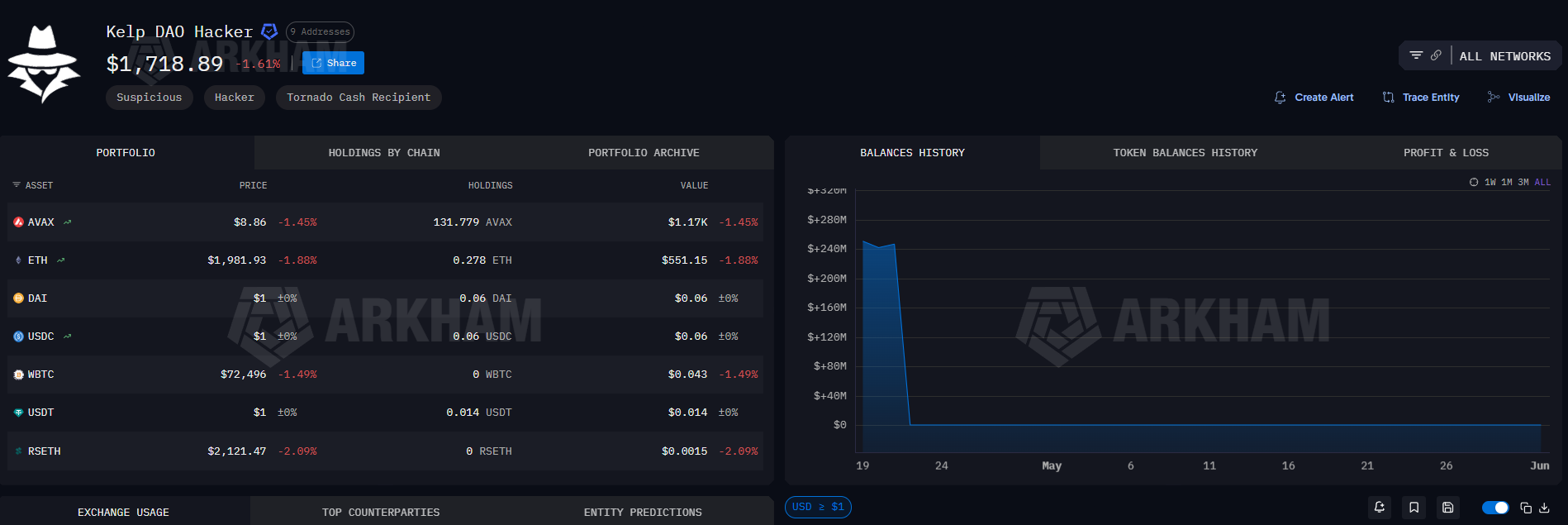
The hacker behind the $293 million Kelp DAO exploit has laundered nearly all of the unfrozen stolen funds, or about $220 million, in just six weeks, according to Arkham data and onchain analysts.
The Kelp DAO hacker-tagged wallet appears to have laundered nearly all the stolen funds, with just $1.7 million remaining traceable in the wallet, according to blockchain data provider Arkham. The malicious actor drained 116,500 Kelp DAO restaked ETH (rsETH) on April 18, pushing the total amount stolen from crypto hacks to $630 million for April.
The funds were laundered in two layers: bridging to Bitcoin using crypto mixer Wasabi and then returning to Ethereum before withdrawing and depositing via mixing protocol Tornado Cash, according to onchain analyst Specter.
The laundering activity may significantly reduce the chances of recovering the remaining unfrozen funds.
An additional $71 million was frozen by Arbitrum’s Security Council on April 21. A governance proposal and a US court order previously approved the transfer of the frozen funds to an Aave-controlled multi-signature wallet for the rsETh recovery effort. The next hearing on the ownership claims tied to the frozen funds is set for Friday in New York, court documents show.
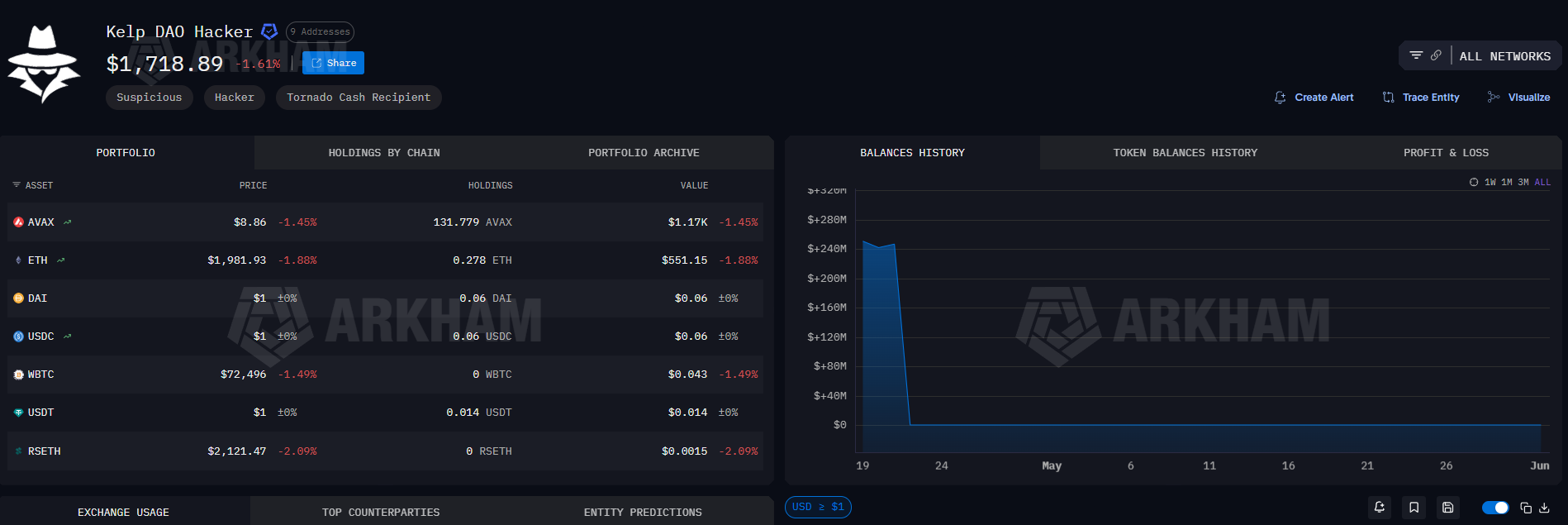
Kelp DAO Hacker-tagged wallet, total balance. Source: Arkham
The development comes a week after Kelp DAO said it restored its restaked Ether token as part of a five-week recovery effort, after the final tranche of 20,373.7 rsETH tokens was sent to the LayerZero smart contract responsible for locking, minting, burning and releasing rsETH during cross-chain transfers, Cointelegraph reported Tuesday.
Related: Verus bridge exploiter returns $8.5M after bounty offer
Crypto hacks decrease by 90% in May, but DeFi security concerns persist
Cryptocurrency hacks logged a significant decrease during May, but it wasn’t enough to soothe the growing concerns tied to the security of the decentralized finance (DeFi) industry.
Losses from cryptocurrency exploits fell to $68.3 million in May, marking a near 90% decline from the amount lost in April, according to crypto security platform CertiK. About $2.6 million was attributed to phishing attacks, while a total of $9.4 million was successfully recovered or returned.
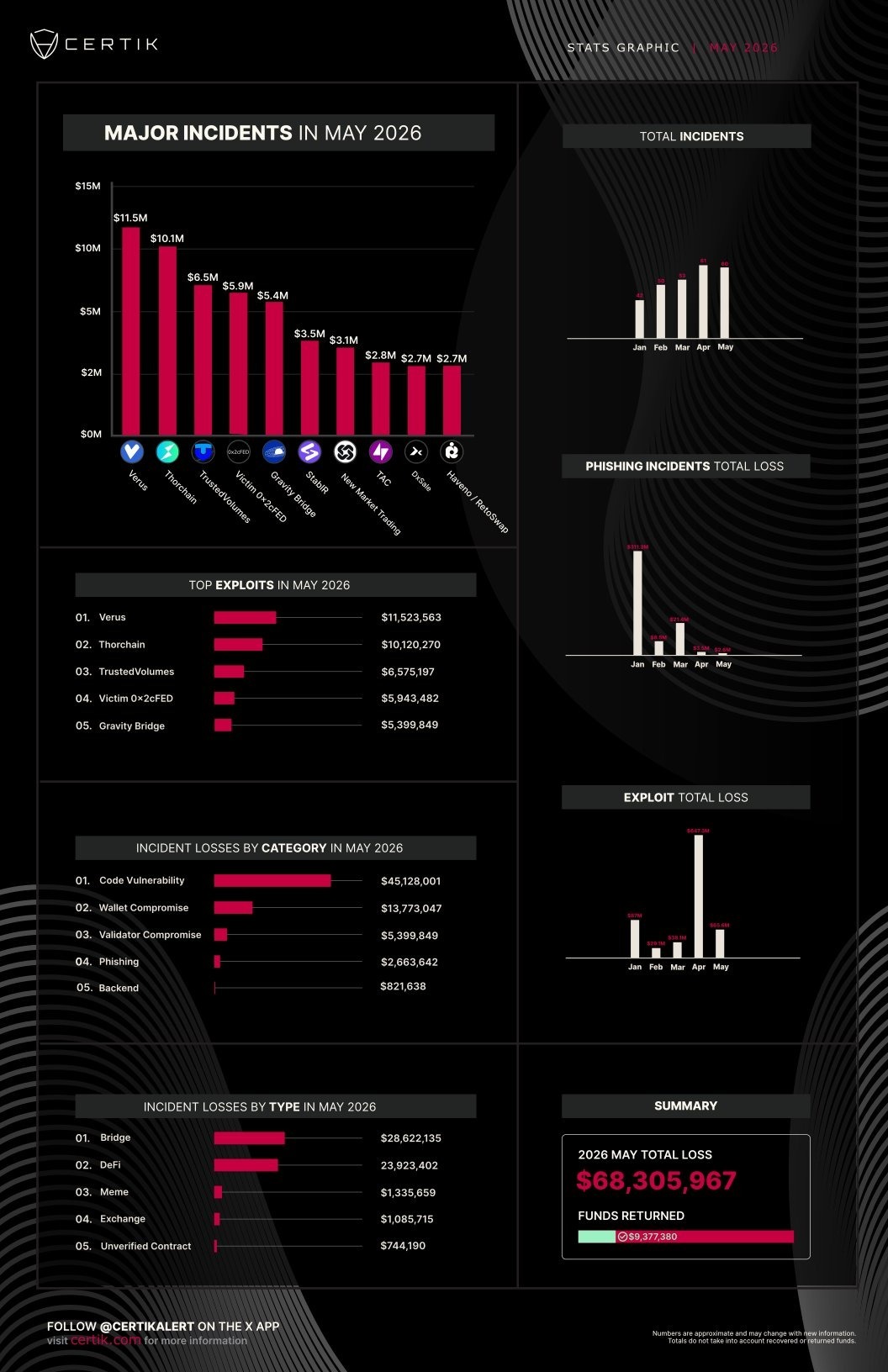
Crypto exploit losses in May reached $68.3 million. Source: CertiK
Still, the $293 million Kelp DAO exploit triggered wider concerns about the safety of the industry, prompting DeFi protocols to reevaluate the security of their oracle providers.
Within three weeks after the exploit, Bitcoin DeFi platform Solv Protocol and liquidity protocol Tydro both migrated to Chainlink’s Cross-Chain Interoperability Protocol (CCIP), seeking a more secure oracle provider.
Kelp DAO also migrated its rsETH token to Chainlink CCIP, moving away from its previous LayerZero-powered bridge after attributing the incident to weaknesses in its cross-chain setup.
However, LayerZero said on April 20 that the exploit resulted from a single point of failure in Kelp DAO’s implementation, which relied on a single LayerZero DVN as the only verified path despite prior warnings against that configuration.
Magazine: The legal battle over who can claim DeFi’s stolen millions


For years, Strategy (MSTR) Executive Chairman Michael Saylor insisted he would never sell bitcoin .
Yet on Monday, the largest company disclosed that it sold 32 bitcoin last week, its first sale in four years. The announcement prompted questions about whether one of bitcoin’s most prominent corporate advocates was changing course.
Most analysts don’t think so. While the transaction sparked debate among investors, they largely agree that the sale was too small to alter Strategy’s long-term bitcoin accumulation strategy.
The company on Monday said that it sold 32 bitcoin between May 26 and May 31 at an average price of $77,135, generating roughly $2.5 million to help fund dividend payments on STRC, its high-yielding perpetual preferred stock known as Stretch. Strategy still held more than 843,700 BTC at the end of May, meaning the sale represented about 0.004% of its total holdings.
While the announcement initially fueled concerns that Executive Chairman Michael Saylor was backing away from his long-held commitment to accumulating bitcoin, several analysts argued that interpretation misses the bigger picture.
TD Cowen analyst Lance Vitanza said reports suggesting Strategy had become a meaningful seller of bitcoin were overblown.
“Headlines suggesting that Strategy has meaningfully reduced its bitcoin position are, in our view, misleading,” Vitanza wrote in a research note. “The transaction was economically immaterial and does not alter the core accumulation thesis.”
Vitanza noted that management has discussed the possibility of limited bitcoin sales on several recent occasions as part of a broader financing strategy. He added that TD Cowen’s model already anticipated small tactical sales and therefore made no changes to its bitcoin accumulation assumptions or its $400 price target on the stock.
The analyst also pointed to signs that Strategy is rebuilding its cash position. The company also sold 801,944 shares of common stock and used part of the proceeds to replenish cash reserves after repurchasing $1.5 billion of convertible debt at a discount.
Benchmark analyst Mark Palmer reached a similar conclusion about the significance of the sale itself, saying he does not expect bitcoin disposals to become a primary source of funding for dividends.
“We do not expect Strategy to use bitcoin sales as a primary means of funding dividends on STRC and its other perpetual preferred stock issues,” Palmer said. “It is far more likely that the company will continue to replenish its cash reserve through equity issuance and then use reserve funds to pay dividends.”
Palmer, however, argued that the sale could change how investors view Strategy’s bitcoin holdings. “Now, investors should view Strategy’s bitcoin holdings as providing a viable backstop for the funding of preferred dividends,” he said.
Others viewed the transaction as a more meaningful signal.
Risk Dimensions CIO Mark Connors said the move demonstrates that Strategy is willing to prioritize the health of its capital structure over maintaining a strict no-sale stance on bitcoin.
“By selling bitcoin, Saylor has stated two things,” Connors said. “First, we will support our shareholders and creditors in every way… including by selling bitcoin.”
“Second, Saylor and Strategy have prioritized the health and perception of health of the MSTR capital structure over being a diamond-handed OG.”
The differing interpretations highlight the key question now facing investors. Analysts broadly agree that the 32-BTC sale was immaterial. What remains up for debate is whether it was simply a routine treasury decision or an early signal that Strategy’s approach to managing its vast bitcoin reserves is becoming more flexible.
Strategy is lower by 5% on Monday, while bitcoin has fallen back to a near two-month low of $71,000.
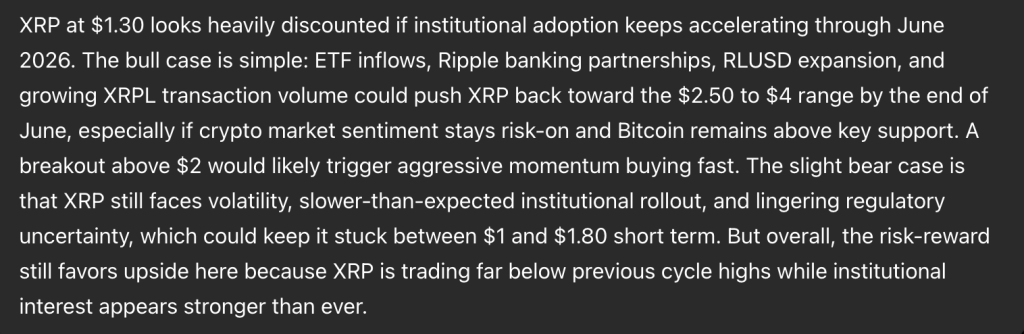
ChatGPT AI is looking at XRP at $1.30 and predicts its heavily discounted, targeting $2.50 to $4.00 by end of June 2026 if the institutional momentum that has been building under the surface finally gets reflected in the price.
The bull case Sam Altman’s AI is making is deliberately simple, which is actually what makes it compelling.
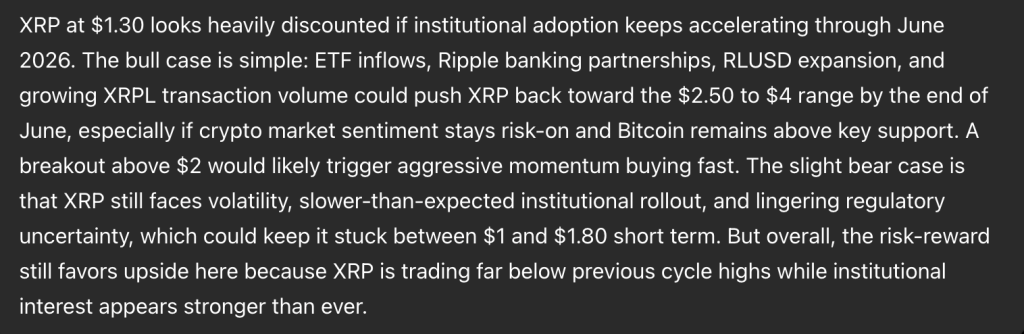
This is not a complicated technical thesis or a multi-variable roadmap play. It is 4 things working together: ETF inflows absorbing supply, Ripple banking partnerships expanding the real-world payment network, RLUSD growing as a stablecoin with actual utility inside the Ripple ecosystem, and XRPL transaction volume climbing as more institutions build on the ledger.
None of those are speculative, all 4 are already in motion. The question ChatGPT is asking is not whether they are real, it is whether the market reprices XRP to reflect them before June ends.
The $2.00 level is the specific trigger ChatGPT identifies as the momentum ignition point. A clean breakout above it would catch a large number of short positions offside and trigger aggressive momentum buying that accelerates the move faster than fundamentals alone could.
That is the mechanical setup underneath the $2.50 to $4.00 target range.

The bear case acknowledges the risks without pretending they are small. Slower-than-expected institutional rollout has been the recurring frustration for XRP holders across multiple cycles, and lingering regulatory uncertainty in certain jurisdictions has not fully disappeared even after the SEC settlement.
If those factors keep the broader narrative cautious, XRP stays trapped between $1.00 and $1.80 short term, which is a frustrating outcome given how strong the underlying thesis looks on paper.
ChatGPT’s closing read is direct: XRP is trading far below previous cycle highs while institutional interest is stronger than it has ever been. That gap between price and institutional engagement is the core of the entire prediction.
XRP Price Prediction: XRP Has a Roadmap Drawn Right on the Chart, the Only Question Is Whether It Follows It
XRP is printing $1.306 on the daily and this chart has something the other XRP charts in this series did not have quite as clearly: a fully mapped sequence of resistance levels with price targets drawn on it, giving a step-by-step picture of exactly what the bull case needs to look like to play out.
Price has been grinding in a tight range between the $1.20 support zone and $1.60 resistance since February, a 4-month compression that has absorbed multiple tests on both sides without breaking in either direction.
The red support band at $1.20 is the floor that has held every meaningful dip, and it is sitting just 8% below current price. That proximity matters because the line between a base forming and a breakdown accelerating is razor thin at these levels.
The sequence the chart is laying out is clear. The first move is clearing $1.60 resistance, which has rejected price at least 4 times since February. Once that breaks, $2.40 is the next target, which aligns almost exactly with where ChatGPT’s lower end bull case sits.
Above $2.40 the chart identifies $3.10 as the next wall, then $3.64 as the upper target zone sitting just below the prior cycle high. Getting from $1.30 to $3.64 by end of June is a 2.8x move in roughly 4 weeks, which is aggressive but not unprecedented for XRP in a momentum environment.
The critical observation is that XRP has been compressing for 4 months while the fundamental narrative has been getting stronger the entire time. That is the kind of coiled setup where the breakout, when it comes, tends to be fast and disorienting for anyone positioned on the wrong side of $1.60.
ChatGPT AI Predicts Bitcoin Hyper to Outperform XRP by 1000x
Bitcoin’s limitations are not new discoveries. They have been there since the beginning and the industry has spent 15 years building around them instead of fixing them.
No native smart contracts. No high-speed execution without trusting a bridge or migrating to a completely different ecosystem. Developers did not choose Ethereum and Solana over Bitcoin because those networks were more trusted. They chose them because Bitcoin left them no viable alternative.
That exodus is still happening. And the infrastructure gap that caused it has never been closed.
Bitcoin Hyper is building the fix from inside the network rather than on top of it with duct tape.
The project combines a Bitcoin Layer 2 with Solana Virtual Machine integration. Developers get Solana-level execution speed and full smart contract programmability without surrendering Bitcoin’s security model. Fast transactions, near-zero fees, and native programmability running directly on the most trusted blockchain in existence rather than competing with it from the outside.
Every previous attempt to solve this problem required compromise. Trust a bridge. Accept a weaker security model. Leave the ecosystem. Bitcoin Hyper is the first credible attempt to close the gap without asking users to make that tradeoff.
The presale is at $0.013679 with over $32 million raised and staking incentives available for early participants.
Bitcoin moving 10% requires tens of billions in new capital at its current market cap. Early stage infrastructure does not work that way. A fraction of that capital produces dramatically different results at this stage of the lifecycle. The upside is asymmetric and so is the execution risk.
The gap is provably real. The only open question is whether this is the team that finally closes it.
The post Sam Altman ChatGPT AI Predicts Incredible XRP Price By End of June 2026 appeared first on Cryptonews.

TLDR
- Global crypto exchange-traded products recorded $1.67 billion in outflows last week.
- Three-week cumulative outflows reached $4.21 billion as total assets under management declined to $141.9 billion.
- Bitcoin products led withdrawals with $1.44 billion in outflows, marking the largest weekly exit in 2026.
- United States spot Bitcoin ETFs accounted for $1.42 billion in redemptions, driven by institutional selling.
- Ethereum ETFs posted $257 million in outflows, extending their losing streak to three consecutive weeks.
Global crypto exchange-traded products have recorded $1.67 billion in weekly outflows, extending a three-week run of investor withdrawals.
According to CoinShares, the latest weekly report shows this is the second-largest outflow of 2026, with only the week ending Jan. 23 posting a higher figure. The firm reported that total redemptions over the past three weeks have reached $4.21 billion, while assets under management declined to $141.9 billion from $148 billion the previous week.
Bitcoin Products Drive Bulk of Withdrawals
Within the broader selloff, Bitcoin-linked funds accounted for most of the activity. CoinShares data shows $1.44 billion exited Bitcoin products globally, setting a new weekly record for outflows this year. The same report notes that year-to-date inflows into Bitcoin funds dropped sharply to $1.2 billion from $2.6 billion a week earlier.
Focusing on the United States, data from SoSoValue shows spot Bitcoin ETFs recorded $1.42 billion in withdrawals. This ranks as the third-largest weekly outflow for U.S. products on record, with domestic institutional activity cited as the primary driver behind the global decline.
At the same time, Ethereum-based products continued to see redemptions. CoinShares reported $257 million in global outflows from Ethereum funds, adding to losses recorded in previous weeks. U.S. spot Ethereum ETFs contributed $241 million of that figure, according to SoSoValue data, marking a third straight week of withdrawals for the segment.
Elsewhere in the market, participation narrowed among alternative assets. CoinShares data shows only five altcoins attracted notable inflows, down from nine in the prior week. XRP products led with $20.3 million in new investments, followed by Hyperliquid products at $10.8 million and Near Protocol funds at $7.6 million.
Regional Trends Highlight U.S. Dominance
Across regions, the United States remained the center of activity. CoinShares reported $1.63 billion of the total outflows originated from U.S.-based products. Meanwhile, Germany recorded $25.7 million in withdrawals after holding steady during earlier weeks, while Sweden and Hong Kong posted smaller outflows of $6.6 million and $4.5 million, respectively.
CoinShares Head of Research James Butterfill linked the sustained selling pressure to rising geopolitical concerns tied to Iran. In the same report, Butterfill stated that these risks have outweighed any market support from legislative developments such as the Clarity Act, drawing comparisons to a similar outflow period earlier in the year.

Crypto World
BTC remains under pressure as ETF outflows, higher oil prices weigh on crypto markets: Crypto Daily
Bitcoin and most major cryptocurrencies remained under pressure as record outflows from U.S. spot bitcoin ETFs, renewed inflation worries from higher oil prices and weakening retail demand kept digital assets from joining Wall Street’s AI-led rally.
BTC is down about 1.4% in the last 24 hours and was trading recently under $73,000, while ether dropped 2.1% to $1,980. The broader CoinDesk 20 (CD20) index fell 2.38%.
The weakness follows a 10-session, $2.97 billion outflow streak from U.S. spot bitcoin ETFs, the longest run of withdrawals on record, which included the rapid exit of a $1.2 billion position.
The crypto market “sold off through last week without a clear catalyst,” according to a note from Laser Digital’s derivatives trading desk. “There seemed to have been a lack of demand, including Strategy announcing that they didn’t purchase any BTC.
“With STRC still trading below par and the continued lack of interest from retail buyers, BTC is expected to remain weak for the time being,” the note said.
That leaves crypto at risk of further underperformance versus equities, where enthusiasm around artificial intelligence has pushed global stock indexes to fresh highs even as oil prices climbed on stalled efforts to reopen the Strait of Hormuz. Stay alert!
Read more: For analysis of today’s activity in altcoins and derivatives, see Crypto Markets Today . For a comprehensive list of events this week, see CoinDesk’s “Crypto Week Ahead.”
What’s trending
Today’s signal

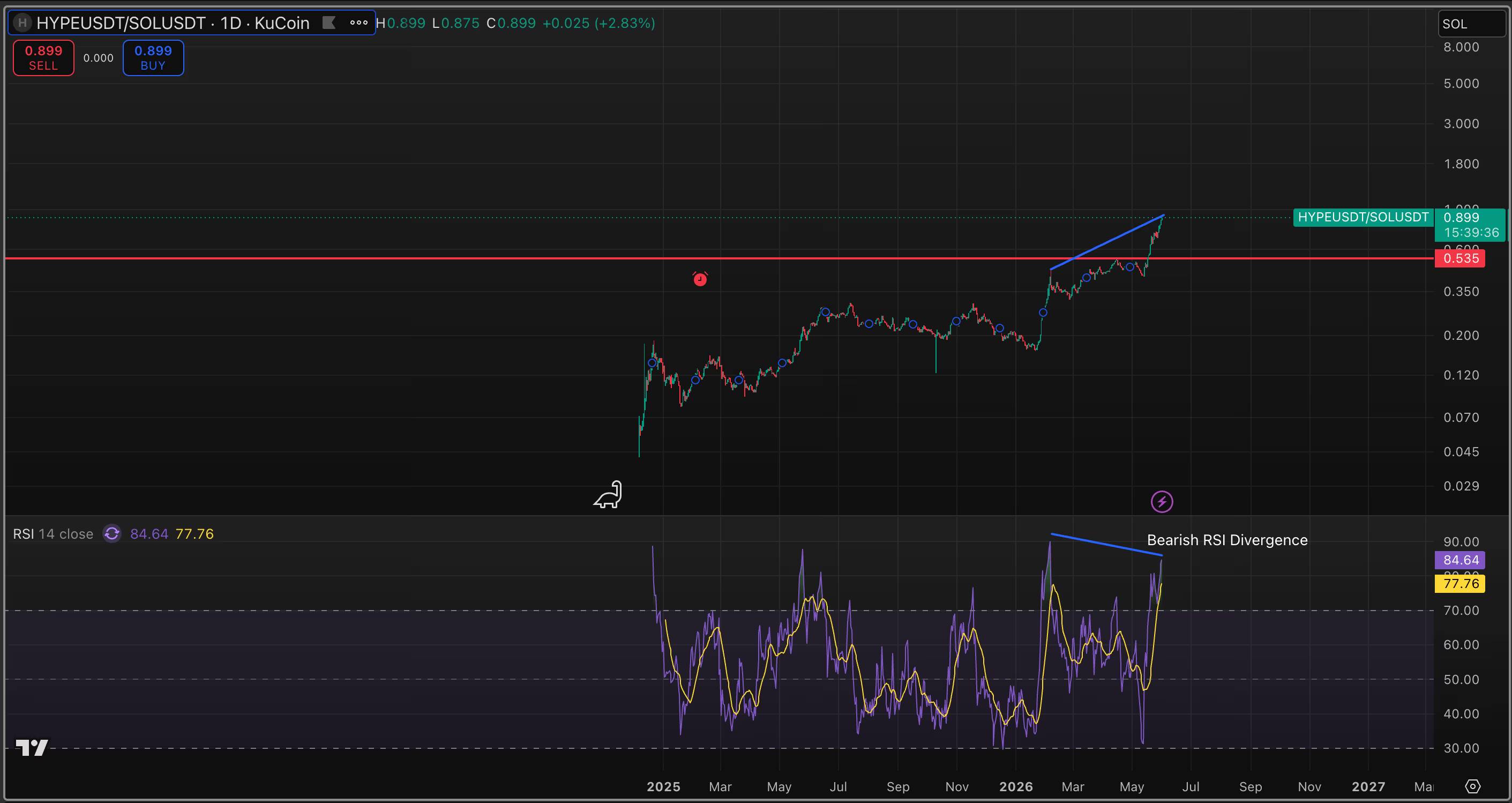
Hyperliquid’s hype (HYPE) token continues to strengthen against Solana’s sol (SOL), hitting record highs.
Still, weakening RSI momentum in the ratio between the two tokens is producing a bearish divergence on the daily chart that could signal a near-term slowdown or shallow pullback.
If it does occur, it’s unlikely to mark a structural break in HYPE’s outperformance trend because there’s no confirmation of the divergence on the weekly chart.


Cardano’s annual summit in Singapore has been scrapped after token holders failed to approve $2 million worth of funding for the event.
That’s according to the Cardano Foundation, which announced on Saturday that the event would be cancelled after a treasury proposal vote failed to pass.
It said, “As part of Cardano’s on-chain governance model, treasury-funded initiatives are subject to community vote. The community has decided not to proceed with this proposal, and we fully respect that outcome.”
“Now, we will review all current commitments and commence winding down Summit execution,” it added.
Despite this, token holders still passed a proposal from “EMURGO” for the Cardano Foundation to attend and sponsor TOKEN2049 in Singapore this October.
Read more: Charles Hoskinson’s $250M clinic to close after buying up NFTs and robots
The firm’s founder, Charles Hoskinson, has since asked the Cardano community if it would like a “MiniSummit” at TOKEN2049 and to “subsidize some of the larger projects” to fund it.
The proposal needed another 1.46% of votes
The Singapore summit funding vote required an approval threshold of 66.67% from delegated representatives who vote on behalf of Cardano (ADA) holders.
However, with only 2.76 billion ADA (worth $638 million) allocated to “yes,” it attracted 65.21% and failed to pass.
The proposal would have allocated roughly $2 million worth of ADA towards the summit and was revised from a proposal that originally planned to allocate over $3 million.
Last year, one significant ADA holder, who goes by the username “Whale,” voted “yes” for Cardano’s 2025 summit while also lambasting the foundation for increased spending.
“We’re in a place where the founding entity has not delivered much for years and is requesting obscene amounts of funds to keep the same level of non-delivery going,” wrote Whale.
Read more: Cardano crisis: senior dev quits after Hoskinson calls in the feds
The 2025 Cardano Summit was held in Berlin and lasted two days. This year’s cancellation means that $300,000 generated from last year’s summit may have gone to waste after it was used to secure the Singapore venue.
Hoskinson has been criticised for his spending in recent months, particularly after his $250 million medical clinic announced that it was shutting down.
The clinic, which opened in Wyoming in 2023, was filled with various oddities and expensive decorations, including an infinite mirror room, and revealed plans to create a nap room for Hoskinson.
The project was plagued with construction problems, and let hundreds of staff go in 2025 and 2026. Overall, it spent too much while scaling too quickly until it eventually became “no longer financially sustainable.”
Protos has reached out to Cardano Summit organizers for comment and will update this piece should we hear anything back.
Got a tip? Send us an email securely via Protos Leaks. For more informed news and investigations, follow us on X, Bluesky, and Google News, or subscribe to our YouTube channel.
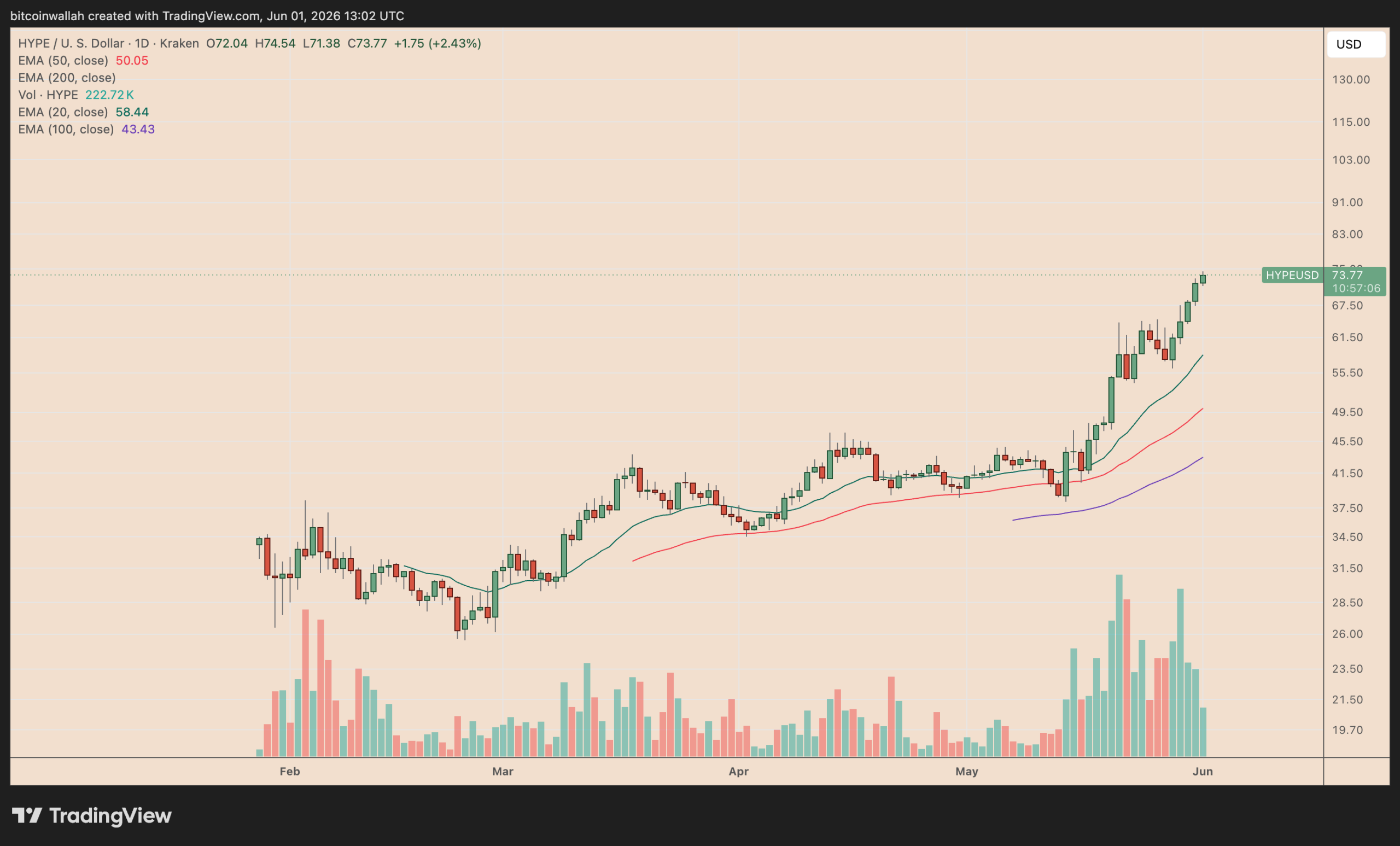
Hyperliquid’s native token, HYPE, has rallied more than 30% in five days to a record high near $74, with a bullish chart breakout now pointing to a potential move above $100.
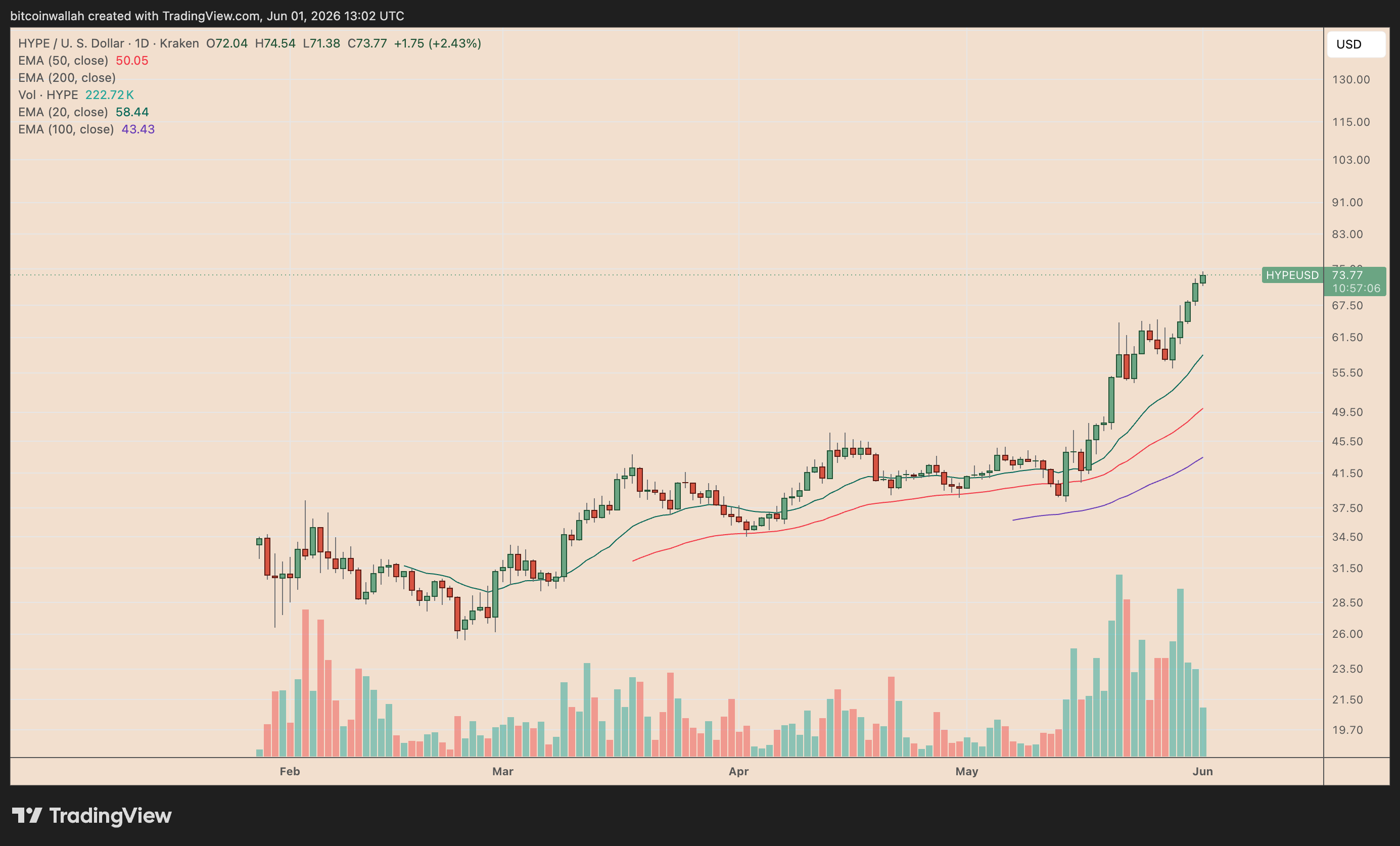
HYPE/USD daily chart. Source: TradingView
Key takeaways:
- HYPE has broken out of a bull pennant pattern, putting its measured upside target near $105.
- Hyperliquid has become the second-largest blockchain by app revenue on a 30-day rolling basis.
HYPE bull pennant hints at rally toward $105
Hyperliquid’s rally may have further room to run after HYPE broke out of a textbook bull pennant pattern.
The setup developed after HYPE’s sharp late-May rally formed the pattern’s “flagpole,” followed by a brief consolidation inside a symmetrical triangle. During this pause, the token printed lower highs and higher lows, showing tightening volatility before the next directional move.
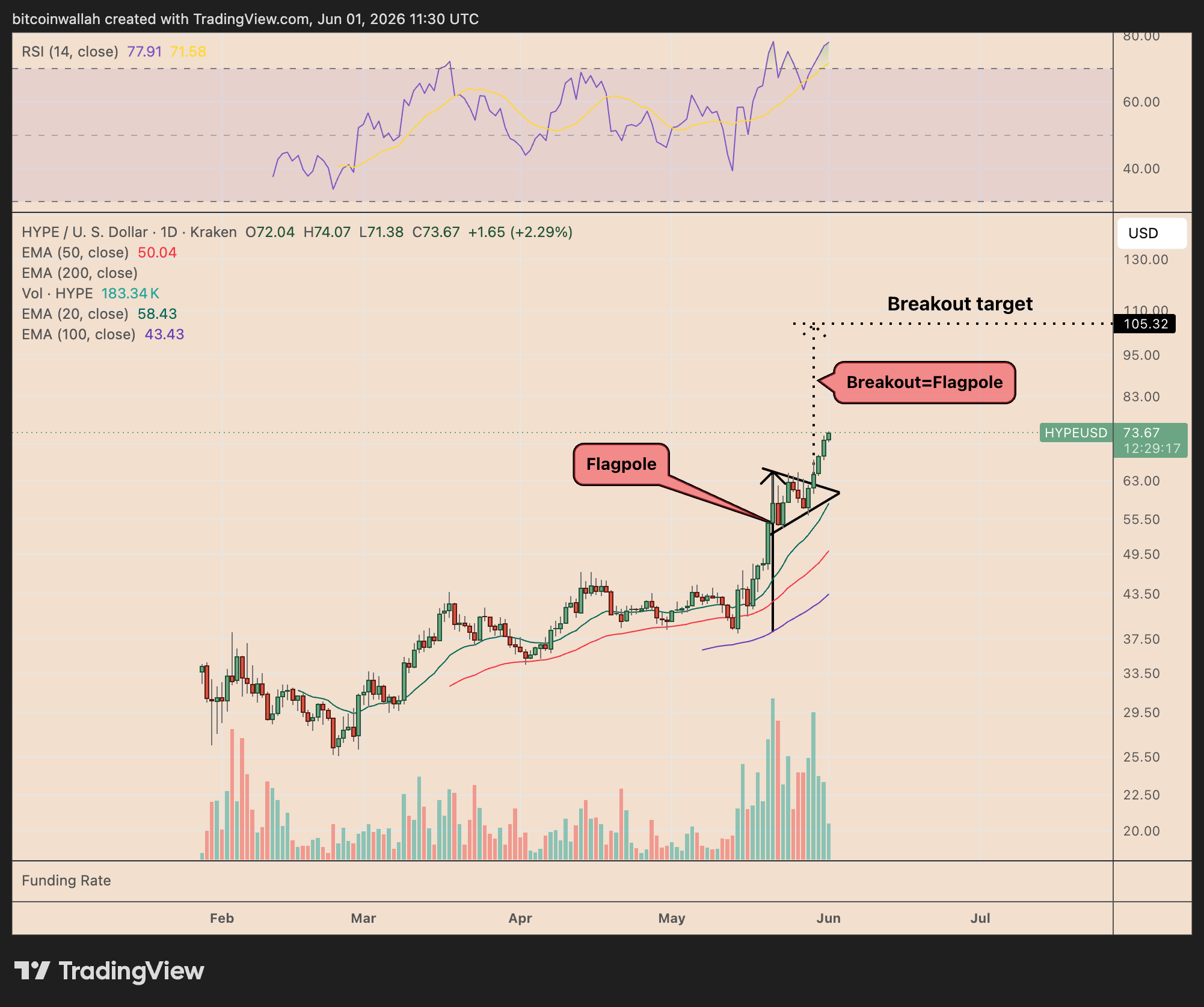
HYPE/USD daily chart. Source: TradingView
In technical analysis, bull pennants typically resolve when the price breaks above the upper trend line. Traders then estimate the upside target by adding the flagpole’s height to the breakout point.
Over the weekend, HYPE moved above the triangle’s upper boundary on rising volume, suggesting stronger conviction behind the breakout. If the pattern plays out as intended, the price could climb toward its measured target near $105.30 by June or July, about 45% above current levels.
However, momentum is becoming stretched. HYPE’s relative strength index was above 77 on Monday, placing it in overbought territory and raising the odds of a brief consolidation or correction.
If profit-taking accelerates, HYPE could retest its 20-day exponential moving average near $58.32 in June. A decisive break below that level would weaken the bullish setup and risk invalidating the pennant breakout.
Hyperliquid futures show a strong bullish bias
Derivatives market data adds another bullish layer to HYPE’s technical breakout.
Hyperliquid’s open interest has climbed to a record $3.5 billion, up from about $1.41 billion at the beginning of the year, according to Coinglass data. The sharp rise shows that more leveraged capital is entering HYPE markets as it pushes into price discovery.
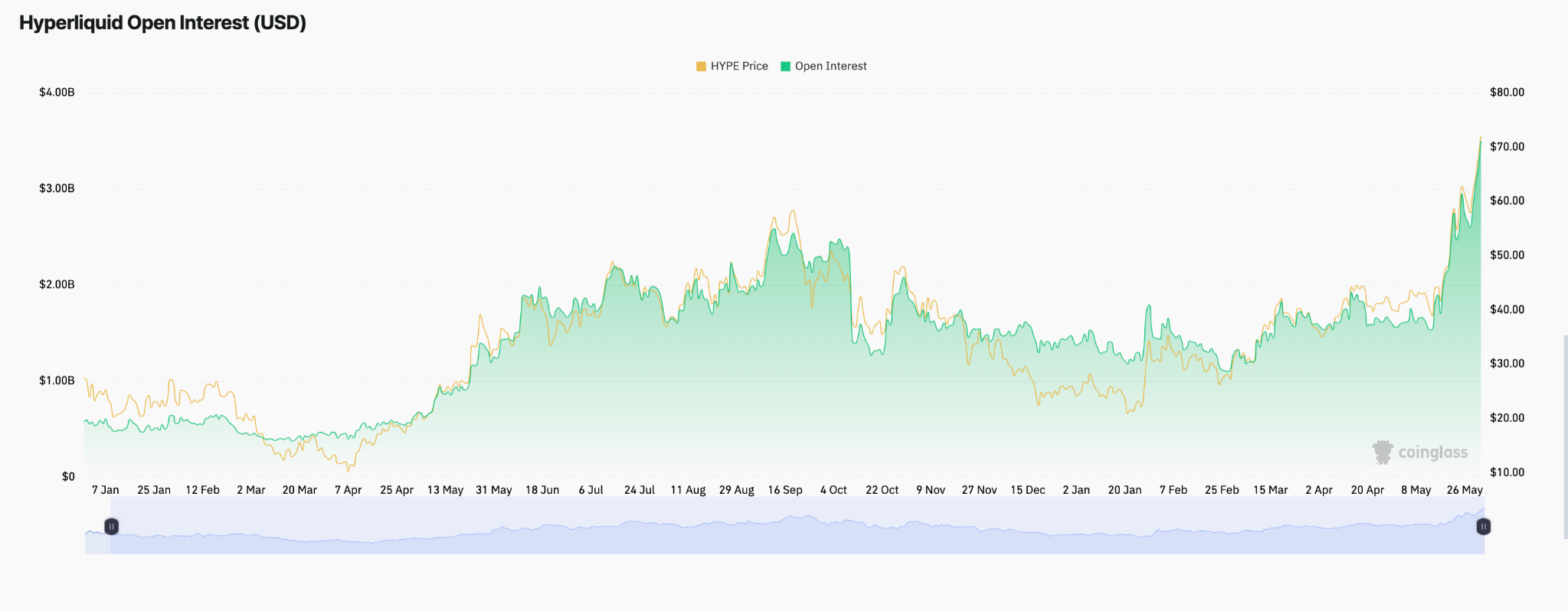
Hyperliquid open interest. Source: CoinGlass
HYPE’s open interest-weighted funding rate stood near 0.0050% every eight hours as of Monday and has remained positive through most of the latest rally.
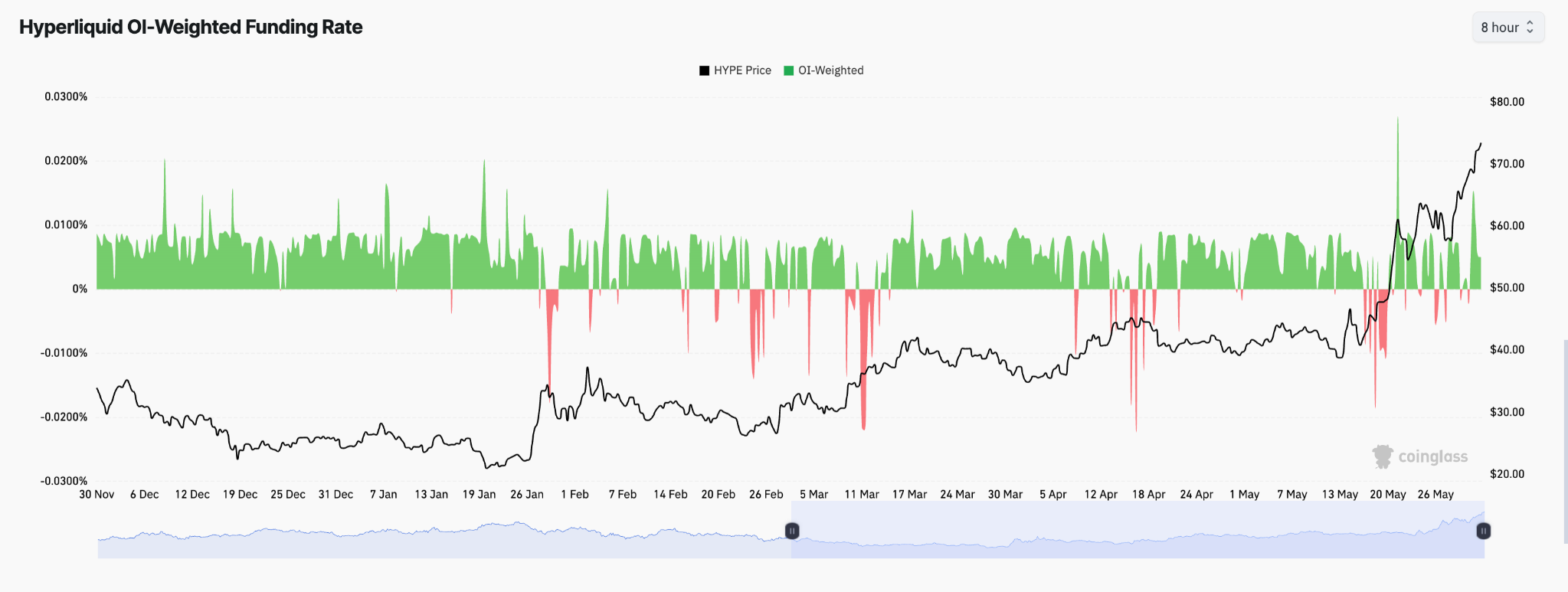
Hyperliquid OI-weighted funding rates. Source: CoinGlass
That means long traders have been paying short traders to keep their perpetual futures positions open, a sign that leveraged demand has leaned bullish. While not extreme, the consistently positive funding rate points to a clear upside bias in HYPE’s derivatives market.
Meanwhile, short sellers have taken the bigger hit during the latest rally.
Since May 20, HYPE has seen about $126.28 million in short liquidations, compared with $68.85 million in long liquidations.
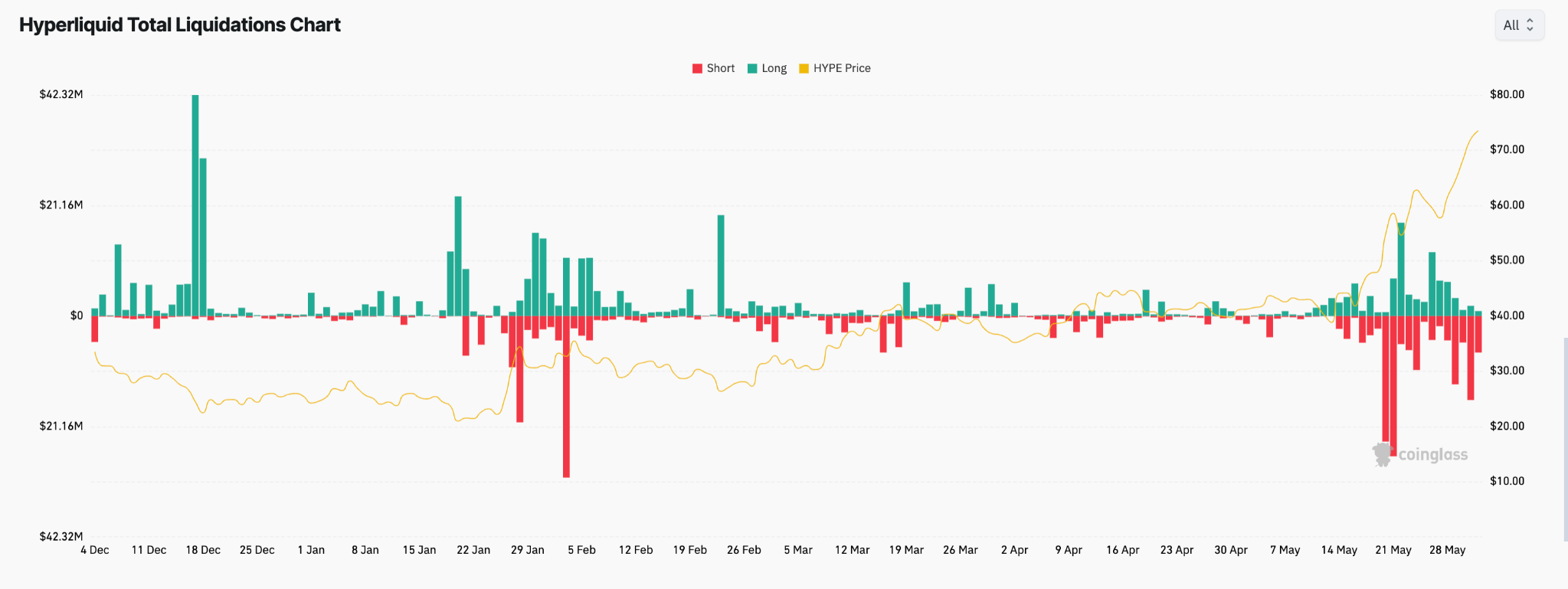
Hyperliquid total liquidation chart. Source: CoinGlass
That imbalance suggests bearish traders have been forced to close positions as the price moved higher, creating a “short squeeze.”
Further gains in HYPE could put more shorts at risk of liquidation, forcing more buybacks and potentially accelerating the move toward the $100–$105 target zone.
Hyperliquid surpasses Ethereum in monthly app revenue
HYPE fundamentals are also leaning bullish.
Hyperliquid has overtaken Ethereum to become the second-largest blockchain by app revenue on a 30-day rolling basis, generating $57.9 million, according to DefiLlama.
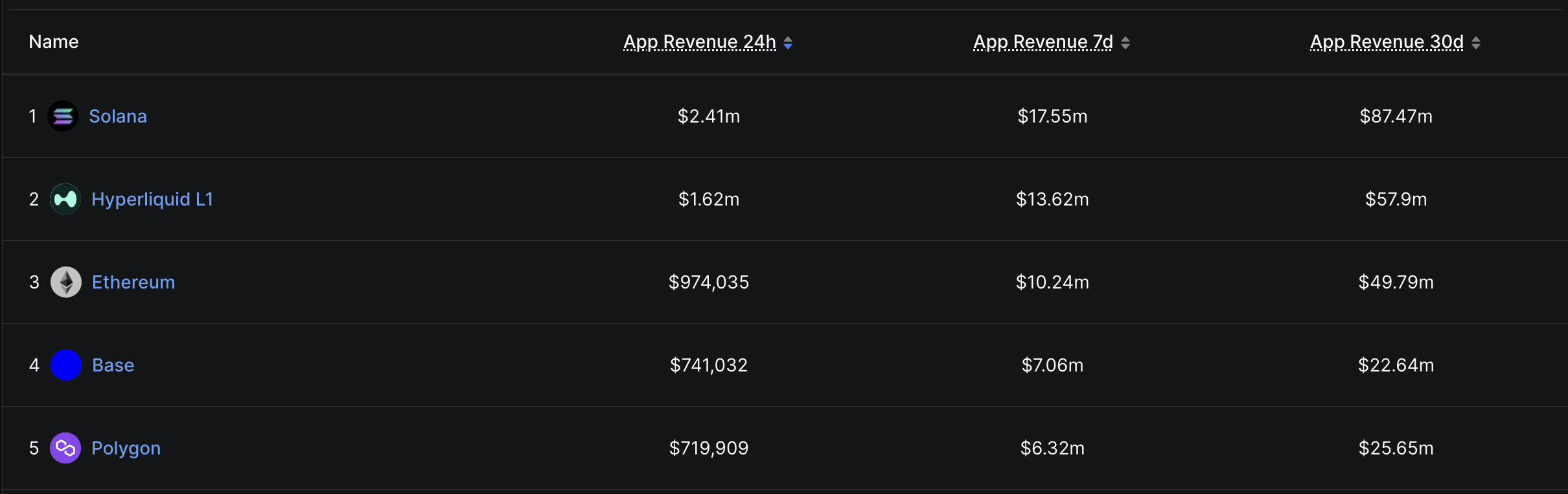
Top revenue-generating protocols. Source: DefiLlama
The chain routes 99% of its protocol fees to its Assistance Fund, which buys HYPE on the open market. That buyback mechanism has become a core part of the bullish investment case for the token, as higher trading activity can lead to stronger recurring demand for HYPE.
The broader backdrop for perpetual futures has also improved.
On Friday, the CFTC recognized perps as useful tools for price discovery and risk management, helping legitimize the market that sits at the center of Hyperliquid’s business model, even if the protocol is not a direct beneficiary.
HYPE has rallied roughly 25% since the CFTC update.
Related: Hyperliquid launches prediction markets for real-world events
The launch of US-listed HYPE exchange-traded funds (ETF) may also help fuel the rally.
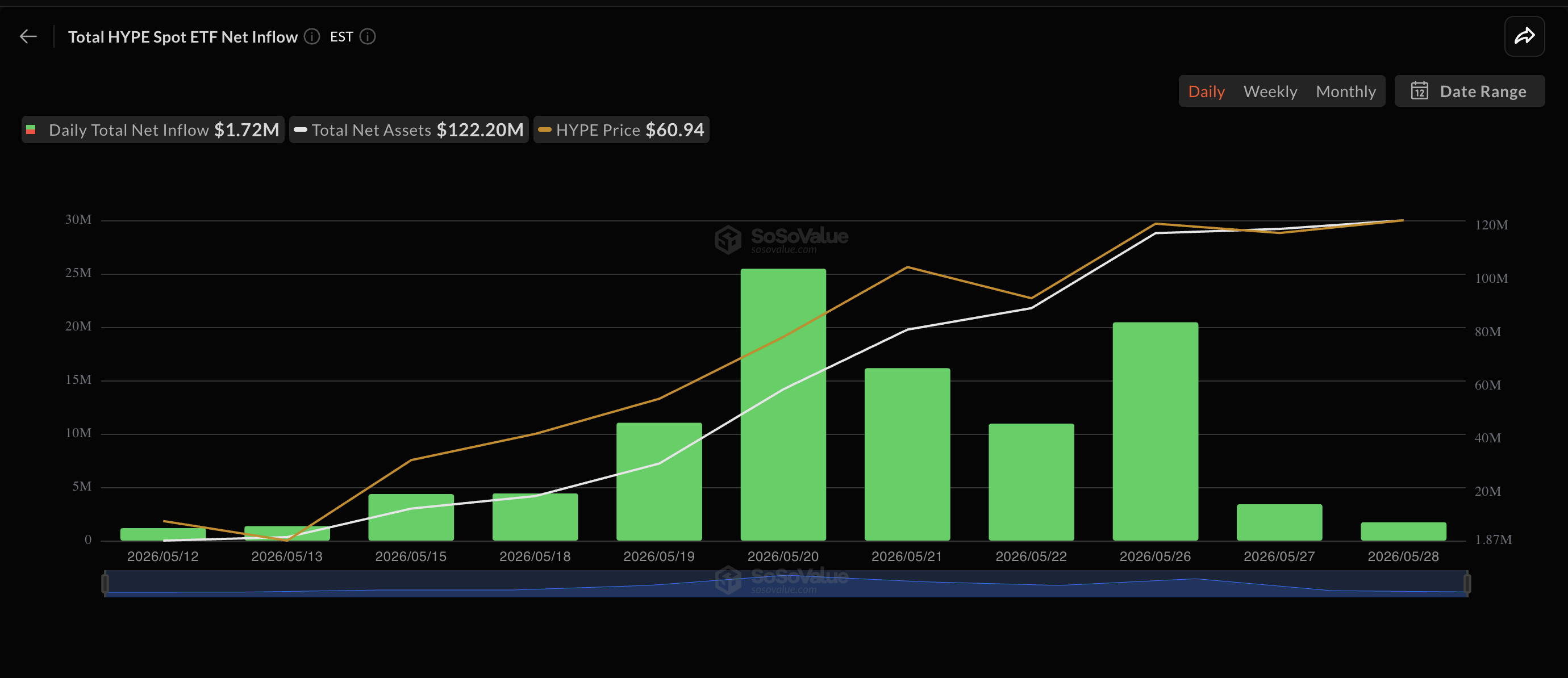
US Spot HYPE ETF net flows. Source: SoSoValue
Since their May 12 debut, HYPE funds from Bitwise and 21Shares have attracted a combined $122.2 million in net assets, according to SoSoValue, pointing to early institutional demand for exposure to the digital token.
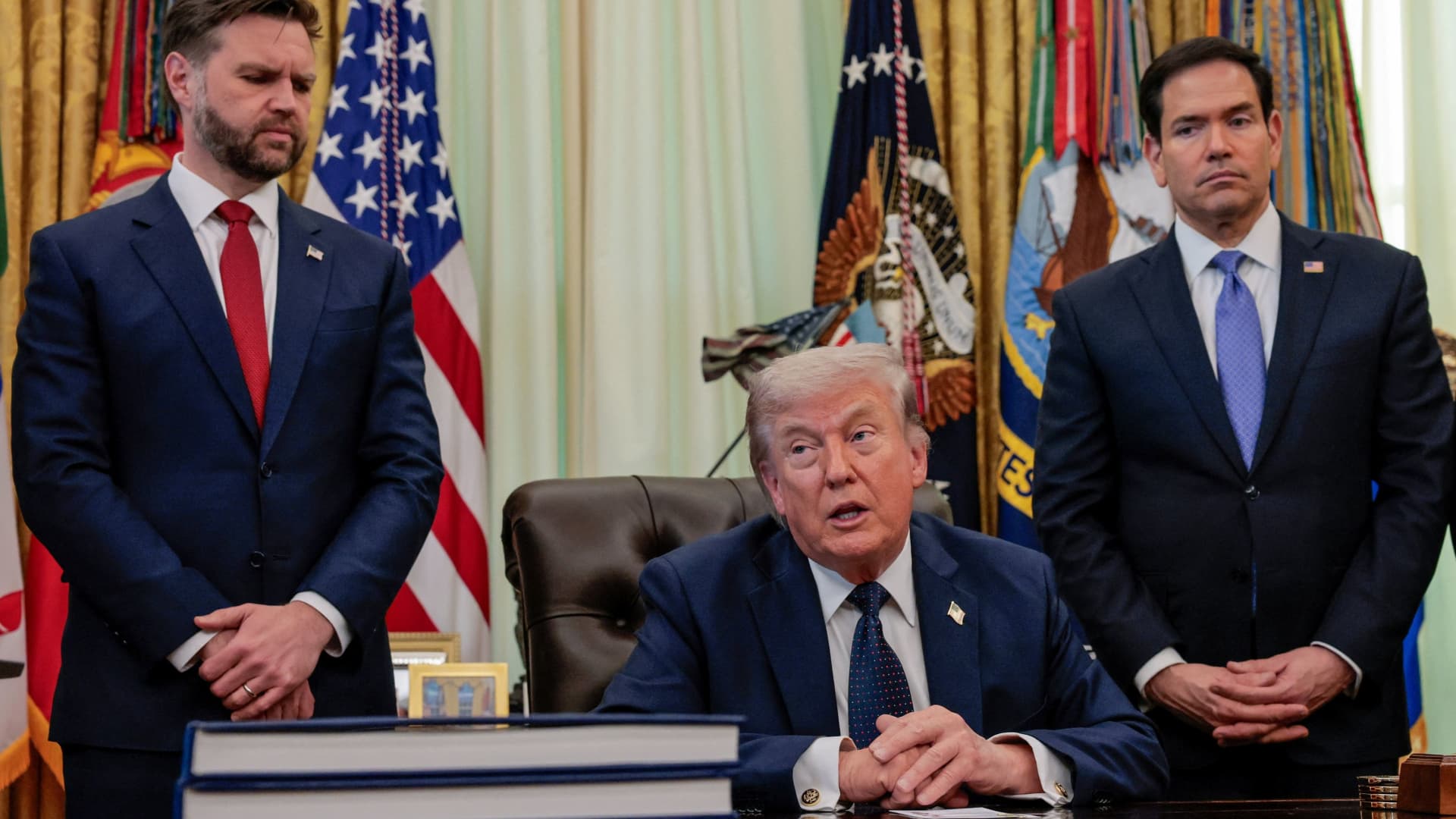
U.S. President Donald Trump speaks in the Oval Office, with Vice President JD Vance and Secretary of State Marco Rubio standing behind him, at the White House in Washington, D.C., U.S., April 23, 2026.
Kylie Cooper | Reuters
Secretary of State Marco Rubio is seen as increasingly likely to be the GOP nominee in 2028, according to traders on prediction market platforms.
While Vice President JD Vance is still favored by traders on Kalshi, his odds have slipped to just 33% on Monday from around 50% on Jan. 1. Rubio, meanwhile, has risen to 30% from around 12% odds.
Vance was seen as the heir to President Donald Trump’s “Make America Great Again” movement, considering his high-profile role in the administration as formally second in command.
However, Trump has reportedly cast doubts about whether he views Vance as his successor, as most recently detailed by a report from The New York Times over the weekend. The Times said that Trump brings up Vance’s initial opposition to the war in Iran when musing over his candidacy.
Rubio’s odds have risen throughout the year, but have sharply increased around the initiation of key military operations, including the capture of Venezuelan President Nicolas Maduro in January and the start of the war with Iran in late February.
Rubio also delivered a short impromptu speech from the White House press room about his hopes for America in May that he clipped into a viral short-form video, creating questions about what the Cabinet member’s plans are for 2028.
While Rubio’s role in military conflicts has increased his chances to be the Republican nominee, those same conflicts have hurt the party’s chances of winning the presidency as Trump’s approval ratings have fallen since the start of the year. Odds that the GOP wins the White House in 2028 have fallen to 39% on Monday from 45% before the war with Iran.
Traders on Polymarket give Vance a 31% chance of being the Republican nominee in 2028, while Rubio is close behind at just under 27%.
Disclosure: CNBC and Kalshi have a commercial relationship that includes customer acquisition and a minority investment.
Dogecoin is trading around $0.10 after House of Doge and Paxos unveiled a partnership that could funnel the meme coin into PayPal and Venmo’s combined base of hundreds of millions of users.
Summary
- Dogecoin’s corporate arm strikes Paxos deal to plug DOGE into PayPal and Venmo’s crypto rails.
- DOGE hovers near $0.10 with a roughly $16.9 billion market cap as traders weigh mainstream access against meme fatigue.
- Most 2026 forecasts cluster in a restrained $0.14–$0.16 band unless a fresh meme mania re‑rates the asset.
House of Doge, the official corporate arm of the Dogecoin Foundation, has announced a strategic partnership with Paxos that will route DOGE (DOGE) into Paxos’ regulated crypto brokerage and custody stack, potentially putting Dogecoin in front of PayPal and Venmo’s mainstream user bases, just as the token trades near $0.10 with a market capitalization of about $16.9 billion. In a GlobeNewswire release, House of Doge said the deal will “integrate the listing of Dogecoin (DOGE) across Paxos’ enterprise‑grade crypto brokerage and custody infrastructure,” opening distribution via clients including PayPal, Venmo, Interactive Brokers and Mercado Libre across more than 150 countries.
The partnership is explicitly about scale: Paxos “powers crypto brokerage and infrastructure solutions for a number of globally recognized platforms, including PayPal, Venmo, Interactive Brokers, and Mercado Libre,” while the Dogecoin side frames this as a bridge to “hundreds of millions of users” reachable through that network. “This partnership with Paxos represents a major step forward in accelerating global access for Dogecoin,” House of Doge CEO Marco Margiotta said, adding that “by integrating with Paxos’ trusted and regulated infrastructure, we are creating a powerful pathway for leading global fintech platforms to make Dogecoin accessible to their users.” Paxos, for its part, has already been the back‑end engine for PayPal’s crypto services and the issuer of its PYUSD stablecoin, which PayPal recently expanded to 70 markets, reinforcing the idea that DOGE is hitching a ride on a maturing, regulated payments stack rather than a pure meme trade.
Dogecoin price sits on the $0.10 knife edge
On the market side, DOGE is changing hands around $0.10, with sources like CoinMarketCap and Trust Wallet putting the live price in the $0.099–$0.101 band and 24‑hour volumes near or above $700 million. That leaves Dogecoin roughly flat on the year but still miles below its prior cycle blow‑off highs, as liquidity has shifted toward more serious L1 and AI narratives, according to recent Dogecoin coverage on crypto.news. A crypto.news Dogecoin price piece notes that “Dogecoin is trading around $0.10–$0.105 today, with most serious 2026 forecasts clustering in a restrained $0.12–$0.18 band unless another meme‑mania shock hits,” a sober framing that contrasts with the retail obsession over a return to $1. For live market data and intraday moves, crypto.news maintains a dedicated Dogecoin price page tracking DOGE’s spot performance, market cap and volume.
External models echo that capped‑upside posture: CoinCodex and CoinDataFlow both see DOGE drifting into the mid‑teens by 2026, with forecasts in the $0.10–$0.16 range implying perhaps 40%–60% upside from current levels if the coin simply grinds along with the broader market. A separate Dogecoin outlook referenced in crypto.news reporting lines up with that trajectory, suggesting that absent a new Elon Musk‑sparked frenzy or a broader meme re‑rating, DOGE is more likely to oscillate between high single‑digits and the mid‑teens than to credibly attack $1 in this cycle.
Price prediction: infrastructure coup, narrative drag
The Paxos integration is, structurally, exactly the sort of plumbing win that token bulls usually fantasize about: a meme asset piggy‑backing on a regulated broker that already pipes crypto into PayPal and Venmo, with PYUSD demonstrating how quickly Paxos‑backed assets can spread once they’re embedded in a giant payments platform. If even a tiny fraction of PayPal and Venmo’s users start dollar‑cost‑averaging into DOGE alongside bitcoin and ether, the steady bid could justify those $0.14–$0.16 2026 targets and push realized volatility lower than in past meme cycles.
The counterpoint is that every serious model you can cite—including the range‑bound projections highlighted in crypto.news Dogecoin coverage—treats DOGE as a structurally capped asset whose fair value lives in a tight band around $0.10–$0.20 unless a full‑blown speculative mania returns. Over the next 12–18 months, a defensible base case is a slow grind toward the mid‑teens, with a realistic 2026 end‑of‑year range of $0.12–$0.18, a bullish tail where the Paxos distribution firehose plus meme reflexivity squeezes DOGE into the $0.20–$0.25 zone, and a bearish path where macro risk‑off or regulatory hostility toward meme coins pushes it back into the $0.06–$0.08 support area.
Crypto World
Michael Saylor’s Strategy sells $2.5 million bitcoin. Chaos ensues in a major prediction market over who gets paid
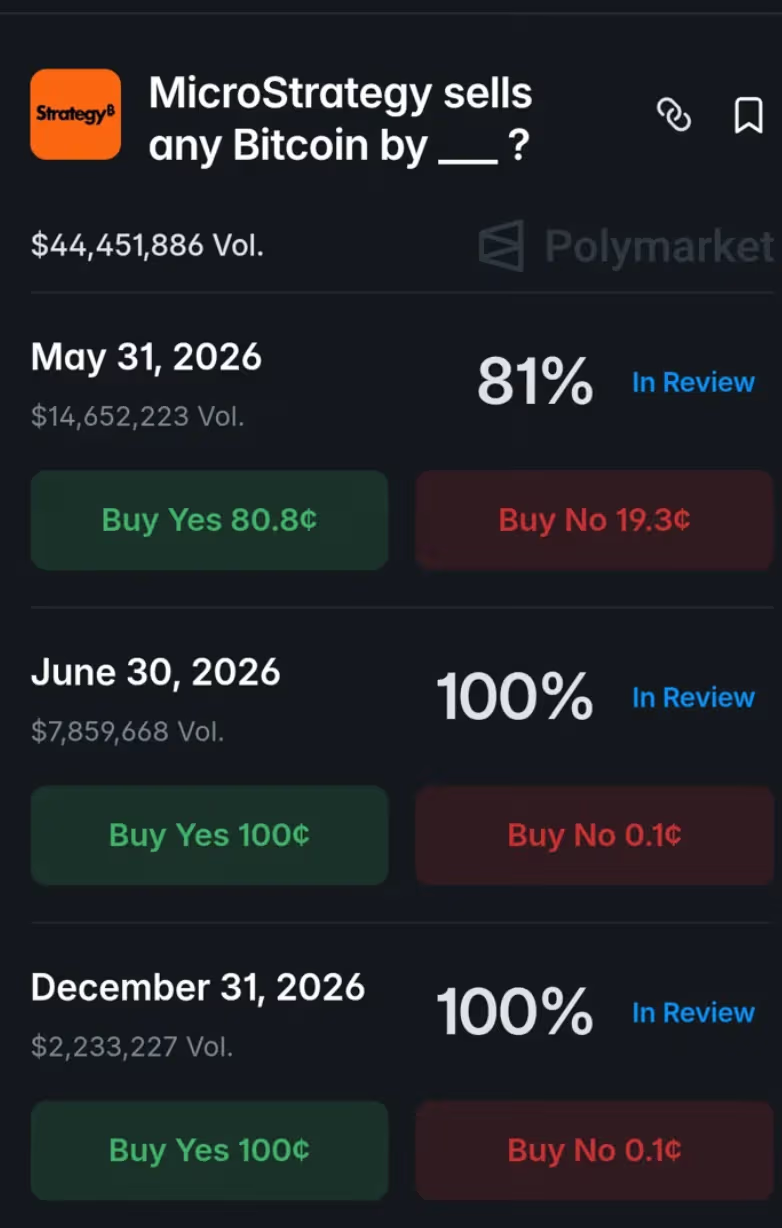
Strategy’s (formerly MicroStrategy) first publicized bitcoin sale has triggered a $15 million resolution dispute on Polymarket.
While the sale was announced in a June 1 filing, the actual disposition occurred in late May. Bettors are now split on whether sales executed between May 26 and May 31 should count for the prediction market’s May 31 deadline, with the contract sitting at 81% Yes and flagged “in review.”
The bet “MicroStrategy sells any Bitcoin by ___?” in Polymarket is built on time-stamp-based contracts, each resolving to ‘Yes’ if Michael Saylor’s Strategy sold any bitcoin by 11:59 p.m. ET on its specified deadline.
Where it gets complicated is that the primary sources for the rules governing bet resolution state that the news will be based on MSTR’s filings and onchain data, with a “consensus of credible reporting” as backup.
Strategy sold those bitcoin between May 26 and May 31, but the 8-K was filed on Monday, June 1.
Now that the sale has occurred, the ‘Yes’ contract holders on May 31 argue that, according to the resolution rules, the bet should settle in their favor. Their argument is that the 8-K’s table states the sale occurred before May 31, as the contract states that ‘Yes’ holders should win if the bitcoin activity is ‘presented as of May 31, 2026, 4:00 p.m. Eastern Time.’
However, the ‘No’ holders counter that no public information existed before the filing dropped on June 1, after the May 31 deadline had passed, despite when the actual sale had taken place.

Meanwhile, the June 30 and December 31 contracts have both been priced to 100% ‘Yes’ since the disclosure, reading 99.9 cents on the ‘Yes’ side and 0.1 cents on ‘No.’ Combined, the three contested timeframes have drawn roughly $24.7 million in volume, with the May 31 market alone at $14.65 million.
While the war over the resolution continues, UMA’s optimistic oracle, the dispute-resolution system Polymarket uses for ambiguous markets, will issue the final call. Usually, these disputes get reviewed over a 2-day period.
Heading into the filing, Polymarket had priced odds of any Strategy bitcoin sale before year-end at 84%, up from 10% earlier in the spring, after CEO Phong Le’s first-quarter earnings call comments treating “disciplined sale of bitcoin” as a capital management tool.
The market is now arguing not over whether the sale happened, but over which day’s calendar it sits on and who gets the big payout.
Read more: Michael Saylor’s Strategy signals potential bitcoin sale to fund dividends obligations

Jeff Brazier reportedly joins Strictly line-up for 2026

Nvidia Eats Intel's Lunch: Downgrade To Sell

Kelp DAO Recovery Hopes Fade as Hacker Launders About $220 Million


-

 NewsBeat5 days ago
Israel says it has killed new Hamas military leader in Gaza City airstrikes
-

 Tech5 days ago
NASA taps Blue Origin to deliver lunar rovers for Moon Base initiative
-

 Sports7 days ago
2026 NBA Finals schedule, odds: Knicks await Thunder or Spurs after winning East
-

 News Videos6 days ago
XRP *JUST* SUCCEEDED!!!! CLARITY ACT EXPOSED!!! (SHE EXPOSED IT)
-

 News Videos3 days ago
This is BROKEN! INSANE 5x MONEY CAR WASH WEEK! The NEW GTA Online UPDATE Today! (GTA5 New Update)
-
Crypto World6 days ago
Micron Crosses $1 Trillion Market Cap as AI Demand Reshapes Memory Sector
-
 NewsBeat7 days ago
Hottest May day ever as London hits 34.8C in 2C leap from previous records
-

 Business6 days ago
Selena Gomez Reportedly Upset Over Benny Blanco’s Comments on Her ‘Terrible’ Diet
-
 Tech6 days ago
China assigns ID codes to 28,000+ humanoid robots
-

 Business7 days ago
Nikkei 225 Surges Past 65,000 for First Time as Iran Peace Hopes Fuel Record Rally
-

 Tech3 days ago
Waymo dominates autonomous vehicle registrations as Tesla trails behind
-
 Entertainment7 days ago
‘Breaking Bad’ Star’s Easy-to-Binge 6-Part Crime Series Spin-Off Is Finally Heading to Free Streaming
-

 Tech5 days ago
The Samsung pay deal is the moment Korean unions changed register
-
 Tech2 days ago
SpaceX just won a second Golden Dome contract. This one is $4.16 billion.
-

 Entertainment6 days ago
Days of our Lives 2-Week Spoilers May 25-June 5: Gwen Rages, Abe Confesses & 2 Tragic Anniversaries!
-
 Entertainment6 days ago
Taylor Swift Fans Label Travis Kelce’s Beer-Chugging A ‘Red Flag
-
 NewsBeat3 days ago
FIRST NIGHT REVIEW: Take That bring the Circus back to life in spectacular sun-soaked style
-

 Tech6 days ago
Millions of AI agents imperiled by critical vulnerability in open source package
-

 News Videos3 days ago
SHE IS KILLING XRP!!! WATCH URGENT AND ACT FAST
-
Crypto World5 days ago
SpaceX’s $2 Trillion IPO: Why Tech Giants Nvidia (NVDA), Apple (AAPL), and Microsoft (MSFT) May Face Pressure
You must be logged in to post a comment Login