

Crypto World
Onfolio Holdings (ONFO) Stock Soars 150% on $100M Equity Financing Deal


Key Highlights
- Shares of Onfolio Holdings (ONFO) climbed more than 150% Thursday following the announcement of a $100 million equity financing arrangement with an institutional backer.
- The proceeds are primarily designated for purchasing profitable online enterprises the firm considers underpriced.
- Some funding will be allocated to expanding Onfolio’s digital asset holdings.
- CEO Dominic Wells stated the organization dedicated 2025 to achieving profitability and is now prioritizing expansion.
- ONFO shares are trading near their 52-week high, positioned 182.9% above the 20-day moving average.
Shares of Onfolio Holdings (ONFO) skyrocketed Thursday after the firm revealed a $100 million equity financing arrangement with an institutional investor. The stock climbed over 149% to $1.66 during trading, approaching the upper boundary of its 52-week trading range between $0.46 and $1.95.
The financing agreement provides Onfolio with adaptable, on-demand capital that can be utilized at the company’s discretion. The arrangement carries no mandatory drawdown obligations.
The majority of proceeds will support working capital needs and business acquisitions. Onfolio plans to pursue profitable online operations it views as undervalued when managed traditionally but could flourish when integrated with AI-powered infrastructure.
A smaller allocation will support expanding the firm’s digital asset portfolio, which complements its operational holdings as part of an overarching value-creation approach.
CEO Dominic Wells was straightforward regarding the company’s position. “We dedicated 2025 to reaching profitability,” he explained. “Now we’re allocating capital toward expansion.”
Wells characterized the facility as enhanced flexibility rather than emergency funding. It complements an existing convertible note arrangement as part of what the organization describes as an expanding capital infrastructure.
AI-Driven Acquisition Strategy
Onfolio’s acquisition framework is deeply connected to its artificial intelligence services platform. Upon acquiring a business, the company integrates it with pre-existing AI systems covering content creation, marketing automation, data intelligence, and operational efficiency.
The firm describes this methodology as capital-efficient. It expands AI-generated revenue leveraging current advanced model infrastructure while avoiding substantial capital investment.
Wells noted that AI implementation is already progressing throughout its current portfolio. The business-to-business division is experiencing enhanced margins, while consumer-facing operations are benefiting from AI-driven data intelligence tools.
This analytics solution is being developed into a standalone service product for B2B customers, targeting both current clients and prospective accounts.
Technical Analysis and Trading Levels
ONFO was positioned 182.9% above its 20-day simple moving average and 188.2% beyond its 100-day SMA during the rally — representing a dramatic revaluation reflecting the stock’s rapid ascent.
The 20-day SMA currently trades above the 50-day SMA, indicating short-term positive momentum. Nevertheless, a death cross formation from November 2025 — when the 50-day crossed beneath the 200-day — continues to signal longer-term technical weakness.
The MACD indicator remains below its signal line with negative histogram readings, suggesting momentum could begin moderating despite the elevated price level.
Critical resistance exists at the $2.00 mark, where shares have previously encountered selling pressure. Immediate support is positioned around $1.50, a psychological price point that has traditionally attracted buying interest.
The organization submitted an 8-K filing with the SEC providing complete details regarding the financing arrangement.



Grayscale Investments revised its Hyperliquid ETF filing and added staking yield features for HYPE exposure. The filing updates aim to enhance returns while keeping the trust structure compliant with U.S. regulations. The ETF will list on Nasdaq under HYPG after registration approval becomes effective.
Grayscale integrated staking consideration into the fund to capture HYPE network rewards. This structure mirrors Ethereum ETF models that distribute staking yield through regulated products. The proposal states compliance checks must confirm grantor trust status before activation.
Hyperliquid operates as a decentralized perpetual trading blockchain, gaining rapid market traction. HYPE token supports ecosystem activity and serves as the primary network asset. Grayscale appointed Anchorage Digital as custodian and Bank of New York Mellon as administrator.
Ethereum ETF Staking Models Expand Across Issuers
Ethereum staking ETF structures expand as issuers integrate yield generation into regulated funds. Grayscale and peers use ETH staking to create additional income streams for fund holdings. These products aim to reflect blockchain rewards while maintaining traditional exchange-traded fund rules.
Ethereum staking integration follows regulatory discussions around yield classification in crypto assets. Asset managers design staking systems to distribute rewards proportionally to ETF unit holders. Custodial frameworks ensure staking operations remain separated from trading and liquidity functions.
Ethereum ETF staking models influence broader crypto fund innovation across multiple networks. Yield distribution mechanisms vary depending on validator participation and network performance metrics. Regulatory compliance remains central as issuers align staking rewards with financial rules.
Solana ETFs Integrate Staking Rewards Into Fund Design
Solana staking ETFs gain attention as issuers explore high-throughput network rewards. Funds tracking SOL aim to capture staking yield from validator participation across the network. Solana network design supports rapid transaction processing and consistent reward distribution models.
ETF issuers evaluate staking risks and operational requirements before launching SOL-based products. Custody providers manage validator delegation to ensure secure staking participation for funds. Market structures adapt as Solana staking becomes integrated into regulated financial vehicles.
Reward calculations depend on validator uptime and network consensus performance metrics. Institutions explore SOL exposure through ETF frameworks to simplify digital asset access. Regulatory alignment shapes how Solana staking income flows into fund structures.
Custody Framework and Regulatory Structure Shape ETF Growth
Grayscale trust design relies on regulated custodians to manage digital asset security. Anchorage Digital provides custody services that support institutional-grade blockchain asset handling. Bank of New York Mellon handles administrative and transfer agent responsibilities for the ETF.
The structure aims to maintain compliance with grantor trust tax classification requirements. Regulatory approval depends on alignment between staking rewards and securities law frameworks. Issuers expand crypto ETF offerings as staking features become integrated across assets.
Fund administrators monitor reward flows to ensure accurate distribution to share units. Crypto ETF evolution reflects the growing integration of blockchain yield mechanisms into finance. Grayscale adjusts filings to match evolving regulatory standards for digital asset products.


Ethereum whale Garrett Jin moved 577,896 ETH worth $1.35 billion to Binance over four days, per Lookonchain.
Summary
- Garrett Jin transferred his entire 577,896 ETH position to Binance over four days, accumulating an estimated $1.3 billion in unrealized losses.
- Jin originally swapped Bitcoin for ETH eight months ago at around $4,591, well above the current trading price of approximately $2,300.
- Total Ethereum exchange reserves climbed from 14.36 million to 14.95 million ETH since May 5, per CryptoQuant data, adding supply pressure.
An Ethereum whale identified as Garrett Jin deposited all 577,896 ETH worth roughly $1.35 billion into Binance over four consecutive days, raising concerns about potential selling pressure. Lookonchain flagged the transfers on May 10 and 11.
Jin originally converted Bitcoin to Ethereum eight months ago when ETH was trading at approximately $4,591. With ETH now holding near $2,300, Lookonchain noted he is sitting on roughly $1.3 billion in unrealized losses. His position represents one of the largest single-wallet inflows to a centralised exchange in Ethereum’s recent trading history.
Why this move is triggering concern
A transfer to an exchange does not guarantee an immediate sale. Whales sometimes move funds for collateral posting, liquidity management, or OTC desk activity. The scale and the fact that Jin moved his entire position, however, has concentrated market attention.
CryptoQuant data shows total Ethereum exchange reserves climbed from 14.36 million ETH on May 5 to 14.95 million ETH in the days that followed, a sustained increase that signals broader accumulation on exchanges. Binance now holds approximately 3.62 million ETH, equivalent to 24.6% of all ETH held on centralised exchanges.
The broader supply picture has also been compounded by institutional activity. BlackRock and Fidelity deposited more than 35,000 ETH into Coinbase Prime in the same week, adding further short-term supply. US spot Ethereum ETFs saw $103.6 million in net outflows on May 7, ending a four-day positive flow streak.
What analysts are watching
Market analyst Ted Pillows said ETH must reclaim the $2,400 level to sustain recovery momentum, warning that failure to do so could push the asset back toward $2,100. He also noted a pattern of hourly Binance inflow surges throughout May that are adding supply pressure beyond Garrett Jin’s single position.
Ethereum whale activity has been a recurring market signal throughout 2026, with concentrated exchange inflows consistently drawing scrutiny from on-chain analysts monitoring whether large holders are positioning for exits or simply rotating collateral. ETH held near $2,300 as of May 12 despite the elevated exchange supply, suggesting the market has not yet absorbed the move as a confirmed sell signal.


SKYAI jumps 44% to top the day’s top‑100 gainers as ONDO sinks 10%, highlighting a rotation from RWA and yield infra into AI‑adjacent tokens riding the agentic AI narrative.
Summary
- SKYAI is the top performer among the top 100 cryptocurrencies by market cap on Tuesday, surging 44.45% to $0.5792, while BUILDon and Humanity posted double-digit gains of 15.32% and 13.06% respectively.
- Ondo Finance’s ONDO token is the day’s biggest loser in the same cohort, dropping 10.28% to $0.3908, with Aerodrome Finance close behind at minus 10.16%, as RWA and DeFi infrastructure tokens give back recent gains.
- The divergence between AI-adjacent tokens like SKYAI and RWA platforms like ONDO captures a broader rotation dynamic playing out across the mid-cap crypto market on May 12.
According to CoinMarketCap data, SKYAI is Tuesday’s standout performer among the top 100 cryptocurrencies by market capitalization, jumping 44.45% to a current price of $0.5792 as AI-themed tokens continue to attract disproportionate speculative interest in a market where the agentic AI narrative is building momentum. BUILDon followed with a 15.32% gain to $0.6454, and Humanity added 13.06% to reach $0.2646, rounding out a top three that is heavily skewed toward newer, narrative-driven tokens rather than established large-caps.
SKYAI’s 44% surge leads an AI-driven top-100 sweep
Injective posted a more measured 7.06% gain to $4.66, while JUST rounded out the top five with a 2.95% rise to $0.08974. The breadth of the gainers list — spanning AI infrastructure, DeFi tooling and cross-chain protocols — is consistent with the early-altseason rotation pattern that analysts have been flagging this week, as capital moves down the risk curve from Bitcoin and Ethereum into mid and small-cap tokens with higher beta and more compressed float. A previous crypto.news story on SUI’s 31% single-session surge noted how open interest across derivatives venues jumped from $450 million to over $620 million in a single day as short squeezes and supply shocks amplified directional moves, a dynamic that appears to be repeating in Tuesday’s AI-token winners.
SKYAI’s move in particular reflects the broader agentic AI rally that has drawn institutional attention this week. As covered in a recent crypto.news story on Gemini, Bitget and Neyro’s push into AI-driven trading, the global agentic AI market is projected to grow from $7.29 billion in 2025 to $139.19 billion by 2034 at a 40.5% CAGR, and tokens with credible exposure to that thesis are attracting flows that look less like speculation and more like early infrastructure positioning.
ONDO’s 10% drop as RWA tokens face profit-taking
The losses side of Tuesday’s ledger tells an equally revealing story. ONDO is down 10.28% to $0.3908, making it the top loser among the top 100 despite — or perhaps because of — a string of positive fundamental announcements this week. Ondo Finance bridged 35 tokenized assets including SPY, QQQ, NVDA, TSLA and BABA to Hyperliquid’s HyperEVM via a LayerZero bridge, as detailed in a crypto.news story, and participated in Ripple’s tokenized Treasury settlement test with JPMorgan and Mastercard. The sell-off on a day of positive news is a textbook “buy the rumor, sell the news” dynamic, with traders who accumulated ONDO ahead of the Hyperliquid and XRP Ledger announcements now rotating proceeds into higher-momentum plays like SKYAI.
Aerodrome Finance shed 10.16% to $0.4725, Ethena lost 7.57% to $0.1204, Sei fell 7.03% to $0.0695 and Virtuals Protocol dropped 6.99% to $0.8131, painting a picture of broad profit-taking across Base ecosystem tokens, yield infrastructure and AI-agent platforms that had run hard in recent weeks. The Virtuals Protocol decline is particularly notable given that AI-agent tokens are simultaneously among Tuesday’s biggest winners and losers, suggesting the market is differentiating sharply between projects it views as having durable infrastructure narratives and those it treats as pure momentum plays. For ONDO specifically, the 10% pullback after a week of landmark partnership announcements — Franklin Templeton’s Kraken integration, Ripple’s Treasury settlement test, and the broader RWA tokenization push covered across multiple recent crypto.news stories — may ultimately read as a healthy consolidation in a token whose fundamental case is arguably stronger today than it was when it was trading 25% higher.
Crypto World
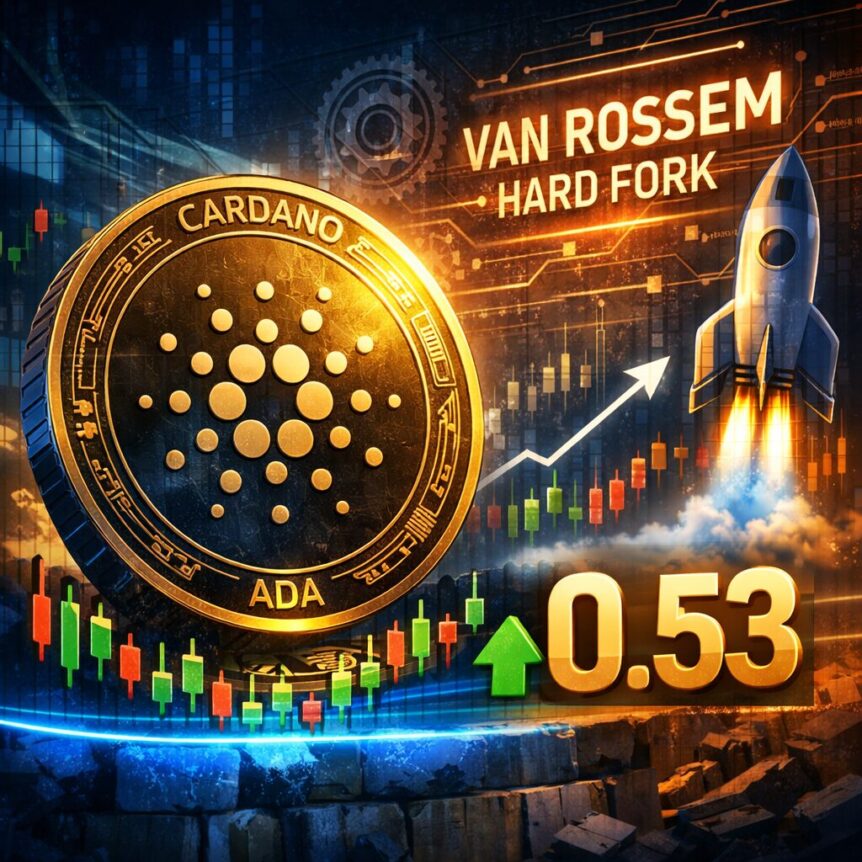
Cardano Looks at $0.53 as ADA Hovers Over Key Support Area With Van Rossem Hard Fork Making Progress
Key Insights
- The Cardano cryptocurrency made another rebound from the key $0.25 support level, with analysts focusing on the possibility of reaching $0.53.
- The previous recoveries of the Cardano coin from the current support area resulted in gains of 88 percent and 243 percent.
- The Van Rossem hard fork is progressing successfully on the Preview testnet.
Bullish Momentum Returns for Cardano After Breaking Out of the Support Level
The Cardano price returned to a bullish trend after buyers defended the important support level of $0.25, which continues to draw a lot of attention in the crypto market. As per Ali Martinez, a cryptocurrency market expert, Cardano has previously been able to generate major uptrends after breaking out of the support region at different points in time.
According to him, Cardano rallied by more than 88% in January 2023 following a breakout above the mentioned support level. The cryptocurrency also witnessed a similar strong rally in September 2023 after defending itself against heavy sell-off pressure from the $0.25 level.
Cardano Recovery Gathers Pace Amid ADA’s Move Towards $0.53
The Cardano cryptocurrency ADA saw more buying interest due to its continued performance, particularly after seeing a resurgence in the entire crypto market sector. Based on cryptocurrency analyst Ali Martinez, the ADA price might go up towards the $0.53 mark if it manages to sustain its momentum at the $0.36 resistance zone.
Analysts have observed that prior recoveries from support levels led to massive gains in the prices of the cryptocurrencies. ADA managed a 5.02% gain during the last 24 hours, with a weekly increase of nearly 11%. The rise in the value of crypto is due to increased investor confidence amid high appetite for risky asset classes.
The Bitcoin price went higher amid other altcoins with a surge in the general market sentiment after seeing better-than-expected economic data in the United States. Encouraging April employment numbers indicated a stable economic outlook in the country amid inflationary pressures.
Key Support Levels Continue to Be Important
While the positive outlook was provided by analysts, they added that ADA is still vulnerable to a downside correction if the market loses its momentum. Ali stressed that the $0.25 region continues to be an important level of support for Cardano. Any breakdown below this level will make ADA more vulnerable to bearish pressure, thus preventing a potential breakout above key resistance zones.
Investors will continue to keep their eye on the overall state of the cryptocurrency markets, since the future direction of Cardano might be dependent on how Bitcoin performs. In the event of continued bullish momentum, ADA will have a chance to try and reclaim higher resistance zones during the upcoming trading days.
Van Rossem Hard Fork Upgrade Progresses on Preview Testnet
Another noteworthy development related to Cardano was the progression of the network with regards to the Van Rossem hard fork upgrade on the Preview testnet.
According to Samuel Leathers, the Daedalus wallet transitioned smoothly through the upgrade phase with no problems reported during the process. The developers are now ready to push an upgraded version of the wallet to the Cardano mainnet next week.
Ripple’s cross-border token has posted a 3% increase over the past week, while the rising institutional interest suggests that a more substantial pump could be on the horizon.
Some analysts are optimistic that XRP could indeed head north, assuming it overcomes important resistance levels.
Best Day in Months
It was in November last year that Canary Capital became the first company to launch a spot XRP ETF in the US with 100% exposure to the asset. Shortly after, well-known entities like Bitwise, Franklin Templeton, 21Shares, and Grayscale followed suit.
At first, these financial vehicles entered the market with a storm, generating consecutive months of strong inflows. However, the momentum faded toward the end of January, and both February and March proved noticeably weaker. April and May saw significant improvement, signaling that the interest from more conservative investors, including pension funds and hedge funds, has returned. In fact, the inflows into spot XRP ETFs in the past 24 hours surpassed $25 million, the highest since the start of the year.

When fresh money flows into these products, the issuers are required to buy real tokens from the market to back the purchased shares. This process automatically generates consistent buying pressure, and when demand rises faster than the available supply, it can naturally push the price upward.
Since their launch, the spot XRP ETFs have accumulated a cumulative total net inflow of roughly $1.35 billion. In comparison, ETFs with Solana (SOL) as the underlying token have attracted approximately $1.08 billion, while those centered on Dogecoin (DOGE) have pulled in a mere $10.65 million.
Meanwhile, Standard Chartered recently projected that inflows into XRP ETFs could explode to the $4-$8 billion range by the end of the year, should regulatory clarity in the United States continue to improve. Growing political momentum behind initiatives like the CLARITY Act could make it easier for big investors to allocate capital, further strengthening the ETF narrative.
When Real Pump?
XRP is well in green territory in both the weekly and monthly timeframes, yet analysts believe a more aggressive surge may come only when it crosses key levels.
The renowned crypto commentator Ali Martinez suggested that it must close above the top of a certain channel at $1.49 to trigger a breakout toward $1.80. Prior to that, he noted that the TD Sequential metric had flashed a major buy signal on the 4-hour chart, expecting a jump to $1.82 if the valuation decisively breaks through the $1.45 resistance.
XRP CAPTAIN 589 also chipped in. In their view, Ripple’s native token is on the verge of a “straight line breakout” to $8, with the catalyst potentially being the approval of the CLARITY Act.
The post XRP Inflows at 5-Month High: Why Institutional Giants Are Flocking Back to Ripple appeared first on CryptoPotato.

The cryptocurrency markets continue to prove their robustness as the price of Bitcoin remains well above the level of $80,000 and the price of Ethereum stays well above $2,300. Such strong market activity has led many traders to ask themselves whether cryptocurrencies are decoupling from traditional financial markets.
Increasingly more market analysts are convinced that Bitcoin and Ethereum will decouple from US stocks. Usually, the markets of cryptocurrencies correlated well with stock indices during times of economic turmoil, yet now there is a clear indication of a new trend.
A well-known trader says that the change is becoming more evident as investors reevaluate the valuations in the markets. Although stocks in the United States remain at historically high prices, cryptocurrencies are considered undervalued investments with higher growth prospects in the long run.
The expert attributed the positive sentiment on crypto news, such as the introduction of the CLARITY Act, the growing popularity of cryptocurrencies among institutions, and an improving regulatory environment in the country. The anticipation of the Bitcoin-friendly stance from the Fed also supports the positive sentiment.
Bitcoin Clings Above $80k Amidst Market Uncertainties
The strong performance by Bitcoin above the $80,000 mark has gained considerable traction amongst market players. Previously, over the past weeks, Bitcoin was finding it difficult to regain and hold its position above $76,000. Following this breakout from resistance, the cryptocurrency is now holding firm in higher zones of support.
A bullish camp claims that if Bitcoin manages to remain above the $80,000 mark, it will provide momentum to make a move towards higher levels of resistance. According to many, a breakout above the $84,000 level will cause explosive momentum, resulting in a new bullish leg.
Bitcoin Could See a Bearish Breakout After Rising Wedge Pattern Formation
Several bearish traders have issued a warning stating that Bitcoin’s present chart setup might be exhibiting a rising wedge formation, a bearish setup in technical analysis. One bearish trader said that Bitcoin has formed such a setup since February, creating an illusion of a bullish trend.
The bearish trader said that each higher high creates the impression of momentum, but each higher low suggests strength in the market. In his opinion, however, the rising wedge pattern indicates weak buying power and compression in price action before a breakout lower.
He cited $84,000 as the top of the wedge and suggested that the resistance level would reject further gains in Bitcoin. In the event that the cryptocurrency is unable to rise past the resistance zone and breaks down from the $80,000 support level, a measured downside target would be around $56,000.
Rotation of Capital From Stocks to Crypto Might Be Already Happening
Even with all the negative sentiment being put out, there are plenty of optimistic views regarding crypto’s future. At the moment, the bullish case being made for crypto is mostly about the undervaluation compared to stocks.
As several market analysts note, the stock markets in the United States are currently experiencing overvaluation because of the past few years’ rapid growth driven by AI promises and successful performances within the technology sector.
However, when it comes to Bitcoin and Ethereum, the price of both currencies is way lower than what many experts predicted back then. All this leads many to believe that some capital might already start to leave stocks and enter crypto. If so, Bitcoin and Ethereum are likely to see more flows heading their way.
THE MOST DECEPTIVE PATTERN IN CRYPTO. BITCOIN IS IN IT.
Rising wedge. Since February.
Every higher high looks like momentum.
Every higher low looks like strength.It’s neither. It’s compression before a breakdown.
$84K is the top of the wedge. Rejection zone.
Break below… pic.twitter.com/4pP2ndg3E4— Merlijn The Trader (@MerlijnTrader) May 11, 2026
Crypto World
Exodus Shifts from Wallet to Full Crypto Payments Company After Selling $87M in Bitcoin

TLDR:
- Exodus launched Exodus Pay, a platform letting users spend crypto directly from wallets across the U.S. and Europe.
- The firm acquired Monavate and Baanx to build out its full-stack crypto payments infrastructure in Q1 2026.
- Exodus cut Bitcoin holdings from 1,704 BTC to 628 BTC, using proceeds to become fully debt-free this quarter.
- XO Cash, Exodus’s new dollar-backed stablecoin, is positioned as the first stablecoin designed for AI agents.
Exodus (EXOD), the publicly traded Bitcoin wallet firm, is broadening its scope beyond wallets into a full crypto payments company.
The firm announced this shift alongside its Q1 earnings report, backed by two strategic acquisitions and a new stablecoin launch.
Its balance sheet also changed sharply, with Bitcoin holdings cut significantly to fund debt repayment and acquisition costs. Shares closed Tuesday at $6.97, down 9.6% on the day.
Exodus Pay and XO Cash Drive the Payments Expansion
Exodus is now positioning itself as a full-stack payments business through its Exodus Pay platform. The platform lets users spend crypto directly from their wallets without surrendering private keys. It is currently live across the United States and Europe.
The company closed two acquisitions to support this move — financial services firms Monavate and Baanx. These deals gave Exodus the infrastructure needed to support crypto spending at scale. CEO JP Richardson described the expansion as a natural extension of the firm’s founding vision.
“Exodus has always been about simplicity and control; that vision hasn’t changed since 2015,” Richardson told Decrypt. “We are expanding what we’re offering, we are not pivoting.”
He added that enabling customers to send and spend digital dollars without handing over their keys is what the firm has been building toward from day one.
Alongside Exodus Pay, the firm launched XO Cash, a dollar-backed stablecoin. Exodus claims it is the first stablecoin built specifically for AI agents, adding another layer to its growing payments ecosystem.
Bitcoin Holdings Drop as Exodus Clears Its Debt
Exodus ended Q1 2026 with $48 million in digital assets, down sharply from $156 million at the close of 2025. Cash and cash equivalents rose to nearly $73 million, compared to under $5 million at year-end. The shift reflects a deliberate treasury reallocation.
Bitcoin holdings fell from 1,704 BTC to 628 BTC during the quarter. The firm also shed 37 ETH, worth roughly $87,000.
These moves helped Exodus pay down a Bitcoin-backed loan from Galaxy and cover acquisition-related costs, leaving the company debt-free.
Richardson addressed the treasury changes directly: “Most of the treasury adjustments you saw in Q1 reflect paying down a Bitcoin-backed loan to Galaxy and other acquisition-related costs. We’re debt-free as a result.” He also reaffirmed that the firm’s long-term conviction in Bitcoin has not changed.
Meanwhile, Exodus added to its Solana position, growing holdings from 12,473 SOL to 17,541 SOL. At Tuesday’s price of around $93.91 per SOL, that stake is worth approximately $1.65 million.
Richardson also noted that Exodus will track transaction volume and the quarterly split between payments and trading revenues going forward. “Spending is a different behavior and a different business,” he said, pointing to the shift away from wallet-only revenue.

WAIB Summit Monaco returns after a successful 2025 edition, with dates set for June 9–10, 2026 at One Monte-Carlo in Casino Square. The event continues to position Monaco as a premier crossroads for Web3, artificial intelligence, and digital assets, drawing a global mix of founders, family offices, institutional investors, regulators, and brand leaders.
Organizers say the two-day gathering will once again attract 2,000+ attendees from around the world, underscoring the summit’s role as a high-signal venue for collaboration, policy dialogue, and capital formation at the intersection of finance and technology. The Monaco setting—coupled with the momentum around the Formula 1 weekend—is designed to elevate conversations about the future of the internet and decentralized finance to the highest level.
Key takeaways
- WAIB Monaco 2025 showcased 150+ speakers from Microsoft, Coinbase, OKX, B2C2, AS Monaco, and other leading brands and institutions.
- The event featured 50 top global KOLs with a combined following exceeding 6 million.
- More than 2,000 international attendees participated, reinforcing Monaco’s appeal as a premium gathering spot for Web3, AI, and digital assets.
- Social reach surpassed 1.3 million impressions, reflecting strong industry engagement and visibility.
A refined edition at One Monte-Carlo
The 2026 edition will take place at One Monte-Carlo, a venue perched at the heart of Monaco’s Casino Square. The choice of location continues to marry luxury with a purposeful program, aiming to accelerate collaboration among technology pioneers, capital providers, and policymakers. By aligning with the Formula 1 weekend’s global spotlight, WAIB Summit Monaco seeks to extend Monaco’s international visibility into the realm of Web3 finance and AI innovation.
In 2025, the summit established a template for a high-impact, invitation-forward program—combining curated sessions with private experiences and strategic networking. The organizers anticipate an expanded suite of experiences in 2026, designed to deepen collaboration across sectors and markets while maintaining the event’s hallmark emphasis on privacy, depth, and tangible opportunities for capital formation.
Power players and strategic partners
The 2026 program emphasizes a broad coalition of policy makers, financial institutions, asset managers, and Web3 infrastructure firms. Participants include senior representatives from European institutions, major banks, and leading asset managers, reflecting a continued push to bridge traditional finance with decentralised technologies and AI.
Policy and government voices featured or anticipated for the event include Peter Kerstens, adviser to the European Commission (DG FISMA); Ondrej Kovarik, former member of the European Parliament; and Dr. Clara Guerra, director representing the government of Liechtenstein. Their involvement signals a keen interest in regulatory and supervisory perspectives as the ecosystem scales.
From the financial sector, Franklin Templeton’s Rafael Mastroberardino; Julien Clausse of BNP Paribas; Ramzi Amairi of Natixis; Elie Naba of ABN AMRO; and Julien Busnel of CoinShares AM are listed among the profiles shaping investment views and product development for digital assets and related technologies.
Investors and family offices are also represented, with figures such as Lucius Czerlau, principal of the Czerlau Family Office, and Paul Infante Moñozca of the Moñozca Family Office noted among participants. In the Web3 infrastructure space, Ada Vaughan (Head of DeFi, Stellar Development Foundation); Kean Gilbert (Head of Institutional Relations, Lido); and Dayana Aleksandrova (Social & New Media Lead, WalletConnect) are expected to contribute to the dialogue on protocol design, liquidity, and user experience.
Global exchanges and trading platforms—Georg Harer (Bybit EU), Sabina Liu (KuCoin EU), Nenter Chow (BitMart), Dorian Vincileoni (Kraken, Head of Regional Growth), and Ajinkya M Tulpule (HashKey Europe)—are also slated to participate, highlighting continued institutional interest from the exchange community in Monaco’s high-profile format.
Experiences, awards, and opportunities for investment
Beyond the conference floor, WAIB Summit Monaco curates a series of exclusive experiences that blend finance, policy, and technology with elite networking. A VIP family offices dinner at the Yacht Club de Monaco—hosted in the iconic venue—gathers 20+ single and multi-family offices, private wealth leaders, institutional providers, and government representatives. The format prioritizes quality interactions over broad, mass-market networking, creating a setting where capital allocators and policymakers can explore collaboration opportunities away from crowded expo spaces.
In addition to the formal program, WAIB Summit Monaco presents awards recognizing excellence and breakthrough innovation in Web3, AI, and digital assets. The event also hosts a VC and startup pitching track, giving select Web3 and AI ventures a platform to present to leading investors such as Draper University, CV VC Labs, funders.vc, Gini Capital, and MonacoTech.
The summit also embraces creativity through a dedicated AI film festival, positioning artificial intelligence as a new driver of cinematic expression. An accompanying AI Film Fest 24H Hackathon—powered on-site by Alibaba Cloud—invites participants to craft a 1–3 minute AI-generated short film within 24 hours, with a jury awarding Gold, Silver, and Bronze distinctions. Jury members include Anthony Bourached, Vincent Lowy, Nicholas Shoolingin-Jordan, and Andrew McNamara, reflecting cross-disciplinary expertise in machine learning, cinema, and creative AI.
More information about the AI-focused program is available through the festival’s official site: aifilmfest-monaco.com. The closing notes of the WAIB experience are punctuated by a Moon party, a celebratory gathering on the Riviera coastline that aims to fuse ambition with the region’s magic after two days of intensive discussions and deal-making.
Ticketing for WAIB Summit Monaco 2026 is live, with early-bird rates available for a limited window. Details and registrations are at waibsummit.com, and access to select events and experiences can be secured through Moongate’s ticketing portal at app.moongate.id/e/waibsummitmonaco2026.
WAIB Summit (Web3 and AI Summit) describes itself as a global platform connecting thought leaders, investors, family offices, and innovators who are shaping the future of decentralized technology and artificial intelligence. The 2026 Monaco edition continues that mission by embedding high-level discussions within Monaco’s refined ecosystem during a moment of rising attention to cross-border collaboration and regulatory alignment.
Media inquiries can be directed to the WAIB Summit team at joseph@waibsummit.com.
What readers should watch next is how European policymakers and financial institutions translate these conversations into concrete pilots and partnerships, and whether the 2026 edition can translate headline attendance into measurable capital deployment and scalable products in Web3 and AI.
Denis Beau urged immediate private-sector mobilisation to build euro stablecoins, breaking publicly with ECB president Christine Lagarde’s slower approach.
Summary
- Banque de France deputy governor Denis Beau called for all relevant European players, public and private, to mobilise now to develop euro-based tokenised money.
- Beau’s position conflicts with ECB president Christine Lagarde, who favours a central bank digital euro targeted for launch around 2029.
- Dollar-pegged stablecoins account for 98% of the total stablecoin market, raising fears of digital dollarisation across European payment infrastructure.
Denis Beau, deputy governor of the Banque de France, called on May 12 for a “mobilization of all relevant European players, public and private,” to develop euro-based tokenised money to counter the dominance of dollar-pegged stablecoins. His position puts him at odds with ECB president Christine Lagarde, who favours waiting for a state-issued digital euro scheduled for around 2029.
“To ensure a sound development of tokenised finance in Europe, its payment and settlement asset pillar should be in euro,” Beau told analysts this week. Dollar-pegged tokens from Tether and Circle currently account for 98% of the total stablecoin market, a concentration Beau described as a direct threat to European monetary sovereignty.
What Beau is asking for and why it differs from Lagarde
While Lagarde has consistently warned that privately issued stablecoins risk amplifying financial vulnerabilities, Beau argued that private-sector solutions are necessary for Europe’s economic development right now, without waiting for a retail CBDC. He specifically cited the risk of “digital dollarisation” at the settlement infrastructure level if euro-denominated alternatives fail to reach sufficient liquidity.
Beau’s stance aligns with Qivalis, a consortium of 12 major European banks, including BBVA, ING, UniCredit, and BNP Paribas, that are planning to launch a euro-pegged stablecoin in the second half of 2026. He also pointed to the Eurosystem’s Pontes project, which will deploy wholesale central bank money in tokenised form before the end of 2026.
“A first deliverable will become available by the end of this year, with the opening of our wholesale central bank money service in tokenized form,” Beau said, framing it as a foundation rather than a complete solution.
The internal ECB divide and what it means for Europe
The split between Beau and Lagarde reflects a broader strategic disagreement within European institutions. Lagarde has argued that dollar and euro-pegged stablecoins alike pose financial stability risks, while Beau and French Finance Minister Roland Lescure have both pushed for more aggressive private-sector development of euro stablecoins as a near-term countermeasure.
The German central bank has also signalled openness to euro-denominated stablecoins as a means of improving cross-border payment efficiency. The gap between the ECB’s retail CBDC timeline and the immediate commercial pressure from dollar stablecoins is giving central bankers across Europe more reason to support private alternatives rather than waiting for a state-led solution.


An Aave vote opening May 15 would transfer 30,765 ETH to Aave LLC as part of the Kelp exploit recovery.
Summary
- A binding Arbitrum Improvement Proposal was launched May 12 with a vote opening May 15 to transfer 30,765 ETH worth $71 million to Aave LLC.
- A Manhattan federal judge cleared the transfer path on May 9 but preserved the legal claim of terrorism creditors holding $877 million in unpaid North Korea judgments.
- The 30,765 ETH was frozen by Arbitrum’s Security Council on April 21 after being linked to the $292 million Kelp DAO exploit attributed to North Korea’s Lazarus Group.
Aave and other affected parties launched a binding Arbitrum Improvement Proposal on May 12, opening a governance vote on May 15 that would move 30,765 ETH worth approximately $71 million from Arbitrum’s Security Council wallet to an Aave LLC-controlled address. The vote is the final procedural step needed to unblock the Kelp DAO recovery effort.
A Manhattan federal judge modified a prior freeze on May 9, permitting the transfer to proceed through onchain governance. Judge Margaret Garnett’s order also shields voters and other participants from personal liability under the existing restraining notice.
However, the terrorism creditors’ legal claim on the funds survives the transfer, meaning Aave LLC cannot freely deploy the ETH if the court ultimately sides with the plaintiffs.
What the $71 million is and how it was frozen
The 30,765 ETH was intercepted by Arbitrum’s Security Council on April 21 after being linked to the April 18 exploit of Kelp DAO’s LayerZero-powered bridge.
Attackers used unbacked rsETH tokens as collateral on Aave v3 to borrow an estimated $230 million in wrapped ETH, generating over $190 million in bad debt and disrupting lending markets across DeFi.
The case became legally complex when Gerstein Harrow LLP, representing families holding $877 million in unpaid terrorism judgments against North Korea, argued the ETH constitutes DPRK property because blockchain analytics firms attributed the Kelp exploit to the Lazarus Group. No court has established that as a legal finding.
Aave founder Stani Kulechov pushed back directly. “These funds belong to the affected users they were stolen from, full stop,” he said. Aave had filed an emergency motion in New York on May 4 seeking to vacate the restraining notice entirely, arguing that a thief does not acquire lawful title to stolen property simply by moving it on-chain.
Recovery progress and what comes next
The broader DeFi United recovery initiative has now raised more than $314 million in ETH commitments from protocols including Mantle, EtherFi, Lido DAO, Ethena, LayerZero, and Compound. The $71 million transfer is one of the last remaining pieces needed to close the backing gap for rsETH.
Voting on the binding AIP opened May 15 and is expected to require roughly eight days before the ETH can move from Arbitrum to Ethereum through the standard L2-to-L1 withdrawal delay. The court dispute with terrorism creditors remains unresolved. If the court sides with the plaintiffs, Aave could ultimately be compelled to surrender the recovered ETH even after the transfer completes.

Beatles museum to open on seven-storey site (and rooftop) of band’s last gig

Cal-Maine acquires frozen food business

Gov. Mikie Sherrill cuts NJ Transit World Cup train tickets to $98

Manchester United reach agreement with Casemiro over contract clause amid transfer speculation

US brings back mandatory military draft registration

Steven Gerrard disagrees with Gary Neville over ‘shock’ Chelsea and Arsenal claim | Football


-
 Crypto World5 days ago
HarrisX Poll Found 52% of Registered Voters Support the CLARITY Act
-

 Fashion4 days ago
Weekend Open Thread: Marianne Dress
-

 Crypto World6 days ago
Upbit adds B3 Korean won pair as Base token gains Korea access
-
 NewsBeat6 days ago
NCP car park operator enters administration putting 340 UK sites at risk of closure
-

 Fashion1 day ago
Coffee Break: Travel Steam Iron
-

 Fashion2 days ago
What to Know Before Buying a Curling Wand or Curling Iron
-

 Tech3 days ago
Auto Enthusiast Carves Functional Two-Stroke Engine from Solid Metal
-

 Politics1 day ago
What to expect when you’re expecting a budget
-

 Politics4 days ago
Politics Home Article | Starmer Enters The Danger Zone
-
 Business4 days ago
Ignore market noise, India’s long-term story intact, say D-Street bulls Ramesh Damani and Sunil Singhania
-

 Tech2 days ago
GM Agrees To Pay $12.75 Million To Settle California Lawsuit Over Misuse Of Customers’ Driving Data
-

 Crypto World6 days ago
BlackRock CEO Larry Fink Discusses a New Asset Class
-
 Sports7 days ago
NBA playoff winners and losers: Austin Reaves is not loving Lakers vs. Thunder matchup, but Chet Holmgren is
-

 Entertainment6 days ago
Sarah Paulson Called Out For Met Gala ‘Hypocrisy’
-

 Politics5 days ago
Simon Cowell Says He Was ‘Horrible’ To Susan Boyle During BGT Audition
-

 Entertainment5 days ago
General Hospital: Ric & Ava Bombshell – Ric’s Massive Secret Exposed!
-

 Crypto World6 days ago
Robinhood says Wall Street is building onchain
-

 Entertainment6 days ago
Bold and Beautiful Early Spoilers May 11-15: Steffy Revolted & Liam Overjoyed!
-

 Sports6 days ago
UEFA Champions League final schedule, teams, venue, live time and streaming | Football News
-

 Entertainment6 days ago
Why David Letterman Called CBS ‘Lying Weasels’
You must be logged in to post a comment Login