
Crypto World
Only 4 of top 20 crypto treasury firms trade above asset value: report

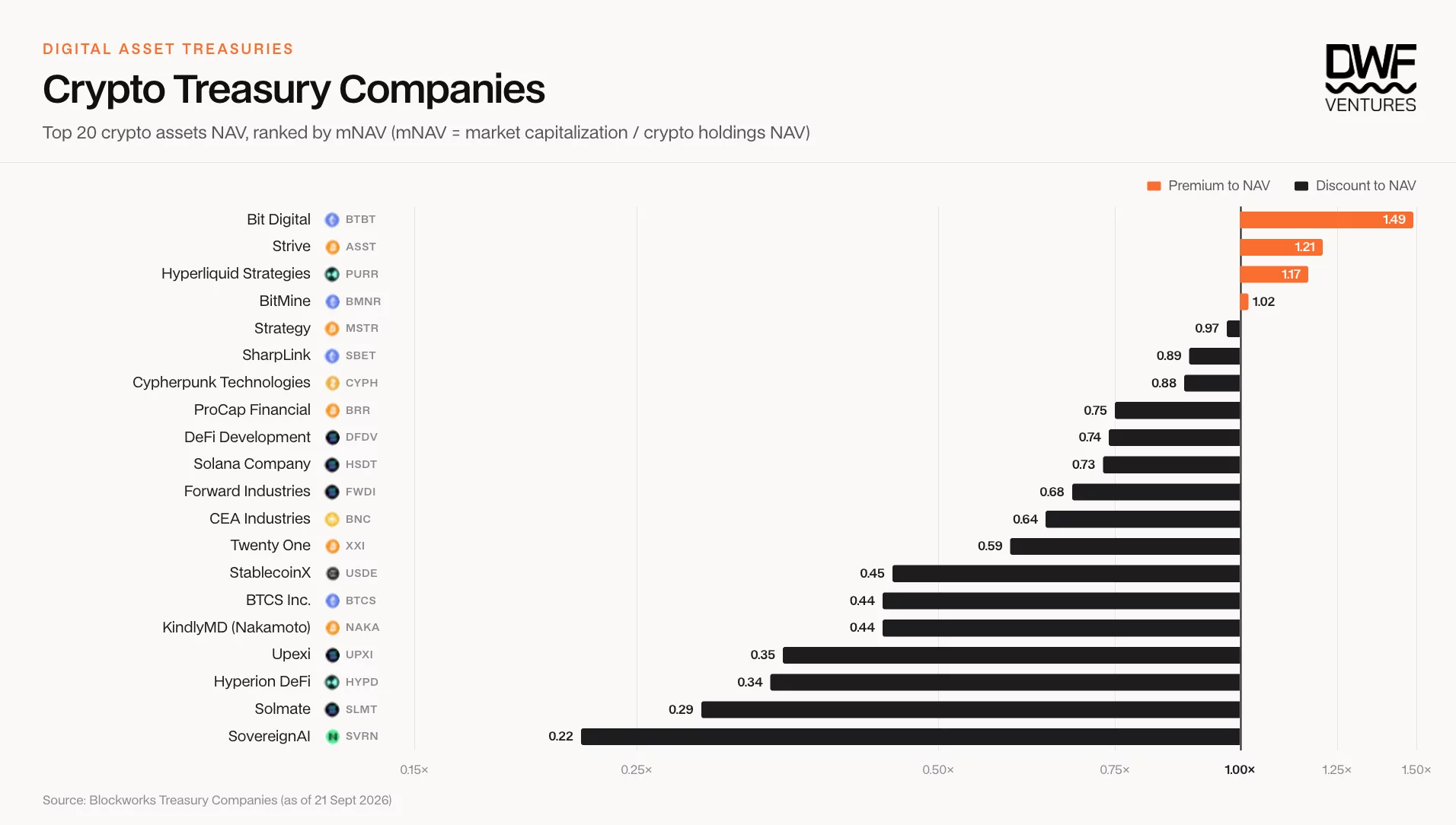
Digital asset treasury companies have mostly lagged the cryptocurrencies they hold, with only four of the 20 largest trading above the value of their token reserves, according to a new analysis by DWF Ventures.
Summary
- Only four of the top 20 digital asset treasuries by assets under management trade at a premium to their crypto holdings.
- Most of the companies studied have underperformed their underlying tokens since adopting a treasury strategy.
- Some treasury stocks beat their tokens by 15% to 40% over a recent period of less than three months, as discounts to asset value narrowed.
- The analysis says financing terms, operating income and management decisions now matter more when comparing the stocks.
DWF Ventures compared the share prices of publicly traded crypto treasury companies with the performance of the tokens they hold. It found that most of the 20 largest companies trade at a market-value-to-net-asset-value ratio, or mNAV, below 1, meaning their shares are valued at less than their crypto holdings.
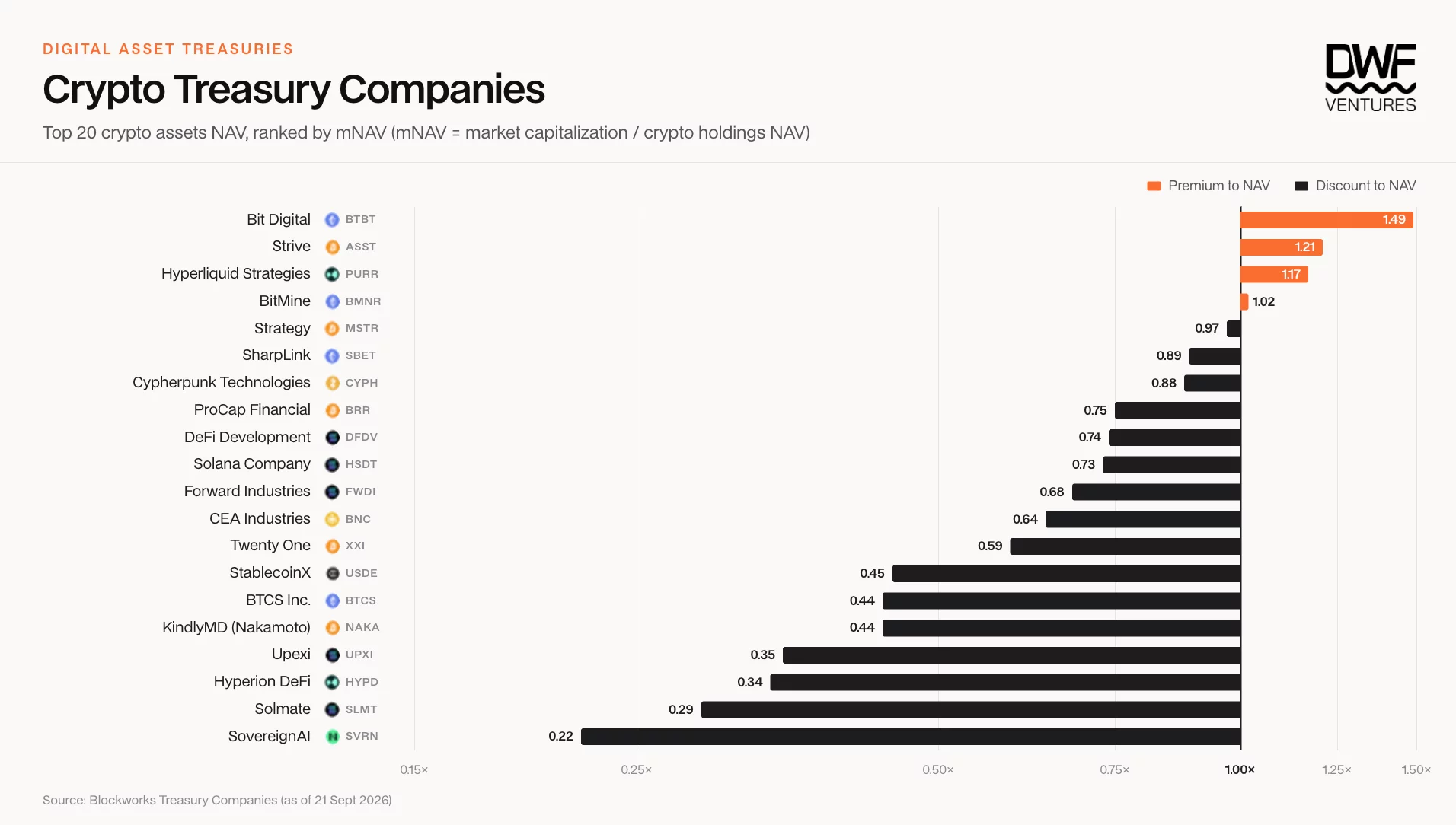
The calculation excludes debt and preferred stock, according to the analysis. Investors therefore need to examine those obligations separately before treating a low mNAV as a discount on everything a company owns.
Crypto treasury stocks have mostly trailed direct holdings
Since the companies began their treasury strategies, buying and holding the underlying token has generally produced a better return than buying their shares, the analysis found. Even where a stock came out ahead, its excess return was usually small compared with the additional risks attached to owning a company.
A treasury share does not track a token in the same way an exchange-traded fund is designed to. Its price also depends on when management buys crypto, how it raises cash, how many new shares it issues, and whether investors expect the company to expand its holdings.
The difference has been visible over shorter periods. Since July, the analysis found that some treasury stocks outperformed their tokens by 15% to 40% as their mNAV ratios climbed from roughly 0.5–0.8 to 0.7–1.0. Hyperliquid-focused PURR and Zcash-focused CYPH recorded returns 31% and 38% above their respective tokens during that period.
According to the analysis, their token holdings per share changed little over those months. Much of the stock gains instead came as investors paid more for exposure to the companies while crypto prices rose. The authors found that the underlying token remained the stronger performer across most periods longer than three months.
A recent U.S. example shows how quickly a treasury stock can move. On Sep. 20, crypto.news reported Strategy’s one-month gain of 47.65% through the Sep. 18 close, a period in which Bitcoin also recovered. The stock’s return over that window does not establish how it has performed against Bitcoin since the company began buying the asset.
A premium lets crypto treasuries buy more tokens per share
The analysis identifies token holdings per share as a central measure of a treasury company’s progress. When a firm’s stock trades above the value of its crypto reserves, it can sell shares, use the proceeds to buy tokens, and potentially increase the amount backing each existing share.
That process becomes harder when mNAV falls below 1. Selling new common shares at a discount can dilute existing investors, while waiting to raise funds may slow further purchases. Companies can also use convertible debt or preferred shares, though each financing method brings terms that common shareholders must weigh.
Strategy has used convertible debt as part of its Bitcoin financing, according to the analysis. Convertible holders may exchange their claims for shares if the stock reaches the agreed terms; until then, the company must manage the obligations attached to its capital structure. The analysis cautions that preferred dividends and other commitments can put pressure on reserves if financing becomes more difficult.
Recent U.S. filings show how differently treasury operators can respond to those demands. As covered in Strategy’s September update, the company bought no Bitcoin and sold no shares through its at-the-market program during the reported week. It instead spent $176.3 million repurchasing STRC preferred shares and doubled its digital credit securities repurchase authorization to $2 billion.
Strive took another route. A Sep. 14 report on its latest Bitcoin purchase said the U.S.-listed company bought 469 BTC for about $36.6 million using proceeds from SATA preferred stock, bringing its holdings to 25,000 BTC as of Sep. 11. Its SEC filing gave investors both the purchase amount and the security used to fund it.
Operating income can change the comparison
The analysis says companies can also seek returns from staking, mining, or businesses outside their token reserves. Such income may increase resources available to shareholders without selling the principal crypto holding, although the result depends on operating costs and execution.
For Bit Digital, the analysis points to its cloud infrastructure business, White Fiber, as a reason its shares maintained a premium while the value of its digital assets fell. White Fiber accounted for more than 89% of Bit Digital’s second-quarter revenue, according to the earnings information cited in the analysis.
Ether treasury companies offer another example through staking. BitMine had more than 5.06 million ETH staked out of holdings approaching 5.98 million ETH, according to its Sep. 21 treasury update. Staking can earn additional ETH, but shareholders still own a company whose share price can move differently from Ether.
The analysis also cited SharpLink’s announced $200 million allocation to stETH and a $125 million onchain yield fund with Galaxy. For Zcash-focused CYPH, it pointed to a mining fleet that the company said received more than 18% of the network’s emissions. Each activity gives investors an operating decision to assess alongside the quantity of tokens held.
Access has changed as well. The analysis argues that treasury stocks once drew a premium partly because some institutions could buy listed shares more easily than crypto directly. With more regulated funds and custody options available, its authors expect investors to place more weight on operators, financing terms, and business income when valuing one treasury company against another.


The European Union has moved closer to tighter oversight of DeFi lending access after the European Banking Authority called for crypto borrowing and lending services to be brought within the scope of the bloc’s Markets in Crypto Assets framework.
Summary
- The EBA wants crypto borrowing and lending brought under MiCA, including services that give customers access to DeFi lending protocols.
- Proposed measures include suitability tests, leverage limits and extra disclosures for firms providing crypto lending services.
- EU regulators could consider restrictions involving regulated stablecoins and a certification regime for DeFi lending protocols.
- The recommendations are part of the European Commission’s ongoing review of MiCA and would require legislative changes before taking effect.
According to the European Banking Authority, crypto asset service providers that connect customers to decentralized lending protocols could face new requirements if the European Commission decides to expand MiCA as part of its ongoing review.
The EBA wants the Commission to conduct a cost benefit analysis of legislative changes that would add the intermediation of crypto borrowing and lending to the list of services regulated under MiCA. Its recommendations go beyond centralized crypto lenders and consider how regulated firms provide customers with access to DeFi protocols.
Possible measures include suitability tests for users, limits on leverage and extra disclosure requirements. The regulator raised the prospect of restrictions involving lending products that use asset referenced tokens or e money tokens requiring authorization under MiCA.
A certification regime for DeFi lending protocols could be considered as another option, particularly where regulated crypto firms act as the gateway through which customers access decentralized lending services.
DeFi lending access could face MiCA checks
Crypto lending activity has been identified in at least 16 EU member states, according to research cited by the EBA. The authority said access to decentralized finance through crypto firms and the growing use of artificial intelligence tools are making the boundary between centralized and decentralized financial services less clear.
MiCA currently provides an EU wide framework for crypto asset issuers and crypto asset service providers, but lending and borrowing are not fully covered by its existing service categories.
A July policy position from the European Parliament had already put DeFi and lending on the regulatory agenda. Lawmakers asked the Commission to examine whether decentralized finance, staking, crypto lending and borrowing, NFTs and tokenized financial assets require further treatment under MiCA. crypto.news previously reported that the position did not change existing law but set out areas lawmakers wanted examined after MiCA’s rollout.
The EBA’s latest recommendations give the Commission a more detailed set of options for lending. Requirements could be placed on crypto firms that intermediate borrowing and lending or provide an interface through which customers reach DeFi protocols.
Such rules would depend on legislative changes. The Commission’s MiCA review consultation remains open until Sept. 30 and is intended to help determine whether the framework remains fit for purpose following its initial implementation. Feedback may feed into a report on MiCA’s application and could be followed by a legislative proposal if the Commission considers changes necessary.
Stablecoin lending is drawing separate scrutiny
Stablecoins form another part of the lending debate. The EBA said policymakers could consider restricting access to borrowing and lending involving asset referenced tokens and e money tokens that require authorization under MiCA.
The proposal comes days after European central banks called for MiCA’s restrictions on stablecoin remuneration to cover lending, borrowing and staking arrangements that can generate indirect returns for token holders.
Under the proposal described in the stablecoin yield review, the European System of Central Banks argued that crypto platforms could structure products outside services currently covered by MiCA in ways that effectively allow stablecoins to generate returns.
The EBA separately said existing MiCA requirements for issuers of asset referenced and e money tokens are broadly appropriate, while recommending changes for third country multi issuer schemes. As of Sept. 1, 39 e money tokens had been issued under MiCA, while no asset referenced tokens had received authorization, according to the authority.
Reserve requirements are under review as well. The EBA recommended reconsidering the minimum amount of reserves that issuers must hold as bank deposits while preserving risk management requirements.
MiCA review is moving into areas outside the original framework
The Commission opened its MiCA review in May to gather feedback on how the regulation is functioning and whether parts of the framework should be changed. The consultation covers crypto issuers, service providers, financial institutions, technology companies, industry groups and public authorities.
MiCA entered into application on Dec. 30, 2024, while its provisions covering asset referenced and e money tokens had started applying six months earlier. Transitional arrangements allowed some existing crypto companies to continue operating under national regimes before the bloc moved into full MiCA implementation.
Attention has since moved toward activities that were not fully addressed by the original regulation. Lending, borrowing, staking and parts of DeFi have become part of that discussion, while regulators have been examining where decentralized systems should fall within existing financial rules.
A June consultation by Malta’s financial regulator proposed a new category for DAOs and other DeFi entities. The Malta Financial Services Authority said many projects described as decentralized may not meet MiCA’s standard for full decentralization where control remains concentrated among identifiable participants.
Similar questions have emerged at the EU level over how decentralization should be assessed when protocols rely on interfaces, governance structures or companies that provide users with access.
Crypto lenders currently sit outside parts of MiCA
The gap can already be seen in the way some companies structure European services. Nexo said in July that custody and brokerage for customers in the European Economic Area were being provided through regulated German partners Tangany and DLT Finance.
Its Earn products and crypto backed loans, however, were offered separately and sat outside the MiCA and MiFID authorizations held by those partners.
Expanding MiCA’s list of regulated services could change the requirements that apply when a crypto asset service provider intermediates lending or gives users access to a decentralized lending protocol. The EBA has not proposed a final set of rules, and its recommendations form part of the Commission’s consultation process rather than legislation already agreed by EU institutions.
Beyond lending, the authority wants clearer rules for crypto asset classification, saying current uncertainty can create costs and delays when firms bring products to market. It recommended clarifying MiCA’s scope and definitions, including its boundary with other EU financial laws.
Reporting requirements for token issuers and crypto asset service providers are another area the EBA wants reviewed to support supervision and risk monitoring.
The authority’s recommendations will now feed into the Commission’s assessment of MiCA alongside responses from other regulators and market participants. Any decision to add crypto lending or specific requirements for access to DeFi protocols would require the Commission to move from the review process toward legislative changes.
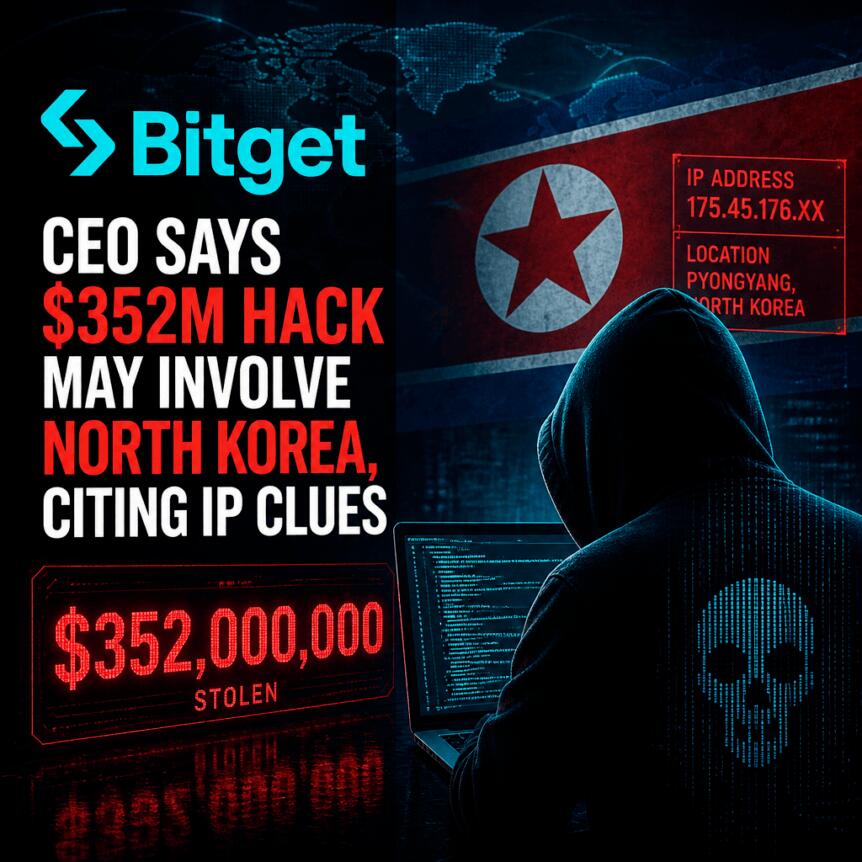
Bitget CEO Gracy Chen said preliminary investigations indicate North Korean hackers may be behind the exchange’s $351.6 million security breach disclosed on Thursday. In a live Q&A on X after the incident, Chen pointed to investigator-identified IP addresses that align with VPN services previously used by a Democratic People’s Republic of Korea (DPRK) hacking group, adding that the attackers’ behavior resembled tactics from earlier campaigns.
Chen also said Bitget does not believe the breach involved an inside job. She further described the mechanics of the theft: investigators concluded that hackers moved funds directly rather than attempting to forge user withdrawal requests, and that the attackers did not obtain Bitget’s cold-wallet or hot-and-warm-wallet private keys.
Key takeaways
- Attribution signals: Bitget’s CEO cited preliminary links between specific IP addresses and VPN choices associated with a DPRK group.
- No inside-job assumption: Chen said the exchange does not currently believe there was an internal compromise.
- How funds were taken: Bitget described direct fund transfers, not forged withdrawal requests.
- Key security controls: Chen said investigators did not find evidence that private keys for cold or hot/warm wallets were accessed.
- Recovery efforts underway: Some stolen funds were reported recovered, though Bitget did not disclose an amount.
Why Bitget’s preliminary attribution points to DPRK activity
Chen’s most concrete evidence, at least at the stage described publicly, centers on network infrastructure. During the X Q&A, she said investigators identified some IP addresses that match the VPN selections used by a DPRK-linked group. She characterized the overall attack pattern as consistent with methods used in prior North Korean operations.
The CEO’s comments matter beyond headline attribution because they can shape how traders, institutions, and partners assess risk and incident timelines. If the VPN and behavioral indicators continue to hold up under forensic review, it strengthens the case that the breach is part of the broader pattern of state-linked cybercrime targeting digital asset infrastructure.
Bitget’s framing also echoes broader reporting on North Korea’s role in crypto theft. Cointelegraph previously noted that North Korean hackers were linked to an estimated $2.02 billion in crypto theft in 2025, including an approximately $1.5 billion Bybit hack that the FBI attributed to North Korea.
What Bitget says happened during the breach
Beyond attribution, Chen provided operational details about the alleged theft process. She said hackers accessed Bitget’s systems and transferred funds directly, explicitly adding that they did not forge user withdrawal requests.
Chen further stated that investigators have not found evidence that the attackers obtained private keys associated with Bitget’s cold wallet or its hot and warm wallets. She said the investigation is still focused on determining which internal systems were compromised and how the attackers gained access in the first place.
For users and counterparties, these distinctions are important. A breach involving private-key extraction typically suggests a different threat level and broader recovery challenges than an incident where attackers manipulate systems to move funds. Chen’s account—direct transfers without key compromise—implies Bitget’s security design may have contained the damage, even as attackers were still able to reach and move assets.
Withdrawals suspended; exchange reports partial recovery
Chen’s remarks come after Bitget reported unauthorized transfers impacting parts of its hot and warm wallet infrastructure. At the time of publication, withdrawals remained suspended, reflecting Bitget’s caution while it continues incident response and reconciliation.
During the Q&A, Chen said some of the stolen funds had been recovered, but she did not specify the amount. She also said the exchange is working with blockchain foundations and other partners on recovery efforts.
For market participants, exchange recovery timelines can materially affect liquidity and user confidence, especially when withdrawals are paused. Even partial recovery—without a stated figure—signals that defenders may have regained control of certain assets or succeeded in interrupting some of the flow after the compromise.
Earlier coverage from Cointelegraph noted the breadth of user-facing impact. In a report on Bitget’s response, Cointelegraph stated that the exchange confirmed the $352M security breach and suspended withdrawals amid reports of affected funds. (See: Bitget calls security withdrawal claims unverified amid $178m breach reports.)
What to watch next as the investigation develops
Chen’s public explanation provides a framework—VPN-linked IP indicators, a lack of evidence of private-key compromise, and a non-insider working assumption—but important questions remain open. Bitget is still determining the scope of compromised systems and the access method, and those findings are likely to influence how credible the DPRK attribution ultimately appears.
Going forward, readers should monitor whether Bitget expands on the technical chain of intrusion (for example, whether the breach began via compromised credentials, a system-level weakness, or some other vector) and whether partners or third-party incident analysts corroborate the VPN/IP and behavioral claims. As recovery continues and more forensic details emerge, the key issue will be whether the initial story holds—or whether additional evidence changes the attribution and the lessons other exchanges draw from the incident.

Bitget CEO Gracy Chen said North Korean hackers may be behind the exchange’s $351.6 million security breach on Thursday, citing preliminary findings linking IP addresses to VPN services used by a North Korean group.
Speaking during a live Q&A following the incident on X, Chen said security investigators had flagged similarities with previous North Korean attacks. She said the exchange did not believe the breach was an inside job.
“We’ve identified some IP addresses that match the VPN choices by a certain DPRK group,” Chen said, referring to the Democratic People’s Republic of Korea.
North Korean hackers were linked to an estimated $2.02 billion in crypto theft in 2025, including the roughly $1.5 billion Bybit exchange hack, which the FBI attributed to North Korea.

Bitget CEO Gracy Chen hosts a live broadcast on X hours after the hack. Source: Bitget
“The pattern looks very much like what the North Korean team did before,” she said.
Chen also disclosed that hackers breached Bitget’s systems and transferred funds directly, rather than forging user withdrawal requests.
“They did not forge user withdrawal requests, nor did they obtain our private keys of the cold wallet and any hot, warm wallet,” she said.
Chen said investigators were still determining which systems were compromised and how the attackers gained access.
Related: Bitget confirms $352M security breach, suspends withdrawals
The comments come after Bitget reported unauthorized transfers affecting portions of its hot and warm wallet infrastructure on Thursday. Withdrawals remain suspended at the time of publication.
During the Q&A, Chen also said some stolen funds had been recovered, without specifying an amount. She said the exchange was working with blockchain foundations and other partners on recovery efforts.
Magazine: Asia dominates Crypto Adoption Index, Bitget’s $351M hack: Asia Express
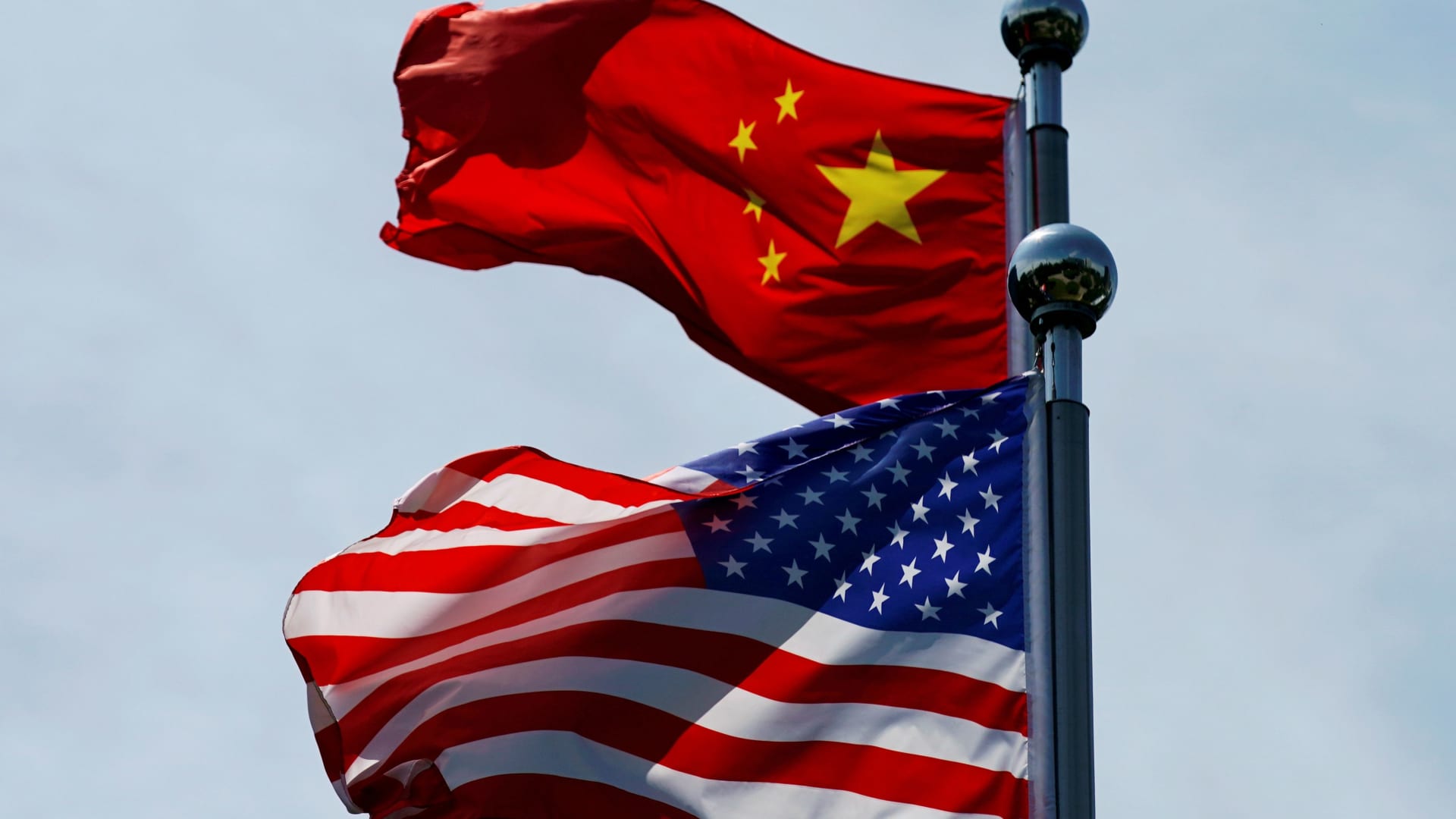
Chinese and U.S. flags flutter near The Bund, before U.S. trade delegation meet their Chinese counterparts for talks in Shanghai, China July 30, 2019.
Aly Song | Reuters
U.S. government officials, business leaders and their spouses dominated a list of more than 100 people who will attend a state dinner Thursday, according to a White House press release.
On the Chinese side, only seven officials were listed, accompanying Chinese President Xi Jinping and U.S. President Donald Trump and their wives.
Nvidia, Apple, Meta and OpenAI were among the major U.S. tech companies represented. But Anthropic was not on the list.
Chinese business leaders were previously expected to attend the dinner. Earlier, CNBC reported that someone briefed about the preparations but who wasn’t authorized to speak on the record said they weren’t aware of any Chinese companies who have been invited to join Xi on his trip.
Xi is making his first state visit to the U.S. since Barack Obama’s presidency more than a decade ago. He arrived in the U.S. on Wednesday and is scheduled to leave Friday.
Here’s the full list:
- President Donald J. Trump
- First Lady Melania Trump
- President Xi Jinping
- Madame Peng Liyuan
- Vice President JD Vance
- Second Lady Usha Vance
- Secretary of State Marco Rubio
- Jeanette Rubio, Spouse of the Secretary of State
- Chief of Staff Susie Wiles
- U.S. Ambassador to China David Perdue
- Bonnie Perdue, Spouse of the US Ambassador to China
- Secretary of the Treasury Scott Bessent
- John Freeman, Spouse of the Secretary of the Treasury
- Secretary of War Pete Hegseth
- Ambassador Jamieson Greer, United States Trade Representative
- Marlo Greer, Spouse of Ambassador Greer
- Cai Qi, CPC Political Bureau Standing Committee Member, Chief of Staff to President Xi
- Wang Yi, CPC Political Bureau Central Committee Member
- He Lifeng, CPC Political Bureau Central Committee, Vice Premier of State Council
- Zheng Shanjie, Chairman of the National Development and Reform Commission
- Wang Wentao, Minister of Commerce
- Ma Zhaoxu, Executive Vice Foreign Minister
- Ambassador Xie Feng, Chinese Ambassador to the United States
- Ms. Ivanka Trump
- Mr. Eric Trump
- Ms. Lara Trump
- Ms. Tiffany Trump
- Mr. Michael Boulos
- Mr. Viktor Knavs
- Ms. Arabella Kushner
- Jensen Huang, Nvidia, CEO
- Lori Huang, Spouse of Jensen Huang
- Mark Zuckerberg, Meta, CEO
- Dr. Lisa Su, Advanced Micro Devices, CEO
- Daniel Lin, Spouse of Lisa Su
- Tim Cook, Chairman of the Board of Apple
- John F.W. Rogers, Goldman Sachs EVP and Secretary to the Board
- Lynn Martin, President of the NYSE
- Linda Mills, President of New York University
- Eric Yuan, Zoom, CEO
- Tang Fangyu, Director, Central Policy Research Office of the CPC Central Committee
- Lan Fo’an, Minister of Finance
- Wang Dan, Wife of Ambassador Xie Feng
- Zhou Hongxu, Deputy Director, General Office of the CPC Central Committee Director, Central Security Bureau
- Lyu Luhua, Secretary to the President
- Hong Lei, Assistant Foreign Minister Director General, Protocol Department
- Cai Wei, Assistant Foreign Minister Director General, Department of North American and Oceanian Affairs
- Mao Ning, Director General, Department of Press, Communication and Public Diplomacy, Ministry of Foreign Affairs
- Zhang Quan, Secretary to Madame Peng
- Zhang Yongchao, Deputy Director General, Department of North American and Oceanian Affairs, Ministry of Foreign Affairs
- Kelly Ortberg, Boeing, CEO
- Larry Fink, Blackrock, CEO
- Stephen Schwarzman, Blackstone, CEO
- Sam Altman, OpenAI, CEO
- Greg Brockman, OpenAI, President & Co-Founder
- Anna Brockman, Wife of Greg Brockman
- Dr. Miriam Adelson, Las Vegas Sand, Controlling Shareholder
- Sergey Brin, Google/Alphabet, Co-Founder
- Gerelyn Gilbert-Soto, Partner of Sergey Brin
- Satya Nadella, Microsoft, Chairman & CEO
- Jim Taiclet, Lockheed Martin, Chairman, President & CEO
- Sundar Pichai, Google, CEO
- Larry Culp, GE Aerospace, CEO
- Sanjay Mehrotra, Micron, CEO
- Cristiano Amon, Qualcomm, CEO
- Jeff Bezos, Amazon, Chairman
- Lauren Sanchez-Bezos, Spouse of Jeff Bezos
- Jeff Yass, TikTok
- Jamie Dimon, JP Morgan, CEO
- Michael Dell, Dell, CEO
- Mary Barra, General Motors, CEO
- David Solomon, Goldman Sachs, CEO
- Jane Fraser, Citi, CEO
- Elon Musk, SpaceX & Tesla, CEO
- Darren Woods, ExxonMobil, CEO
- Chief Justice John Roberts, Chief Supreme Court Justice
- Jane Sullivan Roberts, Chief Supreme Court Justice Spouse
- Justice Amy Coney Barrett, Supreme Court Justice
- Jesse Barrett, Supreme Court Justice Spouse
- Justice Brett Kavanaugh, Supreme Court Justice
- Ashley Estes Kavanaugh, Spouse of Supreme Court Justice
- Speaker Mike Johnson, United States House of Representatives, Louisiana
- Kelly Johnson, Spouse of Speaker Mike Johnson
- Bret Baier, FOX News, American Journalist and Host
- Amy Baier, Spouse of Brett Baier
- Laura Ingraham, FOX News, American Television Presenter
- Representative Richard McCormick, United States House of Representatives, Georgia
- Jesse Watters, FOX News Host
- Emma Watters, Spouse of Jesse Watters
- David Ellison, Paramount Skydance, CEO
- Susan Dell, Spouse to Michael Dell
- Kevin Warsh, Chairman of the Federal Reserve
- Jane Lauder, Spouse to Kevin Warsh
- Secretary Howard Lutnick, Secretary of Commerce
- Allison Lutnick, Spouse to Secretary Lutnick
- Director John Ratcliffe, Director of the Central Intelligence Agency
- Michelle Ratcliffe, Spouse to Director Ratcliffe
- Special Envoy Steve Witkoff, U.S. Special Envoy to Middle East
- Stephen Miller, Deputy Chief of Staff for Policy and Homeland Security Advisor, Assistant to the President
- Katie Miller, Spouse of Stephen Miller
- Dan Scavino, Deputy Chief of Staff, Assistant to the President
- Erin Scavino, Spouse to Dan Scavino
- Attorney General Todd Blanche, Attorney General of the United States
- Kristine Blanche, Spouse to Attorney General Todd Blanche
- Meredith O’Rourke, The O’Rourke Group
- Secretary Chris Wright, Secretary of Energy
- Secretary Robert F. Kennedy, Secretary of Health & Human Services
- Secretary Linda McMahon, Secretary of Education
- Secretary Doug Burgum, Secretary of Interior
- Kathryn Burgum, Spouse to Secretary Burgum
- Secretary Sean Duffy, Secretary of Transportation
- Rachel Campos-Duffy, Spouse of Sean Duffy
- Director Russell Vought, Director of Office of Management & Budget
- Administrator Lee Zeldin, Administrator of the Environmental Protection Agency
- Acting Secretary Keith Sonderling, Acting Secretary of Labor
- Brad Gerstner, Altimeter, CEO
- Sangeeta Mehrota, Spouse of Sanjay Mehrotra
- Anthony Barra, Spouse of Mary Barra
- Kathy Woods, Spouse of Darren Woods
- Albert Bourla, Pfizer, CEO
- David Sacks, Co-chair, President’s Council of Advisors on Science and Technology
- Administrator Kelly Loeffler, Small Business Administrator
- Jeff Sprecher, Spouse of Kelly Loeffler
- Katie Simpson, Fiancé to Brad Gerstner
- Representative Jason Smith, United States House of Representatives, Missouri
- Senator Steven Daines, United States Senator, Montana
- General Dan Caine, Chairman of the Joint Chiefs of Staff
- Director Jay Clayton, Director of Office of the Director of National Intelligence
- Bernard Arnault, LVMH, CEO
- Alexandre Arnault, Son of Bernard Arnault
- Ryan McInerey, Visa, CEO
- Michael Miebach, Mastercard, CEO
- Sandra Lynn Ellison, Spouse of David Ellison
- Cheryl Hines, Spouse of Secretary Kennedy
—CNBC’s David Sucherman contributed to this report

CertiK has joined LF Decentralized Trust, the Linux Foundation initiative for open source decentralized technologies, as the blockchain security firm plans to contribute research and audit expertise to projects used across enterprise and institutional systems.
Summary
- CertiK has joined LF Decentralized Trust to contribute security research, formal verification and audit expertise to open source blockchain projects.
- The company plans to participate in LFDT projects and working groups focused on enterprise and institutional decentralized infrastructure.
- CertiK said security audits are now required directly or indirectly across several major crypto markets, while AML related fines and settlements topped $900 million in the first half of 2025.
- The membership follows CertiK’s earlier security research on LFDT hosted Ethereum client Besu, where researchers identified five vulnerabilities that were later patched.
According to CertiK’s announcement shared with crypto.news, the company joined LF Decentralized Trust, or LFDT, as part of a new group of members entering the organization this quarter. LFDT develops open source infrastructure for decentralized systems across finance, banking, supply chains, healthcare and telecommunications.
CertiK plans to take part in LFDT open source projects and working groups, bringing experience in blockchain security, formal verification and auditing to the community. The company said it would work alongside enterprises, startups and technical teams developing interoperable decentralized infrastructure.
The membership follows previous work between CertiK researchers and Besu, an Ethereum execution client hosted by LF Decentralized Trust. In August, CertiK disclosed independent research that uncovered five vulnerabilities affecting Besu, including resource exhaustion issues capable of disrupting node availability.
As crypto.news previously reported, Besu patched all five CertiK reported vulnerabilities in version 26.7.1 on July 27 before technical advisories were made public on Aug. 14. The flaws affected peer to peer, RPC, WebSocket and consensus facing interfaces.
CertiK plans to bring security research into LFDT projects
LF Decentralized Trust operates as a vendor neutral community within the Linux Foundation, providing governance and development support for open source decentralized technologies. Its projects include Besu and other infrastructure designed for enterprise deployments.
CertiK said its membership would put its security research closer to the development process for systems being built by financial institutions, enterprises and governments.
“Security and compliance can’t be treated as one-off exercises bolted on late in a project’s lifecycle anymore; that’s exactly the kind of thinking the current regulatory environment is punishing,” CertiK co founder and CEO Ronghui Gu said.
Gu said open, vendor neutral and standards driven infrastructure had become central to how enterprises build blockchain systems. CertiK expects to contribute formal verification and security expertise directly to LFDT development work and participate in community and industry activities.
LFDT Executive Director Daniela Barbosa said contributions from security researchers could support the development and deployment of the organization’s open source projects.
“The industry needs infrastructure that’s built to standards from the start, not adapted to them after the fact,” Barbosa said.
LFDT has continued adding organizations and projects during 2026. OpenWallet Foundation announced in September that it would move under LFDT from Jan. 1, 2027, bringing open source wallet and credential development into the organization. Linea became a premier LFDT member in May and contributed the Linea Stack as an open source project, while LFDT announced another 10 members in April.
CertiK membership follows earlier work on Besu security
CertiK’s relationship with technology housed under LFDT predates its membership.
During independent research on Besu, the company deployed a private multi node testnet and used controlled adversarial testing to examine how the client handled hostile conditions. Researchers identified five vulnerabilities capable of degrading or crashing nodes through interfaces available under affected configurations.
The findings covered areas including block announcement processing, consensus proposals, WebSocket subscriptions and JSON RPC filters. Two were classified as Major severity issues, while the complete set ranged from Minor to Major.
CertiK privately disclosed the vulnerabilities to the Besu team and supplied proof of concept testing tools. Besu released version 26.7.1 with fixes on July 27 and published four security advisories covering the five findings on Aug. 14.
Besu supports both public Ethereum networks and enterprise private networks. The Java based execution client provides JSON RPC and plugin interfaces and has been used in institutional blockchain infrastructure.
Its enterprise footprint has continued to grow. The Linux Foundation said in July that Depository Trust & Clearing Corporation was using Besu for an AppChain supporting its tokenized collateral infrastructure. DTCC had begun limited production trades involving tokenized Russell 1000 equities, major exchange traded funds and U.S. Treasuries, with more than 50 firms participating.
Regulatory pressure has put audits and AML controls in focus
CertiK tied its LFDT membership to regulatory requirements facing digital asset companies across major markets.
The company’s Skynet State of Digital Asset Regulations research found that independent smart contract audits had become mandated or indirectly required for licensing and token admission across several jurisdictions, including Hong Kong, the UAE and the EU, along with some U.S. state frameworks.
CertiK’s research further found that anti money laundering enforcement had become a major source of regulatory penalties for crypto companies. AML related fines and settlements exceeded $900 million during the first half of 2025, according to the firm’s regulatory analysis.
Rules applying to exchanges, custodians and issuers have meanwhile incorporated requirements common in traditional financial services, including capital adequacy, asset segregation, liquidity management and operational resilience.
CertiK said the regulatory environment had moved security and compliance closer to the development stage for blockchain infrastructure, creating demand for systems designed around technical and regulatory standards from the outset.
CertiK has expanded work with public sector institutions
The LFDT membership follows CertiK’s move into security work involving central banks and government backed digital asset infrastructure.
On Sept. 14, CertiK announced a memorandum of understanding with the National Bank of the Kyrgyz Republic covering the country’s Digital Som project. The partnership includes work related to the security of the central bank digital currency as well as anti money laundering and counter terrorism financing oversight for digital assets.
CertiK said its services span blockchain infrastructure assessments, smart contract audits, formal verification, penetration testing, custody architecture reviews, system performance evaluations and compliance support.
The company was founded in 2017 and says it has worked with more than 5,500 enterprise clients. Its security research has covered smart contracts, blockchain infrastructure, DeFi exploits and threats targeting digital asset systems.
Under the LFDT membership, CertiK plans to participate in open source projects and working groups while contributing security research and audit experience as opportunities become available.

BlackRock and Ondo Finance have launched tokenized model portfolios on blockchain networks, expanding access to traditional assets. The partnership introduces three digital portfolios that combine stocks, bonds, and Bitcoin ETFs based on different strategies. The move strengthens the growing connection between traditional finance products and blockchain-based markets.
BlackRock And Ondo Finance Expand Tokenized Portfolios
BlackRock has partnered with Ondo Finance to introduce three tokenized model portfolios through the blockchain platform. The portfolios focus on high growth, diversified growth, and high income strategies. Each product tracks a different mix of traditional assets and digital market exposure.
The launch forms part of Ondo Finance’s rollout of seven tokenized model portfolios across its platform. The company will issue digital tokens that represent the performance of each portfolio. Furthermore, automated software will purchase underlying assets when users acquire the digital tokens.
The tokenized portfolios will initially serve markets outside the United States, while enabling round-the-clock trading access. The products allow blockchain users to gain exposure to traditional financial assets through digital representations. However, the portfolios remain linked to the performance of their underlying investments.
BlackRock has expanded its tokenization strategy as financial firms explore blockchain-based infrastructure. The asset manager previously launched tokenized money market funds to support digital finance applications. Therefore, the latest partnership adds another step in BlackRock’s broader blockchain expansion.
Ondo Finance also recently partnered with Near Protocol to launch tokenized stocks and exchange-traded products. The collaboration introduced 20 assets, including Tesla, NVIDIA, Apple, and QQQ products. Consequently, Ondo continues expanding its role in tokenized financial markets.
The partnership highlights the increasing demand for blockchain-based versions of traditional investment products. Financial institutions are using tokenization to create digital access points for existing assets. Meanwhile, platforms like Ondo Finance continue building infrastructure for these products.
OnD O Token Gains After Tokenization Plans
The ONDO token recorded double-digit gains following news of the BlackRock partnership and portfolio launch. The token traded near $0.48, representing a rise of more than 16% based on TradingView data. The increase came despite weakness across the wider cryptocurrency market.
Bitcoin declined toward $83,000 during the same period, creating mixed conditions across digital assets. However, ONDO maintained positive momentum after gaining more than 37% during the week. The token also moved into yearly gains, rising over 33% year-to-date.
The price movement followed increased attention around Ondo Finance’s tokenization activities. The platform has positioned itself as a major provider of blockchain-based financial products. Furthermore, new partnerships have expanded its presence across multiple blockchain ecosystems.
Ondo Finance has also faced internal challenges following the death of founder Nathan Allman. Family members and an early investor have sought control of the company. The dispute has created legal challenges surrounding the platform’s leadership structure.
Despite the leadership issues, Ondo Finance continues advancing its tokenization plans through new partnerships. The company remains focused on connecting traditional assets with blockchain networks. Therefore, the BlackRock collaboration represents a significant development for its product expansion.
The launch reflects a wider shift toward digital versions of financial instruments. Asset managers and blockchain companies are developing systems that combine traditional markets with decentralized technology. As a result, tokenized portfolios are becoming a growing segment within digital finance.
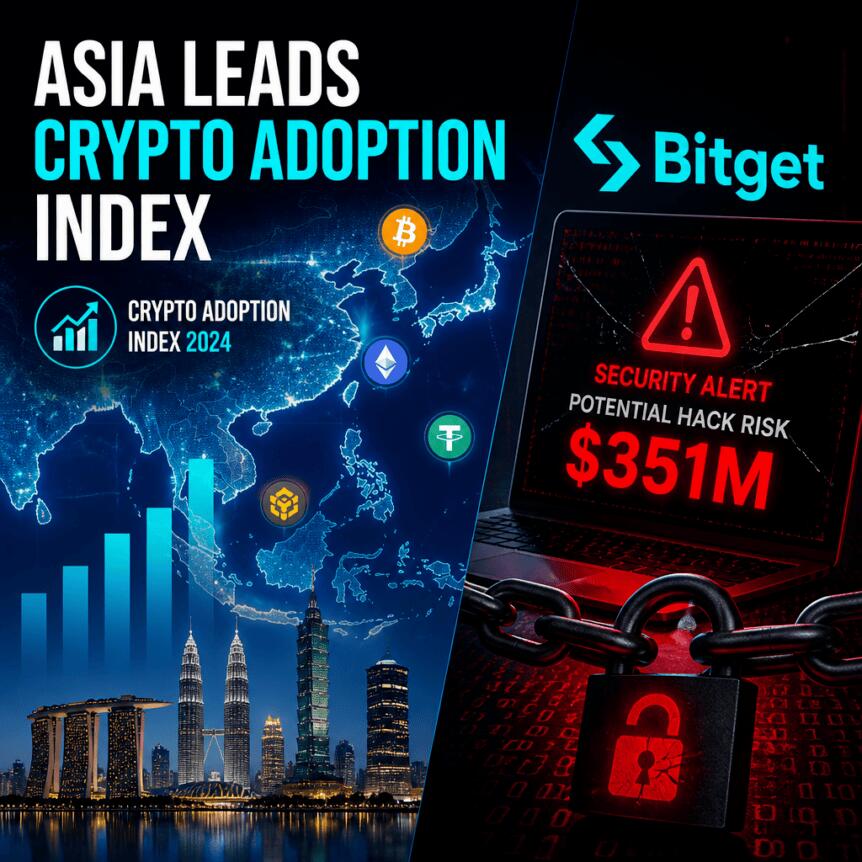
Asia’s grassroots crypto footprint remains a dominant force in the global market, according to Chainalysis’s latest 2026 Global Crypto Adoption Index. Among the 20 countries ranked for broad, on-the-ground adoption, nine are in Asia Pacific—accounting for “almost half” of the top tier.
The index also points to a notable shift in how stablecoins are being used across borders, while other parts of the region continue to grapple with exchange security, evolving financial infrastructure, and regulators testing settlement rails.
Key takeaways
- Japan, South Korea, India, Thailand, and several other APAC countries rank in the top 20 of Chainalysis’s 2026 grassroots adoption index.
- Cross-border stablecoin transfers are singled out as a key growth area in Asia, reflecting demand for faster settlement across fragmented payment systems.
- Bitget confirmed an unauthorized incident affecting about $351.6 million and paused withdrawals while investigating.
- Binance invested $100 million in Circle as part of an expanded five-year USDC partnership agreement.
- Several jurisdictions in the region are moving toward longer operating hours and new infrastructure models for settlement and tokenized finance.
APAC’s heavy weight in grassroots crypto adoption
Chainalysis reports that nine of the top 20 countries for grassroots crypto adoption are located in Asia Pacific. The ranking places Japan at #4, followed by South Korea (#5), India (#6), Thailand (#8), China (#12), Indonesia (#14), Australia (#15), Vietnam (#18), and the Philippines (#19).
The broader theme is that adoption in the region is not limited to trading activity—it extends into day-to-day behavior and payment experimentation. Chainalysis’s index frames this as “grassroots” activity, which typically emphasizes how real-world users interact with crypto rather than purely institutional flows.
Stablecoins gain traction for cross-border payments
One of the clearest operational trends highlighted for the APAC region is the rise in cross-border stablecoin transfers. Earlier coverage from Cointelegraph noted stablecoin cross-border flows increasing significantly—standing out even during broader market softness.
Cointelegraph also reported remarks from Tianwei Liu, co-founder and CEO of StraitsX, who argued that stablecoin demand in Asia has been shaped by fragmented currencies and payment systems. In his view, stablecoins are increasingly used as settlement rails—often because they can fit into payment workflows that people already rely on.
“That demand is also extending into everyday spending, with stablecoins sitting behind payment methods people already use,” Liu said.
For investors and builders, the implication is straightforward: stablecoins are starting to function less like a “side bet” on crypto markets and more like a payments primitive where speed and cross-border usability matter. The key question is whether this momentum concentrates around a small number of issuers and networks—or spreads as more payment providers integrate stablecoin rails.
Exchange security: Bitget confirms $351.6M breach and suspends withdrawals
While adoption narratives build, crypto infrastructure continues to face high-profile security tests. Cointelegraph reported that Bitget confirmed an unauthorized transfer affecting approximately $351.6 million in assets and temporarily suspended withdrawals during its investigation.
Cointelegraph also cited the exchange CEO Gracy Chen, who said the breach was contained to a portion of Bitget’s hot and warm wallet layers, while its cold wallets remained secure. Bitget said it flagged addresses associated with the transfers and contacted law enforcement and on-chain security firms.
The exchange added that the affected amount falls within its User Protection Fund, which currently holds more than $464 million.
This kind of incident matters for users even when funds are insulated, because withdrawal suspensions directly affect liquidity and confidence. It also raises the market question of how quickly major platforms can restore normal operations—and whether security reviews result in changes to custody and transaction routing beyond the specific hot-wallet layer involved.
USDC partnership expands as Binance invests $100M in Circle
On the stablecoin issuance side, Binance moved to deepen its commercial relationship with Circle. Cointelegraph reported that Binance invested $100 million in Circle as part of an expanded five-year agreement aimed at promoting USDC on Binance.
Under the expanded deal, Circle is set to pay Binance a monthly incentive fee that is based on the amount of USDC held through Circle’s Modular Smart Contract Wallet infrastructure. Binance also agreed to take on additional activities to promote USDC on its platform.
For market participants, these terms reinforce an important dynamic: stablecoin distribution increasingly depends on large exchange partnerships that can provide both liquidity and integration depth. The more such incentives align with balance growth on a platform, the more issuers and exchanges may have shared incentives around stablecoin usage—not only trading but on-platform settlement and user onboarding.
Regulatory and infrastructure experiments across Asia
Beyond exchanges and stablecoins, the region continues to test new models for financial infrastructure and settlement timelines.
In South Korea, Cointelegraph reported that the Bank of Korea (BOK) launched a pilot for a 24-hour won settlement network designed to allow foreign investors to settle won transactions outside normal South Korean banking hours. Trial operations began with four domestic lenders, with full operations planned for January 2027 and broader participation expected afterward.
In Hong Kong, the Hong Kong Monetary Authority (HKMA) outlined plans to upgrade its Central Moneymarkets Unit debt securities settlement system to run on blockchain 24/7, with the upgraded platform intended to handle CBDCs, tokenized deposits, and stablecoins.
Other developments underscored the diversity of how tokenization is being considered—from bond settlement pilots using blockchain-based allocation and payment settlement, to partnerships between payment companies and infrastructure providers to explore stablecoin opportunities.
Corporate, policy, and security signals from the wider region
Several non-market signals also shaped the regional story. In Hong Kong, Animoca Brands suspended plans for a Nasdaq reverse merger involving Nasdaq-listed Currenc Group, citing review of market conditions and deal timeline projections, while leaving room to restart talks if conditions improve.
In Saudi Arabia and China, reporting highlighted that Saudi Arabia withdrew from the China-backed mBridge CBDC project after completing a proof of concept, ending its participation following that milestone.
And across the region’s cybersecurity landscape, reporting said a North Korean cyber group targeted developers with fake job offers, infecting at least 30,000 devices across more than 100 countries and stealing cryptocurrency worth about $10.7 million.
Going forward, the most closely watched variables will likely be whether stablecoin usage continues to expand in everyday and cross-border workflows, and how quickly major platforms can convert security incidents into durable operational changes. On the policy side, developments in 24/7 settlement and blockchain-enabled financial infrastructure will be a useful barometer for how fast tokenization ideas move from pilots to mainstream operations.
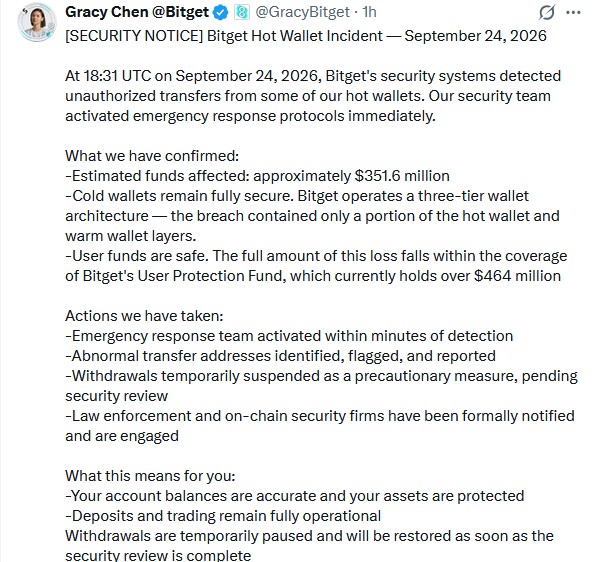
Asian countries account for almost half of Adoption Index
Almost half of the top 20 nations in terms of grassroots crypto adoption are in the Asia Pacific region. According to Chainalysis’s newly released 2026 Global Crypto Adoption Index, Japan ranks at number 4, followed by South Korea (5), India (6), Thailand (8), China (12), Indonesia (14), Australia (15), Vietnam (18) and the Philippines (19), which totals nine countries out of 20 on the index.
A big growth area in the APAC region is cross border stablecoin transfers.
Tianwei Liu, co-founder and CEO of StraitsX, told Cointelegraph that in Asia, fragmented currencies and payment systems have created demand for stablecoin settlement.
“That demand is also extending into everyday spending, with stablecoins sitting behind payment methods people already use,” Liu said.
Bitget confirms $351M security breach, suspends withdrawals
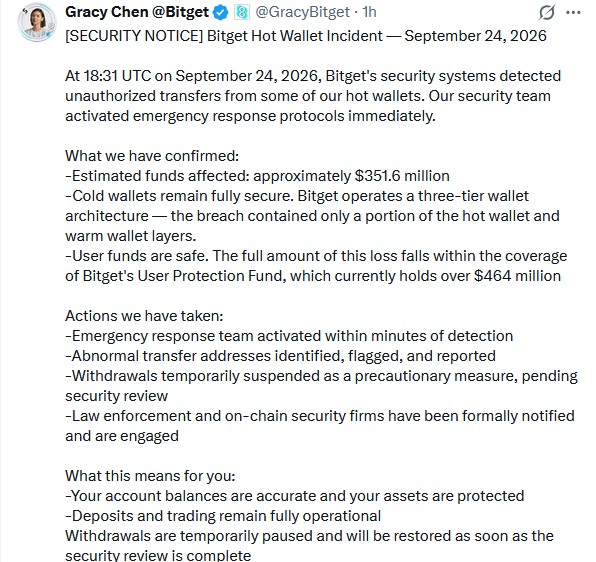
Crypto exchange Bitget has confirmed unauthorized transfers affecting approximately $351.6 million in assets and temporarily suspended withdrawals as it investigates.
The CEO of the Asia-focused exchange, Gracy Chen, said the breach was contained to a portion of the exchange’s hot and warm wallet layers, while its cold wallets remained secure.
Bitget said it has flagged addresses associated with the transfers and contacted law enforcement and onchain security firms. The amount affected falls within Bitget’s User Protection Fund, which currently holds more than $464 million.
Source: Gracy Chen
Binance takes $100M stake in Circle under expanded USDC deal
Binance has invested $100 million in stablecoin issuer Circle as part of an expanded five-year agreement to promote USDC on the crypto exchange. Under the agreement, Circle will pay Binance a monthly incentive fee based on the amount of USDC held through Circle’s Modular Smart Contract Wallet infrastructure.
Binance also agreed to undertake additional activities promoting USDC on its platform.

AUSTRALIA
Australian 40-year economic outlook recognizes ‘AI revolution,’ omits crypto
Australia’s new 40-year economic outlook has identified artificial intelligence as one of five major transitions expected to have a profound effect on the economy, while leaving out any mention of crypto.
Coinbase Australia country director John O’Loghlen told Cointelegraph the report was a missed opportunity. “While the report focuses heavily on artificial intelligence, it completely misses the financial infrastructure those agents will need,” he said.
In related news, OpenAI agents hacked the Australian government’s Medicare system, and the firm forgot to mention the incident until three months later when it fired an email to a public email address.
KOREA
Bank of Korea launches 24-hour won settlement pilot for foreign investors
The Bank of Korea (BOK) launched a pilot of its first 24-hour won settlement network, aimed at allowing foreign investors to settle won transactions outside South Korea’s normal banking hours.
On Monday, its international wire network started trial operations with four domestic lenders: KB Kookmin Bank, Woori Bank, Hana Bank and Shinhan Bank. Full operations are scheduled for January 2027, when participation is expected to expand to other institutions and foreign banks.
The network will operate 24 hours a day, excluding weekends and public holidays
Hana Bank taps Euroclear blockchain for $100M bond issuance: Report
South Korea’s Hana Bank has issued a five-year, $100 million digital bond using Euroclear’s blockchain-based platform. Using the technology for bond allocation and payment settlement reportedly shortened the process from three to five business days to the same day.
Kakao Pay, KakaoBank to explore stablecoin opportunities with Fireblocks
South Korean financial companies Kakao Pay and KakaoBank have signed a memorandum of understanding (MoU) with crypto infrastructure provider Fireblocks to explore digital asset opportunities, including stablecoins.

North Korean fake recruiters infect 30K devices, steal $10.7M in crypto
North Korean cyber group WaterPlum targeted developers with fake jobs at crypto, AI and NFT companies, infecting at least 30,000 devices across more than 100 countries.
HONG KONG
Animoca puts Currenc merger on ice, delaying its Nasdaq debut
Animoca Brands has suspended plans to take the company public through a reverse merger with Nasdaq-listed Currenc Group. Animoca is a Hong Kong-headquartered investment and gaming company whose portfolio includes The Sandbox, Moca Network and Open Campus.
Both parties mutually agreed on the decision after reviewing market conditions and the deal’s projected closing timelines. Animoca said the companies may resume discussions if conditions permit.
Hong Kong jails ex-banker over $1.6B false credit, cryptocurrency bribes
A former bank official in Hong Kong who falsely authenticated letters of credit for more than $1.6 billion was sentenced to four years in prison and ordered to make restitution of more than $470,000 he received in cryptocurrency bribes.
HKMA announces plans for on-chain settlement
The Hong Kong Monetary Authority (HKMA) is upgrading its main debt securities settlement system, the Central Moneymarkets Unit, to run on blockchain 24/7. The upgraded platform is designed to handle CBDCs, tokenized deposits and stablecoins.
Boyaa Interactive adds 152 Bitcoin, holds 4,468 BTC
Hong Kong-listed online gaming company Boyaa Interactive has bought another 152 Bitcoin to bring its total holdings to 4,468 BTC
SAUDI ARABIA/CHINA
Saudi Arabia exits China-backed mBridge CBDC project: FT
Saudi Arabia has withdrawn from mBridge, a China-backed cross-border digital currency project designed to enable direct transactions between central banks, according to the Financial Times.
SAMA, Saudi Arabia’s central bank, joined mBridge as a full participant in June 2024 and ended its participation after completing a proof of concept on May 13, 2025, FT reported, citing a statement from the central bank.
SINGAPORE
Singapore tops crypto wealth migration rankings for 4th year
Singapore ranked No. 1 for a fourth straight year on the Henley Crypto Adoption Index which assesses 36 countries based on which offers the best conditions for cryptocurrency investors to relocate and settle.
VIETNAM
56 crypto scammers arrested
Bilyonaryo reports that 56 alleged scammers working in crypto fraud ring that stole millions from Vietnamese investors have been arrested in Cambodia and Vietnam.
Cointelegraph publishes long-form journalism, analysis and narrative reporting produced by Cointelegraph’s in-house editorial team with subject-matter expertise. All articles are edited and reviewed by Cointelegraph editors in line with our editorial standards. Some articles contain affiliate links, from which Cointelegraph may earn a commission. These relationships do not influence which products we review or our editorial conclusions. Content published in here does not constitute financial, legal or investment advice. Readers should conduct their own research and consult qualified professionals where appropriate. Cointelegraph maintains full editorial independence.
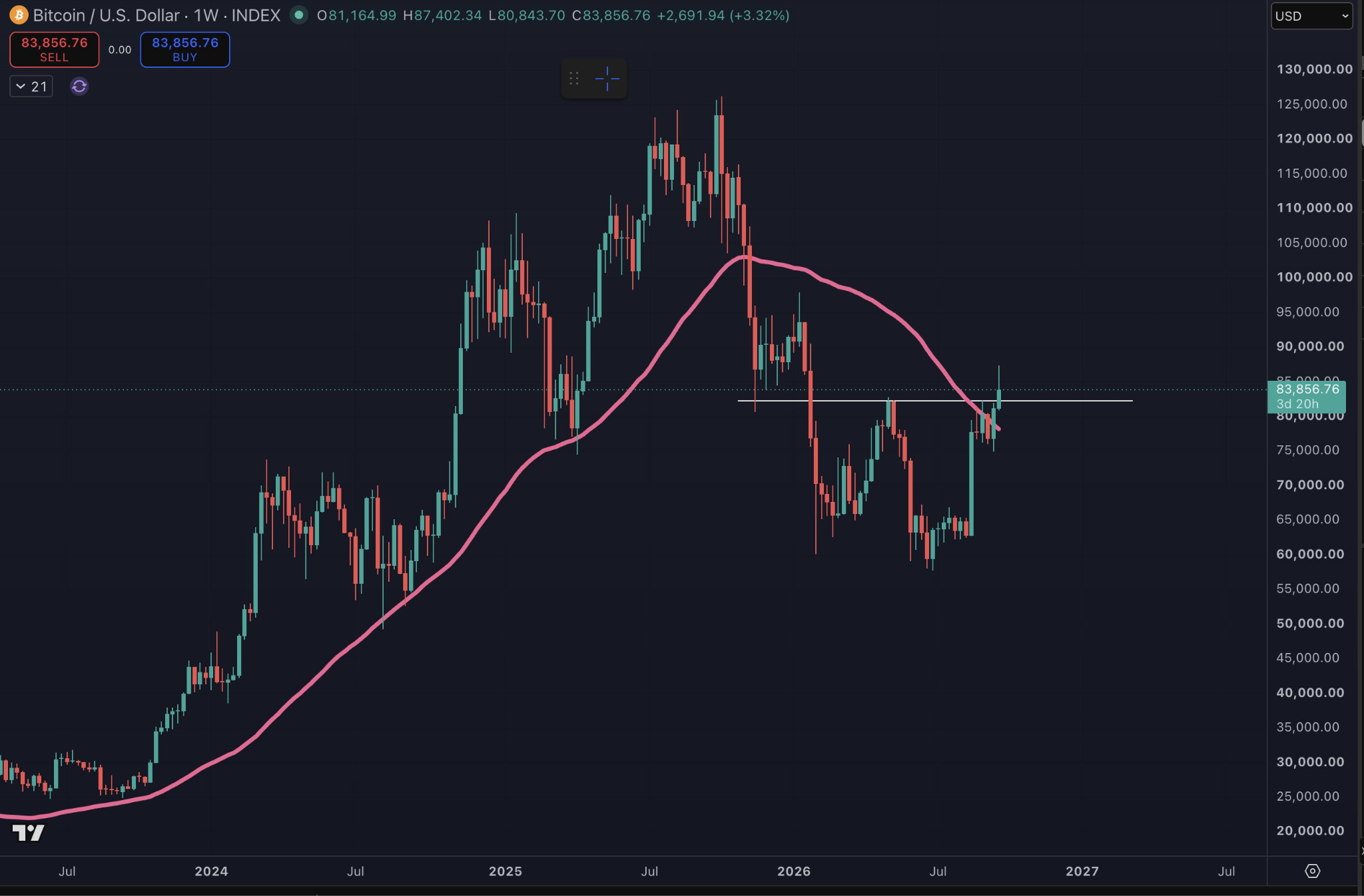
Bitcoin price currently hovers around $84,000, its highest level since January 2026. But will BTC maintain this range and trigger a breakout towards $100,000?
According to Crypto analyst Benjamin Cowen, it comes down to one candle – Bitcoin’s weekly close. A strong weekly close above $82,000 could confirm the breakout. A drop back below it could turn the move into another false start.
Note: A weekly close filters out short-lived price spikes. Traders often see it as a stronger signal than what happens during a single volatile session.

Bitcoin’s Breakout Still Has One Big Test
Cowen argues that a weekly close above the May highs, which is around $82,500, would give traders more confidence that Bitcoin has genuinely entered a new bull market.
If Bitcoin falls back below that level, the breakout could end up as a wick (a brief move higher that quickly reverses).
Macro conditions are making that test more difficult. The 10-year Treasury yield topped 5% on Wednesday, reaching its highest level in 19 years.
Meanwhile, September’s flash PMI data came in much stronger than economists expected.
Higher yields can make risk assets such as Bitcoin less attractive.
“I’m trying to be less deterministic about these outcomes… For breakout traders, I think the weekly candle is worth watching closely for either confirmation of the breakout or a failed move back into the range, particularly with rates rising into a supply shock.”
Bitcoin Is Not Predictable Anymore
This caution matters because Cowen recently admitted that his earlier call for an October cycle bottom no longer matched the market.
His latest view is therefore less about predicting Bitcoin’s next move and more about identifying the level that could settle the debate.
Trader Michaël van de Poppe sees a similarly uncertain setup. He says the recent correction may already be over, although another drop toward $81,000 remains possible.
This week’s close may give traders the clearest answer yet on whether Bitcoin has broken out or simply teased another rally.
The post Will Bitcoin Price Breakout Towards $100,000? One Candle Will Decide This Week appeared first on BeInCrypto.
The Solana Foundation has appointed former Binance executive Rachel Conlan as chief strategy officer and Polygon Labs veteran Jamal Raees as general manager of payments as the network builds out its institutional and payment business after processing more than $5 trillion in stablecoin volume this year.
Summary
- Solana Foundation appointed Rachel Conlan as strategy chief and Jamal Raees as general manager of payments.
- Conlan will oversee institutional partnerships and ecosystem growth, while Raees will focus on payment companies and enterprises.
- Solana has processed more than $5 trillion in stablecoin volume this year, while real world assets have surpassed $4.5 billion.
According to the Solana Foundation, Conlan will lead strategy covering institutional partnerships, ecosystem growth and efforts to bring more companies and users onto Solana, while Raees will work with payment firms and enterprises seeking to use the network as payment infrastructure.
Conlan spent three years at Binance, where she served as global chief marketing officer, after earlier senior roles at OKX, CAA Sports and Havas. Raees joins from Polygon Labs and previously worked at stablecoin infrastructure company Bridge and payments company Wyre.
The appointments put separate executives in charge of two areas where the foundation has spent much of 2026 building partnerships: institutional finance and payments.
“The Solana ecosystem is growing in both scale and ambition,” Solana Foundation President Lily Liu said.
Liu described the current period as the early stages of a “Token Supercycle,” a term the foundation uses for the long term migration of money, assets and ownership onto internet based infrastructure.
Solana has processed more than $5 trillion in stablecoin volume during 2026, according to figures provided by the foundation. Real world assets on the network have passed $4.5 billion, while tokenized equity supply has crossed $620 million.
Solana Foundation puts institutional adoption under Conlan
Conlan’s role will cover the foundation’s institutional strategy as more financial companies test or deploy products on Solana.
“What brought me to Solana was the ambition of the builders and how much it is already being put to use,” Conlan said.
She said her work would include building institutional relationships and helping businesses move “from interest to implementation.”
Her appointment comes after several institutional projects brought tokenized securities, funds and other financial assets onto the network.
Solana attracted roughly $348 million in net distributed real world asset flows over a 30 day period measured in early September, while the value of distributed RWAs on the network reached approximately $4.23 billion, crypto.news previously reported. The network hosted products from firms including BlackRock, Franklin Templeton, VanEck, Circle, Ondo Finance and WisdomTree.
Tokenized equities have become another part of that activity. Ondo Finance brought hundreds of tokenized U.S. stocks and exchange traded funds to Solana earlier this year, while other asset managers have used the network for tokenized Treasury and investment products.
Institutional adoption has expanded outside the U.S. as well. SBI Global Asset Management and DigiFT launched a tokenized Japanese equity fund on Solana in July. The SBI Japan High Dividend Equity Strategy Token gives eligible institutional and accredited investors blockchain based access to a Japanese high dividend equity strategy.
Payments become a dedicated Solana leadership role
Raees will focus on payment companies, enterprises and ecosystem participants building payment services around Solana.
“Payments are one of the clearest areas where blockchain infrastructure is moving from promise to production,” Raees said.
He pointed to Solana’s performance, reliability and developer ecosystem as areas that could support payment services at global scale.
The foundation has spent much of 2026 building infrastructure and partnerships around stablecoin settlement and payments.
In March, it launched a developer platform designed for financial institutions and enterprises working with stablecoins, tokenized assets and payment flows. Mastercard, Western Union and Worldpay joined as early users, with the platform covering use cases including stablecoin settlement, merchant payments and cross border transfers.
Issuance and payments modules were available at launch, while a trading module covering atomic swaps, vaults and onchain foreign exchange was planned for later in 2026. The foundation brought together more than 20 infrastructure providers across wallets, compliance, node infrastructure and payment ramps for the platform.
MoneyGram later became a Solana validator and joined the same institutional developer platform as part of its blockchain payments strategy. The payments company was already developing stablecoin based transfer services and operating validator infrastructure across several blockchain networks.
Payment trials have reached Asian markets as well. South Korean payment processor KSNet and the Solana Foundation began testing Solana Pay for merchant payments, with the companies planning to examine commercialization models after technical validation. Shinhan Card separately worked with the foundation on a stablecoin payment proof of concept using Solana’s testnet.
Solana expands institutional work in Japan
Japan has become another part of the foundation’s institutional strategy following a partnership with SBI Holdings announced in July.
Under the agreement, the Solana Foundation joined SBI R3 Japan alongside SBI Holdings and Sumitomo Mitsui Financial Group, with plans for the company to operate under the SBI Solana Global name following the required corporate process.
The SBI Solana partnership covers stablecoins, tokenized assets, cross border payments and institutional onchain services. Payment systems for AI agents were listed among the planned business areas, although the partners did not provide launch dates for individual products when the venture was announced.
SBI’s work with Solana soon expanded into tokenized securities. Its asset management arm launched the JX token with DigiFT, while SBI later partnered with Ondo Finance to bring tokenized Japanese stocks into its financial ecosystem and use its yen backed JPYSC stablecoin for settlement and collateral.
The foundation has pursued another payment model at the intersection of stablecoins and artificial intelligence.
In May, Solana Foundation and Google Cloud rolled out Pay.sh, a payment gateway that lets AI agents use stablecoins to pay for individual API requests. The system allows agents to access services including Gemini, BigQuery and Vertex AI through a Solana wallet without relying on a conventional subscription for each service.
Pay.sh was designed to support payments as small as fractions of a cent and uses an API proxy on Google Cloud, with the Solana wallet functioning as both a payment and identity layer. More than 50 community API providers were supported when the service was introduced.
Conlan and Raees join a foundation leadership team that has added other senior executives during 2026. Michael Coates became chief information security officer earlier this year after holding senior security roles at Mozilla and Twitter, according to the foundation.

Miller-Uibo named international ambassador for 2026 Delhi Half Marathon | Other Sports News

Square adds Apple Business integration

OWN THIS MUCH XRP? YOU COULD ALREADY BE IN THE TOP 1%!




-

 Fashion6 days ago
Weekend Open Thread: Talbots – Corporette.com
-

 Tech4 days ago
Researchers escape OpenAI Codex sandbox to run commands on host
-

 Crypto World2 days ago
Goldman Sachs and Deutsche Bank Agree: The S&P 500 Rally Isn't Over
-

 Fashion13 hours ago
8 iPhone Accessories That Add Personality
-

 Crypto World4 days ago
Who Needs CLARITY Anyway? ARB Could See 70X Increase: Hodler’s Digest
-

 Crypto World6 days ago
Circle launches Arc Studio AI agent for building onchain apps
-
 NewsBeat6 days ago
Trump says US has reached an agreement to take permanent control of Greenland’s security
-

 Crypto World6 days ago
Trading Bitcoin on Robinhood? Why 2% Spread Has Traders Worried
-

 Crypto World6 days ago
Bitcoin price breaks channel as RSI climbs to 63
-

 Tech5 days ago
Trump suggests rebranding AI with a new name, says he’s also creating an AI Force
-

 Business4 days ago
Analog Devices (ADI) Bets $1.35 Billion on Chips that Let Machines Think for Themselves
-

 Tech3 days ago
Google’s $899 Googlebook is a bet that you’ll buy a new laptop for Gemini
-

 Crypto World4 days ago
Coinbase, Robinhood, Circle Seen as Tokenized-Stock Winners
-
 Business2 days ago
Oil Price Today (September 23): Crude oil below $100 on hopes of US-Iran talks. What did Trump say?
-
 Crypto World2 days ago
Trump-Xi Polymarket Odds for Handshake Hit 50%
-

 Crypto World6 days ago
World Money launches in 150+ countries with Stripe
-

 Crypto World7 days ago
Silver prices recover quickly, hitting weekly high today
-

 Crypto World2 days ago
This Bearish Netflix Stock Trade Can Cash In On Video Streaming Giant’s Woes
-

 Crypto World1 day ago
Bitcoin Threatens Sub-$84,000 Breakdown as Long Liquidations Spike
-

 Crypto World1 day ago
Crude Oil Prices Pressured by Diplomatic Hopes in the Middle East
You must be logged in to post a comment Login