

Crypto World
OpenAI Secures $4B in Funding to Launch Enterprise-Focused AI Deployment Firm


Key Highlights
- The Deployment Company has secured more than $4B in initial funding from OpenAI and strategic investors
- The new enterprise-focused venture carries a $10B valuation before the capital injection
- OpenAI retains majority ownership and operational control of the newly formed entity
- The partnership provides direct access to a network exceeding 2,000 enterprise clients
- Competitor Anthropic is exploring similar partnerships with private equity backers
In a significant move to expand its corporate footprint, OpenAI has secured over $4 billion in funding for The Deployment Company, a newly established venture designed to accelerate AI technology adoption among enterprise clients. The initiative carries a pre-money valuation of $10 billion.
A consortium of 19 investment firms has committed capital to the venture. Key participants include TPG, Brookfield Asset Management, Advent, Bain Capital, Dragoneer Investment Group, and SoftBank Group.
The AI pioneer will maintain majority ownership and strategic oversight of The Deployment Company. OpenAI has yet to disclose comprehensive details regarding the partnership structure publicly.
The fundamental objective extends beyond conventional software licensing. OpenAI aims to facilitate practical integration of its AI capabilities into routine business operations across various industries.
Priority verticals encompass financial services, healthcare systems, software development, sales operations, and customer support functions. These sectors present immediate opportunities for measurable AI implementation.
Strategic Access to Enterprise Markets
The investment consortium brings established relationships with over 2,000 companies spanning multiple industries. OpenAI intends to leverage these connections to penetrate the enterprise market more effectively.
This strategic alliance provides OpenAI with an organized distribution framework previously absent from its business model. Instead of pursuing individual client relationships, the company can now operate through partners with established corporate networks.
Brad Lightcap, OpenAI’s Chief Operating Officer, recently transitioned to an expanded position overseeing strategic initiatives. His responsibilities now include directing the company’s enterprise sales efforts through this collaborative venture.
Lightcap’s reporting structure has been modified to establish a direct line to CEO Sam Altman. This organizational change was communicated to stakeholders last month.
Anthropic Pursues Comparable Enterprise Strategy
OpenAI’s approach is not unique within the competitive AI landscape. Anthropic is currently negotiating with private equity organizations to establish a parallel joint venture for distributing its Claude AI platform.
Both organizations are aggressively pursuing expansion in the enterprise segment. Their target markets overlap significantly, with particular emphasis on financial institutions and healthcare providers.
The competition for corporate customers is intensifying as both companies evaluate potential paths to public markets, with IPOs potentially materializing within the current calendar year.
Microsoft remains a significant stakeholder and strategic partner in OpenAI’s commercial initiatives. The Deployment Company represents a distinct effort specifically engineered for enterprise-level implementation.
The venture’s organizational structure enables OpenAI to expand its business operations efficiently without the overhead of developing each client partnership independently.
As of Monday evening, neither TPG nor OpenAI representatives had provided responses to inquiries regarding specific terms of the arrangement.




Ray Dalio has warned that the AI investment boom could break when investors need real cash, not when the technology itself disappoints.
Summary
- Ray Dalio warned that the AI bubble could burst when investors are forced to turn wealth into cash.
- Bridgewater estimated major technology companies could spend $650 billion on AI infrastructure in 2026 alone.
- Dalio linked the risk to debt pressure, tax debates, fund redemptions, and potential disruptions to Taiwan chip exports.
Bloomberg reported that the founder of Bridgewater Associates issued the warning during a television interview, in which he argued that bubbles often end when holders of valuable assets are forced to convert paper gains into spendable money. Dalio said the danger posed by artificial intelligence lies less in the quality of the technology and more in how financial markets fund fast-growing wealth.
According to Dalio, investors often confuse wealth with money. A private company may gain a billion-dollar valuation after raising a much smaller amount of capital, yet that valuation cannot be spent unless shares are sold. In his view, the pressure begins when many holders simultaneously try to convert that wealth into cash.
Dalio flags cash risk behind AI boom
During the Bloomberg interview, Dalio said major technology changes usually create bubbles because investors struggle to value the opportunity correctly. He said companies often spend heavily to win market share, even before the final winners are clear.
Bridgewater estimated that Alphabet, Amazon, Meta, and Microsoft could spend about $650 billion on AI infrastructure in 2026. The firm compared that with roughly $410 billion in 2025, showing how much large technology companies may commit to data centers, chips, and related systems.
Dalio tied that investment scale to a fragile market setup. He said paper wealth can rise much faster than the money supply, leaving investors exposed when debt payments, tax bills, or fund withdrawals force them to sell.
Government debt adds to the strain
In the same interview, Dalio connected the AI bubble risk to pressure on the U.S. government balance sheet. He said the United States spends about $7 trillion while collecting about $5 trillion in revenue, leaving the government dependent on additional borrowing.
Dalio said that heavy borrowing can strain the bond market, especially when long-term rates rise against short-term rates. He has made similar arguments in past warnings about debt, inflation, and the global monetary system.
His bubble indicators, according to Dalio, now sit near levels seen before the 2000 dot-com crash and the 1929 market collapse. He did not frame that as a reason for immediate panic, but he said investors should prepare for weaker returns.
Election timing could raise market tension
Dalio also pointed to a sensitive political window after the midterm elections and before the next presidential vote. He said tax debates during that period could pressure wealthy investors if policymakers push for changes that require asset sales.
At the same time, Dalio said that outside shocks could accelerate a downturn. He warned that any halt in chip exports from Taiwan would hit AI stocks hard because many AI companies depend on an advanced semiconductor supply.
Dalio’s argument also reaches crypto markets, where investors often hold assets whose value depends on liquidity. Bloomberg noted that Dalio still prefers Bitcoin, which he has described as digital gold, over cash.


Deel, the global payroll and compliance platform serving 40,000 businesses and 1.5 million workers across 150-plus countries, has tapped Stripe's full crypto-infrastructure stack to launch DLUSD, a USD-denominated stablecoin balance contractors can hold, earn rewards on, and spend without leaving… Read the full story at The Defiant

In a sign of growing political muscle for crypto-friendly groups, Democratic and Republican candidates across California, New Jersey, and South Dakota benefited from targeted media buys financed by industry-backed political action committees (PACs). The campaigns underscore how crypto advocacy outfits are weaving into the U.S. election landscape, backing candidates who promise clearer guardrails for the industry and, in some cases, sharper pro-crypto stances.
Key takeaways
- Crypto-aligned PACs spent about $3.5 million on media buys to support California primary candidates, amplifying a coordinated messaging effort in a high-stakes race.
- Fairshake, a PAC backed largely by Coinbase and Ripple, finances these efforts and reported a war chest of roughly $193 million in January, signaling substantial long-term political ambitions.
- Maryland’s June primary in the 5th Congressional district could become a new focal point, with Protect Progress reporting more than $3.1 million in activity supporting a Democratic contender as of midweek.
- Defend Developers, a new hybrid PAC aimed at defending “incumbent members who champion developer protections and crypto builders,” launched with a roster of industry executives but has yet to show reported fundraising activity with the FEC.
Crypto advocacy groups tilt messaging in California primaries
California’s congressional primaries began shaping as a testing ground for crypto-friendly messaging and financier-backed political action. Several Democratic candidates—Jacqui Irwin, Ted Lieu, Zoe Lofgren, Dave Min, Mike McGuire, Hilda Solis, George Whitesides, Lou Correa, and Lateefah Simon—advanced to their party’s nominations, while in New Jersey, Democrat Rob Menendez won a primary for the 8th Congressional District and Republican Mike Rounds secured a primary win in South Dakota for a Senate seat. The results were reported in coverage of the day’s primary outcomes.
The coordinated push appears to have roots in the Protect Progress and Defend American Jobs PACs, which together spent roughly $3.5 million on media buys to back these candidates. The groups are affiliated with Fairshake, a PAC funded predominantly by major crypto firms, including Coinbase and Ripple. In January, Fairshake reported a war chest of about $193 million, underscoring the scale of financial backing behind these political efforts.
“America needs members of Congress who will act to lay out responsible guardrails for the community to maintain our global leadership,” Fairshake spokesperson Geoff Vetter told Cointelegraph, framing the activity as a bid to establish clear, constructive policy parameters for the industry.
The California effort followed prior coverage of crypto-backed media buys in Texas primary contests, which Cointelegraph noted last week. There, Democratic and Republican candidates aligned with the broader crypto-influenced advocacy play seen in California, signaling a broader, national effort to shape the policy environment ahead of the 2026 midterms. The Texas result highlighted that several beneficiaries had publicly supported pro-crypto legislation, such as measures like the GENIUS Act or other industry-friendly policy positions.
From Maryland to Texas: a broader campaign cycle
Looking beyond California, Maryland has emerged as a potential next focal point for Fairshake and its allies. Federal Election Commission filings indicated that Protect Progress spent more than $3.1 million as of midweek to support Democratic candidate Adrian Boafo in Maryland’s 5th Congressional district, where a primary is set for June 23. The data suggest a continued push to use media to shape outcomes in key races ahead of national elections.
The coordinated approach across states illustrates how crypto-focused groups are attempting to place friendly legislators into office who can articulate regulatory approaches favorable to the industry—whether through explicit pro-crypto votes or through crafting the policy context that governs digital assets in the United States.
Defend Developers: a new, developer-focused PAC
In a separate development, industry stakeholders unveiled Defend Developers, a hybrid PAC designed to back incumbent lawmakers who actively champion protections for developers and crypto builders. The group said its mission centers on clarifying the regulatory environment while legislation and rulemaking catch up with rapid technical innovation. Its board of directors features leaders from notable crypto policy and ecosystem organizations, including the DeFi Education Fund, Orca Creative, the Solana Policy Institute, and Uniswap Labs.
“For too long, developers building decentralized technologies have faced regulatory uncertainty and enforcement actions instead of clear rules and guidelines,” said Defend Developers founder Gavin Zavatone. “While legislation and rulemakings are being written as we speak, for some policymakers there is limited incentive to understand the fundamental nature of software development.”
No official fundraising data for Defend Developers had appeared on the FEC portal as of Wednesday. The PAC’s statement of organization listed Nick Stoltzfus, co-CEO of on-chain student loan platform Stratofied, as treasurer and custodian of records as of May 15. Cointelegraph reached out to Defend Developers for comment but did not receive an immediate reply. The lack of visible funding activity suggests the group may still be in an early-stage or exploratory phase as it positions itself for the 2026 midterms.
These developments sit at the intersection of campaign finance, technology policy, and how the crypto industry seeks to influence lawmakers. They also raise questions about transparency and the effectiveness of such advocacy in shaping legislation that affects developers, exchanges, and users nationwide. While the public data points to increasing activity, the true impact on policy outcomes remains to be seen, and readers should watch how the midterm races unfold and how regulators respond to evolving political spending.
As the cycle progresses, investors, users, and builders will want to monitor whether these PACs translate funding into tangible policy wins, particularly around how the US approaches digital assets, custody, staking, and on-chain governance. The next major milestones are forthcoming primary results, FEC disclosures, and any formal policy proposals or bills that emerge from the committees most closely tied to technology and financial regulation.
Crypto World
Tom Lee’s Bitmine (BMNR) to offer preferred stock with 9.5%, following Strategy’s playbook
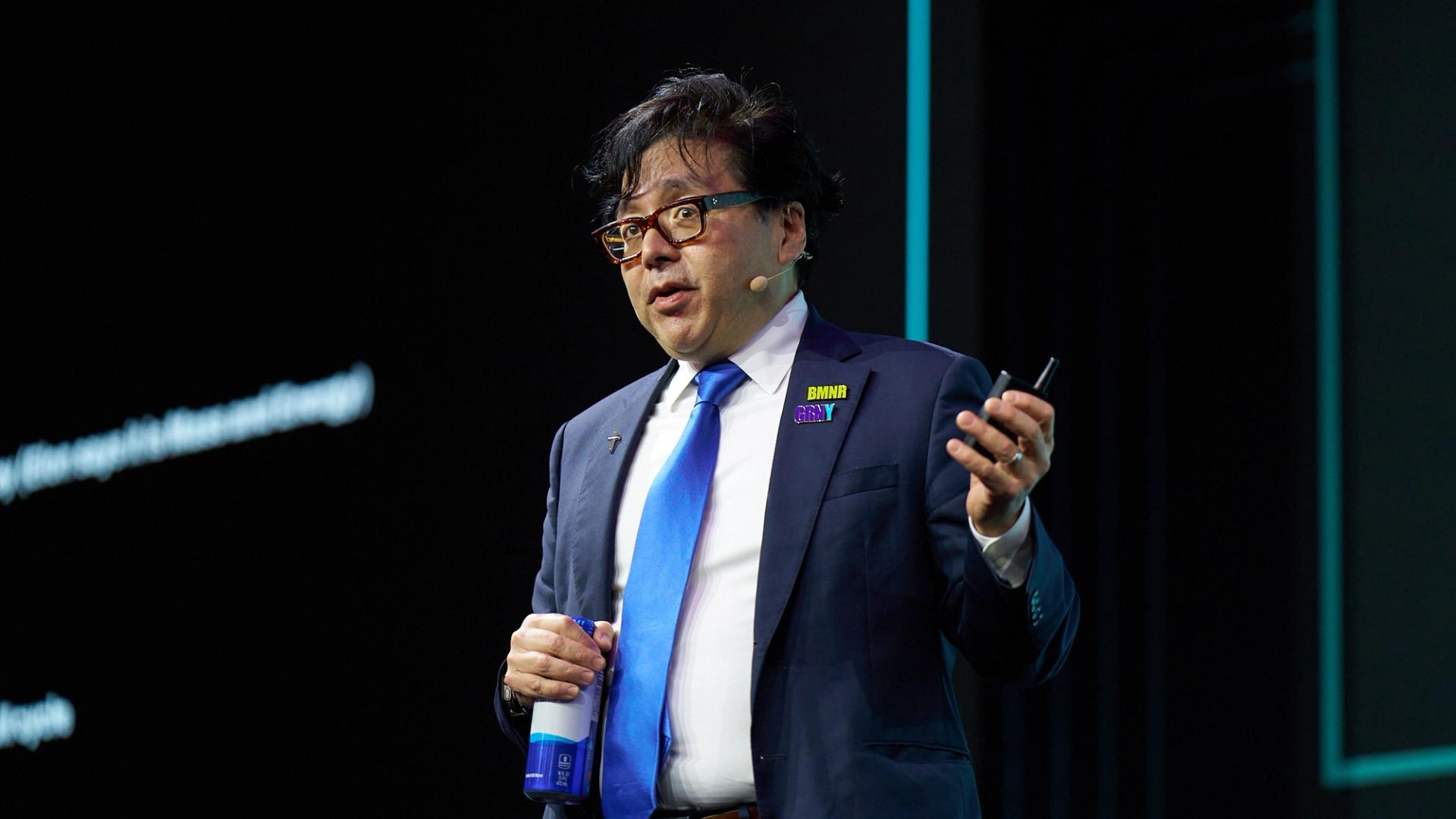
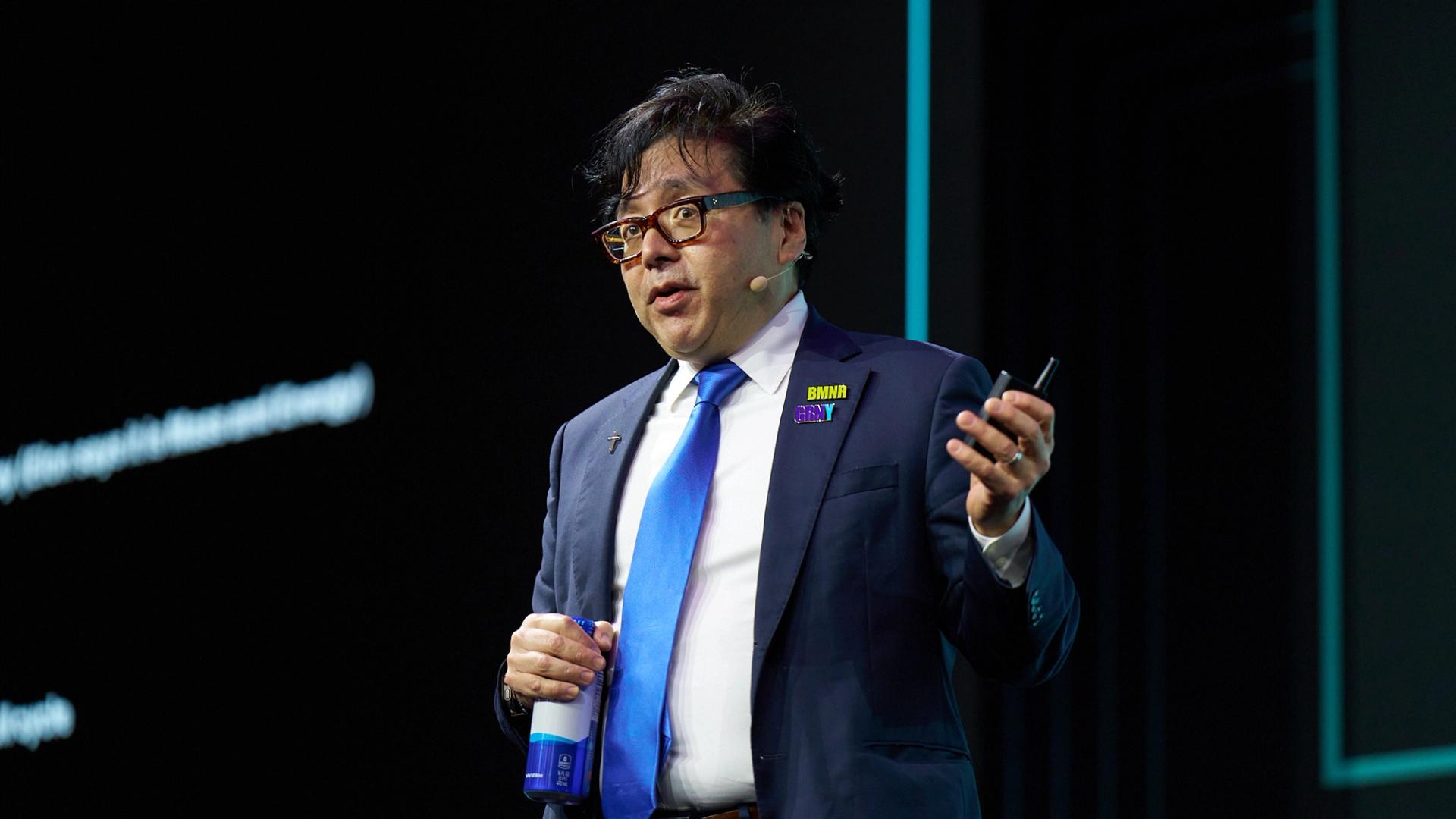
BitMine Immersion Technologies (BMNR), an Ethereum treasury company led by Fundstrat co-founder Tom Lee, is borrowing a page from Strategy’s financing playbook and launching a $300 million preferred stock offering as crypto treasury firms search for new ways to secure funding.
According to a Wednesday filing with the U.S. Securities and Exchange Commission (SEC), the company is offering 3 million shares of its Series A Perpetual Preferred Stock at a stated value of $100 per share. The securities carry a 9.5% annual dividend rate, with dividends paid weekly in cash if declared by the company’s board.
The preferred shares will be listed on the New York Stock Exchange (NYSE) under the ticker BMNP, subject to approval, BitMine said.
The offering comes as digital asset treasury firms, recently under pressure from the downturn in crypto prices, explore new funding sources. Strategy (MSTR), the largest corporate holder of bitcoin, introduced various classes of preferred equities. Bitcoin treasury peers Strive (ASST) and Metaplanet also issued dividend-paying preferred stocks.
Bitmine is aiming to bring that playbook to its Ethereum treasury strategy, according to the filing.
The firm has been among the most aggressive buyers in the sector, accumulating more than 5.3 million ETH worth roughly $10 billion and controlling about 4.5% of Ethereum’s circulating supply over the past year. That ETH bet is currently sitting at an estimated $9 billion unrealized loss as ETH prices fell below $1,800 from around $5,000 in October.
Bitmine’s preferred stock can be redeemed by the company at premiums ranging from 10% to 0% depending on when the redemption occurs. Holders will also have repurchase rights if certain fundamental corporate changes occur. The filing did not specify how BitMine intends to use the proceeds.
The timing is notable given the growing pressure on Strategy’s preferred equity funding model. The firm’s STRC preferred stock fell 5% below its $100 par value on Wednesday as investors debate whether the company can comfortably maintain its dividend payments while bitcoin prices slide.


Politicians in Argentina have called for the government agency probing the LIBRA scandal to be handed more resources after it was discovered that its free crypto tracking software has expired and not been renewed.
According to La Nación, four parliamentarians who originally contributed to a LIBRA investigative committee have called for Argentina’s Attorney General, Eduardo Casal, to allocate more resources to the Specialized Cybercrime Prosecutor’s Unit (UFECI).
This is upon the discovery that the UFECI is lacking the resources and technical licenses to carry out its LIBRA cryptocurrency tracing.
When federal prosecutor Eduardo Taiano called for the UFECI investigation, the body was able to trace 74 digital wallets collectively buying $13 million worth of LIBRA before the token’s promotion by Argentine President Javier Milei.
Read more: US judge won’t restrict LIBRA funds as new trust site emerges
However, La Nación sources claim that the UFECI was dependent on a free trial for its LIBRA tracing that has since expired and not been renewed.
The investigatory body revealed the issue eight months after Taiano called for the probe.
Sources claimed that the Attorney General’s Office was working on restoring the software license, but that there has been a significant “budget cut” and still no renewal of any subscription.
Expired software casts doubt over LIBRA probe’s efficiency
Parliamentarians Maximiliano Ferraro, Mónica Frade, Sabrina Selva, and Juan Marino, subsequently warned that a lack of resources “would pose a serious obstacle to clarifying the facts under investigation and could result in an effective denial of justice.”
On X, Civic Coalition ARI leader Ferraro criticised Taiano’s approach to the agency’s delays and claimed that they will lead to “impunity.”
Read more: Javier Milei disbands crypto unit he set up to investigate himself
He said today, “Taiano has known that the UFECI cannot carry out the expert analyses he himself ordered on the crypto wallets linked to the $LIBRQ case due to a lack of resources and technological tools.”
He added that the probe’s slow pace, “with no interrogations, no witness testimonies, with delayed evidentiary measures and unfinished expert reports,” is making it “easier for potential defendants to coordinate stories, hide information, alter records or relevant evidence.”
Ferraro, Frade, Selva, and Marino joined four other politicians last April in accusing Taiano of misconduct and an unjustified “sequence of delays.”
Earlier this year, a report led by the Public Prosecutor’s Office discovered confidential blockchain advisory draft agreements between Libra co-creator Hayden Davis and Milei.
Last December, a US judge refused to bar millions of LIBRA-linked funds from anonymization and conversion into privacy-focused cryptocurrencies.
Minutes before this hearing took place, the Libra Trust website went live. Blockworks researcher Fernando Molina noted that the site was created five days after a prior freezing order was lifted, and once redirected users to a “pure nudism” blog.
Got a tip? Send us an email securely via Protos Leaks. For more informed news and investigations, follow us on X, Bluesky, and Google News, or subscribe to our YouTube channel.

[PRESS RELEASE – Mexico City, Mexico, June 3rd, 2026]
The international crypto entertainment platform 1win has announced the addition of Ilia Topuria to its VIP community. The signing of the contract with the fighter became publicly known on June 2, 2026.
Topuria becomes a new member of the global 1win VIP Community, the brand’s exclusive project that brings together prominent figures from sports, music, and entertainment industries. One of the most dominant fighters of his generation, Topuria remains undefeated with a professional MMA record of 17 wins and 0 losses. His excellence in sport will become a unique asset and source of inspiration for other 1win members.
The collaboration between a globally recognized brand and one of MMA’s most unstoppable fighters promises exclusive moments for fans, a closer look into the lifestyle of a true 1win VIP member, and a wave of premium entertaining content for international audiences. The expansion of the project highlights the international scale of the initiative and further strengthens 1win’s position as a brand operating at the intersection of sports, digital culture, and entertainment. Previously, famous rapper Tyga had also joined the VIP community.
On June 14, Topuria takes part in one of the year’s most highly anticipated fights – UFC Freedom 250 – a bout against Justin Gaethje that will take place during the UFC tournament at the White House. The upcoming fight has already generated significant attention from the MMA community and sports media worldwide.
1win is also widely known for its collaborations with MMA representatives and professionals in the sports industry. The brand’s ambassadors include legendary UFC fighter Jon Jones, Olympic champion and UFC fighter Gable Steveson, and Latin American athlete Ignacio Bahamondes.
About 1win
Founded in 2016, 1win is a crypto-focused platform in the global gaming industry. Operating across Asia, Latin America, and Africa, 1win offers a wide range of entertainment products adapted to regional audiences. The brand has active collaborations with international public figures, including actor Johnny Sins, martial artist Jon Jones, and Olympic champion and UFC fighter Gable Steveson. In 2026, 1win welcomed American rapper Tyga as a new member of the 1win VIP community.
The post Crypto Platform 1win Welcomes Ilia Topuria as the 1win VIP Community Member appeared first on CryptoPotato.

The US Department of the Treasury’s Office of Foreign Assets Control (OFAC) has sanctioned Nobitex, Iran’s largest digital asset exchange, along with three other Iranian crypto exchanges. The move is part of the Donald Trump administration’s Economic Fury campaign aimed at increasing economic pressure on Tehran.
The Treasury’s sanctions apply to Nobitex, Wallex, Bitpin, and Ramzinex. US officials allege that these exchanges helped users bypass sanctions, facilitated financial activity connected to Iran, and processed transactions linked to the Islamic Revolutionary Guard Corps (IRGC).
Terror Finance and Sanctions Evasion Risks
In an official statement this week, Treasury Secretary Scott Bessent claimed that Iran has increasingly used digital asset technologies to advance its “corrupt agenda,” including circumventing sanctions and transferring wealth outside the country. He added that Treasury would continue tracking financial activity through both traditional banking channels and digital assets as part of the administration’s broader effort to prevent Iran from developing a nuclear weapon.
According to Treasury, Nobitex processed more than 50% of all Iranian digital asset inflows in 2025 and played a central role in the country’s crypto ecosystem. The agency alleged that the exchange facilitated payments linked to Iran’s terrorist activities, sanctions evasion efforts, and IRGC-related transactions, including activity involving IRGC-affiliated ransomware actors. Treasury also accused Nobitex of helping the Central Bank of Iran access hundreds of millions of dollars in stablecoins used to support the Iranian rial and enabling regime insiders to access international crypto exchanges across multiple jurisdictions.
Treasury said Nobitex helped protect and move assets out of the country despite internet blackouts from the very start of the war. In addition to sanctioning the exchange, OFAC designated Amir Hossein Rad, Nobitex’s chairman, co-founder, and former CEO, along with several other company leaders and officials.
According to their findings, Rad helped restore Nobitex’s operations after the platform suffered a $90 million hack in June 2025.
The agency also sanctioned Nobitex co-founders Seyed Mohammad Ali Aghamir Mohammad Ali and Seyed Mohammad Aghamir Mohammad Ali, both members of the Kharrazi family, which Treasury described as part of Supreme Leader Mojtaba Khamenei’s inner circle. Current Nobitex CEO Seyed Ali Khoee was also designated.
Wallex, Bitpin, and Ramzinex Also Targeted
Meanwhile, Wallex, identified as Iran’s second-largest digital asset exchange by volume, was said to have received 12% of Iranian digital asset inflows in 2025 and allegedly facilitated transactions linked to the IRGC. Bitpin accounted for 10% of Iranian digital asset inflows in 2025 and processed millions of dollars in transactions, including transfers allegedly connected to the IRGC, while some of its investors have reportedly been linked to efforts to evade US sanctions.
Ramzinex, a Tehran-based exchange founded in 2018, has processed more than $2.45 billion in transactions and allegedly facilitated transactions linked to the IRGC and an Iranian government-backed financial institution.
The post US Sanctions Iran’s Largest Crypto Exchange Nobitex in Major ‘Economic Fury’ Crackdown appeared first on CryptoPotato.
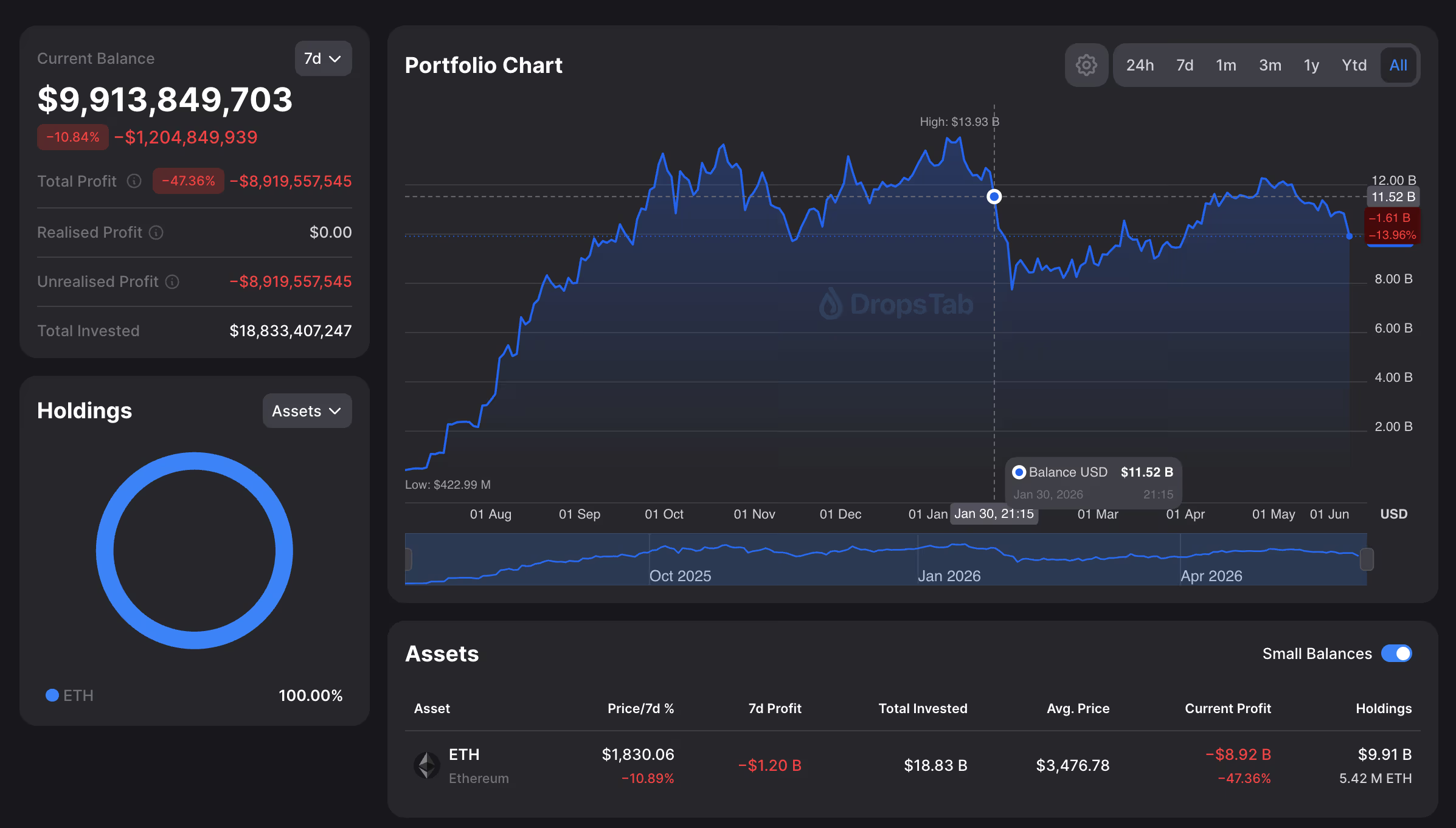
Bitmine Immersion Technologies (BMNR), the largest corporate holder of ether (ETH), is staring at nearly $9 billion in losses as the token’s slide below $1,800 drags down the value of its massive treasury.
Shares of the Tom Lee-chaired company fell another 5.9% Wednesday, slipping below $17 and extending their decline to 28% since early May. The stock has now dropped below its February lows to its weakest level since the company announced its pivot to an Ethereum treasury strategy in 2025.
The selloff comes as ETH retests its February lows. The second-largest cryptocurrency has lost more than 20% since early May, when Lee, Fundstrat’s co-founder and BitMine’s chairman, argued that the market’s “mini crypto winter” had likely ended and a new “crypto spring” had begun.
Under Lee’s leadership, Bitmine has amassed more than 5.4 million ETH, or roughly 4.5% of Ethereum’s circulating supply, in roughly a year. That position is worth about $10 billion at current prices.
Those holdings, however, are now deeply underwater, carrying an estimated $8.9 billion in unrealized losses, according to data collected by DropsTab.

Digital asset treasuries under pressure
Bitmine’s drawdown highlights renewed pressure across the digital asset treasury sector, where companies seek to replicate the playbook pioneered by Michael Saylor’s MicroStrategy (MSTR): raise capital through public markets and use the proceeds to accumulate crypto.
That model has become increasingly harder to sustain as crypto prices weakened and many treasury stocks drifted below the value of their underlying assets.
Strategy itself recently disclosed its first bitcoin sale since 2022, sparking debate about how the company might fund future obligations tied to its preferred stock offerings.
Read more: Saylor’s Strategy sold bitcoin for the first time since 2022. These firms are still buying
Bitmine’s situation differs in some key respects. The company financed its ether purchases primarily through equity issuance rather than debt, leaving it without the leverage concerns and interest payments that some treasury peers face.
The company also generates revenue from staking its ETH and operating its staking service MAVAN. Bitmine said it has staked more than 4.7 million ETH — about 87% of its holdings — and recently estimated annualized staking revenue at roughly $276 million.
Lee calls for $250,000 ETH
The recent price action has not tempered Lee’s long-term outlook.
Speaking at the Proof of Talk conference in Paris earlier this week, he said ETH could eventually reach $250,000 as tokenization, AI-driven transactions and corporate staking reshape Ethereum’s role in the global financial system.
For now, investors appear focused on a more immediate reality. Ether is back near levels last seen during February’s selloff, leaving Bitmine’s treasury deep underwater and highlighting the gap between Lee’s long-term thesis and the market’s current view of the asset.
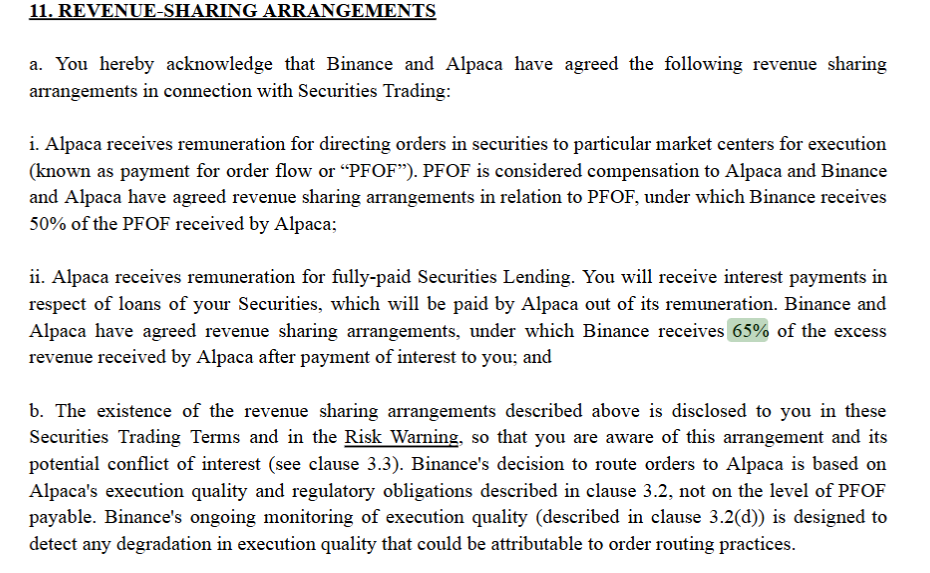
Binance disclosed a revenue-sharing arrangement with custodian and brokerage infrastructure API provider Alpaca, which has become a major infrastructure provider in the custody of tokenized US stocks and exchange-traded funds (ETFs).
Under Binance Securities Trading Terms published Tuesday, Binance will receive 50% of Alpaca’s payment-for-order-flow fees and 65% of remaining profit from user stock lending after users are paid interest, Binance will receive 50% of Alpaca’s payment-for-order-flow, or PFOF, fees and 65% of profit from user stock lending after the platform pays user interest.
Alpaca provides brokerage, clearing and custody infrastructure for Binance’s stock trading product and is also a major infrastructure provider in tokenized US stocks and ETFs. The company raised $150 million at an $1.15 billion valuation for its brokerage infrastructure in January.
The disclosure shows how Binance may monetize its push beyond crypto after launching access to more than 7,000 US-listed stocks and ETFs and previewing a later tokenized stock product called bStocks.
Cointelegraph contacted Binance for comment on the arrangement and asked whether it holds a minority stake in Alpaca.
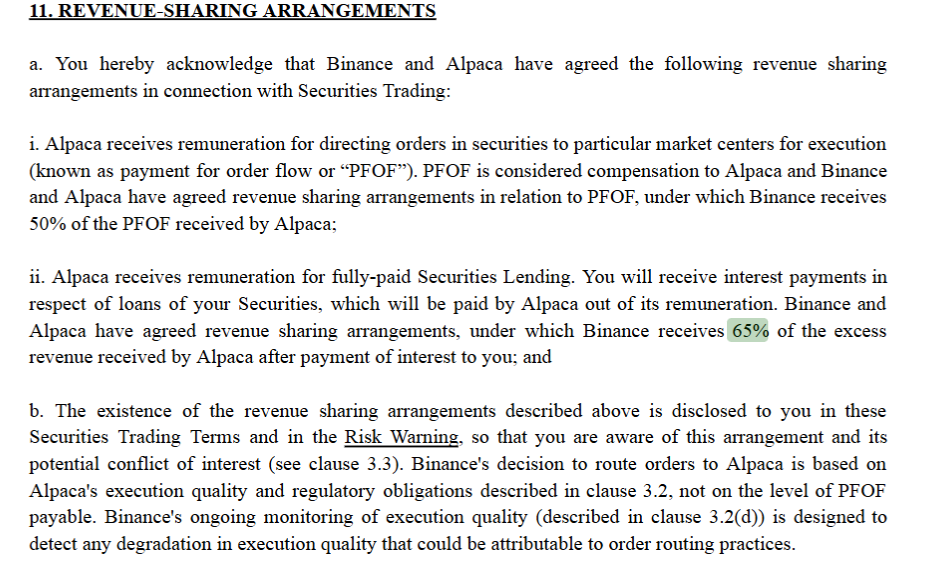
Binance Securities Trading Terms for tokenized stocks and ETFs, Revenue-Sharing Arrangements. Source: Binance
Alpaca said it held $480 million in assets under custody (AUC) as of December 2025, which represents a 29% market share of the current $1.62 billion value of total tokenized stocks, according to data provider RWA.xyz.
The total value of tokenized stocks rose by around 29% during the past 30 days, while holders rose 35% to 304,700. However, monthly active addresses declined by over 77%, to 31,877, signaling that investors are holding, rather than actively trading, these assets.
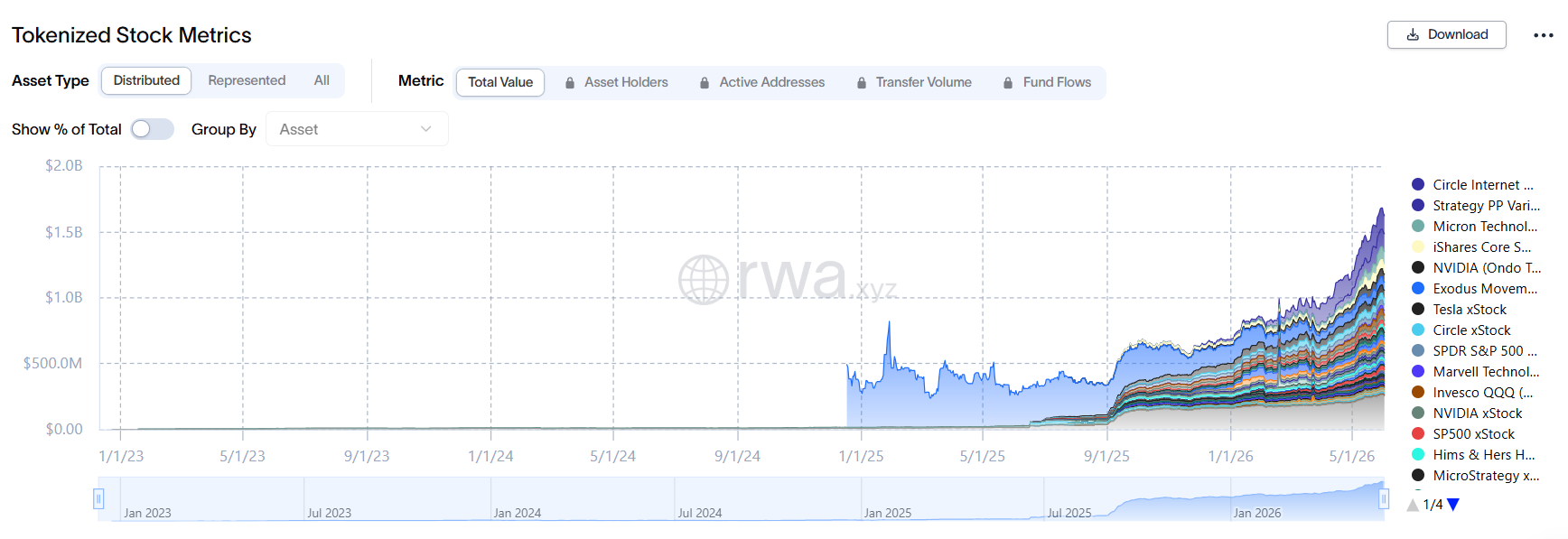
Tokenized stock market total value. Source: RWA.xyz
Crypto exchanges expand into tokenized US stocks
Other large cryptocurrency exchanges are also expanding their offering to include US stocks and ETFs, responding to the growing investor demand for more accessible blockchain-based trading products.
In April, crypto exchange Bitget launched a proxy offering tied to the pre-initial public offering (IPO) phase of Elon Musk’s aerospace manufacturing and space transportation company, SpaceX, Cointelegraph reported at the time.
Related: South Korea plans July rules for tokenized securities
Binance also launched a SpaceX-linked pre-IPO futures product tied to the expected valuation of the company ahead of its public listing, Cointelegraph reported on May 21.
Source: Binance
In January, Vienna-based crypto exchange Bitpanda said it was expanding its offering to include about 10,000 stocks and ETFs.
In April 2025, Kraken launched 11,000 US-listed stocks and ETFs with commission-free trading in an effort to bring “equities and digital assets together” under one trading platform, as part of a “phased national rollout.”
Magazine: Block by block: Blockchain technology is transforming the real estate market
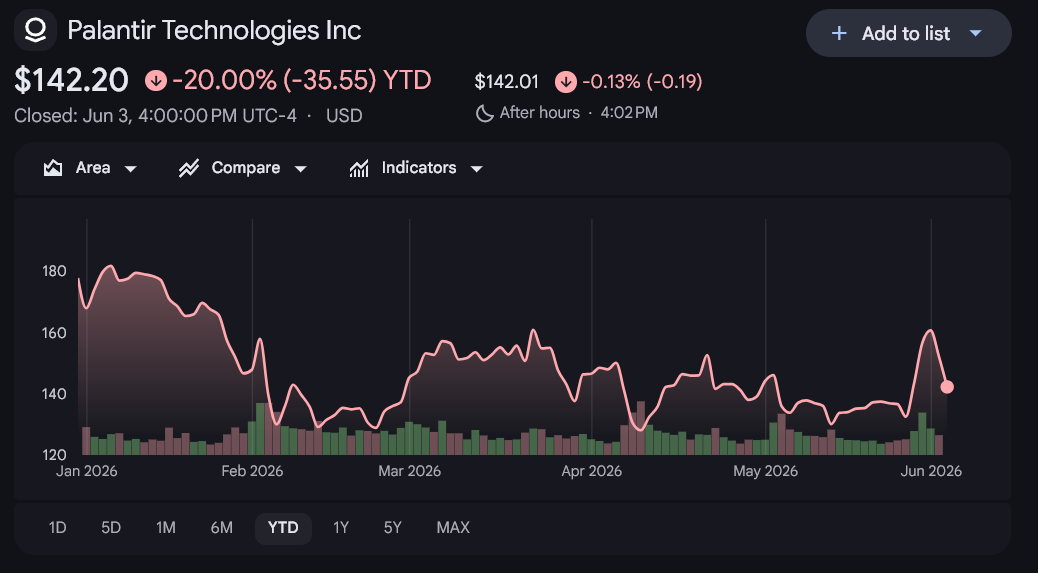
Trump-promoted US stocks have been among the most talked-about names on Wall Street this year, and three stand out for traders. One earned a Truth Social post for its war-fighting tech.
Another rode a government stake and a strong quarter. A third got a direct buy-it call at the White House. Here is how each trade is looking as we head deeper into 2026.
Palantir Technologies (NASDAQ: PLTR)
PLTR trades near $142, down 6.5% in the latest session. The pullback interrupts a sharp run that made it one of the standout Trump-promoted US stocks this spring.

Want more insights like this? Sign up for Editor Harsh Notariya’s Daily Newsletter here.
On April 10, Trump posted on Truth Social that Palantir had proven great war-fighting capabilities. The stock was near its April low of around $122 at the time. Since then, it has rebounded about 33%.
Note: Palantir makes AI software rather than weapons, but its platforms power the US military and intelligence work.
That bounce has not broken the broader downtrend. PLTR still trades inside a falling channel, a downward-sloping price range that has held since early November. The structure stays bearish until the price escapes it.
The key levels come from Fibonacci levels, which measure the proportional pullback of a prior move. It runs from the $207 November high to the $122 April low, revealing key levels. PLTR failed to clear $165 on June 1, a key technical level. The real trigger sits at $175, near the channel’s upper boundary.
A move above it by about 15% would shift the structure from bearish to neutral-bullish.

The bearish case is building too. Selling volume has risen since May 22, and a weak broader market could drag PLTR lower. A drop under $142 would expose the $122 low again.
Above $175 turns the trend, while rising sell volume and a break under $142 keep the bears in control throughout June.
Intel Corporation (NASDAQ: INTC)
INTC trades near $108, down 1.28% in the latest session, though pre-market quotes point higher near $114. The stock is the most policy-linked of the Trump-promoted stocks.
The Trump administration holds a stake in Intel, and that position is up nearly 250% as of late April, per data. Trump has taken public credit for the chipmaker’s surge. The fundamentals backed him up.
Intel’s Q1 2026 earnings drove a 15% jump, pushing the stock past its August 2000 record high.
That report powered a much larger run. INTC climbed from about $40 in late March to a peak near $133, a gain above 200%. The move formed a bull flag, a pause that follows a sharp rally and often resolves higher.
The recent dip looks like profit-taking. Price slipped from late May into early June, yet volume held steady rather than spiking. That hints sellers are not panicking. INTC now sits near $108, closing in on the $102 base.
The first hurdle to the upside is $124, where the breakout stalled. A reclaim there opens the path to the $133 peak, again in June, about 24% higher, then $159 and $194.

The bearish case matters too. A drop under $102 weakens the pattern considerably, and a break under $79 would invalidate it. Hold above $102 and reclaim $124 to keep the flag alive, or lose $102 and risk a slide to $79.
Dell Technologies (NYSE: DELL)
DELL trades near $435, down 6.58% in the latest session after touching a record near $469. It carries the most direct endorsement of the three.
In early May, Trump told a White House crowd to go out and buy a Dell, calling them great. The stock was already climbing, and the comment added fuel. Since late March, DELL has run from about $155 to its $469 peak. It has roughly doubled in the weeks since the direct endorsement.
The move traces a clean pole with the flag (consolidation) expected to form now. This is because the volume faded as the price peaked around May 29, while selling pressure has built since late May. Buyers are stepping back, suggesting a pullback.
The economic anchor is real, as Dell’s AI server demand and a $9.7 billion Pentagon contract back the rally continuation, despite the possible pullback.

The key levels come from the Fibonacci levels of the run from $155 to $468. A pullback is likely to first test $394, then $349. Holding there would keep the uptrend intact and set up another push. The bearish case builds below.
A drop under $312 toward $275 would signal a deeper unwind. The risk grows if AI server spending cools or the political tailwind fades.
For now, DELL needs a daily close back above $468 to prove the rally still has strength.
The post 3 Trump-Promoted US Stocks to Watch in June appeared first on BeInCrypto.

Ciara Miller’s Heartbreaking Admission During Reunion

Ranking Financial Mistakes

Air pollution could be affecting your brain power



-

 Tech6 days ago
Waymo dominates autonomous vehicle registrations as Tesla trails behind
-

 News Videos5 days ago
This is BROKEN! INSANE 5x MONEY CAR WASH WEEK! The NEW GTA Online UPDATE Today! (GTA5 New Update)
-
 Tech4 days ago
SpaceX just won a second Golden Dome contract. This one is $4.16 billion.
-

 Business2 days ago
Jade Biosciences, Inc. (JBIO) Discusses Positive Interim Results From JADE101 Phase I Healthy Volunteer Study and Development Plans Transcript
-

 News Videos5 days ago
SHE IS KILLING XRP!!! WATCH URGENT AND ACT FAST
-
 NewsBeat5 days ago
FIRST NIGHT REVIEW: Take That bring the Circus back to life in spectacular sun-soaked style
-
Crypto World5 days ago
CFTC Has Approved the First Regulated Bitcoin Perpetual Contract in the U.S.
-

 Business4 days ago
Is the Spurs Phenom Already Better Than Prime Diesel?
-
 NewsBeat5 days ago
Novak Djokovic v Joao Fonseca LIVE: French Open latest scores and results after Jannik Sinner’s shocking collapse
-
 Entertainment5 days ago
Weak ‘Supergirl’ Box Office Tracking Amid Milly Alcock Backlash
-
 Crypto World5 days ago
Snowflake (SNOW) Stock Rallies on Strong Q1 Results and AI Product Growth
-

 Business5 days ago
Demand Conditions Improve In Chemicals Sector In April 2026
-
 Crypto World5 days ago
MicroStrategy Moves $30 Million in BTC to Coinbase Prime: Is the Bitcoin Sell-Off Already Here?
-

 Politics5 days ago
The House | Inside Andy Burnham’s Makerfield Campaign: “Nobody Thinks This Is In The Bag”
-

 Tech5 days ago
This Week In Security: Ubiquiti Fixes, And FreeBSD Joins The Club You Don’t Want To Join
-
 Entertainment4 days ago
One of the Greatest Sitcoms of All Time Shoots Up Apple TV’s Charts 11 Years Later
-

 Entertainment5 days ago
Maddox Jolie-Pitt Legally Requests to Drop Brad’s Surname
-
 Crypto World1 day ago
Seagate (STX) Stock Surges to Record High on AI Boom and Legal Settlement
-
 Entertainment5 days ago
Britney Spears Shares Troubling Update After Hard Year
-
 Entertainment5 days ago
Bruce Willis’ Generosity Resurfaces Amid His Dementia
You must be logged in to post a comment Login