

Crypto World
OpenTrade Raises $17 Million to Expand Stablecoin Yield Platform

OpenTrade, an institutional-grade platform for onchain and real-world asset (RWA)-backed lending and stablecoin yield products, has raised fresh capital to expand its yield infrastructure.
The platform secured $17 million in its latest strategic funding round led by Mercury Fund and Notion Capital, OpenTrade said in a Wednesday announcement seen by Cointelegraph.
The new funding will support the continued expansion of OpenTrade’s permissioned and permissionless yield infrastructure, as well as the growth of its vault-focused service Curation+, CEO David Sutter told Cointelegraph.
“The company also plans to expand its asset management and trading team, increase engineering capacity, and build a dedicated customer success function to support its growing client base,” Sutter said.
CEO positive on regulation amid CLARITY Act debate over stablecoin rules
The raise comes as US lawmakers debate how stablecoin rewards should be regulated under the CLARITY Act, a broader digital asset market structure bill that has been delayed partly by disputes over whether crypto firms should be allowed to offer interest-like incentives on stablecoin balances. Sutter expressed optimism over recent progress around the stalled legislation.
CLARITY is nearing a Senate Banking Committee vote after a compromise between crypto and banking stakeholders. The deal would allow usage-based rewards like cashback or discounts on stablecoin activity but prohibit yield on idle balances.
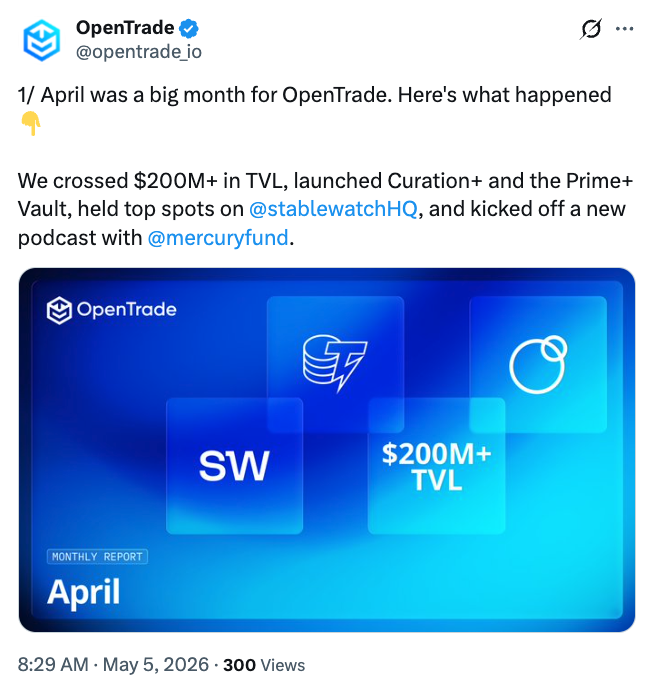
OpenTrade surpassed $200 million in total value locked (TVL) in April. Source: OpenTrade
“Our structure is derived from securities lending in traditional finance, but adapted to the lending of stablecoins instead of securities,” Sutter said, adding that there may be market-specific nuances affecting availability to institutional or qualified investors.
Sutter told Cointelegraph that the legal architecture underpinning the platform has been purpose-built to offer its products to clients globally while maintaining compliance with existing traditional finance and digital asset regulatory standards.
“There are strong regulatory tailwinds for the industry at large, which will be conducive to continued growth for stablecoins,” Sutter added.
Related: Ripple CEO says market structure bill not ‘done deal,’ despite compromise
Circle Ventures was an early investor in OpenTrade
Founded in 2023, OpenTrade seeks to provide scalable and compliant yield products for fintechs and institutional investors.
OpenTrade’s infrastructure routes user deposits into tokenized vaults that allocate capital across a mix of yield sources, primarily RWAs such as fixed-income instruments, alongside selected decentralized finance (DeFi) strategies. Each vault follows a defined allocation strategy and operates through smart contract-based mechanisms that manage deposits, track positions and distribute returns.
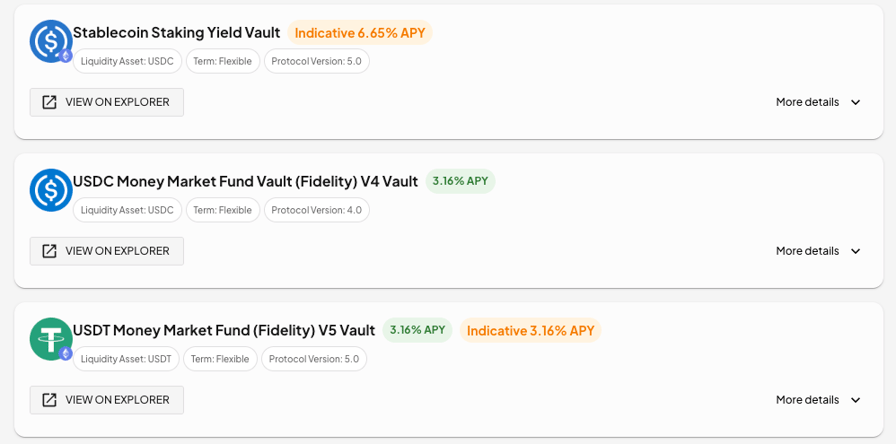
OpenTrade vaults (an excerpt). Source: OpenTrade
The latest funding round brings OpenTrade’s total funding to $30 million and included backing from prominent industry investor a16z Crypto. The London-based company previously raised $7 million in a strategic round led by Mercury Fund and Notion Capital in June 2025, following a $4 million seed round in November 2024.
OpenTrade also secured funding from investors such as Circle Ventures and Polygon Ventures in May 2023, while announcing plans to launch a platform for USDC-denominated investments and tokenized financial assets.
OpenTrade co-founders Dave Sutter and Jeff Handler previously worked at Centre, a now-dissolved consortium of Circle and Coinbase providing standards governance for the USDC stablecoin.



Polish President Karol Nawrocki has vetoed the country’s crypto assets bill for a third time, delaying the implementation of the European Union’s MiCA framework just weeks before the bloc’s July compliance deadline.
Summary
- Karol Nawrocki has vetoed Poland’s MiCA implementation bill for the third time ahead of the EU’s July deadline.
- The proposed law would have given the KNF licensing, reporting, and enforcement powers over crypto firms.
- Concerns over oversight intensified after the collapse of Zondacrypto, Poland’s largest crypto exchange.
According to Reuters, Nawrocki rejected legislation that would have aligned Poland’s crypto rules with the Markets in Crypto-Assets Regulation (MiCA) framework despite lawmakers approving the bill in May. The proposed law was designed to establish a domestic regulatory framework for crypto firms and bring the country in line with EU requirements.
Speaking on the legislation, Nawrocki said the bill failed to address concerns previously raised by his office. Reuters reported that while the president supports regulation of the crypto sector, he believes the current version does not provide sufficient safeguards and requires further changes before it can become law.
His latest veto extends a dispute that has already delayed Poland’s MiCA implementation for months. Earlier measures intended to introduce the EU framework were also blocked after Nawrocki raised objections to the powers granted to regulators and the potential burden on local crypto businesses.
The bill would have expanded KNF oversight
Back in mid-May, Poland’s lower house approved the long-awaited crypto assets bill amid mounting pressure to meet the EU’s implementation timeline. As previously reported by crypto.news, the legislation would have granted Poland’s Financial Supervision Authority, known as the KNF, authority over crypto-asset service providers operating in the country.
Under the proposed framework, crypto firms would have been required to obtain licenses, comply with reporting obligations, and follow new operational standards. The bill also included criminal penalties for serious violations connected to token issuance and exchange activities.
Earlier objections from Nawrocki focused on what he viewed as excessive regulatory powers for the KNF and supervisory fees that could discourage domestic crypto companies. According to Reuters, the president argued that overly restrictive rules could drive innovation and crypto businesses outside Poland.
Although he vetoed the legislation, Nawrocki indicated that he remains open to approving a revised version if lawmakers incorporate changes recommended by his administration.
“I support regulating this market. I support consumer protection, but it must be done effectively. The bill will be signed into law if it is amended.”
Exchange collapse has intensified pressure for regulation
Recent events in Poland’s crypto market have increased scrutiny of the sector. Public concern grew after the collapse of Zondacrypto, widely reported as the country’s largest cryptocurrency exchange, exposed weaknesses in oversight and investor protections.
The failure prompted lawmakers to accelerate work on the MiCA-aligned legislation, with supporters arguing that stronger supervision could help prevent similar incidents and restore confidence among users. Nawrocki, however, maintained that the current draft still falls short of addressing key structural risks despite those concerns.
Elsewhere in Europe, MiCA adoption continues to move forward as member states implement the framework and crypto companies prepare for the new rules. Reuters noted that Poland’s latest delay creates uncertainty over how quickly the country can complete the transition before EU requirements take full effect.
Outside Europe, policymakers in the U.S. are debating their own crypto market legislation. Several industry participants, including Ripple and Coinbase, have backed the CLARITY Act, though its progress remains uncertain due to ongoing disagreements among lawmakers over ethics-related provisions.
Cross-border payout platform MassPay and Coinbase announced a partnership to enable stablecoin-based cross-border payouts, merging MassPay’s global payout network with Coinbase’s crypto infrastructure. The collaboration links MassPay’s network spanning 180 countries with Coinbase’s wallet, custody and on-chain settlement capabilities, enabling customers to move between fiat, USDC and other digital assets.
MassPay CEO Ran Grushkowsky told Cointelegraph that stablecoins are still a small slice of the company’s transaction volume, but the joint rails are expected to support nine-figure payouts in the first year. He added that clients using the system have seen costs fall by roughly 40% to 70% versus traditional international wires, with settlement near instant rather than taking days on legacy rails.
Key takeaways
- MassPay’s network in 180 countries now interfaces with Coinbase’s custodial and settlement rails to enable fiat/crypto cross-border payouts.
- The collaboration targets nine-figure payout volumes in the first 12 months, signaling a scaling push for stablecoin-based cross-border payments.
- Cost reductions of 40% to 70% versus traditional international wires accompany near-instant settlement, potentially improving cash flow for global businesses.
- Compliance duties are divided: Coinbase provides regulated custodial infrastructure and licensing, while MassPay handles Know Your Customer checks, sanctions screening and tax documentation across its network.
- This move aligns with a broader industry transition toward stablecoin-enabled cross-border rails, echoed by Stripe’s Bridge acquisition and Circle’s Payments Network.
MassPay deepens stablecoin payout push
Under the agreement, Coinbase will supply wallet infrastructure, custody and on-chain settlement, while MassPay orchestrates last-mile payouts through bank transfers, mobile wallets and digital asset channels. The two firms split compliance responsibilities, with Coinbase contributing regulated custodial infrastructure and licensing, and MassPay handling KYC, sanctions screening and tax documentation across its expansive network. Grushkowsky noted that MassPay already offers stablecoin payout capabilities via other providers, and this collaboration with Coinbase aims to expand capacity and credibility.
Stablecoins accelerating cross-border rails
The MassPay–Coinbase partnership sits within a broader trend of traditional payments players building stablecoin-focused infrastructure for cross-border flows. In February 2025, Stripe completed the acquisition of Bridge, a startup focused on scaling stablecoins for business use, underscoring expectations that tokenized money will accelerate cross-border commerce. Circle has also advanced its own roadmap, announcing in April 2025 the Circle Payments Network to connect banks, payment companies and digital wallets for real-time cross-border settlement using USDC, EURC and other regulated stablecoins.
Related context: Stripe’s expansion into stablecoin rails and Circle’s network development illustrate how mainstream payment incumbents are reorganizing to accommodate tokenized money across borders.
As these rails mature, investors and merchants are watching how quickly they can scale to mid-sized and enterprise payouts, and whether regulatory clarity keeps pace with the evolving payments landscape. The current collaboration signals a meaningful vote of confidence from established players in favor of stablecoins as a cross-border settlement layer.
As more payments incumbents experiment with stablecoins, observers will watch how adoption scales across mid-market payouts and whether regulatory clarity keeps pace with the technology. Next milestones include broader currency coverage and geographic reach, as well as real-world impact on costs and settlement times across the network.


Chain fees on the XRP Ledger (XRPL) were less than $400 on Wednesday, according to DefiLlama, which tracks fees across major blockchains.
Bithomp, another explorer, estimated users of the blockchain burned 327 XRP over the past 24 hours, confirming the total as worth less than $400.
Expanding the timeframe to a week doesn’t do much to improve the figure. XRPL generated $3,100 in chain fees over the past week, and roughly $16,000 over the past month.
For a sense of scale, Bitcoin users paid miners $183,000 worth of transaction fees yesterday. On the same day, Ethereum generated more than $323,000, while Solana pulled in $358,000.
Tron cleared more than $1 million.
Embarrassingly, the entire trailing 12 months of XRPL chain fees sum to less than a single day at Tron.
A busy network earns almost no fees
To be strictly accurate, XRPL chain fees are burned, a minor distinction from the customary practice of coin payments to miners or validators.
Still, the value of XRP burned to conduct transactions on XRPL is comparable to the value of transaction or chain fees paid to miners or validators on other blockchains.
The explanation for the tiny figure is as simple as it is devastating. Every XRPL transaction destroys a tiny, minimum amount of XRP as an anti-spam measure.
The base cost is 0.00001 XRP, or 10 drops, as the network’s own documentation confirms.
At yesterday’s XRP price near $1.11, that rounds to one thousandth of one cent per transaction.
This contrasts starkly with market-fluctuating, demand-based transaction fees like Bitcoin where chain fees fluctuate in value wildly by day. Indeed, although Bitcoin users typically pay a few hundred thousand dollars worth of daily transaction fees to miners, on a day like April 19, 2024, they paid over $80 million.
On XRPL, fees stay microscopic even when the network is busy. Indeed, the network is quite busy, routinely processing more than a million transactions a day, including many computational, non-payment data requests.
Unfortunately, even an impressive million transactions at the base rate of 10 drops burns just 10 XRP. Run the math at current XRP prices, and a million transactions costs less than $20.
Read more: David Schwartz says don’t invest in Ripple
XRP Ledger fees slow to a trickle
XRPL chain fees are burned, not paid to validators, so no one has any particular motivation to buy XRP on the basis of earning chain fees.
Although burns do reward all token holders equally by reducing supply, their tiny dollar value mostly exists to deter spam.
As a result, the mechanism of chain fees captures only a de minimis measure of the network’s activity, which is dwarfed by its $69 billion market capitalization — almost all of which is speculative investment.
Even by its own low standards, the XRPL is slowing down. Analytics firm Glassnode found that daily fees fell about 89% over the course of 2025.
Last December was “the lowest level seen since December 2020.”
Protos previously documented the same decline from another angle, with active XRP Ledger addresses down 80% during the first half of 2025. The pattern is consistent.
At time of writing, XRP trades at $1.11, down 40% year-to-date and 52% over the past 12 months. The blockchain underneath it earned less than $400 in chain fees yesterday.
Got a tip? Send us an email securely via Protos Leaks. For more informed news and investigations, follow us on X, Bluesky, and Google News, or subscribe to our YouTube channel.

Large financial institutions are turning to tokenization to improve capital efficiency and liquidity, according to representatives from Franklin Templeton and BNP Paribas.
Speaking at a panel at the WAIB Summit 2026 in Monaco, industry executives discussed how tokenized assets and stablecoins could modernize Europe’s capital markets by streamlining settlement, improving collateral mobility and creating new opportunities for cross-border financial activity.
Tokenization offers institutions more “optionality and flexibility,” a development that is driving interest from banks and large corporations to launch their own offerings, said Rafael Mastroberardino, head of digital assets partnership development at investment manager Franklin Templeton.
Julien Clausse, the head of BNP Paribas CIB’s tokenization platform, said blockchain’s ability to host multiple assets on the same chain could unlock new institutional use cases, provided those assets are able to interact with one another.
Institutional interest in tokenization has accelerated in recent months. Some of the largest US banks, including JPMorgan Chase and Bank of America, are reportedly planning a tokenized deposit network for launch in the first half of 2027, seeking to keep deposits within regulated banking channels while offering some of the speed and programmability associated with blockchain-based assets.

Executives discuss stablecoins and tokenized assets during a panel at WAIB Summit 2026 in Monaco. Photo: Cointelegraph
Wall Street pushes deeper into tokenization
On March 18, the US Securities and Exchange Commission approved Nasdaq’s pilot proposal to support the trading of tokenized versions of high-volume stocks and securities.
Days later, on March 24, the New York Stock Exchange partnered with tokenization platform Securitize to develop blockchain-based trading infrastructure for Wall Street, including tokenized shares of stocks and exchange-traded funds.
Related: Equipment finance platform Trad.Fi to bring $650M in private credit onchain
The initiative forms part of parent company Intercontinental Exchange’s plans for a tokenized securities venue featuring 24/7 trading, instant settlement, stablecoin-based funding and onchain settlement.
The sector has also attracted significant investment. On Thursday, Digital Asset Holdings raised $355 million in a round led by Andreessen Horowitz’s crypto arm. The deal reportedly valued the company at around $2 billion. The capital will be used to expand Canton Network, a platform designed for financial institutions to tokenize and settle traditional securities while keeping sensitive data private.
Canton has already been piloted by institutions including Goldman Sachs, BNY Mellon, BNP Paribas, Standard Chartered, Société Générale and Deutsche Börse.
Magazine: Can Robinhood or Kraken’s tokenized stocks ever be truly decentralized?

SpaceX’s Super Heavy booster is seen on the launch pad, as Starship is prepared to be placed on top, at the company’s Boca Chica complex, ahead of Starship’s eighth test flight which is targeted for March 3, from Starbase, near Brownsville, Texas, U.S. March 2, 2025.
Kaylee Greenlee | Reuters
For nearly two decades, some of the world’s most prominent investors quietly accumulated stakes in SpaceX while the rocket maker remained largely off-limits to the public markets.
Now, with Elon Musk’s company seeking a valuation of roughly $1.8 trillion in its initial public offering, those early bets are poised to generate some of the largest paper gains in venture capital history.
Among the biggest beneficiaries are veteran stock picker Ron Baron, Cathie Wood’s ARK Invest and mutual fund giant Fidelity Investments. Also poised to win are venture firms including Founders Fund, Sequoia Capital and Andreessen Horowitz, as well as hedge funds such as D1 Capital Partners and Coatue Management. Select pension funds and endowments are also set to share in the windfall.
The gains are striking for investors who backed SpaceX before its success became obvious. Baron first invested in 2017 through employee tender offers when the company was valued at less than $22 billion and has since participated in 27 funding rounds.
By the end of March, SpaceX accounted for 33% of assets in the $10.4 billion Baron Partners Fund and 23% of the Baron Asset Fund, making it one of the firm’s most consequential investments.
“We think that SpaceX will become the largest, most profitable company on the planet,” Baron said during an investor webcast this week. His firm has invested about $2 billion in the company over the years, a stake that has grown to roughly $12 billion, he said.
Still early in its value creation
Wood’s ARK Venture Fund has also been a major beneficiary of SpaceX’s rapid rise. The rocket maker accounted for 11.4% of the fund’s net assets as of March 31, making it the largest holding in the portfolio.
Wood said ARK views SpaceX as far more than a launch provider. “Through Starship, Starlink and the acquisition of xAI, we believe SpaceX is building vertically integrated AI infrastructure for a much larger space economy,” she told CNBC.
The investment also reflects ARK’s broader thesis around technological convergence. SpaceX sits at the intersection of several of the firm’s core innovation themes, including artificial intelligence, robotics and energy storage. Wood believes the company’s next phase of growth could be driven not only by its existing Falcon 9 launch business and Starlink satellite network, but also by Starship, the next-generation rocket system that could open new commercial opportunities in space.
“For long-term shareholders, an IPO would provide broader access to a company that we believe remains early in its value creation,” Wood said.

Ark Venture Fund 1 year
No traditional asset manager may have benefited more from SpaceX’s rise than Fidelity Investments. The Boston-based firm got in early through former portfolio manager Gavin Baker, who began buying shares in 2015 when SpaceX was valued at just about $10 billion.
As of March 31, SpaceX accounted for 4.7% of the $177 billion Fidelity Contrafund, one of the largest actively managed mutual funds in the world. The company also represented 3.3% of the $103 billion Fidelity Blue Chip Growth Fund and 2.6% of the nearly $99 billion Fidelity Growth Company Fund.
Fidelity declined to comment for this story.
Coming up aces
The extraordinary returns reflect not only the company’s growth, but also the scarcity value of access.
“They were taking a chance on Elon, and it came up aces for them,” said Greg Martin, co-founder and managing director of Rainmaker Securities. “Once they took the chance on Elon, the long-term cap table position turned out to be very scarce because the cap table is managed very tightly.” The cap table, or capitalization table, refers to a written breakdown of a company’s equity ownership.
Unlike many venture-backed companies that routinely broaden their shareholder base, SpaceX maintained tight control over who could invest, Martin said. As a result, investors who secured positions early often received opportunities to participate in later funding rounds that were unavailable to most institutions.
“Their early bet on Elon not only paid off for their initial investment, but enabled them to deploy a lot more capital when the business became more and more of an obvious success,” Martin said.
That dynamic helped transform relatively modest early investments into positions worth billions of dollar. Venture firms Founders Fund first backed SpaceX in 2008, while hedge funds such as Coatue and D1 gained exposure through later private rounds.
“Our success is almost by thinking all the things that other people do that don’t make sense, and just, hopefully, by doing those, it’s like 75% of the work,” said Philippe Laffont, founder of Coatue Management, at Global Alts conference in New York this week.
Pensions and endowments
Pension funds and university endowments are also poised to reap substantial gains from SpaceX’s debut, underscoring how the company’s rise has rewarded institutions responsible for funding retirements, scholarships and academic research.
The Ontario Teachers’ Pension Plan invested more than $200 million in SpaceX in 2019 through a newly created technology-focused investment vehicle at the time. Back then, the pension manager described SpaceX as “a compelling investment opportunity” because of its “proven track record of technology disruption in the launch space and significant future growth potential in the satellite broadband market.”
University endowments have also emerged as major beneficiaries. Washington University in St. Louis invested roughly $50 million in SpaceX nearly a decade ago, a stake that has appreciated dramatically as the company climbed toward its IPO valuation. The holding now accounts for more than 10% of the university’s approximately $17 billion endowment, according to Bloomberg News.
Washington University declined to comment, and Ontario Teachers’ Pension Plan didn’t respond to CNBC’s request for comment.

Key takeaways
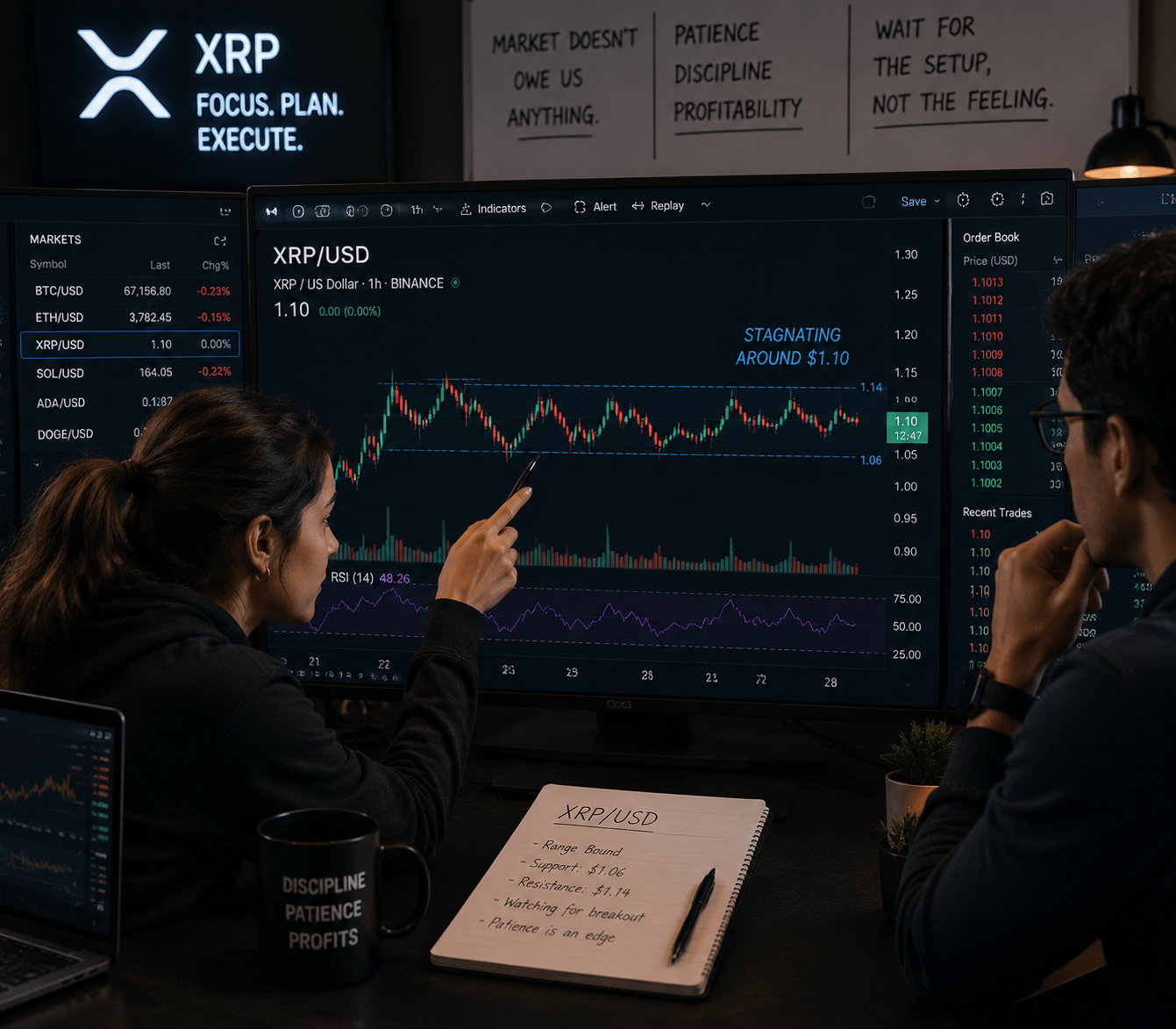
- XRP continues to consolidate around the $1.10 mark.
- The bulls are holding the price above the $1.05 support level.
Ripple’s XRP is trading lower on Thursday, staying around $1.10 as the token attempted to reverse a downtrend that has persisted since mid-May.
The downtrend comes as institutional demand for XRP-linked investment products continues to strengthen, even as retail traders remain cautious amid ongoing geopolitical tensions.
Geopolitical uncertainty continues to weigh on markets
Risk sentiment remains fragile as tensions between the United States and Iran continue to escalate.
Recent developments have included renewed military exchanges between the two nations, with US President Donald Trump stating that Iran has been slow to agree to a peace deal. Following those remarks, the US military conducted additional strikes that it described as defensive actions.
Iran’s Islamic Revolutionary Guard Corps (IRGC) subsequently launched attacks targeting US military facilities in Kuwait, Bahrain, and Jordan.
The uncertainty has contributed to volatility across financial and cryptocurrency markets, limiting investor risk appetite.
Despite the uncertain macro environment, institutional investors continue to add exposure to XRP.
Data from CoinGlass shows that XRP spot ETFs attracted nearly $1.2 million in net inflows on Wednesday, following approximately $7.44 million in inflows on Tuesday.
According to CoinGlass data, XRP futures Open Interest (OI) stood at approximately $2.43 billion on Thursday.
A falling Open Interest environment typically signals reduced speculative activity and limited conviction among short-term market participants.
XRP price analysis: Recovery attempt faces major resistance
XRP is currently trading around $1.10, but the broader technical picture remains bearish.
The token continues to trade below several major trend indicators. Remaining below all three moving averages suggests that the longer-term downtrend remains intact.
Technical momentum indicators suggest selling pressure is easing, but not yet reversing.
The RSI is hovering near 44, indicating weak demand while remaining just above oversold territory.
The Moving Average Convergence Divergence (MACD) histogram remains in negative territory, signaling that bearish momentum continues to dominate despite the recent bounce.
If the bulls regain control, XRP could surge towards the 50-day EMA at $1.30, with additional hurdles at $1.40 and $1.61.
A break above $1.26 would be the first sign that bullish momentum is beginning to strengthen.
However, if the bearish trend persists, XRP could retest the $1.05 support level before dropping below $1.0 to test lower demand zones at $0.95

XRP’s latest rebound is being supported by steady ETF inflows and growing institutional interest. However, declining futures activity, persistent geopolitical uncertainty, and a bearish technical structure suggest that the recovery remains tentative.

Just in, Citi(Citigroup) is launching a crypto platform to tokenize and trade shares of late-stage private companies for institutional and eligible investors. Citi is partnering with SDX, the digital asset arm of SIX Swiss Exchange, on a permissioned distributed ledger infrastructure.
The bank will act as custodian and tokenization agent, issuing securities in the form of authorized tokenized depositary receipts held through regulated financial institutions. Citi says it is already in discussions with some of the largest private companies to participate.
— Real World Asset Watchlist (@RWAwatchlist_) June 11, 2026
 Trump's favorite bank Citigroup to launch tokenized securities of private companies. pic.twitter.com/vIYL8yIZjn
The platform is initially restricted to foreign investors, with U.S. access planned for a later phase once regulatory conditions allow. It targets a $75 billion late-stage pre-IPO equity market that has swelled as companies including SpaceX and Anthropic delay public debuts, leaving institutional capital with no clean secondary-market route into those positions.
Discover: The Best Token Presales
Citi Crypto Tokenization Platform: SDX and Corda Infrastructure
The platform runs on R3’s Corda permissioned distributed ledger through SDX’s digital Central Securities Depositary. It is a regulated venue that sits inside the SIX Group infrastructure rather than on a public chain. It is also a fully permissioned, institution-grade blockchain stack designed to satisfy the custody, compliance, and settlement requirements of regulated financial intermediaries.
Citi issues the tokenized depositary receipts and holds the underlying securities as custodian. Distribution at launch runs through Sygnum Bank in Switzerland and SBI Digital Markets in Singapore, targeting institutional and qualified investors across Europe and Asia.
JUST IN: $2.7T Citigroup is launching TOKENIZED shares of PRIVATE companies.
Citi says it is already in talks with some of the world’s largest private companies to issue tokenized depositary receipts.
The rollout starts with foreign investors, with plans to make it available… pic.twitter.com/vyVEDYP2KB— Coin Bureau (@coinbureau) June 11, 2026
Artem Korenyuk, Citi’s global lead for digital assets enterprise alignment and services enablement, described the investor experience plainly: private-company shares sitting “right next to their Apple stock.”
Trades in late-stage private equity currently involve manual, weeks-long processing and fragmented cap-table records. On SDX’s platform, according to the bank, those trades execute near-instantaneously.
Discover: The Best Crypto to Diversify Your Portfolio
RWA Tokenization Stakes: A $5.5 Trillion Market Is Being Built on Permissioned Rails
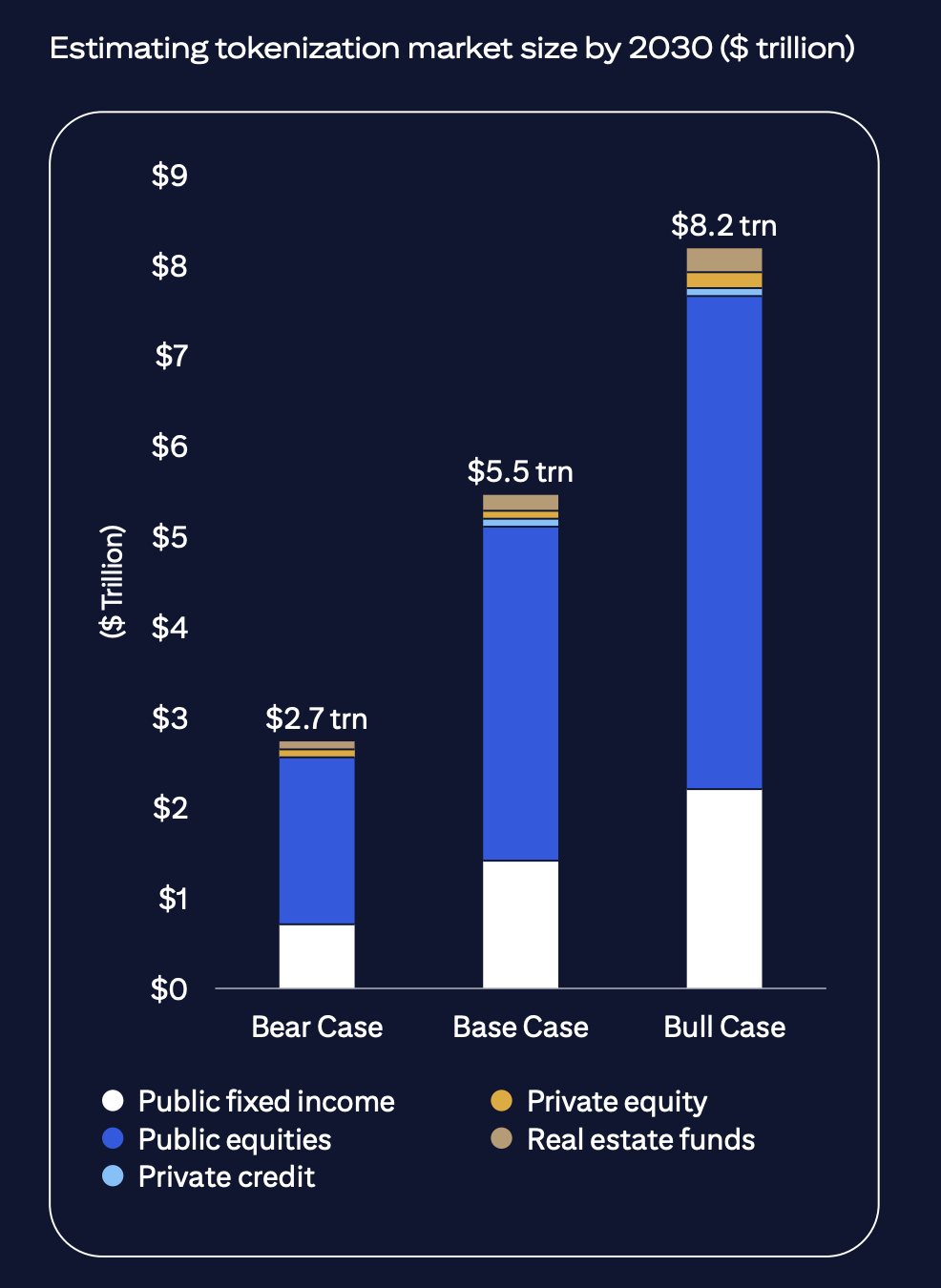
Citi’s own Tokenization 2030 report puts the base-case size of tokenized real-world assets at $5.5 trillion by 2030, up from $17 billion today, with private markets, real estate, and money-market funds leading the growth.
The range runs from $2.7 trillion to $8.2 trillion, depending on regulatory velocity. Institutional demand signals have been mixed in recent months, which makes Citi’s structural commitment to tokenization infrastructure more notable, not less.
The competition is direct. JPMorgan, Bank of America, and Citi are jointly developing a tokenized deposit network through The Clearing House, targeted for H1 2027, to compete with stablecoins on settlement rails.
NYSE has a tokenized securities platform planned for late 2026. DTCC ran limited production trades in July 2026 with full service from October.
Wall Street is not piloting tokenization anymore; it is building production infrastructure, and the Citi–SDX platform is the first institutional-grade on-ramp to private equity within that emerging stack.
The pre-IPO angle sharpens the commercial logic. Institutional appetite for alternative assets has shifted as traditional corporate crypto purchases have softened, pushing yield-seeking capital toward private-market exposure. Citi is positioning tokenized private company shares directly into that gap.
Discover: The Best Token Presales
The post Citi Launches Crypto Platform to Tokenize Private Company Shares appeared first on Cryptonews.
Crypto World
The Best Crypto to Buy? BlockDAG’s $0.05 Buyback Is the Only Number That Matters When Pi Network and Hedera Disappoint

The crypto market is recovering, but not every coin is telling the same story. The Pi Network price is extending a painful downtrend with no clear floor in sight, while the Hedera price today is showing early signs of a bounce, though volume is too thin to call it a real reversal.
Both coins are part of a wider market trying to find its footing, and both come with meaningful risks for anyone watching the best crypto to buy right now. BlockDAG is approaching this moment differently. No recovery story needed, no chart to wait on, just a Legacy Sale at $0.00000044 and a Buyback Program locking in $0.05 per coin. While others are still figuring out where the bottom is, BlockDAG has already built the exit.

Pi Network Price: 6 Straight Weekly Losses With No Floor in Sight
The Pi Network price is hovering below $0.1300 and recording its sixth consecutive weekly loss of 12%. Trading volume has been declining alongside price, which is one of the more concerning signals a chart can show. When price falls and volume shrinks at the same time, it means demand is not stepping in to absorb the selling.
Technically, the Pi Network price is sitting below the 50, 100, and 200-day EMAs at $0.1549, $0.1676, and $0.2142, respectively. RSI is hovering around 30, just above oversold territory, and MACD remains deep in negative territory.
Immediate support sits at the $0.1184 low from Saturday, followed by the S2 Pivot at $0.1124. Among the best crypto to buy conversations happening right now, Pi Network is not generating the kind of momentum that makes a compelling case.
Hedera Price Today Is Moving, But Is Anyone Behind It?
The Hedera price today sits at $0.08157, following a bounce off the key Fibonacci swing low support at $0.07687. That support level held, buyers stepped in, and the broader altcoin market gave HBAR a helpful tailwind.
The setup has real positives. Hedera was named a top altseason 2026 pick on June 6, with TOTAL2 breaking out of an 18-month accumulation range. Research linking HBAR to the proposed CLARITY Act and Kalshi’s filing for HBAR perpetual futures in the US adds genuine narrative weight.
But trading volume dropped more than 50%. A bounce without volume is a bounce without conviction. Resistance sits at $0.0850, then the $0.0920 to $0.0950 zone. Losing $0.07687 support reopens the path to $0.0720.
The Hedera price today is one of the more interesting setups among the best crypto to buy watchlists, but interesting and ready are two different things.
BlockDAG: A $0.05 Buyback Value Is Gaining Investors’ Attention
Among the best crypto to buy options right now, most require a leap of faith. BlockDAG requires math. The Legacy Sale has BDAG priced at $0.00000044. The Buyback Program locks in a guaranteed exit at $0.05 per coin. That structure removes the single biggest risk in crypto buying in with no clear way out. While Pi Network is searching for a floor and Hedera is bouncing on thin volume, BlockDAG has already answered the question most buyers are asking.
For existing holders, BDAG Swap offers entry at 30% below the market price, with up to 250 million BDAG per wallet per day at $0.00025 per coin and uncapped daily sell limits.
Beyond the financials, the BlockDAG casino is a real demand engine. Every bet placed, every reward claimed, and every transaction processed inside it requires BDAG. That creates constant internal buying pressure that does not depend on market sentiment or outside speculation. Players come in, spend BDAG, earn BDAG, and cycle it back; everything stays within the ecosystem, keeping the token moving constantly.
What makes this work smoothly is the technology underneath it. BlockDAG’s network delivers fast transactions, low fees, and high scalability. Smart contracts handle games and rewards automatically, making every interaction instant and seamless.
In a market where Pi Network is losing ground weekly and Hedera is holding a fragile bounce, BlockDAG is running on structure. The Legacy Sale window is open but not indefinitely, and among the best crypto to buy opportunities in 2026, very few come with a guaranteed number already attached.
Final Thoughts
The Pi Network price is in a persistent downtrend with declining volume and no clear catalyst to reverse it. The Hedera price today is showing early recovery signs, but thin participation keeps the outlook cautious. Both coins carry real uncertainty, and both require patience that may not be rewarded quickly this year.

BlockDAG does not ask for that patience. The Legacy Sale entry and the Buyback return are time-limited and already drawing serious attention. A growing casino ecosystem powered by fast, low-fee, scalable technology keeps BDAG in constant circulation, building demand from within rather than depending on the market.
For anyone filtering through the best crypto to buy in 2026, the gap between $0.00000044 and $0.05 is not a prediction. It is already on the table, and it will not stay there forever.
Presale: https://purchase.blockdag.network
Website: https://blockdag.network
Telegram: https://t.me/blockDAGnetworkOfficial
Discord: https://discord.gg/Q7BxghMVyu
Disclaimer: This is a Press Release provided by a third party who is responsible for the content. Please conduct your own research before taking any action based on the content.

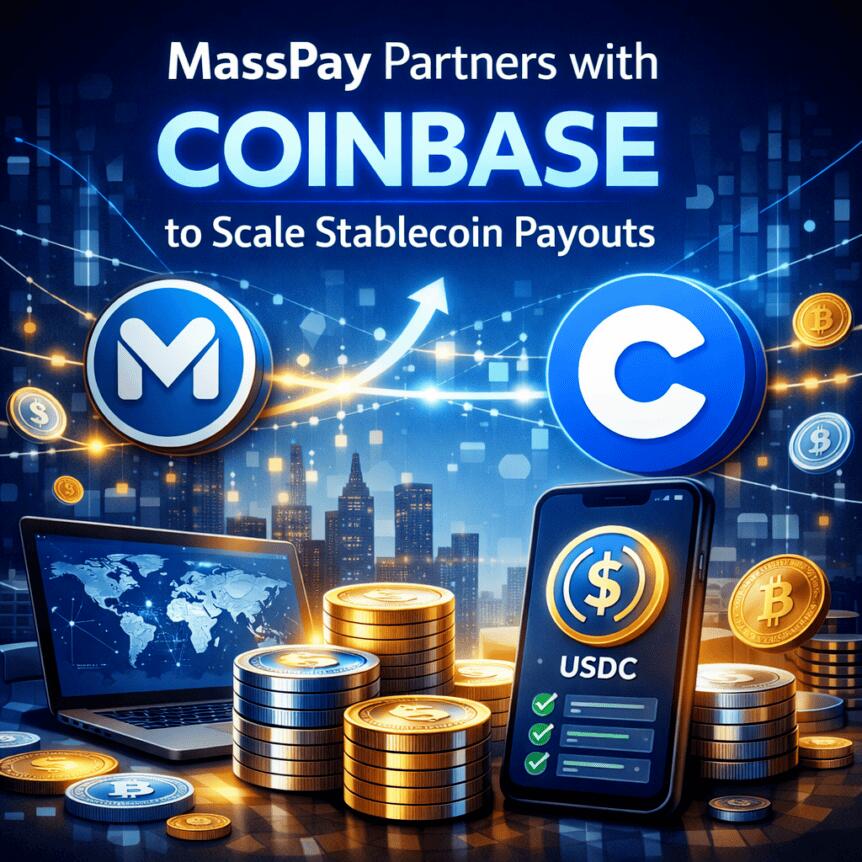
Cross-border payout platform MassPay and Coinbase announced a partnership on Thursday to offer stablecoin cross-border payouts.
The partnership connects MassPay’s network in 180 countries with the US-based exchange’s crypto infrastructure, allowing customers to move between fiat, USDC and other digital assets, the companies said in a joint statement shared with Cointelegraph.
MassPay CEO Ran Grushkowsky told Cointelegraph that stablecoins are still a small slice of the company’s transaction volume. Still, the company expects the new rails to support nine-figure payouts in the first year.
He added that clients using the system have seen costs fall by about 40% to 70% versus international wires, while settlement is near instant instead of taking days on traditional payment rails.
MassPay and Coinbase partner on stablecoin cross-border payments. Source: MassPay
The partnership adds to a broader trend of established payments and financial infrastructure providers embracing stablecoins.
Stripe and Circle, for example, have also moved to expand stablecoin-based infrastructure for cross-border payments.
MassPay deepens stablecoin payout push
Under the partnership, Coinbase provides wallet infrastructure, custody and onchain settlement, while MassPay orchestrates last-mile payouts over bank transfer, mobile wallet and digital asset channels.
The companies split compliance responsibilities, with Coinbase providing regulated custodial infrastructure and licensing, while MassPay handles know-your-customer checks, sanctions screening and tax documentation across its network.
Related: Coinbase to launch token-backed mortgage down payments this summer
Grushkowsky said MassPay already offers stablecoin payout capabilities via other providers and is now expanding capacity and credibility by adding Coinbase.
Stablecoins spread across payment rails
Beyond MassPay and Coinbase, other large payments players are also building stablecoin-based infrastructure for cross-border flows.
Stripe acquired Bridge in February 2025, a startup focused on scaling stablecoins to businesses, and said it expects stablecoin infrastructure to play a critical role in accelerating cross-border commerce.
Circle, meanwhile, announced its Circle Payments Network in April 2025 to connect banks, payment companies and digital wallets for real-time cross-border settlement using USDC, EURC and other regulated payment stablecoins.
Magazine: Guide to the top and emerging global crypto hubs — Mid-2026

The pair behind a $389 million cryptocurrency laundering service dubbed “AudiA6” have been arrested following international investigations between the US, Europol, and 10 other countries.
According to a press release from the US Attorney’s Office, Eastern District of Pennsylvania, both Ruslan Igorevich Tkachuk, 37, Ukrainian, and Alexander Vladimirovich Ledenev, 25, Russian, are residents of Georgia, where they are currently in custody.
The US will be seeking the pair’s extradition, after which they could each face a maximum sentence of 20 years.
Europol called the platform the “most trusted by ransomware gangs and cybercriminal networks” and links it to “over 15 international cybercrime investigations.”
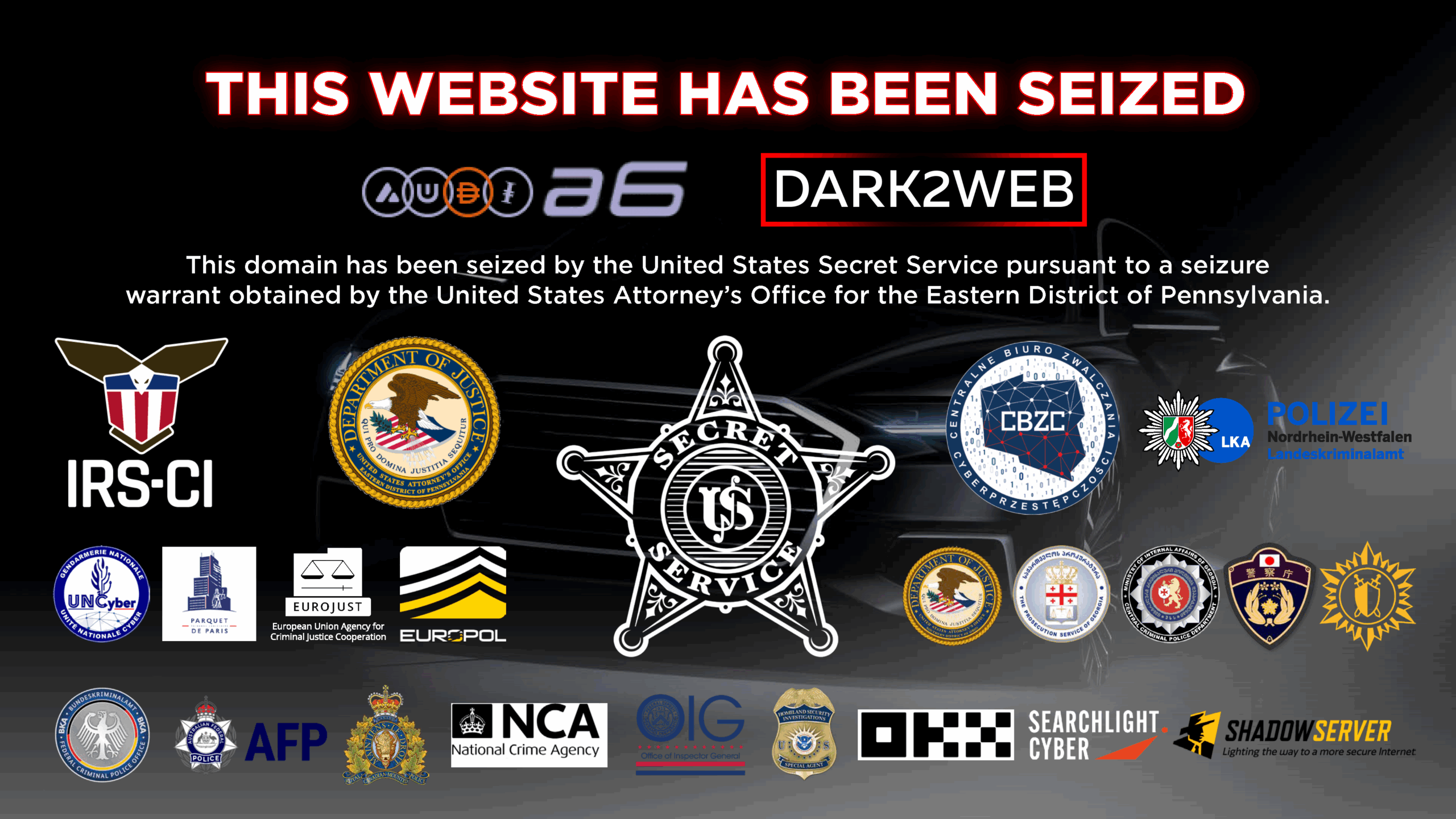
In what is described as a “coordinated international takedown,” properties were searched, cryptocurrency was frozen, and online infrastructure was targeted, with the organization’s websites replaced by a law enforcement seizure banner.
Read more: Crypto hack goes political as Grinex blames ‘Western special services’
As well as running AudiA6, the pair allegedly ran the cybercrime forum Dark2Web. On the forum, AudiA6 “explicitly offers to conceal and disguise” cryptocurrency linked to criminal activity “for a fee of up to five percent.”
According to US law enforcement’s blockchain analysis, over 10,000 bitcoin (BTC) are estimated to have been deposited into AudiA6 since its launch in 2021.
Of these, almost 400 BTC were deposited directly from illicit sources, with additional funds indirectly linked to illicit activity.
KuCoin catches strays
Prolific blockchain investigator ZachXBT called AudiA6 “one of the top” users of centralized crypto exchange KuCoin where it ran a “centralized mixing services for cybercriminals.”
He believes AudiA6 laundered funds stolen from Swissborg last year, and LastPass users, which began in December 2022.
In April, the sleuth questioned why Kucoin would “allow” the laundering of crypto stolen via a fake Ledger app and from crypto ATM Bitcoin Depot.
Read more: KuCoin criticized for helping ‘launder’ $9.5M from fake Ledger app
Another blockchain sleuth is similarly critical of KuCoin in its alleged failure to prevent AudiA6’s operations.
SEAL contributor Nick Bax claims that KuCoin “facilitated” the laundering of “a very large amount of LastPass stolen funds.” He adds that “in rare cases” the exchange temporarily froze funds, but “would often release the funds back to the launderers.”
He also points out that AudiA6 “literally advertised key sweeping,” the mass draining of crypto from stolen seed phrases, such as from a compromised password manager.
Got a tip? Send us an email securely via Protos Leaks. For more informed news and investigations, follow us on X, Bluesky, and Google News, or subscribe to our YouTube channel.

Polish President Nawrocki stalls MiCA rollout despite deadline

Who Is Every Year After’s Alice Everly? Charlie Cliffhanger Explained

Coffee Break: Scarf Waist Belt

HarrisX Poll Found 52% of Registered Voters Support the CLARITY Act

BloFin War of Whales 2026 Grand Prix opens registration for $5M trading championship

Blockchain.com files with SEC for U.S. IPO

Hannah Pangilinan: Money Habits Na Nagbigay Sakin ng Financial Freedom in My 20s

UK Coins Song – Fun British Money Song for Kids. Learn about Currency in the United Kingdom.

All the financial advice you’ll ever need fits on a single index card
-

 Fashion6 days ago
Weekend Open Thread: Evereve – Corporette.com
-
 Crypto World6 days ago
Jensen Huang Approves Samsung, SK Hynix, and Micron for NVIDIA (NVDA) HBM4 Memory Supply
-

 Crypto World4 days ago
Anatomy of the June crypto crash: Fed, Iran, Saylor
-
 Entertainment5 days ago
The Best Mystery Series of All Time Is Surging on Streaming 30 Years After It Ended
-

 NewsBeat4 days ago
Alexander Zverev wins the French Open to finally earn a 1st Grand Slam title
-

 Tech6 days ago
Suspicious Polyfill login prompts pop up on Toshiba, Muji websites
-
 Crypto World5 days ago
Senator Cynthia Lummis Calls CLARITY Act the Most Consequential Financial Legislation of This Generation
-

 Tech4 days ago
Microsoft unveils seven homegrown AI models in new bid for ‘long term self-sufficiency’
-

 Tech6 days ago
Microsoft launches MXC, an OS-level sandbox for AI agents, with OpenAI and Nvidia already on board
-

 Business6 days ago
(VIDEO) Justin Bieber Delivers Surprise Happy Birthday Serenade to Diners at Los Angeles Mexican Restaurant
-
 Business5 days ago
The Pain Points Taking a Fragile Tech Rally Down a Notch
-

 Business4 days ago
High Stakes for Wembanyama as New York Pushes for 3-0 Lead
-
 Crypto World3 days ago
Eli Lilly (LLY) Stock Surges 4% Following Breakthrough Sleep Apnea Trial Results
-

 Tech6 days ago
Von der Leyen’s AI envoy pick draws conflict-of-interest fire
-

 Tech6 days ago
Meta steals a tactic from Tesla and builds data centers in tents
-
Crypto World6 days ago
LBank Surpasses 25 Million Users Worldwide as AFA Partnership Continues to Drive Global Growth
-

 Tech5 days ago
Hackers now exploit SolarWinds Serv-U flaw to crash servers
-
 NewsBeat4 days ago
Alexander Zverev conquers demons and outlasts Flavio Cobolli to win French Open for first major title
-

 Crypto World4 days ago
Trump’s AI Ownership Plan Could Benefit Anthropic at OpenAI’s Expense
-
 Sports2 days ago
Bangladesh beat Australia after 20 years in ODIs, register only their second win over six-time world champions | Cricket News
You must be logged in to post a comment Login