
Crypto World
OrdinalsBot, Bitcoin’s First Inscription Service, Is Shutting Down After 3 Years



OrdinalsBot, the first inscription service in the Bitcoin (BTC) Ordinals ecosystem, has announced its shutdown. The project will sell its brand, intellectual property, and full technology stack.
It opened about a month after the Ordinals protocol went live in early 2023. The project said that sustaining the business is not viable.
OrdinalsBot Puts Brand, IP, and 90 Code Repositories Up for Sale
The team announced the decision in a post on X. OrdinalsBot said it had explored measures, including restructuring and a business pivot, but ultimately determined that continuing operations was no longer viable.
“Unfortunately, the Ordinals market has contracted sharply over the past year…In these 3 years, we have achieved many great things and met amazing, like-minded people looking to bring new use cases to the mother chain and create a robust fee market,” the post read.
Rather than allow the business and its technology to gradually lose value, the company has opted to sell its entire asset portfolio through an open, competitive bidding process. The package includes the OrdinalsBot brand, intellectual property, domains, social media accounts, Discord community, and GitHub presence.
It also includes more than three years of research and development spread across more than 90 code repositories. According to the company, the assets could give a prospective buyer an established foundation for building on Bitcoin without having to develop the underlying infrastructure from scratch.
OrdinalsBot said it has already informed investors about the wind-down and has begun receiving acquisition bids.
Follow us on X to get the latest news as it happens
Shutdowns Pile Up Across Crypto in 2026
OrdinalsBot joins a long queue. More than 120 crypto projects shut down, filed for bankruptcy, or went dark so far this year, according to RootData.
The closures span wallets, exchanges, NFT platforms, and DeFi tools, pointing to a broader shakeout across the industry. Crypto exchanges BitMEX and BitMart both announced shutdowns last month.
Decentralized finance (DeFi) portfolio tracker Zapper closed in August. OrdinalsBot differs in one respect. Its founders are trying to sell the pieces rather than switch off the servers.
Subscribe to our YouTube channel to watch leaders and journalists provide expert insights
The post OrdinalsBot, Bitcoin’s First Inscription Service, Is Shutting Down After 3 Years appeared first on BeInCrypto.

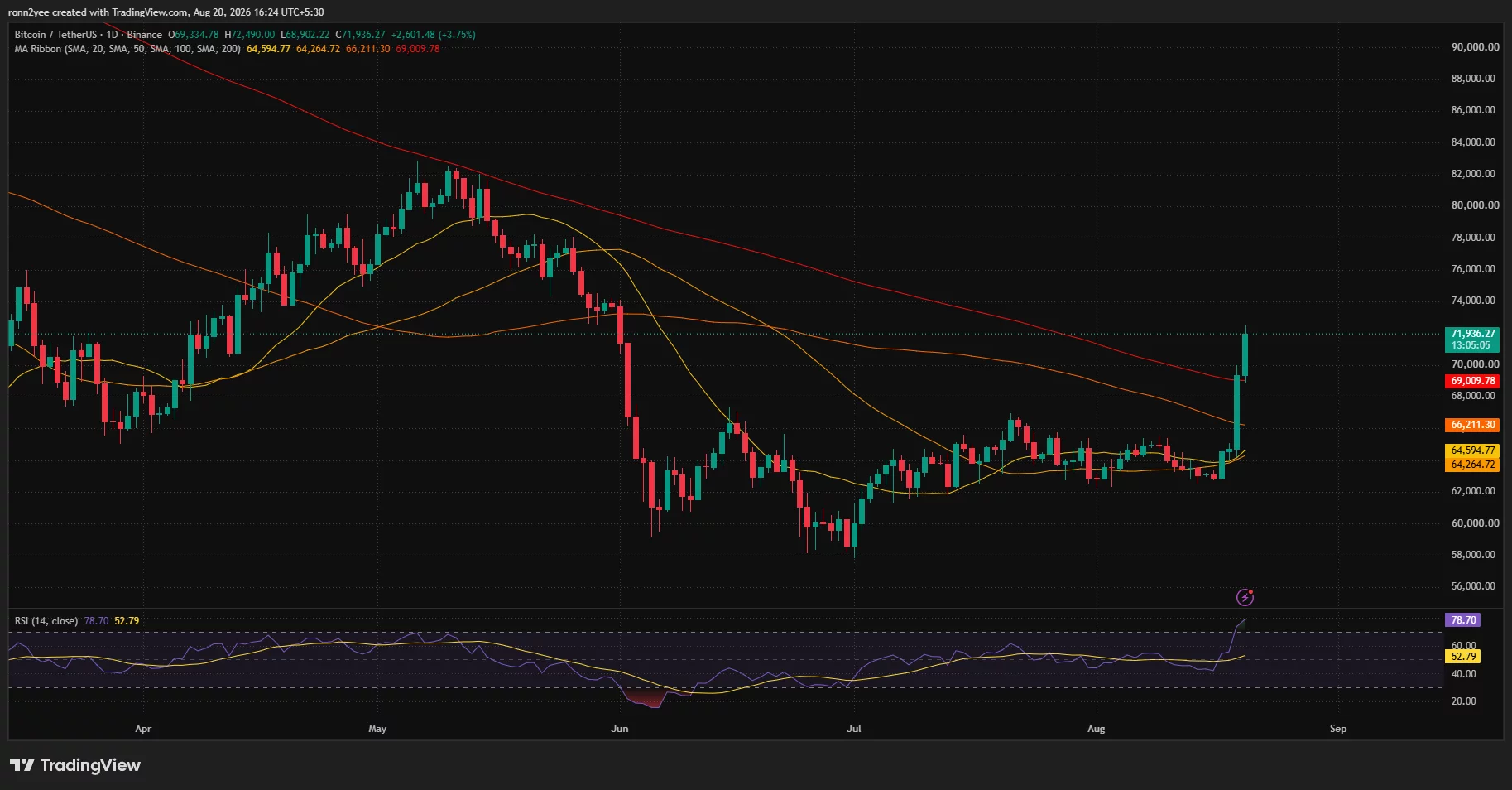
Bitcoin price extended its breakout to $72,490 on Aug. 20 after forced short covering pushed the price through its 200-day moving averages, but an overbought daily reading raises the risk of a pullback.
Summary
- Bitcoin price climbed to an intraday high of $72,490 after breaking above $67,000.
- The price reclaimed its 200-day simple and exponential moving averages near $69,000.
- Daily RSI reached 78.7, placing Bitcoin firmly in overbought territory.
- Liquidation data show the rally cleared several large short-position clusters above $66,000.
Bitcoin price breaks above its 200-day averages
According to data from crypto.news, Bitcoin (BTC) price traded near $71,900 on Binance at the time of writing, up about 3.8% on the daily chart after reaching $72,490 earlier in the session.
The move extended a breakout that began when BTC cleared the $64,000–$66,000 range that had contained the price through much of July and the first half of August. Bitcoin rose from below $65,000 to nearly $70,000 during the first stage of the rally before buyers pushed it above $72,000.
The daily chart shows that Bitcoin has now crossed its 200-day simple moving average at approximately $69,010 and its 200-day exponential moving average near the same level. BTC had remained below both trend indicators since its sharp June decline.
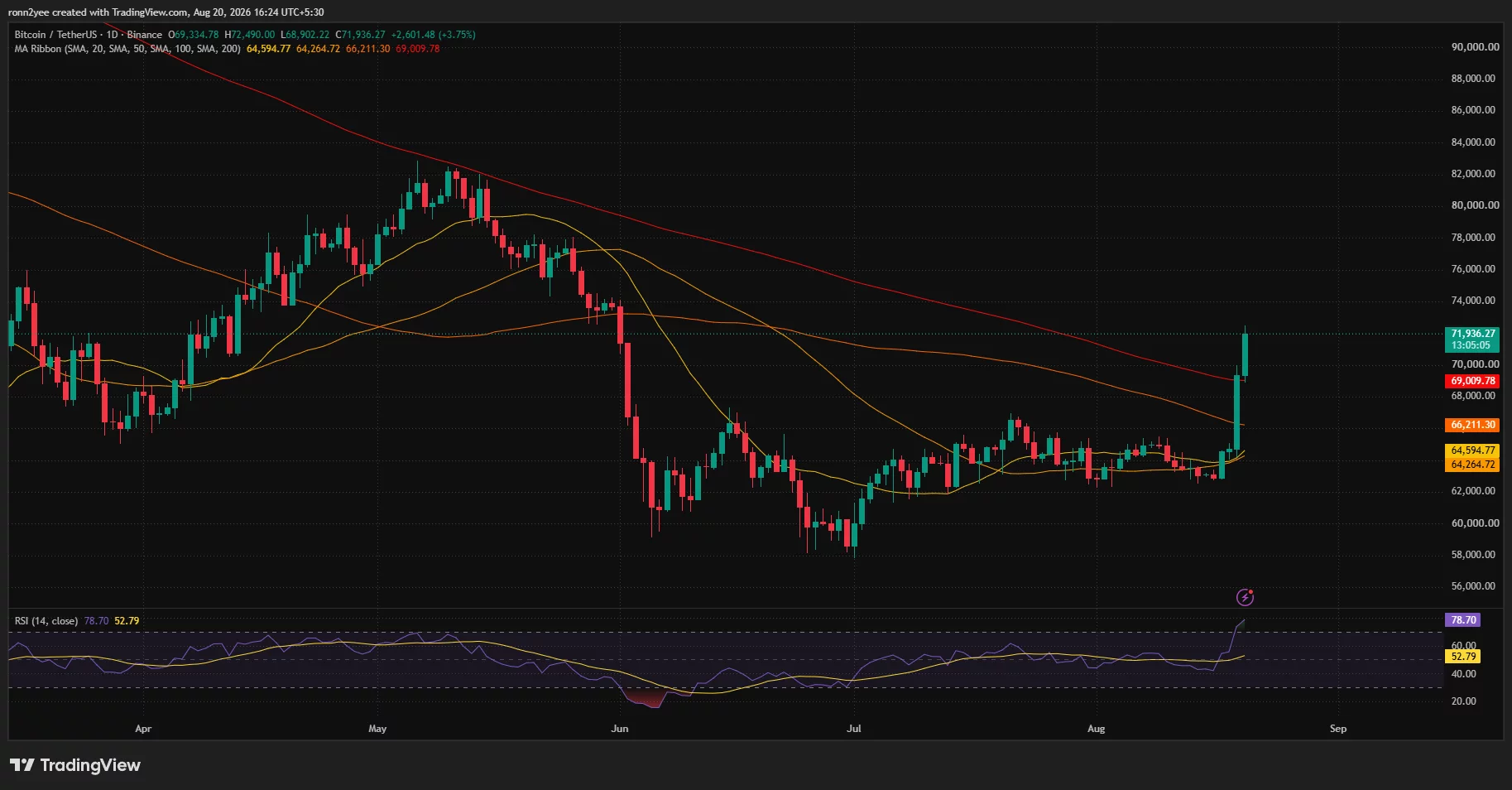
The breakout also took Bitcoin above its shorter moving averages. The 20-day SMA stood at $64,595, while the 50-day and 100-day averages were grouped between $64,264 and $66,211.
That cluster may become a wider support area if the price gives back part of the rally. Holding above the 200-day averages would provide a stronger sign that the move represents more than a temporary derivatives-driven rebound.
Short liquidations accelerated the Bitcoin rally
The one-week CoinGlass liquidation heatmap shows that Bitcoin moved through several layers of leveraged short positions as it crossed $66,000, $68,000, and $70,000.
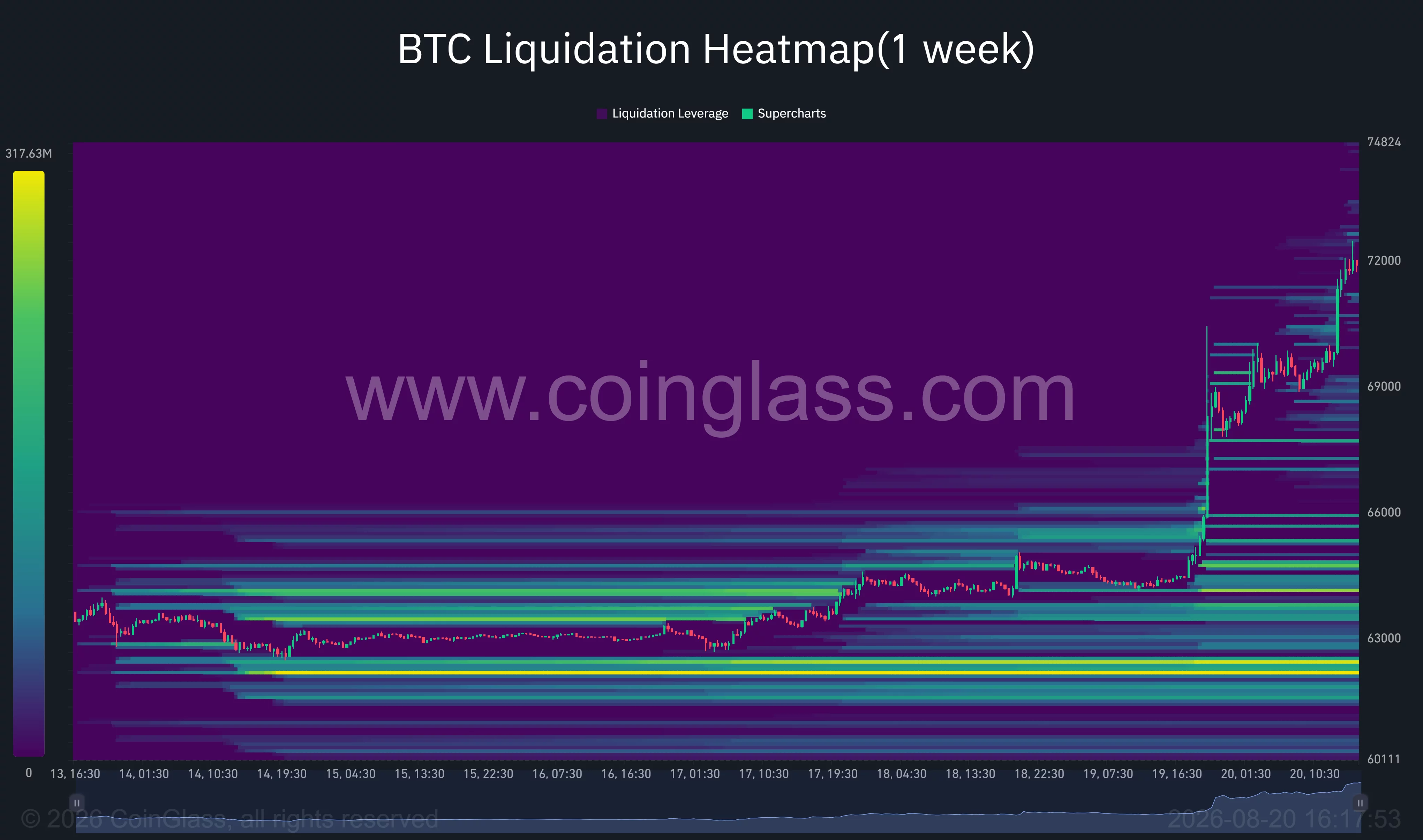
The densest liquidity visible before the breakout was concentrated around $65,000–$66,000. Once Bitcoin crossed that area, forced purchases by traders closing bearish positions helped carry the price toward $69,000.
Further short-liquidation bands between $69,000 and $71,000 added fuel to the advance. The heatmap shows fewer established liquidation clusters above the current price because BTC reached the area rapidly and had spent little time building leveraged positions there.
The rally followed a long period of compression around $63,000–$65,000. Market data supplied with the charts showed more than $1 billion in Bitcoin short liquidations during one hour, and $2.7 billion in bearish positions closed across the broader crypto market.
Liquidations can increase the speed of a move because exchanges automatically buy Bitcoin to close short positions. However, demand generated by forced covering can fade once the largest short clusters have been cleared.
Momentum supports buyers but RSI warns of overheating
Bitcoin’s 4-hour chart remains bullish after the Supertrend indicator flipped positive. Its trailing level has risen to $67,752, placing the first dynamic support roughly 6% below the current price.
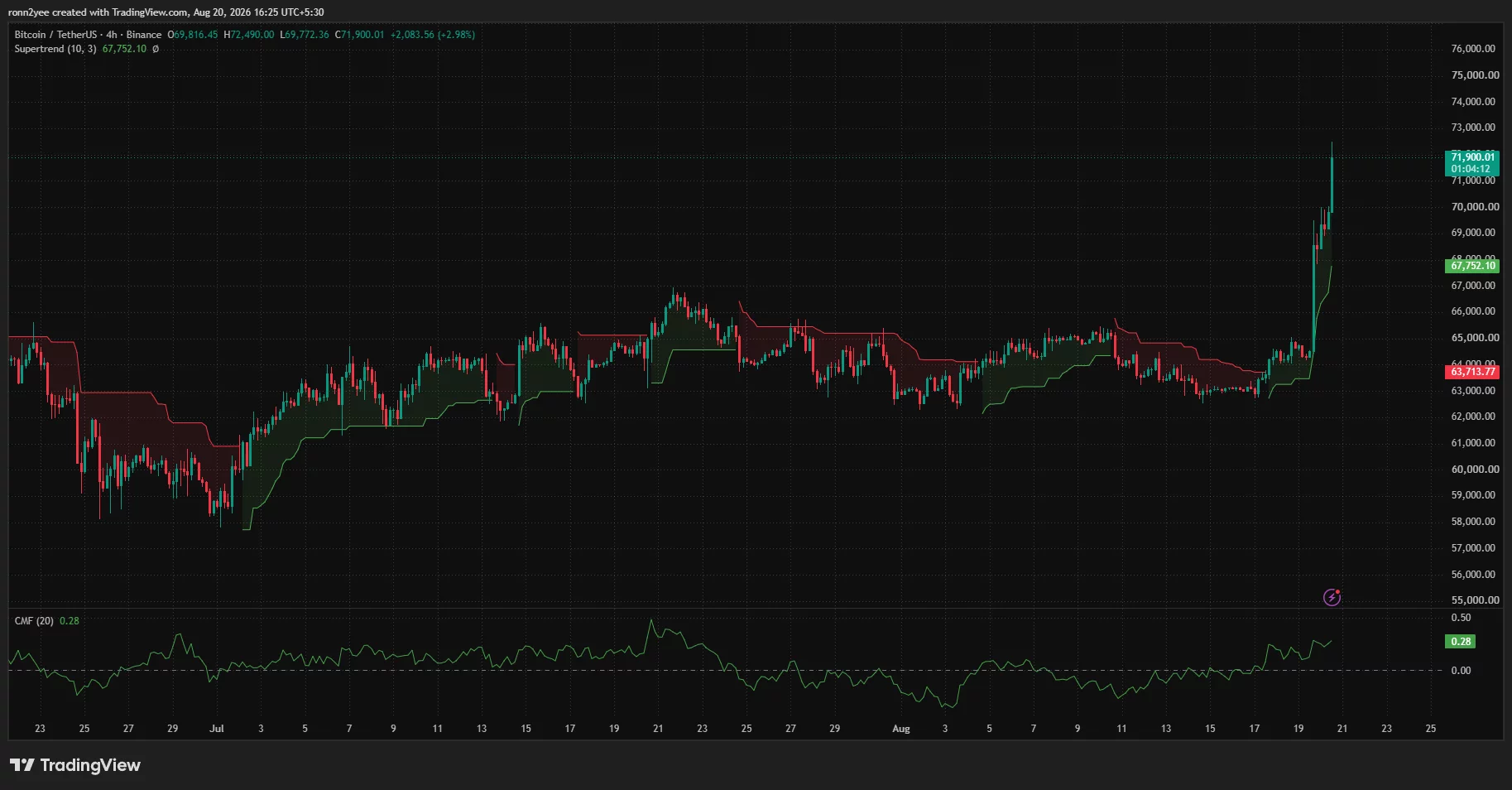
The Chaikin Money Flow reading of 0.28 also shows that buying pressure has accompanied the breakout. A positive CMF reading means more volume has entered Bitcoin during periods when the price closed near the upper part of its trading range.
The daily chart carries a clearer warning. Bitcoin’s 14-day relative strength index jumped to 78.7, well above the 70 level commonly used to mark overbought conditions.
An overbought RSI does not require an immediate reversal, especially during a short squeeze. It does show that the rally has moved faster than its recent trend, increasing the chance of consolidation or profit-taking.
The latest daily candle also produced a high near $72,490 before the price eased below $72,000. Buyers must therefore turn the $69,000–$70,000 region into support to prevent the breakout from becoming a brief move above the 200-day averages.
Analysts watch $67K and $65K for a pullback
Crypto trader Daan Crypto Trades said in an Aug. 20 X post that Bitcoin had made a higher high and was testing its daily 200-day moving-average region.
Daan placed the move inside a wider $60,000–$80,000 range and said the trend had improved on the daily chart. However, the trader expected volatility to remain elevated after Bitcoin escaped the compressed range.
Lennart Snyder offered a more cautious assessment in a separate X post. Snyder said Bitcoin had entered a larger range but remained below important resistance, leading him to favor waiting for the price to settle before opening a new position.
Snyder identified the midpoint of the breakout candle around $67,000 as one area where momentum traders could look for support. He placed a deeper potential buying zone at $65,000–$66,000, near the upper boundary of Bitcoin’s former consolidation range.
Those levels broadly match the technical charts. The 4-hour Supertrend stands near $67,752, while the daily moving-average cluster between $64,264 and $66,211 could offer support during a larger retracement.
On the upside, a sustained close above $72,500 would leave the $74,000 area as the next nearby psychological level. Bitcoin would then face a broader supply region between $78,000 and $80,000, where the market traded before the June sell-off.
US liquidity and ETF demand remain key
The breakout came as US Treasury yields and the dollar pulled back following the Treasury Department’s reported plan to increase long-dated bond buybacks from $2 billion to at least $4 billion per operation in September.
Lower yields can support non-yielding assets such as Bitcoin by reducing the relative return available from government bonds, though the derivatives data indicate that forced short covering was a major immediate driver of the rally.
Data from SoSoValue also showed $517 million in net inflows into US spot Bitcoin exchange-traded funds on Aug. 19. Continued ETF demand would offer stronger evidence that institutional buying is replacing the short squeeze as the source of support.
A renewed rise in US yields, weaker ETF flows, or a daily close below $69,000 would weaken the breakout. Holding the 200-day averages while the RSI cools would give buyers a firmer base for another attempt above $72,500.
Disclosure: This article does not represent investment advice. The content and materials featured on this page are for educational purposes only.

US spot Bitcoin exchange-traded funds (ETFs) saw a surge in demand on Wednesday, pulling in $517.2 million in net inflows—marking their biggest single day since May 4. That strong session helped lift total August net inflows to $1.47 billion, extending a momentum shift that has become increasingly noticeable as the month progresses.
According to data referenced by Cointelegraph, the funds have drawn in roughly $1 billion since Monday, representing their strongest weekly net inflow since the week ended Jan. 16, when they attracted about $1.42 billion.
Key takeaways
- Bitcoin spot ETFs recorded $517.2 million in net inflows on Wednesday, the largest single-day figure since May 4.
- August net inflows reached $1.47 billion as inflow strength continued after Monday’s near-$1 billion total.
- Spot Ether ETFs added $189.2 million in net inflows on Wednesday, bringing this week’s Ether inflows to about $291.5 million.
- ETF inflows coincided with a broad crypto price rally and US Treasury action to expand long-dated debt buybacks.
- Market attention also returned to US crypto policy progress, following renewed discussion of the CLARITY Act.
ETFs post best day since May amid risk-sensitive market signals
The latest ETF numbers arrived alongside a rising crypto tape. At the time of writing on Thursday, Bitcoin was trading near $72,000, up 11% over the prior 24 hours, according to CoinGecko. Ether also gained sharply, up 19% to $2,286.
The close timing matters because it suggests the inflows were not isolated to ETF-specific flows alone. Instead, they came during a day when broader market conditions appeared to favor assets perceived as hedges against currency debasement rather than pure “risk-on” trades.
Cointelegraph quoted Jonatan Randin, senior market analyst at PrimeXBT, saying the Treasury’s move to expand buybacks at the long end helped push yields and the US dollar lower—while gold and silver outperformed equities. In his view, the market interpreted the action as a currency-related development rather than a growth catalyst.
Why Treasury buybacks and regulation talk may be feeding the same narrative
The Wednesday ETF inflow surge was linked to two parallel storylines: the US Treasury’s decision to expand buybacks of longer-dated government debt, and renewed attention on crypto regulation after President Donald Trump urged Congress to advance the CLARITY Act at a White House event.
Cointelegraph’s reporting connected the Treasury decision to the broader price action, including the way Bitcoin traded in sympathy with gold and silver. Randin’s comments emphasized that Bitcoin’s correlation shifted toward the “debasement trade”—an environment where investors often look to hard assets rather than companies or conventional growth exposure.
Investors tend to focus on the interaction between rates, the dollar, and liquidity expectations because those factors can influence whether demand flows into speculative or “hedging” allocations. When ETFs see strong net inflows while Bitcoin’s price behavior resembles traditional hedges, it can indicate a different driver than simple momentum trading.
Ether ETFs also benefit as weekly inflows climb
While Bitcoin led the day’s flows, Ether ETFs also contributed to the broader picture. Spot Ether ETFs logged $189.2 million in net inflows on Wednesday, increasing this week’s net inflows to about $291.5 million.
That matters for market structure: simultaneous strength across major spot products can reinforce the impression that inflows are responding to a macro or policy-driven catalyst rather than reflecting a rotation limited to a single asset.
At the same time, the gap between Bitcoin’s $517.2 million inflow and Ether’s $189.2 million highlights how investor positioning still appears weighted toward Bitcoin as the primary institutional gateway for spot exposure.
What to watch next: whether ETF inflows hold after the catalyst
The immediate question for readers is whether the Wednesday surge was a one-off reaction to Treasury headlines and renewed regulatory urgency—or the start of a more sustained inflow trend. With Bitcoin and Ether both sharply higher and ETF inflows reaching notable multi-month highs, investors will likely watch subsequent daily flow prints, changes in yields and the dollar, and any tangible movement around US crypto policy discussions.
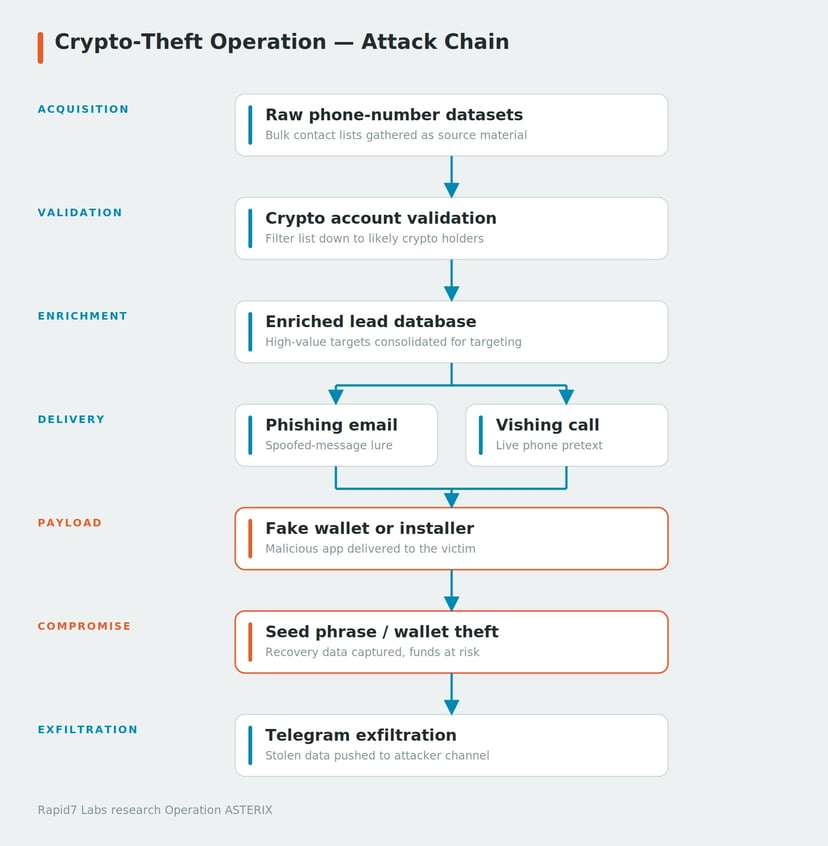
Cybersecurity firm Rapid7 unveiled a new cryptocurrency phishing campaign known as Operation Asterix, targeting roughly 885,000 phone numbers from several countries to steal cryptocurrency investors’ assets.
The phishing campaign led to 5,576 accounts matched to users on crypto exchange Binance, which were queued for attack, while the recovered logs also showed fake emails impersonating Crypto.com, according to a Monday report by Rapid7.
Of the 885,000 phone numbers, the largest file included 316,002 German mobile numbers, with additional directories covering Hong Kong, Bulgaria, the UK, the US, Canadian fintech companies and additional Ledger-related lists.
Phishing attacks and social engineering scams drove the majority of the crypto industry’s losses in the first quarter of the year, accounting for $306 million out of the total $482 million lost, according to blockchain security company Hacken.
As part of the Asterix phishing campaign detailed by Rapid7 analysts Anna Sirokova and Jan Recinsky, attackers drove victims to fake apps impersonating Ledger, Trezor, and Exodus, seeking to steal their seed phrases. Attackers reached out to victims through fake support emails and phone inquiries.
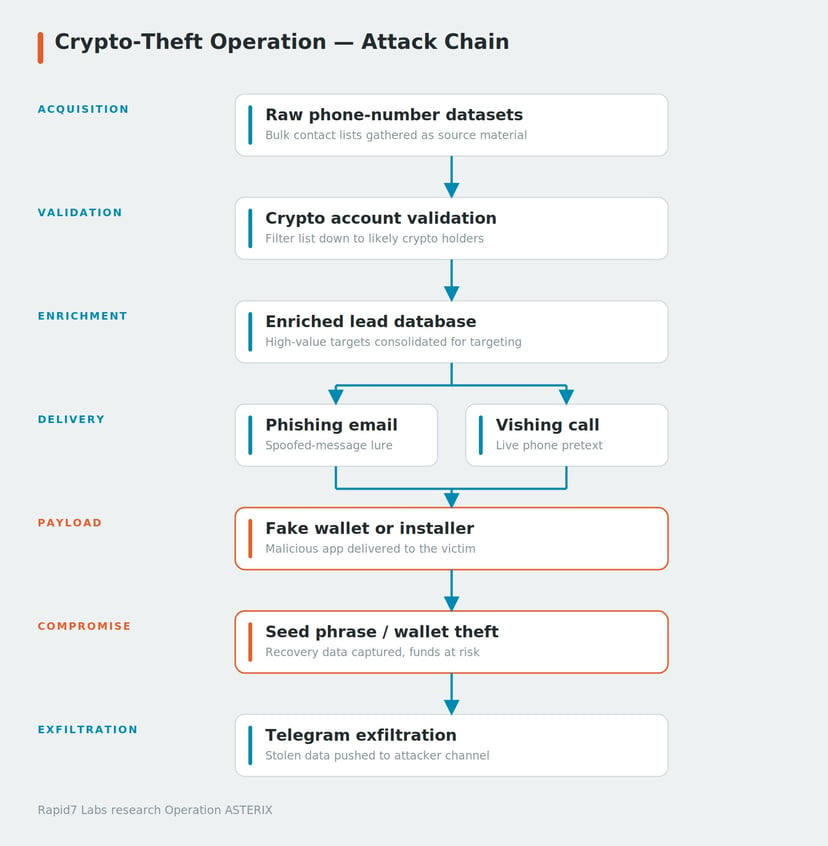
Operation Aseterix kill chain from acquisition to exfiltration. Source: Rapid7.
Cointelegraph has contacted the analysts for further comment on what they found regarding target filtering, hardware wallet spoofing and self-custody vulnerabilities. We will update this article when they reply.
Earlier in August, wallet provider Trezor reported a breach of personal data affecting about 14,000 users through its shipping provider, ShipMonk.
In July, a crypto investor lost nearly $1 million after signing a malicious phishing token approval transaction on Ethereum.
In November 2023, a fake Ledger Live app on the Microsoft Store resulted in the theft of $588,000 across 38 transactions.
Related: DefiLlama delayed mobile launch over phishing apps on Apple Store, founder says
Asterix phishing campaign boasts 13% “hit rate”
Attackers matched 43,066 accounts to cryptocurrency users with exchange accounts, validated from the larger German dataset of over 316,000 phone numbers, meaning that the campaign has a “hit rate” of approximately 13.6%, according to Rapid7.
The report also identified a checker for Kraken, which sought to bulk-validate phone numbers against accounts from the cryptocurrency exchange. The cybersecurity company said that the recovered artifacts showed that artificial intelligence tools were used as a significant part of the phishing campaign.
Phishing attacks are a long-standing headwind for the crypto industry, as they enable attackers to exploit human behavior rather than the code of a protocol.
On May 25, onchain analyst “b-block” warned that scammers used Google to deploy malicious phishing ads impersonating decentralized exchange Uniswap, reportedly stealing more than $400,000 from victims.
Leading crypto industry figures, including Binance co-founder Changpeng Zhao, have previously called for better wallet security measures to avoid phishing scams, after an investor lost $50 million in an address poisoning scam in December 2025.
Magazine: How a ‘Wrong Number’ message turned into a $3.4M crypto scam


Millions of EU citizens already send messages through systems that scan them. Vyara Savova, senior policy lead at the European Ethereum Institute, warns that end-to-end encryption sits next in line.
The current rules come from a derogation to the ePrivacy directive. Lawmakers extended that derogation in July 2026, and it now runs until April 2028.
EU Chat Control Already Reads Whole Messages
In an interview with BeInCrypto, Savova separated two files that critics often merge into one. The first lets providers scan voluntarily. The second would turn scanning into a legal duty.
Most large platforms already use the voluntary route. Therefore, EU message scanning is not a future risk for most users. It is a current default.
Savova explained how the mechanism works in practice.
“Basically what is happening is you have this possibility to scan voluntarily… messages for a specific type of content. But then in order for you to scan for a specific type of content, you still check the whole message.”
That distinction matters. A narrow legal purpose still requires broad technical access. Ethereum co-founder Vitalik Buterin made a similar point in July, when he called the revival a cybersecurity risk for everyone.
Why Encryption Sits Next in Line
Apps that use end-to-end encryption cannot comply with the same logic. Providers would first have to decrypt the traffic. As a result, the debate no longer stops at content moderation.
Savova framed the direction of travel bluntly.
“I would say people should already be worried, but it… has the potential to get much worse.”
Meanwhile, Brussels keeps widening its digital enforcement toolkit. Officials have also flagged VPNs as a loophole in age verification rules. Each file targets a different problem. Together, however, they point one way.
Crypto users face a specific exposure here. Wallet recovery flows, seed phrase backups, and trading group chats all travel over the same consumer apps. Savova noted that file storage falls inside the same scope, not just live chat.
Scale makes the difference. Voluntary scanning covers a narrow category of known material today. A mandate would apply the same machinery to every conversation, on every platform, without suspicion.
Subscribe to our YouTube channel to watch leaders and journalists provide expert insights
The Legal Line Nobody Has Drawn Yet
Marina Markezic, co-founder and executive director of the European Ethereum Institute, argues that the constitutional test has not changed. Digital access simply feels lighter than a physical search.
“But the legal principles and the principles that we have adopted over the years in… our constitutions are still standing. So no matter if it’s the access to our apartments, if it’s access to our communications…”
Supporters of the rules make the opposite case. Child protection groups argue that platforms already hold the data, so targeted scanning adds little new intrusion. European Commission officials have repeatedly said the goal stays limited to abuse material.
Still, the technical answer decides the outcome. Encryption either holds for everyone or breaks for everyone. Consequently, the next negotiation rounds in autumn will matter more than the language on paper.
Users can act now. Choosing apps that publish their encryption model, and moving sensitive files off consumer chat, both reduce exposure well before any final vote. Savova and Markezic plan to keep tracking the negotiations through the autumn rounds.
The post EU Message Scanning Is Live and End-to-End Encryption Could Be Next appeared first on BeInCrypto.

The UK government sent more than 81,000 warning letters during the 2025/2026 financial year to crypto holders it suspects of owing unpaid taxes.
A freedom of information request seen by the BBC revealed that the volume of letters from HM Revenue and Customs (HMRC) had tripled from 27,714 in 2024.
Unpaid taxes stem from crypto bull run
HMRC believes most of the unpaid taxes stem from gains made during the crypto bull run between 2022 and 2025.
The letters remind UK crypto users that if they sell, give away, exchange or make a purchase with crypto, they may need to pay capital gains tax.
If they don’t pay, they face a possible penalty of up to 100% of their owed tax with interest. This increases when it comes to offshore transfers.
HMRC plans to track wealthy crypto holders with ease
Neela Chauhan, a partner at accounting firm UHY Hacker Young, told the BBC, “A lot of the traders are young, have had little previous exposure to HMRC and often work under the assumption that HMRC has limited visibility over their activities.”
Chauhan adds that tax authorities suspect many crypto investors are evading tax, and that tracking the unpaid taxes of wealthy crypto users will be like “shooting fish in a barrel” once HMRC acquires new powers next year.
Read more: Dutch nominee to oversee crypto tax quits over CV scandal
These powers will force offshore crypto firms to divulge customers’ information to HMRC. The body estimates this will raise £315 million by 2030.
UK banks are also tight on crypto
Meanwhile, there’s still friction between UK banks and crypto investors.
A number of MPs representing a crypto and digital assets all-party parliamentary group recently reached out to UK banks to complain about the crypto restrictions in place and their effect on the wider crypto market.
They claim there have been “repeated instances” where crypto firms struggle to open bank accounts, and that these restrictions “could be one of the single biggest barriers to growth for UK crypto and digital asset businesses.”
Got a tip? Send us an email securely via Protos Leaks. For more informed news and investigations, follow us on X, Bluesky, and Google News, or subscribe to our YouTube channel.

Ethereum jumped roughly 20% in the past 24 hours, a move large enough to rank as the 8th-biggest single day for the token since January 2018.
Historical data compiled by analyst Jamie Coutts suggests such moves have been unreliable over 30 days but have produced better results over three to six months.
Where This Move Ranks, and What Tends to Happen Next
Coutts published a table of every ETH day that gained 15% or more since 2018, sixteen of them completed and now trackable against what came after. Ethereum’s August 19 print landed at plus 18.5%, just behind an 18.8% day in November 2022 and ahead of a 17.5% day in December 2018.
The biggest on record is still May 2021’s 24.5% single-day gain, which was followed by a rough month (down 25.3% in 30 days) before turning positive by 180 days (up 68%). That pattern repeats across the dataset.
Of the sixteen completed cases, only 8 were higher 30 days later, but 10 were higher after 90 days, and 12 were higher after 180 days. Average returns climbed the same way: plus 20.6% at 90 days, plus 59.3% at 180 days.
Coutts summed it up on X, saying the numbers show odds that “skew meaningfully higher over the next 3 to 6 months.”
At the time of writing, ETH was trading near $2,280 after going past $2,300 during the last 24-hour period. CoinGecko data shows a nearly 18% daily gain, an almost 19% rise over seven days, and a just about 17% increase over 30 days. Its 24-hour trading volume has climbed to about $32 billion, up 439% from the previous day.
That move also puts ETH well ahead of Bitcoin over the same period. BTC gained about 9% in 24 hours and slightly more than that in seven days, with Ethereum’s stronger performance lifting the ETH/BTC ratio by about 9% over the latest 24-hour period.
Meanwhile, the buying pressure was unusually large, as noted by CryptoQuant contributor MorenoDV_, who reported that ETH taker-buy volume reached $2.55 billion in one hour on August 19, the third-highest reading since February 7. However, the figure does not distinguish between new long positions and short positions being closed.
Technical Recovery Meets a Broader Crypto Policy Rally
Sykodelic wrote on August 20 that ETH had moved back above its 200-day simple moving average before Bitcoin. The trader had also earlier identified the $2,400 area as the next major range level.
The wider rally came after the August 19 White House crypto meeting, where President Donald Trump pushed Congress to advance the CLARITY Act, leading to Bitcoin spiking toward $70,000.
The SEC’s August 18 crypto fundraising proposal added another policy catalyst. It includes exemptions for offerings of up to $5 million over four years or $75 million over 12 months, alongside a conditional safe harbor for certain tokens.
The post ETH’s Rare Double-Digit Surge Could Be Just the Beginning appeared first on CryptoPotato.


The approved plan reallocates 546.9 million OP from user airdrops to a Foundation-controlled Strategic Ecosystem Fund.


AI agents may not converge on public blockchains, Fidelity Digital Assets said, naming that outcome as one of the largest potential risks to the sector’s AI thesis.
The warning came days after Grayscale named 4 blockchain networks that could benefit from the adoption of artificial intelligence (AI).
Fidelity Flags Risks in Crypto’s AI Agent Thesis
Senior Research Analyst Max Wadington published the Fidelity report on August 19. He listed the scenario among six structural risks to the AI and digital assets thesis.
Wadington explained that closed systems run by large technology firms and fintech platforms could absorb the same activity. He cited advantages in performance, cost, user experience, and regulatory clarity.
“Even if AI drives a substantial increase in overall digital economic activity, there is no guarantee that public blockchains will capture a meaningful share of it,” he wrote.
This follows comments from Grayscale Head of Research Zach Pandl, who said the growing adoption of artificial intelligence (AI) will generate demand that public blockchains are well-positioned to meet.
He named Ethereum (ETH), Solana (SOL), Worldcoin (WLD), and Bittensor (TAO) against three demand areas. Pandl grouped that demand into agentic finance, verifiable record-keeping, and decentralized AI. He argued that traditional systems were not built for what AI will generate.
Follow us on X to get the latest news as it happens
The Other Risks Fidelity Outlined
A second risk concerns payments. The report noted that payments can drive significant transaction volumes, but they generally generate relatively low fees and compete with established financial institutions and technology platforms.
As a result, higher payment activity could boost adoption and usage, particularly among stablecoin issuers, without necessarily translating into comparable value accrual for native tokens, especially at the base blockchain layer.
“The primary economic beneficiaries of payment-driven growth may be stablecoin issuers and adjacent service providers rather than the underlying blockchain networks themselves,” the report read.
The remaining risks cut across the same thesis. Wadington wrote that more software output does not guarantee more economic value.
He also stated that technical differentiation could weaken as AI commoditizes development. Liquidity, distribution, security, and trust become the durable advantages instead.
Security itself turns into a competitive differentiator. AI lowers the cost of finding vulnerabilities while also lowering the cost of writing code.
Compliance rounds out the list. Systems offering clearer identity and permissioning frameworks may suit institutional adoption.
Fidelity did not forecast any of these outcomes. The firm framed each as a risk that could reshape how much value public chains capture.
Subscribe to our YouTube channel to watch leaders and journalists provide expert insights
The post Fidelity Digital Assets Names 6 Risks to Crypto’s AI Agent Thesis appeared first on BeInCrypto.


A federal appeals court has ruled that crypto theft victims can sue Binance in US courts, rejecting the exchange’s attempt to push their claims into arbitration under terms they never signed.
The Eleventh Circuit granted a writ of mandamus on Wednesday, a rare remedy that forces a lower court to correct a clear error. The panel directed a Florida district court to vacate its arbitration order.
Court Says Victims Can Sue Binance Without Signing Its Terms
Eight theft victims filed proposed class actions against Binance Holdings, BAM Trading Services, which operates Binance.US, and founder Changpeng Zhao. None of them ever held a Binance account or accepted its Terms of Use.
They allege criminals drained their wallets, then laundered the proceeds through the exchange. The complaints cite the Racketeer Influenced and Corrupt Organizations (RICO) Act, conversion, and consumer protection laws in California and Massachusetts.
The plaintiffs say Binance ran an unlicensed money transfer business and disregarded the Bank Secrecy Act. That US law requires financial firms to detect and report suspicious transactions.
A judge in the Southern District of Florida sent the dispute to arbitration anyway, relying on equitable estoppel. The doctrine can force non-signers into a contract’s arbitration clause when they benefit from the agreement.
The three-judge appeals panel called that a misreading of the complaints. According to the order, the claims rest on a “duty otherwise imposed by law” rather than on Binance’s terms.
The procedural route matters. Federal law bars appeals of orders compelling arbitration, so mandamus was the victims’ only exit after two years of fighting over the forum. The panel also credited evidence they would forfeit claims and face unreasonable costs arbitrating abroad.
What the Ruling Means for Binance and Other Exchanges
David Silver founded Silver Miller, the firm representing the victims. He said Binance told his clients to arbitrate in Hong Kong, one case at a time.
“A contract you never signed shouldn’t keep you out of court,” Silver noted.
The compliance allegations track a record Binance has already admitted. The exchange pleaded guilty in November 2023 to Bank Secrecy Act violations and running an unlicensed money transmitting business.
It paid a $4.3 billion resolution, and prosecutors said it never filed a single suspicious activity report with FinCEN. Zhao admitted failing to maintain an anti-money laundering program and served a four-month prison sentence in 2024.
Laundering speed explains why victims target exchanges rather than thieves. Global Ledger’s review of 255 hacks worth $4.04 billion found stolen funds can move within two seconds of an attack.
Binance’s courtroom record remains mixed. It won dismissal of terror financing claims in March, yet investors filed a $200 million UK lawsuit in June over leveraged trading losses.
The case now returns to the Southern District of Florida, where the civil RICO count allows triple damages if the victims prevail. Other circuits may soon face the same question about non-customers and exchange arbitration clauses.
The post Court Opens Door for Crypto Users to Sue Binance Over Stolen Funds appeared first on BeInCrypto.

The conversations offer clues to DSA’s sudden relevance. Members talk about rent and health care, Donald Trump and immigration enforcement, Israel and Gaza, jobs that do not pay enough and homes they cannot afford. Others describe a Democratic Party they no longer believe is capable of addressing the problems shaping their lives.
There is plenty at the summit to remind visitors that this is an avowedly socialist organization. A bookseller in the hallway sells Marxist literature; The Communist Manifesto sells out by evening. Nearby, organizers decorate a “Free Stuff!” booth with fake bags of money and gold bars. But many of the grievances drawing people toward DSA no longer sound especially fringe. For Katie Sims, DSA’s 28-year-old electoral chair, the revelation came after graduating from Cornell in 2020 and looking at what a job would pay, then what rent and health insurance would cost. “I was like, none of these numbers add up,” Sims says. Polls show younger Americans are increasingly pessimistic about reaching the basic milestones available to their parents: homeownership, financial security, raising a family without amassing crushing debt. But, while Mamdani was elected mayor of New York with 51% of the vote, the people DSA has attracted are disproportionately young, white, urban, and college educated—hardly a representative sample of the working class the organization hopes to organize.

Bitcoin Just Split. BlackRock Priced It In. Michael Saylor Denies It Happened.

Thailand News Roundup: Crisis, Recovery, and Development

Bitcoin price hits $72K, but charts warn of pullback





-

 Fashion6 days ago
Weekend Open Thread: Ann Taylor
-
 Sports7 days ago
This U.S. Amateur is a glimpse into golf’s future in more ways than you think
-
 Tech6 days ago
11 Ways to Rank Your Videos
-
 NewsBeat5 days ago
Myanmar says over 300,000 Rohingya refugees verified for repatriation as exodus enters ninth year
-

 Sports5 days ago
Birmingham 2026: Day 6 Timetable for Irish Athletes
-

 Politics5 days ago
SEQ Code: The Three Letter Boarding Pass Code That Could Give You The Worst Seat
-

 Tech7 days ago
DeepSeek Harness launches as open source rival to Claude Code, alongside V4-Pro on API with higher prices
-

 Tech2 days ago
Qwen3.8-27B runs frontier-class coding agents and reasoning locally, no cloud API required
-

 Crypto World5 days ago
Pi Network Protocol 27 endgame: last upgrade before what?
-

 Crypto World3 days ago
OCC Greenlights Trump Family Crypto Firm for Trust Charter
-

 Business2 days ago
SMA Solar Technology AG (SMTGY) Q2 2026 Earnings Call Transcript
-
 Tech5 days ago
Every fusion startup that has raised over $100M
-

 Fashion6 days ago
Weekly News Update, 8.14.26 – Corporette.com
-

 Business6 days ago
15 Ways to Make Money From Your Phone (2026 Guide)
-
 Entertainment6 days ago
10 Netflix Shows That Quietly Became Modern Classics
-

 Business5 days ago
Facebook Down Now? Users Report Login And Loading Problems As Outage Trackers Monitor Ongoing Issues
-
 Entertainment5 days ago
Marvel Studios Reveals New X-Men Cast Including Adam Driver and Sadie Sink
-

 Fashion6 days ago
Silver bangles for women – Newbridge Silverware
-

 News Videos8 hours ago
Don’t Leave Your Financial Future To Chance | August 19, 2026
-
 Business5 days ago
Monarch Mutual Fund set to enter MF space with maiden overnight fund; files draft with Sebi
You must be logged in to post a comment Login