
Crypto World
Paradigm-backed Succinct launches ZCAM iPhone app to verify real media



Succinct Labs has launched ZCAM, an iPhone camera app built to verify photos and videos at the moment of capture.
Summary
- Succinct Labs launched ZCAM to verify iPhone photos and videos at the moment of capture.
- The app creates cryptographic fingerprints that help prove media came from a real device.
- ZCAM targets rising AI fake risks as fraud losses tied to generative AI continue growing.
The app uses cryptography to create a record linked to the device that captured the media.
The company said ZCAM “signs photos and videos at the moment of capture, producing a tamper-proof record that links content to the device that captured it.” The record allows users to check whether a file came from a real device and whether it was later changed or generated by AI.
ZCAM targets AI fake photo and video risks
The launch comes as AI-generated images and videos continue to raise concerns around online fraud, identity abuse, and false media. Succinct said commercial AI detection tools can fail, so its system focuses on proving origin rather than only detecting fakes.
According to the company, ZCAM creates a cryptographic hash from the pixels captured by an iPhone camera. This hash works as a digital fingerprint for the photo or video and can support independent verification.
Succinct also cited Deloitte Center for Financial Services research that estimated generative AI could help push fraud losses in the United States to $40 billion by 2027. The figure compares with $12.3 billion in 2023.
Adoption remains key for media verification
The app could serve businesses, journalists, and users who need proof that photos and videos are real. Media verification has become more important as AI tools make it easier to create realistic fake content.
However, broad use may depend on whether people choose to capture content inside ZCAM instead of their default phone camera. The product works best when users sign media at the original capture point.
Other projects have also used blockchain and cryptography to address AI-related trust issues. World, backed by OpenAI CEO Sam Altman, uses a human verification model to help separate real people from AI-driven online accounts.
Paradigm-backed Succinct expands crypto tools
Succinct Labs raised $55 million in a 2024 financing round led by Paradigm. The round also included support from founders linked to Polygon and EigenLayer.
The company said its SP1 zero-knowledge virtual machine secures more than $4 billion in digital assets. In August, Succinct launched the mainnet for its Succinct Prover Network and activated the PROVE token.
The Succinct Prover Network runs as a decentralized marketplace on Ethereum. It lets applications submit zero-knowledge proof requests, while independent provers compete to verify them.

Wisconsin filed three lawsuits against Kalshi, Robinhood, Coinbase, Polymarket, and Crypto.com.
According to the announcement, authorities are moving to shut down the platforms’ alleged facilitation of sports betting activity that Wisconsin treats as illegal commercial gambling.
State Crackdown on Prediction Markets Widens
The Wisconsin DOJ filed its lawsuits in Dane County. They seek a declaration that offering sports-related event contracts to in-state customers violates Wis. Stat. § 945.03(1m) and constitutes a public nuisance.
The authorities are also pursuing both preliminary and permanent injunctions to bar the named companies from making sports-related event contracts available for trading by customers located in Wisconsin. Attorney General Josh Kaul framed Wisconsin’s theory bluntly in Thursday’s announcement.
“Thinly disguising unlawful conduct doesn’t make it lawful. “These companies’ alleged facilitation of sports betting in Wisconsin should be shut down,” Kaul said.
Follow us on X to get the latest news as it happens
The press release noted that commercial gambling, including sports wagering, is prohibited in Wisconsin, with only narrow exceptions. The complaints also argue that the defendants have sidestepped that ban by rebranding sports bets as “event contracts,” which settle based on sporting outcomes, as traditional wagers do.
“The complaints further allege that the companies collect a fee for every bet made, meaning they generate revenue from Wisconsinites by violating the state’s gambling laws. Kalshi, as one example, reportedly generates more than $1 billion in annual revenue from its sports contracts, representing around 90% of its total estimated annualized revenue,” the press release added.
Meanwhile, Wisconsin’s filings arrive two days after New York Attorney General Letitia James sued Coinbase and Gemini. James alleged that the platforms run illegal gambling operations “in New York through their so-called ‘prediction market’ platforms.”
“Gemini and Coinbase’s so-called prediction markets are just illegal gambling operations, exposing young people to addictive platforms that lack the necessary guardrails. My office is taking action to protect New Yorkers and stop these platforms from violating the law,”
The actions reflect a wide enforcement push. Last month, Lawmakers Adam Schiff and John Curtis introduced a bill that would ban sports event contracts on prediction market platforms.
Subscribe to our YouTube channel to watch leaders and journalists provide expert insights
The post Wisconsin DOJ Targets Kalshi and Polymarket in Sweeping Prediction Market Crackdown appeared first on BeInCrypto.


Tron Inc., the Nasdaq-listed treasury company built around Tron (TRX), bought another 152,162 TRX tokens on Friday at an average price of $0.3286, pushing its corporate holdings above 693 million tokens.
Founder Justin Sun signaled the accumulation campaign is far from over, urging followers to keep buying with a blunt two-word post on X hours after the purchase settled.
Tron Inc. Deepens Its TRX Position
Tron Inc. disclosed the buy through its official X account. The tokens sit in a publicly verifiable wallet on the Tron blockchain. Shareholders and analysts can monitor the stack on Tronscan in real time rather than waiting for quarterly filings.
At Friday’s average price of $0.3286, the purchase added roughly $50,000 of TRX to a position that has grown steadily through early 2026. Tron Inc. said it aims to keep expanding its Tron DAT, short for digital asset treasury, to drive long-term shareholder value.
The company is already the largest publicly traded holder of TRX, a threshold it cleared in March after crossing 686 million tokens. Its accumulation program runs on near-daily purchases rather than single large tranches.
A Saylor-Style Bet Reshaped for Tron
The treasury model Tron Inc. follows borrows directly from the playbook that Michael Saylor opened to corporate America starting in 2020. A public company issues equity and debt to accumulate one digital asset, then markets its stock as a leveraged proxy for that asset’s price.
The approach has attracted imitators across the crypto industry. Altcoin treasury firms targeting Ethereum, Solana, and Tron have raised billions of dollars since 2025. Several have since stumbled as token prices churned and equity premiums compressed.
Tron Inc. itself was formed through a reverse merger that raised roughly $210 million when the deal was announced in 2025. The company was previously known as SRM Entertainment before it adopted the Tron name and Nasdaq ticker in July of that year.
On-Chain Transparency and Market Questions
By routing every purchase through a single public wallet, Tron Inc. is leaning on blockchain transparency to court institutional buyers. The tactic contrasts with Bitcoin treasury firms that rely on custodians and periodic attestations.
The DAT model still carries familiar risks. A drop in TRX would compress the company’s book value and likely drag the stock lower. Ongoing US Securities and Exchange Commission scrutiny of Sun himself adds a regulatory overhang that traditional corporate treasuries avoid.
TRX traded near $0.33 at the time of Friday’s disclosure, within a few cents of where Tron Inc. has been buying through the quarter. Several altcoin treasury companies have struggled in 2026 as their stock premiums to underlying tokens narrowed.
The next test is whether that two-word endorsement translates into sustained accumulation if TRX trades sideways or weakens. Tron Inc.’s transparent wallet means the market will see the answer in real time.
The post Justin Sun’s Tron Is Buying Its Own Token And He Says It Will Not Stop appeared first on BeInCrypto.


Riot Platforms has sent another 500 BTC to an NYDIG deposit address, according to on-chain data cited by Lookonchain. The transfer was worth about $39 million at the time of reporting.
Summary
- Riot Platforms transferred 500 BTC worth about $39 million to an NYDIG deposit address.
- The miner sold 3,778 BTC in Q1 2026, generating $289.5 million in proceeds.
- Post-halving pressure and rising mining difficulty have pushed more public miners to sell Bitcoin.
The latest move adds to a series of Bitcoin transfers from Riot over the past two weeks. The miner has reportedly sent regular batches of 60 BTC to 125 BTC to NYDIG execution wallets almost daily.
Riot also made another 500 BTC deposit two weeks earlier. The repeated transfers show that the company has continued to reduce part of its Bitcoin reserves through institutional trading channels.
Q1 report showed large Bitcoin sales
Riot had already disclosed Bitcoin sales in its first-quarter 2026 operational report. The company sold 3,778 BTC during the quarter and generated $289.5 million in proceeds.
The firm reported an average sale price of $76,626 per Bitcoin. These sales placed Riot among the major public miners using Bitcoin reserves to support business needs.
Riot remains one of the largest listed Bitcoin mining companies. Its recent activity comes as miners manage tighter margins after the latest Bitcoin halving.
Moreover, the Bitcoin halving cut miner block rewards by 50%, reducing the amount of new BTC miners receive for each block. This has raised pressure on companies with high energy and infrastructure costs.
Mining difficulty has also continued to rise. Higher difficulty means miners need stronger and more efficient machines to produce the same amount of Bitcoin.
Many firms are upgrading ASIC fleets and expanding facilities to stay competitive. These costs can push miners to sell Bitcoin, especially when they need cash for operations, debt, or equipment.
Other public miners also sell BTC
Riot is not the only miner selling Bitcoin this year. MARA has sold more than 15,000 BTC for about $1.1 billion after revising its 2026 treasury policy to allow ongoing sales for operational needs.
CleanSpark also sold 405 BTC at spot prices and another 500 BTC. Core Scientific announced the sale of 1,900 BTC earlier this year and said it planned to exit its Bitcoin holdings by the end of the first quarter.
The sales show a broader shift among miners after years of holding Bitcoin reserves. Public mining firms now appear more willing to convert BTC into cash as market and operating conditions change.

Jane Street Group LLC, a prominent quantitative trading firm, has moved to dismiss a lawsuit brought by the administrator of Terraform Labs’ bankruptcy estate. In a Manhattan federal court filing on Thursday, the firm urged the court to throw out the case, which accuses Jane Street of insider trading that allegedly worsened the Terra ecosystem’s collapse.
The motion frames Terraform’s complaint as an attempt to recover funds from Jane Street to cover a fraud Terraform allegedly perpetrated on the market. The filing argues that Terraform’s claims rest on a mischaracterization of the firm’s trading activity and that any alleged wrongdoing by Terraform itself has already been prosecuted and resolved.
Terraform’s court-appointed administrator, Todd Snyder, filed the lawsuit in February, naming Jane Street, Terra founder Do Kwon’s associates, and two Terraform employees. The complaint accuses the trading firm of acting on material nonpublic information from Terraform insiders to profit from Terra-related tokens as the project unraveled.
In their motion to dismiss, Jane Street’s lawyers contend that the firm’s Terra-linked trades were motivated by ordinary market signals and public information, not any nonpublic tips. The court papers emphasize that Terraform’s collapse became widely visible to investors as the market pricing deteriorated, and that Jane Street acted to sell a deteriorating investment during the downturn.
The filing also notes that Terraform’s own representatives have publicly linked the collapse to ongoing market dynamics, arguing that the timing of Jane Street’s TerraUSD sales does not align with any disclosed material nonpublic information. The motion points to Terra’s transition to a new liquidity pool in early May 2022 and asserts that Terraform failed to identify any specific nonpublic information that Jane Street allegedly learned, despite extensive pre-suit discovery.
For context, Terraform’s dramatic downfall occurred in May 2022 when its algorithmic stablecoin TerraUSD briefly lost its peg to the U.S. dollar, triggering a broader crash in the Terra ecosystem. The implosion sent the price of Luna token sharply lower and erased roughly $40 billion in market value, a specter that still shapes regulatory and legal scrutiny of crypto markets.
Jane Street’s submission argues that the fundamental questions about Terra’s collapse—and who bears responsibility—had already been addressed through criminal prosecutions. The motion points to the guilty pleas of Do Kwon on conspiracy and wire fraud charges, which culminated in a 15-year prison sentence, as evidence that the broader fraud narrative has been adjudicated by the courts.
On the factual point at the heart of the case—the timing of Terra-related trades—the motion asserts that Terraform’s complaint is self-defeating. It notes that Terraform claimed Jane Street’s largest TerraUSD sale occurred roughly 10 minutes after “material nonpublic information” allegedly became visible to the market, a sequence the filing says is inconsistent with the asserted information flow and timing. Jane Street also contends that Terraform failed to identify any specific nonpublic information the firm allegedly obtained, despite pre-suit discovery efforts.
The motion requests that the court dismiss the suit with prejudice, meaning Terraform could not refile a claim against Jane Street on the same grounds in the future. Court filings offer a window into the procedural chess game unfolding as the parties navigate whether crypto market activity can be treated the same as traditional securities markets in insider-trading disputes.
As the litigation unfolds, the dispute raises broader questions about how insider trading claims will be treated in the relatively uncharted territory of crypto markets. The case pits a well-resourced market-maker against a bankruptcy administrator aiming to recover value for Terra creditors. The outcome could influence how other market participants respond to similar allegations in the wake of high-profile collapses.
In addition to the core claims against Jane Street, the lawsuit named Terra’s co-founder and individuals connected to the project. The legal maneuvering reflects a broader pattern in which investors and authorities scrutinize trading activity around controversial crypto events, especially those tied to failed guarantees, liquidity shifts, or ecosystem transitions. The balance between public information and alleged nonpublic tips remains central to the legal debate.
Observers will be watching closely to see how the judge weighs the timing of Terra-related disclosures against the process by which nonpublic information might circulate in crypto markets. The court’s ruling could provide a blueprint for how similar insider-trading theories are evaluated when the assets in question are algorithmic stablecoins, cross-chain tokens, or other crypto instruments that lack traditional centralized disclosure regimes.
For now, the case sits at a crossroads of market behavior, regulatory scrutiny, and the evolving standard for what constitutes actionable insider information in crypto markets. The docket remains active, and future filings will likely shed additional light on how the courts interpret these complex dynamics as crypto trading continues to mature into a regulated, litigated landscape.
Readers watching this case should note the docket referenced in the motion, which is publicly accessible. The filing material can be reviewed in the docket entry for Snyder v. Jane Street Group LLC on CourtListener: https://www.courtlistener.com/docket/72321910/29/snyder-v-jane-street-group-llc/

Key Highlights
- DeepSeek unveiled two open-source AI models: V4-Pro (1.6 trillion parameters) and V4-Flash (284 billion parameters)
- Each model features a 1-million-token context window, rivaling Google’s Gemini capabilities
- V4-Pro achieves performance comparable to OpenAI’s GPT-5.4 in coding tests and ranks second only to Gemini in reasoning tasks
- The company emphasizes significantly lower computational and memory requirements versus competitors
- News arrives amid reports of Tencent and Alibaba negotiating investment deals valuing DeepSeek above $20 billion
Chinese artificial intelligence firm DeepSeek unveiled preview editions of its newest flagship open-source AI system, V4, this past Friday. According to the company, this latest iteration delivers enhanced reasoning capabilities, cost efficiency, and an exceptionally large context processing capacity.
The firm introduced two distinct variants: V4-Pro and V4-Flash. The Pro edition features 1.6 trillion parameters, while the Flash variant represents a streamlined alternative containing 284 billion parameters, engineered for superior efficiency and cost-effectiveness.
Each variant supports processing up to one million tokens simultaneously. This capability enables them to analyze substantial volumes of text in a single operation, positioning them competitively alongside Google’s Gemini in this dimension.
The company noted that current models handle text exclusively. DeepSeek confirmed development is underway to incorporate multimodal functionality, which will enable future versions to analyze images and video content.
Performance Against Competing Systems
In MMLU-Pro testing, a standard industry benchmark, V4-Pro delivered results equivalent to OpenAI’s GPT-5.4. Performance placed it marginally below Google’s Gemini and Anthropic’s Claude Opus 4.6. For reasoning benchmarks specifically, V4-Pro secured second place behind only the most recent Gemini release.
DeepSeek highlighted that V4 has been fine-tuned for integration with AI agent frameworks including Claude Code, OpenCode, and CodeBuddy.
The organization characterized V4’s context capacity as “world leading with drastically reduced compute and memory costs.” Industry analyst Zhang Yi identified it as an “inflection point,” suggesting ultra-long context capabilities could transition from experimental research environments into mainstream commercial applications.
AI industry expert Max Liu characterized the launch as a “milestone” for China’s artificial intelligence sector, drawing parallels to the market impact when DeepSeek’s R1 initially debuted.
Financial and Strategic Landscape
This marks DeepSeek’s first significant new-generation model launch since R1 emerged in early 2025. That previous release sent ripples through global technology markets, affecting companies like Nvidia and Meta, by demonstrating that an economical, efficient model could rival expensive proprietary alternatives.
DeepSeek has not disclosed which semiconductor chips powered V4’s training process. Earlier in the year, U.S. authorities alleged the company utilized restricted Nvidia Blackwell chips. Subsequently, a report from The Information indicated training occurred on Huawei chips instead.
Huawei verified that its Ascend supernode infrastructure, utilizing Ascend 950 AI processors, would provide complete support for DeepSeek’s V4 systems.
The model debut follows closely after reports emerged that Tencent and Alibaba are pursuing investment discussions with DeepSeek at a valuation exceeding $20 billion. DeepSeek ranks among China’s six premier AI unicorn companies.
A preview build of V4 is currently accessible through Hugging Face. DeepSeek has not yet specified a timeline for the complete public release.

Crypto World
BTC price steady near $77,500 as derivatives signal cooling momentum, cautious sentiment
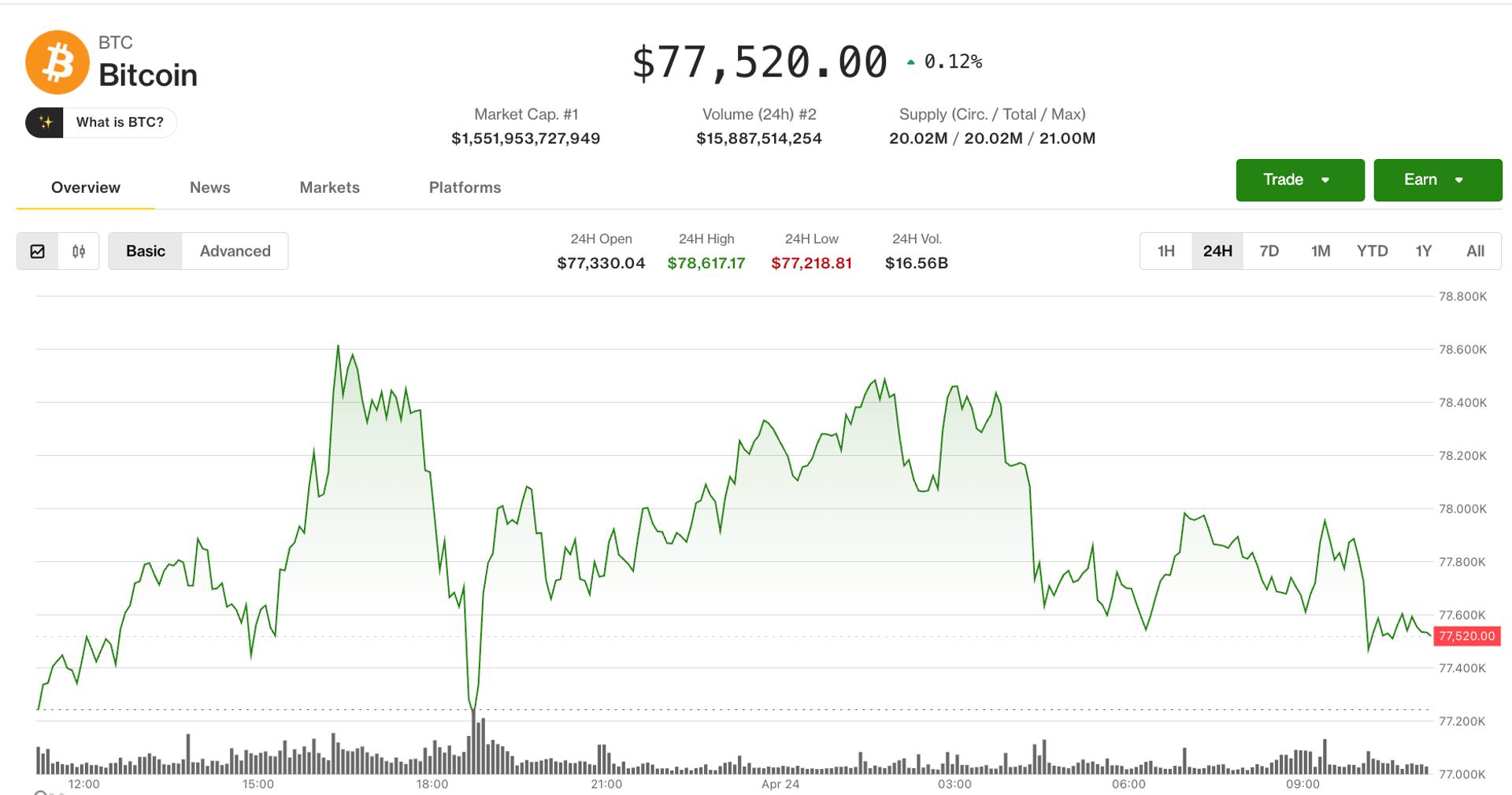
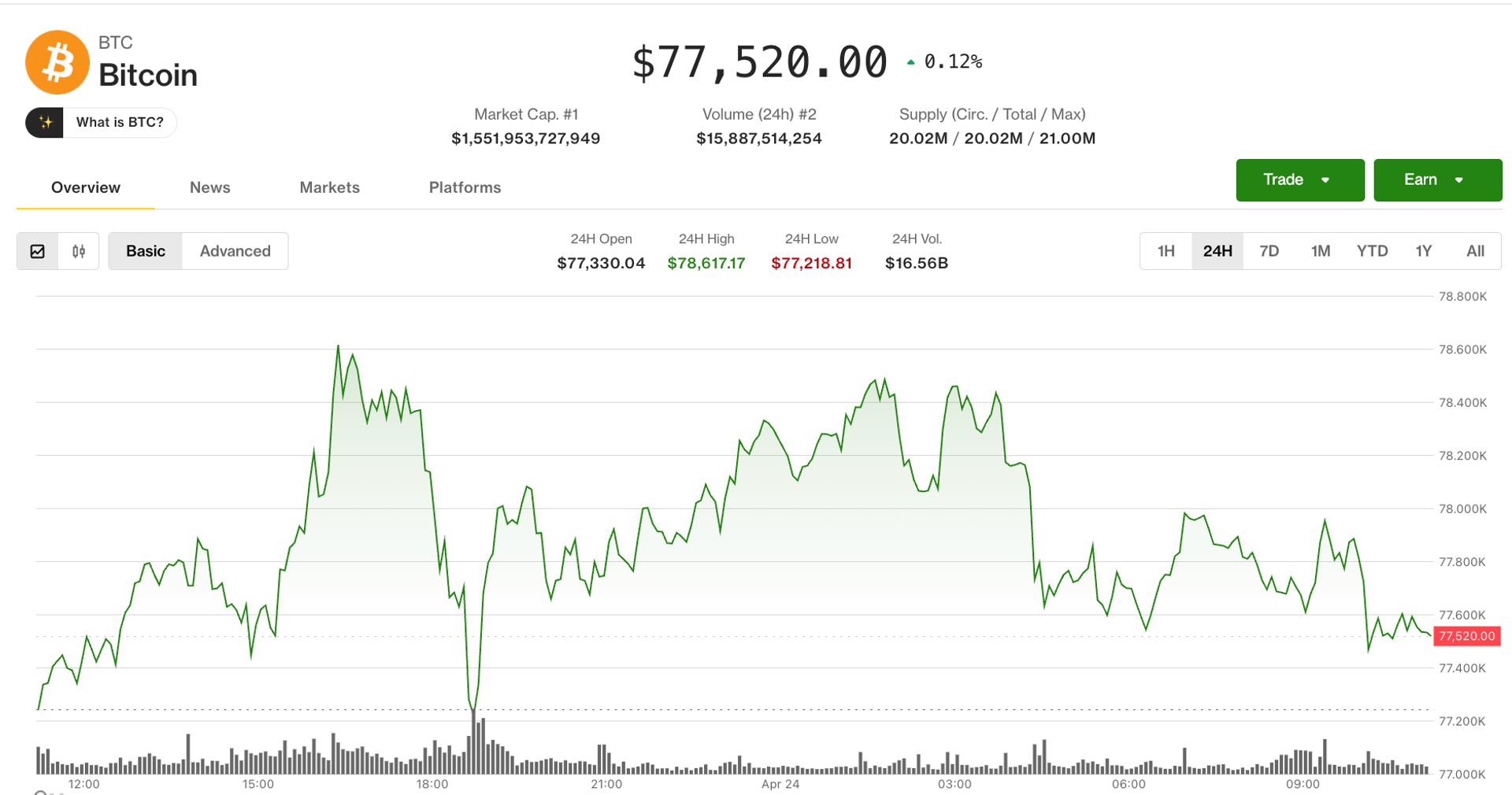
Crypto volatility cooled on Friday, with bitcoin stuck between $77,500 and $78,500 range since midnight UTC.
The muted price action follows a failed breakout attempt near $80,000 on Wednesday, although the broader trend remains constructive, with the BTC price grinding higher through April and printing a series of higher highs and higher lows.
Ether (ETH) matched bitcoin’s performance on Friday, losing around 0.9% since midnight while also remaining in a narrow trading range.
U.S. stock futures were mixed, with Nasdaq 100 futures rising by 0.5% on the back of strong tech earnings and S&P 500 futures slipping 3 basis points.
The Dollar Index (DXY) was little changed despite comments from U.S. President Donald Trump confirming that the ceasefire between Israel and Lebanon has been extended by three weeks. The dollar fell roughly 0.5% when the ceasefire was first announced on April 16.
Derivatives positioning
- Bitcoin futures open interest has declined by over 6% to 744.3K BTC in 24 hours, as the rally in spot price pulls back to $77,500 after failing to hit $80,000 early this week. The moves suggest traders are unwinding leveraged positions and that bullish momentum is cooling in the near term.
- BTC’s 24-hour open interest–adjusted cumulative volume delta has flipped negative, meaning sellers are hitting the bid more than buyers are lifting the ask over the period. Annualized perpetual funding rates remain slightly negative, indicating dominance of bearish short positions.
- Futures tied to other major cryptocurrencies, such as ether (ETH), solana (SOL) and XRP (XRP), have seen lackluster trading over the past 24 hours.
- Privacy-focused zcash (ZEC), however, stands out. Open interest in its futures has climbed nearly 7.5% to a 10-day high of 1.88 million tokens, while 24-hour trading volume has surged 80%.
- The token also boasts one of the strongest positive CVD readings alongside positive funding rates, indicating sustained aggressive buying interest and bullish positioning overall.
- While BTC and ETH prices have come under pressure, investors likely see it as a brief pause in the rally. That’s evident from the continued slide in bitcoin’s 30-day implied volatility index, BVIV. It has dropped to 42%, the lowest since Jan. 31. ETH’s index has dipped below 65%, also the lowest since Feb. 1.
- On Deribit, bitcoin and ether risk reversals continue to show a bias for put options across all time frames. It shows persistent downside hedging by market players and upside volatility selling via covered calls.
Token talk
- The CoinDesk Memecoin Index (CDMEME) was the only benchmark in the black on Friday, posting a gain of less than 0.2% while the DeFi Select Index (DFX) and Computing Select Index (CPUS) lost about 1% each.
- DeFi tokens lido (LDO) and led the sector’s losses, falling by between 3% and 3.8% since midnight UTC as sentiment continues to suffer following last weekend’s $290 million KelpDAO exploit.
- Privacy coin zcash (ZEC) gave back 0.5% of its gains on Friday, but remains up by more than 7% over the past 24 hours, buoyed by Thursday’s listing on popular retail trading app Robinhood.
- CoinMarketCap’s “Altcoin Season” index ticked back up to 39/100 on Friday as investors began to make speculative bets while bitcoin remained range-bound.
Crypto World
Michael Saylor says BTC winter is over. Market analyst disagrees, says bitcoin was in a pullback


Michael Saylor, executive chairman of Strategy (MSTR), the largest publicly traded holder of bitcoin , said Thursday on X that the crypto winter is over as bitcoin held above $78,000, a price level first reached early on April 22, according to CoinDesk data.
In a Game of Thrones-style image, dressed in a fur coat, a garment not particularly suited for when the winter is over, and mounted on a horse, Saylor, whose firm recently added 13,927 bitcoin, bringing its treasury’s total BTC holdings to 780,897, said “Winter’s over”, a statement not all crypto analysts agree with.
“Even if the winter is over for bitcoin, which I don’t agree with, it is still very cold for altcoins,” said Jason Fernandes, a market analyst and AdLunam co-founder.
For Mati Greenspan, a former senior market analyst at eToro and founder of Quantum Economics, what bitcoin and the broader crypto market have experienced since the Oct. 10 “flash crash”, which triggered roughly $19 billion in forced liquidations within 24 hours, does not even qualify as a crypto winter.
“I’m not sure I would classify what we just saw as a crypto winter exactly,” Greenspan said, it was “more of a large pullback within a broader bull market.”
Greenspan agrees, however, with what Saylor appears to be suggesting: Bitcoin has reached its bottom and is likely to head higher from here. “Yes, I think it is very likely that we have seen the bottom,” he said.
Greenspan and other experts say that Saylor’s comments, along with his firm’s ongoing bitcoin purchases, suggest a transition into a more permanent institutional bitcoin era. A new cycle characterized by market dominance of corporate bitcoin treasuries and a shift in institutional sentiment.
Nation-state adoption
Even so, institutional adoption is just one piece of the puzzle.
“Yes, increased institutional adoption will kick off this next leg, but what Saylor is missing is the nation-state adoption, which is undoubtedly right around the corner,” Greenspan said.
The crypto founder and market analyst said that, to date, the crypto industry has experienced three distinct adoption cycles.
The first, he said, was driven by early adopters in 2013. And then came the “mass retail awakening of 2017,” and, now, institutional adoption in 2021.
“The fourth and final major driver is nation-state adoption, which I believe will happen very soon, especially with the U.S. abruptly flipping course during U.S. President Donald Trump’s second term,” Greenspan said.
“Imagine central banks adding bitcoin to their balance sheets to maintain price stability, similar to how they’ve added gold in the past,” he added.
To Greenspan’s point, nation-state adoption is already moving beyond theory and onto government balance sheets. Under Trump, for example, the U.S. plans for a strategic bitcoin reserve, though it is neither formalized nor operational; the government already holds roughly 300,000 BTC. El Salvador continues its daily purchase program toward a 7,500 BTC treasury, while China and the U.K. hold roughly 190,000 BTC and 61,000 BTC, respectively. Activity is also emerging at the sub-sovereign level, with entities such as Wisconsin and New Jersey introducing bitcoin exposure within public pension allocations.

Key Takeaways
- Wedbush initiated Oracle with an Outperform rating Friday, sending shares up 2% in premarket activity
- The firm’s $225 price target contrasts with Oracle’s current trading level near $176
- Analyst argues Wall Street misunderstands Oracle’s capital expenditure as primarily contract-backed AI spending
- The company’s multi-cloud database business exploded 531% annually in its third fiscal quarter of 2026
- Analyst consensus stands at Strong Buy with a $244.89 average price objective
Shares of Oracle experienced a 2% lift in Friday’s pre-market session following Wedbush analyst Daniel Ives’ initiation of coverage with an Outperform designation and $225 price objective.
Ives has established himself as a closely-watched voice in technology sector analysis, and his positioning on Oracle is generating renewed investor interest in a name that’s declined 37.4% across the last half-year.
Oracle is currently changing hands around $176.28. The Wedbush projection suggests approximately 28% appreciation potential from present levels. Wall Street’s collective view skews even more optimistic, with the consensus target landing at $244.89.
The fundamental thesis behind Wedbush’s stance is straightforward: investors are misjudging Oracle’s true position.
According to Ives, while Oracle’s aggressive infrastructure investments appear risky at first glance, the substantial majority connects directly to secured AI agreements — indicating demand-backed deployment rather than speculative buildout.
OCI Emerges as Strategic Differentiator
Central to the optimistic outlook is Oracle Cloud Infrastructure, commonly known as OCI. Wedbush highlights that OCI’s streamlined network architecture provides meaningful advantages for artificial intelligence applications, enabling superior speed and reduced latency compared to legacy cloud platforms.
This architectural advantage becomes critically important during large-scale AI model training, where computational efficiency and throughput directly influence both economics and results.
Oracle is simultaneously advancing its “AI for Data” initiative, centered on the Oracle AI Database 26ai offering. The strategy focuses on enabling enterprises to integrate AI capabilities directly with their proprietary data repositories — a pragmatic application that could accelerate widespread enterprise adoption.
Multi-Cloud Strategy Delivers Explosive Results
The multi-cloud performance metrics are particularly striking. Oracle reported 531% year-over-year expansion in multi-cloud database revenue during its fiscal 2026 third quarter.
This remarkable growth stems from Oracle’s strategy of deploying its database solutions within competing cloud environments — including Amazon Web Services and Google Cloud. Instead of competing head-to-head, Oracle is positioning itself as critical infrastructure within rival platforms.
The company recently unveiled an enhanced collaboration with Google Cloud, introducing the Oracle AI Database Agent for Gemini Enterprise. This integration enables users to interact with Oracle databases through conversational language interfaces.
A parallel AWS initiative is also underway, focused on strengthening inter-cloud connectivity capabilities.
These strategic alliances provide context for the extraordinary multi-cloud revenue acceleration. Oracle is establishing itself as essential infrastructure that even competitors rely upon.
Wedbush’s perspective positions Oracle as evolving beyond its legacy database company identity toward becoming a fundamental component of AI infrastructure. Ives contends the current stock valuation hasn’t caught up with this transformation.
Across the trailing twelve-month period, Oracle produced $64.1 billion in revenue, representing 14.9% growth. The enterprise currently maintains a market capitalization approaching $507 billion.
The broader analyst community shares this constructive perspective. Oracle carries a Strong Buy consensus rating, derived from 27 Buy recommendations and six Hold ratings issued during the most recent three-month period.
The $244.89 average analyst price target indicates potential appreciation of approximately 39% from current trading levels.


Wisconsin has escalated its challenge against prediction market platforms, widening a legal fight already taking shape across several U.S. states over how these products should be classified.
Summary
- Wisconsin filed complaints against Crypto.com, Polymarket, and Kalshi, along with Robinhood and Coinbase, alleging their prediction markets function as unlicensed gambling platforms.
- State prosecutors argue that event contracts tied to outcomes such as NCAA tournament games meet the legal definition of a bet, with fixed payouts for correct predictions.
Fresh complaints filed in Dane County name Crypto.com and its derivatives arm, Polymarket, and Kalshi, alongside distribution partners Robinhood and Coinbase. Prosecutors argue the platforms enable event-based wagering for residents, including contracts tied to sports outcomes.
At the core of the filings sits a simple claim. Users pay to take positions on real-world events and receive fixed payouts if correct.
Wisconsin says that the structure fits its legal definition of a bet. Contracts linked to NCAA tournament games are cited as one example, where positions trade at probability-based prices and settle at $1 or $0 depending on the result.
Marketing language has been pulled into the case as supporting evidence. Kalshi’s promotional material described it as “The First Nationwide Legal Sports Betting Platform,” while Polymarket has referred to itself as a place where users can bet on future events.
Attorney General Josh Kaul addressed that framing directly, stating, “Thinly disguising unlawful conduct doesn’t make it lawful.”
Meanwhile, these platforms collect transaction fees on each contract, a structure prosecutors compare to a casino taking a cut from wagers placed on its floor.
Federal and state fight over control deepens
Wisconsin’s move follows a similar path taken earlier by New York. As previously reported by crypto.news, New York Attorney General Letitia James filed lawsuits against Coinbase Financial Markets and Gemini Titan, accusing both of operating unlicensed prediction markets.
Her office argued that event-based contracts tied to sports and elections were offered without approval from the New York State Gaming Commission and were accessible to users below the legal betting age of 21.
“Gambling by another name is still gambling, and it is not exempt from regulation under our state laws and Constitution,” James added.
Court filings in that case sought at least $2.2B from Coinbase and $1.2B from Gemini, increasing financial pressure alongside regulatory scrutiny.
Industry participants continue to push back by pointing to federal oversight. Coinbase has argued that such disputes belong in federal court.
Platforms operating through Kalshi maintain that event contracts qualify as swaps under the jurisdiction of the Commodity Futures Trading Commission, not state gambling regulators.
A recent ruling from the United States Court of Appeals for the Third Circuit sided with Kalshi, treating the regulator’s decision not to block the contracts as effectively settling the question of jurisdiction.
Even so, states continue to press their own interpretations. Authorities in Nevada have described similar contracts as indistinguishable from gambling, while New York has maintained that each contract represents a bet.
With multiple states building cases on similar grounds, the dispute is moving toward a broader constitutional question. A final determination from the Supreme Court of the United States could decide whether prediction markets fall under a single federal framework or remain subject to state gambling laws.


Artificial intelligence has now expanded its dominance to US equities and the credit market.
The shift is rewriting how capital flows through Wall Street, with AI-linked companies crowding out traditional sectors from benchmark indices while also redefining the largest corners of the bond market.
AI Stocks Hit Record 45% of S&P 500 as Credit Markets Follow Suit
AI-linked stocks now account for a record 45% of the S&P 500’s total market cap, according to data from The Kobeissi Letter. That share has risen by 20 percentage points since OpenAI launched ChatGPT in November 2022.
Follow us on X to get the latest news as it happens
The shift in the credit market is equally stark. A record 15.4% of US investment-grade debt is now tied to AI, up +3.5 points since 2020. It has also become the market’s largest segment.
Total AI-linked debt has nearly doubled since 2020, reaching an all-time high of $1.4 trillion. Hyperscalers such as Amazon, Alphabet, Meta, Microsoft, and Oracle have dominated the trend.
Together, the five issued $121 billion in US corporate bonds during 2025, well above the $28 billion annual average they posted between 2020 and 2024.
“Never before has a single theme dominated both US equity and credit markets to this magnitude,” The Kobeissi Letter wrote.
The AI trade is also reshaping global equity leadership. Taiwan’s stock market cap climbed to $4.14 trillion, passing the UK’s $4.09 trillion for the first time.
The country’s market cap has tripled since 2020, driven almost entirely by semiconductor stocks. Taiwan Semiconductor Manufacturing Company (TSMC) alone accounts for more than 40% of the market capitalization.
In effect, the trajectory of AI adoption and monetization may now set the direction for much of the global market. Meanwhile, any pause could expose how much of that valuation rests on a single theme.
Subscribe to our YouTube channel to watch leaders and journalists provide expert insights
The post AI Swallows Wall Street: Stocks Hit Record 45% of S&P 500 Market Cap appeared first on BeInCrypto.

History-making Munetaka Murakami is already ‘one of the boys’ with White Sox

Aurzen Zip Cyber Foldable Portable Projector: Not Bright, Poor Connectivity, but a Lot of Fun

The “Easy” Steps of Becoming A Financial Advisor Are Concerning

Manchester United reach agreement with Casemiro over contract clause amid transfer speculation

US brings back mandatory military draft registration

Steven Gerrard disagrees with Gary Neville over ‘shock’ Chelsea and Arsenal claim | Football
The “Easy” Steps of Becoming A Financial Advisor Are Concerning

#1 MONEY EXPERT Reveals The 75/15/10 Money System That Builds Wealth with ANY Income!

What is Financial Modelling? | www.carajaclasses.com | #365daysfinancemastery
-

 Fashion7 days ago
Weekend Open Thread: Theodora Dress
-

 Politics7 days ago
Palestine barred from entering Canada for FIFA Congress
-

 Business5 days ago
Powerball Result April 18, 2026: No Jackpot Winner in Powerball Draw: $75 Million Rolls Over
-
Entertainment5 days ago
NBA Analyst Charles Barkley Chimes in on Ice Spice McDonald’s Fiasco
-

 Tech5 days ago
Auto Enthusiast Scores Running Tesla Model 3 for Two Grand and Turns It Into Bare-Bones Go-Kart
-

 Politics5 days ago
Zack Polanski demands ‘council homes not luxury flats for foreign investors’
-

 Crypto World7 days ago
Russia Pushes Bill to Criminalize Unregistered Crypto Services
-

 Politics4 days ago
Gary Stevenson delivers timely reminder to register to vote as deadline TODAY
-

 Business2 days ago
Rolls-Royce Voted UK’s Most Iconic Trade Mark as IPO Register Hits 150
-

 Politics2 days ago
Disabled people challenge government SEND proposals over segregation concerns
-

 Politics2 days ago
Making troops accountable for war crimes threatens US alliance, ex-SAS colonel warns
-

 Crypto World7 days ago
Russia Introduces Bill To Criminalize Unregistered Crypto Services
-

 Politics2 days ago
Starmer handler McSweeney to be dragged from shadows by Foreign Affairs Committee
-
Politics2 days ago
Wings Over Scotland | How To Get Away With Crimes
-

 Politics2 days ago
Zack Polanski responds to home secretary’s taser threat
-
Crypto World5 days ago
Kelp DAO rsETH Bridge Hack Drains $292M as DeFi Losses Top $600M in Two Weeks
-

 Politics2 days ago
‘Iran is still a nuclear threat’
-

 Crypto World3 days ago
New York sues Coinbase, Gemini over prediction market offerings
-

 Business2 days ago
The Job Benefits Most Men Don’t Know to Negotiate
-

 Politics5 days ago
Reform investigating candidate who ‘hates’ the NHS
You must be logged in to post a comment Login