
Crypto World
Paris Blockchain Week opens with privacy, composability and tokenized gold in focus



Day one at Paris Blockchain Week turns into an institutional scouting mission for privacy, composability and gold‑backed tokenization plays in the heart of Paris.
Summary
- Early conversations at Paris Blockchain Week 2026 are converging on institutional needs for privacy and composability, according to builders on the ground.
- Canton Network and iExec are drawing attention as examples of how to square confidential data with interoperable on‑chain workflows for banks and asset managers.
- A gold tokenization project reportedly backed by JPMorgan is adding real‑world asset “weight” to a program already framed as “where institutions and digital assets finally meet.”
Day one of Paris Blockchain Week 2026 is underscoring a simple message from the buy‑side: if blockchains want serious institutional flows, they must solve privacy and composability at the same time. In a recap post after the first day, investor and commentator Tokenoya wrote that “institutions are converging on one thing: privacy + composability is the real bottleneck,” name‑checking custody platform dfnsHQ and permissioned ledger project Canton Network as emblematic of that shift.
Institutional Paris turns to privacy and composability
Held at the Carrousel du Louvre on April 15‑16 under the banner “Where Institutions and Digital Assets Finally Meet,” Paris Blockchain Week’s 7th edition has drawn more than 10,000 decision‑makers from banks, asset managers, regulators and Web3 infrastructure teams. Organizers and partners describe the focus as squarely post‑speculation, with sessions on tokenized treasuries, regulated stablecoins and cross‑border settlement rails framed as extensions of existing market structure rather than parallel casinos.
Social media threads highlight how that institutional tone is filtering into side events. At a dfnsHQ gathering, they reported that large institutions now view privacy‑preserving composability as “the real bottleneck,” a view echoed by Canton Network’s own framing of public‑chain design as a trade‑off between radical transparency and usable confidentiality. Canton describes itself as a “network of networks” that lets financial institutions run applications with “institutional‑grade privacy” while still enabling atomic swaps between, for example, a tokenized private equity fund and a digital currency, without exposing either party’s full books.
The recap also nods to a coffee meeting with iExec’s Fotshudi in Paris, with Tokenoya telling followers that “if you’re into privacy, give him a follow,” underscoring how off‑program conversations are gravitating toward confidential computing and data markets. iExec has long pitched itself as a way for enterprises to tap trusted execution environments and privacy‑preserving compute, a theme that fits neatly with European regulators’ insistence on data protection even as banks experiment with on‑chain settlement and DeFi‑style liquidity pools.
Perhaps the most eye‑catching detail in the post is a “meeting with a gold tokenization project backed by JP Morgan,” a reminder that real‑world asset pilots are no longer confined to crypto‑native players. Paris Blockchain Week’s own marketing leans heavily on tokenization “at scale,” pointing to experiments in digitizing U.S. Treasuries, sovereign bonds and private credit, and several speakers have suggested that tokenized commodities and collateral will be the next wave once legal and custody issues are ironed out.
Coverage from French outlets such as Journal du Coin has framed the 2026 edition as the moment “la finance traditionnelle bascule,” with tokenization and digital euros forcing incumbents to rethink plumbing, capital efficiency and risk controls rather than just issuing press releases. Global Digital Finance, a policy group whose members include major banks and crypto firms, similarly describes this year’s conference as one where “the focus is no longer speculative,” but on how blockchain “is beginning to play inside large financial institutions” under MiCA and other regulatory regimes.

Colombia’s President Gustavo Petro said the nation’s Caribbean coast has the potential to become a Bitcoin mining hub, leveraging its surplus renewable energy to attract foreign investment and spur economic development.
In a post on X on Tuesday, Petro said the Caribbean cities of Barranquilla, Santa Marta and Riohacha could host Bitcoin (BTC) mining facilities and tap the country’s clean energy sources, following a path similar to Venezuela and Paraguay in recent years.
“It’s an immense boost to the development of the Caribbean,” Petro said, proposing that the Wayúu community — Colombia’s largest Indigenous community, which mainly resides on the Caribbean coast — could be co-owners of the project.
Bitcoin mining analysts such as Hashlabs managing partner Jaran Mellerud have said the industry can have a sizable economic impact on emerging countries looking to convert otherwise unused electricity into cash flow.
There’s also an opening for countries with low electricity costs to capture a larger share of the Bitcoin network hashrate as US commercial miners continue expanding into AI and high-performance computing in pursuit of higher-margin opportunities.
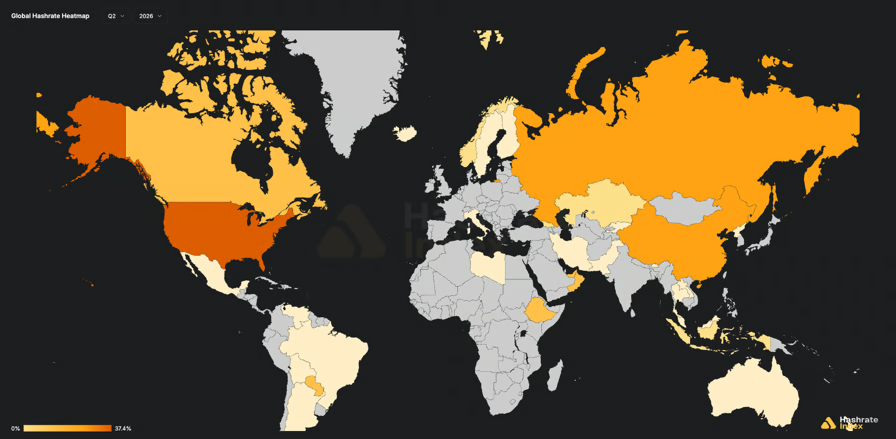
Petro’s remarks were made in response to a post from Luxor Technology’s Alessandro Cecere, who noted that Paraguay’s share of global Bitcoin hashrate has risen to 4.3% since tapping into hydroelectric energy at its Itaipu dam.
The small, landlocked South American country is now the fourth-largest Bitcoin mining country by hashrate, behind the US, Russia and China.
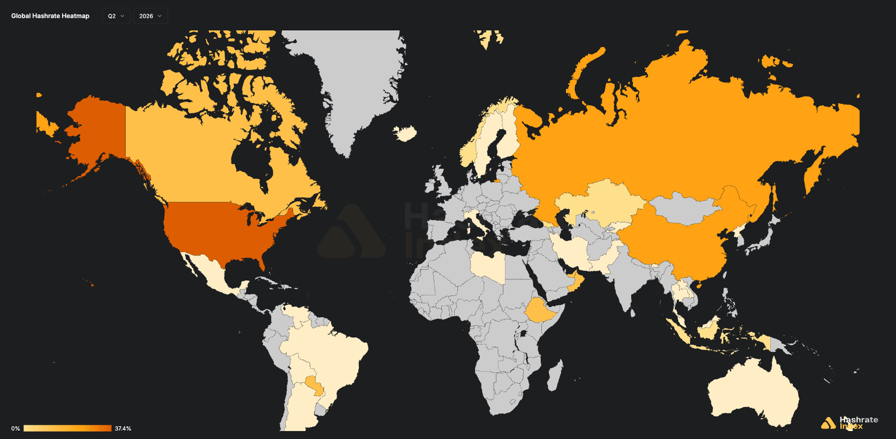
Global Bitcoin hashrate map. Source: Hashrate Index
A World Bank report published in April 2024 found that Colombia generates as much as 75% of its electricity from renewable energy — more than twice the global average.
Tapping these renewable sources would mitigate concerns flagged by Petro that Bitcoin mined with fossil fuels contributes to global warming and potential “climate collapse.”
Petro’s presidential term ends in August
Petro has served as Colombia’s president since August 2022 and has adopted a relatively neutral stance on Bitcoin and the crypto industry.
Related: K Wave Media abandons Bitcoin treasury push for AI infrastructure
Petro only has another three months to lead the Bitcoin mining initiative as his presidential term comes to an end in August.
He is not running in Colombia’s forthcoming presidential election on May 31 due to constitutional limits.
Data from prediction market Kalshi suggests that left-leaning Senator Iván Cepeda Castro and Abelardo de la Espriella, a conservative lawyer and free-market advocate, are the clear front-runners to replace Petro.
Neither candidate has made significant public comments on Bitcoin or digital assets to date.
Magazine: Bitcoin may face hard fork over any attempt to freeze Satoshi’s coins
Crypto World
Bitcoin’s (BTC) 30% price surge has a hidden rhythm. Here are the hours and days driving gains.
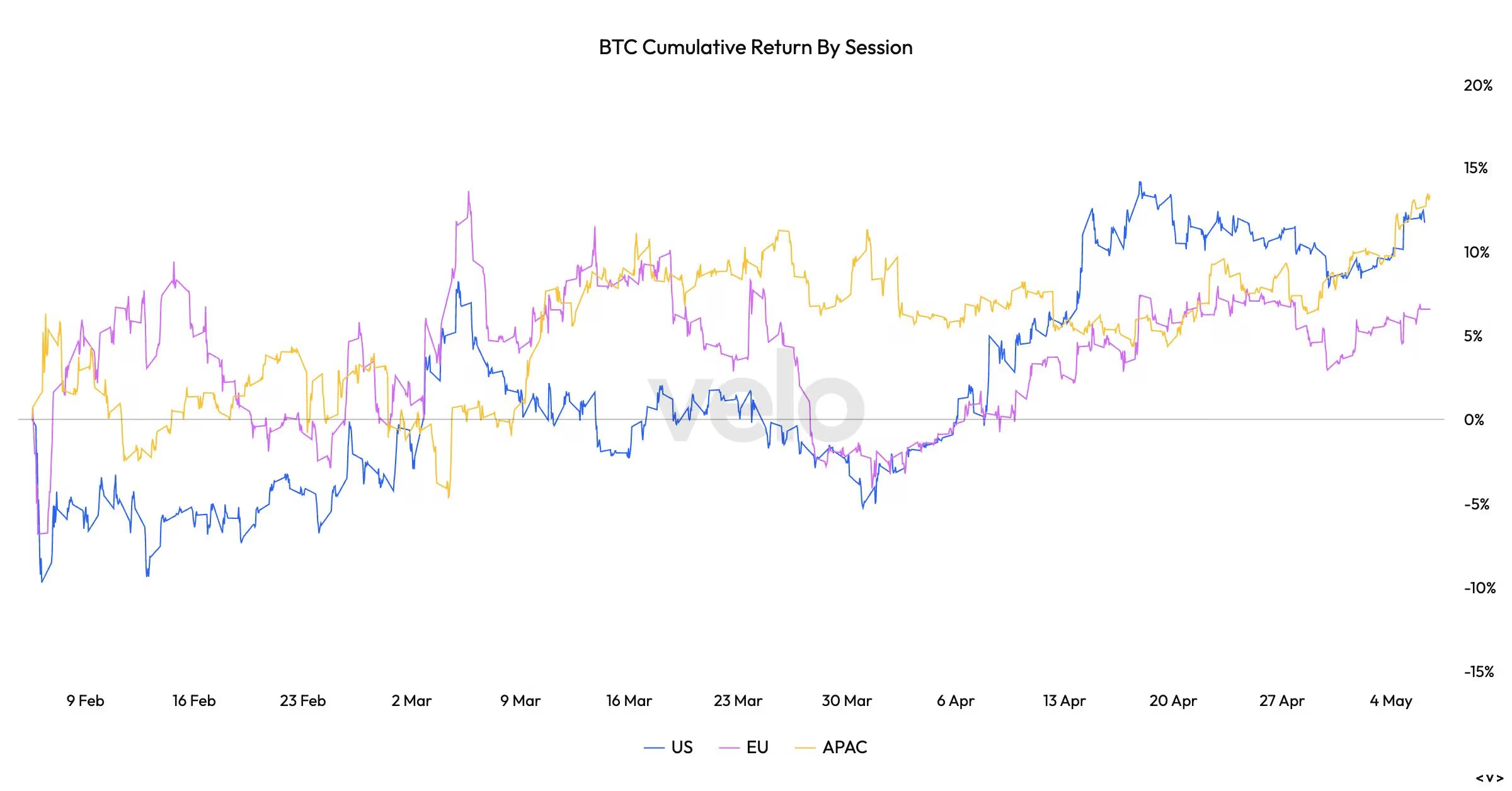
Those looking to trade bitcoin’s price rise might want to pay attention to a simple but useful roadmap. It consists of three months of price data from Velo, which shows the recovery from the early February lows under $63,000 to over $80,000 has not been evenly distributed across the day.
Specific sessions, hours, and days have consistently outperformed and knowing those windows could sharpen traders’ approach to the market.
Data source Velo breaks the trading day into three eight-hour sessions: APAC from 00:00 to 08:00 UTC, covering Tokyo, Singapore, Seoul, and Sydney; Europe from 08:00 to 16:00 UTC, covering London and Frankfurt; and the U.S. from 16:00 to 00:00 UTC, covering New York.
The session picture: APAC and the U.S. are leading the rally
APAC and U.S. hours have done the heavy lifting throughout the roughly 31% price rise since Feb. 6. APAC has produced a return of 13%, with the U.S. at 11.5% and Europe lagging significantly at just 6.5%.
The U.S. session’s contribution is particularly notable because it was not always the leader. For most of February and March, returns during U.S. hours were mostly flat to negative, while APAC led the recovery. But that suddenly changed in early April, with the U.S. session flipping decisively positive.
Overall, the data shows that liquidity and momentum are strongest in APAC and the U.S. While this does not guarantee the continuation of trends, it does highlight when price discovery has been most active in the ongoing phase of the cycle, which some traders may find useful for market timing and risk management.

Best and worst hours
The next obvious question is which hours are optimal for trading during these best-performing sessions.
The answer to that is the midnight UTC candle, which represents the price action between 00:00 and 01:00. This has been the best hour, producing an average return of 0.10% over three months.
That’s a particularly interesting time window because it sits right at the intersection of two sessions: the late U.S. trading hours and early APAC, when fresh liquidity enters the market.
The second strongest hour is 15:00 UTC, deep in the European session, and the worst single hour is 06:00 UTC.
The best day to place a bullish bet: Monday
On a day-of-week basis, the data is unambiguous. Monday has been the strongest day of the week by a wide margin over the past three months, averaging a return of approximately 1.5%. Wednesday is a distant second at around 0.65%, and Friday is mildly positive at around 0.3%.

Thursday is the worst single day, averaging around negative 0.55%. Across the full three months, weekdays overall average approximately positive 0.4% while weekends average negative 0.25%.
To conclude, for bulls looking to time market entries, Monday has been the clearest edge in the data.
Crypto World
Intel (INTC) Stock Soars 13% in One Day: Should Investors Buy the Dip or Sell the Spike?

Key Takeaways
- Intel shares rocketed 13% to close at $108.19, peaking at $110.48 intraday, with trading volume hitting 191 million shares — 65% higher than typical levels.
- Apple reportedly engaged in preliminary discussions with Intel regarding potential U.S.-based manufacturing of core device processors.
- The chipmaker received antitrust approval for its SambaNova acquisition and delivered first-quarter earnings of $0.29 per share, crushing the $0.01 Wall Street forecast.
- A senior Intel executive offloaded approximately 40,000 shares valued at roughly $4 million in early May.
- Wall Street consensus stands at “Hold” with a mean price objective of $74.47 — significantly under current trading levels.
Shares of Intel experienced a dramatic 13% surge Tuesday, settling at $108.19 after reaching an intraday peak of $110.48. Trading activity exploded to 191 million shares — representing a 65% increase over normal daily volume.
This rally propelled Intel’s market capitalization to an unprecedented $544 billion. The semiconductor giant now ranks as the 17th largest U.S. company by market cap, surpassing both Oracle and Johnson & Johnson — a remarkable climb from 56th position at 2025’s conclusion.
Since early 2026, the stock has tripled in value. This year’s performance is approximately eight times stronger than the top-performing Magnificent Seven stock, Alphabet, which has climbed 24% year-to-date.
Potential Apple Partnership Sparks Investor Enthusiasm
The primary driver behind Tuesday’s explosive move was news that Apple conducted preliminary discussions with Intel — alongside Samsung — regarding domestic production of its flagship device processors. Such a partnership would represent a transformative opportunity for Intel’s foundry operations, the centerpiece of CEO Lip-Bu Tan’s strategic revival plan.
Intel also secured antitrust clearance for its planned SambaNova acquisition. This regulatory green light eliminates a significant uncertainty and reinforces Intel’s ambitions in the enterprise AI acceleration space.
On the talent acquisition front, the company recruited Qualcomm veteran Alex Katouzian to oversee its PC division and emerging “physical AI” initiatives. This strategic hire signals Intel’s commitment to AI-powered edge computing and consumer applications — sectors poised for substantial growth in coming years.
Broader market dynamics provided additional support. Both the S&P 500 and Nasdaq reached fresh record highs Tuesday, powered by strength across AI semiconductor stocks and diminishing geopolitical tensions. Intel benefited from this sector-wide momentum.
Strong Q1 Performance Provides Foundation
Intel’s first-quarter financial results, unveiled April 23rd, supplied fundamental support for the rally. The company reported earnings per share of $0.29, dramatically exceeding the $0.01 analyst consensus. Revenue totaled $13.58 billion, topping the $12.32 billion estimate — representing a 7.4% year-over-year improvement.
Foundry gross margin expansion is also gaining traction, a crucial development. This division has historically weighed on Intel’s overall profitability, making any operational improvements particularly significant for bullish investors.
For the second quarter, Intel projects EPS of $0.20. Wall Street anticipates full-year earnings per share of $0.63.
Skepticism remains, however. A senior Intel executive divested 40,256 shares on May 1st at an average price of $99.53 — totaling slightly over $4 million and representing a 27.7% reduction in her holdings.
Analyst sentiment has been cautious. RBC maintained a neutral stance with an $80 price target. New Street Research elevated its target from $50 to $80 while keeping a neutral rating. Truist increased its objective from $49 to $81, also maintaining a hold recommendation.
Among 41 analysts monitored by MarketBeat, 25 rate the stock Hold, 11 recommend Buy, one suggests Strong Buy, and four advise Sell. The consensus price target stands at $74.47 — nearly $34 beneath Tuesday’s closing price.
Intel’s 50-day moving average rests at $54.62, while the 200-day moving average sits at $45.91. The stock is trading well above both technical benchmarks.
The company exhibits a beta of 2.18 and a price-to-earnings ratio of -174.51. Institutional investors control 64.53% of outstanding shares.

Key Highlights
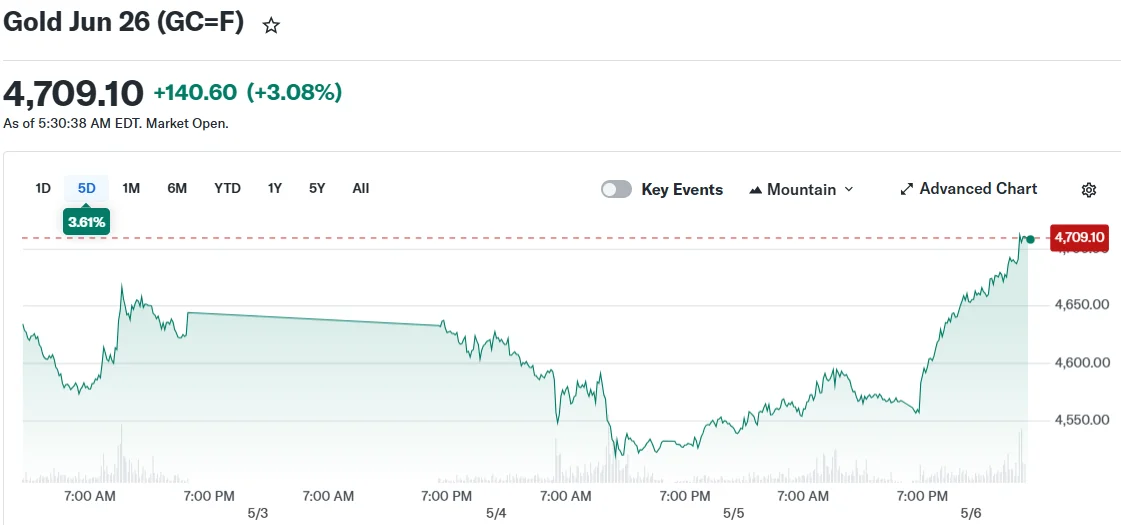
- Precious metals gained momentum Wednesday, with spot gold advancing 2.3% to reach $4,662.70 per ounce amid diplomatic progress.
- Trump administration halted naval escort operations in the Strait of Hormuz, signaling significant advancement in negotiations with Tehran.
- The greenback’s 0.5% decline enhanced gold’s appeal to international investors, supporting upward momentum.
- Market participants increasingly anticipate the Fed may tighten rather than ease monetary policy amid persistent inflation worries.
- The yellow metal has shed over 12% of its value since U.S.-Iran hostilities escalated in February’s final weeks.
Precious metals experienced substantial appreciation during Wednesday’s session, with spot gold advancing 2.3% to settle at $4,662.70 per ounce in New York markets, while futures contracts reached $4,668.80 per troy ounce—marking a 2.2% daily increase. Silver demonstrated even stronger performance, surging 4.2% to $75.91. Both platinum and palladium registered positive movements as well.
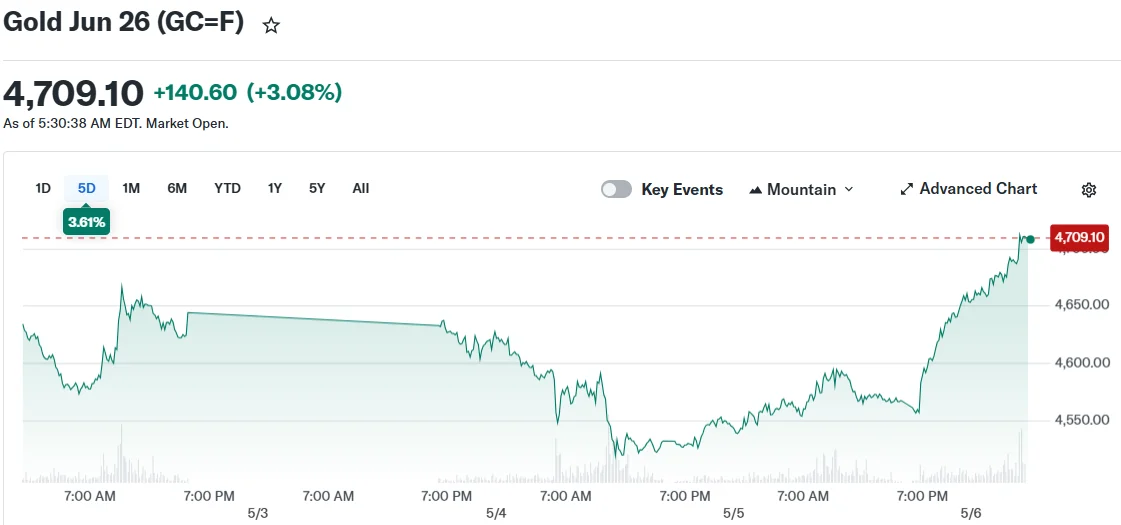
The rally followed President Trump’s social media announcement declaring substantial advancement in diplomatic discussions with Iranian leadership, alongside his decision to suspend American-coordinated naval operations intended to escort commercial vessels navigating the Strait of Hormuz during ongoing negotiations.
Defense Secretary Pete Hegseth validated that the ceasefire initiated approximately one month earlier remained effective. Secretary of State Marco Rubio emphasized that offensive military actions had concluded, with American efforts now concentrated on safeguarding commercial maritime traffic. Iran’s Foreign Minister Abbas Araghchi characterized the discussions as “making progress.”
Despite optimistic statements from government officials, reports emerged of a commercial cargo ship sustaining damage from an unidentified projectile one day following confrontations near the strategic waterway—underscoring that regional instability persists.
Currency Weakness Supports Rally
The U.S. dollar index’s 0.5% retreat contributed additional momentum to gold prices, as dollar depreciation reduces acquisition costs for purchasers transacting in alternative currencies. ING strategists Warren Patterson and Ewa Manthey observed that concerns regarding potential escalation continue sustaining gold’s traditional safe-haven characteristics.
They suggested that a sustained ceasefire arrangement could diminish inflationary pressures and reduce the probability of Federal Reserve monetary tightening—dynamics that would generally favor precious metals. Assets without yield, such as gold, typically perform favorably when interest rate projections decline.
Monetary Policy Uncertainty Creates Headwinds
The trajectory for gold remains uncertain. Fixed-income market participants are progressively incorporating expectations that the Federal Reserve’s next policy adjustment will involve raising rather than lowering rates. This sentiment shift is constraining gold’s near-term appreciation potential.
Market observers are intensely focused on forthcoming employment statistics, which may reveal stabilizing workforce conditions—potentially reinforcing inflation-related considerations in Federal Reserve policy deliberations.
Gold has declined more than 12% since tensions with Iran intensified in late February, and market strategists indicate positioning in the precious metal remains complex. Nicky Shiels, head of research and metals strategy at MKS PAMP SA, characterized precious metals as entering the summer season amid a “structural positioning paradox.”
Despite elevated total dollar investments in gold, the actual contract volume and ounce holdings remain comparatively modest. “The medium-term bull case on debasement, supply chain fragmentation, and monetary order breakdown remains intact,” Shiels stated, “but the near-term path to new highs requires generalist institutional capital to step in.”
She noted that seasonal trends combined with what she termed “exhausted retail” participation are insufficient to independently fuel the next significant upward movement.
According to ING analysts, gold’s subsequent primary catalyst will emerge from interest rate expectations—influenced by U.S. Treasury financing strategies and critical economic indicators scheduled for release in coming weeks.
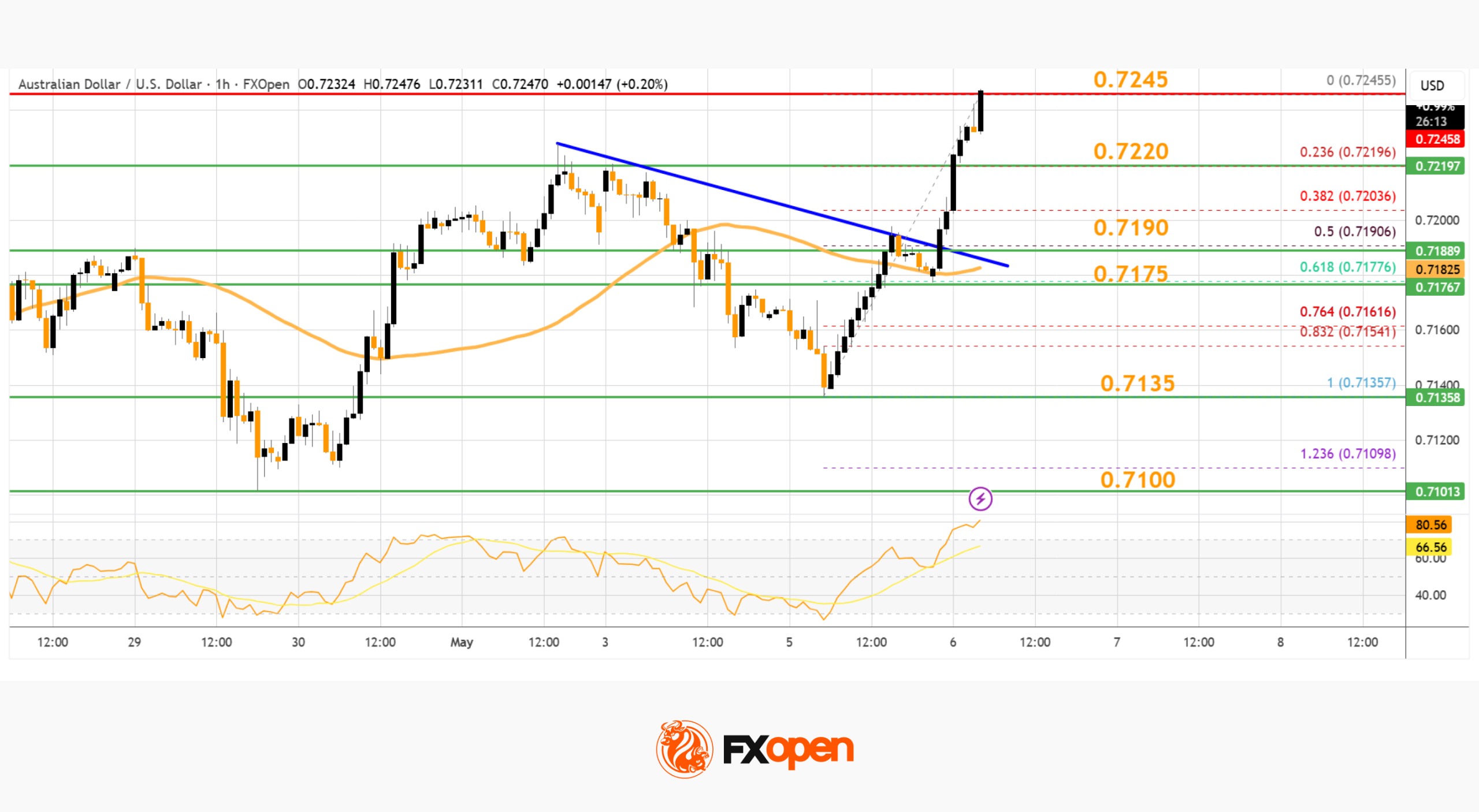
AUD/USD started a fresh increase above 0.7175 and 0.7200. NZD/USD is also rising and might aim for more gains above 0.5950.
Important Takeaways for AUD USD and NZD USD Analysis Today
· The Aussie Dollar started a steady increase above 0.7150 against the US Dollar.
· There was a break above a bearish trend line with resistance at 0.7190 on the hourly chart of AUD/USD at FXOpen.
· NZD/USD is consolidating gains above the 0.5925 pivot zone.
· There was a break above a bearish trend line with resistance at 0.5900 on the hourly chart of NZD/USD at FXOpen.
AUD/USD Technical Analysis
On the hourly chart of AUD/USD at FXOpen, the pair started a fresh increase from 0.7100. The Aussie Dollar was able to clear 0.7100 to move into a positive zone against the US Dollar.
There was a break above a bearish trend line with resistance at 0.7190. There was a close above 0.7200 and the 50-hour simple moving average. Finally, the pair tested 0.7245. A high was formed near 0.7245 and the pair remains elevated for more gains.
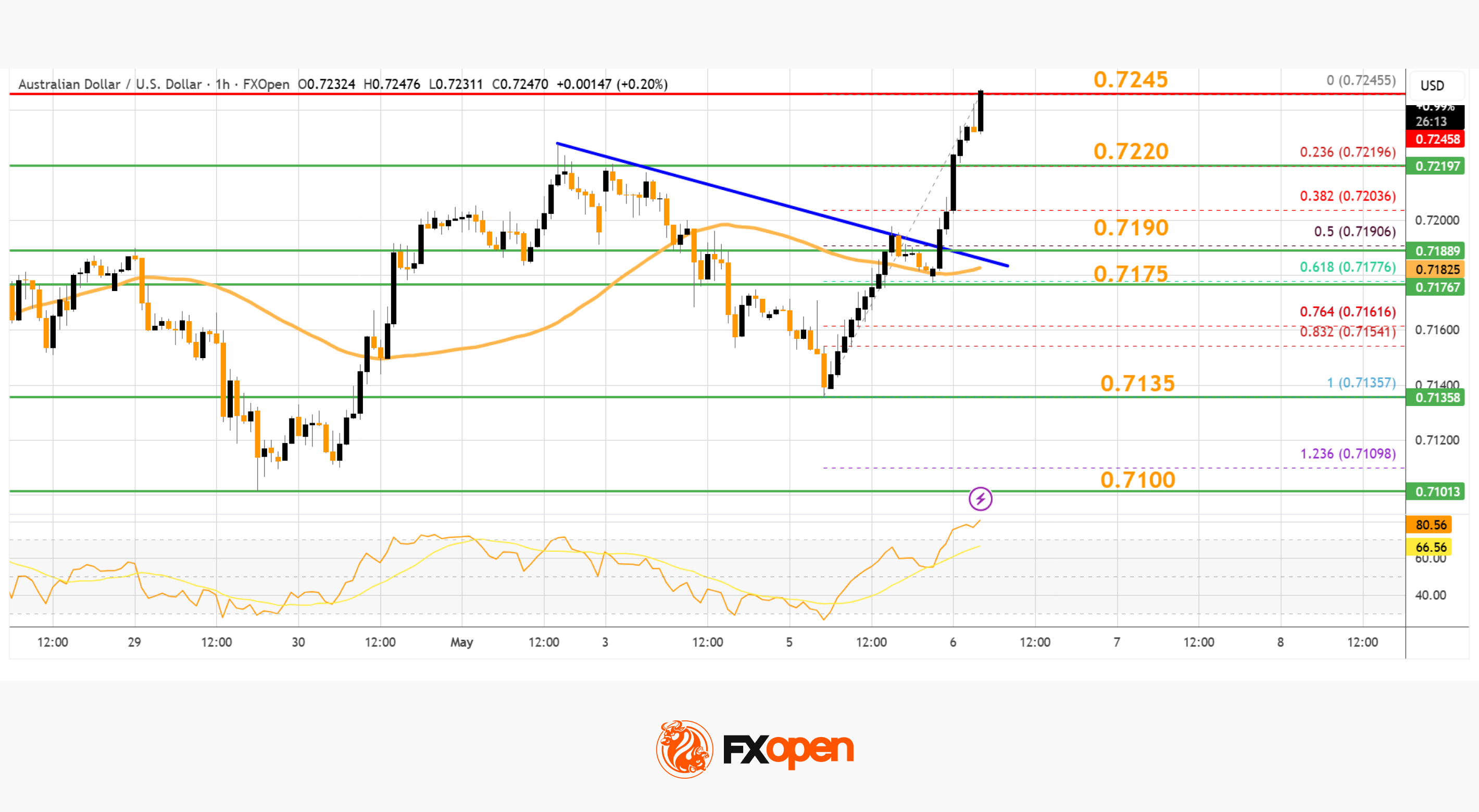
On the downside, initial support is near the 23.6% Fib retracement level of the upward move from the 0.7135 swing low to the 0.7245 high at 0.7220. The next area of interest could be near 0.7190 and the 50% Fib retracement.
If there is a downside break below 0.7190, the pair could extend its decline toward the 0.7175 zone and the 50-hour simple moving average. Any more losses might signal a move toward 0.7135.
On the upside, the AUD/USD chart indicates that the pair is now facing resistance near 0.7245. The first major hurdle for the bulls might be 0.7260. An upside break above 0.7260 might send the pair further higher. The next stop is near 0.7320. Any more gains could clear the path for a move toward 0.7350.
NZD/USD Technical Analysis
On the hourly chart of NZD/USD on FXOpen, the pair started a fresh increase from 0.5855. The New Zealand Dollar broke the 0.5875 barrier to start the recent rally against the US Dollar.
More importantly, there was a break above a bearish trend line with resistance at 0.5900. The pair settled above 0.5925 and the 50-hour simple moving average.
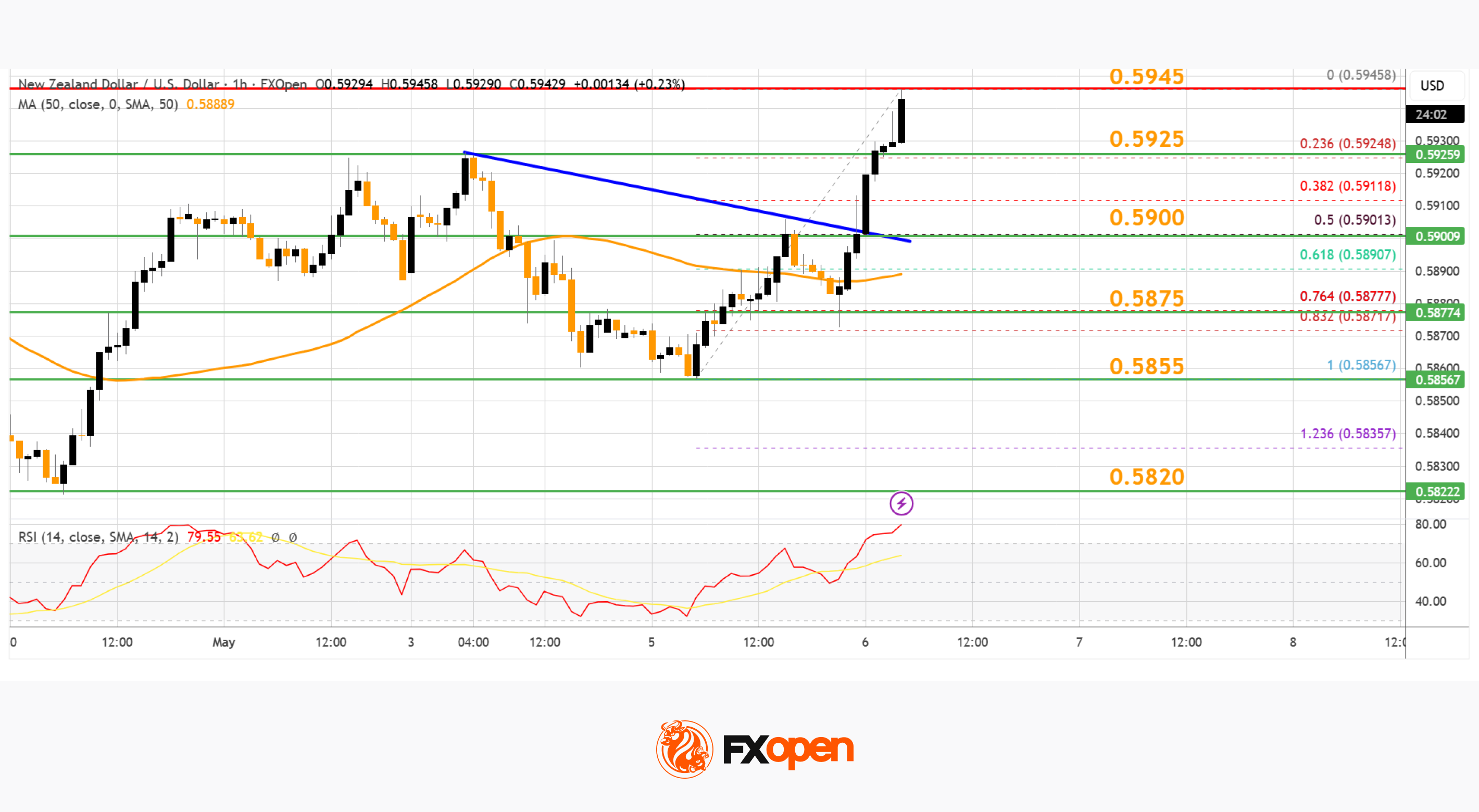
It tested 0.5945 and is currently showing signs of more gains. The NZD/USD chart suggests that the RSI is now just above 70. On the upside, the pair might struggle near 0.5945. The next major hurdle is near the 0.6000 pivot level.
A clear move above 0.6000 might even push the pair toward 0.6050. Any more gains might clear the path for a move toward the 0.6140 zone in the coming days.
On the downside, immediate support is near the 0.5925 level and the 23.6% Fib retracement level of the upward move from the 0.5856 swing low to the 0.5945 high.
The first key zone for the bulls sits at 0.5900 and the 50% Fib retracement. The next important level is 0.5875 and or 50-hour simple moving average. If there is a downside break below 0.5875, the pair might slide toward 0.5855. Any more losses could lead NZD/USD into a bearish zone to 0.5820.
Trade over 50 forex markets 24 hours a day with FXOpen. Take advantage of low commissions, deep liquidity, and spreads from 0.0 pips (additional fees may apply). Open your FXOpen account now or learn more about trading forex with FXOpen.
This article represents the opinion of the Companies operating under the FXOpen brand only. It is not to be construed as an offer, solicitation, or recommendation with respect to products and services provided by the Companies operating under the FXOpen brand, nor is it to be considered financial advice.


OKX is preparing to offer perpetual futures tied to private companies, including OpenAI, SpaceX, and Anthropic, intensifying a growing race among crypto firms to bring pre-IPO speculation markets on-chain, the company said Wednesday in a blog post.
The contracts will provide synthetic price exposure to private companies ahead of their anticipated public listings, without granting actual equity ownership or shareholder rights.
Bitget entered the sector in April with “IPO Prime,” listing a Solana-based SpaceX-linked token issued through investment platform Republic. Last year, Injective rolled out pre-IPO perpetual futures tied to firms including OpenAI, Anthropic, SpaceX, and Perplexity, describing the products as a way to bring the $13 trillion private equity market “directly on-chain.”
The trend also reflects how crypto exchanges are increasingly moving beyond bitcoin and ether (ETH) trading to include equities, prediction markets, and real-world assets as they seek new sources of trading activity.
Robinhood tried something similar but took a different approach last year. The fintech platform offered OpenAI-linked tokens backed by a special purpose vehicle that held equity purchased on the secondary market, rather than direct equity ownership.
OpenAI publicly distanced itself from the product at the time, warning that any transfer of actual company equity would require its approval.
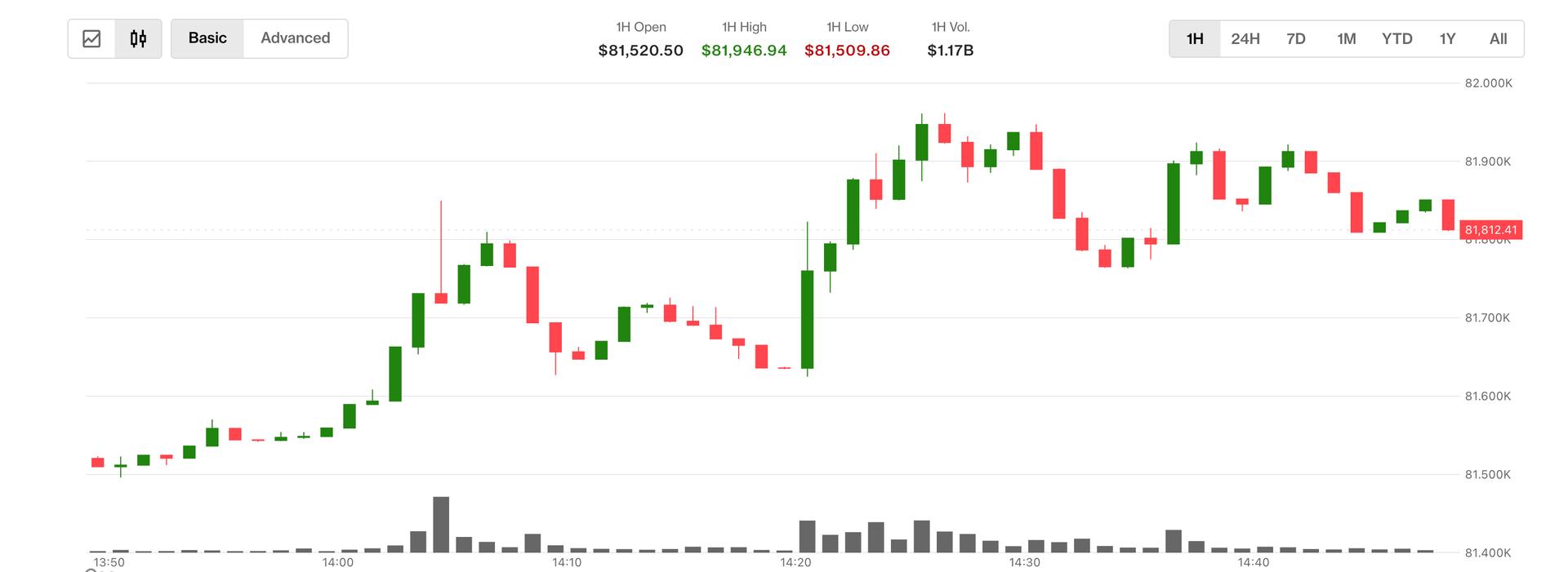
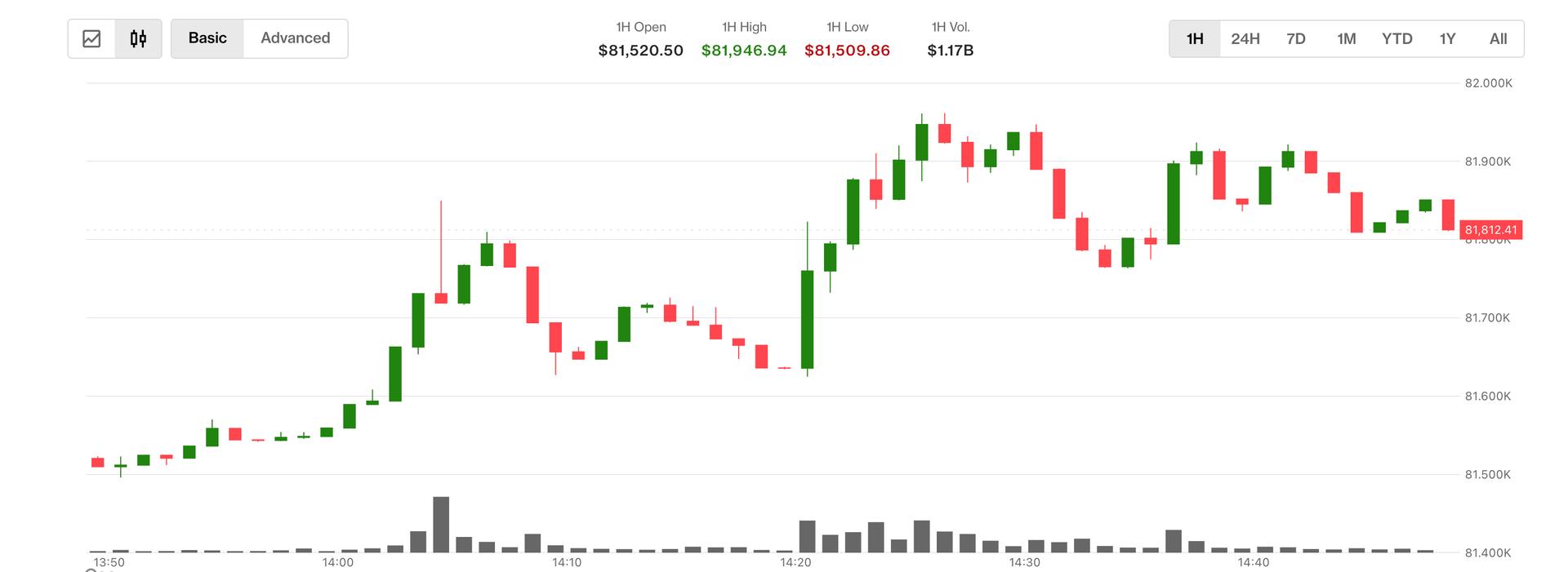
Risk assets rallied across the globe and oil crashed during Monday’s European hours as reports of progress in U.S.–Iran peace talks boosted risk sentiment.
Bitcoin extended Asian gains to trade close to $82,000 during the European hours, as futures tied to Wall Street’s tech heavy index Nasdaq rose over 1%. Futures tied to WTI crude oil fell 6% to $95.28 per barrel.
The move followed an Axios report that Washington and Tehran are close to a one-page memorandum of understanding aimed at ending the war. The draft agreement is said to include negotiations between U.S. envoys Steve Witkoff and Jared Kushner and Iranian officials, conducted both directly and through intermediaries.
The report raised hopes for the normalization of oil flows through the Strait of Hormuz, which has reportedly been mined by Iranian forces. The disrupted flows since late February have wreaked havoc in energy markets across the world, especially in Asia.
According to the report, Iran would agree to remove highly enriched uranium from the country, a long-standing U.S. demand that Tehran has previously resisted. However, some market participants questioned the likelihood of a durable breakthrough, particularly around nuclear concessions.
“I’m a bit skeptical on the final point about Iran ceding ground on the nuclear front. But we’ll have to wait and see I guess,” ForexLive’s currency analyst Justin Low said.
Still, the prospect of de-escalation was enough to trigger a broad shift in positioning, with traders moving into risk assets and out of energy exposure on expectations of reduced geopolitical friction.

A crypto-backed political action committee affiliated with Fairshake is intensifying its midterm push, disclosing a six-figure media spend in support of a GOP incumbent in Indiana. A Federal Election Commission filing shows Defend American Jobs, part of Fairshake’s network, spent more than $514,000 on media in favor of James Baird in Indiana’s 4th Congressional District.
The filing details a substantial media buy aimed at aiding Baird’s reelection bid as political groups aligned with cryptocurrency advocacy sharpen their spending as Americans head toward the midterms. Baird, who took office in January 2019, has backed digital-asset policy initiatives in the past, including votes on the GENIUS Act, a stablecoin-related payments bill, and the CLARITY Act, a package shaping digital-asset market structure. Stand With Crypto, a Coinbase-aligned crypto advocacy organization, rates Baird as a candidate who “strongly supports crypto.”
Fairshake and its affiliates—Defend American Jobs and Protect Progress—have signaled a broader strategy for 2026, signaling that they expect to deploy millions to back “pro-crypto” candidates in the general election cycle. The latest filing places a concrete figure on Indiana activity, but the umbrella aims to sustain a nationwide footprint as candidates with crypto-friendly stances seek advantage ahead of November’s elections.
Cointelegraph has previously reported sizable investments by Fairshake-backed political action committees. In 2024, the group disclosed more than $130 million in media expenditures supporting crypto-friendly candidates, including a roughly $40 million outlay in Ohio’s U.S. Senate race, which the PAC framed as part of its broader drive to favor pro-crypto leadership. The Indiana filing comes as the network seeks to translate those nationwide efforts into momentum in key battlegrounds.
The Indiana race itself is straightforward: the primary pits Baird against state Representative Craig Haggard. Backers of Fairshake’s broader effort include notable crypto industry players Coinbase and Ripple Labs. Cointelegraph requested comment from Fairshake but did not receive an immediate reply.
Key takeaways
- Defend American Jobs reported a media spend of about $514,000 to back James Baird in Indiana’s 4th District, illustrating a targeted use of crypto-linked PAC funds in state races.
- Fairshake’s network, including Defend American Jobs and Protect Progress, signals an ongoing plan to spend “millions” in support of pro-crypto candidates during the 2026 cycle.
- The broader crypto-political operation links to major industry players such as Coinbase and Ripple Labs, highlighting the industry’s willingness to mobilize resources through PACs.
- Historical context shows a pattern of large media spending by crypto-aligned PACs in 2024, with Ohio singled out as a major example; what happens in 2026 could inform the broader regulatory and political climate.
- Regulatory dynamics remain central: the GENIUS Act, the CLARITY Act, and their movement through Congress frame how the crypto sector seeks formal market structure and regulatory clarity ahead of elections.
Crypto influence in the Indiana primary and beyond
The Indiana filing situates Defend American Jobs and its associated groups within a broader ecosystem that has emerged around the Fairshake umbrella. The groups are positioning themselves as defenders of crypto-friendly policies at a time when policymakers in the United States grapple with how to regulate digital assets, ensure market integrity, and guard consumer protection without stifling innovation. The CLARITY Act, which outlines a proposed framework for digital asset markets, has been stalled in the Senate after clearing the House in mid-2025. Observers note that bipartisan talks and a recent compromise proposal have changed the dynamics, but uncertainty remains about whether the bill will reach a floor vote and what changes, if any, will be accepted by the Senate leadership.
In Indiana, Baird’s voting history on crypto-related legislation has fed into the narrative that he is crypto-friendly. Stand With Crypto’s rating of his stance reinforces the messaging strategy behind the campaign’s sizable media investment. For opponents, the spending underscores a broader effort to elevate crypto policy as a decisive electoral issue, a pattern already seen in other states where the PAC has directed substantial resources.
Data from Fairshake indicates a broader ambition: to mobilize financial support for candidates deemed favorable to crypto interests. The group has previously disclosed substantial war chests, with Fairshake reporting assets in the hundreds of millions of dollars in some periods. In Illinois, for example, the network allocated significant sums to races for governor and the state legislature, and it has noted similarly sizable activity in Texas. While the quantities shift with each cycle, the underlying strategy remains consistent: align political power with policy outcomes favorable to the crypto sector.
Analysts and observers point to the regulatory backdrop as the crucial determinant of political spending. The CREPT or “crypto market structure” framework advanced by the House and the stalled Senate process create a high-stakes environment for investors and builders who seek clarity and early-stage policy certainty. The prospect of broader, standardized rules—covering stablecoins, custody, exchanges, and market surveillance—could translate into a more predictable operating environment for participants and, by extension, influence political calculations in the midterms and beyond.
As campaigns continue to evolve, readers should watch whether the Senate marks up the CLARITY Act or introduces new language that reflects evolving concerns about ethics, disclosure, and stablecoin yields. The degree to which crypto industry players mobilize on the ground—via PACs, donor networks, and advocacy coalitions—will offer a critical gauge of how political finance intersects with technology policy in the coming months.
To corroborate any specific claims or updates, observe the ongoing FEC filings and committee disclosures, which continue to shape the public ledger of crypto-aligned political spending. For the latest on Fairshake and its affiliates’ activity, readers can review the official FEC filing referenced in this report: Defend American Jobs PAC, C00836221, 1972239, se.
What remains uncertain is how the regulatory process will unfold in the Senate and how much of the crypto policy agenda will be reflected in campaign messaging as the midterms approach. Investors and users should weigh the potential implications: more formal market structures could unlock broader adoption, while the political calculus surrounding who controls policy could influence funding landscapes for crypto-friendly candidates in 2026 and beyond.
As the year advances, the industry will continue to monitor both the policy horizon and the political battlefield, where campaign spending and regulatory ambition intersect with the real-world adoption of digital assets.

Ripple signalled a multi-chain stance as its chief executive rejected labels tied to a single token strategy. The company reaffirmed its commitment to XRP while supporting broader blockchain growth. Leadership also addressed artificial intelligence, stating it supports expansion rather than workforce reductions.
Ripple CEO Rejects Single-Chain Identity and Supports Broader Crypto Ecosystem
Brad Garlinghouse stated that he does not align with maximalist views around any single digital asset. He emphasised that blockchain growth depends on multiple networks working together. He added that industry tribalism limits innovation and slows long-term adoption.
He highlighted that Bitcoin remains an important part of the ecosystem despite competition among networks. He explained that different chains serve different use cases across finance and technology. He maintained that a multi-chain future offers stronger resilience and broader utility.
He also referenced strong community engagement around XRP and acknowledged its role in Ripple’s strategy. He noted that user communities drive awareness and support development across networks. He confirmed that XRP continues to guide Ripple’s long-term direction.
Ripple Reinforces XRP Commitment While Expanding Adoption Strategy
Garlinghouse clarified that Ripple remains closely tied to XRP through its holdings and ecosystem efforts. He stated that the company continues to hold a significant portion of XRP supply. He explained that this position aligns Ripple with the network’s long-term success.
He added that Ripple’s acquisitions aim to increase XRP adoption across financial services. He pointed out that liquidity growth remains a key objective for the company. He linked these efforts to expanding real-world use cases for digital assets.
He also addressed regulatory developments, including progress around the CLARITY Act. He noted that lawmakers continue refining the bill through bipartisan discussions. He expressed confidence that regulatory clarity could support industry growth in the near term.
AI Drives Growth Strategy as Ripple Distances Itself From Layoffs Trend
Garlinghouse discussed artificial intelligence and its impact on Ripple’s operations and growth plans. He stated that AI enables faster product development and improved efficiency across teams. He emphasised that the company uses AI to expand rather than reduce its workforce.
He contrasted Ripple’s approach with layoffs reported at other firms, including Coinbase. He noted that some companies have reduced staff while shifting toward automation strategies. He argued that such decisions often reflect broader operational challenges rather than AI alone.
He concluded that Ripple benefits from its private structure when managing costs and growth decisions. He explained that this flexibility allows the company to invest steadily in innovation. He maintained that AI will continue shaping crypto development without replacing human contribution.


Crypto bank Anchorage Digital has introduced an agentic banking service that allows AI systems to access and move funds across traditional and crypto payment rails without human intervention.
Summary
- Anchorage Digital has launched an agentic banking service that lets AI agents access and move funds across crypto and traditional payment rails.
- CEO Nathan McCauley said the system assigns AI agents verified identities, spending limits, and audit controls to meet compliance requirements.
- The rollout includes a Google Cloud partnership, as firms like Coinbase and the Solana Foundation expand tools for AI-driven payments using stablecoins.
According to Anchorage Digital co-founder and CEO Nathan McCauley, the new infrastructure equips AI agents with direct access to financial rails while operating under predefined controls designed for institutional use.
In a recent X post, McCauley said that the system enables agents to transact across both fiat-linked systems and blockchain networks.
Anchorage stated that each AI agent will be assigned a verifiable identity, along with spending limits, permissions, and policy controls that govern how funds can be used. Auditability features have been built into the system to ensure compliance with regulatory standards, particularly as institutions begin to test automation across treasury and payment functions.
McCauley noted that existing financial systems were not designed for non-human actors, even as companies increasingly automate operational workflows. Meanwhile, he has previously described agentic finance as a major growth area.
“This is, in my view, set to be a trillion-dollar industry where we are going to have agents paying each other, agents paying merchants, and agents getting paid,” he said during his appearance at the Consensus 2026 conference in Miami.
The rollout includes a partnership with Google Cloud, which provides the intelligence layer for agent interaction. Anchorage said this layer allows AI agents to discover services, negotiate terms, and coordinate transactions with other agents in real time.
Recent developments across the crypto sector show similar efforts to enable machine-driven transactions. The Solana Foundation has launched a gateway service with Google Cloud that allows AI agents to pay for APIs using stablecoins on the Solana network, expanding payment use cases beyond human-driven activity.
Earlier, Coinbase introduced Agentic.market, a platform where AI agents can discover and pay for services using USDC through the x402 protocol. Coinbase reported that the protocol has already processed about 165 million transactions across more than 480,000 agents, indicating that machine-to-machine payments are already operating at scale.
On April 30, Oobit, backed by Tether, launched a Visa-supported virtual card that allows AI agents to make online purchases using USDT. The company said the cards are funded directly from Tether’s treasury, allowing continuous use of capital without requiring fiat conversions or manual top-ups.
Anchorage’s move builds on its earlier focus on infrastructure tied to institutional risk management. In March, the bank took a strategic stake in Immunefi and acquired its IMU token, linking regulated custody services with on-chain security programs aimed at reducing smart contract vulnerabilities.
Andrew Parker Bowles secret meeting exposes hidden financial desperation motive

Emma Raducanu, Jack Draper and Sonay Kartal – why are so many British tennis players injured?

Citadel’s $6B threat could sting local food vendors

Manchester United reach agreement with Casemiro over contract clause amid transfer speculation

US brings back mandatory military draft registration

Steven Gerrard disagrees with Gary Neville over ‘shock’ Chelsea and Arsenal claim | Football


-
 Business7 days ago
Tesla Officially Registers Elon Musk’s Stock: What Investors Need to Know
-

 NewsBeat3 days ago
Channel 5 – All Creatures Great and Small series 7 new post
-

 Entertainment6 days ago
Insider Claims Reason Behind Key & Peele Split
-
 Tech5 days ago
Trump’s 25% EU auto tariff breaches Turnberry Agreement that also covers semiconductors and digital trade
-
 Sports5 days ago
Paul Scholes issues Marcus Rashford reality check as agreement emerges over Man United star
-

 Entertainment5 days ago
Met Gala 2026 Rumored Guest List Is Turning Heads
-

 Entertainment6 days ago
Celebrities Who Are Attending the 2026 Met Gala Event
-

 Business6 days ago
Strait of Hormuz Remains Heavily Restricted on April 29 Amid Iran Conflict
-
 Sports4 days ago
David Benavidez responds to team Canelo saying the fight will never happen
-

 Crypto World7 days ago
Meta (META) starts stablecoin payout to creators in Circle’s USDC on Polygon, Solana via Stripe
-
Business5 days ago
Strait of Hormuz Blockade Persists Amid US-Iran Standoff, Sending Oil Prices Soaring
-

 Tech7 days ago
Texas Instruments made a new flagship graphing calculator: the TI-84 Evo
-
Entertainment5 days ago
New on Prime Video in May 2026 — Full List of Movies and Shows
-

 Sports4 days ago
Cavaliers vs. Raptors Game 6 live score, updates, highlights from 2026 NBA playoffs first-round series
-

 Entertainment4 days ago
Kylie Jenner Hit With Second Lawsuit From Ex-Housekeeper
-

 Tech6 days ago
Mark Zuckerberg Says Meta Is Working On AI Agents For Personal And Business Use
-

 Sports4 days ago
Plane crash in Wimberley, Texas kills 5 pickleball players at tournament
-

 Sports6 days ago
Saudi Arabia set to withdraw LIV Golf funding after 2026 season, per reports
-
 Sports4 days ago
IPL 2026: ‘Love you darling’- Hardik Pandya’s reaction to MS Dhoni steals the show |Watch | Cricket News
-

 Sports6 days ago
Arsenal, Atletico Madrid share draw after penalty drama in Champions League semi-final
You must be logged in to post a comment Login