

Crypto World
Gold Surges 2.3% on U.S.-Iran Diplomatic Progress and Weakening Dollar

Key Highlights
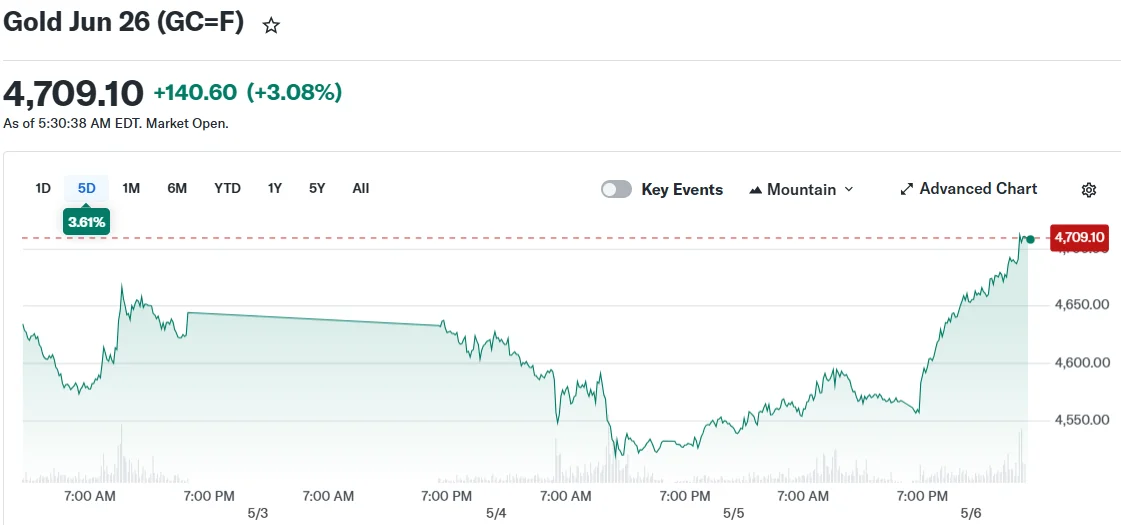
- Precious metals gained momentum Wednesday, with spot gold advancing 2.3% to reach $4,662.70 per ounce amid diplomatic progress.
- Trump administration halted naval escort operations in the Strait of Hormuz, signaling significant advancement in negotiations with Tehran.
- The greenback’s 0.5% decline enhanced gold’s appeal to international investors, supporting upward momentum.
- Market participants increasingly anticipate the Fed may tighten rather than ease monetary policy amid persistent inflation worries.
- The yellow metal has shed over 12% of its value since U.S.-Iran hostilities escalated in February’s final weeks.
Precious metals experienced substantial appreciation during Wednesday’s session, with spot gold advancing 2.3% to settle at $4,662.70 per ounce in New York markets, while futures contracts reached $4,668.80 per troy ounce—marking a 2.2% daily increase. Silver demonstrated even stronger performance, surging 4.2% to $75.91. Both platinum and palladium registered positive movements as well.
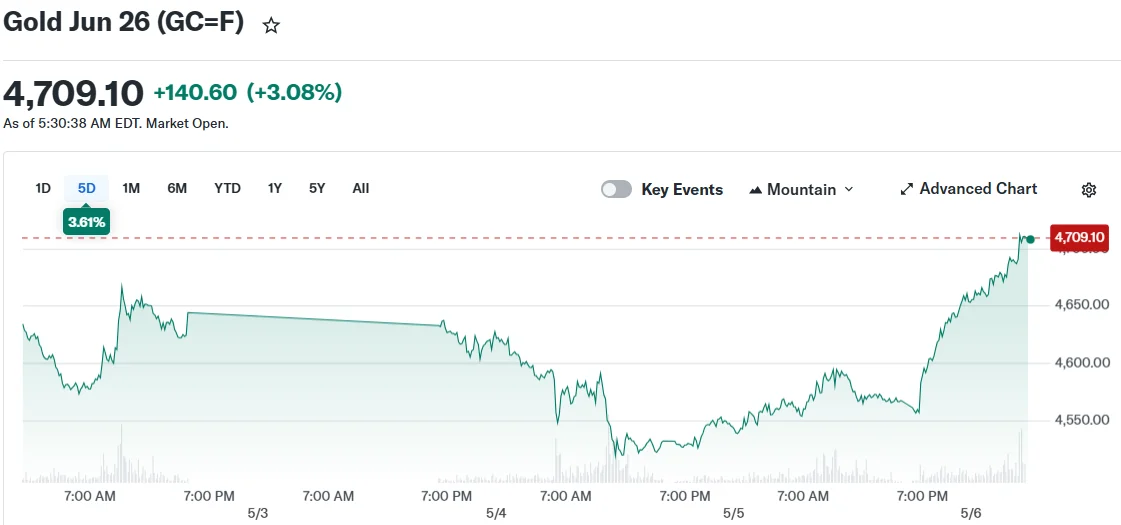
The rally followed President Trump’s social media announcement declaring substantial advancement in diplomatic discussions with Iranian leadership, alongside his decision to suspend American-coordinated naval operations intended to escort commercial vessels navigating the Strait of Hormuz during ongoing negotiations.
Defense Secretary Pete Hegseth validated that the ceasefire initiated approximately one month earlier remained effective. Secretary of State Marco Rubio emphasized that offensive military actions had concluded, with American efforts now concentrated on safeguarding commercial maritime traffic. Iran’s Foreign Minister Abbas Araghchi characterized the discussions as “making progress.”
Despite optimistic statements from government officials, reports emerged of a commercial cargo ship sustaining damage from an unidentified projectile one day following confrontations near the strategic waterway—underscoring that regional instability persists.
Currency Weakness Supports Rally
The U.S. dollar index’s 0.5% retreat contributed additional momentum to gold prices, as dollar depreciation reduces acquisition costs for purchasers transacting in alternative currencies. ING strategists Warren Patterson and Ewa Manthey observed that concerns regarding potential escalation continue sustaining gold’s traditional safe-haven characteristics.
They suggested that a sustained ceasefire arrangement could diminish inflationary pressures and reduce the probability of Federal Reserve monetary tightening—dynamics that would generally favor precious metals. Assets without yield, such as gold, typically perform favorably when interest rate projections decline.
Monetary Policy Uncertainty Creates Headwinds
The trajectory for gold remains uncertain. Fixed-income market participants are progressively incorporating expectations that the Federal Reserve’s next policy adjustment will involve raising rather than lowering rates. This sentiment shift is constraining gold’s near-term appreciation potential.
Market observers are intensely focused on forthcoming employment statistics, which may reveal stabilizing workforce conditions—potentially reinforcing inflation-related considerations in Federal Reserve policy deliberations.
Gold has declined more than 12% since tensions with Iran intensified in late February, and market strategists indicate positioning in the precious metal remains complex. Nicky Shiels, head of research and metals strategy at MKS PAMP SA, characterized precious metals as entering the summer season amid a “structural positioning paradox.”
Despite elevated total dollar investments in gold, the actual contract volume and ounce holdings remain comparatively modest. “The medium-term bull case on debasement, supply chain fragmentation, and monetary order breakdown remains intact,” Shiels stated, “but the near-term path to new highs requires generalist institutional capital to step in.”
She noted that seasonal trends combined with what she termed “exhausted retail” participation are insufficient to independently fuel the next significant upward movement.
According to ING analysts, gold’s subsequent primary catalyst will emerge from interest rate expectations—influenced by U.S. Treasury financing strategies and critical economic indicators scheduled for release in coming weeks.




The UK government today designated Huobi Global S.A, the Panama-registered entity operating Justin Sun-advised crypto exchange HTX, under its Russia sanctions regime.
The move targets entities accused of supporting Russia’s financial sector and enabling sanctions evasion through cryptocurrency channels.
Escalating Pressure on Global Exchanges
Announced on May 26, 2026, as part of a broader package cracking down on Russian crypto networks, the designation adds Huobi Global S.A. alongside other platforms like EXMO Exchange.
UK authorities cited ongoing concerns over P2P trading and facilitation that could help Russia bypass Western restrictions.
Justin Sun, Tron founder and HTX’s prominent Global Advisor with significant ownership ties, remains unlisted personally.
However, the action directly impacts the exchange he publicly promotes and strategically influences.
What UK Sanctions Mean for HTX Users and Partners
Designated entities face strict UK asset freezes and prohibitions on dealing in funds or economic resources.
British individuals and businesses must immediately cease transactions with HTX and report any exposure to the Office of Financial Sanctions Implementation (OFSI).
Violations risk severe civil and criminal penalties.
This compounds existing FCA enforcement against HTX for illegal financial promotions to UK consumers, including court actions and app/social media blocks.
Crypto markets have grown sensitive to geopolitical sanctions as exchanges navigate compliance in a fragmented global landscape.
HTX, once among the top platforms by volume, now faces heightened scrutiny that could limit liquidity, user access in key regions, and institutional partnerships.
HTX may accelerate geo-restrictions or compliance overhauls, while global exchanges monitor UK and allied moves.
Investors should review exposure, prioritize regulated platforms, and watch for official sanctions list updates on GOV.UK.
The case highlights tightening oversight in 2026, potentially reshaping how major players operate amid Russia-related risks.
The post UK Sanctions Justin Sun’s HTX Crypto Exchange Over Russia Ties appeared first on BeInCrypto.
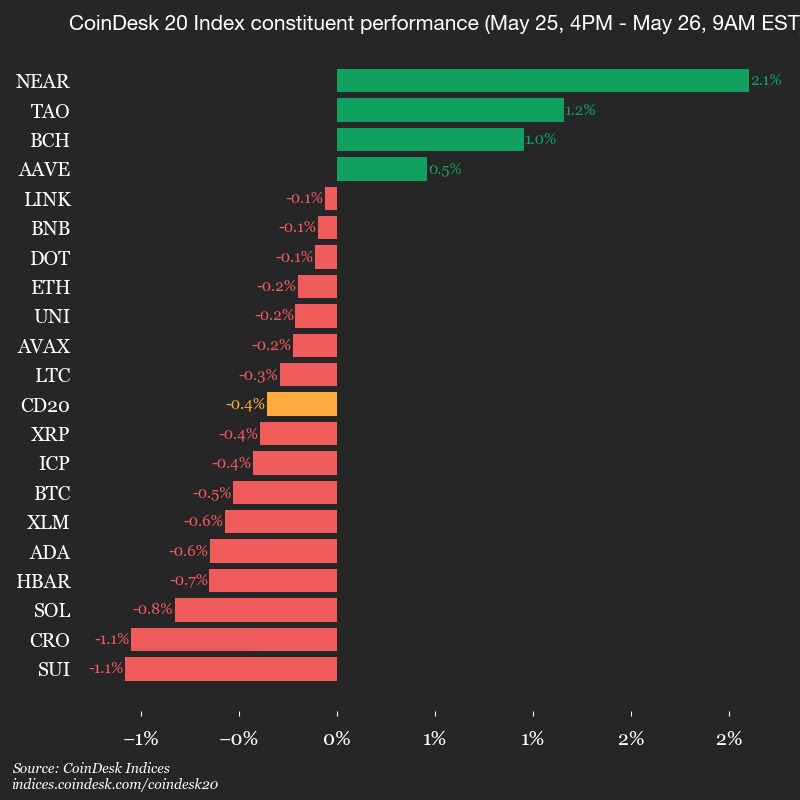
CoinDesk Indices presents its daily market update, highlighting the performance of leaders and laggards in the CoinDesk 20 Index.
The CoinDesk 20 is currently trading at 2066.65, down 0.4% (-7.39) since 4 p.m. ET on Monday.
Four of the 20 assets are trading higher.

Leaders: NEAR (+2.1%) and TAO (+1.2%).
Laggards: SUI (-1.1%) and CRO (-1.1%).
The CoinDesk 20 is a broad-based index traded on multiple platforms in several regions globally.

BitMine Immersion Technologies now controls 5,390,404 ETH—around 4.47% of Ethereum’s total supply—after quietly accelerating its “5% Alchemy” accumulation strategy to within striking distance of its self-imposed goal.
Summary
- BMNR reports holding 5.39 million Ethereum (ETH) at an average entry of $2,134, plus $444 million in cash, for combined crypto, cash and “moonshot” assets of $12.3 billion.
- The company says it has staked roughly 4.71 million ETH—worth about $10.1 billion at recent prices—with expected annual staking income of $276 million at a 2.75% annualized yield.
- One listed corporate treasury now controls a low-single-digit slice of Ethereum’s supply and an even larger share of its active validator set, raising uncomfortable questions about network governance and consensus capture.
As of May 25, BitMine Immersion Technologies says its treasury has reached 5,390,404 ETH held at an average acquisition price of $2,134, representing 4.47% of Ethereum’s roughly 120.7 million coin supply. According to the company’s latest release, that stash sits alongside 203 BTC, $200 million in Beast Industries equity, $95 million in Eightco Holdings “moonshot” exposure and $444 million in cash, bringing total crypto, cash and moonshot assets to $12.3 billion.
BMNR frames this as progress toward what chairman Tom Lee has branded the “Alchemy of 5%”—a plan to acquire roughly 5% of all ETH in existence, then pivot from accumulation to harvesting protocol-level yield through an internal staking stack called MAVAN. Earlier disclosures show how aggressively the position has ramped: in December 2025 the firm reported holding 4.11 million ETH (about 3.41% of supply), rising to 4.66 million ETH (3.86% of supply) by late March and 4.80 million ETH in early April as it kept buying into the low $2,000s.
A single treasury is turning into an ETH mega-validator
The more important number is not just how much ETH BitMine owns, but how much it has already staked into Ethereum’s consensus layer. Recent materials indicate that the company has staked approximately 4.71 million ETH, with earlier data showing 3.14 million ETH staked as of March 23 and 4.71 million ETH associated with MAVAN and partner validator operations as it moved closer to its 5% target. Using a 7‑day annualized staking yield of roughly 2.75%, BitMine estimates that its staked ETH can generate around $276 million in yearly rewards at current prices, with some earlier projections putting the fully scaled MAVAN revenue closer to $282 million at a 2.78% yield.
That makes BMNR not just a whale, but arguably Ethereum’s most important corporate validator operator in the making. A January analysis of BitMine’s strategy noted that the company had already accumulated more than 4.2 million ETH, around 3.48% of total supply, and explicitly highlighted trader anxiety about what happens when “the largest purchaser” of ETH finishes buying and flips into a pure staking-and-yield posture. The same piece flagged that BitMine was already staking about 1.84 million ETH at that point and planned to deepen partnerships with third-party staking providers while rolling out MAVAN as a dedicated validator network.
Concentration risk, governance leverage and the politics of “5%”
On paper, 4.47% does not sound like control, but in practice a single listed corporation that owns and stakes a low-single-digit percentage of Ethereum’s entire supply is a structural fact for the network. Staking is already dominated by a handful of liquid staking protocols and centralized exchanges; dropping another multi-million‑ETH block into a unified treasury that answers to a board and equity shareholders adds a visibly political actor to Ethereum’s validator set.
This is exactly the concern raised in recent coverage that asked whether Ethereum’s price and security model become more fragile once BitMine reaches its 5% goal and stops being a one-way buyer. The “toll booth for programmable money” language surrounding the Alchemy of 5% strategy, echoed in investor materials and Binance Square posts, is not subtle: BitMine wants to own a systemically important slice of the base asset, run validators at scale, and skim protocol yield at volumes that rival mid-cap public companies’ operating profit.
From a decentralization standpoint, this is a regression disguised as sophistication. Where early Ethereum culture pretended to fear miners and exchanges, the network is now sleepwalking into a regime where a handful of branded, compliant, fully KYC’d mega-validators can credibly threaten to coordinate around contentious forks, censorship of sanctioned addresses, or political pressure from regulators. BitMine does not need to “attack” Ethereum to change it; it only has to exist at this scale and behave like every other large, risk-averse public company.
The market’s complacent response so far—treating BMNR’s accumulation as bullish “institutional adoption”—misses the point. A future in which one treasury controls and stakes 5% of ETH may be good for BitMine’s shareholders, but it makes Ethereum’s consensus and politics meaningfully more legible, more captured, and easier to pressure from the outside.
Crypto World
CoreWeave (CRWV) Stock Surges as Major Institutions Boost Holdings and Russell 3000 Inclusion Takes Effect

Key Highlights
- Deutsche Bank maintains Buy rating with $135 price objective on CoreWeave ($CRWV), currently trading near $105.49
- Major institutional investors like Vanguard, PNC Financial, and Invesco dramatically expanded their CRWV holdings
- Company secured a groundbreaking $3.1 billion AI infrastructure financing facility for data center growth
- Analyst consensus shows “Moderate Buy” with mean price objective of $129.63 across 33 Wall Street analysts
- Company insiders offloaded more than $2.8 billion in shares over 90 days, primarily for tax obligations related to equity compensation
CoreWeave ($CRWV) is attracting significant institutional capital and positive analyst commentary as the company aggressively expands its AI-focused cloud infrastructure footprint. Shares started Tuesday’s session at $105.49, notably below the 52-week peak of $187.00 yet comfortably above the $63.80 yearly low.
CoreWeave, Inc. Class A Common Stock, CRWV
Deutsche Bank maintained its Buy recommendation while keeping the $135 price objective intact, pointing to robust AI infrastructure demand as the catalyst driving revenue expansion and growing backlogs at specialized cloud infrastructure providers such as CoreWeave.
The investment bank recognized that profitability metrics throughout the industry face headwinds. CoreWeave’s gross margin stands at 69%, yet the firm reported a $3.15 per-share loss across the trailing twelve months as it channels significant capital toward platform expansion.
Deutsche Bank observed that Wall Street has struggled to properly value AI-centric businesses within the broader cloud computing landscape, though it emphasized that CoreWeave’s extended contract terms deliver appealing returns while mitigating risk across their multi-year duration.
Wall Street consensus anticipates revenue growth this year despite the absence of profitability. The average earnings per share projection for the current fiscal year is -$4.58.
Institutional Capital Flows Into CRWV
The surge in institutional ownership of CoreWeave has been remarkable. PNC Financial Services expanded its holding by 248.9% during Q4, purchasing 38,205 additional units to reach 53,556 shares worth approximately $3.84 million.
Vanguard made an even more substantial commitment, growing its position by 275.6% to approximately 28 million units valued near $2 billion. Proficio Capital Partners and Invesco similarly established significant positions during the third quarter.
The inclusion of the stock in the Russell 3000 index is anticipated to trigger additional buying from passive investment vehicles tracking the benchmark.
$3.1B Financing Facility and Platform Innovation
CoreWeave completed a $3.1 billion high-performance computing infrastructure financing arrangement — characterized as the inaugural publicly syndicated HPC infrastructure-backed credit facility. The structure earned Ba2 credit ratings from Moody’s and BB+ from Fitch.
The firm unveiled CoreWeave Sandboxes, a new offering providing protected environments for AI researchers to execute computational workloads. The solution is accessible through CoreWeave Kubernetes Service and a serverless alternative via Weights & Biases.
CoreWeave achieved the top inference performance benchmark for Moonshot AI’s Kimi K2.6 model, reaching 205 tokens per second.
Regarding analyst coverage, Wells Fargo increased its price objective from $135 to $155 while maintaining an overweight stance. Jefferies boosted its target from $120 to $160, continuing with a buy recommendation. Citizens JMP maintains a $180 objective. Macquarie recently upgraded to an outperform rating.
Bearish voices remain present. Bernstein SocGen kept an underperform rating, elevating its target only to $67, expressing concerns regarding potential competitive threats from a planned AI cloud collaboration between Blackstone and Alphabet.
Among 33 Wall Street analysts tracking the stock, 19 recommend Buy, 12 suggest Hold, and 2 advise Sell. The consensus price target stands at $129.63.
Insider selling activity has been substantial, with more than $2.8 billion in shares sold during the previous 90 days, though regulatory filings show these transactions occurred under pre-established Rule 10b5-1 trading plans designed to satisfy tax withholding requirements on vesting equity awards.
Smaller Bitcoin treasury firms added 602.6 BTC worth about $46 million last week, even as the largest corporate holders appeared to pause their acquisitions.
The purchases included a 381.6 Bitcoin (BTC) acquisition by asset manager and Bitcoin treasury company Strive, 200 BTC bought by global consumer food brand DDC Enterprise Limited, 19 BTC acquired by UK-based web design company The Smarter Web Company (SWC), and 2 BTC bought by AI data center company Hyperscale Data.
The buying suggests corporate Bitcoin demand has not disappeared during the latest drawdown, but has shifted toward smaller treasury firms while market leader Strategy paused its usual weekly accumulation.
The purchases came as spot Bitcoin exchange-traded funds (ETFs) logged $1.54 billion in combined net outflows in the six trading days leading up to Friday, Farside Investors data shows.
However, crypto sentiment analysis platform Santiment called the mounting outflows a “counter-indicator,” arguing that ETFs disproportionately reflect retail investor sentiment, not smart money positioning, Cointelegraph reported on Saturday.
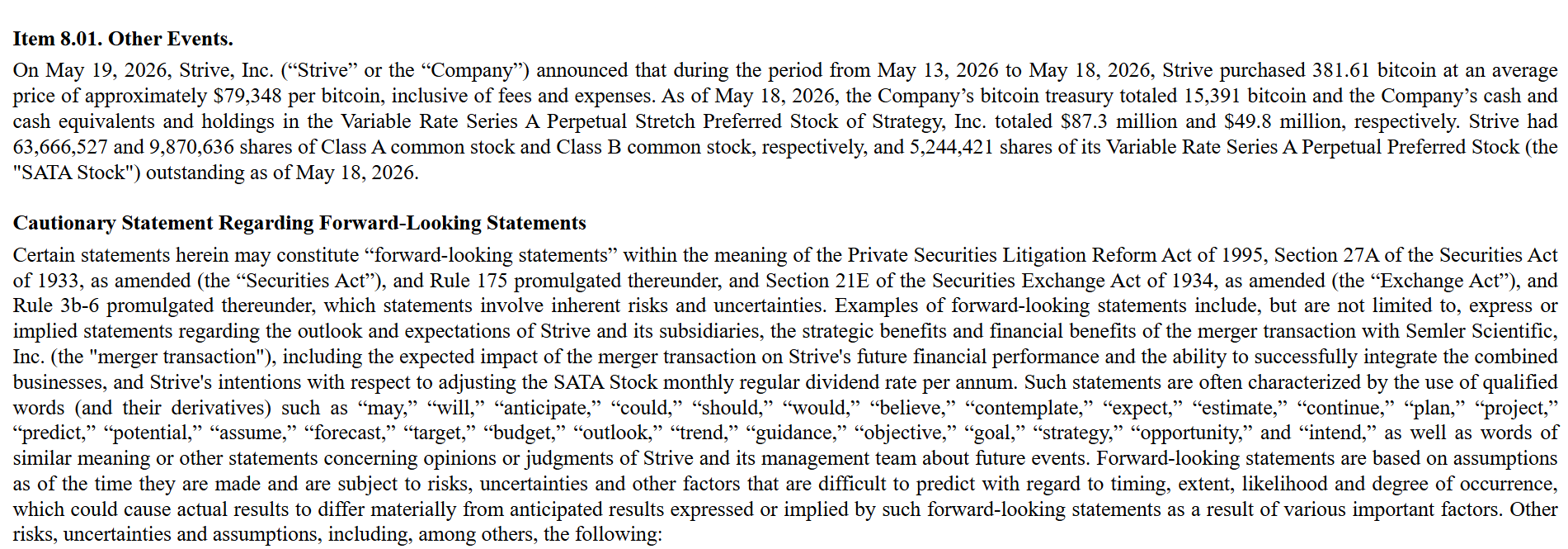
Strive FORM 8-K filed with the US Securities and Exchange Commission. Source: SEC.gov
Bitcoin treasuries bought the BTC dip below $80,000
The Bitcoin treasury companies made their acquisitions shortly after Bitcoin fell below the $80,000 level.
Strive made its latest investment at an average purchasing price of $79,348 per Bitcoin, while DDC bought at an average purchasing price of $79,496 per BTC and SWC at an average purchasing price of $77,687 per BTC.
Hyperscale bought the BTC in the open market and did not disclose an average purchasing price, though it acquired on Sunday, when Bitcoin’s price closed the day at $76,981.
The average purchasing price of Bitcoin treasury firms is an important metric that reveals the unrealized gains or losses on the current BTC position and is often used to gauge a company’s long-term conviction in the underlying asset.
Related: New York lawsuit tests lost property claim over dormant Bitcoin
The development comes a week after Strategy announced a massive acquisition of 24,869 BTC acquired for $2.01 billion between May 11 and 17, at an average purchasing price of $80,985 per BTC. The $2 billion investment marked Strategy’s third-largest investment of 2026.
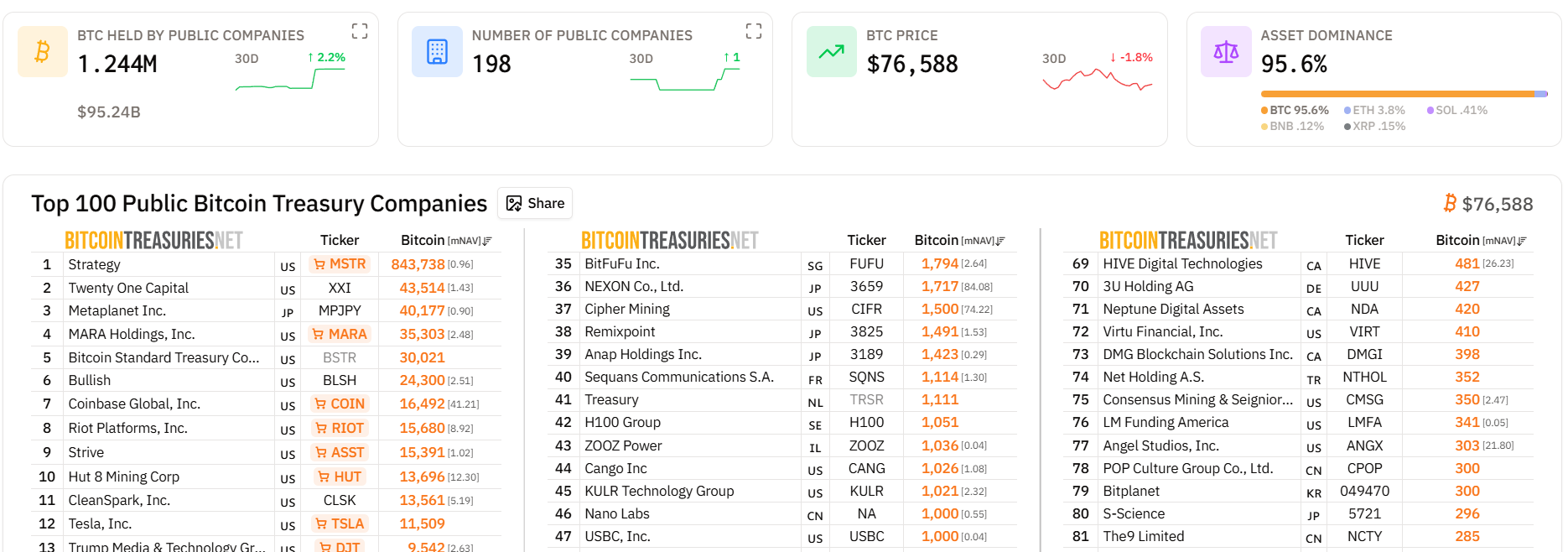
Top Bitcoin treasury companies by holdings. Source: Bitcointreasuries.net
There are currently about 198 public Bitcoin treasury companies holding 1.24 million Bitcoin, representing about 5.9% of the total supply, data from Bitcointreasuries shows.
Magazine: Bitcoin ETFs bleed $1B, Aave’s $71M ETH unfreeze bid delayed: Hodler’s Digest, May 10 – 16

Disclosure: This article does not represent investment advice. The content and materials featured on this page are for educational purposes only.
DOGEBALL gains attention as a crypto presale combining gaming utility, payments, and audited blockchain infrastructure.
Summary
- DOGEBALL is a Layer 2-based crypto ecosystem built on DOGECHAIN, combining payments and gaming with a utility-driven presale model.
- The project enables crypto-to-fiat transfers with zero FX fees and integrates a play-to-earn gaming system with real reward mechanisms.
- It is in presale Stage 5 at $0.00065, with reported fundraising of $295K+ and a staged pricing model designed to reduce supply over time.
DOGEBALL (DOGEBALL) is quickly standing out for investors searching for the best crypto presale to buy now. With real payment utility, a powerful gaming ecosystem, and audited tech, DOGEBALL is designed to deliver long-term value rather than short-lived hype.

Why DOGEBALL could be the best crypto presale to buy now
DOGEBALL crypto presale 2026 is built on DOGECHAIN, a custom Ethereum Layer 2 that powers fast, low-fee transactions. This infrastructure supports both global payments and gaming, making DOGEBALL a serious contender for anyone hunting the Best Crypto Presale To Buy Now.
Unlike many crypto presale projects that lean on vague promises, DOGEBALL has a clear, utility-driven roadmap: DOGEPAY for real-world payments, a high-stakes play-to-earn game, and a scalable Layer 2 network. That combination gives DOGEBALL multiple real demand drivers from day one.
DOGEBALL details: Why this crypto presale is different
DOGEBALL is a full crypto ecosystem that lets users send crypto while receivers get fiat directly in their bank accounts worldwide. There are zero FX fees, no banks or intermediaries, and near-instant transfers, all powered by DOGECHAIN and the DOGEBALL token.
The same infrastructure also fuels a cross-platform play-to-earn game with a prize pool up to $1M and a top reward up to $500K. Players can cash out winnings straight to fiat, and developers can accept crypto and convert to fiat instantly, making DOGEBALL useful across gaming and payments.
For investors, this is more than a speculative crypto presale. DOGEBALL is already in presale stage 5 at $0.00065, with $295K+ raised and 1000+ participants. A 4bn token burn (20% of the 20bn presale allocation) has already permanently reduced supply, tightening tokenomics.
The presale now runs as a timed model with 20 stages (starting from Stage 2), each lasting up to 7 days. If a stage sells out early, the next one starts immediately with a higher price. All unsold tokens from each stage are burned, further supporting long-term scarcity.
Every weekend, a stage ends, and each Monday at 21:00 UTC a new, higher-priced stage begins. That means today’s price is among the lowest available before launch, and with marketing ramping up from 11 May 2026, more buyers are likely to enter later at higher prices.
DOGEBALL presale growth potential: Numbers that make sense
DOGEBALL is currently priced at $0.00065 in stage 5, with an expected launch price of $0.015. The potential upside is easy to see:
- Launch price: 0.015
- Today’s presale price: 0.00065
- 0.015 / 0.00065 ≈ 23.07
- That is roughly a 23x increase from the current presale price
In ROI terms, this is around a 2207% gain. For example:
- Investing $100 at $0.00065 gets about 153,846 DOGEBALL tokens
- At $0.015, those tokens would be worth around $2307
These figures only cover the move from today’s presale level to the scheduled launch price, before considering any additional upside once DOGEBALL lists on exchanges and DOGEPAY plus the gaming ecosystem go live. Combined with ongoing token burns and growing marketing, early participants are positioned at some of the most attractive entry levels.
How to join DOGEBALL: Easy steps to enter this crypto presale
Getting into the DOGEBALL crypto presale 2026 is straightforward, even if someone is new to presales. Here is how to secure an allocation at the current stage price before the next increase.
- Visit the official DOGEBALL website and open the updated timed presale widget.
- Connect a supported web3 wallet, such as MetaMask or a trusted mobile wallet.
- Choose a payment method (such as ETH or USDT, depending on what the widget supports) and enter the amount to invest.
- Confirm the transaction in the wallet and wait for on-chain confirmation.
- The DOGEBALL allocation will be stored to be claimed once the presale ends and the token launches on exchanges with a specialist web3 partner.
Because each new stage brings a higher price and any unsold tokens are burned, buying earlier allows investors to secure more tokens for the same capital. With a planned launch price of $0.015, today’s $0.00065 stage offers one of the strongest value entries in this crypto presale.

Conclusion: Why DOGEBALL crypto presale 2026 looks like the best crypto presale to buy now
The DOGEBALL presale combines several powerful elements: a custom Ethereum Layer 2 (DOGECHAIN), a real-world payment app (DOGEPAY) that converts crypto to fiat in 30+ currencies, and a serious gaming ecosystem with up to $1M in rewards and instant cash-outs.
With audited smart contracts, a 4bn token burn already executed, automatic burns on unsold stage tokens, $295K+ raised, 1000+ participants, and a clear launch target of $0.015, DOGEBALL presale gives investors transparent numbers and real utility. For many, that makes DOGEBALL crypto presale 2026 a leading candidate for the best crypto presale to buy now.
For more information, visit the official website, Telegram, and X.
FAQs for best crypto presale to buy now
What is the best crypto to buy in Presale?
The best presales usually combine clear utility, audited contracts, and disciplined tokenomics. DOGEBALL fits this profile with payments, gaming, a Layer 2 chain, and a structured, burn-backed presale, which puts it high on many investors’ shortlists.
Which crypto has 1000x potential?
No project can guarantee 1000x, but tokens with multiple real use cases have a better chance. DOGEBALL powers payments, gaming, staking, and Layer 2 gas, creating several streams of organic demand instead of relying only on speculation.
How to find the best presale crypto?
Focus on real products, audits, transparent teams, and supply mechanics. DOGEBALL publicly outlines DOGEPAY, its gaming ecosystem, DOGECHAIN, and stage-based burns, giving investors concrete fundamentals rather than empty marketing slogans.
What is the fastest crypto presale?
Fast-moving presales usually have strong demand and smart mechanics. DOGEBALL’s timed stages, automatic price rises, supply burns, and increasing marketing can accelerate stage sellouts as more investors discover its payments-plus-gaming value proposition.
Is it good to buy presale tokens?
Presales carry higher risk but can offer strong upside when backed by real utility and clear tokenomics. DOGEBALL’s audited contracts, defined launch price, ecosystem roadmap, and scarcity-focused presale structure give buyers a more informed, data-backed opportunity.
Disclosure: This content is provided by a third party. Neither crypto.news nor the author of this article endorses any product mentioned on this page. Users should conduct their own research before taking any action related to the company.

Singapore’s criminal justice system has taken aim at governance practices in one of the industry’s high-profile cases linked to the Terra ecosystem collapse. Former Hodlnaut chief executive Zhu Juntao was charged in Singapore with six counts of fraud by false representation, tied to statements made after the TerraUSD (UST) crash in 2022. The Commercial Affairs Department conducted the investigation, and Zhu, aged 36, faces three charges under Section 424A(1)(a) read with Section 424A(3) of the Penal Code 1871, as well as three additional charges under the same provision read with Section 109, according to the Singapore Police Force.
According to the Singapore Police Force, the charges allege that Zhu directed Hodlnaut staff to issue statements in the company’s official Telegram group and in emails to users between May and July 2022 that falsely asserted Hodlnaut did not have direct exposure to UST and had not suffered losses from the crash. The police also stated that Zhu published three similar posts on his personal Twitter account (now known as X) in June 2022. If convicted, he faces up to 20 years in prison, a fine, or both, on each charge.
The case adds a new layer to the scrutiny over the Terra collapse—a turning point in the 2022 digital asset market rout that erased approximately $50 billion in market value and contributed to broader turmoil within the crypto lending sector.
Related: Singapore revokes crypto payment license of Bsquared over regulatory breaches
The Terra event, which unfolded in May 2022 as the algorithmic stablecoin UST lost its peg, reverberated across the sector. Hodlnaut—an Singapore-based platform that allowed users to deposit tokens for yield—found itself at the center of the fallout. The company halted withdrawals in August 2022, and its website currently notes that its affairs, business, and property are being managed by court-appointed liquidators. The firm previously served more than 30,000 users worldwide before its collapse, marking one of the more consequential episodes of 2022’s crypto downturn.
The Terra crisis also led to distress at other lenders. Celsius Network reported assets exceeding $10 billion prior to its Chapter 11 filing, while Voyager Digital disclosed assets and liabilities ranging between $1 billion and $10 billion. The sequence of failures underscored how rapid liquidity strains and misaligned risk disclosures can destabilize platforms that promise yield on digital assets.
Cointelegraph sought comment from Hodlnaut’s court-appointed liquidators, but there was no immediate response. The proceedings in Singapore continue to shape regulatory expectations for crypto platforms, particularly around the accuracy of public statements and investor communications.
Opening context for enforcement and policy considerations
The charges against Zhu re-emphasize the primacy of truthful communications in crypto service offerings, especially when users’ funds and platform solvency are at stake. In jurisdictions around the world, including Singapore, authorities are increasingly focusing on corporate governance, disclosures, and the accuracy of information shared with customers and counterparties. The case thus sits at the intersection of criminal law, corporate conduct, and regulatory oversight in a sector characterized by rapid innovation and evolving risk profiles.
From a regulatory perspective, the incident reinforces several critical themes for institutions operating or interacting with digital asset markets:
- Governance and accountability: Public assurances by executives and staff about exposure, liquidity, and solvency must align with a firm’s actual risk profile and financial status. Misrepresentations can invite criminal liability and civil consequences, particularly in jurisdictions with robust consumer protection and market integrity regimes.
- Disclosure standards and investor protection: The Terra episode highlighted gaps in disclosure practices that can leave retail and professional investors exposed to mispricing and liquidity risk. Regulators are likely to scrutinize communications policies, disclosure controls, and the monitoring of information disseminated through official channels and social platforms.
- Licensing, supervision, and cross-border implications: The Singapore case dovetails with broader calls for enhanced oversight of crypto lenders, exchanges, and payment services. As jurisdictions pursue licensing regimes and ongoing supervision, firms face increased expectations around risk management, governance structures, AML/KYC compliance, and capital adequacy.
- Regulatory alignment and enforcement posture: The Terra fallout underscored the need for coherent policy responses in fast-moving markets. While MiCA governs the European Union’s digital asset framework, comparable standards are evolving in Asia and elsewhere, influencing licensing criteria, enforcement priorities, and the delineation of permissible activities for custodians and lenders.
For institutional readers and compliance professionals, the case offers a lens into how regulatory authorities may pursue accountability for misrepresentations, and how such actions can ripple through governance practices, customer communications, and risk governance frameworks across crypto businesses. It also highlights the importance of clear internal controls surrounding public messaging and the separation between executive communications and the firm’s official risk disclosures.
Looking ahead, authorities may continue to pursue parallel inquiries into other entities involved in Terra’s aftermath, while courts assess whether the statements in question meet the threshold for fraud by false representation. The outcome could influence future guidance on how crypto platforms should manage public communications during periods of stress, as well as how regulators calibrate licensing and enforcement tools to deter deceptive practices without stifling innovation.
What to watch next: the legal process will determine whether the charges lead to a conviction and, if so, the standards by which communications must be vetted in exchange for customer assurances and platform disclosures. In the broader policy landscape, the episode could inform ongoing discussions about cross-border cooperation, standardization of reporting, and the resilience requirements placed on platforms that offer yield-generation services to a growing, global user base.

Key Takeaways
- The U.S. Department of Energy has chosen Oklo for advanced discussions regarding its Surplus Plutonium Utilization Program.
- Oklo will collaborate with newcleo, a European nuclear technology company, to transform Cold War surplus plutonium into usable reactor fuel.
- Shares of OKLO are currently trading at $65.88, representing an almost 18% increase over the previous seven days.
- The collaboration with newcleo features a possible capital injection reaching $2 billion, pending final agreements and regulatory clearance.
- Congressional Democrats have expressed concern over security risks, highlighting that the stockpile theoretically contains material for 2,000 nuclear weapons.
The U.S. Department of Energy has tapped Oklo Inc. to enter advanced negotiations as part of its Surplus Plutonium Utilization Program. This federal initiative aims to repurpose designated surplus plutonium by converting it into fuel suitable for next-generation nuclear reactors.
Shares were changing hands at $65.88 when the news broke, giving the company an $11.5 billion market capitalization. The stock has climbed nearly 18% in the last week alone.
Oklo stands among five advanced nuclear technology companies selected for participation in the program. The firm intends to spearhead the fuel conversion initiative in partnership with newcleo, a European developer of advanced nuclear reactor systems.
Newcleo’s involvement would contribute specialized fuel fabrication knowledge and potential financing for the project, contingent upon finalized contracts and government approvals. The partnership between the two entities was initially unveiled in October 2025, featuring a prospective $2 billion capital commitment from a newcleo-associated investment vehicle.
By February 2026, newcleo had initiated preliminary discussions with the U.S. Nuclear Regulatory Commission concerning an advanced fuel fabrication plant and a lead-cooled fast reactor architecture.
The plutonium targeted by this program originates from the Cold War era. Sourced from decommissioned nuclear weapons, approximately 20 metric tons are currently held by the United States at high-security storage sites located in South Carolina, Texas, and New Mexico.
President Trump issued an executive order roughly one year ago terminating a program intended to dilute and permanently dispose of this surplus material. The directive instead instructed federal agencies to make the plutonium accessible as fuel for cutting-edge nuclear energy systems.
Understanding the Plutonium Initiative
The substance possesses a half-life of 24,000 years and necessitates specialized protective equipment during handling. Storage occurs at facilities maintained under weapons-grade security protocols.
Oklo CEO Jacob DeWitte stated the program establishes a mechanism to accelerate reactor deployment. “Material previously earmarked for disposal can now be transformed into fuel for electricity generation,” he explained.
Newcleo CEO Stefano Buono indicated that utilizing the plutonium as reactor fuel would diminish America’s nuclear waste obligations.
The program mandates strict adherence to all U.S. security protocols, safeguard measures, and material tracking requirements.
Congressional Opposition and Regulatory Scrutiny
Democratic members of Congress have called on the Trump administration to abandon the initiative. Their concerns center on proliferation dangers, emphasizing that the accumulated stockpile theoretically holds sufficient plutonium to manufacture around 2,000 nuclear weapons.
The Department of Energy has not yet provided a response to inquiries regarding security protocols for the material.
It bears mentioning that current U.S. Energy Secretary Chris Wright was previously a board member at Oklo prior to his appointment to the Trump administration.
Regarding Wall Street coverage, BofA Securities launched coverage on Oklo with a buy recommendation and an $80 price objective, highlighting the company’s integrated build-own-operate business approach. Wolfe Research assigned a Peerperform rating with an estimated fair value between $51 and $71 per share.
Oklo disclosed Q1 2026 earnings per share of -$0.19, matching analyst consensus forecasts. Four financial analysts have recently increased their earnings projections for the next reporting period.
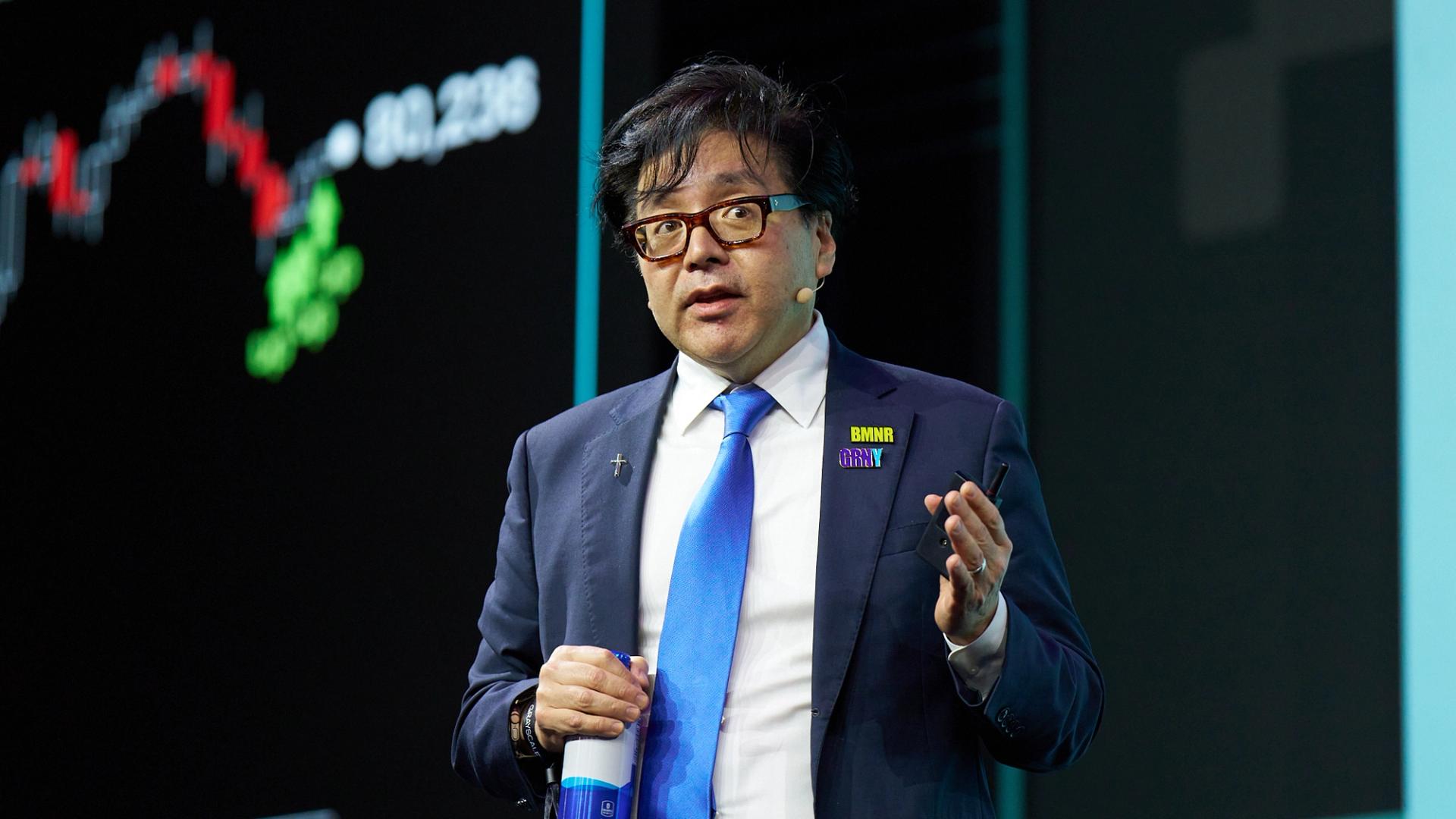
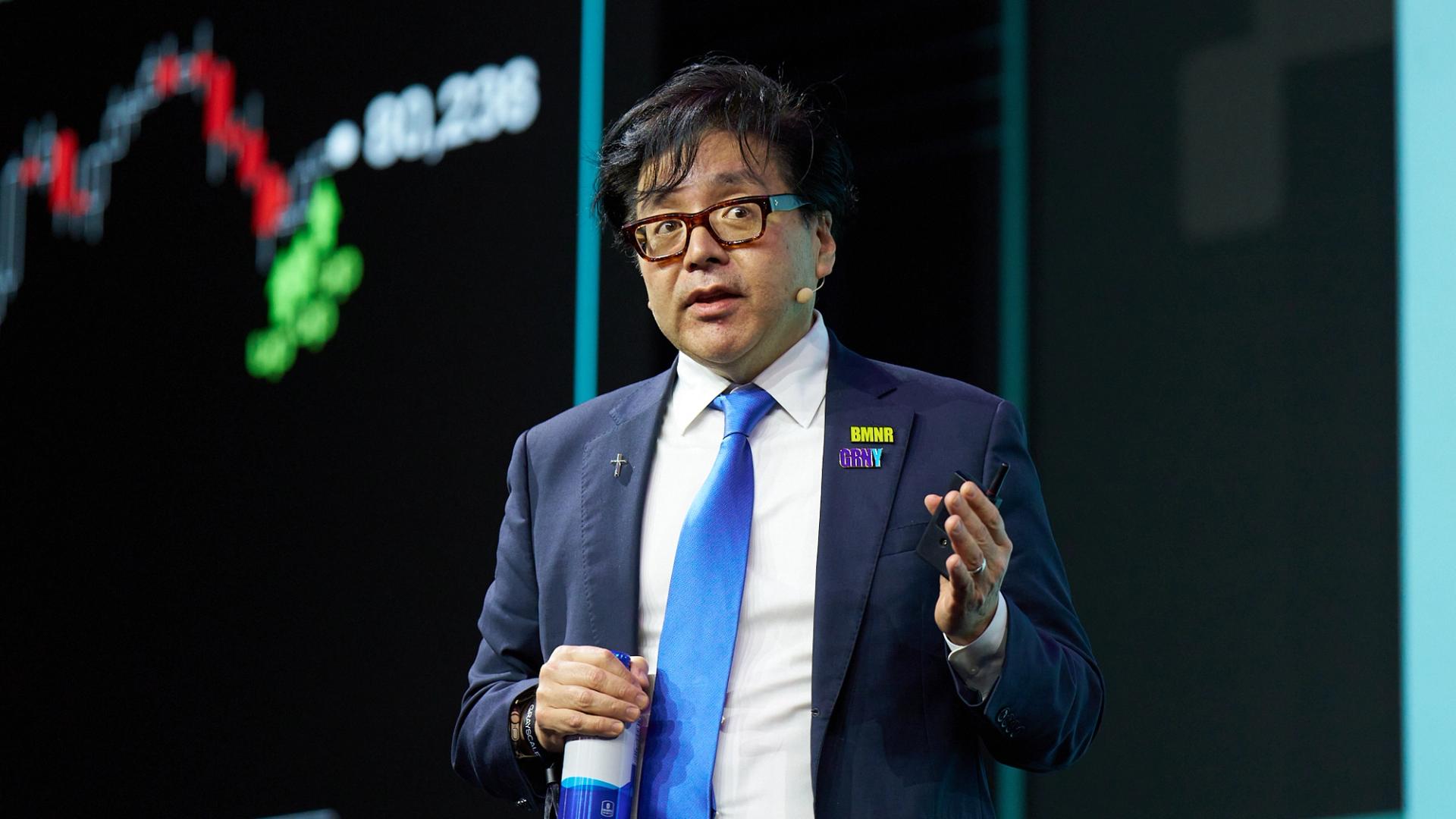
Bitmine Immersion (BMNR), the Ethereum treasury firm helmed by chairman Tom Lee, ramped up purchases again, making its biggest haul since December.
The company said Monday it bought 111,942 ether (ETH) last week, worth around $237 million at current prices. That lifted the firm’s holdings to almost 5.4 million ETH, about 4.47% of Ethereum’s circulating supply.
The purchase marks a renewed acceleration in Bitmine’s buying pace after Lee said earlier in May at Consensus 2026 in Miami that the company planned to slow weekly accumulation. The shift happened as the firm aims to take advantage of ETH sliding from $2,400 in early May and April to near $2,100.
“We continue to steadily acquire ETH,” Lee said in the statement. “We view the recent pullback of ETH to below $2,200 as an attractive opportunity.”
Lee added that the firm is expected to reach its goal to corner 5% of ether’s supply later in 2026.
Bitmine’s total crypto and cash holdings stand at $12.3 billion, according to the report. The company also holds 203 bitcoin, $444 million in cash and equity stakes including investments in Beast Industries and Eightco Holdings.
The firm said it has staked more than 4.7 million ETH — about 87% of its holdings — generating approximately $276 million in annualized staking revenue.
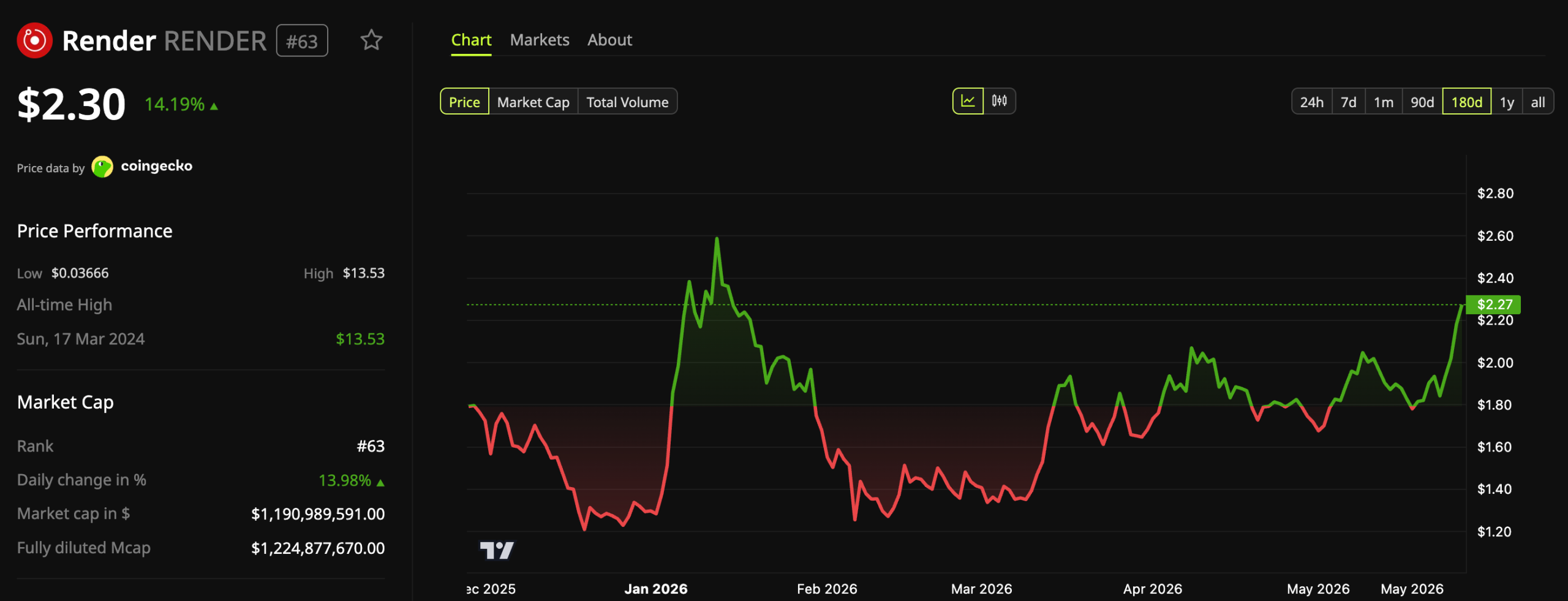
Render’s native token, RENDER, climbed to a four-month high of $2.32 on Tuesday, extending its recent rally as network activity and investor interest in AI-linked infrastructure projects accelerated.
At press time, the token traded near $2.30, up 14.19% over the past 24 hours. The latest move also outpaced gains across the broader cryptocurrency market, with traders continuing to rotate into artificial intelligence-related digital assets.

Follow us on X to get the latest news as it happens
RENDER Outperforms Bitcoin and Ethereum With Double-Digit Daily Rally
According to a recent analysis by BeInCrypto, RENDER has trended higher since May 18, with sizable buying volume backing the move. The rally has separated itself from speculative pump.
The report added that easing geopolitical tensions involving Iran helped improve sentiment toward AI-linked assets.
On-chain data further highlighted the surge in activity across the Render ecosystem. Blockchain analytics platform Santiment noted that daily active addresses jumped to 394, while 118 new wallets joined the network.
“These two metrics are important because they measure how many unique wallets are actively interacting with the network and how many new participants are entering the ecosystem,” the post read.
AI Infrastructure Demand Anchors the Move
Meanwhile, Santiment explained that most of Render’s 2026 momentum stems from expanding demand for AI infrastructure. The project has cemented its role as a decentralized GPU computing network for training, machine learning, and advanced rendering workloads.
The network expanded its GPU base throughout the year, integrating tens of thousands of units and supporting newer NVIDIA hardware.
The rally also aligns with a wider rotation into US-aligned AI tokens, with compute infrastructure names drawing fresh investor flows.
Whether the token holds above $2.3 remains to be seen. Sustained on-chain expansion in the coming sessions will reveal if the breakout has staying power.
Subscribe to our YouTube channel to watch leaders and journalists provide expert insights
The post Render Hits 4-Month High as New Wallets Pile Into the Network appeared first on BeInCrypto.

Fredun Pharmaceuticals board approves 2:1 bonus issue

UK Sanctions Justin Sun’s HTX Crypto Exchange Over Russia Ties

The Most Intense Action Thriller of the Year Gets 10/10 First Look


![TL | Thief Gives Money To Homeless[TRACYLEAD] #tracylead #kindperson #respect #help](https://wordupnews.com/wp-content/uploads/2026/05/1779804688_maxresdefault-80x80.jpg)

-

 Crypto World5 days ago
Blockchain.com files with SEC for U.S. IPO
-

 Fashion4 days ago
Holiday Weekend Open Thread – Corporette.com
-

 Business4 days ago
Dell Technologies DELL Stock Surges 15% on AI Server Momentum and Analyst Upgrades in 2026
-

 Crypto World4 days ago
Bitcoin Accumulation Weakens as BTC Realized Losses Hit $600M
-

 Crypto World4 days ago
Space X IPO Is ‘Bad News’ for Tech Stocks: But What About Bitcoin?
-

 Politics4 days ago
Makerfield: a tale of two social-media histories
-

 Crypto World3 days ago
Robinhood crypto COO Tanya Denisova exits
-

 Business2 days ago
NYT Strands Answers May 24 2026 Revealed for Puzzle No. 812 Theme Summer Essentials
-

 Crypto World4 days ago
MicroStrategy’s Saylor Says Miners No Longer Set Bitcoin Price, Another Force Has Taken Over
-

 Crypto World4 days ago
AI infrastructure race heats up as IREN pitches full-stack strategy, WhiteFiber lands $160M deal
-

 Tech5 days ago
WhatsApp ads could make Irish debut after discussions with DPC
-
 Tech4 days ago
A 0.12% parameter add-on gives AI agents the working memory RAG can’t
-

 Tech4 days ago
You Can Now Add ChatGPT To PowerPoint
-

 Business4 days ago
Trump Invests $1M-$5M in Kura Sushi USA Chain With 27 California Locations
-
 NewsBeat5 days ago
Charity run by Reform leader Malcolm Offord accused of ‘law breaking’ over Scottish registration
-

 Sports5 days ago
2026 CJ Cup Byron Nelson leaderboard: Brooks Koepka finds putting stroke in Round 1
-

 Crypto World6 days ago
Exa Labs raises $250 million in funding led by a16z
-
Business4 days ago
Goldman Sachs reinstates Ageas stock coverage with neutral rating
-
 Crypto World4 days ago
Verus Bridge Hacker Returns $8.5M ETH, Keeps $2.8M as Bounty
-

 Crypto World4 days ago
Trump Media’s Bitcoin Stash Shrinks Again as 2,650 BTC Lands on Crypto.com
You must be logged in to post a comment Login