

Crypto World
Pepe Coin Price Prediction: Whale Wallets Stack $7.5M PEPE During 17% Rebound While Pepeto Lines Up 150x Listing

The Pepe Coin price prediction is heating up. PEPE whales added $7.5 million during a 17% rebound off the June 6 low, pushing whale supply from 181 trillion to 183.6 trillion tokens, and meme coin ETF flows are pulling capital back per CoinMarketCap.
Whenever big-money flows show that kind of conviction, meme tokens move first, and the hunt for the next Pepe-style winner gets noisy.
The same builder who scaled the original Pepe Coin from internet joke to $11 billion on 420 trillion tokens now leads Pepeto, with identical supply, the same bottom-up community heat, and a full exchange the first version never delivered.
Anyone who picked up Pepe Coin in April 2023 turned tiny deposits into life-rewriting paydays as the token printed 7,000% in four weeks, riding pure hype with no audit and no real product.
Pepeto ships both plus an approaching Binance listing, and the same crowd that drove the original Pepe Coin into mainstream headlines is already gathering. The big-cap picture lays the table, but the real prize is the presale still on offer. With whale wallets stacking, this is the moment.
The Next Pepe Coin: Same Builder, Real Products, and a Binance Listing Ready
The original Pepe Coin proved a meme token without products could ride pure crowd belief to $11 billion. Buyers who entered early and held past listing day walked away with returns that rewrote their lives. But PEPE never launched an exchange or any cross-chain product, leaving nothing to support demand once the hype faded.
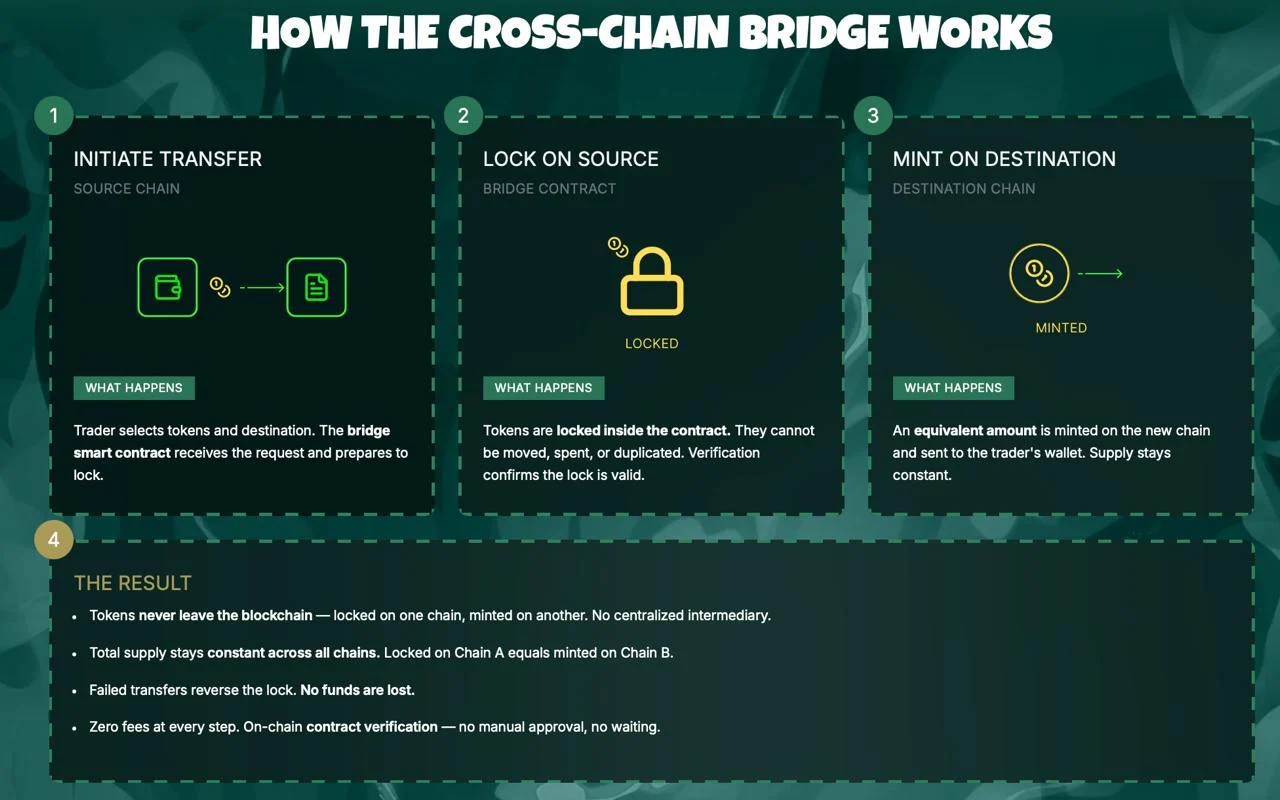
That is why PEPE today sits 90% below its peak. Pepeto fills every void the first version left empty, with the same cofounder shipping zero-fee trading, a bridge across ETH, BNB, and SOL, a token scanner that flags threats before capital arrives, and a signed SolidProof audit on file. The Binance listing arrives at launch, and the organic build behind Pepeto walks the same path that took the original from nothing to billions.
Pepe Coin Price Prediction 2026 and the Presale Where the Same Builder Goes Bigger
Pepeto: The Exchange Presale From the Builder Who Already Hit $11 Billion
Pepeto is the strongest presale on the market, carrying more working tools than any meme coin has ever shipped at this stage.
Pepeto runs a live exchange on Ethereum where the risk engine scores every contract before your wallet goes near it, catching dangerous permissions and liquidity holes most buyers learn about only after losing money.
Against the original Pepe Coin which peaked at $11 billion on hype alone, Pepeto delivers a live exchange, a signed SolidProof audit, and a former Binance lead running the listing roadmap. Over $10.307 million committed while new wallets join every round shows where serious capital is heading.
Staking at 169% APY grows inside the presale while the market tracks PEPE price charts. At $0.0000001878 on 420 trillion tokens, reaching the same cap Pepe hit while shipping nothing means 150x, and the exchange gives that target a real base. That entry slams shut the moment the Binance listing goes live, and each round closes faster than the one before.
PEPE Price Outlook: Recovery Has a Ceiling and the Upside Is Capped
Pepe (PEPE) trades near $0.000002722 per CoinMarketCap, down 90% from its all-time high, with a $1.12 billion cap.
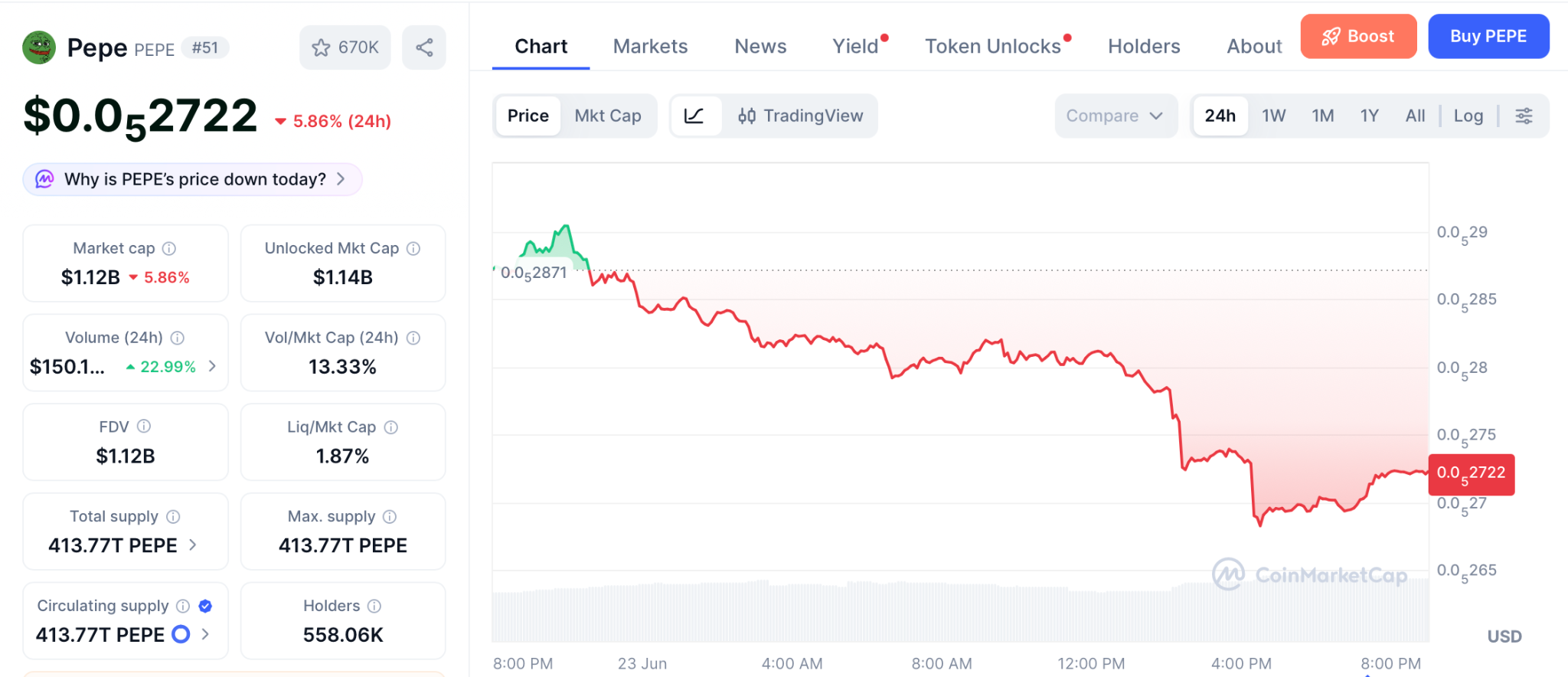
The 50-day EMA hovers around $0.0000035 per FXStreet, with a run back to the $0.000028 peak giving roughly 10x. For a Pepe Coin that already proved meme power, 10x is a recovery play not a wealth builder, while the builder behind Pepeto targeting 150x to that same peak tells you exactly where the better math lives.
Conclusion
The $7.5 million in whale accumulation and the 17% rebound off June lows tell you smart money is already back, and that blend of meme power with real exchange tools is why wallets entering each round trace to addresses that held winners across past cycles.
They commit with size, verify everything, and move the second they spot what the rest of the market hasn’t priced in. The Pepe Coin price prediction hands you a 10x at best, but the next Pepe Coin is the one shipping real products and a presale spot that vanishes the moment trading opens, and the Pepeto official website is the gateway holding those entries right now.
Every wallet stacking before the Binance listing opens is writing the part of this cycle late arrivals will spend the rest of 2026 trying to undo, because once the rounds close the entry price disappears and the chance to be early is gone for good.
Click To Visit Pepeto Website To Enter The Presale

FAQs
What makes the Pepe Coin price prediction for 2026 different from Pepeto’s upside?
PEPE at $0.000002722 targets recovery toward $0.0000050 short term, but even reaching its ATH only delivers 10x. Pepeto at presale pricing carries 150x to that same cap with a working exchange and approaching Binance listing behind it.
Why do crypto investors keep calling Pepeto the next Pepe Coin heading into 2026?
Pepeto shares the same cofounder and 420 trillion token supply as the original, but ships zero-fee trading, a cross-chain bridge, and a signed SolidProof audit. Over $10.307 million raised confirms serious conviction.
Disclaimer: This is a Press Release provided by a third party who is responsible for the content. Please conduct your own research before taking any action based on the content.



Kpler has pushed its expectation for a reopening of the Strait of Hormuz into 2027, raising the risk of sustained higher oil prices.
Matt Smith, Kpler’s director of commodity research, gave the revised timeline on CNBC. He said there is no endgame in sight after five months of conflict.
Why the Strait of Hormuz Reopening Timeline Slipped
The United States and Iran signed a memorandum of understanding in June, reopening the strait. Tanker traffic then picked up through early July.
Smith said those flows have since slowed to a trickle. Meanwhile, US forces have continued nightly strikes on Iranian military and maritime targets.
A second chokepoint has now opened. Saudi Arabia had been routing an extra 3.25 million barrels a day into the Red Sea through Bab el-Mandeb.
Smith said that the outlet is now at risk. The Houthis declared a maritime blockade on Saudi shipping and struck two Saudi tankers two days ago.
“And there doesn’t seem like there’s an end game in sight,” Smith said. “We’re looking at our expectations for the Strait of Hormuz reopening… it’s 15 million barrels a day of crude that leaves through there. That is ground to a halt. And we’re pushing that reopening into next year.”
Follow us on X to get the latest news as it happens
Brent Climbs While Refined Fuels Take the Bigger Hit
Smith said Brent has risen about 40%, or roughly $30, over the past couple of weeks. The benchmark settled at $100.69 on Thursday, its first close above $100 since May 26. Prices then reversed. Brent fell about 4% on Friday to close near $97 after reports of revived US-Iran talks.
Refined products have fared worse than crude. Smith put diesel near $180 a barrel and gasoline near $140.
He said the concerns he raised about jet fuel in May have been addressed. However, that relief came at the expense of diesel and gasoline, and he expects those strains to worsen.
Subscribe to our YouTube channel to watch leaders and journalists provide expert insights
The post When Will the Strait of Hormuz Open for Good? Analyst Gives Timeline appeared first on BeInCrypto.
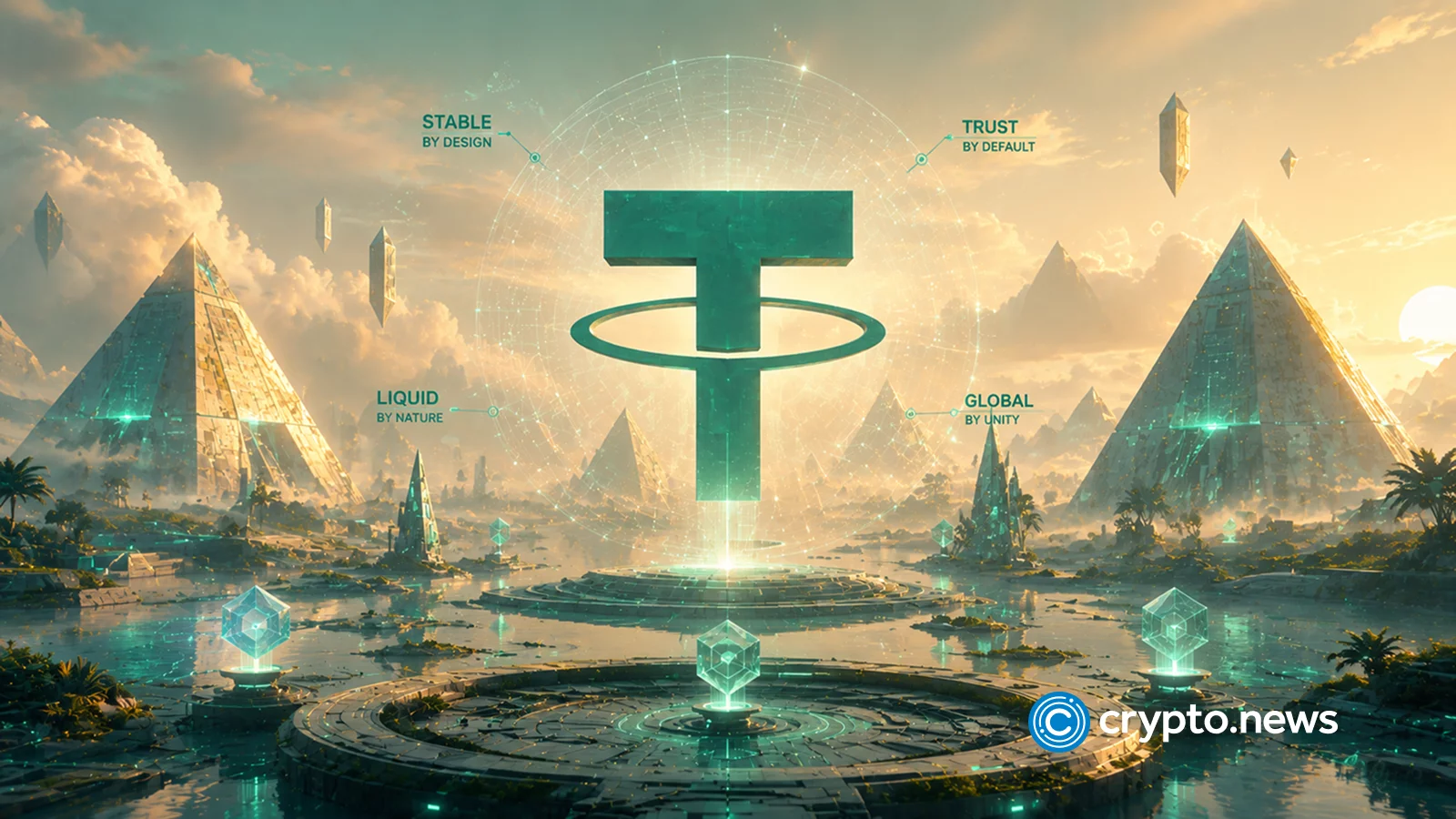
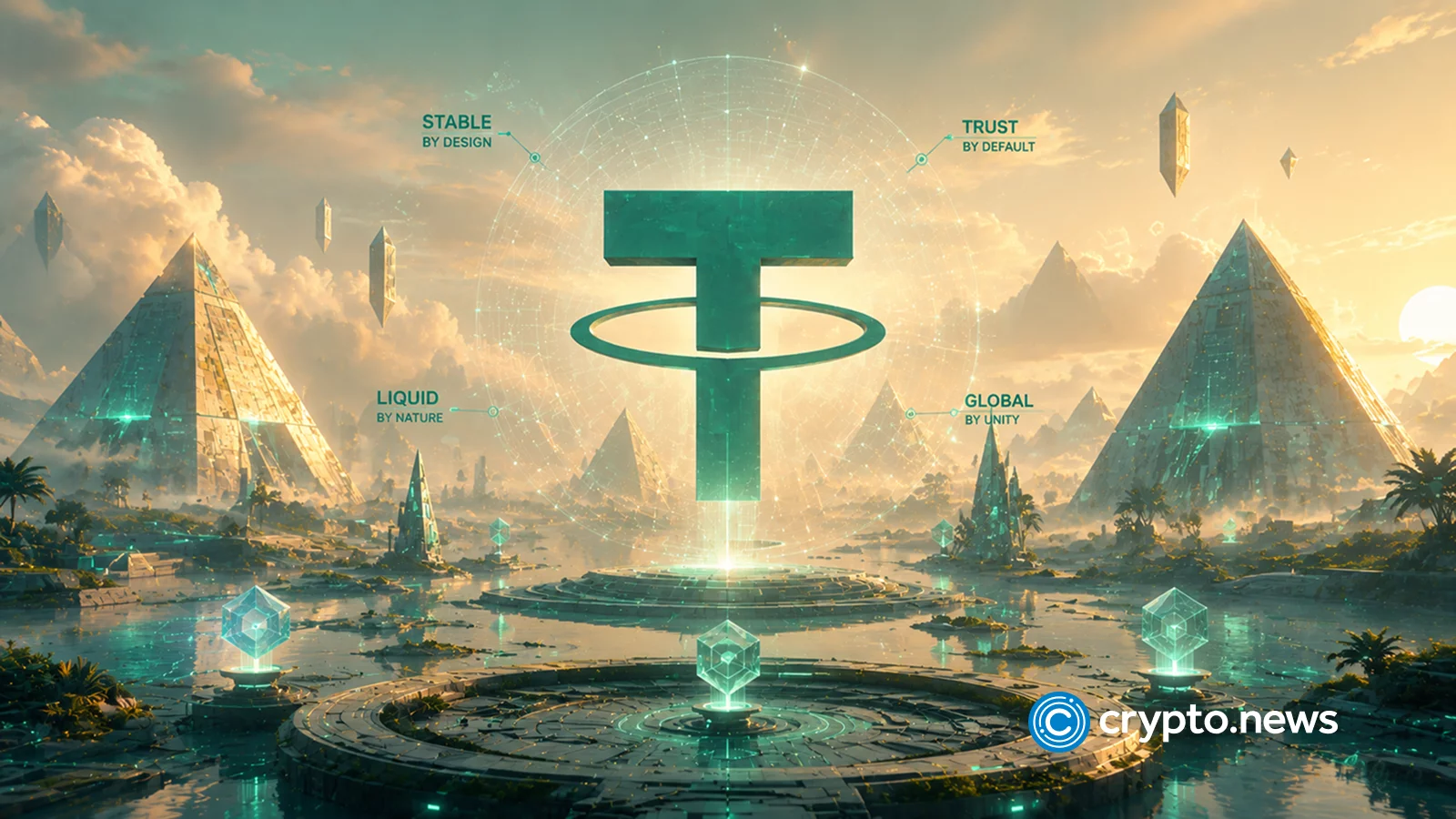
The world’s largest stablecoin issuer pays roughly $2.9 billion a year in fees to blockchains it does not control. Its answer was to back two competing chains at once: Plasma, the $373 million DeFi-flavored bet, and Stable, the enterprise rail where USDT is the gas. One issuer, two armies, one enemy named Tron, and a strategy that makes sense only when you see whose problem it solves.
Summary
- Tether’s ecosystem has seeded two purpose-built USDT chains that compete directly with each other: Plasma, live since September with a $373 million token sale, a paymaster model, and roughly $551 million in DeFi TVL, and Stable, live since December with $2 billion in pre-deposits, USDT-as-gas, and an enterprise focus.
- The motive is a number: analyses put Tether’s annual network-fee bill near $2.9 billion, split largely between Ethereum and Tron, value that leaks to base layers the issuer does not control while its own revenue runs near $5 billion.
- The two chains embody opposite design philosophies, a subsidized general-purpose DeFi economy with a native token doing traditional work, versus a stripped payments rail where the dollar itself is the fuel, and opposite go-to-market strategies.
- The real target is not each other but Tron, which still carries roughly 45% of all USDT and earns the fees on the world’s largest remittance flows, a moat neither challenger has meaningfully dented.
- Funding both sides is not indecision; it is a portfolio: the issuer wins if either chain repatriates the fee leak, wins bigger if both segment the market, and loses only to the status quo it is paying $2.9 billion a year to escape.
Companies do not usually finance both armies in a war, but then no company has ever been positioned quite like Tether. The issuer of USDT sits atop the most profitable simple business in finance, collecting Treasury yield on the reserves behind roughly $150 billion of circulating dollars, and it watches, every day, a substantial slice of its ecosystem’s economics leak sideways: the fees users pay to move USDT accrue not to Tether but to the blockchains USDT lives on, a bill that research houses have tallied near $2.9 billion a year, flowing mostly to Ethereum validators and, above all, to Tron, the chain that quietly became the developing world’s dollar-remittance backbone.
Tether’s response, characteristically, was not one bet but two. Plasma, backed by Tether-adjacent capital and Founders Fund, raised $373 million in an oversubscribed sale and launched in September as a general-purpose stablecoin chain with a native token, a paymaster that makes USDT transfers free, and a DeFi ecosystem that onboarded Aave, Ethena, and Euler on day one. Stable, backed by Bitfinex with Tether’s chief executive advising, drew $2 billion in pre-deposits and launched in December as something sparer: a chain where USDT itself is the gas, transfers are free by protocol rule, and the pitch is enterprise blockspace rather than yield farming.
Two chains, one family, the same target market, and a rivalry the ecosystem politely declines to name. This piece names it, maps the two designs honestly, and answers the question the arrangement raises: why an issuer would fund its own chain war, and what winning even means when you own both sides.
The fee leak: the war’s actual cause
Start with the number that explains everything, because without it the two-chain strategy looks like a waste and with it the strategy looks obvious.
USDT’s success created a strange corporate geometry: the asset is Tether’s, the activity is enormous, and the toll booths belong to other people. Every USDT transfer on Ethereum pays gas to Ethereum validators; every transfer on Tron, where nearly half of all USDT lives and where the remittance corridors of Asia, Africa, and Latin America actually run, pays energy and bandwidth costs into Tron’s economy.
Aggregated, analyses of Tether’s ecosystem have put the annual network-fee spend associated with USDT movement at roughly $2.9 billion, against issuer revenues that industry estimates placed near $4.9 billion in the same period, meaning the base layers underneath USDT capture value at a scale approaching the issuer’s own take.
Delphi Digital’s framing of the problem is the cleanest: as issuance spread across chains, the infrastructure supporting USDT ended up largely outside Tether’s control, and the economic value generated by usage is disproportionately captured by the rails, especially Ethereum and Tron.
For most companies this would be an irritation. For a stablecoin issuer, it is a strategic vulnerability with three faces. Economically, it is margin leaking to landlords. Competitively, it funds a chain, Tron, whose operator is an independent actor with his own token, his own politics, and his own regulatory exposures, none of which Tether chooses. And architecturally, it means the user experience of the world’s most used digital dollar, fees, congestion, gas-token requirements, is set by networks optimizing for other things.
The purpose-built USDT chain is the answer to all three at once: repatriate the fees, own the rail, and design the experience around the dollar. The only question was which design, and Tether’s ecosystem answered: both.
Two chains, two philosophies
The rivals are best understood as opposite answers to one question: how much chain does a stablecoin need?
Plasma’s answer is: a whole one. It is a full EVM Layer 1 with its own token, XPL, doing the traditional native-token jobs, validator staking, settlement asset, and value accrual through the chain’s growth, while a paymaster contract absorbs gas costs so that simple USDT transfers cost users nothing. The design keeps the familiar crypto economy intact: XPL had a $373 million public sale seven times oversubscribed, the chain launched with more than a hundred DeFi integrations, TVL has built to roughly $551 million, sub-second PlasmaBFT finality serves trading as well as payments, Bitcoin anchoring adds a security narrative, and a confidential-transfers module courts payroll and B2B flows.
https://x.com/cryptodotnews/status/1971621952008999090
Plasma is, in short, a general-purpose chain that subsidizes its stablecoin lane, betting that free USDT transfers pull in users whose other activity, lending, trading, yield, pays the bills and accrues to the token. The paymaster’s economics depend on exactly the patron logic this publication’s gasless-transfers guide dissects: most zero-fee chains in history died when the subsidy ran out, and Plasma’s differentiating claim is that its subsidy is underwritten by an ecosystem with a direct commercial interest in USDT ubiquity.
Stable’s answer is: as little chain as possible. No paymaster indirection, no separate gas asset at all: USDT0, the omnichain dollar, is the fee token; simple transfers are exempt by protocol rule, and the native STABLE token is confined to staking and governance, deliberately invisible to users, the architecture this publication’s companion guides map in detail.
Where Plasma courted DeFi, Stable ships enterprise blockspace, dedicated capacity for institutional payment flows, and its traction metric was not TVL but the $2 billion in pre-deposits that arrived before mainnet. The design concedes the DeFi economy to others and optimizes one thing: dollar movement at payments-grade predictability, on the bet that remittance processors, merchants, and treasuries choose rails the way they choose clearing banks: for boredom, not composability.
The philosophies produce different vulnerabilities, and honesty requires both. Plasma’s risk is dilution of purpose: a general-purpose chain competing for DeFi against Ethereum, Solana, and every L2, where free USDT transfers are a loss leader for an economy that may never outgrow its subsidy, and where the XPL token must justify itself against exactly the value-accrual skepticism this publication applies everywhere.
Stable’s risk is the mirror: a rail so minimal that its moat is only execution and alignment, with no ecosystem gravity to retain users who arrive, and a token whose value case, as our STABLE guide argues, waits on governance decisions nobody has made. One chain risks being too much; the other risks being too little; and both share the risk that actually matters, which lives in Asia, on the incumbent.
Tron: the enemy both were built to fight
The polite framing says Plasma and Stable address different segments. The impolite truth is that both exist to take the same prize: the roughly 45% of all USDT that lives on Tron and the fee flows it generates.
Tron’s dominance is the most underexamined fact in stablecoin land. It hosts the largest share of the largest stablecoin, it carries the remittance and exchange-settlement flows of the markets where USDT is not a trading chip but a savings technology, and its moat is precisely the kind that whitepapers cannot breach: cash-network effects, integrations in thousands of local exchanges and OTC desks, muscle memory in a hundred million wallets, and fees that, while meaningfully nonzero, are known, tolerated, and priced into every corridor.
Both challengers aim at it explicitly, Plasma’s remittance-routing pitch is skip Tron’s TRX gas requirement, Stable’s free-transfer pitch is the same sentence with different plumbing, and both discovered what challengers of payment incumbents always discover: users do not migrate for architecture, they migrate when their exchange, their employer, or their remittance app migrates, which makes the war a business-development grind, not a technology contest.
The scoreboard that matters is therefore not TVL or transaction counts, both inflatable, but the share of USDT supply resident on each chain, and by that measure the war has barely begun: Tron’s share has eroded only at the edges, the challengers’ combined float remains a fraction of it, and the incumbent retains the advantage every toll-road owner has, profitability that funds its own retention incentives.
Which is exactly why the two-chain strategy makes sense from the issuer’s chair, and this is the piece’s resolving move. Tether does not need to pick the winning design; it needs the fee leak plugged and the rail owned by family, and funding two philosophies is how a portfolio manager attacks an uncertain market: Plasma tests whether a subsidized DeFi economy can bootstrap payments gravity, Stable tests whether enterprise minimalism can, the two chains’ competition sharpens both faster than monopoly would, and every dollar of USDT float either one wins from Tron or Ethereum converts leaked fees into family economics.
If both succeed, the market segments, retail-and-DeFi on one, institutional on the other, and the issuer owns the whole stack. If one dies, the survivor inherits its lessons and its float. The only losing scenario is the status quo, and the status quo is the thing costing $2.9 billion a year.
Wars are usually negative-sum for the combatants and profitable for the arms dealer; this one was designed by the arms dealer, which is the fact to keep in view as the ecosystem spends the next year pretending the two chains are not aimed at each other, and at Tron, and, quietly, at the $2.9 billion.
The regulatory shadow both chains share
One more force shapes the war from outside it, and the family’s own coverage of Washington makes it unavoidable: both chains are Tether-ecosystem infrastructure launching into the exact regulatory window in which American law is deciding what offshore-issued dollars may do.
The GENIUS Act’s stablecoin framework, whose missed implementation deadlines this publication has chronicled, and the CLARITY Act’s market-structure fight, live on the Senate floor this very week, together draw the perimeter that will define both chains’ addressable markets. The core exposure is identical for both: USDT remains an offshore-issued dollar under frameworks built to privilege domestically regulated issuance, and every corridor the chains win converts informal USDT usage into visible, systematic flows that regulators can see, name, and gate.
The chains’ opposite strategies produce opposite versions of the exposure. Stable’s enterprise pitch runs toward the regulated world on purpose, courting institutions whose compliance departments must bless the rail, which makes it the family’s test of whether Tether-aligned infrastructure can pass American diligence at all. Plasma’s retail-and-DeFi economy runs away from that scrutiny by construction, thriving in exactly the permissionless corridors that the illicit-finance provisions of every pending bill target.
One chain bets the family can join the regulated system; the other bets it can outgrow the need to; and the legislation moving through Congress this month will grade both bets before either chain’s technology does. The honest summary for the cluster this piece opens: the fee-leak war is the family’s offensive campaign, and the regulatory perimeter is its defensive one, and the second war, unlike the first, is not one the issuer designed.
The third bidder nobody prices
One actor complicates the family war’s tidy geometry, and the honest map includes it: the incumbent chains are not standing still, and the war’s most likely spoiler is not either challenger failing but the leak becoming cheaper to tolerate.
Tron’s defense is already visible in its pricing behavior: the network has periodically tuned its resource model when migration pressure rises, and its operator retains the toll-road owner’s ultimate weapon, the ability to cut fees toward zero in the corridors under attack while keeping them positive everywhere else, a price-discrimination play incumbents from airlines to telecoms have run against cherry-picking entrants forever. Every basis point Tron shaves narrows the challengers’ pitch, and Tron can shave from profits while the challengers subsidize from war chests, an asymmetry that favors the incumbent in any prolonged price war.
Ethereum’s defense is structural: the institutional and DeFi USDT that lives there is the stickiest float in the ecosystem, held for composability with the deepest markets in crypto, and no payments-optimized rail competes for it at all, which is why the realistic battlefield is Tron’s remittance float, not Ethereum’s collateral float, and why the challengers’ addressable prize is meaningfully smaller than the headline $2.9 billion suggests.
And there is a fourth trajectory the war could take, the one the arms-dealer framing predicts: the leak becoming the product. Tether’s ecosystem does not strictly need either chain to win the migration war if the chains’ existence disciplines the incumbents’ pricing, converts the issuer from rate-taker to rate-negotiator, and hands the family credible exit infrastructure it can invoke in every commercial conversation with Tron.
Leverage, not conquest, may be the strategy’s real deliverable: the $373 million and the $2 billion pre-deposits purchase, at minimum, the ability to move, and the ability to move is what turns a captive tenant into a negotiating one. On this reading, the two chains are already succeeding, quietly, in the only meeting that matters, and the float-share scoreboard understates a war whose first victory is a better lease.
What to watch
USDT float by chain, quarterly: The war’s only honest scoreboard: the share of total USDT supply resident on Plasma and Stable versus Tron and Ethereum. Transaction counts inflate; resident float is the fee leak actually moving. Watch whether the challengers’ combined share reaches double digits, and whose share it comes from.
The subsidy postures: Plasma’s paymaster spend against its DeFi economy’s fee generation, and Stable’s emission schedule against its enterprise fee flows: both chains’ free tiers have funding models this publication’s framework can grade, and the first one to show cross-subsidy covering the free lane has found the sustainable shape.
A corridor flip: The event that would actually move the war: a major remittance processor, exchange, or payments app moving a named corridor’s settlement from Tron to either challenger. One real corridor outweighs any TVL milestone, and business-development announcements of that specific shape are the tell.
The issuer’s hand: Canonical USDT issuance decisions, where Tether mints natively versus where USDT0 bridges, are the issuer quietly picking favorites, and any consolidation move, shared infrastructure, a merger, a formal designation of lanes, would be the portfolio manager closing a position. The war ends the way it started: by family decision.
A closing note on the observable that will settle the philosophies faster than any strategy memo: developer behavior. Chains are chosen twice, once by users moving money and once by builders deploying products, and the two chains’ opposite designs make opposite bids for the second constituency. Plasma’s full EVM economy with a hundred day-one DeFi integrations bids for builders with composability and a token to align them; Stable’s enterprise blockspace bids with predictability and a customer base of institutions that pay for boredom.
The early returns are legible in the metrics each side brags about: TVL and integrations on one side, pre-deposits and enterprise partnerships on the other, and the metric each side avoids, and the first year of divergence will show whether payments infrastructure in crypto follows the platform playbook, where ecosystems win, or the utility playbook, where reliability does.
Tron, for what it is worth, won its position with neither: it won with distribution into exchanges and remittance desks before anyone was watching, which is the quiet reminder that the war’s decisive constituency may be neither users nor builders but the few hundred business-development conversations, with processors, exchanges, and payroll providers, that actually move float at scale. Both challengers know it, which is why the war’s real battles will be invisible, fought in integration roadmaps and settlement agreements, and reported, if at all, one corridor at a time.
Frequently Asked Questions
What are Plasma and Stable, in one line each?
Plasma is a general-purpose stablecoin Layer 1, live since September, with a native token (XPL), a paymaster making simple USDT transfers free, and a DeFi ecosystem around $551 million in TVL. Stable is a payments-focused Layer 1, live since December, where USDT0 itself is the gas asset, simple transfers are free by protocol rule, and the focus is enterprise and institutional flows.
Why does Tether’s ecosystem back both?
Because the strategic problem, roughly $2.9 billion a year in USDT-related network fees leaking to chains outside the family, above all Tron and Ethereum, matters more than which design solves it. Backing two opposite philosophies is portfolio logic: each tests a different route to repatriating the fee flow, competition sharpens both, and any float either wins converts leaked economics into aligned economics.
How do the two chains differ technically?
Plasma keeps a conventional chain economy: XPL handles staking and settlement, a paymaster subsidizes the free USDT lane, the EVM ecosystem is fully general, and Bitcoin anchoring plus confidential transfers extend the feature set. Stable removes the separate gas asset entirely, USDT0 pays fees, simple transfers are exempt, the STABLE token is confined to staking and governance, and capacity is marketed as enterprise blockspace.
Are they really competitors, or complementary?
Directly competitive, whatever the diplomatic framing. Both target the existing USDT float and the same migration sources, Tron’s remittance corridors first, and both pitch the identical headline benefit of free dollar transfers. Segmentation into retail-DeFi versus institutional lanes is a possible equilibrium, but it would be an outcome of the competition, not an alternative to it.
Why is Tron the real target?
Tron carries roughly 45% of all USDT, the largest share of the largest stablecoin, concentrated in the remittance and exchange-settlement corridors where USDT functions as everyday money. Its fees are the biggest single component of the ecosystem’s leak, and its moat, integrations, habits, and cash-network effects, is the one both challengers were engineered to attack, so far with only marginal erosion.
What would winning look like for either chain?
Resident USDT float, not activity metrics. A challenger reaching a double-digit share of total USDT supply, or flipping a named remittance corridor’s settlement from Tron, would mark real progress. For the issuer’s ecosystem, winning is broader: any combination of outcomes that moves fee flows from external chains to family-aligned ones, including a split decision where both chains hold different segments.
What are the main risks to each?
Plasma: the general-purpose trap, competing for DeFi against far larger ecosystems while its free lane depends on subsidy, and an XPL token facing the standard value-accrual skepticism. Stable: the minimalism trap, a rail with no ecosystem gravity, a token whose value case awaits governance decisions, and reliance on enterprise adoption cycles that move slowly. Both: Tron’s incumbency and the possibility that users simply do not migrate.
What does this mean for USDT holders?
Little direct risk and some structural benefit: the chains compete to make USDT cheaper and easier to move, and the omnichain plumbing (USDT0) connecting them is the same system this publication’s guides describe, with the same trust stack. The war’s outcome matters more for XPL and STABLE holders, whose tokens are claims on the respective designs winning, and for the fee economics of Tron and Ethereum, the incumbents being challenged. This is educational analysis, not investment advice.
Disclaimer: This article is for information and educational purposes only and does not constitute financial or investment advice. Figures for fees, revenues, TVL, and supply shares are estimates drawn from third-party research and change continuously. Nothing here is a recommendation to buy, sell, or hold any asset. Always do your own research. Information is accurate as of July 24, 2026.
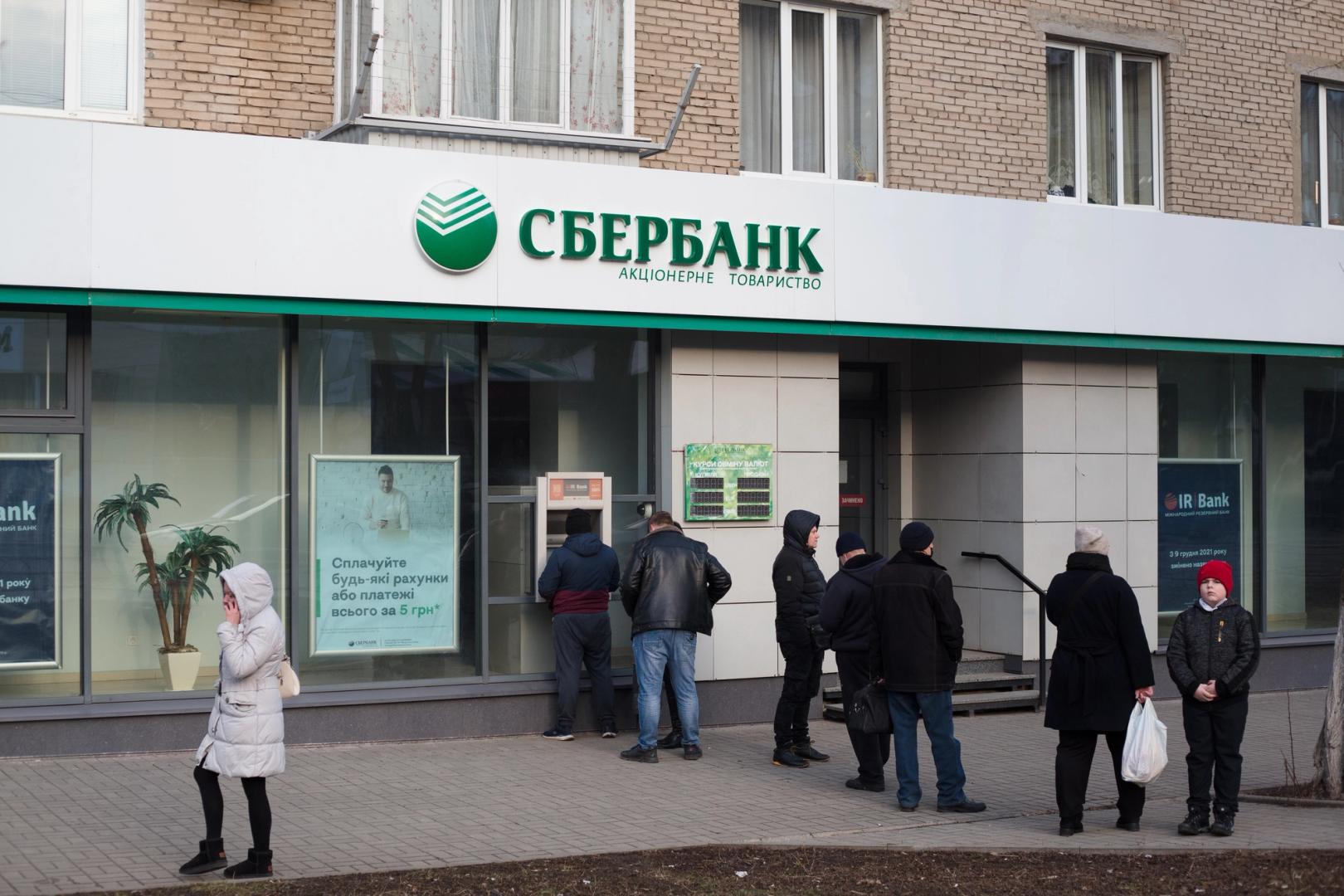
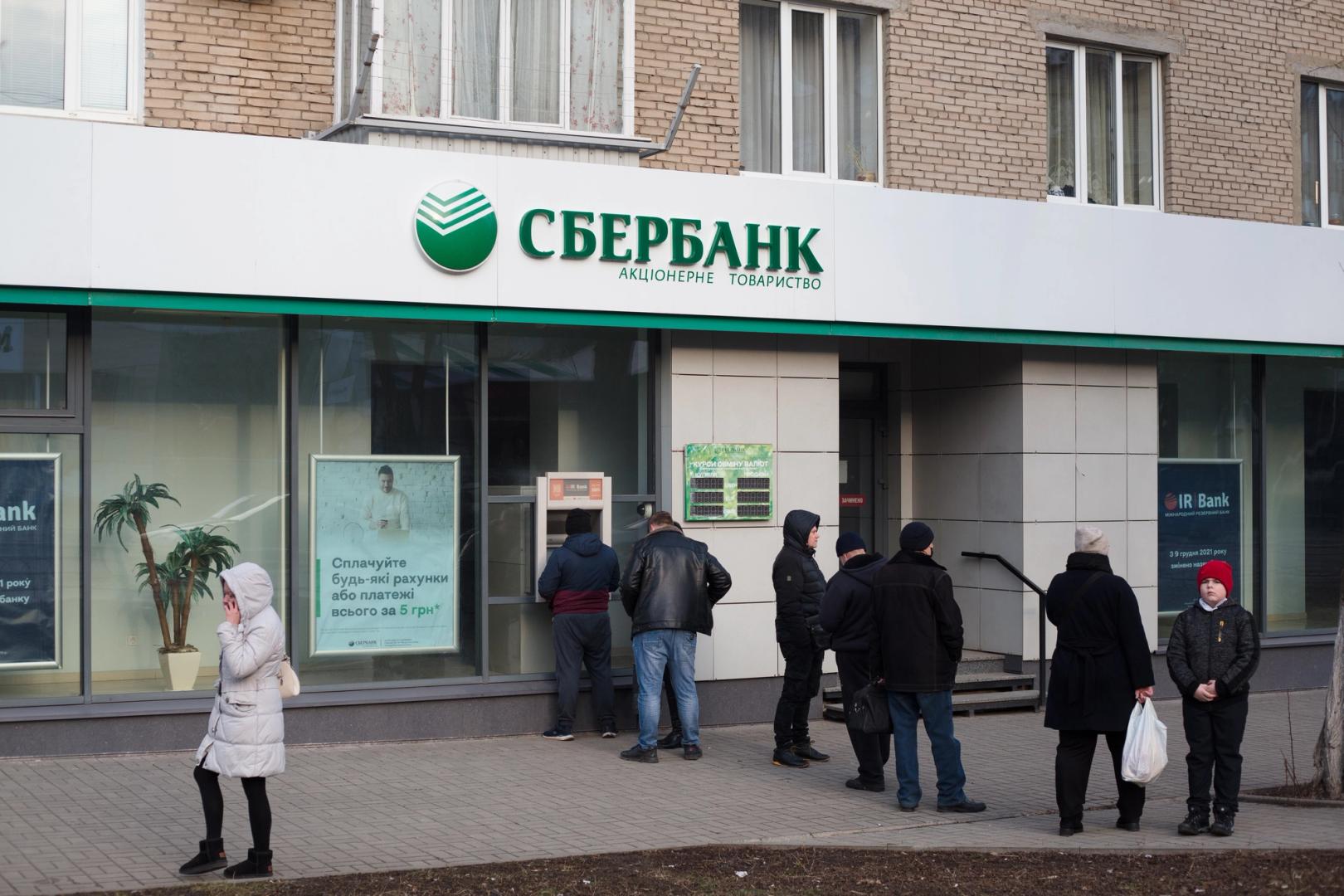
Russia’s largest bank, Sberbank, plans to build cryptocurrency trading infrastructure and launch a digital depository by Dec. 1 as Russia moves to bring crypto trading, custody and settlement into its regulated financial system.
The depository, according to Interfax, will record clients’ ownership of cryptocurrency and process most transactions outside the underlying blockchain. Sberbank will operate active wallets for client-initiated deposits, withdrawals and transfers.
The plan follows the Federation Council’s approval of a law regulating cryptocurrency trading through licensed brokers, exchanges, asset managers and depositories.
The framework is set to take effect Sept. 1, though rules requiring transactions to pass through licensed intermediaries will apply from July 2027.
Public exchange trading will be limited to cryptocurrencies that meet Bank of Russia liquidity thresholds, including an average market capitalization above 5 trillion rubles ($64 billion) and an average daily volume above 1 trillion rubles ($12.8 billion) over 2 years.
Qualified investors will be able to access a broader range of assets. Crypto payments for goods and services inside Russia remain prohibited.
Sberbank started offering qualified investors structured bonds tied to bitcoin last year, and completed a bitcoin-backed lending pilot with miner Intelion Data in December.
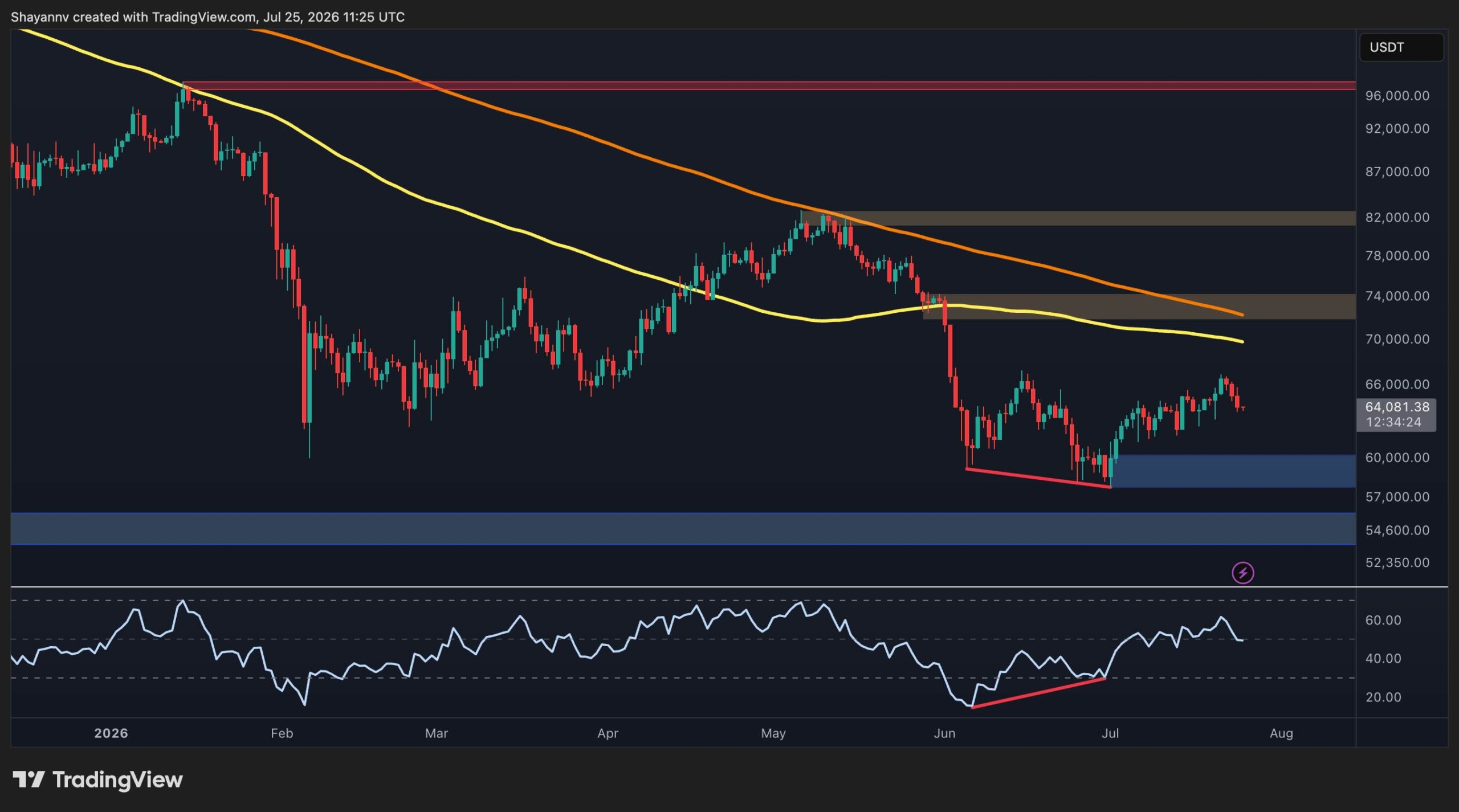
Bitcoin is consolidating just above the $60K region after a volatile first half of 2026 that saw the asset collapse from its January highs near $96K. The recent rebound off the June lows has restored some short-term optimism, but the price is now stalling directly beneath a heavy confluence of moving-average resistance.
Whether this becomes the start of a genuine trend reversal or simply another lower high inside the broader downtrend will likely be decided over the next several sessions.
Bitcoin Price Analysis: The Daily Chart
On the daily timeframe, BTC remains capped below both its 100-day and 200-day moving averages, which are converging near the $70K zone and still slope downward. This is a sign that the higher-timeframe trend has not yet flipped bullish.
Since dropping from $96K in January, Bitcoin has carved out a sequence of lower highs, with the April and May recovery stalling around $82K before rolling over into the June and July low near $58K. However, the asset has since printed a series of short-term higher lows relative to the broader structure amid a clear bullish divergence with the RSI, and the market has reclaimed the $64K mark.
A sustained close above the confluence of moving averages and the $74K supply zone would be the first real evidence that the downtrend is losing control, potentially opening the door toward the prior resistance zone near $82K.
On the downside, failure to build on this recovery would put the $60K zone back in focus as the immediate support. A breakdown below that level would expose the major demand region around $54K, which remains the key higher-timeframe floor.
BTC/USDT 4-Hour Chart
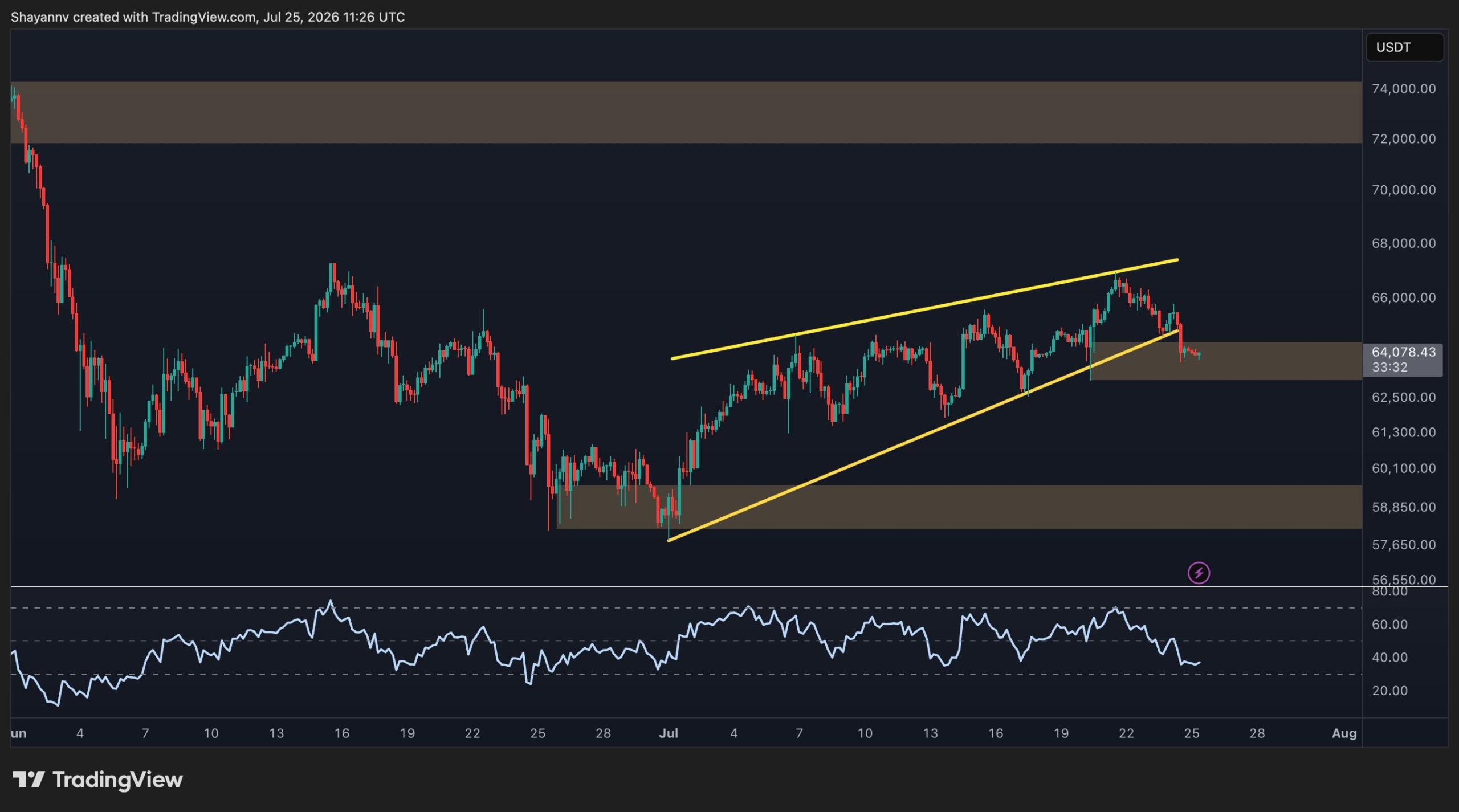
The 4-hour chart shows a cleaner picture. Bitcoin bottomed inside the $58K-$60K demand zone in late June and has been climbing steadily within a rising wedge pattern, printing higher lows along the lower trendline.
That advance carried price into the $65K–$67K resistance cluster formed by June highs. However, the latest candles show a rejection from this area, with the price breaking the wedge to the downside and slipping back toward $64K.
The RSI has also cooled from overbought territory near 70 down toward the 40 zone, reflecting fading momentum rather than outright bearish pressure. A rebound and reclaim of the recent highs around the $67K zone would support a push toward $72K–$74K, while continued rejection and decline here would validate the rising wedge breakdown and likely send the price back to retest the $58K support area, which, as things stand, is the more probable scenario.
Sentiment Analysis
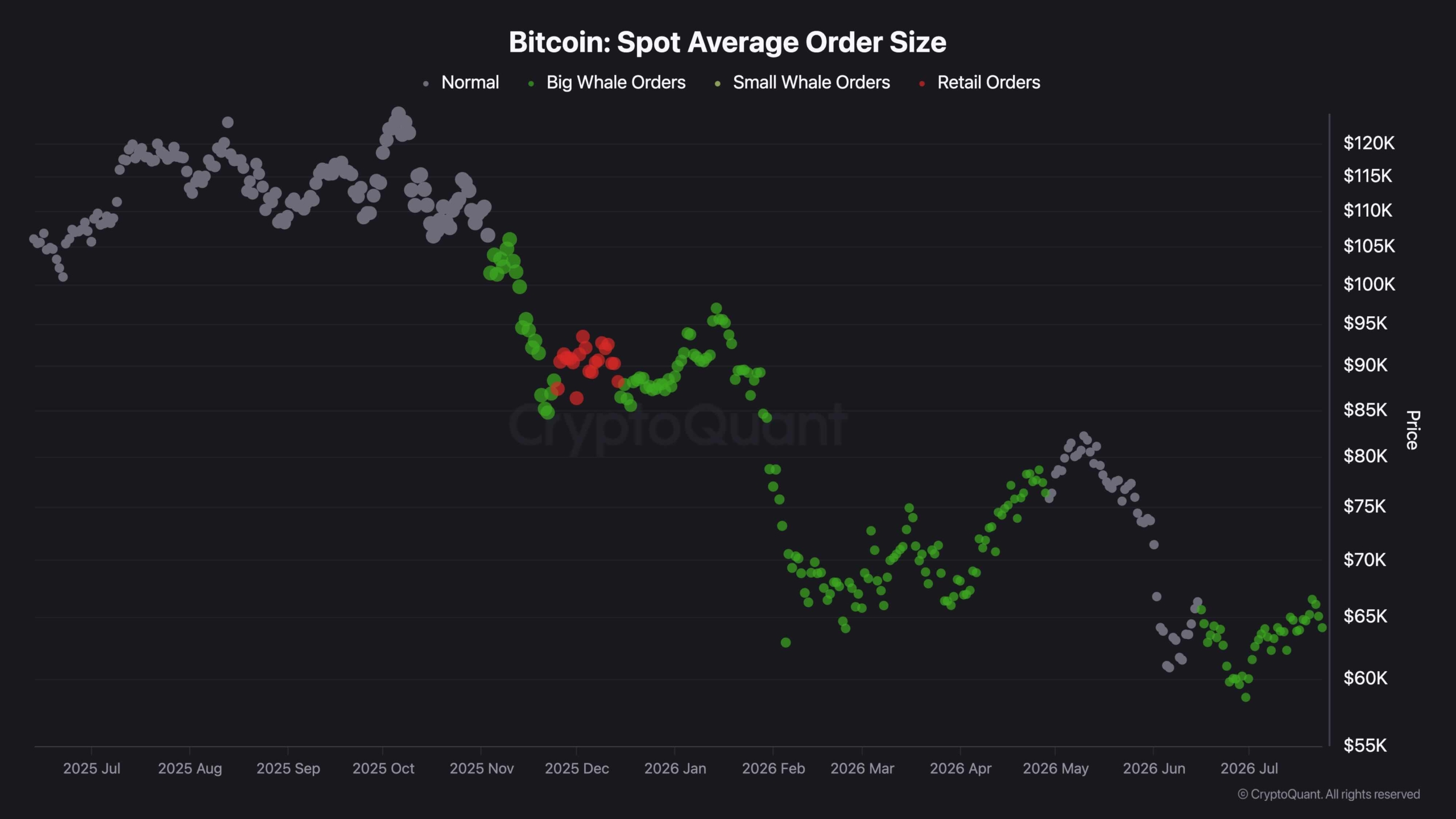
Looking at Bitcoin’s spot average order size, large whale orders have dominated the tape through the entire decline and subsequent recovery since June. This is a marked shift from the retail-heavy order flow seen back in December 2025 near the $90K region.
This metric tracks the size distribution of executed spot orders, distinguishing retail-sized trades from large block orders typically associated with institutional or high-net-worth participants. Persistent big-whale activity through a drawdown generally signals accumulation rather than capitulation, since larger players tend to scale into weakness rather than chase strength.
The continued presence of big whale orders through both the $58K low and the recovery above $64K suggests accumulation has been underway at these depressed levels. If this behavior persists as price approaches the $72K-$74K resistance, it would lend credibility to the case for a deeper structural reversal. A sudden shift back toward retail-dominated flow near resistance, by contrast, would be a caution flag worth watching, and could point to another potential decline in the coming weeks.
The post Bitcoin Price Analysis: BTC’s Rally Could Be a Bull Trap as Sub-$60K Target Remains appeared first on CryptoPotato.


The OCC denied the UK company’s application this week citing AML/CFT risks, despite approving similar charters for digital asset companies in the last year.


North Korean authorities arrested former military hackers accused of stealing state funds from two banks and laundering the proceeds through cryptocurrency.
The group, according to a Daily NK report citing an anonymous source in Pyongyang, allegedly breached the internal systems of the Central Bank of the DPRK and Foreign Trade Bank, diverted foreign currency and state trade funds, and moved the money into overseas crypto wallets.
The report could not be independently verified.
Chinese brokers then converted the assets into U.S. dollars and yuan, Daily NK said. Contacts in the border cities of Sinuiju and Hyesan allegedly exchanged the crypto for cash in real time, with the group splitting transfers into small amounts to avoid detection and using encrypted messaging apps, unregistered phones and Chinese wireless equipment.
North Korea’s National Intelligence Agency arrested the suspects at a Pyongyang safe house on July 12 after officials detected discrepancies in foreign-currency payment approvals and suspicious overseas IP activity, according to the report.
The laundering route mirrors methods used by North Korean hacking groups to cash out stolen crypto.
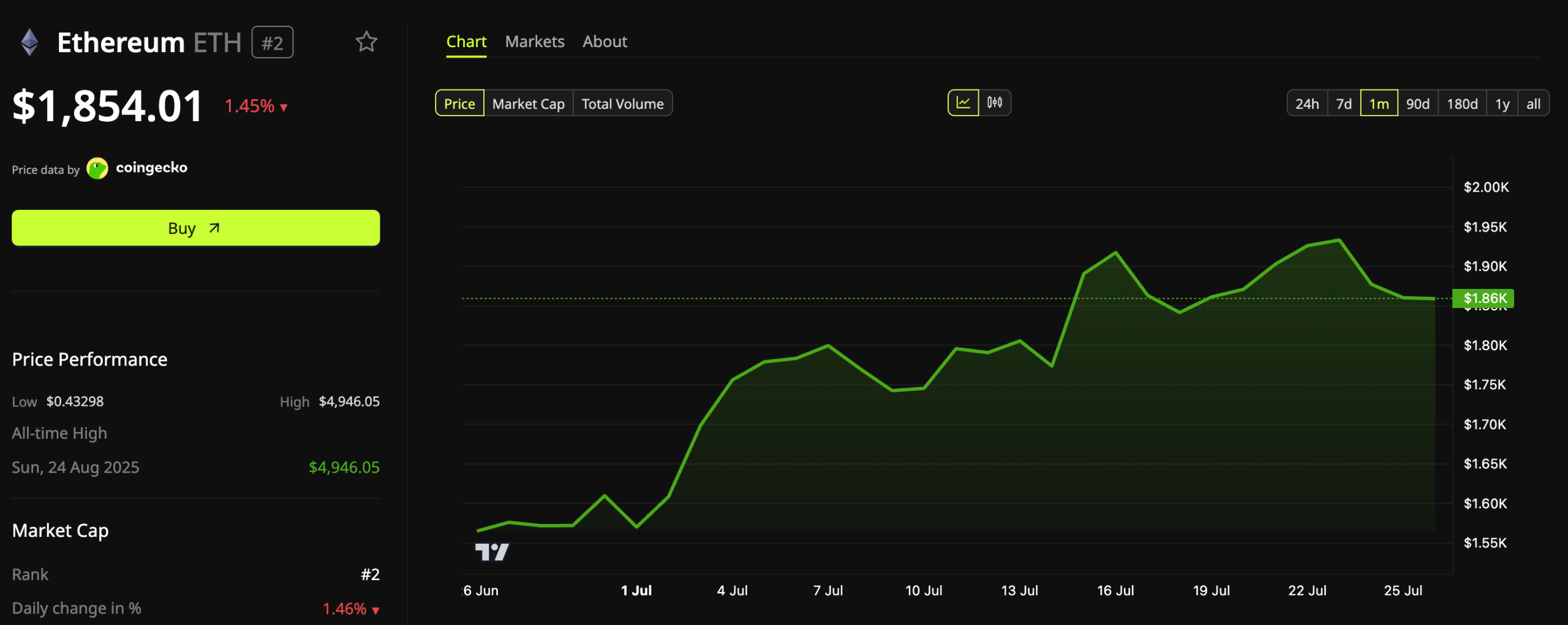
Ethereum (ETH) social commentary has turned very bearish for the third time in a month, according to Santiment. Two previous low readings preceded price rebounds.
The reading comes as ETH trades near $1,854 and spot exchange-traded fund (ETF) demand strengthens. Santiment treats crowd pessimism as a contrarian marker.

Why Ethereum’s Bearish Sentiment Matters
Santiment tracked the ratio of positive to negative Ethereum commentary across X, Reddit, Telegram, and other crypto channels. The reading fell to 1.089 on July 24, its third bearish extreme in a month.
The two earlier troughs arrived on June 27 and July 11. ETH gained 14% over the following 7 days and 7% over the next 4 days.
Follow us on X to get the latest news as it happens

Nonetheless, Santiment stopped short of calling a reversal.
“The bullish takeaway isn’t that negative sentiment guarantees an instant reversal. It’s that when traders are loudly giving up on Ethereum while ETF flows, L2 activity, and protocol upgrades remain active, the #2 market cap in crypto often gets a cleaner setup for a turn-around…” the firm said.
Ethereum ETF Inflows and On-Chain Data Flash Bullish Signals in July
Notably, the crowd turned bearish, but institutional buyers did not follow. Ethereum ETFs pulled in $103.9 million in the week ending July 24, more than any other spot crypto product. That marked a third straight positive week after inflows of $84 million and $105 million.
Demand is not the only metric improving. CryptoQuant said ETH is “undervalued relative to its cost basis.”
“It trades near $1,900 — roughly 17% below its realized price of $2,304 — and in the lower half of its realized price band, a zone historically associated with market bottoms and asymmetric upside,” the firm explained.
At the same time, the ETH/BTC exchange inflow ratio now sits near 0.8, down from above 1.5 in August 2025. Earlier bottoms formed nearer 0.4.
XWIN Research also flagged Binance reserves as a key signal. Holdings there have fallen from nearly 5 million ETH in mid-2025 to around 3.8 million. That leaves fewer coins ready to sell.
“While this does not confirm that Ethereum has reached its final bottom, the combination of declining Binance reserves, improving on-chain metrics, and recovering institutional interest suggests that downside risk is gradually diminishing,” the analyst said.
The post added that a continuation could set up relative strength against Bitcoin.
Subscribe to our YouTube channel to watch leaders and journalists provide expert insights
The post Ethereum Traders are Giving Up Again. The Last Two Times ETH Rallied appeared first on BeInCrypto.

After a major rally toward a monthly peak, bitcoin’s price has lost momentum and is down to $64,000, which is very close to a level that could provide more insight into which way the asset is going next.
Popular analyst Ali Martinez outlined the two most likely charts depending on whether BTC breaks out or down.
$67K Again or $60K?
The analyst told his over 165,000 followers on X that the primary cryptocurrency has returned to the key support level at $63,800 after failing at $67,000 earlier this week. He believes this critical line will determine the next leg, whether it will head back toward that aforementioned monthly high or crumble down to $60,000 as it did on a few occasions in June and in early July.
Keep an eye on Bitcoin $BTC at $63,800.
If this level holds as support, I’m watching for a rebound toward $67,000. But if it breaks, the next downside target sits around $60,000. pic.twitter.com/kAn0hDIEmc
— Ali Charts (@alicharts) July 25, 2026
Given his recent assessment of the upcoming month, though, the odds are leaning bearish. As reported earlier, Martinez outlined historical data showing that August has been anything but a positive month for the largest cryptocurrency. The last four editions have all been in the red, and only three out of the past 12 have posted gains. The last significant August rally came nine years ago when it pumped by 65% during the 2017 bull run.
On the positive side, CW reported that small whales holding between 100 and 1,000 BTC have seen their positions turn green. The analyst claimed that such developments in the past preceded short-term upticks or more profound rallies.
BTC Still Capped
Rekt Capital noted that all of BTC’s recent breakout attempts have been halted at approximately $65,500 on the weekly scale, which is where the 50-Month EMA is positioned. He warned that BTC may be “developing a new multi-week lower high” after the latest rejection.
In addition, he noted that the declining buy-side volume hints at another bearish shift, as sellers have stepped up lately.
“The more seller-dominant the volume becomes while Bitcoin is at resistance, the greater the chances for a rejection from here,” he concluded.
The post Bitcoin Is Testing a Crucial Level: Breakout or Breakdown Next? appeared first on CryptoPotato.
When SpaceX went public, the only place most of the world could short it was Hyperliquid, where a perpetual future tracked the IPO of the decade tick for tick, and a whale ran a $14 million leveraged short no brokerage would have offered. Equity perps are the first crypto product Wall Street cannot ignore, and regulators cannot place, and this is the audit of what they actually are.
Summary
- Hyperliquid, the dominant on-chain derivatives venue with roughly 70% of decentralized perpetuals volume and around $1.3 billion in annualized fees, now lists perpetual futures on stocks, with its SpaceX contract as the breakout case.
- The SPCX perp traded the IPO of the decade before, during, and after the listing, ran to a $228.74 high alongside the stock’s $225.64 peak, tracked its 48% collapse, and hosted positions like a 10x-leveraged $14 million short paired with a 40x $60 million Bitcoin short, structures no retail brokerage offers.
- Equity perps deliver what the equity market rations: 24/7 trading, high leverage, short exposure without locates or borrow fees, and access for the global majority locked out of US brokerage accounts, all against an oracle price and a funding rate instead of shares.
- The product’s honesty requires its limits: holders own no equity, no dividend, no claim, only a synthetic exposure whose integrity depends on oracle quality and venue solvency, on platforms mostly outside US jurisdiction.
- The regulatory placement is unresolved by design: synthetic equity exposure with no share changing hands sits between the SEC’s securities world and the CFTC’s derivatives world, on infrastructure neither reaches, and the CLARITY-era jurisdiction map does not cover it.
The most interesting trade of June was not in a stock. When SpaceX completed the largest IPO in history and its shares began their 48% descent, an anonymous trader on Hyperliquid, the blockchain derivatives venue, was running a combined position no prime broker would have blessed and no retail app could have executed: a $60 million Bitcoin short at 40x leverage paired with a $14 million short on SPCX at 10x, a pure bet on the deflation of the year’s twin euphorias, placed on rails that never close, require no borrow, and asked no questions.
The instrument making it possible, the equity perpetual future, is the crypto industry’s quiet invasion of the stock market: a synthetic contract that tracks a share price via oracle, settles in stablecoins, charges longs or shorts a funding rate to keep the peg, and trades around the clock at leverage American brokerages reserve for institutions, on venues most of the world can reach with a wallet.
Hyperliquid’s SPCX contract, born before the IPO priced and still trading through the stock’s every convulsion, is the product’s proof of concept and its perfect case study, and this piece uses it as one: what equity perps actually are, what they genuinely fix, what they quietly are not, and why the regulatory map, freshly redrawn for crypto by the CLARITY era, has no square for them at all.
The machine: how a stock trades without shares
An equity perpetual is three mechanisms in a trench coat, and each deserves one honest paragraph.
The first is the oracle. No share of SpaceX exists anywhere in the system; the contract’s reference is a price feed, assembled from the listed market’s data during exchange hours and from the perp’s own supply and demand when Nasdaq sleeps. This is the design’s power and its softest point in one: the feed makes the synthetic possible, and every question about the product’s integrity is ultimately a question about the feed, its sources, its manipulation resistance, its behavior when the underlying halts, gaps, or, as with SPCX in its lockup-shadowed churn, moves violently on thin news.
Perp venues have run oracle machinery for crypto assets for years at scale; equities add wrinkles crypto never had, official closes, halts, corporate actions, and the young history of equity perps includes the learning curve those wrinkles imply.
The second is the funding rate, the elegant trick that replaces ownership. Because nothing forces a perp’s price toward the stock’s, the contract pays a periodic transfer between longs and shorts; whichever side is heavier pays the other, so deviation from the reference price becomes expensive and arbitrage pulls the peg tight.
The funding rate is also the product’s honest price tag: holding a leveraged equity view costs whatever the crowd on your side must pay, which in euphoric stretches, SPCX’s first week, say, made long exposure meaningfully expensive, a cost structure entirely unlike owning shares and closer to a rolling options position. Traders who read funding as information, crowding, sentiment, squeeze risk, get a signal equity markets deliver only obliquely.
The third is the venue itself. On Hyperliquid, order book, matching, and liquidations run on-chain, collateral is stablecoin, and the exchange’s economics, roughly $1.3 billion in annualized fees at about 70% of the on-chain perps market, fund the token model this publication has covered as crypto’s clearest value-accrual machine. Equity perps arrived through the venue’s expansion of builder-deployed markets, the mechanism opening listings beyond crypto pairs, and the roster now reaches into stocks, indices, and commodities.
The plumbing matters because it defines the counterparty question: an equity perp holder’s real exposures are the oracle, the liquidation engine, and the venue’s solvency, not any transfer agent or clearinghouse, and those exposures live, for most such venues, offshore and on-chain, exactly where the traditional system’s guarantees do not.
What it fixes, honestly
The bull case for equity perps is not hype; it is a list of the equity market’s genuine rationing decisions, each of which the perp un-rations.
Time: stocks trade 32.5 hours a week; the news that moves them does not. The SPCX perp priced Starship’s failed test, the Cursor-acquisition backlash, and every lockup rumor in real time, weekends included, while shareholders waited for Monday.
For an asset class whose defining events, launches, in this case, literally happen at all hours, continuous price discovery is not a gimmick, and the perp’s around-the-clock tape has already become, for SpaceX watchers, the leading indicator the listed market opens to.
Access: a US brokerage account requires US residency, documentation, and, for anything beyond cash equities, suitability gates; the global majority is structurally excluded from the market that prices the world’s most important companies. A perp venue asks for a wallet.
Whatever one thinks of the compliance implications, and they are the final section’s subject, the distributional fact is real: equity perps are the first instrument through which a trader in Lagos or Karachi shorts an American IPO on the same terms as a fund in Connecticut.
Shorting: the equity market’s short path, locate the borrow, pay the fee, face the recall, buy-in risk, and, for a fresh IPO like SPCX with its 911.5 million share lockup, borrow scarcity that makes shorting practically institutional-only, is friction by design. The perp deletes all of it: shorting is symmetric with longing, no locate, no borrow, no recall, which is why the instrument’s clearest use case so far is exactly the whale trade this piece opened with, and why fresh IPOs, where the listed short is hardest, and opinion is hottest, are where equity perps found product-market fit first.
Our own coverage of SPCX’s descent noted the perp and the tokenized versions tracking the collapse in lockstep with the stock, a three-venue price war in which the crypto rails, not the exchange, offered the only practical retail short.
Leverage and capital efficiency complete the list; 10x on a stock position with stablecoin collateral is a different capital regime than Reg-T margin, and together the four fixes explain the product’s trajectory better than any narrative: equity perps grow wherever the traditional market’s rationing binds hardest.
What it is not, and where it cannot be placed
The audit’s other half is shorter and sharper, because the perp’s limits are as structural as its fixes.
It is not equity. No dividend, no vote, no claim in bankruptcy, no share: the holder owns a cash-settled bet on a number, and the number’s connection to the company runs entirely through the oracle.
In calm markets the distinction is pedantic; in the scenarios that define instruments, a halt, a delisting, a corporate action, an oracle failure, a venue insolvency, it is everything, and the young product’s stress record is thin precisely where equities generate their worst stresses.
The tokenized-equity reckoning this publication audited after the SpaceX IPO, products scrapped, buyers refunded, late vintages underwater, is the adjacent cautionary tale: synthetic exposure to private and newly public equity is exactly where the gap between marketing and mechanism has already cost real money.
And it is not placeable, yet, on any regulatory map. A perpetual future on a security, offered without the security, settles into a jurisdictional void the American system has spent two years mapping everything except: the SEC governs securities and the platforms that touch them; the CFTC governs derivatives on commodities; the CLARITY framework, whose implementation this publication has covered in detail, allocates digital assets between them, and a synthetic stock position on an offshore chain answers to neither cleanly.
US platforms do not offer equity perps for precisely this reason; offshore and on-chain venues offer them to everyone else, and the enforcement perimeter, as with every offshore derivatives wave before, reaches the marketing, the fiat ramps, and the US-person access, not the protocol.
The honest forecast is the one the product’s own growth writes: volumes concentrating offshore, a widening data gap between the priced world and the regulated one, and eventually, once the instrument prices something systemic, a jurisdictional fight that will make the prediction-market war look tidy, because at least an event contract admits what it is. An equity perp is a security’s price without the security, the purest regulatory-arbitrage instrument crypto has produced, and the system it arbitrages has not yet noticed the size of the hole.
The venue underneath: why this happened on Hyperliquid
The product’s story is inseparable from its venue, because equity perps did not emerge on a neutral substrate; they emerged on the one platform whose economics and architecture made them almost inevitable, and the causation teaches something about where crypto’s product frontier actually lives.
Hyperliquid’s qualifications are three. Liquidity first: at roughly 70% of on-chain perpetuals volume, with open interest and depth that dwarf its decentralized rivals, it is the only venue where a $14 million single-position equity short meets a book that can absorb it, and derivatives listings live or die on day-one depth.
Machinery second: a fully on-chain order book, matching engine, and liquidation system, hardened by years of crypto perps at scale, generalizes to any oracle-priced underlying, which is precisely what the builder-deployed markets mechanism formalized, opening the listing function beyond the core team and letting the equity roster grow at ecosystem speed rather than committee speed.
And incentives third: the venue’s fee engine, the roughly $1.3 billion annualized flow whose token mechanics this publication has covered as crypto’s most direct value-accrual machine, means every new asset class listed compounds the platform’s core loop, giving the ecosystem a structural hunger for exactly the kind of frontier products that traditional venues must clear through legal departments first. Where a regulated exchange asks whether it may list synthetic SpaceX, a permissionless listing mechanism asks only whether anyone will trade it, and the answer, June showed, was emphatic.
The concentration cuts both ways, and the audit owes the caveat. A product category living overwhelmingly on one venue inherits that venue’s specific risks: its oracle choices become the category’s oracle standard, its solvency becomes the category’s systemic question, and its governance, including the validator-set concentration questions that have followed the platform since launch, becomes the category’s political exposure.
Traditional equity infrastructure disperses these risks across exchanges, clearinghouses, and transfer agents by regulatory design; the equity-perp stack concentrates them by architectural choice, trading resilience for velocity. That trade has run in crypto’s favor for two years of calm-to-volatile markets. The scenario that would reprice it, a venue-level failure during an equity stress event, with synthetic positions on halted underlyings and no clearinghouse behind the book, is the category’s true tail, unpriced precisely because it is unprecedented, and anyone sizing positions in these instruments should price the venue before pricing the view.
What to watch
The roster’s growth. Which equities get perps next, and how fast listings follow retail heat. The pattern so far, fresh IPOs and locked-up names where shorting is hardest, is the tell for where the product’s edge actually lies, and the first perp on a halted or delisted name will write the stress-test chapter early.
Funding rates as the new sentiment tape. SPCX perp funding, and its successors’, is becoming the cleanest continuous read on positioning in names the options market covers only during business hours. Expect equity desks to start quoting it, quietly, the way they came to watch crypto funding.
The basis triangle. Perp versus listed stock versus tokenized versions: three prices for one exposure, on three legal architectures. Divergences in stress are where the instruments’ true differences surface, and the first sustained break will teach the market which venue leads and which merely follows.
The first US regulatory contact. An enforcement action, a no-action letter, or a CLARITY-era rulemaking that names synthetic equity exposure would end the placement void. Until then, the product grows in the gap, and the gap is the story.
One historical rhyme completes the audit, because the market has seen this movie’s structure before. Contracts for difference, CFDs, ran the same play against the equity market two decades ago: synthetic exposure, high leverage, no ownership, offered offshore to retail the regulated market rationed out, and they grew into a permanent, regulated, and repeatedly scandal-scarred fixture of European and Asian trading, banned outright for US retail to this day.
Equity perps are CFDs rebuilt on crypto rails, with three genuine upgrades: transparent on-chain positioning instead of dealer books, funding rates set by market balance instead of broker discretion, and self-custodied collateral instead of client-money accounts, and one genuine downgrade: the absence of any regulatory perimeter at all, even the imperfect one CFDs eventually accepted.
https://x.com/cryptodotnews/status/2066521860502683882
The CFD precedent predicts the arc: rapid offshore growth, a defining blowup that forces structure, then bifurcation into regulated products where allowed and gray markets where not. It also predicts the endgame nobody in crypto says aloud: the traditional exchanges, watching a parallel equity market price their listings around the clock, will eventually either extend their own hours, list their own perpetual-style products, or buy the venues, because that is what incumbents do to successful arbitrage.
The instrument’s deepest significance may be exactly that pressure: equity perps are the market’s demonstration that the 32.5-hour trading week is a policy choice, not a law of nature, and demonstrations of that kind have a way of ending with the incumbents adopting what they could not suppress.
Frequently Asked Questions
What is an equity perpetual future?
A derivative that tracks a stock’s price without any share existing in the system: an oracle feeds the reference price, traders post stablecoin collateral for leveraged long or short exposure, and a periodic funding-rate payment between longs and shorts keeps the contract’s price pegged to the stock’s. It trades continuously, including when the underlying market is closed, and settles in cash, never in shares.
Why did SpaceX’s perp become the breakout example?
Because it offered what the listed market could not. The SPCX contract traded through the IPO of the decade around the clock, tracked the stock from its $225.64 peak through its 48% collapse, and enabled short exposure, including a documented 10x, $14 million short paired with a 40x Bitcoin short, at a moment when the fresh IPO’s lockup made traditional borrowing scarce and practical shorting nearly impossible for retail.
What do equity perps genuinely improve on?
Four rationing decisions of the equity market: hours, with 24/7 trading against a 32.5-hour week; access, with a wallet replacing residency-gated brokerage accounts for the global majority; shorting, with no locates, borrow fees, or recall risk; and capital efficiency, with high leverage on stablecoin collateral. The product grows wherever these constraints bind hardest, which is why new IPOs led adoption.
What does a holder of an equity perp actually own?
A cash-settled position on a number, nothing more: no dividend, no vote, no bankruptcy claim, no share. The exposure’s integrity depends on the oracle’s accuracy, the venue’s liquidation engine, and the platform’s solvency, typically on offshore, on-chain infrastructure outside traditional investor protections. In halts, delistings, corporate actions, or oracle failures, the differences from equity ownership become decisive.
Who offers these products, and can US users trade them?
On-chain derivatives venues, with Hyperliquid, at roughly 70% of decentralized perpetuals volume and about $1.3 billion in annualized fees, as the category leader through its builder-deployed markets. US platforms do not list equity perps because of their unresolved legal status, and offshore venues restrict US persons formally; practical access, as with every offshore derivatives generation, varies with enforcement of the perimeter.
How do funding rates work, and why do traders watch them?
Whichever side of the contract is more crowded pays a periodic fee to the other, making deviation from the reference price costly and pulling the peg tight. The rate doubles as a sentiment gauge: expensive long funding signals crowded bullishness and squeeze risk, and because it prints continuously, it offers positioning information about a stock even while the listed market sleeps.
Where do equity perps sit legally?
In a void. They are synthetic exposure to securities offered without securities, on infrastructure the SEC does not reach, in a derivative form the CFTC’s commodity jurisdiction does not clearly cover, and the CLARITY-era framework allocating digital assets between the agencies does not address them. That placement question, unresolved and growing with the product’s volumes, is the category’s defining regulatory story.
Should traders use them?
That is an individual decision this article does not make. The honest framing: equity perps are powerful instruments whose advantages, hours, access, symmetric shorting, and leverage are real, and whose risks, oracle dependence, venue solvency, funding costs, legal ambiguity, and the absence of every traditional investor protection, are equally real and mostly unpriced until stress arrives. Position sizes that assume the venue is a brokerage misunderstand the instrument. This is educational analysis, not investment advice.
Disclaimer: This article is for information and educational purposes only and does not constitute financial or investment advice. Derivatives trading with leverage carries substantial risk of loss; products described may be unavailable or restricted in your jurisdiction, and figures reflect data available at the time of writing. Nothing here is a recommendation to trade any instrument. Always do your own research. Information is accurate as of July 24, 2026.


Dango will shut down its trading platform and its own blockchain after concluding the project has no path to lasting commercial success. The team told users to close positions and withdraw funds.
The wind-down arrives only months after Dango opened perpetual futures trading in April. Similar closures have hit the sector repeatedly through 2026.
Dango Sets 2 Deadlines for Users to Exit
Dango operates a Layer 1 (L1) blockchain and a decentralized exchange (DEX). Both are now on a countdown.
Trading stops on Wednesday, July 29, at 12 pm UTC. Remaining positions will close at the oracle price, and deposits in its liquidity provider vaults will unlock. The team said that all balances will be returned in USDC to spot accounts.
The L1 then stops running on Wednesday, August 13, at 12 pm UTC. Deposits left behind at that point go back to their original Ethereum (ETH) addresses.
“Funds are safe. Limits to withdrawals will be lifted shortly. We encourage you to close positions and withdraw funds. Be careful of slippage, as liquidity is expected to be thin,” Dango wrote.
Follow us on X to get the latest news as it happens
Founder Larry pointed to a stack of pressures rather than a single failure.
“Since the launch in April, our team has faced strong headwind: cash running out, legal/compliance challenges that led to large delays in our ability to ship new features, the resulting lose of growth momentum, lose of talents from the team, and the overall highly adverse market conditions,” he explained.
Dango is far from alone. CryptoRank counted 17 major crypto shutdowns and bankruptcies through July 23, including Loopring DEX, Movement Labs, and Bitcoin Depot.
Subscribe to our YouTube channel to watch leaders and journalists provide expert insights
The post Another Crypto Project Goes Dark as Dango Winds Down appeared first on BeInCrypto.

When Will the Strait of Hormuz Open for Good? Analyst Gives Timeline

Paxton is trying to cut into Talarico’s lead with Latino voters. It’ll be tough.

Anthony Joshua vs. Kristian Prenga fight predictions, start time, card, live stream


-

 Fashion1 day ago
Weekend Open Thread: Brooks Brothers
-

 Politics6 days ago
Democrats look to World Cup watch parties to register thousands of voters
-

 News Videos6 days ago
Big Money Is Entering XRP
-

 Crypto World4 days ago
Grayscale Files For Worldcoin ETF, WLD Registers Sharp Rise
-

 Tech5 days ago
Sail Virtually Aboard The “Itanic” With IA-64 Emulator
-
 Tech5 days ago
Turtle Beach Command Series KB7 review: a nifty screen-equipped gaming keyboard
-

 NewsBeat5 days ago
Unregistered fitter used Gas Safe logo on business flyers
-
 Business4 days ago
New Jersey voter registration controversy explained: How 6,600 noncitizens got on the rolls, and what happens next
-
 Entertainment4 days ago
Johnny Depp’s R-Rated Gothic Cult Classic Gets New Release Ahead of Sydney Sweeney Remake
-

 Crypto World3 days ago
Ethics, other provisions in crypto Clarity Act to be further discussed
-

 Tech5 days ago
Watch Flock Safety CEO Garrett Langley discuss the future of surveillance at TechCrunch Disrupt 2026
-
 NewsBeat5 days ago
Shanghai science forum photos show China’s AI and robotics advances in rivalry with US
-

 Crypto World5 days ago
Circle’s President Sold Over 360,000 Shares, The Filings Explain Why
-

 Tech6 days ago
Subway Sandwich Computers Get a Second Life as Gaming Machines
-

 Sports2 days ago
2026 3M Open leaderboard: Scottie Scheffler finds putter in Round 1, sits three back
-

 News Videos2 days ago
The Peugeot Family: How 200 Years of an “Old Money” Dynasty Died in A Boardroom
-

 Fashion2 days ago
16 Dresses for the High Summer Event
-

 Tech6 days ago
How To Use Claude’s Reflect Dashboard And Learn When It’s Time To Touch Grass
-

 Tech5 days ago
The 35 Best Board Games for Family Game Night
-

 Entertainment6 days ago
Stephen Colbert Returns to Social Media After Late Show End
You must be logged in to post a comment Login