
Crypto World
Perle pumps 63% in 24 hours, while the next big crypto BlockchainFX crosses $14.4 m presale milestone


Disclosure: This article does not represent investment advice. The content and materials featured on this page are for educational purposes only.
Perle jumps 63.9% as BlockchainFX nears $15 million softcap with strong presale momentum building.
AI data tokens are having a moment, and Perle (PRL) just pumped 63.9% in 24 hours to prove it. But while traders chase green candles on Coinbase, a quieter story is unfolding in the presale arena, where the next big crypto BlockchainFX (BFX) has crossed a serious $14.4M milestone with a $15M softcap firmly in sight and the launch bell almost ringing.

BlockchainFX is the only web3 super app letting users trade crypto, stocks, forex, ETFs, and commodities from a single dashboard. With over 24,000 participants already onboard, an AOFA license in hand, and the “Best New Crypto Trading App of 2025” award on the shelf, the next big crypto contender is approaching launch with momentum few presales have ever build.
BFX edges toward sellout with $14.4m already in the bag
BlockchainFX has pulled in over $14.4M from 24,000+ participants, with the current presale price sitting at $0.035 and the launch price set at $0.05. That alone hands early buyers a baked-in gain before the next big crypto candidate even hits exchanges. The platform is licensed by the Anjouan Offshore Finance Authority, fully audited, KYC-verified, and already live in beta with thousands of daily users actively trading.
What keeps early BFX holders grinning? Daily staking rewards in BFX and USDT, paid out automatically while the platform handles trading on stocks, crypto, forex, and ETFs from one app. Compare that to Binance or Coinbase, which lock users into crypto-only trading, and the appeal becomes pretty obvious. Buy $100+ of BFX and qualify for the $500,000 Gleam giveaway.
CEX60 unlocks 60% more BFX before the June 1 cutoff
To mark the first centralized exchange listing reveal, BlockchainFX rolled out the bonus code CEX60, handing buyers 60% extra BFX tokens during this final presale stretch. The offer expires on June 1 at 6 PM Dubai time, and once the $15M softcap fills, the presale closes for good, and the launch follows. So what does that 60% bonus actually translate to in dollar terms?
A $10,000 buy at $0.035 secures roughly 285,714 BFX, and CEX60 boosts that haul to around 457,142 tokens. At the $0.05 launch price, that stack is already worth $22,857. If analyst predictions of $1 post-launch land, the same position climbs to $457,142. The next big crypto rarely waits for hesitation, and the clock is ticking faster than the market wants to admit.
Perle rockets 63.9% as AI data token hype spreads
Perle is trading around $0.3555 after a 63.9% jump in 24 hours and a 56.6% climb over the week. The Solana-based token sits roughly 17% below its $0.4312 all-time high from 11 days ago, while its $0.1137 low feels like ancient history at this point. Momentum traders on Coinbase clearly spotted something worth chasing this week.
Founded by Scale AI veterans, Perle Labs (formerly Kiva AI) is building a sovereign AI data layer where human-verified training data gets recorded on-chain. The pitch tackles “model collapse,” that awkward problem where AI models degrade after feasting on synthetic junk. PRL/USD is doing $6.84M in daily volume on Coinbase, with Gate and Bitget rounding out the major trading venues right now.

Last call before BFX rings the exchange bell
Based on the latest research, the best crypto presale right now is BlockchainFX, full stop. Perle’s pump is fun for traders, but BFX offers something different: ground-floor entry into a regulated super app with a real product, real users, and a $1 post-launch target backed by analyst chatter. The next big crypto opportunity rarely arrives this neatly packaged for early buyers.
With $14.4M already raised and the $15M finish line within reach, the presale window is closing quickly. Code CEX60 vanishes June 1, the launch follows immediately after, and the next big crypto train pulls out of the station whether buyers are on it or not. Smart money is already loading up before the doors shut.
For more information, visit the official website, X, and Telegram.
Disclosure: This content is provided by a third party. Neither crypto.news nor the author of this article endorses any product mentioned on this page. Users should conduct their own research before taking any action related to the company.

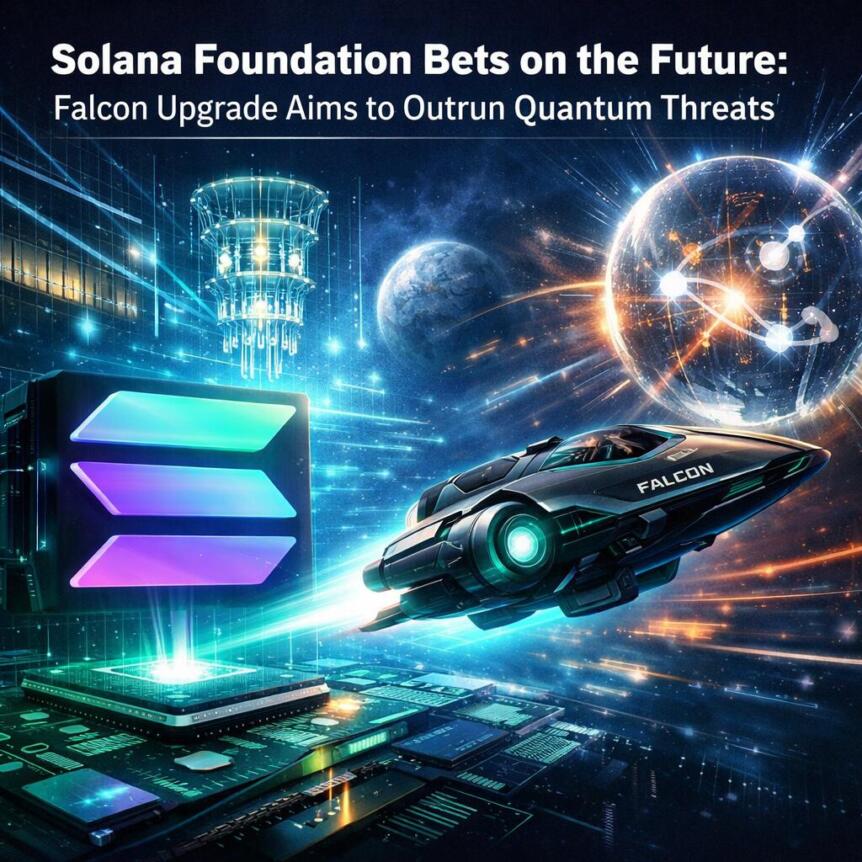
Solana is advancing a post-quantum security plan as it selects Falcon to secure the network against future threats. Independent developer teams align on Falcon for speed and compact design, and there are no immediate changes as the rollout proceeds in phases to ensure a smooth transition.
Solana Aligns on Falcon for Quantum Security
Solana relies on high transaction throughput, so any upgrade must remain efficient.
Developers selected Falcon because it offers compact signatures and strong security.
This combination helps preserve network speed while improving future resilience.
Both Anza and Firedancer teams studied multiple post-quantum options. However, they reached the same outcome without coordination.
This consistency signals strong technical validation behind Falcon’s selection.
Falcon also holds recognition from the National Institute of Standards and Technology as a post-quantum candidate. That status adds credibility to its long-term viability. It also aligns Solana with broader industry research.
Compact Signatures Support High Throughput
Falcon produces signatures around 690 bytes, which remain significantly smaller than alternatives.
Larger schemes like Dilithium generate signatures several kilobytes in size.
Smaller data sizes help maintain faster processing speeds.
Solana processes thousands of transactions per second, so efficiency remains critical.
Developers confirmed that Falcon supports this demand without major trade-offs.
Early tests suggest improved performance compared to current cryptographic methods.
Optimized implementations may increase network speed further. Internal testing indicates potential gains of up to three times. These results strengthen the case for Falcon integration.
Phased Roadmap Limits Immediate Disruption
The foundation confirmed that no urgent changes affect users today. Existing wallets and transactions continue operating under current cryptographic standards. This ensures stability while development progresses.
Future phases will introduce Falcon gradually across the ecosystem. New wallets may adopt the system first if risks increase. Older wallets will transition later through a structured migration plan.
Other ecosystem projects explore additional quantum-resistant tools. Blueshift’s Winternitz Vault represents one such effort. These parallel developments show broader preparation across the network.
Solana’s strategy reflects a long-term focus on security and performance. The foundation recognizes that quantum threats remain distant but possible. Early preparation allows controlled testing and reduces future risk.
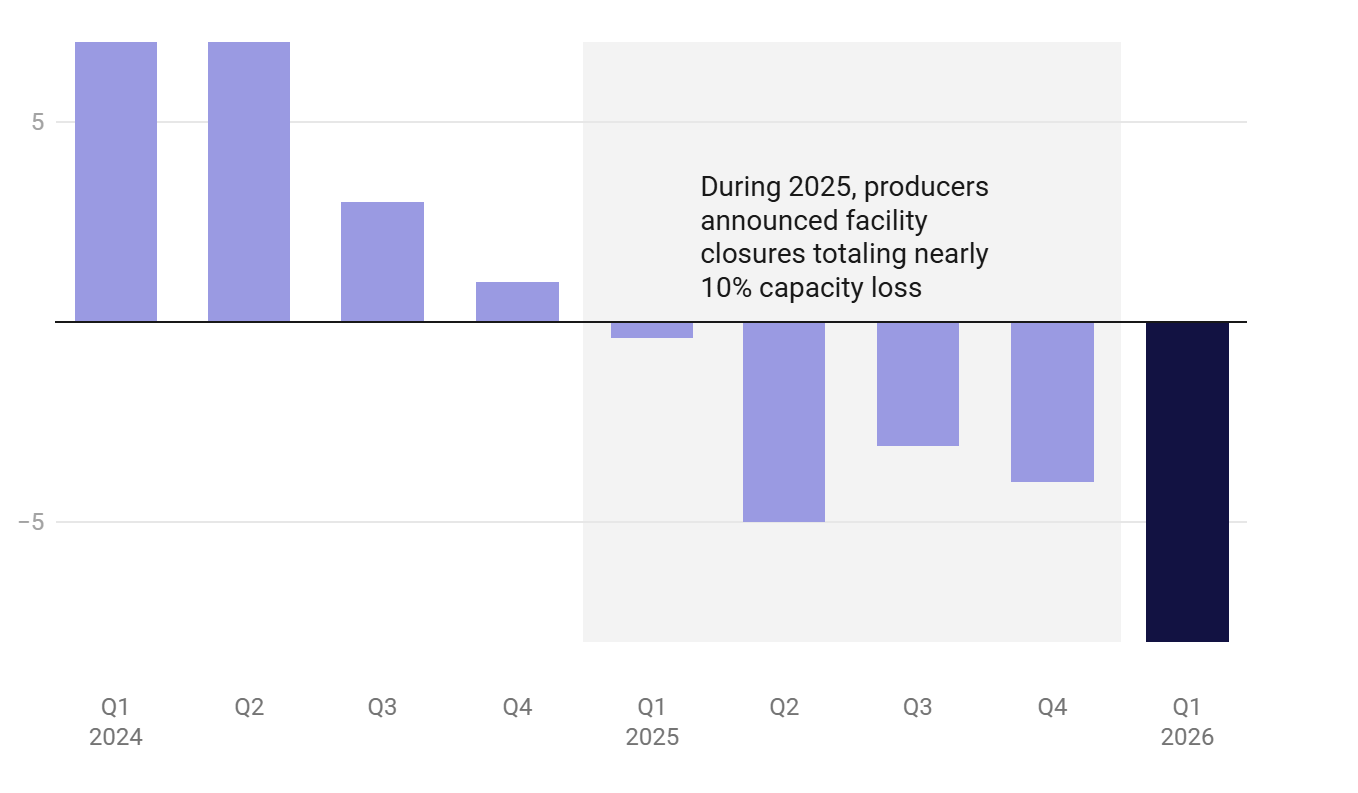
America’s cardboard box business just printed its ugliest quarter in years, and now Wall Street is whispering the R-word again. US containerboard production tumbled more than 8% during Q1 2026, fresh AF&PA data shows.
Box shipments slipped 1.9% over the same stretch, according to the Fibre Box Association. Producers have already cut roughly 10% of capacity since 2025. That haircut runs deeper than the one taken during 2009.
The Cardboard Tell In US Recession Fears
Almost 75% of US non-durable goods ship inside corrugated boxes. That makes box demand a real-time pulse on factories, retailers, and Amazon trucks alike.
Former Federal Reserve chair Alan Greenspan reportedly watched the gauge closely. Box volumes have historically slid 10% to 15% before or during recessions. The 2008 downturn followed that pattern.
E-commerce dependency has rewired the gauge somewhat. Online ordering kept boxes flowing through 2020 lockdowns even as services ground to a halt. That carve-out makes today’s slump harder to read.
The Q1 2026 numbers still came in worse than analysts expected. Storms knocked January shipments down 7% year over year. February dipped 1.7%. March then jumped 3.4%, hinting at stabilization.
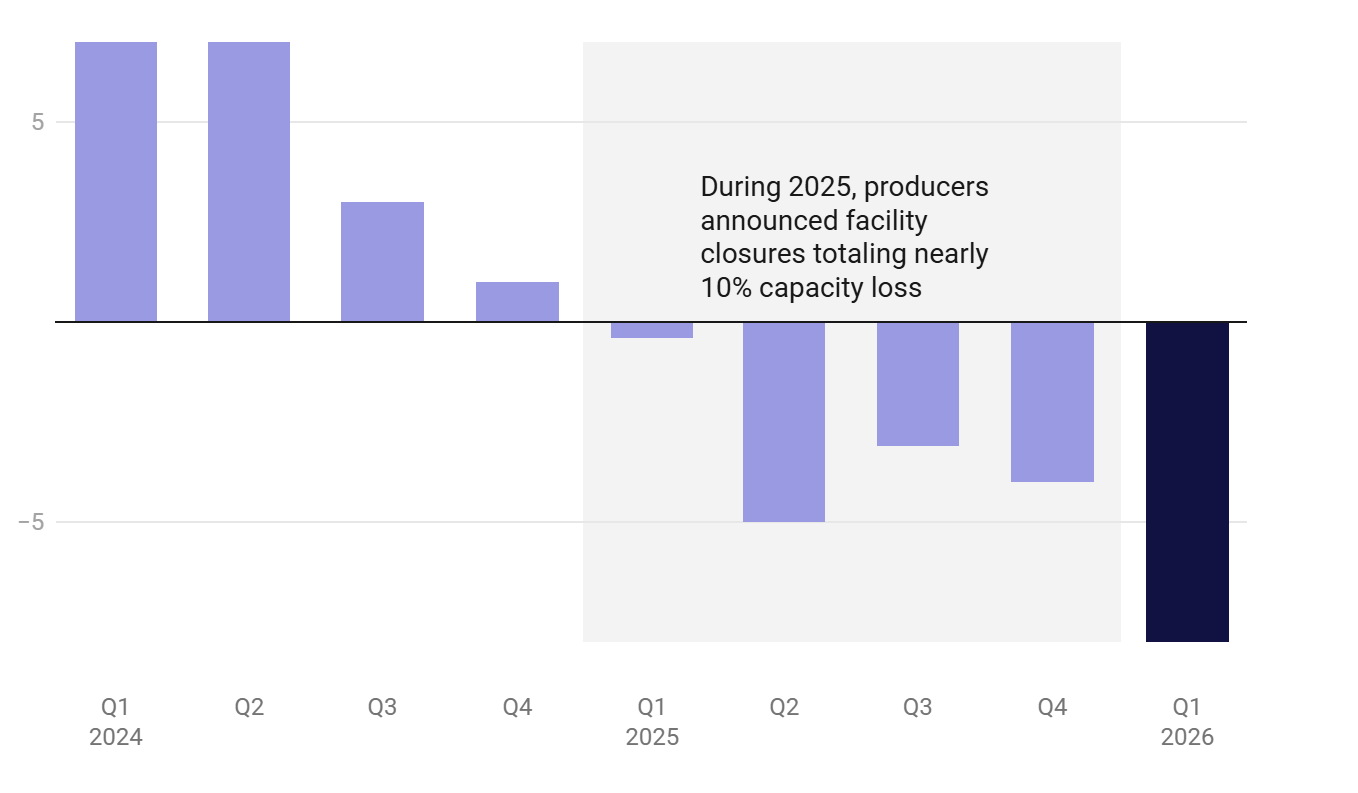
The production drop is not unprecedented, coming after the sharper fall that followed the post-COVID stocking glut.
Wall Street Splits the Bill
Meanwhile, Goldman Sachs lifted its 12-month US recession probability to 30% in March. The bank cited oil shocks and tighter financial conditions.
Moody’s analyst Mark Zandi went further, putting the odds at 48.6%.Zandi called the risks “uncomfortably high.”
“US job market is signaling that a recession is already underway, per Mark Zandi of Moody’s,” reported Unusual Whales, citing Zandi.
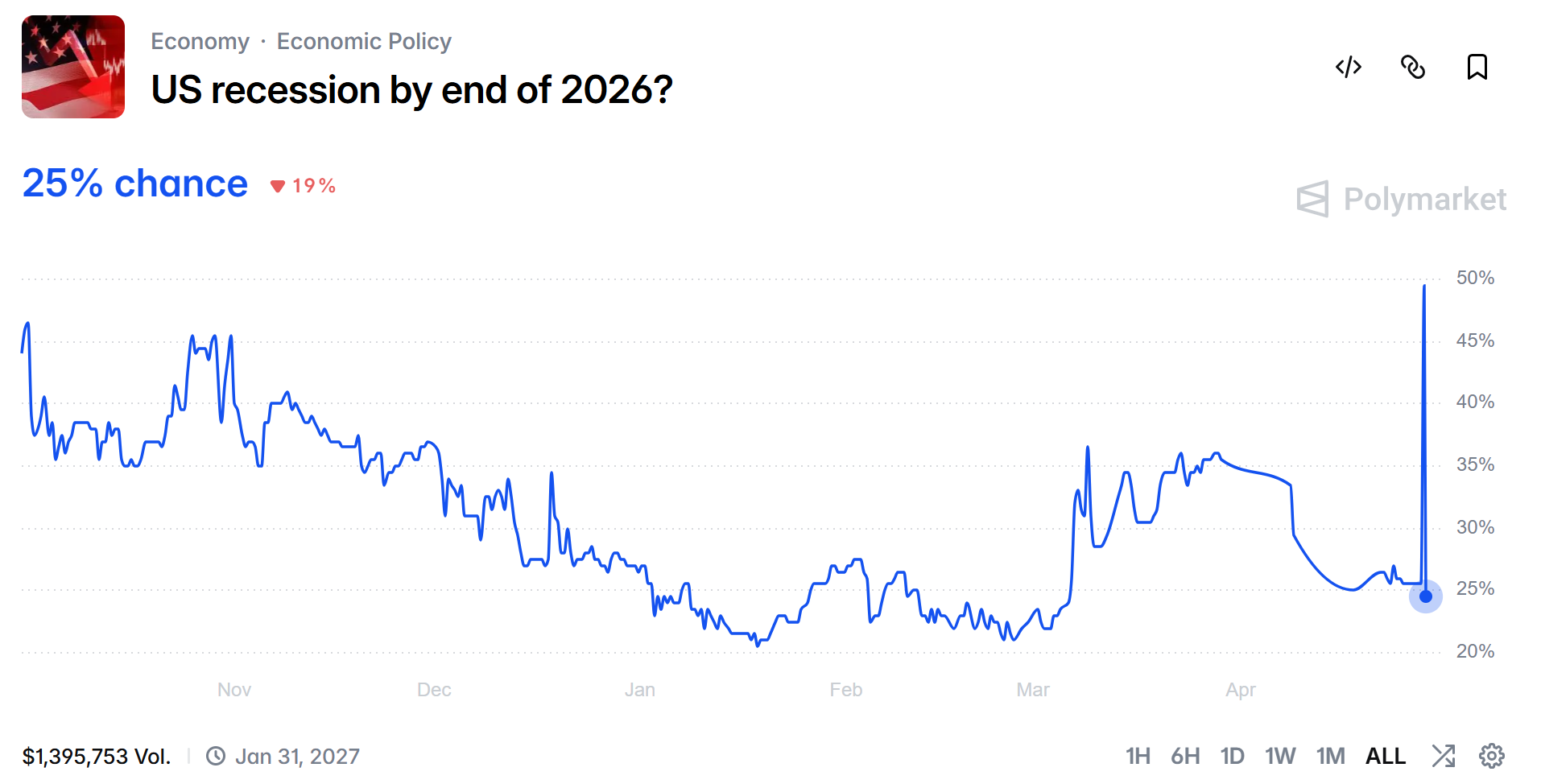
A Wall Street Journal economist survey landed at 33%. Meanwhile, Polymarket bettors hover between 25% and 28%.
Goldman CEO David Solomon told investors that risk was “not materially elevated right now.” He warned the read sat only one tweet away from shifting.
However, it is worth noting that recession odds hit 48.6% in February, the highest since the pandemic, with crowd-sourced bets on Polymarket flagging 40% in March.
What Happens Next
Still, US Treasury Secretary Scott Bessent has dismissed recession talk, saying he expects “very strong, noninflationary growth” in 2026.
In the same tone, US President Donald Trump has promised a “golden age of America” built on tariffs and reshoring.
Democrats counter that the affordability squeeze and slowing hiring tell a different story. Unemployment has crept up to 4.5%. The Conference Board Leading Economic Index has wobbled lower for three months running.
Cardboard could be the swing data:
- If Q2 box orders bounce back, the soft-landing crowd wins the argument.
- If shipments slide again, Greenspan’s old gauge will flash red. Then the whispers may turn into shouts.
Markets remain split on what arrives first. A Federal Reserve rate cut, a Q1 GDP surprise, or another oil shock could redraw the picture.
The post Why a Sudden Cardboard Box Slump Is Quietly Flashing US Recession Warnings appeared first on BeInCrypto.

TLDR:
- Raoul Pal argues UBI is a broken 20th-century solution that cannot keep pace with an AI-driven economy.
- AI agents will become the biggest DeFi users within five years, managing treasuries at machine speed.
- Anyone with a phone can buy permissionless equity in blockchain infrastructure with no KYC or restrictions.
- Pal projects the total crypto market will hit $100 trillion in six to eight years, calling it humanity’s pension plan.
Crypto will power the first truly global wealth system, according to macro investor Raoul Pal. The Real Vision CEO recently outlined a sweeping vision for how blockchain technology could reshape wealth distribution after artificial intelligence disrupts traditional economies.
Pal argues that permissionless crypto ownership is not a speculative bet but a structural reality. He believes anyone with a phone and internet connection can access this system regardless of location, status, or background.
Crypto Rails Are Already Replacing Legacy Financial Infrastructure
Crypto will power the new economy because legacy financial systems cannot keep up with AI-agent activity. The dollar does not fractionalise below a cent, and settlement is far from instant. Permissions depend on jurisdiction, which slows down machine-speed transactions considerably.
Pal noted that “agents run on crypto rails because nothing else works.” He added that “stablecoins handle the dollar leg and native tokens handle the rest.” This makes blockchain infrastructure the only viable backbone for an agent-driven economy.
AI agents are becoming the dominant users of the internet, gradually replacing human activity online. Pal wrote that “the biggest users of DeFi in five years won’t be humans farming yield” but rather “agents managing treasuries, swapping, earning and spending at machine speed.” That shift is already underway and accelerating faster than most expect.
Pal also pointed to memecoins as an early proof of concept for this system. He described them as enabling “instant capital formation around the attention of an idea, raised by entities without legal personhood, settled in seconds.” That model, he argues, is “the template agent economies will use to fund themselves.”
A Permissionless Stake in the World’s Productive Infrastructure
Crypto will power the first homogenous, globally fractionalisable claim on productive infrastructure ever created. Layer 1 blockchains are not just settling agent transactions but coordinating the entire new economy. Every contract, treasury, permission, and identity layer routes through this substrate.
Pal described ownership of this substrate as the actual answer to what he calls the Economic Singularity. He stated that anyone on earth with a phone can access “the first homogenous, permissionless, globally fractionalisable claim on the productive infrastructure of the world.” He added that there are “no KYC walls, no accreditation rules, no jurisdiction, no employer, no state, no permission.”
He outlines four pillars that hold up the post-AGI world for humans. These are Universal Basic Equity through token ownership, income derived from being human, AI-driven abundance lowering living costs, and taxing data center electricity use. Pal called these “four legs of a stool that holds up the post-singularity human world.”
Pal advises putting 10% of monthly earnings into crypto assets consistently over a decade. He recommends “Bitcoin if you want pure store of value, a basket of the major L1s if you want the coordination layer.” He projects the total crypto market will reach $100 trillion within six to eight years, adding that crypto is “humanity’s pension plan.”

Crypto World
Here’s everything to expect when the Fed issues its latest interest rate decision Wednesday
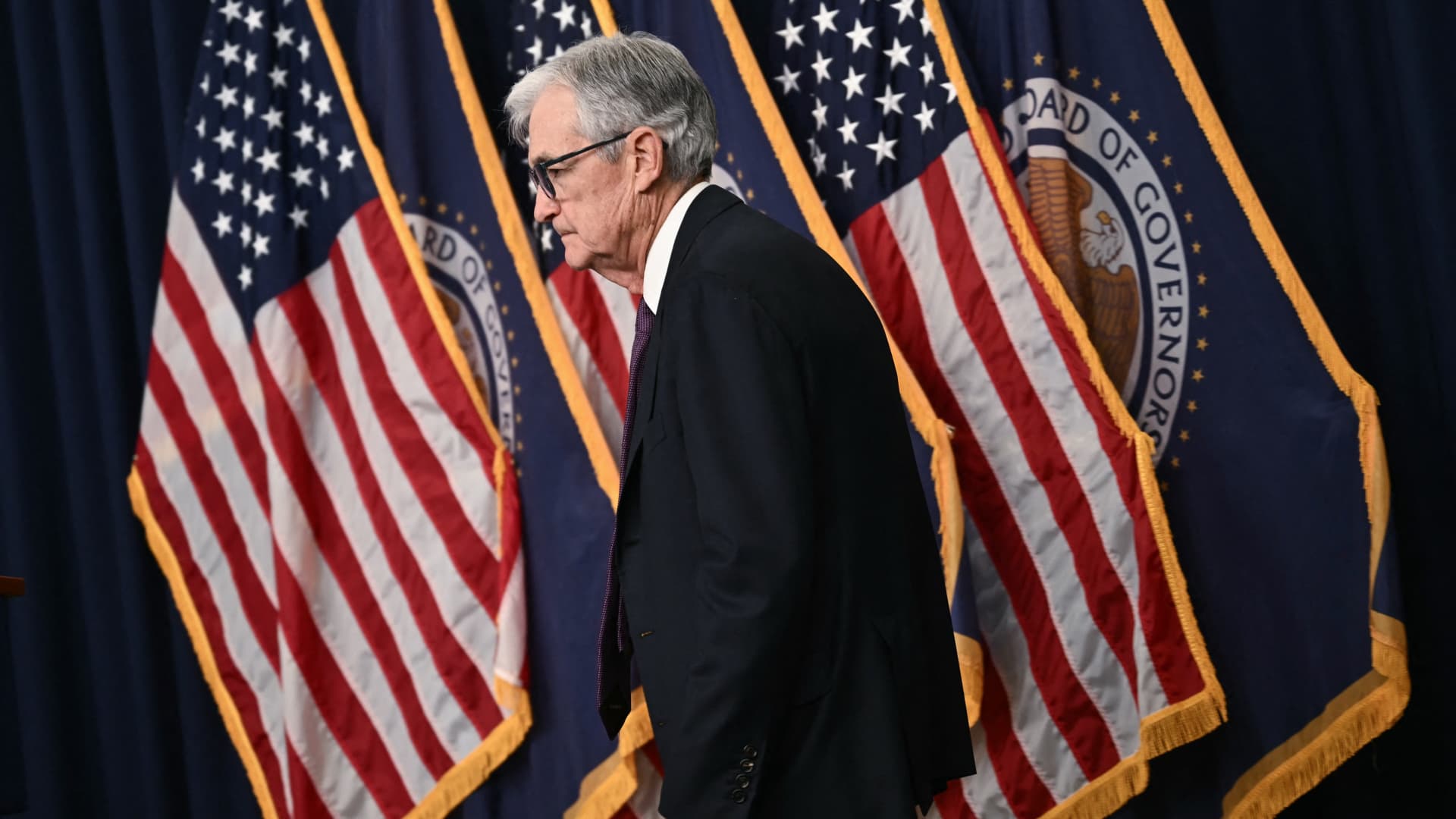
US Federal Reserve Chair Jerome Powell arrives for a press conference following the Federal Open Market Committee meeting at the Federal Reserve Board Building in Washington, DC, on March 18, 2026.
Brendan Smialowski | Afp | Getty Images
In what could be Jerome Powell’s final meeting as Federal Reserve chair, he is expected to lead his fellow policymakers toward another cautious pause, with stubborn inflation and a resilient labor market leaving little room yet for interest rate cuts.
The decision Wednesday will come against a backdrop of elevated energy prices and a central bank that has been above its 2% inflation target for five years at the same time that the labor market has been weak but not in distress. That’s not a recipe for easing, at least not yet.
“On the dual mandate, they’d say we’re roughly at a stable labor market,” Roger Ferguson, an economist and former vice chair at the Fed, told CNBC. “On the inflation side of the mandate, [there’s] a lot more work to be done with a sticky 3% [inflation rate], and I hope they argue, ‘we’re going to sit tight for a little while to see how this all plays out.’”
Similarly, Goldman Sachs economist David Mericle expects the post-meeting statement “is likely to acknowledge the better labor market news and higher inflation numbers but to leave the standing policy guidance unchanged. We expect a strong consensus to stay on hold for now, with only one dissent, as in March.”
So with little drama over the rate decision — markets are pricing in a 100% chance of the FOMC staying on hold — attention will turn squarely to Powell.
Unless something unexpected pops up, the chair’s designated successor, Kevin Warsh, appears on track to take over when Powell’s term ends in May.
The transition clouds the usual signaling value of Powell’s post-meeting news conference.
Inflation the key
Powell’s post-meeting news conference, normally a closely watched event for markets, could be viewed as less of a guide to future policy steps than it is a valedictory for a central bank leader who has had one of the most contentious relationships with a president in the institution’s history.
“If Powell were staying, I might be trying to read more in between the lines of what he says at the press conference,” said Jerry Tempelman, a former senior analyst at the New York Fed and now vice president of economic and fixed income research at Mutual of America Capital Management. “But given the fact that, in all likelihood, Kevin Warsh will soon be the Fed chair, all the surrounding language, etc., probably becomes less relevant.”
From a communications standpoint, Tempelman expects the Fed will put the focus on inflation, which most recently ran at 3% on an ex-food and energy basis using the central bank’s preferred gauge.
Crude oil prices are hovering around $100 a barrel and the average price nationwide for gasoline is surging again, now around $4.18 a gallon, further complicating the Fed’s path.
Though Fed officials often would look through such spikes as temporary, they also remain cautious about longer-term impacts should the fighting in the Middle East escalate.
“Inflation has continued to come in far above anyone’s expectations and far above the Fed’s target,” Tempelman said. “Everyone expects this to be Jay Powell’s final meeting. I think also there’s very little uncertainty as to what the decision will be, namely, that there will be no change to monetary policy in this meeting, and that from the June meeting on, it will be the Fed … chaired by Kevin Warsh.”
What does Powell do next?
That does not, however, mean that Powell’s future will be settled. The current chair has the option to stay on at the central bank for the final two years of his term as governor. So far, he has provided no indication of what he will do.
At the March meeting, he did say he wouldn’t be leaving until an investigation into the renovations at the Fed’s headquarters is completed. Jeanine Pirro, the U.S. attorney for the District of Columbia, passed the investigation off to the Fed’s office of inspector general, a move that politically cleared the way for Warsh’s confirmation.
However, it’s unknown whether that will satisfy the “well and truly over” bar that Powell set in March for his leaving.
“I’m not sure that the move of this investigation from the Justice Department to someplace else really fully checks the box of putting this behind us,” Ferguson said. “I’m not sure that if I were sitting in his seat or [was one of] his advisors, that I would say, let’s blow the all clear.”


The coalition has secured ETH commitments to refill the bridge in tranches and will use Aave and Compound governance proposals to liquidate the exploiter’s remaining positions.
DeFi United, a coalition of decentralized finance (DeFi) ecosystem participants, on Tuesday published the technical implementation plan to restore the backing of Kelp DAO’s rsETH and recover roughly 107,000 tokens still controlled by the exploiter.
The exploit targeted rsETH’s LayerZero-powered bridge on the Unichain to Ethereum route, where a forged inbound packet was verified on the Ethereum side without a corresponding burn on Unichain. The attack released 116,500 rsETH from the Ethereum-side adapter, with proceeds distributed across multiple addresses and supplied as collateral on lending protocols.
Seven addresses associated with the exploiter currently hold active rsETH-backed positions on Aave and Compound, representing approximately 107,000 rsETH of the original 116,500 rsETH stolen.
Restoring Backing
DeFi United said it has secured the ETH commitments needed to restore rsETH’s backing, with final execution subject to governance approvals and definitive agreements. The committed ETH will be converted into rsETH in tranches and transferred to the bridge lockbox contract, allowing the bridge to resume normal operation.
The process targets rsETH’s nominal exchange ratio of 1.07 ETH. The coalition’s fundraising effort has progressively chipped away at the original 163,200 ETH shortfall.
LayerZero Labs on Tuesday pledged more than 10,000 ETH to the effort, donating 5,000 ETH directly to DeFi United and depositing an additional 5,000 ETH to strengthen Aave markets’ liquidity. The firm said it would also strategically deepen liquidity for Aave’s GHO stablecoin.
Clearing Exploiter’s Positions
Recovering the exploiter’s excess collateral requires governance proposals pertaining to Aave’s Ethereum and Arbitrum deployments. The execution involves a controlled liquidation sequence: the rsETH oracle price will be temporarily adjusted to enable efficient liquidation, generating a temporary deficit to be addressed in a subsequent step. Recovered rsETH will be transferred to a DeFi United multisig and redeemed for ETH through Kelp’s standard redemption procedure, with the resulting ETH applied to clear the Aave Ethereum and Arbitrum deficits.
The Aave clearing process aims to recover approximately 13,000 ETH. Compound will take a similar approach with DeFi United providing the liquidity, recovering an estimated 16,776 ETH.
WETH and rsETH reserves on Ethereum Core, Arbitrum, Base, Mantle, and Linea will remain frozen during the process. The final phase involves unpausing and unfreezing rsETH and ETH across affected instances and restoring loan-to-value ratios for any assets whose configurations were temporarily adjusted.
Risks
DeFi United flagged several execution risks. ETH deployment is contingent on finalizing agreements and governance approvals. Deliberate interference by the attacker could result in incomplete accrual of deficits, requiring additional liquidation steps to fully resolve the positions. Residual bridge risk also remains until the newly implemented LayerZero and Kelp security measures are validated in production.
This article was written with the assistance of AI workflows. All our stories are curated, edited and fact-checked by a human.


Top‑100 crypto traded mixed today as Humanity Protocol jumped 14.5%, MemeCore slid 9.3% on 90% insider‑supply fears, and total market cap dipped 1.39% to $2.65T.
Summary
- The top 100 cryptocurrencies by market cap saw divergent action, with Humanity Protocol (H) leading gainers at 14.53% and MemeCore (M) dropping 9.26% as total crypto market cap slipped 1.39% to about 2.65 trillion dollars.
- Humanity Protocol, an Ethereum Layer 2 focused on privacy‑first palm‑scan identity and proof‑of‑human consensus, traded near 0.1639 dollars, while Binance Life, Siren, Pi Network and Tezos rounded out the day’s strongest performers.
- MemeCore declined amid on‑chain reports that over 90% of its supply sits with insiders, echoing RaveDAO‑style liquidity risks, as Bitcoin hovered near 76,500 dollars, Ethereum held around 2,260 dollars, and stablecoins grew to 317 billion dollars in market cap.
The top 100 cryptocurrencies by market capitalization recorded divergent price action during today’s trading session, with Humanity Protocol (H) leading gainers at 14.53% and MemeCore (M) pacing decliners with a 9.26% loss, according to CoinMarketCap data. The mixed performance reflects ongoing consolidation across crypto markets as total market capitalization sits at approximately $2.65 trillion, down 1.39% over the past 24 hours.
Humanity Protocol (H), an Ethereum Layer 2 blockchain focused on privacy-first identity verification through palm scanning technology, surged to $0.1639, extending gains amid growing interest in Proof of Human consensus mechanisms. Binance Life followed with a 9.11% advance to $0.3754, while Siren (SIREN) added 7.3% to reach $0.7059. Pi Network (PI) climbed 5.45% to $0.1915, and Tezos (XTZ) rounded out the top five gainers with a 5.34% rally to $0.3842.
Losers Face Technical Pressure
On the downside, MemeCore (M) dropped 9.26% to $3.55 amid mounting scrutiny over concentrated token distribution, with onchain analysis revealing over 90% of supply held by insiders, raising liquidity concerns similar to RaveDAO’s recent 95% crash. DeXe (DEXE) fell 6.32% to $13.43, while Zebec Network (ZBCN) declined 6.26% to $0.003695. Zcash (ZEC) slid 5.7% to $334.42, and Chiliz (CHZ) lost 5.07% to trade at $0.04609.
The broader market exhibited cautious sentiment as Bitcoin (BTC) traded near $76,500, down approximately 2% over the past 24 hours following its failure to break through the $80,000 resistance zone. Ethereum (ETH) changed hands around $2,260, maintaining stability despite the selloff in select altcoins.
Trading volume across the top 100 assets remained subdued at approximately $133.6 billion over 24 hours, with Bitcoin dominance holding steady near 59.98%, reflecting a flight to quality during periods of uncertainty. Stablecoin market cap reached $317 billion, representing 11.73% of total crypto market capitalization, underscoring their role as safe-haven assets during volatility.
Samson Mow, a prominent Bitcoin advocate, entrepreneur, and CEO of Jan3, has forecasted that an “Omega candle” and $1 million Bitcoin (BTC) are “just around the corner.”
The Bitcoin maximalist argues that the available supply is far lower than the market recognizes and that a price below $120,000 is undervalued.
Samson Mow Explains Why $1 Million Bitcoin Is Coming
In an interview with Pete Rizzo, Mow argued that recent market behavior challenges the idea of a fixed four-year cycle. He noted that Bitcoin reached an all-time high before the halving and only saw a less euphoric peak afterward.
While some interpret this as a cycle top and expect a prolonged downturn, Mow disagrees.
“Everything is up in the air now. And I think an Omega candle and $1 million Bitcoin is just around the corner, especially with all the buy pressure that is flooding the market now with Saylor through STRC and other Bitcoin treasury company players all coming in,” he said.
Follow us on X to get the latest news as it happens
Mow did not lay out a specific timeline but said the move would happen “very quickly.”
“There are only 21 million, and the supply to be mined is less than a million. And there are multiple big entities scooping up Bitcoin. Like you wouldn’t believe, with no intention to stop and no sensitivity to the price. So if you don’t believe in 1 million Bitcoin, good luck. But it’s coming,” he noted.
The executive argued that Bitcoin’s supply is far more constrained than the market assumes. He suggested this misunderstanding could eventually lead to a supply shock, as Bitcoin’s fixed supply becomes more apparent.
“People think there’s, you know, 2 3 million coins on exchanges ready for sale. But those are not coins that are meant for sale. That is liquidity. That’s market makers, trading firms, and hedge funds using that Bitcoin on exchange to perform other activities. And it is not meant to be just sold and never bought back,” Mow noted.
He also highlighted that large institutional buyers, such as MicroStrategy under Michael Saylor, are continuing to accumulate even during downturns, lowering their average cost.
Similar behavior from other treasury-focused firms, such as Metaplanet, reinforces the idea that these entities act as price-insensitive buyers of last resort, consistently absorbing available supply.
In his view, the fact that investors are still willing to sell at relatively low levels enables this accumulation, but it is unlikely to persist indefinitely.
In addition, Mow maintains that “we’re really early.” Based on factors such as inflation adjustments and valuation models like the stock-to-flow model, he believes Bitcoin is currently undervalued, with fair value estimates well above prevailing prices.
“Even anything under $120,000, $110,000 I think, is below fair market value. Just keeping track with inflation, like Bitcoin needs to be at 111,000, I think, to keep track with inflation over the past four to five years, and then fair market value from stock to flow models are indicating its fair market value is something like $110 $115,000, so this is a deep, deep discount right now, and it’s because people don’t really understand Bitcoin,” he remarked.
Experts Back BTC’s Seven-Figure Forecast
Mow’s view echoes similar projections from major institutional voices. Bitwise Chief Investment Officer Matt Hougan highlighted that Bitcoin could reach $1 million if it captures roughly 17% of a projected $121 trillion store-of-value market within a decade.
Subscribe to our YouTube channel to watch leaders and journalists provide expert insights
ARK Invest CEO Cathie Wood maintains a 2030 target of $1.2 million for Bitcoin. Wood revised the figure down from $1.5 million in late 2025, citing the rise of stablecoins.
The Gap Between Bitcoin Forecasts and Reality
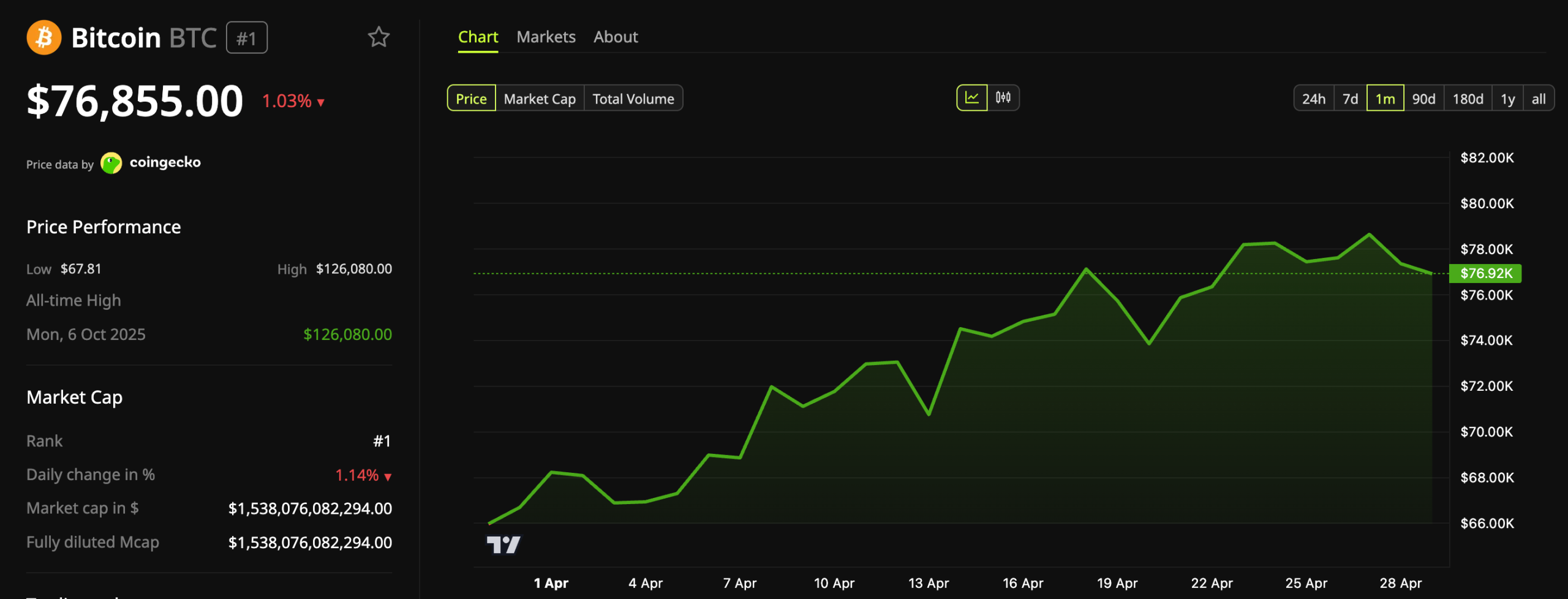
Despite these calls, Bitcoin trades roughly 39% below its October 2025 all-time high of over $126,000. The asset traded at $76,855 on April 27, with several analysts forecasting a market bottom only in late 2026.
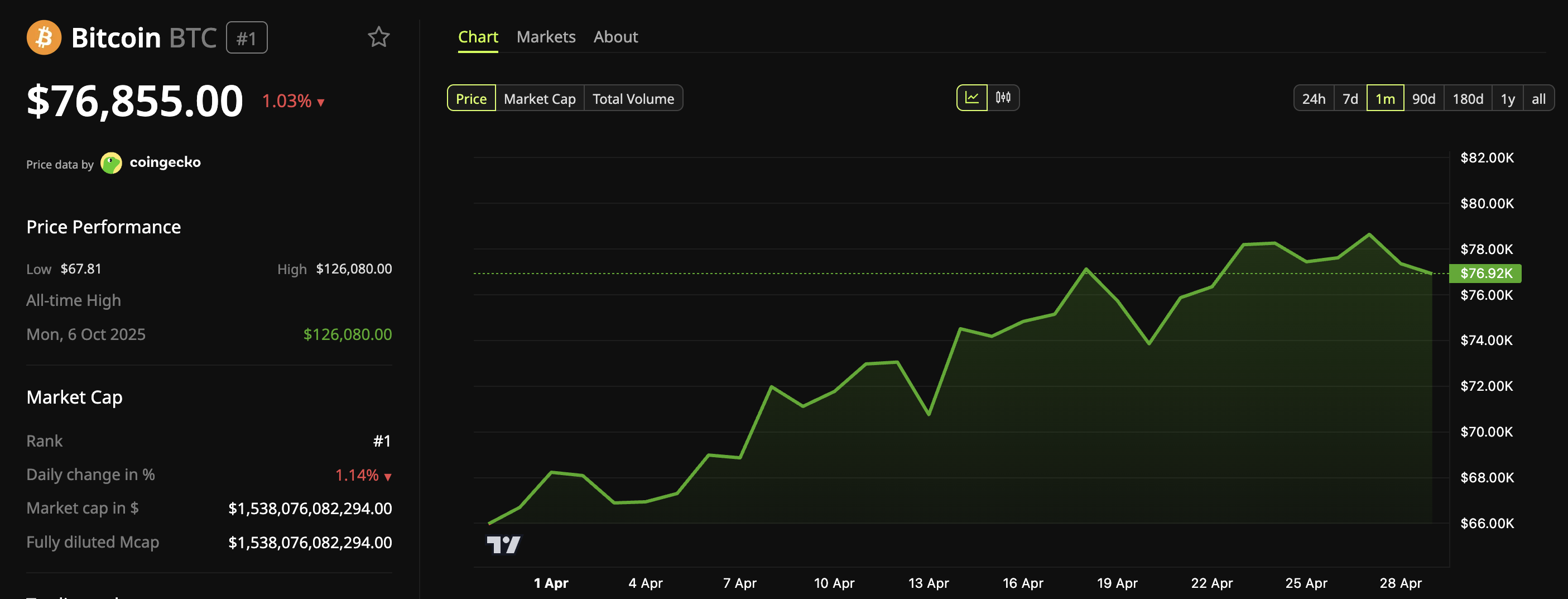
From around $76,855, reaching $1 million would require a price increase of nearly 1,200%, or more than 13 times the current value. Such a move might be mathematically possible over a multi-year horizon, but unlikely in the immediate term.
Bitcoin also missed multiple bullish 2025 forecasts that called for $150,000 or higher by year-end. While the asset may eventually approach the seven-figure milestone, the path looks far longer than Mow’s “Omega candle” framing suggests.
Forecasts of this scale remain scenarios, not guaranteed targets, and a $1 million Bitcoin would require a major structural shift in the market.
The post Expert Says $1 Million Bitcoin and “Omega Candle” Is Just Around the Corner appeared first on BeInCrypto.


Over Foundation has shut down all Over Protocol infrastructure, abandoning OverWallet, nodes and explorers, and leaving block production to any validators stubborn enough to keep running.
Summary
- Over Foundation says “insurmountable financial constraints” forced it to permanently cease operations, killing OverWallet, OverNode, OverFlex, RPC endpoints, block explorers, and public APIs with immediate effect.
- The Layer 1 was pitched as a way for ordinary users to run validators on personal computers, but with all foundation‑run infra offline, the chain’s survival now depends entirely on whether independent node operators keep producing blocks.
- The shutdown folds Over Protocol into a growing list of underfunded L1s and DeFi projects that failed to outlast the consolidation cycle, exposing how fragile foundation‑dependent “decentralization” becomes once the treasury runs dry.v
The Over Foundation announced it will permanently cease operations of Over Protocol, a Layer 1 blockchain network, citing insurmountable financial constraints that have forced the immediate shutdown of all infrastructure and services. The foundation confirmed it has discontinued OverWallet, OverNode, OverFlex, RPC nodes, block explorers, and all related APIs, with no plans for recovery or restart.
Over Protocol was designed as a decentralized Layer 1 mainnet that aimed to democratize blockchain participation by enabling ordinary users to run validator nodes and contribute to network consensus. However, the foundation acknowledged that while the protocol’s architecture supports decentralization in theory, practical operation is now uncertain following the infrastructure shutdown. Block production will depend entirely on whether independent validators choose to continue running the open-source client software, an outcome the foundation cannot guarantee.
Network Faces Uncertain Future
The announcement represents a critical test of blockchain decentralization claims. Layer 1 networks typically require robust infrastructure including RPC endpoints, block explorers, and wallet services to remain accessible to users and developers. Without foundation-operated infrastructure, the protocol faces significant barriers to continued operation, even if validators theoretically remain active.
The foundation emphasized that Over Protocol‘s original mission centered on allowing everyday users to participate in building Layer 1 network infrastructure, contrasting with blockchains dominated by institutional validators requiring specialized hardware. In their final statement, the team thanked the community for their support and expressed regret that they could not continue advancing the project’s vision.
This shutdown adds to a growing list of blockchain projects that have ceased operations during the extended crypto market consolidation phase. Financial sustainability remains a critical challenge for newer Layer 1 protocols competing against established networks with deeper treasury reserves and institutional backing.
The Over Foundation did not disclose specific details regarding the financial circumstances that precipitated the shutdown or whether token holders would receive any form of compensation or migration path to alternative networks.
TLDR
- Tether introduced a modular bitcoin mining system developed with Canaan and ACME Swisstech.
- The company designed the system around application-specific hash board modules instead of sealed mining rigs.
- Tether integrates the modules into its own control architecture, cooling systems, and software stack.
- CEO Paolo Ardoino said the company aims to improve efficiency and scalability through modular design.
- Canaan will supply hash boards while ACME Swisstech supports engineering and industrial integration.
Tether introduced a modular Bitcoin mining system built with Canaan and ACME Swisstech on Tuesday. The company said it redesigned mining hardware to separate compute, power, and enclosure components. The move expands Tether’s direct role in bitcoin infrastructure beyond stablecoin issuance.
Tether Partners with Canaan and ACME to Redesign Mining Hardware
Tether structured the new systems around application-specific hash board modules rather than sealed mining rigs. The company integrates those modules into its own control architecture and cooling systems. It also manages the software stack to coordinate performance and power use.
The company said it separates compute units from power supply and enclosures to optimize each element independently. It pairs the architecture with immersion cooling to cut energy overhead and improve uptime. CEO Paolo Ardoino said, “Most mining infrastructure is still built as sealed, fixed units, which makes it expensive to scale and inefficient to run.”
He added that Tether is “revisiting that concept” with modular compute that operators can tune and upgrade. Canaan said the partnership reflects demand for modular, high-performance hardware for custom deployments. ACME Swisstech said the design shifts away from “plug-and-play, retail-oriented products” toward industrial systems.
Tether said the modular approach allows operators to replace or upgrade hash boards without discarding entire machines. The company expects this design to support higher system availability in large facilities. It also said independent component control can streamline maintenance cycles.
Canaan confirmed it will supply application-specific integrated circuit hash boards for the project. ACME Swisstech said it will contribute engineering and industrial integration support. Tether said it will coordinate system assembly and operational deployment.
The announcement outlined how Tether intends to control hardware, software, and cooling within a unified framework. The company said it wants tighter oversight over cost, energy use, and performance. It framed the effort as part of its broader infrastructure strategy.
Tether Expands its Footprint Across Bitcoin Mining and BTC Infrastructure
Tether remains best known as the issuer of USDT, the largest stablecoin by market capitalization. However, the company has expanded its presence across bitcoin infrastructure over the past year. It said mining supports its strategy to manage bitcoin holdings directly.
Last week, Tether disclosed an 8.2% stake in Antalpha, a Bitmain-linked mining finance firm. Earlier this year, the company open-sourced its Bitcoin Mining OS, known as MOS. Tether said the software aims to challenge proprietary mining management platforms.
In December, Tether-backed Northern Data sold its Peak Mining arm to entities controlled by Ardoino and Giancarlo Devasini. The transaction highlighted the company’s deeper operational involvement in mining. Tether confirmed the deal through public statements at the time.
Ardoino said in 2024 that Tether plans to become the world’s largest bitcoin miner by the end of 2025. He tied that target to securing and hedging the company’s bitcoin reserves. The latest modular hardware initiative forms part of that ongoing plan.

Live weekday coverage of Bitcoin markets, geopolitics, and frontier technology debuts Summer 2026 from Nashville, airing across six platforms to a projected 58 million annual impressions.
NASHVILLE, TN, April 27, 2026 — Bitcoin Magazine, a global media brand within BTC Inc. (the “Company”), a Nakamoto Inc. (NASDAQ: NAKA) subsidiary, today announced BM TV (Bitcoin Magazine TV), a daily live broadcast network launching Summer 2026. The show will air Monday through Friday from 9:30 to 11:30 AM ET, timed to U.S. market open, delivering rigorous, unsentimental analysis of Bitcoin, global capital markets, macroeconomic currents, geopolitical policy, and frontier technology commentary.
Produced from the Company’s Nashville office and distributed simultaneously across six platforms, including X, YouTube, Facebook, Rumble, BitcoinMagazine.com, and LinkedIn, BM TV targets the Company’s existing 5 million aggregated online audience, which reached over one billion impressions in 2025.
“Bitcoin has moved from the periphery of global finance to its center, and the media infrastructure around it must evolve accordingly,” said Brandon Green, CEO of BTC Inc. “BM TV represents a fundamental expansion of what Bitcoin Magazine is, from the world’s most trusted publication in this space to a full-spectrum media company capable of meeting this moment at scale.”
Built for Bitcoin’s Institutional Inflection
BM TV arrives at a pivotal juncture. More than $102 billion is now held in Bitcoin ETF assets under management, according to Bitbo. The Company estimates that, following the launch of Bitcoin ETFs in 2024 and the subsequent public company adoption of Bitcoin as a balance sheet asset, an expanding cohort of institutional allocators is evaluating Bitcoin as a strategic portfolio position.
The Company believes that demand for credible, broadcast-quality analysis on Bitcoin has emerged as a result of this new class of investors. Simultaneously, artificial intelligence is commoditizing text-based media. BM TV is purpose-built for the post-AI landscape: its experiential value is designed to compound trust through production quality, editorial personality, and the irreplicable spontaneity of real-time analysis.
“The Bitcoiner is changing. In the post-Covid era of monetary stimulus, a largely retail-oriented cohort joined the ranks of Bitcoin investors. Now, with the launch of Bitcoin ETFs, institutional adoption, and serious consideration from world governments, it’s more important than ever to meet the Bitcoiner where they are,” said Spencer Nichols, Executive Producer and Director of BM TV. “We look forward to providing nuanced coverage of Bitcoin in the context of global events, in addition to preserving the ethos and legacy of Bitcoin’s cypherpunk roots that Bitcoin Magazine has supported since its creation in 2012.”
A Show for Modern Audiences
Each two-hour episode will feature multi-camera, broadcast-grade production with an anchor-and-analyst desk, live data overlays including tickers, charts, prediction markets, ETF flow trackers, and two remote guests drawn from the leading voices in finance, technology, energy, and policy. Coverage will span four interlocking verticals: Bitcoin, global markets, macro and political commentary, and energy, AI, and frontier technology.
“Every consequential shift in capital markets has been accompanied by the rise of a defining media voice. BM TV is being built for the allocator, the builder, and the policymaker who understand that Bitcoin is no longer optional, it’s inevitable,” said Mark Mason, Head of Media at Bitcoin Magazine. “We have the audience, the credibility, and the distribution. This is the broadcast the market has been waiting for.”
The show aims to explain Bitcoin market activity against the backdrop of global events and themes, treating Bitcoin as a monetary constant embedded in financial markets, energy systems, semiconductor supply chains, AI compute economics, government regulation, and internet culture.
The Company believes that the influx of Bitcoin-backed securities investors has expanded the audience for Bitcoin-centric news and media.
Distribution
BM TV will broadcast across six simultaneous platforms, leveraging Bitcoin Magazine’s distribution infrastructure. The show aims to produce approximately 230 episodes per year, with each broadcast generating derivative content across short-form clips, newsletter features, and BitcoinMagazine.com editorial analysis.
Bitcoin Magazine has established itself as the preeminent livestream broadcaster in the Bitcoin and crypto ecosystem, with a proven track record of producing high-impact live events such as the Bitcoin Conference, Halving coverage, the 2024 Inauguration show, and numerous bespoke livestreams.
Be the First to Know When BM TV Launches
With BM TV expected to launch Summer 2026, the Company has created a website where it intends to share updates and behind-the-scenes previews with early subscribers.
About BTC Inc.
BTC Inc. is the world’s leading Bitcoin media enterprise, operating Bitcoin Magazine, the Bitcoin Conference, and Bitcoin for Corporations. Through its media, events, and educational platforms, BTC Inc. delivers trusted news, research, and experiences that advance Bitcoin adoption among individuals, institutions, and enterprises worldwide.
BTC Inc. is a subsidiary of Nakamoto Inc. (NASDAQ: NAKA), a publicly held Bitcoin company that owns and operates a global portfolio of Bitcoin-native enterprises.
Forward-Looking Statements
Certain statements in this press release constitute forward-looking statements, as defined under U.S. federal securities laws. Forward-looking statements can be identified by the use of words such as “estimate,” “project,” “predict,” “believe,” “expect,” “anticipate,” “potential,” “intend,” “could,” “would,” “may,” “plan,” “will,” “seek,” “target,” or similar expressions.
Forward-looking statements in this press release include, but are not limited to, statements regarding BTC Inc.’s business plans and strategies, projected audience size, reach, impressions, expected launch dates, production schedules, and anticipated growth of Bitcoin-related media, events, and services.
These forward-looking statements are inherently uncertain and involve numerous assumptions and risks, including Bitcoin price volatility, changes in audience engagement, platform dependency, regulatory developments, competition, and general economic conditions.
Additional details can be found in Nakamoto Inc.’s filings available at www.nakamoto.com and www.sec.gov.
Because Nakamoto Inc. (NASDAQ: NAKA) is the parent company of BTC Inc., investors should be aware that the performance and risks of BTC Inc.’s operations may affect Nakamoto Inc.’s overall results.

Inquest opened into death of biker Aran Sadler in Scarborough crash

US stocks today: Nasdaq, S&P 500 end lower on renewed AI growth worries ahead of big tech earnings

Falcon Upgrade Aims to Outrun Quantum Threats

Manchester United reach agreement with Casemiro over contract clause amid transfer speculation

US brings back mandatory military draft registration

Steven Gerrard disagrees with Gary Neville over ‘shock’ Chelsea and Arsenal claim | Football


-

 Tech1 day ago
Register Renaming | Hackaday
-

 Fashion4 days ago
Weekend Open Thread – Corporette.com
-
Crypto World3 days ago
Hyperliquid $HYPE Rally Builds Momentum as AI Sector Enters Prove-It Phase
-

 Politics6 days ago
Making troops accountable for war crimes threatens US alliance, ex-SAS colonel warns
-

 Politics6 days ago
Disabled people challenge government SEND proposals over segregation concerns
-

 Business5 days ago
Patterson-UTI Energy, Inc. (PTEN) Q1 2026 Earnings Call Transcript
-

 Business6 days ago
Rolls-Royce Voted UK’s Most Iconic Trade Mark as IPO Register Hits 150
-
 Sports2 days ago
IPL 2026: Ruturaj Gaikwad registers slowest fifty of the season, enters all-time unwanted list | Cricket News
-

 Politics23 hours ago
Drax board avoid their own AGM, accused of greenwashing & environmental racism
-

 Crypto World7 days ago
New York sues Coinbase, Gemini over prediction market offerings
-

 Politics6 days ago
Starmer handler McSweeney to be dragged from shadows by Foreign Affairs Committee
-
Politics6 days ago
Wings Over Scotland | How To Get Away With Crimes
-

 Politics6 days ago
Zack Polanski responds to home secretary’s taser threat
-

 Politics6 days ago
‘Iran is still a nuclear threat’
-
 Business7 days ago
HCL Tech share price tank over 9% after weak Q4. JPMorgan, HSBC & 3 others cut target price
-

 Crypto World7 days ago
Crypto’s great hope in Senate’s Clarity Act still has a path to survive tight calendar
-

 NewsBeat3 days ago
LK Bennett closes all stores after entering administration
-
 Sports6 days ago
Tim Bradley names the current best in the world: “Better than Inoue and Usyk”
-

 Crypto World4 days ago
Michael Saylor says BTC winter is over. Market analyst disagrees, says bitcoin was in a pullback
-
 Crypto World7 days ago
Ethereum Price News: ETH Flashes a Bullish Setup No Holder Should Miss While Pepeto Nears Its Binance Listing
You must be logged in to post a comment Login