

Crypto World
Philippines Crypto Rules Shape Binance Return Via Local Partner


Binance has disclosed a formal market-entry initiative in the Philippines, aligning with fintech partner BlockShoals Technologies to pursue operations through local partnerships and regulatory engagement. The arrangement positions BlockShoals as an approved local intermediary under the Philippine Securities and Exchange Commission’s StratBox framework, with Binance providing technology, security, operations, and compliance support. According to Cointelegraph, the effort signifies Binance’s intent to pursue a compliance-first pathway into a market where direct access has historically been restricted.
A Binance spokesperson told Cointelegraph that the company is pursuing a compliance-oriented market approach in collaboration with local stakeholders. “This represents Binance’s first formal market entry approach in the Philippines through local partnerships and regulatory engagement,” the spokesperson said.
The StratBox-based plan is designed to unfold in phases, with the sandbox portion expected to commence in the second half of 2026 and run for at least two years under the SEC framework. The initiative comes as Binance remains blocked in the country, a status tied to licensing concerns and regulatory action by local authorities.
Key takeaways
- BlockShoals Technologies is an approved StratBox participant, designated to operate as the local intermediary for Binance under the Philippines’ regulatory sandbox framework.
- The StratBox sandbox is slated to begin in H2 2026 and extend for a minimum of two years, reflecting a structured, regulator-led pathway for market access.
- Binance’s ongoing access restrictions in the Philippines persist, tied to licensing and registration requirements; regulators have historically directed or mandated access limitations on unregistered platforms.
- The Philippines’ regulatory regime has evolved through a series of public advisories and enforcement actions targeting unregistered crypto platforms, illustrating a high-risk environment for cross-border exchanges operating without local authorization.
- The development highlights a broader trend toward formalized, compliance-driven market entry strategies for international exchanges seeking a regulated foothold in Southeast Asia.
Formal market-entry strategy through StratBox
The Philippines’ StratBox framework, described by Binance as an approved sandbox, is intended to enable a controlled, supervised pilot of digital-asset activities through locally licensed intermediaries. In this structure, BlockShoals will act as the approved operator within the regulatory perimeter, while Binance supplies the behind-the-scenes technology, security controls, and ongoing compliance oversight. The approach aligns with a broader demand from regulators for direct oversight over market participants, particularly in areas touching securities law and investor protections.
From a practical standpoint, the model reduces immediate exposure to blanket, cross-border access while establishing a clear line of sight into local consumer protections, anti-money laundering (AML) and know-your-customer (KYC) controls, and licensing requirements. The market-entry plan underscores an emphasis on governance, risk management, and regulatory reporting, with the sandbox design intended to allow regulators to observe, assess, and steer operations before broader permissioning is granted.
Regulatory backdrop: enforcement history and current posture
The regulatory narrative in the Philippines around Binance has been marked by a sequence of warnings, blocking actions, and ongoing licensing considerations. The Securities and Exchange Commission first warned the public against Binance in November 2023, stating that the platform was not authorized to sell or offer securities in the country due to the absence of the required registration and license. This initial advisory underscored the SEC’s stance that unregistered platforms pose compliance and investor-protection risks.
In March 2024, the SEC indicated it had requested the National Telecommunications Commission to block access to Binance and related pages, citing the absence of a Philippine-registered operating license. Local internet-service providers subsequently restricted access in alignment with the regulator’s directive. The episode illustrated the interplay between securities regulators and communications regulators in enforcing market access constraints against unlicensed platforms.
The regulatory emphasis on licensing and registration broadened in 2025, when the SEC issued an advisory against a group of crypto exchanges, including OKX, Bybit, KuCoin, and Kraken, warning that their activities may expose Filipino investors to heightened risks. The advisory reflected a willingness to pursue sanctions or enforcement measures against platforms lacking proper local authorization, signaling a tighter risk posture for overseas exchanges seeking Philippine operations.
Further signals emerged in April 2025, when the regulator named several platforms—dYdX, Aevo, gTrade, Pacifica, Orderly, Deriv, and Ostium—in an investor alert, stating that these entities were not registered with the SEC but appeared to be offering investments to the public. The action illustrated a continued effort to deter unregistered platforms from marketing to Philippine investors and to standardize expectations around registration, licensing, and compliance practices for digital-asset participants.
These enforcement milestones collectively shape the regulatory environment in which Binance’s StratBox plan operates. They indicate a persistent risk that access to Philippine markets remains contingent on regaining licensed status or establishing an authorized local intermediary under a regulator-approved framework. The evolving regime places a premium on formal licensing, registration, and ongoing compliance, with regulators signaling readiness to impose access restrictions on non-compliant platforms.
Regulatory and market-structure implications for cross-border operators
Binance’s attempt to re-enter the Philippine market through a regulator-approved intermediary marks a notable shift in how large, international exchanges may pursue access in jurisdictions with stringent licensing regimes. The StratBox pathway embodies a hybrid model that balances local oversight with international technology and risk-management capabilities. For exchanges, this approach could become a template for navigating disparate regulatory landscapes where outright market access is blocked or revoked absent a local license or licensed intermediary.
From a policy perspective, the Philippines’ evolving framework aligns with broader regional and international trends toward formalizing digital-asset markets. The emphasis on sandbox experimentation, intermediary licenses, and phased market access mirrors regulatory moves seen in other jurisdictions that favor structured pilots before granting broad licensing. The regulatory emphasis on AML/KYC, investor protection, and clear licensing requirements has direct implications for exchanges and market participants seeking to avoid sanctions and ensure compliance with local law.
For financial institutions and banks interfacing with crypto platforms, the Philippine experience reinforces the importance of due diligence and compliance readiness in cross-border payments and custodial arrangements. Banks and payment facilitators are increasingly attuned to the regulatory status of crypto platforms operating within their ecosystems, given the potential reputational, legal, and operational risks associated with unregistered or unlicensed entities. In this sense, the StratBox model could influence how banks assess counterparties, conduct audit trails, and implement cross-border AML controls in collaboration with regulators and local partners.
Broader policy and regional context
The Philippines’ regulatory trajectory sits within a global milieu of enhanced crypto oversight, where frameworks such as the EU’s Markets in Crypto-Assets Regulation (MiCA) and corresponding U.S. enforcement priorities shape cross-border operations. Policymakers are increasingly expecting robust licensing, transparent disclosures, and verifiable compliance programs as prerequisites for market access. In this context, StratBox and similar sandbox avenues may serve as pragmatic mechanisms to harmonize innovation with risk management, providing clear benchmarks for registration, reporting, and supervisory review.
For market participants, the evolving landscape also underscores a need to monitor cross-border regulatory differences, potential licensing harmonization efforts, and the degree of regulatory certainty that may emerge from sandbox-based pilots. As regulators balance investor protection with the benefits of fintech innovation, the Philippines’ experience may inform policy discussions on licensing timelines, interim safeguards, and the role of approved intermediaries in overseeing digital-asset activities.
Closing perspective
The Binance-BlockShoals StratBox initiative reflects a deliberate, regulation-aligned strategy to gain a regulated foothold in the Philippines. While the sandbox offers a clear pathway to market access, the ongoing licensing and access constraints illustrate the prudence regulators exercise to balance innovation with investor protection. As the two-year-plus sandbox unfolds, observers should watch for how the framework addresses registration hurdles, supervisory expectations, and the practical implications for institutions seeking to participate in a regulated Philippine digital-asset market. The outcome will likely influence how other international exchanges craft compliant market-entry plans in similarly regulated jurisdictions.


Disciplined retail traders who follow the rules could probably beat the S&P 500, according to Peter Tuchman, the longest-serving floor trader at the New York Stock Exchange.
The 40-year veteran, who trades up to $1 billion in stock daily, says the COVID-era retail wave has produced a new class of smart money.
Why Tuchman Says Retail Can Beat the S&P 500
In a new interview, Tuchman said the COVID trading boom rewired who holds the edge. Commission-free apps gave anyone with a phone and $100 access to markets.
“I believe if you’re a responsible, disciplined, consistent day trader and you follow the rules, you could probably beat the S&P.”
He estimates 80 to 90% of that first meme-stock wave blew up their accounts. The survivors matured, and “there’s this new generation of retail that’s become smart money,” he said.
Some traders he mentored “are making $20 million a year now in their 20s and have these amazing communities around them.”
His claim lands days after US regulators scrapped the $25,000 pattern day trader minimum. The rule change opens unlimited day trades to accounts as small as $2,000.
Retail flows already steer index direction during major swings.
Discipline Beats Home Runs
Tuchman’s method favors small, repeatable wins over swinging for the fences. He teaches stop orders and quick partial profits at his Wall Street Global Trading Academy.
“Discipline and consistency are the key to a successful trader. Somebody who hits singles and doubles is going to be a successful day trader.”
The caveat cuts the other way. Passive investors putting $250 monthly into the S&P 500 from age 18 would reach $1.4 million by 60, he noted.
For traders chasing more, his warning stands. “FOMO, hype and hope are not sustainable trading strategies.”
The post Disciplined Retail Traders Could Beat the S&P 500, NYSE Veteran Tuchman Says appeared first on BeInCrypto.
Cryptocurrency market outflows reflect a sentiment shock, as geopolitics, rate expectations and capital rotation into artificial intelligence weigh on digital assets, according to James Butterfill, head of research at CoinShares.
In a statement sent to Cointelegraph, Butterfill said that sentiment in crypto markets has “soured drastically” after billions of dollars flowed out of digital asset investment products in recent weeks.
“This is a pure sentiment shock rather than a structural break,” Butterfill said.
Butterfill added that the correction was being driven primarily by geopolitics, with uncertainty around the Iran conflict weighing on the outlook for interest rates. He said expected rate cuts had been pushed off the table, while markets were beginning to price in the possibility of higher rates.
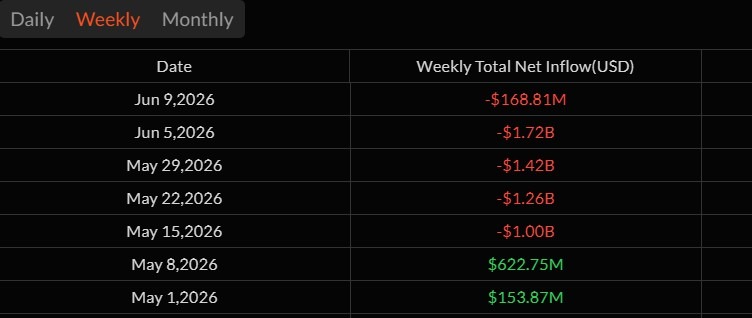
The comments follow a sharp reversal in US spot Bitcoin exchange-traded funds (ETFs), which recorded about $1.72 billion in net outflows last week.
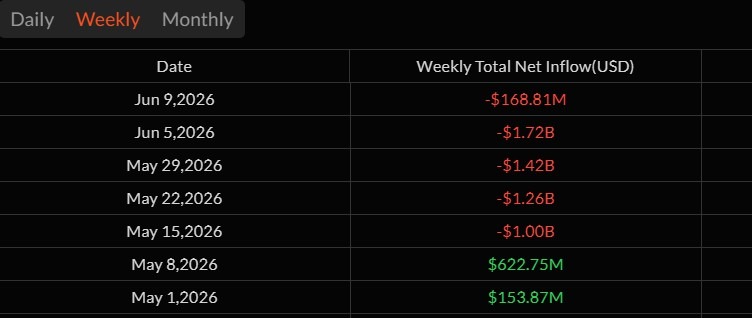
Spot Bitcoin ETF weekly flows data. Source: SoSoValue
Bitcoin rebound may still be fragile
Other analysts said Bitcoin’s recent rebound may not be enough to confirm a recovery. In a statement sent to Cointelegraph, Paul Howard, a senior director at liquidity firm Wincent, said last week’s outflows reflected institutional reactions to macroeconomic headlines, while pressure across tech-heavy markets showed the broader strain facing risk assets.
Howard said Bitcoin’s break below a key moving average suggested markets may have entered a more cautious phase, while elevated CME Bitcoin volatility pointed to continued news-driven swings. He said he remained cautious that the rebound would prove sustainable.
Related: Crypto users wary as Anthropic releases Claude Mythos with safeguards
Adam Haeems, head of asset management at crypto investment firm Tesseract Group, said that much of the market narrative had focused on Strategy’s sale of 32 BTC in late May. However, he said the sale, which raised about $2.5 million, was too small to mechanically explain the broader BTC decline.
“It unsettled confidence, because Strategy had been treated as a near one-way source of corporate demand, but it was a signal shock, not the flow behind the fall,” Haeems said.
Magazine: Vietnam preps crypto pilot, HK pushes tokenization: Asia Express

Coinbase’s vice president of tax, Lawrence Zlatkin, testified before the House Ways and Means Committee on June 9, asking lawmakers to stop requiring Americans to calculate capital gains every time they spend a stablecoin or pay a blockchain transaction fee.
His testimony came during a hearing on six standalone bills aimed at updating how the US tax code treats digital assets, covering everything from mining and staking taxation to charitable donations and broker reporting requirements.
Coinbase Presses for Simpler Crypto Tax Rules
Ahead of the hearing, the House Ways and Means Committee said it would examine legislation designed to bring “clarity, parity, and administrability” to digital assets. Representing Coinbase, Zlatkin told legislators that the current tax rules force consumers to track tiny gains and losses on routine transactions involving crypto.
According to him, federally regulated stablecoins pegged to the US dollar should be treated at par for tax purposes because they are designed to maintain a one-to-one value with the greenback.
He also argued that asking users to calculate cost basis every time they spend a stablecoin only created paperwork without generating any meaningful tax revenue. Furthermore, Zlatkin backed a proposal by Congressman Rudy Yakym to waive tax reporting on gas fees of up to $10.
He also asked Congress to create a broader de minimis exemption for small crypto purchases. Under Coinbase’s proposal, people making low-value transactions with Bitcoin (BTC) or other non-stablecoin cryptocurrencies would not have to calculate taxable gains every time they bought something.
Recall that in March this year, Coinbase CEO Brian Armstrong faced accusations of lobbying against a BTC tax exemption. At the time, he called the claims “totally false” and said that he had personally spent time advocating for a Bitcoin de minimis rule.
On mining and staking, the exchange supported a bill by Congressman Mike Carey that, if passed, would let validators defer tax on block rewards until those assets are actually sold instead of when they are received.
“A farmer is never taxed when a bushel of wheat sprouts from the ground; they are taxed when they harvest that crop, bring it to market, and execute a sale,” Zlatkin explained.
The Wash-Sale Question
Lastly, the executive reiterated Coinbase’s view on wash-sale rules, which prevent investors from claiming a tax loss if they buy back the same asset within 30 days of selling it.
While the firm has long agreed that the rules should also apply to crypto, it flagged a practical problem: that crypto trades 24 hours a day across exchanges, liquidity pools, and self-custody wallets, all at the same time, and there currently is no shared data architecture that would let anyone track wash-sale violations across that broken environment in real time.
According to the tax guru, before the rules take effect after being enacted, there should be an implementation runway of at least 18 to 24 months to allow for necessary software infrastructure to be built. He warned that forcing immediate compliance would lead to widespread reporting errors and a flood of IRS audits.
The post Coinbase Urges Congress to Treat Stablecoins Like Cash and Ease Crypto Tax Burdens appeared first on CryptoPotato.
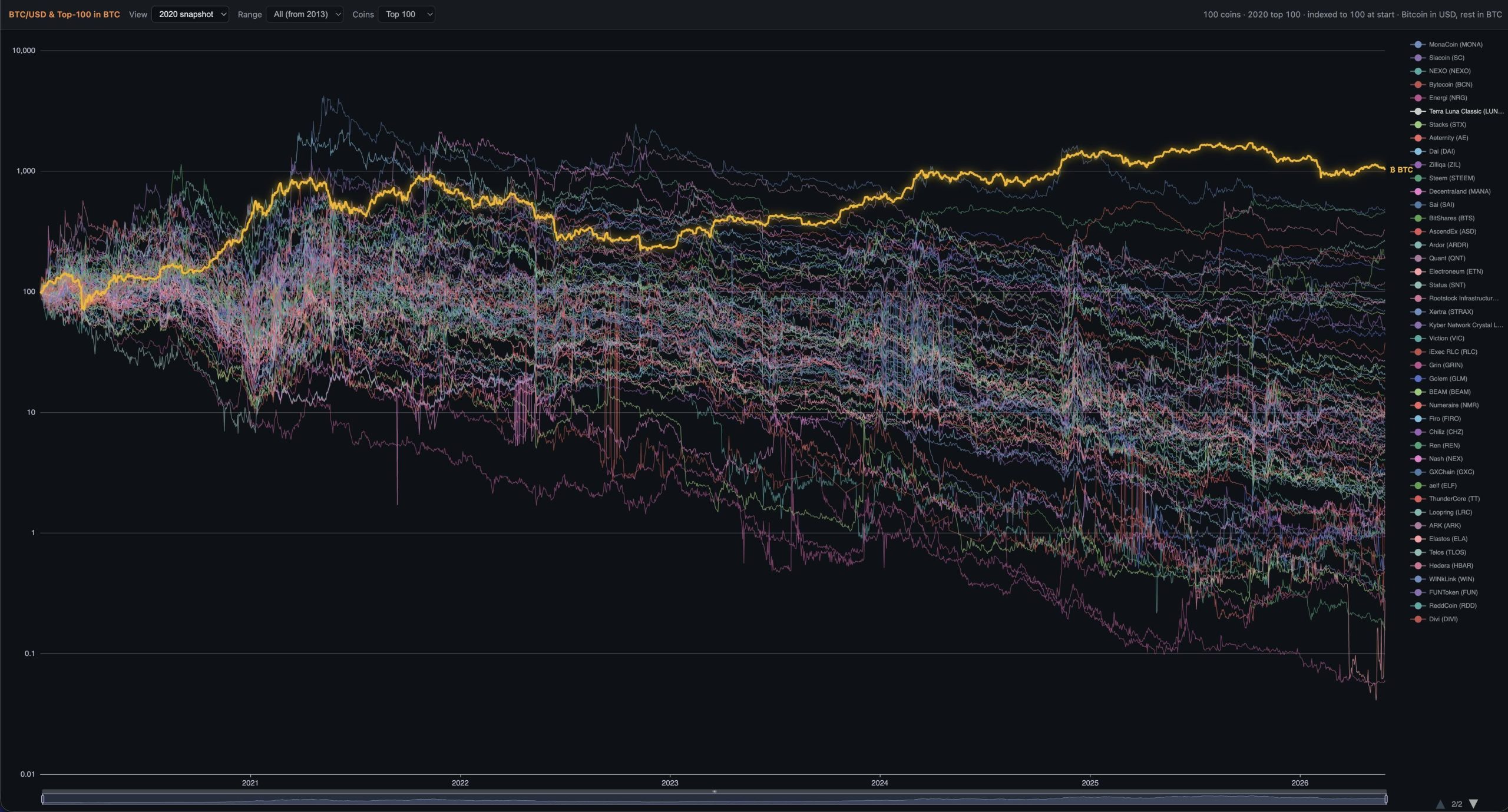
Bitcoin (BTC) has beaten nearly all of the top 100 altcoins since 2020, and chart data now points to almost 50% more downside for the broad altcoin market.
The total altcoin market cap, tracked as TOTAL2, trades near $864 billion after a steep weekly drop. Two charts explain why the pressure could continue.
Bitcoin Beat the 2020 Top 100 Altcoins by a Wide Margin
The first chart indexes the 2020 top 100 coins to a value of 100. It prices Bitcoin in US dollars and each altcoin in Bitcoin terms.
From that base, the BTC line climbed toward 1,000 on a logarithmic scale. Most altcoins, instead, fell from 100 to 10, 1, or lower. That gap means many former leaders lost 90% to 99% of their value against Bitcoin. Terra Luna Classic (LUNC) marked the most extreme collapse on the chart.
The framing matters because it measures opportunity cost. Holding most altcoins meant underperforming a simple Bitcoin position for more than five years. The chart also shows why coin selection rarely helped. Even well-known projects struggled to hold value once measured against Bitcoin.

A few names held near the starting line. However, the broad set shows years of losses for holders who skipped BTC and chose these survivors instead.
The current downturn has not reversed the trend. Bitcoin trades near $61,228, down about 2% on the day and roughly 44% over the past year. Meanwhile, altcoins have fallen harder. Over the past 30 days, BTC dropped about 24% while Ethereum (ETH) lost roughly 31%.
Total Market Cap Points to $436 Billion by July
The second chart shows TOTAL2 on a weekly timeframe with three cycle peaks. The most recent top printed at $1.77 trillion.
History gives two reference declines. The 2018 bear market fell 92% over 49 weeks, while the 2021 to 2022 drop fell 75% over 31 weeks.
Those moves average about 40 weeks in duration. Applying the more recent 75% decline to the $1.77 trillion, the top projects point to a bottom near $436 billion.
TOTAL2 currently sits at $864.73 billion, below the $942.62 billion level it just lost. The green support shelf near $494.05 billion held the prior cycle low.
A move to $436 billion would break that shelf and retest the $427.57 billion bottom from 2022. That target implies nearly 50% more downside from current prices.

The timing lines up with mid-July 2026, roughly 40 weeks from the peak. Rising Bitcoin dominance remains the main catalyst pulling capital away from altcoins.
Past cycles do not guarantee future outcomes. Spot Bitcoin exchange-traded fund flows, and broader macro conditions could shorten or deepen the move.
A weekly reclaim of $942.62 billion would weaken this bearish case. Until then, the structure favors lower prices and a delayed altseason.
The post Bitcoin Crushed Top 100 Altcoins Since 2020, But Charts Indicate More Pain by July appeared first on BeInCrypto.


Coinbase has urged U.S. lawmakers to remove capital gains tax requirements on stablecoin payments and exempt small crypto transactions from burdensome reporting rules.
Summary
- Coinbase asked Congress to remove capital gains taxes on stablecoin spending and small crypto purchases.
- The exchange backed tax deferrals for mining and staking rewards until assets are sold.
- Coinbase requested an 18–24-month transition period before crypto wash-sale rules take effect.
According to testimony delivered by Coinbase vice president of tax Lawrence Zlatkin before the House Ways and Means Committee on June 9, the current tax framework forces Americans to calculate gains and losses on routine stablecoin payments and blockchain transaction fees, creating compliance burdens with little practical benefit.
Zlatkin appeared during a hearing focused on six digital asset tax bills that would update how the U.S. tax code treats cryptocurrencies, including proposals covering mining rewards, staking income, charitable donations, broker reporting obligations, and transaction-level tax rules.
Stablecoin payments should not trigger taxable events
Speaking on behalf of Coinbase, Zlatkin told lawmakers that federally regulated stablecoins pegged to the U.S. dollar should be treated at face value for tax purposes because they are designed to maintain a one-to-one relationship with the dollar.
Under the current system, users may need to track cost basis and calculate gains or losses every time they spend stablecoins, even when those transactions involve minimal value changes. Zlatkin argued that such requirements generate paperwork without producing meaningful tax revenue.
Alongside stablecoin reforms, Coinbase backed a proposal introduced by Congressman Rudy Yakym that would exempt gas fee transactions of up to $10 from tax reporting requirements.
The company also called for a broader de minimis exemption covering small purchases made with Bitcoin and other cryptocurrencies. Under Coinbase’s proposal, consumers making low-value crypto payments would not need to calculate taxable gains for every transaction.
The request follows earlier debate around crypto tax exemptions. In March, Coinbase chief executive Brian Armstrong rejected claims that he had lobbied against a Bitcoin tax exemption, describing those accusations as false and stating that he had personally supported a de minimis rule for Bitcoin transactions.
Coinbase seeks changes for staking and wash-sale compliance
Beyond transaction taxes, Coinbase endorsed legislation introduced by Congressman Mike Carey that would allow miners and validators to defer taxation on newly created digital assets until those assets are sold.
Explaining the company’s position, Zlatkin compared digital asset production to agricultural activity.
“A farmer is never taxed when a bushel of wheat sprouts from the ground; they are taxed when they harvest that crop, bring it to market, and execute a sale.”
Attention also turned to wash-sale rules, which currently prevent investors from claiming tax losses when they repurchase the same asset within 30 days of a sale.
While Coinbase said it supports applying wash-sale restrictions to crypto markets, Zlatkin warned that implementation presents technical challenges because digital assets trade continuously across centralized exchanges, decentralized liquidity pools, and self-custody wallets.
According to his testimony, the industry lacks a unified data system capable of identifying wash-sale violations across those venues in real time.
For that reason, Coinbase asked Congress to provide an implementation period of at least 18 to 24 months before any crypto wash-sale rules take effect. Zlatkin said an immediate rollout could result in reporting mistakes and increased IRS audits.
The testimony arrives as policymakers continue debating crypto regulation beyond taxation. Recent proposals from the New York State Department of Financial Services seek to align state stablecoin oversight with requirements established under the GENIUS Act.
Meanwhile, crypto investment firm Paradigm has separately urged the FDIC to revise parts of its proposed stablecoin framework that could restrict rewards offered by third-party companies.
Several industry participants, including Coinbase and Ripple, have also called on Congress to advance the CLARITY Act, a market structure bill that preserves certain activity-based stablecoin reward programs.


Anthropic CEO Dario Amodei called for mandatory third-party testing of frontier AI models on Wednesday. He also wants governments empowered to block systems that fail safety audits.
The essay, Policy on the AI Exponential, arrived one day after Anthropic released Claude Fable 5. The company paired it with a legislative proposal on model testing and a job displacement framework.
Dario Amodei Moves From Transparency to Binding Rules
Anthropic spent 2025 backing disclosure-based laws. The company supported SB 53 in California, the RAISE Act in New York, and Illinois’ SB 315. However, Amodei announced that transparency alone no longer matches the risks.
He proposes a regime modeled on the Federal Aviation Administration (FAA). Models above a compute threshold would face mandatory third-party audits in four areas.
These cover cybersecurity, biological weapons, loss of control, and automated AI research.
“Frontier AI models, like airplanes, should be required to go through technical testing and auditing, and their release should be blocked or reversed as a threat to public safety if they do not meet high standards of safety,” Amodei wrote in the essay.
Follow us on X to get the latest news as it happens
The plan goes beyond the White House’s June Executive Order on AI, which Amodei welcomed as incremental progress.
He also wants prompt safety incident reporting and strict protection of model weights.
Cyber Risks Put Crypto Infrastructure on Notice
Amodei called cybersecurity the first risk to fully materialize. He pointed to Claude Mythos Preview, which solved 73% of expert-level cyber challenges that no AI had passed before.
The essay warns that frontier models could disrupt the financial sector and critical infrastructure.
BeInCrypto analysis has likewise flagged DeFi security risks tied to Mythos-class models, since Decentralized Finance (DeFi) protocols hold open, attackable value.
Meanwhile, Anthropic shipped the Claude Fable 5 model on June 9 with safeguards that block high-risk cyber and biology requests.
Amodei argues such voluntary limits cannot substitute for binding rules across the industry.
He also warned that autonomy risks may follow. Anthropic’s own data already shows AI building better AI, with Claude writing most of the code at major AI labs.
Job Losses, Civil Liberties, and a Democratic Coalition
On the economic front, the essay proposes wage insurance, retention tax incentives, and workforce training grants.
If displacement proves enduring, Amodei says universal basic income could be financed through company or capital gains taxes.
The civil liberties agenda is equally pointed. Amodei wants fully autonomous weapons banned from domestic law enforcement. He also urges Congress to close the data broker loophole that enables bulk surveillance purchases.
Geopolitically, he calls for a coalition of democracies to control chips and semiconductor manufacturing equipment.
He cites pending US bills MATCH and OVERWATCH as first steps toward tighter, coordinated export controls.
Amodei rejected the idea that public fear of AI is a marketing problem, calling the concern accurate. Whether Congress takes up Anthropic’s testing proposal may now define the next phase of AI policy.
The post Dario Amodei Demands Power to Block Unsafe AI a Day After Claude Fable 5 Launch appeared first on BeInCrypto.

The U.S. Commodity Futures Trading Commission has unveiled a draft rule proposal for prediction markets, signaling a nuanced stance on the treatment of contracts tied to real-world events. The document indicates that sports-event contracts based on final scores and win-loss records may be permissible as price-discovery mechanisms under the public-interest standard, while bets linked to injuries, officiating decisions, or other outcomes that could invite manipulation are unlikely to meet that standard. The proposal also states that election contracts are not considered “gaming” under applicable federal law, a distinction that could reduce regulatory uncertainty for platforms such as Kalshi and Polymarket. The public comment period is set at 45 days, signaling a potential shift in how the United States defines and governs prediction markets going forward.
According to Reuters, the draft rules are intentionally principles-based rather than a blanket green light; each contract would still undergo a case-by-case public-interest analysis. The agency emphasizes that predication markets could play a legitimate role in price formation, but that not all event-based contracts will qualify. This approach reflects a broader regulatory aim to balance market innovation with safeguards against manipulation or consumer harm.
The push comes as platforms in the prediction-market space have gained traction with both retail and institutional participants. Kalshi and Polymarket, which surged in prominence during the 2024 U.S. presidential race, have seen their profiles rise as investors seek alternative channels for hedging and information discovery. The draft rules’ openness to categorizing certain event contracts as permissible could accelerate regulatory clarity for operators seeking to align with a formal public-interest standard.
The proposal’s impact on the legal status of event contracts was underscored by discussions with industry practitioners. Gary Kalbaugh, a partner at Cahill Gordon & Reindel LLP, described the framework as principles-based and contingent on a per-contract assessment. “Gaming is defined broadly enough to encompass sports events, but contracts that settle on aggregate outcomes—such as final scores or season statistics—are presumptively permissible,” he observed in commentary surrounding the draft.
Source: Gary Kalbaugh
Key takeaways
- The CFTC’s draft rule framework treats certain sports-event contracts—based on aggregate outcomes like final scores or win-loss records—as presumptively permissible under the public-interest standard, while contracts tied to injuries or officiating decisions face heightened scrutiny for potential manipulation.
- Election contracts are not considered gaming under the relevant federal laws, a designation that could reduce regulatory uncertainty for prediction-market platforms operating in the U.S.
- The rules are open for a 45-day public comment period and are described as asset-class oriented, signaling a potential shift in how prediction markets are categorized and overseen.
- Industry momentum remains robust, with Kalshi and Polymarket achieving high valuations and expanding institutional collaborations, including partnerships with Nasdaq and Dow Jones that integrate prediction-market data into broader market workflows.
- Analysts and academics emphasize a growing need to resolve whether event contracts are financial instruments or gambling instruments, a distinction with meaningful regulatory and compliance implications.
Regulatory stance and scope of the proposal
The draft rules articulate a clear distinction between types of event-based contracts, anchored in the mechanics of the underlying outcomes. Contracts tied to final scores, win-loss records, or other aggregate statistics are positioned as potential instruments for price discovery in efficiently priced markets. By contrast, contracts that could incentivize manipulation—such as those hinging on injuries, officiating judgments, or other sensitive event facets—may fail to satisfy the public-interest test. This nuanced approach reflects a tailored assessment rather than a universal endorsement or rejection of prediction-market activity.
Crucially, the proposal confirms that election contracts do not fall within the gaming category under federal law. This interpretation could reduce regulatory ambiguity for platforms that pivot to election outcomes, allowing for a more stable licensing and compliance pathway as operators expand their product offerings. The public-interest framework is described as case-by-case, meaning that even contracts based on seemingly permissible aggregate outcomes would still require a thoughtful, contract-specific evaluation by regulators before market access is granted.
Industry observers note the emphasis on a principles-based regime, which aims to balance innovation with investor protection and market integrity. The open-ended nature of the framework invites comments from a broad set of stakeholders, including exchanges, financial institutions, legal counsel, and researchers, potentially shaping a more mature U.S. regulatory regime for prediction markets.
From a legal and policy perspective, the proposal aligns with ongoing efforts to harmonize the treatment of market-based information tools with broader securities and derivatives frameworks, while maintaining safeguards against manipulation and fraud. While the draft does not provide a final license blueprint, it signals the CFTC’s willingness to define clear boundaries around permissible and impermissible market structures in this evolving space.
Market momentum and institutional engagement
The regulatory attention arrives as prediction markets have seen a surge in adoption and strategic collaboration. Kalshi and Polymarket now occupy prominent positions in this niche, with valuations reflecting substantial investor interest in market-based forecasting tools. The landscape has broadened beyond pure retail participation to include institutional interest and cross-sector partnerships that embed prediction-market data into traditional information ecosystems.
Notably, Kalshi has forged a collaboration with Nasdaq to launch a new category of prediction markets that allows forecasting of private-company valuations ahead of private financing rounds and potential IPO milestones. This initiative signals a practical pathway for using event-driven contracts to glean forward-looking signals about private markets, expanding the traditional suite of commodity- and equity-linked contracting.
Polymarket has partnered with Dow Jones to integrate real-time prediction-market data into its media brands, including The Wall Street Journal, illustrating how market-derived probabilities can inform financial journalism and decision-making processes. These partnerships demonstrate a trend toward mainstreaming prediction-market data as a source of dynamic information for investors, researchers, and policymakers alike.
Academia and research firms have commented on the practical significance of these developments. Melinda Roth, a professor of sports law and corporate finance at Georgetown University Law Center, notes that the central question remains whether event contracts should be treated as financial instruments or as gambling instruments. As markets grow and scale, the regulatory overlay will influence how institutions structure risk, comply with KYC/AML requirements, and manage legal risk across borders.
Industry analysts have also highlighted a broader shift toward institutional adoption. Bernstein’s researchers point to growing appetite among sophisticated market participants seeking hedge-like tools and macro-risk hedges through binary or probabilistic contracts. The rising integration of prediction-market data into traditional market infrastructure—whether for hedging, forecasting, or risk management—suggests that these markets are moving from a niche activity toward standard practice in some research and risk-management workflows.
As the sector expands, questions about market integrity, insider information, and governance persist. Academic and professional discourse emphasizes the need for robust compliance frameworks that address potential biases, conflicts of interest, and the risk of insider trading on event outcomes. The continued collaboration with media outlets and financial data providers also elevates the importance of reliable data feeds and transparent methodology to ensure that market signals remain credible and auditable.
Reuters notes that the CFTC’s approach to these markets could influence how other regulators view similar products, particularly in cross-border contexts where licensing, AML/KYC regimes, and consumer protections vary. The evolving policy environment underscores the importance for platforms and participants to align with evolving enforcement priorities, maintain clear governance structures, and implement rigorous surveillance to mitigate manipulation and fraud risks.
While the 45-day comment window leaves time for stakeholder input, the draft represents a meaningful step toward defining a stable regulatory framework for prediction markets in the United States. The outcome could shape licensing pathways, audit requirements, and enforcement expectations for exchanges and firms seeking to operate sophisticated, event-based markets on a compliant footing.
Related developments, including legal scholarship and industry analyses, continue to scrutinize whether these instruments function more like financial products or as forms of gambling, a distinction with material implications for investor protection standards and market oversight.
In the broader policy arena, the CFTC proposal intersects with ongoing conversations about how to regulate emerging data-driven markets while preserving innovation. The question of cross-border activity—where U.S. rules may diverge from other jurisdictions—adds another layer of complexity for platforms seeking global reach.
Overall, the proposal signals a pragmatic path forward: acknowledge predictive value in aggregated outcomes, guard against manipulation in sensitive event dimensions, and provide a regulatory corridor that could foster legitimate use cases in institutions and markets, while preserving the integrity of price discovery frameworks.
Closing note: as market participants prepare comments and refine product designs, the evolving regulatory dialogue will likely shape licensing regimes, compliance controls, and how these markets are integrated into traditional financial ecosystems.
What to watch next: how the CFTC finalizes the framework, the treatment of specific contract types, and the degree to which institutions adopt prediction-market tools within compliant, auditable risk-management architectures.
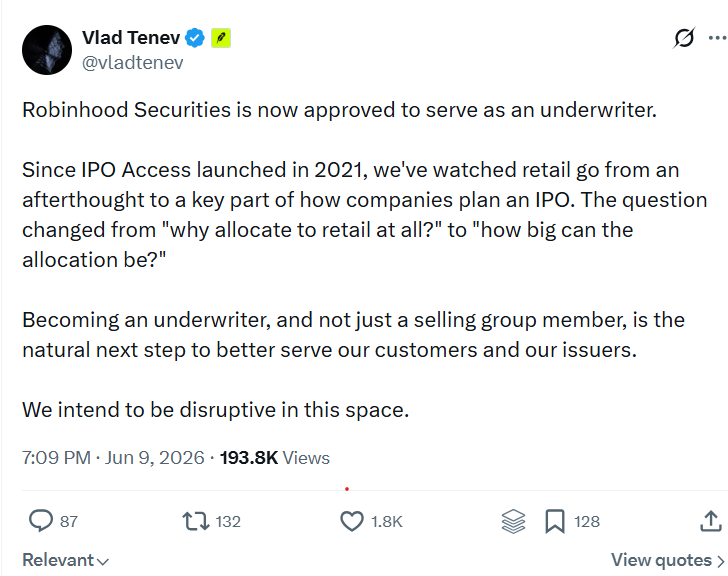
Robinhood Securities said it had secured approval to act as an IPO underwriter, moving from a distribution role into the main underwriting group alongside Wall Street banks.
Chief executive Vlad Tenev said in a Tuesday X post that Robinhood Securities is “now approved to serve as an underwriter,” without specifying which regulator granted the approval, a process that typically involves oversight from the Securities and Exchange Commission (SEC) and the Financial Industry Regulatory Authority (FINRA).
Framing the move as the “natural next step” after launching IPO Access in 2021, Tenev said the question in equity capital markets had shifted from “why allocate to retail at all?” to “how big can the allocation be?”
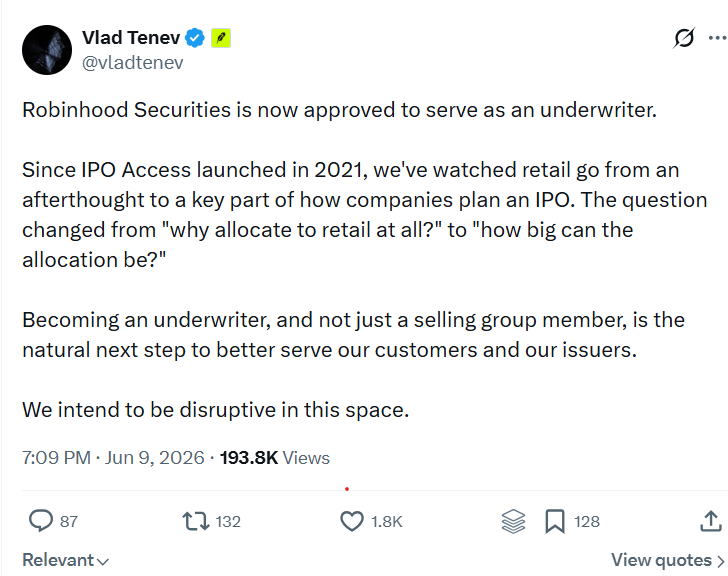
Robinhood secures underwriter status. Source: Vlad Tenev
His comments land as SpaceX reportedly considers making as much as 30% of its record-setting offering available to retail investors and as demand already runs at close to four times the planned size.
Crypto rails race for SpaceX
Robinhood’s push to sell IPO shares directly to app-based traders comes as crypto platforms race to build parallel rails around the same listings.
Major exchanges have begun offering alternative access to private markets through tokenized pre-IPO products, including Bybit’s xStocks, Kraken’s pre-IPO equity tokens and Coinbase’s secondary markets.
On the derivatives side, a Tuesday report from Talos and Coin Metrics argues that onchain pre-IPO perpetuals are becoming a meaningful price discovery venue in their own right.
Liquidity is increasingly a hybrid of retail traders, crypto-native funds and systematic market makers, according to the report, with SpaceX contracts on Hyperliquid generating billions in volume and hundreds of millions in open interest.
Related: Crypto entrepreneur Chun Wang joins SpaceX mission to Mars
The report highlights Cerebras Systems, where Hyperliquid’s pre-IPO futures tracked the stock’s eventual opening level within about 1%, while underwriters priced the IPO itself far lower.
Samar Sen, vice president of international markets at Talos, told Cointelegraph that underwriters and retail platforms like Robinhood are increasingly likely to monitor these signals for high-profile listings as a supplementary input for assessing demand, though not as a replacement for traditional book-building.
For an underwriter, pre-IPO perpetuals are “unlikely to determine retail versus institutional allocations on their own, but they can provide an additional signal around investor demand ahead of listing,” he said.
Magazine: How to fix suspected insider trading on Polymarket and Kalshi
A Citibank logo is displayed on a sign at one of their branches on Nov. 7, 2025 in Encinitas, CA.
Kevin Carter | Getty Images
Citigroup outperformed the broad market as well as some other major bank stocks Wednesday after President Donald Trump lauded the bank and its CEO Jane Fraser in a social media post.
At 9:30 a.m. ET, Trump praised Citigroup on Truth Social, writing: “Wow! CITI was ranked Number 1 in topping M&A Advisory Market by Value in Q1. Congratulations to Jane F and ALL of her great people. They’ve worked really hard! BIG comeback for CITI!!! President DONALD J. TRUMP”
The president’s post went up just as the stock market was opening, and at one point Citigroup shares touched a high of $137.12, up almost 1.8%. By the end of the day, however, Citi fell 1%, still less than JPMorgan and Goldman Sachs and the S&P 500.
It wasn’t immediately clear which investment banking league rankings President Trump was referring to. So far in 2026, for example, Goldman Sachs, JPMorgan, Morgan Stanley and BofA Securities all rank ahead of Citigroup in the latest Global M&A Advisor Ranking on Dealogic, a leading financial analytical platform.
While Goldman Sachs was the lead advisor on 196 deals worth a combined $992.3 billion this year, Citi was the lead on 97 deals worth $285.3 billion.
In fact, according to Dealogic, Citigroup has fallen to number 5 among leading mergers and acquisitions advisors in 2026, down from number 4 in 2025.
Leon Kalvaria, Citigroup’s global chair for banking, appeared on Fox Business News early Wednesday, where he was asked about Citi’s position as the leading advisor on power sector deals. Citi advised on four deals worth a combined $41.4 billion in the energy industry so far in 2026, according to Global Data Financial Deals Database.
What is clear is that Citigroup stock has outperformed the S&P 500 this year, climbing 14.3% against an S&P 500 gain of 6.2%, according to FactSet data. By contrast, Wells Fargo is down 12.1%, JPMorgan is lower by 4.1% and Bank of America is off 1% in 2026. Goldman is 13.9% higher, also trailing Citi.
Citigroup is in the midst of a multiyear turnaround under Fraser, involving streamlining business units, cutting jobs and focusing on high-margin markets and services. The stock has risen for three straight years after jumping more than 70% in 2025, almost 42% in 2024 and 19% in 2023.
Crypto World
Kalshi Reports 150+ Insider-Trading Investigations in Q1, Rolls Out Employer Checks for High-Risk Markets


Kalshi opened more than 150 insider-trading investigations in the first quarter of 2026, blocked over 100 potential insider trades using automated screening tools, and referred at least 20 cases to law enforcement. The CFTC-regulated prediction market paired the numbers Tuesday with three new… Read the full story at The Defiant

Nurse banned from profession after ‘improper’ relationship with child

The furious dispute over what caused Air India flight 171 to crash

Disciplined Retail Traders Could Beat the S&P 500, NYSE Veteran Tuchman Says



-

 Fashion5 days ago
Weekend Open Thread: Evereve – Corporette.com
-
 Crypto World5 days ago
Jensen Huang Approves Samsung, SK Hynix, and Micron for NVIDIA (NVDA) HBM4 Memory Supply
-

 Crypto World3 days ago
Anatomy of the June crypto crash: Fed, Iran, Saylor
-
 Entertainment4 days ago
The Best Mystery Series of All Time Is Surging on Streaming 30 Years After It Ended
-

 NewsBeat3 days ago
Alexander Zverev wins the French Open to finally earn a 1st Grand Slam title
-

 Tech5 days ago
Suspicious Polyfill login prompts pop up on Toshiba, Muji websites
-
 Crypto World4 days ago
Senator Cynthia Lummis Calls CLARITY Act the Most Consequential Financial Legislation of This Generation
-

 Tech6 days ago
Microsoft launches MXC, an OS-level sandbox for AI agents, with OpenAI and Nvidia already on board
-

 Tech3 days ago
Microsoft unveils seven homegrown AI models in new bid for ‘long term self-sufficiency’
-

 Business6 days ago
(VIDEO) Justin Bieber Delivers Surprise Happy Birthday Serenade to Diners at Los Angeles Mexican Restaurant
-
 Business4 days ago
The Pain Points Taking a Fragile Tech Rally Down a Notch
-
 Crypto World2 days ago
Eli Lilly (LLY) Stock Surges 4% Following Breakthrough Sleep Apnea Trial Results
-
Crypto World6 days ago
LBank Surpasses 25 Million Users Worldwide as AFA Partnership Continues to Drive Global Growth
-

 Tech5 days ago
Von der Leyen’s AI envoy pick draws conflict-of-interest fire
-

 Crypto World3 days ago
Trump’s AI Ownership Plan Could Benefit Anthropic at OpenAI’s Expense
-

 Tech5 days ago
Meta steals a tactic from Tesla and builds data centers in tents
-
 Sports1 day ago
Bangladesh beat Australia after 20 years in ODIs, register only their second win over six-time world champions | Cricket News
-

 Business3 days ago
High Stakes for Wembanyama as New York Pushes for 3-0 Lead
-

 Tech5 days ago
Hackers now exploit SolarWinds Serv-U flaw to crash servers
-

 Tech3 days ago
Notion restores access to Anthropic after service disruption
You must be logged in to post a comment Login