

Crypto World
Pi at around $0.15 today, what happens to PI if it ever becomes a GENIUS Act stablecoin?

Pi Network is trading near $0.15 today, and the real question is whether a GENIUS Act-style shift toward regulated, reserve-backed digital dollars would cap its upside or finally give it a credible path to parity with the U.S. dollar.
Summary
- Pi Network is trading around $0.15, with most models seeing either flat or modestly higher prices into 2026
- The GENIUS Act framework for fully backed, bank-style stablecoins could one day turn PI from a speculative asset into a regulated dollar proxy
- That trade-off would likely swap 10x moonshot upside for a hard $1 target and a shot at mainstream payments and savings use cases
Pi Network’s (PI) various IOU markets are currently pricing PI just under the $0.15 mark, with recent data from Bybit showing the token at roughly $0.17 and analytics platforms such as CoinCodex and CoinCheckup clustering the live price in the $0.14–$0.15 band as of late May 2026. Price prediction engines are broadly cautious: CoinCodex, for example, projects Pi could slip toward $0.11 by late June 2026, implying downside of roughly 25% from current levels, while its 2026 full-year model sees an average price near $0.11 within a $0.10–$0.15 trading channel. Longer-term forecasts are more generous, with some outlets modeling potential paths toward $0.50–$0.80 by 2030 and even north of $1 by 2050, but those curves assume PI remains a high-beta, speculative asset tied to broader crypto liquidity cycles rather than a tightly managed stablecoin.
The GENIUS (National Innovation Guidance and Establishment for American Stablecoins) Act points to a radically different future. The law is designed to create a category of fully reserved, U.S.-regulated stablecoins that hold one-to-one backing in cash or ultra-safe assets like U.S. Treasuries and live inside a bank-like supervisory perimeter. In a viral explainer circulating in the Pi community, one commentary describes how GENIUS-compliant issuers “must hold one-to-one reserves, one real dollar or super safe equivalents in protected accounts,” and notes that Pi teams are “actively exploring the path to register Pi as a GENIUS-certified stablecoin pegged to the U.S. dollar,” with the explicit goal that “one Pi equal…1 U.S.” dollar. In that vision, the Pi users have been mining for years would “no longer have a fluctuating unknown value” but would convert into a regulated digital dollar with real-world purchasing power.
What a GENIUS-style pivot would mean for PI’s price path
If Pi ever did complete that pivot—from an IOU-like, thinly traded altcoin at $0.15 into a GENIUS Act registered, reserve-backed stablecoin—the price prediction game changes completely. Under a strict one-to-one reserve model, the long-term “target” price is effectively hard-coded at $1, with variations only around market confidence, liquidity and short-term technical noise. Overnight, the question “Can PI hit $10?” becomes nonsensical; the relevant question becomes “Can PI credibly defend $1 through cycles?” That is the trade-off: accept a ceiling on upside in exchange for dramatically lower volatility, better regulatory clarity and access to mainstream payments rails and bank integrations.
From today’s roughly $0.15 spot price, even that path is non-trivial. To credibly peg PI at $1 under GENIUS rules, its backers would have to amass and ring-fence reserves that match whatever portion of the existing supply they convert into the new instrument, plus manage redemptions in a way that avoids bank-run dynamics. For existing holders who mined or bought PI on the expectation of uncapped upside, a forced migration into a $1-anchored instrument could feel like an expropriation of optionality, especially if conversion terms do not fully reward early risk-taking. On the other hand, a regulated stablecoin backed by one-to-one reserves could be the only realistic path to turning Pi from a speculative IOU priced at cents into something that merchants, payroll platforms and even conservative fintechs will actually touch.
Price prediction in a bifurcated future
In the base case where Pi never becomes a GENIUS-compliant stablecoin, the numbers on the table are modest. CoinCodex’s mid-range scenario has PI averaging around $0.11 in 2026 and potentially climbing toward $0.49 by 2030, with bullish tails that extend above $0.80 by 2040 and $1.70 by 2050, assuming the project stays alive and the broader crypto cycle cooperates. Other forecasters sketch similar arcs, generally keeping PI below $0.20 in the near term but allowing for multi-bagger potential over a decade if adoption, listings and network effects materialize. In that world, Pi is another high-risk token riding crypto’s liquidity waves, not a serious monetary instrument.
Under a GENIUS-style pivot, the price path compresses. The bull case is not a 10x from $0.15 to $1.50; it is a roughly 6–7x move to $1 followed by a plateau where returns come from using Pi in real-world commerce, payments and yield-bearing wrappers rather than capital gains on the token itself. The bear case shifts too: instead of grinding down toward zero in a liquidity winter, a fully reserved, well-governed Pi stablecoin would either hold the peg or fail outright if governance, reserves or regulation blow up. For now, Pi trades and is modeled as if the GENIUS Act is background noise. If the project ever actually crosses that regulatory Rubicon, every price prediction you see today will need to be rewritten from scratch.



CoinEx has rejected claims that it helped Iranian state-linked entities move funds through its crypto exchange after a Wall Street Journal report cited $3.84 billion in Iran-linked transactions since 2019.
Summary
- CoinEx denies state-linked Iran ties while promising stronger sanctions screening after WSJ’s $3.84b report.
- The exchange says on-chain flows alone do not prove platform knowledge or active support.
- The response comes as U.S. sanctions pressure rises around Iranian crypto platforms and fund routes.
The exchange said it had “never established any commercial relationship” with Iranian government-related entities, Iranian domestic exchanges, the Revolutionary Guard, or sanctioned parties. CoinEx said it does not have an office or operating entity in Iran.
CoinEx also said its official domain had been blocked in Iran since 2021 after it was blacklisted by the Iranian government. The exchange said that fact shows it was not a platform backed or recognized by Iranian authorities.
The company said some users promoted CoinEx through its global referral program, but it denied organizing Iran-focused promotion. It said ordinary user activity should not be treated as proof of state-level sanctions evasion.
CoinEx disputes on-chain reading
The WSJ report said investigators traced unusual transactions from two wallets controlled by Iran’s central bank. It also said further tracing showed links to funds stolen from Bybit by North Korean hackers.
CoinEx said the report relied too heavily on on-chain interpretation. The exchange said blockchain transactions are open and traceable, but a fund passing through a platform does not prove that the platform knew about, supported, or joined the related activity.
The company also challenged the reported aggregate amount. It said combining two-way fund flows into one number and presenting it as funds “processed” by CoinEx was misleading.
CoinEx said third-party blockchain analytics platforms can reach different results. It added that on-chain attribution has limits and depends on how analysts interpret wallet links and transaction paths.
Bybit hack reference draws response
CoinEx also addressed the Bybit theft cited in the WSJ report. It said it helped Bybit block accounts and freeze assets after learning about the incident. CoinEx said it would conduct an internal review of the transactions mentioned in the report.
WSJ said investigators linked the Iranian central bank wallet trail to assets stolen from Bybit by North Korean hackers. The Bybit hack remains one of the largest crypto thefts reported by the industry.
In a previous article, crypto.news discussed how the Bybit hacker laundered more than half of the stolen Ethereum in less than a week, mainly through THORChain swaps. That activity kept attention on cross-platform money movement after large thefts.
CoinEx said it had also been a hacking victim in 2023, when North Korea-linked actors were reported to have stolen funds from the exchange. In another previous article, crypto.news discussed CoinEx’s plan to resume services after the $70 million Lazarus-linked hack.
Compliance measures expanded
CoinEx said it started a full review and exit process for Iran-related risk exposure after sanctions against Iranian domestic exchanges. The exchange said it strengthened checks for Iranian users, blocked registrations from Iranian regions, and started compliance off-boarding for identified accounts.
It also said it expanded geo-fencing, access restrictions, KYT monitoring, sanctions screening, and transaction freezes for high-risk activity. CoinEx said it would restrict or freeze accounts and assets tied to any sanctioned entity or person.
The response comes during a broader U.S. sanctions push against Iranian crypto activity. As previously reported, the U.S. Treasury sanctioned Nobitex, Wallex, Bitpin, and Ramzinex, accusing them of helping sanctioned entities access digital asset markets.
Treasury said Nobitex processed more than 50% of Iranian digital asset inflows in 2025. It also accused the exchange of helping Iranian regime insiders access international platforms and move funds across jurisdictions.
CoinEx said it will keep investing in KYC, AML, sanctions screening, and on-chain risk monitoring. The exchange also said it would respond to concerns from users, partners, and authorities.

Indonesia’s financial regulator has moved to tighten rules governing “finfluencers,” requiring certified competency for individuals who recommend crypto and other digital financial assets. The change signals a broader push to bring social-media promotions within formal financial-consumer protection and licensing frameworks.
Under Financial Services Authority Regulation (POJK) No. 6 of 2026, announced Wednesday, individuals who provide recommendations about digital assets must hold competency certifications unless they are already covered by a separate licensing requirement. The regulation also limits what influencers can recommend and sets conditions on how marketing is carried out and by whom.
Key takeaways
- Competency certification required: POJK No. 6 of 2026 introduces competency certification obligations for influencers recommending digital assets.
- Scope restricted to authorized listings: Influencers may recommend only digital assets that are listed on authorized exchanges.
- Licensed service-provider rule: Any service providers recommended by influencers must be licensed.
- Marketing must route through regulated businesses: Promotions must be carried out by regulated financial services businesses responsible for the content and distributed via their official communication channels.
Indonesia’s POJK No. 6 of 2026: what changes
Indonesia’s Financial Services Authority (OJK) is framing the regulation as part of its expanded oversight of financial promotions on social media. POJK No. 6 of 2026 focuses on the behavior of “financial information deliverers,” which includes influencers who promote crypto and other digital financial products.
Practically, the regulation creates a compliance pathway and a gatekeeping mechanism. Influencers providing recommendations about digital assets are expected to obtain competency certification unless they fall under another licensing regime. This approach differs from rules that rely only on whether a promoter is formally acting as a licensed intermediary; it instead adds a targeted competency requirement for social-media recommendation activity.
The regulation also narrows the promotional universe. Influencers are permitted to recommend only digital assets that appear on authorized exchanges, which reduces the risk of promoting unapproved offerings. In addition, any service provider promoted alongside such recommendations must be licensed, tying influencer marketing to the status of the underlying entities offering access to regulated services.
Finally, POJK No. 6 of 2026 imposes content and channel controls. Marketing campaigns must be run through regulated financial services businesses, which are responsible for the promotional content. The campaigns must then be distributed through those businesses’ official communication channels. For compliance teams, this structure is significant: it places accountability on regulated firms to ensure that promotional material is aligned with requirements and that distribution does not occur solely through third-party influencer channels outside the regulated firm’s control.
Why certification and channel rules matter for compliance
For institutional stakeholders, influencer promotion requirements are not merely reputational issues—they can create legal exposure, distribution-risk, and documentation gaps across marketing operations.
Certification requirements can affect onboarding and contracting. Firms that engage finfluencers may need to verify whether individuals recommending digital assets have the required competency certification or whether their activities fall under an alternative licensing framework. This can change due diligence procedures, recordkeeping expectations, and the compliance review workflow for campaigns.
Authorized-asset constraints also alter governance. The requirement that influencers recommend only assets listed on authorized exchanges means that firms must maintain an up-to-date inventory of eligible assets and align campaign content with that list. It introduces an ongoing monitoring obligation, especially if exchange authorization status changes or if new assets are promoted in response to market developments.
Licensed-provider requirements shift scrutiny toward partnerships. Even where an influencer’s role is limited to promotion, POJK No. 6 of 2026 conditions recommendations on the licensing status of service providers involved in the promoted services. That makes it necessary for regulated businesses to verify licensing and ensure that contracts with marketing partners do not result in promotion of non-compliant counterparties.
Channel control and content responsibility are likely the most operationally consequential element. By requiring that campaigns be distributed through regulated financial services businesses’ official channels, the regulation may limit the ability of influencers to independently disseminate promotional materials. This creates clearer lines of responsibility for compliance monitoring and supports a record trail for regulators and internal audit.
Indonesia’s move in a broader finfluencer enforcement trend
Indonesia is not acting in isolation. Several jurisdictions have tightened their approaches to influencer marketing tied to regulated financial products, reflecting a wider recognition that social-media endorsements can function as financial promotion and, in some cases, as de facto advice or transaction facilitation.
In March 2022, the Australian Securities and Investments Commission (ASIC) stated that influencers may require a financial services license when content constitutes financial advice or helps arrange transactions. ASIC also highlighted potential liability risks for licensed financial firms that engage influencers who engage in misconduct—an important reminder that regulated entities can face enforcement consequences tied to how they structure third-party arrangements.
In the UK, the Financial Conduct Authority (FCA) issued guidance in 2024 indicating that unauthorized influencers may commit a criminal offense when promoting regulated financial products without appropriate approval from an authorized firm. In a later enforcement push, the FCA led an international “week of action” on April 24, reporting participation from 17 regulators and describing account-takedown efforts affecting a large volume of illegal financial advertisements reaching substantial social media audiences.
Elsewhere in the region, the Philippines introduced crypto-specific marketing restrictions in 2025, covering endorsements, sponsored content, social media posts, podcasts, livestreams, and certain paid educational content. Under those rules, crypto asset service providers must disclose authorized third-party marketers to the Philippine Securities and Exchange Commission—again reinforcing the theme that regulators are seeking greater visibility and accountability in the influencer ecosystem.
Potential implications for market participants in Indonesia
POJK No. 6 of 2026 is likely to change how firms in Indonesia plan, approve, and document digital-asset promotional activities. Companies operating as regulated financial services businesses may face pressure to adjust marketing governance so that influencer campaigns are routed through official channels and supported by compliance oversight of both the content and the parties involved.
For exchanges and other market intermediaries, the authorized-list condition creates a compliance dependency on exchange authorization status. For platforms and service providers partnering with influencers, the licensing requirement means that marketing arrangements must be treated as a regulatory-sensitive activity, not simply a branding exercise.
Cross-border considerations also matter. Influencer marketing often spans jurisdictions, and promotional content created for one market can be repurposed elsewhere. Firms will need to assess how Indonesian requirements interact with local rules in other countries—particularly where the same campaign is distributed through global social-media accounts that may not distinguish between audiences subject to different regulatory standards.
Closing perspective
Indonesia’s POJK No. 6 of 2026 adds certification, licensing, and channel controls aimed at reducing compliance risk from crypto promotions on social media. Market participants should monitor OJK implementation details—such as how competency certification is administered and verified—and align influencer contracting, asset eligibility checks, and distribution workflows accordingly.
Crypto World
Request Network Introduces One-Click Cross-Chain Mass Payouts and Expands Wallet Screening With Merkle Science
[PRESS RELEASE – Zug, Switzerland, June 25th, 2026]
Anyone can now execute mass payouts across EVM chains and Tron from a single platform and can choose between multiple wallet screening providers.
Just three weeks after releasing major upgrades for crypto payment collection, the Request Network Foundation today announced another expansion of its stablecoin payment platform. The release introduces one-click mass payouts on both EVM and Tron, alongside built-in bridging and token swapping across EVM chains. The update also expands compliance capabilities through the integration of Merkle Science as an additional wallet screening provider.
Together, these capabilities reinforce Request Network’s vision of providing businesses with a simpler, more scalable, and more resilient way to operate stablecoin payments globally.
Users Can Now Disburse at Scale in One Click From a Single Wallet Without Bridging or Swapping
Stablecoins are already widely used to disburse salaries, commissions, affiliate rewards, bug bounties, supplier payments, and customer refunds or withdrawals across the world. While settlements are now faster and cheaper in stablecoins compared to fiat, the operational processes needed to send funds remain complex as recipients usually require payments on multiple chains and in multiple currencies. This has forced finance teams to initiate multiple transactions in separate currencies and from multiple wallets.
Request Network now abstracts away this fragmentation, allowing anyone to initiate mass payouts from a single wallet in a single currency to pay recipients across the top 6 EVM chains (Ethereum, Base, Arbitrum, Optimism, Polygon, and BNB Chain) in USDC and USDT.
Through a single signature, a mass payout can now be initiated even if the individual transactions need to be bridged and swapped to reach their recipient. Request Network protocol automatically retrieves and batches bridge and swap quotes in order to funnel every payment of a batch to its correct destination in just one approval.
To simplify the process further, Request Network also allows any recipient to set and update their payment preferences so payments are always routed to where they should go.
This represents one of the biggest breakthroughs in cross-chain and swapping abstraction, bringing payers and recipients closer than ever before, regardless of the blockchain or currency they trust.
Mass Payouts Now Available on Tron
Alongside EVM mass payouts, Request Network also announced the support of mass payouts on Tron, becoming the first protocol to combine both capabilities.
Thanks to this release, anyone can now send USDT to multiple recipients on Tron in a single transaction, unlocking large-scale payouts on one of the most used chains in Asia, Africa, Eastern Europe, and Latin America.
With this release, anyone can now manage all stablecoin payouts globally from the Request Network protocol.
More Choice for Wallet Screening
Alongside mass payouts, Request Network also announced a partnership with Merkle Science to offer additional wallet screening providers on the protocol.
As a reminder, Request Network offers built-in wallet screening to protect its users from high-risk wallet interactions. When enabled, this feature allows payments to be executed only if the payer or recipient satisfies the preset screening policies, helping businesses to avoid exposure to high-risk wallets which may lead to asset freezing or difficulties off-ramping to fiat.
By expanding its integration of Merkle Science, Request Network just became one of the safest ways to receive crypto onchain, while accommodating for recipients’ preferences.
Tristan Wallaert, CEO of the Request Network Foundation, said: “Stablecoins allowed money to move globally without the usual fiat constraints, but executing payments at scale remains a bottleneck and is forcing users to rely on payment service providers. Anyone should be able to pay by himself hundreds of payments across chains in just a single operation.High risk wallets exposure has tarnished the crypto reputation recently, if we want to provide the best protection to blockchain users they need to be able to use the best screening providers. Sending and receiving payments must become intuitive and safe if we want stablecoins to be a real alternative to fiat.”
Mriganka Pattnaik, CEO of Merkle Science, said: “As stablecoin payments become more global and cross-chain, compliance needs to become just as seamless as the payment experience itself. Our integration with Request Network helps businesses screen wallets with greater confidence, reduce exposure to high-risk activity, and scale onchain payments without compromising trust or operational efficiency”.
About Request Network
Since 2017, Request Network has developed, educated about, and promoted the use of open-source, decentralized and permissionless protocols that provide infrastructure for on-chain payments and related financial flows.
Request Network allows anyone to send and receive crypto at scale, across chains, without custodial intermediaries. The protocol is developed by a community-funded foundation whose mission is to make crypto payments accessible while protecting its participants.
To date, more than $2 billion has moved thanks to Request Network technology.
About Merkle Science
Merkle Science provides blockchain analytics and crypto compliance solutions that help businesses detect, investigate, and prevent financial crime across digital assets. Its platform supports wallet screening, transaction monitoring, risk intelligence, and investigations, enabling crypto platforms, financial institutions, and payment providers to manage onchain risk and meet compliance requirements at scale.
The post Request Network Introduces One-Click Cross-Chain Mass Payouts and Expands Wallet Screening With Merkle Science appeared first on CryptoPotato.


Decentralized Finance (DeFi) total value locked (TVL) has fallen every month of 2026. The TVL has dipped 39%, driven by a broad market correction and a run of protocol exploits.
Among the top 10, only two chains grew their TVL in 2026, bucking a downtrend that pulled down every other major network.
What Is Behind the TVL Slide
In its latest report, CryptoRank noted that DeFi TVL dropped from roughly $115 billion in January to about $70 billion. The decline mirrors a broader market reversal.
After hitting an all-time high in October, Bitcoin (BTC) has dropped by more than 50%, with other major assets also recording steep losses.
Follow us on X to get the latest news as it happens
Meanwhile, most leading chains lost ground as capital exited. Ethereum (ETH), which leads the top-10 chains, saw a 43% drop, leaving its DeFi base at $38.91 billion. Arbitrum sank 55%, and Plasma collapsed nearly 75%.
Only two large networks held firm. TRON grew TVL by about 5%, supported by its role in Tether (USDT) settlement and stablecoin lending. Hyperliquid rose roughly 7% on perpetuals trading and its expanding HyperEVM ecosystem.
Crypto Hacks Add Pressure as Q2 Sets a Record
The report added that exploit frequency also affected user confidence. The second quarter produced 85 incidents and about $775 million in losses.
That makes it the most active quarter in the dataset for exploits. Overall, in 2026, the space experienced 121 hacks resulting in $942 million in losses.
“High-profile incidents involving major protocols reinforced concerns around security and may have accelerated capital outflows from DeFi,” CryptoRank stated.
Two April attacks drove most of the damage. The Drift Protocol breach cost $295 million, and the KelpDAO exploit followed at $293 million. Together, they accounted for more than half of all 2026 losses.
The KelpDAO incident hit lending hardest. Aave’s TVL fell from $26.4 billion to $14.3 billion over a few days, a 46% drop in deposits.
Nonetheless, the report highlighted that the current downturn still looks milder than the previous cycle. DeFi TVL collapsed by more than 70% in seven months, following its late-2021 peak near $177 billion.
A wider spread of capital across stablecoins, real-world assets, and derivatives may have cushioned the sector against sharper falls.
Subscribe to our YouTube channel to watch leaders and journalists provide expert insights
The post DeFi Total Value Locked Slides Every Month in 2026 to $70 Billion appeared first on BeInCrypto.
The controversial cryptocurrency project has recently unveiled numerous ecosystem updates that, unfortunately for the Pioneers, have failed to trigger a decisive rebound in PI.
All eyes are now set on June 28, which could deliver some groundbreaking announcements that could finally result in a major price increase.
‘Stay Tuned’
Pi2Day (June 28) is a symbolic day for Pi Network’s community since it represents the mathematical constant 2π. For several weeks, Pioneers have debated whether the Core Team is preparing to roll out significant updates on that date, with some floating the idea of a potential Binance listing.
Recently, Pi Network added fuel to the rumors by describing Pi2Day as a milestone-driven event and highlighting that last year’s edition included Pi App Studio, Directory Staking, Node updates, and other releases.
“Stay tuned on June 28 for what’s to come,” it teased.
Shortly after, the team reminded that Pi2Day marks the final deadline for the Vibe Coder campaign. The initiative aims to bring AI-driven applications into the project’s real distribution network through Pi App Studio. June 28 is also the last day of the Pi Launchpad testing period, which features the new test token, SLICE.
“Both initiatives help contribute to the growth, development, and use of the Pi ecosystem and its utilities,” the Core Team stated.
As usual, the announcements were met with mixed feelings by the community. Some said they are excited about Pi2Day and look forward to the potential updates, while others stressed that the migration to mainnet and KYC procedures remain hurdles that need to be addressed as a priority.
PI Price Outlook
The token remains under heavy pressure, falling alongside the reset of the crypto market. Currently, PI is worth around $0.127 (per CoinGecko), which is quite close to the all-time low witnessed at the start of June and represents a staggering 96% decline since the historic peak of $3 witnesses in February 2025.
Earlier this week, some analysts spotted the formation of a classic “head and shoulders pattern” on PI’s price chart, which could be a precursor of a further pullback.
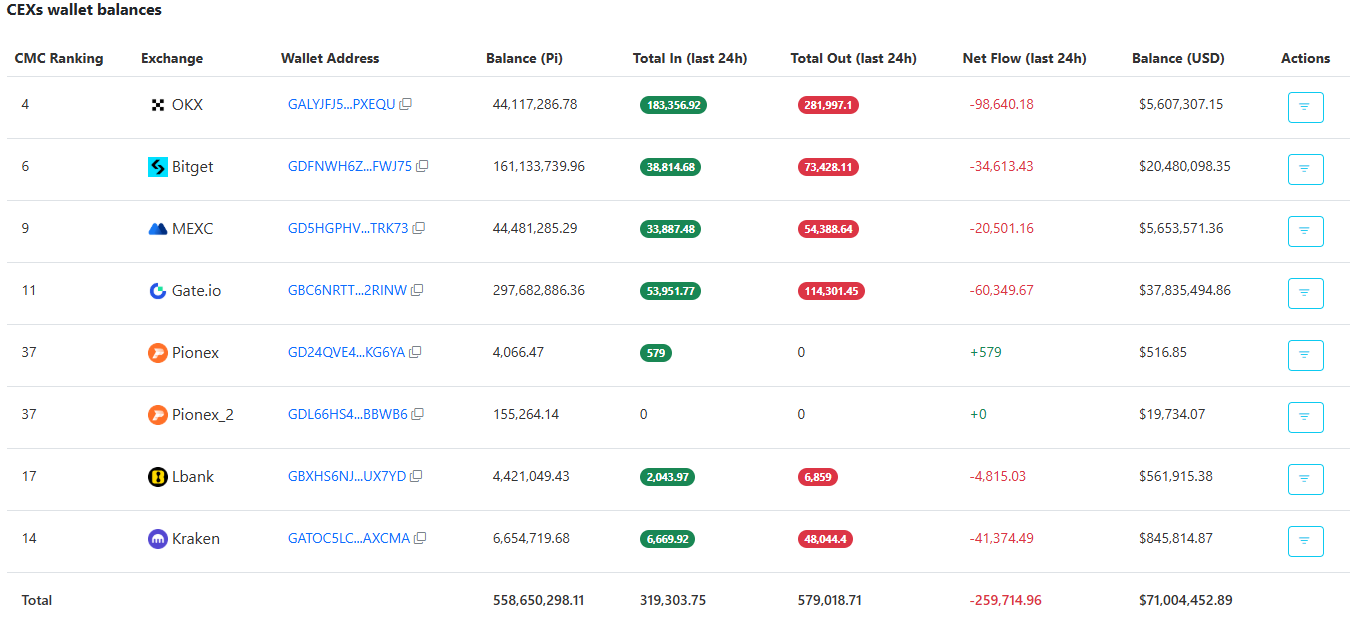
The rising amount of coins stored on crypto exchanges is another issue. The figure has risen to almost 560 million, signaling that many investors have moved their holdings from self-custody toward centralized platforms, thereby increasing immediate selling pressure.
The post Pi Network (PI) Teases Major Updates This Week: What Could Be Next? appeared first on CryptoPotato.

Kanga, a Poland-founded crypto exchange, says it has secured a Markets in Crypto-Assets Regulation (MiCA) license in Latvia—an approval it says will let it operate across the European Union through passporting.
In a Wednesday statement shared with Cointelegraph, Kanga’s operator, SIA AlphaRoute, said it received a Class 3 MiCA license from the Bank of Latvia after the regulator’s Supervisory Committee approved the authorization. The license was granted on June 18 and, according to the exchange, authorizes services including crypto custody, trading, and transfers across the EU.
Key takeaways
- Kanga (via SIA AlphaRoute) obtained a Class 3 MiCA license from the Bank of Latvia, enabling EU passporting.
- The authorization covers core exchange activities including custody, trading, and transfers, per the exchange’s announcement.
- Kanga says it began Latvia pre-licensing in November 2025 to prepare for MiCA’s transitional period.
- Poland remains without MiCA implementation legislation as the EU’s July 1 transitional deadline approaches, due in part to a recurring legislative deadlock.
Latvia licensing sets up EU-wide expansion
MiCA’s framework is designed to harmonize crypto regulation across the EU, but implementation schedules and national legislative processes have differed. Kanga’s move to obtain licensing in Latvia effectively positions it to serve EU customers under a compliant path while other jurisdictions—such as Poland—remain in flux.
According to Kanga’s statement, the relevant authorization was granted after the Bank of Latvia’s Supervisory Committee approved SIA AlphaRoute’s application. The exchange emphasized that the license permits it to provide crypto services across EU member states once passporting mechanisms are used.
Kanga also described how it planned for the regulatory shift. Its chief executive, Dominik Tomczyk, said the company began the pre-licensing process in Latvia in November 2025 after reviewing multiple jurisdictions. He framed the decision around using MiCA’s transitional period to ready internal systems and the organization for the new rules.
“From the very beginning, we knew that we had to use the transitional period provided for under the MiCA regulation to prepare the organisation to operate within the new regulatory framework,” Tomczyk said.
The exchange added that it will share additional information about operational changes and service terms through its official communication channels, pointing to a likely period of adjustment for customers as it aligns offerings with MiCA requirements.
Why passporting matters as MiCA deadlines loom
For operators, MiCA passporting is often the difference between being able to scale across borders quickly and being forced to run separate regulatory processes in each country. By securing a Class 3 license in Latvia, Kanga is effectively aligning itself with an EU-wide compliance route rather than waiting for national legislation elsewhere to catch up.
The timing is notable. The EU’s transitional deadline is set for July 1, and the broader compliance landscape remains uneven across member states. Kanga’s license—granted June 18—arrives shortly before that deadline, during a window when exchanges and custody providers may be reassessing market access and legal certainty.
That context is especially relevant for Poland-based firms. If a home market delays implementation, companies may seek licensing in other EU jurisdictions to avoid service uncertainty and to continue serving EU customers under a stable regulatory framework.
Poland’s legislative deadlock continues
While Kanga points to regulatory progress in Latvia, its home country still faces obstacles to MiCA implementation. According to earlier coverage from Cointelegraph, Poland has remained without MiCA implementation legislation ahead of the EU’s July 1 transitional deadline, with lawmakers attempting to break a deadlock after the Polish president vetoed a government-backed crypto bill three separate times.
Cointelegraph reports that President Nawrocki vetoed the bill for a third time on June 11, arguing that successive versions failed to address his objections—especially provisions he considered overly burdensome for crypto companies. Following the veto, members of the Poland 2050 party, part of Prime Minister Donald Tusk’s governing coalition, reportedly submitted a new proposal incorporating changes requested by the president.
As described by the bill’s sponsors, the latest proposal would reduce some fees, remove certain regulatory provisions, and make the overall framework less restrictive for crypto firms. Poland 2050 has reportedly called for the legislation to be fast-tracked through parliament.
At the same time, regulatory pressure in Poland is not limited to legislative timing. The country’s crypto sector has also faced increased scrutiny following a fraud investigation into Zonda, which Cointelegraph previously reported as Estonia’s largest crypto exchange. Prosecutors reportedly estimate customer losses exceed 350 million zlotys (about $92.7 million). Developments tied to that case may affect how regulators and lawmakers approach compliance and oversight of crypto platforms.
What to watch next for Kanga and EU MiCA adoption
Kanga’s Latvia license provides a concrete example of how crypto firms may navigate MiCA’s rollout when national implementation is delayed. Investors and customers will likely want to monitor how Kanga communicates specific operational changes, and whether Poland’s MiCA bill ultimately passes in the near term—since the pace of home-country legislation can still influence competition, costs, and compliance strategies for exchanges headquartered in Poland.
With the EU transitional deadline approaching, the next key signal will be whether other exchanges follow similar cross-border licensing paths—or whether Poland’s legislative process finally catches up, narrowing the gap between “ready under MiCA” and “still waiting for national law.”


Nouriel Roubini says the overwhelming majority of crypto projects are built on nothing, and that nearly two decades of blockchain development stemming from Bitcoin has produced exactly one legitimate use case.
Speaking on the BeInCrypto Expert Council podcast alongside Atlas Capital CEO Reza Bundy and Securitize founder Carlos Domingo, the economist known as “Dr. Doom” delivered a blunt post-mortem on the ICO era and the altcoin market as a whole.
A Massive Failure Rate With Fraud Baked In
Roubini’s accounting of the ICO boom left little to salvage. Of the 20,000 Initial Coin Offerings (ICOs) ever launched, he said the damage runs far deeper than market losses alone.
“There have been 20,000 ICOs, 80% of them were scam in the first place… A lot of stuff is backed by nothing. It’s totally vaporware. It’s based just on faith.”
The math compounds from there. Of the remaining non-fraudulent projects, Roubini argues 70% lost all their value. Then, among the small fraction still standing, including most of the top 10 cryptocurrencies, they have shed 50 to 60% from their all-time highs.
Indeed, Bitcoin dropped below $60,000 briefly on June 24, more than 50% down from its all-time high of $126,080.
His verdict: nearly everything built on-chain represents a speculative bet on faith rather than a claim on any real asset or utility. The history of ICO fraud bears this out, from pump-and-dump schemes at launch to projects that vanished entirely after raising funds.
Roubini has levelled similar criticism at the crypto space for years, including a 2019 face-off with Ethereum creator Vitalik Buterin in which he called the ecosystem overcentralized and riddled with manipulation. He also testified before the US Congress, calling blockchain the least useful technology in human history.
Stablecoins: One App Left Standing
Despite writing off the vast majority of the market, Roubini identified one product that genuinely works.
“After almost 20 years of Bitcoin, what’s the big killer app in crypto? Stablecoins.”
His endorsement comes with a caveat. Stablecoins, he argues, are simply a digital wrapper around fiat currency and therefore carry the same debasement risks. They work as a payment rail, particularly for users in high-inflation economies, but they generate no real return and offer no hedge against the monetary risks that originally made crypto appealing.
That distinction, useful for payments but limited as a store of value, underpins his argument for tokenized real-world assets as the next step.
The podcast appearance marks a notable evolution for Roubini, who previously dismissed all crypto as fraud in public forums. His position now separates speculative tokens, which he still regards as backed by nothing, from tokenized assets with verifiable, real-world collateral.
If Roubini’s numbers hold, the altcoin market’s long-run track record amounts to a near-total loss across 20,000 projects, with stablecoins as the only durable output of the entire experiment.
The post Dr. Doom Calls Most Crypto Vaporware Backed by Nothing, Except One Use Case appeared first on BeInCrypto.
Kanga, a crypto exchange founded in Poland, said it has obtained a Markets in Crypto-Assets Regulation (MiCA) license in Latvia, allowing it to passport its services across the European Union.
The exchange’s operator, SIA AlphaRoute, received a Class 3 MiCA license from the Bank of Latvia after its Supervisory Committee approved the authorization, according to a Wednesday statement shared with Cointelegraph.
The license was granted on June 18 and authorizes the company to provide services, including crypto custody, trading and transfers, across the EU, said the exchange.
Kanga’s approval comes as Poland remains without MiCA implementation legislation ahead of the EU’s July 1 transitional deadline, with lawmakers still trying to break a deadlock following three presidential vetoes.
Source: Kanga
Kanga’s path to EU-wide operations
Kanga began the pre-licensing process in Latvia in November 2025 after reviewing several jurisdictions, according to SIA AlphaRoute CEO Dominik Tomczyk.
“From the very beginning, we knew that we had to use the transitional period provided for under the MiCA regulation to prepare the organisation to operate within the new regulatory framework,” Tomczyk said.
Related: Binance withdraws Greece-filed MiCA application
The company said it will provide customers with additional details about operational changes and service terms through its official communication channels.
Poland’s MiCA deadlock
President Nawrocki vetoed a government-backed crypto bill for a third time on June 11, saying successive versions failed to address his objections, including provisions he considered overly burdensome for crypto companies.
Members of the Poland 2050 party, part of Prime Minister Donald Tusk’s governing coalition, have since reportedly submitted a new proposal incorporating several changes requested by the president.
According to the bill’s sponsors, the proposal would reduce some fees, remove certain regulatory provisions and make the framework less restrictive for crypto companies. Poland 2050 reportedly called for the legislation to be fast-tracked through parliament.
Poland’s crypto sector also faces heightened scrutiny following a fraud investigation into Zonda, the country’s largest crypto exchange, where prosecutors estimate customer losses exceed 350 million zlotys (about $92.7 million).
Magazine: Bitcoin decouples from tech stocks, Ether eyes ‘selling wave’: Market Moves
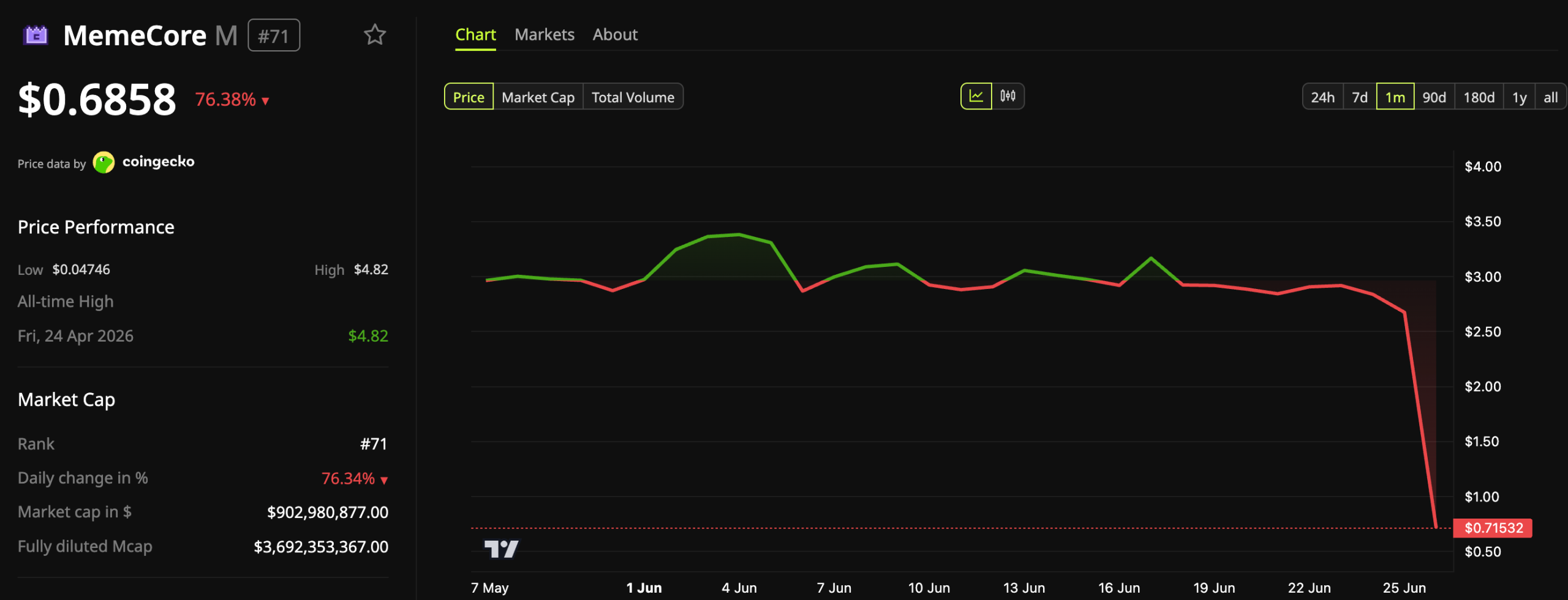
MemeCore’s M token shed 76% of its value on Thursday in a sudden selloff that handed traders no clear reason.
The crash wiped billions from the token’s valuation and pushed its market capitalization below $1 billion.
MemeCore Token Falls From $2.66 to $0.5 in One Session
According to BeInCrypto Markets data, the meme coin tumbled from $2.659 to an intraday low of $0.50 before paring some losses. M traded near $0.6858 at press time, down 76.38% on the day.
Follow us on X to get the latest news as it happens

The token’s fully diluted valuation (FDV) fell to roughly $3.69 billion. Its market cap dropped to about $903 million, from around $3.5 billion before the slide.
Thursday’s decline left the token ranked 72nd by market capitalization. The wider crypto market slipped just 1.64% over the same window. M’s loss far outpaced that move.
ZachXBT’s Warnings Resurface
Onchain investigator ZachXBT addressed the crash in a Telegram post, pointing to his past warnings about the meme coin.
“Myself, Mlm, & Wazz previously highlighted a number of red flags on X about MemeCore with inorganic supply concentration and deceptive practices by its team to boost user numbers,” he said.
ZachXBT cited Arkham data showing no onchain transfer above $50,000 on BNB Smart Chain (BSC) in more than two weeks. Dexscreener data indicated under $100,000 in total onchain liquidity there.
“The community needs answers from Binance & Bybit about why M was listed for perps and why Kraken & Bitget listed M spot as these highly manipulated tokens continue to give our industry a bad reputation and extract from retail,” the investigator added.
In April, ZachXBT publicly questioned Kraken’s decision to list M for spot trading. He asked how the token cleared the exchange’s due diligence.
BeInCrypto has reached out to MemeCore and the exchanges for comment.
Subscribe to our YouTube channel to watch leaders and journalists provide expert insights
The post MemeCore Token Drops Below $1 Billion Market Cap After 76% Crash appeared first on BeInCrypto.

Binance says it is withdrawing its application for Markets in Crypto-Assets Regulation (MiCA) authorization in Greece and plans to seek approval in another EU member state, days ahead of the July 1 deadline for firms to become licensed or take steps to scale back their EU operations. The decision comes as the European regulator signals that crypto service providers lacking authorization after the transitional period ends must act immediately to wind down activity within the bloc.
In a statement on Wednesday, Binance said it would announce the new member state publicly once it is ready. Binance’s head of Europe and the United Kingdom, Gillian Lynch, told Reuters that the exchange is “not leaving Europe” and would pursue authorization elsewhere if the Greek process does not progress.
Key takeaways
- Binance has withdrawn its MiCA authorization application with Greece’s Hellenic Capital Market Commission (HCMC), aiming to seek authorization in another EU member state.
- The move occurs just before MiCA’s July 1 transitional cutoff, when ESMA expects unauthorized crypto service providers to begin winding down EU activities.
- Binance warned that some users may be affected and that it will communicate with impacted accounts, while stating that user funds remain protected.
- Licensing uncertainty may influence token issuers indirectly, as authorized exchanges increasingly gatekeep MiCA white-paper notifications and listing readiness.
MiCA authorization withdrawal and the new EU strategy
Binance’s stated objective is to remain compliant with EU requirements as the MiCA framework moves into its post-transitional enforcement phase. The exchange said it is taking the necessary steps before July 1 to comply with applicable obligations. It did not specify which member state it plans to approach next.
According to Reuters, Lynch said Binance contacted other regulators but submitted a formal application only in Greece. Binance reportedly held discussions with several authorities, including Ireland and Latvia, before focusing on Greece. Reuters also reported that some regulators expressed concerns related to Binance’s past money-laundering penalties, its international operating structure, and risk-related cultural factors.
For compliance teams and institutional stakeholders, the key point is that MiCA licensing is not a single, centralized EU process for market access. Authorization is assessed by national competent authorities and embedded in national supervisory relationships, which can lead to different outcomes across jurisdictions even within the same regulatory regime.
Why the July 1 deadline is operationally material
MiCA’s transitional period ends on July 1. In a public statement on Tuesday, the European Securities and Markets Authority (ESMA) said that crypto service providers that remain unauthorized by the deadline must take “immediate” steps to wind down their EU activities. ESMA’s wording effectively creates a near-term compliance forcing function: firms must either secure authorization or implement drawdown and cessation measures for EU-facing operations.
Binance’s announcement therefore has immediate operational implications. The company did not provide additional detail beyond saying it expects some users could see changes. It said it will communicate directly with affected users and that its priority is to minimize disruption. It also reiterated that all user funds remain safe and secure.
However, unresolved questions remain for regulated counterparties and compliance monitors. Withdrawal of an application can create uncertainty about timelines and the scope of what activities remain permissible during the transition to a new authorization path. For institutions that rely on regulated on-ramps and exchange counterparties, this increases the importance of verifying current licensing status and conducting ongoing controls around service availability and permitted services in specific EU jurisdictions.
Potential effects for European market access
Even if MiCA licensing constraints do not necessarily eliminate EU demand, the regulatory transition can influence how euro-denominated trading access evolves. CryptoQuant analyst Maartunn told Cointelegraph that euro pairs account for about 1% of Binance’s global spot trading volume, indicating that a European licensing setback may have limited impact on overall business volume.
Still, Binance remains a significant venue for euro trading. CryptoQuant data cited in the reporting suggested Binance handled roughly $100 million to $250 million in daily euro-pair volume in 2026, with occasional spikes of about $600 million. The same data placed Binance second in share of euro-denominated spot trading at an estimated 18.5%, behind Kraken’s estimated 43.3% share.
These figures matter for institutional monitoring because MiCA authorization affects not only retail access but also how regulated market participants evaluate venue risk. Where firms have counterparties spread across multiple exchanges, licensing uncertainty may change routing decisions, hedging practices, and settlement reliability—even without direct changes to token market fundamentals.
MiCA compliance as an ecosystem function for exchanges and token issuers
Binance’s licensing challenge may reverberate beyond trading venues. Authorized exchanges increasingly act as compliance gatekeepers for token issuers seeking MiCA-related documentation readiness, including work tied to white-paper notifications and listing processes.
In a LinkedIn post, Ryan King, creator of the EU Crypto Register, said he tracked at least 380 of 867 white-paper entries where notifications were made by third parties rather than the token issuers themselves. He reported that Kraken, LCX, OKX, and Bitstamp together accounted for 271 of those third-party notifications, representing about 31% of the total.
King told Cointelegraph that this approach can be “symbiotic,” because exchanges employ MiCA-trained compliance teams, maintain regulator relationships, and have access to large law firms. He said exchanges increasingly request white papers during onboarding and may offer to prepare documentation, even for tokens covered by transitional arrangements. According to King, one exchange allegedly told a token project to “fill it in and we’ll handle the rest,” reflecting the practical role exchanges can play in operationalizing MiCA requirements.
For market participants, the compliance implication is that exchange authorization status can shape how quickly issuers can move from token planning to EU-ready documentation. When authorization trajectories shift or when a major exchange alters its EU operational posture, it may affect issuer workflows, legal review capacity, and timelines for token availability on EU-compliant venues.
Closing perspective
Binance’s withdrawal of its Greece application and intent to pursue authorization elsewhere set the stage for a rapidly developing compliance timeline as the July 1 MiCA cutoff approaches. What to watch next is whether Binance can secure a new authorization path in time and how ESMA’s “wind down” expectations translate into concrete permitted activity during the transition—particularly for EU customers, counterparties, and token issuers relying on exchange-led compliance processes.
PepsiCo Shares Trade Flat as Beverage Giant Focuses on Portfolio Diversification and Health Trends

CoinEx denies Iran ties after WSJ sanctions report

Indonesia Requires Certifications for Crypto Influencer Promoters


-

 Fashion6 days ago
Weekend Open Thread: Miami – Corporette.com
-

 Entertainment4 days ago
Renter of Home in Anne Heche Crash Denies Settlement With Son
-
 Sports2 days ago
Two goals and an assist by sheer aura: Cristiano Ronaldo just entered the World Cup chat
-

 Tech3 days ago
Microsoft accidentally kills epic Outlook email threads
-

 Business4 days ago
Soccer-U.S. defends Iran World Cup travel restrictions, says discussions ongoing
-
Crypto World1 day ago
Bitcoin (BTC) Dips Below $62K, Ethereum (ETH) Plunges 6% Daily: Market Watch
-

 Politics5 days ago
Andy Burnham and the meaning of Makerfield
-

 Politics7 days ago
BBC Reporter Discusses Cross Party Criticism Of Trumps Iran Deal
-

 Crypto World1 day ago
Securitize Wraps Roubini's SEC-Registered ETF as Dubai VARA Digital Security
-
Business1 day ago
Entergy settles forward sale agreements, raises $672 million in cash proceeds
-

 NewsBeat6 days ago
Keir Starmer Allies Question His Chances For No 10
-
 Business5 days ago
Wall Street Week Ahead: Investors see Micron earnings as pulse check of AI rally momentum
-

 Tech7 days ago
AWS enters the context layer race with a graph that learns from agents, not manual curation
-
 Crypto World5 days ago
Can Charles Hoskinson Really Rescue Cardano?
-

 Crypto World5 days ago
HIVE shares jump as $220M AI deal speeds Bitcoin mining pivot
-

 Crypto World5 days ago
Jake Chervinsky accuses CME of protecting derivatives monopoly
-

 Entertainment5 days ago
Jose Alvarado Wants Taylor Swift at More Knicks Games
-
 Tech4 days ago
Signal’s Meredith Whittaker says AI chatbots ‘are not your friends’ and calls Copilot agents a backdoor
-

 Tech3 days ago
Nearly 7,000 fake Amazon domains registered ahead of Prime Day 2026, researchers warn
-

 Sports6 days ago
FIFA World Cup 2026: Canada beat 9-men Qatar 6-0 to register first ever win | FIFA World Cup 2026
You must be logged in to post a comment Login