

Crypto World
Pi Network Activates Protocol 24 as PI Price Hovers Near All-Time Lows

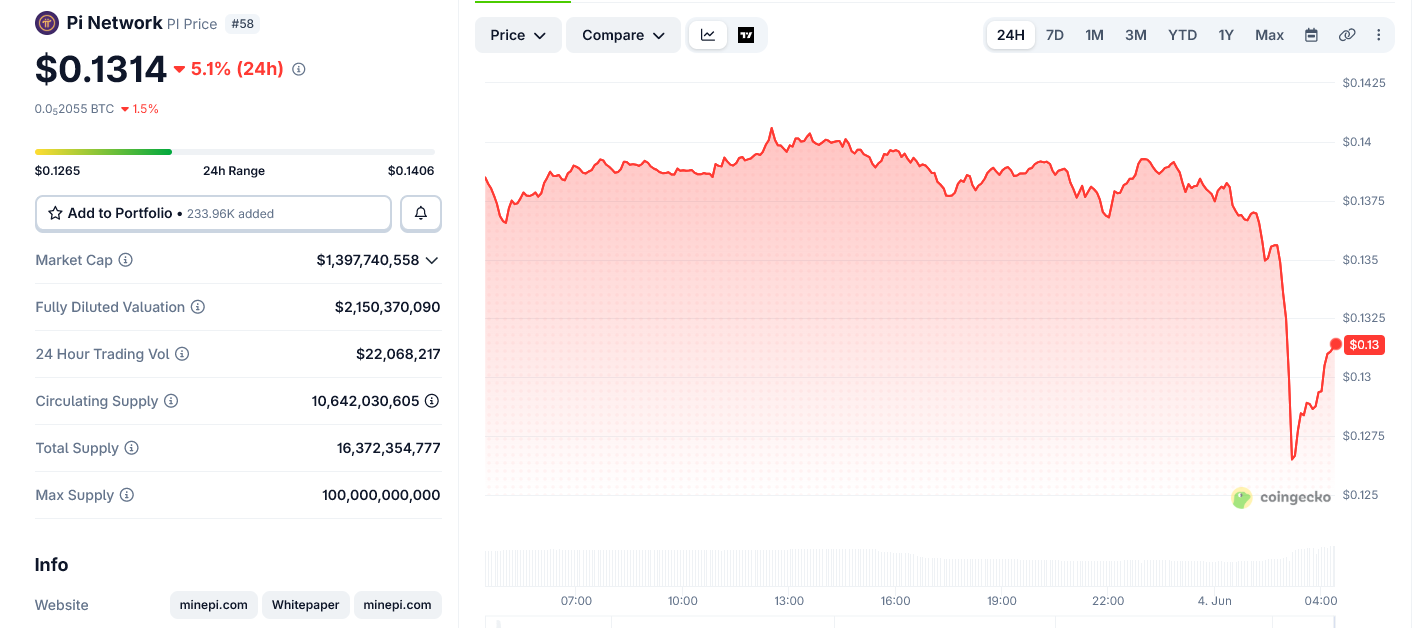
Pi Network just hit a significant technical milestone, but it has not helped the price of $PI at all.
Pi Network officially began rolling out its Protocol 24 upgrade on June 3, designed to enhance core network performance, improve node synchronization, and strengthen overall system stability.
What Protocol 24 Actually Does For Pi Network
The Pi Network upgrade has been one of Pi’s most technically complex updates so far, involving multiple subsystem improvements, internal data reprocessing, and major infrastructure upgrades.
It also includes a move from Ubuntu 20 to 24 and PostgreSQL 12 to 16. All mainnet nodes were required to complete the upgrade by June 2 or risk being disconnected from the network.
Protocol 24 was first completed and synchronized on Testnet 2 before the mainnet rollout, with the next expected step being the full V24 deployment across the live network.
The upgrade is part of a rapid sequencing through June. Protocol v25.1 follows on June 8 and v26.0 on June 22, with the releases targeting node performance, scalability, and smart contract maturation.
For Pi Network, a protocol that has been building toward smart contract functionality for years, three protocol upgrades in a single month represent a significant acceleration.
The Price Is Not Following the Progress
As of June 4, PI trades at $0.127, with a market cap of $1.36 billion. PI has slumped 27% this year, with the token sitting at its lowest level since February 14. It has fallen below all moving averages, a sign that bears remain in control.

The supply pressure is not helping. The Pi network is set to unlock over 174 million tokens worth over $26 million in June alone, adding to ongoing sell pressure in an already thin market.
The Protocol 24 upgrade opens a door for utility-driven demand later in 2026, but in the near term, it unlocks and thins liquidity, favouring continued price pressure.
To read the latest cryptocurrency news from BeInCrypto, click here.
The post Pi Network Activates Protocol 24 as PI Price Hovers Near All-Time Lows appeared first on BeInCrypto.

BP has seen an impressive spike in its value within the last 24 hours after Backpack launched a new securities trading platform that supports both tokenized and traditional stock trading. Data posted by CoinGecko indicated the coin gained 89.2% over the last 24 hours.
Key Takeaways
- BP rose by 89.2% in just one day after the launch of Backpack’s securities trading platform
- CoinGecko says the cause for this price movement was the merging of stock trading in both tokenized and traditional forms
- The price managed to reach around $0.28 from $0.15 earlier in the day
CoinGecko Post Draws Attention to BP Rally
CoinGecko said that BP increased by 89.2% following the launch of a securities exchange by Backpack which was meant to cater to both traditional and tokenized stock trading. This post received significant attention from cryptocurrency traders given the token’s strong intraday performance.
From the chart on CoinGecko, BP traded near $0.15 before starting an upward trend and moved to about $0.28, representing one of the biggest gains for the token in recent times.
There were several instances when the token consolidated before the final breakout. Throughout the trading session, buyers appeared to push prices higher.
Backpack Expands Into Securities Trading
The recently introduced platform by Backpack aims to integrate traditional financial assets with blockchain-based tokenized stocks. The product places the company among firms attempting to link traditional markets with digital-asset infrastructure.
Tokenized stocks have drawn growing interest in the digital asset industry as firms seek blockchain-powered access to equity markets. With the launch of this product, Backpack has added another venue for interaction between traditional and tokenized assets.
The launch comes amid increasing interest in tokenized real-world assets. Some market participants view tokenized securities as an area that may attract both crypto and non-crypto investors.
Market Reaction Drives Trading Activity
The movement in BP’s price indicates a high level of market enthusiasm following the announcement. The token rallied through multiple resistance levels to reach new short-term highs during trading.
Market participants watched for signs that the surge would create a new support area or trigger profit-taking after the sharp rally. While BP’s near-90% gain drew attention, it remains important to monitor how the Backpack securities exchange affects ongoing participation.


AI agents have moved from experimental tools to active participants in financial markets, and Neyro’s Andrew Isaacs has argued that decentralized finance could become one of the sectors where the technology proves its value most clearly.
Summary
- Neyro COO Andrew Isaacs said DeFi trading offers a real-world test for AI agents because market decisions produce immediate financial outcomes.
- Robinhood, Base, and Coinbase have launched agent-focused products that allow AI systems to execute transactions, monitor portfolios, and process payments under user-defined controls.
- Isaacs argued that AI-driven automation in DeFi should preserve user ownership and decentralization rather than rely on custodial systems or centralized trust models.
Over recent weeks, several major companies have already started rolling out products designed around that same idea.
Robinhood launched Agentic Trading and Agentic Credit Card services that allow approved AI agents to execute trades and purchases through dedicated accounts with user-defined limits.
Coinbase-backed Base introduced Base MCP, a system that connects AI assistants such as ChatGPT, Claude, Codex, and Cursor to crypto wallets for tasks ranging from token swaps to portfolio monitoring.
Meanwhile, Coinbase has expanded its x402 payment infrastructure and agentic commerce initiatives, which CEO Brian Armstrong said could support an economy that eventually exceeds the scale of human commerce.
As AI agents take on more financial responsibilities, some industry participants believe decentralized finance could become one of the most important testing grounds for the technology.
Isaacs, who serves as the Chief Operating Officer at Neyro, a decentralized AI-powered crypto trading platform, believes trading presents conditions that quickly reveal whether AI systems can perform reliably when decisions carry real financial consequences.
“In many industries, an AI agent can save time. In trading, it can show whether this new model of automation is actually reliable under pressure,” Isaacs said in comments shared with crypto.news.
Unlike routine business workflows, trading requires continuous monitoring of market activity, interpretation of incoming data, and decision-making within predefined limits. Isaacs said those characteristics make markets a useful environment for evaluating how well AI agents operate outside controlled demonstrations.
“Trading is where small delays and bad judgment show up immediately,” Isaacs said. “That makes it a very honest environment for testing what AI agents can actually do.”
Fast-moving DeFi markets create a case for automation
Business interest in AI agents has already moved beyond experimentation. A McKinsey survey found that nearly two-thirds of companies are testing AI agents in their operations, while crypto firms have increasingly focused on ways to connect those systems with financial infrastructure.
For decentralized finance, Isaacs said the opportunity comes from the speed and complexity of crypto markets themselves.
“What stood out to me was the mismatch between how fast DeFi markets move and how manually most users still operate,” he said.
Around-the-clock trading, fragmented liquidity, and thousands of tokens spread across multiple blockchains have created an environment where keeping up with every opportunity is difficult for individual traders.
“A human trader cannot watch every pool, every token. But an AI agent can. That creates a very obvious use case for agentic systems,” Isaacs said.
Recent developments across the industry point to the same direction. Base MCP was introduced to help users manage crypto activity through AI chat interfaces while requiring transaction approvals before execution.
Similarly, Isaacs’s Neyro is attempting to combine automation with decentralized infrastructure, allowing users to benefit from AI-driven trading without relying on custodial systems.
Coinbase has also highlighted the growing use of USDC and Base for machine-to-machine payments, stating during its first-quarter earnings call that AI agents use USDC in 99% of tracked transactions and conduct more than 90% of those payments on Base.
According to Coinbase, AI agents are already using x402 infrastructure for services such as trading, data access, AI inference, media generation, and storage. Official x402 statistics cited by the company showed monthly volumes surpassing 75 million transactions.
Why decentralized exchanges have lagged behind
Despite growing interest in AI-powered finance, Isaacs said decentralized exchanges have faced obstacles that centralized platforms do not.
Centralized trading environments allow developers to deploy AI systems within platforms that already have internal controls and safeguards. On decentralized exchanges, however, agents interact with non-custodial wallets and smart contracts where transactions are typically irreversible.
“There was also a trust problem. In CeFi, an AI system can sit behind an exchange account with internal controls. But on DEXs, AI touches wallets and smart contracts directly. A bad prompt or a misread market condition can become an irreversible transaction,” Isaacs said.
Security concerns surrounding AI agents have continued to attract attention across the industry. When Base launched MCP, the company emphasized that transactions require explicit user approval and that the system never accesses private keys.
Separately, researchers from organizations including Google, Meta, Gray Swan AI, EmbraceTheRed, and several universities argued in a recent report that AI agents should be treated as untrusted components and isolated from sensitive instructions and data wherever possible.
Against that backdrop, Isaacs said the industry should be careful not to sacrifice decentralization in pursuit of convenience.
“AI is powerful enough to make centralization look convenient again, and that is the danger. The point of Web3 was never only to make financial products more digital. It was to change the trust model.”

The U.S. Treasury Department has expanded its sanctions regime against Iran’s crypto ecosystem, adding four Iranian exchanges—including the country’s largest, Nobitex—to the Office of Foreign Assets Control (OFAC) sanctions list. The move is part of Washington’s ongoing Economic Fury campaign, which aims to sever Tehran’s access to the global financial system and curb sanctioned networks from using digital assets to evade controls.
OFAC designated Wallex, Bitpin and Ramzinex alongside Nobitex, prohibiting U.S. persons and entities from providing services to these platforms. Treasury Secretary Scott Bessent said the move reflects a broader effort “to cut off financial networks from Iran” and to counter the regime’s use of digital assets for sanctions evasion and wealth transfers. “While Iran’s economy is in free fall, the regime has chosen to co-opt digital asset technologies for its own corrupt agenda,” Bessent stated. The sanctions are positioned within the administration’s Economic Fury campaign, which began on April 14, during a period of heightened tension following attacks in the region that affected maritime routes and regional stability.
The Treasury’s latest action comes on the heels of earlier disclosures about asset seizures tied to Iranian crypto activity. Four days prior, Bessent disclosed that U.S. authorities had seized nearly $1 billion in crypto from Iranian exchanges and wallets since the onset of the current conflict. The enforcement push targets both traditional banking channels and the digital asset ecosystem as part of a comprehensive effort to disrupt Tehran’s access to capital and to deter sanctioned behavior.
Key takeaways
- OFAC adds four Iranian crypto exchanges—Nobitex, Wallex, Bitpin and Ramzinex—expanding sanctions to prohibit U.S. services to these platforms.
- Nobitex is identified as Iran’s central exchange in the sanctions framework and is described as a key node in Iran’s use of digital assets for sanction evasion, according to Treasury and industry observers.
- Chainalysis, cited by media reporting, indicates Nobitex handles a substantial portion of Iran’s crypto trading volume, underscoring its systemic importance to the domestic market.
- The designation is tied to allegations that Nobitex facilitates state-linked surveillance and supports entities connected with the Islamic Revolutionary Guard Corps and other sanctioned actors.
- The sanctions are part of the Economic Fury campaign, which seeks to isolate Iran from international financial networks and limit funding for its governance and military activities.
Regulatory enforcement and the Iran digital asset landscape
OFAC’s designation of Nobitex and the other exchanges underscores the U.S. government’s focus on the intersection of traditional financial controls and digital asset infrastructure. The Treasury’s language frames the exchanges as conduits for sanctioned activity and emphasizes the regime’s use of digital assets to move wealth and support repressive actions. The accompanying enforcement posture signals to banks, exchanges, and financial institutions the heightened due diligence and screening required when transacting with Iranian counterparties or platforms with ties to Tehran’s state apparatus.
In the Treasury’s view, the sanctions aim to “cut off tens of billions of dollars” in funding channels that could enable the Iranian regime and its proxies. The actions extend beyond direct exchanges to encompass related networks, including alleged shadow banking arrangements and foreign entities engaged in Iran’s oil trade and military activities. The broader regulatory message is clear: digital asset rails are not immune from sanctions enforcement, and compliance programs must account for cross-border digital flows as part of AML/KYC obligations.
Nobitex at the center of Iran’s digital dollar pipeline
The Treasury highlighted Nobitex as Iran’s largest crypto exchange and noted that it has continued to facilitate payments for sanctioned actors, including the Islamic Revolutionary Guard Corps. This characterization aligns with industry observations that Nobitex plays a pivotal role in the country’s crypto market. Chainalysis, cited by Cointelegraph, described Nobitex as the hub of Iran’s “digital dollar pipeline,” handling a large share of the nation’s on-chain activity—roughly half of the country’s trading volume in certain assessments. The designation also extends to Nobitex’s leadership, with CEO Seyed Ali Khoee and chairman Amir Hossein Rad added to the OFAC sanctions list.
In its public statements, the Treasury asserted that Nobitex’s operations have contributed to the repression of Iranian civilians by enabling state-linked surveillance capabilities. The agency’s stance suggests that the platform’s use by sanctioned entities and the governance connections of its leadership are central to the rationale for continued pressure on Iran’s crypto infrastructure.
Regulatory context and industry implications
The sanctions situate crypto exchanges within a broader regulatory and policy framework that regulators have been refining for years. As the international community debates licensing regimes, cross-border oversight, and the integration of digital assets with traditional financial rails, actions such as these illustrate how enforcement agencies pursue sanctions-compliant ecosystems even in markets where crypto use remains pervasive. For exchanges and financial institutions, this underscores the need for robust screening, sanctions screening, and end-to-end governance to prevent inadvertent exposure to prohibited actors or sanctioned services. The episode also intersects with debates on how digital asset technologies fit within MiCA-era European regulation, as well as cross-jurisdictional enforcement strategies among the SEC, CFTC, DOJ and OFAC in the United States.
Analysts and institutional compliance teams should monitor for evolving narratives around digital-dollar-like mechanisms and sanction evasion risk, including potential shifts to alternative platforms or obfuscation techniques. While the current action targets specific Iranian exchanges, the broader risk landscape may prompt firms to reassess onboarding criteria, customer risk scoring, and ongoing monitoring for entities linked to sanctioned regimes or non-cooperative jurisdictions.
Closing perspective
As enforcement efforts intensify, the interplay between traditional finance controls and crypto markets will continue to shape compliance protocols, risk assessment, and cross-border operations for crypto firms, banks, and other financial institutions. The Iranian case provides a concrete example of how policy objectives—sanctions enforcement, financial integrity, and national security—translate into practical regulatory mandates for digital-asset-related businesses. Authorities, market participants, and researchers should watch for further OFAC updates, the emergence of additional sanctioned actors, and potential legal clarifications around sanctions-compliant use of crypto technologies in constrained environments.

California, New Jersey, and South Dakota shaped a political landscape in which crypto industry–backed committees directly funded media buys to bolster candidates perceived as friendly to digital-asset policy. Across the three states, several incumbents and challengers won primaries, with observers noting a notable alignment between campaign messaging and the positions advanced by crypto advocates.
In California, a slate of Democratic House contenders—Jacqui Irwin, Ted Lieu, Zoe Lofgren, Dave Min, Mike McGuire, Hilda Solis, George Whitesides, Lou Correa, and Lateefah Simon—secured primary victories for their respective districts. In New Jersey, Democrat Rob Menendez won in the 8th congressional district, while South Dakota voters gave incumbent or leading candidates a victory in the Senate race by supporting Mike Rounds. The outcomes followed intense media campaigns financed by crypto-aligned political action committees (PACs) affiliated with Fairshake, a collective funded largely by Coinbase and Ripple Labs, according to reporting that tracks campaign spending in primaries.
As noted in coverage cited by Cointelegraph, the two primary-focused PACs—Protect Progress and Defend American Jobs—together spent roughly $3.5 million on media buys to support candidate selections. The groups’ objectives center on advancing a pro-crypto policy environment, including votes and public statements that favor digital-asset development and industry protections. Fairshake, which has positioned itself as a fiscal hub for crypto-oriented political activity, has reported a robust fundraising posture, with a $193 million war chest reported earlier in the year.
The wave of spending followed earlier media campaigns tied to Texas primaries, which helped propel Democratic candidate Christian Menefee in the statewide race and supported several Republican hopefuls in congressional districts, underscoring a broader strategy to influence a developing policy framework for crypto across multiple states. Many of the candidates associated with these efforts have publicly supported digital-asset legislation or expressed favorable views on recognition and regulation of crypto technologies, including measures like the GENIUS Act. The implications extend beyond electoral outcomes to the policy conversations shaping the regulatory environment for crypto markets.
Maryland is emerging as the next focal point for the same broad coalition. Federal Election Commission (FEC) filings indicate that Protect Progress spent more than $3.1 million in support of Adrian Boafo in Maryland’s 5th Congressional District—a race scheduled for June 23. Cointelegraph requested comment from Fairshake but did not receive an immediate response. These filings illustrate how campaign finance data is used to surveil activity by industry-aligned groups as regulators and researchers assess the influence of money in politics on crypto policy.
Key takeaways
- Crypto industry PACs mobilize media buys to influence primaries: Protect Progress and Defend American Jobs channeled substantial funds into targeted advertising to back candidates seen as favorable to digital-asset policy. (According to Cointelegraph)
- Affiliates and funding sources are increasingly scrutinized: The campaigns are linked to Fairshake, with ties to Coinbase and Ripple Labs, illustrating how industry players coordinate fundraising and messaging around regulatory issues.
- Regulatory context is central to campaign objectives: The political activity occurs amid evolving discussions on crypto regulation at federal and state levels, including licensing, enforcement priorities, and cross-border policy alignment.
- New organizing efforts aim to shape policy for developers and builders: The Defend Developers PAC signals a focus on protections for developers of decentralized technologies, highlighting the regulatory uncertainty facing crypto innovation.
- Regulatory filings illuminate activity but leave questions open: While Maryland’s race shows substantial spending, the Defend Developers portal did not display funding activity as of the latest disclosures, underscoring gaps between announcements and on-the-ground fundraising data.
Crypto advocacy, developer protections, and the policy gap
Defend Developers announced its launch as a hybrid PAC designed to back incumbent lawmakers who actively champion developer protections and crypto builders. The organization says its board comprises leaders from prominent crypto policy organizations, including the DeFi Education Fund, Orca Creative, Solana Policy Institute, and Uniswap Labs. The stated aim is to address what its organizers describe as a regulatory environment characterized by uncertainty and enforcement actions rather than clear, guidelines-based rules for software developers building decentralized technologies.
The founder, Gavin Zavatone, framed the PAC as a response to the current pace of rulemaking and the limited incentives some policymakers have to understand the technical nature of software development. While the Defend Developers group has not publicly disclosed specific engagement plans or the precise races it intends to prioritize in 2026, it signaled a nationwide focus on key races that could influence the trajectory of crypto policy in Congress.
From a governance perspective, the transition from broad advocacy to a targeted PAC raises questions about how developer protections will be treated within the legislative process. The absence of immediate fundraising data on the FEC portal—despite the launch—illustrates a broader challenge for researchers and compliance teams: aligning disclosure schedules with organizational announcements to monitor regulatory lobbying and influence operations accurately. The Defend Developers’ leadership and board composition suggest an intent to harmonize policy development with industry-standard practices around governance, risk management, and accountability.
Beyond the campaign infrastructure, the Maryland focus underscores how industry-backed political activity intersects with district-level outcomes. FEC filings confirm Protect Progress’ active involvement in the Maryland race, yet the broader impact on legislative behavior remains a matter of ongoing observation. For compliance and regulatory teams, these dynamics emphasize the need to map political risk to policy developments, particularly as regulatory bodies intensify attention on crypto firms, exchanges, and banks integrating digital-asset services.
Regulatory context and policy implications for institutions
Policy development in the crypto space remains a complex tapestry of federal and state initiatives, with MiCA in Europe and analogous discussions in the United States shaping expectations for licensing, oversight, and enforcement. The campaigns described above unfold against a backdrop of active regulatory scrutiny in the United States from agencies including the Securities and Exchange Commission (SEC), the Commodity Futures Trading Commission (CFTC), and the Department of Justice (DOJ). Key themes influencing policy direction include:
- Licensing and regulatory oversight: As exchanges and crypto firms seek clearer operating permission in multiple jurisdictions, campaign activity hinting at pro-crypto stances may influence how regulators balance innovation with consumer protection and market integrity.
- AML/KYC and compliance frameworks: Stronger anti-money-laundering and know-your-customer requirements are central to many regulatory reforms. Political advocacy around these themes can affect the structure and stringency of enforcement and licensing regimes that shape bank access and on-ramp/off-ramp integrations.
- Cross-border policy dynamics: The alignment (or lack thereof) between U.S. policy, MiCA-style frameworks abroad, and multinational firms’ compliance programs has practical implications for licensing strategies, cross-border operations, and inter-jurisdictional settlements.
- Enforcement posture and clarity of rules: The ongoing tension between enforcement actions and the development of formal rules contributes to regulatory risk for crypto developers, mining operators, and financial intermediaries. The policy environment remains uncertain in areas such as decentralized governance, token classifications, and the regulatory treatment of stablecoins and on-chain finance.
From an institutional standpoint, the political activity surrounding crypto policy matters for exchanges, banks, and asset managers that are navigating licensing processes, capital adequacy considerations, and integrated liability management. A more predictable regulatory regime — including explicit criteria for token classifications, clear guidelines for DeFi developers, and transparent enforcement parameters — would reduce compliance risk and support more stable banking relationships for crypto firms. In the meantime, investors and institutions must monitor political developments and regulatory signals, recognizing that electoral outcomes can influence regulatory timing and aggressiveness, even as policy debates continue at both state and federal levels.
Analysts and compliance professionals should also consider the implications of industry-funded political activity on governance and disclosure practices. As campaigns expand their reach through media buys and political engagement, the need for rigorous monitoring of campaign finance disclosures, lobbying registrations, and related enforcement actions becomes more pronounced. The evolving interplay between crypto advocacy groups, PACs, and regulatory authorities will continue to shape how institutions structure risk assessments, third-party relationships, and policy engagement strategies over the coming months.
In assessing the broader trajectory, observers should watch for how forthcoming regulatory proposals, licensing standards, and enforcement priorities will dovetail with the political momentum generated by industry-driven campaigns. The 2026 midterms and the subsequent regulatory agenda could crystallize the boundaries of permissible advocacy, clarify the roles of developers and builders in policy conversations, and define the responsibilities of exchanges and market participants under a more unified framework.
As with prior industry campaigns, the evolving narrative will likely influence corporate risk programs, compliance controls, and due-diligence processes across the crypto ecosystem. Stakeholders should maintain vigilance for new disclosures, additional PAC formations, and evolving statements from industry groups as regulators respond to market developments and participants seek to shape the rules that govern digital-asset markets.
Closing observations aside, the interplay between political fundraising, regulatory reform, and industry strategy underscores a central reality for 2026: policy clarity and enforcement consistency are critical to unlocking broader institutional participation in crypto markets while ensuring robust investor protection and market integrity. Regulators, industry, and lawmakers will continue to negotiate the balance between encouraging innovation and safeguarding financial stability—a balance that will almost certainly be tested as campaigns and policy initiatives unfold in parallel.
Further developments will be closely tracked by researchers and compliance teams to assess how electoral dynamics translate into regulatory outcomes and market structure changes in the evolving crypto landscape.


Nine House Democrats have asked the Federal Trade Commission to investigate online prediction market platforms.
Summary
- Nine House Democrats asked the FTC to probe prediction market ads and customer messaging practices.
- Lawmakers say platforms market sports bets while calling contracts financial products in regulatory filings publicly.
- Recent reports show rising pressure from insider trading cases, state disputes and record volumes industrywide.
The request focuses on whether companies present themselves one way to customers and another way to regulators.
The letter was led by Representatives Kevin Mullin and Gabe Vasquez. Other signers included Jared Huffman, Raul Ruiz, Salud Carbajal, Mike Levin, Dina Titus, Paul Tonko, and Valerie Foushee.
Advertising claims draw attention
The lawmakers said some prediction market platforms use public ads linked to sports betting. They pointed to terms such as legal betting and betting on sports without a sportsbook.
At the same time, the lawmakers said these companies tell regulators they offer financial contracts. They argue that mixed messaging may confuse users about which rules and consumer protections apply.
“These prediction market companies are presenting themselves differently to regulators than they are to the public,” Mullin said. He added that such messaging can mislead consumers about the rules in place.
Kalshi and Polymarket face wider review
Prediction markets let users buy and sell contracts tied to future events. These events can include elections, sports, economic data, crypto prices, and global conflicts.
The FTC request comes as Congress has already examined Kalshi and Polymarket over insider-trading concerns. Lawmakers have asked how the companies check users, block restricted locations, and watch suspicious trading.
As previously reported by crypto.news, Kalshi suspended three political candidates after finding that they traded on their own election races. Kalshi treated the cases as violations of exchange rules.
Federal investigators examined trades linked to former U.S. Representative George Santos, as crypto.news reported. The case added fresh attention to how platforms handle users with direct knowledge of an event.
Growth brings more regulatory pressure
Prediction markets have grown quickly in 2026. crypto.news previously reported that transactions crossed 191 million in March, while monthly trading volume reached about $23.9 billion.
Much of that growth came from political, macroeconomic, and geopolitical event contracts. Crypto-related contracts now represent a smaller share of total activity on some platforms.
That growth has also brought state-level disputes. Some regulators argue that sports and election-linked contracts look like gambling products, while platforms seek federal treatment under financial market rules.
Kalshi has supported a new advocacy group called Americans for Fair Markets. The group plans to push for federal prediction market rules, consumer protections, user checks, and limits on certain event contracts.
FTC response is due by June 29
The House Democrats asked the FTC to respond by June 29. They want to know whether the agency has received complaints about prediction markets and whether it plans any enforcement action.
They also asked whether the FTC considers public ads, court filings, and regulator statements when reviewing possible deceptive practices. The request places consumer messaging at the center of the prediction market debate.
The FTC has not announced a new case tied to the letter. Any review would add another layer to the growing policy fight over whether prediction markets are financial products, gambling platforms, or both.


Polymarket has finalized a disputed prediction market with a “No” outcome after 98.6% of voting power backed the decision in a final UMA review, despite Strategy disclosing that it sold 32 Bitcoin before the market’s May 31 deadline.
Summary
- Polymarket finalized the disputed Strategy Bitcoin sale market with a “No” outcome after 98.6% of UMA voting power backed the decision.
- Traders challenged the ruling because Strategy disclosed that it sold 32 Bitcoin between May 26 and May 31, before the contract deadline.
- The dispute has fueled debate over whether prediction markets should be resolved based on when an event occurred or when it was publicly confirmed.
According to Polymarket’s market data, the contract asking whether Strategy would sell any Bitcoin by May 31 completed its final review on Wednesday, ending a dispute that had already triggered two previous “No” resolutions and subsequent challenges.
At the center of the disagreement is Strategy’s June 1 regulatory filing, which revealed that the company sold 32 BTC for roughly $2.5 million between May 26 and May 31.
Traders who supported a “Yes” outcome argued that the sale itself occurred before the deadline stated in the market question. Others maintained that the transaction was not publicly confirmed until after the deadline had passed.
Days before the final review concluded, Polymarket added a note to the market page stating that “confirmation achieved outside of the market’s time frame does not qualify.” The clarification became a key point in the debate over how the contract should be resolved.
Traders challenge resolution standards
Across social media, several traders criticized the decision and questioned whether the outcome matched the original wording of the contract.
Among the most vocal participants was trader 0xDinosaur, who previously disclosed that he had purchased 49,695.76 “Yes” shares for about 35,000 USDC.
In a public statement issued before the final ruling, he argued that the contract referred to whether Strategy sold Bitcoin by May 31 and did not explicitly require the sale to be publicly disclosed before that date.
“My position was aggressive, and maybe I was greedy,” 0xDinosaur wrote on X. “But risk-taking does not change the facts, and it does not allow a platform to apply an unclear or unwritten rule after real money has already been placed.”
Earlier reporting on the dispute noted that Strategy’s filing showed the company sold 32 Bitcoin during the final week of May, while still holding 843,706 BTC as of May 31. The filing stated that proceeds from the sale were expected to support preferred stock distributions.
Elsewhere on X, trader willo2 argued that UMA voters were obligated to follow Polymarket’s published rules rather than their personal interpretation of the outcome.
“Even if UMA voters think that this outcome is ridiculous… they are forced to ratify it,” willo2 wrote. “This is because UMA is forced to respect the rules as written by Polymarket. Polymarket changed the rules, and now the outcome is literally in the rules.”
The trader claimed to have lost $500,000 after placing large “Yes” positions on June 1, alleging that the market remained open for betting after information about the sale had emerged.
Debate expands beyond a single market
Beyond the financial losses reported by traders, the dispute has drawn attention to how prediction markets handle events that occur before a deadline but become public afterward.
Galaxy Research said the controversy was less about the outcome itself and more about which set of rules should govern the contract’s resolution.
“The core issue is whether the original rules (event-based) or the post-trade clarification (confirmation-based) governs,” Galaxy Research wrote on X. “Traders correctly predicted the future. The platform is about to tell them they were wrong anyway.”
It argued that prediction markets should prioritize the occurrence of an event rather than reinterpretations introduced after trading has taken place.
“Prediction markets should price what happens, not how the oracle will reinterpret rules after the fact,” the firm said, adding that clearer listing criteria, deterministic resolution methods for verifiable events, and structural changes ahead of potential regulatory oversight could help prevent similar disputes.

LayerZero is going deeper into finance. It wants to be part of the infrastructure for Wall Street institutions. The company has a protocol that lets different blockchains work together. Now it is promoting an idea that focuses on blockchain infrastructure for institutions.
LayerZero Expands Beyond Cross-Chain Transfers
Some people are worried about the security of systems that work with blockchains. LayerZero is known for its technology that enables messages to be sent across multiple blockchains. It has spent years building tools that help assets and data move between different blockchains. LayerZero connects more than 160 blockchain networks. It is one of the platforms that helps different blockchains work together in the crypto industry.
Recently, LayerZero has been focusing on getting institutions to use its technology. The company started a project called Zero this year. Zero is a blockchain infrastructure project that helps with financial trades, settlements, and tokenization. Big financial companies like Citadel Securities, DTCC, and ICE are supporting this project.
This is part of a trend. Many crypto companies are trying to work with Wall Street because it is getting more interested in tokenized assets and systems that use blockchain for settlements. LayerZero is pushing to be a part of this trend. It wants to help traditional finance institutions use blockchain technology.
Rivals Highlight Security Risks
LayerZero is still facing a lot of questions about the security of its chain technology, even though many institutions are supporting it.
Cross-chain bridges and messaging protocols are often targeted by hackers who look for weaknesses in the system to steal money. Over the past few years, hackers have stolen billions of dollars.
Recently, there was a problem with a bridge that uses LayerZero’s technology. The problem resulted in losses of $300 million. This incident intensified debate about the safety of cross-chain technology. Some competing companies were very critical, and a few projects are now looking for alternative approaches to cross-chain transactions.
Institutional Race Heats Up
These companies say that big investors need to be sure the technology is secure before they put in significant capital. Some projects have already moved to interoperability networks because of security concerns.
LayerZero says that its system is flexible and allows developers to choose how they want to secure their transactions. The company believes that cross-chain technology is essential for the future of blockchain, especially when real-world assets are moved across different networks.
More traditional financial institutions are exploring blockchain technology, meaning competition among companies that provide interoperability services will intensify. To succeed, these companies need to be secure, scalable, and able to comply with regulation.
Conclusion
LayerZero is trying to get into the finance sector on Wall Street. This is an attempt to combine traditional finance and blockchain technology. However, the company faces a challenge: it needs to prove that its technology is secure enough for institutional investors. The outcome will be important for the future of blockchain and tokenized finance.
LayerZero needs to show that its cross-chain technology is safe. If it can do this, it will be a step forward for the company and the industry.
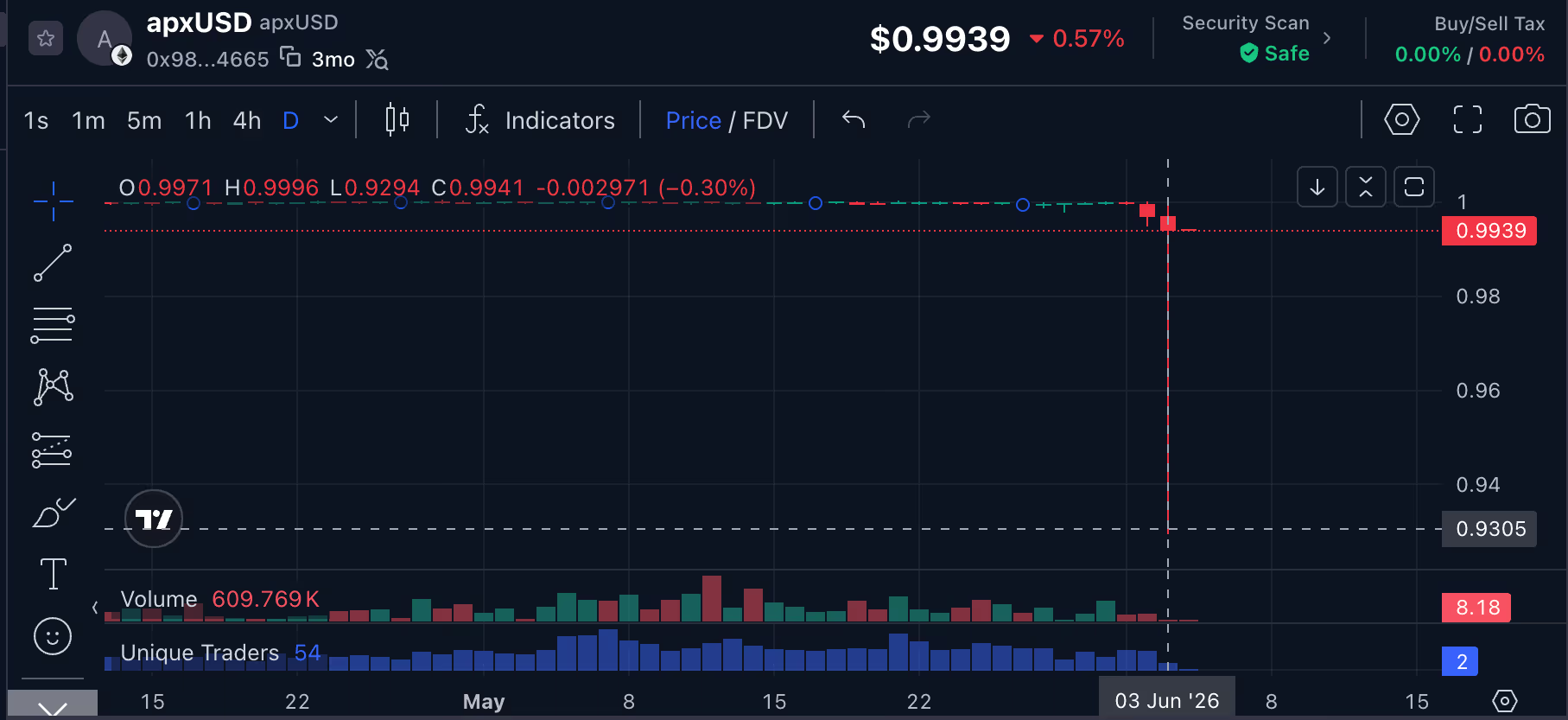
Stablecoin depegs are a recurring feature of crypto bear markets. And the latest candidate is apxUSD, the preferred equity-backed stablecoin of the Apyx protocol.
As market leader bitcoin fell sharply in the past 24 hours, reaching lows under $63,000 at one point, apxUSD briefly slipped to as low as 93 cents, deviating from its 1:1 dollar peg, according to CoinMarketCap.

The stablecoin is primarily backed by preferred equity issued by digital asset treasury firms, specifically Strategy’s STRC shares, which carry a $100 par value.
The protocol purchases those shares, collects the dividend they pay and distributes the yield to onchain holders. The reserve basket also includes short-term U.S. Treasuries and cash equivalents to ensure liquidity and reduce concentration risk.
Apyx runs a two-token system. apxUSD is the base stablecoin designed to trade at $1 and does not pay yield; holders who deposit apxUSD receive apyUSD, a yield-bearing savings token that accrues returns through dividends flowing in from the underlying preferred shares.
That said, because preferred equity makes up the majority of those reserves, the stablecoin is influenced by the volatility in the underlying shares. So, when STRC trades below its $100 par value, the market value of apxUSD’s reserves declines, leading to volatility in the stablecoin in secondary markets.
This, according to Apyx, isn’t an extraordinary development.
“This is not a bug, it is the expected behavior of a stablecoin backed by preferred equity rather than cash deposits. Holders who understand STRC’s risk profile and its history of mean-reversion should view these episodes as the asset class working through its normal cycle, not as evidence of a broken peg,” the protocol noted in a detailed X post.
It explained that its peg stability model has multiple layers to absorb stress. The preferred shares have structural features that allow issuers to raise dividend rates, which draw demand for the shares, lifting their value toward par over time.
According to Apyx, Strategy has historically used this lever. Note that STRC has traded below its par value four times since August last year, and each episode ended with prices bouncing back to $100.
Beyond that, Apyx said that it maintains collateral value in excess of the stablecoin’s circulating supply. This buffer helps absorb mark-to-market drawdowns in the backing assets before they meaningfully impact the peg.
“Users can compare the collateral position against apxUSD supply in real time through the app dashboard,” it said.
The explainer comes as market participants panicked over the brief de-peg, with some saying persistent volatility could shake investor confidence.
There were also concerns about cascading liquidations across Morpho lending markets, but Apyx said those were largely misplaced. It said that its main apyUSD/apxUSD Morpho market is driven by dividend accrual, not STRC’s spot price, which means that volatility in STRC doesn’t impact that oracle and trigger liquidations.
Ethereum treasury company Bitmine Immersion Technologies is launching a $300 million perpetual preferred stock offering, borrowing a page from Strategy’s financing playbook.
Bitmine told the SEC on Wednesday that it intends to offer 3 million of its 9.5% Series A perpetual preferred stock at $100 per share, which will trade under the symbol BMNP within 30 days of issuance.
Preferred shares are a hybrid of stocks and bonds. Investors are not directly betting on the company’s growth but lending it money in exchange for regular payments. For every $100 share, Bitmine will pay dividends on a weekly basis, amounting to $9.50 per year.
The firm plans to use income from its staked Ether (ETH) to pay the dividends, similar to offerings from Michael Saylor’s Bitcoin treasury company, Strategy.
Strategy launched its Stretch (STRC) perpetual preferred stock in July 2025. Unlike Bitmine’s BMNP, which has a fixed rate, STRC uses a variable rate that Strategy adjusts monthly with the goal of keeping the trading price stable near $100.
STRC has scaled to $8.5 billion in just nine months and is now the largest preferred stock by market cap in the world, according to a May SEC filing.
“Digital Credit, highlighted by STRC, has been a big success. STRC has shown strong demand, high liquidity, and low volatility,” said Phong Le, Strategy president and CEO.
In March, Le said that roughly 80% of STRC holders were retail investors.
Related: 80% of Strategy’s ‘Stretch’ buyers are mom-and-pop investors
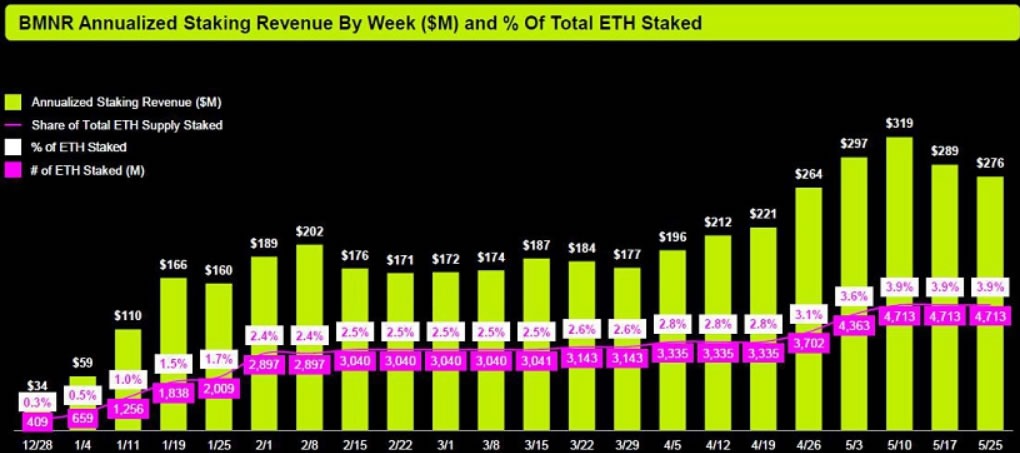
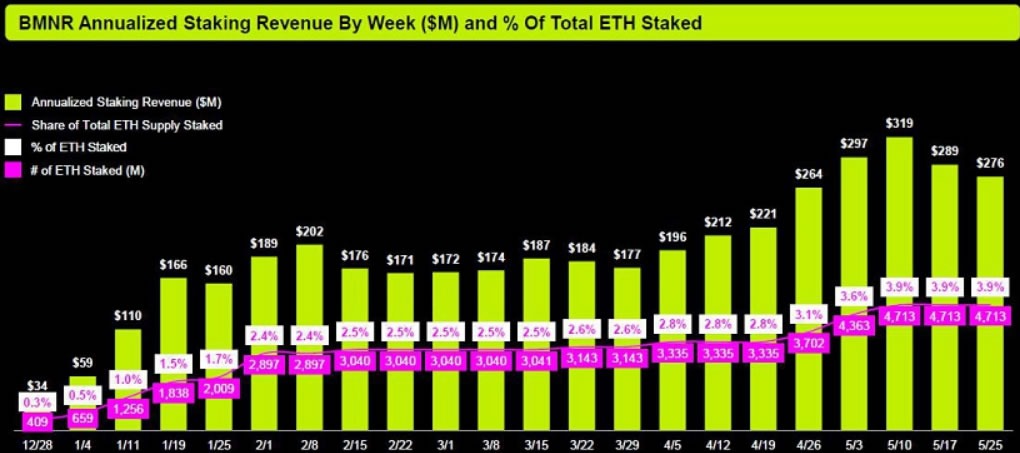
Bitmine’s annualized staking revenue by week. Source: SEC
Bitmine said the net proceeds of its proposed offering would be used for general corporate purposes, including buying more Ether, expanding staking and validator infrastructure through Made in America Validator Network (MAVAN) and repurchasing common stock.
Bitmine announced on Monday that it currently owns 4.49% of the total ETH supply and is 90% of the way to its “Alchemy of 5%” plan in just 11 months.
The firm has 4.7 million staked Ether, worth around $8.3 billion at current prices. However, unrealized losses on that ETH are nearly $9 billion.
The perpetual stock offering comes at a tough time for Ether investors, with the asset falling more than 12% over the past seven days to a 14-month low of $1,734 in early trading Thursday.
“In our view, ETH prices are not reflecting the strengthening of Ethereum fundamentals, but then again, this is not surprising given we are in the early stages of crypto spring,” said Bitmine chairman Tom Lee on Monday.
Bitmine stock fell nearly 6% Wednesday to $16.90, its lowest level since it pivoted to Ethereum in June 2025, according to Google Finance.
Magazine: Big Questions: Do we really only need 2–5 cryptocurrencies?
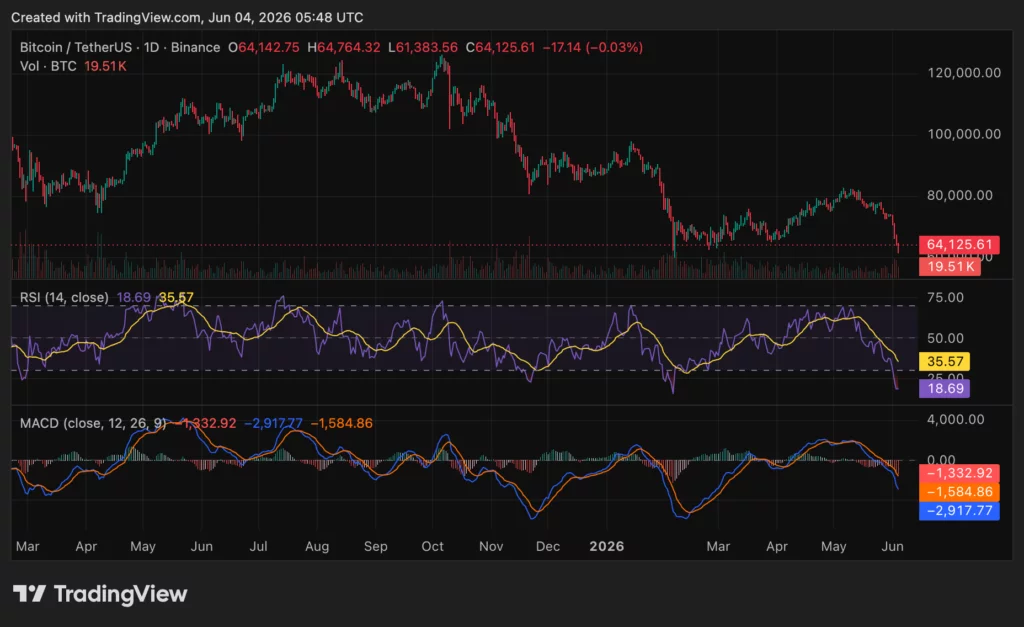
Bitcoin fell below $63,000 on Thursday as the selloff in the crypto market deepened.
Summary
- Bitcoin dropped below $63,000 as sellers broke the May range and liquidations crossed $1.1 billion.
- Analysts now watch $60,000, $55,000 and $50,000 as pressure builds across Bitcoin derivatives markets.
- RSI and MACD readings show Bitcoin is deeply oversold, but bearish momentum remains active.
The move pushed BTC to its weakest level since February and extended a sharp decline from its May range.
The drop came as renewed U.S.-Iran tensions weighed on wider risk markets. The Kobeissi Letter said Bitcoin had lost about $400 billion in market value since May 11, while more than $1.6 billion in leveraged crypto positions were liquidated in 24 hours.
Bitcoin price breaks below key May range
Bitcoin had already lost the $72,000 and $68,000 areas before the latest break. The fall below $64,000 and then $63,000 showed that sellers remained in control of the short-term trend.
The price is now trading near the $60,000 to $64,000 psychological zone. This area matters because it sits close to previous demand and could decide whether BTC stabilizes or extends losses toward deeper support.
According to crypto.news market data, Bitcoin traded near $63,753 at press time, down almost 5%, with a 24-hour low around $61,557. The broader drop followed a week of heavy selling that erased about 16% from Bitcoin.
The latest candles showed strong downside pressure. Buyers have not yet built a clear recovery base, and Bitcoin would need to reclaim higher levels before the short-term structure improves.
Liquidations deepen market stress
Derivatives markets added more pressure to the spot decline. More than $1.6 billion in leveraged crypto positions were liquidated over 24 hours, according to Coinglass data.
Liquidations happen when exchanges force traders out of leveraged positions because their collateral no longer covers the trade. In a falling market, this can push prices lower because forced selling adds to normal spot selling.
The leverage wipeout followed a broader shift in sentiment. Risk assets came under pressure as the U.S. and Iran exchanged fresh strikes and ceasefire talks stalled.
Analysts watch $60K, $55K and $50K
Analyst Captain Faibik said Bitcoin was sitting above a major eight-year trendline. “If Bulls defend this level and build a base, we could be witnessing the early stages of another mega bull run,” he wrote.
He also warned that BTC could briefly sweep liquidity around $54,000 to $55,000 before any stronger recovery. That view places the next few weeks as a key period for Bitcoin’s long-term direction.
Ali Charts said the breakdown below $72,000 placed Bitcoin in a vulnerable position. Based on MVRV pricing bands, he said the next major support area sits between $54,000 and $50,000.
CryptoQuant founder Ki Young Ju also pointed to unusual sell pressure. He said Bitcoin investors’ average cost basis sits around $53,000 and argued that the current distribution phase feels like a large change of hands.
Technical indicators remain weak
Bitcoin’s RSI stood at 18.69, placing BTC deep in oversold territory. That shows selling momentum has become extreme, but it does not confirm a reversal by itself.
A stronger recovery signal would require RSI to move back above 30. A later reclaim of the 50 area would show buyers are gaining more control of momentum.
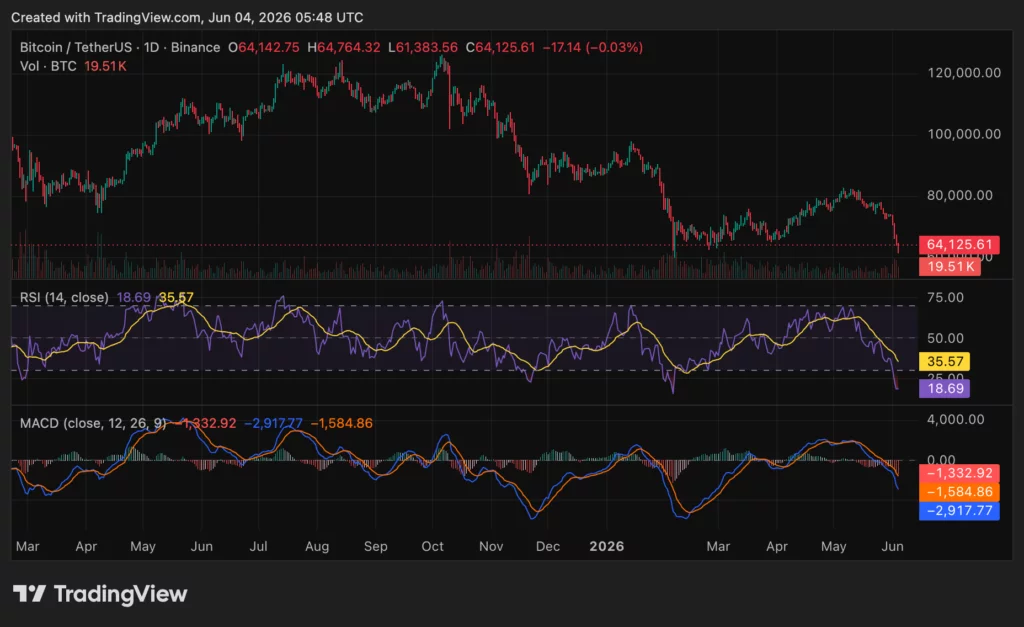
The RSI moving average sat at 35.57, far above the current RSI reading. That gap confirms the speed of the selloff and shows that buyers have not yet closed the momentum difference.
MACD also remained bearish. The MACD line sat near -2,917.77, below the signal line near -1,584.86, while the histogram was negative at about -1,332.92.
Binance volume data confirms selling pressure
Arab Chain said Binance CVD Confirmation Score reached about 0.80, its highest level in four months. The reading came as Bitcoin traded around the mid-$60,000 area during the decline.
CVD, or cumulative volume delta, tracks the balance between buying and selling activity. A high reading during a price drop suggests that selling pressure is backed by actual trading volume.
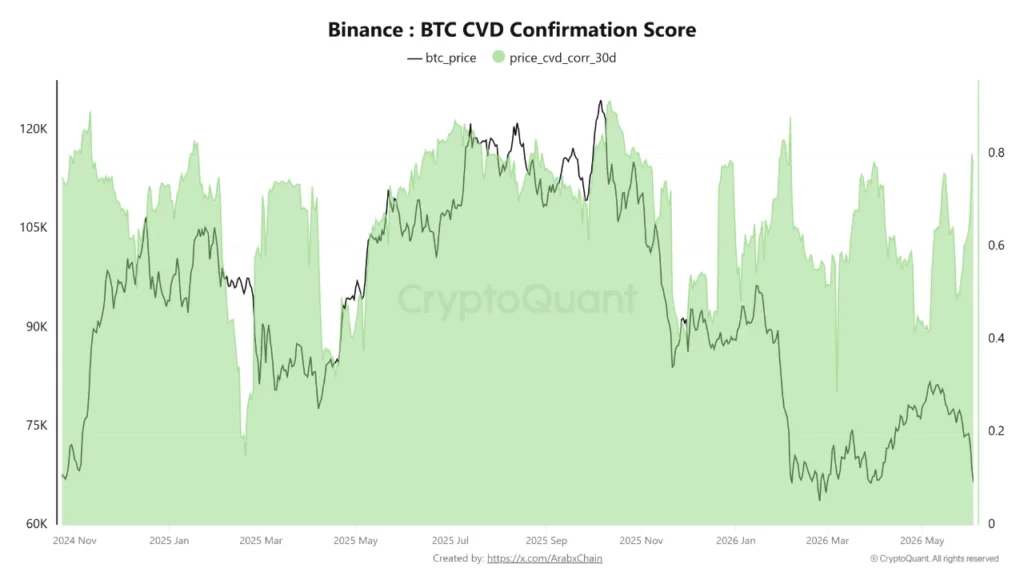
That matters because it reduces the chance that the latest move came only from thin liquidity. Instead, the data points to active seller participation during the breakdown.
For now, Bitcoin remains oversold but technically bearish. A move back above $64,000 and then $68,700 could ease pressure, while a clean break below $60,000 may turn focus toward $55,000 and $50,000.
Disclosure: This article does not represent investment advice. The content and materials featured on this page are for educational purposes only.

BP Rockets Nearly 90% as Backpack Unveils Traditional and Tokenized Stock Trading

How to watch England vs New Zealand: TV Channels, Full Schedule & 1st Test Preview
Jennifer Garner reveals how 'upheaval' from Ben Affleck divorce impacted her career



-

 Tech6 days ago
Waymo dominates autonomous vehicle registrations as Tesla trails behind
-

 News Videos6 days ago
This is BROKEN! INSANE 5x MONEY CAR WASH WEEK! The NEW GTA Online UPDATE Today! (GTA5 New Update)
-
 Tech5 days ago
SpaceX just won a second Golden Dome contract. This one is $4.16 billion.
-

 Business2 days ago
Jade Biosciences, Inc. (JBIO) Discusses Positive Interim Results From JADE101 Phase I Healthy Volunteer Study and Development Plans Transcript
-
 News Videos5 days ago
SHE IS KILLING XRP!!! WATCH URGENT AND ACT FAST
-
 NewsBeat5 days ago
FIRST NIGHT REVIEW: Take That bring the Circus back to life in spectacular sun-soaked style
-
 Crypto World6 days ago
CFTC Has Approved the First Regulated Bitcoin Perpetual Contract in the U.S.
-

 Business5 days ago
Is the Spurs Phenom Already Better Than Prime Diesel?
-

 Politics5 days ago
The House | Inside Andy Burnham’s Makerfield Campaign: “Nobody Thinks This Is In The Bag”
-
 NewsBeat6 days ago
Novak Djokovic v Joao Fonseca LIVE: French Open latest scores and results after Jannik Sinner’s shocking collapse
-
 Entertainment5 days ago
Weak ‘Supergirl’ Box Office Tracking Amid Milly Alcock Backlash
-
 Crypto World6 days ago
Snowflake (SNOW) Stock Rallies on Strong Q1 Results and AI Product Growth
-

 Business5 days ago
Demand Conditions Improve In Chemicals Sector In April 2026
-

 Entertainment6 days ago
Maddox Jolie-Pitt Legally Requests to Drop Brad’s Surname
-

 Tech6 days ago
This Week In Security: Ubiquiti Fixes, And FreeBSD Joins The Club You Don’t Want To Join
-
 Entertainment5 days ago
One of the Greatest Sitcoms of All Time Shoots Up Apple TV’s Charts 11 Years Later
-
 Crypto World5 days ago
MicroStrategy Moves $30 Million in BTC to Coinbase Prime: Is the Bitcoin Sell-Off Already Here?
-
 Entertainment5 days ago
Bruce Willis’ Generosity Resurfaces Amid His Dementia
-
 Crypto World2 days ago
Seagate (STX) Stock Surges to Record High on AI Boom and Legal Settlement
-

 Sports1 day ago
French Open 2026 results: Alexander Zverev beats Rafael Jodar and will play Jakub Mensik in semi-finals
You must be logged in to post a comment Login