
Crypto World
Pi Network price sinks to a new ATL, will June token unlocks push it below $0.10?

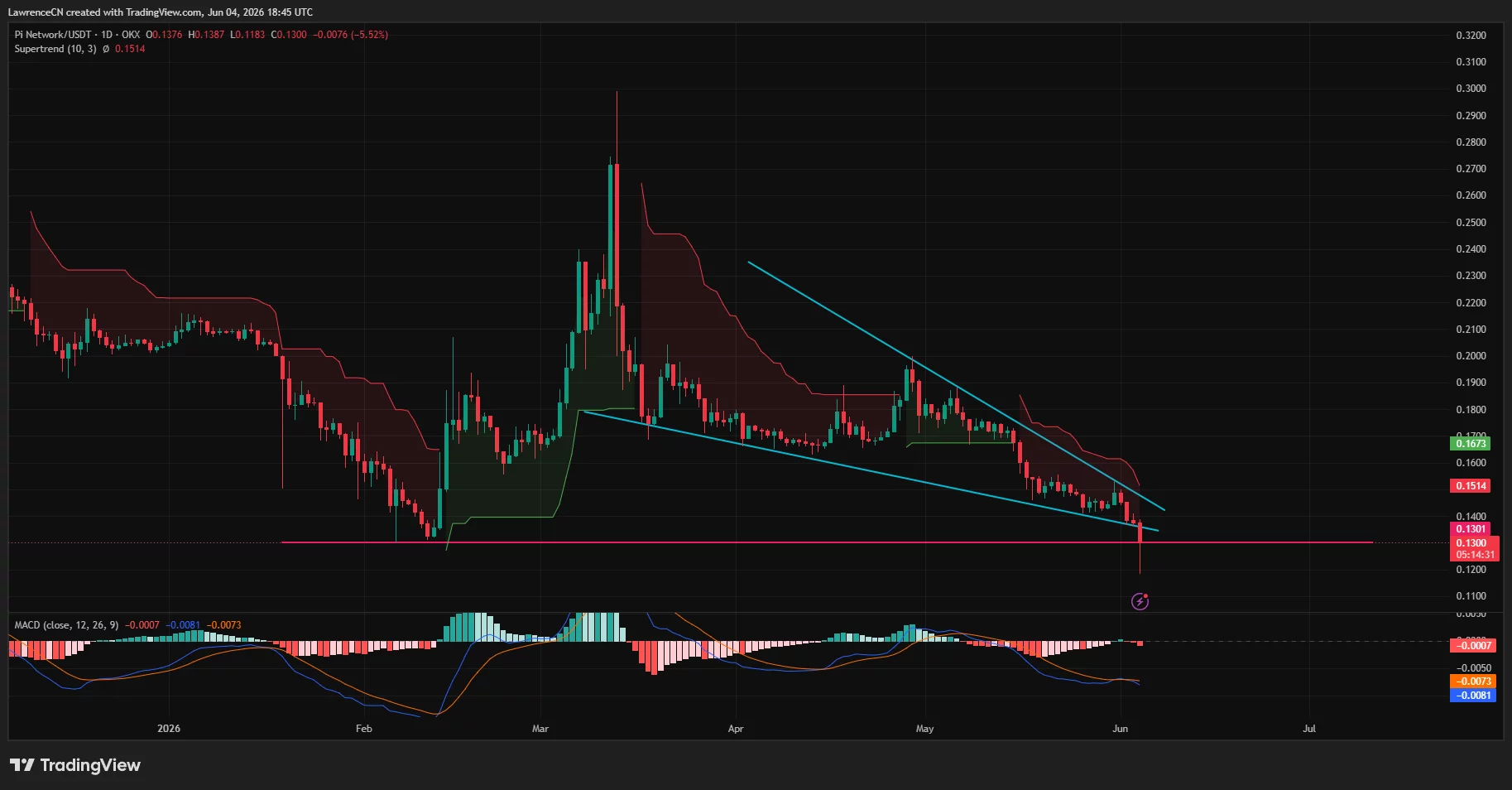
Pi Network price has fallen to a fresh all-time low after heavy token unlock pressure and weak market liquidity triggered another wave of selling across the ecosystem.
Summary
- Pi Network price fell to a new all-time low near $0.126 as traders reacted to more than 163 million PI tokens scheduled to unlock in June.
- Weak liquidity and a crypto market selloff that triggered over $1.6 billion in liquidations added further pressure to the token.
- A confirmed breakdown below a falling wedge pattern and the loss of key $0.13 support have put the $0.10 level in focus for traders.
According to data from crypto.news, Pi Network (PI) price traded near $0.130 on June 5 after plunging to a new record low of approximately $0.126. The token has now lost more than 30% over the past month, extending a downtrend that has persisted since its March rally faded.
A major source of pressure continues to come from the network’s token release schedule. Data from PiScan shows that more than 159 million PI tokens are still scheduled to enter circulation this month, with daily unlocks averaging over 5 million tokens. The largest single-day unlock is expected on June 11, when nearly 16 million PI will become available for trading.
The additional supply arrives at a time when market liquidity remains thin. Daily trading volume has slipped below $20 million across major exchanges, leaving the token vulnerable to large sell orders from early miners and long-term holders who recently completed KYC verification and mainnet migration.
Outside the Pi ecosystem, sentiment across digital assets has deteriorated sharply. Bitcoin (BTC) briefly fell to an intraday low near $61,550 on June 4, while Ethereum (ETH) dropped below $1,800.
CoinGlass data shows the selloff triggered more than $1.6 billion in liquidations across leveraged crypto positions, reducing appetite for speculative altcoins and adding further pressure to Pi Network’s price.
Network activity has offered a mixed picture. CiDi Games recently launched a Developer Center alongside four new games designed to attract builders and users into the Pi ecosystem.
Whale activity has also attracted attention in recent weeks, although those developments have so far failed to offset concerns surrounding rising token supply.
A recent X post from Whale Hunter highlighted the sharp rebound that followed PI’s previous drop to $0.128.
The analyst added that buyers had started returning to the market and argued that a break above $0.20 could trigger renewed momentum.
Falling wedge breakdown opens the door to lower prices
As crypto.news previously reported, Pi Network price was nearing a critical test of falling wedge support on the daily chart. Buyers failed to defend that level, allowing sellers to force a breakdown that eventually pushed the token to a new record low around $0.126.
The decline also took PI below the psychological $0.13 support zone, a level that had repeatedly attracted buying interest in recent months. Although the token managed to recover part of the loss, the breakdown has left the market focused on whether the next wave of June unlocks could trigger another move lower.
Technical indicators remain heavily tilted toward the downside. PI continues to trade below its Supertrend resistance at approximately $0.151, while price action remains well beneath its major short- and medium-term moving averages. The chart has also produced a sequence of lower highs and lower lows since March.
Meanwhile, the MACD remains in bearish territory, with the MACD line still positioned below the signal line. Although histogram bars have started to contract, buyers have yet to generate enough momentum to reverse the prevailing trend.
June token unlocks keep $0.10 level in focus
The most important support now sits near the recent low between $0.126 and $0.13. A decisive break below that zone would place PI in new price-discovery territory and expose the psychologically important $0.10 level.
Token unlocks remain the primary risk factor throughout the month. Fresh supply entering circulation could increase exchange inflows and intensify selling pressure, particularly if crypto market sentiment remains weak.
On the upside, bulls would first need to reclaim the former breakdown area near $0.14 before attempting a move toward the Supertrend resistance around $0.15. Above that, the next notable resistance zone sits between $0.18 and $0.20, where multiple recovery attempts failed during May.
Until buyers absorb the upcoming unlocks and reclaim key resistance levels, the chart structure continues to favor sellers, with the $0.10 threshold emerging as the market’s next major downside target.
Disclosure: This article does not represent investment advice. The content and materials featured on this page are for educational purposes only.



Prediction market guides explain how contracts resolve and pay. Almost none explain what happens when a market never gets that far, because it was voided, suspended by a court, renamed mid-life, or pulled by the exchange. The answers live in rulebooks and incident history, and they differ enough to matter.
Summary
- A prediction market can end without a normal resolution in at least four ways: the exchange voids it, a regulator or court forces suspension, the contract’s terms are altered mid-life, or the venue withdraws a self-certified product under pressure.
- Voiding is the cleanest outcome and generally means positions are cancelled and trades refunded, though the treatment of fees already paid varies by venue.
- Regulatory suspension is the messiest, because a state order can stop trading in a market that still has months to run, leaving positions frozen instead of settled.
- Contract terms are not immutable. Exchanges can and do clarify or rename markets after trading begins, which changes what you are holding without cancelling it.
- The one most useful habit is reading a venue’s rules on voiding, suspension, and settlement disputes before trading, because those clauses are where every one of these outcomes is defined.
Most explanations of prediction markets follow the same path: a contract opens, you buy shares priced between $0.01 and $0.99, the event occurs, the winning side receives $1, and settlement lands in your account within hours. That description covers the overwhelming majority of contracts, and the guides that stop there are not being careless. But a growing share of the interesting cases never reach that path. Markets get voided when their wording turns out not to describe reality.
They get suspended when a state court orders an exchange to stop offering a category. They get renamed when the exchange decides the original title was ambiguous. And they get withdrawn when a regulator opens a review, and the venue pulls the product instead of fighting. In each case, a trader is holding something, and what happens to it depends on clauses almost nobody reads. This guide covers those clauses, what the incident record shows, and what to check before you put money into a contract that might not finish.
Four ways a market ends early
The outcomes differ enough that lumping them together is the first mistake.
Voiding: The exchange determines the contract cannot be resolved fairly under its stated criteria and cancels it. Typical triggers: the underlying event becomes impossible to adjudicate, the resolution source stops publishing, the criteria turn out to be ambiguous in a way trading has exposed, or the market was listed in error. This is the most orderly failure mode.
Regulatory suspension: An external authority forces the exchange to stop offering a market or a category of markets to some or all users. Recent examples have involved state gaming regulators ordering venues to halt sports contracts in their jurisdiction, and enacted state bans with effective dates. The exchange remains solvent, and the market may remain open elsewhere, but affected users lose access.
Modification: The contract survives but its terms change. An exchange clarifies wording, renames a market, or publishes an interpretive note about how it will read the criteria. Nothing is cancelled, and nobody is refunded, but the thing you bought is not quite the thing you now hold.
Withdrawal: The venue itself pulls a product, often after a regulator opens a review. Historically, exchanges facing scrutiny over specific event contracts have withdrawn their certification instead of awaiting an order, which ends the market without any formal decision being issued.
Voiding and refunds
The orderly case is worth understanding first, because it is the outcome traders should generally want when a market has gone wrong.
The principle is straightforward: if the contract cannot be settled fairly, the exchange unwinds it and returns participants to their starting position. Positions are cancelled, and the collateral committed to them is released. The argument for this treatment is that a market whose terms do not describe reality never functioned as a market, so allowing it to pay out would reward whoever read the ambiguity best instead of whoever forecast the event correctly.
Where venues differ, and where the rulebook matters, is in three details. Whether trading fees already paid are refunded alongside the collateral, which is not universal. Whether the refund reflects your entry price or a mid-market value at cancellation, which matters if you traded in and out. And how the exchange handles a market that has partially resolved, where some component of a multi-outcome event has settled, and others have not.
The disputed cases usually involve wording, not events. Commentary on one episode, in which an exchange renamed a market whose title had become confusing, argued that best practice is simply to void and refund whenever the terms need altering, because if the trading desk understands the confusion well enough to rewrite the title, participants have already been trading something ambiguous. That is a reasonable standard, and it is not the universal practice, which is exactly why the clause is worth reading.
Regulatory suspension
This is the outcome with the least satisfying answers, and the one most likely to affect a large number of traders at once.
The prediction market industry is in active legal conflict across multiple US states over whether sports event contracts constitute gambling requiring state licensing. That conflict has produced cease-and-desist orders, litigation in several federal circuits, at least one enacted state ban with an effective date, and venues complying with court orders while appealing them. 12 or more states have taken some action. Availability changes month to month.
For a trader in an affected state, the practical questions are what happens to positions already open, whether new trades are blocked while existing positions can be closed, and whether funds can be withdrawn. Venues have generally handled this by restricting new trading for affected users while allowing existing positions to be closed or to run to settlement, which is the least disruptive approach available. But that is a policy choice, not a guarantee, and the mechanism differs from voiding in an important way: the market itself is not defective; it is simply unavailable to you.
Two consequences follow. Your position may continue to exist and settle normally while you cannot manage it, which is a materially different exposure than the one you took on. And where the venue is compelled to halt a market entirely, the treatment falls back on the voiding provisions above.
The instruction that follows is unglamorous: verify current availability in your own jurisdiction at the moment you intend to trade, from the venue’s own disclosures, and treat any published state list as potentially out of date, including one in a guide like this.
Modification, and why it is the sneakiest case
The outcome that produces the least noise and the most quiet damage is the one where nothing is cancelled.
Exchanges publish clarifications: They rename markets whose titles have become misleading. They issue interpretive notes explaining how ambiguous criteria will be read. On blockchain-based venues, the operator can publish clarifications that shape how the decentralized resolution process reads the rules, even where the operator cannot decide the outcome itself.
None of this refunds anyone: A trader who bought a contract on one reading of its title and finds the title changed is holding a different instrument at the same cost basis, with no cancellation and no recourse beyond the dispute mechanisms the venue provides. The argument for allowing modification is practical: voiding every market that needs a clarification would be enormously disruptive and would itself become a manipulation vector. The argument against is that it makes the contract’s terms mutable after the trade, which is not a property most participants assume they are accepting.
The defence is to read the rules and important-information sections at entry, not the headline, and to treat any market whose title carries obvious ambiguity as carrying modification risk on top of everything else.
Regulated exchanges versus on-chain venues
The two architectures handle all of this differently, and the difference is structural, not a matter of policy quality.
On a federally licensed exchange, the rulebook governs, and the exchange is accountable for enforcing it. There is a named entity, a regulator supervising it, a complaints path, and, for a designated contract market, obligations under the core principles to list contracts that are not readily susceptible to manipulation. Voiding, suspension, and modification decisions are made by an identifiable party that can be asked to justify them. Our guide to the designated contract market licence covers that structure.
On a blockchain venue, resolution runs through a decentralized process with proposal, challenge, and token-holder voting stages, which this publication examines in its guide to how prediction markets resolve. Once a resolution finalizes on-chain, it is locked, and there is no operator with the authority to reverse it. That is a genuine guarantee against arbitrary reversal, and it is also a guarantee against correction: a resolution that a reasonable observer considers wrong is nonetheless final.
Neither model is uniformly better. The regulated venue can fix mistakes and can therefore also make discretionary decisions you may dislike. The on-chain venue cannot make discretionary decisions and can therefore also not fix mistakes. Knowing which you are on determines what kind of failure you are exposed to, and our guide to Polymarket’s 2 venues explains why a one brand can be both.
Two incidents worth knowing
Abstract categories are less useful than cases, and two episodes illustrate the range between the orderly and the messy versions of a market ending early.
The first involved wording. An exchange listed a market on whether a named executive would leave her role within a stated period, and the contract’s terms turned out to be ambiguous enough that the exchange altered the market’s title mid-life. Commentary at the time argued the correct response was to void and refund instead of renaming, on the reasoning that an operator who understands the confusion well enough to rewrite the title has already conceded that participants were trading something unclear. The counterargument is that voiding every ambiguous market would itself be disruptive and gameable. Neither position is obviously wrong, which is precisely why this belongs in a rulebook, not in a judgment call, and why reading that rulebook before trading is the only protection available.
The second involved subject matter, not wording. Venues have adopted explicit policies against markets that settle directly on a person’s death, a line drawn after contracts touching geopolitical events and named individuals generated substantial controversy. That is a listing standard, not an early-ending mechanism, but it points at the same underlying reality: what a venue will and will not carry is a policy that can change, and contracts near the edges of those policies carry a risk of removal that has nothing to do with their subject matter being resolved.
The generalisable lesson from both is that the risk concentrates where the wording is loose, or the subject is sensitive. Objective criteria resolved by a single authoritative source almost never produce these outcomes. Markets whose terms invite argument, or whose subject matter invites institutional discomfort, produce them regularly.
What to check before trading
Five items, ordered by how often skipping them causes losses.
The voiding clause: Find it in the venue’s rules. It defines what happens in the orderly failure case, including whether fees are refunded and how partial resolutions are treated. If you cannot find it, that is itself information.
The resolution source and criteria: Read the rules and important-information sections, not the market title. Ambiguity between them is the raw material of every voiding and modification event.
Current availability in your jurisdiction: Legal status by state is contested, moving, and specific to product categories. Check at the moment you trade.
The settlement timeline in the rules: Some markets specify a determination date later than the point at which the event appears to conclude, which means a position you consider settled is still open.
Whether the venue can modify terms: If the rulebook permits clarification or renaming after trading begins, you are accepting mutable terms. That may be fine. It should be a decision, not a discovery.
The theme across all five is that the answers exist, in documents the venues publish and almost nobody reads, and that the small number of traders who read them before entering are the ones not surprised when a market ends in an unusual way.
The self-certification connection
One structural fact explains why early-ending markets happen more often in this category than in most regulated products, and it is worth knowing because it also predicts where the risk concentrates.
American event contracts reach the market through self-certification: a licensed exchange files a submission stating that a product complies with the law and begins listing it, without waiting for approval. Our guide to that mechanism covers it in full.
The consequence for this discussion is that no regulator vetted the contract’s wording before trading began. The exchange’s own compliance judgment is the only filter, and every ambiguity that later forces a void or a clarification passed through that filter first.
The same procedure creates the withdrawal risk. Where a submission touches activities the statute enumerates, including gaming and conduct unlawful under state law, the regulator may open a review and request that the exchange suspend listing or trading while it proceeds. Historically, exchanges facing such reviews have sometimes withdrawn certifications rather than await a decision, which ends a market with no order ever issuing and no formal ruling to appeal.
Read together, the two halves explain the distribution of risk. Markets whose subject matter sits near the enumerated activities carry regulatory-ending risk on top of their ordinary market risk, and that category is not obscure: it is sports, politics, and anything touching conduct that states regulate as gambling, which is where most retail volume concentrates. A trader who wants to minimise exposure to early endings should prefer contracts whose resolution criteria are objective, whose subject matter is remote from gaming, and whose venue has a track record of certification decisions that have not been reviewed.
A final observation on why this question deserves more attention than it receives. Prediction market coverage has concentrated overwhelmingly on two subjects: whether these venues are legal, and whether their prices are accurate. Both are legitimate, and both are extensively covered. What has been almost entirely absent is the operational question of what a position actually is, contractually, once you hold it.
That gap has a structural cause. The parties best positioned to explain voiding, suspension, and modification are the venues themselves, and none of them has a commercial reason to lead with the circumstances in which your position does not resolve normally. The affiliate-driven guides that dominate search on these terms have less reason still, since their revenue depends on account signups, not on informed participants. So the material stays in rulebooks, where it is accurate, complete, and read by almost nobody.
The consequence is a category where a substantial number of participants hold instruments whose failure modes they have never considered, in a regulatory environment producing suspensions and withdrawals at a steady rate. Reading the rules before trading is not a sophisticated practice. It is the minimum, and in this category it puts you ahead of most of the order book.
Frequently Asked Questions
What happens if a prediction market is voided?
Generally, the exchange cancels the contract and returns participants to their starting position, releasing the collateral committed to open positions. The rationale is that a market whose terms do not describe reality never functioned properly, so paying out would reward whoever read the ambiguity best. Whether fees already paid are also refunded, and how partial resolutions are handled, varies by venue and is defined in the rulebook.
Why would an exchange void a market?
Because the contract cannot be settled fairly under its stated criteria. Common triggers include an underlying event becoming impossible to adjudicate, a resolution source ceasing publication, criteria turning out to be ambiguous in ways trading has exposed, or a market being listed in error. Voiding is the most orderly of the early-ending outcomes.
What happens to my position if my state bans prediction markets?
It depends on the venue’s policy and the scope of the order. Exchanges have typically restricted new trading for affected users while allowing existing positions to be closed or to run to settlement. The market itself is not defective, so the voiding provisions do not automatically apply; you may hold a position that settles normally while you cannot manage it.
Can an exchange change a market’s terms after I have bought?
Yes, on regulated venues. Exchanges publish clarifications, rename markets, and issue interpretive notes about ambiguous criteria. Nothing is cancelled, and nobody is refunded, which means you can end up holding a different instrument than the 1 you bought. Reading the rules and important-information sections at entry, and not the market title, is the defence.
Is a resolution ever reversed?
On regulated exchanges, decisions can be reviewed through the venue’s dispute procedures. On blockchain venues using decentralized oracles, once a resolution finalizes on-chain, it is locked, whether it arrived through an uncontested challenge window or a token-holder vote. That finality protects against arbitrary reversal and also prevents correction of outcomes many observers consider wrong.
Which venue type handles this better?
Neither uniformly. A regulated exchange has an accountable operator that can fix errors and can therefore also exercise discretion you may dislike. An on-chain venue removes discretion entirely and therefore also removes the ability to correct mistakes. The relevant question is which failure mode you prefer to be exposed to.
Do I get my trading fees back?
Not necessarily. Collateral release on a voided market is standard; fee treatment is not, and it is defined in each venue’s rules. On contracts priced in cents, fees represent a meaningful share of the position, so this clause is worth locating specifically rather than assuming.
What is the single most useful precaution?
Reading the venue’s rules on voiding, suspension, and settlement disputes before you trade, and reading each market’s own rules and important-information sections rather than its headline. Every outcome described in this guide is defined in documents the venues publish, and the traders who are not surprised are the ones who read them 1st. This is educational information, not investment or legal advice.
Disclaimer: This article is for information and educational purposes only and does not constitute financial, investment, or legal advice. Venue policies, availability, and the legal status of event contracts vary by jurisdiction and change frequently. Always verify current rules and terms with the venue directly. Always do your own research. Information is accurate as of July 29, 2026.
Hackers briefly took over Senator Cynthia Lummis’ verified X (Twitter) account on Wednesday. The account pushed a fake Solana meme coin called $USA Token before the posts disappeared within roughly five minutes.
The Wyoming Republican is the Senate’s most persistent advocate for the Digital Asset Market Clarity Act, a bill that would divide crypto oversight between two federal regulators. Few lawmakers post about digital assets more often.
Inside the Lummis Crypto Scam Hack
The message claimed the token was “officially created by our team” and tagged Solana. It carried an American flag image and a link to pump.fun. That platform lets anyone mint a Solana meme coin in minutes.
A screenshot captured by Bitcoin Archive shows the post reached about 5,600 views and 37 replies before it vanished. Several near-identical versions appeared in quick succession. Each pointed to a different token page.
Follow us on X to get the latest news as it happens
Verified political accounts make attractive targets. Followers rarely expect a token promotion from a sitting senator, so the first few minutes carry the most weight.
Crypto users flagged the account within minutes and warned followers not to buy. However, Lummis’ office had issued no statement confirming the breach at the time of publication.
No proceeds have been tied to the tokens so far. That marks a sharp contrast with the Robinhood CEO’s X account takeover six days earlier, where the attacker cleared roughly $1.2 million.
Account Takeovers Keep Hitting Crypto’s Biggest Names
Vlad Tenev lost control of his account on July 23 after attackers socially engineered X customer support. They promoted a token called Vladhood and extracted about 650 ETH.
Earlier in July, the SpaceX and Starlink accounts were used to push a rug pull called SCATMAN, netting around $125,000. X (Twitter) began locking first-time crypto posts in April to slow the pattern. It has not stopped.
The playbook rarely changes. Attackers seize a verified account, post a freshly minted token, then delete the evidence before the owner regains control.
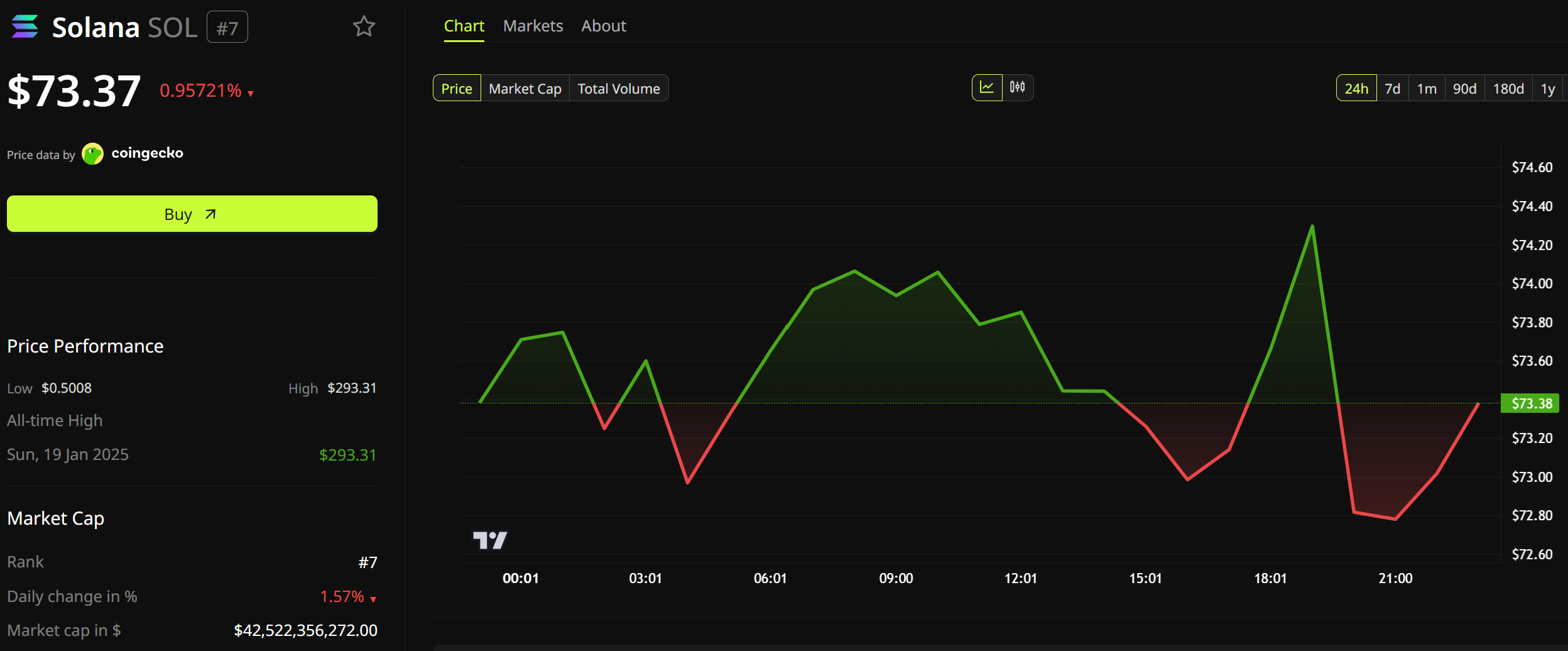
SOL traded around $73 on Thursday, down almost 1% over 24 hours and roughly 60% below its level a year ago. The scam token itself carried no real liquidity.

Meanwhile, the timing lands awkwardly for Lummis. Her bill stalled before the recess after Senate leaders conceded there was no time for a floor vote. How the account was accessed may end up mattering more than the token ever did.
The post Lummis, CLARITY Act’s Fiercest Proponent, Hit by Crypto Scam Hack appeared first on BeInCrypto.

MoonPay has introduced PayBox, a “payment vault” designed to let users authorize AI assistants such as ChatGPT and Claude to carry out crypto actions directly from a conversation. The tool is positioned as a safer way for AI agents to handle tasks like token swaps, cross-chain transfers, and DeFi interactions—while keeping users in control of their funds.
Alongside PayBox, the launch highlights the growing role of x402, an open payments protocol developed by Coinbase for internet-native payments by AI agents. x402 has been moving toward wider industry standardization, including governance under the Linux Foundation and integration across cloud and custody infrastructure.
Key takeaways
- MoonPay’s PayBox aims to enable AI assistants to execute crypto transactions from chat, with user approvals supported via passkeys or spending limits.
- MoonPay says PayBox protects wallet keys using multi-party computation and trusted execution environments to prevent unilateral access by either the AI or MoonPay.
- PayBox supports multiple chains and payment rails, including debit cards, bank accounts, Apple Pay, and PayPal.
- x402 is expanding beyond Coinbase, including Linux Foundation governance and reported usage growth on Coinbase’s Base network.
- Public x402 ecosystem data (via x402scan) shows more than 12.7 million transactions over the past 30 days across participating services.
MoonPay’s PayBox: AI-initiated crypto with guardrails
PayBox is built to connect a user’s crypto wallet and payment methods to AI assistants, allowing those assistants to prepare on-chain actions after receiving natural-language prompts. According to MoonPay, the system can generate transaction flows such as token swaps, cross-chain transfers, and DeFi interactions.
A key design element is transaction authorization. MoonPay says users can approve each action using a passkey, or they can set spending limits that let the AI perform certain permitted operations automatically. Alternatively, users can require approval for every transaction, effectively keeping the assistant from executing any spend without explicit confirmation.
MoonPay also emphasized security around key custody. The company states PayBox uses multi-party computation and trusted execution environments to protect wallet keys, aiming to ensure neither the AI assistant nor MoonPay can independently access user funds. For users, that distinction matters because AI-driven payments introduce an obvious risk: the assistant might be capable of generating transactions, but should not be able to control the underlying assets without authorization.
Beyond consumer use, MoonPay says developers can integrate the payment vault into their own AI applications via its software development kit, positioning PayBox as infrastructure rather than only an end-user feature.
Why this matters: reducing friction without surrendering control
AI payments are often discussed in terms of convenience—an assistant handling purchasing, swapping, or settlement without requiring users to manually navigate wallets. PayBox takes a more security-forward angle by focusing on approval mechanisms and constraining what an AI can do.
For investors and builders, the most important question is where the “automation boundary” should be: how far should an assistant go before a user must sign off, and how should spending permissions be scoped. MoonPay’s approach—passkey-based approvals, optional per-transaction confirmation, and predefined spending limits—suggests an attempt to make that boundary explicit.
It also signals that AI payment systems may converge on user-consent patterns that resemble modern financial authorization workflows, rather than “fully autonomous” agent behavior. The market is already seeing demand for agentic capabilities, but the trust layer—especially key security and transaction approval—often determines whether mainstream users adopt these tools.
x402 traction and standardization under the Linux Foundation
PayBox also supports x402, an open payment protocol intended to let AI agents make internet-native payments. x402 was originally developed by Coinbase, and the protocol is now being governed as an open, vendor-neutral industry standard, following a contribution to the Linux Foundation in April 2026. The Linux Foundation announced the creation of a governance structure for x402 after welcoming the protocol contribution, and described it as an industry standard.
Coinbase has continued expanding the x402 ecosystem this year. In June, the exchange launched tools that reportedly enable AI agents to accept USDC payments, trade crypto, discover paid services through an AI marketplace, and handle high-frequency micropayments more efficiently. Earlier in the year, cloud provider Amazon Web Services integrated x402 into its Bedrock AgentCore Payments service, and Fireblocks introduced an x402-compatible payments framework for AI agents while joining the x402 Foundation.
These moves matter because x402 is not just a single integration—it’s aimed at enabling interoperability between AI services and payment execution layers. When multiple categories of infrastructure (cloud services, custody and tooling, and payment frameworks) adopt a common protocol, it can reduce fragmentation and speed up development of agent payment features across platforms.
On-chain activity signals growing usage—alongside uncertainty
Data cited by Cointelegraph’s earlier coverage suggests that agentic payments tied to Coinbase’s Base network have grown rapidly. In a June 3 report, blockchain analytics firm Chainalysis said agentic payments on Base surpassed 100 million transactions within roughly nine months. The report also noted that early usage was driven in part by speculative applications, highlighting that adoption metrics can include experimentation as well as sustained real-world demand.
At the time of writing, the x402 public dashboard hosted at x402scan shows more than 12.7 million transactions over the past 30 days across participating services. The continuing presence of large transaction counts on a short rolling window suggests activity is not confined to one-off launches, though it still leaves open how much of that volume reflects long-term utility versus short-cycle testing.
For readers tracking the broader “agent economy,” the practical takeaway is that payment protocols and execution frameworks are moving from concept to operational tooling. However, transaction volume alone doesn’t fully answer how many agents are used by real businesses, what percentage of payments are high-value versus micropayments, or how often transaction flows are gated by user permissions—questions that will likely become clearer as more product deployments mature.
Next, watch how PayBox’s authorization controls perform in real user workflows—especially whether per-transaction approvals become the default for mainstream use—and whether x402 ecosystem growth continues to translate into consistent, non-speculative payments across more services and chains.
Microsoft Copilot AI is not easing into this predicts. By the end of 2026, XRP at $1.06 faces a bull case projecting $5 to $8, a level that treats regulatory approval as the trigger for a genuine repricing rather than a gradual climb.
Regulatory clarity sits at the center of the case. SEC and CFTC recognition of XRP as a digital commodity would remove the legal fog that has followed this asset for years.
Billions in ETF inflows, led by BlackRock, are identified as the second pillar. That kind of institutional entry point did not exist in any prior XRP cycle.
Ripple’s own business expansion adds real-world weight. Japan’s expansion with the RLUSD stablecoin, tokenization partnerships with Archax, and XRP Ledger upgrades powering DeFi and real-world asset settlement all point toward genuine utility rather than speculative volume.
Macro tailwinds round out the bull case. Fed easing and a Bitcoin rally are cited as examples of broader conditions that tend to lift every major asset at once, including XRP.
The bear case is specific about where the price gets stuck. If the CLARITY Act stalls, XRP stays range-bound at $0.85 to $1.50, with a sell wall at $1.44 acting as the ceiling that keeps rejecting advances.
Macro tightening that drains liquidity from the system is named as the other real risk. Copilot frames the entire outcome as hinging on one question: whether institutional adoption and tokenization flows actually materialize into sustained demand rather than staying announcements.

XRP Is Sitting Right On The Floor Of Its Own Bear Case
Price closed at $1.05989, down 0.50%, in a session ranging between $1.04395 and $1.06630. That places XRP almost exactly at the lower boundary of the range this same prediction describes as the bear scenario.
Zoom out and the decline since December has been long and largely uninterrupted. XRP peaked near $2.40 in January, then broke down through February in a sharp single move, gapping from above $2.10 to under $1.70 in a matter of days.
Since that crash, price spent months compressing within a slowly narrowing range between roughly $1.30 and $1.60, then broke lower in June, sliding toward $1.00. The recovery attempt in July has been shallow, stalling near $1.20 before rolling back to current levels.
Support sits right here at $1.00, the psychological floor XRP is testing directly. Below that, there is little chart history to lean on before price would be trading in territory not seen this entire period.
Resistance stacks at $1.20, then $1.30, then the heavier ceiling near $1.44 that Copilot’s own bear case names as the sell wall. Momentum here is weak, with price grinding along its lows rather than building any base for a reversal.
For any part of this bull case to gain traction, XRP first needs to reclaim $1.44, a level it has not closed above since May. Until that happens, this chart is doing exactly what the bear case describes, sitting on the floor rather than building toward the ceiling.
Here is what Copilot AI Predicts For LiquidChain’s Near Future
Every cycle has a moment where waiting becomes the most expensive decision you can make. That moment is now.
Bitcoin, Ethereum, and XRP are all pinned under the same resistance they have been testing for weeks. The macro unlock is perpetually one data point away. The institutional money keeps arriving next quarter. Large-cap traders waiting for a breakout are queuing for a decision that belongs to someone else entirely.
Grok AI has identified what experienced cycle traders already act on. Capital that registers as statistical background noise at Bitcoin’s market cap can completely reprice a small, undiscovered project.
The asymmetry is not complicated. It lives in the distance between what something is genuinely worth and what the market has currently assigned it. The moment that distance gets noticed, it collapses. Before that moment, it is fully open.
Cross-chain fragmentation has been quietly taxing every DeFi participant since the first bridge went live. Bitcoin, Ethereum, and Solana were engineered independently with zero shared infrastructure and no design intent to communicate.
Every transaction crossing those ecosystem boundaries absorbs the cost of that decision in fees, failed execution, and slippage that hits before settlement even begins. The bridge industry did not fix this problem. It built a business model on top of it.
LiquidChain removes the business model entirely. Three networks unified inside a single execution layer. One deployment reaches all of them simultaneously. No cross-chain tax is extracted from any interaction anywhere.
Copilot AI predicts it as a coin worth watching. The presale sits at $0.01454 with just over $860,000 raised.
Execution is unproven. Adoption is an open question. Established assets offer a smoother path toward a ceiling that the entire market can already see. LiquidChain is the entry point that stops existing once the market finds it.
The post Microsoft Copilot AI Just Dropped the Most Bullish XRP Prediction of 2026 appeared first on Cryptonews.


Every chain announcement leads with a transaction number. On a network charging $0.0002, 1 million transactions represents $200 of economic activity and a weekend of testing. The metric that headlines every milestone is the one that survives the least scrutiny, and the analytics platforms already know it.
Summary
- Transaction counts are the most-cited blockchain metric and among the least informative, because a count measures events, not value, and says nothing about what those events were worth.
- On networks with fees measured in fractions of a cent, the cost of generating enormous counts is trivial, so testing, scripts, and incentive farming produce numbers indistinguishable from commerce.
- A concrete case: a network processing 1.4 million transactions at a fixed fee near $0.0002 generated roughly $280 in total network fees, a figure that reframes the milestone entirely.
- Fee subsidies compound the distortion in both directions, inflating activity while suppressing the revenue that would otherwise reveal its scale.
- The analytics platforms that publish these numbers already flag the problem in their methodology notes; the caveat simply never reaches the press releases that cite them.
There is a number in almost every blockchain announcement, and it is almost always the first one: transactions processed. 1 million in the first week. 4 million. 3.6 million a day. Cumulative counts in the billions. The number is easy to produce, easy to compare, and easy to understand, which is precisely why it dominates. It is also, on most modern networks, close to meaningless as a measure of whether anything of consequence is happening, and the reason is arithmetic, not opinion.
A transaction count multiplied by a fee approaching zero equals an economic activity level approaching zero. Networks designed for cheap transactions have made the headline metric cheap to manufacture, and the industry has continued citing it as though the cost of generating it had not collapsed. This guide walks the arithmetic, explains what counts actually measure, catalogues the three ways they get inflated, and sets out the metrics that survive the same scrutiny.
The arithmetic that breaks the metric
Take a real example instead of a hypothetical, because the numbers make the argument better than any abstraction.
A blockchain designed for payments charges a fixed transaction fee of approximately $0.0002. It announced a milestone: more than 1 million transactions initiated by automated software agents, a figure that grew to roughly 1.4 million. The announcement was covered as evidence of an emerging machine-payments economy.
Now multiply. 1.4 million transactions at $0.0002 each produces roughly $280 in total network fees. Not per day. In total, across the entire milestone being celebrated.
That figure is not a criticism of the technology, which works, or of the strategic thesis behind it, which is defensible. It is a measurement. It says that whatever the 1.4 million transactions represent, they represent about the fee revenue of a modest lunch, and that a single developer running an integration test suite in a loop over a weekend could produce a six-figure transaction count for the price of a coffee.
The same arithmetic applies wherever fees are negligible. A chain processing 4 million transactions in its first week at similar fee levels has generated something in the hundreds of dollars. A chain reporting 3 million daily active transactions has told you almost nothing about whether that activity has value, because it costs almost nothing to create.
What a count actually measures
If not commerce, what does a transaction count measure? Three things, in descending order of usefulness.
Capability: A network that has processed millions of transactions has shown it can. Throughput claims are frequently theoretical, and a real count is evidence the infrastructure functions under load. This is genuinely worth knowing, and it is what most milestone announcements are actually entitled to claim.
Interest: People or programs are doing something on the network. That is not nothing, particularly for a new chain competing for developer attention, and the direction of the number over time carries some signal about whether attention is growing or fading.
Enthusiasm, subsidised or otherwise: Where incentives exist, whether airdrop farming, fee subsidies, or points programmes, the count measures the incentive, not the underlying demand. When the incentive ends, the count reveals what it was.
What a count does not measure is economic activity, user adoption, revenue, or product-market fit. A network can rank first in transactions and last in every metric that pays for anything, and several have.
Three ways counts get inflated
The distortions are systematic, not occasional, and knowing them lets you discount a headline in the right direction.
Testing and automation. Development activity, integration testing, bot loops, and automated scripts generate transactions indistinguishable from user activity in a raw count. On expensive networks this self-limits, because testing at scale costs real money. On cheap networks it does not self-limit at all. Some unknowable share of any low-fee chain’s count is machines talking to themselves, and the honest position is that nobody outside the team knows the proportion.
Incentive programmes. Airdrop farming, points systems, and volume-based rewards produce transactions whose purpose is to be counted. The pattern is recognisable in the data, since farming activity clusters in wallets with no other behaviour and collapses when the programme ends, but it is not visible in the headline.
Fee subsidies. Several chains launch with a period during which transactions are free or heavily subsidised. This inflates counts and suppresses fee revenue simultaneously, which is the worst combination for anyone trying to assess the network, because the metric that looks best is inflated and the metric that would correct it is artificially depressed. A chain running a 90-day subsidy is a chain whose first 90 days of data cannot be compared to anything, including its own subsequent performance.
One further complication that applies to every count: system transactions. Some architectures generate protocol-level transactions in every block that no user initiated. Analytics platforms exclude these precisely because including them inflates figures, but not every source cited in an announcement applies the same filter.
The analytics platforms already say this
The most useful confirmation of the argument is that the platforms producing these numbers document the caveat themselves, in the methodology notes that headlines never carry.
One major Layer 2 analytics provider states directly that transaction count can be artificially inflated through spam or micro-transactions that do not represent meaningful activity, notes the problem intensified as Layer 2 costs fell, and recommends the metric be analysed alongside chain revenue or transaction costs on the reasoning that users facing real fees are less likely to spam.
The same provider excludes system transactions from its counts and explains why. Other on-chain data platforms make similar points, placing transaction volume alongside fee revenue, stablecoin presence, and developer activity precisely because no single 1 of them is sufficient.
That is the whole argument, published by the people best positioned to know, sitting in documentation that the press release citing their dashboard does not reproduce. The information is not hidden. It is simply one layer below where the number gets quoted.
Where the metric came from
The transaction count’s dominance is partly an inheritance, and knowing its origin explains why it stopped working, not why it was ever chosen.
In Bitcoin’s early years, transaction count was a reasonable proxy for adoption. Block space was scarce, fees were real, and every transaction represented someone deciding the network was worth paying to use. The metric measured what it appeared to measure because the cost of generating it was non-trivial and the supply of it was capped. Ethereum inherited the convention for the same reasons, and through the period when gas fees regularly reached double-digit dollars, a rising transaction count meant rising willingness to pay.
Two changes broke the link. The first was scaling: rollups and high-throughput chains reduced per-transaction costs by orders of magnitude, which was the entire point and an unambiguous success, and which simultaneously removed the economic filter that made counts meaningful. A metric whose validity depended on transactions being expensive stopped being valid when transactions stopped being expensive.
The second was competition for attention. As the number of chains multiplied, each needed a comparable number to argue with, and transaction count was the only metric every chain reported in the same units. Comparability beat accuracy, as it usually does, and the industry standardised on the figure that was easiest to place in a table instead of the one that answered the question.
The result is a metric that was appropriate for the conditions it was designed under and has been carried, unmodified, into conditions where those assumptions no longer hold. That is a common failure in measurement generally, and the correction is equally common: state the cost alongside the count, and the number becomes informative again.
The metrics that survive
Replace the count with a short set that resists manufacture, in rough order of how hard each is to fake.
Fee revenue: The most robust single number, because it is the count multiplied by what people were actually willing to pay. Real fee revenue cannot be manufactured cheaply, since manufacturing it costs exactly what it reports. Where a network is subsidising fees, note that the figure is suppressed and will reprice when the subsidy ends.
Value settled: The dollar amount moving through the network, which distinguishes 1 million dust transfers from 1 million payments. This is the metric that separates a payments chain doing its job from a payments chain being tested.
Stablecoin balances held on the chain: Money parked on a network is a statement of intent that costs something to make, and it is considerably harder to fake than activity. A chain with rising resident stablecoin supply has users who chose to keep funds there.
Active addresses, with a caveat: Better than raw counts, worse than it looks, because address creation is nearly free. Useful in combination, misleading alone, and always worth checking for the concentration pattern that indicates farming.
Retention: Whether the addresses active last month are active this month. Almost nobody publishes it, which is itself informative.
How to read a chain announcement
Four questions, applied in order, will correctly discount most headlines in under a minute.
What did those transactions cost in total? Multiply the count by the fee. If the answer is small, the count is a capability claim, not an economic one, and should be read as such.
Is a subsidy running? If fees are free or discounted, both the activity figure and the revenue figure are artefacts of the programme rather than of demand, and no comparison to another chain or another period is valid.
Are there incentives attached? Points, airdrops, and volume rewards produce transactions for the purpose of being counted. Check whether a programme is live before treating growth as organic.
What is the fee revenue, and is it growing? This is the question that reframes everything else, and it is usually available on public dashboards even when the announcement omits it.
None of which means transaction counts should be ignored. They are a real measure of a real thing: that a network functions and that something is happening on it. The error is treating a measure of activity as a measure of value on networks specifically engineered to make activity nearly free.
The industry built chains where transactions cost almost nothing and then kept using transaction counts as the headline, and the gap between those two facts is where most of the confusion in chain comparisons now lives.
What good disclosure looks like
Not every project reports this way, and recognising the ones that do is a useful shortcut, because a network confident in its economics tends to publish the numbers that would embarrass a network that is not.
Good disclosure names the fee environment alongside the activity. A chain reporting transaction counts during a subsidy period, and saying so, is telling you how to read its own figure. A chain reporting counts and fee revenue together lets you do the multiplication without hunting for the 2nd number. A chain publishing value settled instead of transactions is reporting the metric that resists manufacture. None of that costs anything except the willingness to be measured on a harder number.
Poor disclosure is recognisable by omission, not by falsehood. The figures cited are usually accurate; what is missing is the context that would size them. A milestone announcement that reports a count, does not mention an active fee subsidy, does not state the fee level, and does not link to revenue data is not lying. It is presenting the most flattering true number available and leaving the reader to find the rest, which most readers do not.
The same asymmetry runs through comparisons between chains. Rankings by transaction count place networks with different fee levels, different subsidy states, and different system-transaction accounting on one table as though the numbers were commensurable. They are not, and the ranking usually rewards whichever network has made transactions cheapest, which is a design choice rather than an achievement. Any comparison worth making normalises for cost, and almost none of the widely circulated ones do.
One last point about why this metric persists despite everyone in a position to know understanding its limits.
Transaction counts survive because they satisfy every constituency at once. They are easy for a network to produce, easy for a journalist to write, easy for a reader to compare, and, critically, they almost always go up. Fee revenue can fall. Value settled can fall. Retention can be embarrassing. A cumulative transaction count is monotonic by construction, which makes it the only headline metric guaranteed never to deliver bad news.
That property explains the shape of most chain communications. Cumulative figures appear more often than daily ones, because cumulative figures cannot decline. Counts appear more often than revenue, because counts are less sensitive to whether anyone is paying. Records are announced at intervals instead of trends being published continuously, because records are selected and trends are not.
None of this requires anyone to lie, and mostly nobody does. It requires only the ordinary practice of reporting the truest flattering number available, which every organisation in every industry does. The reader’s job is to know which number that is, and in blockchain announcements it is almost always the transaction count. When a network leads with revenue instead, that choice is itself the most informative thing in the release.
Frequently Asked Questions
Why are transaction counts considered unreliable?
Because a count measures events rather than value, and on networks with fees measured in fractions of a cent, generating enormous counts costs almost nothing. Testing scripts, automated loops, and incentive farming produce transactions indistinguishable from genuine commerce in a raw count, so the number can grow substantially without any underlying economic activity.
Can you give a concrete example?
A payments-focused network charging roughly $0.0002 per transaction announced 1.4 million transactions initiated by software agents. Multiplied out, that represents approximately $280 in total network fees. The technology worked, and the milestone was real, but the economic weight of the activity was a rounding error, which the headline figure did not convey.
What do transaction counts actually tell you?
Three things: that the network can process transactions at that scale, which is a genuine capability claim; that some level of interest or activity exists; and, where incentives are running, how effective those incentives are. They do not tell you about economic value, revenue, user adoption, or whether the activity continues once incentives end.
How do fee subsidies affect the numbers?
They distort both directions at once. Free or discounted transactions inflate activity while suppressing the fee revenue that would otherwise reveal its scale, which means a chain running a subsidy produces data that cannot be compared to other networks or to its own later performance. A 90-day subsidy makes 90 days of metrics uninterpretable.
Do analytics platforms acknowledge this?
Yes, in their methodology documentation. One major Layer 2 data provider states that counts can be artificially inflated through spam and micro-transactions, notes the problem worsened as costs fell, excludes system transactions from its figures, and recommends reading counts alongside chain revenue. That caveat rarely appears in the announcements citing the dashboards.
What metrics are more reliable?
Fee revenue first, because manufacturing it costs exactly what it reports. Then value settled, which distinguishes dust transfers from payments; stablecoin balances resident on the chain, since parked money is a costly statement of intent; active addresses with concentration checks; and retention, which almost nobody publishes
Are transaction counts completely useless?
No. They are a real measure of throughput and a rough indicator of direction, and for a new network showing that infrastructure functions under load, that is worth reporting. The error is treating a measure of activity as a measure of value on networks specifically designed to make activity nearly free.
How should I read a chain milestone announcement?
Multiply the count by the fee to size the economic activity, check whether a fee subsidy or incentive programme is running, and look up the network’s actual fee revenue on a public dashboard. Those three checks take about a minute and correctly discount most headlines in this category. This is educational information, not investment advice.
Disclaimer: This article is for information and educational purposes only and does not constitute financial or investment advice. Network metrics, fee levels, and subsidy programmes change frequently, and figures cited reflect data available at the time of writing. Always do your own research. Information is accurate as of July 29, 2026.


Robinhood (HOOD) topped Wall Street’s second-quarter expectations, but shares fell about 4% in after-hours trading, adding to their 3.1% decline during Wednesday’s session.
The online brokerage reported adjusted earnings per share of $0.62, well ahead of analysts’ $0.43 estimate, while revenue climbed 32% from a year earlier to a record $1.31 billion, narrowly topping the $1.29 billion consensus forecast.
The results reflected strength across Robinhood’s expanding product lineup, even as crypto trading cooled. Crypto revenue fell 38% year over year to $100 million from $160 million, while transaction revenue was lifted by surging options, equities and prediction markets activity.
“Whether it’s the Robinhood Chain, Robinhood Ventures, or Trump Accounts, our product velocity is focused on one goal: making everyone an owner,” Vlad Tenev, Chairman and CEO of Robinhood, said in a statement.
The second quarter marked one of Robinhood’s biggest product pushes in recent years. The company launched Robinhood Chain, a blockchain network that supports tokenized U.S. stocks for eligible European customers as part of its push to bring traditional financial assets onchain.

Bitcoin extended its positive run last week with a minor 1% weekly gain, marking its fourth straight weekly advance for the first time since April. Even so, the rally showed signs of losing momentum after a sharp midweek reversal weakened buying pressure.
The cryptocurrency climbed to a weekly high of $67,000 on Tuesday before dropping 5% as short-term holders sold near their breakeven level. The decline reinforced resistance overhead and showed that buyers are still struggling to push Bitcoin beyond its recent trading range.
Institutional Demand Remains Under Pressure
According to the latest Bitfinex Alpha report, the short-term holder cost basis has stabilized near $68,500. The metric had gradually moved closer to spot prices over the past month. Analysts said this level has become a key resistance area that will likely require stronger demand for Bitcoin to break above it.
So far, that demand has remained limited despite recent ETF inflows. The report said institutional participation continues to weaken. Specifically, CME Bitcoin futures fell below $6 billion, while options reached a September 2023 low.
ETF flows also reflected that softer demand beneath the surface. Despite this, US spot Bitcoin ETFs recorded a third straight week of net inflows totaling $33.9 million. However, they also saw $465.2 million in outflows on Thursday and Friday, while BlackRock’s IBIT turned net negative.
Macro Risks Add to Bitcoin’s Cautious Outlook
Another sign of softer institutional participation is the Coinbase Premium Index, which has remained below zero for more than 60 consecutive trading days. Bitfinex described current market conditions as a typical summer slowdown, with 30-day spot trading volumes at just 62.4% of their yearly average.
Beyond weaker market activity, broader economic conditions are adding uncertainty to Bitcoin’s outlook. Rising US diesel prices continue to pressure transport and production costs, raising the risk that inflation could remain elevated.
Meanwhile, higher inflation could complicate the Federal Reserve’s policy path, while futures markets assign about a one-in-three chance of a rate hike at this week’s FOMC meeting.
The report also noted that the US 10-year real yield has climbed to 2.43%, approaching a level that could pressure risk assets. As a result, Bitcoin remains range-bound between $63,000 and $68,500, awaiting stronger demand or fresh catalysts.
The post Bitcoin’s Four-Week Winning Streak Faces Test as Demand Softens appeared first on CryptoPotato.

US law enforcement advocacy groups are asking the White House to revise provisions in the Senate’s proposed Digital Asset Market Clarity (CLARITY) Act, specifically targeting language that would affect how “developer” guidance is handled under the bill’s Blockchain Regulatory Certainty Act (BRCA) component. The push comes as Congress heads toward a month-long recess, tightening the timeline for any legislative movement.
According to a Tuesday report by Politico, the National Association of Assistant US Attorneys and the National District Attorneys Association sent a letter to the White House urging changes to BRCA provisions related to developers. The groups want adjustments to guidelines that, as described in the reporting, would not require developers to “create, expand, or modify criminal liability under Federal law.”
Key takeaways
- Law enforcement groups have proposed edits to BRCA language in the CLARITY Act, with a focus on how developer-related guidance intersects with criminal liability.
- White House crypto adviser Patrick Witt said the proposed language is far from the Trump administration’s position and suggested the effort was not the product of “productive negotiations.”
- Senator Catherine Cortez Masto is reported to be pressing the White House to address BRCA provisions before any Senate vote.
- Senate Majority Leader John Thune had not scheduled a CLARITY vote before the chamber’s August recess as of Wednesday, narrowing the odds of final passage soon.
Law enforcement groups press for developer-language revisions
The Politico report says the letter was sent by two US prosecutors’ organizations to the White House, requesting modifications to BRCA provisions inside the CLARITY Act. The specific change outlined in the reporting centers on language that would constrain how guidelines regarding developers might affect federal criminal liability.
While the letter’s request is framed around developer-related provisions, the underlying implication is broader: how Congress chooses to draw lines between regulatory guidance and criminal exposure for participants in the digital asset ecosystem. For developers and related technical contributors, the difference between “regulatory guidance” and “criminal liability” is not merely academic—it can influence how legal teams structure compliance programs and how risk is assessed for future product changes.
The timing also matters. Politico reported the proposals with only days left before the Senate moves toward a state-work period and a month-long recess, a window that tends to limit complex floor negotiations on contested bills.
White House response raises questions on negotiation dynamics
After coverage of the proposed changes surfaced, White House crypto adviser Patrick Witt commented on the matter via social media. As reported, Witt said the provisions were “not even close” to the Trump administration’s position and suggested the changes were not the result of “productive negotiations.”
That response signals the White House may view the law enforcement groups’ requests as misaligned with the administration’s drafting approach—or as an attempt to shift the bill without reaching a common negotiating position first.
Separately, Politico reported that Senator Catherine Cortez Masto has been pushing the White House to address BRCA provisions before any potential vote. If her position reflects broader Democratic concerns, the White House’s willingness to adjust BRCA language could determine whether CLARITY can clear remaining hurdles.
Ethics fight and legislative schedule complicate passage
Beyond the developer-language dispute, the CLARITY Act has faced pushback from many Democrats tied to ethics rules in the bill, including rules connected to US President Donald Trump’s crypto investments. The report cited that Trump’s investments netted him $1.4 billion in 2025.
As of Wednesday, Senate Majority Leader John Thune had not scheduled a vote before the Senate breaks for state work periods. According to the schedule cited in the reporting, state work periods are expected to run from Aug. 7 to Sept. 14, leaving a short stretch for any procedural steps that often determine whether major legislation can reach the floor.
One procedural reality highlighted by political observers is that even if CLARITY were ready to be taken up immediately, finishing the process before the recess could be difficult. Anne Kelley, a partner at Mercury Strategies, wrote on X that completing the required steps—cloture, an amendment process, a second cloture, and up to 30 hours of debate—would be extremely challenging without unanimous consent to waive process, which she said is rare on contested bills.
For investors and market participants, that procedural friction can matter as much as the policy itself. When deadlines compress and ethics and developer-language debates remain unresolved, the bill’s direction can become harder to predict, and timelines for regulatory clarity may slip—regardless of how markets initially react to policy headlines.
Why BRCA’s regulator-shift plan remains central
One of the major goals of the CLARITY Act, as described in the reporting, is to change the regulatory purview over digital assets away from the US Securities and Exchange Commission (SEC) and toward the Commodity Futures Trading Commission (CFTC). The CFTC is described as having fewer enforcement and oversight tools and resources compared with the SEC, while both agencies are reported to be understaffed at the leadership level—specifically noting only one CFTC chair and three SEC commissioners.
That regulator-shift is one of the core reasons CLARITY is likely to remain controversial. Different agency mandates can translate into different approaches to enforcement priorities, compliance expectations, and the practical meaning of “market structure” rules for tokens and exchanges. As a result, debates over “developer” provisions and ethics rules are not separate from the regulatory center of gravity—they interact with how policymakers think the bill should function and who should have authority.
It also raises an immediate question for readers: if BRCA language—particularly around developer-related liability constraints—is being negotiated through law enforcement input, what does that mean for the broader regulatory architecture lawmakers are trying to establish? For developers and firms building on-chain infrastructure, the answer could shape both legal exposure and how they interpret future compliance requirements as CLARITY moves (or stalls).
With the Senate calendar narrowing and political disagreements persisting, the next developments to watch are whether the White House signals openness to BRCA edits and whether Senate leadership can align procedural timing with remaining ethics and policy disputes. Until then, CLARITY’s fate may hinge less on consensus about the end goal and more on whether negotiators can reconcile competing views fast enough to move the bill before recess complicates the process again.
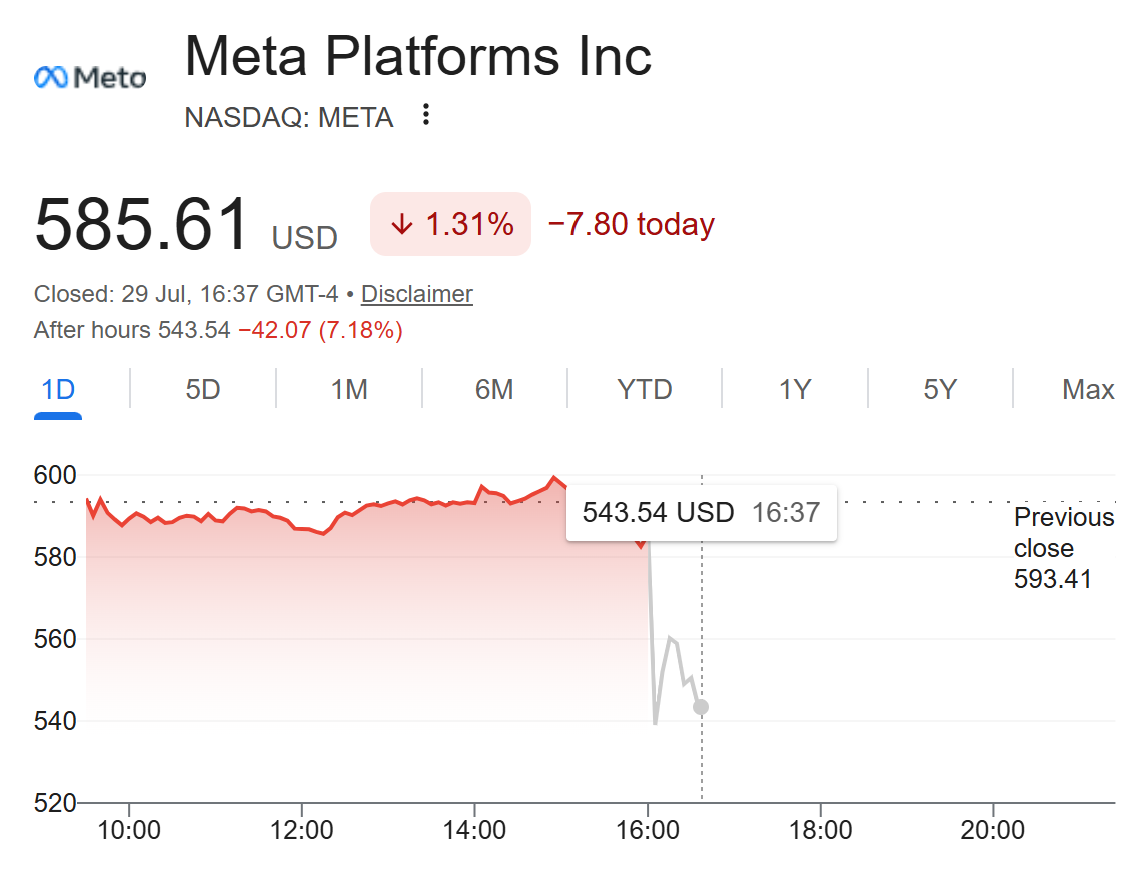
Meta Q2 earnings beat Wall Street on revenue but missed on profit, as AI infrastructure spending, legal charges, and severance costs pushed the operating margin down to 31% from 43%.
Shares fell 5.06% to $556 in after-hours trading on Wednesday, according to Benzinga, as investors weighed a higher capital spending outlook against shrinking free cash flow.
Meta Q2 Earnings Beat Hides a Margin Squeeze
Revenue reached $60.80 billion, up 28% year over year and ahead of the roughly $59.50 billion analysts expected. Diluted earnings landed at $6.18 per share, down 13% from $7.14.
Costs told the other half of the story. Total expenses jumped 55% to $42.03 billion, including $2.40 billion in legal charges and $1.18 billion in severance tied to a May headcount reduction.
Operating income fell 8% to $18.78 billion. Ad demand stayed healthy, with impressions up 14% and average price per ad up 12%, yet neither was enough to hold the margin.
User growth also held up. Family daily active people averaged 3.60 billion in June, a 3% rise from a year earlier.
Filings across the sector had already flagged AI capex draining cash before this week’s reports.
Capex Guidance Climbs Toward $145 Billion
Meta raised the floor of its 2026 capital expenditure range to $130 billion from $125 billion and kept the ceiling at $145 billion. Full-year expense guidance now starts at $165 billion.
The quarter shows why. Capital expenditures hit $31.08 billion, and operating cash flow of $31.86 billion left only $784 million in free cash flow, against $8.55 billion a year ago.
Most of that money is going into data centers. Meta and BlackRock unveiled a $14 billion data center venture in El Paso, Texas, this week.
The tax outlook tightened as well. Meta now expects a rate of 15% to 17% for the rest of 2026, up from a prior 13% to 16%.
“AI is accelerating our core business today, powering our next generation of products, and opening the door to entirely new enterprise opportunities,” read an excerpt in the release, citing Mark Zuckerberg, Meta founder and chief executive.
Follow us on X to get the latest news as it happens
Will the Stock Surge From Here?
META stock dropped by over 7% after market after market to $543.54 after closing Wednesday at $585.61.

The bull case rests on guidance. Meta expects third-quarter revenue of $61 billion to $64 billion and still projects full-year operating income above the 2025 result.
The bear case rests on the balance sheet. Long-term debt grew to $83.66 billion from $58.74 billion in December, and Reality Labs lost another $4.62 billion.
Legal risk sits on top of that. Meta flagged youth-related trials in the United States this year that may ultimately produce a material loss.
Sentiment across the sector is split. Microsoft’s Azure growth beat landed the same evening, a sign that investors will still fund AI spending when revenue follows it.
Crypto traders track these reports because the AI trade sets risk appetite. A Big Tech selloff hit crypto in June, and Bitcoin (BTC) traded near $63,409 on Thursday, down 0.7% over 24 hours.
Apple reports Thursday. Its spending commentary should show whether Meta’s margin squeeze is company specific or the price every large cloud operator now pays.
The post Meta Revenue Beats, But AI Spending Crushes Profit Margins: Will the Stock Surge? appeared first on BeInCrypto.
Robinhood reported $100 million in second quarter cryptocurrency transaction revenue, topping the $86.6 million analyst consensus even as the line fell 38% from a year earlier.
The beat landed inside a record quarter. Total net revenues rose 32% to $1.31 billion, while diluted earnings per share climbed 48% to $0.62.
Robinhood Crypto Revenue Cleared a Bar That Had Already Dropped
Expectations were modest going into Wednesday’s release. Crypto revenue had already fallen 47% in the first quarter to $134 million.
The second quarter figure slipped another 25% from that level. Trading activity accounts for most of the decline.
Robinhood App crypto notional volumes fell 35% year over year to $18 billion. Bitstamp contributed $22 billion, taking the combined total to $40 billion.
The wider market has not recovered. Bitcoin trading near $63,559 sits roughly 46% below its level a year ago.
Robinhood opened a crypto stock earnings week that also brings Coinbase and Strategy results on Thursday.
Prediction Markets Carried the Record Print
Transaction based revenues rose 44% to $776 million. Event contracts delivered $156 million, more than 10 times the year ago figure.
Options revenue climbed 29% to $342 million. Equities revenue nearly doubled to $129 million.
Crypto now supplies under 8% of total net revenues. Two years ago it was one of the company’s headline growth stories.
The customer base kept widening behind those numbers. Funded customers reached 28.4 million and Robinhood Gold subscribers hit a record 4.8 million.
“The business is firing on all cylinders. We delivered record revenues and drove new highs across equity, option, and event contract volumes, as we continue to win market share,” Shiv Verma, Chief Financial Officer of Robinhood, in the earnings release.
Follow us on X to get the latest news as it happens
HOOD Slipped Even as the Numbers Beat
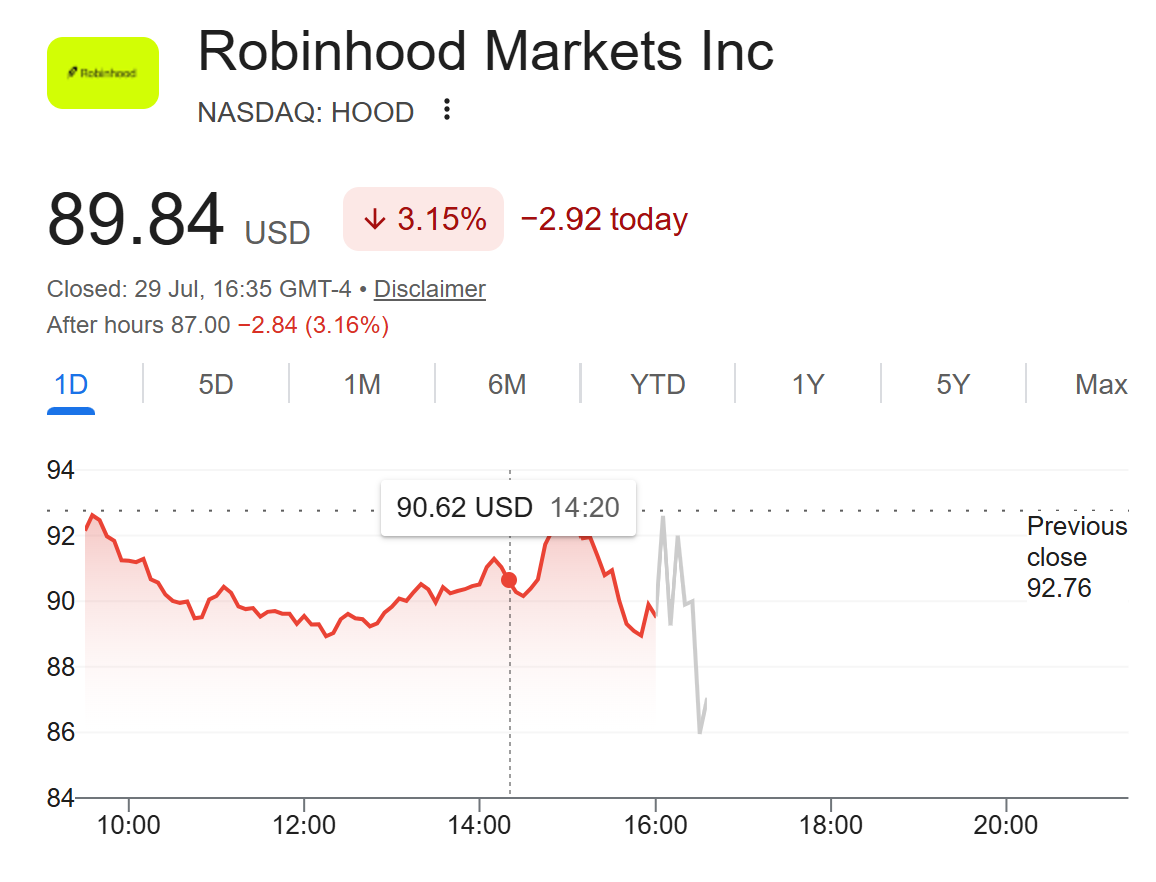
Robinhood shares closed Wednesday at $89.84, down 3.15% on the day. The stock eased further to $87.00 in after hours trading.

Earnings quality may explain some of the hesitation. The $0.62 diluted EPS included $0.14 of gains tied to the deconsolidation of Robinhood Ventures Fund I.
Management is still funding crypto regardless. The quarter brought the public mainnet launch of Robinhood Chain, an Ethereum Layer 2 built for tokenized real world assets.
That network has already climbed the fee tables, with Robinhood Chain application fees reaching $25 million in a single week this month.
Robinhood also debuted Robinhood Earn, its first onchain lending product, rolled out stock tokens across more than 120 countries, and closed the WonderFi acquisition in Canada.
Perpetual futures went live in the European Union during the quarter. The company flagged plans for a crypto offering in the United Kingdom.
The company lowered its 2026 adjusted operating expense and share based compensation outlook to a range of $2.675 billion to $2.775 billion.
Whether the crypto line stabilizes may matter less to the share price than whether event contract volumes keep compounding at this pace.
The post Robinhood Crypto Revenue Tops Estimates Despite 38% Drop, How Will Stock React? appeared first on BeInCrypto.

Remo Stars Appoint Olumide Ajibolade as New Head Coach

NOAA ditches weather-predicting supercomputers for Google Cloud

Man suspected of starting fatal house fire found dead in wheelie bin days later


-

 Fashion5 days ago
Weekend Open Thread: Brooks Brothers
-
 Sports3 days ago
Commonwealth Games boxing: Jadumani Singh seals dominant 5-0 win over Pakistan’s Sumama Rehman to enter quarter-finals | Commonwealth Games News
-

 Tech3 days ago
Intel is reversing course and bringing hyper-threading back to its server chips
-

 Crypto World7 days ago
Ethics, other provisions in crypto Clarity Act to be further discussed
-

 Politics3 days ago
Luke Littler dismantles Gerwyn Price to retain title in Blackpool
-

 Crypto World4 days ago
Ripple bought a bank in pieces. The $4 billion audit
-

 Business3 hours ago
Why Trees Belong on the Risk Register
-
 Entertainment5 days ago
A New Post-Apocalyptic Gundam Anime Series Blasts Into SDCC
-

 News Videos3 days ago
BITCOIN JUST ENTERED THIS CRITICAL ZONE…
-

 Politics2 days ago
The Part of the Electric Transition Nobody Wants to Discuss
-

 Sports6 days ago
2026 3M Open leaderboard: Scottie Scheffler finds putter in Round 1, sits three back
-

 Fashion6 days ago
16 Dresses for the High Summer Event
-

 News Videos6 days ago
The Peugeot Family: How 200 Years of an “Old Money” Dynasty Died in A Boardroom
-

 Business18 hours ago
Major shareholder moves on Canyon
-

 Crypto World4 days ago
XRP Ledger adds $2.6B as RWA inflows rank second
-

 Politics3 days ago
Spain sweeps the board at 2026 World Cup with individual awards
-

 Crypto World6 days ago
Uniswap (UNI) pushes deeper into tokenized RWAs with permissioned trading pools
-
 Entertainment1 day ago
‘Stargate’ Creator’s New Sci-Fi Series Returns for Season 3 Tomorrow
-
Crypto World7 days ago
SEC Agrees to Overhaul Recordkeeping After Settling Coinbase Lawsuit Over Gensler’s Lost Texts
-

 Tech5 days ago
Anthropic launches Claude Opus 5, a cheaper AI model for coding, agents and enterprise workflows
You must be logged in to post a comment Login