
Crypto World
Playnance pushes GCOIN onto fourth exchange with XT.COM listing



Playnance has expanded GCOIN’s exchange presence to four new trading venues this month after securing a listing on XT.COM, continuing its effort to make the token available to more users worldwide.
Summary
- Playnance has listed GCOIN on XT.COM, making it the token’s fourth exchange listing in June.
- The company says GCOIN powers gaming, sports predictions, and on-chain transactions across its PlayBlock ecosystem.
- Playnance reports more than 300,000 users, 10,000 blockchain games, and a fixed GCOIN supply capped at 77 billion tokens.
According to an announcement from Playnance, trading for the GCOIN/USDT pair on XT.COM began on June 24, 2026. The company said the latest listing gives more users another entry point into its blockchain entertainment ecosystem, where GCOIN is used across gaming, sports prediction, and other on-chain applications.
Latest listing extends GCOIN’s exchange rollout
Coming after listings on WEEX, BitMart, and KoinBX earlier in June, XT.COM becomes the fourth exchange to add GCOIN this month. Playnance said the series of listings forms part of its strategy to increase access to the token as the platform expands its user base.
Commenting on the development, Playnance CEO Pini Peter said the company views exchange availability as an important step toward bringing more mainstream users into Web3 entertainment.
“Four exchange listings in a single month reflect our commitment to increasing accessibility, expanding adoption, and bringing more users into the Playnance ecosystem.”
The company added that easier access to GCOIN allows more participants to engage with its blockchain-powered gaming, sports prediction, and entertainment services without changing how the underlying ecosystem operates.
GCOIN entered the market on March 18 as the native token supporting economic activity across Playnance’s ecosystem. According to the company, the token facilitates gameplay, reward distribution, prediction markets, and settlement transactions while operating on PlayBlock, its blockchain infrastructure built to support gas-free interactions, non-custodial ownership, and full on-chain transparency.
Playnance continues building around its Web3 ecosystem
Founded in 2020, Playnance has focused on developing blockchain products designed to simplify Web3 participation. In March, the company said its ecosystem included more than 300,000 registered users, partnerships with over 30 game studios, and access to more than 10,000 blockchain-based games.
Company figures also indicated that roughly 2 million on-chain transactions are processed each day across the network, while users participate in more than 2.5 million sports events annually. According to Playnance, this activity is supported through a shared wallet system and infrastructure built to handle high transaction volumes.
Alongside the ecosystem expansion, the company has introduced a fixed token supply model capped at 77 billion GCOIN. Playnance said the circulating supply will be controlled through a lock-and-release mechanism under which tokens lost during gameplay remain locked for 12 months before returning to circulation.
Separately, Playnance executives have continued discussing the technology supporting the platform. Speaking recently to crypto.news, Chief Technology Officer Roman Levi outlined Ethereum’s ongoing scalability challenges and discussed emerging approaches that could improve blockchain performance. Read the full interview here.

Every twelve seconds, the Ethereum network asks a question that would have seemed absurd before 2022: who gets to write the next page of a $400 billion ledger, and how do you stop them from lying? The answer, for Ethereum and the majority of active blockchains by market value, is proof of stake, a consensus mechanism that replaced the energy-intensive puzzle-solving of proof of work with a simpler, older idea: put your money where your mouth is. Validators lock cryptocurrency as collateral, propose and verify blocks, and face the destruction of their deposit if they cheat. No mining rigs, no electricity arms race, no warehouse full of ASICs. Just capital at risk and code that enforces the consequences.
Summary
- Proof of stake secures blockchains by requiring validators to lock cryptocurrency as collateral, replacing the computational competition of proof of work with economic incentives and penalties.
- Ethereum’s September 2022 Merge was the largest proof-of-stake transition in history, cutting the network’s energy use by 99.95% while enabling a path to future scaling upgrades.
- The mechanism now underpins the majority of major blockchains by market cap, but carries its own risks: centralization of stake, slashing penalties, lock-up periods, and an evolving US regulatory landscape around staking services.
The idea predates crypto itself. Traditional finance has always understood that people with money on the line behave differently from people without it. Margin requirements, performance bonds, insurance deposits – the financial system is built on collateral as a behavior constraint. Proof of stake applied the same logic to distributed consensus: instead of proving you spent electricity (proof of work), you prove you have wealth locked up that the protocol can destroy if you misbehave. The mechanism was first described in a 2012 Peercoin whitepaper by Sunny King and Scott Nadal, spent a decade in Bitcoin’s shadow while proof of work dominated the conversation, and then became the consensus mechanism of choice for virtually every major blockchain launched after 2020. Ethereum’s adoption of it in 2022, the single largest infrastructure migration in crypto’s history, settled the debate about whether proof of stake could secure serious money. It can. It does. And the questions that remain are not about whether it works, but about the particular ways it concentrates, centralizes, and regulates differently from the mechanism it replaced.
The core mechanism: how validators replace miners
In proof of work, security comes from physical scarcity: miners burn electricity to find a hash that satisfies the network’s difficulty target, and the cost of that electricity is what makes attacks expensive. The security guarantee is thermodynamic. You cannot fake the work because the work is physics.
Proof of stake replaces this with economic scarcity. Instead of burning electricity, validators deposit tokens, their stake, into a smart contract controlled by the protocol. This stake serves three purposes simultaneously: it is the validator’s entry ticket (you cannot validate without it), their incentive (correct behavior earns staking rewards), and their punishment (incorrect or malicious behavior triggers slashing, the partial or total destruction of the deposit). The protocol’s security guarantee is economic: attacking the network requires acquiring and risking an enormous amount of the network’s own currency, and a successful attack would destroy the value of the very asset the attacker holds. The mechanism is self-referential by design. The thing securing the network is the thing the network produces, and that circularity is both the mechanism’s elegance and its most debated vulnerability.
The practical difference for the network is dramatic. Proof of work requires specialized hardware running continuously, consuming energy on the scale of a small country. Proof of stake requires a server, a stable internet connection, and the staked capital. Ethereum’s energy consumption dropped by an estimated 99.95% the day it switched, from roughly 78 terawatt-hours per year to the equivalent of a few thousand homes. The environmental argument for proof of stake is settled. The security argument is subtler, and understanding it requires walking through how a block actually gets produced.
The lifecycle of a block under proof of stake
Ethereum’s implementation, the most battle-tested proof-of-stake system by value secured, runs on a twelve-second heartbeat called a slot. Every slot, the protocol selects one validator to propose a block and a committee of validators to attest that the proposal is valid. The selection process uses a pseudorandom algorithm seeded by on-chain data, weighted by stake size: a validator with 64 ETH staked has twice the chance of selection as one with 32 ETH, but the randomness prevents anyone from predicting assignments more than a few minutes ahead.
The proposer assembles a block from the transaction pool, constructs it according to protocol rules, and broadcasts it. The committee members, typically several hundred validators per slot, then independently verify the block: they check that transactions are valid, that the proposer followed the rules, and that the block builds correctly on the chain’s history. Each committee member publishes an attestation, a signed vote that says “this block is valid and extends the chain correctly.” These attestations accumulate, and when enough are collected, the block is considered justified.
Finalization, the point at which a block becomes irreversible, takes longer. Ethereum uses a finality gadget called Casper FFG that finalizes blocks once two-thirds of the total staked ETH has attested to them across two consecutive epochs (each epoch is 32 slots, roughly 6.4 minutes). After finalization, reversing the block would require at least one-third of all staked ETH to be slashed, a cost that currently exceeds $35 billion. This is the concrete security guarantee: the price of rewriting Ethereum’s history is the destruction of tens of billions of dollars of capital.
The fork-choice rule, the algorithm validators use to decide which chain is the “real” one when they see competing versions, is called LMD-GHOST (Latest Message-Driven Greedy Heaviest Observed SubTree). It follows the branch with the most recent attestation weight, meaning the chain that the most stake has most recently voted for wins. Together, Casper FFG and LMD-GHOST create a system where blocks are produced quickly (every 12 seconds), justified within minutes, and finalized within roughly 13 minutes, with finality backed by the full economic weight of staked ETH.
Proof of stake vs proof of work: the real tradeoffs
The debate between proof of stake and proof of work is one of the oldest in crypto, and it is not as settled as either side claims. Both mechanisms solve the same fundamental problem, how to reach agreement in a network where participants do not trust each other, but they do so with genuinely different security models, and those differences produce different failure modes.
Proof of work ties security to the physical world. Mining requires electricity and hardware, both of which have real, external costs that cannot be faked or printed. An attacker needs to acquire 51% of the network’s hash rate, which means outspending the entire existing mining infrastructure. The cost of attacking Bitcoin is, roughly, the cost of all the mining hardware and electricity currently deployed to secure it, a cost that exists regardless of Bitcoin’s token price. This externality, security coming from outside the system, is what proof-of-work advocates consider its fundamental advantage: it anchors the digital to the physical.
Proof of stake ties security to the system’s own token. An attacker needs to acquire roughly one-third of all staked tokens (for finality-breaking attacks) or one-half (for censorship attacks), which means buying an enormous position in the network’s own currency. The attack is self-deterring because the act of attacking would crash the token’s price, destroying the attacker’s own holdings. But the security is circular: the network is secured by its token’s value, and its token’s value depends on the network being secure. Critics argue this creates a reflexivity problem that proof of work avoids. Defenders argue that the economic incentives are strong enough that the circularity is academic rather than practical.
The energy argument is overwhelmingly one-sided. Proof of work networks consume enormous amounts of electricity: Bitcoin alone uses an estimated 150 terawatt-hours per year, comparable to a medium-sized country. Proof of stake networks use a tiny fraction of that. Whether Bitcoin’s energy consumption is “wasteful” or “the cost of decentralized security” is a values question, not a technical one, but the gap in energy use is not debatable.
Hardware centralization cuts differently in each model. Proof of work has centralized around ASIC manufacturers (principally Bitmain) and regions with cheap electricity. Proof of stake centralizes around large token holders and staking service providers. Both mechanisms concentrate influence; they just concentrate it in different places. On Ethereum, Lido controls approximately 28% of all staked ETH as of mid-2026, a concentration that would be alarming in a proof-of-work context and is increasingly alarming in proof of stake as well.
Finality is the clearest practical advantage of proof of stake. Bitcoin transactions are never truly “final” in the mathematical sense; each new block makes reversal harder but never impossible, and merchants conventionally wait for six confirmations (roughly an hour) before considering a payment settled. Ethereum’s proof of stake provides deterministic finality: once a block is finalized by Casper FFG, reversing it requires destroying at least one-third of all staked ETH. The transaction is done, period, within roughly 13 minutes.
Why Ethereum switched: the Merge and what it changed
Ethereum’s transition from proof of work to proof of stake, called the Merge, occurred on September 15, 2022. It was the most complex and consequential upgrade in blockchain history: a live, $200 billion network switched its entire consensus mechanism without downtime, without a chain split, and without losing a single block. The execution was flawless, which tends to make people forget how extraordinary it was.
The Merge had been planned since Ethereum’s earliest days. Vitalik Buterin’s original roadmap always envisioned proof of stake as the endgame; proof of work was an interim measure while the research team, principally Vlad Zamfir and later the Ethereum Foundation’s consensus team, worked out the formal properties of a secure PoS protocol. The Beacon Chain, Ethereum’s proof-of-stake chain, launched in December 2020 as a parallel system running alongside the proof-of-work chain. Validators staked ETH on the Beacon Chain for nearly two years before the Merge merged the two systems into one.
What the Merge changed immediately: energy consumption dropped by 99.95%. Ethereum went from consuming roughly as much electricity as Chile to consuming roughly as much as a small town. Mining ceased entirely. GPU prices dropped as miners sold off their hardware. Ethereum’s environmental narrative reversed overnight.
What the Merge changed economically: issuance dropped by approximately 90%. Under proof of work, Ethereum issued roughly 13,000 ETH per day to miners. Under proof of stake, issuance fell to approximately 1,700 ETH per day to validators. Combined with EIP-1559’s fee-burning mechanism, which destroys a portion of every transaction fee, this made Ethereum’s supply dynamics deflationary during periods of high network activity. More ETH is burned than issued, and the total supply slowly decreases, a property no proof-of-work chain can replicate because miners need revenue to cover their physical costs.
What the Merge did not change: gas fees, transaction speed, and throughput remained the same. The Merge was a consensus-layer change, not an execution-layer change. Scaling improvements depend on layer-2 solutions, Arbitrum, Optimism, Base, and others, that settle batches of transactions on Ethereum’s mainnet. The Merge was a prerequisite for these scaling plans, because future upgrades like danksharding require proof of stake’s validator architecture to process data blobs, but the Merge itself did not make Ethereum faster or cheaper. The common misconception that the Merge would reduce gas fees was one of the most persistent communication failures of the entire project.
The landscape: which blockchains use proof of stake
Proof of stake is no longer an alternative; it is the default. The overwhelming majority of blockchains launched since 2020 use some variant of proof of stake, though the implementations differ significantly in their validator economics, finality properties, and centralization profiles.
Ethereum uses the Casper FFG and LMD-GHOST combination described above, with a minimum stake of 32 ETH per validator (approximately $110,000 at current prices). The high minimum creates a barrier to solo validation that has driven much of the staking volume toward pooling services. As of mid-2026, approximately 33 million ETH is staked, roughly 27% of the total supply, across over 1 million active validators.
Solana uses proof of stake combined with proof of history, a cryptographic clock that timestamps transactions before they enter consensus, enabling the network to order events without validators needing to communicate about sequencing. This architecture allows Solana to process thousands of transactions per second with sub-second finality, though it requires significantly more powerful hardware to validate than Ethereum, which introduces its own centralization pressures. Solana’s validator count is smaller and its hardware requirements higher, a deliberate tradeoff of accessibility for performance.
Cardano runs Ouroboros, a proof-of-stake protocol developed through academic peer review at the University of Edinburgh and IOHK. Ouroboros divides time into epochs and slots, uses a verifiable random function for leader selection, and was the first proof-of-stake protocol to be formally proven secure under a rigorous cryptographic model. Cardano’s approach prioritizes formal correctness over speed, a philosophy that has earned it both respect in academic circles and criticism for slower development velocity.
Polkadot uses nominated proof of stake, a system where nominators back validators with their tokens and share in both rewards and slashing risk. Polkadot’s unique contribution is its relay chain architecture, where a central chain provides consensus and security for multiple application-specific parachains that run in parallel. The staking mechanism secures not just one chain but an entire ecosystem of connected chains.
Cosmos, through its Tendermint BFT consensus engine, pioneered delegated proof of stake with instant finality. Tendermint produces blocks that are final the moment they are committed, with no possibility of reversal, a property that makes it especially suitable for financial applications. The Cosmos ecosystem’s hub-and-spoke model, where independent chains communicate through the Inter-Blockchain Communication protocol, has made it the backbone for dozens of application-specific blockchains, from the Osmosis DEX to dYdX’s order-book exchange.
Avalanche uses a novel consensus protocol based on repeated random sampling: validators poll random subsets of other validators about their preferences, and consensus emerges through the accumulation of confidence, similar to how snowflakes form through repeated crystallization, hence the consensus family’s name: Snowball, Snowflake, Snowman. The approach achieves sub-second finality and high throughput while maintaining a relatively low hardware barrier.
BNB Chain, Binance’s blockchain, uses proof of staked authority, a hybrid where a small set of 21 validators are elected through staking but also meet identity and reputation requirements. This is the most centralized of the major proof-of-stake implementations, trading decentralization for performance and the institutional backing of Binance.
Bitcoin remains the most prominent proof-of-work holdout, and its community has shown no inclination to switch. The Bitcoin argument against proof of stake is philosophical as much as technical: proof of work anchors security to the physical world, and that anchoring is considered a feature that proof of stake cannot replicate. Whether this position will hold indefinitely as the industry standardizes around proof of stake is an open question, but as of 2026, it holds firmly.
The risks validators and stakers actually face
The staking ecosystem has matured enough that its risks are well-documented, and they are not trivial.
Slashing is the mechanism’s enforcement tool: validators who provably violate protocol rules, principally by signing two conflicting blocks or attestations, lose a portion of their staked tokens. On Ethereum, the minimum slashing penalty is 1/32 of a validator’s stake, roughly 1 ETH, but the penalty scales with how many other validators are slashed in the same time period. If a single validator is slashed in isolation, the penalty is modest. If hundreds are slashed simultaneously, suggesting a coordinated attack or a catastrophic infrastructure failure, the penalties escalate toward total stake destruction. This correlation penalty is by design: it punishes systemic threats more than individual mistakes, but it also means that a bug in a widely-used validator client could trigger mass slashing of validators who did nothing individually wrong. The concentration of the validator ecosystem around a few major clients, principally Prysm and Lighthouse on Ethereum, makes this a non-theoretical risk.
Lock-up and unbonding periods vary by network but create real liquidity risk. Ethereum introduced withdrawals in April 2023 with the Shanghai/Capella upgrade, but the withdrawal queue can extend to days or weeks during periods of high exit demand. Other networks impose fixed unbonding periods: Cosmos chains typically require 21 days, Polkadot requires 28 days, and during those windows the staker cannot sell or use their tokens regardless of market conditions. A 28-day lock-up during a market crash is not a theoretical concern; it has happened.
Liquid staking protocols solve the liquidity problem but introduce smart contract risk. When you stake through Lido, your ETH goes into Lido’s smart contracts, and you receive stETH, a liquid token that represents your staked position. This stETH can be used across DeFi: lent, borrowed against, or provided as liquidity. But the arrangement is only as safe as Lido’s contracts. A bug or exploit in a liquid staking protocol could result in the loss of all deposited tokens, and because liquid staking concentrates enormous amounts of stake in single contract systems, the blast radius of such an exploit would be severe. Lido holds roughly $15 billion in staked ETH as of mid-2026; Rocket Pool, the second-largest, holds several billion more. These are among the largest smart-contract honeypots in existence.
Centralization pressure is the most debated long-term risk. On Ethereum, Lido controls approximately 28% of all staked ETH. If Lido’s governance were compromised or its operators coordinated, they could theoretically influence block production or censorship decisions for a significant fraction of the network. The Ethereum community has debated self-imposed caps on liquid staking dominance, and Lido has made governance decentralization changes, but the structural incentive favoring large staking pools, economies of scale, professional operations, integration with DeFi, has not changed. Proof of stake does not inherently centralize, but it centralizes differently from proof of work, and the patterns are already visible.
Validator MEV, the extraction of value from transaction ordering, affects proof of stake validators just as it affected proof-of-work miners, but the dynamics differ. Under proof of work, MEV accrued to miners who could order transactions within blocks. Under proof of stake, MEV accrues to the block proposer for that slot, and the MEV-Boost system, which allows proposers to outsource block construction to specialized builders, has created a sophisticated supply chain around transaction ordering. The relationship between validators, builders, relays, and searchers is complex, and the MEV flowing through this pipeline represents billions of dollars per year, revenue that disproportionately benefits sophisticated operators and further concentrates the staking economy.
Proof of stake and US regulation: where it stands
The US regulatory treatment of proof of stake is fragmented across multiple agencies, each approaching staking through a different lens.
The SEC’s interest in staking crystallized in February 2023 when it charged Kraken with offering unregistered securities through its staking-as-a-service program. Kraken settled for $30 million and shut down its US staking service. The SEC’s theory was that Kraken’s staking program, where users deposited tokens with Kraken and received yield in return, constituted an investment contract under the Howey test: users invested money in a common enterprise with an expectation of profit derived from Kraken’s efforts. The action targeted the service model, not the proof-of-stake mechanism itself, but it sent a clear signal that centralized staking services would face scrutiny. Coinbase challenged a similar SEC action and secured partial judicial skepticism about the SEC’s approach, but the legal landscape remains unsettled.
The tax treatment of staking rewards is the most practically consequential question for individual stakers. The IRS treats staking rewards as ordinary income, taxable at fair market value when received. This creates an immediate tax liability on tokens that may subsequently lose value. In 2023, a Tennessee couple won a partial victory in Jarrett v. United States, where the court accepted their argument that newly created staking rewards, like newly created property, should not be taxable until sold. The IRS refunded the Jarretts’ taxes but has not adopted their reasoning as policy, and the question remains unresolved. The practical implication: most tax advisors still recommend treating staking rewards as income at receipt, because the IRS’s position has not formally changed.
State-level regulation has been more accommodating. Wyoming’s blockchain-friendly legislation explicitly addresses staking as a permitted activity. Several states have introduced or passed legislation recognizing that operating a proof-of-stake validator is distinct from issuing securities. The patchwork of state approaches creates complexity but also creates jurisdictions where staking operations can operate with legal clarity.
The GENIUS Act and other proposed federal legislation may eventually clarify the regulatory framework, particularly around stablecoins and digital asset classification, but as of mid-2026, staking regulation in the US is primarily a product of enforcement actions and court decisions rather than comprehensive legislation. The gap between how the technology works and how regulators categorize it remains wide.
How to stake: the three paths and what each costs
For someone who has decided to stake, the choice comes down to three models, each with a distinct risk-reward profile.
Exchange staking is the simplest entry point. Coinbase, Binance, and other major exchanges offer one-click staking for supported tokens. You deposit your tokens, the exchange handles validator operations, and you receive rewards minus a commission, typically 10-25% of the yield. The advantage is simplicity: no technical knowledge, no hardware, no key management. The disadvantage is custodial risk: your tokens are held by the exchange, which means you are exposed to the exchange’s solvency, security, and regulatory risk. The collapse of FTX in November 2022, where customers lost billions in deposits, is the cautionary tale that hangs over every custodial staking arrangement. Exchange staking yields on Ethereum currently run 2.5-3.5% APR after the platform’s commission.
Liquid staking offers a middle path. Protocols like Lido, Rocket Pool, Jito (on Solana), and others accept deposits and return a liquid receipt token, stETH, rETH, JitoSOL, that represents the staked position plus accumulated rewards. The receipt token can be traded, used as collateral in lending protocols, or deposited into liquidity pools, allowing the staker to earn additional yield on top of staking rewards. This composability is liquid staking’s core advantage: your capital works twice. The risks are smart contract exposure (the protocol’s contracts hold your tokens), oracle risk (the receipt token’s exchange rate depends on accurate price feeds), and the possibility of depegging, where the liquid staking token trades below its theoretical value during periods of market stress, as stETH briefly did during the Three Arrows Capital collapse in June 2022. Liquid staking typically charges a 10% fee on rewards, yielding net returns of roughly 3-3.5% APR for Ethereum.
Solo staking is the gold standard for decentralization and the most operationally demanding option. On Ethereum, solo staking requires depositing 32 ETH (approximately $110,000 at current prices), running a validator node on dedicated hardware or a cloud server with reliable uptime, and maintaining the software through upgrades. The staker earns the full yield, currently around 3.5-4% APR, with no intermediary taking a cut, and keeps full custody of their withdrawal keys. The staker also contributes maximally to network decentralization, because each solo validator is an independent node that makes its own attestation decisions. The barriers are capital (32 ETH is a significant commitment), technical competence (running a validator is not difficult but requires ongoing attention), and responsibility (downtime means missed rewards and minor penalties, and a misconfigured setup risks slashing). Ethereum’s community actively encourages solo staking through resources like ethstaker.cc and various client diversity initiatives, recognizing that the network’s long-term health depends on maintaining a large base of independent validators rather than concentrating stake in a few large operators.
The decision between these paths is ultimately about what risks you are comfortable with. Exchange staking trades custodial risk for convenience. Liquid staking trades smart contract risk for capital efficiency. Solo staking trades operational burden for maximum independence. There is no universally correct choice, only the one that matches a given staker’s capital, technical ability, and risk tolerance, and the honest answer is that most people should start with the simplest option and graduate to more self-sovereign approaches as their understanding and commitment deepen.
Frequently asked questions
Is proof of stake safe?
Proof of stake secures hundreds of billions of dollars across Ethereum, Solana, Cardano, and dozens of other networks. Ethereum’s implementation has been live since the Beacon Chain launch in December 2020 and operating as the sole consensus mechanism since September 2022, without a consensus-level exploit. The main risks are not in the mechanism itself but in its surrounding infrastructure: smart contract bugs in staking protocols, centralization of stake among a few large operators, and the potential for correlated slashing events caused by validator client bugs.
Can you lose money staking crypto?
Yes, in several ways. If the price of the staked token drops, your position loses value regardless of staking rewards, and a 3% annual yield does not protect against a 50% price decline. Validators can lose tokens through slashing penalties if their infrastructure fails or is misconfigured. Staking through liquid staking protocols adds smart contract risk: a bug or exploit could result in the loss of deposited funds. And on networks with unbonding periods, you cannot sell during market downturns, potentially locking in losses.
How much can you earn staking crypto?
Annual yields depend on the network, the staking method, and market conditions. Ethereum staking yields approximately 3-4% APR as of mid-2026. Solana offers roughly 6-7%. Cosmos ecosystem chains range from 8-15% depending on the specific chain. Newer or smaller networks may offer higher rates to attract validators, but higher rates almost always correlate with higher risk: token volatility, smaller validator sets, less-audited code, and thinner liquidity for exits.
Does Bitcoin use proof of stake?
No, and the Bitcoin community has firmly resisted any suggestion of switching. Bitcoin uses proof of work, secured by an enormous global network of ASIC miners. The Bitcoin argument is that proof of work’s energy expenditure is not a bug but a feature: it anchors the network’s security to physical reality, costs that exist outside the system and cannot be manipulated within it. Whether this philosophical position will hold as the rest of the industry standardizes on proof of stake is an open question, but there is currently no serious proposal to change Bitcoin’s consensus mechanism.
What happens if a validator goes offline?
On Ethereum, validators that go offline lose a small amount of their stake through inactivity penalties, designed to be mild for short outages (a few hours or days of missed attestations cost a fraction of the rewards earned during normal operation) but significant for extended downtime. If a validator is offline for weeks, the inactivity leak accelerates to drain the validator’s balance until it falls below the minimum (16 ETH, the ejection threshold). Crucially, going offline is not slashing: validators are only slashed for provably malicious behavior like signing two conflicting blocks or attestations. The distinction matters because slashing is rare and severe, while brief offline periods are routine and their penalties are designed to be recoverable.
Disclaimer: This article is for informational purposes only and should not be considered financial or investment advice.


In April 2024, a single on-chain vote moved $165 million from Uniswap’s treasury into a two-year grants program. No CEO signed off. No board convened. A collection of token holders, pseudonymous and scattered across every time zone, debated the proposal on a forum, cast their votes through a smart contract, and the funds moved, automatically, irreversibly, exactly as the code specified. This is what a decentralized autonomous organization does: it replaces the corporate hierarchy of officers, boards, and bylaws with token-weighted voting and smart contracts that execute the results. Whether that replacement is an upgrade, a sidegrade, or a new category of organizational failure depends entirely on which DAO you examine and when you examine it.
Summary
- A DAO is an internet-native organization governed by smart contracts and token-holder votes, replacing traditional corporate hierarchy with programmable governance rules.
- DAOs manage over $30 billion in combined treasury assets across hundreds of active organizations, governing everything from DeFi protocols and investment funds to social clubs and collector groups.
- The model solves real coordination problems, particularly for open-source protocols with global stakeholders, but faces persistent challenges: voter apathy, plutocratic voting, governance attacks, legal ambiguity, and the fundamental tension between decentralization and decisiveness.
The concept emerged from a simple observation: if a blockchain can execute financial transactions without intermediaries, it should also be able to execute organizational decisions without intermediaries. The first serious attempt, confusingly named “The DAO,” launched on Ethereum in April 2016, raised $150 million in a crowdfunding campaign, and was drained of $60 million by an attacker who exploited a recursive call vulnerability in its smart contract within two months. The hack was so catastrophic that it split Ethereum itself into two chains, Ethereum and Ethereum Classic, and cast a shadow over the concept of decentralized governance that took years to lift. The shadow was worth remembering, because it established the central truth about DAOs: code is law until the code has a bug, and then the humans behind the code must decide what law actually is.
The model survived The DAO’s failure because the underlying need was real. Open-source protocols with billions in treasury assets, global communities of stakeholders who had never met, token-based economies that needed parameter adjustments, all of these required some decision-making mechanism, and the traditional options (a company, a foundation, a benevolent dictator) all introduced the centralization that the protocols were designed to avoid. DAOs became that mechanism, imperfect but structurally aligned with the decentralized systems they governed. By 2026, DAOs collectively manage over $30 billion in treasury assets across hundreds of active organizations, and the governance infrastructure, voting systems, delegation platforms, proposal frameworks, has matured into a small industry of its own.
The anatomy of a DAO: how token governance works
The standard DAO governance cycle has five stages, and understanding each reveals where the mechanism works and where it breaks.
The first stage is token distribution. Governance power in a DAO is represented by tokens, typically ERC-20 tokens on Ethereum, that grant voting rights proportional to holdings. How these tokens are distributed determines the DAO’s power structure from birth. Some DAOs airdrop tokens broadly to past users (Uniswap distributed UNI to every wallet that had ever made a swap). Others sell tokens in public sales, grant them to early investors and team members with vesting schedules, or distribute them through liquidity mining programs. The initial distribution is the most consequential decision a DAO makes, because it sets the electorate. A DAO where 40% of tokens are held by the founding team and investors is not meaningfully decentralized, regardless of what the governance documentation says.
The second stage is proposal submission. Any token holder meeting a minimum threshold can submit a governance proposal. On Uniswap, the threshold is 2.5 million UNI (roughly $15 million worth), a bar so high that most proposals are submitted by delegates, large holders, or protocol teams rather than individual community members. On smaller DAOs, the threshold may be as low as a single token. Proposals are typically structured documents specifying the action to be taken, the rationale, the implementation details, and the expected impact. They are published on governance forums, usually hosted on Discourse, Commonwealth, or Snapshot.
The third stage is deliberation. Before a formal vote, proposals are discussed in forums and on governance calls. This phase is the most important and the least automated: it is where arguments are refined, concerns are raised, alternatives are proposed, and the community’s actual preferences emerge. The quality of deliberation varies enormously between DAOs. Some, like MakerDAO (now Sky), have developed sophisticated governance frameworks with working groups, delegates, and structured feedback processes. Others are chaotic free-for-alls where discussions are dominated by a few vocal participants while the majority remains silent.
The fourth stage is the on-chain vote. Token holders cast their votes, weighted by the number of tokens they hold. Most DAOs use a simple token-weighted model: one token equals one vote. Some have experimented with quadratic voting (where the cost of additional votes increases quadratically, giving more weight to breadth of support over depth) or conviction voting (where the longer you stake your vote, the more weight it carries). The vote requires reaching both a quorum, a minimum level of participation, and a passing threshold, typically a simple majority or supermajority. Voting mechanisms include on-chain transactions (expensive, gas costs apply) and off-chain signature-based systems like Snapshot (free, but not binding without a separate execution step).
The fifth stage is execution. If the vote passes, the proposed action is executed. In the most mature DAOs, execution is automatic: the governance contract, typically a timelock controller like OpenZeppelin’s Governor or Compound’s GovernorBravo, queues the approved transaction and executes it after a delay period (usually 24-48 hours), giving the community time to react if something unexpected was approved. In less mature DAOs, execution may depend on a multisig, a set of trusted signers who manually execute the approved action, reintroducing human trust into a system designed to eliminate it.
The species: what kinds of DAOs exist
The DAO model has diversified into several distinct categories, each with different governance challenges and success metrics.
Protocol DAOs govern decentralized protocols and are the largest by treasury size. Uniswap DAO controls over $1.5 billion in treasury assets and governs the most widely-used decentralized exchange. Aave DAO manages the parameters of a lending protocol with billions in deposits: interest rate curves, collateral factors, risk parameters, and new asset listings. MakerDAO (now Sky) governs DAI, one of crypto’s most important stablecoins, making decisions about what assets can serve as collateral, what stability fees to charge, and how to manage the protocol’s balance sheet. These DAOs face the most consequential decisions, because governance failures can directly threaten the deposits of millions of users who never participate in governance themselves.
Investment DAOs pool capital from members to invest collectively. The LAO, MetaCartel Ventures, and Flamingo DAO pioneered the model, using token-based voting to make investment decisions that traditional venture capital structures handle through partnership agreements. The legal structure of investment DAOs is complex, typically involving a Delaware LLC wrapper and compliance with securities regulations, which limits most investment DAOs to accredited investors.
Social DAOs organize around shared identity or interests. Friends With Benefits (FWB) uses a token-gated membership model for cultural events, media projects, and community access. The token serves as both a membership credential and a governance instrument, and FWB has navigated the tension between exclusivity and decentralization more visibly than most social DAOs.
Collector DAOs pool funds to acquire high-value assets. PleasrDAO has acquired culturally significant NFTs and assets, including the original Doge meme photograph. ConstitutionDAO raised $47 million in a week to bid on a first-edition copy of the US Constitution at Sotheby’s auction in November 2021. ConstitutionDAO lost the auction but demonstrated the model’s fundraising power, and its aftermath, a chaotic refund process where gas costs consumed a significant portion of small contributors’ deposits, demonstrated the model’s operational limitations.
Service DAOs function as decentralized agencies or talent networks. Raid Guild coordinates web3 development projects, and its members vote on project acceptance, pricing, and revenue distribution. The model replaces the traditional agency’s management hierarchy with contributor-led governance, though it faces the challenge that client relationships and project management require responsiveness that token-based voting does not always provide.
The case studies: DAOs that defined the model
Three DAOs illustrate the spectrum of governance outcomes more clearly than any theoretical framework.
Uniswap DAO is the clearest success story, though even its success requires qualification. Since launching in September 2020, UNI governance has directed billions in treasury spending, deployed the protocol to over a dozen blockchains, managed the protocol’s fee switch debate (whether to direct trading fees to UNI holders), and funded a multi-year grants program. The governance process works, proposals are submitted, debated, voted on, and executed, but it works slowly and with low participation. Typical governance proposals pass with less than 5% of tokens voting. The effective governing body is a small number of large delegates, protocol team members, and active community participants, perhaps a few hundred people governing a protocol used by millions. The question of whether this is a decentralized organization or a representative democracy with extremely low voter turnout is left as an exercise.
MakerDAO, now rebranded to Sky, is the most ambitious governance experiment in crypto. Since its inception, MKR holders have governed every parameter of the DAI stablecoin system: stability fees, collateral ratios, debt ceilings, oracle configurations, and the onboarding of new collateral types including real-world assets like US Treasury bonds. In 2024, MakerDAO underwent a radical restructuring, rebranding to Sky and splitting into specialized SubDAOs, each focused on specific functions like lending, real-world assets, and growth. The restructuring was itself a governance decision, approved through the DAO’s voting process, making it perhaps the only example of an organization voting to fundamentally redesign itself while continuing to operate billions of dollars in financial infrastructure. Whether the SubDAO structure succeeds in solving Maker’s governance scalability challenges remains to be seen.
Arbitrum DAO illustrates governance’s failure modes. When Arbitrum launched its ARB token in March 2023, the foundation published a proposal requesting ratification of actions it had already taken, including the spending of $1 million. The community reacted furiously to what it perceived as retroactive governance theater: asking for a vote on something already done. The episode exposed the tension between operational speed (the foundation needed to act quickly) and governance legitimacy (the community expected to be asked first). Arbitrum has since developed a more structured governance process, but the early controversy established that DAOs cannot simply bolt governance onto an organization that was built to operate without it. The culture of governance must precede the mechanics.
The original sin: The DAO hack and Ethereum’s fork
No discussion of DAOs is complete without the event that gave the concept its first, and most brutal, stress test. The DAO, launched in April 2016, was a venture fund governed by token holders on Ethereum. It raised $150 million in a crowdfunding campaign, making it the largest crowdfund in history at that time, and it was hacked within two months.
The exploit used a reentrancy vulnerability in The DAO’s smart contract. The attacker called the withdraw function in a way that allowed them to withdraw their share repeatedly before the contract updated its balance, draining approximately $60 million worth of ETH, roughly one-third of The DAO’s holdings. The attack was not a hack in the traditional sense: the attacker did not break into a system or guess a password. They used the code exactly as written. The code allowed the drain; the code was law; and by the code’s own logic, the attacker had done nothing wrong.
The Ethereum community did not accept this argument. After intense debate, the network executed a hard fork, a retroactive change to the blockchain’s history, that reversed the theft and returned the funds to The DAO’s depositors. The fork was approved by the majority of the community but rejected by a minority who argued that “code is law” must mean something, even when the law produces unjust outcomes. That minority continued operating the unforked chain as Ethereum Classic (ETC), which still exists today.
The DAO hack established several principles that continue to shape DAO design. First: smart contract risk is existential, and no amount of governance sophistication matters if the contract holding the treasury has a bug. Second: the “code is law” ideology has limits that are tested by real money and real consequences. Third: decentralized governance is only as strong as the community’s willingness to act when the code fails, and acting requires the very centralized decision-making that decentralization is supposed to eliminate. The tension has never been resolved. It has only been managed, through audits, timelocks, bug bounties, and the hard-won institutional knowledge of a community that watched $60 million disappear into a recursive function call.
The failure modes: what actually goes wrong
A decade of DAO operations has produced a well-documented catalog of failure modes, and they are not the failures most people expect.
Voter apathy is the most pervasive problem. On paper, DAOs are governed by their entire token-holder base. In practice, they are governed by whoever shows up, which is usually less than 5% of token holders. Uniswap governance proposals routinely pass with a fraction of the total supply participating. Compound governance once had a proposal pass with votes from three wallets. The dynamic is structurally familiar: it is the same low-turnout problem that plagues democratic elections, intensified by the fact that governance tokens often have no direct economic incentive to vote (your token’s value is the same whether you participate or not) and each vote requires either a gas-cost transaction or the minor friction of signing a message.
Plutocracy is the flip side. One token, one vote means that governance power is proportional to wealth. A single whale holding 2% of a token’s supply can outvote thousands of smaller holders combined, and in practice, many important DAO votes are decided by fewer than ten wallets. Delegation systems, where small holders delegate their voting power to trusted representatives, partially address this, but delegates are themselves subject to capture and often represent narrow interests. The quadratic voting model, where each additional vote costs exponentially more, has been proposed as a solution but faces its own problem: sybil attacks, where one person splits their holdings across many wallets to circumvent the cost curve.
Governance attacks represent the most acute risk. In 2024, BonkDAO lost approximately $20 million when an attacker accumulated enough voting power to pass a proposal draining the treasury. The attack exploited the DAO’s low quorum requirements and the community’s governance apathy: by the time enough legitimate voters noticed the malicious proposal, it had already passed. The BonkDAO incident is the clearest illustration of a paradox at the heart of DAO governance: the same permissionless participation that makes DAOs open also makes them vulnerable to anyone willing to acquire enough tokens to cross the governance threshold.
Speed is a structural disadvantage. Corporate decisions happen in hours: a CEO convenes the relevant people, a decision is made, and execution begins immediately. DAO proposals typically require a discussion period (3-7 days), a voting period (3-7 days), and a timelock period (1-2 days), meaning even urgent decisions take one to three weeks to execute. During the March 2023 banking crisis, when USDC briefly depegged and MakerDAO needed to adjust its collateral parameters, the slow governance process was a real liability. Some DAOs have introduced emergency governance mechanisms, guardian multisigs that can act quickly in crises, but these mechanisms reintroduce centralization through the back door.
Legal ambiguity is the final persistent problem. Most DAOs have no legal entity, which means they cannot sign contracts, open bank accounts, hire employees, pay taxes, or defend lawsuits. When a DAO is sued, the question of who is liable, all token holders? The founders? The active voters?, has no settled answer. This ambiguity does not prevent DAOs from operating, but it creates a latent risk that grows as DAOs manage larger treasuries and interact more with the traditional legal system.
DAOs and US law: the liability question
The legal status of DAOs in the United States is evolving through a combination of state legislation, federal enforcement, and case law, with no comprehensive framework yet in place.
Wyoming became the first state to recognize DAOs as legal entities in 2021, passing legislation that allows DAOs to register as limited liability companies. A Wyoming DAO LLC provides its members with the same liability protection as a traditional LLC, shielding them from personal liability for the organization’s debts and legal obligations. The tradeoff is compliance: the DAO must designate a registered agent, maintain a Wyoming presence, and file annual reports. Tennessee and Utah have passed similar legislation, creating a small but growing number of jurisdictions where DAOs can operate with legal clarity.
Federal enforcement has taken a different approach. The CFTC’s 2023 action against Ooki DAO established that DAO token holders who actively participate in governance can be held personally liable for the DAO’s activities. Ooki DAO operated a decentralized margin trading platform without proper registration, and the CFTC argued that voters who participated in governance were functioning as the DAO’s operators. The ruling sent shockwaves through the DAO community: it suggested that merely voting on a governance proposal could expose a participant to regulatory liability. The practical impact has been chilling but selective, affecting DAOs that clearly operated in regulated financial activities while leaving non-financial DAOs largely unaffected.
The SEC has approached DAOs primarily through the lens of securities law. The SEC’s 2017 DAO Report, published after The DAO hack, concluded that DAO tokens sold to investors as part of a common enterprise with an expectation of profit may constitute securities. This framework has informed subsequent enforcement actions and created uncertainty around governance tokens that also carry economic rights, such as fee sharing, buybacks, or revenue distribution. The distinction between a governance token (which grants only voting rights) and a securities token (which grants economic rights) is legally significant but practically blurry: many governance tokens have both properties, and the SEC has not drawn a clear line.
Tax treatment compounds the complexity. The IRS has not issued specific guidance on DAO treasury distributions, but income received through DAO participation, whether through grants, contributor payments, or token distributions, is generally treated as taxable. DAO treasuries themselves exist in a tax gray area: they are not corporations, not partnerships, not trusts, and not individuals, and the appropriate tax treatment depends on the specific legal structure, if any, that the DAO has adopted.
For US residents considering DAO participation, the practical guidance is straightforward: participation in governance carries legal risk that scales with the DAO’s activities and your level of involvement. Registering as a DAO LLC in Wyoming or a similar jurisdiction provides liability protection. Active participation in governance of unregistered DAOs that operate in regulated financial markets carries the most risk. Passive token holding without governance participation carries the least, though even this is not risk-free in the wake of the Ooki DAO ruling.
DAOs vs corporations: the honest comparison
The comparison between DAOs and traditional corporations reveals that DAOs are not replacements for corporations in most contexts, but genuine improvements in a few specific ones.
DAOs excel at governing shared resources where no single party should have unilateral control. Open-source protocol treasuries, community funds, and parameter governance for decentralized financial infrastructure are the use cases where DAOs have proven most effective. The Uniswap protocol, used by millions and holding billions in user deposits, benefits from having its governance distributed across thousands of token holders rather than concentrated in a corporate board. The alignment of incentives, where token holders benefit from the protocol’s success, creates a governance model that is structurally resistant to the kind of extraction that corporate governance sometimes enables.
Corporations excel at speed, accountability, and operational execution. A CEO can make a decision in an hour, fire an underperforming employee in a day, and pivot the company’s strategy in a week. A DAO cannot do any of these things without a multi-week governance process, and the lack of formal employment relationships means that “firing” an underperforming contributor is a governance proposal rather than a management decision. The DAO model’s inefficiency is not a bug that will be fixed with better tooling; it is an inherent property of distributed decision-making, and any DAO that becomes efficient enough to operate like a company has, in practice, centralized its decision-making around a small group of active participants.
The honest assessment is that DAOs are a useful tool for a specific set of problems: governing shared on-chain infrastructure, managing community treasuries, and making decisions that affect large numbers of stakeholders who do not trust each other. They are not a general-purpose replacement for companies, and the projects that have tried to run DAO-governed startups have generally either recentralized (reintroducing de facto management structures behind a governance facade) or stalled (unable to make operational decisions fast enough to compete). The mechanism works where it works, and the wisdom is in knowing the difference.
How to participate in a DAO
Getting involved in a DAO is permissionless by design, but effective participation requires more than holding a token.
Start by identifying a DAO aligned with your interests. DeepDAO.io tracks active DAOs, their treasury sizes, voter participation rates, and governance activity. Boardroom and Tally aggregate governance proposals across major DAOs. Reading a DAO’s governance forum for a few weeks before participating gives you context that token holding alone does not provide.
Acquire the governance token through a decentralized exchange (Uniswap, Jupiter) or a centralized exchange (Coinbase, Binance). Some DAOs also distribute tokens through participation: contributing to the protocol, writing documentation, moderating forums, or completing bounties. Gitcoin, Dework, and Layer3 are platforms where DAOs post contribution opportunities.
If you lack the time or expertise to evaluate every proposal, delegate your voting power. Most major DAOs support delegation, and platforms like Agora and Tally make it straightforward to find and select delegates who align with your values. Delegation is revocable: you can reclaim your voting power at any time.
For deeper involvement, join the DAO’s working groups or committees. Many DAOs organize their operations around thematic working groups, grants, treasury management, risk assessment, growth, that handle specialized decisions. Working group participation is where governance becomes less about voting and more about the messy, valuable work of research, debate, and relationship building that produces good proposals in the first place.
Contribution is the most effective path to influence. DAOs need writers, researchers, marketers, community managers, and strategists as much as they need developers. Many DAOs compensate contributors through grants, retroactive funding, or working-group budgets. The contributors who shape a DAO’s direction are not always the largest token holders; they are often the people who show up consistently, do the work, and build the trust that makes governance function.
Frequently asked questions
Are DAOs legal?
DAOs exist in a legal gray area in most jurisdictions. Wyoming, Tennessee, and Utah have passed laws recognizing DAOs as legal entities, specifically as LLCs, which provides members with liability protection. In most other states and countries, DAOs lack formal legal status, creating potential liability for active governance participants. The CFTC’s action against Ooki DAO established that governance voters can be held liable for a DAO’s activities, making legal registration increasingly advisable for DAOs managing significant assets.
Can you make money with a DAO?
Some DAOs distribute protocol revenue to token holders through fee sharing, buybacks, or staking rewards. Governance tokens can also appreciate in value if the protocol they govern grows. However, most DAO participation is unpaid, governance tokens are volatile, and the correlation between governance activity and token price is weak. DAOs are coordination tools, not passive income vehicles, and treating them primarily as investment opportunities tends to produce both poor governance and poor returns.
What was “The DAO” hack?
In June 2016, an attacker exploited a reentrancy vulnerability in The DAO, an early investment DAO on Ethereum, draining approximately $60 million worth of ETH. The attacker used a recursive call pattern that allowed repeated withdrawals before the contract updated its balance. The Ethereum community voted to hard fork the blockchain and reverse the theft, creating Ethereum (ETH) and Ethereum Classic (ETC) as separate chains. The event remains the most consequential smart contract failure in crypto’s history and established that smart contract risk is the existential threat to DAO treasuries.
How is a DAO different from a company?
A company has legal personhood, officers, employees, and is governed by corporate law enforced by courts. A DAO typically has no legal personhood (unless registered as a DAO LLC), no officers, and is governed by smart contracts and token votes. Companies can sign contracts, open bank accounts, sue and be sued. Most DAOs cannot do these things without a legal wrapper. Companies optimize for speed and accountability; DAOs optimize for transparency and distributed control. The tradeoffs are real, and the right structure depends on what the organization is trying to accomplish.
Do you need to know how to code to join a DAO?
No. The majority of DAO participation involves voting, discussion, and non-technical contribution. DAOs need writers for documentation and communication, analysts for treasury and risk management, marketers for growth, moderators for community management, and strategists for governance design. Many DAOs have non-technical working groups and compensate contributors through grants and bounties. Technical knowledge helps but is not a prerequisite for meaningful participation in most DAOs.
Disclaimer: This article is for informational purposes only and should not be considered financial or investment advice.


In the summer of 2020, a governance token called COMP turned decentralized finance inside out. Compound, a lending protocol on Ethereum, began distributing COMP tokens to anyone who lent or borrowed on the platform, and within weeks, hundreds of millions of dollars flowed into smart contracts that had held a fraction of that the month before. Users were not just earning interest on deposits; they were earning a second layer of rewards, governance tokens, on top of the base yield, and then depositing those tokens elsewhere to earn a third layer. The practice acquired a name, yield farming, and for a brief, fevered period, annual returns exceeded 1,000% on major platforms. The rates were unsustainable, the risks were poorly understood, and the strategies were genuinely novel. Three years later, the fever broke, the unsustainable yields collapsed, and what remained was a permanent feature of the DeFi economy: the practice of actively deploying capital across protocols to maximize returns. Yield farming did not disappear after DeFi Summer. It grew up.
Summary
- Yield farming is the practice of depositing cryptocurrency into DeFi protocols to earn returns from trading fees, lending interest, governance token rewards, or protocol incentive programs.
- The strategy encompasses multiple categories: liquidity provision on decentralized exchanges, lending on money markets, automated vault strategies, and points-based programs that convert to future token allocations.
- Sustainable yields in DeFi typically range from 3-15% for stable pairs and 10-30% for volatile pairs, with higher advertised rates usually reflecting temporary subsidies, token inflation, or risks that are not priced into the headline number.
The term “farming” is borrowed from gaming culture, where players repeat actions to accumulate resources. In DeFi, the resource is yield, and the repeated action is depositing capital wherever the return is highest. The analogy extends further than most people realize: farming in games is tedious, repetitive, and rewards those who optimize ruthlessly. DeFi yield farming is the same. The casual farmer deposits stablecoins into Aave and earns 4%. The professional farmer splits capital across eight protocols on four chains, compounds rewards hourly through automated strategies, hedges impermanent loss with options positions, and earns 12-20% while monitoring smart contract risk across every position. The difference between the casual and professional farmer is not just in returns; it is in the understanding of where yield comes from, because yield that appears to come from nowhere always comes from somewhere, and the farmer who does not know the source is usually the source.
The mechanics: what happens when you deposit
Yield farming, stripped to its simplest form, involves three steps: you deposit tokens into a smart contract, the protocol uses your tokens for some productive purpose, and you receive a share of the value that purpose generates. The productive purposes vary by protocol type, but they fall into a small number of categories.
On a decentralized exchange like Uniswap or Curve, the productive purpose is market-making. You deposit a pair of tokens, say ETH and USDC, into a liquidity pool, and the DEX uses your tokens to facilitate trades between those assets. Every time a trader swaps ETH for USDC or vice versa, they pay a fee (typically 0.3% on Uniswap v2, variable on v3), and that fee is distributed proportionally among all liquidity providers in the pool. Your return depends on the volume of trades flowing through the pool relative to its total size: a pool with $10 million in deposits and $1 million in daily trading volume generates a different return profile than one with $10 million in deposits and $100,000 in daily volume. The yield is real, it comes from fees paid by real traders, but it is not free: providing liquidity exposes you to impermanent loss, a cost that can exceed the fees earned if the price ratio of your deposited tokens changes significantly.
On a lending protocol like Aave, Compound, or Morpho, the productive purpose is credit intermediation. You deposit tokens, the protocol lends them to borrowers who pay interest, and you receive a share of that interest. Borrowers must overcollateralize their loans (deposit more value than they borrow), which protects lenders from default risk at the protocol level, though smart contract risk remains. Lending yields fluctuate with demand: when lots of people want to borrow USDC (often to lever up during bull markets), the interest rate rises; when borrowing demand drops, yields compress. Stablecoin lending rates have ranged from below 1% to above 15% in recent years, driven almost entirely by the market cycle.
On a yield aggregator like Yearn Finance, Beefy, or Sommelier, the productive purpose is strategy execution. You deposit tokens into a vault, and the vault’s smart contract automatically executes a farming strategy: depositing into lending protocols, providing liquidity, claiming reward tokens, swapping them for the base asset, and redepositing. The vault automates the compounding and rebalancing that a manual farmer would need to do themselves, charging a performance fee (typically 10-20% of profits) in exchange. Vaults are the passive farmer’s tool: they abstract away the complexity of multi-protocol strategies and reduce gas costs by batching operations across all depositors. The tradeoff is opacity, you are trusting the vault’s strategy and its smart contract code, and a layered risk: the vault contract can fail, the underlying protocol contracts can fail, and the strategy itself can underperform if market conditions change faster than the vault rebalances.
The taxonomy: types of yield farming
The yield farming landscape has diversified into several distinct categories, each with different return profiles and risk characteristics.
Liquidity provision farming is the oldest and most straightforward form. You deposit token pairs into DEX pools and earn trading fees. On concentrated liquidity DEXs like Uniswap v3, you can specify a price range for your liquidity, concentrating your capital where trading activity is highest and earning more fees per dollar deployed. The tradeoff is that concentrated liquidity amplifies impermanent loss when prices move outside your range, and managing positions actively requires constant attention or automated position managers.
Incentivized farming adds a second yield layer. Protocols distribute their own governance tokens to liquidity providers as a subsidy to attract deposits. During DeFi Summer 2020, COMP, SUSHI, and dozens of other tokens were distributed this way, producing triple-digit APYs that attracted billions in capital. The incentive model has evolved: modern incentive programs tend to be more targeted (rewarding specific pools or behaviors) and time-limited (vesting schedules, lock-ups, or decreasing emission rates). The fundamental dynamic has not changed: incentivized yields are subsidized by token inflation, and the sustainability of the return depends entirely on whether the token’s price holds while emissions dilute the supply.
Lending farming is lower-risk and lower-return. Depositing stablecoins into Aave or Compound earns a base interest rate from borrower payments. Some lending protocols add governance token incentives on top, creating a total yield that exceeds the base rate. The appeal is simplicity and the absence of impermanent loss: your deposit stays in the asset you deposited, and your return is denominated in the same asset. The risk is primarily smart contract exposure and, for non-stablecoin deposits, the underlying token’s price volatility.
Points farming emerged in 2024-2025 as a new incentive model. Instead of distributing tokens directly, protocols award off-chain “points” for depositing capital or using the product. Points are expected to convert to governance tokens at a future token generation event, but the conversion ratio is unknown until that event occurs. EigenLayer’s restaking points, Blast’s ecosystem points, Ethena’s shard system, and Hyperliquid’s points program all used this model. Points farming introduces a unique risk: you are earning a claim on a future asset whose value, issuance, and distribution rules are all unknown. The speculative element is explicit, and the returns are entirely dependent on the eventual token’s price and your share of the total point supply.
Recursive or leveraged farming amplifies returns and risks. A farmer deposits collateral into a lending protocol, borrows against it, deposits the borrowed tokens into another protocol (or the same one), and repeats. Each loop earns an additional layer of yield but also increases the farmer’s exposure to liquidation risk: if any of the underlying assets drops in price, the chain of positions can unwind in a cascade of forced sales. Leveraged farming was responsible for some of the most spectacular blowups in DeFi’s history, and it remains a strategy reserved for operators who understand exactly what they are leveraging and what triggers their liquidation.
The math that lies: APY, APR, and what the numbers actually mean
Yield farming returns are universally quoted as APY or APR, and both numbers lie, though in different ways.
APR, annual percentage rate, is the simple interest rate without compounding. If a pool earns 1% per month on deposits, its APR is 12%. The number is honest about what the rate has been but says nothing about what it will be: APR is backward-looking, a measurement of recent performance extrapolated to a year, and DeFi rates change daily or hourly based on capital flows and demand. A pool showing 50% APR when you check it may show 5% APR a week later because $100 million in new deposits arrived and diluted the yield.
APY, annual percentage yield, includes the effect of compounding. The same 1% per month, compounded, produces an APY of 12.68%. In DeFi, the compounding frequency varies: some vaults compound daily, others weekly, and the difference in APY can be significant for high-yield positions. The number is useful for comparing strategies with different compounding frequencies but adds a layer of abstraction that can obscure the underlying rate.
Both metrics share a critical flaw when applied to incentivized farming: they value the reward tokens at their current price. A pool showing 200% APY in governance token rewards assumes the governance token maintains its current price for the entire year. If the token drops 80%, which is not unusual for newly-launched DeFi tokens, the real APY is 40%, and if everyone who farmed the token sells their rewards simultaneously (which is what typically happens), the selling pressure itself drives the price down, creating a reflexive loop where the advertised yield self-destructs.
The honest way to evaluate yield farming returns is to decompose the yield into its sources and assess the sustainability of each. Fee-based yield from trading volume is sustainable as long as the trading volume persists. Interest from lending is sustainable as long as borrowing demand exists. Governance token incentives are sustainable only if the token’s price absorbs the emission schedule without collapsing. Points-based yields are entirely speculative until the token launches. Any headline APY above 15-20% for stablecoin strategies or 30-50% for volatile pair strategies should be treated with skepticism and decomposed into its sources before capital is committed.
Impermanent loss: the cost the headline yield hides
Impermanent loss is the single most important concept in yield farming, and it is the one most farmers understand least well. It occurs whenever you provide liquidity to a constant-product AMM (like Uniswap) and the price ratio of your deposited tokens changes relative to when you deposited them.
The mechanism is mathematical and unavoidable. A constant-product AMM maintains the invariant x * y = k, where x and y are the quantities of the two tokens in the pool and k is a constant. When an external price change occurs, arbitrageurs trade against the pool to bring its internal price in line with the market price, and this rebalancing changes the composition of your position. If you deposited 50% ETH and 50% USDC and ETH doubles in price, arbitrageurs will buy ETH from the pool (cheap relative to the market) and sell USDC into it, leaving the pool with less ETH and more USDC. Your position is now worth less than if you had simply held the original tokens in your wallet.
The magnitude depends on the price change. A 1.25x price move produces approximately 0.6% impermanent loss. A 2x move produces 5.7%. A 5x move produces 25.5%. For concentrated liquidity positions, where capital is allocated to a narrow price range, the impermanent loss is amplified proportionally to the concentration factor, creating a tradeoff between higher fee earnings and higher impermanent loss exposure.
The term “impermanent” is misleading. The loss is impermanent only in the sense that it reverses if the price ratio returns to its original value. In practice, prices rarely return to exactly where they were, and for trending assets, the loss is permanent and growing. For stablecoin-stablecoin pairs (USDC/USDT), impermanent loss is negligible because both tokens track the same price. For volatile pairs (ETH/MEME, SOL/bonk), impermanent loss can easily exceed the trading fees earned, producing a net loss despite a seemingly positive APY.
The practical implication: impermanent loss must be subtracted from the headline yield to determine the real return. A pool showing 30% APY in trading fees but experiencing 15% impermanent loss is actually yielding 15%. A pool showing 10% APY with 12% impermanent loss is losing money. Tools like APY.vision, Revert.finance, and DeBank allow farmers to track their actual P&L including impermanent loss, and anyone providing liquidity without tracking this number is flying blind.
The risk stack: what can go wrong, ranked by frequency
Yield farming risks form a hierarchy, and the most common risks are not the ones that make headlines.
Token price decline is the most frequent source of loss. If you farm with volatile tokens and the token price drops 40%, your 15% APY is irrelevant: you lost money. This is not a DeFi-specific risk but a market risk that yield farming amplifies because it encourages deploying capital into the highest-yield (often the highest-volatility) opportunities.
Impermanent loss, as described above, is the second most common source of loss for liquidity providers. It is predictable, measurable, and almost universally underestimated.
Smart contract exploits are the most consequential risk. DeFi protocols are code, and code has bugs. In 2024, over $1.7 billion was stolen from DeFi protocols through smart contract exploits, oracle manipulation, and governance attacks. Your deposited funds are held in smart contracts that can be exploited, and the composability of DeFi, where one protocol deposits into another which deposits into a third, creates cascading risk: a bug in a downstream protocol can affect every protocol built on top of it. Audits reduce but do not eliminate this risk; some of the largest exploits have targeted audited code.
Rug pulls and protocol abandonment are distinct from exploits. In smaller, newer protocols, the development team may drain the protocol’s funds and disappear, or simply stop maintaining the code and let the protocol decay. Rug pulls are less common on major, established protocols but remain a significant risk in the long tail of DeFi, particularly on newer chains where the protocol ecosystem is less mature.
Liquidation risk applies to leveraged farming strategies. If you borrow against your deposits and the collateral value drops, the protocol liquidates your position, selling your collateral to repay the loan, often at a significant loss. During sharp market downturns, cascading liquidations create forced selling that amplifies the crash, and leveraged farmers are the first casualties.
Regulatory risk is the slowest-moving but potentially the most disruptive. Centralized yield products, Celsius, BlockFi, Gemini Earn, were shut down or restructured under SEC enforcement. Pure DeFi yield farming, interacting directly with permissionless smart contracts, has not been directly targeted, but the regulatory boundary between “decentralized” and “centralized” is legally ambiguous, and the DeFi frontends that most users interact with are operated by companies subject to jurisdiction.
The Curve Wars and the economics of liquidity incentives
No discussion of yield farming is complete without the episode that revealed the mechanism’s deepest dynamics: the Curve Wars.
Curve Finance, a DEX optimized for stablecoin and similar-asset swaps, introduced a system where CRV token holders who locked their tokens for up to four years (receiving vote-escrowed CRV, or veCRV) could direct the protocol’s token emissions to specific liquidity pools. Pools receiving more emissions attracted more liquidity providers, which deepened liquidity, which improved trading execution, which attracted more volume, which generated more fees. The right to direct CRV emissions became, in effect, the right to attract liquidity, and protocols whose stablecoins or tokens needed deep Curve pools began competing for that right.
The competition took the form of bribes: protocols paid veCRV holders to vote for their preferred pools. Convex Finance emerged as the dominant intermediary, aggregating CRV deposits and voting power and selling governance votes to the highest bidder. At the peak of the Curve Wars, protocols were paying $1.50-2.00 in bribes per $1 of CRV emissions directed to their pools, a ratio that only made sense because the liquidity those emissions attracted was worth more to the protocol than the bribe cost.
The Curve Wars revealed a fundamental truth about yield farming economics: liquidity is a commodity that goes to the highest bidder, and yield farming returns are, in the long run, determined by the cost protocols are willing to pay to rent that liquidity. When protocols pay high incentives, yields are high. When they stop paying, yields collapse and capital migrates elsewhere. The farmer who understands this dynamic, that they are selling a service (liquidity) to protocols willing to rent it, has a fundamentally clearer view of their position than the farmer who believes high yields are a natural property of DeFi.
Yield farming and US taxes: the compliance reality
US tax treatment of yield farming is complex, largely ungoverned by specific guidance, and imposes significant record-keeping burdens on active farmers.
Every yield farming reward is a taxable event. The IRS treats tokens received as farming rewards, whether from trading fees, lending interest, governance token distributions, or vault profits, as ordinary income at fair market value when received. If you claim 100 COMP tokens worth $50 each, you owe income tax on $5,000, regardless of whether you sell the tokens. If you later sell those tokens at $80 each, you owe capital gains tax on the $3,000 gain ($30 per token times 100 tokens). If you sell at $20 each, you have a $3,000 capital loss that can offset other gains.
Compounding creates a tax nightmare. Vaults that auto-compound, selling reward tokens and redepositing the proceeds, generate a taxable event at every compound cycle. A vault that compounds daily creates 365 taxable events per year, each requiring the fair market value of the tokens at the moment of compounding. No DeFi protocol issues 1099 forms. The burden of tracking every event falls entirely on the farmer.
Impermanent loss has no clear tax treatment. The IRS has not addressed whether impermanent loss constitutes a realized loss (deductible against income) or an unrealized loss (not deductible until the LP position is closed). Most tax advisors treat impermanent loss as realized only upon withdrawal of the LP position, but the treatment is not settled.
Token swaps within a strategy are taxable. If a vault sells governance tokens for stablecoins as part of its compounding strategy, each swap is a taxable disposition. Multi-hop strategies that involve three or four token swaps per cycle generate taxable events at each hop.
The practical advice for US yield farmers: use a crypto tax tracking platform (Koinly, CoinTracker, TokenTax, ZenLedger) from day one. Retroactive tracking across multiple chains, protocols, and wallet addresses is exponentially harder than real-time tracking. Budget for tax compliance as a cost of farming, because the marginal gains of active yield farming can be significantly reduced by the tax and accounting costs of documenting them.
How to start: a practical path for beginners
If you want to explore yield farming, a progressive approach minimizes your risk while building your understanding.
Begin with stablecoin lending. Deposit USDC or USDT into Aave on Ethereum mainnet or Arbitrum. The yield is modest, currently 3-8% depending on market conditions, but the risk profile is the simplest in DeFi: no impermanent loss, single-asset exposure, and Aave is one of the most audited and battle-tested protocols in the ecosystem. This step teaches you the mechanics of connecting a wallet, approving transactions, depositing, and monitoring a position.
Graduate to stablecoin LP positions. Providing USDC/USDT liquidity on Curve earns trading fees from stablecoin swaps with minimal impermanent loss (both tokens track the dollar). The yield is typically higher than pure lending, and the experience teaches you how LP positions work, how to read pool statistics, and how to claim and compound rewards.
Explore yield aggregator vaults. Depositing into a Yearn or Beefy vault automates the compounding process and exposes you to the vault’s strategy, which may span multiple protocols. Read the vault’s strategy description, understand what protocols it deposits into, and check the TVL and age of the vault (older, larger vaults have been more heavily tested).
Only after you are comfortable with these steps should you consider volatile pair liquidity provision, concentrated liquidity positions, or leveraged strategies. Each step up the complexity ladder adds risk, and the most common yield farming losses come from farmers who jumped to advanced strategies before understanding the basics.
Regardless of strategy, follow these operational principles: use established protocols with multiple audits and significant TVL. Deploy capital you can afford to lose. Monitor your positions regularly. Use hardware wallets for large deposits. Diversify across multiple protocols and chains. Track your taxes from day one. And remember the fundamental question: if you do not know where the yield comes from, you are the yield.
Frequently asked questions
Is yield farming still profitable in 2026?
Yes, but the character of profitability has changed. The triple-digit APYs of DeFi Summer 2020 are gone for mainstream protocols. Sustainable yields on stablecoin deposits range from 3-10%. Volatile pair liquidity provision yields 10-30% but carries impermanent loss risk. Points farming and early-protocol incentives can produce higher short-term returns but with significant uncertainty. Professional yield farmers earn competitive returns through active management across multiple protocols and chains, but casual farming with set-and-forget deposits produces modest, savings-account-level yields on stablecoins.
What is the difference between yield farming and staking?
Staking secures a proof-of-stake blockchain network and earns validator rewards. Yield farming provides liquidity, lending capital, or strategic deposits to DeFi protocols and earns trading fees, interest, or incentive tokens. The risk profiles differ: staking risk is primarily slashing and lock-up periods; yield farming risk includes impermanent loss, smart contract exploits, token price collapse, and liquidation (for leveraged strategies). Some activities blur the line: depositing liquid staking tokens like stETH into a DeFi lending protocol combines both staking and yield farming in a single position.
Can you yield farm with Bitcoin?
Not directly on Bitcoin’s blockchain, which does not natively support the smart contracts required for DeFi protocols. However, wrapped Bitcoin (WBTC on Ethereum, tBTC via Threshold Network) can be deposited into Ethereum DeFi protocols for yield farming. Some Bitcoin layer-2 networks and sidechains are building native DeFi capabilities, but the ecosystem is much smaller and less battle-tested than Ethereum’s. The wrapping process itself introduces risk: your BTC is held by a custodian or smart contract that issues the wrapped token, and that intermediary is a single point of failure.
What is the safest yield farming strategy?
Lending stablecoins (USDC, USDT, DAI) on established, multi-year, multiply-audited lending protocols (Aave, Compound, Morpho) on Ethereum mainnet or major layer-2 networks. This strategy eliminates impermanent loss, minimizes token price risk, and uses the most heavily-tested smart contracts in DeFi. The yield is modest, typically 3-8% APR, but the risk-reward profile is the most conservative available in decentralized finance. Even this strategy carries non-zero smart contract risk and stablecoin depeg risk, but both are well-understood and historically rare on established platforms.
How much money do you need to start yield farming?
The answer depends entirely on which blockchain you use. On Ethereum mainnet, gas costs for depositing, claiming rewards, and withdrawing can run $50-200 per transaction, making yield farming impractical with less than $5,000-10,000 in capital. On layer-2 networks like Arbitrum, Base, or Optimism, gas costs are typically under $1, allowing meaningful farming with $500-1,000. On Solana, transaction costs are fractions of a cent, and farming is accessible with even smaller amounts. The minimum is set by gas economics, not by protocol requirements: most protocols have no minimum deposit, but if your gas costs exceed your expected yield, the position is economically irrational.
Disclaimer: This article is for informational purposes only and should not be considered financial or investment advice.


On November 29, 2024, a perpetual futures exchange called Hyperliquid distributed 31% of its total token supply to users who had traded on the platform. There was no venture capital allocation to dilute the drop. There was no points program with opaque conversion ratios. The protocol simply looked at who had used the product, calculated their allocation based on trading activity, and sent the tokens. Some active traders received allocations worth six figures. A few exceeded a million dollars. The HYPE token launched at $2 and traded above $30 within weeks, making it the most valuable airdrop in crypto’s history and, briefly, a larger market-cap asset than some of the tokens it traded. The event was exceptional, but the mechanism behind it, distributing tokens to reward early users and bootstrap a decentralized community, has become one of the defining patterns of the crypto economy. This guide explains how airdrops work, the models that have evolved, the strategies that position wallets for eligibility, the scams that exploit the format, and the US tax obligations that most recipients discover too late.
Summary
- A crypto airdrop distributes free tokens to wallet addresses, typically rewarding early protocol users, specific token holders, or participants who complete qualifying on-chain activities.
- Airdrops have evolved from simple holder distributions to sophisticated retroactive rewards, points-based programs, and sybil-filtered campaigns that attempt to distinguish genuine users from industrial farmers.
- In the United States, airdropped tokens are taxable as ordinary income at fair market value when received, creating immediate tax liability regardless of whether the tokens are sold, a trap that catches many recipients when token prices subsequently decline.
The word “airdrop” entered the crypto vocabulary early, borrowed from military supply drops: tokens delivered to wallets from above, unsolicited and (initially) unexpected. The earliest airdrops were crude: protocols would distribute tokens to every Ethereum address that had ever transacted, or to holders of a specific token, as a marketing exercise to generate awareness. The tokens were often worthless and the strategy was indiscriminate, the crypto equivalent of dropping flyers from a plane. What transformed airdrops from a marketing gimmick into a serious economic mechanism was the retroactive model: rewarding people who had already used a product before they knew a reward was coming. This subtle shift changed everything. Instead of distributing tokens to build awareness, protocols began distributing tokens to reward genuine early adoption, aligning incentives between the protocol and its most committed users. The retroactive airdrop became, in effect, a delayed equity grant for early users, a mechanism without precedent in traditional technology. No web2 company has ever retroactively compensated its earliest users with ownership stakes. Crypto protocols do it routinely, and the practice has distributed billions of dollars to millions of wallets since Uniswap established the template in September 2020.
How airdrops work: the mechanics from snapshot to claim
The mechanics of a modern airdrop follow a consistent pattern, though the details vary between protocols.
The process begins with a snapshot: at a specific block number, the protocol records the state of every wallet that interacted with it. The snapshot captures a moment in time, a frozen record of who used the product, how much they used it, and what they did. Snapshot dates are typically announced only after they have passed, preventing users from gaming the system by rushing to interact before the cutoff. Some protocols take multiple snapshots across different dates, weighting allocations toward sustained usage rather than one-time interactions.
After the snapshot, the protocol calculates allocations. The criteria vary but generally reward a combination of factors: total transaction volume, number of interactions, duration of usage (how many months was the wallet active), breadth of activity (how many different protocol features were used), and, increasingly, qualitative assessments of whether the usage appears organic or synthetic. The allocation formula is the airdrop’s most consequential design decision, because it determines who benefits and how much. Broad formulas that give every user a minimum allocation (Uniswap’s 400 UNI floor) maximize reach but dilute per-user value. Narrow formulas that heavily weight volume or duration concentrate value in power users but risk excluding the community members who would benefit most from governance participation.
Once allocations are calculated, the protocol publishes a claim page, typically a dedicated web application where users connect their wallet and claim their tokens. The claim process involves signing a transaction that triggers the distribution smart contract to release the allocated tokens to the connected wallet. Most airdrops impose a claim deadline, usually 30-90 days, after which unclaimed tokens revert to the protocol treasury or are redistributed. The deadline creates urgency and ensures that allocations reach active community members rather than sitting indefinitely in dormant wallets.
Some airdrops skip the claim process entirely and send tokens directly to eligible wallets, though this approach has fallen out of favor for two reasons: it creates an immediate tax liability for US recipients who did not ask for the tokens (more on this below), and it can trigger phishing confusion, where users see unknown tokens in their wallets and interact with them, potentially connecting to malicious contracts.
The evolution: from holder drops to retroactive rewards
The history of crypto airdrops is a story of increasing sophistication in answering a deceptively simple question: who deserves tokens?
The first generation of airdrops, roughly 2017-2019, answered “everyone.” Projects distributed tokens to all ETH holders, all users of a specific DeFi protocol, or anyone who filled out a form. The tokens were typically worthless or nearly so, and the primary purpose was awareness: getting the token name into wallets and onto portfolio trackers in the hope that some recipients would investigate further. The model was spray-and-pray, and its success rate matched that description.
The second generation, inaugurated by Uniswap’s September 2020 UNI airdrop, answered “people who used our product.” Uniswap distributed 400 UNI tokens (worth approximately $1,200 at launch) to every wallet that had ever made a swap on the platform, with larger allocations for liquidity providers. The airdrop was retroactive: users who had interacted with Uniswap months or years before the token existed received allocations based on their historical usage. The model was elegant in its incentive alignment: it rewarded genuine early adopters who had taken the risk of using an unproven protocol, and it distributed governance power to users who presumably understood the product they were governing. The UNI airdrop is the most important single event in airdrop history because it established the template that every subsequent major airdrop has followed.
The third generation, spanning 2022-2024, refined the retroactive model with tiered criteria and anti-sybil measures. Optimism’s OP airdrop weighted allocations across multiple criteria: Ethereum usage history, governance participation, multi-protocol interaction, and bridging activity. Arbitrum’s ARB airdrop used a point system that rewarded specific behaviors: bridging to Arbitrum, transacting regularly over time, using multiple protocols on the chain. These airdrops were more targeted than Uniswap’s flat-minimum approach, rewarding depth and duration of usage rather than mere existence.
The fourth generation, peaking in 2024-2025, introduced points programs as a pre-airdrop incentive layer. Instead of a retroactive surprise, protocols openly told users: “use our product, earn points, and points will convert to tokens at some future date.” EigenLayer’s restaking points, Blast’s ecosystem points, Ethena’s shards, and dozens of others used this model. Points programs solved one problem, they aligned user behavior in real time rather than retroactively, but created another: they transformed organic usage into calculated farming, attracted capital that would leave the moment points stopped accruing, and introduced a speculative dynamic where the uncertain conversion ratio spawned secondary markets for points trading. The fifth generation, represented by Hyperliquid’s direct distribution model, was in part a reaction against the fourth: no points, no VC allocation, just retroactive rewards to genuine users. Whether this approach becomes the new standard or an anomaly depends on whether protocols can sustain themselves without the VC funding that points programs are designed to complement.
The biggest airdrops in crypto history
The financial significance of airdrops is best understood through the events that defined the category. Each case study illustrates different design choices and their consequences.
Uniswap’s UNI airdrop (September 2020) distributed 15% of the total supply to past users. The minimum allocation of 400 UNI was worth roughly $1,200 at launch and reached $16,800 at UNI’s all-time high. The airdrop reached approximately 250,000 addresses and distributed $1.1 billion in value at peak prices. It established the retroactive model and created a governance structure for the most important decentralized exchange.
ENS’s airdrop (November 2021) rewarded users who had registered Ethereum Name Service domains, with allocations weighted by the duration and number of registrations. Early domain registrants who had held names for years received allocations worth tens of thousands of dollars. The airdrop was notable for rewarding long-term commitment to a public good rather than financial activity.
Arbitrum’s ARB airdrop (March 2023) distributed 11.5% of the total supply to early users of the layer-2 network. Allocations were calculated on a points basis with criteria including bridging, transaction frequency, duration of usage, and interaction with multiple protocols. Maximum allocations exceeded $10,000, and the airdrop reached over 600,000 addresses. The concurrent creation of the Arbitrum DAO, with a $3.5 billion treasury, made ARB one of the most consequential governance token launches in crypto history.
Jupiter’s JUP airdrop (January 2024) rewarded users of Solana’s leading DEX aggregator. The airdrop was notable for its scale on Solana, reaching hundreds of thousands of wallets, and for the turbulence of its launch, where high demand overwhelmed the claim interface and created a chaotic first hour of trading. Jupiter subsequently conducted additional airdrop rounds, distributing tokens over multiple events rather than a single drop.
Hyperliquid’s HYPE airdrop (November 2024) distributed 31% of the total supply to platform users with no VC allocation. The airdrop was the most valuable in crypto history by per-user value, with some active traders receiving allocations worth hundreds of thousands of dollars. HYPE launched at approximately $2 and traded above $30 within weeks, reaching a fully diluted valuation that briefly exceeded $30 billion. The drop was widely celebrated for its fair distribution model and for demonstrating that a protocol could bootstrap a community without venture capital dilution.
EigenLayer’s EIGEN airdrop (May 2025) distributed tokens to users who had restaked ETH through the protocol’s restaking infrastructure. The airdrop was one of the most anticipated in crypto’s history, given the billions of dollars deposited in EigenLayer’s contracts, but also one of the most controversial: the points-to-token conversion ratio was lower than many depositors expected, and geographic restrictions excluded users in several jurisdictions. The episode crystallized the risks of points-based airdrop farming: uncertain conversion, geographic risk, and the mismatch between depositor expectations and protocol decisions.
How to position yourself: strategies that have worked
While no airdrop is guaranteed, retroactive analysis of successful airdrops reveals consistent patterns that have historically qualified wallets for significant allocations.
Use protocols early and consistently. The most valuable airdrop allocations go to wallets that used a product during its earliest months, before it had significant traction. Early usage signals genuine interest rather than airdrop farming, and protocols consistently weight allocations toward users who took the risk of trusting unproven code with their capital. The corollary: a single interaction months before the snapshot is typically worth more than dozens of interactions in the week before, because early usage is harder to fake.
Be a genuine, multi-dimensional user. Protocols increasingly use breadth of activity as a quality signal. A wallet that bridged to a chain, swapped on its DEX, provided liquidity, participated in governance, and used multiple dApps across multiple months reads as an organic user. A wallet that made one swap of exactly $100 on the first of every month for six months reads as a bot. The more closely your on-chain behavior resembles how someone who actually uses and cares about the protocol would behave, the more likely you are to qualify for meaningful allocations.
Provide liquidity and stake. Protocols value capital commitment because it directly benefits the ecosystem. Depositing tokens into liquidity pools, lending markets, or staking contracts signals that you are contributing to the protocol’s function, not just passing through. Liquidity provision, lending deposits, and staking consistently trigger higher-tier airdrop allocations than transactional usage alone.
Participate in governance and community. Voting on proposals, delegating governance tokens, and participating in governance forums have qualified wallets for airdrops from Optimism, Gitcoin, and ENS. Community participation signals alignment with the protocol’s long-term goals rather than extractive, farm-and-dump behavior.
Use multiple chains. The cross-chain ecosystem rewards users who bridge and transact across Ethereum, Arbitrum, Optimism, Base, Solana, Cosmos, and emerging chains. Bridging activity is a common airdrop criterion because it demonstrates willingness to explore the broader ecosystem rather than staying on a single chain.
Track announcements but do not trust secondary sources. Airdrop eligibility criteria are published by the protocol team on their official website, blog, or X/Twitter account. Third-party aggregator sites (airdrops.io, earni.fi, DeFi Llama’s airdrop page) compile upcoming opportunities but should be verified against primary sources. Never connect your wallet to a site you discovered through a DM, an ad, or an unsolicited link.
The sybil problem: farming, filtering, and the arms race
The most significant challenge facing the airdrop model is the tension between rewarding genuine users and resisting industrial-scale farming.
Sybil farming is the practice of operating dozens or hundreds of wallets, each executing a scripted set of interactions designed to qualify for airdrop allocations, effectively multiplying one person’s allocation by the number of wallets they control. At its peak, airdrop farming operations ran thousands of wallets, each with automated transaction flows that mimicked organic user behavior, and the operators treated farming as a business with calculable costs (gas fees, bridging costs, time) and expected returns (airdrop allocations across the wallet fleet).
The countermeasure is sybil detection: analyzing on-chain activity patterns to identify clusters of wallets controlled by the same entity. Common detection signals include: wallets funded from the same source, wallets that execute identical transaction sequences within the same time window, wallets that all bridge identical amounts on the same day, and wallets that interact with the same set of contracts in the same order. LayerZero’s 2024 airdrop was the most aggressive sybil filtering exercise to date: the protocol invited users to self-report sybil activity in exchange for a reduced (but nonzero) allocation, then used on-chain analysis to identify and disqualify wallets that did not self-report. The exercise disqualified thousands of addresses and demonstrated that the days of low-effort sybil farming producing outsized returns are likely over.
On-chain identity systems are the next frontier of sybil resistance. Gitcoin Passport aggregates identity signals, social media accounts, government ID verification, participation in specific communities, into a composite score that protocols can use as an eligibility criterion. Worldcoin’s proof of personhood, based on iris scanning, offers a more extreme version: cryptographic proof that a wallet belongs to a unique human. The tradeoff between sybil resistance and privacy is explicit: the more identity information you provide, the harder it is to farm, but the more you sacrifice the pseudonymity that attracted many users to crypto in the first place.
The arms race between farmers and protocols is permanent. Every new filtering technique inspires new evasion strategies: more realistic transaction patterns, more diversified funding paths, human-assisted farming operations that blend automated and manual behavior. The equilibrium is that farming remains profitable for sophisticated operators but increasingly unprofitable for casual copy-paste farming, and the majority of airdrop value flows to genuinely organic users, which is the outcome protocols want even if it is never perfectly achieved.
Airdrop scams: the taxonomy and how to survive
For every legitimate airdrop, there are orders of magnitude more scam attempts, and the scam ecosystem is industrialized, creative, and dangerous.
Fake claim sites are the most common and most effective scam vector. Within minutes of a legitimate airdrop announcement, scammers launch dozens of websites that visually clone the official claim page. They distribute links through social media ads, phishing emails, fake project accounts, and paid promotions. When a user connects their wallet and signs a transaction on the fake site, the transaction does not claim tokens but instead approves a malicious contract to drain the wallet’s existing assets. The defense is verification: never use a claim link from a tweet, DM, email, or ad. Go directly to the protocol’s official website (bookmarked, not searched) and find the claim link from there. Verify the contract address on Etherscan before signing anything.
Phishing tokens are the second major vector. Scam tokens appear in your wallet unsolicited, showing a deceptive name (“AIRDROP,” “Claim at [malicious URL],” or the name of a legitimate protocol). The tokens are designed to bait you into interacting with them: swapping, transferring, or visiting the URL embedded in the token name. Any interaction can trigger a transaction that grants a malicious contract access to your real assets. The rule is absolute: never interact with tokens you did not expect to receive. Hide them in your wallet interface and ignore them entirely.
Social engineering exploits trust and urgency. Scammers impersonate project team members on Discord and Telegram, sending direct messages about “early access” to airdrops, “whitelisting” opportunities, or “unclaimed allocations” that will expire soon. Legitimate project teams never initiate direct messages about airdrops. Any DM claiming to offer an airdrop is a scam, without exception.
“Send to receive” scams are the simplest and oldest form. A scammer claims you can unlock or multiply your airdrop allocation by sending tokens to a specific address. No legitimate airdrop requires you to send crypto first. If someone asks you to send tokens to receive tokens, it is a scam, full stop.
Operational security for airdrop claims should be routine: use a dedicated claiming wallet that does not hold your main assets. Check contract addresses against verified sources before signing. Never sign unlimited token approvals. Revoke approvals after claiming (tools like revoke.cash make this straightforward). Treat every claim interaction as potentially hostile until verified through primary sources.
US taxes: the IRS position and the trap it creates
The US tax treatment of airdrops is one of the least understood and most consequential aspects of the crypto tax landscape, and it creates a trap that catches thousands of recipients every airdrop season.
The IRS position is clear: airdropped tokens are taxable as ordinary income at fair market value on the date of receipt. For claimable airdrops, the receipt date is when you claim the tokens, not when the snapshot was taken and not when the tokens were announced. For direct-send airdrops where tokens appear in your wallet without any action on your part, the receipt date is when the tokens arrive. The income is taxed at your ordinary income tax rate, which can be as high as 37% federal plus state taxes.
The trap operates as follows. A user claims 10,000 tokens worth $5 each on claim day: $50,000 in ordinary income. They owe approximately $15,000-20,000 in taxes (depending on their bracket and state). They hold the tokens because they believe the price will rise. The token’s price drops 80% over the following months, as many airdropped tokens do when the initial distribution wave triggers selling pressure. The user’s tokens are now worth $10,000, but they still owe $15,000-20,000 in taxes on the original $50,000 income event. Selling the tokens at $10,000 creates a $40,000 capital loss ($50,000 cost basis minus $10,000 sale price), which can offset capital gains from other sources, but capital losses in excess of $3,000 per year can only be carried forward, not applied against ordinary income. The result: a net tax liability on tokens that produced an actual loss. The farmer who claimed and immediately sold at least locked in the proceeds to cover the tax bill. The farmer who held and watched the price decline is paying taxes on money they never received.
The compliance burden is entirely on the recipient. No DeFi protocol issues 1099 forms for airdrops. No centralized claim page reports your allocation to the IRS. You are responsible for tracking the date of receipt, the fair market value at that moment, and the subsequent cost basis for every airdropped token. For active airdrop farmers who claim tokens from multiple protocols across multiple chains, the record-keeping burden is substantial and the consequences of noncompliance are the same as for any other unreported income.
The practical advice is to make the tax decision at the moment of claiming. If you claim tokens worth $X, decide immediately whether you are holding or selling. If holding, set aside the estimated tax obligation in cash. If selling, sell enough to cover the tax bill and treat the remainder as risk capital. The worst outcome, and the most common one, is claiming tokens, doing nothing, watching the price decline, and discovering the tax bill at filing time.
Where airdrops go from here
The airdrop model is at an inflection point. Several forces are reshaping how protocols think about token distribution.
Points fatigue is real. After two years of points-based programs with uncertain conversion ratios, the community has developed meaningful skepticism toward programs that ask for capital commitment without concrete token commitments. Hyperliquid’s success was partly a reaction to points fatigue: its clean, direct distribution was perceived as more honest than the opaque points systems that preceded it. Protocols launching in 2026 face higher expectations for transparency about token allocation and distribution timelines.
Sybil resistance is improving but imperfect. On-chain analysis, identity verification, and machine learning are making industrial farming less profitable, but they have not eliminated it. The arms race continues, and the equilibrium will likely stabilize at a point where farming remains viable for sophisticated operators but unprofitable for casual copy-paste approaches. The cost of being identified as a sybil, permanent exclusion from future airdrops and potential reputation damage, is increasing.
Regulatory pressure is building. As airdrops distribute larger amounts of value and more US residents participate, the IRS and SEC’s interest grows. Future airdrops to US recipients may require KYC verification, which would fundamentally change the permissionless character of the mechanism. Some protocols have already geo-blocked US users from claiming, either out of regulatory caution or because the legal analysis of whether their token constitutes a security has not produced a comfortable answer.
Revenue sharing is emerging as an alternative. Instead of one-time token airdrops, some protocols are shifting toward ongoing revenue sharing with active users, paying a portion of protocol fees to users who contribute liquidity, volume, or other measurable value. This model is more sustainable than one-time drops because it rewards continued engagement rather than past usage, and it avoids the sell-pressure dynamics that plague token launches. Whether revenue sharing replaces airdrops or complements them is an open question, but the trend toward more sustainable, less speculative distribution mechanisms is clear.
The underlying dynamic will not change: protocols need users, users respond to incentives, and the most effective incentive crypto has ever produced is the retroactive distribution of value to early adopters. The format will evolve, the filtering will improve, the regulatory environment will tighten, and the tax obligations will persist, but the fundamental mechanism, rewarding those who bet on a product before the crowd arrives, is too powerful to abandon. The airdrop is not going away. It is growing up.
Frequently asked questions
Are crypto airdrops free money?
Airdrops distribute tokens at no direct cost, but they are not truly free. You earn eligibility by using protocols, which involves transaction fees, gas costs, time, and the risk of interacting with unaudited smart contracts. In the United States, airdropped tokens are immediately taxable as ordinary income at fair market value, which can result in a significant tax bill. Some airdrops have been worth thousands or tens of thousands of dollars per recipient; many others are worth near zero. The expected value of any individual airdrop is uncertain until the token launches and trades.
How do I know if I am eligible for an airdrop?
Check the protocol’s official announcement channels: their website, blog, X/Twitter account, or Discord announcements channel. Protocols publish eligibility criteria, including snapshot dates, qualifying actions, and allocation formulas, when they announce the airdrop. Aggregator sites like earni.fi, airdrops.io, and DeFi Llama’s airdrop tracker compile upcoming and active airdrop opportunities. Always verify eligibility through the protocol’s official website before connecting your wallet to any claim page. Never rely on DMs, ads, or unsolicited links for airdrop information.
Can airdrops be scams?
Yes, and the majority of unsolicited airdrop offers are scams. Legitimate airdrops are announced through official project channels and use the project’s verified website for claims. Scam airdrops appear as unknown tokens in your wallet designed to bait interaction, as fake claim websites that drain your wallet when you connect, or as social media messages from impersonated team members. Never sign transactions for unexpected tokens, never send crypto to “unlock” an airdrop, and never use claim links from DMs or ads. If an airdrop claim requires you to do anything other than connect your wallet to a verified official site and sign a claim transaction, it is almost certainly a scam.
Do I have to pay taxes on airdrops in the US?
Yes. The IRS classifies airdropped tokens as ordinary income, taxable at fair market value on the date received or claimed. This tax is owed regardless of whether you sell the tokens. If you later sell the tokens, you owe capital gains tax on any price change from the fair market value at receipt (your cost basis). No DeFi protocol or claim platform issues tax forms, so the entire burden of tracking and reporting falls on the recipient. The most common tax trap is claiming tokens, holding them while the price drops, and discovering at tax time that you owe income tax on value you never realized. Sell enough at claim time to cover estimated taxes, or set aside cash to cover the obligation.
What is the best wallet for receiving airdrops?
Any non-custodial wallet that supports the relevant blockchain: MetaMask or Rabby for Ethereum and EVM chains, Phantom for Solana, Keplr for Cosmos. The key requirement is that you control the private keys, because airdrops are distributed to on-chain addresses that you interact with, and you need to be able to sign claim transactions from the same wallet. Exchange-hosted wallets (Coinbase, Binance) sometimes receive airdrops on behalf of users, but not always, and you have no guarantee of receiving or claiming through a custodial platform. For security, use a hardware wallet (Ledger, Trezor) for large holdings and consider maintaining a separate “hot” wallet specifically for airdrop claims and exploratory protocol usage, limiting your exposure if a claim interaction turns out to be malicious.
Disclaimer: This article is for informational purposes only and should not be considered financial or investment advice.


U.S. spot Bitcoin ETFs attracted $233.1 million in net inflows on July 30, recording their strongest daily result in more than three weeks.
Summary
- $233.1 million entered U.S. spot Bitcoin ETFs, marking their strongest daily inflow since July 6.
- IBIT captured 78.7% of daily inflows, adding $183.4 million while reporting $47.67 billion in assets.
- July flows reached $438 million through Thursday, positioning the funds to reverse two losing months.
BlackRock’s iShares Bitcoin Trust led the session with $183.4 million, according to Farside Investors’ daily flow table.
The inflow returned the funds to positive territory for both the week and July. However, the session represents renewed buying rather than proof of a lasting reversal. The SoSoValue Bitcoin ETF dashboard reported total net assets of about $78.76 billion after the July 30 session.
Bitcoin ETFs returned to positive weekly flows
BlackRock’s IBIT accounted for 78.7% of the daily total. Bitwise’s BITB followed with $20.7 million, while Fidelity’s FBTC added $15.5 million. Morgan Stanley’s MSBT received $7.4 million, VanEck’s HODL added $2.3 million and Grayscale’s Bitcoin Mini Trust recorded another $2.3 million.
ARK 21Shares’ ARKB added $1.5 million, while the remaining products recorded no flows. No fund reported a net outflow during the session, making the rebound broader than an IBIT-only increase, although BlackRock still supplied most of the demand.
The funds entered July 31 with about $203.9 million in weekly net inflows, based on Farside’s figures for Monday through Thursday. A Friday outflow larger than that amount would return the week to negative territory. Otherwise, the products would complete a fourth consecutive positive week.
However, Bitcoin ETFs began July by ending a ten-day withdrawal run with $221.7 million in inflows. Demand then strengthened and weakened several times, showing that institutional flows remained uneven rather than moving in one direction.
BlackRock’s IBIT controlled most of the rebound
IBIT’s $183.4 million inflow was its largest since July 6, when the fund attracted $209.4 million. That earlier session helped the broader ETF group collect $265.7 million, which remains July’s strongest daily result through July 30.
BlackRock’s official IBIT fund page listed $47.67 billion in net assets and almost 1.3 billion shares outstanding on July 30. The fund’s net asset value rose 1.26% that day to $36.68, while its Bitcoin benchmark stood at $64,764.70.
IBIT therefore represented more than 60% of the approximately $78.76 billion held across the U.S. spot Bitcoin ETF group. Its size means changes in BlackRock’s creations and redemptions can heavily influence the combined daily total.
As crypto.news reported earlier in July, IBIT’s return to inflows followed a prolonged period of weak activity and repeated withdrawals. The latest session extends that recovery, but BlackRock also recorded outflows on July 27 and July 28 before returning to positive flows.
July may end two months of Bitcoin ETF outflows
Farside’s daily figures show approximately $438.2 million in net Bitcoin ETF inflows from July 1 through July 30. SoSoValue’s total was slightly lower at about $437.8 million, reflecting small differences in data timing and calculation methods.
A positive July would end two consecutive months of withdrawals. Farside data indicate that the products lost about $2.41 billion in May and $4.51 billion in June. The July recovery has therefore regained only a small part of the capital removed during those months.
crypto.news examined the record 13-day outflow streak that removed approximately $4.37 billion between May 15 and June 3. Total ETF assets fell sharply during that period as redemptions combined with Bitcoin’s declining market price.
The latest daily inflow is constructive, but it remains modest compared with the fund group’s total assets. A longer sequence of positive sessions would provide stronger evidence that investors are rebuilding exposure rather than making short-term allocations.
Bitcoin’s price has not confirmed a wider reversal
Bitcoin traded near $63,144 on July 31, according to CoinGecko market data. Its 24-hour range extended from approximately $62,785 to $65,006, leaving the asset below the benchmark price used for BlackRock’s July 30 fund valuation.
ETF assets and Bitcoin’s price rose strongly through much of 2024 and 2025 before declining from their later peaks. The July 30 inflow interrupted a more inconsistent flow pattern, but one session cannot establish that the longer decline has ended.
ETF creations can support demand because authorized participants facilitate new fund shares and the trusts increase their Bitcoin exposure. However, Bitcoin also responds to derivatives positioning, macroeconomic conditions, exchange activity and sales by existing holders. ETF flows should therefore be treated as one market indicator rather than a standalone price signal.
Ethereum ETFs added a smaller $13M inflow
U.S. spot Ethereum ETFs also returned to positive daily flows. SoSoValue’s Ethereum ETF dashboard reported approximately $13.29 million in net inflows on July 30, led by BlackRock’s ETHA with $16.24 million.
Farside calculated a slightly lower group total of $12.8 million. Its table showed ETHA adding $16.2 million, while Fidelity’s FETH lost $2.9 million and Grayscale’s ETHE recorded $1.6 million in outflows. Smaller inflows into Bitwise’s ETHW and 21Shares’ TETH partially offset those withdrawals.
BlackRock’s official ETHA page listed $5.57 billion in net assets on July 30. Its NAV increased 1.11% to $14.50, while the fund’s Ether benchmark stood at $1,922.06.
The final July result will depend on flows recorded during the July 31 U.S. trading session. Investors will watch whether Bitcoin ETFs preserve their weekly and monthly gains and whether Ether products extend their more frequent July inflows.


AFX has announced that it has prepared a goodwill plan for users affected by last week’s $24.15 million bridge exploit, with the recovery proposal scheduled for release on Aug. 3.
Summary
- AFX will announce a goodwill plan for users affected by its $24.15 million bridge exploit on Aug. 3.
- The protocol said its investigation found the attack began with a social engineering campaign that compromised internal development infrastructure.
- AFX said the exploit targeted its own custody bridge and did not affect Arbitrum’s native bridge.
- The protocol has rebuilt key infrastructure and introduced additional security measures while recovery efforts continue.
According to an announcement shared by AFX, the decentralized derivatives protocol is finalizing a goodwill plan following the July 22 security incident and will publish the details on Monday, Aug. 3. The team said investors, employees and early supporters had all been affected by the attack and asked the community to remain patient while it completes the final proposal.
The update comes after AFX completed its technical investigation into the exploit, which resulted in the theft of about 24.15 million USDC from an AFX-operated custody bridge. The protocol has not yet disclosed how compensation or recovery will be structured, but said its next announcement will focus on the goodwill plan.
Earlier public statements confirmed the exploit targeted infrastructure operated by AFX rather than Arbitrum’s native bridge. At the time, blockchain security firm Blockaid and the Arbitrum team investigated the incident, while Offchain Labs co-founder Steven Goldfeder said the suspicious transaction originated from a third-party protocol instead of Arbitrum’s core bridge.
AFX says attack started with a developer
In a detailed post-mortem released after the incident, AFX said the breach originated from a social engineering campaign against one of its developers rather than a vulnerability in its smart contracts or blockchain infrastructure. According to the protocol, the attacker posed as a recruiter from a company called Oddium Lab on July 9 and convinced the developer to clone what appeared to be a legitimate software repository.
AFX said the repository contained a malicious Git configuration that executed a hidden payload during a routine Git workflow, giving the attacker an initial foothold inside the developer’s workstation. Using the compromised device, the attacker gradually expanded access across internal development systems before downloading project source code several days later.
The investigation said the attacker later uploaded a malicious Groovy plugin into the protocol’s JFrog artifact repository, obtaining remote code execution inside the software delivery environment. According to AFX, repeated out-of-memory events on the JFrog server were initially treated as operational problems with assistance from the vendor, allowing the malicious plugin to survive multiple restarts without triggering a security response.
Forensic analysis later found that the attacker had replaced system binaries with trojanized versions, injected malicious shared libraries and attempted to erase security logs before portions of the malware crashed. SELinux logs captured outbound command-and-control traffic, shell execution and in-memory code execution that became important evidence during the investigation, according to the report.
Validator compromise enabled the bridge theft
The protocol said the attacker eventually pivoted from the compromised development environment into its operational infrastructure using an internal Ansible-based management service that already held privileged access to validator nodes. Rather than stealing new credentials or exploiting an external service, the attacker used existing trust relationships to deploy malicious payloads across a subset of validators.
AFX said the infected validator nodes downloaded a second-stage payload from a remote server before interfering with consensus-message handling. At 9:27 p.m. UTC on July 22, the affected validators co-signed a bridge transaction that transferred roughly 24.15 million USDC from the AFX-operated custody bridge.
The protocol said its investigation found no evidence that the Arbitrum network or Arbitrum’s native bridge had been compromised. The attack remained confined to infrastructure managed by AFX, matching statements previously issued by Offchain Labs and Blockaid during the initial response.
On-chain investigators later tracked the stolen USDC after it moved from Arbitrum to Ethereum, where the proceeds were converted into approximately 12,467 ETH. At the time of the initial investigation, no public reports confirmed that any portion of the stolen assets had been recovered.
Investigation points to supply chain compromise
According to AFX, the incident demonstrated that software supply chain attacks can bypass blockchain security without exploiting smart contracts directly. The protocol concluded that the attack relied on trusted development tools, internal deployment systems and validator infrastructure instead of weaknesses in on-chain code.
The report said the protocol has rebuilt affected infrastructure, rotated operational credentials, increased monitoring sensitivity and migrated production systems into a more isolated environment with zero-trust segmentation. Additional work planned over the coming months includes stronger behavioral monitoring, mandatory security reviews before restarting production services, expanded threat-hunting exercises and employee training against social engineering attacks.
Based on forensic evidence, attack techniques and infrastructure observed during the investigation, AFX said its findings are consistent with independent attribution linking the incident to UNC4899, also known as TraderTraitor, a DPRK-linked threat group tracked by Mandiant, Microsoft Threat Intelligence, the FBI and CISA. The protocol said it continues working with external security partners to trace the stolen assets and support ongoing response efforts.
Off-chain attacks have surfaced in multiple DeFi exploits
The latest findings add to a series of incidents in which protocols have concluded that attackers compromised supporting infrastructure instead of exploiting flaws in smart contracts.
On July 30, Ostium said its investigation into a separate 23.75 million USDC exploit found that unauthorized access to off-chain infrastructure allowed fraudulent BTC-USD price reports to drain funds from its liquidity vault, while its smart contracts and governance multisigs remained uncompromised.
Earlier this month, Singapore-based stablecoin payments firm Triple-A also disclosed unauthorized access to treasury wallets holding company-owned digital assets, although it said customer funds and payment operations were unaffected.


Blockchain asset management protocol Swan Treasury has suffered an estimated $625,000 loss after attackers exploited a leaked off-chain signer key to buy STY tokens at a steep discount before selling them for profit.
Summary
- Swan Treasury lost about $625,000 after attackers exploited a compromised off chain signer key on BNB Chain.
- The attacker bought about 687,000 STY at a 100 times discount using forged signatures and a PancakeSwap flash loan.
- Forged claim and transfer signatures allowed the attacker to sell the tokens into the STY USDT pool for profit.
- Security analysis found the transactions were signed with the protocol’s compromised signer key rather than exploiting a flaw in signature verification.
According to blockchain security firm Defimon Alerts, the exploit took place on BNB Chain after the protocol’s off-chain signer key, hardcoded as the _signer address in the ZhaiquanBuy contract, was compromised.
The attacker used the leaked key to generate valid signatures for their own wallet, allowing them to bypass the protocol’s intended purchase restrictions.
Swan Treasury exploit relied on leaked signer key
Defimon Alerts said the attacker manipulated the buy() function, which calculates the amount of STY a user receives based on a signed discount value. By generating a valid signature with the discount parameter set to one, the attacker purchased STY at roughly one-hundredth of its intended price.
Using a PancakeSwap flash loan worth about 19,700 USDT, the attacker acquired nearly 687,000 STY tokens through the discounted purchase mechanism.
The security firm said the exploit did not stop there. Valid signatures were also forged for the protocol’s claim() and transfer() functions on related contracts, giving the attacker additional access to STY before selling the tokens into the STY/USDT liquidity pool.
After unwinding the position, the attacker realized about 625,000 USDT in profit, according to Defimon Alerts.
STY traded at approximately $2.87 at the time of the incident, the firm’s alert noted.
Transaction analysis points to a compromised private key
In its technical assessment, Defimon Alerts said every ecrecover operation observed during the exploit resolved to the protocol’s hardcoded signer address rather than any attacker-controlled account.
The firm said this behavior indicates the private signer key itself had been compromised instead of the protocol containing a flaw in its signature verification logic. Because the generated signatures matched the expected signer exactly, the transactions appeared valid to the affected smart contracts.
The finding narrows the likely cause of the exploit to unauthorized access to the protocol’s signing credentials rather than an error in the cryptographic verification process.
At the time of publication, Swan Treasury had not publicly explained how the signer key was exposed or whether additional mitigation measures had been implemented.
Private key compromises continue to drive crypto losses
The incident adds to a series of crypto attacks in which compromised privileged keys, rather than smart contract bugs, allowed attackers to access protocol funds.
In June 2025, blockchain security company Hacken disclosed that a compromised private key tied to a contract with minting privileges enabled an attacker to create 900 million HAI tokens across Ethereum and BNB Chain.
Hacken said the key was exposed while the company was making architectural changes to its blockchain bridge infrastructure, allowing the attacker to realize about $250,000 before the affected minting account was revoked and bridge operations were paused.
Separate research has also continued to identify private key exposure as one of the industry’s most persistent security risks. A Hacken report cited by crypto.news previously found that access control failures, including private key leaks, accounted for 78% of crypto hack losses recorded during 2024.
More recently, Zilliqa disclosed a flaw in its native Ledger application that could allow attackers to recover private keys from public transaction signatures. The network suspended native ZIL transactions after determining that a weakness in nonce generation made it possible to reconstruct affected keys once enough signatures had been collected.
Zilliqa said the issue stemmed from its own Ledger application rather than Ledger hardware itself and instructed affected users to wait for recovery guidance instead of moving funds immediately.
Security researchers continue warning about key exposure
Academic researchers and crypto industry players have likewise warned that private key security remains vulnerable outside traditional smart contract exploits.
Researchers from the University of California reported earlier this year that some third-party AI routing services were capable of accessing sensitive credentials, including cryptocurrency private keys and seed phrases, because they process user requests in plaintext.
During controlled testing, the researchers observed malicious behavior from several routing services and demonstrated that one intermediary successfully drained Ether from a test wallet after receiving its private key.
While the university study was unrelated to the Swan Treasury incident, the researchers concluded that developers should avoid exposing private keys or seed phrases to intermediary systems and instead rely on stronger cryptographic protections to reduce credential theft risks.
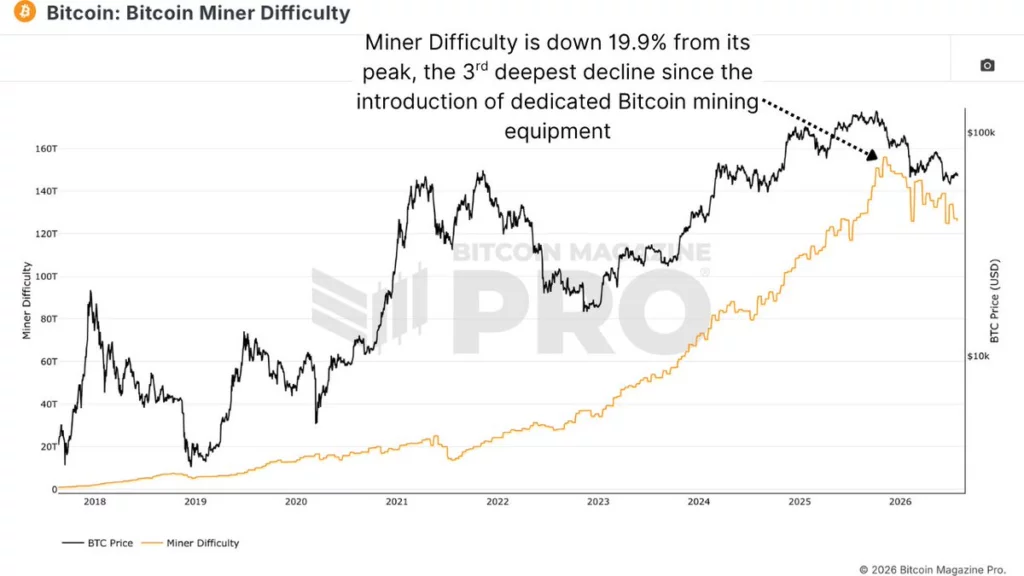
Bitcoin miners entered one of their longest periods of contraction by July 31, even as shares of several listed operators climbed on expectations for AI data-center revenue.
Summary
- 19.9% difficulty decline places mining in its third-deepest ASIC-era drawdown, according to Bitcoin Magazine Pro.
- 12% hashrate retreat from December’s peak coincides with low hashprice and expanding artificial-intelligence contracts globally.
- Hut 8’s AI leases total $26.6 billion, helping explain mining stocks’ divergence from Bitcoin prices.
Bitcoin Magazine Pro calculated that mining difficulty had fallen 19.9% from its peak, making the decline the third deepest since application-specific integrated circuits replaced graphics processors as the industry’s main hardware.
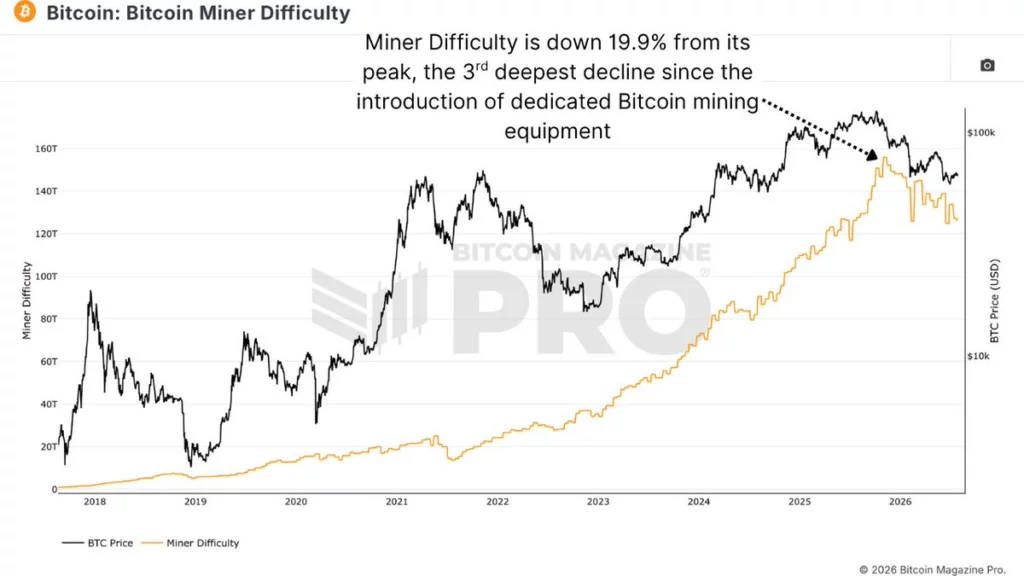
Independent network data confirm the broader contraction. Bitcoin’s difficulty fell 0.74% on July 25 to 126.23 trillion after a larger 5% cut on July 11. The current level is about 19% below the record of roughly 156 trillion set in November 2025.
Bitcoin traded near $63,100 on July 31, down about 47% over 12 months and almost 50% below its October 2025 record. That price decline has reduced dollar revenue for miners while the protocol continues issuing only 3.125 BTC per block.
Bitcoin miner capitulation is visible in network data
Bitcoin’s seven-day average hashrate stood near 868 exahashes per second on July 29, down from more than one zettahash per second at its late-2025 peak. Hashrate Index placed the broader 30-day measure near 940 EH/s in its third-quarter review, about 12% below the December record of 1,066 EH/s.
Different data providers use different averaging windows, so they may not identify the same starting date for the decline. Bitcoin Magazine Pro’s claim that the drawdown had lasted 287 days reflects its chosen hashrate series. The precise duration may vary, but the downward direction is clear across public datasets.
Difficulty has also turned negative on a year-over-year basis for only the second time in Bitcoin’s history, according to Luxor’s Hashrate Index. The previous instance followed China’s 2021 mining ban, when a large share of global equipment shut down before relocating to other countries.
The present contraction has no single policy-driven cause. Hashrate Index attributes it to compressed mining revenue, Bitcoin’s lower price, less-efficient hardware shutting down and power capacity moving into AI and high-performance computing. It recorded two consecutive quarterly hashrate declines through June.
Hashprice, which measures expected daily revenue from one petahash of computing power, stood near $32 per PH/s per day late in July. Older fleets can struggle to remain cash-positive around $30 to $35 unless operators have electricity below roughly five cents per kilowatt-hour.
As previously reported, listed miners sold more than 32,000 BTC during the first quarter of 2026. The total exceeded their combined sales during all of 2025, as companies raised cash for debt, operating costs and data-center construction.
AI deals explain why mining stocks broke from Bitcoin
Mining stocks traditionally behaved like leveraged Bitcoin exposure. Rising Bitcoin prices improved mining revenue and lifted equity valuations, while falling prices compressed margins and pushed miner shares down faster than the asset.
That relationship has weakened because investors increasingly value some operators as energy and AI infrastructure companies. A basket of mining equities gained 56% during the early part of 2026 while Bitcoin fell 17%, according to research cited in related crypto.news coverage.
Hut 8 provides one of the clearest examples. On July 20, the company signed a second 15-year lease for 352 megawatts at its Beacon Point campus in Texas. The agreement raised the campus’s base-term contract value to $19.6 billion and Hut 8’s total contracted AI portfolio to $26.6 billion. Initial delivery for the second phase is scheduled for the second quarter of 2028.
Hut 8’s shares more than quadrupled over the preceding 12 months and rose 11% after the second Beacon Point agreement, according to market data reported by Barron’s. Those gains reflect expected future lease revenue rather than stronger Bitcoin-mining economics.
Core Scientific reported another large expansion on July 28. The company announced an AMD partnership anchored by 15-year agreements covering about 530 MW and more than $14 billion in potential base contracted revenue. It said its total leased customer capacity had reached roughly 1.1 GW, representing more than $24 billion in potential contracted revenue.
Meanwhile, TeraWulf’s AI and HPC lease revenue reached $21 million in the first quarter, overtaking its Bitcoin-mining revenue for the first time. Mining generated less than $13 million during the period.
These agreements help explain why falling hashrate and rising miner stocks can occur together. Operators can shut down inefficient mining equipment while preserving valuable power connections, land and data-center infrastructure for higher-value workloads.
However, announced contract values are not the same as revenue already received. Many projects require years of construction, outside financing and customer deployment. Delays, cost overruns or weaker AI demand could challenge valuations built around future capacity.
Bitcoin Magazine Pro wrote that miners had “found something more profitable to do with their hardware.” The statement captures the market’s current thesis, but it does not apply equally to every miner. Some locations cannot meet the networking, cooling or reliability standards required for AI workloads, while efficient mining sites may remain profitable.
Bitcoin fees remain too small to replace the subsidy
Miner revenue consists of the fixed block subsidy and transaction fees. The subsidy has declined from 50 BTC in 2009 to 3.125 BTC after the April 2024 halving. It is expected to fall to 1.5625 BTC at the next halving, currently projected for 2028.
Bitcoin Magazine Pro said BTC-denominated block-reward revenue recently reached its lowest daily level on record. That claim requires context. Lower BTC-denominated issuance is largely a programmed outcome of halvings, while slower-than-target block production can temporarily reduce daily issuance before the next difficulty adjustment.
Dollar revenue can still rise when Bitcoin appreciates. Therefore, a record low measured in BTC does not automatically represent a record low security budget in U.S. dollar terms.
Transaction fees are providing little support. Miners collected about 20 BTC in fees during the seven days through July 13, equal to roughly 2.86 BTC per day. That was below the 3.125 BTC subsidy paid by a single block and represented only 0.69% of total block rewards for that week.
The comparison supports Bitcoin Magazine Pro’s broader point, although the exact result depends on the period measured. Fee demand can rise rapidly during congestion, token launches or other periods of intense blockspace competition.
For now, fees remain far from replacing issuance. At approximately 144 blocks per day, the network creates about 450 BTC in daily subsidy when blocks arrive on schedule. Fee income of less than 3 BTC per day covers only a small share of that amount.
This gap matters over decades rather than weeks. Every future halving will reduce issuance, requiring some combination of higher Bitcoin prices, greater fee demand, improved mining efficiency or a smaller amount of economically sustainable hashrate.
In related coverage, crypto.news reported that the long-term security-budget debate depends on several uncertain variables, including future fees, hardware efficiency, energy costs and Bitcoin’s market value. Current fee weakness does not prove that the network will face a security failure.
Falling hashrate is not an immediate security crisis
Bitcoin remains secured by hundreds of exahashes per second of computing power. The protocol also adjusts difficulty every 2,016 blocks to bring average block production back toward ten minutes when machines enter or leave.
Lower difficulty improves conditions for the miners that remain. Each unit of surviving hashrate competes against less total computing power and can earn a larger share of the fixed block rewards.
That mechanism can stabilize the network after a miner capitulation. Weak operators leave, difficulty falls and lower-cost miners gain revenue share. A 19.9% decline from the peak therefore signals industry stress, but it also shows that Bitcoin’s adjustment mechanism is responding as designed.
Still, the current cycle differs from earlier contractions. Some hardware is not merely being shut down temporarily. Power contracts and data-center sites are entering AI leases that can last 15 or 20 years, making their return to Bitcoin mining less likely.
Luxor described the trend as “a structural shift, not just a cyclical low.” Its research found that listed miners had announced more than $70 billion in AI and HPC contracts, while network hashrate experienced its second consecutive quarterly decline.
The next difficulty adjustment, expected around August 9 to August 11 depending on block production, will provide another network checkpoint. A further reduction would show that miners continued leaving after the July 25 reset. Stable or rising difficulty would suggest that the contraction had begun to slow.
Investors will also watch Hut 8’s second-quarter results on August 4, new AI-capacity delivery schedules and whether miners continue selling Bitcoin reserves.
FAQs
Why are Bitcoin mining stocks rising while hashrate falls?
Several listed miners now hold multibillion-dollar AI and HPC contracts. Investors are valuing their secured power, data-center land and future lease revenue rather than relying only on Bitcoin production.
Does falling difficulty mean Bitcoin is less secure?
Falling difficulty shows that less computing power is competing to produce blocks. Bitcoin still has a very large hashrate, and no verified evidence indicates an immediate security crisis. The protocol lowers difficulty to maintain block production when miners leave.
Are all Bitcoin miners moving into AI?
No. AI conversions require strong grid connections, fiber networks, advanced cooling and large amounts of capital. Efficient miners with cheap power may continue focusing on Bitcoin, while operators with suitable sites pursue AI contracts.
What would show that miner capitulation is ending?
Key signals include stable hashrate, difficulty beginning to rise, hashprice moving above operating costs and reduced treasury selling. A sustained Bitcoin recovery would also improve dollar-denominated mining revenue.
Disclosure: This article does not represent investment advice. The content and materials featured on this page are for educational purposes only.


NEAR Protocol has launched a staking-based payment system for its AI platform, allowing users to access confidential inference and autonomous AI agents by locking NEAR tokens instead of paying with a credit card.
Summary
- NEAR Protocol has launched staking based AI payments that convert locked NEAR into monthly compute credits for AI services.
- Users can access all 43 AI models on NEAR AI without a credit card, while retaining ownership of their staked tokens until they choose to unstake.
- NEAR said the system supports confidential AI inference and always on agents through an onchain staking mechanism.
- The launch adds a new utility for NEAR staking after earlier initiatives including an institutional staking fund and a network upgrade that reduced token inflation.
According to an announcement published by NEAR Protocol on X, the new feature converts staked NEAR into monthly compute credits that can be used across the platform’s artificial intelligence services.
The protocol said users can adjust the amount they stake based on their computing needs, while the underlying tokens remain locked rather than spent and become available again after unstaking.
The rollout covers all 43 AI models currently available through NEAR AI, including models from Anthropic, OpenAI and Google. NEAR Protocol said the mechanism removes the need for a cloud billing account, stored payment credentials or a credit card to access those services.
The protocol described the launch as one of the first production systems to let users pay for confidential AI inference and always-on agents through onchain staking. In its announcement, NEAR said the feature brings together “the NEAR you hold and the AI you run, joined without a card in between.”
NEAR staking converts locked tokens into AI compute credits
Under the new system, users stake NEAR before using AI services, with the amount locked determining how many monthly compute credits they receive. According to NEAR Protocol, larger staking positions generate more compute points, allowing users to scale usage without moving to a different payment model.
Unlike a traditional subscription where funds are spent each billing cycle, the protocol said the staked tokens themselves are not consumed while the service is being used. Users can increase their stake to obtain additional one-time credits, reduce it when usage declines or withdraw their tokens completely by unstaking.
NEAR Protocol said every supported AI model on NEAR AI is available through the staking mechanism, allowing developers and users to switch between providers without changing how they pay for inference or agent hosting.
Describing the design, the protocol said users can “stake the token and it converts into monthly compute credits that scale with the size of your stake,” while the capital “is not spent but staked, and it returns to your wallet when you unstake.”
The company also framed the feature as part of its effort to let users keep control of their assets and credentials while interacting with AI services. According to the announcement, confidential inference and hosted agents can run without requiring users to hand over payment information to third-party platforms.
NEAR ties AI usage to token staking
Alongside the product launch, NEAR Protocol connected the payment model to its long-term view of an AI-driven onchain economy. The protocol argued that if software agents become primary participants in digital markets, the assets securing blockchain networks could also become the assets used to pay for machine-generated work.
According to NEAR Protocol, staking for AI turns the token into a recoverable payment instrument instead of a consumable expense. Rather than purchasing credits that disappear after use, users temporarily lock tokens while accessing computing resources and receive them back after the staking period ends.
The protocol wrote that “staking NEAR equates to AI usage, prepaid in a form you can recover,” adding that the payment process, staking and unstaking all remain onchain throughout the lifecycle.
NEAR also argued that the same token supports two functions at once by helping secure the blockchain while simultaneously paying for AI computation. The company presented that approach as part of what it calls the “agent economy,” where digital assets secure network infrastructure while also facilitating automated economic activity.
AI payments add another use case for NEAR token
Beyond user payments, NEAR Protocol said staking AI fees could influence the network’s token economics because the locked assets remain out of circulation while supporting AI workloads.
According to the protocol, a single AI subscription would have little effect on overall supply, but repeated usage across developers and applications could result in more tokens being committed to active computing instead of remaining freely tradable.
The company said every AI inference request or autonomous agent paid through staking contributes to the same cycle by locking tokens against real network activity rather than speculative trading. NEAR added that the value created through that activity can return to participants securing the network instead of accumulating with centralized service providers.
The announcement stopped short of estimating how much supply could eventually become locked through AI payments and did not provide adoption forecasts.
The latest AI payment feature introduces another role for staking within the NEAR ecosystem by linking token deposits directly to AI computing instead of relying only on validator participation or investment products.
Closing its announcement, NEAR Protocol described the system as an example of “AI sovereignty,” where users can stake tokens, allow private AI agents to run without exposing credentials, and later recover the same tokens after unstaking.
Previous staking initiatives laid groundwork for the launch
The new payment model builds on earlier efforts by NEAR to expand staking beyond conventional validator rewards.
In February 2025, Nomura-backed Laser Digital introduced the Laser Digital NEAR Adoption Fund for institutional investors seeking long-term exposure to the blockchain’s native token. The fund uses TruStake, an institutional staking solution developed by TruFin, allowing participants to earn staking rewards while supporting network consensus.
At the time, Laser Digital Chief Executive Officer Jez Mohideen said the fund combined exposure to artificial intelligence and digital assets with staking income. The product was made available to eligible institutional and professional investors in selected jurisdictions outside the United States.
NEAR also changed its monetary policy later that year. On Oct. 30, 2025, the protocol activated a network upgrade reducing annual token inflation from about 5% to roughly 2.4%, cutting yearly token issuance by nearly 60 million NEAR. The update also lowered expected staking yields from around 9% to approximately 4.5%, assuming roughly half of the circulating supply remained staked.


Quantum Solutions and Hyperscale Data each redirected part of their crypto treasuries toward AI data centers on July 30.
Summary
- 1,000 ETH sale raised $1.9 million for Quantum Solutions’ Japanese AI data center expansion plans.
- 100 BTC were monetized as Hyperscale Data established a Bitcoin-backed credit facility for Michigan construction.
- 4,375 ETH sale ceiling leaves Quantum authorized to dispose of another 2,471 tokens by October.
Tokyo-listed Quantum sold 1,000 ETH for $1.903 million, while U.S.-listed Hyperscale monetized about 100 BTC and established a Bitcoin-backed credit facility.
The transactions show two approaches to using digital assets as operating capital. Quantum converted Ethereum directly into cash. Hyperscale combined a Bitcoin sale with collateralized borrowing to finance its Michigan AI data center.
Quantum Solutions converts ETH into AIDC funding
Quantum’s subsidiary GPT Pals Studio sold 1,000 ETH at $1,903 per token, generating $1.903 million after transaction fees. The company expects to record a $100,970 loss, equal to about ¥17 million, because the sale price was below its May 31 carrying value of $2,003.97 per ETH. The accounting loss is not measured against the original purchase price.
The July transaction followed a June 16 sale of 904 ETH for about $1.61 million. Together, the two disposals raised roughly $3.51 million and reduced Quantum’s balance from 6,668.8 ETH to 4,764.8 ETH, a decline of about 28.6%.
Quantum increased its cumulative sale limit from 1,875 ETH to 4,375 ETH through October 30. The company may therefore sell another 2,471 ETH. However, its filing states that the higher ceiling “does not constitute a decision to immediately sell” the full amount. Future transactions will depend on ETH prices, funding requirements and progress in the AI Infrastructure Data Center business.
Most of Quantum’s remaining ETH is pledged
Of Quantum’s remaining 4,764.8 ETH, 3,050 ETH is pledged as collateral to a Singapore-based financial services company. Another 1,714.8 ETH remains in GPT Pals’ crypto trading account. The company has not identified the lender publicly.
The unused sale authorization exceeds Quantum’s freely held trading-account balance by 756.2 ETH. Selling the full authorized amount would therefore appear to require the release or replacement of some collateral, additional ETH purchases or another arrangement. Quantum has not announced plans to take any of those steps.
The sale also changed Quantum’s position among Japanese corporate Ethereum holders. Def Consulting reported 4,976 ETH on June 30, which is 211.2 ETH more than Quantum’s post-sale balance. Based on the companies’ latest disclosed figures, Quantum no longer appears to be Japan’s largest listed ETH holder, although the balances were reported on different dates.
Ascrypto.news previously reported, Quantum had become the largest Ethereum treasury company outside the U.S. after rapidly accumulating ETH in October 2025. Its latest disposals mark a shift from treasury expansion toward business funding.
In addition, Quantum said the proceeds would support data center contracts, GPU equipment and preparations for its AIDC business. In June, it signed a memorandum of understanding with Hong Kong-based Integrated Capital to examine financing and resource cooperation for a Japanese AI data center.
The proposed infrastructure would focus on systems using NVIDIA B300 and GB300 GPUs. However, the memorandum is nonbinding. Quantum said “specific investment amounts, financing conditions and implementation timing remain undecided.” The ETH sales therefore provide capital flexibility but do not confirm that a completed data center investment has been agreed.
Hyperscale Data monetizes 100 BTC for Michigan
Hyperscale Data separately said it monetized approximately 100 BTC and invested the proceeds into its Michigan AI data center campus. The company also created a Bitcoin-backed facility with an expected variable interest rate of 4.5% to 5%.
The release did not identify the lender, borrowing limit, maturity, collateral ratio or amount of Bitcoin pledged. Hyperscale had reported 1,106.0467 BTC on July 27, valued at about $71.7 million. Subtracting the stated sale would leave roughly 1,006 BTC, but that figure is an estimate because the company has not disclosed a precise post-transaction balance.
Hyperscale is building capacity for a neocloud provider under a definitive master services agreement. The initial deployment covers about 20 megawatts and has a ten-year term with two optional five-year extensions. The company estimates that the maximum term could produce more than $1.2 billion in revenue.
The customer also has an option for another 32 MW. Hyperscale said the expanded arrangement “would be expected” to raise total contract revenue above $3 billion if the capacity and extension options are exercised. Those amounts are conditional forecasts, not revenue already earned.
Crypto treasuries become operating finance tools
The announcements show digital-asset treasuries moving beyond passive holding. Quantum is selling ETH to fund a project that remains at an early stage. Hyperscale is selling and borrowing against Bitcoin to support a data center tied to a signed customer agreement.
The model is spreading across crypto-linked infrastructure companies. In related coverage, Core Scientific sold 2,385 BTC during the first quarter to fund AI capital expenditure. Crypto.news also found that listed miners had secured more than $70 billion in announced AI and high-performance computing contracts while selling Bitcoin to cover development costs.
Quantum’s next deadline is October 30, when its expanded ETH sale authorization expires. The company has promised disclosures if it makes additional sales and expects to recognize the ¥17 million loss in its fiscal second quarter.
Hyperscale said it will issue further construction, financing and operational updates. Investors will be watching for the credit facility’s full terms, an updated Bitcoin balance and evidence that planned Michigan capacity is delivered according to schedule.

Ransom Notes in Nancy Guthrie Case: What Has Been Revealed?

7 Powerful Financial Habits That Can Transform YourWealth |Nirmala Sitharaman’s PracticalMoneyAdvice

Russian missile attack on Ukrainian capital kills at least 3, wounds over a dozen

Renter of Home in Anne Heche Crash Denies Settlement With Son

No Jackpot Winner as $257 Million Prize Rolls Over to $269 Million Monday Draw

Weekend Open Thread: Staud – Corporette.com
7 Powerful Financial Habits That Can Transform YourWealth |Nirmala Sitharaman’s PracticalMoneyAdvice

LISA – ‘MONEY’ EXCLUSIVE PERFORMANCE VIDEO

The Second Leg Down of the Bitcoin Bear Market Will Be Much Worse Than the First Leg Down – PROOF
-
 Sports5 days ago
Commonwealth Games boxing: Jadumani Singh seals dominant 5-0 win over Pakistan’s Sumama Rehman to enter quarter-finals | Commonwealth Games News
-

 Business2 days ago
Why Trees Belong on the Risk Register
-

 Fashion9 hours ago
Weekend Open Thread: Wit & Wisdom
-

 Tech5 days ago
Intel is reversing course and bringing hyper-threading back to its server chips
-

 Politics6 hours ago
Meta enters AI-training agreement with far-right ‘propaganda rag’ Newsmax
-

 Crypto World6 days ago
Ripple bought a bank in pieces. The $4 billion audit
-

 Politics5 days ago
Luke Littler dismantles Gerwyn Price to retain title in Blackpool
-

 Politics4 days ago
The Part of the Electric Transition Nobody Wants to Discuss
-

 News Videos5 days ago
BITCOIN JUST ENTERED THIS CRITICAL ZONE…
-
 Entertainment3 days ago
‘Stargate’ Creator’s New Sci-Fi Series Returns for Season 3 Tomorrow
-

 Crypto World6 days ago
XRP Ledger adds $2.6B as RWA inflows rank second
-

 Business3 days ago
Major shareholder moves on Canyon
-

 Politics6 days ago
Spain sweeps the board at 2026 World Cup with individual awards
-

 News Videos2 days ago
Bitcoin Enters the 3rd Stage of the Bear Market
-

 Entertainment6 days ago
Sara Gilson Killed By Husband After Viral “Pedophile” TikTok Video
-

 Crypto World3 days ago
Kraken Enables Retail Access to Jersey Mike’s IPO via Tokenized Shares
-

 Tech7 days ago
Anthropic launches Claude Opus 5, a cheaper AI model for coding, agents and enterprise workflows
-

 Tech4 days ago
New macOS Sequoia & Sonoma security updates for older Macs
-

 News Videos3 days ago
Claude: Build Financial Dashboards in Minutes (2026)
-

 Politics1 day ago
Luke Littler’s dominance sparks GOAT debate
You must be logged in to post a comment Login