
Crypto World
Plume Turns Paychecks Into Yield-Bearing Assets in RWA Payroll Pilot

Employees can elect to receive a portion of their salary in shares of WTGXX, earning yield from the day compensation is paid.

WisdomTree does not see pending U.S. crypto legislation as a prerequisite for innovation, even as policymakers debate new rules for digital assets.
“I don’t [think] it would inhibit anything that we’re trying to do,” said Will Peck, the firm’s head of digital assets, referring to the proposed Clarity Act. “We don’t view it as a gatekeeper.”
The Clarity Act, which is pending approval from Congress, aims to establish clearer jurisdiction between the Securities and Exchange Commission (SEC) and the Commodity Futures Trading Commission (CFTC), while setting rules for how digital assets are classified and regulated. Supporters say it could reduce uncertainty that has slowed institutional adoption.
Peck’s believes much of the framework already exists. “The SEC has all the tools… to foster good tokenized security markets, good tokenized fund markets,” he said.
That perspective reflects WisdomTree’s approach. The asset manager has been building in crypto and tokenization for years, earlier than many traditional peers. It offers a spot bitcoin exchange-traded fund (ETF) in the U.S. and a broader suite of crypto exchange-traded products in Europe, where competition has been less intense and innovation started earlier.
More recently, the firm has focused on tokenized real-world assets. WisdomTree operates one of the larger tokenized money market funds, a product category that has grown as investors look for yield on-chain. Peck said the fund has already found “good product market fit.”
The company also secured a form of SEC relief that allows the fund to trade continuously. “This holy grail of… instant settlement is actually happening now with this product,” Peck said.
In practice, that means institutional investors can move between U.S. dollars, stablecoins like USDC and the fund itself at any time, rather than waiting for end-of-day processing. The model points to how traditional financial products could evolve on blockchain rails.
WisdomTree’s broader goal is to bring more regulated investment products on-chain. Peck said the firm wants to expand beyond money market funds into other tokenized instruments, including exchange-traded funds and yield-generating products. Over time, that could allow investors to access familiar assets directly from digital wallets, without relying on traditional brokerage accounts.
The firm is also betting that demand will persist regardless of market cycles. “It has not affected us at all,” Peck said of recent crypto price volatility, describing activity as “all systems go.”
While Peck said the Clarity Act would be “constructive for the industry,” he suggested it is not the main driver of progress. Instead, firms like WisdomTree are moving ahead using existing regulatory pathways.
Nvidia (NVDA) stock closed above $165 on March 30, down over 9% since March 25. It now sits directly on the neckline of a head-and-shoulders pattern that projects an 11% measured breakdown if it fails.
The decline has brought Nvidia stock to its most critical technical test since early 2026. Now, the daily chart, institutional flow data, and options positioning are all pointing in different directions.
AI Memory Sell-Off Pushes Nvidia to the Neckline
The catalyst behind the 9% NVDA price decline traces back to March 24. This is when Google announced TurboQuant, a memory compression algorithm that reduces AI model memory requirements by 6x without sacrificing performance.
The announcement triggered a sharp sell-off across AI memory manufacturers. Micron dropped roughly 20%, and SanDisk fell approximately 18% in the days that followed.
Reports that OpenAI is scaling back data center spending compounded the pressure. OpenAI’s October 2025 deal to secure 40% of global DRAM supply had been a key pillar of the memory shortage thesis. Any pullback from that commitment weakens the demand outlook for high-bandwidth memory, which feeds directly into Nvidia’s GPU production pipeline.
The combination dragged the NVDA stock price to $165 by March 30.
The daily chart shows the damage in structural terms. The AI memory rout nearly pushed the NVDA stock beyond the head-and-shoulders neckline. If the neckline breaks, the NVDA stock price might end up correcting by another 11%, per target projections. The sloping-down neckline makes a clean breakdown harder to trigger because the price must keep falling to reach it, but NVDA is now inches away.
The Chaikin Money Flow (CMF) indicator, a proxy for institutional buying and selling pressure, adds nuance. CMF attempted to cross above zero between March 10 and 16. This signalled a brief return of institutional buying interest, but failed and has since declined to -0.24.
Yet, between February 5 and March 30, as the stock prices trended lower, the CMF still managed to hold higher.
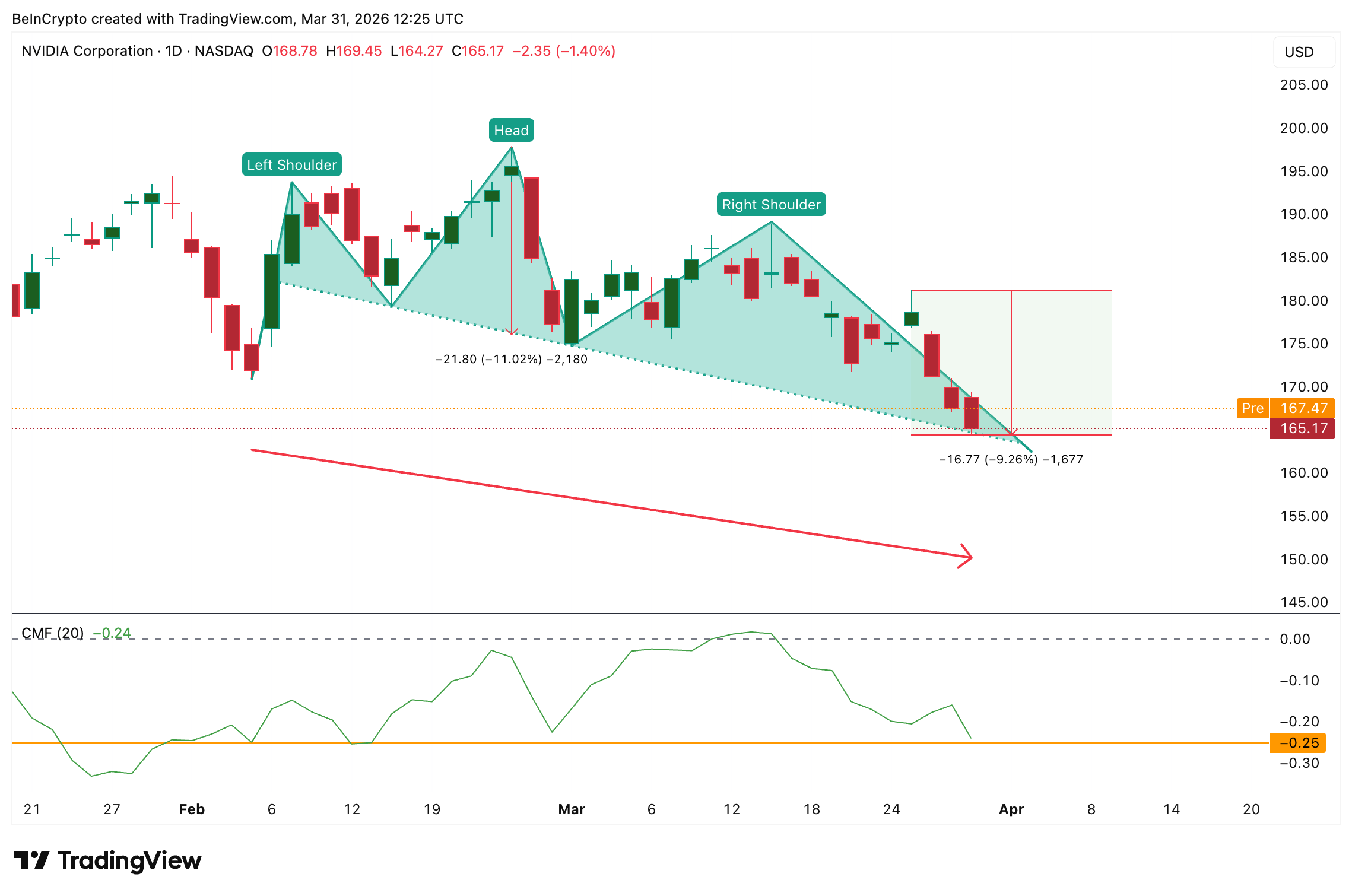
That reading sits just above the -0.25. If CMF breaks below -0.25, it would confirm institutional sellers are driving the move, and the neckline breakdown becomes significantly more likely.
Put-Call Ratio Shows Options Traders Buying Into the Dip
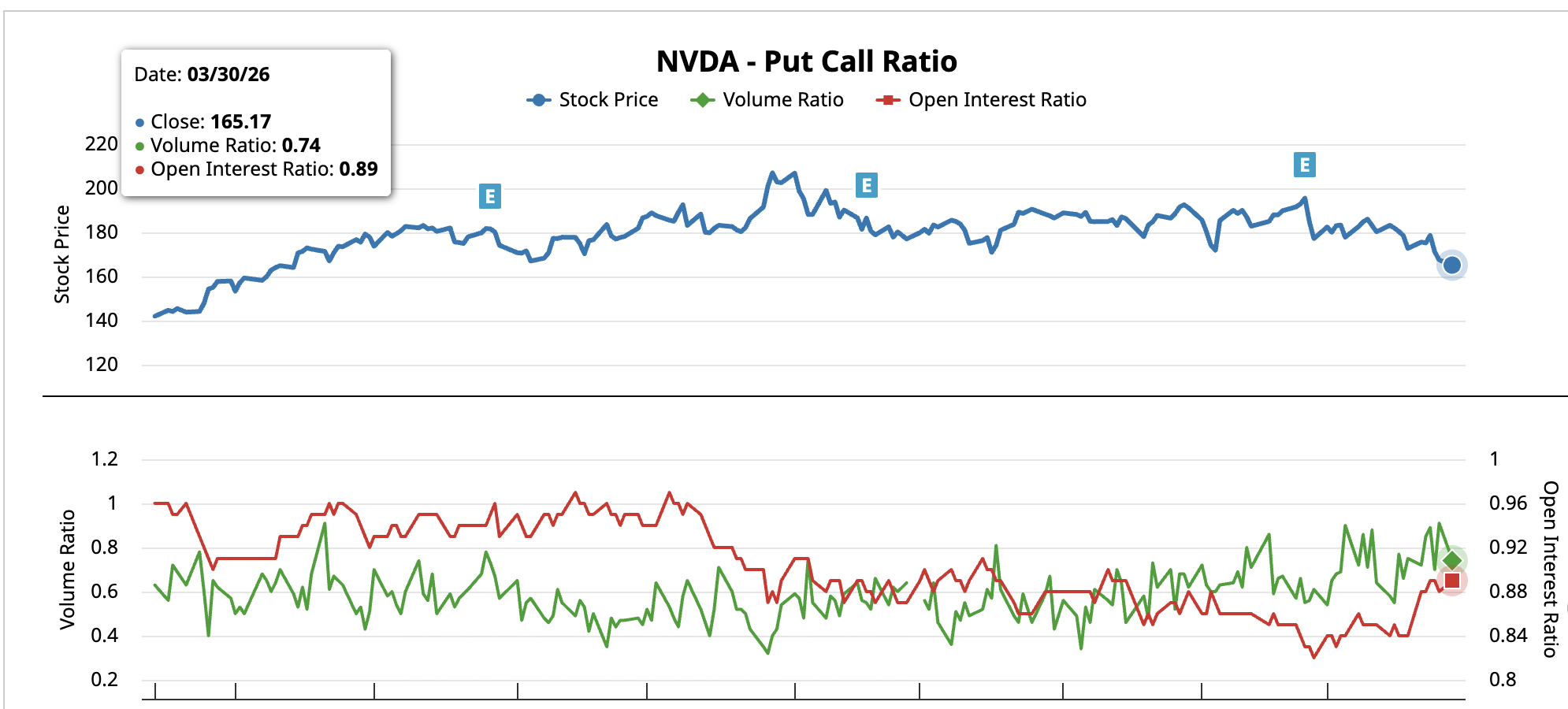
While the price chart and money flow data point to weakness, the Nvidia put-call ratio tells a contrarian story. On March 25, when the sell-off started, the put-call volume ratio stood at 0.89, nearly balanced between bearish puts and bullish calls.
By March 30, the volume ratio had dropped 16.8% to 0.74, meaning call volume (bullish bets) expanded significantly relative to put volume as prices fell. The broader market might be looking at the bullish targets for NVDA, as proposed by Wall Street Analysts.
UBS analyst Timothy Arcuri reiterated a Buy rating on Nvidia shares with a $245 price target on March 20, implying 48% upside. That call, issued five days before the AI memory rout began, prices in continued demand driven by Rubin GPU shipments and treats the memory supply disruption as a short-term headwind rather than a structural shift.

A volume ratio below 0.80 on a stock that just dropped over 9% in five sessions is unusual. It signals that options traders are using the decline to build bullish positions rather than hedging for further downside.
Want more insights like this? Sign up for Editor Harsh Notariya’s Daily Crypto Newsletter here.
The open interest ratio, which reflects longer-duration positioning, held at 0.89, meaning the existing put-heavy book from earlier in the sell-off remains intact. New activity skews bullish, but the older short base has not been unwound.
That divergence between falling price and rising call activity aligns with UBS’s institutional view and creates a setup where a confirmed bounce off the neckline could trigger a short squeeze in the options market. However, if the neckline breaks, call buyers would face rapid losses, and the unwinding could accelerate the move toward the deeper price targets.
Key Nvidia Stock Price Levels to Watch
The Nvidia stock price now trades below all four major exponential moving averages (EMAs). Exponential moving averages (EMAs) are trend indicators that weight recent prices more heavily to identify directional momentum.
The 20-day EMA sits at $177, the 50-day and 100-day EMAs at $181, and the 200-day at $174. The bearish crossover between the 50-day and 100-day EMA completed during the final week of March, adding a long-term headwind. That headwind seems to have played its part in leading the NVDA price correction.
The key technical levels place the 0.618 level at $174, which closely aligns with the 200-day EMA. That $173-$174 zone becomes the critical reclaim target. A move back above $165 neutralizes the immediate neckline threat, while a reclaim of $174 would place the price above the 200-day EMA and open the path toward $183 and $188. Beyond $188, the UBS analyst’s price target could start looking practical.
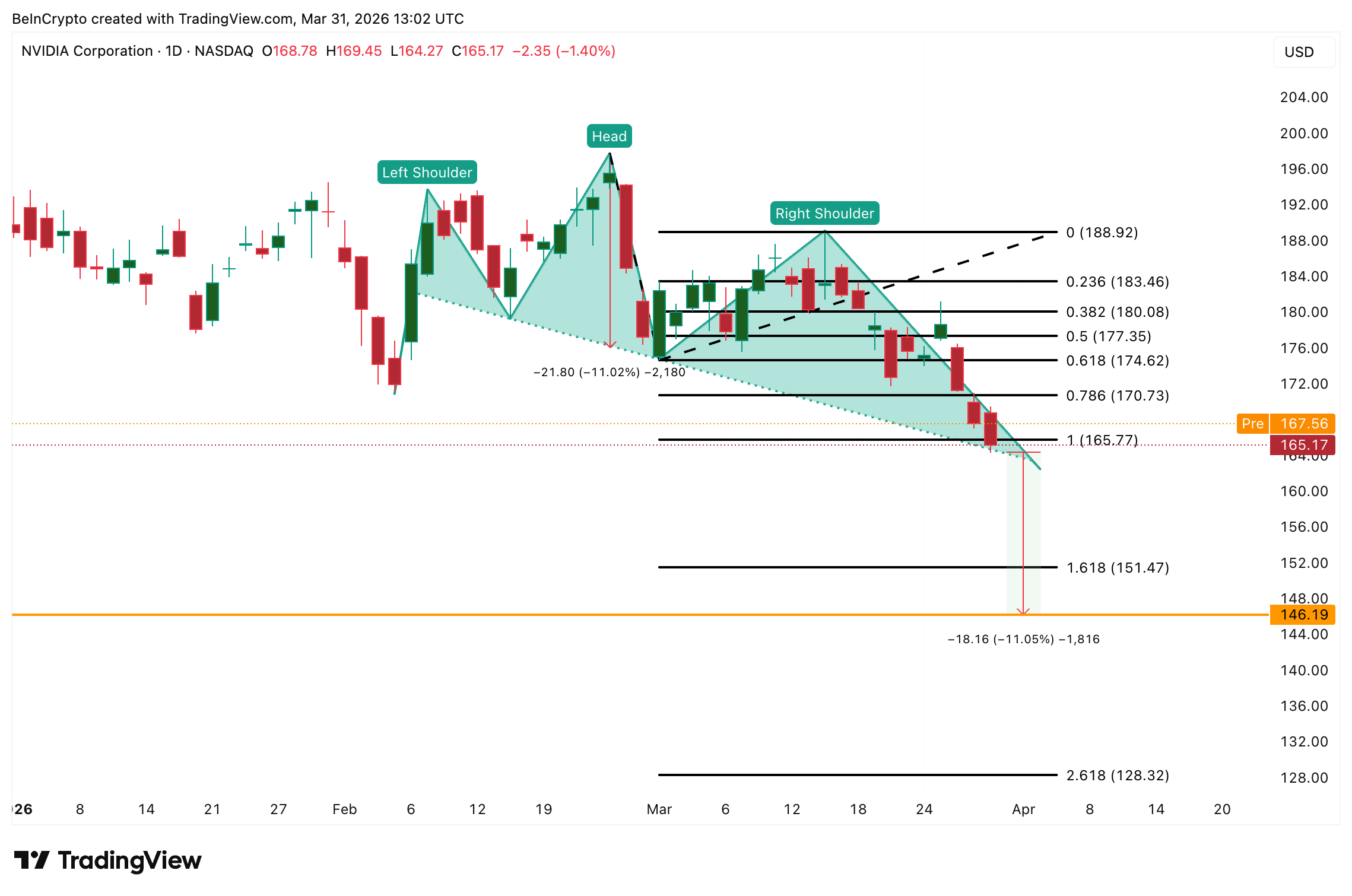
A daily close above $174 targets $183 and weakens the breakdown thesis. A failure to reclaim $165 in the subsequent trading sessions confirms the head-and-shoulders and exposes an 11% measured move toward $146.
The post AI Memory Rout Wipes 9% Off Nvidia Stock: Chart Says More Pain Ahead appeared first on BeInCrypto.
Bitcoin’s first-quarter slump capped an unusual run: nearly six months of underperformance against U.S. equities, a stretch that has no precedent.
“That’s never happened,” said Mark Connors, founder of Risk Dimensions, pointing to data showing bitcoin lagging stocks consistently since early October. The trend has raised fresh questions about whether the asset is behaving more like a risk trade than a hedge.
Bitcoin fell roughly 22% in the first quarter of 2026, following a 25% decline during the final three months of 2025. Over a similar period, the S&P 500 declined far less, leaving a wide performance gap. Connors said the duration of that gap, not just the size, stands out. Previous pullbacks have been sharper but shorter.
The weakness came amid broader market struggles. U.S. equities logged their worst quarter in four years, with the Nasdaq down more than 10% from recent highs. The combined decline across stocks and crypto erased much of the rally that followed the 2024 election.
Policy progress has been uneven. A new SEC chair has helped clear a path for more crypto ETFs, and lawmakers have advanced measures such as the GENIUS Act. Trump also signed an executive order in August that would make it easier for 401(k) plans to include alternative assets such as cryptocurrencies, private equity and real estate, which the Labor Department proposed a rule in response to on Monday.
March Shows Signs of Stability
Despite the weak quarter, bitcoin held up better in March than many expected.
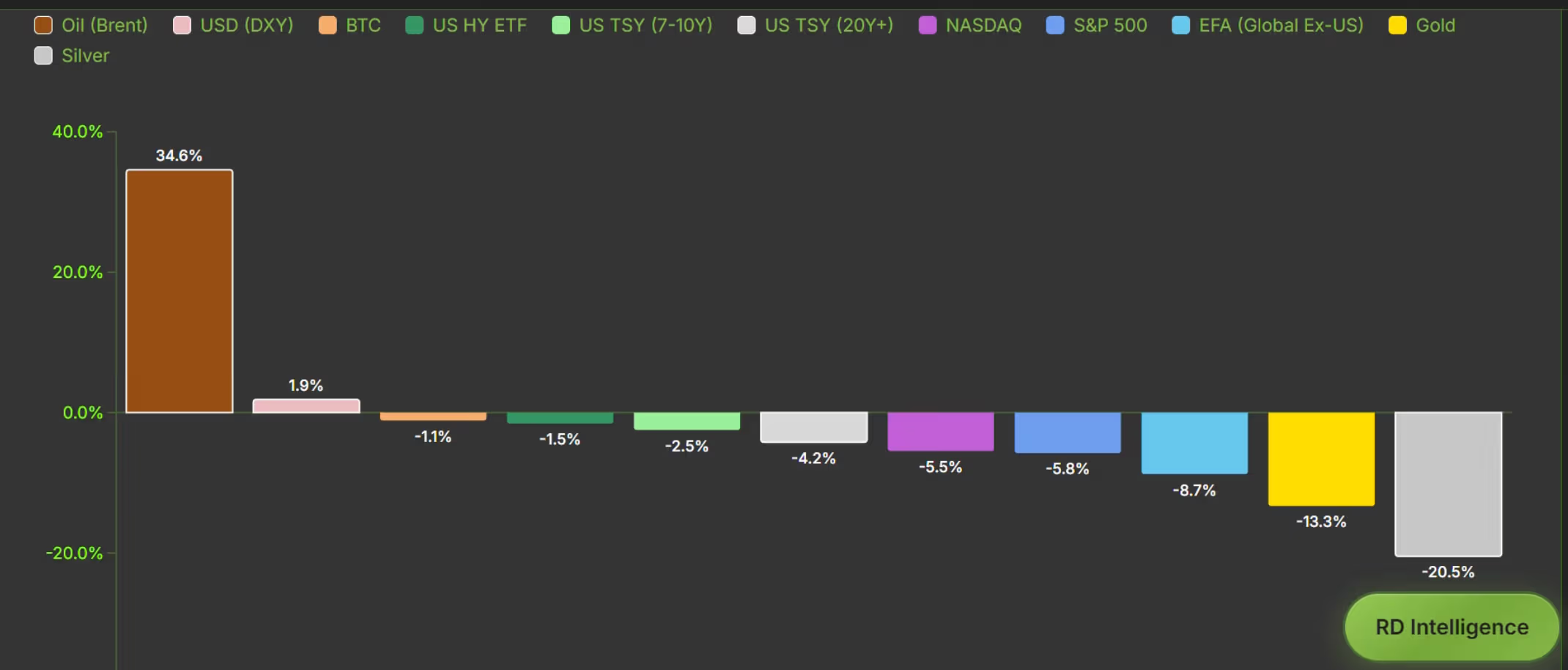
The early March escalation between the U.S. and Iran sent shockwaves through global markets, driving oil prices and the U.S. dollar higher as investors reacted to supply risks and rising costs.
The volatility triggered sharp moves across asset classes. Gold, often treated as a safe haven, saw extreme swings as margin calls and urgent liquidity needs forced selling by both institutional investors and sovereign entities. The scale of the move ranked among the most severe short-term dislocations in decades.
Bitcoin, however, did not experience the same level of forced unwinding. The crypto rose about 1% in March, while gold fell 11% over the same period. “It really hung in there,” Connors said.

He attributes that stability in part to earlier liquidations that cleared out leveraged positions. Bitcoin’s ability to move quickly across borders may also limit forced selling compared with physical assets.
Outlook: A “Coiled Spring”?
Looking ahead, Connors pointed to bitcoin’s extended stretch of underperformance relative to equities as a factor that could shape what comes next. Rolling 63-day data shows the asset has lagged the S&P 500 since October — the longest such period on record — an imbalance that has historically preceded reversals.
If that pattern holds, bitcoin could be entering a phase where relative weakness gives way to renewed demand, particularly as macro pressures tied to debt and currency expansion continue to build in the background.
The timing, however, may depend less on market structure and more on geopolitics. The trajectory of the Iran conflict and its impact on energy markets, liquidity and global risk appetite could determine how quickly sentiment shifts.
“It’s either two months or two years,” Connors said.

Warren Buffett warned that the spread of nuclear weapons is making the world a more dangerous place, saying the prospect of Iran acquiring a bomb would heighten the risk of a catastrophic conflict.
The Berkshire Hathaway chairman said the growing number of nuclear-armed states has fundamentally altered the global risk landscape, amplifying concerns he has voiced for decades about proliferation.
“Now you’ve got … nine countries,” Buffett said on CNBC’s “Squawk Box” on Tuesday. “We worried enormously about it when there were two. … You were not dealing with unstable people or anything like that. The ship’s turned around.”
Buffett pointed specifically to rising geopolitical tensions involving Iran and North Korea, suggesting that the potential presence of nuclear weapons in those regions raises the stakes considerably.
“Just think of how you’d feel with North Korea having it and Iran wanting to get it,” he said. “The most dangerous thing is, actually, somebody that’s got their hand on the switch, who is dying themselves, or is facing enormous embarrassment. … I don’t know the answer for it, but I do know that … it’ll be more difficult if Iran has the bomb than they don’t.”
The 95-year-old investor has long warned that the spread of nuclear capabilities increases the likelihood of a worst-case scenario. Asked what advice he would give a U.S. president confronting the issue of enriched uranium, Buffett struck a fatalistic tone about the long-term trajectory.
“I would say that one way or another … in the next 100 years — maybe it’s 200 years, who knows — something will happen to cause it to be used,” he said. “And we can’t take what’s out there now.”
Coinbase’s Layer 2 shifts focus to tokenizing every major asset class and scaling stablecoin payments.
Ivan Kozlov shared the first public update on recovery efforts nine days after an attacker minted 80 million unbacked USR tokens and extracted roughly $23 million.
Galaxy Digital has introduced a Solana staking feature on its GalaxyOne retail platform, furthering its push into consumer crypto services amid intensifying competition among all-in-one trading apps.
In a Tuesday announcement, Galaxy said GalaxyOne users can now stake Solana (SOL) directly through the app, earning up to 6.5% in variable annual rewards. The yield is not fixed and depends on network conditions, validator performance and overall staking participation, meaning actual returns may fluctuate over time.
The rollout reflects a broader industry shift toward integrating yield-generating products into retail platforms, allowing users to earn passive income on idle crypto holdings rather than simply holding or trading them.
To attract early users, Galaxy is waiving commissions on staking until the end of the year — a temporary incentive that suggests the company is prioritizing user acquisition over near-term revenue from the product.

Galaxy already operates institutional-grade Solana validators — infrastructure that helps secure the network by processing transactions and validating blocks.
In proof-of-stake systems like Solana, users delegate their tokens to these validators, which in turn distribute a share of staking rewards. By integrating this capability into GalaxyOne, the company is effectively extending its existing infrastructure business to retail customers.
The move positions Galaxy more directly against platforms like Coinbase and Robinhood, which offer bundled services including trading, custody and staking. As staking becomes a standard feature across crypto apps, competition is increasingly shifting toward fees, user experience and regulatory access.
Related: SEC approval sought for JitoSOL Solana-based liquid staking token ETF
Institutional demand supports staking narrative
Solana staking continues to draw investor interest despite a sharp decline in price amid broader weakness across the crypto market.
Institutional participation has rebounded recently, as staking-based investment products gain traction. The debut of Solana-focused exchange-traded funds (ETFs), including those with liquid staking strategies, has given investors exposure to both price movements and onchain yield.
Solana traded near $250 in September but has since fallen by roughly 67%. Despite the drawdown, staking activity has held up, indicating continued demand for yield.

Bohdan Opryshko, co-founder and chief operating officer of Everstake, which operates validator infrastructure across multiple proof-of-stake networks, said both retail and institutional participants are increasingly “treating Solana as a yield-generating asset rather than a speculative trade.”
Related: Nasdaq tokenization plans could split trading into two markets — TD Securities
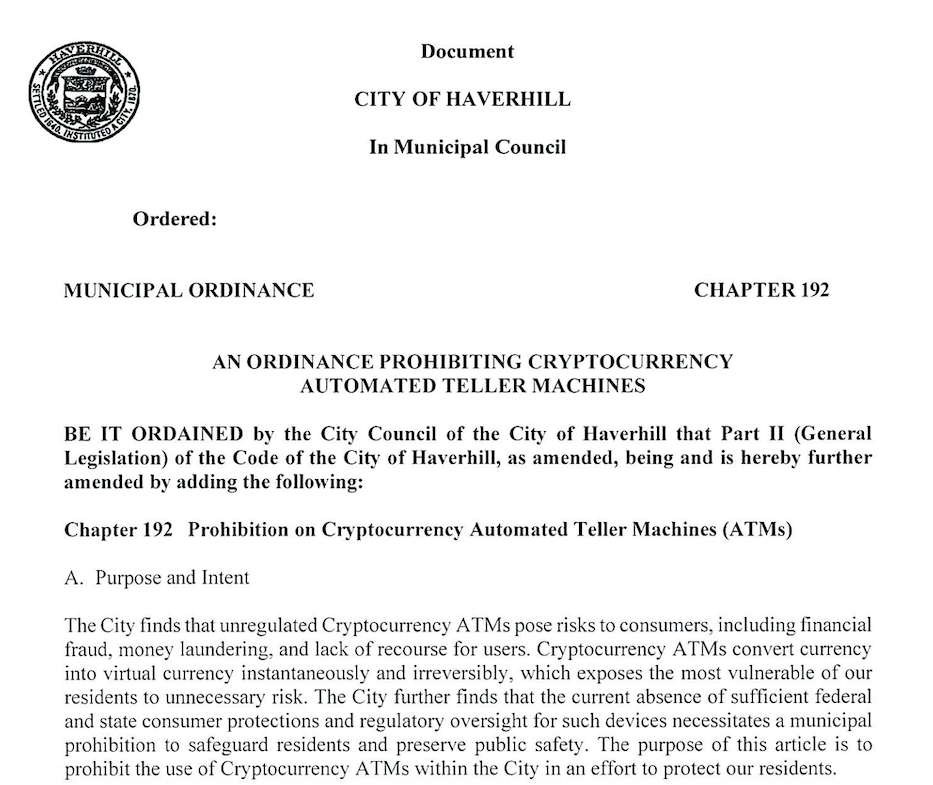
The city council of Haverhill, Massachusetts is set to consider a ban on cryptocurrency ATMs following a proposal for an ordinance introduced on March 17.
According to Haverhill City Council’s agenda, the government body is scheduled to review a crypto ATM ordinance introduced by Mayor Melinda E. Barrett. The proposal would amend the city code to prohibit cryptocurrency ATMs, an ordinance which received a unanimous 11 votes in the council’s March 17 meeting.

The ordinance cited potential risks to Haverhill residents due to “financial fraud, money laundering and lack of recourse” for ATM users. The city said the absence of state and federal regulations necessitated local authorities stepping in. If passed, all crypto kiosks and ATMs would need to be removed from the city within 60 days or face a $300 a day fine.
Haverhill‘s proposed action is just one of many examples of jurisdictions across the US introducing bans on crypto ATMs in response to scams and other illegal activities. In February, a Minnesota lawmaker introduced a bill that could ban crypto kiosks, building on a 2024 law that imposed restrictions on ATM operators.
Related: Crypto gains political clout among 80% of UK young voters
According to data reported by CoinATMRadar and crypto ATM operator Bitcoin Depot, there could be eight or more machines in the Haverhill area. Cointelegraph reached out to Mayor Barrett’s office for comment but had not received a response at the time of publication.
Bitcoin Depot stock declines as company shakes up leadership
As one of the largest crypto ATM operators in the US, the share price of Bitcoin Depot stock (BTM) has declined since 2025, dropping by more than 90% in the past six months. As of Tuesday, the stock was trading at $2.06 on the Nasdaq.
In additional to the potential ordinance in Haverhill, Bitcoin Depot faced Connecticut banking regulators issuing a temporary cease-and-desist order in March, effectively suspending its money transmission license. Authorities in Iowa and Massachusetts have also sued the company for allegedly facilitating crypto scams.
Last week, Bitcoin Depot announced that Scott Buchanan had stepped down as CEO, having served at the role for less than three months. Board member and former MoneyGram CEO Alex Holmes replaced Buchanan as CEO and chair.
Cointelegraph reached out to Bitcoin Depot for comment on the Haverhill ordinance but had not received a response at the time of publication.
Magazine: Are DeFi devs liable for the illegal activity of others on their platforms?

- XRP, Solana, and Cardano prices hover near $1.30, $80, and $0.24, respectively.
- Currently, BTC trades around $66,430 after retreating from highs of $68,000.
- Analysts say the week is heavy on macroeconomic data releases, and that’s likely to impact volatility.
XRP, Solana, and Cardano prices hover at critical support levels amid a potentially volatile week for cryptocurrencies, with Bitcoin poised just above $66,000 as traders brace for a fresh wave of macroeconomic data.
While geopolitical risk from the Iran war continues to roil markets, investors weighing the next moves might also want to pay attention to key macroeconomic events this week.
QCP Group has noted, via a post on X, that these data releases will likely shape the next leg of the Bitcoin price.
On Monday, analysts at Greeks.live opined that, in addition to macroeconomic factors, volatility could also hinge on announcements from US President Donald Trump.
Bitcoin led altcoins briefly higher after Trump announced that the US was looking to end its military operation in Iran.
Key macro events to watch this week
This week’s macro calendar is packed, with analysts at QCP Capital highlighting several data releases as potential volatility triggers across traditional markets and cryptocurrencies.
For investors, the key focus is how incoming data shapes expectations for US growth, inflation, and the interest-rate path—factors that continue to drive risk assets, including Bitcoin.
Key macro events to watch for this week:
Mar 31: CAD GDP m/m
Mar 31: US Consumer Confidence, JOLTS Job Openings, Chicago PMI
Apr 1: S&P Global US Manufacturing PMI, ISM Manufacturing PMI
Apr 2: Jobless Claims, Trade Balance
Apr 3: Non-Farm PayrollsMain volatility triggers:…
— QCP (@QCPgroup) March 31, 2026
On March 31, attention turns to US Consumer Confidence, JOLTS Job Openings, and the Chicago PMI.
QCP identifies JOLTS as a key volatility catalyst, as signs of labour market cooling or tightness directly influence Federal Reserve expectations and the dollar, with spillover effects on crypto flows.
Tokens such as XRP, Solana, and Cardano are likely to track Bitcoin’s direction.
On April 1, the S&P Global US Manufacturing PMI and ISM Manufacturing PMI will be released, with the ISM reading seen as particularly important.
A weaker print could strengthen expectations for rate cuts and support crypto, while stronger data may reinforce a “higher for longer” rate outlook and weigh on digital assets.
A similar dynamic applies to jobless claims data, another closely watched indicator.
A sharp rise could signal labour market weakness and potentially support Bitcoin as markets adjust expectations for monetary easing.
The week culminates on April 3 with the release of US Non-Farm Payrolls (NFP).
QCP flags this as a primary macro event that could revive inflation concerns and strengthen the dollar.
Historically, a stronger greenback has pressured Bitcoin, while softer payrolls tend to support the broader digital asset market through expectations of looser policy.
XRP, SOL, and ADA price outlook
From a technical perspective, Bitcoin enters this data-heavy period with a constructive but fragile setup on the daily chart.
Traders are balancing macroeconomic risks with geopolitical tensions, particularly around the Iran conflict and disruptions linked to the Strait of Hormuz.
The result is a market caught between competing drivers of volatility, with implications across risk assets.
Bitcoin’s sensitivity to incoming data could drive broader moves in altcoins.
XRP is holding near $1.30 support but may slip toward $1.20 if BTC weakens following non-farm payrolls data.
On the upside, softer inflation readings could support a move toward $1.50.
Solana (SOL), trading near $80, is testing key moving averages and could face downside risk toward $70.
A stronger bullish push, however, may open the path toward $100.
Meanwhile, Cardano (ADA) has declined to around $0.24, with potential for further downside toward $0.22.
A renewed influx of buyers could instead see the token attempt a move back toward the $0.30 resistance level.
Crypto World
Warren Buffett says he sold Apple too soon and would buy more of it, though not in this market

Warren Buffett said he sold Apple too soon and would buy more of it, though not in the current market.
“I sold it too soon. But, I bought it even sooner, so,” Buffett told CNBC’s Becky Quick in an interview Tuesday on “Squawk Box” in which he announced he’s bringing back his famed charity lunch.
Apple remains Berkshire Hathaway’s largest holding even after the conglomerate trimmed its stake to $61.96 billion at the end of last year, according to InsiderScore.
However, Buffett said Tuesday that he would continue to add to the position if it gets cheaper. He said the iPhone maker is not yet attractive even after falling more than 14% off its recent high, and dropping more than 6% this month. That’s amid turmoil in the broader market, with both the Dow Jones Industrial Average and the Nasdaq Composite in a correction.

Apple performance year to date
“I’m very happy to have it be our largest holding,” Buffett said. “I was not happy to have it be as large as almost everything else combined.”
“It’s not impossible that Apple would get to a price, we would buy a lot of it,” he added. “But not in this market.”
Buffett said the firm has made more than $100 billion in the stock pretax, and was favorable in his comments regarding Tim Cook‘s leadership of the firm over Steve Jobs.
“Tim Cook has done better with the hand. Steve Jobs — he couldn’t have done what Steve Jobs did — but Steve Jobs handed him a hand that Steve would not have done as well,” Buffett said.
“Tim was a fantastic manager, and he’s a good guy, and somehow he gets along with everybody in the world,” he added. “That’s a technique I wouldn’t have, for example, certainly my partner, Charlie Munger, wouldn’t have had it.”
Buffett stepped down as Berkshire’s CEO at the beginning of 2026 after six decades running the conglomerate. He remains chairman of the firm.
Read more from CNBC’s interview with Warren Buffett

Satono Glow grabs easy 2026 Group 3 win in Flemington feature

Can You Legally Walk On The Highway In The US? It's Complicated
Snow maps show Scottish city in line for snow over Easter weekend


-
 NewsBeat7 days ago
Manchester United reach agreement with Casemiro over contract clause amid transfer speculation
-

 News Videos6 days ago
Parliament publishes latest register of MPs’ financial interests
-

 NewsBeat4 days ago
The Story hosts event on Durham’s historic registers
-
 Tech5 days ago
Intercom’s new post-trained Fin Apex 1.0 beats GPT-5.4 and Claude Sonnet 4.6 at customer service resolutions
-

 Sports4 days ago
Sweet Sixteen Game Thread: Tide vs Michigan
-

 Business5 days ago
Instagram, YouTube Found Responsible for Teen’s Mental Health Struggle in Historic Ruling
-
 NewsBeat6 days ago
Tesco is selling new Cadbury Dairy Milk bar and people can’t wait to try it
-
 Entertainment3 days ago
Lana Del Rey Celebrates Her Husband’s 51st Birthday In New Post
-
Entertainment1 day ago
Fans slam 'heartbreaking' Barbie Dream Fest convention debacle with 'cardboard cutout' experience
-
Crypto World10 hours ago
Dems press CFTC, ethics board on prediction-market insider trades
-

 Sports5 hours ago
Tallest college basketball player ever, standing at 7-foot-9, entering transfer portal
-

 Sports7 days ago
Fantasy Baseball Week 1 Preview: Top sleeper hitters for both five- and 12-day period led by Munetaka Murakami
-

 Tech7 days ago
US FCC Prohibits Approval Of New Foreign-Made Consumer Routers
-
Sports7 days ago
One Team in Particular Is Monitoring Kirk Cousins
-

 Entertainment6 days ago
HBO’s Harry Potter Series Will Definitely Fail For One Big Reason, And It’s Not J.K. Rowling Or Snape
-
 NewsBeat7 days ago
DWP to close two benefits for all new and existing claimants before April
-

 Sports7 days ago
Football: France arrive in Boston to face Brazil and Colombia in friendlies – Sports
-
 Fashion6 days ago
How to Style Spring Like WeWoreWhat: Easy Outfit Ideas for 2026
-

 Fashion5 days ago
En Vogue in Brown Leather and Tailored Neutrals by Atelier Savoir, Styled by J Bolin
-
Sports7 days ago
Another Former Vikings QB Enters the Mix for Falcons
You must be logged in to post a comment Login