

Politics
Andrew Garfield’s cowardly swipe at JK Rowling


Celebrities are not known for their common sense. From apologism for genocidal regimes to slathering themselves in Korean snail slime, they are a remarkably stupid caste. Nowhere is this clearer than in their treatment of JK Rowling, where the approved line among those with more Botox than brain cells is that her insistence that biology is real is ‘dangerous’.
The latest dullard sleb to bleat about Rowling is Andrew Garfield. The Los Angeles-based star of Spider-Man told Hits Radio last week that he still enjoys the Harry Potter films, despite the ‘controversy’. He declined to name their creator, instead referring to her as ‘she that shall remain nameless’ – a nod to Lord Voldemort, the series’ arch villain, variously described as ‘You Know Who’ and ‘He Who Must Not Be Named’.
Unlike Garfield, ‘she’ is a woman who has inspired generations of children, donated millions to good causes and built her success from scratch. And with a new Harry Potter series in the pipeline, ‘she’ is also quite capable of managing without the approval of red-carpet sniffers. Yet Garfield spoke as though sitting on his arse to watch the films inspired by Rowling was a radical and brave act. ‘I feel like, oh man, we can’t throw the baby out with the bathwater’, he said. ‘There are so many beautiful artists who worked on those films.’
Naturally, he did not elucidate which of Rowling’s beliefs or actions is so heinous that even her name must not be spoken. Perhaps it is her funding of a women-only rape crisis centre, Beira’s Place, which she did because survivors in Scotland were self-excluding because ‘trans inclusive’ policies had opened the door to men. Perhaps it is her thoughtful 2020 essay reflecting on her experience as a survivor of domestic abuse, in which she champions freedom of speech and calls for empathy. Or perhaps it is her view that gender-identity ideology is in tension with gay rights, and that placing children on a medical pathway with potentially sterilising consequences is negligent – a position now reflected in the findings of the Cass Review and in the growing shift among clinicians away from the ‘affirmation model’.
Garfield’s position that art should be separated from the artist is doubtless informed by his past. In 2016, he helped usher Mel Gibson back into polite company after years in the wilderness, following his anti-Semitic rants and allegations of domestic abuse. Garfield insisted that Gibson had ‘done a lot of beautiful healing with himself’, a generous assessment of a man once recorded blaming Jews for ‘all the wars in the world’. He added that Gibson ‘deserves to make films’ because of his ‘very, very big, compassionate heart’. Whatever one makes of Gibson’s misdemeanours or subsequent rehabilitation, the inconsistency in Garfield’s approach is striking.
Garfield has joined the tuneless chorus of cretinous celebs bashing JK Rowling. The ingrates she made famous – Daniel Radcliffe, Emma Watson and Rupert Grint – have all publicly and pointedly claimed that ‘transwomen are women’. Meanwhile, Pedro Pascal, star of HBO’s The Last of Us, has referred to Rowling as a ‘heinous loser’. Of course, none has dared to take on the beliefs of ‘she who must not be named’. That’s because, stripped of caricature, her arguments are not extreme but recognisably grounded in everyday reality.
It would be truly illuminating if actors like Andrew Garfield were ever asked to explain their own position. Why, precisely, should rapists be housed in women’s prisons, if they say they’re trans? Why should disabled people be denied the right to request same-sex intimate care? Why shouldn’t gays and lesbians be able to reject opposite-sex partners from their dating apps? These are not abstract questions but practical ones.
The lazy platitudes spewed out by the likes of Garfield are not the product of careful thought, but of a fashionable, elite worldview – one sustained at a comfortable distance from its consequences. Celebs won’t find themselves on an NHS ward, queuing for a public lavatory, or trying to protect their kids from trans ideology in the classroom. They can afford their fantasies precisely because they will never have to live with the consequences of them.
Jo Bartosch is co-author of Pornocracy. Order it here.



Veteran human rights campaigner Peter Tatchell was assaulted and forced out by a mob at the Rally Against Antisemitism in Whitehall on Sunday 10 May.
He described attendees at the rally wrestling and shoving him and stealing a Free Palestine badge. He also received threats of violence if he attempted to rejoin the rally. And police even threatened him with arrest while taking no action against his attackers.
Tatchell said:
They ripped off my Free Palestine badge (which I wear everywhere), grabbed, wrestled, shoved and threatened me.
I was there to stand in solidarity with the Jewish community, against hate and violence. My placard said: ‘I stand with the Jewish community. Fight antisemitism. Love will triumph over hate.’
The assailants falsely accused me of supporting Hamas and terrorism against Jews. They said ‘f*ck off’, ‘get out’, ‘Jew hater’ and ‘terrorist supporter’.
I oppose Israel’s mass killing of Palestinian civilians, including 20,000 innocent children (according to Save the Children). But I also totally oppose terror attacks and have condemned Hamas as an antisemitic, sexist and homophobic dictatorship for many years.
The police who were present did not arrest my assailants or retrieve my badge. Officers threatened me with arrest for breach of the peace and escorted me, against my will, out of the rally area.
When I was out of the rally area, a group of aggressive, menacing men tracked me down and threatened violence. One said: ‘If you come back in, you won’t come out’ which I interpreted as an implied death threat.
This incident was not typical. I received many ‘thanks for attending’ from Jewish people at the rally. Some told me they opposed the war policies of the Netanyahu regime and, like me, supported a two-state solution.
My support for Jewish victims of hate crime is unconditional.
Tatchell has reported the assault to the police and is seeking charges against the assailants.
Featured image via Peter Tatchell Foundation
By The Canary


The May 2026 local elections in England saw sweeping gains for the far-right Reform UK. Whilst it could be tempting to dismiss these results for being limited to the council level, the will nevertheless have a massive effect on vulnerable groups in our society. That applies both in terms of Reform’s power and the politics it normalises.
The Canary’s HG, wrote that:
The reality is that we now have a bunch of men and women across the country wearing light blue who will show up to work tomorrow thinking they have a say in ‘closing the borders’ and ‘stopping the boats’.
They’re in for a nasty surprise tomorrow when they realise the things in their control amount to bin collections and potholes. The only thing they’re stopping is traffic with ‘temporary’ roadworks.
Thank fuck that Reform is in charge of budgets for bins, potholes and planning permission, rather than the UK’s defence budget, international relations and our beloved NHS.
However, this isn’t to say that we can disregard the impact of local policy. Local government holds immense power over our daily lives, and that applies twofold for the more vulnerable among us. These people are in very real danger from the far-right scum who now sit in their town halls.
Reform are racism and white supremacy
Back in March, a Hope Not Hate report exposed the fact that over half of Reform members want UK citizens who weren’t born here out of the country. 30% of Reform members think that only if the individual in question is Black or brown. For 15%, that same sentiment also applies to second-generation Black and brown citizens.
That’s white ethnonationalism, plain and simple. Couple that with the fact that newly elected Reform councillors have spouted bile like stating that “the Hallocaust [sic] is a hoax”, calling Muslims “pure scum”, saying Nigerians should be melted down to “fill in the potholes”, and celebrating the rape of a Sikh woman.
As such, we at the Canary have no problem calling Reform and its supporters ‘white supremacists’. Given the clear backing for such a racist party, and the rhetoric its MPs and councillors have normalised, it’s no surprise that ethnic minority groups are bracing themselves for a yet-further rise in racism.
For example, Oxford-based anti-racism campaigner Shaista Aziz told the Guardian that:
Many British Muslim communities feel scared and intimidated by the Reform victories and also feel sad that their neighbours have voted for a party that openly calls for the deportation of members of our communities and can’t call out their councillors for their deeply racist rhetoric.
Likewise, regarding the slew of new Reform councillors in Birmingham, Muslim Women’s Network chair Shaista Gohir asked:
What does that mean for [communities] in terms of our safety, the quality of services that we’re going to receive? Is anti-Muslim rhetoric going to really escalate locally? There is a lot of concern.
A threat in local government
Beyond the racism and Islamophobia they stoke, the victims of Reform councils are often older or disabled people, or vulnerable children who rely on local support. For them, and their counterparts in the other new Reform areas across England, the power of Reform councillors has devastating consequences.
As an example, take the existing Reform council in Kent. Despite pledging to find £40m in potential savings, the council actually increased the budget overspend to £46.5m. Likewise, in defiance of its earlier promises, the council also hiked council tax by 4%.
One senior local cabinet member complained that:
Everyone thought we’d come in and there was going to be these huge costs we could cut away, but there just aren’t.
On the contrary, the Reformers found that just 1.2% of their budget went to head off costs. Meanwhile, 71.6% goes to statutory adult and children’s social care. However, the Socialist Worker reported that
Nevertheless, Reform UK found some “unnecessary” spending. It cut £1.2 million from fostering services and £700,000 from fostering for children with disabilities.
Likewise, the Conversation reported similar stories elsewhere:
In Derbyshire, the Reform-led council’s plan to shut eight care homes was called a “betrayal of local people”. Similar plans in Lancashire entailed the closure of five public care homes as well as five day centres, with residents moved to the private sector.
What is striking is not just the direction of policy, but also the political reaction to it. The privatisation plans in Lancashire were eventually abandoned due to strong local opposition, which came not only from rival parties, but also from Reform grassroots members.
Moving forward together
Meanwhile, Nigel Farage himself appeared on BBC Radio Sussex in April to call adult social care bill “enormous” and a “huge burden” on local councils. He was brazen about the fact that Reform has no real plan for the service, but said that it was “looking at radical options”.
So yes – last week’s local elections aren’t the same as the far-right party gaining control of parliament. However, the new rise of local authorities in Reform’s clutches still spells disaster for many of the most vulnerable among us.
This party’s rhetoric is dangerous. Its actions and its supporters are a threat, both at the local and national level. Over the coming years, we must ensure that we do not leave behind the marginalised communities who are living under the greatest risk precisely because of their reliance on local care and support.
Featured image via the Canary
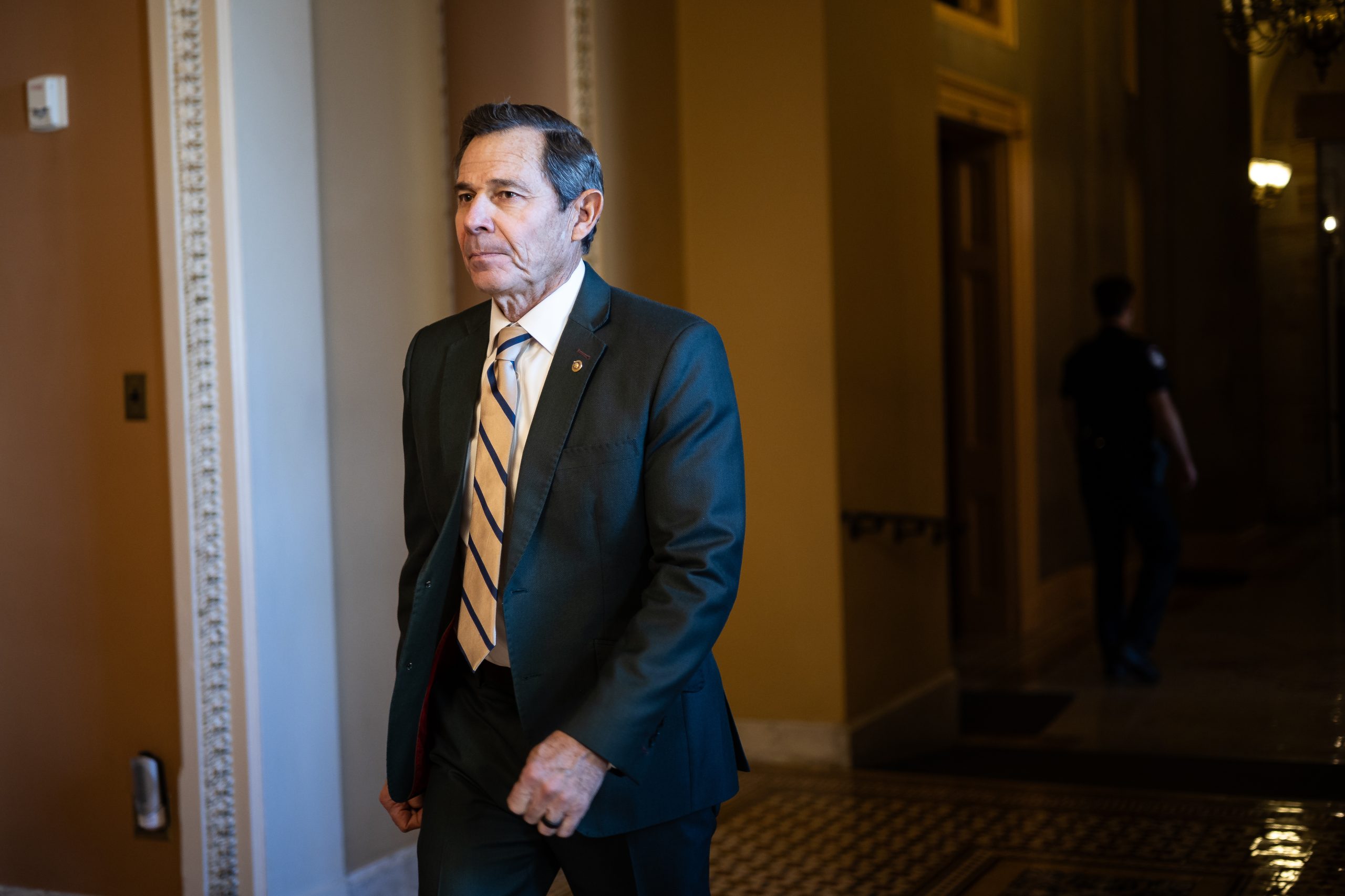

John Curtis arrived in the Senate just 16 months ago. He’s already eyeing a possible move back home.
The Utah Republican’s inner circle is actively canvassing donors and allies in Utah to gauge support for a gubernatorial bid in 2028, according to six people involved with or briefed on the discussions. They were granted anonymity to detail private conversations. His allies have asked donors in recent months to hold off on supporting other gubernatorial candidates until Curtis makes up his mind. And his chief of staff has said his boss is keeping the door open.
“John Curtis is going to serve where the people of Utah want him to serve,” Corey Norman, Curtis’ chief of staff, told POLITICO.
Curtis, who replaced former Sen. Mitt Romney (R-Utah) last year, has a reputation as a pragmatic dealmaker and moderate voice from his three terms in the U.S. House. But after seeing Washington grow increasingly polarized during his decade there, the former mayor and business executive may see the benefits of returning home.
“He doesn’t love being in the Senate,” said a Utah Republican operative who has discussed Curtis’ political future with him. “Trump’s MAGA base sees him as one of the four squishiest Republicans. He’s basically Mitt without the stature.”
The timing of Curtis’ exploration is tethered to former GOP Rep. Jason Chaffetz, who is quietly attempting to clear the 2028 gubernatorial field for himself since Utah Gov. Spencer Cox announced he wouldn’t seek a third term.
A potential Chaffetz-Curtis primary in 2028 would likely mirror the Republican Party’s own ideological battles as it enters its first presidential election without Trump on the ballot in over a decade. Chaffetz is one of the Trump administration’s staunchest defenders on Fox News; Curtis is a self-described “Reagan Republican” and occasional Trump critic more in the mold of his predecessor, Romney.
Earlier this year, as Chaffetz began asking Utah donors and elected officials to back him, Curtis received an influx of inquiries about a run of his own, according to two people close to the senator, granted anonymity to discuss private conversations. Curtis first rebuffed the proddings; now, he is actively exploring it.
“The first time I asked John about this, and the third and fourth and fifth time, his answer was, ‘Have I said hell no lately?’” said one longtime friend. “And now his response has changed dramatically.”
Just in the last few weeks, the friend said, “there has been a very meaningful change in his thinking.”
The ad-hoc team of advisers, friends and longtime allies that are now canvassing donors have a goal of securing $10 million in pledges. Curtis’ current outlook, a second longtime friend said, is, “If there’s a pathway forward and I felt like it was clear to me that citizens wanted me to do it, then I would do it.”
Curtis, an avid outdoorsman and practicing Latter-day Saint, went on a retreat in the mountains recently to pray and meditate about running, according to the first longtime friend. Now Curtis is planning a 250-mile solo walk across the state to honor the U.S.’ 250th anniversary, concluding on July 4 in Provo, Utah, a second person close to the senator said. The walk will give Curtis additional time to meditate on his political future.
Meanwhile, Chaffetz, who Curtis replaced in the U.S. House when the former left Congress for a gig on Fox News, is holding regular meetings with local lawmakers and donors across the state to ask for their support, and he’s begun transferring funds from a federal PAC to a state PAC.
“His pitch is that he is the likely nominee and he invites them to get in early while they still can,” said a second longtime Utah GOP operative who hasn’t chosen sides in the potential primary, granted anonymity to discuss the topic openly. “You can tell from his finance disclosures that he has had limited success on that front.” Chaffetz did not respond to a request for comment.
Keeping the door open now may be an attempt to avoid repeating past mistakes: Curtis initially vowed he wouldn’t run for Romney’s seat, but he changed his mind and made a late entry into the 2024 GOP primary field after being urged to run by Utah donors, politicos and Romney allies. It was a tough fight, as former Utah House Speaker Brad Wilson and others had already locked up supporters across the state. But Curtis rallied and garnered over 50 percent of the vote in a crowded primary.
“He’s not going to cede early ground to Chaffetz like he did to Wilson in the Senate race,” the second Utah GOP political operative said. “It’s now to the point where I would be surprised if Curtis doesn’t run.”
Curtis entered the Senate in 2025 amid much fanfare among Trump-skeptical Republicans who hoped he would fill the role of his predecessor, Romney, as a frequent critic of and check on the president. Curtis had earned a reputation during his time in the House as a China hawk and a rare Republican voice supporting conservation, as founder of the House’s Conservative Climate Caucus. He was one of the most effective House members, passing 27 bills during his three terms.
But the Senate has proved to be a difficult place for a consensus-minded pragmatist like Curtis. He failed to get a seat on the Energy and Natural Resources Committee which his fellow Utahn, Sen. Mike Lee, chairs. Though he bucked the Trump administration on several occasions — he was credited with torpedoing several Trump nominees, and he fought to protect clean energy tax credits in the One Beautiful Bill Act — he voted in line with Trump 100% of the time in 2025, per VoteHub’s tally. (He eventually relented and voted for the reconciliation package — with a gradual rollback of some credits included.)
Curtis often tells allies his favorite job was as mayor of Provo, Utah, where he could enact change as the city’s nonpartisan chief executive, according to two other people close to the senator.
Norman, the senator’s longtime chief of staff, has made the rounds on local media hinting that his boss is open to a run for governor. During an appearance on KSL NewsRadio on April 9, he said his boss “hasn’t said yes, he hasn’t said no.” During an interview with ABC4 that aired Sunday, Norman was more blunt: “He is an executive problem solver at heart, and in my opinion, he would make an exceptional governor.”
Curtis could retain his seat in the U.S. Senate while running for governor. If he wins, he would select his successor from three options provided by the state legislature.
There is a growing contingent of Utah politicos who want him in the governor’s mansion.
“Chaffetz is the only one out there right now and folks are looking for an alternative that has the ability to beat him,” said a third Utah GOP operative, granted anonymity to speak openly. “It just sucks that he’s forcing the field to start so early. A two-plus year run for governor is absurd.”
Curtis’ openness about the possibility of a gubernatorial run — a full two-and-a-half years before November 2028 — is rankling some allies. The topic arose at a wedding for Romney’s grandson last week, where Romney’s allies and former staffers mingled. They acknowledged Curtis would make a good governor but wanted to see him finish out his term in the Senate, according to one individual present, granted anonymity to discuss a private conversation.
But all were frustrated by Curtis’ team signaling at his intentions this early in the cycle. “It’s pretty early to leak it all out,” the person said. “Way too early.”

DAYS THE BUDGET IS LATE: 41
SPENDING SPECIFICS: Crucial state budget details — including aid for New York City, the structure of a surcharge on high-value second homes and the contours of major pension changes — are yet to be fully ironed out.
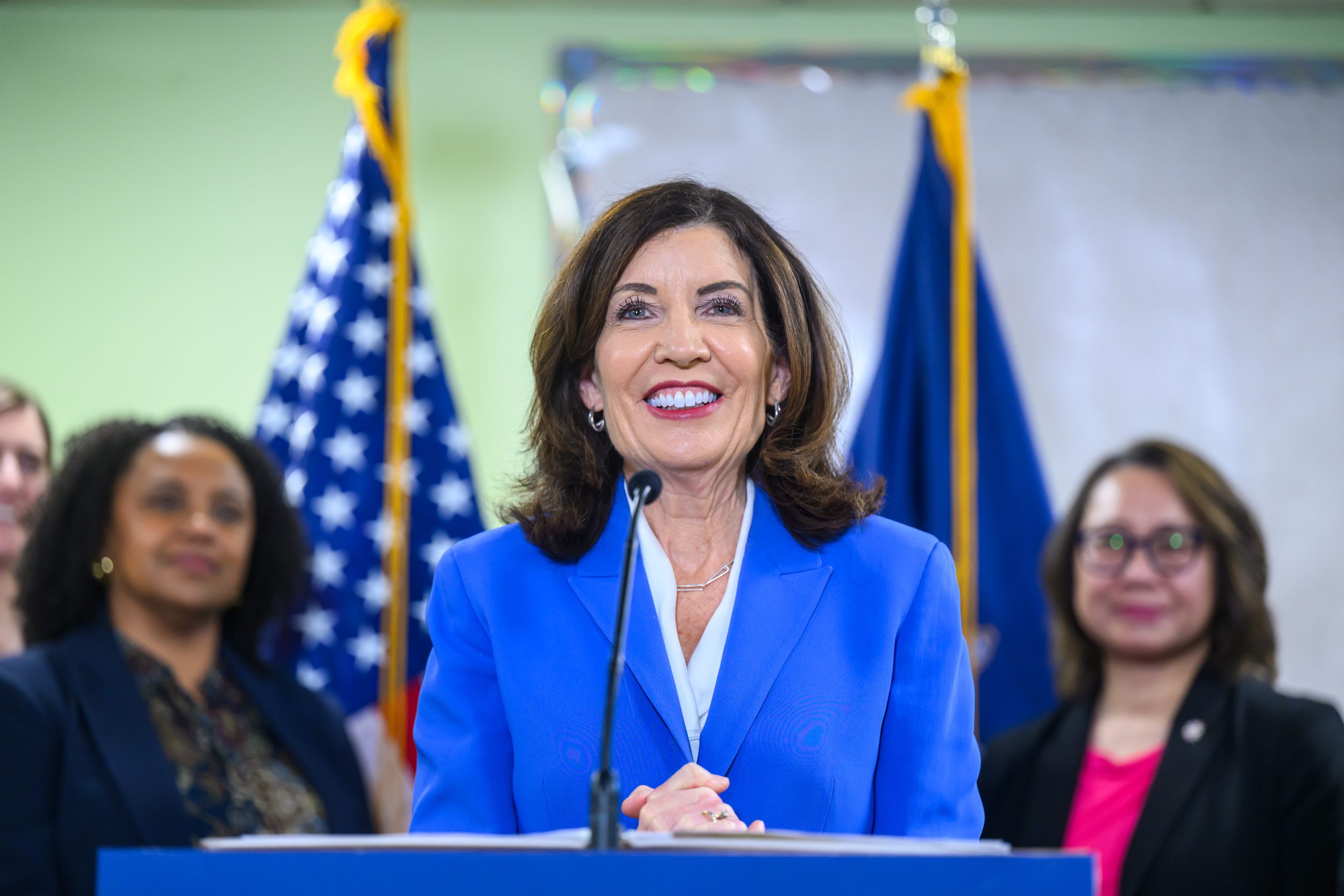
Gov. Kathy Hochul last week announced a “general agreement” for a $268 billion spending plan — but without specifics on many items. The closed-door discussions remain underway in Albany and none of the nine remaining budget bills have been printed.
The state budget is now destined to be at least six weeks past its March 31 due date. Yet Hochul is counting on voters to appreciate her policy wins and not focus on what has been an at-times messy process.
Hammering out these final specifics won’t make or break a final deal. But the fine print will matter for how much New York plans for its massive tax-and-spend plan — impacting some 19 million people.
Here’s what’s to still expect when you’re expecting a budget.
New York City aid: More help for the Big Apple is on the way from Albany. Lawmakers and Hochul are discussing additional foundation aid, potentially changing the formula for how public education spending is determined, and more cash for homeless students. At the same time, enabling legislation for pension amortization is being considered.
Those measures are designed to help New York City Mayor Zohran Mamdani close what’s left of a $5.4 billion budget gap. And they come on top of the additional $1.5 billion Hochul agreed to earlier this year.
The governor told reporters Monday morning her office has been working well with the Mamdani administration to fix the city’s budget woes.
“There’s quite a bit that needs to be OK’d by New York state,” she said. “I spent last night talking to the mayor, Friday night talking to the mayor. It’s been a great level of cooperation.”
Pied-à-terre structure: Lawmakers are yet to see any detailed budget language for Hochul’s proposed surcharge on non-primary second residences worth $5 million and above. How that surcharge is structured — including how much it will rely on a home’s assessed value — will matter for how many residences are actually captured by the tax.
Overhauling Tier 6: Overhauling the Tier 6 pension category is a potentially costly endeavor. Hochul and lawmakers are now considering what’s being called a “skinny” version of a plan originally pushed by unions, according to two people familiar with the talks.
The change would lower the retirement age for teachers to 58 after 30 years of service, but it would not alter how much they contribute from their paychecks. For the rest of the public workforce, contributions of no lower than 3 percent of a worker’s take-home pay is under consideration, but no change would be made to their retirement age.
The move is expected to cost $500 million combined for the state, local governments and school districts. That’s far less than the $1.5 billion proposal advanced earlier this year by the New York State AFL-CIO.
Buffer zones: As POLITICO Pro reported earlier, lawmakers and Hochul have weighed a 50-foot protest buffer zone that would allow local officials to expand it as they see fit. Having those zones around houses of worship is largely agreed to, but working through the specifics remains a sticking point. — Nick Reisman
From the Capitol

HANTAVIRUS IN NEW YORK: Three New Yorkers were aboard a cruise ship at the center of an international hantavirus outbreak, state Health Commissioner James McDonald said in a statement this afternoon. The three passengers were sent to the Offutt Air Force Base in Nebraska, where they are expected to be subject to a 42-day monitoring period, according to McDonald.
“While the Department is working in close coordination with the Centers for Disease Control and Prevention and local health departments to gather information, at this point it is unclear how long they will stay in Nebraska and whether, or when those individuals intend to return to New York,” McDonald said.
“At this point, it is important to emphasize that there is no immediate risk to the public. We will continue to monitor the situation and provide updates as needed,” he added.
When asked about the threat of the virus to New Yorkers, Hochul said the state health agency is working with the CDC, and she is monitoring the federal government to make sure officials have the capacity to handle any potential outbreak.
“I want to make sure that the CDC is capable of handling something that could be larger than they are predicting, and I say that because I know that over a year ago, there were significant cuts to the CDC,” Hochul said. “We have outstanding resources here in the state of New York…so I’ve activated them to start preparing New York for worst-case scenarios and hope they do not come.”
She noted that the state is putting together a plan to address any spread of the virus, but she does not believe it will turn into another coronavirus pandemic. She said she will begin doing briefings if it spreads beyond the three individuals flown in from the ship. — Katelyn Cordero
GOV’S SOCIAL ACCOUNT GETS PLAUDITS: The state government’s eyebrow-raising, joke-telling, irreverent social media accounts were honored with a Webby Awards “Honoree” award last week, Hochul’s office told Playbook.
The accounts, which go under the handle @NYGov on Instagram and X, are separate from the “Governor Hochul Press Office” account, which drew the ire of Barstool Sports founder Dave Portnoy last week when it mocked him for his age.
@NYGov, also known as “State of New York” on X, most recently posted messages like “it’s hole filling season” to spread the word about the state’s pothole reporting hotline on X, or “UNALIVE THOSE FLYS” as an Instagram PSA on the invasive spotted lantern fly.
“I’ve always believed that government is for the people, and in order to reach people, we need to communicate like them,” said Milly Czerwinski, a digital content strategist who works in Hochul’s comms shop and runs the account. “NYGov’s oddity and authenticity has broken down the traditional bureaucratic barriers to reach millions of people. Being weird works — this award is proof of that.” — Jason Beeferman
FROM CITY HALL

CCR-CHI COMPLAINT: City Councilmember Chi Ossé filed a misconduct complaint today against an NYPD officer who arrested him, advancing a case that stands to drive a further wedge between the police department and Mayor Mamdani.
The complaint, which Ossé shared with POLITICO, alleges the officer used excessive force during the April 22 arrest in Brooklyn, where the Council member and others were protesting the planned eviction of a woman who claims she’s the victim of deed theft.
The Civilian Complaint Review Board, which investigates and prosecutes cases of police misconduct, has received Ossé’s claim and is reviewing it, a spokesperson confirmed.
Ossé, a democratic socialist and ally of Mamdani, told POLITICO he believes the arresting officer violated his civil rights. “My rights were violated, but more importantly, my responsibility to my community and constituents demands a fact-finding,” said Ossé, who claims he suffered a concussion from being slammed to the ground.
The NYPD previously said Ossé and three other protesters were only arrested after refusing verbal commands to stop blocking access to the property where the eviction was set to be executed.
A spokesperson for Mamdani — who called video of Ossé’s arrest “incredibly concerning” last month — said in response to the Council member’s complaint that “the mayor respects the independence of the CCRB and will allow the disciplinary process to play out based on the evidence, established procedures, and the NYPD’s disciplinary matrix.”
Mamdani, a longtime NYPD critic, faces a fraught situation in responding to Ossé’s complaint.
If he doesn’t back up his fellow democratic socialist, Mamdani is likely to anger his allies on the left. On the flipside, if he condemns the arresting officer, he risks drawing the ire of NYPD leaders, including Commissioner Jessica Tisch, as well as the department’s rank-and-file cops.
Read more about the CCRB and Ossé from Chris Sommerfeldt in POLITICO.
CASE CLOSED: Council member Vickie Paladino has reached a settlement with the City Council to resolve disciplinary charges focused on her controversial social media posts.
The takeaway? The Council has withdrawn its disciplinary charges, and Paladino is dropping her lawsuit challenging the proceedings.
The agreement, filed in Manhattan Supreme Court on Monday, effectively dismisses the charges and cancels an ethics hearing that could have led to censure, fines or expulsion. As part of the settlement, Paladino must delete three posts cited in the case. She must also remove “Council Woman” from her personal X account display name within 48 hours of court approval to communicate to the public a clearer separation between her official posts, which are subject to some of the Council’s rules and regulations, and her personal opinions, one member familiar with the parameters of the settlement told Playbook.
The case stemmed from a string of inflammatory posts starting in December where, in a deleted post, she called for the “expulsion of Muslims from western nations,” prompting the committee to look into her conduct.
In February, she posted that New York was under “foreign occupation” following Mamdani’s appointment of a top immigration official. Paladino questioned whether the administration included “one single actual American” and later described a photo of Muslim sanitation workers praying as part of an “Islamic conquest.”
The Council’s Rules and Ethics Committee had charged Paladino with disorderly conduct and violations of its anti-harassment and discrimination policy in March.
Paladino sued to block the proceedings, arguing she was being targeted for her conservative views and that the discipline violated her First Amendment rights.
As part of the settlement, Paladino must issue a statement saying she did not intend to make colleagues or staff feel “unwelcomed or unsafe.” Council member Sandra Ung, who chairs the ethics committee, issued her own statement Monday afternoon saying the resolution “strikes the balance” between protecting staff and lawmakers’ free speech rights.
Both sides agreed to issue limited public statements and refrain from further comment. — Gelila Negesse
FROM THE CAMPAIGN TRAIL

EYES ON AI: Rep. Pat Ryan is backing state Assemblymember Alex Bores to succeed retiring Rep. Jerry Nadler, making him the latest member of the New York delegation to weigh in on one of the state’s most competitive primary elections.
In making his endorsement, the Hudson Valley Democrat cited the high-profile AI fight that’s become a central theme of the race as a key reason for backing Bores.
“He’s going to be the next member of Congress for the New York 12th District,” Ryan said at an event in Midtown with Bores today. “If you have any doubt, you don’t have to take my word for it — follow the money. Look at the incredible unprecedented amount … It’s because these tech billionaires are terrified, they’re terrified of Alex specifically.”
The millions of dollars in spending by a pro-artificial intelligence super PAC against Bores — an alum-turned-critic of data analytics company Palantir and a sponsor of the AI safety RAISE Act in the state Legislature — has also drawn an influx of money from regulation-friendly AI and tech-affiliated groups to boost him.
Bores’ campaign said that both he and Ryan “share a belief that the next Congress must take decisive action to regulate artificial intelligence before this transformative technology outpaces the rules meant to govern it” — a debate that continues to rage on in Washington and globally.
Bores is viewed as one of the top contenders for the 12th District, which covers a large swath of Manhattan. He’s up against Assemblymember Micah Lasher, Kennedy scion Jack Schlossberg and anti-Trump commentator George Conway, as well as a handful of lesser-known challengers. Public polling has been sparse in the race, and internal polls from earlier this year don’t show a clear front-runner. — Madison Fernandez
IN OTHER NEWS
— CLOCK’S TICKING: Mamdani has less than a month to fill two longstanding vacancies on the Metropolitan Transportation Authority board — and the appointments could be key for his mission to make the city’s buses “fast and free.” (THE CITY)
— NECK AND NECK: Hochul made a joint campaign appearance with Rep. Dan Goldman who’s running for reelection in New York’s 10th congressional district, with a primary challenge from Mamdani-backed Brad Lander. (Gothamist)
— SARCONE DOGGED: The top prosecutor in the U.S. attorney’s office for the Northern District of New York is accused of misconduct, according to the watchdog organization Campaign for Accountability. (POLITICO Pro)
Missed this morning’s New York Playbook? We forgive you. Read it here.


UK airborne troops and medics were parachuted onto a remote south Atlantic island to assist a British national with suspected hantavirus. Yet foreign secretary Yvette Cooper’s comments on this mission suggest the UK had broader geopolitics considerations and the failing US-UK ‘special relationship’ in mind.
Naturally, the British military are always desperate for a ‘good news’ story. A government press release on 10 May said of the “daring” mission to the Atlantic island of Tristan De Cunha:
The team of six paratroopers and two military clinicians, all from 16 Air Assault Brigade, parachuted from an RAF A400M transport aircraft. Meanwhile, vital oxygen supplies and other medical aid were air dropped almost simultaneously onto the remote island.
This operation is the first time the UK military has inserted medical personnel to provide humanitarian support via a parachute jump, demonstrating how the military can deploy at very short notice across the world on a range of tasks.
UK specialist paratroopers and military clinicians have carried out a daring parachute operation to deliver critical medical support to Tristan da Cunha – Britain’s most remote inhabited Overseas Territory – after a suspected case of Hantavirus was identified on the island. pic.twitter.com/w0xPU8fvcw
— Ministry of Defence
 (@DefenceHQ) May 10, 2026
That last line is vital here:
demonstrating how the military can deploy at very short notice across the world.
The passenger had come ashore with the illness in mid-April, according to the BBC. The Beeb also reported on 10 May that:
He reported having diarrhoea on 28 April and fever two days later. He is currently in a stable condition and in isolation.
Protecting the British family
Cooper said:
I am deeply grateful to the personnel across the Armed Forces and the RAF who acted at pace to get urgent medical support to Tristan da Cunha.
Adding (and this is the important bit):
This extraordinary operation reflects our unwavering commitment to the people of our Overseas Territories and to British nationals, wherever they are. The safety and well-being of all members of the British family is our number one priority.
I am deeply grateful to the @16AirAssltBCT in getting urgent medical support to Tristan da Cunha.
This extraordinary operation reflects our unwavering commitment to the people of our Overseas Territories and British nationals, wherever they are. https://t.co/gUn4JdEyTU
— Yvette Cooper (@YvetteCooperMP) May 10, 2026
It can’t have escaped our readers attention that tensions between the UK and Argentina are up lately. This is connected to a threat by US president Donald Trump to change the US position on the Falkland Islands/Las Malvinas. The UK and Argentina fought a short, bloody war over the south Atlantic archipelago in 1982.
As legacy media reported on 25 April:
Relations between the U.S. and the U.K. have been strained since European and NATO allies refused to provide aid to America and Israel’s war with Iran.
According to an internal Pentagon email reported by Reuters, the U.S. is considering a review of U.S. diplomatic support for European countries’ “imperial possessions,” such as the Falkland Islands, in response.
Add to this, radical right-wing Argentine president Gabriel Milei is a very close ideological ally to Trump and Israel’s Benyamin Netanyahu.
The Falklands issue has also been used recently by right-wing Labour MPs as a stick to beat the Green Party with.
None of this is to suggest that there wasn’t a sick man on Tristan de Cunha, which has no airstrip. Yet the UK military and foreign office carefully framed the mission in terms of A) demonstrating military reach and B) in terms of being able to back up the so-called “British family” in the south Atlantic.
Call me a cynic… and you’d be absolutely right. It’s always important when looking at events like this forcefully publicised mission to ask what the government is doing. But we also have to ask what it is saying and why…
Featured image via the Canary
By Joe Glenton

Following Labour’s disastrous 2026 local elections, Keir Starmer attempted to once again reboot his government.
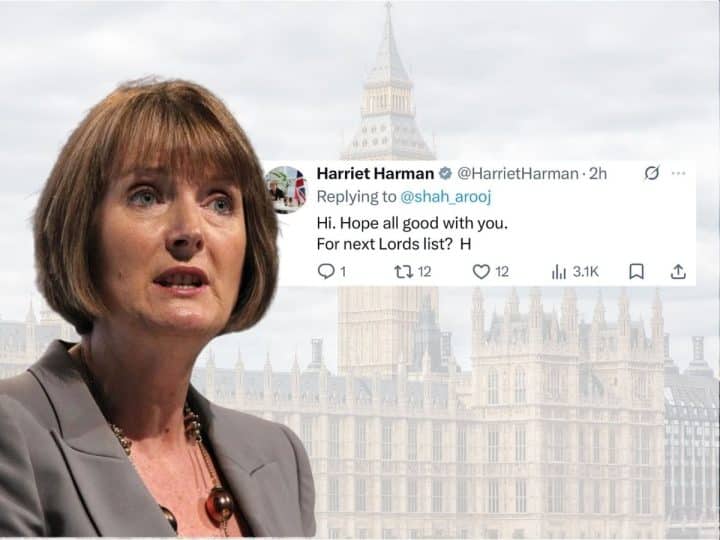
Farcically, the latest ‘refresh’ saw him bringing back Gordon Brown (the last Labour politician to lose an election as a sitting PM) and Harriet Harman (the woman whose stint as deputy Labour leader proved so unpopular that it rallied support for the then-unknown Jeremy Corbyn).
To say this plan ‘went wrong’ would imply it was going right at some point, which clearly wasn’t the case. Saying that, the plan has now gone wrong, with Harman seemingly caught offering out peerages:
Incredible. One day back in the fold & she's reassuring all the worst cunts you just voted out that they'll stick them in the House of Lords. — Michael Walsh (@thatbloodyMikey) May 11, 2026
One Big Club. https://t.co/aDz12cyoWu
In other words, Labour has embroiled itself in yet another cronyism scandal.
Cometh the honour
As we reported, Starmer brought Harman back to be the ‘Adviser on Women and Girls’. He did this despite her historic links to a notorious paedophile network:
I’m delighted to appoint @HarrietHarman as my Adviser on Women and Girls.
Harriet is a strong advocate for women and girls and I know she will deliver greater opportunity for women in public life.
I’m committed to tackling structural misogyny that is a barrier for too many… pic.twitter.com/iQeDS0XQrI
— Keir Starmer (@Keir_Starmer) May 9, 2026
This wasn’t that surprising, of course, because many politicians in Starmer’s inner circle have been exposed for their ties to paedophiles – most notably Peter Mandelson.
Back to Harman’s tweet, it looks very much like she was offering to get ex-Labour councillor Arooj Shah on the list to become a lord. Presumably, she thought she was sending a private message. Instead, she publicly tweeted at Shah, resulting in a new crisis for Starmer.
The real question is this: if Harman wasn’t offering to elevate Shah – and if she didn’t make the tweet public by accident – then what was she doing?
Novara‘s Aaron Bastani commented on Harman’s apparent mistake:
Harman inviting a former council leader to become an unelected legislator for life as if it was a Jay Rayner reviewed small plates trattoria in Bermondsey.
The Lords has to go! What a farce.
One reason (among many) that the Labour establishment despised Corbyn from day one of his leadership.
This stuff was no longer happening.
The Tories tried to capitalise on it too, receiving some pushback in the process:
David Cameron created 245 peers
Theresa May created 43 life peerages
Boris Johnson appointed a total of 87 life peers Liz Truss created three peerages in her resignation honours list
Rishi Sunak created a total of 46 peerages during his tenure
They never change!
— Bernard McEldowney (@BernardMcEldown) May 11, 2026
Starmer ran on a platform of being competent and not-corrupt, and instead he’s getting dunked on by Tories for being both.
Cometh the woman
Harman recently attracted backlash for her criticism of Zack Polanski, which amounted to him… being a man:
Oh no! We've lost Harriet Harman! https://t.co/nj0EO2wyZe
— Zack Polanski (@ZackPolanski) October 28, 2025
In the video above, Harman says snottily:
And there’s been a lot of focus on Zack Polanski as their new supposedly dynamic, charismatic leader. Now, for me, the Greens have always seemed like a very sort of collaborative, women’s-focused, team-ly kind of party. And Zack Polanski is not in that vibe at all. He’s in the kind of big-I-am, you know, male leader vibe.
She added that Polanski is a combination of:
Jeremy Corbyn and Nigel Farage, and neither appeals to me.
As the Canary reported, the things that did appeal to Harman in her political career included:
- The invasion of Iraq
- Opposing fairer taxation
- ID Cards
- Mass surveillance
- Reducing tax avoidance
And this is who Starmer brought back to turn a new corner!
Embarrassing
At this point, things are just embarrassing for Starmer. This is why the number of MPs calling for him to resign keeps growing:
Catherine McKinnell and Alan Gemmell have both made statements in the last few minutes — Politics UK (@PolitlcsUK) May 11, 2026
 UPDATE: The number of Labour MPs calling for Keir Starmer to resign has now risen to 54
We’ll be sure to update you with what the Starmer camp thinks about this as soon as Harriet Harman accidentally about tweets it.
Featured image via Harriet Harman
By Willem Moore


A top Iranian official has warned of escalation over UK PM Keir Starmer’s plan to send a British warship to the straits of Hormuz.
On 12 May, Starmer and his allies are meeting to discuss plans to open up the strait, which Iran closed after the US and Israel launched unprovoked strikes in March 2026.
Strait of Hormuz multinational mission
The UK and France will discuss their so-called “Strait of Hormuz multinational mission”. And before any consensus has been reached, the UK is sending British destroyer HMS Dragon to the Middle East.
A government press release outlines the following details about the upcoming meeting.
builds on the significant progress made in the last few weeks by military planners from 44 nations, spanning every continent. The UK has consistently led the way, including hosting a meeting of military planners at the UK’s Permanent Joint Headquarters on the 22-23 April, which was critical in converging national perspectives into a multinational plan.
Defence secretary John Healey also said:
The UK is leading this multinational, defensive mission because trade, energy, and economic security for working people here at home depend on it.
The Dragon was deployed to Cyprus early in the war. It almost immediately broke down. The legacy media reported on 7 April:
HMS Dragon has docked in the eastern Mediterranean after suffering technical problems with its water systems.
The Military Watch website has said:
The Type 45 class has particularly stood out with the fleet for its poor reliability.
How reassuring…
Iran accuses the UK are escalation
Iran is fully aware of the deployment. Deputy foreign minister Kazem Gharhibabadi said:
Any deployment and stationing of extra-regional destroyers around the Strait of Hormuz, under the pretext of ‘protecting shipping’, is nothing but an escalation of the crisis, the militarization of a vital waterway, and an attempt to cover up the true root of insecurity in the region.
US-Israel attacked Iran first on 28 February without provocation. Iran was offering unprecedented concessions in negotiations at the time. The Pentagon has since stated there was no imminent threat from Iran. And the UN’s atomic watchdog, the IAEA, has said there is no evidence Iran was developing a nuclear weapon.
The US has achieved none of its original war aims. Iran predictably closed the Straits of Hormuz, a vital oil channel, once attacked — creating a global energy crisis. Far from being defeated, Iran has said the war will continue until “the enemy’s inevitable and permanent humiliation, disgrace, regret, and surrender”. Trump came to power on an anti-war ‘America First’ ticket. He now faces worldwide humiliation.
Pakistan has made a series of attempts to broker peace. The US-Israeli attack has faltered with Donald Trump left scrambling for an off-ramp.
The Brits falsely claim their role is only defensive. Yet Starmer has slowly embroiled his country deeper in the conflict. The PM, whose role is under severe pressure following a predictable drubbing in local elections, seems determined to drag the UK deeper into Israel and America’s failed war of choice.
Featured image via the Canary
By Joe Glenton


President Donald Trump has nominated Kari Lake and Doug Mastriano — two allies who waged failed bids for governor in battleground states — to diplomatic posts.
The White House announced Monday that Trump has nominated Lake to be ambassador to Jamaica and Mastriano to be ambassador to Slovakia. Both nominations require Senate confirmation.
Mastriano, who ran for governor of Pennsylvania, and Lake, who lost in Arizona, both embraced the president and his baseless election conspiracies and were rejected by voters in 2022.
“I look forward to representing our nation abroad, strengthening the friendship between our two countries, and advancing the interests of the American people,” Mastriano said in a statement posted online.
Lake, a former local TV personality who dismantled the Voice of America as Trump’s appointed head of the U.S. Agency for Global Media, said she was looking forward to her new role in the Caribbean.
“Jamaica is a country I know very well, full of incredible people, and if confirmed by the Senate, I look forward to strengthening the partnership between our nations, advancing America’s interests abroad, and building on the deep friendship shared by the American and Jamaican people,” she said in a social media post.
Mastriano said he will continue serving as a Pennsylvania state senator until his appointment is confirmed by the Senate. Lake’s future status leading the U.S. Agency for Global Media is unclear.
Mastriano’s appointment likely undermines an ascendant write-in campaign for him in Pennsylvania’s Republican gubernatorial primary, the race he won in 2022. The campaign, which Mastriano supported but was not involved with, threatened to pose an obstacle for Republicans’ preferred pick, state Treasurer Stacy Garrity, ahead of next Tuesday’s primary.
Lake earned an appointment to USGM last year after losing two statewide races in battleground Arizona. She lost to Gov. Katie Hobbs in 2022, then sought to succeed former Sen. Kyrsten Sinema in 2024, but lost to Ruben Gallego.
Shortly after joining USGM in a non-Senate confirmed role, Lake oversaw the gutting of Voice of America as part of the administration’s remaking of the federal workforce. By the end of the administration’s cuts last year, roughly 85 percent of the agency’s staff had been removed.
But Lake’s work at USGM hasn’t withstood legal scrutiny. A federal judge ruled in March that Lake’s tenure at the head of the agency was improper because she was not confirmed by the Senate. Later in March, the same judge ordered the Trump administration to reinstate the staff members who had been placed on leave.

2026 is a tough year for fliers. Between ongoing fuel price crises and EES check-related queues, flying might not be as efficient as we’re used to.
Which means that any advice, including the “efficient” onboard recommendations from Jet2′s site, is welcome for travellers.
“To make our service as efficient as possible, we only accept card payments,” the page reads.
Bring a physical card on board
It’s not just that cash won’t fly (teehee) for on-board payments. Contactless isn’t guaranteed to work, either.
“We’ve also introduced a few updates to contactless, including Apple Pay and Google Pay,” Jet2 shared.
“So, please bring your physical card to use chip and PIN when needed.”
Their on-board offerings include a duty-free range of fragrances, skincare, makeup, aftershave, and jewellery, as well as refreshments, which you can also pre-order.
Anything else?
Yes. The airline has previously spoken about the best way to handle EES checks, which have led to some queues and even missed flights as airports get passengers onto the EU system for the first time.
They said, “There may be longer wait times at Border Control at some EU Airports, especially at busy times. Once you start your EES registration, it should take around 1-2 minutes per person to complete.”
But seeing as multiple people from non-Schengen countries may be doing so at the same time, those minutes can build up fast.
Schengen countries include:
- Austria,
- Belgium,
- Bulgaria,
- Croatia,
- Czechia,
- Denmark,
- Estonia,
- Finland,
- France,
- Germany,
- Greece (though Greece have effectively temporarily suspended biometric EES checks for UK passengers),
- Hungary,
- Iceland,
- Italy,
- Latvia,
- Liechtenstein,
- Lithuania,
- Luxembourg,
- Malta,
- Netherlands,
- Norway,
- Poland,
- Portugal,
- Romania,
- Slovakia,
- Slovenia,
- Spain,
- Sweden, and
- Switzerland.
Therefore, they cautioned fliers, “Depending on how busy the airport is, this may result in longer wait times at passport control before boarding your flight to the UK.
“After checking in for your flight, please head straight to security and passport control in order to arrive at your gate in plenty of time.”

Keir Starmer has vowed to prove his doubters “wrong” in a major speech as he tries to win back the Labour MPs calling for him to quit.
The prime minister has been blamed for Labour’s shocking losses in the local elections last week, as well as the party’s poor performance in the devolved elections for the Welsh and Scottish parliaments.
But Starmer has doubled down and even insisted over the weekend he wanted to stay in the job for a decade.
In a party political speech on Monday, Starmer admitted the election results “very tough”, saying it “hurt” to lose so many Labour representatives.
He added: “I take responsibility. But it’s not just about taking responsibility for the results.
“It’s about taking responsibility to explain how, as a political and electoral force, we will do better and be better in the months and years ahead.
“We are not just facing dangerous times, but dangerous opponents, very dangerous opponents.”
He warned if “we don’t get this right”, the UK will “go down a very dark path”, alluding to the rising popularity of the rival parties.
The prime minister said he takes responsibility for building a “stronger and fairer” Britain, while navigating a world that is increasingly dangerous.
“I take responsibility for not walking away [and] plunging our country into chaos,” he said, with a nod to the high turnover of Conservative prime ministers.
“A Labour government would never be forgiven for inflicting that on our country again.
“I know people are frustrated by the state of Britain, frustrated by politics, and some people, frustrated by me.
“I know I have my doubters and I know I need to prove them wrong, and I will.”
He claimed he will focus on growth, defence, Europe and energy next, while adding: “Stories beat spreadsheets, people need hope.”
“Like every government, we’ve made mistakes. But we got the big political choices right,” he said, pointing to Labour’s decision not to join Donald Trump’s war against Iran.
He pointed to success by bringing down NHS waiting lists, child poverty and immigration rates, while claiming, “we stabilised the economy”.
“But that’s not enough clearly,” the prime minister said. “For the British people, tired of a status quo which has failed them, change cannot come quickly enough.
“I’m sure they believe we care, I’m not sure they believe that we see their lives.
“That’s tough to say when you come from a working class background like me. because I do know what it’s like to struggle and to strive.”
The prime minister insisted neither Reform UK’s Nigel Farage nor Green Party’s Zack Polanski hold the answers to the country’s problems.
He also targeted Farage’s previous promises on Brexit, saying: “He took Britain for a ride.”
“Now he’ll talk about almost everything other than the consequences of the one policy he actually delivered, because he’s not just a grifter – he is a chancer.”
“I want to remind you what Nigel Farage said about Brexit.
“He said it would make us richer. Wrong. It made us poorer.
“He said it would reduce migration. Wrong. Migration went through the roof.
“He said it would make us more secure. Wrong again.
“He just fled the scene and now he will talk about almost anything other the consequences of what they delivered.
“He is not just a grifter, he’s a chancer.”
Starmer said: “This Labour government will be defined by rebuilding our relationship with Europe, by putting Britain at the heart of Europe, so that we are stronger on the economy, stronger on trade, stronger on defence, you name it” he adds, to applause in the room.”
He also insisted he would offer “something more” for the country’s youth, and declared “full national ownership of British steel”.
Starmer repeatedly attacked his political rivals, saying: “They want more grievance politics, more pointing at Britain’s problems not for solutions but someone to blame.”
“I don’t think that’s British. That is not the decency and respect we are known for,” he added. “This is nothing less than a battle for the soul of our nation and I want to be crystal clear about how we will win.”
He said they cannot win as a weaker version of Reform or the Greens, but as a “stronger version of Labour”.
Starmer also claimed he had overcome doubters many times in the past, including with Labour’s victory in 2024.
“I proved them wrong. I’m going to prove them wrong again,” he insisted.
Subscribe to Commons People, the podcast that makes politics easy. Every week, Kevin Schofield and Kate Nicholson unpack the week’s biggest stories to keep you informed. Join us for straightforward analysis of what’s going on at Westminster.

Peter Tatchell assaulted at Rally Against Antisemitism

Dodgers activate Mookie Betts from injured list, option Alex Freeland

Microsoft exec Shawn Bice returns to AWS to lead reliability push for AI agents

Manchester United reach agreement with Casemiro over contract clause amid transfer speculation

US brings back mandatory military draft registration

Steven Gerrard disagrees with Gary Neville over ‘shock’ Chelsea and Arsenal claim | Football


-
 Crypto World4 days ago
HarrisX Poll Found 52% of Registered Voters Support the CLARITY Act
-

 Fashion3 days ago
Weekend Open Thread: Marianne Dress
-

 Crypto World5 days ago
Upbit adds B3 Korean won pair as Base token gains Korea access
-
 NewsBeat5 days ago
NCP car park operator enters administration putting 340 UK sites at risk of closure
-

 Tech2 days ago
Auto Enthusiast Carves Functional Two-Stroke Engine from Solid Metal
-

 Politics3 days ago
Politics Home Article | Starmer Enters The Danger Zone
-
 Business2 days ago
Ignore market noise, India’s long-term story intact, say D-Street bulls Ramesh Damani and Sunil Singhania
-

 Crypto World6 days ago
UAE Free Zone Deploys Blockchain IDs to Verify Registered Firms
-

 Tech16 hours ago
GM Agrees To Pay $12.75 Million To Settle California Lawsuit Over Misuse Of Customers’ Driving Data
-

 Fashion5 hours ago
Coffee Break: Travel Steam Iron
-

 Fashion21 hours ago
What to Know Before Buying a Curling Wand or Curling Iron
-

 Crypto World5 days ago
BlackRock CEO Larry Fink Discusses a New Asset Class
-

 Crypto World5 days ago
Robinhood says Wall Street is building onchain
-

 Entertainment5 days ago
Sarah Paulson Called Out For Met Gala ‘Hypocrisy’
-

 Politics39 minutes ago
What to expect when you’re expecting a budget
-

 Tech6 days ago
Apple and Samsung are dominating smartphone sales so thoroughly that only one other company makes the top 10
-
Entertainment7 days ago
Serena Williams hits Met Gala in metallic dress after GLP-1 reveal
-

 Tech6 days ago
I tested the Xiaomi 17 Ultra’s camera and I don’t think I’ll ever go back to an iPhone
-
 Sports6 days ago
NBA playoff winners and losers: Austin Reaves is not loving Lakers vs. Thunder matchup, but Chet Holmgren is
-

 Fashion5 days ago
The Best Work Pants for Women in 2026
You must be logged in to post a comment Login