

Crypto World
Polymarket Hit by Third-Party Breach Drains $2.9M, Raises Compliance Risks

Polymarket says a third-party vendor compromise discovered on Thursday enabled attackers to inject malicious code into its website interface, leading to a phishing campaign that targeted multiple users. According to blockchain analyst Specter, the injected script was used to drain an estimated $2.94 million from at least 11 Polymarket wallets.
Polymarket stated that the incident has been contained and that the compromised dependency has been removed. The platform also said affected users will receive full refunds. Cointelegraph contacted Polymarket for comment but did not receive a response before publication.
Key takeaways
- Polymarket reported a third-party vendor compromise that allowed attackers to inject a malicious script into its frontend.
- Analyst Specter linked the malicious code to phishing activity, estimating losses of about $2.94 million across at least 11 user wallets.
- Polymarket said the issue has been contained, a dependency has been removed, and users will be fully refunded.
- Blockchain security reporting data indicates the incident fits within a high volume of crypto breaches in the quarter.
- Separately, DefiLlama data shows private key compromise remains the dominant cause of reported exploit losses over the last 30 days.
Frontend compromise and phishing-driven wallet losses
The Polymarket incident centers on a supply-chain style failure rather than a direct smart contract exploit. Specter said the malicious script appeared to enable a phishing attack that redirected or induced users into compromising credentials or authorizations, culminating in unauthorized asset movement from user wallets.
In practice, this type of front-end compromise can be especially damaging for institutions and compliance teams because it shifts the risk profile away from on-chain mechanics alone. Even where contracts are unchanged, malicious web-layer code can manipulate user behavior, compromise session-related security assumptions, or trick users into signing harmful transactions. For regulated entities that integrate with or route user access to crypto services, incidents like this highlight the need for tighter vendor governance and continuous integrity controls over externally served dependencies.
Polymarket’s response suggests the affected component was identified and removed after discovery. Its commitment to fully refund users also raises operational and policy considerations: while refunds may mitigate user harm, they do not automatically address whether the underlying controls—such as third-party software update processes, dependency monitoring, and incident response playbooks—were sufficient to prevent reoccurrence.
DefiLlama breach reporting underscores a pattern of recurring exploit methods
The Polymarket case arrives as crypto security incident reporting remains elevated. DefiLlama data places the event within a broader timeline: the third quarter’s second quarter-to-date statistics indicate the quarter had its most-hacked period by incident count, according to Cointelegraph’s reference to DefiLlama and its reporting on Q2.
DefiLlama also reports that June saw reported crypto exploit losses of $74.9 million across 29 incidents, exceeding May’s $60.5 million total but remaining well below April’s $644 million peak.
Among the largest June incidents were a $36 million Humanity Protocol exploit, a $4.7 million Secret Network bridge exploit, two separate Aztec exploits valued at $2.1 million each, and a $1.7 million bridge exploit tied to Taiko. While each exploit involves different technical pathways, they collectively reinforce a key compliance reality: incident frequency and magnitude continue to stress operational risk management across exchanges, wallets, and service providers with protocol-level exposure.
DefiLlama’s breakdown of losses over the past 30 days points to private key compromise as the most common leading vector, accounting for 43% of reported exploit losses. Fake proof exploits made up 10%, and reverse MEV honeypots accounted for 8%. For risk teams, these categories matter because they indicate whether controls should prioritize key management, signature/authorization integrity, or transaction routing safeguards for automated systems and integrators.
Private key history at Polymarket highlights multiple threat surfaces
About a month before the reported Polymarket frontend incident, the prediction market disclosed an additional exploit traced to a six-year-old private key used for internal top-up operations. Cointelegraph previously reported that Polymarket said contracts and user funds remained safe in that earlier case and that all permissions associated with the compromised key were revoked.
Taken together, the two events underscore that Polymarket—or any crypto service with on-chain and off-chain touchpoints—can face multiple, distinct threat surfaces: backend key management for operational processes, and web-delivered dependencies for user-facing interactions. For institutional stakeholders, the combination can complicate assurance: even when one control area is remediated (for example, permissions revoked after a key issue), a separate control plane—like third-party dependency integrity—can still introduce new risk.
Polymarket’s scale also implies higher stakes for incident governance. DefiLlama reports that the platform holds more than $450 million in total value locked, up from $112 million a year ago.
Regulatory and compliance implications for crypto firms and integrators
Although Polymarket operates in a market with evolving regulation, incidents of this nature feed directly into compliance expectations for crypto businesses. Under frameworks such as the EU’s Markets in Crypto-Assets regulation (MiCA), firms are expected to meet governance and operational resilience obligations, while AML/CFT requirements under applicable regimes typically extend to “know your customer” processes and the protection of user funds. Supply-chain compromise and phishing-driven theft also raise questions for regulated counterparties about how customer asset protection claims are substantiated in practice.
For exchanges, wallet providers, payment processors, and institutional service providers, vendor-linked incidents may trigger additional internal review under third-party risk management policies. Common areas include: the lifecycle management of dependencies, auditability of frontend build and deployment pipelines, incident detection and containment procedures, and the adequacy of refund or restitution policies. Even if the theft originates outside on-chain code, user harms can still translate into regulatory scrutiny about consumer protection, disclosures, and operational risk controls.
Cross-border differences in enforcement priorities can further complicate response. In the United States, where crypto enforcement actions have frequently addressed security, consumer protection, and alleged failures in compliance controls, and where federal agencies coordinate through legal processes and subpoenas, a frontend-driven phishing incident can still be framed as a failure to maintain reasonable safeguards. Separately, AML/KYC obligations do not prevent phishing, but they can affect how stolen funds are identified, how affected users are supported, and how suspicious activity is triaged.
For institutional compliance monitoring, the most actionable element is the incident pattern itself: third-party compromise leading to user deception, alongside persistent exploit vectors such as key compromise. These themes suggest that governance should cover both technical controls (key management, permissioning, transaction integrity) and administrative controls (vendor oversight, software supply-chain assurance, and documented response measures).
Closing perspective
Polymarket says the compromised dependency has been removed and that affected users will be refunded. The next phase will likely involve detailed post-incident validation of the compromised supply chain, verification of residual exposure across its frontend delivery stack, and continued alignment of technical controls with the compliance expectations institutions apply to customer protection and operational resilience. Security incident reporting will remain a key reference point for assessing whether this case reflects a broader systemic risk pattern or an isolated vendor failure.


Bitcoin’s price went through a highly volatile and mostly painful ride throughout June, dumping to a multi-year low first at $59,000 before another one at $58,000.
Analysts continue to debate whether this cycle’s bottom has been reached or not, but Ali Martinez recently published a post on his views about the current accumulation zone and whether it’s a proper entry level.
History Says Yes
In the post specifically designated to bitcoin’s 200-week Simple Moving Average (SMA), the popular analyst noted that the asset has rarely traded below it for a longer period. And when it has dipped below it, the subsequent rally has shown that those moments “have consistently marked exceptional long-term accumulation opportunities.”
Since the 200-week SMA currently sits at $63,500, a level that BTC lost earlier this week, Martinez concluded that “This is exactly when you want to deploy a dollar-cost averaging strategy.”
In the more detailed post on BTC’s market structure, though, the analyst admitted that bitcoin trading below the 200-week SMA doesn’t necessarily mean it has bottomed out. In fact, he noted that the asset can still dip further south and outlined potential targets at $54,000 or even $40,000. If that’s the case, investors might want to double down on their DCA strategy, he argued.
“Spreading buy orders across the $58,000 to $40,000 range allows you to build a position while the asset trades at a technical discount.”
Martinez believes $63,500 remains BTC’s most significant level now, as if it registers a “high-timeframe reclaim of the 200-week SMA as macro support,” it would suggest the early stages of a new bull run.
When Bottom?
Each leg down opens the door for analysts to continue the always-hot debate over whether the bottom is in or if more pain lies ahead. Martinez brought up BTC’s historical performance after the aforementioned 200-week SMA came into play. Each of his four examples delivered massive gains after bitcoin tested that level in 2015, 2018, 2020, and 2022.
As such, he determined that the bottom is “almost in” and outlined the precise gains registered from bottom to top.
-
August 2015: Bitcoin touched the 200-week SMA and launched a bull market, rallying over 8,500%.
- December 2018: A test of this moving average triggered a swift 267% recovery.
- March 2020: The COVID-induced liquidity flush saw Bitcoin validate the 200-week SMA as support before surging 1,125%.
- June 2022: For the first time ever, Bitcoin dipped and consolidated below the moving average until December 2022. Once the line was reclaimed, it initiated a 680% expansion.
The post Bitcoin’s Price Has Finally Entered the Buy Zone: Analyst Maps Out Big Targets appeared first on CryptoPotato.
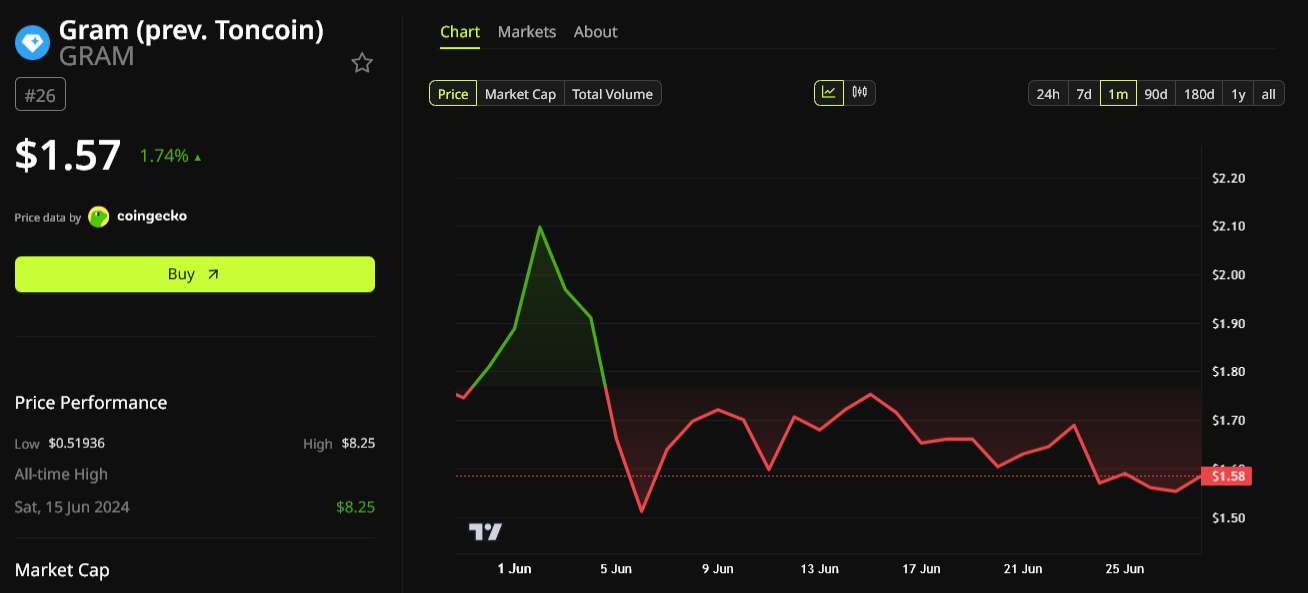
Telegram founder Pavel Durov purchased Plush Pepe #834 for 7,500 Gram (GRAM) on The Open Network, then transferred the NFT to Adler Toberg, a designer linked to Telegram’s interface and gift system.
The acquisition marks Durov’s third confirmed purchase of a TON collectible in just over six months. He added his first Plush Pepe in December 2025, then picked up a Telegram Gift NFT in January 2026. Together, the moves reflect deliberate and ongoing personal engagement with the digital asset layer Telegram continues to build.
Plush Pepes and the TON Collectibles Market
Plush Pepes are Telegram’s official collectibles series, issued natively on The Open Network (TON). At GRAM’s current price of $1.55, the 7,500 GRAM spent on Plush Pepe #834 comes to roughly $11,625.
The specific piece is the Donatello model, a 1% rarity variant, with a Bell Pepper symbol (0.5%) and a Navy Blue backdrop (2%). Of the 2,861 Donatello editions, 2,825 have found owners.
TON development has accelerated alongside the demand for collectibles. A major protocol upgrade made TON 10 times faster, cutting transaction times to sub-second finality.
On the product side, GOAT Gaming’s Underground Pepe moved Plush Pepes beyond profile accessories. The project turned them into active gaming assets, complete with a dedicated rewards currency.
Secondary market activity has also expanded. A Telegram username sold for 500,000 USDT in a recent TON NFT resale, reflecting strong demand for Telegram-native assets.
Durov Gifts the NFT to Designer Adler Toberg
The TON Blockchain X account responded to Durov’s purchase with a dry piece of humor. It expressed hope that he would pass the NFT along to a Telegram intern as a workplace bonus. The joke turned out to be close to the truth.
Durov transferred Plush Pepe #834 directly to Adler Toberg, a designer known for his work on Telegram’s interface and gift system. Toberg has previously made public statements about the direction of Telegram’s collectibles program, including the cadence of new gift releases.
The transfer points to something real. Within the Telegram ecosystem, collectibles now carry social weight as markers of community standing. Durov’s decision to give a high-value NFT to a member of his team reinforces that dynamic.
His role as Telegram’s CEO makes each on-chain move a visible signal across the network.

The token itself also changed course this year. GRAM was rebranded from Toncoin following an 81% governance vote, reverting to the name from Telegram’s original 2018 whitepaper. The chain also broadened its reach through Apple Watch integration and a wider ecosystem push.
The post Pavel Durov Gifts $12,000 Worth of Plush Pepe NFT to a Telegram Designer appeared first on BeInCrypto.

Key Highlights
- Micron rallied 17.1% following fiscal Q3 2026 results showing $41.46 billion in revenue, a 346% year-over-year increase, with EPS of $25.11 crushing the $20.5 consensus
- Company provided Q4 outlook of approximately $50 billion in revenue and roughly $31 EPS, significantly exceeding analyst projections
- Micron secured approximately $100 billion in multi-year strategic customer commitments through take-or-pay arrangements with 16 partners
- Leadership indicated supply won’t match demand until at least 2028
- Barclays upgraded MU price target by 70% to $2,000 from $1,175 while maintaining a Buy rating
Micron Technology posted a quarter for the history books on Wednesday, sparking an immediate and powerful response from investors.
The semiconductor manufacturer specializing in memory chips revealed fiscal Q3 2026 sales of $41.46 billion, representing a 346% year-over-year surge and landing approximately 17% higher than Wall Street’s projections. The company’s non-GAAP earnings per share reached $25.11, significantly exceeding the consensus forecast of $20.50. Gross margin expanded dramatically to 84.9%, a stark contrast to the 39% recorded in the same period last year.
MU stock climbed 17.1% following the announcement, reaching $1,209 per share — marking a fresh 52-week high.
While the quarterly performance was impressive in isolation, forward-looking guidance proved to be the real catalyst behind the stock’s momentum.
Micron projected fiscal Q4 revenue at approximately $50 billion with earnings per share around $31. These figures substantially exceeded Wall Street expectations, which had anticipated Q4 revenue near $43 billion and EPS of approximately $25.31.
$100 Billion Worth of Binding Customer Commitments
The chipmaker disclosed it has executed 16 Strategic Customer Agreements (SCAs) — binding take-or-pay contracts spanning data center, consumer, and automotive sectors. Fourteen of these arrangements include a combined minimum revenue obligation of $100 billion throughout their duration.
These represent firm commitments backed by real capital. Partners have already deposited $22 billion. Standard SCAs extend five years (2026–2030), while automotive-focused agreements run for three-year periods.
Barclays analyst Thomas O’Malley characterized the SCA disclosures as exceeding expectations in both dollar magnitude and customer count. He boosted his MU price target by 70% to $2,000 from $1,175, applying a 12x multiple to his updated 2027 EPS projection of $166.74.
O’Malley highlighted that existing SCAs represent roughly 20% of total DRAM volume and 33% of NAND volume. After finalizing all pending agreements, Micron anticipates over 50% of its revenue will originate from these contractual commitments.
Data-center segment revenue exceeded $25 billion during the quarter — translating to an annualized run rate surpassing $100 billion.
Supply Constraints Expected Through 2028
Micron CEO Sanjay Mehrotra stated the company sees “no line of sight” to supply equilibrium with demand occurring before 2028. DRAM pricing increased in the low-60s percentage range during the quarter, fueled by a fundamental supply shortage affecting the entire industry.
This supply-demand imbalance is visible across competitors as well. Samsung disclosed a 146% spike in DRAM average selling prices during Q1. SK Hynix reported mid-60s percent price increases.
The constrained supply environment is affecting all three leading memory manufacturers.
It’s notable that MU shares had declined 13.6% just 48 hours prior following news that SK Hynix was moderating its high-bandwidth memory (HBM) expansion plans. That selloff now appears to have been an overreaction.
Investors should monitor HBM scaling expenses and new fabrication facility construction, which will contribute approximately $1 billion to FY2027 operating costs, along with the eventual repayment of the $22 billion in customer deposits.
Wall Street maintains a Strong Buy consensus rating on MU, featuring 28 Buy ratings against just one Hold. The average analyst price target of $1,526.67 suggests approximately 36% potential upside from current trading levels.
Micron shares have appreciated 283% year-to-date.



For years, investors had valued the firm well above its bitcoin holdings, giving Strategy massive flexibility to raise capital as needed — a situation Michael Saylor and team took full advantage of.
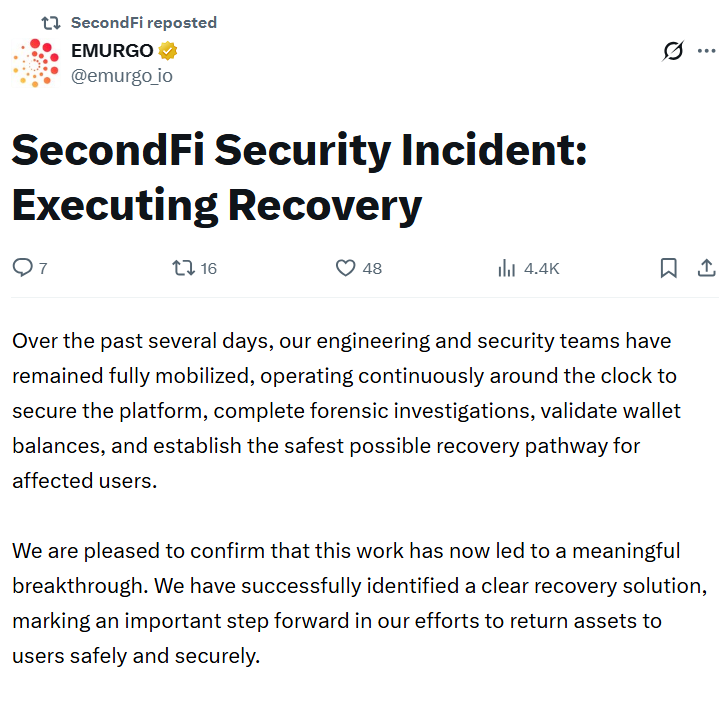
Cardano wallet SecondFi has identified a recovery path for users affected by Tuesday’s exploit and expects to begin returning assets in about two weeks, following testing and security reviews.
According to a Saturday statement by Phillip Pon, CEO of SecondFi developer Emurgo, the company completed forensic investigations and established a recovery pathway for affected users. Pon said the coming week would be spent building the solution, followed by another week of testing before assets begin to be returned.
Pon urged users to refrain from migrating assets or taking actions outside official guidance, saying the recovery process was designed around existing wallet states and that independent action could complicate the secure return of funds.
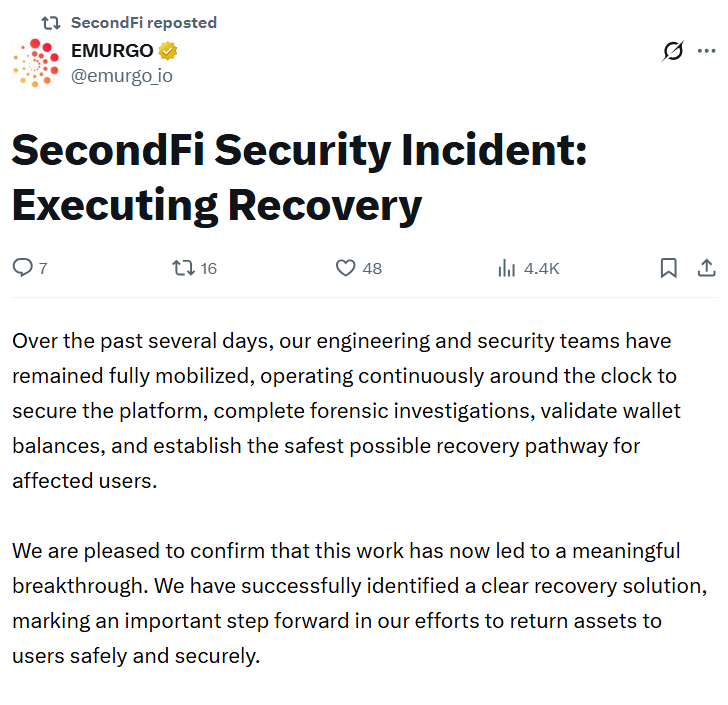
SecondFi developer Emurgo shared an update on the wallet’s recovery efforts. Source: Emurgo
SecondFi disclosed a security breach on Tuesday that affected approximately 16 million ADA, worth about $2.4 million at the time, across 374 addresses. SecondFi previously said it traced the incident to an address-level issue in its Cardano web wallet generation software that exposed users’ private keys.
Related: Q2 2026 emerges as most-hacked quarter on record with 83 incidents
The company also said it secured roughly 129 million ADA through emergency measures and transferred the funds to an independent third-party custodian, where they will remain until the verification and recovery process is complete.
SecondFi has not yet published a comprehensive post-mortem detailing the vulnerability or how the exploit was carried out.
SecondFi warns of recovery-related scams
In a separate update on Saturday, SecondFi warned that malicious actors are circulating fraudulent messages impersonating the wallet while its recovery effort remains underway.
The company said no recovery actions requiring user participation have begun and that it will never ask users for private keys, seed phrases, wallet credentials or direct wallet access.
SecondFi said any messages instructing users to submit wallet information, migrate assets or take immediate action outside its verified communication channels should be treated as fraudulent.
It added that users requiring assistance should submit a ticket through its official support portal while the recovery process continues.
Magazine: AI is banking the unbanked in Africa… faster than crypto

Key Takeaways
- Oracle shares plummeted 19% over the past week — the most severe weekly decline since August 2001
- The company’s market valuation has dropped approximately 55% from its September peak near $900 billion
- Capital spending exploded 162% to almost $56 billion during fiscal 2026
- The company’s debt load reached approximately $130 billion by late May, accompanied by nearly $24 billion in negative free cash flow
- Despite the selloff, 71% of Wall Street analysts maintain Buy ratings — a 15-year high
Oracle has just endured its most punishing week on the stock market in a quarter century. Shares tumbled 19% over five straight trading sessions, with daily losses exceeding 2.6% each day. The last time the enterprise software giant experienced such a devastating stretch was during August 2001, amid the dot-com bubble collapse.
The recent downturn represents more than just a bad week. Oracle’s market capitalization has contracted by roughly 55% since reaching approximately $900 billion last September.
Both the extended decline and this week’s brutal selloff share a common culprit: the escalating expenses tied to Oracle’s artificial intelligence strategy.
Oracle has committed heavily to AI infrastructure development, particularly through its involvement with OpenAI as part of the Stargate initiative. Constructing this infrastructure demands massive capital investment — and currently, shareholders are paying a hefty price.
Financial Metrics Paint a Concerning Picture
As of May’s conclusion, Oracle’s outstanding debt stood at roughly $130 billion. The company’s capital expenditure soared 162% during fiscal year 2026, hitting close to $56 billion.
Free cash flow registered at nearly negative $24 billion for the fiscal year.
To continue financing its infrastructure expansion, Oracle intends to secure an additional $40 billion in fiscal 2027 through combined debt and equity offerings. This follows the previous year’s $43 billion in debt issuance plus $5 billion raised through equity sales.
The fundamental challenge is clear: Oracle finds itself competing against Amazon, Microsoft, and Google in the race to construct AI data center capabilities — yet unlike these rivals, it cannot offer a comprehensive technology ecosystem. This constraint puts pressure on margins for what amounts to an extraordinarily expensive gamble.
Analyst Community Remains Largely Optimistic
Remarkably, analyst confidence hasn’t wavered despite the sharp decline. FactSet data shows 71% of ORCL analysts maintain Buy ratings — representing the strongest bullish sentiment in 15 years. The overall consensus stands at Strong Buy, reflecting 28 Buy recommendations, five Hold ratings, and zero Sell calls over the most recent three-month period.
The mean price target stands at $263.86, suggesting potential upside exceeding 77% from present levels.
Evercore, which holds a Buy rating on the stock, explained the situation in Wednesday’s research note: “We expect financing/leverage and the pace of equity issuance to remain the central investor debate near term, even as demand signals stay strong.”
This disconnect between professional analyst optimism and actual market performance represents the key narrative entering the following week.
As a footnote, Oracle co-founder Larry Ellison has also dropped several spots on global wealth rankings this week, falling behind Google’s co-founders, Jeff Bezos, and Michael Dell.

Key Highlights
- Starting July 1, AWS will implement a 20% price increase on reserved GPU compute resources, affecting Nvidia B200, B300, H100, and H200 processors.
- H200 pricing has now increased for three consecutive quarters — AWS GPU reservation costs have surged 20–50% since the start of the year.
- Wells Fargo reaffirmed its Buy recommendation on AMZN with a $312 price objective, viewing the increase as confirmation of cloud infrastructure pricing strength.
- Analyst consensus shows 57 Buy ratings on AMZN, with an average price objective of $312.78 — suggesting approximately 38.5% potential appreciation from current prices.
- Institutional shareholders control 72.2% of AMZN shares, with several major funds expanding their holdings during Q1 2026.
Amazon (AMZN) shares climbed 2.5% Thursday following Wells Fargo’s positive commentary on AWS’s latest 20% reserved GPU compute price adjustment, interpreting the move as evidence of robust pricing dynamics and sustained AI infrastructure appetite.
AMZN began Friday’s session at $232.69. The shares currently trade beneath their 50-day moving average of $255.53 while maintaining a position above the 200-day moving average of $234.13. The stock’s 52-week trading band extends from $196.00 to $278.56.
The pricing adjustments become effective July 1 and apply to multiple Nvidia processor architectures — including the B200, B300, H100, and H200 models.
Regarding the H200 particularly, this marks the third straight quarter of upward pricing pressure. AWS implemented a 15% H200 price increase in Q1, followed by 10% in Q2, and now an additional 20% entering Q3. Cumulatively this year, AWS GPU reservation pricing has escalated between 20% and 50% across different chip configurations.
Wells Fargo analyst Ken Gawrelski maintained his Buy recommendation while establishing a $312 price objective. His interpretation: the sustained pricing increases demonstrate that AI compute demand continues exceeding available supply, enabling hyperscale providers like AWS to transfer elevated infrastructure expenses to end customers.
Understanding AWS Reservation Pricing Dynamics
AWS reservation blocks enable clients to secure GPU capacity for periods extending up to six months. The willingness of customers to accept escalating prices for guaranteed access reveals the persistent tightness in available supply.
Wells Fargo recognized that these price adjustments may not translate immediately into revenue gains, given that certain clients operate under existing contractual arrangements. Nevertheless, the firm views this development as reinforcing AWS’s extended growth trajectory.
AMZN maintains a Strong Buy consensus rating throughout Wall Street. Among analysts providing coverage within the last three months, 44 assign Buy ratings while one assigns a Hold rating. The consensus price objective stands at $319.24, implying roughly 38.5% upside potential.
Recent price objective adjustments include: JPMorgan elevating its target to $330, Truist increasing to $320, Wolfe Research establishing a $320 target, and Deutsche Bank moving to $315.
Institutional Holdings and Additional Growth Drivers
Institutional ownership represents 72.2% of outstanding shares. Clark Asset Management acquired 4,879 additional shares during Q1, expanding its complete AMZN holdings to 38,238 shares valued at approximately $7.96 million. Arrowstreet Capital expanded its position by 21% in Q4, currently maintaining over 24.6 million shares worth roughly $5.7 billion.
Beyond GPU pricing developments, Amazon has several additional strategic initiatives underway. The company revealed a $13 billion commitment to India extending through 2030 for AI and cloud infrastructure expansion. Prime Day performance also appears promising, with industry observers anticipating record-breaking sales figures.
Regarding potential headwinds, EU regulatory authorities have suggested AWS could encounter more stringent competitive oversight — representing a possible concern for investors. Certain analysts have additionally expressed reservations regarding the company’s substantial capital investment requirements.
Amazon’s latest quarterly performance delivered $2.78 EPS, exceeding the $1.63 consensus estimate by $1.15. Revenue reached $181.52 billion, representing 16.6% year-over-year expansion.
CEO Andrew Jassy divested 20,000 shares on May 21 at $263.42 through a previously established 10b5-1 trading arrangement.


Ripple CTO emeritus David Schwartz has pushed back on a fresh social media debate over whether XRP existed before Bitcoin.
Summary
- Schwartz said Fugger’s 2004 idea was a payment network, not XRP or decentralized assets.
- XRPL history places XRP’s creation in 2012, years after Bitcoin launched in 2009 officially.
- The debate shows how older RipplePay ideas still drive confusion around XRP’s real origin.
The exchange began after Crypto Dyl News claimed on X that “Bitcoin was NOT the 1st” and that XRP was created in 1988.
That claim drew a question from XRP community user MitchRob, who asked Schwartz whether Ryan Fugger had conceptualized XRP and the XRP Ledger before or after Bitcoin. Schwartz replied that Fugger had conceptualized a decentralized payment and settlement network around 2004, well before Bitcoin.
Schwartz added one key limit to that answer. He said Fugger’s idea did not include decentralized assets. That distinction separates RipplePay, Fugger’s early payment concept, from XRP and the XRP Ledger, which arrived later.
Ryan Fugger built RipplePay, not XRP
Fugger’s RipplePay concept dates back to 2004. It focused on payments, IOUs and trust lines between users. It did not operate as a blockchain in the modern crypto sense, and it did not include XRP as a native asset.
Schwartz’s answer makes that point clear. He wrote that Fugger conceptualized a decentralized payment and settlement network “but without decentralized assets” around 2004. That means the idea came before Bitcoin, but XRP itself did not.
The official XRP Ledger history page places XRP’s launch in 2012. It says Schwartz, Jed McCaleb and Arthur Britto built a distributed ledger that aimed to improve on Bitcoin’s limits. The ledger included a native asset that became XRP.
The XRPL learning portal also says the three developers joined forces in 2011 to create a faster and more scalable digital asset. That timeline puts XRP after Bitcoin, not before it.
XRP origin debate continues online
MitchRob later asked whether Satoshi Nakamoto may have drawn any inspiration from Fugger’s earlier concepts. He also asked which network was built with a better framework for payments and settlement.
Schwartz had not answered that follow-up in the provided thread at the time of writing. The question remains speculative because no public evidence in the thread shows that Satoshi used Fugger’s work when designing Bitcoin.
The confusion comes from the Ripple name. Fugger’s RipplePay project came before Bitcoin, while the XRP Ledger came after Bitcoin. Ripple Labs later used the Ripple name, but the technical system behind XRP was built separately.
As previously reported, David Schwartz recently explained his XRP Ledger role after stepping back from daily leadership. The report noted that he remains CTO emeritus and one of XRPL’s co-creators.
XRPL history still matters
The debate comes as XRP Ledger development continues. In a previous article, crypto.news discussed Schwartz backing the XRP Ledger 3.2.0 upgrade, which renamed the core server software from rippled to xrpld.
That update moved XRPL further away from older Ripple-branded software names. It also added cleanup fixes for features tied to DeFi tools, vaults, lending, permissioned domains and token functions.
Previously, crypto.news explored XRPL’s growing tokenized finance use cases. Schwartz said XRPL use is expanding from payments into tokenized assets, stablecoins and other financial tools.
The latest exchange does not change XRP’s history. Fugger helped shape an early payment idea before Bitcoin. XRP and XRPL, however, began later as separate code written by Schwartz, McCaleb and Britto.


Cathie Wood has said that rising global instability has created the conditions for another Bitcoin rally as investors increasingly look for assets that can protect wealth across borders.
Summary
- Cathie Wood says capital leaving unstable countries could drive Bitcoin’s next major rally.
- Wood argues AI cannot replace Bitcoin’s role as a tool for protecting wealth during uncertainty.
- ARK Invest added $25.54 million in Coinbase, SpaceX, Circle, Bullish, and Robinhood shares.
According to a June 27 X post by ARK Invest founder Cathie Wood, capital leaving economically and politically unstable countries is likely to provide fresh momentum for Bitcoin and other digital assets.
She argued that while artificial intelligence has captured investor attention and a large share of market liquidity, it cannot replace the role digital assets play during periods of uncertainty.
Bitcoin remains a hedge against global instability
In her post, Wood said AI has launched a technological revolution and is attracting substantial investment, but described digital assets as a form of “insurance policy” for protecting wealth when confidence in traditional financial systems weakens.
She linked this view to growing capital outflows from less stable nations, saying those flows could “light another fire” under Bitcoin and the broader digital asset market.
Rather than competing directly, Wood suggested AI and crypto serve different purposes in today’s investment landscape. While AI companies continue drawing fresh capital because of their growth prospects, she argued that Bitcoin addresses a separate need by offering an alternative store of value that can move across borders more easily than many traditional assets.
Her comments come as investors continue weighing geopolitical tensions, inflation concerns, currency weakness in several regions, and uncertainty surrounding monetary policy. According to Wood, these conditions are increasing demand for assets that can preserve purchasing power while remaining accessible outside domestic financial systems.
The remarks also follow a post by ARK analyst Lorenzo Valente, who argued that many investors are overlooking crypto’s original purpose. Valente wrote that although the market has become increasingly institutional, digital assets should not be viewed only as risk-on investments because they continue to serve as financial protection in uncertain environments.
ARK continues adding crypto-related investments
Wood’s latest comments coincide with continued buying activity across ARK Invest’s exchange-traded funds.
According to ARK Invest’s latest daily trade disclosure, the firm purchased about $25.54 million worth of shares in Coinbase, SpaceX, Circle, Bullish, and Robinhood.
Coinbase represented the largest purchase by value. ARK acquired 68,366 shares through the ARK Innovation ETF, ARK Next Generation Internet ETF, and ARK Fintech Innovation ETF. Based on Friday’s closing price of $149.06, the transaction was worth about $10.19 million.
SpaceX ranked second after ARK bought 45,728 shares through four of its ETFs, including ARKQ and ARKX, for roughly $7.01 million using the company’s closing price of $153.23.
The investment manager also added 78,756 Circle shares valued at approximately $5.79 million, alongside smaller purchases of Bullish and Robinhood shares worth around $1.34 million and $1.21 million, respectively.
The latest buying activity is consistent with Wood’s positive view on financial markets despite ongoing concerns about inflation and interest rates.
As crypto.news previously reported, she said discussions with investors across Asia and Europe indicated many expect inflation to remain persistent and believe the Federal Reserve could tighten monetary policy further. Even so, Wood argued that incoming economic data points toward a different outcome.


Hong Kong has confirmed that its first regulated stablecoins are expected to enter circulation between the middle and second half of 2026 after two bank-backed institutions secured issuer licenses earlier this year.
Summary
- Hong Kong expects its first regulated stablecoins to launch between mid and late 2026 after licensing two bank-backed issuers.
- The HKMA says licensed issuers must hold eligible reserve assets and will remain under ongoing regulatory supervision.
- Hong Kong plans to expand crypto oversight with new rules for trading, custody, advisory, and management service providers.
According to a written reply by Secretary for Financial Services and the Treasury Christopher Hui to Hong Kong’s Legislative Council, the Hong Kong Monetary Authority (HKMA) granted stablecoin issuer licenses to two institutions with banking backgrounds in April 2026. Hui said the expected launch timeline is based on the institutions’ existing business plans.
The response also outlined how regulators intend to supervise the market after the rollout, saying the licensing framework is designed to support financial innovation while protecting users and maintaining monetary and financial stability.
Licensed issuers face reserve and supervision requirements
While confirming the launch window, the government said the HKMA had already considered the effect that regulated stablecoins could have on Hong Kong’s banking system before creating the licensing framework.
Under the Stablecoins Ordinance, which took effect in August 2025, licensed issuers must back their tokens with eligible reserve assets, including bank deposits and high-quality liquid debt securities. The government said those reserves must be placed with banks in Hong Kong, while the HKMA retains the authority to impose additional requirements if market conditions warrant.
Beyond the reserve rules, the central bank said it will carry out ongoing supervision once regulated stablecoins begin circulating and will continue assessing whether issuance affects bank deposits, lending activity, or overall financial stability.
At the international level, the government added that the HKMA is participating in studies led by organizations such as the Bank for International Settlements to examine how wider stablecoin adoption could affect traditional banking systems and to keep Hong Kong’s framework aligned with evolving global standards.
Separately, the government said the two licensed issuers are already participating in pilot projects involving central bank digital currency networks, tokenized deposits, and cross-border payment infrastructure. According to the reply, future adoption of these payment technologies will depend on demand across different use cases.
The announcement follows another digital payments initiative in Hong Kong. As previously reported by crypto.news, HKEX, and the HKMA recently began testing a wholesale e-HKD for derivatives trading, allowing clearing participants to use central bank digital currency for after-hours margin payments. The pilot is intended to improve settlement outside normal banking hours, although any commercial rollout remains subject to regulatory approval and operational readiness.
Enforcement expands as Hong Kong prepares more crypto rules
Alongside the rollout plans, the government said regulators have begun taking action against businesses that continue offering stablecoins without authorization.
According to the Legislative Council reply, the HKMA has issued letters to unregulated stablecoin providers explaining the legal requirements under the Stablecoins Ordinance and has continued monitoring whether those businesses comply. Depending on the circumstances, cases may be referred to the Police or the Department of Justice.
The Securities and Futures Commission (SFC) also shares information with the HKMA when it identifies suspected marketing of unregulated stablecoins to Hong Kong residents through its monitoring under the Anti-Money Laundering and Counter-Terrorist Financing Ordinance.
Looking beyond stablecoin issuance, the government said it will introduce legislation later this year covering virtual asset trading, custody, advisory, and management service providers to create a more comprehensive regulatory framework.
Officials also reiterated that regulated stablecoins are intended to function as blockchain-based payment instruments rather than speculative investments. The government warned that people who acquire unregulated stablecoins through unregulated channels do so at their own risk, while adding that financial regulators will continue public education campaigns and maintain updated lists of licensed entities.

Recent Selloff Could Provide Appealing Entry Point For Pan American Silver (NYSE:PAAS)
Bitcoin’s Price Has Finally Entered the Buy Zone: Analyst Maps Out Big Targets

Billy Joe Saunders addresses potential boxing comeback after 5 years out


-

 Entertainment7 days ago
Renter of Home in Anne Heche Crash Denies Settlement With Son
-
 Sports4 days ago
Two goals and an assist by sheer aura: Cristiano Ronaldo just entered the World Cup chat
-

 Tech5 days ago
Microsoft accidentally kills epic Outlook email threads
-

 Fashion19 hours ago
Weekend Open Thread: Staud – Corporette.com
-

 Business7 days ago
Soccer-U.S. defends Iran World Cup travel restrictions, says discussions ongoing
-

 Politics1 day ago
The House | Manchesterism won’t survive the painful trade-offs unless it gets citizens on board
-

 Politics1 day ago
Potential 2028er World Cup attendee leaderboard
-

 Business1 day ago
Asia stock markets slide as tech shares slump
-

 Tech2 days ago
A Look At A Gaggle Of Transputer Boards
-
Crypto World3 days ago
Bitcoin (BTC) Dips Below $62K, Ethereum (ETH) Plunges 6% Daily: Market Watch
-

 Crypto World3 days ago
Securitize Wraps Roubini's SEC-Registered ETF as Dubai VARA Digital Security
-
 Crypto World2 days ago
Dell (DELL) Shares Tumble Over 5% Following Analyst Downgrade to Hold
-
Business3 days ago
Entergy settles forward sale agreements, raises $672 million in cash proceeds
-

 Sports16 hours ago
FIH Pro League: India defeat Pakistan 7-1, register biggest win of campaign | Other Sports News
-

 Crypto World8 hours ago
Kraken's xStocks Opens Bending Spoons IPO Registration to EEA Retail
-

 Crypto World20 hours ago
RTX holders must register wallets before token distribution begins
-
 Crypto World22 hours ago
Hyperliquid Named on Singapore MAS Investor Alert Register
-

 Sports2 days ago
India vs Bangladesh LIVE Score, Women’s T20 World Cup: Bangladesh Opt To Bat; India Enter ‘Do-Or-Die’ Stage As Semi-Final Race Heats Up
-
 Tech6 days ago
Signal’s Meredith Whittaker says AI chatbots ‘are not your friends’ and calls Copilot agents a backdoor
-
Crypto World1 day ago
The DATA Foundation Launches to Tackle AI’s Multi-Billion Dollar Training Data Bottleneck
You must be logged in to post a comment Login