
Crypto World
ProductionReady’s Jimmy Song Pitches Case for Conservative Bitcoin Software

The Bitcoin (BTC) network needs a “conservative” Bitcoin client node software implementation to preserve its monetary properties and strengthen network decentralization, according to Jimmy Song, co-founder of ProductionReady, a non-profit organization funding open source Bitcoin node software development and education.
The organization has a “bias” against significant code changes, unless there is “overwhelming” community support for the change, Song told Cointelegraph.
“The general principle is: if you’re not sure a change makes the money better, don’t make it,” he said.

ProductionReady expects to restore the 83-byte OP_Return data limit for arbitrary, non-monetary information in Bitcoin transactions, he said, adding that keeping node storage costs down by limiting arbitrary data is essential to network decentralization. He said:
“The more self-sovereign Bitcoin users are, the more decentralized and resilient the network becomes. That means keeping the cost of running a node low enough for ordinary people to do it.
“When storage and bandwidth requirements grow, fewer people verify for themselves, and the network centralizes by default. A conservative client takes that tradeoff seriously,” Song continued.
Maximizing nodes and making them accessible to the average user hardens the Bitcoin network, reducing the chances of cheating by submitting false transactions or a few actors colluding to centralize the network.

Related: 72% of subsea cables would need to fail to impact Bitcoin, study shows
Bitcoin Core 30 removes the OP_Return data limit, sparking major pushback
Node storage and onchain spam became hot-button topics in 2025 after Bitcoin Core developers unilaterally changed the 83-Byte data limit in Bitcoin Core version 30, the latest major upgrade to the reference implementation for Bitcoin node software.
The limit was changed to 100,000 bytes despite significant pushback from the Bitcoin community. For context, the proposal to change the limit received about 4 times as many downvotes as it did upvotes, according to the proposal’s GitHub pull request page.
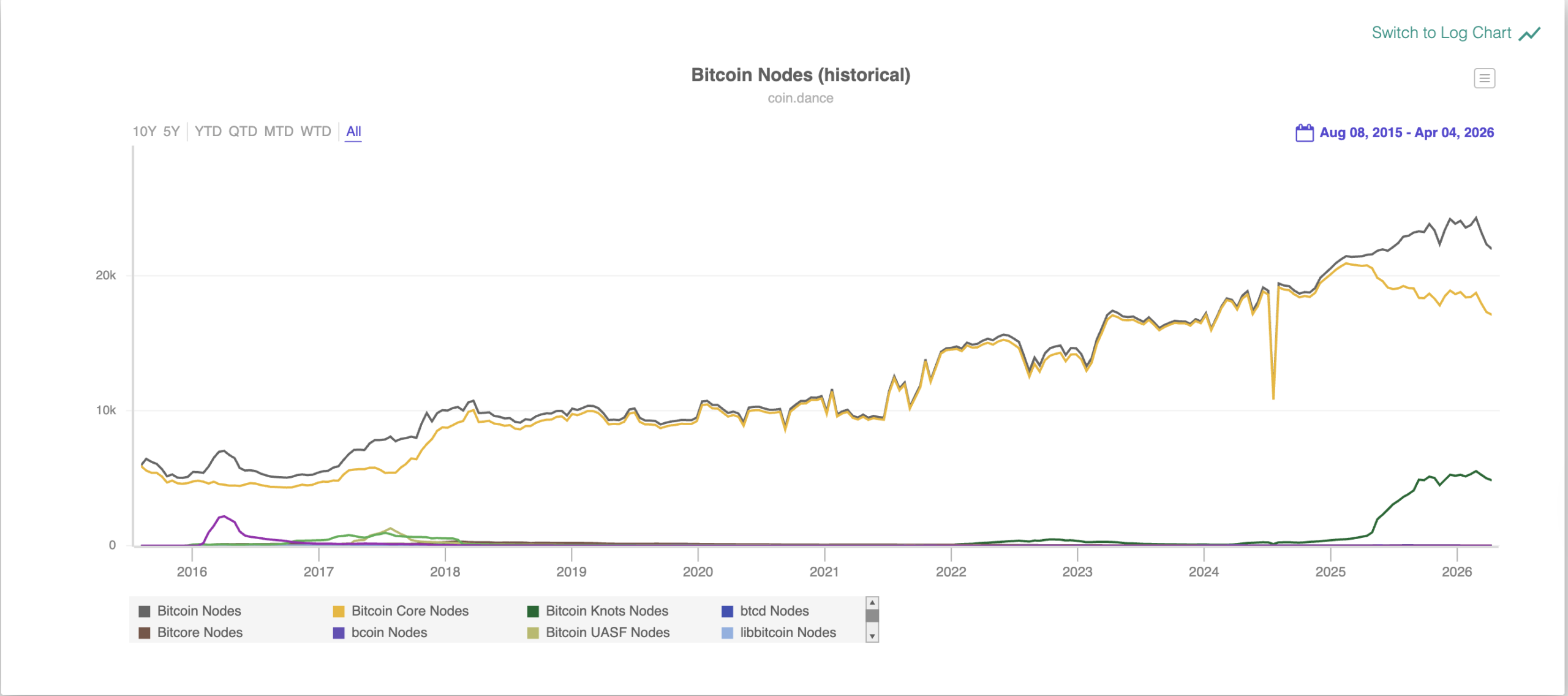
Bitcoin Core 30 went live in October 2025, triggering a historic surge in the number of Bitcoin nodes running Bitcoin Knots, an alternative implementation of the node client software.

There are 4,746 Bitcoin Knots nodes, representing over 21.7% of nodes on the network, according to Coin Dance.
Only about 1% of the network was running the Knots software in 2024 before the decision to remove the OP_Return function was announced.
Magazine: Bitcoin may face hard fork over any attempt to freeze Satoshi’s coins



Drift Protocol said the April 1 attack on its platform followed months of planning and social engineering.
Summary
- Drift said attackers spent six months building trust before using malicious tools to breach contributor devices.
- The exchange linked the exploit with medium-high confidence to actors behind Radiant Capital’s October 2024 hack.
- Drift said repeated in-person contact at crypto events helped attackers study contributors and gain access.
The decentralized exchange linked the case to a group that spent time building trust with contributors before sending malicious tools and links. External estimates put the loss at about $280 million.
Drift Protocol said its early review found a long and organized campaign against the platform. The team said the attackers showed “organizational backing, resources, and months of deliberate preparation” during the operation.
The exchange said the contact began around October 2025. According to Drift, people posing as members of a quantitative trading firm approached contributors at a major crypto conference and claimed they wanted to integrate with the protocol.
Drift said the group kept meeting contributors at several industry events over the next six months. The team said the people involved were technically skilled, knew how Drift worked, and appeared to have real professional backgrounds.
That steady contact helped the group gain trust. Drift said the attackers later used malicious links and tools shared with contributors to compromise devices, carry out the exploit, and remove traces of their activity after the breach.
In addition, Drift said it has “medium-high confidence” that the same actors behind the October 2024 Radiant Capital hack carried out this exploit. That earlier attack caused losses of about $58 million and also involved malware used to gain access to internal systems.
Radiant Capital said in December 2024 that a North Korea-aligned hacker posed as a former contractor and sent malware through Telegram. Radiant said “this ZIP file” later spread among developers for feedback and opened the way for the intrusion.
Drift warns conferences can become attack targets
Drift said the people who met contributors in person “were not North Korean nationals.” At the same time, the team said DPRK-linked threat actors often use third-party intermediaries for face-to-face contact and relationship building.
The exchange said it is now working with law enforcement and other crypto industry participants to build a full record of the April 1 attack.
The case has also added a fresh warning for crypto firms, as conferences and in-person meetings can give threat groups a chance to study teams, build trust, and prepare later attacks.

Key Highlights
- Marvell’s shares climbed 21.3% throughout March, fueled by robust quarterly results and a transformative Nvidia partnership
- Fourth-quarter revenue increased 22.1% to $2.2 billion, while adjusted earnings per share rose 33.3% to $0.80
- Nvidia committed $2 billion to Marvell through an equity investment and unveiled a comprehensive strategic collaboration
- Company executives project 40% data center revenue expansion in fiscal 2027, significantly exceeding Wall Street’s 25% forecast
- Erste Group launched coverage with a Buy recommendation on April 2, highlighting robust financial metrics and AI market positioning
March proved to be a landmark month for Marvell Technology. The semiconductor company not only exceeded expectations with its quarterly performance but also secured a game-changing agreement with Nvidia.
Marvell Technology, Inc., MRVL
The fourth-quarter financial results impressed investors. Revenue surged 22.1% compared to the prior year, reaching $2.2 billion. Adjusted earnings per share hit $0.80, representing a 33.3% increase. Both metrics exceeded Wall Street projections.
Forward-looking guidance reinforced the positive momentum. Executives forecast a 9% sequential revenue boost in the first quarter, with adjusted EPS projected at $0.79. These projections also surpassed analyst expectations.
However, the month’s most significant development arrived on March 31. Nvidia revealed a $2 billion equity stake in Marvell, accompanied by an extensive strategic alliance.
The collaboration encompasses custom silicon development, networking solutions, and optical technology innovations. At its core sits NVLink Fusion, Nvidia’s framework for incorporating external chips into its artificial intelligence infrastructure ecosystem.
The arrangement’s significance lies in the architectural flexibility it creates. Previously, AI infrastructure typically followed two paths: Nvidia-centric systems or custom XPU chip configurations with Ethernet connectivity. This alliance introduces hybrid possibilities — combining XPUs with Nvidia’s GPUs, CPUs, and interconnect technologies.
Data Center Revenue Projections Exceed Expectations
Management established ambitious targets for fiscal 2027. The chipmaker anticipates data center revenue will expand by 40% — substantially surpassing the 25% consensus among financial analysts.
This optimism appears rooted in its XPU operations, which supply custom AI chip intellectual property to cloud computing giants. While concerns had emerged about potential market share erosion at Amazon following the launch of Amazon’s Trainium chips, the aggressive guidance indicates the XPU business remains robust.
Marvell has simultaneously diversified its client portfolio. Microsoft introduced its enhanced Maia2 XPU processor in January, incorporating Marvell’s intellectual property into the chip architecture.
The Nvidia alliance also encompasses silicon photonics — an emerging technology poised to eventually supplant copper-based networking within AI data centers. Given that Nvidia’s existing NVLink infrastructure relies on copper, the partnership with Marvell represents a strategic shift toward optical interconnect solutions.
Wall Street Coverage Intensifies
On April 2, Erste Group launched coverage of Marvell with a Buy recommendation. The investment firm noted that net profits have doubled across the previous five quarters, while return on equity has climbed to 19%.
Erste additionally emphasized Marvell’s competitive advantages in high-performance analog and optical DSP technologies as fundamental drivers behind its optimistic assessment.
The Nvidia investment propelled Marvell to 52-week peak valuations. The stock had traded within a constrained range for much of the preceding six months, but the convergence of impressive earnings and Nvidia’s endorsement triggered a breakout.
Marvell presently trades at approximately 27 times forward earnings projections — a valuation premium compared to last year, though one that numerous analysts consider justified given the data center expansion outlook.
The company’s XPU offerings now interface with Nvidia’s NVLink Fusion infrastructure, potentially unlocking additional revenue opportunities throughout Nvidia’s expanding network of hyperscale clients.

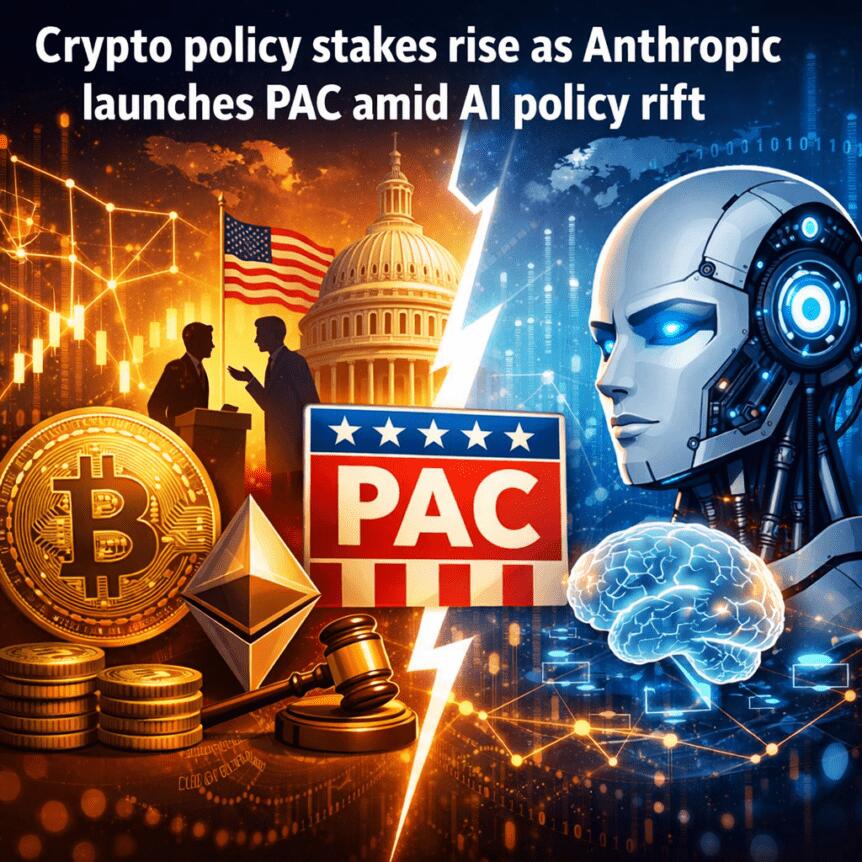
Anthropic, the AI safety-focused lab behind several widely used language models, has moved to formalize its political engagement by launching an employee-funded political action committee named AnthroPAC. A filing with the Federal Election Commission shows the organization as a connected entity to Anthropic, organized as a separate segregated fund and aimed at receiving voluntary contributions from employees. The filing outlines the PAC’s intent to participate in federal elections while remaining aligned with the company’s stated interest in AI policy and safety considerations.
Under U.S. campaign finance rules, individual contributions to a federal candidate are capped at $5,000 per election, with disclosures required through public filings. AnthroPAC’s organizers say the fund is designed to support candidates from both major parties. However, observers and industry watchers are already raising questions about how closely the effort will stay within bipartisan lines, given broader debates over AI regulation, safety standards, and the strategic direction of AI policy in Washington.
The AnthroPAC move lands as Anthropic navigates a fraught relationship with the U.S. government over how its technology should be employed. Separately, the Defense Department in February designated Anthropic as a supply chain risk—an action tied to the company’s stance against the use of its AI in fully autonomous weapons and mass surveillance. Anthropic has challenged that designation in court, contending it constitutes retaliation for a protected position. A federal judge in California has temporarily blocked the measure and paused further restrictions while the dispute unfolds.
Beyond governance and defense concerns, Anthropic has already been active politically this cycle. Notably, the company contributed $20 million to Public First Action, a political committee focused on AI safety and related policy advocacy, underscoring the firm’s broader strategy to influence AI-related regulation and public safety standards.
Meanwhile, Anthropic’s broader ecosystem is drawing capital and infrastructure support that could accelerate its technology roadmap. In a related development, Google is preparing to back a multibillion-dollar data-center project in Texas that would be leased to Anthropic via Nexus Data Centers. The project’s initial phase could exceed $5 billion, with Google expected to provide construction loans and be joined by banks arranging additional financing. The arrangement highlights the growing demand for AI infrastructure capable of supporting expansion in model training, inference, and data storage.
Key takeaways
- Anthropic formed AnthroPAC, an employee-funded political action committee registered as a separate segregated fund under the company’s umbrella.
- The PAC is intended to support candidates from both parties, with strict contribution limits and mandatory disclosures under U.S. election law.
- The move occurs amid fraught relations with the Pentagon over AI use, including a safety-focused designation that Anthropic is challenging in court.
- Anthropic has a track record of political giving in this cycle, including a $20 million contribution to Public First Action focused on AI safety.
- Google’s backing of a Texas data-center project for Anthropic signals strong infrastructure demand and potential financing mechanisms that could accelerate AI deployment.
Anthropic’s political engagement and the policy context
The formation of AnthroPAC marks a notable step in how AI firms engage with lawmakers and regulators. By coordinating staff contributions through a dedicated PAC, Anthropic signals a structured approach to influencing elections and policy debates that shape the development and governance of artificial intelligence. The FEC filing describes AnthroPAC as a “connected organization” operating under a separate segregated fund, aligning with typical industry practices for corporate-employee political activity. While the stated aim is bipartisanship, the broader AI policy environment in the United States has become highly polarized, with differing views on liability, safety mandates, data privacy, and government access to AI systems.
Investors and builders watching the space can interpret this as part of a broader trend: major AI developers increasingly engage directly in policy conversations, seeking to frame the regulatory environment in ways that balance innovation with oversight. The implications extend beyond ethics and governance; policy direction can materially affect the regulatory runway for product development, procurement, and collaboration with public sector actors. The presence of a formal PAC also raises questions about how corporate political contributions could influence which AI-safety and governance proposals gain traction on Capitol Hill and in regulatory agencies.
Defense frictions and legal maneuvering
The tension between Anthropic and the Department of Defense centers on how the company’s models should be deployed in sensitive contexts. The Pentagon’s decision to label Anthropic as a supply chain risk stemmed from the company’s public stance against fully autonomous weapons and broad surveillance use. Anthropic has challenged that designation in court, arguing that it amounts to retaliation for a viewpoint it regards as legitimate and protected. A federal judge in California issued a temporary ruling to pause the measure and related restrictions while the case proceeds, illustrating the jurisdictional balance between corporate risk assessments and national-security considerations in AI technology usage.
For policymakers, the case underscores a core policy question: where should the line be drawn between compelling safety and preserving innovation? If courts narrow how procurement risk designations can be wielded, it could affect how similar technology providers are treated as the government expands its AI procurement and testing programs. Conversely, if the government can justify risk designations on safety grounds, it could strengthen leverage for tighter controls on how AI systems are used in defense contexts.
Political giving and AI-safety advocacy
Anthropic’s political activity isn’t limited to its new PAC. Earlier in the cycle, the company contributed a sizable $20 million to Public First Action, a political arm focused on AI safety and public-interest considerations tied to the development and governance of AI technologies. This level of funding signals a broader strategy to influence public discourse and regulatory design around AI, complementing the PAC’s electoral role with policy advocacy and education efforts. Observers are watching how such funding patterns translate into concrete policy outcomes, particularly in an environment where legislators are weighing landmark AI bills and safety standards that could shape model development, data usage, and transparency requirements.
Infrastructure bets amid AI acceleration
Infrastructure matters are increasingly central to AI strategy, and Google’s involvement in a Texas data-center project for Anthropic is a vivid illustration. The Nexus Data Centers-leased facility, if realized as outlined, could become a cornerstone asset to support large-scale model training and deployment. The project’s initial phase exceeding $5 billion underscores the capital intensity of modern AI initiatives and the financial orchestration that underpins them. Google’s expected role in providing construction loans, alongside competitive financing arrangements from banks, points to the consolidation of AI infrastructure finance as a distinct sub-market within the tech sector. For Anthropic and similar firms, such backing could shorten timelines to deploy more capable models and scale services that demand robust, energy-efficient, and highly reliable data-center capacity.
As policy debates progress, industry participants and investors should monitor both political and practical developments: how much traction new AI safety proposals gain in Congress, how procurement rules evolve in defense programs, and how infrastructure financing evolves to accommodate the next wave of AI workloads. Each of these strands will influence not only which AI products reach market first, but also how quickly the industry can translate research advances into real-world use cases across enterprise, healthcare, and public services.
Readers should stay attentive to any updates on Anthropic’s PAC activity and the Pentagon case outcomes, as both arenas will shape the company’s public-facing strategy and its broader partnerships. The balance between safety-driven governance and aggressive innovation remains a live tension set to define the next phase of AI adoption and investment.
The rapid growth in the number of crypto tokens is outpacing the value they generate, creating an “existential” problem for the industry, according to Michael Ippolito, co-founder of Blockworks.
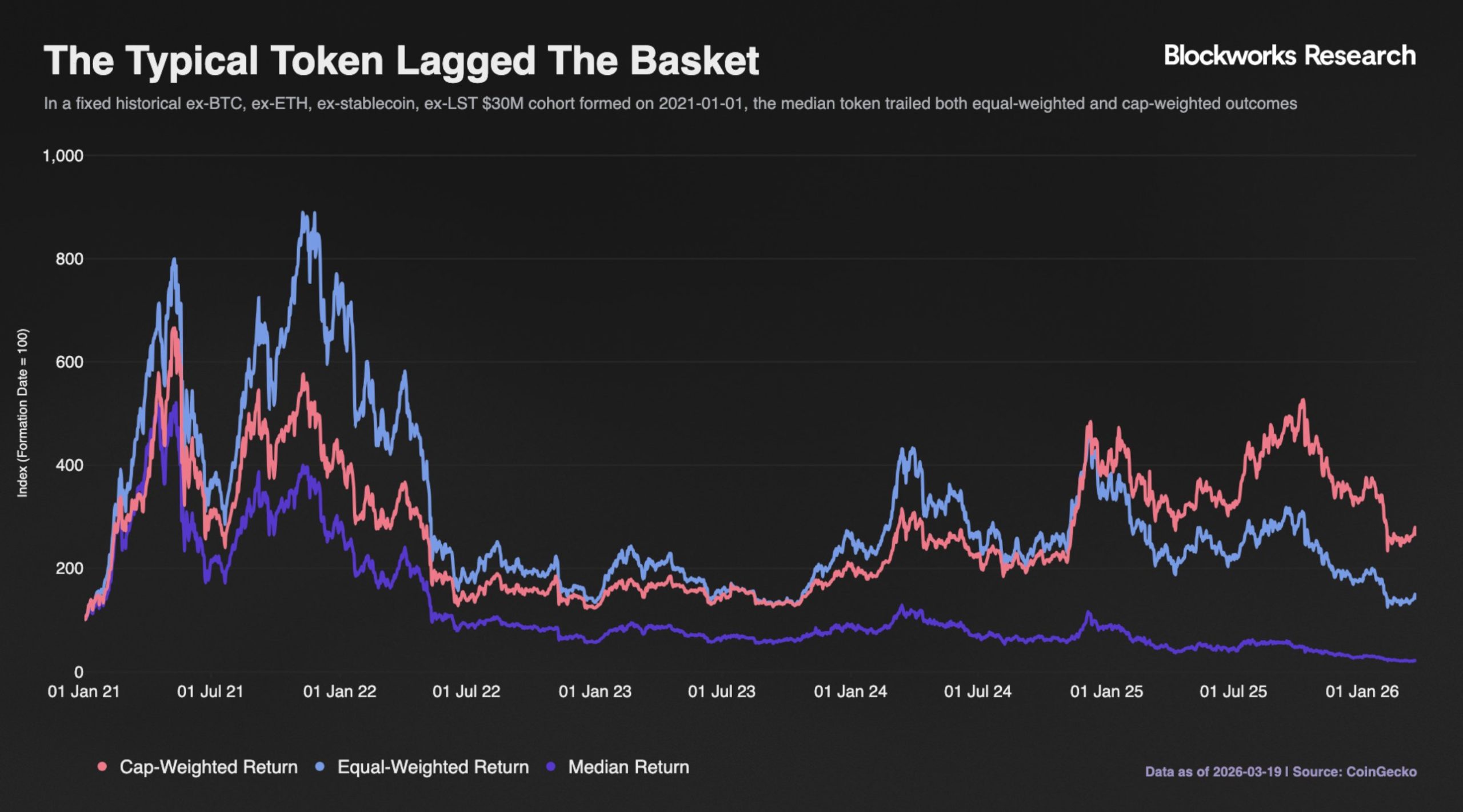
In a series of posts on X, Ippolito noted that while total crypto market capitalization remains relatively strong, the average value per token tells a different story. “The average coin is only slightly higher than where it was in 2020 (!) and down ~50% since 2021,” he wrote.
Median token returns have also deteriorated sharply. Most tokens are down roughly 80% from their highs, suggesting that gains have been concentrated in a narrow set of large-cap assets, while the broader market underperforms, Ippolito claimed.

He argued that the imbalance appears to be driven by a rapid expansion in token supply. “We created a TON of new assets and STILL total market cap is flat,” he wrote, adding that this dynamic effectively dilutes value across a growing pool of tokens.
Related: Bitcoin ‘done’ with 85% crashes, says Cathie Wood amid new $34K target
Token prices break from fundamentals
Ippolito also claimed that the relationship between fundamentals and price has weakened. In 2021, token prices closely tracked onchain revenue. Recent data shows that despite a resurgence in protocol revenues, prices have not followed, pointing to a disconnect between usage and investor returns.
He argued that this signals a loss of confidence in tokens as vehicles for capturing value. “The token problem is existential for this industry,” he said, adding that without stronger alignment between fundamentals and price, the sector risks losing its core appeal.

In a post on X, Arthur Cheong, founder and CEO of DeFiance Capital, said he agrees “with the urgency to fix the current situation of tokens in the crypto industry,” warning that if the market continues to concentrate around a small set of assets like Bitcoin and Ether, the broader crypto ecosystem risks losing relevance.
Related: Bitcoin shorts risk $2.5 billion liquidation at $72K: Are bears in danger?
Capital shifts from tokens to stocks
Investor demand is increasingly moving away from newly launched tokens toward publicly listed crypto firms, as most token launches fail to hold value, a February research from DWF Labs found. The report revealed that over 80% of projects trade below their token generation event (TGE) price, with typical losses of 50% to 70% within about three months.
The pattern appears structural rather than cyclical. According to DWF’s Andrei Grachev, most tokens peak within the first month before declining under sustained selling pressure. Factors such as airdrops and early investor unlocks add to the supply overhang, reinforcing downward price trends even for projects with active products or protocols.
Magazine: Bitcoin may take 7 years to upgrade to post-quantum — BIP-360 co-author


Crypto markets are facing renewed pressure as the number of tokens keeps rising faster than the value those assets create.
Summary
- Most crypto tokens trade far below prior highs as supply keeps rising across markets.
- New token launches keep growing, while value creation fails to support broader market pricing today.
- Investor demand is shifting toward crypto stocks as many token launches lose value quickly.
Market participants are now questioning whether token launches, supply schedules, and value capture models still support long-term investor interest across the wider sector.
Michael Ippolito, co-founder of Blockworks, said the crypto industry now faces an “existential” token problem as supply continues to expand. In a series of posts on X, he said total market capitalization has stayed relatively firm, but the average value of individual tokens has remained weak.
He wrote that “the average coin is only slightly higher than where it was in 2020” and is down about 50% from 2021 levels. He also said most tokens now trade roughly 80% below their peak prices, showing that gains have stayed concentrated in a small group of large-cap assets.
Ippolito also said token prices no longer move in line with protocol fundamentals as closely as they did in 2021. At that time, prices and onchain revenue often moved together. Recent data, however, shows that protocol revenues have recovered in many cases while token prices have not.
He said this gap points to weaker confidence in tokens as tools for capturing network value. According to him, “the token problem is existential for this industry,” as the market no longer rewards activity and revenue in the same way it did in earlier cycles.
Arthur Cheong, founder and chief executive of DeFiance Capital, agreed with the urgency of the issue. In a post on X, he said the market needs to address token structure problems before attention shifts even more toward a narrow group of assets such as Bitcoin and Ether.
That view adds to growing concern that smaller tokens may continue to lose relevance if investors keep focusing on a few dominant names. The trend has raised questions about whether the broader token market can still attract capital on a wide scale.
Investors Shift Focus to Crypto Stocks
A February report from DWF Labs said investor demand has increasingly moved from newly launched tokens to publicly listed crypto companies. The report found that more than 80% of projects trade below their token generation event price, with losses of 50% to 70% within about three months.
DWF Labs partner Andrei Grachev said most tokens reach their highest level within the first month after launch and then fall under steady selling pressure.
He said airdrops and early investor unlocks often add more supply to the market, making it harder for prices to hold even when projects remain active.

Quick Overview
- Rocket Lab achieved 38% revenue growth, reaching $601.8 million in 2025, backed by a $1.85 billion record backlog
- An $816 million Space Development Agency contract strengthened Rocket Lab’s position in government aerospace
- AST SpaceMobile generated $70.9 million in 2025 revenue as it continues early-stage commercial infrastructure development
- AST maintains over $3.9 billion in pro forma liquidity to support satellite constellation expansion
- Analyst consensus favors Rocket Lab with a Moderate Buy rating, while AST receives a Reduce rating
Among space sector equities, Rocket Lab and AST SpaceMobile stand out as two of the most discussed investment opportunities. However, these companies pursue fundamentally different strategies and carry distinct risk-reward profiles. One has established a diversified operational foundation. The other represents a transformative vision for global mobile connectivity.
Rocket Lab delivered impressive financial performance throughout 2025. The company recorded 38% year-over-year revenue expansion, totaling $601.8 million. Its fourth-quarter performance reached a milestone with $179.7 million in revenue. Perhaps most significantly, the firm concluded 2025 with a $1.85 billion backlog—a 73% increase from the previous year. This substantial order book provides greater revenue visibility than most competitors in the space industry can demonstrate.
The company’s revenue composition demonstrates meaningful diversification beyond launch services. Product sales generated $371.6 million during 2025, complemented by $230.2 million from service operations. Today’s Rocket Lab manufactures complete spacecraft, subsystems, and specialized components for defense and intelligence agencies.
Government Contract Wins Strengthen Rocket Lab’s Position
A significant milestone arrived when the company secured an $816 million agreement with the Space Development Agency. This substantial contract validates Rocket Lab’s capabilities for executing complex, multi-year government programs. Meanwhile, the Neutron medium-class launch vehicle represents management’s primary catalyst for the next phase of expansion.
Profitability remains elusive despite operational progress. Rocket Lab recorded a $198.2 million net loss for 2025. Leadership projected continued negative adjusted EBITDA for the opening quarter of 2026. Market valuations currently reflect anticipated future scale rather than present earnings performance.
AST SpaceMobile pursues an entirely different opportunity. The enterprise aims to deploy a satellite constellation providing cellular broadband connectivity directly to unmodified smartphones—eliminating requirements for specialized equipment. Successfully executing this vision at scale could unlock previously inaccessible market segments that conventional satellite providers cannot economically serve.
AST remains in the foundational stages of its mission. The company reported $70.9 million in total 2025 revenue. Fourth-quarter performance contributed $54.3 million, primarily from gateway equipment deliveries, mobile network operator partnerships, and government development milestones.
Strong Liquidity Position Supports AST SpaceMobile’s Deployment Plans
The company maintained $2.8 billion in cash and equivalents as of year-end 2025. Following additional capital raises completed in early 2026, pro forma liquidity exceeded $3.9 billion. This financial cushion enables continued satellite deployment without near-term funding pressures.
AST has secured more than $1.2 billion in contracted revenue commitments from strategic partners. For a company just beginning to recognize meaningful revenue, this represents substantial commercial validation. Nevertheless, significant losses continue, and ultimate success depends critically on deployment velocity and network performance metrics.
Analyst sentiment clearly distinguishes between the two opportunities. Rocket Lab earns a Moderate Buy consensus rating, comprising 2 Strong Buys, 7 Buys, 7 Holds, and 1 Sell recommendation. AST SpaceMobile receives a Reduce consensus, with 2 Buys, 6 Holds, and 3 Sells.
Final Thoughts
Investment community confidence runs higher for Rocket Lab’s proven business model. While acknowledging AST’s substantial upside potential, analysts find the opportunity more challenging to quantify at this development stage. Rocket Lab offers greater operational maturity, revenue diversification, and broader analytical support. AST represents a higher-risk proposition with correspondingly larger potential returns if its satellite broadband architecture achieves technical and commercial success.
Rocket Lab presents the more established investment thesis currently. AST SpaceMobile offers the more ambitious transformational opportunity. The appropriate choice depends entirely on individual investor risk tolerance and portfolio objectives.

TLDR
- The British government is actively pursuing Anthropic for expanded UK operations
- Offers include London headquarters expansion and dual stock exchange listing opportunities
- Prime Minister Keir Starmer’s administration is directly supporting the initiative
- Anthropic faced US blacklisting after declining to permit Claude for military surveillance or weaponized systems
- Federal courts have temporarily halted the blacklist enforcement, with additional legal challenges underway
British officials are making aggressive moves to attract Anthropic, the developer of the Claude AI assistant, as reported by the Financial Times. The UK sees a strategic opening to expand the company’s presence following escalating tensions between Anthropic and the Pentagon.
The British government’s pitch encompasses expanding Anthropic’s current London operations and facilitating a dual stock market listing. The UK’s Department of Science, Innovation and Technology is spearheading these initiatives.
Prime Minister Keir Starmer’s administration has thrown its weight behind the department’s outreach efforts. Officials plan to present these proposals directly to Anthropic’s Chief Executive Dario Amodei during his anticipated UK visit scheduled for late May.
Both Anthropic and the UK’s Department of Science, Innovation and Technology declined to provide statements when contacted by Reuters.
The Pentagon Dispute Explained
The Department of Defense labeled Anthropic as a national-security supply-chain threat. The designation stemmed from the company’s firm stance against permitting its Claude AI system to be deployed for US military surveillance operations or autonomous weaponry applications.
This classification resulted in Anthropic being added to a government blacklist. Such listings typically limit a company’s capacity to collaborate with federal agencies and approved contractors.
Anthropic mounted a swift legal response. A federal judge granted temporary relief, preventing the blacklist from becoming operational while litigation proceeds.
The AI company has simultaneously launched a separate legal challenge targeting the supply-chain threat classification itself. This additional lawsuit remains pending judicial review.
Britain’s Strategic Proposal
The UK’s aggressive courtship represents part of a wider strategy to capitalize on uncertainty surrounding American technology governance.
A dual stock listing arrangement would enable Anthropic shares to trade on British exchanges parallel to any potential US market debut. This structure would provide UK-based investors with immediate access to company equity.
Expanding the London facility would strengthen Anthropic’s European footprint significantly. Britain has cultivated a thriving AI ecosystem, with government officials making tech investment attraction a cornerstone policy objective.
The Financial Times report did not indicate whether Anthropic has shown interest in or rejected the British proposals.
Amodei’s late May UK visit is anticipated as the critical juncture when officials will formally present their complete package.
The temporary judicial stay on the blacklist designation leaves Anthropic’s regulatory status in flux. The resolution of both ongoing legal battles will probably determine the company’s strategic direction going forward.

Key Takeaways
- Wall Street Zen shifted its SPCE rating from “hold” to “sell” on April 4, 2026
- Shares currently trade near $2.43, while the analyst consensus price target stands at $3.45
- Virgin Galactic has resumed accepting reservations at $750,000 per seat for Delta Class flights
- First quarter earnings showed a loss per share of ($0.98), surpassing expectations, though revenue of $0.31 million fell short of projections
- Jefferies lowered its price objective from $8.00 to $5.00 while maintaining a “buy” stance, pointing to cash flow timing issues
Virgin Galactic (SPCE) stock began Friday’s session at $2.43, declining 1.4% during trading.
Virgin Galactic Holdings, Inc., SPCE
Wall Street Zen revised its outlook on SPCE from “hold” to “sell” on April 4, 2026. This shift reinforces a generally bearish analyst sentiment, with MarketBeat reporting a consensus rating of “Reduce” and a mean price target of $3.45.
Morgan Stanley maintains an “underweight” stance with a $2.30 price objective. Weiss Ratings similarly assigns a “sell” grade. Among six tracked analysts, one recommends buying, three suggest holding, and two advise selling.
Jefferies reduced its price forecast from $8.00 to $5.00 recently, while retaining its “buy” recommendation. The investment firm highlighted cash flow timing uncertainties within the developing space industry.
SPCE has fluctuated between $2.13 and $6.64 over the past 52 weeks. The stock’s 50-day moving average sits at $2.56, with the 200-day average at $3.25. A beta of 2.20 indicates significant volatility compared to broader market movements.
On March 30, Virgin Galactic announced Q1 earnings per share of ($0.98), outperforming the ($1.12) consensus forecast. Revenue reached $0.31 million, missing the anticipated $0.41 million.
Return on equity registers at negative 108.78%, while net margin sits at negative 18,063.93%. The company carries a debt-to-equity ratio of 1.87, though its current ratio of 2.87 indicates sufficient near-term liquidity.
Market capitalization currently stands around $177 million. Wall Street projects full-year earnings per share of ($16.05) for the ongoing fiscal period.
Fresh Reservations for Next-Generation Spacecraft
Coinciding with the rating downgrades, Virgin Galactic reopened its reservation system for flights aboard the upcoming Delta Class vehicle. Tickets now cost $750,000 per person — a $150,000 increase from the $600,000 price point in 2023.
The Delta Class accommodates six passengers, representing a two-seat capacity boost over previous models. Virgin Galactic plans to conduct test flights this summer, followed by commercial operations launching in the fall. Research missions will precede passenger journeys by six to eight weeks.
The initial offering includes 50 available seats before the company temporarily closes bookings. CEO Michael Colglazier indicated that future pricing rounds will feature higher rates, though specific amounts remain undisclosed.
Additionally, a queue of 675 “founding astronauts” — early customers who secured spots with deposits years earlier — will board flights at discounted rates compared to new purchasers.
Ambitious Monthly Flight Goals
Virgin Galactic’s most recent commercial mission, Galactic 07, took place on June 8, 2024. That flight marked the final journey of VSS Unity, the organization’s inaugural spacecraft.
Colglazier has established an ambitious goal of conducting 10 flights monthly by 2027, which would transport approximately 60 passengers each month. Achieving this frequency hinges on successful summer testing of the Delta Class vehicle.
Institutional investors control 46.62% of SPCE shares. Multiple funds expanded their holdings in recent quarters, with Truist Financial Corp boosting its position by 78.2% during Q4.
Susquehanna established a $3.50 price target in January 2026.

Key Takeaways
- Micron’s share price has tumbled approximately 20% following its second-quarter results released March 18, as investors worry about Google’s TurboQuant potentially cutting memory requirements
- Mizuho’s Vijay Rakesh continues to rate the stock as Outperform with a $530 target, characterizing the downturn as an attractive entry point
- The company’s DRAM average selling prices climbed in the mid-60% range during Q2, while NAND ASPs jumped in the high-70% range, demonstrating robust pricing strength
- Wall Street remains divided: certain analysts view the selloff as panic-driven, while others highlight risks from customer concentration and pricing sustainability
- Over the trailing twelve months, Micron shares have surged 324%, eclipsing gains from Nvidia, AMD, TSMC, and Broadcom
The past several weeks have proven turbulent for Micron. Following one of the most impressive rallies in the chip industry — climbing 324% year-over-year — the memory specialist encountered serious resistance. The trigger came from Google’s unveiling of TurboQuant, a lossless compression algorithm that sent jitters through the investment community about potential declines in DRAM and NAND requirements. Markets responded swiftly.
Following Micron’s fiscal second-quarter report on March 18, shares have declined approximately 20%. This represents a significant pullback for a business that recently stood as a poster child for the artificial intelligence boom.
The downturn revolves around one core concern: if Google’s TurboQuant technology enables superior data compression while preserving model precision, cloud giants may require substantially less physical memory for their AI operations. Reduced DRAM and NAND consumption translates to weakened pricing leverage for Micron. This narrative, though, faces pushback from multiple industry watchers.
Vijay Rakesh from Mizuho mounted a strong counterargument. He retained Outperform classifications for both Micron and Sandisk (SNDK), assigning price objectives of $530 and $710 respectively. Rakesh invoked the Jevons paradox — an economic principle suggesting efficiency gains frequently stimulate increased usage rather than decreased demand. His reference point: when DeepSeek emerged in 2025 and initially shook GPU equities, AI infrastructure investments ultimately intensified.
Rakesh further noted that Google’s TurboQuant documentation itself suggests possibilities for expanded models and accelerated inference capabilities, which would still necessitate considerable memory resources. He characterizes the present decline as excessive market pessimism.
Examining the Financial Performance
Micron’s second-quarter results painted an impressive picture. DRAM unit shipments increased mid-single digits on a sequential basis, while average selling prices surged in the mid-60% range. NAND unit volumes expanded low-single digits, accompanied by ASP growth in the high-70% territory. These represent exceptional pricing premiums, propelled by constrained availability rather than explosive volume expansion.
Seeking Alpha’s Oliver Rodzianko highlighted this pattern. He noted that Micron currently faces greater supply limitations than demand constraints, and that DRAM and NAND market tightness should persist past 2026 based on company guidance. His apprehension doesn’t center on technological factors — rather, he questions how much of Micron’s profitability stems from price inflation versus sustainable structural advantages.
Should pricing revert to historical norms, profit margins could face pressure. Rodzianko additionally emphasized customer concentration concerns: Micron maintains heavy exposure to hyperscaler capital expenditure, meaning any slowdown in that deployment cycle would deliver swift and substantial stock impact.
Optimistic Voices Emphasize AI Infrastructure Growth
Analyst Dmytro Lebid offered a decidedly positive perspective. He attributed the decline to “irrational investor behavior” and suggested the market is overstating deceleration threats. From his vantage point, cloud providers’ hunger for HBM3E memory remains undiminished, while Micron’s supply-limited status preserves margin health.
Nvidia’s ongoing requirements alone should sustain growth momentum, he contended, establishing a solid foundation beneath Micron’s pricing structure.
The company is simultaneously expanding production capabilities across Idaho, Tongluo, and Singapore facilities stretching into 2027–2028 — representing a strategic commitment that AI-powered memory consumption will maintain its upward trajectory.
As of early April 2026, Micron traded near $366 per share, commanding a market capitalization approaching $413 billion within a 52-week trading band of $61.54 to $471.34.
TLDR:
- Binance USDT inflows are nine times higher than levels recorded during Bitcoin’s all-time high of $123K in June 2025.
- The BWCI reached a one-year record of 74.58%, confirming that institutional players are driving the current liquidity surge.
- Binance Open Interest climbed 2.22% to $6.17B, with USDT reserves acting as direct collateral for derivatives expansion.
- Bitcoin’s $54K downside risk persists unless ETF flows confirm the reversal and global risk aversion sentiment fully fades.
Binance is registering USDT inflows nine times higher than those seen at Bitcoin’s all-time high of $123,000 in June 2025.
Bitcoin trades at $66,990 as of writing amid a geopolitical risk-off environment. On-chain data reveals a massive buildup of institutional liquidity on the platform. The Binance Whale Concentration Indicator, or BWCI, has reached a one-year high of 74.58%. This places Binance at the center of global digital dollar liquidity.
BWCI Signals Institutional Takeover on Binance
The BWCI measures liquidity quality by crossing inflow data with capital retention on the exchange. At Bitcoin’s June 2025 all-time high, the indicator registered just 8.25%, pointing to a retail-driven top.
Today’s reading of 74.58% confirms that large players are now absorbing panic liquidity. This marks a one-year record for institutional-grade capital concentration on the platform.
On-chain analyst GugaOnChain shared the data on social media, noting the scale of this divergence. The post stated that USDT flow is serving as direct collateral for Open Interest expansion. Open Interest on Binance rose 2.22% throughout the day, reaching a total of $6.17 billion.
USDT Exchange Reserves on Binance reached $3.4993 billion within a 24-hour window. Whales are deploying this capital to establish support levels in spot markets.
At the same time, they are directing derivatives activity using the same reserves. The BWCI confirms this flow is the direct engine behind the observed Open Interest growth.
This activity surpasses the flow recorded during the “Trump Tariff Flush” of April 9, 2025, which stood at 20.11%. The current BWCI reading of 74.58% places Binance above every other venue for deployable digital liquidity. Large players are consolidating strategic order book control not seen in recent months.
ETF Flows and Macro Sentiment Remain Key Variables for Bitcoin
Despite the strong liquidity buildup on Binance, downside risk for Bitcoin has not disappeared. A move toward $54,000 remains possible if ETF flows fail to confirm a trend reversal.
On-chain data strength alone cannot guarantee a new macro expansion. Broader geopolitical uncertainty continues to weigh on overall market direction.
ETF flows serve as a bridge between traditional finance and the crypto market. Without their confirmation, Binance’s accumulation may not translate into a sustained recovery. Global risk aversion sentiment must fully exhaust itself before the bullish case can materialize.
The current market structure on Binance differs from what was seen in prior downturns. Institutional players are not retreating; they are positioning with clear precision and scale.
This behavior reflects a degree of confidence in Bitcoin’s longer-term trajectory. Short-term risks tied to macro conditions, however, remain present.
The BWCI at its one-year high confirms this is not a retail-driven accumulation phase. Smart money is making deliberate moves while fear remains elevated in the broader market.
Macro headwinds will ultimately determine whether this positioning pays off. Binance, for now, stands as the clearest measure of institutional intent in the global crypto market.

Drift links $280M hack to radiant attackers

In Dating, Here’s How To Tell If Your Standards Are Too High

Oilers’ Hyman to miss next three games, won’t travel on road trip


-

 NewsBeat3 days ago
Steven Gerrard disagrees with Gary Neville over ‘shock’ Chelsea and Arsenal claim | Football
-

 Business2 days ago
No Jackpot Winner and $194 Million Prize Rolls Over
-

 Fashion2 days ago
Weekend Open Thread: Spanx – Corporette.com
-
Entertainment6 days ago
Fans slam 'heartbreaking' Barbie Dream Fest convention debacle with 'cardboard cutout' experience
-

 Crypto World4 days ago
Gold Price Prediction: Worst Month in 17 Years fo Save Haven Rock
-

 Tech6 days ago
The Pixel 10a doesn’t have a camera bump, and it’s great
-
Crypto World5 days ago
Dems press CFTC, ethics board on prediction-market insider trades
-

 Tech6 days ago
Avatar Legends: The Fighting Game comes out in July and it looks pretty slick
-

 Business3 days ago
Login and Checkout Issues Spark Merchant Frustration
-

 Sports14 hours ago
India men’s 4x400m and mixed 4x100m relay teams register big progress | Other Sports News
-

 Tech6 days ago
Apple will hide your email address from apps and websites, but not cops
-

 Sports5 days ago
Tallest college basketball player ever, standing at 7-foot-9, entering transfer portal
-

 Tech5 days ago
EE TV is using AI to help you find something to watch
-

 Politics6 days ago
Should Trump Be Scared Strait?
-

 Tech5 days ago
Flipsnack and the shift toward motion-first business content with living visuals
-

 Tech7 days ago
Elon Musk’s last co-founder reportedly leaves xAI
-

 Fashion6 days ago
The Best Spring Trends of 2026
-

 Tech5 days ago
How to back up your iPhone & iPad to your Mac before something goes wrong
-
Crypto World6 days ago
Bitcoin’s Six-Month Losing Streak: What On-Chain Data Says About the Market’s Next Move
-

 Politics6 days ago
BBC slammed for ignoring author of The Fraud
You must be logged in to post a comment Login