
Crypto World
Prosecutors flag SBF letter sent from the Bay Area, not prison

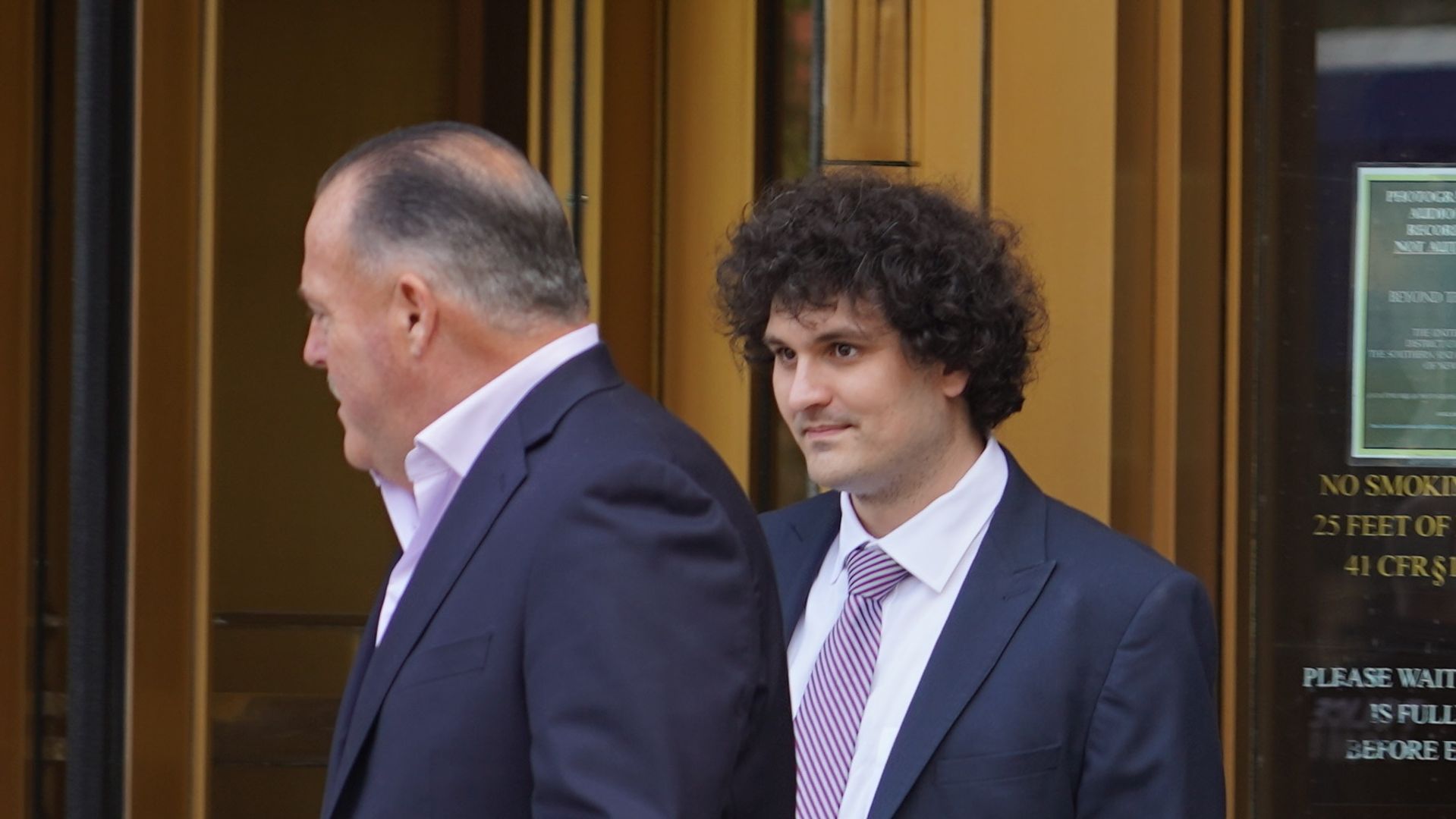
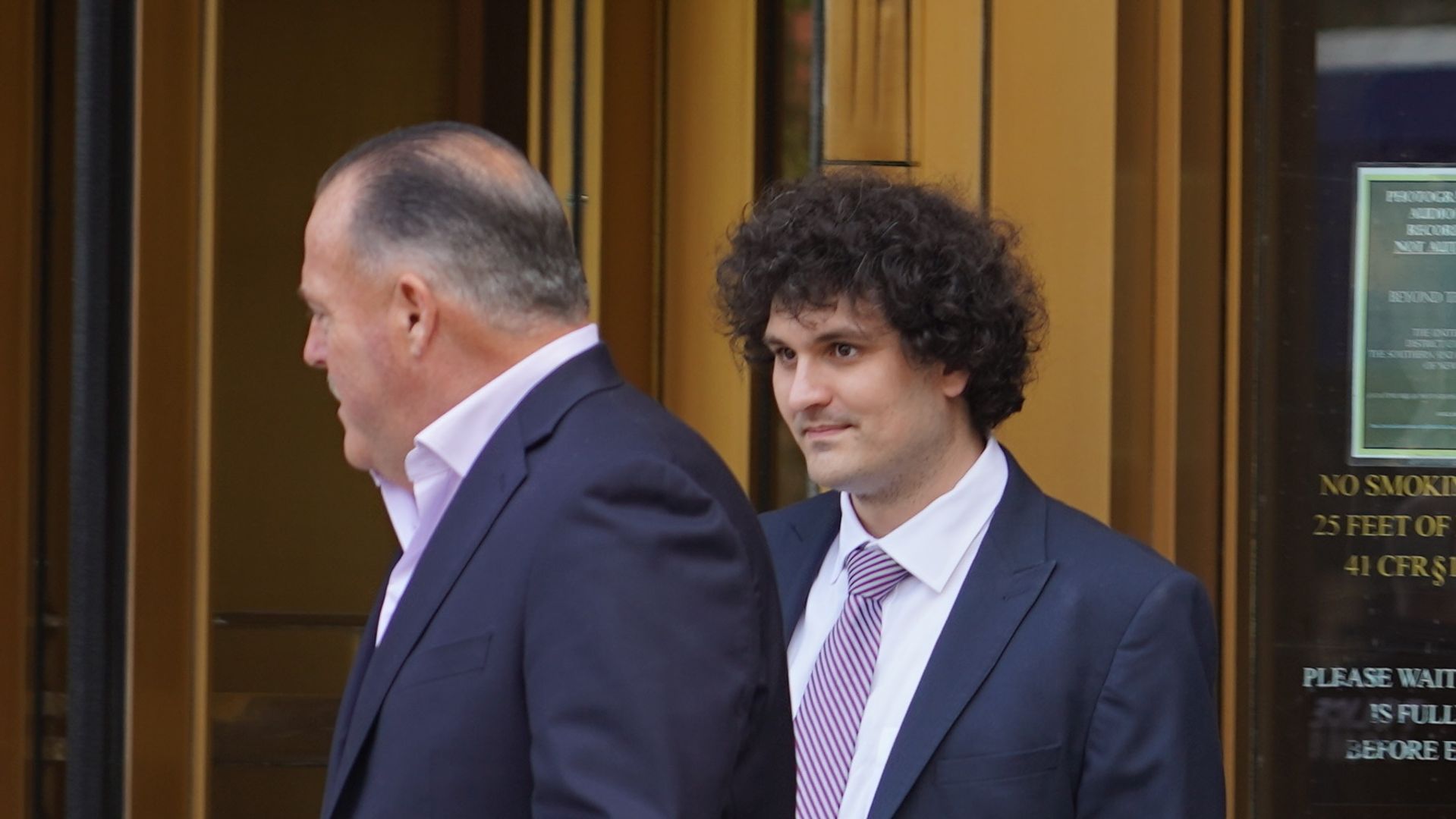
Federal prosecutors told a judge that a letter purportedly sent by Sam Bankman-Fried from prison was actually shipped via FedEx from somewhere else entirely, suggesting someone outside impersonated him.
The filing adds an unusual wrinkle to Bankman-Fried’s post-conviction fight. The FTX founder, sentenced to 25 years for fraud and conspiracy, has been pursuing a new trial from Federal Correctional Institution Terminal Island in San Pedro, California.
Prosecutors say the suspect letter was docketed March 16 but shipped from Palo Alto or Menlo Park, mislabeled the prison as a state facility, and carried a typed “/s/” instead of an actual signature.
Bureau of Prisons regulations bar inmates from sending mail through private carriers like FedEx, prosecutors noted.
Taken together, prosecutors said these discrepancies provide “reason to doubt” the letter was sent by Bankman-Fried.
The government did not accuse the defendant or his associates of fabricating the document, but the filing signals a willingness to challenge the reliability of materials submitted as part of his effort to secure a new trial.
Bankman-Fried has repeatedly argued that he did not receive a fair trial and has pointed to what he claims is new evidence, including the later recovery of customer funds through the FTX bankruptcy process.
Appellate judges have signaled skepticism toward that argument, stressing that the case turned on how customer funds were used and represented at the time, not whether creditors were later made whole.


Irish authorities have recovered a portion of a long-dormant Bitcoin stash tied to a convicted drug dealer, signaling a rare success in unlocking a decades-old cryptographic puzzle. The Criminal Assets Bureau (CAB) announced on Tuesday that it had gained access to and seized a cryptocurrency wallet containing 500 BTC, valued at more than $35 million, with crucial assistance from Europol’s European Cybercrime Centre.
Cabinet-level cooperation appears to have been pivotal. Europol reportedly hosted operational briefings at its headquarters in The Hague and supplied specialized technical expertise and decryption resources that supported CAB investigators and analysts in bringing the operation to fruition.
The wallet is part of a cluster of 12 addresses holding a total of about 6,000 BTC once linked to Clifton Collins, a drug dealer who received a five-year prison sentence for cannabis cultivation and distribution. The keys to these wallets were believed to be irretrievable after the paper containing them vanished from a fishing-rod case at Collins’ rental home.
“CAB gained access to and seized a cryptocurrency wallet” containing 500 BTC, the agency said, with support from Europol’s European Cybercrime Centre.
The disclosure underscores the evolving landscape of crypto asset recovery, where authorities increasingly combine off-chain investigations with on-chain tracing to locate and recover illicit funds long after their acquisition.
Key takeaways
- A 500 BTC wallet, one of 12 tied to Clifton Collins, has been seized by Irish authorities with Europol’s help, valued at over $35 million.
- The broader stash comprises about 6,000 BTC spread across 12 wallets, deposited by Collins in 2011–2012 and guarded by a paper key hidden in a fishing-rod case.
- Blockchain analytics firm Arkham has linked a wallet labeled “Clifton Collins: Lost Keys” to recent movement in the wallet cluster, including a transfer to Coinbase Prime.
- Arkham’s data indicate Collins controls 14 addresses with a total of roughly 5,500 BTC, valued at more than $391 million, highlighting the persistence and scale of his holdings despite prior legal actions.
- The case illustrates how cross-border law enforcement collaboration and decryptive capabilities can unlock “lost” crypto memories that were once deemed inaccessible.
Tracing a decade-old stash and its implications
The seizure traces back to a long-running narrative of how crime proceeds were converted into Bitcoin more than a decade ago. The 6,000 BTC in question reportedly flowed to multiple wallets in late 2011 and early 2012. Police describe the storage as an audacious yet ultimately fragile arrangement: private keys scattered across 12 wallets, and crucially, paper-based credentials hidden inside an aluminum cap within a fishing-rod case. When Collins was arrested in 2017, authorities say the landlord cleared out the rental home and discarded many belongings, complicating any effort to recover the keys.
While this story has a long tail in public reporting, the latest development shows that some of those “lost keys” can still unlock real value under the right circumstances. The Guardian’s coverage of Collins’ case provides the background on the criminal operation and the 2017 arrest, underscoring how a single possession—an apparently ordinary fishing-rod case—could become a cryptographic Achilles’ heel decades later.
Fresh on-chain activity and what it signals
Beyond the 500 BTC seizure, on-chain observers have noted movements linked to the Clifton Collins wallet cluster. Arkham, a blockchain analytics platform, traces a transfer of 500 BTC to Coinbase Prime from a wallet labeled “Clifton Collins: Lost Keys” on a recent Tuesday. Arkham’s explorer shows Collins as the controller of 14 addresses holding a combined 5,500 BTC, currently valued at more than $391 million.
The development has several practical implications. For investors and fund managers, it highlights that even “cold” assets tied to past criminal activity can re-enter the market or be moved to regulated custodians, potentially affecting liquidity and spot availability in sensitive coins. For traders and risk managers, it underscores the ongoing risk of asset provenance concerns—an issue that can influence compliance checks, KYC/AML workflows, and the perception of who ultimately controls large, long-dormant holdings.
Context and what to watch next
The case sits at the intersection of criminal finance, digital asset forensics, and international enforcement. It underscores the growing role of institutional-grade assistance in crypto asset recovery, including decryption resources and cross-border coordination. While only a portion of Collins’ original stash has been recovered to date, authorities have signaled that the collaboration with Europol will continue to pursue the remaining wallets where possible.
Readers should monitor further updates from the CAB and Europol as the investigation unfolds. The Arkham disclosures also warrant attention, as additional wallets in the cluster could surface new movements that shed light on the ultimate disposition of the roughly 6,000 BTC tied to Collins’ operations. The broader takeaway is clear: the line between traditional crime and digital assets is continually being redrawn as investigators apply both on-chain analytics and cooperative legal channels to recover illicit proceeds.
In the coming weeks, observers should watch for any additional wallet recoveries, updates on the status of the 12-wallet cluster, and whether more of Collins’ holdings surface in public or institutional custody. The episode serves as a reminder that even long-standing crypto hoards can be traced, unlocked, and, in some cases, repurposed for asset recovery and restitution.


Ripple is moving ahead with new payment plans tied to its RLUSD stablecoin as it targets faster cross-border trade settlement.
Summary
- Ripple and Unloq are testing RLUSD in Singapore to automate trade payments on XRP Ledger.
- BLOOM gives Ripple a regulated sandbox to test settlement tied to shipment verification and financing.
- The pilot adds to Ripple’s broader payments expansion in Asia and planned Australian licensing push.
According to the announcement, the company is working with supply chain finance firm Unloq to test a trade finance model on the XRP Ledger through BLOOM, a sandbox run by the Monetary Authority of Singapore.
Meanwhile, the pilot will examine whether RLUSD can replace manual payment steps that have slowed trade finance for years. Ripple and Unloq said the system can release payments “automatically when predefined conditions are met, such as shipment verification.”
Ripple plans to use RLUSD as the settlement asset in a pilot built with Unloq’s SC+ platform. The project aims to combine trade obligations, settlement rules, and financing workflows in one execution layer on the XRP Ledger.
The companies said current trade finance still depends on manual checks, documentary credits, and correspondent banking links that often take days or weeks to complete. They said the new model seeks to reduce delays by automating payment release once agreed trade conditions are verified.
The pilot will run inside BLOOM, which stands for Borderless, Liquid, Open, Online, Multi-currency. MAS launched the initiative in October 2025 to expand settlement options for tokenized bank liabilities and regulated stablecoins.
Ripple said the test will focus on whether RLUSD can replace manual processes that have “slowed cross-border trade for decades.” The companies also said the model could give firms better visibility into settlement risk while helping smaller businesses access trade-finance services.
RLUSD growth supports Ripple’s wider payments plan
Ripple launched RLUSD in December 2024 with institutional use as its main target. The stablecoin has grown to a market value near $1.5 billion, placing it among the largest stablecoins by market capitalization.
The BLOOM pilot comes less than four months after Ripple said MAS approved an expanded scope of payment activities for Ripple Markets APAC in December 2025. That approval added to Ripple’s push to deepen its role in regulated payment infrastructure in Asia.
As previously reported, Ripple has also outlined plans to expand in Australia through an Australian Financial Services License. The company said it aims to obtain that license by acquiring BC Payments Australia Pty Ltd., subject to the final completion process.

- Bitcoin price rebounds above $71,000 amid cautious market sentiment.
- Exchange outflows suggest long-term accumulation by investors.
- Geopolitical signals and Bitcoin transfers shape near-term trends.
Bitcoin has bounced back above $71,000 after a week of mixed signals in the market.
The move comes as investors closely watch geopolitical developments, particularly efforts to ease tensions in the Middle East.
Notably, a peace proposal between the United States and Iran has sparked cautious optimism, lifting risk assets and sending Bitcoin higher.
Despite the rebound, sentiment remains cautious, with the Fear & Greed Index at 35, signalling that investors are still in the “Fear” zone.
This suggests that while the price has recovered, many market participants are hesitant to commit fully, waiting for clearer direction.
Exchange outflows signal an accumulation phase
Recent on-chain data shows that more bitcoins have been leaving crypto exchanges than entering them.
This trend is often interpreted as a sign of accumulation.
Investors appear to be moving coins into private wallets for long-term holding rather than selling immediately.
The persistent outflows indicate confidence in Bitcoin’s fundamentals and a willingness to weather short-term price swings.
This accumulation behaviour can help reduce selling pressure in the market.
When coins leave exchanges, fewer are available for immediate trading, which often supports the price even during periods of uncertainty.
Bhutan Government moves $37 BTC
Adding another layer to the market dynamic, the Royal Government of Bhutan recently moved roughly $37 million worth of Bitcoin from government-controlled wallets, according to Arkham Intelligence data.
Analysts see this as a structured transfer rather than a sudden liquidation, suggesting careful treasury management.
While the exact motives are not fully public, such large-scale movements highlight that governments and large holders can influence liquidity.
These actions can affect market psychology, especially when combined with broader investor accumulation trends.
Bitcoin price forecast for the coming days
Overall, the market is in a consolidation phase, seeking a catalyst to define the next sustained move.
Exchange outflows, government movements, and geopolitical developments are all factors that could influence the next direction.
The recent Bitcoin price movements suggest that it may have recently hit bottom around $67,500, even though the broader picture is still uncertain.
But whether the current recovery signals a true bottom or just a temporary rebound remains to be seen, although the combination of accumulation behaviour, controlled government movements, and cautious optimism on geopolitical developments has created an environment where Bitcoin can maintain support and potentially build momentum.
A daily close above $73,000 could signal strength and potentially push the price toward $75,000, according to analysts.
Conversely, a break below $70,000 might prompt a retest of $67,500 support, marking a critical line for short-term investors.
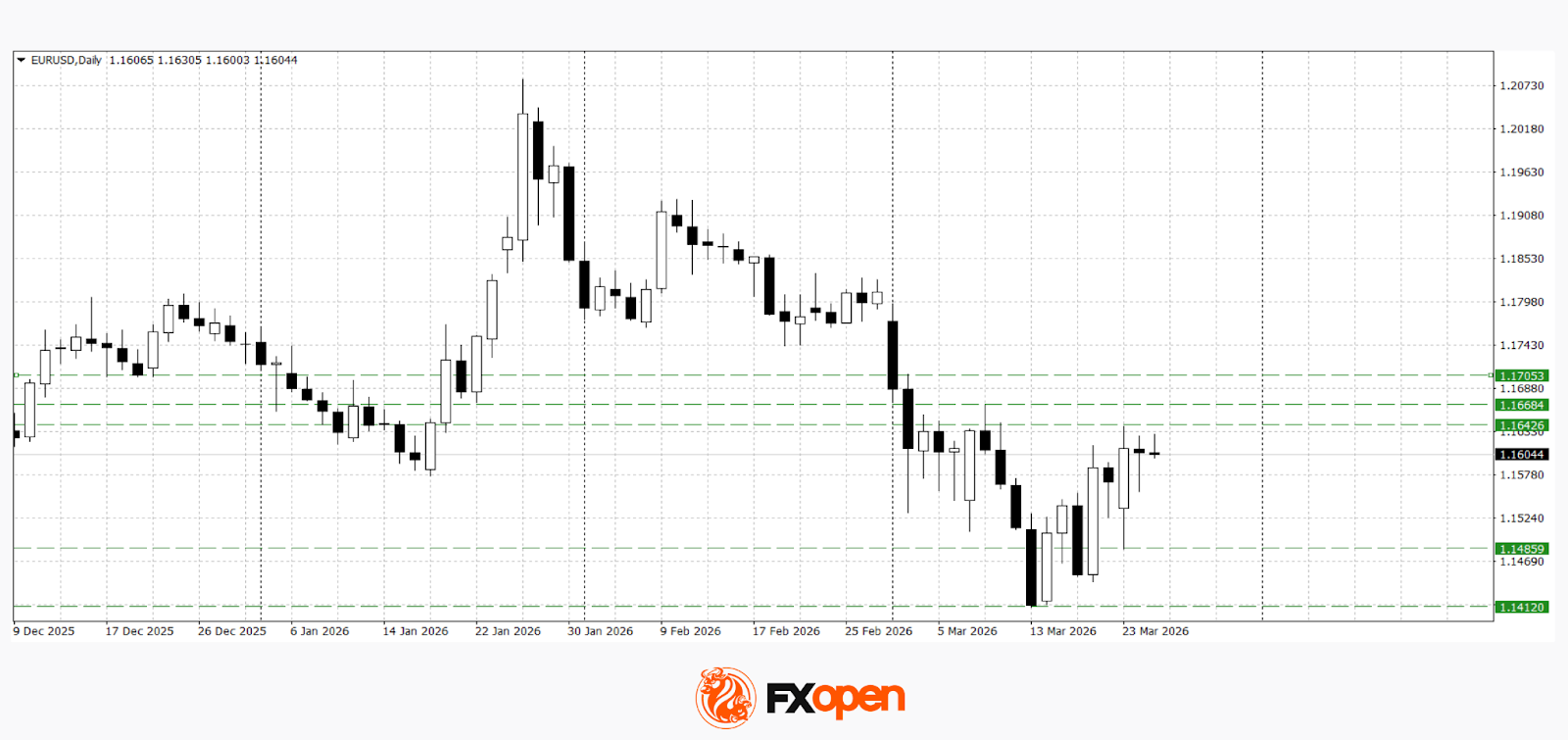
European currencies are trading without a clear direction against the US dollar, remaining in a consolidation phase following the earlier decline driven by USD strength. At the start of the week, both EUR/USD and GBP/USD attempted a recovery, but the upside proved limited, and the pairs are now testing the upper boundaries of their short-term trading ranges.
Market participants are adopting a wait-and-see approach ahead of the release of key macroeconomic data, which could determine the next direction for the dollar and major currency pairs. Geopolitical uncertainty in the Middle East remains an additional factor weighing on sentiment. Reports of ongoing tensions and risks to energy supply disruptions continue to support elevated oil prices, fuelling inflation expectations and prompting investors to reassess the outlook for central bank policy.
Today, the focus is on business activity and inflation data from Europe and the UK, as well as housing market and consumer activity figures from the US. These releases could significantly impact interest rate expectations, prompting traders to refrain from opening large positions ahead of the data.
EUR/USD
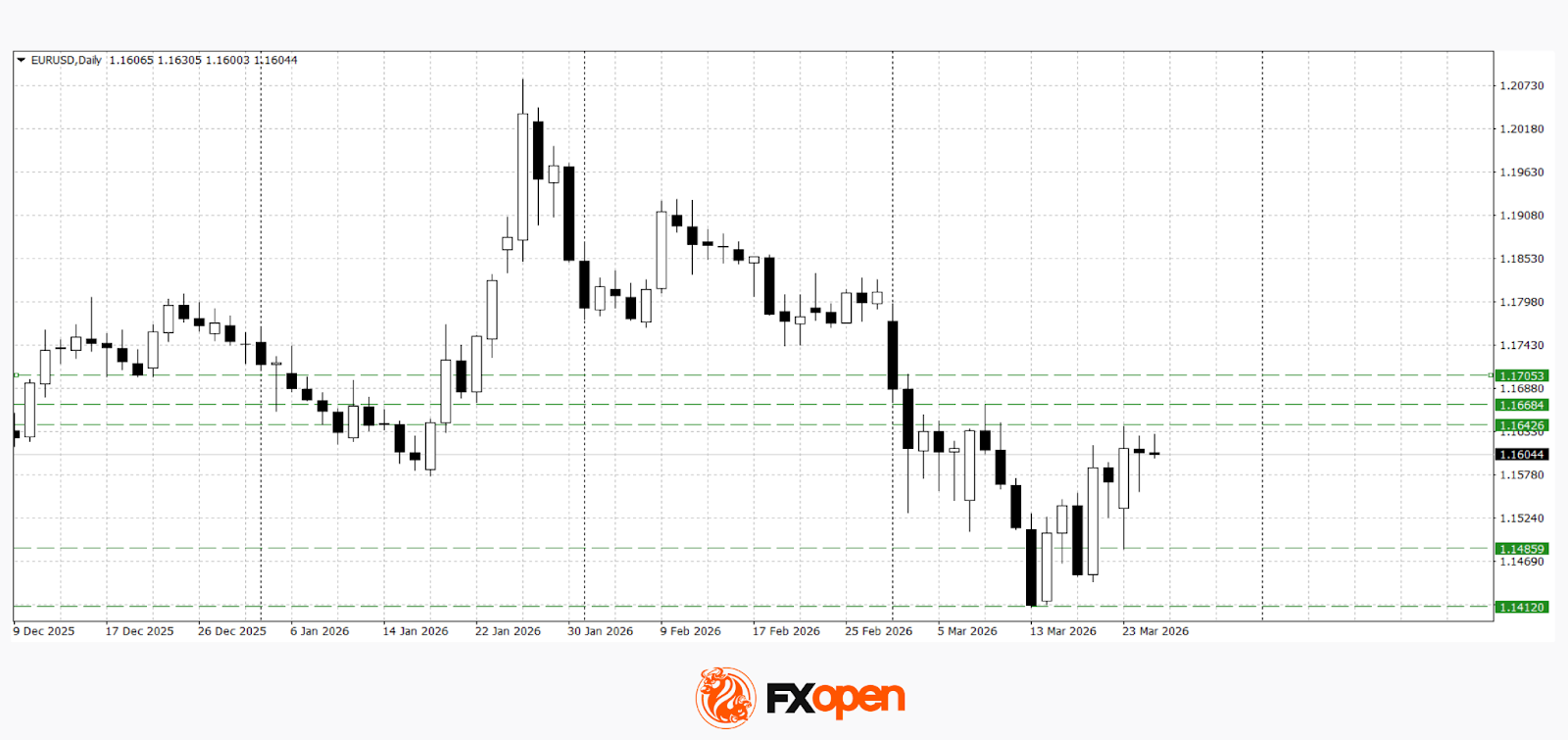
At the start of the week, EUR/USD tested key support near 1.1480 before rebounding above 1.1600. Technical analysis suggests a range-bound market: a rejection from the key resistance level at 1.1640 could lead to a renewed test of recent lows in the 1.1420–1.1480 area. Conversely, a firm break above 1.1640 and a move out of the range could open the way for further gains towards 1.1680–1.1710.
Key events for EUR/USD:
- Today at 11:00 (GMT+2): Germany business expectations index
- Today at 13:00 (GMT+2): Bundesbank monthly report
- Today at 14:30 (GMT+2): US current account balance
GBP/USD
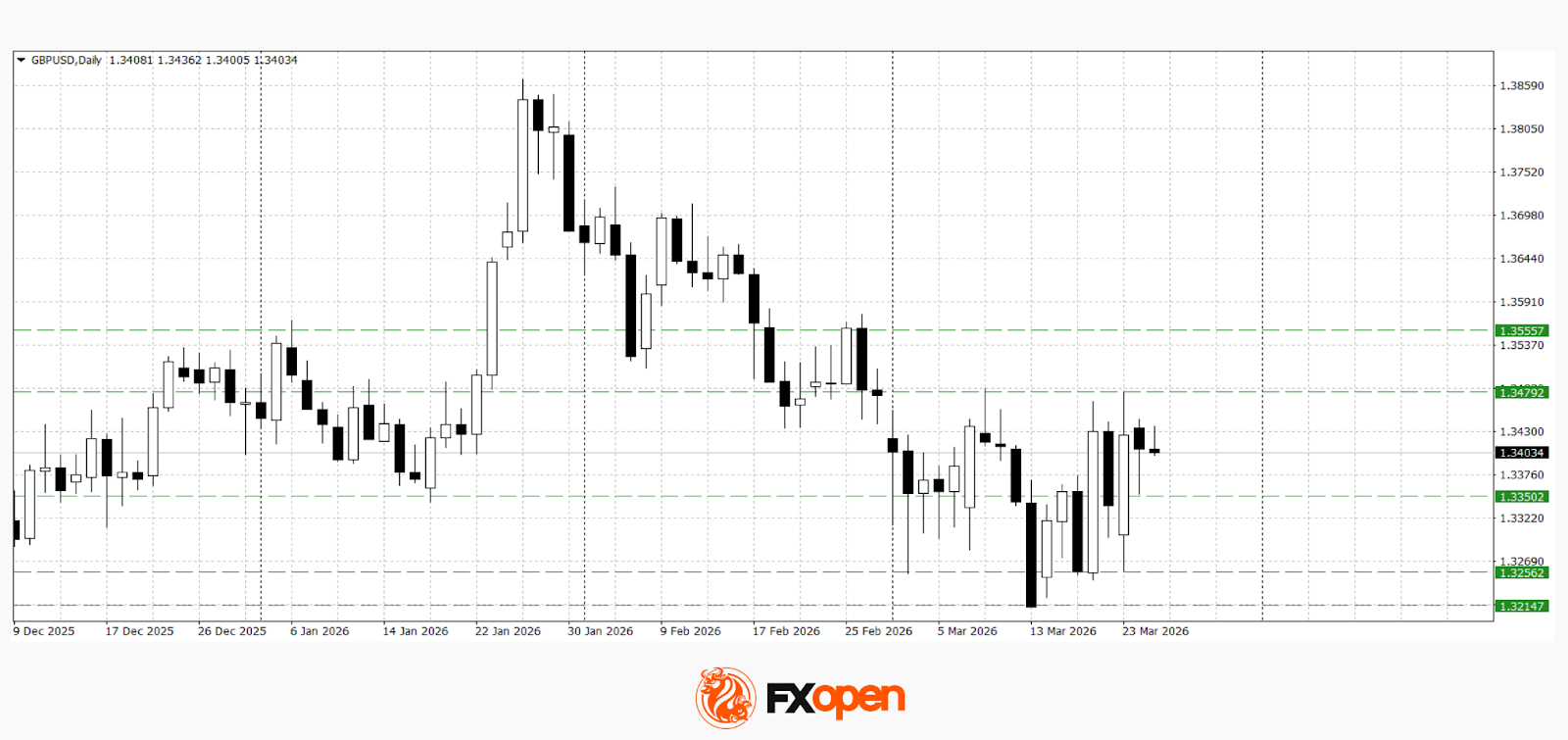
GBP/USD is also trading within a range. Following last week’s Bank of England meeting, the pair strengthened towards 1.3480 but failed to sustain upward momentum, retreating to 1.3250 on Monday. Technical analysis points to the potential for a retest of the recent high; however, in the event of weak UK data, a move lower towards the 1.3350–1.3250 area is equally possible.
Key events for GBP/USD:
- Today at 09:00 (GMT+2): UK Consumer Price Index (CPI)
- Today at 11:30 (GMT+2): UK house price index
- Tomorrow at 11:30 (GMT+2): Speech by Bank of England Financial Policy Committee member Sarah Breeden
Trade over 50 forex markets 24 hours a day with FXOpen. Take advantage of low commissions, deep liquidity, and spreads from 0.0 pips (additional fees may apply). Open your FXOpen account now or learn more about trading forex with FXOpen.
This article represents the opinion of the Companies operating under the FXOpen brand only. It is not to be construed as an offer, solicitation, or recommendation with respect to products and services provided by the Companies operating under the FXOpen brand, nor is it to be considered financial advice.
Crypto World
Cardano (ADA) Price: Historic Bullish Indicators Emerge as Token Tests Key Support Level
TLDR
- The 365-day MVRV metric for Cardano has plummeted to -43%, entering what market analysts identify as an accumulation zone
- ADA funding rates on Binance have hit their lowest point since June 2023, indicating extreme bearish positioning
- Total Value Locked on Cardano increased 3% over 24 hours to reach 525.44 million ADA, signaling sustained network activity
- Both metrics last converged at these levels in mid-2023, preceding an approximate 300% price increase over the next year and a half
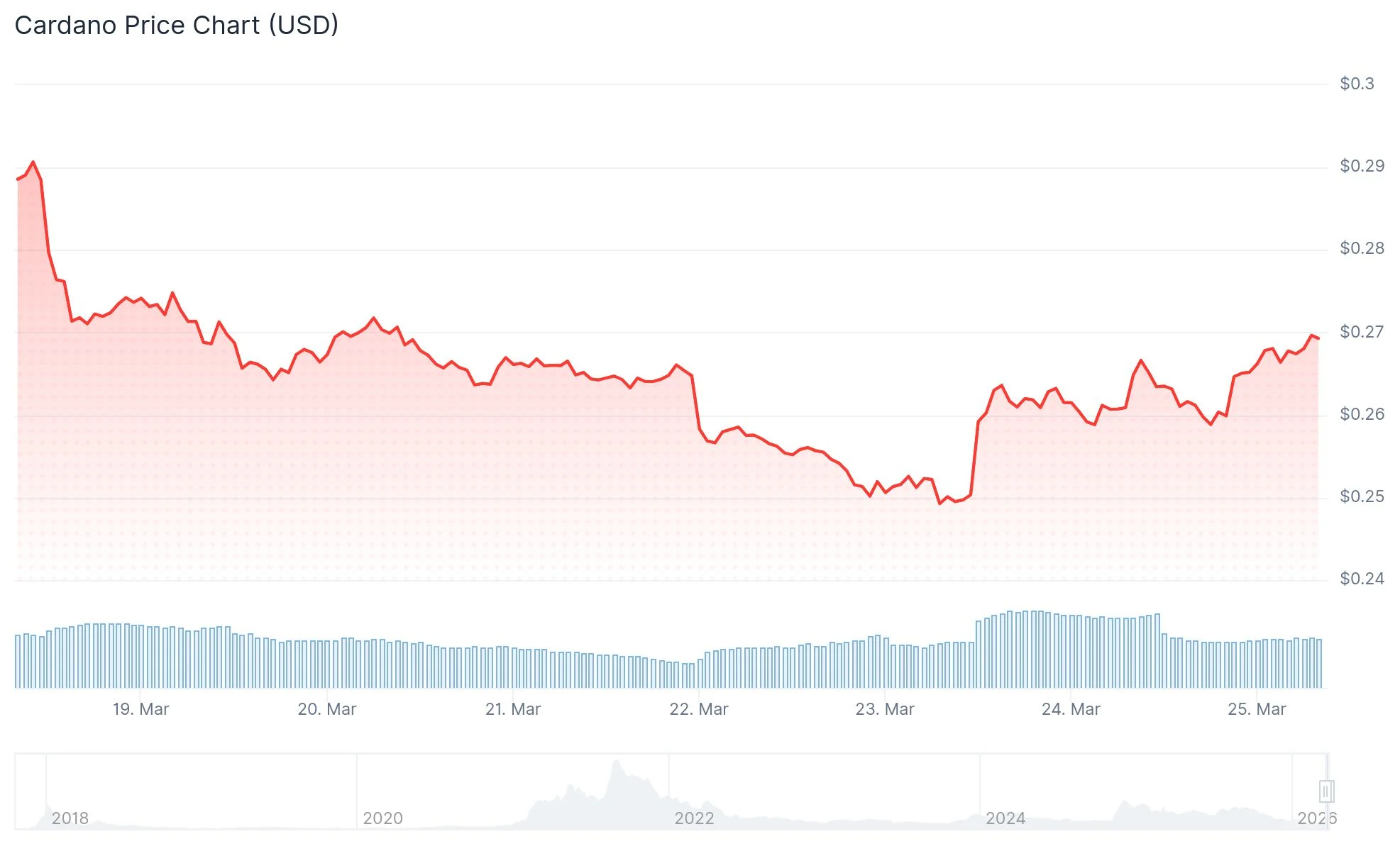
- Current ADA price stands around $0.26, reflecting a weekly decline of 7% and a 71% drop from September highs
Cardano is currently exchanging hands near the $0.26 mark following a 4% intraday recovery on Monday. A combination of two historically significant indicators from on-chain analytics and derivatives markets has simultaneously activated, mirroring conditions that previously signaled major price reversals.
The 365-day Market Value to Realized Value metric for Cardano has declined to -43%. This negative reading indicates that network participants who have been active over the previous 12 months are currently experiencing unrealized losses averaging 43%. Blockchain analytics provider Santiment categorizes this territory as the “opportunity zone.” Historical data suggests that when MVRV reaches such deeply negative values, the majority of weak-handed sellers have typically already capitulated.

The MVRV indicator measures the average profit or loss position of market participants across a defined timeframe and has historically demonstrated mean-reversion characteristics. When this metric falls significantly below zero, the remaining holders typically consist of long-term believers or investors who have already reconciled themselves to current losses. This dynamic substantially reduces the probability of additional capitulation events.
Concurrently, Binance’s weekly average funding rate for ADA perpetual futures has plunged to its most bearish level since June 2023. Funding rates in perpetual swap markets represent the cost exchange between long and short position holders. An extremely negative funding rate indicates that short sellers dominate the market and must compensate long position holders to maintain their bearish bets.
Why Short Crowding Matters
When bearish positioning reaches such extreme concentration levels, even modest upward price movements can catalyze cascading liquidations. Short positions get forcibly closed, requiring traders to purchase the underlying asset to cover their exposure, which subsequently drives prices higher and triggers additional liquidation events.
Market participants refer to this phenomenon as a short squeeze. For Cardano specifically, periods of extremely negative funding rates have more frequently preceded sharp upward price movements rather than continued downward trends.
The previous instance when both the MVRV indicator and funding rate metrics converged at comparable extreme levels occurred in mid-2023. At that juncture, ADA was trading near $0.25 before subsequently appreciating approximately 300% throughout the subsequent 18-month period.
According to DeFiLlama analytics, Cardano’s Total Value Locked experienced a 3% increase within a 24-hour window, climbing to 525.44 million ADA. The TVL measurement has exhibited a predominantly upward trajectory since the market correction that began in September.
Technical Levels to Watch
From a technical perspective, ADA continues to defend the $0.2436 support threshold, which previously served as a testing point on February 5. The upper boundary of the current range is established at $0.2991, last contacted on February 26.
Cardano remains positioned beneath its 50-day, 100-day, and 200-day Exponential Moving Averages, all of which maintain bearish downward trajectories. The Relative Strength Index registers at 45, marginally below the 50-level neutral threshold. The MACD indicator has crossed back underneath its signal line.
ADA has depreciated approximately 71% from its September zenith and trades roughly 7% lower across the weekly timeframe.



OpenAI has started shutting down the Sora app, a move that marks a sharp pullback from its consumer video push.
Summary
- OpenAI started shutting down the Sora app and said timelines for users would follow soon.
- Reports said OpenAI is winding down more video products beyond the consumer-facing Sora app too.
- Sora grew quickly, but deepfake concerns and a stalled Disney deal added pressure over time.
On Tuesday, the Sora app account said, “We’re saying goodbye to the Sora app,” and added that more details would follow on timelines for the app, the API, and ways users can preserve their work.
The move came just days after OpenAI’s own help pages described Sora 2 and the Sora app as active products. A March 23 safety page said “The Sora 2 model and the Sora app” were available, while March 19 release notes announced new editing tools on iOS and web.
The Wall Street Journal reported that Chief Executive Sam Altman told staff OpenAI would wind down products built around its video models. Reuters, citing sources familiar with the matter, said that includes the consumer app and other video-related offerings as the company shifts resources to coding, enterprise tools, robotics, and broader AI goals.
OpenAI has not yet posted a full product blog on its main site explaining the broader change. Its current developer documentation still lists Sora 2 and Sora 2 Pro among OpenAI’s video generation models, which shows some public pages had not yet caught up with Tuesday’s decision.
Sora gained users but also drew criticism
OpenAI launched the Sora app on September 30, 2025, starting with invite-only iOS access before expanding further. The company described it as a new app for short video creation, while outside reports said it reached 1 million downloads within five days of launch.
The product also faced pressure over deepfakes, copyrighted characters, and other misuse concerns. The Associated Press reported that OpenAI restricted some public-figure content after protests from families and entertainment groups, while OpenAI’s own safety material said it used watermarks, moderation systems, and provenance tools inside Sora.
In addition, the shutdown also affects a planned Disney tie-up that had drawn market attention. The Disney arrangement did not close and that no funds changed hands, even though the proposed deal had included licensed characters and a large equity component.

Key Takeaways
- Irish authorities and Europol successfully accessed a Bitcoin wallet inactive for almost ten years
- Approximately 500 BTC valued at roughly $35 million was transferred to Coinbase on March 24, 2026
- The cryptocurrency belonged to Clifton Collins, a convicted cannabis cultivator who concealed his private keys in a fishing rod container
- Authorities believed the keys were permanently lost when Collins’ possessions were disposed of in a landfill after his 2017 detention
- Law enforcement officials are confident the technique used can unlock the other 11 wallets containing over €330 million
The Criminal Assets Bureau (CAB) of Ireland, working alongside Europol, has gained access to a Bitcoin wallet that remained untouched for close to ten years. The wallet contained 500 BTC, currently valued at approximately $35 million, which was moved on-chain and deposited into Coinbase on March 24.
The cryptocurrency belonged to Clifton Collins, a Dublin resident who was found guilty of operating large-scale cannabis growing operations spanning several Irish counties over more than a decade. Before his criminal enterprise, Collins worked in security and beekeeping.
Between 2011 and 2012, Collins purchased 6,000 Bitcoin when the digital currency was trading for just a few dollars. He financed these acquisitions using profits from his cannabis business.
Collins divided his 6,000 BTC holdings evenly among 12 separate wallets, placing 500 BTC in each one. He printed all the private keys onto a single piece of paper and concealed this document inside a fishing rod case at his rented residence in Galway.
In 2017, law enforcement arrested Collins following the discovery of cannabis during a routine vehicle inspection. Subsequently, his landlord cleared out the property and discarded Collins’ belongings at a landfill site.
The fishing rod case containing the sole copy of the private keys was almost certainly destroyed in the process. Collins later indicated that a burglary at the property might have also played a role.
In 2020, an Irish High Court mandated the seizure of the Bitcoin. At the time, the 6,000 BTC was valued at approximately €53 million. Today, that same amount is worth roughly €360 million.
Despite the court’s ruling, CAB had no method to access the cryptocurrency without the private keys. Both law enforcement and Collins assumed the Bitcoin was irretrievably lost.
The Method Behind the Breakthrough
CAB and Europol have not revealed the specific method used to access the wallet. Europol stated only that it supplied “highly complex technical expertise and decryption resources.”
One hypothesis suggests Collins may have stored his keys in an encrypted file secured by a weak password, which investigators could have cracked using brute force techniques.
An alternative explanation is that Collins employed a defective tool to create all 12 key pairs. A compromised random number generator could have produced predictable keys, enabling investigators to recreate them.
Authorities reportedly have high confidence that the identical approach can be used on the other 11 wallets.
Outstanding Holdings
Collins still possesses 5,500 Bitcoin, currently worth approximately $389 million based on Arkham intelligence.
Should CAB successfully unlock all remaining wallets with the same methodology, recovering the complete 6,000 BTC would represent the largest single asset confiscation in the bureau’s operational history.
The 500 BTC transferred on March 24 represents the first verified access to any of Collins’ wallets since his apprehension nine years ago.
Key Takeaways
- XRP currently trades at $1.39, experiencing a 3.46% decrease over the past day
- Critical support remains intact at the $1.40 level following recent pullback
- Resistance zone between $1.45 and $1.50 represents the next hurdle for bulls
- The Relative Strength Index rests at 46, indicating subdued buying momentum
- Failure to hold $1.3850 support may trigger further downside toward $1.3620
XRP maintains its position near a crucial support threshold following sustained bearish pressure. The digital asset has retreated from recent peak levels and currently consolidates within the $1.40 vicinity.
Current market data shows XRP changing hands at $1.39. Daily trading volume reaches $3.16 billion while the total market capitalization stands at $85.87 billion, per CoinMarketCap statistics. The cryptocurrency has shed 3.46% of its value during the last 24-hour period.
The token previously surged beyond the $1.41 and $1.42 marks, ultimately reaching a session high of $1.4650. Following this peak, sellers emerged and forced the price below both $1.45 and $1.44 thresholds.
Price action breached the 61.8% Fibonacci retracement level calculated from the swing low of $1.3612 to the swing high of $1.4650. Demand materialized around $1.3850, coinciding with the 76.4% Fibonacci level, preventing additional downside movement.
Market analyst BitGuru observed on March 24 that XRP operates within what he identifies as a significant accumulation zone. His assessment indicates that price behavior follows a falling wedge pattern breakdown, with XRP potentially establishing support at the $1.40 level.
$XRP is moving inside a key accumulation zone after a long downtrend and recent falling wedge breakdown.
Price is now stabilizing around 1.40 support, showing signs of base formation. If buyers manage to push and hold above 1.45–1.50 resistance. pic.twitter.com/AFIZozlx3b
— BitGuru 🔶 (@bitgu_ru) March 24, 2026
Momentum Indicators Signal Cautious Sentiment
The Relative Strength Index currently registers approximately 46, remaining beneath the neutral 50 threshold. This positioning indicates that bearish forces continue to dominate market sentiment.
XRP also trades beneath its 20-day moving average positioned at $1.41 and significantly below the 200-day moving average at $2.09. The moving average configuration displays a bearish alignment.
MACD indicator lines remain horizontal within negative territory. The absence of a bullish crossover signal indicates that momentum has yet to shift toward buyer favor.
Critical Price Levels for Traders
Regarding upside potential, initial resistance emerges near $1.4250. Clearing this barrier would expose $1.44, followed by $1.4650.
A decisive breakout above $1.4650 could establish targets at $1.50 and subsequently $1.5250. Bulls must defend the $1.4250 level to sustain any upward trajectory.
Should XRP encounter rejection at higher levels, the initial support line sits at $1.40. Additional downside cushions exist at $1.3850 and $1.3620.
A daily close beneath $1.3620 may accelerate selling toward $1.35 or potentially $1.3320.
This trendline could offer a strong buying opportunity for $XRP! pic.twitter.com/rdyxCeal1s
— Ali Charts (@alicharts) March 20, 2026
Technical analyst Ali Charts shared on X that an important trendline may present a compelling accumulation opportunity for XRP, highlighting the present support region as a favorable entry zone.
XRP presently maintains levels above both $1.40 and the 100-hourly Simple Moving Average, with market participants adopting a cautious stance as they monitor developing price patterns.
TLDR:
- The Philippines imports 98% of its oil from Gulf nations, all directly disrupted by the ongoing Iran war conflict.
- Fuel prices have nearly tripled since February 28, with diesel hitting 130 pesos and LPG reserves lasting just 24 days.
- President Marcos signed Executive Order 110, granting authority over fuel rationing and essential goods distribution nationwide.
- Labor union KMU warned the emergency order could restrict worker strikes, with transport workers planning a two-day strike this week.
The Philippines has become the first country to declare a national energy emergency linked to the ongoing Iran war. President Ferdinand Marcos Jr. signed Executive Order 110 on Tuesday.
The order cites an imminent danger to the country’s energy supply stability. With roughly 45 days of fuel remaining on average, the government is moving quickly.
The declaration grants broad authority over fuel purchasing, rationing, and distribution of essential goods across the nation.
A Nation Running Low on Fuel
The Philippines imports 98% of its oil from the Gulf region. Its top three suppliers — Saudi Arabia, the UAE, and Iraq — are all caught up in the conflict.
Together, these three nations account for billions of dollars in annual oil exports to the Philippines. With the Strait of Hormuz effectively shut down, those supply lines have been severely disrupted.
Saudi Arabia has already cut oil exports to Asia for a second straight month. Meanwhile, the Philippines produces just 14,300 barrels of oil per day domestically.
The country consumes around 474,000 barrels daily, leaving a 97% gap between supply and demand. That gap is now at the center of a deepening national crisis.
As TFTC noted on X: “The Philippines just became the first country in the world to declare a national energy emergency over the Iran war. They have 45 days of fuel left.”
Energy Secretary Sharon Garin provided a detailed breakdown of current reserves. “Gasoline for 53 days, diesel for 46 days, jet fuel for 39 days, and LPG for just 24 days,” Garin stated. The 45-day figure represents the average across all petroleum products. These numbers have pushed the government toward emergency measures.
Fuel Prices Surge as Government Acts
Fuel prices in the Philippines have nearly tripled since the war began on February 28. Diesel, widely used across the country, has surged to nearly 130 pesos per liter.
Kerosene, a cooking fuel for lower-income households, has climbed to 145 pesos. Gasoline has now exceeded 90 pesos per liter, more than double pre-war levels.
In response, the government has introduced several conservation measures. Civil servants are now on a four-day workweek to cut fuel use.
Ferry services have also been reduced, and transport workers are receiving 5,000-peso subsidies. The country is also shifting temporarily to coal-fired power plants to reduce reliance on liquefied natural gas.
Labor unions, however, are not satisfied. The KMU, the Philippines’ largest labor coalition, described the executive order as an “admission” that the government failed to act sooner.
The group also warned that provisions in the order could be used to “restrict strikes and protests.” Transport workers are planning a two-day strike on Thursday and Friday in direct response to the crisis.


Robinhood has approved a share repurchase program worth $1.5 billion, according to a filing with the U.S. Securities and Exchange Commission on Tuesday. The company said it plans to execute the buyback over the next three years.
Summary
- Robinhood approved a $1.5 billion share buyback program to run over the next three years.
- HOOD closed down 4.7% Tuesday and remains nearly 39% lower so far in 2026 overall.
- Robinhood replaced its prior credit line with a new $3.25 billion JPMorgan revolving facility Tuesday.
According to the filing, the total includes $1.1 billion in new capacity. Robinhood rolled over the rest from an older repurchase plan. The company said the move reflects its capital plans as it continues to build new products and return value to shareholders over time.
Robinhood Chief Financial Officer Shiv Verma addressed the decision in a company statement. He said,
“Robinhood is a generational company with a massive long-term opportunity.” Verma also said, “This authorization reflects the confidence of our management team and board in our ability to continue delivering innovative products for customers and creating value for shareholders while returning capital over time.”
The company linked the program to its broader business strategy rather than to a short-term market move.
Robinhood shares closed Tuesday at $69.08, down 4.7% on the day. That marked the stock’s lowest closing price of the year. The shares later recovered slightly to $70.90 in after-hours trading.
The stock has fallen nearly 39% so far this year. It also stands 54.7% below its October peak of $152.46. The decline came during a weak period for both stocks and crypto, with broader macro concerns and the Iran war weighing on risk assets.
Credit facility expands while growth plans continue
Robinhood also said its unit, Robinhood Securities, entered a new $3.25 billion revolving credit facility with JPMorgan Chase. The new facility replaces a prior $2.65 billion line. It also includes an option to expand by up to $1.62 billion, which would bring the total capacity to $4.87 billion.
Even with pressure on its share price, Robinhood continues to push into crypto, tokenization, and adjacent financial products. The company launched the testnet for its Ethereum layer-2 network in February. Chief Executive Officer Vlad Tenev said the network processed 4 million transactions in its first week of public testnet activity.
Robinhood plans to launch the mainnet later this year to support tokenized equities, ETFs, and other traditional financial assets. Robinhood Ventures Fund has also invested about $35 million across Stripe and ElevenLabs.

Kristin Cavallari Blasts Married Man For Repeatedly Liking Her Instagram Posts
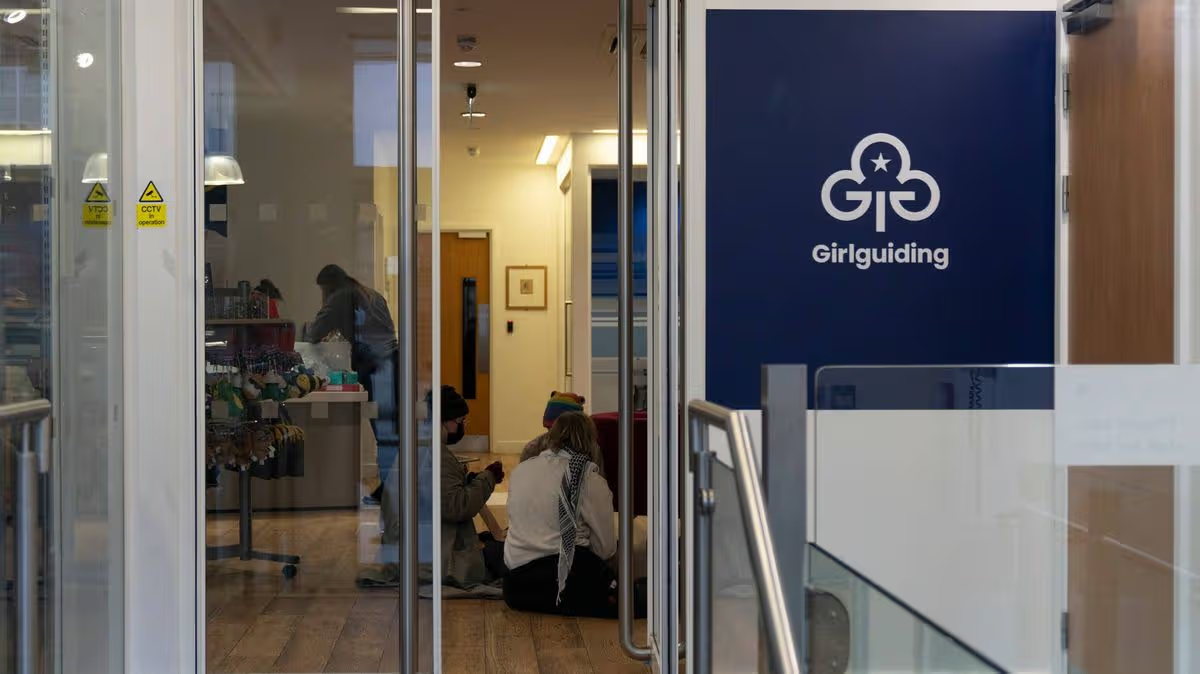
Girlguiding tells transgender girls they must leave by September

Australia’s Trucking Fleet Faces Potential Shutdown Within 30 Days


-
 Crypto World4 days ago
NIO (NIO) Stock Plunges 6.5% as Shelf Registration Sparks Dilution Worries
-

 Fashion5 days ago
Weekend Open Thread: Adidas – Corporette.com
-

 Politics5 days ago
Jenni Murray, Long-Serving Woman’s Hour Presenter, Dies Aged 75
-

 Crypto World3 days ago
Best Crypto to Buy Now: Strategy Just Spent $1.57 Billion on Bitcoin During Fear While Early Investors Quietly Enter Pepeto for 150x Potential
-

 News Videos7 days ago
RBA board divided on rate cut, unusually buoyant share market | Finance Report | ABC NEWS
-

 Crypto World3 days ago
Bitcoin Price News: Bhutan Sells $72 Million in BTC Under Fiscal Pressure, but the Smart Money Entering Pepeto Sees What the Market Does Not
-

 Politics7 days ago
The House | The new register to protect children from their abusers shows Parliament at its best
-

 Tech5 days ago
inKONBINI Lets You Spend Summer Days Behind the Register
-

 Crypto World7 days ago
Canada’s FINTRAC revokes registrations of 23 crypto MSBs in AML crackdown
-

 Sports2 days ago
Remo Stars and Kano Pillars Strengthen Survival Hopes in NPFL
-
 NewsBeat6 days ago
Residents in North Lanarkshire reminded to register to vote in Scottish Parliament Election
-

 News Videos7 days ago
PARLIAMENT OF MALAWI – PAC MEETING WITH REGISTRAR OF FINANCIAL ON AMARYLLIS HOTEL – INQUIRY LIVE
-

 Politics6 days ago
Gender equality discussions at UN face pushbacks and US resistance
-

 Business3 days ago
No Winner in March 21 Drawing as Prize Rolls to $133 Million for Next
-

 Business7 days ago
Who Was Alex Pretti? 5 Key Facts About the ICU Nurse Killed by Federal Agents in Minneapolis
-

 Sports2 days ago
Gary Kirsten Accuses Pakistan Cricket Board Of ‘Interference’, Mohsin Naqvi Responds
-

 Tech3 days ago
Give Your Phone a Huge (and Free) Upgrade by Switching to Another Keyboard
-

 Tech7 days ago
Inventec’s bizarre VeilBook laptop hides its touchpad under a sliding keyboard just to give cooling fans a little breathing room
-

 Sports5 days ago
2026 Kentucky Derby horses, odds, futures, preview, date: Expert who nailed 12 Derby-Oaks Doubles enters picks
-
Sports6 days ago
Vikings Free Agency Enters Phase 2 with Key Questions
You must be logged in to post a comment Login