
Crypto World
Provenance Blockchain TVL Hits All-Time High of $1.2 Billion



HELOC provider Figure Markets accounts for the network’s entire TVL.
The Provenance blockchain hit a new milestone on Wed. Feb. 11, as its total value locked (TVL) climbed to an all-time high of $1.2 billion.
This marks a 7% increase in TVL over the past 24 hours, and a roughly 570% jump since early November 2025, when TVL stood at about $179.9 million, according to DeFiLlama data.
Notably, Figure Markets is currently the only protocol tracked on Provenance by DeFiLlama, meaning the network’s entire TVL is essentially tied to Figure’s activity. Figure Markets is described as a decentralized custody platform, which offers spot trading, crypto-backed lending, and yield-bearing assets.
DeFiLlama data shows Figure Markets’ TVL at approximately $1.22 billion, with about $301 million currently borrowed. The protocol has generated roughly $3.84 million in annualized fees and revenue, while 30-day decentralized exchange volume stands at approximately $2.08 billion.
Figure Technologies, the entity behind Figure Markets and Provenance, currently leads in the tokenized private credit space, accounting for $15 billion of the market’s $20 billion active loans, per RWAxyz. The company is also the largest non-bank home equity line of credit (HELOC) originator in the U.S.
Meanwhile, Provenance’s native token, HASH, was the second-best performing token on the day, rising about 8% in 24 hours to trade near $0.018, according to CoinGecko. Figure’s HELOC token is currently trading at $1.02, down 1% on the day.
Provenance’s TVL increase comes amid renewed attention towards tokenized real-world assets (RWAs), which have grown 14% over the past month to a distributed asset value of over $24.7 billion.
Experts are Divided
Still, not everyone views the milestone as a structural breakthrough. Brian Huang, co-founder of Glider, told The Defiant that tokenizing assets on a standalone or siloed blockchain does not necessarily increase their utility.
“Assets aren’t any more useful on chain than offchain unless they have composability. Provenance has no composability,” Huang said. “Overall, I wouldn’t read into the $1.2 billion in assets. In the long term, tokenization will favor open protocols like Ethereum and Solana.”
Danny Nelson, Research Analyst at Bitwise Asset Management, took a different viewpoint, calling Provenance’s business “very real.”
“It’s the secret sauce fueling Figure Markets’ rise to become the largest non-bank home equity loan (HELOC) business in the U.S,” Nelson said. “Figure Markets purpose built Provenance Chain to handle its HELOCs.”
He explained that Figure represents all loan-related paperwork, contracts, and finances as tokens on the blockchain. “There, it can process everything much faster than a traditional lending business can,” Nelson added. “Figure is cutting the costs of creating each loan, and speeding up its processing, by handling the entire loan lifecycle on Provenance.”
Provenance’s growth follows a January announcement from Figure launching the On-Chain Public Equity Network (OPEN) on Provenance. The move allowed companies to list their equity natively on-chain.
“Unlike other tokenization efforts, OPEN equities are blockchain-registered, not a tokenized version of Depository Trust and Clearing Corporation (DTCC) securities,” the announcement reads.
Figure said its own stock will be the first public equity trading natively on the blockchain, with market makers including Jump Trading preparing to support the platform.
The Defiant reached out to Figure and Provenance for comment, but has not heard back at the time of publishing.



xAI Terafab teams have contacted Applied Materials, Tokyo Electron, and Lam Research for price quotes and delivery times on chipmaking equipment, with Musk’s representatives telling suppliers the project needs to move at “light speed” and offering to pay above quoted prices for priority.
Summary
- Staff from the Tesla and SpaceX joint venture behind Terafab have reached out to major chip equipment makers for quotes on photomasks, substrates, etchers, depositors, cleaning devices, and testers, per Bloomberg.
- Samsung was also contacted for support but responded by offering to allocate more production capacity at its Taylor, Texas facility rather than joining the initiative directly.
- The first milestone is a pilot line capable of processing 3,000 wafers per month, with silicon chip manufacturing targeted to begin by 2029.
xAI Terafab has moved from announcement to active procurement, with teams from the Tesla and SpaceX joint venture contacting Applied Materials, Tokyo Electron, and Lam Research for chipmaking equipment prices and delivery windows, Bloomberg reported April 16 citing people familiar with the matter.
The outreach covers photomasks, substrates, etchers, depositors, cleaning devices, testers, and other tools. In one instance, staff asked a supplier on a holiday Friday for estimates to be delivered the following Monday. Musk wants to move at “light speed,” the supplier was told, and Terafab is offering to pay considerably above quoted amounts if suppliers give it priority.
The contacts mark the first concrete indication that Terafab has crossed from concept to procurement planning. No formal orders have been placed, and suppliers are being given minimal information about the products to be manufactured, which analysts say reflects the project’s early stage.
Terafab is a $25 billion joint venture between Tesla, SpaceX, and xAI. Musk unveiled it at Giga Texas in Austin in March 2026, describing it as “the most epic chip-building exercise in history.” The project targets one terawatt of annual AI compute output, roughly 50 times current global AI chip production, through a vertically integrated facility combining design, fabrication, packaging, and advanced logic under one roof.
Intel joined the initiative on April 7 as foundry partner, contributing its 18A process node, the most advanced logic manufacturing capability produced entirely within the United States. Intel CEO Lip-Bu Tan said Musk has “a proven track record of reimagining entire industries.”
Samsung Said No to Joining
The Terafab team also approached Samsung Electronics for direct support. Samsung declined, instead offering to allocate additional production capacity for Tesla at its planned Taylor, Texas facility. That response underscores ongoing skepticism in the established semiconductor industry about Terafab’s ambitions, even as individual equipment suppliers engage.
Bernstein Research estimated the true capital required to hit one terawatt of annual compute at approximately $5 trillion, roughly 200 times the $25 billion budget cited. Berenberg’s head of tech equity research, Tammy Qiu, said her bank has yet to include Terafab in its financial models for ASML, whose EUV equipment would likely be needed at scale.
Timeline and Crypto Market Angle
The first step is a pilot line capable of processing 3,000 wafers per month, with silicon chip manufacturing targeted to begin by 2029. The chips would power Tesla’s Full Self-Driving stack, Optimus humanoid robots, and SpaceX and xAI space infrastructure.
Tokyo Electron shares rose 5.3% in Tokyo on Thursday on news of the supplier contacts. Shares of Applied Materials, Lam Research, and other equipment makers also moved higher. Wedbush analyst Dan Ives called it an early step toward Tesla’s long-term AI infrastructure strategy.
For crypto, the Terafab buildout intensifies competition for high-end fabrication capacity globally. As analysts have noted, AI compute and Bitcoin mining are both industrial-scale races for the same underlying semiconductor resources, with the winner in AI chip supply increasingly determining which AI players can scale, and which crypto mining operations can remain cost-competitive.


Across two record-breaking days this week, Strategy’s 11.5% dividend-paying preferred stock, STRC, likely raised more than $1.2 billion and could even have raised as much as $2.7 billion.
Whatever the figure, it was enough to trigger popular crypto YouTuber Coffeezilla to take the STRC controversy mainstream.
The volatile, quasi-pegged STRC is the subject of intense debate among bitcoin (BTC) investors on social media.
It usually pays monthly dividends and trades near $100, yet has fluctuated more than 9% across its brief lifespan and can suspend dividend payments at the discretion of its board of directors.
Depending on the estimation methodology ahead of Monday’s formal SEC filing, Strategy’s STRC sales on Monday and Tuesday this week could have funded the purchase of anywhere between 17,204 and 29,914 BTC.
Although that pace is certainly unprecedented — and likely unsustainable — if it were to actually persist, Strategy’s rate of purchases would remove over 10% of the circulating supply of BTC from the market within 12 months.
Skeptical as ever, Coffeezilla published an 18-minute video on his second YouTube channel, which boasts 1.5 million subscribers and is reserved for higher production content.
The sleuth questioned almost every claim about STRC made by its issuer, Michael Saylor’s BTC acquisition company Strategy. He cautioned against CEO Phong Le’s advice to consider STRC for someone’s primary savings, including people living paycheck-to-paycheck.
He highlighted why STRC is not a bank account, money market, nor any type of insured savings product.
Not a bank account, money market, or fixed income
Coffeezilla also highlighted the lack of redemption rights of STRC holders who must re-sell their stock to other traders, not the company, in order to get their money back.
He contested any characterization of voluntary dividend payments as “fixed income” and lamented promoters misrepresenting its features to Main Street workers.
Coffeezilla’s criticism racked up 800,000 views in less than 24 hours. He compared STRC’s 11.5% yield to Terra Luna’s unsustainable returns on its Anchor stablecoin offering that once reached 20%, and flagged Strategy’s junk B- credit rating from S&P.
He was particularly concerned that 80% of STRC buyers are retail investors, indicating a lack of financial sophistication for a highly sophisticated, leveraged, and financially engineered offering.
Coffeezilla then zeroed-in on Saylor’s repeated comparisons of STRC to money market funds, even though STRC isn’t any type of money market fund, noting that Strategy itself admits that it’s “not required to hold any assets to back the STRC Stock.”
Strategy now holds more than 780,897 BTC at an average cost basis of $75,577. BTC actually trades near $74,000, meaning its entire treasury is underwater.
Coffeezilla controversy with STRC suitcoiners
Adam Livingston, a staunch supporter of Strategy, posted a 32-minute rebuttal within hours. He opened with his characteristically sensational style, falsely claiming, “STRC is the greatest fixed income investment ever.”
Coffeezilla disagreed wholeheartedly, saying, “STRC is not fixed income, it’s variable. It doesn’t guarantee return of principle which is famously what fixed income does.”
ZachXBT, the on-chain investigator, rebuked Livingston’s combative tone.
Read more: We calculated the present value of STRC — it’s bad for MSTR
The math behind STRC marketing
The substantive disagreement hides under the theatrics. Even though BTC has only rallied 23% in five years, Saylor believes it’s going to appreciate 30% per year on average going forward.
As a result of this belief, paying lavish dividends like 11.5% makes sense.
Coffeezilla didn’t center on that belief, however. He focused on Strategy’s retail-focused and simplistic marketing.
On CNBC, Saylor called STRC “a bank that pays you 10% interest” and on an earnings call recommended it “for your family treasury.” To induce demand and keep STRC trading near its intended $100 par, Strategy has hiked the dividend seven times since it launched the product at 9%.
Unlike an insured savings account, STRC fell to $90.52 in November 2025 and again to $93.10 in February 2026.
The STRC debate generated 6,536 posts on X in 17 hours and trended nationally.
After its dividend date on Tuesday, which encourages people to buy for the monthly dividend, trackers reported $0 estimated STRC sales by Strategy after its ex-dividend. The stock is trading 0.8% below its par today.
As Protos has previously reported, STRC carries no FDIC insurance, no SIPC protection, no redemption rights, and no obligation to maintain the stock’s $100 par value on Nasdaq.
Got a tip? Send us an email securely via Protos Leaks. For more informed news, follow us on X, Bluesky, and Google News, or subscribe to our YouTube channel.
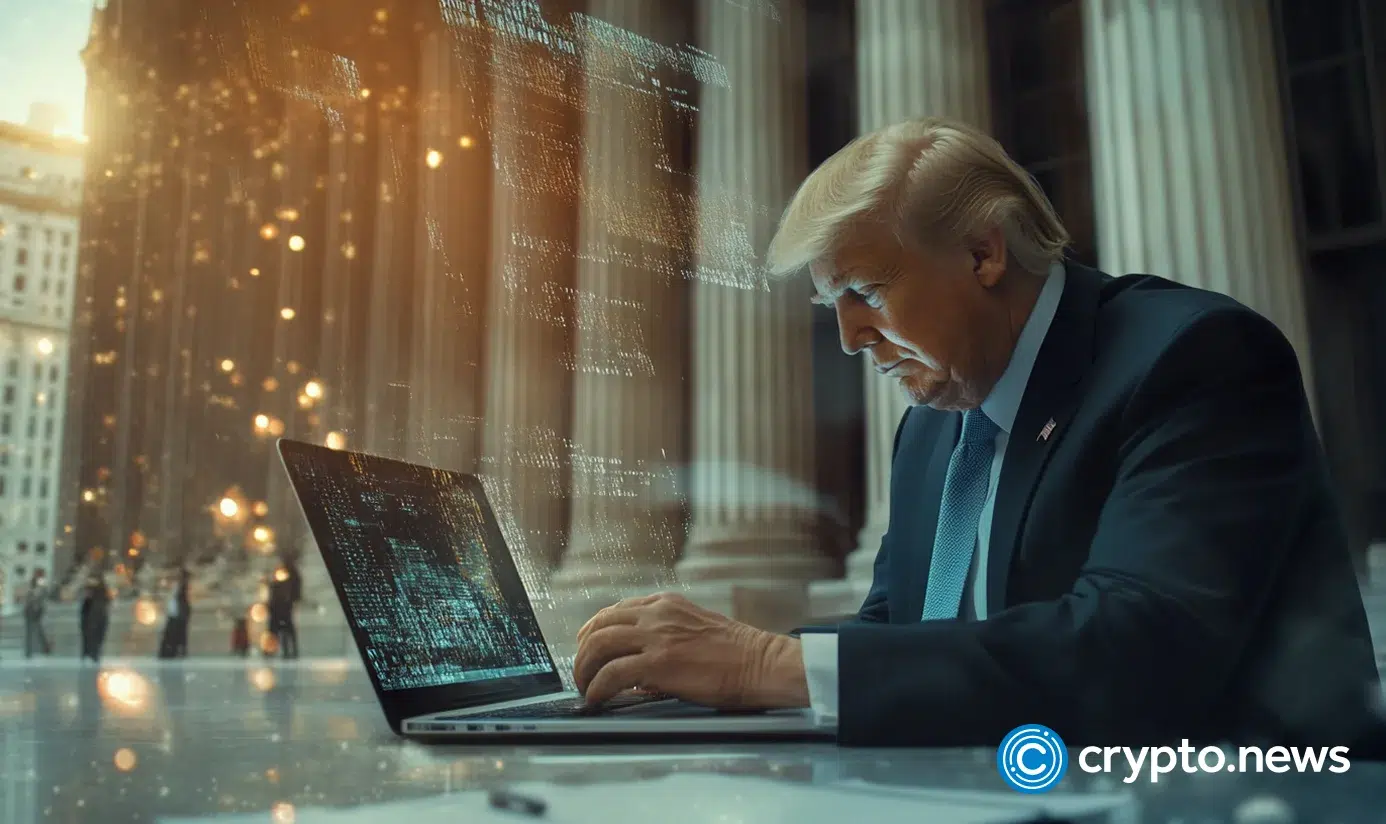
President Trump announced Thursday that Israel and Lebanon have agreed to a 10-day ceasefire beginning at 5 PM ET today, April 16, following direct conversations with Lebanese President Joseph Aoun and Israeli Prime Minister Benjamin Netanyahu.
Summary
- Trump posted on Truth Social that both leaders agreed to formally begin a 10-day ceasefire and has invited them to the White House for what he called the first meaningful Israel-Lebanon talks since 1983.
- Lebanese Prime Minister Nawaf Salam welcomed the ceasefire, while Lebanese President Aoun had initially declined to speak directly with Netanyahu before Trump personally called him to broker the announcement.
- More than 2,100 people have been killed in Lebanon and over 1 million displaced since Israeli strikes began targeting Hezbollah positions approximately six weeks ago.
President Trump announced Thursday that Israel and Lebanon have agreed to a 10-day ceasefire, beginning at 5 PM ET today, following what he described as “excellent conversations” with Lebanese President Joseph Aoun and Israeli Prime Minister Netanyahu. “These two Leaders have agreed that in order to achieve PEACE between their Countries, they will formally begin a 10 Day CEASEFIRE at 5 P.M. EST,” Trump wrote on Truth Social.
Trump said he has directed Vice President JD Vance, Secretary of State Marco Rubio, and Chairman of the Joint Chiefs of Staff Dan Caine to work toward a lasting peace agreement. He also invited Aoun and Netanyahu to the White House for what he called “the first meaningful talks between Israel and Lebanon since 1983.”
The announcement came after a turbulent morning of diplomacy. Lebanese President Aoun initially declined to speak directly with Netanyahu during a call with Secretary Rubio, with Washington signaling it “understands Lebanon’s position.” Trump then personally called Aoun, and the ceasefire announcement followed within hours.
The deal grew out of direct negotiations that began Tuesday between the Lebanese and Israeli ambassadors to the United States, the first such talks between the two countries in decades. Lebanon had insisted on a ceasefire as a precondition for any broader engagement, while committing to disarm Hezbollah over time.
Iran’s chief negotiator Mohammad Bagher Ghalibaf said Thursday morning that “a ceasefire in Lebanon is as important as a ceasefire in Iran,” framing the Lebanon front as part of the broader regional conflict that has defined 2026.
The Human Cost and Ground Situation
More than 2,100 people have been killed in Lebanon since Israeli forces began strikes approximately six weeks ago, targeting Hezbollah positions following the outbreak of the US-Iran war in late February. More than one million Lebanese have been displaced. Israel has suffered 21 casualties from strikes tied to both Iran and Hezbollah since the conflict began.
Israeli Defense Forces confirmed they will not withdraw from southern Lebanon during the 10-day pause, maintaining their ground position while the ceasefire holds. Hezbollah is not formally a party to the Lebanon-Israel talks, and Israel had previously denied that any Iran ceasefire framework extended to Lebanon.
Why It Matters Beyond Lebanon
The Lebanon ceasefire adds a second diplomatic track to an already fragile regional situation. Iran had argued that continued Israeli strikes on Lebanon constituted a violation of the existing US-Iran truce, while Washington and Jerusalem denied that connection. The Lebanon announcement removes that point of friction at a moment when the US-Iran ceasefire window is approaching its April 22 expiration.
Prediction markets had priced a Lebanon ceasefire by April 30 at only around 55% as recently as last week, reflecting how uncertain the diplomatic picture had looked. For financial markets, a stable Lebanon ceasefire alongside the Iran truce removes one of several risk premiums that have kept oil elevated and risk assets suppressed since February.
Bitcoin has consistently moved 4 to 5% within hours of credible ceasefire signals across this conflict, with the pattern repeating on April 7, April 8, and April 14. The Lebanon announcement, arriving while BTC already hovers near $75,000, adds to the stack of diplomatic catalysts that analysts say could push BTC past $76,000 if the ceasefire holds through the weekend.
Drift Protocol has announced a collaboration with Tether (USDT) and other partners totaling nearly $150 million to fund user recovery and a protocol relaunch following its April 1 exploit on Solana (SOL).
The package includes a $100 million revenue-linked credit facility, an ecosystem grant, and loans to designated market makers. USDT will serve as the settlement asset when the protocol relaunches.
Recovery Pool and Token for Impacted Users
The funds, out of which $127.5 million is reportedly from Tether, will support a dedicated user recovery pool fed by exchange revenue and committed support capital.
Drift stated that any assets recovered through ongoing law enforcement and blockchain forensics efforts will also flow into the pool.
To distribute recovery assets, Drift will issue a new transferable token to users affected by the April 1 exploit. The team said additional details on token mechanics will follow in the near term.
The April 1 attack drained between $270 million and $285 million from Drift’s vaults.
Blockchain analytics firm Elliptic attributed the operation to North Korean state-linked actors who spent six months infiltrating the protocol’s inner circle.
Attackers posed as a quantitative trading firm, built trust at conferences, and compromised devices through a malicious TestFlight app and a VSCode vulnerability.
They then manipulated Drift’s multisig approvals using Solana’s durable nonces feature to drain core vaults holding USDC, SOL, and JLP tokens.
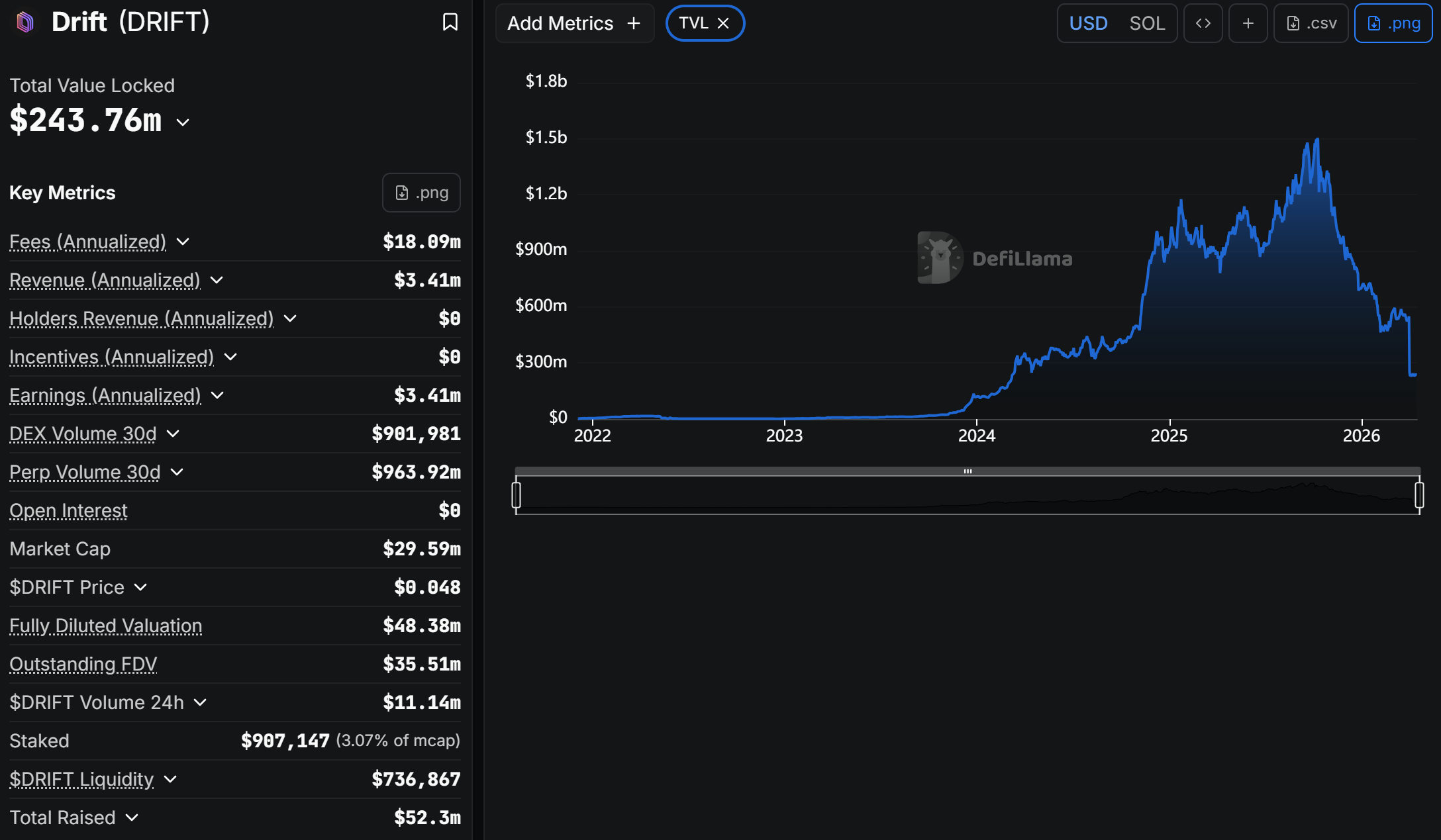
The incident slashed Drift’s total value locked from $550 million to roughly $230 million. The Drift (DRIFT) token dropped over 30% in the immediate aftermath. The protocol’s TVL was $243 million as of this writing.
Hardened Security and USDT-Centered Relaunch
Before relaunching, every protocol component will pass independent audits from OtterSec and Asymmetric Research.
Drift will also introduce a community-governed multisig for core protocol assets, requiring all signers to use dedicated devices with transaction content verified outside the primary signing interface.
Tether has proposed extending a USDT support facility to market makers to ensure deep liquidity from day one.
The shift to USDT settlement marks a notable pivot after Circle declined to freeze stolen USDC during the original attack.
Circle’s position on the matter is that it didn’t freeze stolen USDC because it can only act with legal orders, not on its own.
“When Circle freezes USDC, it is not because we have decided, unilaterally or arbitrarily, that someone’s assets should be taken from them. It is because the law requires us to act,” wrote Circle’s CSO Dante Disparte in a blog.
Tether’s involvement signals a growing willingness among stablecoin issuers to act as ecosystem backstops during major crises.
“The willingness of Paolo Ardoino Tether and our partners to commit real capital to Drift’s recovery says something about the strength of what we’ve built and what we’re building next, as well as our shared vision to scale the Solana DeFi ecosystem together,” said Cindy Leow, co-founder at Drift Protocol.
However, the partial recovery also highlights persistent vulnerabilities in operational security, even among mature protocols.
Drift described the plan as its first step toward making users whole over time.
The post Drift Protocol Lands $150 Million Lifeline in Aftermath of Exploit Shock appeared first on BeInCrypto.

TLDR
- The Royal Government of Bhutan transferred 250 BTC worth about $18.47 million, within 24 hours.
- Bhutan has moved 3,247 BTC in 2026, with total outflows valued near $240.4 million at current prices.
- After the latest transfers, Bhutan holds about 3,524 BTC worth between $260 million and $264 million.
- Bitcoin climbed to an intraday high of $76,038 before easing toward the $74,000 range.
- Glassnode identified resistance between $74,000 and $76,000, while CryptoQuant placed key levels near $76,800.
The Royal Government of Bhutan transferred about 250 BTC worth $18.47 million within 24 hours. Arkham data showed 162 BTC and 69.7 BTC moved to new wallet addresses in quick succession. The transactions came as Bitcoin traded above $74,000 and tested resistance levels.
Bhutan Extends Bitcoin Sales as Treasury Activity Continues
Arkham data confirmed that Bhutan shifted 162 BTC and 69.7 BTC to fresh addresses within hours. The transfers formed part of a wider reduction in publicly tracked holdings. Bhutan has moved 3,247 BTC in 2026, with total outflows valued near $240.4 million at current prices.
Other pricing periods placed the yearly sales closer to $198 million. After the latest transfers, Bhutan wallets hold about 3,524 BTC worth between $260 million and $264 million. Analysts linked earlier movements to wallets that later routed funds to Galaxy Digital and OKX.
Arkham reported that no Bitcoin inflow above $100,000 reached Bhutan-linked wallets in over a year. That data drew attention to possible shifts in mining operations or liquidity priorities. Bhutan originally built much of its reserve through hydropower-backed mining using surplus national energy.
On-chain records showed reduced inflows and continued outflows across tracked addresses. The pattern matched earlier sequences where funds moved in structured batches. However, blockchain data has not confirmed the final destination of the newest transfers.
Bitcoin Price Tests Resistance as Market Metrics Shift
Bitcoin price climbed to an intraday high of $76,038 earlier this week before easing toward $74,000. Glassnode said the market is moving through a resistance band between $74,000 and $76,000. CryptoQuant identified $76,800 as the “Traders’ Realized Price” level.
CryptoQuant stated that holders who bought between $65,000 and $76,000 now sit in profit. The firm reported that large deposits rose from under 10% to above 40% of exchange inflows. The shift pointed to heavier activity from larger holders within days.
Daily realized profits reached about $500 million on Wednesday. However, that figure remained below the $1 billion level often seen near local tops. Market data showed Bitcoin trading in the mid-$74,000 range during the latest session.
Mining economics also shifted as prices recovered in recent days. The average all-in production cost stood near $79,500 per BTC as of mid-Wednesday. The gap between cost and spot price narrowed compared to previous months.
The next network difficulty adjustment is scheduled for April 17. Forecasts projected a decline of nearly 3%, which would bring difficulty below 135 trillion hashes. Reports also showed the network hash rate fell 4% during the first quarter of 2026.
Some operators shut down older machines due to unprofitable conditions. Other miners redirected resources toward AI and high-performance computing services. The difficulty adjustment estimate remained the latest scheduled network update.

A Chinese professor’s incendiary claim that Bitcoin was engineered by the CIA as a financial surveillance tool is resurfacing across crypto circles, just as BTC is fighting for a decisive breakout. Professor Jiang’s theory isn’t new, but its renewed traction in an era of spot ETF approvals and institutional accumulation carries a certain irony that even Bitcoin maximalists can’t fully dismiss.
Jiang’s core argument: Satoshi Nakamoto’s anonymity, the dollar-denominated pricing structure, and Bitcoin’s emergence post-2008 financial crisis were all engineered to serve U.S. geopolitical interests. According to Jiang, Bitcoin is giving Washington a mechanism to track global capital flows while maintaining plausible deniability.
For now, no credible evidence supports the claim, and the cypherpunk origins of Bitcoin are extensively documented. Still, the theory spreads precisely because Bitcoin’s creator remains unidentified. That’s a gap conspiracy narratives thrive in. Meanwhile, BTC has posted a 4% weekly gain above $72,000 following a U.S.-Iran ceasefire announcement, with spot ETF inflows rebounding and institutional appetite cautiously returning.
Whether or not you believe the CIA theory (most analysts emphatically don’t), the more pressing question for traders right now is what happens to Bitcoin’s price in the next 72 hours — and whether the current consolidation resolves upward or fades.
Discover: The best crypto to diversify your portfolio with
Bitcoin and $80K Level to Break
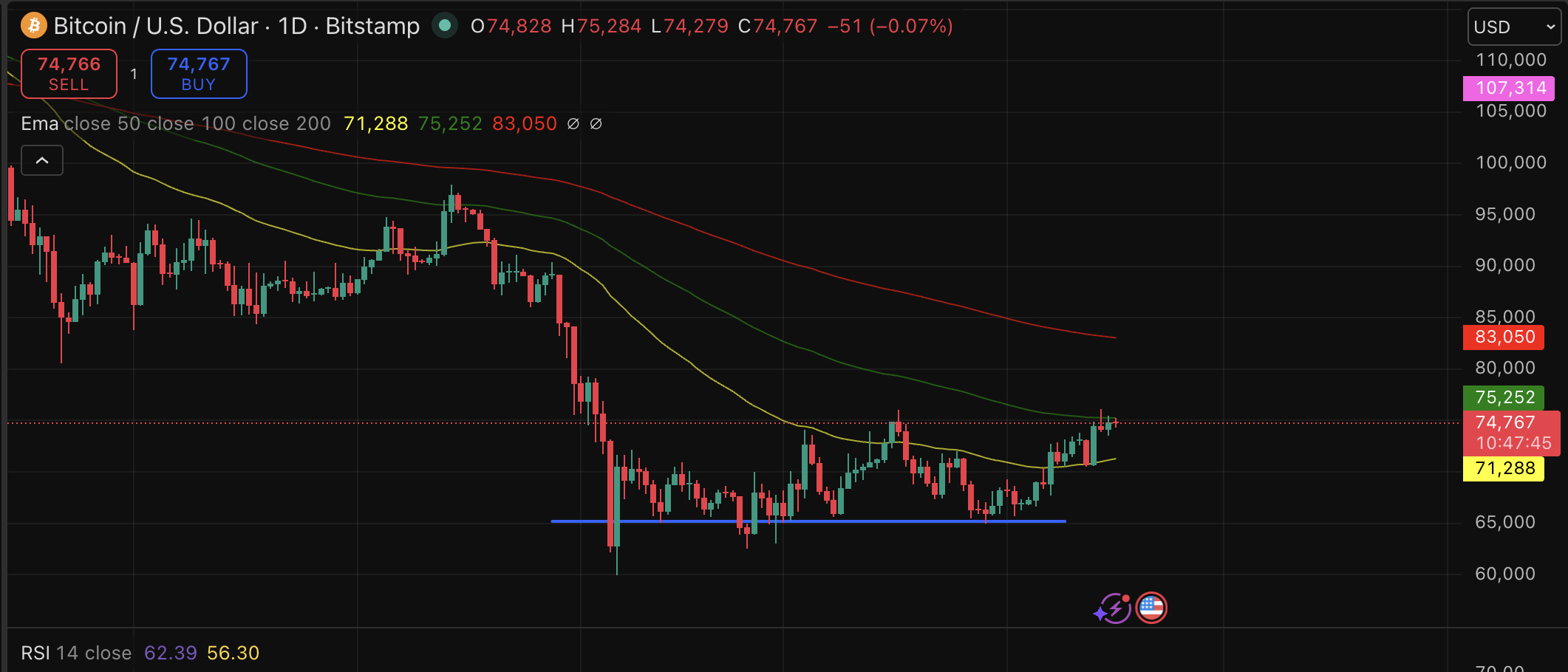
Bitcoin is consolidating just below $75,000, holding above the $71,000–$72,000 support band that served as a floor during earlier geopolitical volatility. Yesterday’s high of $76,000 represents immediate resistance.
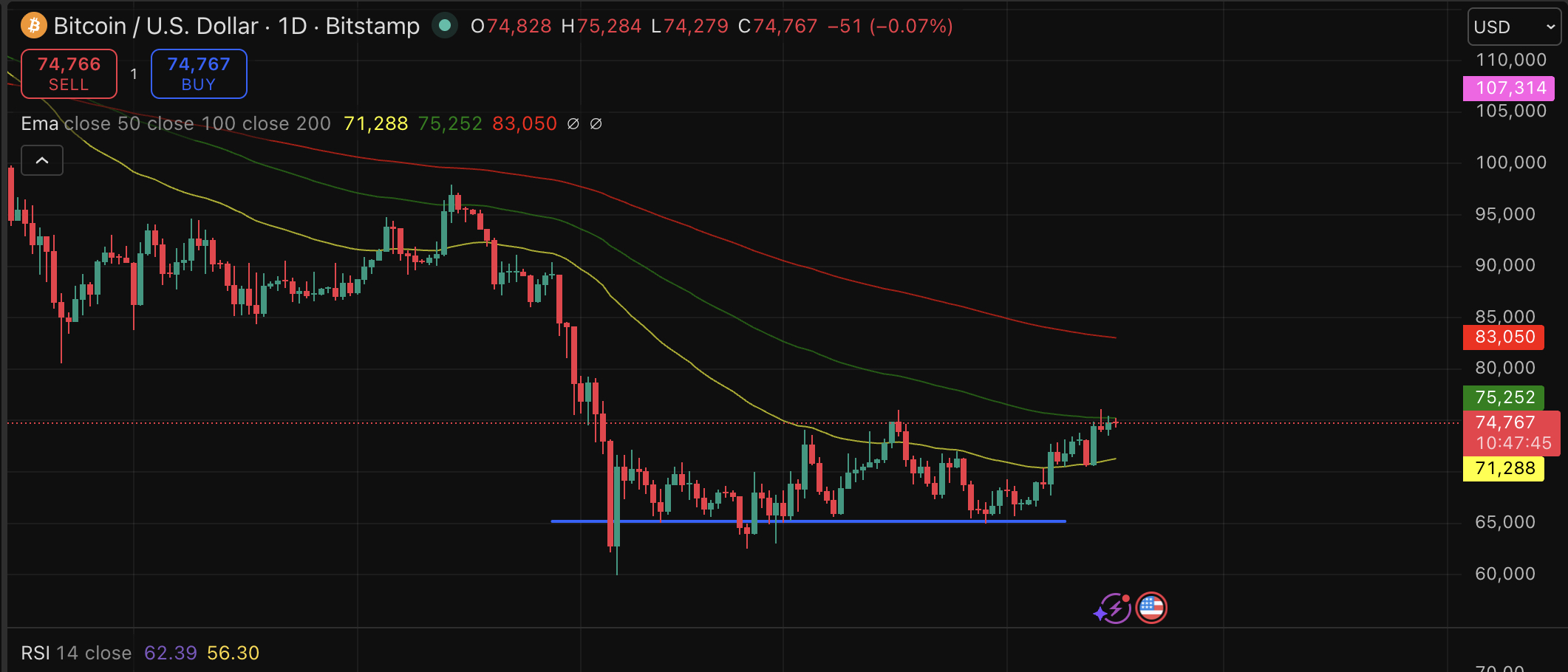
The technical picture is mixed, though. RSI sits at 62, a neutral territory, approaching overbought. But 20 of 32 technical indicators currently read bearish on daily and weekly timeframes, a signal that the rally lacks broad conviction. Alexander Kuptsikevich characterizes the current move as “slow but steady growth,” in not a ringing endorsement for aggressive longs.
Discover: The best pre-launch token sales
Bitcoin Hyper Is Not a CIA Surveillance Instrument
CIA or not, Bitcoin’s asymmetric upside window is largely priced in. That’s not a knock on BTC’s long-term thesis. It’s just arithmetic.
This is why some traders are rotating early-stage exposure toward infrastructure plays positioned to benefit from Bitcoin’s growth rather than replicate it. Bitcoin Hyper ($HYPER) is one project drawing significant attention, and not without reason.
It’s the first Bitcoin Layer 2 integrating the Solana Virtual Machine (SVM), delivering transaction speeds that reportedly surpass Solana itself while inheriting Bitcoin’s security layer. That’s a technically aggressive claim, and the market is responding.
The presale has raised $32 million at a current token price of $0.0136, with huge staking rewards available for participants who commit early. The presale milestone has already drawn wider coverage as BTC Layer 2 infrastructure becomes a key narrative heading into 2026.
Features include a Decentralized Canonical Bridge for BTC transfers, low-latency smart contract execution, and support for payments, meme coins, and dApps, essentially the programmability Bitcoin has never natively offered.
The post Bitcoin is CIA Operation: Professor Jiang Believes appeared first on Cryptonews.


The curated art platform says its infrastructure has already been spun down with no plans to come back online.
Foundation, the Ethereum-based NFT marketplace, is shutting down for good after a failed acquisition by digital art display company BlackDove.
Founder Kayvon Tehranian announced the closure in a post on X, explaining that a deal to sell the platform to a buyer “who intended to continue its operations” fell through, and the company does not believe another buyer is worth pursuing.
“Our goal in pursuing a sale was always to see Foundation live on,” Tehranian wrote. “That’s no longer possible. As part of our wind-down process, our infrastructure has already been spun down, and we’re not in a position to bring the platform back online.”
The announcement marks the final chapter in a drawn-out unraveling that began in January, when Tehranian transferred ownership of Foundation to BlackDove. At the time, he framed the move as a transition to a leadership committed to the platform’s long-term future, noting that Foundation had facilitated roughly $230 million in primary sales since its launch and had hosted landmark auctions for artists like Jen Stark, James Jean, and Edward Snowden.
But BlackDove’s involvement was short-lived. The company later said full due diligence was only completed after the operational handover, and BlackDove ultimately concluded that building its own proprietary marketplace was a more viable path.
Foundation’s closure adds to a growing list of NFT platform shutdowns that have accelerated since 2024. MakersPlace, KnownOrigin, RTFKT, Nifty Gateway, and X2Y2 have all wound down operations as monthly NFT trading volumes collapsed from $2.9 billion at the 2021 peak to just $23.8 million by early 2025. Surviving platforms like OpenSea have pivoted aggressively toward fungible token trading to stay afloat.
The shutdown also raises familiar questions about the permanence of NFT media hosted on centralized infrastructure, an issue The Defiant raised as early as 2021. Tehranian said Foundation plans to continue pinning IPFS-hosted media and metadata for another year, but urged the community to take responsibility for personally pinning assets they care about. Users with NFTs listed on Foundation’s marketplace smart contract will need to unlist and retrieve them.
This article was written with the assistance of AI workflows. All our stories are curated, edited and fact-checked by a human.
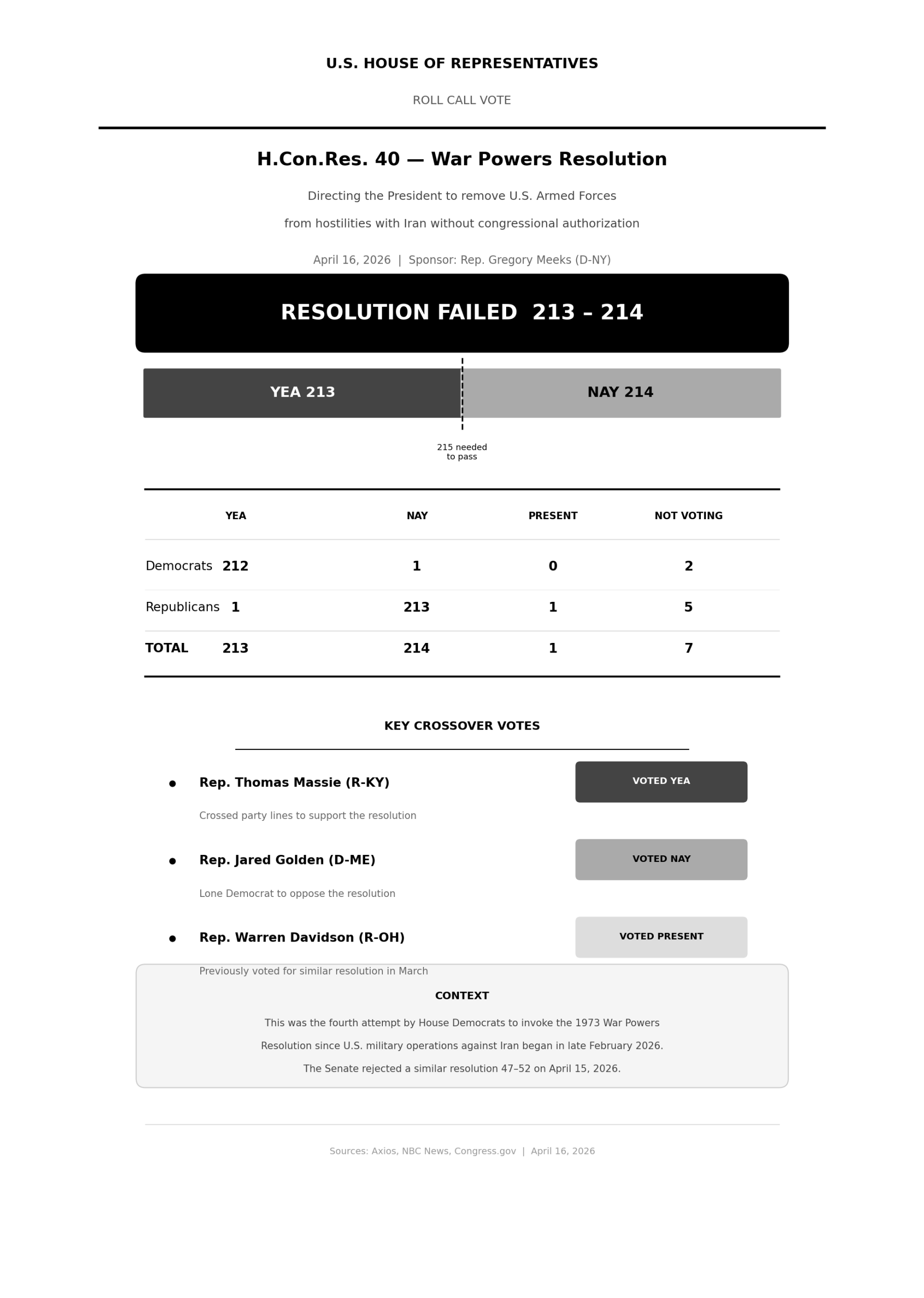
The US House of Representatives rejected a War Powers Resolution on Iran by a 213-214 vote today, preserving President Donald Trump’s authority to continue military operations.
The narrow defeat came as Trump simultaneously announced a 10-day ceasefire between Israel and Lebanon, positioning himself as a peacemaker even as Congress debated constraints on his war powers.
War Powers Vote Falls One Short
Rep. Gregory Meeks (D-NY) introduced H.Con.Res. 40 to force the withdrawal of US Armed Forces from hostilities with Iran without explicit congressional authorization. The measure failed along largely partisan lines.
Rep. Jared Golden (D-ME) was the lone Democrat to vote against the resolution, siding with Republicans. Meanwhile, Rep. Thomas Massie (R-KY), a frequent critic of expansive executive war powers, crossed party lines to support it. Rep. Warren Davidson (R-OH) voted “present.”
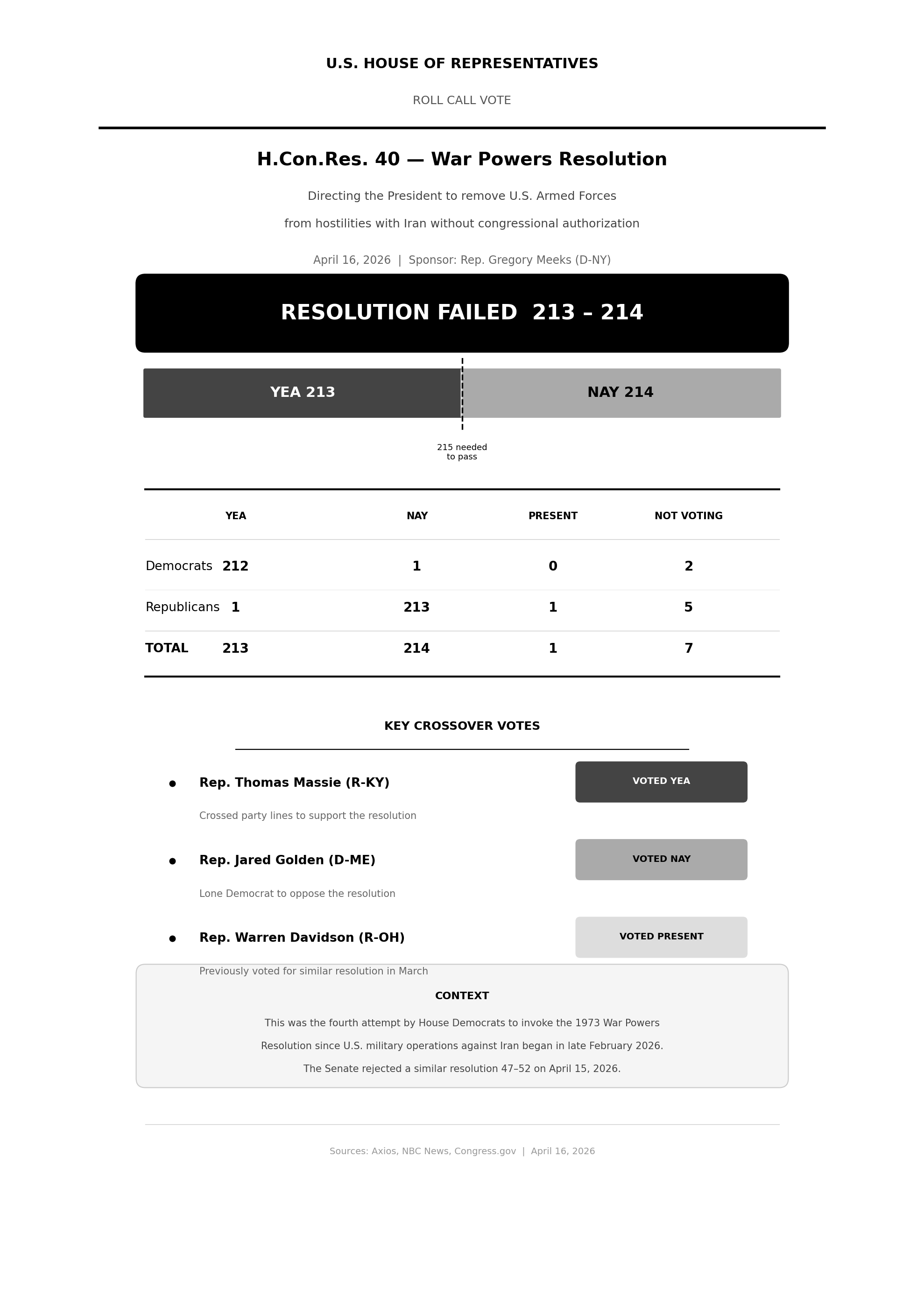
The Senate rejected a similar resolution 47-52 a day earlier. Democrats have now forced at least four such votes in both chambers since the Iran conflict began in late February, all failing along partisan lines.
Trump Announces Israel-Lebanon Ceasefire
Hours before the vote, Trump announced that Israeli Prime Minister Benjamin Netanyahu and Lebanese President Joseph Aoun had agreed to a 10-day ceasefire starting at 5 p.m. EST.
The deal followed the first direct talks between the two countries in 34 years, held in Washington with Secretary of State Marco Rubio.
Trump said he would invite both leaders to the White House for what he called the first meaningful talks between Israel and Lebanon since 1983.
European Commission President Ursula von der Leyen welcomed the truce, urging “a path to permanent peace” and full respect of Lebanon’s sovereignty.
Energy Crisis Deepens Alongside Conflict
The International Energy Agency warned that Europe holds just six weeks of jet fuel supply as the Iran conflict disrupts global energy flows.
IEA Executive Director Fatih Birol described the situation as the largest energy crisis the agency has ever tracked.
Dutch airline KLM has already cancelled 80 flights over the next month due to rising fuel costs. Jet fuel prices across Europe have surged by over 100% since the war began.
Gulf and European officials now estimate the U.S. may need six months to reach a deal with Iran, suggesting the energy shock could extend well into summer.
Whether the Israel-Lebanon ceasefire eases broader regional tensions or simply shifts attention remains the open question for markets.
The post Trump Announces Israel and Lebanon Ceasefire, But Oil Crisis Deepens appeared first on BeInCrypto.
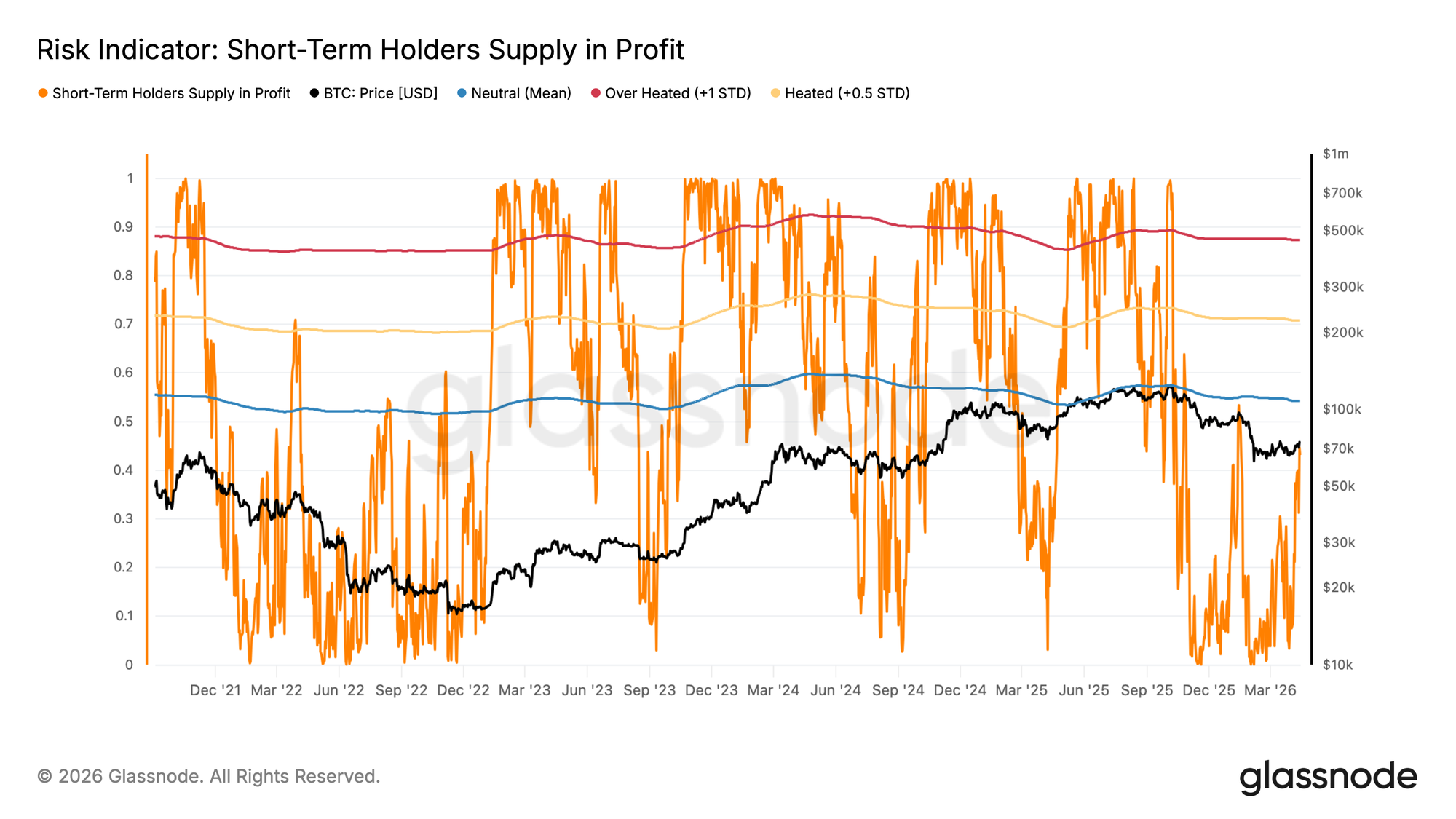
Market analysts said Bitcoin’s (BTC) latest rally to $76,000 was a “clear momentum shift,” confirming a short-term uptrend for BTC price.
Bitcoin’s short-term holder (STH) supply in profit, a measure of the share of recently acquired coins currently held at an unrealized gain, suggests that BTC/USD has not exhausted its bear market rally, data from Glassnode shows.
Local tops in bear market rallies have historically formed when this metric approaches its statistical mean of 54.2%, a threshold where the concentration of profitable STHs becomes sufficient to trigger meaningful distribution.
Currently at 43.2%, the STH supply in profit remains “meaningfully below that threshold, suggesting the present rally has not yet reached the zone of typical exhaustion,” Glassnode said in its latest Week Onchain newsletter, adding:
“This leaves slight room for further upside toward the True Market Mean, while also providing a quantitative level to monitor as price advances.”

Meanwhile, Bitcoin has remained in “deep under extension territory” relative to its 50-week simple moving average (SMA), currently at $96,800, analyst McKenna said in a recent post on X.
Related: Bitcoin traders cash out 63K BTC profit as price rallied above $76K: Will the market rebound?
When markets deviate either to the upside or downside, they usually revert back to their mean.
Combined with “clear momentum shifts and bullish trending signals firing then I would be inclined to be directionally bullish here, the analyst said, adding:
“BTC breaking above $74K and holding this level on a HTF is the final trigger I want to see to be confident in mid to high 80s over the coming weeks.”

Fellow analyst Bitcoin Archive focused on the falling US dollar index, saying that it provides a “massive tailwind for the next leg up” for Bitcoin.

As Cointelegraph reported, several metrics support Bitcoin’s potential to rise higher, including increasing network activity and a strengthening technical setup.
Onchain data reveals key Bitcoin price levels to watch
Bitcoin’s 41% drawdown from its $126,000 all-time high has seen the BTC/USD pair drop below key pricing levels, including the active realized price at $85,100, the STH cost basis at $80,950 and the true market mean currently at $78,140.
At $74,000, Bitcoin is 5.2% below the true market mean, a metric tracking the cost basis of active BTC supply.
While the price is yet to “test and stabilize above this key threshold, the probability of a spike toward and potentially above it remains considerable in the mid-term,” Glassnode added.

The importance of this resistance level is reinforced by cost basis distribution. The heatmap below shows that over 200,000 BTC were acquired for around $78,000.

On the downside, the first major support is at $72,000, where the 20-day and 50-day exponential moving averages (EMAs) appear to converge. It is also where investors bought approximately 220,000 BTC.
Lower than that, the $65,000-$70,000 demand zone is a key area to watch. This price band has historically served as a vital support level, as seen between October and November 2024, providing a launching pad for the October 2024-January 2025 rally.
As Cointelegraph reported, a drop below the $70,000 would suggest the bears are back in control, increasing the prospects of a drop toward $60,000.
This article is produced in accordance with Cointelegraph’s Editorial Policy and is intended for informational purposes only. It does not constitute investment advice or recommendations. All investments and trades carry risk; readers are encouraged to conduct independent research before making any decisions. Cointelegraph makes no guarantees regarding the accuracy or completeness of the information presented, including forward-looking statements, and will not be liable for any loss or damage arising from reliance on this content.
NVIDIA Ising has launched as the world’s first family of open-source quantum AI models, targeting the two biggest engineering bottlenecks in quantum computing: processor calibration and error correction decoding.
Summary
- NVIDIA Ising delivers up to 2.5x faster and 3x more accurate quantum error correction decoding than current open-source benchmarks, with calibration workflows shrinking from days to hours.
- The model family includes Ising Calibration, a 35-billion-parameter vision-language model, and Ising Decoding, a 3D convolutional neural network framework, both available on GitHub and Hugging Face.
- Early adopters include Fermi National Accelerator Laboratory, Harvard, IQM Quantum Computers, Lawrence Berkeley National Laboratory, and the UK National Physical Laboratory.
NVIDIA Ising launched April 15, 2026, as the world’s first open-source AI model family purpose-built for quantum computing, providing researchers and enterprises with tools to address processor calibration and error correction, the two engineering barriers standing between today’s fragile qubits and large-scale useful quantum systems.
The models achieve up to 2.5x faster and 3x more accurate quantum error correction decoding compared to pyMatching, the current open-source benchmark.
The family has two domains. Ising Calibration is a 35-billion-parameter vision-language model that automates quantum processor tuning, compressing calibration workflows that previously required days of manual setup to hours of automated execution. Ising Decoding is a 3D convolutional neural network framework for real-time quantum error correction, available in two variants optimized for either speed or accuracy depending on the application.
Both models are distributed through GitHub, Hugging Face, and NVIDIA’s build.nvidia.com platform, integrated with CUDA-Q and NVQLink. NVIDIA is also releasing a quantum workflow cookbook, training datasets, and hardware-specific fine-tuning tools so researchers can adapt the models to their own quantum processor architectures without exposing proprietary data.
Jensen Huang, NVIDIA’s founder and CEO, framed the launch in infrastructure terms. “AI is essential to making quantum computing practical. With Ising, AI becomes the control plane, the operating system of quantum machines, transforming fragile qubits to scalable and reliable quantum-GPU systems,” he said.
Who Is Already Using It
Adoption at launch spans a range of institutions including Academia Sinica, Fermi National Accelerator Laboratory, Harvard’s John A. Paulson School of Engineering and Applied Sciences, IQM Quantum Computers, Lawrence Berkeley National Laboratory’s Advanced Quantum Testbed, Sandia National Laboratories, UC San Diego, the UK National Physical Laboratory, and Yonsei University.
The breadth of early adopters reflects a deliberate open-model strategy. By releasing pre-trained weights, training frameworks, and benchmarks publicly, NVIDIA positions Ising as a foundation layer that other developers can build on without starting from scratch.
Crypto and AI Market Implications
The Ising launch reinforces NVIDIA’s positioning as the dominant infrastructure provider across both classical AI and the emerging quantum-classical hybrid computing stack. For the crypto sector, quantum computing has long represented a future threat to existing blockchain encryption standards, particularly RSA and elliptic curve cryptography used to secure Bitcoin wallets.
Progress in quantum error correction, which Ising specifically targets, is the technical precondition for cryptographically relevant quantum computers to exist. The timeline remains distant, but every improvement in error correction decoding accuracy shortens it.
NVIDIA news has historically triggered moves in AI tokens across the crypto market, as the chip company’s hardware underpins the AI infrastructure that powers many blockchain AI projects. The Ising launch adds a new quantum AI vertical to that relationship.

Zayn Malik ‘cried’ as he honoured Liam Payne while performing One Direction song

Eminem Skips Coachella 2026 Despite Fan Buzz as Festival Heads in Fresh Pop and Latin Direction

xAI Terafab Contacts Chip Suppliers


-

 Politics6 days ago
US brings back mandatory military draft registration
-
 Sports6 days ago
Man United discover Nico Schlotterbeck transfer fee as defender reaches Dortmund agreement
-

 Fashion6 days ago
Weekend Open Thread: Veronica Beard
-

 Politics7 days ago
Malcolm In The Middle OG Turned Down ‘Buckets Of Money’ To Appear In Reboot
-

 Politics4 days ago
World Cup exit makes Italy enter crisis mode
-

 Business6 days ago
Tesla Model Y Tops China Auto Sales in March 2026 With 39,827 Registrations, Beating Cheaper EVs and Gas Cars
-

 Crypto World3 days ago
The SEC Conditionalises DeFi Platforms to Be Avoided for Broker Registration
-

 Crypto World3 days ago
SEC Signals Exemption for Crypto Interfaces From Broker Registration
-

 News Videos2 days ago
Secure crypto trading starts with an FIU-registered
-
 NewsBeat4 days ago
Pep Guardiola and Gary Neville agree over Arsenal title problem that benefits Man City
-

 Business5 days ago
Ireland Fuel Protests Enter Day 5 as Blockades Spark Shortages and Government Prepares Support Package
-

 Business6 days ago
OpenAI Halts Stargate UK Data Centre Project Over Energy Costs and Copyright Row
-

 Politics7 days ago
LBC Presenter Mocks Trump Over Iran War Failures
-

 Crypto World6 days ago
Federal judge blocks Arizona from bringing criminal charges against Kalshi
-

 NewsBeat2 days ago
Trump and Pope Leo: Behind their disagreement over Iran war
-

 Crypto World3 days ago
SEC Proposes Certain Crypto Interfaces Don’t Need to Register as Brokers
-
 NewsBeat5 days ago
JD Vance announces ‘no agreement’ with Iran over nuclear weapons fear
-

 Tech7 days ago
A version of Windows 10 released a decade ago is now eligible for additional security patches
-

 Business6 days ago
IMF retains floor for precautionary balances at SDR 20 billion
-

 Business6 days ago
Former Liverpool CEO eviscerates FIFA for World Cup ticket pricing
You must be logged in to post a comment Login