

Crypto World
Qivalis Signs Up 25 Banks Ahead of Euro Stablecoin Launch


Qivalis, the European banking consortium building a regulated euro stablecoin, expanded its ranks to 37 member institutions on Wednesday by adding 25 banks across 15 countries. Among the new members are ABN AMRO, Rabobank, Nordea and Intesa Sanpaolo. The Amsterdam-based group aims for a launch in the second half of 2026, according to a statement shared with Cointelegraph.
“We are not merely building payment rails; we are ensuring that European principles around data protection, financial stability and regulatory rigour are embedded into the next generation of digital money,” said Howard Davies, chairman of Qivalis’ supervisory board.
The expansion comes as European institutions intensify efforts to offer regulated alternatives to dollar-dominated stablecoins, which CoinGecko data show account for a large majority of the market. The push signals a broader push to embed euro-denominated on-chain infrastructure within the bloc’s regulatory framework.
Key takeaways
- Qivalis expands to 37 member banks, adding 25 institutions across 15 countries, with a targeted launch in H2 2026.
- Notable new members include ABN AMRO, Rabobank, Nordea and Intesa Sanpaolo, reinforcing cross-country participation.
- Spain emerges as the most represented country in the new wave, adding five banks and highlighting early euro-stablecoin adoption in the retail sphere.
- The expansion aligns with the European Union’s MiCA framework, as institutions seek a regulated euro-stablecoin backbone under EU rules.
- ECB President Christine Lagarde recently signaled a cautious stance on euro-stablecoins as Europe’s path to expanding the euro’s global role, illustrating regulatory tensions that accompany the initiative.
A broader push for a regulated euro stablecoin network
With 25 banks joining from 15 countries, Qivalis is accelerating its effort to create a unified, regulated euro-stablecoin infrastructure. The new members broaden the consortium’s geographic footprint, spanning Northern and Southern Europe, and reinforcing the bloc-wide ambition to offer a euro-denominated digital money system governed by European rules. Howard Davies framed the project as more than a payments layer; it is an attempt to embed core European values—data protection, financial stability and regulatory integrity—into a new form of money that can operate across borders and institutions.
In parallel with the expansion, the consortium has been engaging with crypto exchanges to prepare for a broader ecosystem around the euro stablecoin. Cointelegraph has reported that Qivalis has been in dialogue with venues ahead of the planned launch, signaling an intent to foster liquidity, trading access and custody within a compliant, MiCA-aligned framework. The plan is to tokenize, custody and manage on-chain euro-denominated assets with oversight suitable for European markets.
Spain leads the new member wave and euro adoption momentum
Spain stands out in the new roster, providing five additions: ABANCA, Banco Sabadell, Bankinter, Cecabank and Kutxabank. The country’s growing footprint among Qivalis members mirrors broader signs of euro-stablecoin uptake in Spain’s retail space, where data from Brighty has highlighted Spain as a leading market for Circle’s EURC usage. The strong presence from Spain reflects a wider European push to diversify away from USD-centric stablecoins toward euro-denominated on-chain services within a robust regulatory envelope.
In addition to Spain, Italy joined with two new banks, while France, Sweden, Greece, the Netherlands, Finland and Ireland each added two members. The spread across these markets underscores a pan-European appetite to integrate stablecoin rails into existing banking rails, blending traditional financial oversight with the benefits of digital asset rails under MiCA-compliant governance.
Tech backbone, governance and regulatory context
Qivalis is pursuing a covered, regulated pipeline for euro stablecoin issuance, with Fireblocks already chosen in a March collaboration to provide tokenization, wallet infrastructure and custody services, along with tools to support compliance. Jan Sell, the consortium’s CEO, has stressed that the euro should be carried on-chain by European institutions and governed by European rules, a stance that aligns with the bloc’s regulatory ambitions while inviting scrutiny from observers wary of how rapidly the sector evolves.
The push operates in a climate of contested momentum about the role of private sector money inside Europe’s monetary architecture. In early May, European Central Bank President Christine Lagarde suggested that stablecoins might not be Europe’s best route to strengthening the euro’s international reach, cautioning against a reflexive move to euro-backed equivalents in response to US dollar-stablecoins. The Qivalis expansion, therefore, sits at an inflection point: banks are eager to provide a regulated euro stablecoin alternative, but policymakers are weighing how such tools fit into broader monetary and financial stability objectives.
According to Cointelegraph reporting, the consortium has been engaging with crypto exchanges in anticipation of a euro-stablecoin launch, signaling a readiness to build an ecosystem that includes liquidity venues, wallets and custody aligned with European standards. This ecosystem-building effort is paired with MiCA-ready frameworks already shaping custody, identity verification, anti-money-laundering controls and data protection, which are intended to reduce compliance risk while enabling cross-border euro transactions on-chain.
What changes—and what remains uncertain
The most visible change is the accelerated diversification of Qivalis’ member base, bringing more European banks into a shared project that seeks to encode euro-denominated digital money within a carefully regulated perimeter. The heightened country representation suggests that banks across the EU are ready to experiment with on-chain euro rails, potentially unlocking new forms of settlement, cross-border payments and digital asset services for customers who need faster, cheaper and more transparent transactions than traditional correspondent networks offer.
However, the path forward remains cinched with regulatory nuances. Lagarde’s comments frame a cautious stance on the euro-stablecoin thesis as Europe experiments with on-chain money, and MiCA’s ultimate implementation will shape what is permissible, how liquidity is created, and which institutions can participate at scale. The H2 2026 target for launch sets a concrete timeline, but adoption will depend on how quickly member banks can harmonize compliance, risk controls and interoperability with external exchanges and wallets within the EU’s supervisory framework.
For investors and builders, the development signals a persistent appetite among European banks to offer regulated alternatives to dollar-dominated digital assets. The expansion also foreshadows potential competition among regional euro-stablecoin ecosystems, each anchored in national banking standards yet interoperable under EU-wide rules. As the MiCA regime matures and the ECB’s stance evolves, watchers should monitor how liquidity channels develop, how custody and identity standards converge, and whether consumer demand lives up to the regulatory promise of a more stable, transparent euro on the blockchain.
Readers should keep an eye on when Qivalis begins to align more tightly with exchanges and liquidity providers, and how the consortium’s governance evolves as more banks verify and participate in the euro-stablecoin framework. The next steps will reveal whether this is a turning point for euro-denominated digital money or a measured experiment navigating a complex regulatory landscape.



Online code repository firm GitHub says a recent breach of its internal data stemmed from a staff member downloading a “poisoned” VS Code extension.
The Microsoft-owned firm first disclosed in the early hours of this morning that it was investigating unauthorized access to its internal repositories.
Since then, GitHub has shared that the breach has only affected internal GitHub repositories.
It added, “The attacker’s current claims of ~3,800 repositories are directionally consistent with our investigation so far.”
The breach involves a malicious VS Code extension downloaded from Microsoft’s VS Code extension marketplace. VS Code stands for Visual Studio Code, and the marketplace offers various tools and applications for code editors to download.
Read more: Binance says GitHub data leak could cause ‘severe financial harm’
The hacking group claiming to have breached GitHub’s repositories is TeamPCP, which has been linked to the Mini Shai Halud supply chain attack that impacted OpenAI, as well as a number of other supply chain attacks targeting developer software.
The group is selling the roughly-4,000 private repositories on the Breached hacking forum for no less than $50,000 while stressing that it will not accept any “low ball offers.”
It said, “This is not a ransom, we do not care about extorting GitHub.” The data on its end will supposedly be “shred” after the sale, and if it can’t find a buyer, TeamPCP said it will leak the data for free.
GitHub says it has removed ‘malicious extension’
GitHub claims it “removed the malicious extension version, isolated the endpoint, and begun incident response immediately.”
“Critical secrets were rotated yesterday and overnight with the highest-impact credentials prioritized first,” the firm said, adding that it will continue to monitor the situation.
The reception to the incident hasn’t been forgiving. Users noted longstanding complaints against former Microsoft and GitHub executives that have asked for solutions to malware-ridden downloads within the VS Code extension marketplace.
This complaint was levied against GitHub’s former CEO two years ago.
Read more: Microsoft could stall Bitcoin development via GitHub
Former Binance CEO Changpeng Zhao warned, “If you have API keys in your code, even private repos, now is the time to double check and change them…”
CEO of coding firm Treehouse, Ryan Carson, similarly warned, “If you have ANY private repos with plain text secrets or sensitive documents/architectures, immediately rotate your secrets.”
Crypto security expert Taylor Monahan added to Zhao’s statement, and said that you should get your API keys “out of your repos.”
“Your biggest risk is not this. It’s your own devs getting hit by one of these wormy motherfucking supply chains and leaking all those secrets,” Monahan said.
Second GitHub leak in days
Software firm Grafana also claimed earlier this week that it witnessed unauthorised access to its GitHub repositories.
It claims the attackers “downloaded our codebase,” before issuing “a ransom demand under threat of data disclosure.”
Read more: Stealthy crypto miners loot altcoins with GitHub trial accounts
In this case, Grafana claims the breach also stemmed from the supply chain attack associated with the Mini Shai-Hulud campaign.
It said, “We performed analysis and quickly rotated a significant number of GitHub workflow tokens, but a missed token led to the attackers gaining access to our GitHub repositories. A subsequent review confirmed that a specific GitHub workflow we originally deemed not impacted had, in fact, been compromised.”
In 2024, leaked passwords and site code stemming from Binance were viewable on GitHub for months before they were eventually taken down.
The exchange said the leaks were capable of causing “severe financial harm,” and that the upload of its data was never authorized.
Protos has reached out to GitHub for comment and will update this piece should we hear anything back.
Got a tip? Send us an email securely via Protos Leaks. For more informed news and investigations, follow us on X, Bluesky, and Google News, or subscribe to our YouTube channel.


LayerZero Labs has released its incident report on the KelpDAO bridge attack, saying about $292 million in rsETH was stolen after attackers poisoned RPC infrastructure used by its verification network and forcing policy changes around single-signer configurations.
Summary
- LayerZero said KelpDAO was exploited for about $290 million, or roughly 116,500 rsETH, in an attack isolated to rsETH’s single-DVN setup.
- The company said preliminary indicators point to North Korea-linked TraderTraitor and described the exploit as an infrastructure compromise rather than a protocol flaw.
- LayerZero said it will stop signing messages for applications using 1/1 DVN configurations and is pushing affected integrators toward multi-DVN redundancy.
LayerZero Labs has published a detailed account of the KelpDAO exploit, confirming that attackers stole roughly 116,500 rsETH, worth about $292 million, by compromising downstream infrastructure tied to the verification layer used in KelpDAO’s cross-chain configuration.
The company said the incident was limited to KelpDAO’s rsETH setup because the application relied on a 1-of-1 DVN configuration with LayerZero Labs as the sole verifier, a design LayerZero said directly contradicted its standing recommendation that applications use diversified multi-DVN setups with redundancy.
In its statement, LayerZero said there was “zero contagion to any other cross-chain assets or applications,” arguing that the protocol’s modular security architecture contained the blast radius even as a single application-level configuration failed.
How the attack worked
According to LayerZero’s report, the April 18, 2026 attack targeted the RPC infrastructure relied on by the LayerZero Labs DVN rather than exploiting the LayerZero protocol, key management, or the DVN software itself.
The company said the attackers gained access to the list of RPCs used by the DVN, compromised two nodes running on separate clusters, replaced binaries on op-geth nodes, and then used malicious payloads to feed forged transaction data to the verifier while returning truthful data to other endpoints, including internal monitoring services.
To complete the exploit, the attackers also launched DDoS attacks on uncompromised RPC endpoints, which triggered failover toward the poisoned nodes and allowed the LayerZero Labs DVN to confirm transactions that had never actually occurred.
Outside forensic work broadly matches that description. Chainalysis said the attackers linked to North Korea’s Lazarus Group, specifically TraderTraitor, did not exploit a smart contract bug but instead forged a cross-chain message by poisoning internal RPC nodes and overwhelming external ones in a single-point-of-failure verification setup.
Security changes
LayerZero said the immediate response included deprecating and replacing all affected RPC nodes, restoring the LayerZero Labs DVN to operation and contacting law enforcement agencies while working with industry partners and Seal911 to trace the stolen funds.
More importantly, the company is changing how it handles risky configurations. In the statement, LayerZero said its DVN “will not sign or attest messages from any applications that utilize a 1/1 configuration,” a direct policy shift aimed at preventing a repeat of the KelpDAO failure mode.
The company is also reaching out to projects still using 1/1 configurations to migrate them to multi-DVN models with redundancy, effectively admitting that configuration flexibility without enforced safety rails was too permissive in practice.
The attribution picture has also hardened. Chainalysis linked the exploit to North Korea’s Lazarus Group and specifically TraderTraitor, while Nexus Mutual said the forged message drained $292 million from KelpDAO’s bridge in under 46 minutes, making it one of 2026’s biggest DeFi losses.
The result is a familiar but brutal lesson for cross-chain infrastructure: the smart contracts can survive intact and the protocol can still fail in practice if the off-chain trust layer is weak enough. LayerZero is now trying to prove that the right takeaway from a $292 million bridge theft is not that modular security failed, but that letting anyone run a single-signer setup was the real mistake.
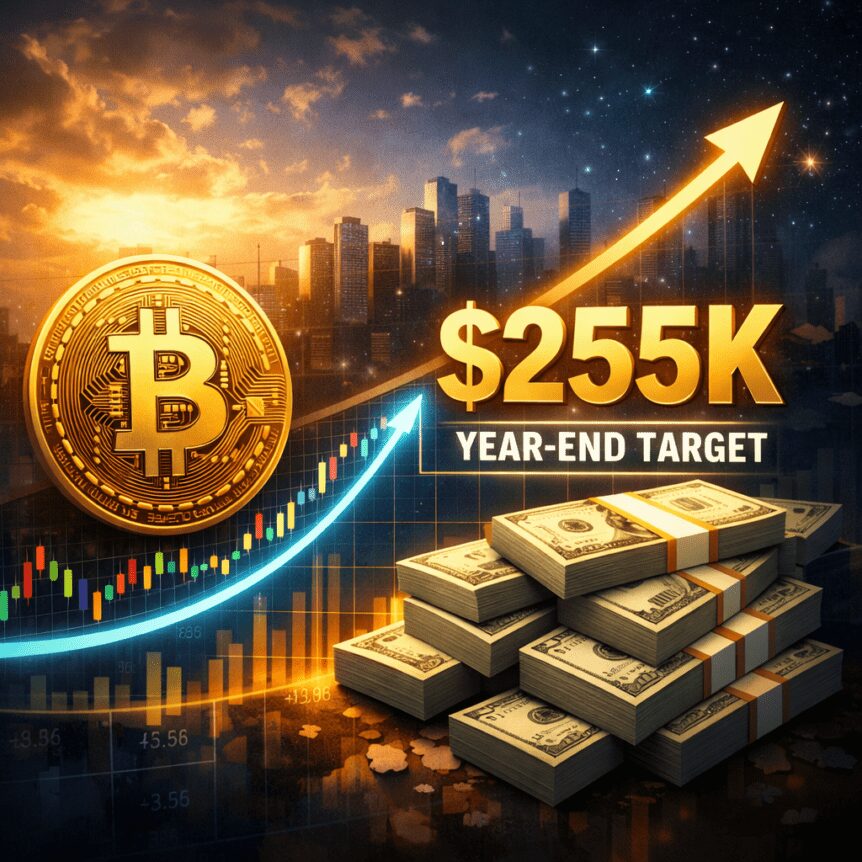
Bitcoin is roughly 40% off its October 2025 peak, but a long-range valuation framework suggests the pullback could be retraced as the market moves through a new cycle. The Bitcoin Decay Channel, a logarithmic model that tracks BTC’s secular uptrend while accounting for incremental gains each cycle, points to a broad end-of-year range—and potentially higher into 2027—despite near-term volatility.
Key takeaways:
- Bitcoin Decay Channel projects a conservative year-end range of $90,000–$255,000, with a 2027 band extending to $128,000–$308,000.
- On-chain signals, notably the HODL Waves indicator, imply a possible bottom around $65,900–$70,500 if selling pressure persists.
- BTC’s rebound in 2024 appears to have touched the lower edge of the Decay Channel, a region historically associated with long-term support.
- Analysts’ forecasts vary: Bernstein has emphasized a longer adoption cycle with a target near $150,000 for 2026 and a potential $200,000 peak in 2027, while other forecasters point to near-term milestones such as $126,000 this year and higher targets in the following years.
Decay Channel: a long-range compass for BTC valuation
The Bitcoin Decay Channel is a logarithmic framework that seeks to chart BTC’s extended uptrend while incorporating gradual gains across cycles. Historically, Bitcoin’s major tops in 2013, 2017 and 2021 formed near the model’s upper valuation band, while bear-market lows have repeatedly pressed back toward its lower support zone. The model has served as a reference point for traders seeking to understand where BTC might find底 in prolonged downturns and where renewed upside momentum could begin.
Bitcoin’s most recent rebound began near the lower boundary of the Decay Channel in March–April, a zone the model has traditionally treated as long-run support. That alignment keeps alive a bullish framing for the current cycle, according to observer Sminston, who highlighted the model’s plausible end-year range: “Bitcoin Decay Channel gives a pretty reasonable range—conservative case—of $90k–$255k, by the end of this year. $128k–$308k for end of ’27.”
To put that into perspective, Sminston has contrasted the gap between present prices and later targets with historical context: “For comparison, Bitcoin was $43k in December 2023.” The Decay Channel’s structure thus anchors expectations not only on where BTC could go if the cycle resumes, but also on where it might have already spent time in the current weak phase.
The model’s framing resonates with a broader narrative in the market: several independent forecasts align with the idea that BTC could participate in a fresh all-time high within the next couple of years as institutional demand, ETFs, and corporate treasury activity continue to evolve. This longer horizon is a recurring theme among strategic analysts who view the current pullback as part of a larger secular expansion rather than a purely cyclical retreat.
Bearish patterns and on-chain signals
Despite the optimistic scenario implied by the Decay Channel, a cluster of technical and on-chain indicators warns that downside risk remains material in the near term. A classic bear flag formation has traders watching for a potential breakdown that could push BTC toward the lower end of recent trading ranges. In raw terms, a breakdown of this setup could see BTC testing sub-$56,000 levels, representing a decline of roughly 30% from present price levels.
On-chain data, however, presents a more nuanced picture. The HODL Waves metric—tracking how long bitcoins sit in wallets without movement—has been cited as suggesting a stronger long-term holder base could stabilize the market and support a higher bottom. In a recent briefing, CryptoQuant analyst Sunny Mom noted that the ongoing accumulation by long-term holders could favor a higher, slower bottom this cycle, with $70,500 as a critical level to hold. The implication is that even as price drifts downward, a robust base of entrenched holders might cap further downside and lay groundwork for a renewed ascent.
These signals complicate the straightforward bearish view. While the bear flag remains a credible risk in the near term, the interplay between chart patterns and on-chain activity underscores a market that could drift within a broad range before a decisive move higher or lower materializes. Investors will be watching whether the lower-support zone identified by the Decay Channel—plus the stabilizing effect of a strengthening holder cohort—can anchor prices in the mid-to-high five-figure territory or whether a breach triggers a more extended correction.
What comes next for BTC price trajectories
Forecasts about BTC’s path in the medium term reflect a mix of valuation frameworks and strategic bets about institutional involvement. In coverage that preceded this edition, Bernstein analysts maintained a $150,000 target for 2026, while also laying out a $200,000 peak further out in 2027, tied to a lengthier cycle of institutional adoption driven by exchange-traded products and expanding corporate holdings. The pacing of this adoption curve remains a central question for the market, with the belief that larger institutions will progressively allocate to BTC as regulatory clarity improves and as more capital-bearing products become available.
Other prominent voices offer a different, though compatible, flavor of the story. Arthur Hayes, co-founder of BitMEX, has argued for BTC’s upside as macro and geopolitical catalysts fuel demand for scarce digital assets, citing paths toward a $126,000 level within the current year on the back of new liquidity drivers and demand from AI-related infrastructure. While these calls are not uniform, they reflect a shared conviction that BTC’s price action could be shaped by macro liquidity, regulatory developments, and the appeal of BTC as a non-sovereign store of value in uncertain times.
Taken together, the picture is one of a market in which multiple horizons coexist: a near-term range-bound regime driven by chart patterns and on-chain dynamics, alongside a longer-term trajectory that envisions fresh highs once institutional demand finds more durable footing. The Decay Channel’s ranges—$90,000 to $255,000 by year-end, extending to $128,000 to $308,000 in 2027—offer a framework for risk-aware participants to balance potential upside with the possibility of further volatility in the months ahead. The central task for traders and investors is to interrogate the underlying drivers: will the current weak phase resolve into renewed accumulation, or will a deeper consolidation re-assert itself before a new leg higher begins?
As the market navigates this juncture, traders should monitor both the technical backdrop and the on-chain substrate. A durable hold above the $65,900–$70,500 zone, reinforced by rising long-term holder activity, could tilt the odds toward a more constructive second half of the year. Conversely, a decisive break below the lower boundary of the Decay Channel or a fresh wave of macro shocks could reassert downside pressure in the near term.
In short, Bitcoin’s path remains contingent on how quickly institutional demand solidifies, how macro forces unfold, and whether the balance of active and dormant supply can sustain a credible bottom. The coming weeks will reveal which of the competing narratives dominates—and whether BTC can indeed align with the longer-term targets suggested by the Decay Channel and the diverse set of forecasts that accompany it.
Looking ahead, readers should watch for changes in on-chain behavior—especially shifts in HODL Waves and wallet activity—as well as any regulatory developments that could unlock or constrain financially meaningful products. The interaction of these factors will be decisive in determining whether Bitcoin stays within its current corridor or breaks toward the higher targets favored by some models and institutions alike.
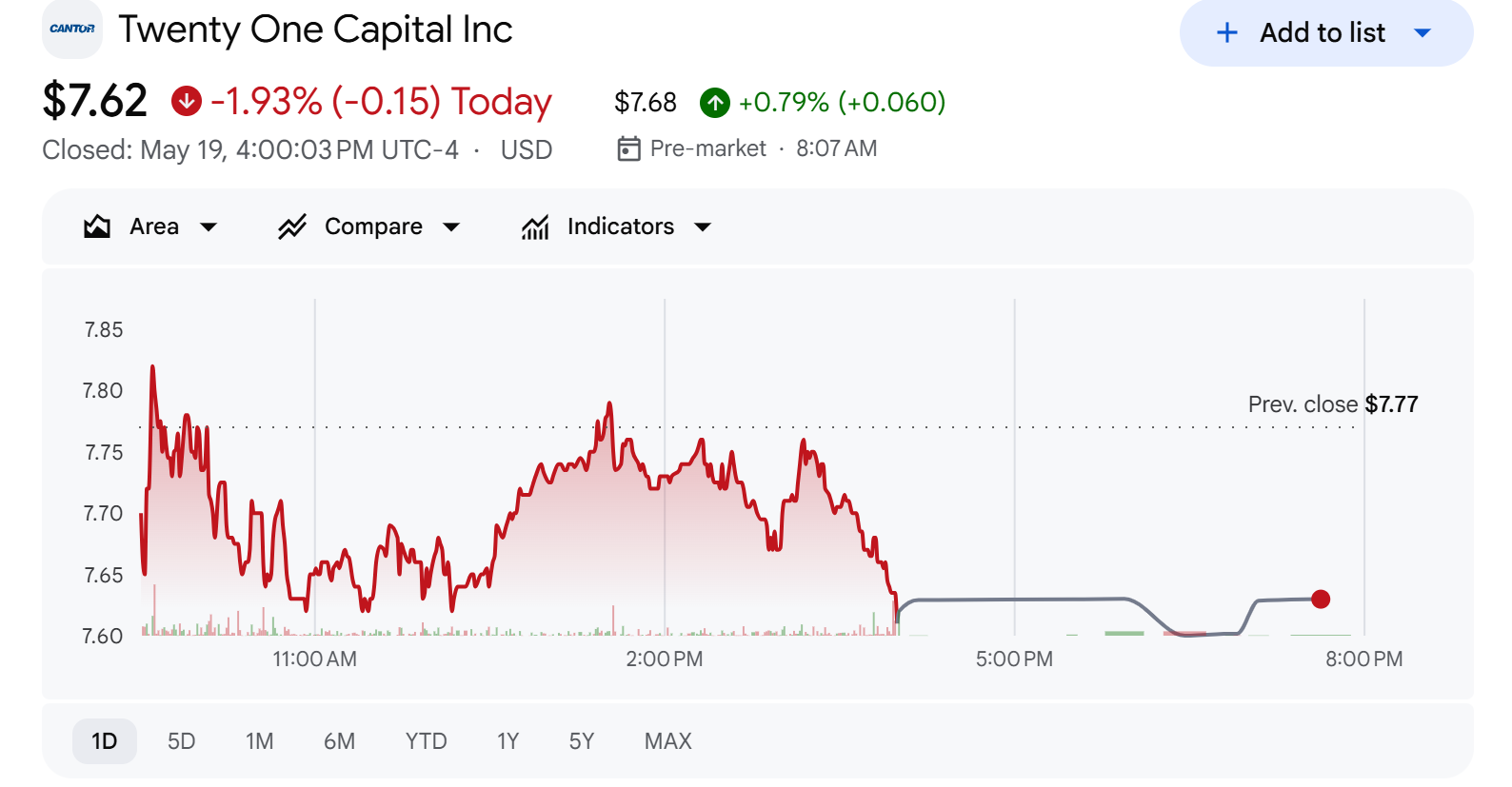
Tether International has acquired SoftBank’s entire stake in Twenty One Capital (NYSE: XXI), tightening its grip on one of the largest public Bitcoin treasuries.
Announced May 20, 2026, the deal removes SoftBank’s board seats and signals deeper conviction in XXI as a Bitcoin-native powerhouse.
Tether Takes Full Control of XXI, Buys SoftBank Stake
Twenty One Capital launched in December 2025 via SPAC merger with Cantor Equity Partners. It debuted with over 43,500 BTC, roughly $4 billion at the time, ranking as the third-largest corporate Bitcoin holder.
Tether and Bitfinex supplied the majority, with SoftBank contributing a significant minority stake equivalent to about 10,500 BTC.
SoftBank brought credibility and discipline during XXI’s formative phase. Its experience backing transformative tech firms helped shape strategy and attract institutional attention.
With the buyout complete, Tether now holds uncontested control as majority shareholder.
“Tether’s conviction in XXI has only deepened,” said Paolo Ardoino, Tether CEO. “SoftBank’s involvement gave XXI the kind of institutional depth that few early-stage companies ever have. They leave behind a company with a stronger foundation, a clearer mandate, and an ambitious path ahead.”
Follow us on X to get the latest news as it happens
The move comes months after Tether proposed merging XXI with Jack Mallers’ Strike platform and Elektron Energy.
The three-way combination aims to create an integrated Bitcoin company spanning treasury accumulation, mining, lending, and financial services.
Market Context and Investor Focus
XXI’s strategy centers on maximizing Bitcoin per share (BPS) through aggressive accumulation, capital markets tools, and ecosystem building.
While pure treasury plays like MicroStrategy dominate headlines, XXI positions itself as more operational and Bitcoin-native. Shares have experienced typical volatility tied to BTC price action since listing.

Tether’s latest action reinforces its massive Bitcoin holdings and long-term bet on BTC infrastructure.
As the world’s largest stablecoin issuer, Tether continues leveraging its balance sheet to expand influence in public Bitcoin markets.
What’s Next for XXI?
Investors will watch for updates on the proposed mergers, future BTC purchases, and capital raises.
With Tether fully aligned, XXI gains streamlined governance to execute its ambitious roadmap.
The coming months could see accelerated growth in holdings and operational milestones as Bitcoin adoption deepens among corporations.
The post Tether Takes Full Control of Twenty One Capital (XXI) After Buying SoftBank Stake appeared first on BeInCrypto.

South Carolina just became the most aggressive pro-Bitcoin state in America. Bitcoin may be down, its price prediction is also hitting a low, but with regulatory clarity and institutional adoption, BTC is coiling.
Governor Henry McMaster signed Senate Bill S.163 into law on May 19, 2026, implementing a total ban on CBDCs, tax neutrality for crypto payments, and hard protections for miners and self-custody holders. The vote was resolved at 110-1 in the House, a genuine bipartisan conviction.
The document states:
AN ACT TO AMEND THE SOUTH CAROLINA CODE OF LAWS BY ADDING CHAPTER 47 TO TITLE 34 SO AS TO PROHIBIT A GOVERNING AUTHORITY FROM ACCEPTING OR REQUIRING PAYMENT USING CENTRAL BANK DIGITAL CURRENCY OR PARTICIPATING IN A TEST OF CENTRAL BANK DIGITAL CURRENCY; TO PERMIT INDIVIDUALS OR BUSINESSES USING DIGITAL CURRENCY FOR TRANSACTIONS; TO PROVIDE THAT DIGITAL ASSETS MAY NOT BE SINGLED OUT FOR DISPARATE TAX TREATMENT; TO PROVIDE THAT DIGITAL CURRENCY TRANSACTION MAY BE TAXED IF THE TAXATION IS THE SAME AS IF THE TRANSACTION USED UNITED STATES LEGAL TENDER; TO RESTRICT CERTAIN ACTIVITY FOR DIGITAL CURRENCY OPERATIONS THAT ARE ZONED FOR INDUSTRIAL USE; TO PROVIDE THAT DIGITAL ASSET MINING BUSINESS OPERATIONS SHALL NOT PLACE ANY ADDITIONAL STRESS ON THE ELECTRICAL GRID FOR WHICH THEY ARE CONNECTED AND TO PROVIDE THAT DIGITAL MINING BUSINESSES MUST PROVIDE CERTAIN INFORMATION TO THE PUBLIC SERVICE COMMISSION UPON REQUEST; TO PROVIDE THAT THOSE ENGAGED IN DIGITAL MINING OPERATIONS DO NOT HAVE TO OBTAIN CERTAIN LICENSES AND THAT THOSE WHO PROVIDE CERTAIN SERVICES RELATED TO DIGITAL MINING OR STAKING ARE NOT OFFERING A SECURITY; TO PROVIDE THAT THE ATTORNEY GENERAL CAN PROSECUTE AN INDIVIDUAL OR BUSINESS THAT FRAUDULENTLY CLAIM TO BE OFFERING DIGITAL ASSET MINING AS SERVICE OR STAKING AS A SERVICE; AND TO DEFINE NECESSARY TERMS.
The law bars state agencies from accepting or testing any federal central bank digital currency, shields proof-of-work mining operations from discriminatory zoning and noise ordinances, and eliminates extra fees or levies on goods purchased with digital assets.
A separate House Bill, H.4256, would additionally allow South Carolina’s treasurer to allocate up to 10% of unallocated state funds into Bitcoin as an inflation hedge, capped at 1,000,000 BTC.
Discover: The best crypto to diversify your portfolio with
Bitcoin Price Prediction: Reclaim $80,000 as State-Level Adoption Accelerates?
At $77,000, Bitcoin is pulling back from recent highs but remains structurally elevated. The $75,000 level is the line that matters as a major psychological and technical support zone that needs to be defended to keep the uptrend intact. A daily close below that threshold would shift short-term momentum decisively bearish.
The weekly 4.5% drop reads as profit-taking after a rally from $66,000 to $83,000, particularly given the macro and legislative tailwinds accumulating beneath the price. ETF inflows remain a persistent bid, and the state-level reserve demand would represent a structural buyer class that doesn’t sell on red candles.

If Bitcoin could hold $75,000 as support and legislative momentum from South Carolina accelerates copycat bills in other states, ETF inflows could push the price back through $80,000. However, a break below $75,000 on volume would open the door to the $72,000 range, likely triggering forced liquidations and headlines of ETF outflows.
Regulatory clarity tends to compress volatility and attract institutional positioning, meaning South Carolina’s move may be more consequential for medium-term price structure than this week dip suggests.
Discover: The best pre-launch token sales
Bitcoin Hyper Targets Early-Mover Upside as Bitcoin Tries to Break Downtrend
Bitcoin consolidating away from all-time highs is a familiar frustration: the macro thesis is right, the entry is not that cheap, and the asymmetric upside that early adopters captured has already been realized. That’s the gap a project like Bitcoin Hyper is targeting: infrastructure-layer exposure to Bitcoin’s growth cycle at presale prices, before exchange listing.
Bitcoin Hyper ($HYPER) is positioning as the first Bitcoin Layer 2 with Solana Virtual Machine (SVM) integration, delivering sub-second finality and low-cost smart contract execution while inheriting Bitcoin’s security model.
Hyper aims to break Bitcoin’s core limitations, like slow throughput, high fees, and zero programmability, without abandoning Bitcoin’s trust layer. The project has raised more than $32 million at a current presale price of just $0.0136, with 35% APY staking available for early holders.
Hyper also offers a Decentralized Canonical Bridge that handles BTC transfers across the Layer 2 for traders watching Bitcoin’s state-level policy cycle accelerate,
Bitcoin Hyper represents early infrastructure-layer positioning that is worth researching.
The post Bitcoin Price Prediction: South Carolina Moves Against CBDCs With Zero-Tax BTC Bill appeared first on Cryptonews.

- Algorand (ALGO) jumped 5% after Robinhood listed it for US users.
- Algorand’s price has stayed between $0.1092 and $0.1173 with no breakout.
- Weekly trend is still down 6.8% despite the short-term rally.
Algorand has recorded a sharp burst of activity following its addition to Robinhood’s crypto trading platform, including availability for users in New York.
At the time of writing, Algorand’s ALGO coin was trading near $0.1149, showing a 24-hour gain of about 5%.
Robinhood listing triggers short-term momentum
The listing on Robinhood marks a notable distribution shift for Algorand.
$ALGO is now available to trade on Robinhood Crypto, including NY. pic.twitter.com/HBqM2MZ9zA
— Robinhood (@RobinhoodApp) May 19, 2026
The listing on Robinhood gives access to a large base of retail users, and historically, new listings on major retail brokerages tend to attract immediate trading interest.
In this case, the move was preceded by a wave of market commentary highlighting the possibility of Robinhood adding ALGO.
During that period, Algorand recorded intraday gains in the range of 5% to over 7%, depending on the timeframe used across different market trackers.
Once the listing was confirmed, trading activity increased further, with daily volume reaching approximately $58.9 million according to data from Coingecko.
This spike in activity coincided with heightened attention from retail traders reacting to the expanded accessibility of the token.
Price structure still shows resistance to a sustained breakout
Even with the Robinhood-driven rally, Algorand continues to trade well below its long-term highs.
The token remains down roughly 96.8% from its all-time peak of $3.56, recorded in June 2019.
This long-term drawdown highlights how far the asset has moved away from its earlier cycle valuations.
Over the past seven days, ALGO is still down around 6.8%, indicating that the recent move has not fully reversed earlier weakness.
On a monthly basis, however, the token is up approximately 12.1%, showing that the asset has been recovering in bursts rather than maintaining a steady trend.
More recently, price behaviour has been shaped by a narrow trading band.
The 24-hour range between $0.1092 and $0.1173 aligns closely with the observed rally, suggesting that most of the move occurred within established short-term volatility limits rather than breaking out of a broader range structure.
A key technical observation is that while momentum improved after the listing, there has been no sustained push beyond recent resistance levels near the $0.117–$0.122 zone, where price has repeatedly stalled in prior short-term rallies.

This indicates that buyers have not yet gained full control of trend direction.
Market reaction points to a liquidity-driven move rather than a trend shift
The current market setup shows characteristics of a liquidity-driven reaction rather than a structural reversal.
The combination of a confirmed Robinhood listing and rapid price expansion fits a pattern commonly seen when assets gain new retail access.
Trading volume near $59 million in 24 hours reflects increased participation, but the lack of follow-through beyond the immediate price spike suggests that the move is still largely sentiment-driven.
The fact that ALGO has remained negative over the past week reinforces the idea that recent gains are offsetting prior declines rather than establishing a new upward trend.
Outlook: bounce or reversal still unresolved
The expansion of availability on Robinhood, including access for New York users, increases the potential pool of participants.
This type of distribution event typically has two phases: an initial reaction driven by attention and a second phase where sustained demand either develops or fades.
With the token still trading far below historical highs and showing negative weekly performance, the recent move sits within a corrective recovery phase rather than a confirmed breakout structure.
Whether this develops into a trend reversal will depend on whether trading activity continues beyond the initial listing impact or fades back into the prior range.


The European Commission has opened a public consultation on the functioning of the EU’s MiCA regime, with feedback due by Aug. 31, 2026, in a move that will shape how crypto rules are applied across the bloc.
Summary
- The European Commission said the consultation covers the functioning of the Markets in Crypto-Assets Regulation, or MiCA, and will remain open until Aug. 31, 2026.
- The consultation seeks input from individuals as well as more technical feedback from issuers, service providers, financial institutions, academics, industry bodies and public authorities through the EU’s Have your say process.
- MiCA already sets harmonized EU rules for crypto-asset issuers, crypto-asset service providers, asset-referenced tokens and e-money tokens.
The European Commission said on May 20 that it had launched a consultation to gather feedback from stakeholders and the wider public on how MiCA is working in practice, marking a new phase in the EU’s attempt to turn its landmark crypto law from statute into an enforceable and adaptable operating framework.
The consultation matters because MiCA is no longer theoretical. The regime established a harmonized EU framework for crypto-assets and related services, covering crypto-assets, asset-referenced tokens, e-money tokens, their issuers and crypto-asset service providers, and the Commission now wants to know where the rulebook is working and where it is already showing strain.
The Commission said the exercise includes both a public consultation for individuals and a targeted consultation aimed at more technical and legal questions for market participants and institutional stakeholders, meaning the review is designed not just as a political box-ticking exercise but as a practical audit of the regime’s first real-world effects.
Implementation phase
According to the European Commission, all feedback gathered through the consultation will be used to inform its future policy work on digital assets, making the process one of the clearest early signals that Brussels is already thinking beyond first-generation MiCA implementation.
That matters for any firm operating in Europe because the framework already applies across the bloc. As the French regulator AMF notes, MiCA entered into force on June 29, 2023, with rules for stablecoins taking effect on June 30, 2024, and the wider regime applying from Dec. 30, 2024.
The substance of the regime is broad. ESMA says MiCA introduces uniform EU market rules for crypto-assets not already covered by existing financial services law, with key provisions covering transparency, disclosure, authorization and supervision.
Industry impact
For exchanges, wallet providers, token issuers and stablecoin firms, this consultation is effectively an invitation to try to shape the next round of European crypto supervision before it hardens into precedent. Industry participants, consumer groups, civil society and public authorities are all being asked to weigh in on how the rules should function in practice and where gaps remain.
That broader review has been signaled for weeks. At Paris Blockchain Week, EU financial services official Peter Kerstens said the Commission would launch a public consultation on MiCA with “no taboos,” according to KuCoin, raising the prospect that issues such as DeFi, tokenized assets and cross-border supervision could become part of the next policy cycle.
The outcome will matter well beyond Brussels procedure. For crypto firms trying to operate across all 27 member states, the consultation will help determine whether MiCA remains a static compliance burden or evolves into a more usable framework for licensing, disclosure, stablecoin issuance and cross-border service provision throughout the European Union.
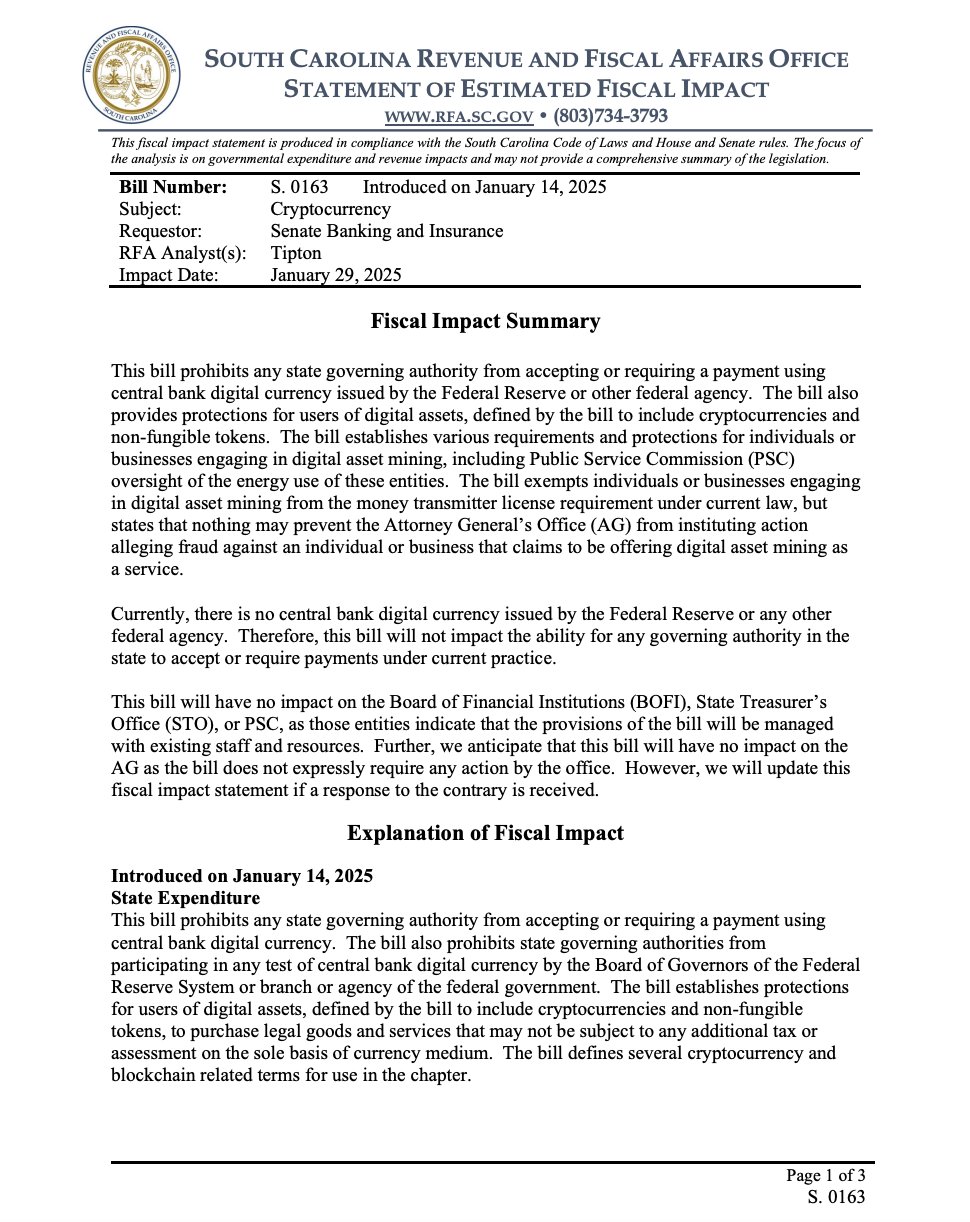
South Carolina Governor Henry McMaster signed Senate Bill 163 into law on Tuesday, advancing one of the most crypto-friendly state-level frameworks in the country.
The bill, which previously passed the Senate 38-1 and the House 110-1, bans state agencies from accepting central bank digital currencies (CBDCs), protects the rights of crypto users and miners, and clears regulatory hurdles for businesses operating in the space.
On CBDCs, the law bars any state agency or political subdivision from accepting, requiring payment in, or participating in Federal Reserve-led digital currency trials, including any pilot programs run by federal agencies.
It also protects crypto self-custody rights, preventing governments from restricting the use of hardware and self-hosted wallets while barring higher taxes on crypto transactions than comparable payments made in US dollars.
Related: Senate Crypto Bill Might Pass as Late as August: NYDIG
South Carolina protects Bitcoin miners
The bill gives Bitcoin miners operating in industrial zones specific protections. Local governments cannot impose restrictions on mining businesses that do not apply to other industrial operations in the same area, and cannot set mining-specific noise limits beyond what general pollution rules already require.
“A political subdivision shall not change the zoning of a digital asset mining business without going through the proper notice and comment. A digital asset mining business may appeal a change in zoning to the proper court of jurisdiction,” the bill reads.
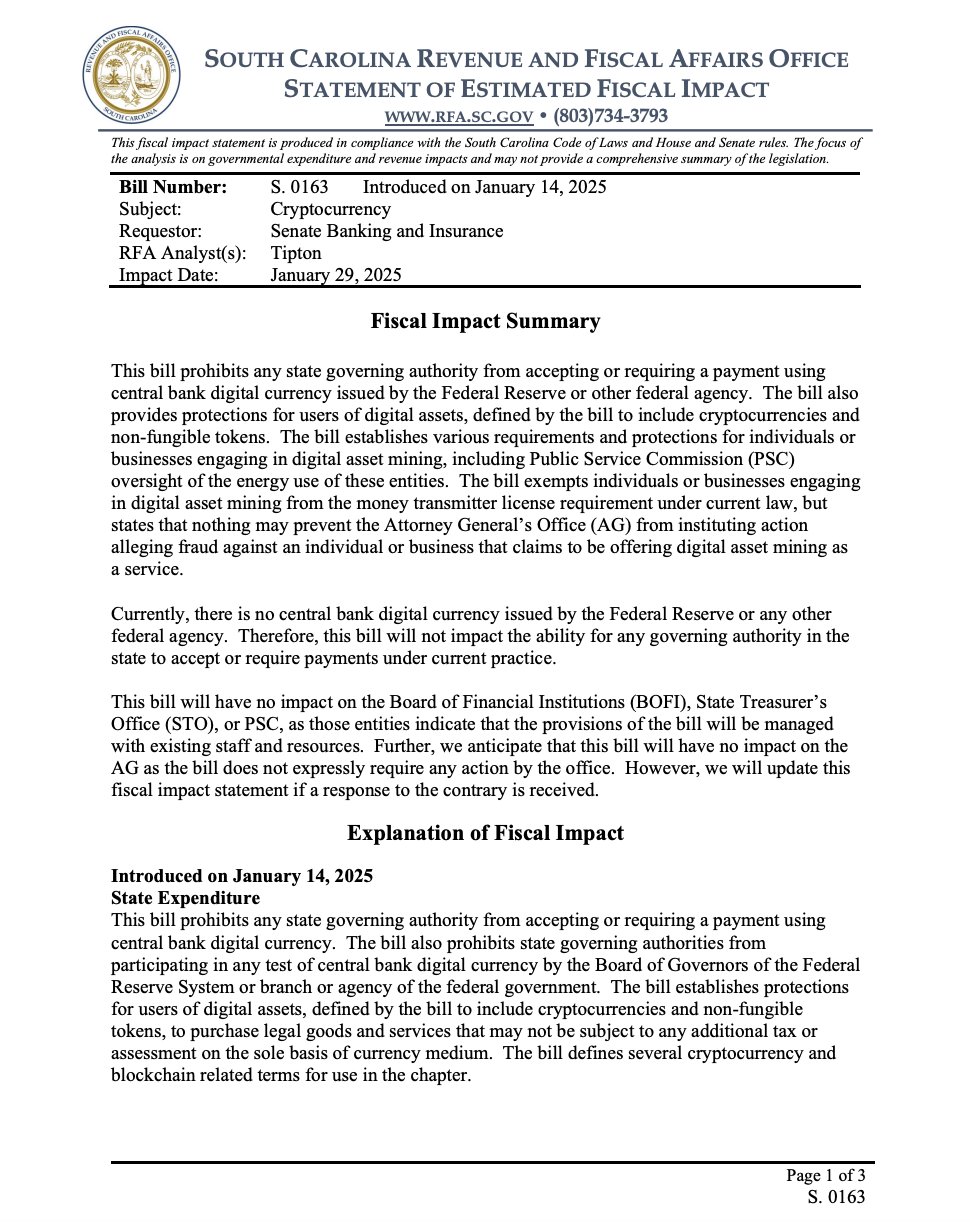
Source: South Carolina State House
The law also exempts several activities from money transmitter licensing requirements, including mining, node operation, blockchain software development and crypto-to-crypto trading. Mining-as-a-service and staking-as-a-service providers are excluded from securities classification.
Related: Polish lawmakers back revised crypto bill after repeated vetoes
More states pass crypto-friendly bills
South Carolina joins a growing list of states staking out pro-crypto positions. Kentucky passed the Bitcoin Rights bill in March last year, guaranteeing self-custody rights and shielding mining operations from discriminatory local rules.
Oklahoma, Arkansas, Florida, Mississippi, Montana, North Dakota, Louisiana and Arizona are among the states that have passed similar pieces of crypto legislation in recent years.
Market analysts say Bitcoin (BTC) is showing “momentum exhaustion” after its 8% drop from multi-month highs above $82,000, with bulls expected to defend key crucial support levels.
Key takeaways:
- Bitcoin momentum weakens after rejection above the $82,000 level.
- Analysts warn BTC could fall to $65,000 if support at $74,000-$76,000 fails.
Bitcoin’s price momentum is “weakening”
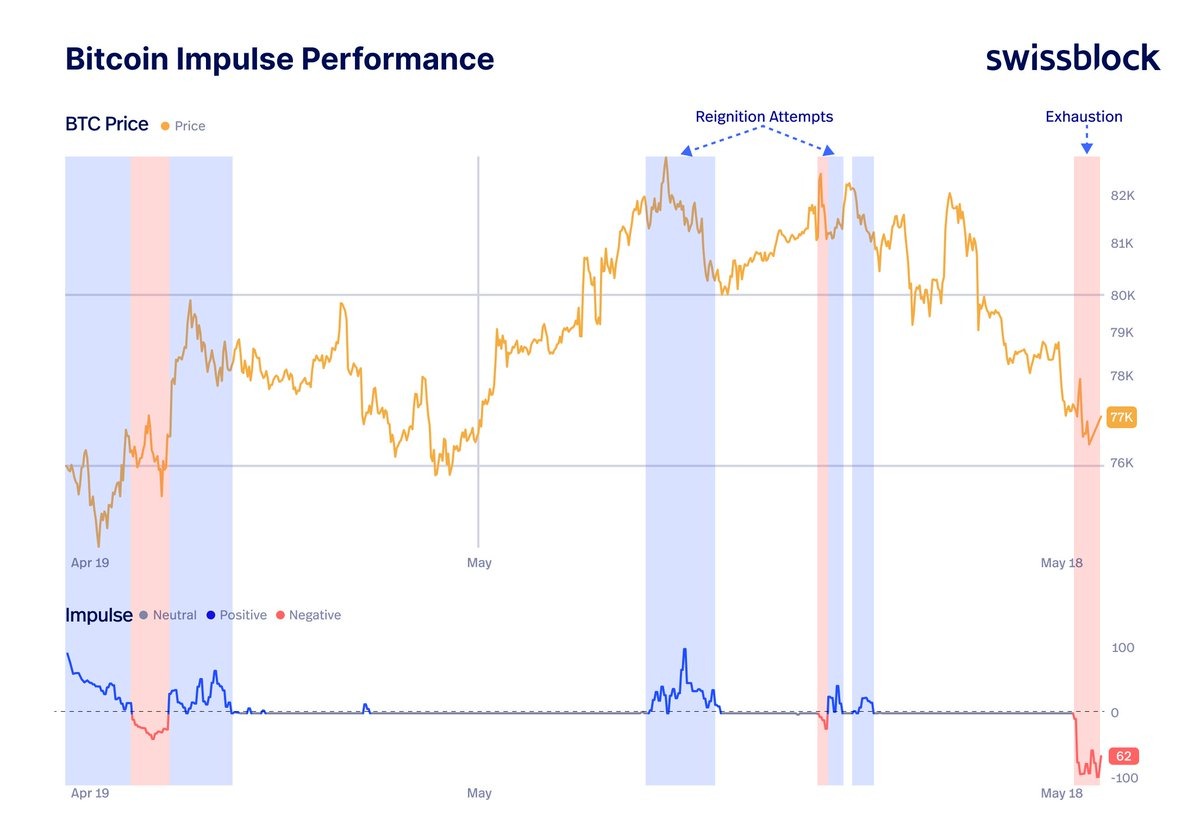
Private wealth manager Swissblock stated that Bitcoin’s momentum is fading following failure to “sustain expansion” above $82,000.
Swissblock said that Bitcoin’s positive momentum has been losing “force with every bounce,” contributing to the latest drop to $76,000.
Related: Bitcoin price stays under $77K as US bond yields near 20-year highs
Bitcoin is now trading at $77,200, with the true market mean and the short-term holder cost basis around $78,000 now acting as immediate resistance.
“Bitcoin is losing its capacity to regenerate strong positive momentum internally,” the wealth manager said, adding:
“Momentum exhaustion is not the breakdown itself. It is the process that usually comes before it.”
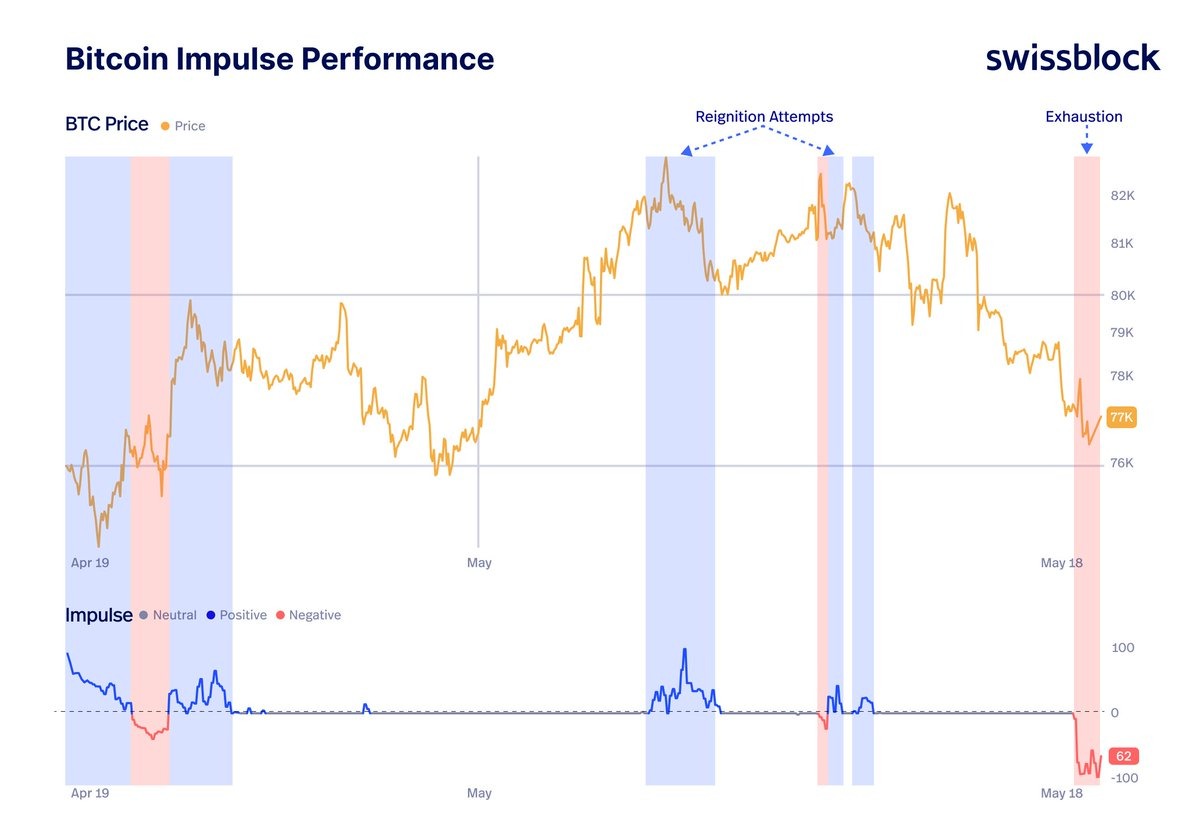
Bitcoin performance impulse. Source: Swissblock
Echoing this observation, analyst Axel Adler Jr pointed out that Bitcoin’s slow impulse performance indicator has “turned negative for the first time since April,” adding:
“Momentum is fading exactly as macro pressure is rising. Without Slow back above zero, every rally is unconfirmed.”
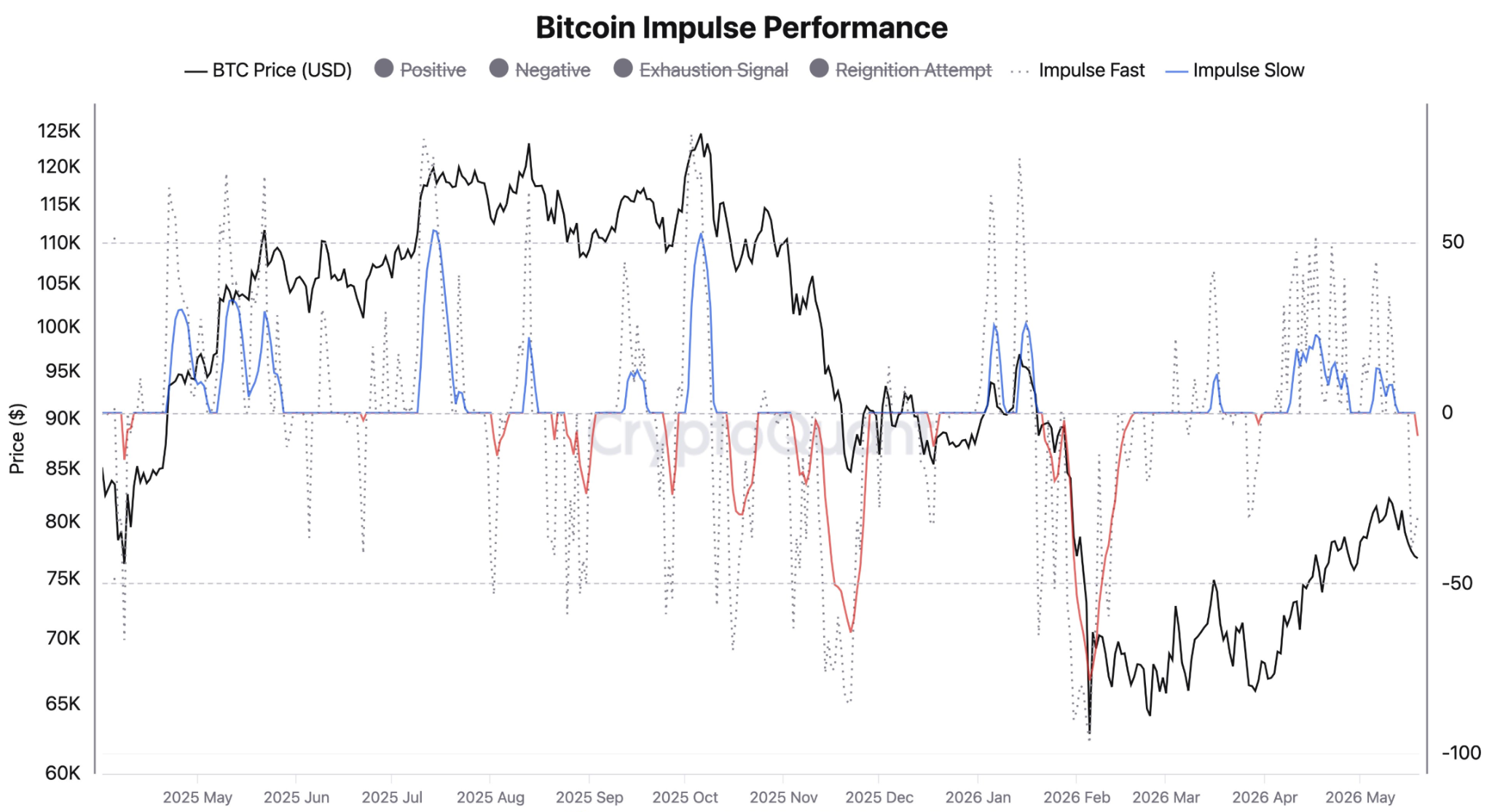
Bitcoin impulse performance. Source: CryptoQuant
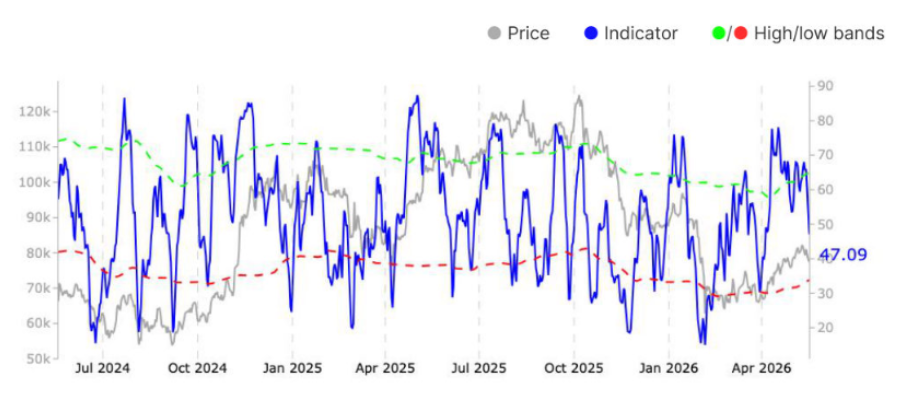
Bitcoin’s price momentum indicator has also decreased significantly, falling by 29% over the last week to 47.1 from 66.7, indicating a “shift from strong upward to weakening momentum,” Glassnode said in its latest Market Pulse report, adding:
“Bitcoin’s market structure is beginning to soften as momentum, spot demand, and speculative positioning weaken across the market.”
Bitcoin price momentum. Source: Glassnode
Key Bitcoin support levels to watch
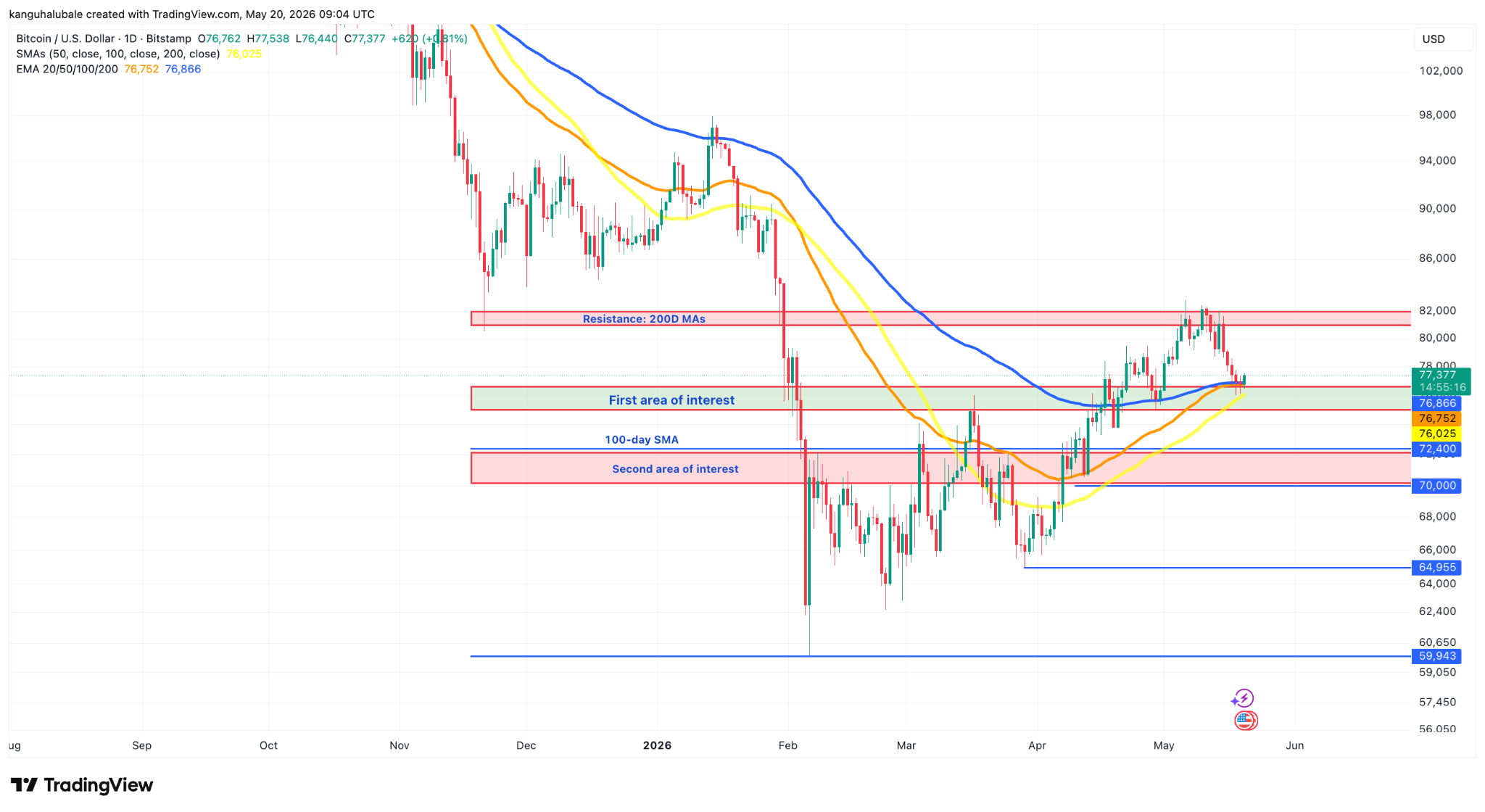
As Cointelegraph reported, Bitcoin’s upside hinges on bulls keeping the price above the $74,000-$75,000 zone, as it has repeatedly served as key support over the last two years.
This is where the key moving averages are found, including the 50-day exponential moving average (EMA), 100-day EMA and the 50-day simple moving average (SMA), as shown in the chart below.
This reinforces the importance of this demand zone and the fact that BTC/USD has not yet dipped below, “may be the most bullish thing” for Bitcoin, trading resource Material Indicators said in a recent X post.
BTC/USD daily chart. Source: Cointelegraph/TradingView
The second area of interest lies between $72,000 (100-day SMA) and the psychological level at $70,000.
If this level is lost, BTC price could drop to $65,000 or later revisit the macro low below $60,000, reached on Feb. 6.
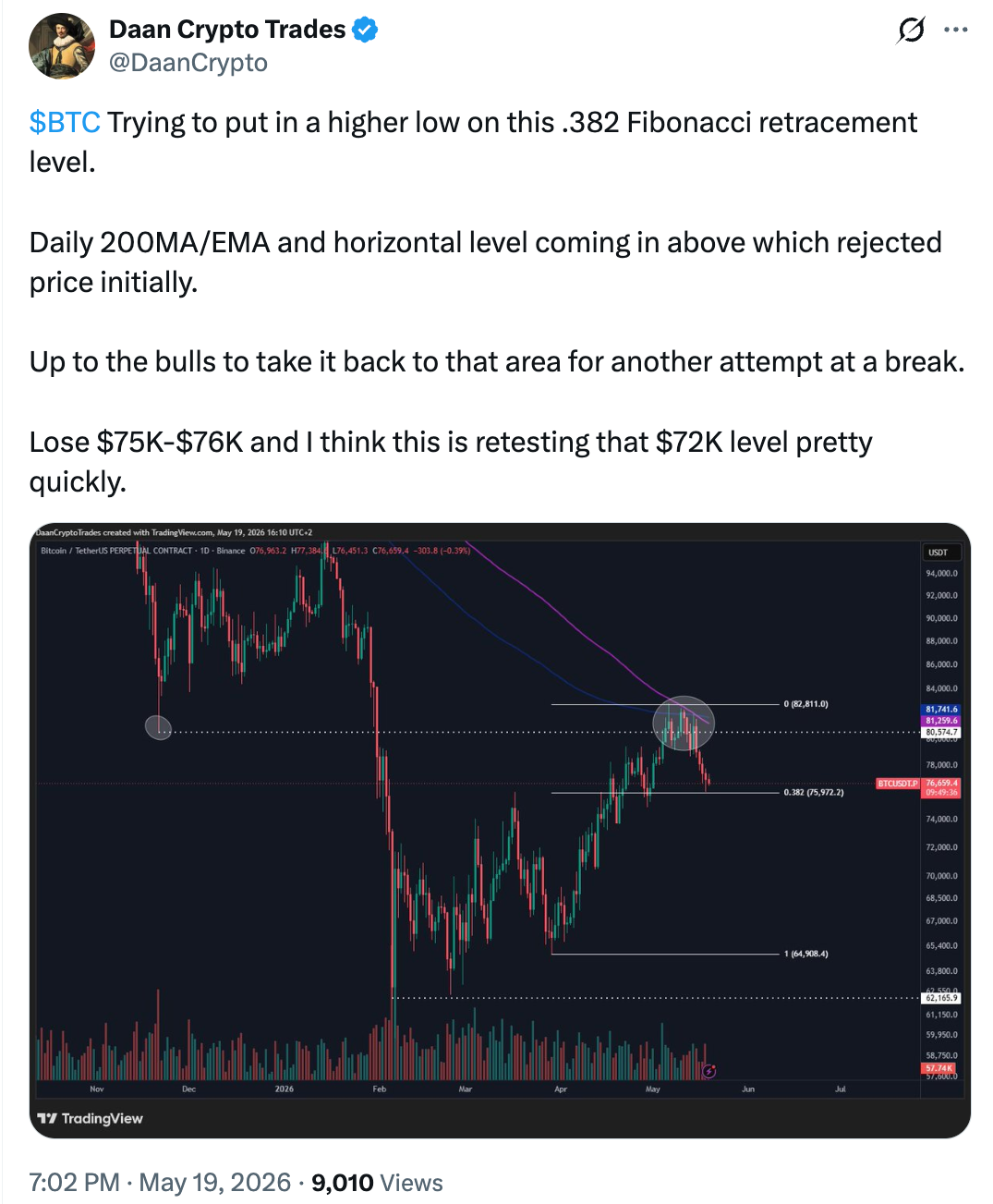
Analyst Daan Crypto Trades Bitcoin said that if the support at $75,000-$76,000 is lost, the BTC/USD pair would retest the $72,000 “level pretty quickly.”
BTC/USD daily chart. Source: X/Daan Crypto Trades
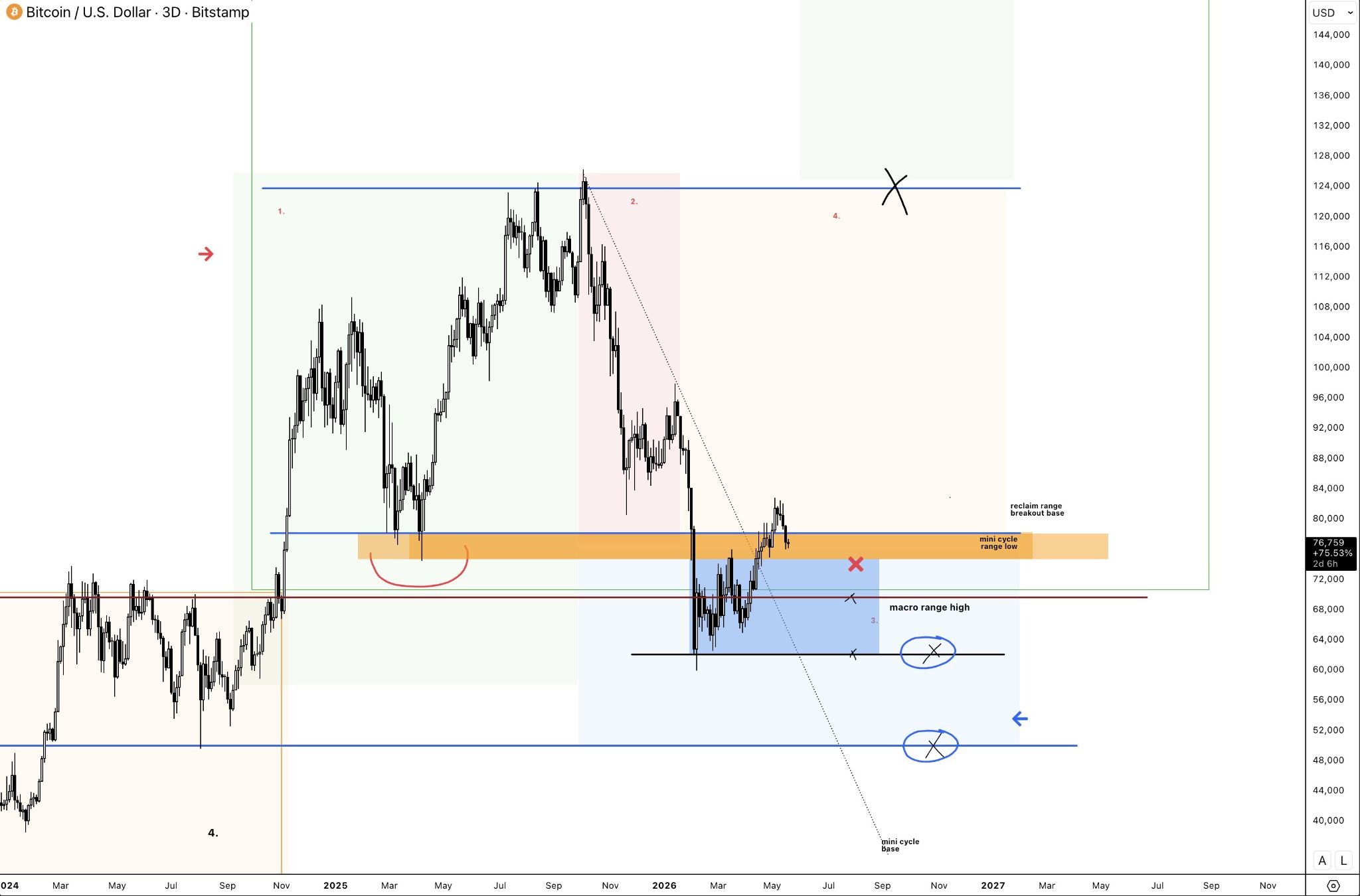
Zooming out, trader CryptoAmsterdam said it would be “good” if the BTC/USD pair held support at $74,000-$76,000 (the orange area on the three-day chart below) with other areas of defense around $72,000.
The analyst sets downside targets at $60,000 and $50,000 in case these support levels are breached.
BTC/USD three-day chart. Source: X/CryptoAmsterdam
As Cointelegraph reported, a key support level for the bulls was the 50-day SMA at $75,600, which, if lost, could see the BTC/USDT pair sink to $65,000.
The primary cryptocurrency, which performed quite well towards the end of April and beginning of May, has tumbled by 5% over the past week, sparking fears that the bottom of the bear cycle has yet to be reached.
One popular analyst believes that its eventual breakout would heavily depend on holding a critical support level.
Big Jump or Major Collapse?
Ali Martinez – a renowned analyst who often makes BTC predictions after observing certain technical indicators and factors – once again chipped in. This time, he paid special attention to the Market Value to Realized Value (MVRV) pricing bands and envisioned a rally to almost $95,000 should the asset’s valuation hold above $72,960.
At the same time, Martinez claimed that falling below this key zone could trigger a major pullback to just under $55,000, representing a 30% crash from today’s price.
In a separate post, the X user revealed that BTC’s MVRV ratio has plunged below its 180-day SMA. Unlike traditional models, which see this development as a cooling phase, Martinez views it as “a shift toward a high-conviction accumulation zone.”
“When the MVRV ratio sits below the 180-day moving average, it means the market is effectively flushing out premium and pricing in a deep discount. Historically, these specific periods mark the exact foundation on which long-term smart money builds its positions. As long as the ratio consolidates under this 180-day line, the short-term trend will remain compressed, offering a highly strategic accumulation window,” he explained.
The latest activity of the big investors supports the bullish outlook. As CryptoPotato reported, the number of market participants holding at least 100 BTC has increased to 20,229. This represents an 11% increase compared to the 18,191 wallets recorded in May 2025.
Such a development shows that these big shots are confident in the asset and position themselves for a potential price pump in the future. This could have a psychological effect on smaller players, who may follow suit and inject fresh capital into the ecosystem.
Is History Repeating?
Meanwhile, other analysts made pessimistic forecasts and expect BTC to post a painful decline in the short term. Among those is X user Chiefy, who argued that the asset is entering the exact same pivot zone that appeared during the 2022 market meltdown.
They reminded that back then, many people described the crash as a “healthy correction,” suggesting that now history is repeating. If that is indeed the case, BTC could tumble to as low as $45,000 in the coming months.
Another worrying factor is the rising amount of coins stored on crypto exchanges. CryptoQuant’s data show the figure currently stands at almost 2.7 million, close to the monthly high reached earlier this week. This shift suggests that some investors have abandoned self-custody methods in favor of centralized platforms, thereby increasing immediate selling pressure.
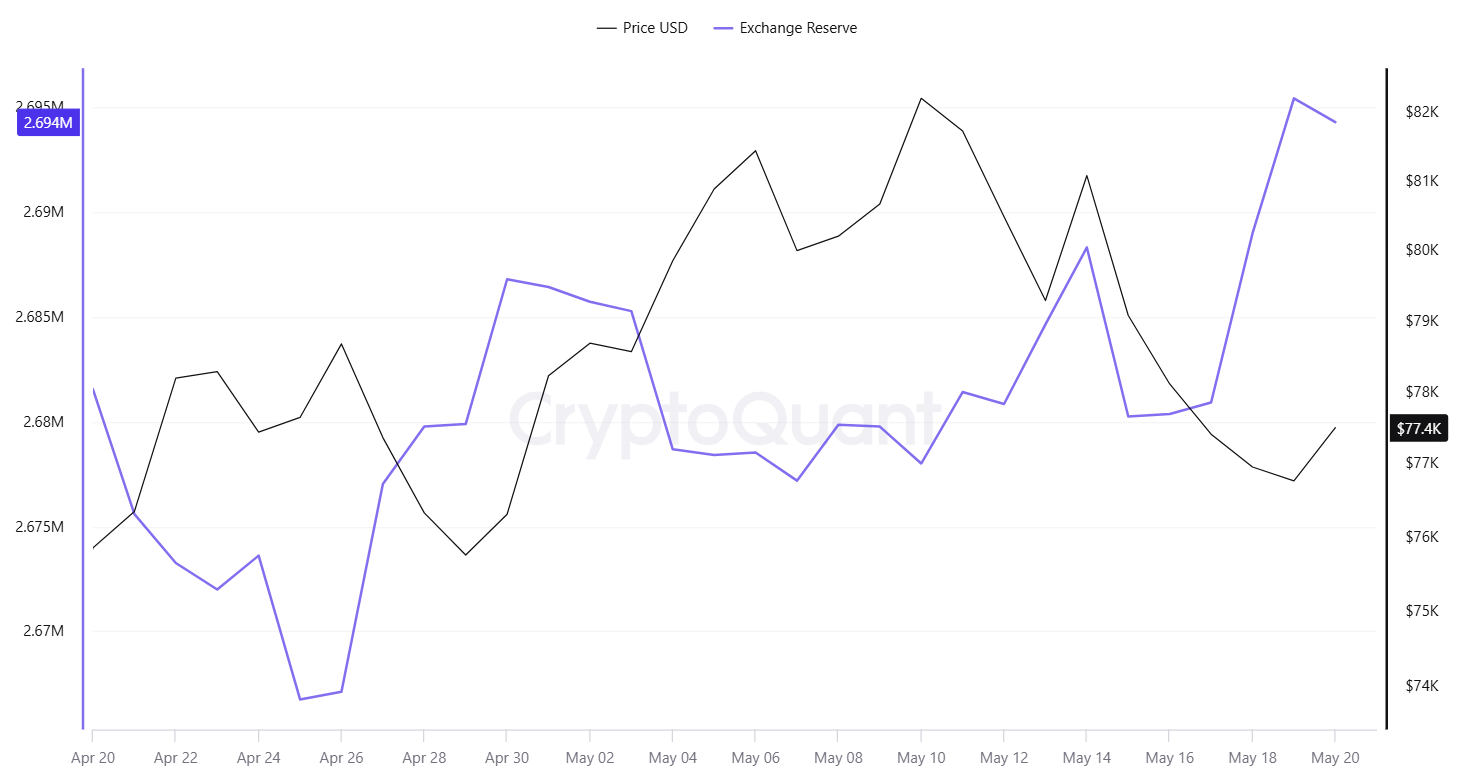
The post Bitcoin (BTC) on the Edge: 23% Rally or 30% Crash Comes Next? appeared first on CryptoPotato.

GitHub breach traced to poisoned VS Code extension

North Korean side Naegohyang wins in South Korea to reach Asian Women’s Champions League final

StitcherAI emerges from stealth with $3M and a different take on the AI spending problem


-

 Crypto World5 days ago
BloFin War of Whales 2026 Grand Prix opens registration for $5M trading championship
-

 Fashion5 days ago
Weekend Open Thread: Theory – Corporette.com
-

 Crypto World5 days ago
E-Estate Announces 1 Year Live: Washington DC Summit as Real Estate Tokenization Enters Its Next Phase
-

 Tech5 days ago
Tech Moves: Microsoft AI leader jumps to OpenAI; former AI2 exec joins Meta; and more
-

 Tech5 days ago
Google reimburses Register sources who were victims of API fraud
-
 Crypto World6 days ago
Google’s Gemini AI Predicts Incredible Solana Price by the End of 2026
-

 Business5 days ago
H&R Real Estate Investment Trust (HR.UN:CA) Q1 2026 Earnings Call Transcript
-

 Sports5 days ago
Napoleonic enters 2026 Doomben 10,000 field via Abounding withdrawal
-
 Entertainment6 days ago
Zara Larsson Has Blunt Response To Chris Brown Diss
-
 Crypto World7 days ago
Two AI Tokens Lead May Rally, But Risks Are Rising
-

 Crypto World5 days ago
BeInCrypto 100 Institutional Awards Nomination: KAST for Best Digital Assets Neobank and Best Digital Assets Fintech
-

 Fashion3 days ago
On the Scene at Gucci’s Cruise Show in New York City: Mariah Carey, Kim Kardashian, Lindsay Lohan, Iman, and More!
-
 Crypto World5 days ago
Bitcoin Battles US Bond Nerves With BTC Price Dip Toward New May Lows
-
 Crypto World5 days ago
Wall Street’s Boldest Gold Prediction Has Russians Rushing to Buy
-

 Fashion4 days ago
Trending Western Style Vests Perfect for Summer
-

 Politics6 days ago
DWP PIP Timms review continues to be an absolute farce
-

 Entertainment5 days ago
David Letterman Returns to Late Show, Blasts Cancellation
-

 Crypto World5 days ago
ICE and CME urge US regulators to curb Hyperliquid energy trading
-

 Fashion3 days ago
Amazon Sundays: Memorial Day Hosting
-
 Crypto World6 days ago
Lido Finance Selects Chainlink CCIP as the Official Cross-Chain Infrastructure for wstETH Security
You must be logged in to post a comment Login