
Crypto World
Quant (QNT) Rockets 75% Today as Major Banking Catalyst Fuels 180% Weekly Rally


During a relatively calm weekend trading session in which most larger-cap cryptocurrencies have remained sideways, Quant’s QNT has gone on a tear, skyrocketing by 75% in the past 24 hours alone to over $180.
A major US banking partnership appears to be the most evident catalyst, although on-chain data shows activity began heating up well before the announcement was made public.
Why Is QNT Soaring?
Interestingly, the biggest fundamental development didn’t come in the past 24 hours. It was announced on September 24 when The Clearing House selected Quant to power its On-Chain Money Initiative. The crypto project will provide the interoperability, orchestration, and transaction-management layer for the planned network, allowing financial institutions to clear and settle tokenized deposits while connecting with existing payment infrastructure, including the RTP and CHIPS networks.
Both parties expect to launch the system to participating institutions in the first half of 2027. The scale involved helps explain why this announcement attracted so much attention. The Clearing House says its US payment networks clear and settle more than $2 trillion every day, across wire, ACH, check-image, and real-time payments.
However, the activity around Quant and its native token started to pick up over a week before the partnership made the news. Santiment Intelligence said that active addresses exceeded 870 every day between September 16 and 23, whereas they had not topped 792 during the first half of the month.
New addresses were also running at approximately 1.8 times their earlier September weekday average. After the announcement, though, active addresses exploded to 2,064 on September 24, which marked the highest level in nearly a year. QNT’s price skyrocketed by 27% that day.
$QNT’s on-chain activity stepped up on Sep 16, eight days before its Clearing House headline.
Active addresses topped 870 every day from Sep 16 to 23. From Sep 1 to 15 they never passed 792.
New addresses ran about 1.8x their Sep 1 to 15 weekday average over the same… pic.twitter.com/VIyGPyIhyf
— Santiment Intelligence (@SantimentData) September 25, 2026
How High, QNT?
There’s no way to sugarcoat what happened to QNT’s price in the past day and week. The asset is up by 75% since this time yesterday and by a whopping 185% weekly. It currently trades at $180 after briefly topping $190 earlier today.
Crypto Patel, who outlined the significance of the $115 support recently, noted that QNT has reached a couple of his big targets. However, he warned that investors should not FOMO in and start buying now, trying to catch the next wave up. Instead, he noted that consolidation and retracement become important after such a parabolic move, and predicted that the price could settle somewhere between $50 and $100 before the next big move.
EGRAG CRYPTO shared a similar warning, indicating that investors should buy the retracements on such occasions, as going blindly into a token that has posted such a green candle could prove counterproductive.
The post Quant (QNT) Rockets 75% Today as Major Banking Catalyst Fuels 180% Weekly Rally appeared first on CryptoPotato.


GIWA has rejected claims that its mainnet RPC was leaked, saying the Ethereum Layer 2 network has not launched its mainnet.
Summary
- GIWA says its mainnet remains unlaunched, ruling out any leak involving a live mainnet RPC.
- Official documentation lists only GIWA Sepolia testnet RPC endpoints while mainnet infrastructure remains under development.
- GIWA runs on the OP Stack and uses Ethereum as the settlement layer for transactions.
- GIWA Wallet and stablecoin ecosystem products remain labeled Coming Soon on the project website currently.
- Upbit partnered with Optimism to build GIWA under a self-managed OP Enterprise infrastructure model earlier.
The project said on X on Sept. 27 that a mainnet RPC leak was impossible because no mainnet has gone live. GIWA told users to “DYOR” and remain alert to false information and scams circulating before launch.
Official GIWA documentation supports the main point of the clarification. The network’s mainnet section remains marked as under development, while GIWA Sepolia is available as a public test environment.
GIWA mainnet remains under development
GIWA’s connection documentation does not provide a mainnet RPC endpoint. Instead, developers can access the GIWA Sepolia testnet through sepolia-rpc.giwa.io, while a separate Flashblocks test endpoint is available for faster transaction preconfirmation.
Both endpoints are rate limited and intended for development and testing, according to the project’s network guide. GIWA specifically says its mainnet is “currently under development.”
The same distinction appears in GIWA’s smart contract documentation. Its contracts page lists deployed contracts for the Sepolia testnet but leaves the mainnet section marked as under development.
A separate Flashblocks document identifies a working testnet endpoint while listing the corresponding mainnet endpoint as “Coming soon.”
The available documentation therefore supports GIWA’s statement that a public test network exists while the production network has yet to launch.
The clarification follows social-media claims involving what was described as a leaked mainnet RPC. GIWA did not identify the accounts or URLs behind those claims in the statement supplied for this report.
No evidence provided by GIWA indicates that its Sepolia testnet RPC was compromised. The project’s response specifically addresses claims involving the unlaunched mainnet.
GIWA uses OP Stack for its Ethereum Layer 2
GIWA is an Ethereum Layer 2 built with the OP Stack, the open-source software framework maintained within the Optimism ecosystem.
Its technical documentation describes a one-second block time and compatibility with Ethereum Virtual Machine development tools. Developers can deploy Solidity contracts using tools already common in Ethereum development.
The network uses a sequencer for block production, while Ethereum provides the Layer 1 environment underlying GIWA’s settlement architecture. The current design specifies a 60 million block gas limit and one-second block intervals.
Unlike some Layer 2 networks, GIWA does not currently advertise a separate native token. Its FAQ says ETH is used as the base asset and for transaction fees, while stablecoin-based fee payments may be supported later through a Paymaster system.
Upbit’s involvement became public earlier in 2026. Upbit partnered with Optimism to build GIWA using the OP Stack under the Self Managed OP Enterprise tier.
The arrangement allows Upbit to manage its own infrastructure while receiving technical support and failover services from Optimism, according to the report. Sequencer control gives the operator responsibility for ordering transactions on the network.
GIWA’s own documentation describes the chain as “Powered by Upbit” and positions it as infrastructure linking users, developers and liquidity to Web3 applications.
GIWA Wallet and stablecoin products remain unfinished
GIWA’s public website shows that several planned products have not yet entered general release. The official site lists GIWA Wallet as “Coming Soon.” It describes the wallet as a self-custody product designed for GIWA Chain with multichain support and integrated views of exchange assets.
A planned stablecoin ecosystem carries the same status. GIWA says it intends to support stablecoin payments involving Korean won and global stablecoins, including Paymaster infrastructure that could allow stablecoins to cover transaction fees.
The project currently directs developers toward its testnet instead. Test ETH is available through a faucet, and developers can use GIWA Sepolia for smart contracts, wallet integrations and other testing before production deployment.
GIWA’s smart contract development guide supports Foundry, Hardhat and Remix IDE. Applications can use Solidity or other EVM-compatible tools because the network follows Ethereum’s execution environment.
The node documentation provides a similar test-focused setup. Developers can run their own GIWA node or use the free Sepolia RPC endpoint, while the project recommends external node services for future production workloads.
Upbit continues building around blockchain infrastructure
GIWA forms one part of Upbit operator Dunamu’s efforts to expand beyond centralized exchange trading.
The project’s website describes on-chain identity, data oracle services, a wallet and stablecoin payments among planned components. Some remain in development as GIWA progresses toward a production network.
Upbit has previously had to clarify reports concerning unreleased blockchain products. Crypto.news reported in July that the exchange rejected claims it was participating in issuing Open USD after Dunamu appeared on a list connected to the stablecoin initiative.
At the time, Upbit said it had not agreed to issue or launch the dollar-backed stablecoin. Several other South Korean companies named in the same initiative similarly denied having made formal commitments.
GIWA’s current clarification is narrower. It concerns technical claims about an RPC endpoint and states only that no GIWA mainnet has been launched.
The project’s public documentation does not provide a mainnet launch date. Its connection, contracts and Flashblocks pages continue to show mainnet features as being under development or coming soon.

Many patients in that situation wind up living on the streets or in shelters, despite efforts to find them permanent housing. A surprising number of older adults, however, find themselves in a nursing home—even if they don’t need or want that level of care.
According to research from the United Health Foundation, one in 11 people in nursing homes have “low-care needs,” meaning they do not require physical assistance for bed mobility, transferring, using the toilet, or eating. The ratios vary by state, from a low of 2.5% in Hawaii to nearly 23% in Oklahoma.
Synovec recalls one client in her 50s who lost her housing while she was in the hospital getting treatment for a stroke. Although a family member was willing to take her in, she couldn’t navigate their second-floor apartment. The stroke left her without the use of one arm and with mild cognitive problems, but she still was able to manage most daily activities, including taking the bus to visit family, friends, and her church. She needed some help—for example, with getting dressed—but she valued her independence.

Bitcoin’s seven-day average hashrate has fallen to roughly 915.8 EH/s while miner holdings dropped by 1,530 BTC over one week, according to mining data covering Sept. 20 through Sept. 26.
Summary
- Bitcoin’s seven-day average hashrate fell to 915.8 EH/s, its lowest level in three weeks recently.
- Miner reserves declined by 1,530 BTC in one week to approximately 1.1928 million BTC overall.
- Bitcoin’s Puell Multiple rose by 0.24 over the week to reach a reading of 1.13.
- Mempool data showed network hashrate remained below one zettahash during several late-September sessions this week.
- Several listed miners have continued selling mined Bitcoin as operating and infrastructure strategies evolve further.
Digital Asset reported that the seven-day moving average stood at 915,844,520 TH/s on Sept. 26, down approximately 34.86 million TH/s from a week earlier. The reading was the lowest since around Sept. 3.
During the same period, CryptoQuant data cited by the report placed miner Bitcoin reserves at 1,192,766 BTC. The balance was 1,530 BTC lower than seven days earlier.
Bitcoin hashrate slips after September recovery
The hashrate reading indicates that less computing power was securing the Bitcoin network on a seven-day average basis than one week earlier.
Hashrate measures the combined computational power miners use to process Bitcoin transactions and compete to add new blocks. A higher network hashrate generally means more computing resources are participating in mining.
Public Mempool mining data supports the weaker late-September trend. Individual daily and pool-level readings moved below one zettahash during several sessions after climbing above that threshold earlier in September.
CoinWarz recorded Bitcoin network hashrate at roughly 954 EH/s on Sept. 25 after readings near 984 EH/s a day earlier. Its daily estimates showed substantial swings throughout September, including levels above 1 ZH/s on Sept. 15 and Sept. 9.
The movement follows a longer decline from Bitcoin’s late-2025 peak. Twenty One Capital CEO Raphael Zagury described the period as Bitcoin’s first “hashrate bear market,” based on the distance from the network’s previous record.
Zagury’s presentation put the decline from the late-2025 peak at roughly 22% to 24%. He linked part of the reduction to mining companies directing more power and capital toward artificial intelligence computing.
The Sept. 26 seven-day average represents a shorter-term reading and should not be treated as proof that all miners are reducing capacity. Bitcoin hashrate can fluctuate because of block timing, power conditions, mining difficulty and changes in active equipment.
Miner reserves fall by 1,530 BTC in one week
Miner-held Bitcoin declined during the same week. CryptoQuant data cited by Digital Asset showed miner reserves at 1,192,766 BTC on Sept. 26. The figure was down 1,530 BTC from the previous week.
CryptoQuant defines miner reserve as Bitcoin held in wallets associated with miners and mining pools. A falling balance indicates that coins have moved out of tracked miner wallets, although the destination and purpose can vary.
Outflows can involve exchange sales, transfers to custodians, collateral arrangements, lending or other treasury activity. A decline in reserves therefore does not establish that every transferred Bitcoin was sold in the open market.
Earlier in September, miner reserves briefly moved in the opposite direction. Reporting based on CryptoQuant data placed miner holdings near 1.1919 million BTC on Sept. 5, an increase of 261 BTC from the previous week.
Public mining companies continue to show different treasury policies. CleanSpark, for example, mined 593 BTC in August but sold 821 BTC during the month.
As crypto.news reported on CleanSpark’s August production, the company finished August holding 13,703 BTC. Its average operating hashrate reached 38.3 EH/s. Other miners have reduced or abandoned mining activity as computing infrastructure is redirected toward AI customers. Hyperscale Data stopped Bitcoin mining at its Michigan facility on Sept. 1 while preparing the site for an AI computing contract.
Crypto.news reported on the Michigan shutdown that the company’s Bitcoin holdings had fallen roughly 79% from 1,006 BTC in July to around 215 BTC.
Bitcoin’s Puell Multiple increased during the week even as miner reserves and hashrate declined. Digital Asset reported a reading of 1.13 on Sept. 26, up 0.24 from seven days earlier. The metric compares the daily U.S. dollar value of newly issued Bitcoin with its 365-day moving average.
A reading above one means daily miner issuance revenue is higher than its one-year average. The indicator does not directly measure miner profit because it does not account for each operator’s electricity, financing or equipment costs.
Public mining dashboards show similar readings around the neutral range. HalvingLens placed the Puell Multiple near 1.01 on Sept. 26 and classified the level as normal. The site estimated daily miner issuance near 450 BTC and daily miner revenue around $37.8 million at the time.
The difference between individual Puell readings can result from data timing, price sources and methodology. The Digital Asset figure of 1.13 refers specifically to the source it cited for Sept. 26.
Bitcoin’s current block subsidy remains 3.125 BTC after the April 2024 halving. Crypto.news explained in its updated halving guide that the next scheduled reduction is expected around 2028, when the subsidy will fall to 1.5625 BTC per block.
Mining conditions remain uneven across regions
Mining conditions have differed sharply between operators during September. Ethiopia reduced electricity supplied to Bitcoin miners to 23% of contracted levels after reservoir inflows fell 20%, according to Ethiopian Electric Power.
Crypto.news reported on the electricity restrictions that Bitcoin mining consumed nearly one-third of Ethiopia’s electricity and generated 35% of the utility’s revenue during the previous fiscal year.
The utility plans to reassess conditions in October. Further restrictions could depend on reservoir levels and electricity demand. At the network level, Bitcoin continued producing blocks normally despite the lower seven-day hashrate reading. Mempool showed blocks continuing to clear on Sept. 26 while pool shares and short-term hashrate estimates shifted throughout the day.
Bitcoin’s difficulty mechanism adjusts approximately every 2,016 blocks to account for changes in network computing power. The next adjustment will respond to actual block production over the full difficulty period rather than a single seven-day hashrate reading.
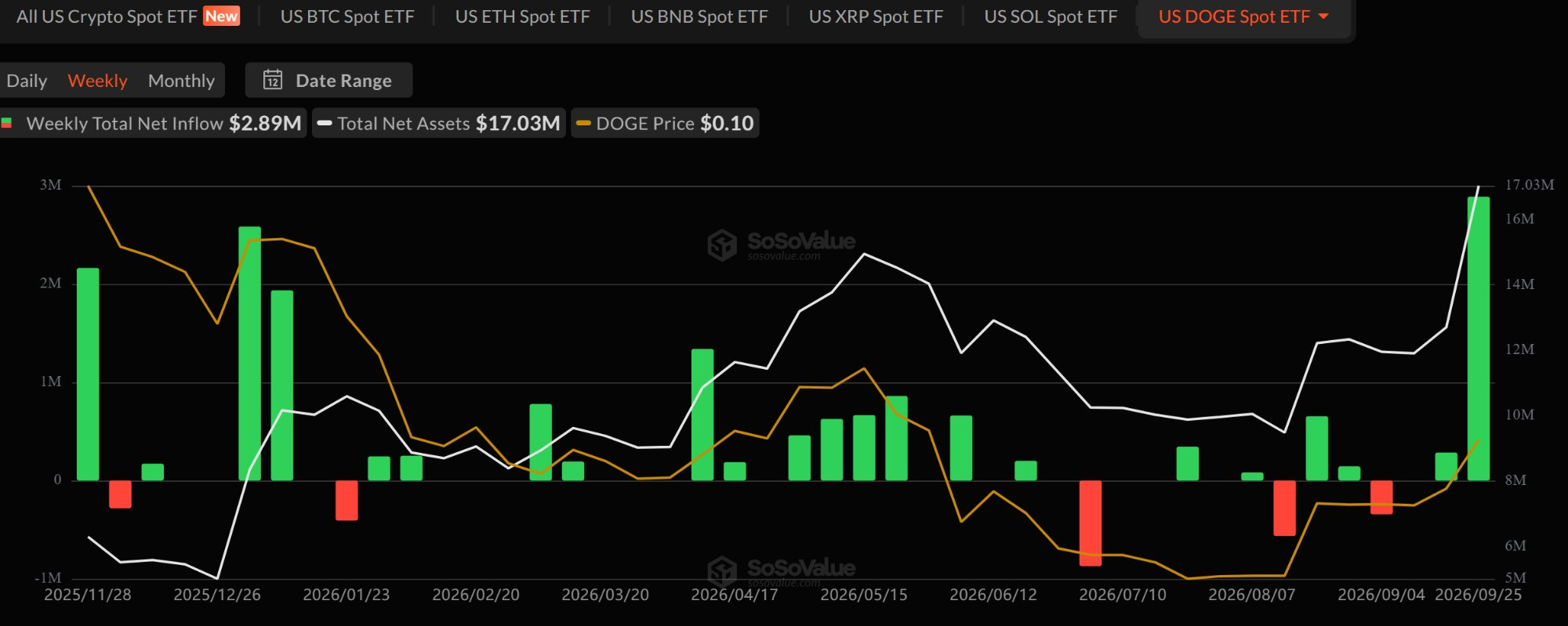
US spot Dogecoin (DOGE) exchange-traded funds (ETFs) drew $2.89 million in net inflows in the week ending September 25. That is their largest week since launch, according to SoSoValue data.
An ETF lets investors buy exposure to an asset through a normal brokerage account, much like buying a stock. The record came 11 days after Bitwise said it would shut its own Dogecoin fund.
Dogecoin ETF Inflows Beat the January Record
The previous weekly high was about $2.59 million, set in the week ending January 2, SoSoValue data shows. The week before this one brought in only $284,510.
All of the new money arrived in three sessions last week. Monday, Tuesday, and Friday.

Grayscale Takes Nearly All the Money as Bitwise Exits
BeInCrypto reported on September 10 that Bitwise will liquidate its Dogecoin ETF, BWOW. Its last trading day is October 14, barely three weeks away. The fund has lifetime net outflows of $1.23 million and holds $801,400.

“Bitwise has determined to liquidate the Fund as it continues to optimize its product range to meet evolving investor needs,” the issuer stated.
Since that announcement, cumulative inflows into Grayscale’s GDOG rose from $11.7 million to $15.46 million. Meanwhile, 21Shares’ TDOG fell from $1.63 million to $1.03 million.
GDOG took all of Friday’s $806,060. It now holds $13.87 million, or about 81% of the group’s assets.
How Big is Dogecoin ETF Demand?
The funds hold 0.11% of Dogecoin’s total market value, SoSoValue data shows. DOGE traded near $0.098, with a market cap of about $15.3 billion, according to BeInCrypto Markets data.

Quiet days are the norm. Between July 1 and September 18, the funds posted net flows on just nine trading days.
The Dogecoin record also landed in the same week US spot Bitcoin ETFs pulled in $2.39 billion. That total is more than 800 times the Dogecoin figure.
After October 14, two US spot Dogecoin funds will remain. Grayscale accounted for every dollar of Friday’s inflow.
The post Dogecoin ETFs Hit Record Week After Bitwise Exit Plans. Will Price React? appeared first on BeInCrypto.

Michael Saylor, executive chairman of Strategy and co-founder of the firm, argues that the next era of digital intelligence should be built around a “bill of digital rights” rather than expanding restrictions on how people and businesses use digital assets. In an essay posted on X on Saturday, Saylor positioned digital assets as essential infrastructure for productivity and capital formation—especially as automation reshapes industries.
Saylor’s framework outlines five core freedoms he says should apply to both individuals and companies: the ability to create new digital assets, to issue them to markets to finance productive activity, the right to hold them or choose custodians, the ability to transfer assets across users and service providers, and the freedom to use them—whether for spending, investing, earning income, or borrowing against collateral.
Key takeaways
- Saylor proposes a “bill of digital rights” centered on five freedoms: create, issue, hold/custody, transfer, and use digital assets.
- He argues that restricting what owners can do with assets undermines their economic value—because asset value depends on owner utility.
- Saylor links AI-driven productivity gains to the need for more flexible capital markets that can fund new businesses.
- He calls for “digital dollars” to be able to compete on yield and operate with minimal friction—where law allows it, and with legal updates where it doesn’t.
- Strategy’s recent Bitcoin buying resumed after a brief pause, reinforcing Saylor’s broader message about capital formation through digital assets.
From digital assets to a “rights” framework
In his essay, Saylor frames digital rights as a practical foundation for economic growth in an age where “digital intelligence” will automate tasks and make existing products obsolete. Rather than treating digital assets as a niche financial tool, he suggests they function as a general-purpose mechanism for raising capital and reallocating resources faster than traditional systems typically allow.
The five rights Saylor highlights start with creation and issuance. He argues that participants should be free to create new digital assets and to issue them to markets so businesses can finance productivity and expansion. From there, he emphasizes ownership and custody choice—owners should be able to hold assets themselves or select custodians that fit their needs.
Transferability is the next pillar. Saylor stresses that rights should include the ability to move digital assets among people, companies, wallets, and service providers. Finally, he argues that digital assets should be usable in real economic activity, including spending, investing, earning income, and borrowing against them.
“An asset’s value depends on what its owner can do with it,” Saylor wrote, adding that “restrict its usefulness, and you restrict its economic potential.” The argument is less about any single token category and more about what regulations and market design allow owners to do—particularly during periods of fast technological change.
Why AI-era capital markets may require fewer bottlenecks
Saylor connects his “rights” idea to the economics of AI adoption. He writes that an AI age can increase production, but he argues it will only reach its potential if capital markets and money systems are capable of supporting the businesses and innovations that emerge from automation.
He also criticizes what he describes as a mismatch between protecting today’s business models and financing their successors. According to Saylor, shielding existing models while making it difficult for new ventures to raise capital leaves the economy less prepared for technological change.
To underscore the scale of what he envisions, Saylor says the ambition should be to enable “10 million new companies” to raise capital. The core implication is that digital assets and modernized rails for money and funding could shorten the time between technological opportunity and real-world investment.
This is where his policy argument becomes more pointed. If future prosperity depends on rapid entrepreneurship, then the rules governing digital asset creation, issuance, custody, transfer, and use are not just technical questions—they determine whether new market entrants can fund their growth.
“Digital dollars” should compete—and move quickly
Saylor’s essay extends beyond general digital assets to the specific question of money. He argues that “digital dollars” should be allowed to compete on yield and operate at “the speed of light.” In his view, banks, fintech companies, and technology platforms should be able to provide digital dollars through the applications and devices people already use.
In other words, the differentiator shouldn’t be whether these systems are compatible with legacy processes, but whether they can deliver competitive returns and low-friction settlement. Saylor also calls for legal reform where necessary, writing that “where the law prevents it, the law should change.”
For investors and market participants, the practical question is what regulatory barriers might be slowing interoperability or limiting issuance and distribution. Saylor’s framework suggests that the more restrictive the rules on custody, transfers, or usage, the less capital the system can efficiently mobilize for new activity.
Strategy’s Bitcoin buys align with Saylor’s capital-formation thesis
While Saylor’s essay is a policy and philosophy statement, it lands alongside Strategy’s ongoing Bitcoin accumulation. Cointelegraph reported earlier this week that Strategy resumed buying Bitcoin after a two-week pause. The company acquired 950 BTC for $75.7 million, averaging $79,670 per coin.
Cointelegraph also reported that this brought Strategy’s holdings to 846,000 BTC, acquired for about $63.8 billion at an average cost of $75,416 per coin. At the time of publication in the source report, Bitcoin was trading at roughly $84,523.
Strategic Bitcoin purchasing has been a central part of Strategy’s public narrative for enabling capital exposure through a digital asset. Read alongside Saylor’s essay, the purchases reinforce his larger claim: that economic transformation requires funding mechanisms that can move quickly and function across modern financial rails, rather than being constrained by older frameworks.
At the same time, Saylor’s broader critique about “protecting existing business models” hints at a tension that investors may watch as AI accelerates. If regulations or market structures slow down funding channels for new companies—even while incumbents benefit from continuity—the economy could fail to realize the full productivity promised by automation.
Going forward, readers may want to watch how lawmakers and regulators respond to calls for more flexible digital-money systems and clearer rights for digital-asset usage—particularly around custody choices, transferability, and the ability to deploy digital assets for borrowing and investment. The direction of those rules will likely determine how quickly new ventures can access capital in an AI-driven economy.
SpaceX President and Chief Operating Officer Gwynne Shotwell sold $52.5 million of company stock on September 22, ahead of Monday’s Starship launch, the rocket’s first attempt to reach orbit.
It is the first significant stock sale by a SpaceX executive since the company listed on Nasdaq in June, according to TipRanks.
How the SpaceX Stock Sale Worked
A Form 4 filed with the Securities and Exchange Commission (SEC) on September 24 shows Shotwell first exercised stock options. Options let an employee buy shares at a fixed, older price.
She bought 342,170 shares at $8.40 to $19.40 each, a total cost of about $4.5 million. She then sold all of them the same day through Morgan Stanley at roughly $151 to $155 per share.
The trades ran under a Rule 10b5-1 plan she adopted on June 23, according to the filing. These plans lock in sale instructions ahead of time, so an executive cannot pick the day based on private news.
Shotwell Still Holds About $830 Million in Shares
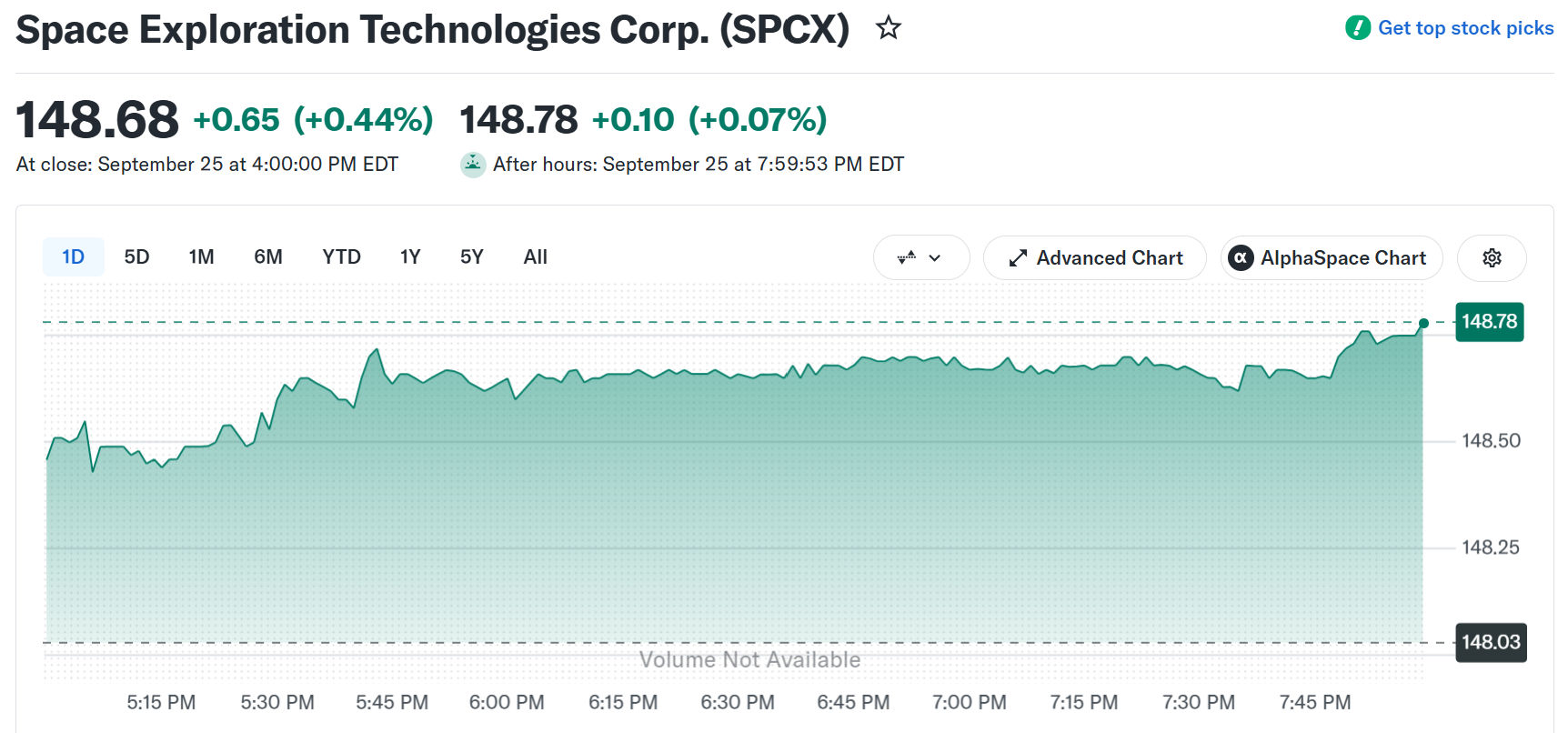
After the sale, Shotwell holds 2.47 million Class A shares directly and 3.11 million through two family trusts. At Friday’s $148.68 close, that stake is worth roughly $830 million.

The sale equals about 6% of her position. She also holds 575,005 unexercised options.
Why the Timing Draws Attention
Starship Flight 14 is set for Monday at 7:15 a.m. Central time from Starbase, Texas, according to SpaceLaunchLive. It is the rocket’s first try at a stable orbit, carrying 26 Starlink internet satellites.
Notably, however, the launch has already slipped once. SpaceX first set September 22 for the flight, which sent SpaceX stock up 6% on the news.
Shotwell’s plan predates the flight date by three months. A larger source of new supply is the lock-up, a rule that bars early holders from selling for set periods after an IPO.
About 328 million shares were freed on September 24, and the stock fell over 4% the day before, BeInCrypto reported. More unlocks are scheduled through June 2027.
The 33 analysts tracked by TipRanks rate SpaceX a Moderate Buy, with an average price target of $232.07, about 56% above Friday’s close.

Still, SpaceX shares trade about 34% below their $225.64 high. Monday’s launch and the next unlock are the stock’s next two tests.
The post SpaceX President Cashes Out $52 Million Before Monday's Starship Launch appeared first on BeInCrypto.

Michael Saylor, executive chairman of Strategy and co-founder of the company widely regarded as the largest corporate Bitcoin holder, argues that the next era of digital assets and AI should be built around a clear set of “digital rights.” In an essay posted on X, Saylor said the industry needs a rights-based framework that prioritizes what asset owners can do with their money and capital—not additional restrictions that limit utility.
His proposal centers on five fundamental freedoms for both individuals and companies: the ability to create and issue new digital assets, hold them directly or via a custodian, transfer them across parties and systems, and use them for everyday economic activity—from spending and investing to earning income and borrowing against collateral.
Key takeaways
- Saylor’s “bill of digital rights” is framed as an alternative to restricting digital assets, emphasizing how owner control drives real economic value.
- The framework covers both people and companies, spanning creation/issuance, custody choice, transferability, and use cases like spending, investing, and borrowing.
- Saylor links the need for better “money and capital markets” to realizing AI’s productivity gains.
- He argues the long-term prosperity of automated economies will depend on enabling rapid business formation and capital access.
- The essay follows reporting that Strategy resumed Bitcoin purchases after a brief pause, adding 950 BTC to its balance sheet.
Why Saylor is calling for a “bill of digital rights”
In the X essay, Saylor positions digital assets as essential infrastructure for an AI-driven economy—one that can increase production but will require “better money and capital markets” to translate that potential into widespread growth. The heart of his argument is that policy and market design should recognize that asset value is tied to utility: if owners cannot act on what they hold, economic potential shrinks.
Instead of focusing on narrow concerns about how particular products are used, Saylor proposes a general framework meant to guide how digital assets operate across the economy. He writes that a useful model should define rights that remain consistent regardless of the issuer or holder type.
The five freedoms: creation, custody, transfer, and practical use
Saylor’s “digital rights” framework outlines five freedoms. First, it includes the “freedom to create new digital assets” and the “ability to issue them to the market” so businesses can finance activity and productivity improvements.
Second, he emphasizes the right to hold digital assets directly or select a custodian—an acknowledgment that custody choices matter for both operational flexibility and risk management.
Third, he argues for transferability, describing the right to move assets among people, companies, wallets, and service providers. In practice, that means interoperability and the ability to transact without being blocked by arbitrary barriers.
Finally, Saylor makes the case that digital assets should be usable in real economic workflows. His list includes spending, investing, earning income, and borrowing against digital assets. The policy implication is straightforward: if regulations or design choices prevent assets from serving these roles, then their broader contribution to capital formation and liquidity is limited.
“An asset’s value depends on what its owner can do with it. Restrict its usefulness, and you restrict its economic potential,” Saylor wrote.
From AI productivity to capital markets that can fund new businesses
Saylor connects the rights framework to the economic transition brought by AI. He suggests that automation will transform work, make some products obsolete, and require societies to continuously generate new businesses and opportunities. In that framing, the availability of capital and the ability to deploy it quickly become determining factors for future prosperity.
He also sets a growth target for the entrepreneurial ecosystem, writing that the ambition should be to enable “10 million new companies to raise capital.” While the essay does not provide a specific policy roadmap, the underlying point is that capital formation depends on asset mechanisms that work reliably and broadly—particularly during periods of rapid technological change.
Strategy’s Bitcoin buying continues as Saylor argues for open capital
Saylor’s essay also arrives amid ongoing Bitcoin accumulation by Strategy. Cointelegraph reported earlier this week that Strategy resumed buying Bitcoin after a two-week pause, purchasing 950 BTC for $75.7 million at an average price of $79,670 per coin.
Cointelegraph further reported that this brought Strategy’s total holdings to 846,000 BTC, acquired for about $63.8 billion at an average cost of $75,416 per coin. At the time of publication of that report, Bitcoin was trading at about $84,523.
While Saylor’s remarks are not a direct comment on Strategy’s specific purchases, the timing underscores a broader narrative that runs through much of corporate Bitcoin advocacy: digital assets should function as flexible capital tools rather than tightly constrained instruments. For investors and market participants, the practical question is whether regulatory frameworks and market infrastructure can support the kinds of custody, transfers, and financing uses Saylor describes—especially in a world where capital efficiency may be critical to competing in AI-driven markets.
Readers should watch how policymakers and industry leaders respond to Saylor’s “digital rights” framing, and whether future proposals more clearly address custody choice, transferability, and the ability to use digital assets for financing, rather than focusing only on restrictions that could narrow utility.

Michael Saylor, co-founder of Strategy, said that an age of digital assets and intelligence needs a “bill of digital rights,” rather than restrictions.
An age of AI can increase production, but it needs better money and capital markets to realize its potential, according to an essay that Saylor, executive chairman of world’s largest corporate Bitcoin holder, posted on X Saturday.
A useful framework for digital assets should establish five fundamental rights, or freedoms, Saylor wrote.
These rights include (1) the freedom to create new digital assets and (2) to issue them to the market to finance business and productivity. They also include (3) the right to hold them or choose a custodian, as well as (4) to transfer them, to move the assets among people, companies, wallets and service providers. Finally, (5) to use them, to spend, invest, earn income and borrow against digital assets.
Related: Strategy became a symbol of the dot-com crash: Could history repeat?
These rights should apply to both people and companies, Saylor wrote. “An asset’s value depends on what its owner can do with it. Restrict its usefulness, and you restrict its economic potential,” he said.
As digital intelligence will automate jobs and make many products obsolete, future prosperity will depend on our ability to create new businesses and opportunities at a faster pace, Saylor wrote, adding that “our ambition should be to enable 10 million new companies to raise capital.”
Cointelegraph reported on Monday that Strategy had resumed buying Bitcoin after a two-week pause, acquiring 950 Bitcoin (BTC) for $75.7 million at an average price of $79,670 per coin.
This brought Strategy’s holdings to 846,000 BTC, acquired for about $63.8 billion at an average cost of $75,416 per coin. Bitcoin was trading at about $84,523 at the time of publication.
Magazine: Big Questions: Does Satoshi actually own 1.1 million Bitcoin?

Circle has secured a $100 million investment from Binance and a five-year commercial agreement designed to increase USDC distribution, giving the stablecoin issuer another channel as it competes with Tether.
Summary
- Binance invested $100 million in Circle and signed a five-year agreement focused on expanding USDC.
- Circle will pay Binance monthly incentives linked to qualifying USDC balances held through wallet infrastructure.
- Binance bought 1.24 million Circle shares at $80.84 each through a private placement transaction completed.
- USDC market capitalization reached roughly $75 billion while USDT remained above $183 billion in September.
- Binance expanded USDC spot markets to 329 as trading volumes rose sharply after 2024 partnership.
Circle said on Sept. 22 that Binance had purchased $100 million of its Class A common stock and renewed their USDC partnership for five years, with a focus on distribution in emerging markets.
The agreement builds on a relationship that began in late 2024. Analysts interviewed by CoinDesk said Binance could help Circle place USDC in front of more users, particularly in markets where dollar stablecoins play a large role in crypto trading and payments.
Kaiko data cited by CoinDesk showed the number of USDC-quoted spot markets on Binance rising from 140 when the original partnership began to 329. Monthly USDC trading volume on the exchange moved from roughly $20 billion-$40 billion before the deal to more than $80 billion in recent months.
Circle and Binance deepen their financial ties
The new arrangement goes further than distributing USDC because Binance now owns Circle stock. Circle’s SEC filing shows that Binance bought 1,237,011 Class A shares at $80.84 each. The private placement generated $100 million for Circle and closed on Sept. 17.
The purchase price represented a discount to Circle’s market price before the transaction closed. Binance retains voting rights attached to the shares but agreed to restrictions on selling, transferring, pledging or hedging them for up to two years, subject to specified exceptions.
Under the commercial agreement, Circle will pay Binance a monthly incentive calculated as a percentage of qualifying USDC held through Circle’s Modular Smart Contract Wallet infrastructure service. Binance agreed to perform activities promoting USDC on its platform.
Either company can terminate the agreement before the five-year period expires when specified conditions occur. The arrangement replaces agreements signed in November 2024 and August 2025.
As crypto.newsreported on the Binance investment, the share purchase and renewed commercial arrangement tie Binance’s financial interest more closely to USDC distribution.
Clear Street analyst Owen Lau told CoinDesk that the structure further aligns Binance and Circle, drawing a comparison with Circle’s existing relationship with Coinbase.
Binance has become a major USDC trading venue
Trading data suggests Binance was already becoming a larger source of USDC activity before the new agreement was signed.
According to Kaiko data cited by CoinDesk, Binance handled roughly $5 billion-$10 billion of USDC spot trading per day during 2026. Anastasia Melachrinos, Kaiko’s head of research, said that was around 10 to 20 times the activity recorded on many competing trading venues.
USDC trading pairs on Binance have increased sharply since the companies began working together. The platform had 39 USDC spot markets in 2021 and 140 by late 2024, before reaching 329 under the partnership.
The expansion does not mean every USDC pair remains permanently listed. Binance periodically removes individual markets when liquidity or volume no longer meets its requirements. Crypto.news reported earlier in September that BREV/USDC, COOKIE/USDC, LA/USDC and QNT/USDC were scheduled for removal following one such review.
Circle has been working with other exchanges at the same time. Its expanded partnership with OKX covers USDC trading in spot, margin and futures markets.
Circle’s expanded OKX partnership earlier this month. Eligible traders gained more access to USDC-denominated markets as Circle sought distribution beyond a single exchange.
USDC remains well behind Tether by market value
The Binance agreement comes while USDC remains the second-largest dollar stablecoin behind Tether’s USDT.
CoinGecko recorded USDC’s market capitalization at roughly $75.3 billion on Sept. 23, up from $73.6 billion on Sept. 17.
Tether remained considerably larger. CoinGecko data placed USDT’s market value at approximately $183.8 billion on Sept. 26, with daily trading volume close to $69 billion. Its market capitalization had stayed near $183 billion throughout most of September.
Gravity Team CEO Martins Benkitis told CoinDesk that Binance gives Circle an incentive and distribution route to increase USDC usage. He cautioned that USDT’s existing trading pairs, local liquidity and established user behavior make rapid changes in market share difficult.
The difference extends beyond token supply. USDT has long-established liquidity in international crypto markets and remains heavily used as a quote asset for trading. Analysts interviewed by CoinDesk said Circle’s Binance partnership could increase competitive pressure without immediately replacing those networks.
Circle has meanwhile expanded USDC’s presence through its own infrastructure. On Sept. 16, the company launched the mainnet of Arc, a blockchain using USDC for transaction fees.
The Arc launch, the network opened with institutional validators including BlackRock, Visa, Mastercard, DTCC and Standard Chartered.
Circle is building payment rails beyond exchanges
Circle’s competition for stablecoin usage now extends into payment infrastructure and cross-border settlement.
On Sept. 8, Circle announced an agreement to acquire Tazapay, a Singapore-based cross-border payment company. Circle said the transaction would add relationships with more than 60 banks and fintech companies and payout capabilities covering more than 100 markets.
The acquisition is expected to close in 2027 after regulatory approvals, including consent from the Monetary Authority of Singapore. An SEC filing shows the transaction is structured as a share purchase and remains subject to closing conditions.
Tazapay transaction is valued at $400 million in stock. Tazapay processes more than $25 billion in annualized payment volume, while stablecoins account for roughly 60% of its transaction activity, according to information released around the deal.
Circle Payments Network forms another part of the company’s payments strategy. The network connects financial institutions and payment providers using regulated stablecoins for cross-border settlement.
Binance gives Circle a different distribution route through trading accounts and users in international markets. Binance co-CEO Richard Teng said the company’s $100 million investment and five-year commitment represented what he called “long-duration conviction” in Circle and USDC.
Circle CEO Jeremy Allaire described Binance as one of the largest platforms for dollar stablecoin use and said the renewed partnership would extend USDC availability through its global user base.

Payward has expanded its financial infrastructure strategy beyond Kraken through regulated derivatives, tokenized equities, payments, banking services and technology offered to other financial companies.
Summary
- $508 million in second-quarter adjusted revenue represented a 17% increase from the previous year period.
- Nasdaq agreed to invest $100 million in Payward while expanding work on tokenized equity infrastructure.
- Payward’s $550 million Bitnomial acquisition added regulated exchange, clearing and futures brokerage infrastructure in America.
- 6.6 million funded accounts held $40 billion in assets on Payward platforms during the second quarter.
- London Stock Exchange plans to list Payward-backed xStocks on its planned LSE 24 venue during 2027.
CoinDesk reported on Sept. 26 that co-CEO Arjun Sethi described Payward as one financial platform built around a shared infrastructure stack. Trading through Kraken forms one of four operating pillars alongside banking, asset management and Payward Services.
The expansion comes as Payward’s revenue mix becomes less dependent on trading fees. The company reported $508 million in adjusted revenue for the second quarter of 2026, up 17% year over year. Adjusted EBITDA reached $23 million.
Total platform transaction volume fell 18% year over year to $310 billion as crypto spot activity weakened. Payward said traditional futures, equities and tokenized equities grew during the quarter. Futures daily average revenue trades rose 8%.
Asset-based and other revenue represented 60% of total revenue, compared with 55% one year earlier. Assets on the platform stood at $40 billion, while funded accounts reached a record 6.6 million.
As crypto.news reported in August, the company changed the way it defines funded accounts after expanding its operating structure. The newer measure covers accounts across Payward platforms and can count subaccounts separately.
Payward has spent billions building regulated trading infrastructure
Payward has used acquisitions to add regulated infrastructure that would take years to recreate internally. Kraken agreed in March 2025 to acquire U.S. futures brokerage NinjaTrader for $1.5 billion, bringing traditional futures trading and regulatory capabilities into the group.
NinjaTrader remained a separate operating platform after the transaction. The acquisition expanded Kraken beyond crypto markets while preserving NinjaTrader’s existing platform.
Payward followed that deal with its acquisition of Bitnomial for up to $550 million in cash and stock. The transaction added a Commodity Futures Trading Commission-regulated designated contract market, derivatives clearing organization and futures commission merchant.
Those licenses place exchange operations, clearing and brokerage services within the same regulated group. Payward said the acquisition would support its U.S. derivatives strategy.
Crypto.newsreported when the deal was announced that Bitnomial had become the first crypto-native U.S. platform to hold the three main CFTC derivatives registrations together.
Payward completed the transaction on May 1. Its second-quarter financial report said Bitnomial infrastructure subsequently supported regulated U.S. perpetual futures and spot margin products.
The company moved further into on-chain derivatives in September. Payward announced plans to offer perpetual futures using Hyperliquid’s HIP-3 infrastructure to eligible U.S. clients, subject to regulatory approval.
Under the proposed structure, Bitnomial would deploy, administer, clear and settle the contracts. NinjaTrader Clearing would carry eligible customer accounts.
In related coverage, crypto.news reported that customers would need approval from the regulated entities before gaining access to the markets.
Payward tokenized equities strategy reaches Nasdaq and LSE
Payward’s tokenized equity business has drawn partnerships with two established stock market operators.
Nasdaq announced on Sept. 10 that Nasdaq Ventures had agreed to invest $100 million in Payward. The companies are expanding their work on the Nasdaq Equity Token framework while introducing a new market surveillance agreement.
Nasdaq said the collaboration covers infrastructure for tokenized equities and markets that operate for longer periods than conventional stock trading hours. Payward would provide technology supporting distribution, trading and post-trade functions.
Nasdaq Equity Tokens are expected to launch in the second quarter of 2027. Payward was valued at $21 billion in connection with Nasdaq’s investment.
The London Stock Exchange has separately partnered with Payward on tokenized public equities. LSE plans to list xStocks on its forthcoming LSE 24 venue during 2027, subject to regulatory approval.
xStocks are tokenized representations of publicly traded shares and exchange-traded funds. Payward gained greater control over the product infrastructure through its acquisition of Backed Finance, which developed the tokenized securities platform.
Sethi told CoinDesk that partnerships with established market operators remain part of Payward’s strategy because traditional exchanges still provide regulatory and listing infrastructure developed over decades. “Trust is their currency,” he said.
Kraken has continued expanding xStocks independently of those partnerships. The company had expanded its equities business while tokenized stocks gained a larger share of real-world asset activity.
Payward Services opens its infrastructure to other companies
Payward is turning technology originally developed for Kraken into infrastructure that banks, fintech companies, brokers and other platforms can integrate.
Payward Services combines trading, custody, liquidity, funding, payments, compliance, risk management and settlement capabilities through shared integrations. At least 25 companies were developing products using the infrastructure, Sethi told CoinDesk.
The company said in its second-quarter report that its unified Payward Services API had already brought its first external partner live. Later integrations added conversions, transfers, European equities and Kraken’s request-for-quote infrastructure.
Payward has continued expanding the business through acquisitions. It closed its purchase of stablecoin payments company Reap in July, bringing payments and card issuance infrastructure into the group.
The company agreed later in July to acquire Magic Labs’ wallet infrastructure business. Crypto.news reported that the technology supports wallet infrastructure used by around 60 million users and is intended to become part of Payward Services after completion.
Payward’s newsroom shows the expansion continued through September. The company announced integrations covering Ledger, stablecoin card programs through Reap and Visa, on-chain xStocks yield and IPO access through Payward Services.
Payward keeps its IPO separate from expansion funding
Payward’s infrastructure spending has continued while its planned public listing remains on a longer timetable.
The company confidentially submitted a draft registration statement for an initial public offering to the U.S. Securities and Exchange Commission in November 2025. It has not publicly disclosed a ticker, proposed share price or number of shares.
Payward is not expected to complete an IPO before the second quarter of 2027 at the earliest. Sethi told CoinDesk that Payward does not rely on an IPO to finance its operations because the company remains profitable and can fund investments from its balance sheet. Recent capital raises have brought strategic investors including Citadel Securities and Nasdaq into the company.
Payward is pursuing another regulated component in Europe. Sethi said the company was “about to buy a bank in Europe,” without naming the target. Earlier reporting cited in the source linked the talks to a possible Lithuanian bank acquisition.

You Don’t Need to Pay for Distraction-Blocking Software

Police appeal after man attacked by dog in Maesteg
Republicans pour money into dozens of US House races previously considered ’safe’





-

 Crypto World4 days ago
Goldman Sachs and Deutsche Bank Agree: The S&P 500 Rally Isn't Over
-

 Fashion2 days ago
Weekend Open Thread: J.McLaughlin – Corporette.com
-

 Tech6 days ago
Researchers escape OpenAI Codex sandbox to run commands on host
-

 Fashion3 days ago
8 iPhone Accessories That Add Personality
-

 Crypto World6 days ago
Who Needs CLARITY Anyway? ARB Could See 70X Increase: Hodler’s Digest
-

 Entertainment4 days ago
These 17 Fall Amazon Dresses Seriously Look Like Anthropologie
-

 Business6 days ago
Analog Devices (ADI) Bets $1.35 Billion on Chips that Let Machines Think for Themselves
-

 Crypto World6 days ago
Coinbase, Robinhood, Circle Seen as Tokenized-Stock Winners
-

 Crypto World4 days ago
This Bearish Netflix Stock Trade Can Cash In On Video Streaming Giant’s Woes
-

 Crypto World5 days ago
Trump-Xi Polymarket Odds for Handshake Hit 50%
-

 Tech6 days ago
Google’s $899 Googlebook is a bet that you’ll buy a new laptop for Gemini
-

 Crypto World3 days ago
Crude Oil Prices Pressured by Diplomatic Hopes in the Middle East
-
 Crypto World3 days ago
Bitcoin price tests $83,600 Supertrend support after $87K rejection
-
 Business4 days ago
Oil Price Today (September 23): Crude oil below $100 on hopes of US-Iran talks. What did Trump say?
-

 Tech4 days ago
Reolink’s solar 4K security camera falls to its lowest price in months
-

 Crypto World3 days ago
Bitcoin Threatens Sub-$84,000 Breakdown as Long Liquidations Spike
-
 Crypto World5 days ago
Meta Jumps 11% As Muse Shines and Investors Show an Appetite for Advancing AI
-

 Crypto World4 days ago
Did Jim Cramer Just Give GameStop Stock the Kiss of Death When He Said the Turnaround Is Working?
-
 Crypto World6 days ago
Bitcoin price holds above $81K as key catalysts line up
-

 Crypto World6 days ago
ARB Price Signals Spur Speculation of 70x Upside in Hodler Digest
You must be logged in to post a comment Login