
Crypto World
Quantum Computing Insiders Cash Out: Infleqtion and D-Wave (QBTS) Executives Sell $30M in Stock


Key Takeaways
- Infleqtion’s CTO Pranav Gokhale offloaded 120,000 shares worth approximately $2.1 million on June 4, while keeping more than 2.2 million shares
- D-Wave’s CFO John Markovich executed multiple sales totaling over $10 million throughout late May and early June
- D-Wave’s CEO Alan Baratz liquidated nearly $18 million in company shares on June 8
- Stock sales occurred after May 21 announcement of $2 billion in federal quantum computing funding, which triggered a rally in quantum sector stocks
- Market experts view these transactions as relatively insignificant when measured against total share count and executives’ remaining ownership positions
Senior leadership at two prominent quantum computing firms have liquidated tens of millions of dollars in company stock during recent weeks, capitalizing on price increases sparked by government funding announcements.
Pranav Gokhale, who serves as Chief Technology Officer and co-founder at Infleqtion, disposed of 120,000 shares on June 4 for an average of $17.73 per share, generating approximately $2.1 million in proceeds. Following this transaction, Gokhale maintained ownership of over 2.2 million shares, representing roughly $37.6 million based on the June 4 closing price of $16.95.
The transaction accounted for merely 5.13% of his direct ownership stake. No derivative instruments were part of the transaction, marking his sole public market sale during this timeframe.
Infleqtion completed its public market debut in February with shares priced at $14.25. The stock reached $19.87 on June 2, shortly before Gokhale’s transaction, following a $100 million funding award from the U.S. Department of Commerce announced on May 21.
Infleqtion disclosed first quarter revenues of $9.5 million, representing a 14% increase compared to the prior year period. The company recorded a Q1 net loss of $30.3 million while maintaining $569 million in cash and marketable securities.
D-Wave Leadership Reduces Positions
At D-Wave Quantum, Chief Financial Officer John Markovich divested 328,752 shares on May 22, realizing approximately $9.1 million. On the identical date, he converted restricted stock units into 536,678 common shares. Subsequently, on June 2, he sold another 2,908 shares for slightly more than $90,000.
Markovich executed additional sales on June 8 at a weighted average of $26.24 per share, generating around $1.34 million. Following these combined transactions, his direct holdings stood at 1,388,863 shares, which includes 420,872 unvested restricted stock units.
Chief Executive Officer Alan Baratz of D-Wave sold shares on June 8 at a weighted average of $26.13, collecting close to $18 million in total proceeds. His remaining position after the sale consists of 3,299,771 shares, encompassing more than 1.27 million unvested restricted stock units.
Putting the Sales in Perspective
D-Wave maintains a total share count exceeding 360 million. Infleqtion’s outstanding share count stands at 218 million. The volumes sold by company insiders represent minimal percentages of each firm’s overall float.
These sales occurred in the aftermath of the May 21 disclosure of a $2 billion federal quantum computing initiative, which catalyzed a significant upward movement across quantum technology stocks.
Gokhale’s divestment coincided with Quantinuum’s market debut, which also took place on June 4.
Quantum computing equities remain primarily driven by market sentiment and regulatory developments rather than established commercial revenue streams. Both organizations are currently navigating the nascent phases of commercial market penetration for their quantum technologies.




IBM CEO Arvind Krishna said quantum computing will measurably affect the company’s revenue and earnings by 2028 or 2029. He projected $1 trillion in value from the technology by the end of the 2030s.
The forecast signals quantum hardware is commercializing faster than many Bitcoin (BTC) holders assumed. Roughly a third of the supply remains exposed to a future quantum attack.
Quantum Gets an Earnings Date
Krishna made the comments on Thursday on CNBC.
“I think that in 2028 or 2029, you’ll see it have a measurable impact on our top line and bottom line. By the end of the 2030s, we are now pretty convinced this is a trillion dollars of value,” he said.
The remarks came the same day IBM and Algorithmiq said they had demonstrated what they called quantum advantage. The firms reported that a quantum computer outperformed leading classical computing methods on a specific simulation task.
“It demonstrates that quantum computers can provide trusted solutions more efficiently, more cheaply, or more accurately than leading classical compute methods — which has long been considered a key milestone in the field,” the team noted.
Follow us on X to get the latest news as it happens
Bitcoin’s Quantum Defense Clock Keeps Shrinking
Quantum machines cannot break encryption today, but their pace of progress is what security planners act on. Google Quantum AI’s findings from March slashed the qubit count needed to break elliptic curve cryptography by roughly 20-fold, to under 500,000.
Meanwhile, the exposure is substantial. Over 34% of Bitcoin’s supply is held in addresses with publicly revealed keys, per the BIP-361 proposal. That equals roughly 6.8 million BTC, worth about $437 billion at press time.
However, Bitcoin still lacks an agreed migration path. Developers merged BIP-360 into the proposal repository in February, while the broader BIP-361 draft remains contested.
Nonetheless, institutional money has started to respond. Galaxy Digital launched its Bitcoin Quantum Readiness Initiative on July 21, committing up to $5 million in developer grants.
Coinbase also set up an Independent Advisory Board on Quantum Computing. Both firms are among nine founding members of the Bitcoin Security Consortium, which pledged $15 million alongside BlackRock, Fidelity Digital Assets, and Strategy.
Subscribe to our YouTube channel to watch leaders and journalists provide expert insights
The post Bitcoin’s $437 Billion Quantum Exposure Meets IBM’s 2028 Deadline appeared first on BeInCrypto.


New York has sued Kalshi, seeking to block its prediction markets and recover at least $36 billion in penalties and restitution over alleged violations of the state’s gambling laws.
Summary
- New York has sued Kalshi, seeking to block its prediction markets and recover at least $36 billion in penalties and restitution.
- State officials alleged Kalshi offered unlicensed gambling products and allowed underage users to access its markets.
- The lawsuit came days after a federal judge refused to stop New York from enforcing its gambling laws against Kalshi.
According to the New York Attorney General’s Office, Attorney General Letitia James filed the lawsuit on Friday, asking the court to stop Kalshi from operating prediction markets in the state and require the company to pay restitution to affected users along with civil penalties.
The complaint alleges that Kalshi has been offering event contracts tied to sports, elections and cultural events without obtaining a license from the New York State Gaming Commission. State officials argue those contracts fall within New York’s legal definition of gambling rather than federally regulated derivatives.
New York also alleged that Kalshi allowed residents under the state’s legal gambling age of 21 to participate in its markets, exposing them to financial risks while bypassing consumer protections required under state law. The lawsuit further accused the platform of avoiding taxes associated with gambling operations.
Filed alongside the complaint, New York’s motion for a temporary restraining order asks the court to immediately halt Kalshi’s relevant event contracts in the state. The filing also seeks restitution for users, disgorgement of revenue earned through the offerings, treble damages and an additional $100,000 penalty for each offering.
Court filings cited by the attorney general’s office estimate that the requested compensatory damages could reach at least $36 billion, subject to a complete accounting of Kalshi’s business in New York.
“Kalshi has chosen to ignore New York’s gaming laws, which exist to protect consumers, prevent problematic gambling, deliver funding for critical public services, and ensure that every company plays by the same rules,” New York Governor Kathy Hochul said in a statement released by the attorney general’s office.
Attorney General Letitia James also defended the lawsuit, saying, “New York’s gambling laws protect children from underage betting and help combat gambling addiction. No matter what they call themselves, prediction markets like Kalshi are gambling platforms, plain and simple.”
New York has expanded its legal challenge against Kalshi
The latest lawsuit follows several months of legal disputes between New York regulators and Kalshi over whether the company’s sports-related event contracts fall under federal commodities law or state gambling rules.
Earlier this week, U.S. District Judge Analisa Torres again declined Kalshi’s request for emergency relief while its appeal continues before the Second Circuit.
As previously reported, Torres denied Kalshi’s request for an injunction pending appeal on July 27 after concluding that the company had not satisfied the higher legal standard required for emergency relief. The judge also rejected Kalshi’s request for short-term administrative protection from New York enforcement.
Her decision followed an earlier July 7 ruling that found the Commodity Exchange Act was unlikely to preempt New York’s gambling laws as applied to Kalshi’s sports-event contracts. Kalshi appealed that ruling to the U.S. Court of Appeals for the Second Circuit, where the case remains pending.
In rejecting the emergency request, Torres said Kalshi’s claim that compliance with New York law could jeopardize its federal registration was speculative. She also found that the company’s expected compliance costs were largely financial and therefore did not amount to irreparable harm under the legal standard for an injunction pending appeal.
The judge further declined to rely on the Commodity Futures Trading Commission’s proposed June rule on prediction markets. Although the proposal states that the Commodity Exchange Act expressly preempts conflicting state laws for transactions on CFTC-registered exchanges, Torres said courts must independently interpret federal statutes under the Supreme Court’s Loper Bright decision because the proposal has not become a final rule.
The CFTC has continued pressing its federal jurisdiction argument
Separate from New York’s lawsuit, the Commodity Futures Trading Commission filed its own motion for a temporary restraining order on Thursday seeking to prevent New York from pursuing criminal or civil enforcement against Kalshi and other CFTC-registered prediction market platforms.
The regulator has argued in multiple cases that Congress gave it exclusive authority to oversee federally registered event-contract markets and that states should not regulate products listed on designated contract markets.
That position remains central to Kalshi’s appeal as the company continues arguing that its contracts fall within the CFTC’s exclusive jurisdiction under the Commodity Exchange Act.
The commission has also proposed a new regulatory framework that would establish a contract-by-contract review process for event contracts involving gaming, unlawful conduct, war, terrorism and assassination. The proposal’s public comment period closed on July 27, but the agency has not announced when it will issue a final rule.
Courts across the U.S. have reached different conclusions on prediction markets
New York’s latest action comes as courts around the country continue issuing conflicting rulings on prediction markets.
Only days ago, Judge Katherine Menendez temporarily blocked Minnesota from enforcing its new prediction market ban against CFTC-registered designated contract markets, including Kalshi and Polymarket US, before the law’s Aug. 1 effective date.
In that case, Menendez found that the plaintiffs were likely to succeed, at least in part, on their argument that the Commodity Exchange Act gives the CFTC exclusive jurisdiction over qualifying swaps traded on federally registered exchanges. At the same time, she emphasized that the ruling was only preliminary and did not establish that every prediction market contract offered by Kalshi or Polymarket qualifies for federal protection.
Menendez also noted that permanent relief could ultimately apply to fewer contracts after a detailed review because some event contracts may not meet the legal definition of swaps.
Minnesota Attorney General Keith Ellison has said the state will continue defending its law, maintaining that prediction markets constitute gambling and that Minnesota has authority to regulate unlicensed gambling activity.
Other states have taken a different path. Last month, a Michigan judge temporarily barred Kalshi from offering sports-related event contracts in the state, while a Washington court granted similar temporary relief last week after concluding that the platform was operating illegal gambling activities under state law.
Earlier this year, the Third Circuit ruled that New Jersey could not regulate Kalshi’s sports-event contracts because they fell within the CFTC’s exclusive jurisdiction. New York federal courts, however, have adopted a narrower interpretation of federal preemption, leaving the legal dispute unresolved as multiple appeals continue.
The outcome of Kalshi’s pending Second Circuit appeal, together with the CFTC’s future rulemaking and the growing number of state lawsuits, is expected to determine how far states can regulate prediction market platforms operating under federal registration.

Coinkite, the Canadian company behind the Coldcard hardware wallet, has warned users that Bitcoin funds may be at risk if their wallet seed was generated on certain affected firmware versions.
The company said the issue affects every Mk3 firmware release since version 4.0.1, released in March 2021, and is linked to the device-generated entropy used when creating seeds.
Funds Still at Risk
Seeds generated on Mk4 and Mk5 before firmware version 5.6.0, and on Q before version 1.5.0Q, are also affected, although Coinkite said the impact on those models is less severe but remains serious. According to the company, affected seeds have around 72 bits of entropy instead of the expected 128 bits. According to the update, TAPSIGNER, OPENDIME, and SATSCARD are not affected because they use different codebases.
Coinkite urged users with affected ones to migrate their funds to a newly generated seed on an unaffected device. The company said Mk4 and Mk5 users should first upgrade to firmware version 5.6.0 or later, while Q users should install version 1.5.0Q or later before generating a replacement seed.
Users were also advised to back up and verify the new seed, confirm a new receive address on the device, and send a small test transaction before moving the remaining funds. If the Mk3 is the only available option, it suggested temporarily using a strong, unique BIP-39 passphrase and carefully verifying the wallet fingerprint and receive address.
Large Scale Theft
The advisory came after several reports emerged on July 30 that Bitcoin had been drained from Coldcard wallets. Atlas21 reported that an automated operation swept 500 single-signature addresses across four consecutive blocks, from 960188 to 960191. The transactions moved 1,324 UTXOs totaling 594.5 BTC, which is worth around $38 million at current prices. Evidence pointed to weak private keys generated when the wallets were created.
No multisig or Taproot wallets were among the victims.
The median loss was 0.41 BTC, while 110 victims lost more than one Bitcoin. The largest loss was 29.9 units of the crypto asset, while the operation cost about 0.044 units in transaction fees. Atlas21 said the first public warning came from a victim on Reddit, who said their Coldcard had generated the 24-word seed phrase in 2021 and that the seed had never been entered on a computer.
Despite the massive drain, Bitcoin’s price remained unfazed as it continued to trade near $64,000.
The post Coldcard Mk3 Users Warned of Risk After 594 BTC Swept From 500 Addresses appeared first on CryptoPotato.
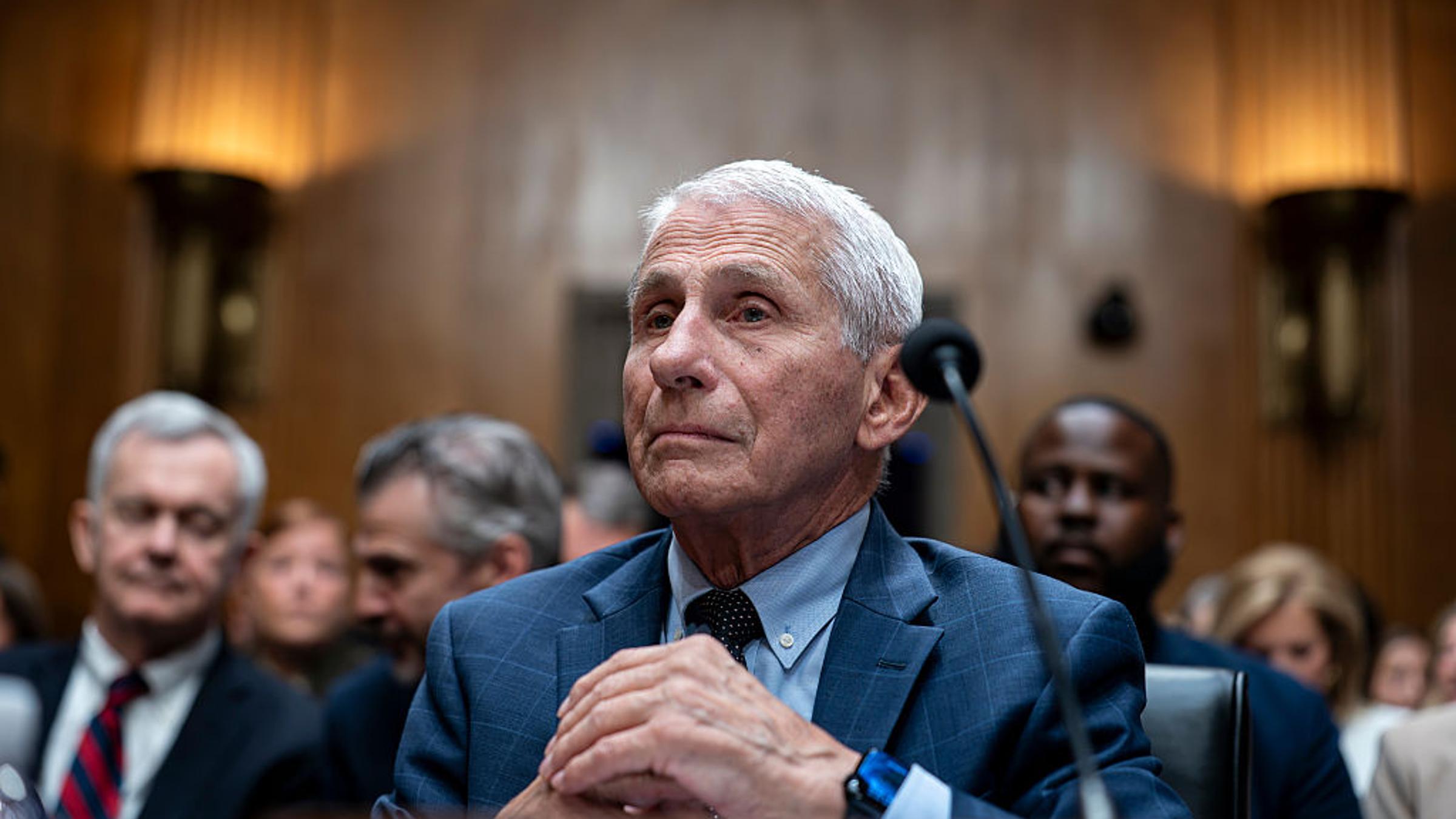
Why did Fauci invoke the Fifth Amendment?
In his opening statement to the Senate committee on Wednesday, Fauci accused Paul of having an “obvious obsession with calling for my prosecution.”
“The only conclusion I can reach is that the sole reason he is calling me before this committee is to get me to say something, anything, that could vindicate his repeated public pledges that I end up, in his words, ‘behind bars,’” Fauci said.
“Although it pains me to do so because of the respect that I have for the legislative branch of government and my decades-long record of cooperating with Congress,” he said, “under the advice of my attorneys, I will invoke my right under the Fifth Amendment of the Constitution to refrain from answering your questions.”
Shortly before former President Joe Biden left office, in January 2025, he preemptively pardoned Fauci. Biden said he was issuing the pardon to shield Fauci from “politically motivated prosecutions.”
Wall Street just lived through one of its wildest 48 hours of the year. On Wednesday, the Fed held rates steady at 3.50%-3.75%, but three FOMC members broke ranks to demand a hike—an unusually hawkish dissent that sent the Dow plunging over 1,100 points, its worst session since April 2025. Treasury yields spiked, with the 30-year touching levels unseen since 2007, as renewed US-Iran strikes pushed oil higher and reignited inflation fears. The Nasdaq 100 briefly slid into correction territory, down 11% from its June record high.
Then came the reversal. Thursday’s blockbuster earnings from Microsoft, whose Azure cloud business surged, alongside a rebound in beaten-down semiconductor stocks, powered the Nasdaq Composite (US Tech Mini on FXOpen) to a 2.8% gain, snapping a six-day losing streak.
The whiplash captures the market’s core dilemma perfectly: a Fed chair in Kevin Warsh determined to prove his inflation-fighting credentials, a Middle East conflict refusing to fade, and a tech sector whose AI-driven earnings power may be the only thing strong enough to override both.
Technical Analysis of the Nasdaq 100 Chart
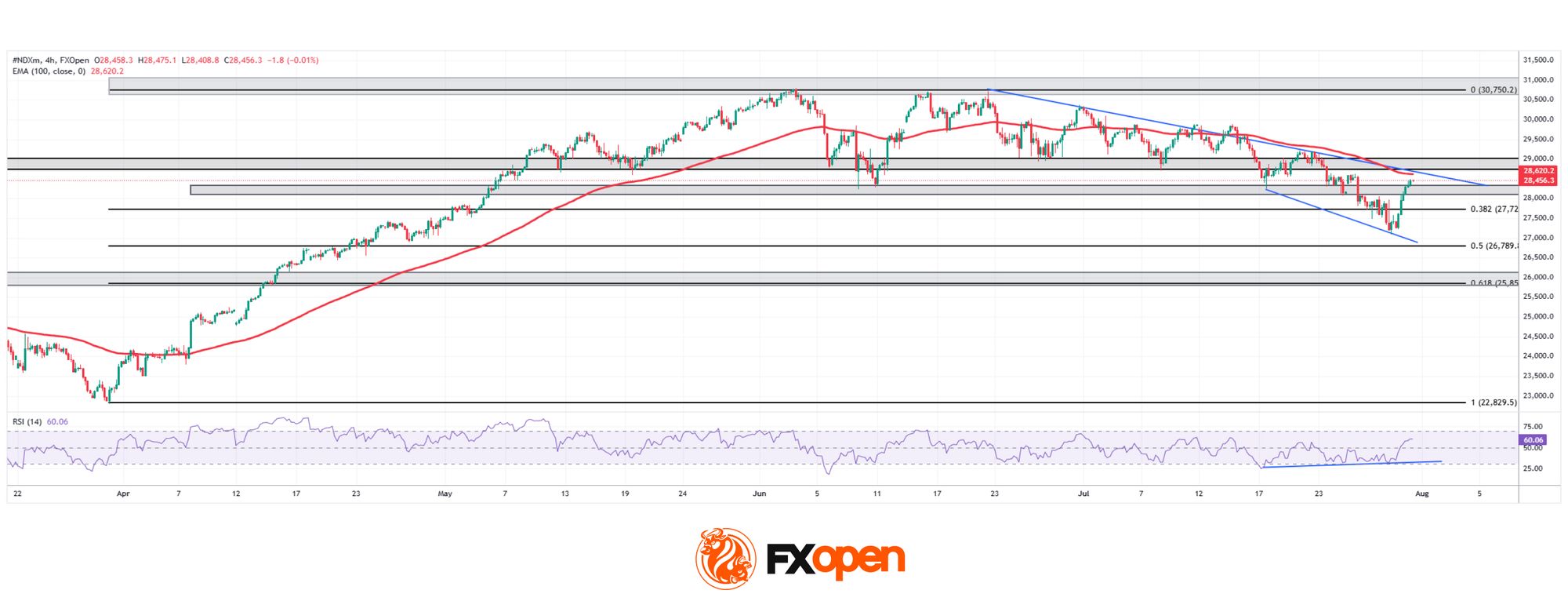
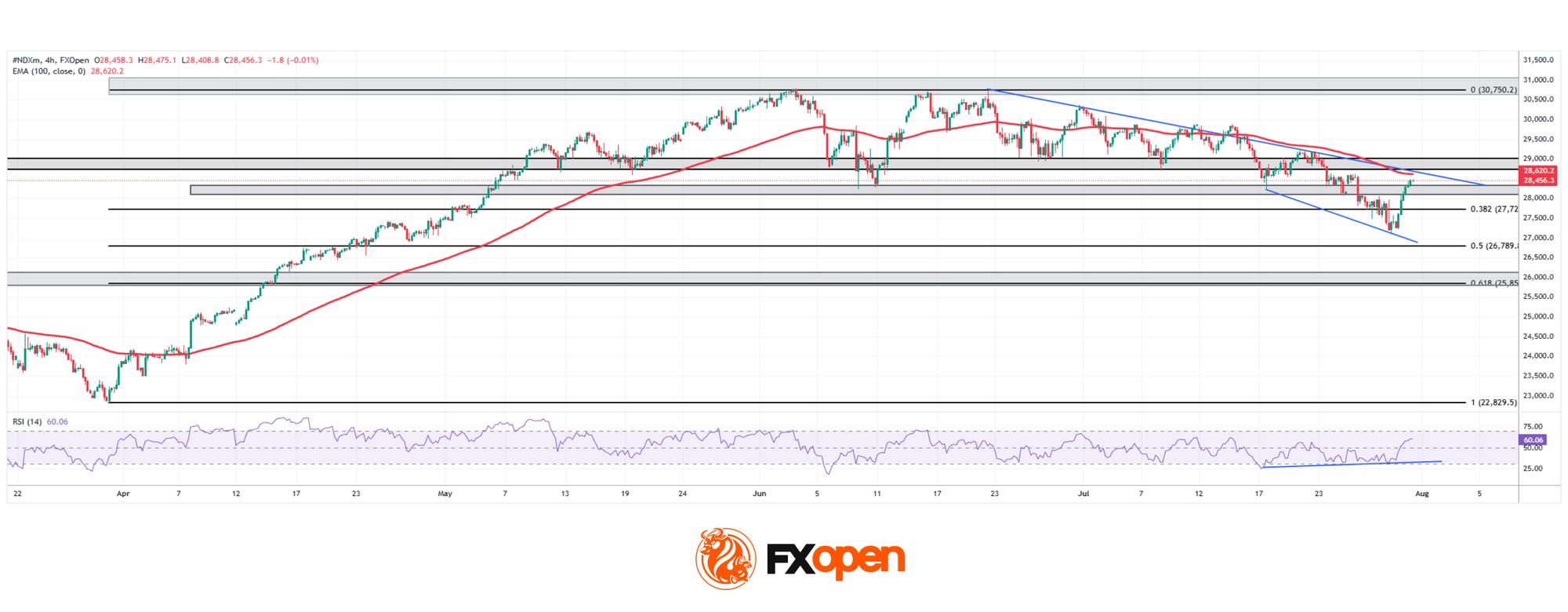
As the chart shows, the Nasdaq 100 (US Tech 100 Mini on FXOpen) is currently testing the descending trendline that has guided its decline from late June’s highs, with price also pressing against the 100-period EMA near 28,620, a confluence that has repeatedly capped rallies over the past several sessions. Adding weight to this setup, the RSI is showing a bullish divergence, printing higher lows even as price carved a fresh low in late July.
Bullish Scenario
Should buyers finally break above both the descending trendline and the 100-period EMA, the divergence would gain real technical credibility, opening the path toward the 28,800-29,000 resistance zone and, beyond that, a retest of the 30,750 highs from June.
Bearish Scenario
Conversely, a rejection at this trendline-EMA confluence would invalidate the bullish divergence for now, sending price back toward the 27,720 area, the 0.382 Fibonacci retracement of the March-June rally. A deeper break would expose the 0.5 and 0.618 retracements near 26,789 and 25,850, levels that previously acted as key support during the spring advance.
With price coiled right beneath a trendline it has yet to conquer, and the RSI quietly hinting at renewed strength underneath, the Nasdaq 100 chart (US Tech 100 Mini on FXOpen) looks ready to answer the question markets have been asking all week: was this correction just noise, or the start of something bigger?
Trade global index CFDs with zero commission and tight spreads (additional fees may apply). Open your FXOpen account now or learn more about trading index CFDs with FXOpen.
This article represents the opinion of the Companies operating under the FXOpen brand only. It is not to be construed as an offer, solicitation, or recommendation with respect to products and services provided by the Companies operating under the FXOpen brand, nor is it to be considered financial advice.
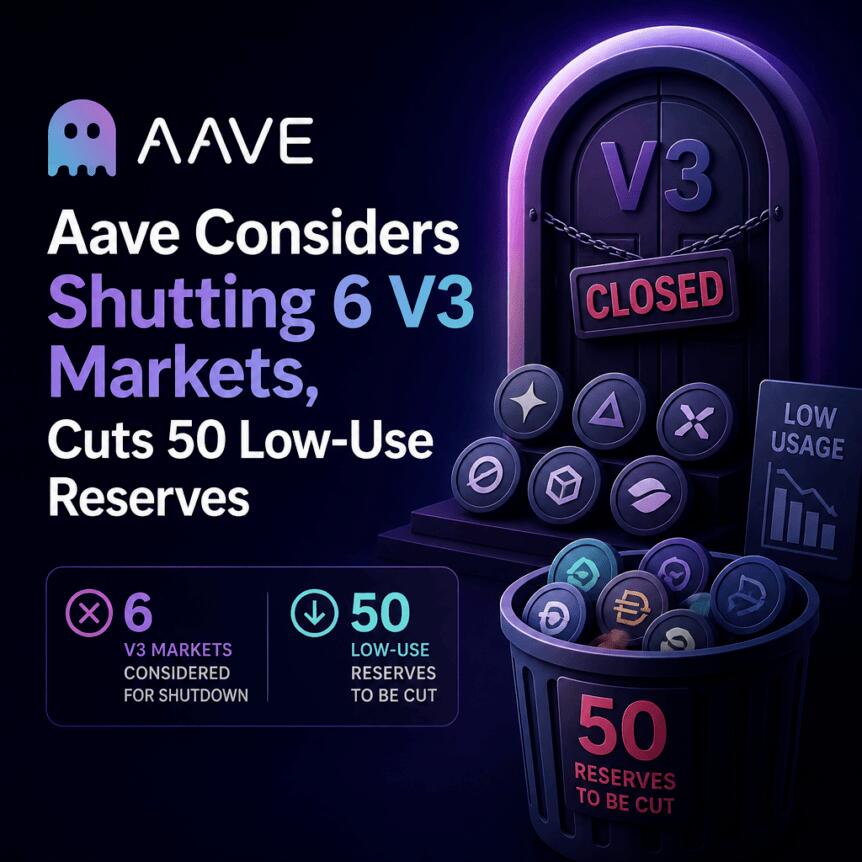
Aave governance is considering a broad cleanup of its V3 lending markets, targeting underused reserves across multiple blockchains and retiring certain matured listings. The proposal, detailed in an ARFC (Aave Request for Comment), outlines offboarding activity on six chains and removing dozens of low-adoption assets, covering $98.1 million in supplied collateral and $15.6 million in outstanding debt, measured as of July 28.
Risk services provider LlamaRisk, working alongside other Aave service providers, recommended deprecating 50 low-use reserves and retiring 21 matured Pendle principal token listings across 11 deployments. The same proposal also calls for retiring all 25 reserves on Sonic, Scroll, zkSync, Metis, Soneium and Aptos.
Key takeaways
- Aave’s ARFC targets low-adoption assets and matured Pendle principal token listings, with balances snapshot at July 28.
- The plan would wind down V3 markets on six blockchains and deprecate 50 low-use reserves across 11 deployments.
- All chain-specific closures proposed here come after earlier freezes and prior governance decisions on certain networks.
- Aave founder Stani Kulechov framed the move as reducing the protocol’s “economic and technical risk surface” under updated frameworks.
- This ARFC is a proposal step, not proof that a final onchain vote has already passed.
Why this proposal is moving forward
ARFCs are a formal governance stage at Aave: they provide detailed recommendations and serve as a precursor to an Aave Improvement Proposal. As such, the publication of this ARFC does not itself confirm that the changes have been approved via an onchain vote or executed by the protocol.
Even so, the scope is notable. The offboarding plan described in the ARFC would restructure Aave’s V3 presence on multiple networks—primarily by removing reserves where usage has been insufficient and by retiring token listings that have reached maturity. In total, the proposal covers $98.1 million in supplied assets and $15.6 million in debt, indicating that the affected V3 markets are meaningful in size even if they are not retaining strong participation.
Aptos exit follows a short-lived V3 rollout
The most time-sensitive portion of the cleanup appears to be the proposed Aptos exit. According to data cited by LlamaRisk, the V3 market launch on Aptos occurred roughly 11 months before this ARFC recommendation.
LlamaRisk attributes weak performance to a sharp liquidity contraction and minimal earning. It reports that available liquidity fell by 94% over six months and that quarterly revenue was below $1,000. Those figures, as referenced in the ARFC summary, set the justification for moving from an active posture to a full deprecation across the network.
The same recommendation also distinguishes between chains that were already inactive in practice and those that were still operating. The ARFC indicates that every reserve on Scroll, zkSync, Metis and Soneium was already frozen. By contrast, Sonic and Aptos were still active at the time of the snapshot, and the ARFC recommends freezing and retiring reserves on those remaining deployments.
How earlier “temp checks” shaped the current cleanup
The proposal builds on prior governance outcomes and implementation steps across Aave’s multichain V3 strategy. Earlier in the process, a “temp check” on Aave’s multichain approach concluded on Dec. 5, 2025. That vote, described in Aave governance materials, recorded 923,400 votes in favor with under 1% voting against, and it covered actions such as increasing reserve factors on underperforming instances, shutting down instances on zkSync, Metis and Soneium, and establishing a $2 million annual revenue floor for new instance deployment.
Additionally, Aave governance processes have already accelerated deprecations on specific chains. In April, Scroll was added to the list of affected protocols through an accelerated procedure. A corresponding governance action described the move as completing Scroll’s deprecation after rapid deterioration in network liquidity and Aave market activity, via a direct-to-AIP proposal filed by LlamaRisk.
Beyond instance closures, Aave’s risk posture has also been formalized in updated internal documentation. The protocol published an updated risk framework on June 9, covering asset risk, bridge and monitoring risks, chain risk, and criteria for winding down reserves or deployments. Separate governance activity later this month indicated de facto adoption of rules under a newer “governance framework v2,” pointing to a more structured approach to deciding when underperforming deployments should be reduced or removed.
Aave founder ties the move to risk-framework changes
Aave founder Stani Kulechov publicly commented that the cleanup is intended to reduce exposure as the protocol applies its new risk approach. In a Thursday post on X, Kulechov said the deprecations would also “reduce Aave’s economic and technical risk surface as part of the new Aave Risk Framework and Technical Asset Listing Framework.”
Source: Stani Kulechov on X
While the current action may look like an exit from certain environments, Kulechov’s framing suggests it is not a retreat from multichain itself. He stated that Aave will continue applying continuous risk assessment for assets across deployments, with the immediate effect being a refocusing on selected chains where usage and performance are stronger.
The comments also arrive amid Aave’s ongoing expansion activities elsewhere. Earlier coverage from Cointelegraph noted that Aave is launching on Avalanche, and the current governance cleanup appears to align with that broader operational theme: expand into targeted environments while methodically trimming underused or deteriorating ones.
What to watch next for Aave V3 users and liquidity providers
If this ARFC advances, the key question will be how quickly the proposed offboarding transitions from governance discussion to formal execution—and whether Aave provides additional updates on how liquidity is expected to migrate as reserves are frozen and retired. Investors and DeFi participants should also watch for signals that the newly adopted risk frameworks keep tightening the threshold for maintaining V3 markets on smaller or less liquid chains.


Elon Musk dismissed rumors that Tesla plans to sell its Gigafactory Shanghai plant, calling the claims fake news on Friday.
Musk’s denial followed a Wall Street Journal report on a possible split of Tesla’s China business. That report tied the move to a possible merger between Tesla and SpaceX.
What Musk Is Actually Denying
The rumor began after an X user suggested directly to Musk that Tesla was preparing to offload the plant. Musk’s reply, posted early Friday morning, called the report absurdly fake news and urged people to assume breaking news is false until proven otherwise.
The Journal’s report did not name Gigafactory Shanghai directly. Instead, it said Tesla advisers had weighed a spin-off, a sale, or a closure of the automaker’s Chinese operations, options Musk has not addressed beyond his blanket denial.
Gigafactory Shanghai remains Tesla’s largest plant, with annual capacity above 950,000 vehicles, and it historically accounts for more than half of the company’s global deliveries.
Gigafactory Shanghai exports vehicles across Europe, Canada, and the Asia-Pacific region. However, Musk’s denial landed during a rough stretch for Tesla stock, which suffered its worst week since 2022 after mixed second-quarter results.
Why the SpaceX Merger Talk Persists
The China business rumor did not emerge in isolation. Wolfe Research has already framed a Tesla and SpaceX merger as a core investor thesis, a pairing Musk has never firmly ruled out. That view follows SpaceX’s record initial public offering, which raised $75 billion in June and valued the rocket company at $1.75 trillion.
Musk has separately argued that SpaceX could outvalue Earth itself. That claim underscores how central the rocket company has become to his broader ambitions. Ark Invest’s Cathie Wood disclosed a $529 million rotation from Tesla into SpaceX shares this month, citing similar merger logic.
Musk also has a track record of terse denials moving markets. He used a similar two-word denial to knock down another SpaceX rumor just weeks earlier. That pattern is why commentators like Whole Mars Catalog urged outlets not to delete their posts after a denial. Keeping the original post visible, they argued, helps the public track exactly what Musk is rejecting.
Tesla’s second-quarter earnings showed revenue climbing to $28.24 billion, even as margins narrowed to 16.8%. That gap adds financial pressure that could fuel more reorganization speculation regardless of Musk’s denial. For now, his post stands as the only official word from either company, and investors will likely keep testing that line as merger chatter builds through the rest of 2026.
The post Is Tesla Really Selling Gigafactory Shanghai? Elon Musk Says No appeared first on BeInCrypto.
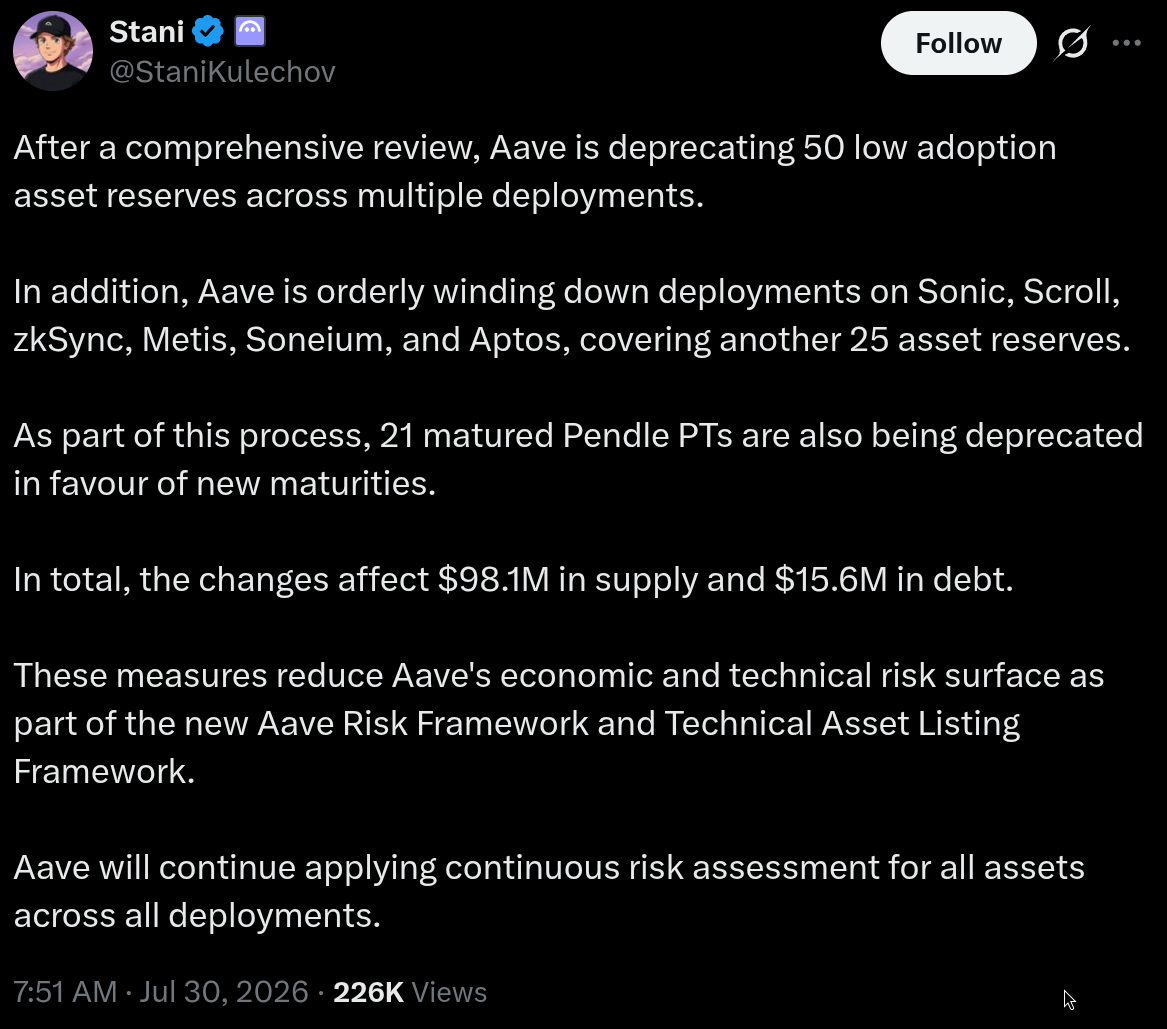
An Aave governance proposal would wind down the lending protocol’s V3 markets on six blockchains and retire dozens of low-use token listings, a cleanup covering $98.1 million in supplied assets and $15.6 million in debt.
Risk service provider LlamaRisk, working with other Aave service providers, recommended offboarding 50 low-use reserves and 21 matured Pendle principal token listings across 11 deployments. It also proposed retiring all 25 reserves on Sonic, Scroll, zkSync, Metis, Soneium and Aptos. The balances were measured on July 28.
An ARFC is a detailed proposal and precursor to an Aave Improvement Proposal; it is not, by itself, proof of a completed final onchain vote or execution.
Aptos exit follows recent launch
The proposed Aptos exit comes just 11 months after Aave launched its V3 market there, with available liquidity down 94% over six months and quarterly revenue below $1,000, according to LlamaRisk.
Every reserve on Scroll, zkSync, Metis and Soneium was already frozen, whereas Sonic and Aptos remained active and are recommended for freezing. The temp check on Aave’s multichain strategy concluded on Dec. 5, 2025, with 923,400 votes in favor and under 1% against increasing the reserve factor on underperforming instances, shutting down the instances on zkSync, Metis and Soneium, and establishing a $2 million annual revenue floor for new instance deployment.
Related: Aave positioned to capture tokenized asset growth in DeFi: Standard Chartered
Scroll was then added to the affected protocols through an accelerated process in April, as LlamaRisk filed a direct-to-AIP proposal to freeze every Scroll reserve and raise selected reserve factors, describing the measure as completing Scroll’s deprecation after a rapid deterioration in network liquidity and Aave market activity. Aave also published an updated risk framework on June 9, covering asset, bridge, monitoring and chain risk and criteria for winding down reserves or deployments, and this month’s announcement indicated de facto adoption of those rules by the protocol.
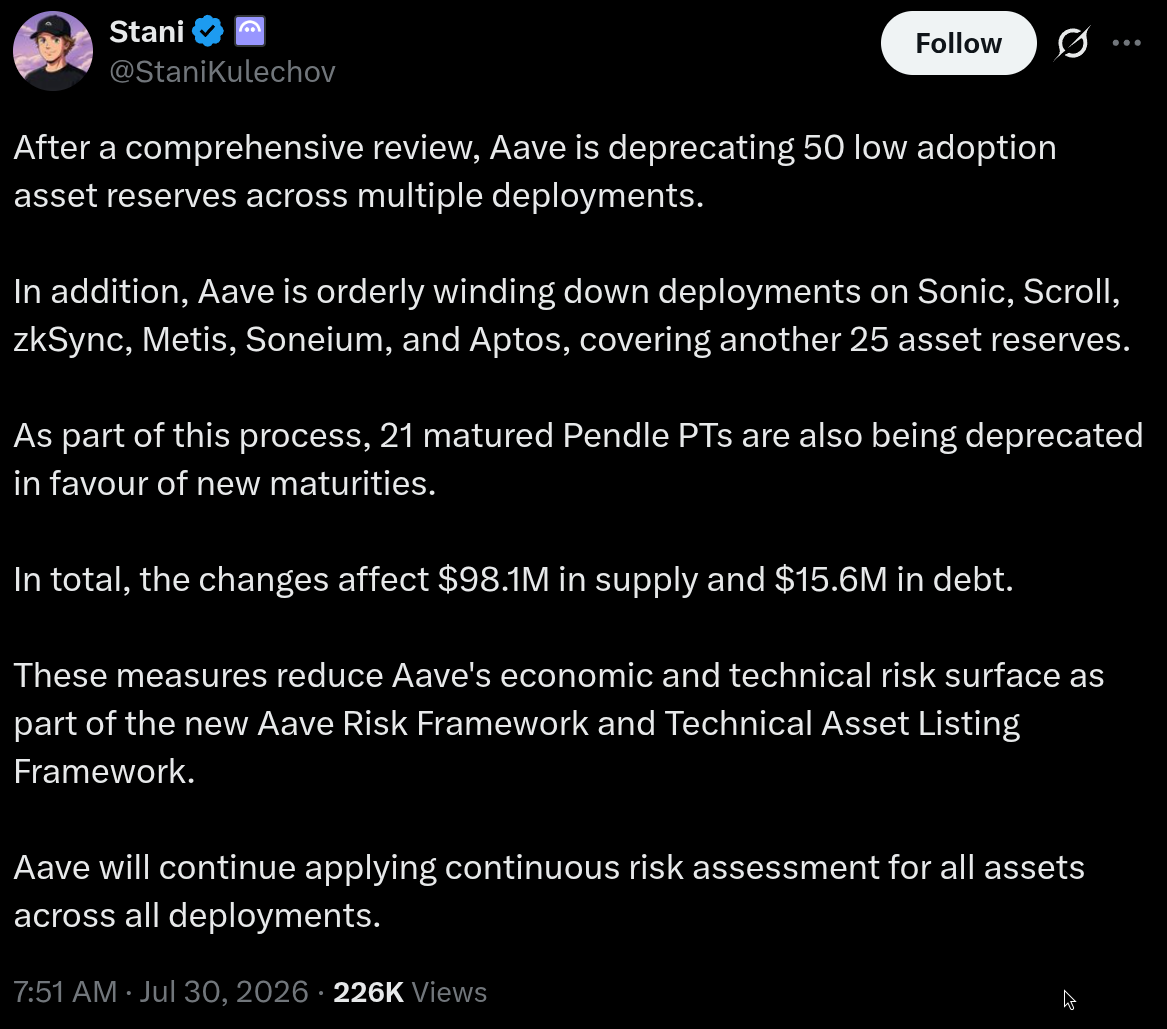
Source: Stani Kulechov
Aave founder Stani Kulechov said in a Thursday post that this will also “reduce Aave’s economic and technical risk surface as part of the new Aave Risk Framework and Technical Asset Listing Framework.”
Related: Aave brings V3 lending and GHO stablecoin to Monad
Still, this is not a reversal of Aave’s multichain expansion strategy, rather a strategic refocusing on select protocols. “Aave will continue applying continuous risk assessment for all assets across all deployments,” Kulechov said. The comments also follow Aave launching on Avalanche earlier this month.
Magazine: The real reason DeFi projects that survived 2022 crash are shutting down now


Bitcoin and Ether options with a combined notional value of about $10.43 billion expired on July 31, placing the $64,000 Bitcoin level at the center of the monthly settlement.
Summary
- 149,000 Bitcoin options worth $9.6 billion expired with max pain concentrated at the $64,000 level.
- 435,000 Ether options worth $830 million expired with a 0.63 put-call ratio and $1,850 max-pain.
- Low implied volatility and uneven inflows kept Bitcoin near $64,000 despite call-heavy monthly positioning overall.
Greeks.live reported that 149,000 Bitcoin options worth $9.6 billion expired with a 0.28 put-call ratio and $64,000 max pain. Another 435,000 Ether options worth $830 million expired with a 0.63 ratio and $1,850 max pain.
Deribit’s monthly options settle at 08:00 UTC on the final Friday of each month. Shortly after settlement, Bitcoin traded near $63,824, while Ether changed hands around $1,891. Neither asset recorded an immediate break from its recent range.
Bitcoin options expiry settled near $64,000 max pain
The Bitcoin expiry represented about 30% of outstanding contracts, according to Greeks.live. Its low 0.28 put-call ratio showed that call open interest greatly exceeded put open interest going into settlement.
A separate PerpFinder snapshot, based on Deribit data at 07:51 UTC, recorded $7.39 billion in call open interest and $2.06 billion in puts. It placed total notional open interest at $9.45 billion, slightly below Greeks.live’s $9.6 billion estimate. The difference likely reflects changing Bitcoin prices and data captured at different times.
Max pain refers to the settlement price at which the largest value of options would expire without value for buyers. It does not guarantee that the spot market will move toward that level or remain there afterward.
Recent activity supports that caution. Research covering two earlier July expiries found that Bitcoin did not settle precisely at the stated max-pain levels and showed little lasting price movement after the contracts expired.
Call-heavy positioning did not confirm a bullish breakout
The low Bitcoin put-call ratio appears bullish at first because calls provide upside exposure. However, many calls were concentrated above the market price, particularly around the $70,000 and $72,000 strikes.
Contracts at those levels could not generate gains at expiry unless Bitcoin rose sharply above its weekly range. Bitcoin instead traded within a 24-hour range of roughly $63,787 to $65,305, keeping the largest upside positions out of the money.
Greeks.live said call gamma exposure was spread across several strikes, while put gamma exposure was more concentrated. Gamma measures how quickly an option’s price sensitivity changes when the underlying asset moves. Concentrated exposure can affect how dealers hedge, but it does not independently forecast market direction.
The firm also said “the conditions for a rally are not in place,” citing limited capital inflows and weak follow-through when U.S. equities rebounded. That is the firm’s market assessment rather than a confirmed future outcome.
Ether options showed stronger downside protection
Ether’s 0.63 put-call ratio showed more demand for puts relative to calls than the Bitcoin market recorded. Greeks.live placed Ether’s max-pain level at $1,850, below the market price shortly after settlement.
PerpFinder’s final pre-expiry snapshot recorded approximately $499.4 million in Ether call open interest and $311.5 million in puts. It calculated total open interest of $810.9 million and a 0.62 ratio, close to the figures provided by Greeks.live.
Ether traded near $1,891 after settlement, within a 24-hour range of about $1,884 to $1,934. The asset therefore remained above both the $1,850 max-pain estimate from Greeks.live and the $1,800 level cited by some earlier market reports.
As previously reported, Ether options carried a 1.26 put-call ratio during the July 10 expiry. The fall to about 0.63 indicates that positioning became less defensive by month-end, although Ether still carried more relative put exposure than Bitcoin.
ETF inflows and $65,000 resistance shape the next move
The expiry arrived as spot Bitcoin ETF demand showed signs of recovery. U.S. funds received $233.1 million on July 30, led by BlackRock’s IBIT with $183.4 million. However, flows had alternated between gains and withdrawals earlier in the week, supporting Greeks.live’s description of uneven capital demand.
Bitcoin also remained below the heavy trading area above $65,000 identified by Greeks.live. The asset briefly reached a 24-hour high above $65,300 but returned below $64,000, showing that buyers had not established the former rally zone as support.
crypto.news reported that the smaller July 10 expiry also produced cautious positioning and limited confidence in a sustained advance. Earlier July 3 coverage placed attention on weak ETF flows and demand for short-term downside protection.
Traders will next monitor whether positions roll into the August 28 monthly expiry. Deribit data showed about $3.15 billion already positioned for that date in Bitcoin options, while the September 25 expiry carried roughly $6.22 billion.
A sustained move above $65,000, stronger spot volume and several consecutive ETF inflow sessions would provide clearer evidence of improving demand. Without those conditions, the July settlement mainly removed a large block of expiring exposure while leaving Bitcoin’s wider trading range unresolved.


Tokyo-listed Quantum Solutions (2338) sold 1,000 ETH for $1.9 million and more than doubled its disposal ceiling to fund an AI data center business.
The move came as another crypto treasury firm, Hyperscale Data (GPUS), monetized about 100 BTC and opened a bitcoin-backed credit line for a Michigan AI data center..
Quantum sold the ETH on July 30 at $1,903 per token, generating $1.903 million after fees, according to a company filing. It expects to recognize a $100,970 loss against the position’s May 31 carrying value of $2,003.97 per ETH, the filing adds.
The sale price was 47% below the $3,595.02 average acquisition cost Quantum reported in June.
The firm sold 904 ETH for $1.61 million on June 16 at an average price of $1,777 per token. The two disposals raised about $3.51 million and reduced its holdings by 29% to 4,764.8 ETH from 6,668.8 ETH.
Quantum’s board raised the cumulative sale limit to 4,375 ETH from 1,875 ETH through Oct. 30, leaving it authorized to sell another 2,471 ETH. Using the full limit would mean disposing of nearly 66% of the holdings it reported in June.

Live A14 updates as ‘unfortunate spillage’ blocks road in Cambridgeshire

'I will miss my shop tremendously after six decades'

Bitcoin’s $437 Billion Quantum Exposure Meets IBM’s 2028 Deadline


-

 Fashion7 days ago
Weekend Open Thread: Brooks Brothers
-
 Sports5 days ago
Commonwealth Games boxing: Jadumani Singh seals dominant 5-0 win over Pakistan’s Sumama Rehman to enter quarter-finals | Commonwealth Games News
-

 Business2 days ago
Why Trees Belong on the Risk Register
-

 Tech4 days ago
Intel is reversing course and bringing hyper-threading back to its server chips
-

 Crypto World6 days ago
Ripple bought a bank in pieces. The $4 billion audit
-

 Politics4 days ago
Luke Littler dismantles Gerwyn Price to retain title in Blackpool
-
 Entertainment7 days ago
A New Post-Apocalyptic Gundam Anime Series Blasts Into SDCC
-

 Politics3 days ago
The Part of the Electric Transition Nobody Wants to Discuss
-

 News Videos5 days ago
BITCOIN JUST ENTERED THIS CRITICAL ZONE…
-

 Business2 days ago
Major shareholder moves on Canyon
-

 Crypto World5 days ago
XRP Ledger adds $2.6B as RWA inflows rank second
-

 News Videos22 hours ago
Bitcoin Enters the 3rd Stage of the Bear Market
-

 Politics5 days ago
Spain sweeps the board at 2026 World Cup with individual awards
-
 Entertainment3 days ago
‘Stargate’ Creator’s New Sci-Fi Series Returns for Season 3 Tomorrow
-

 Entertainment5 days ago
Sara Gilson Killed By Husband After Viral “Pedophile” TikTok Video
-

 Crypto World2 days ago
Kraken Enables Retail Access to Jersey Mike’s IPO via Tokenized Shares
-

 Tech6 days ago
Anthropic launches Claude Opus 5, a cheaper AI model for coding, agents and enterprise workflows
-

 News Videos3 days ago
Claude: Build Financial Dashboards in Minutes (2026)
-

 Politics18 hours ago
Luke Littler’s dominance sparks GOAT debate
-

 Tech3 days ago
New macOS Sequoia & Sonoma security updates for older Macs
You must be logged in to post a comment Login