

Crypto World
Radiant Capital to wind down after $50 million North Korea-linked hack



Radiant Capital has announced plans to wind down operations after failing to recover from a $50 million exploit that devastated the lending protocol and left it without sufficient funding to continue.
Summary
- Radiant Capital said it will wind down operations after failing to recover from a $50 million exploit and secure new funding.
- The protocol will remain online in a maintenance state, allowing users to withdraw funds and manage positions while development work ends.
- Investigations linked the 2024 attack to North Korea-aligned threat actors, while recovery efforts were hindered after portions of the stolen funds moved through Tornado Cash.
According to a statement published Monday by Radiant’s decentralized autonomous organization, the protocol could no longer identify a viable route forward after unsuccessful attempts to recover stolen assets, raise fresh capital, and maintain the resources needed to operate responsibly.
In a separate update shared on X, the DAO said contributors and community members had continued supporting the platform under increasingly challenging circumstances. The organization stated that without recovered funds, new investment, or renewed growth, the protocol could not remain sustainable.
The decision closes a difficult chapter for a project that once ranked among the largest cross-chain lending platforms.
Launched in 2022, Radiant sought to unify liquidity across multiple blockchains and grew rapidly during 2023. Data from the protocol shows its total value locked reached $386.8 million in December 2023.
Fortunes changed sharply after an October 2024 exploit that security researchers and later investigations linked to North Korean threat actors. Following the breach, Radiant’s total value locked fell to roughly $75 million and dropped to about $5 million within weeks, according to protocol data.
Recovery efforts failed to restore the protocol
While operations are being scaled back, Radiant said the protocol will not disappear entirely. Instead, it will move into what it described as a maintenance state.
Under that arrangement, the frontend will remain online, smart contracts will stay accessible, and users will still be able to withdraw assets, repay loans, and manage existing positions. Development work, protocol upgrades, and expansion efforts, however, will cease as DAO contributors step away from active operations.
Radiant also urged users to manage their exposure carefully while the protocol enters its final phase.
Remaining recovery initiatives connected to the hack will continue. The DAO said its remediation portal will stay open and any assets recovered in the future will be returned to affected users.
Previous recovery efforts have produced limited results. In October 2025, blockchain security firm CertiK reported that wallets linked to the attacker deposited 2,834 ETH into Tornado Cash after moving funds through multiple addresses and swaps involving DAI.
CertiK estimated that approximately $10.8 million worth of Ethereum had already been laundered through the mixer, complicating efforts to trace and recover the stolen assets.
North Korea-linked attack became a turning point
Radiant said in December 2024 that an attacker posing as a former contractor distributed malware through Telegram. According to the protocol, a malicious ZIP file circulated among developers for feedback, creating an entry point that ultimately led to the compromise.
A post-mortem investigation from cybersecurity firm Mandiant later linked the incident to the AppleJeus hacking group, which it identified as part of North Korea’s cyber ecosystem.
According to Mandiant, the attackers gained control of three of Radiant’s eleven multisig signer permissions and replaced the lending pool’s implementation contract, allowing them to steal approximately $53 million from the Arbitrum and BNB Chain deployments.
The tactics used in the attack later surfaced in other major crypto incidents. In April 2026, Drift Protocol said it had medium-high confidence that the same actors behind the Radiant breach were responsible for a separate exploit against its platform. Drift’s investigation concluded that the group spent months building trust with contributors through conference meetings and professional contacts before deploying malicious tools and links.
Market reaction to Radiant’s closure announcement remained negative. The protocol’s RDNT token fell 4.2% after the news.


Following last week’s market-wide calamity in which the cryptocurrency markets shed over $400 billion and all major assets plummeted to yearly lows, many analysts have started speculating on where the bottom is.
The latest to do so was Ali Martinez, who outlined the lowest targets during this cycle for BTC, ETH, and XRP. Hint: there’s more pain ahead for all, according to his findings.
Bitcoin Bottom
The analyst with over 165,000 followers on X began with the largest cryptocurrency by market cap, indicating that the asset is “approaching a market bottom.” He noted that the MVRV Pricing Bands suggest the ultimate capitulation zone, and that level has historically been around the 0.8 MVRV Band.
If history repeats itself, it would represent another major leg down that will drive BTC toward $43,000. The other, less painful option would be a nosedive to the 1.0 MVRV Band, which is currently at $54,000.
Interestingly, another recent analysis on BTC’s potential bottom suggested that it could arrive during the ongoing World Cup in North America. BIT Research justified their prediction with bitcoin’s A-B-C structure it has been following since the October 2025 rejection and subsequent bear market.
ETH Major Decline
While the leg down for bitcoin could see a more modest 32% drop from the current levels to bottom out, ETH’s projected crash is a lot worse. Basing his analysis on Ethereum’s Delta Price model, which measures the relationship between investor cost basis and miner production costs, Martinez warned that the largest altcoin can plummet to $700.
This level has “consistently flagged generational accumulation floors.” If such a major decline indeed transpired, then ETH will dump by another 60%. Moreover, its crash from last year’s all-time high at almost $5,000 would be north of 85%, which will be ‘shitcoin’ territory.
XRP Bottom Closeby
The landscape for ETH seems the most grim given Martinez’s projections. XRP, on the other hand, might be a lot closer to his targeted bottom. He noted that a dominant rising trendline on the monthly chart has “successfully defined every major cycle bottom for nearly a decade.”
If XRP is to find its bottom again there, it could drop to somewhere between $0.70 and $0.90. The lower target would mean a 40% decline, while the higher one is only 21% away from XRP’s current price tag of around $1.15.
5/5 If these projections fully mature, I will be executing a heavy spot-layering strategy directly inside these deep-value windows:$BTC: $43,200$ETH: $700$XRP: $0.90
Pacing capital at these levels keeps the portfolio aligned with structural-cycle data.
— Ali Charts (@alicharts) June 12, 2026
The post BTC vs. ETH vs. XRP: Which Is Closest to a Major Reversal? Analyst Explains appeared first on CryptoPotato.

TLDR:
- CFTC sues New Mexico over attempts to apply state gaming laws to derivatives markets
- KalshiEX case triggers wider jurisdiction clash between federal and state regulators in US markets
- CFTC cites Commodity Exchange Act as basis for exclusive authority over event contracts nationwide
- Multiple US states now challenge prediction markets, raising regulatory uncertainty across the sector
The Commodity Futures Trading Commission has filed a federal lawsuit against New Mexico over jurisdictional authority on prediction markets. The CFTC argues the state is attempting to apply gaming laws to federally regulated derivatives platforms.
New Mexico previously targeted CFTC-registered KalshiEX, escalating tensions between state and federal oversight. The dispute centers on whether states can regulate event contracts already covered under federal law.
CFTC New Mexico Lawsuit Over Prediction Markets Jurisdiction
The CFTC New Mexico lawsuit was filed in federal court in Washington, marking a direct challenge to state-level enforcement actions. The agency seeks to block New Mexico from applying gaming statutes to CFTC-registered contract markets.
According to the filing, federal law grants the commission exclusive authority over derivatives trading venues. The CFTC also requested declaratory relief and a permanent injunction.
New Mexico had earlier filed its own case in state court against KalshiEX LLC.
The state alleged the firm’s prediction markets function as unlawful online sports betting platforms. It also argued the company was attempting to bypass state gaming regulations. That action triggered the federal response from the CFTC.
At the center of the dispute is the Commodity Exchange Act. The law gives the CFTC exclusive jurisdiction over designated contract markets and event contracts.
The commission argues this framework preempts conflicting state gaming laws. It maintains that only federal regulators can oversee such derivatives activity.
CFTC Chairman Michael Selig defended the agency’s position in a statement tied to the filing. He said the state’s approach conflicts with established legal precedent and federal authority.
The commission reiterated that it will continue defending its jurisdiction over commodity derivatives markets.
KalshiEX and Expanding State Challenges in Prediction Markets
The CFTC New Mexico lawsuit is part of a broader wave of state actions targeting prediction markets.
Similar disputes have emerged in Arizona, Connecticut, Illinois, New York, Minnesota, Rhode Island, and Wisconsin. These cases generally focus on whether event-based trading resembles sports wagering. The CFTC has consistently rejected that framing.
KalshiEX sits at the center of the regulatory friction. The platform offers event contracts that allow users to trade on outcomes of real-world events.
States argue these products resemble gambling instruments. The CFTC classifies them as federally regulated derivatives.
The federal agency is seeking to prevent states from enforcing laws that could restrict CFTC registrants. It argues that fragmented regulation would undermine national market consistency. The lawsuit requests a court ruling affirming federal exclusivity. It also seeks to block state interference moving forward.
Market operators now face growing legal uncertainty as jurisdictional lines tighten.
The outcome of the CFTC New Mexico lawsuit could shape how prediction markets expand in the United States. It may also define how far states can extend gaming laws into federally governed financial instruments.



Crypto search interest is rising again in June, according to Alphractal data, as retail investors appear to be paying closer attention to digital assets after months of weaker activity.
Summary
- Crypto searches rose again in June as retail investors started tracking digital assets more actively.
- Alphractal said search spikes often appear during moments of market euphoria and fear.
- Rising crypto search interest shows attention is returning, but it does not confirm fresh buying.
Crypto searches rise again in June
Alphractal said Google searches for cryptocurrencies are increasing in June. The analytics platform described the move as a sign that retail investors are starting to search more about different crypto assets again.
“Google searches for cryptocurrencies are rising again in June,” Alphractal said.
The move comes after a quieter period for digital asset interest. Search activity often drops when prices move sideways or when retail traders leave the market after heavy volatility.
Alphractal also noted that Google Trends spikes are not always bullish. Search jumps can appear during strong rallies, but they can also happen when traders react to fear, crashes, or uncertainty.
Retail attention returns to crypto
The latest rise suggests that crypto is moving back into retail focus. More users are searching for coins, market direction, and exchange-related terms as the market tries to stabilize.
Search activity is often used as a soft sentiment gauge. It does not show actual buying, but it can show when retail investors start watching the market again.
As previously reported by crypto.news, Bitcoin search interest reached 12-month highs during 2026 volatility. That report noted that fear-driven searches do not always mean new buyers are entering the market.
The same report also said small holders were still selling while whales were accumulating. That means renewed attention must be separated from real capital inflows.
Bitcoin volatility drives interest
Bitcoin’s price action has remained one of the main drivers of crypto searches. The asset traded near the low $60,000 area in June after a deep pullback from its 2025 record high.
Sharp price moves tend to pull retail users back into search engines. Some look for dip-buying chances, while others search because they fear deeper losses.
The recent search rise follows a period when broad crypto attention had dropped sharply. As reported earlier this month, global search interest for “crypto” had fallen to one-year lows earlier in 2026.
That earlier drop showed how much retail attention had weakened even while institutions, ETFs, and treasury buyers played a larger role in the market.
Search data gives mixed signals
The return of search activity can help market watchers track sentiment, but it does not confirm a full retail comeback. Stronger proof would require higher retail trading volume, new exchange deposits, and small-holder accumulation.
For now, the data shows that crypto is gaining attention again. It also shows that traders are reacting to volatility after months of weaker interest.
Search spikes can appear near both tops and bottoms. That makes them useful for tracking emotion, but less reliable as a standalone price signal.
The key question is whether June’s rise turns into sustained participation. If searches keep climbing alongside stronger spot demand, retail activity may become a larger force in the market again.


Michael Saylor defended Strategy’s small Bitcoin sale at BTC Prague, saying the move did not change the company’s long-term Bitcoin position.
Summary
- Strategy sold 32 BTC for $2.5 million to fund preferred stock dividend payments due June.
- Saylor said his never-sell advice targeted individual holders, not corporate treasury management decisions at Prague.
- Strategy later bought 1,550 BTC, lifting current reserves to 845,256 Bitcoin after the sale disclosure.
Michael Saylor addressed Strategy’s 32 BTC sale during an appearance at BTC Prague on June 11. The comments followed criticism from traders who questioned the sale after years of “never sell” messaging around Bitcoin.
Strategy sold 32 BTC between May 26 and May 31 for about $2.5 million. The sale came at an average price of $77,135 per coin and marked the company’s first disclosed Bitcoin sale since December 2022.
“I said to YOU never sell your bitcoin,” said Michael Saylor at BTC Prague.
The remark drew attention because Saylor separated personal investor advice from corporate treasury actions. His response framed the sale as a company-level funding decision, not a change in Bitcoin conviction.
Strategy sold BTC to fund dividends
Strategy’s June 1 filing showed that proceeds from the Bitcoin sale were expected to support preferred stock distributions. The board had declared June 30 cash dividends across its preferred share series.
Those obligations include payments tied to STRF, STRC, STRE, STRK, and STRD. The STRC dividend for June carried an annual rate of 11.50%, according to the company filing.
The sale represented only about 0.0038% of Strategy’s Bitcoin balance at the time. That made the transaction small compared with the company’s overall treasury, but it carried more weight because of Saylor’s public messaging.
As previously reported by crypto.news, Strategy’s 32 BTC sale raised debate because the company had built its identity around long-term Bitcoin accumulation. The report noted that the sale was small in size but large in market attention.
Strategy later resumed Bitcoin buying
Strategy later bought 1,550 BTC between June 1 and June 7 for $101.3 million. The company paid an average price of $65,332 per coin and lifted its total Bitcoin reserve to 845,256 BTC.
The purchase was nearly 50 times larger than the 32 BTC sale. It also came as Strategy increased its U.S. dollar reserve by $100 million to $1 billion.
The new purchase eased some concerns over whether Strategy had moved away from accumulation. The same update showed that the company used proceeds from its at-the-market share program to fund the purchase and rebuild cash reserves.
Strategy’s dashboard now lists 845,256 BTC at an average acquisition price of $75,680. That keeps the company as the largest public corporate Bitcoin holder by a wide margin.
Dividend model remains in focus
The debate now centers on how Strategy funds future obligations. Preferred stock dividends create recurring cash needs, while Bitcoin remains the main asset on the company’s balance sheet.
Saylor’s comments suggest that Strategy may separate personal Bitcoin advice from corporate liquidity management. That approach leaves room for limited sales when the company has dividend or financing needs.
Investors will watch the June 30 dividend date for more clues. The key question is whether Strategy uses cash reserves, capital markets, or small Bitcoin sales to meet future payments.
The company’s latest purchase shows that Strategy remains a net Bitcoin accumulator for now. Still, the 32 BTC sale has changed how some traders read the company’s “never sell” message.


Siren has plunged about 75% to $0.126 after a large holder reportedly sold 17 million tokens across multiple on-chain addresses, triggering one of the steepest declines seen in the market this week.
Summary
- SIREN crashed about 75% to $0.126 after a whale reportedly sold 17 million tokens across multiple wallets.
- Open interest fell nearly 40% to $28 million as traders unwound positions and reduced leverage.
- The sell-off renewed concerns over token concentration, with analyst EmberCN claiming whales control 94% of SIREN’s supply.
According to on-chain analyst EmberCN, a whale sold roughly 17 million SIREN tokens, including 6.75 million siren2-native tokens, across multiple addresses over a two-hour period on June 13. The analyst said the selling pressure pushed the token from around $0.47 to $0.23 before losses deepened further. Market data later showed SIREN extending the decline to a low of $0.126 at the time of writing.
EmberCN also claimed that whale-controlled wallets hold at least 94% of SIREN’s total supply, equivalent to about 680 million tokens. The analyst argued that concentrated ownership has allowed a small group of holders to exert significant influence over the token’s price movements.
Whale activity coincides with sharp derivatives unwind
While spot markets absorbed the sell-off, derivatives traders rapidly reduced exposure as prices continued to fall.
Data from CoinGlass showed open interest dropping nearly 40% to $28 million during the decline. The contraction occurred alongside falling prices, a combination that typically points to long liquidations and traders closing existing positions rather than opening fresh bearish bets.
With leveraged positions unwound across the market, speculative activity cooled considerably. The reduction in open interest suggested many traders stepped away after SIREN failed to maintain its earlier rally, leaving the market searching for a new price level following the rapid sell-off.
In a June 13 X post, EmberCN described SIREN as a token heavily influenced by large holders and claimed similar trading cycles had occurred several times in recent months. The analyst alleged that major holders repeatedly accumulated tokens, benefited from rising prices, and later sold into strength before the cycle restarted.
“Every time they finish feasting on the shorts, they turn around and feast on the longs: pump it up dozens of times, then smash it back down. Scoop up the chips and roll into the next round…From February to now, that’s 4 rounds of harvesting in 4 months.”
Similar token collapses have emerged across crypto markets
Recent market events show that sudden token crashes tied to concentrated ownership, liquidity concerns, or unexplained selling pressure have become increasingly common across the crypto sector.
As previously reported by crypto.news, Sahara AI’s SAHARA token fell about 55% on June 9 after heavy selling pushed the asset close to its record low. Responding to the decline, Sahara AI said there were no security issues affecting its token contracts or products and launched an internal review.
A subsequent statement from the project rejected speculation that insiders contributed to the sell-off. Sahara AI stated that no team or investor tokens had been sold or moved, while adding that it had not identified the source of the market pressure.
As previously reported by crypto.news, EDGE tumbled earlier in June after edgeX flagged what it described as unusual market activity. The token fell from about $1.20 to an intraday low near $0.36 before recovering part of the decline.
Although edgeX said preliminary findings pointed to attempts by an external party to manipulate the market, on-chain investigator ZachXBT challenged that explanation. He argued that a small group controlled much of EDGE’s circulating supply and called on the project to disclose details about counterparties and market-making arrangements linked to the token.

The Core Team behind the controversial project has updated the participation and flow model for the Pi Launchpad in a move to strengthen community ties and engagement.
It has opened the doors for Pioneers to participate in testing a second token called ‘SLICE,’ which will run for two more weeks.
Pi Launchpad Update and SLICE Testing
The latest post from the team on X indicated that Pi Launchpad incorporates data and feedback from the first testnet token that commenced testing on PiDay 2026 (March 14) after the new update. Almost 480,000 Pioneers took part in the Launchpad testing and “generated valuable feedback on the Launchpad mechanism.”
According to the team, the feedback has been incorporated into a simpler participation flow, updated Launchpad mechanics, and an improved user experience. Pi Network has now launched its second such test token called ‘SLICE.’ The testing has now commenced and will remain open until Pi2Day (June 28).
Pioneers who want to participate need to follow these steps:
• Open Pi Launchpad in Pi Browser
• Review the SLICE test token and project
• Choose a commitment amount in Test-Pi
• Confirm participation
• Engage with the Slice of Pi app and provide feedback
The testing will help evaluate if the updates can achieve the major goals and provide Pi Network users with another chance to “learn the new ecosystem token mechanics.” The team asserted that SLICE will never go onto Mainnet, as it will only be a Testnet token.
PI Price Update
Despite some other protocol updates and product launches, the project’s native token has remained highly depressed in its price moves. Recall that the overall market-wide crash harmed it severely in the past few weeks, pushing it to a new all-time low of under $0.12, marked on June 6.
It has managed to recover some ground since then and now sits about 7% higher. Nevertheless, the macro scale remains severely painful, with a 95.7% drop since the all-time high seen in late February 2025.
Some on-chain metrics and the upcoming token unlock schedule, on the other hand, suggest that PI’s worst days might be behind it. The RSI is also deep in oversold territory, which could mean a major reversal is upon it, but there’s no clear breakout attempt yet.
The post Major Pi Network (PI) News: Here’s What All Pioneers Need to Know appeared first on CryptoPotato.
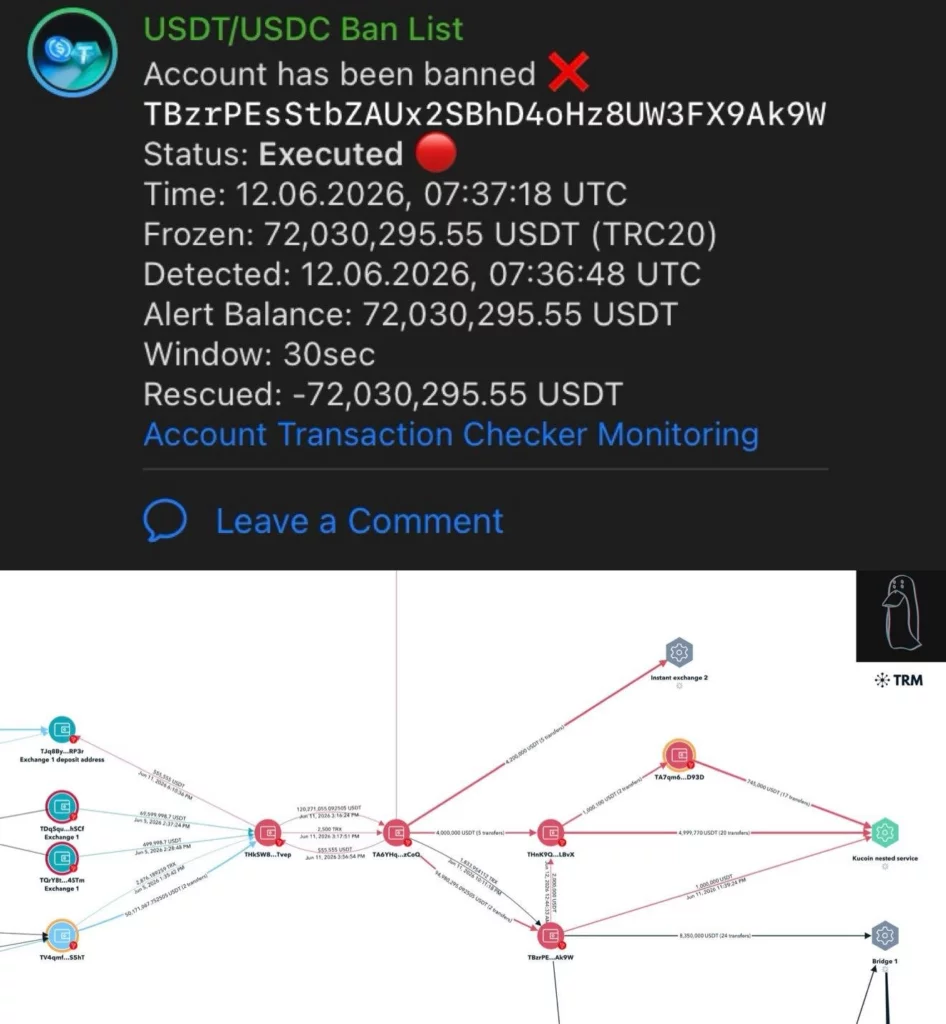
Tether froze more than $72 million in USDT on Tron after ZachXBT linked a large wallet to recent Monero buying and a sharp XMR price spike.
Summary
- ZachXBT traced 120.2 million USDT moving through Tron, KuCoin, instant exchanges, Near Intents wallets.
- Tether froze 72.03 million USDT on Tron after a related address was blacklisted Friday morning.
- XMR traded near $357 after surging toward $438, keeping privacy-coin liquidity in focus today Friday.
ZachXBT traces $120M USDT wallet
On-chain investigator ZachXBT said a Tron address received 120.2 million USDT on June 11 before moving funds across exchanges and cross-chain routes. The address was identified as TA6YHqB2xh5HhfmC7WoLQaWmqq7Vv4zCoQ.
The funds later moved in several directions. ZachXBT said more than $12 million went to KuCoin deposit addresses, while $8 million moved to instant exchanges.
Another $8 million was bridged from Tron to Bitcoin and Ethereum through Near Intents. The activity drew attention because it happened before and during a strong move in Monero.
“Yesterday (June 11) TA6YHqB2xh5HhfmC7WoLQaWmqq7Vv4zCoQ received 120.2M USDT on Tron and began transferring $12M+ to Kucoin deposit addresses and $8M to various instant exchanges,” said ZachXBT.
Monero orders linked to XMR spike
ZachXBT said the same entity created large Monero orders. He linked those orders to a sharp XMR move from $330 to $420.
“The entity created Monero orders which caused the XMR price to spike from $330 -> $420,” said ZachXBT.
Monero later traded near $357.20, according to crypto.news market data. XMR recorded a 24-hour trading range between $345.09 and $438.06, showing how wide the move became.
The token’s 24-hour trading volume stood near $291.3 million, while market capitalization was around $6.7 billion. XMR was still up over 3% on the day and almost 10% over seven days.
The move added fresh attention to Monero’s market depth. Large orders can move XMR quickly because the asset has less exchange access than many top tokens.
Tether freezes related Tron address
ZachXBT said Tether later blacklisted a related Tron address holding about 72 million USDT. Whale Alert data showed 72,030,295 USDT frozen on Tron on June 12.
“A few minutes ago Tether blacklisted an address directly related to Ta6YHq with 72M USDT: TBzrPEsStbZAUx2SBhD4oHz8UW3FX9Ak9W,” said ZachXBT.
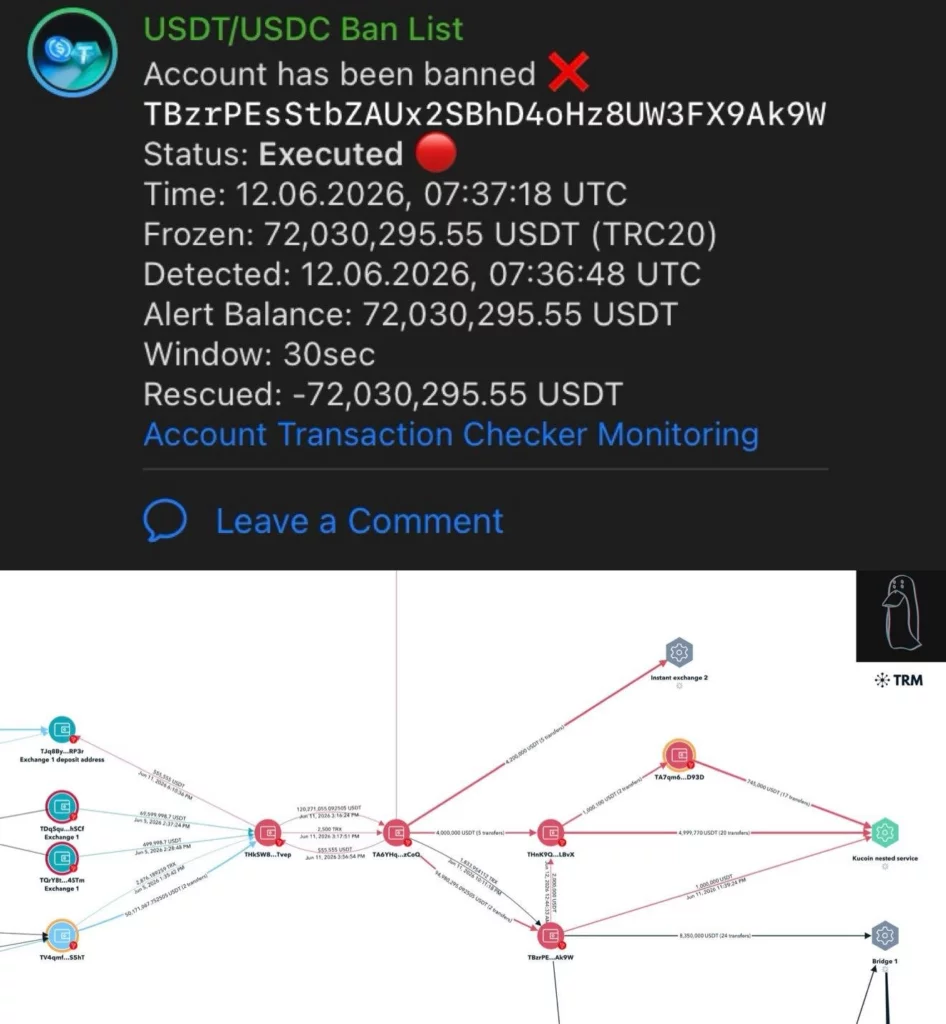
The freeze shows how issuer-controlled stablecoins can be halted at the token contract level. This makes USDT different from assets like Bitcoin or Monero, where issuers do not control transfers.
As previously reported by crypto.news, Tether froze about $515 million in USDT across Ethereum and Tron over a 30-day period in May. Tron accounted for most of those frozen balances.
Monero rally follows earlier demand
The wallet activity came after Monero had already seen stronger market attention. As previously reported, XMR rose above $350 after double-digit daily gains on June 11.
That earlier move was tied to privacy-coin demand, Cake Wallet’s Passport Prime integration, and renewed attention around Monero security audits. The latest ZachXBT report added a separate liquidity-driven angle.
Monero remains one of the largest privacy coins by market value. Its design hides transaction sender, receiver, and amount details by default, which makes it attractive to privacy users and harder for investigators to track.
The latest price action now leaves traders watching whether XMR can hold above the $350 area. A return toward $400 would keep the breakout debate alive, while loss of support could show that the spike was driven mainly by short-term order flow.


TRM Labs has tied four cryptocurrency addresses to live scams targeting 2026 World Cup fans, spanning fake ticket sites and a fixed-match betting scheme as matches play out across North America.
The blockchain intelligence firm says wallets associated with the operations have received less than $1,700 combined so far. However, it warns that scam volume and frequency could ramp up.
How World Cup Demand Fuels Crypto-Based Scams
Major sporting events create concentrated demand spikes for tickets, travel, and merchandise. Scammers build that timing into their planning, seeding fake infrastructure weeks ahead, then promoting it hard near kickoff, TRM research shows.
FIFA-WTO studies estimate that the tournament could draw 6.5 million attendees and add up to $40.9 billion to global GDP. That scale gives fraudsters a deep pool of potential victims.
Watchdogs flagged the risk early. The FBI warned in May about spoofed FIFA websites built to steal personal data and sell fake tickets. The Better Business Bureau echoed the alarm.
Angela Dennis, CEO of the Better Business Bureau of Central Ontario, told reporters why mass demand draws fraud.
“When there is such a mass volume and this high demand, that’s when scammers really get excited because people do fall for the information that they send, whether it’s an email, a phishing email or a text, and having people link to fake sites and providing personal information or payment details to them,” Dennis stated.
Follow us on X to get the latest news as it happens
Inside the On-Chain World Cup Scams
TRM identified several on-chain scam types, led by fake ticketing and fixed-match betting. Fraudulent ticket sites pose as official sellers, list sought-after matches, and demand crypto.
One Polygon (POL) wallet pulled in about $1,562, almost all on April 1. A second operation, tied to a Bitcoin (BTC) address, keeps its phishing page live but has not accepted any payments.
Fixed-match schemes charge an upfront fee for supposed insider results. TRM linked one to a Bitcoin wallet that collected small sums between January and May 2026, then routed them into a custodial account.
A third route runs through tokens. TRM pointed to the $WORLDCUP coin. It trades on LBank as a fan-made commemorative project with no FIFA tie, exposing holders to familiar low-liquidity meme coin losses.
Scammers also lean on bridges to muddy the trail, with TRM counting roughly $1.9 billion in scam funds moved through them over time.
A third scam runs through tokens. A coin called $WORLDCUP trades on the LBank exchange, billed as a fan-made commemorative project with no affiliation with FIFA. Holders face the standard low-liquidity meme coin loss patterns when issuers exit.
“The amounts involved in these cases are modest, but the movement of funds follows patterns commonly seen in consumer crypto fraud,” the report read.
Scammers lean on bridges to move proceeds and complicate tracing. Across all tracked activity, roughly $1.9 billion in scam funds has passed through bridges.
TRM expects to see more typologies as the tournament continues, including gambling pitches, deepfake impersonations of FIFA figures, and fake streaming sites.
Subscribe to our YouTube channel to watch leaders and journalists provide expert insights
The post Crypto Scammers Hit World Cup Fans as Tournament Gets Underway appeared first on BeInCrypto.
TLDR:
- US export control order forced global shutdown of Fable 5 and Mythos 5 models immediately across all users
- Anthropic says restriction stems from alleged jailbreak concern but calls issue narrow and non-systemic in scope
- Other Claude models remain online as company complies with government national security directive requirements
- Firm disputes severity of claims, citing prior red-teaming tests and absence of verified harmful exploits
A US government export control directive has forced Anthropic to suspend global access to Fable 5 and Mythos 5. The order applies to all foreign nationals, including employees outside the United States.
The decision triggered an immediate shutdown of both models across all customer environments. According to internal communication, the directive was issued citing national security concerns tied to potential jailbreak vulnerabilities.
Fable 5 and Mythos 5 Export Control Order Shakes Anthropic AI Access
AnthropicAI confirmed it received the directive at 5:21pm ET from US authorities.
The order required immediate suspension of Fable 5 and Mythos 5 access worldwide. The restriction applies even to foreign national staff working within the company.
The company stated compliance was mandatory under export control rules.
As a result, it disabled both models across its infrastructure. Other Claude models remain fully operational without restriction.
The announcement highlighted that the directive affects users across all regions. Customers outside the United States lost access at the same time as domestic users. The scope of the order reflects broad national security classification.
Anthropic noted the shutdown was abrupt and not pre-planned.
Engineering teams executed global deactivation procedures shortly after receiving the notice. Service disruption affected enterprise users and developers relying on the models.
Fable 5 and Mythos 5 Security Concerns and Jailbreak Claims Explained
The directive reportedly stemmed from concerns about a potential jailbreak method targeting Fable 5.
Authorities believed the technique could expose cybersecurity-related capabilities under certain conditions. The company reviewed the same demonstration internally.
Anthropic stated the identified issue involved narrow vulnerabilities already seen in other models. It added that similar weaknesses could be reproduced using publicly available AI systems. The company did not identify evidence of a universal jailbreak.
Internal assessments showed safeguards were tested extensively before release.
The models underwent thousands of hours of red-teaming with external partners. These included government-linked AI safety institutes and third-party evaluators.
According to Anthropic, no verified harmful deployment resulted from the reported vulnerability. The company said it had not received documentation of a broad exploit affecting model safety systems. It described the issue as limited in scope and non-systemic.
Despite disagreement with the directive’s severity, Anthropic complied with legal requirements.
The firm emphasized ongoing discussions with regulators to restore access. It also reaffirmed that other models remain unaffected and continue operating normally.


Bitget has secured registration in Argentina as a Virtual Asset Service Provider, adding another regulated market to its Latin American footprint as crypto adoption in the country approaches 20% of the population.
Summary
- Bitget has secured Virtual Asset Service Provider registration in Argentina, extending its regulated presence across Latin America.
- Argentina’s crypto market now includes nearly 20% of the population and more than 15,000 businesses that accept digital asset payments.
- The approval comes as Bitget continues expanding tokenized stock and real world asset products across its exchange and wallet ecosystem.
According to a press release shared with crypto.news, Bitget has been added to Argentina’s Virtual Asset Service Provider registry maintained by the National Securities Commission, known locally as the CNV.
The registration allows the exchange to operate within the country’s existing framework for crypto service providers while complying with oversight requirements tied to anti-money laundering and counter-terrorism financing rules.
As part of the registration, Bitget will be subject to reporting and compliance obligations before Argentina’s Financial Information Unit and other relevant authorities. The approval comes as policymakers across Latin America continue building formal rules for digital asset businesses operating in their jurisdictions.
Argentina has emerged as one of the region’s busiest crypto markets, with company data indicating that nearly 20% of the population uses digital assets and more than 15,000 businesses accept crypto payments. Growing participation has turned the country into a key destination for exchanges seeking expansion opportunities across Latin America.
“Regulatory frameworks for digital assets continue developing across Latin America, making compliance and registration increasingly important for platforms operating in the region,” said Gracy Chen, CEO of Bitget.
“Argentina represents an important market within Latin America’s broader digital asset landscape, and Bitget remains focused on supporting sustainable growth by aligning with local regulatory requirements.”
Argentina adds to Bitget’s regional expansion
Coming shortly after regulatory progress in Mexico, the Argentina registration extends Bitget’s presence in markets where crypto adoption and regulatory development are advancing at the same time.
Recent months have also seen the company deepen its focus on products that connect digital assets with traditional finance. Earlier in June, Bitget enabled 15 tokenized stocks and exchange-traded funds, including Apple, Nvidia, Tesla, Microsoft and Amazon-linked assets, to be used as collateral for USDT-margined futures trading through its Unified Trading Account system.
At the time, Chen said users were looking for more ways to put tokenized assets to work across different trading activities as demand for blockchain-based financial products continued to grow.
A separate announcement from Bitget Wallet on June 9 expanded the company’s tokenized asset infrastructure further. The wallet introduced support for direct trading of tokenized real-world assets through its DEX Aggregator API, allowing partner platforms to route trades from cryptocurrencies into tokenized stocks without requiring separate trading systems.
According to Bitget Wallet, the upgrade introduced an RFQ-based routing model designed to secure liquidity before transactions reach the blockchain. Initial integrations included Ondo Finance and xStocks, two of the largest participants in the tokenized asset sector.
Bitget Wallet also reported that its ecosystem now offers access to more than 300 tokenized products spanning equities, commodities, precious metals and other financial instruments. Company figures further show that Bitget’s tokenized equity products have generated more than $30 billion in trading volume since 2025.
BTC vs. ETH vs. XRP: Which Is Closest to a Major Reversal? Analyst Explains

The 2026 World Cup in five football shirts

China opens photonic computing lab to bypass US chip curbs


-

 NewsBeat5 days ago
Alexander Zverev wins the French Open to finally earn a 1st Grand Slam title
-
 Entertainment6 days ago
The Best Mystery Series of All Time Is Surging on Streaming 30 Years After It Ended
-

 Crypto World5 days ago
Anatomy of the June crypto crash: Fed, Iran, Saylor
-

 Crypto World2 days ago
Oppenheimer backs SpaceX as $70 billion retail frenzy builds
-

 Crypto World2 days ago
Markets Rally as SpaceX IPO Looms Amid Iran Tensions and Inflation Surge
-
Crypto World6 days ago
Senator Cynthia Lummis Calls CLARITY Act the Most Consequential Financial Legislation of This Generation
-
 NewsBeat6 days ago
Alexander Zverev conquers demons and outlasts Flavio Cobolli to win French Open for first major title
-

 Tech6 days ago
Microsoft unveils seven homegrown AI models in new bid for ‘long term self-sufficiency’
-

 Tech7 days ago
Hackers now exploit SolarWinds Serv-U flaw to crash servers
-

 Business5 days ago
High Stakes for Wembanyama as New York Pushes for 3-0 Lead
-
 Business6 days ago
The Pain Points Taking a Fragile Tech Rally Down a Notch
-

 Tech5 days ago
Notion restores access to Anthropic after service disruption
-
 Crypto World5 days ago
Eli Lilly (LLY) Stock Surges 4% Following Breakthrough Sleep Apnea Trial Results
-
 Business6 days ago
The investment to transform historic St Helen’s ground in Swansea
-

 Crypto World6 days ago
Trump’s AI Ownership Plan Could Benefit Anthropic at OpenAI’s Expense
-
 Sports4 days ago
Bangladesh beat Australia after 20 years in ODIs, register only their second win over six-time world champions | Cricket News
-

 Business7 days ago
Forensic Expert Floats Handyman Theory in Disappearance of Savannah Guthrie’s Mother
-

 Tech6 hours ago
NanoClaw integrates JFrog registries to secure AI agent downloads
-

 Tech17 hours ago
This Week In Security: Microsoft On Microsoft, Register Your Domains, Linux On ARM, And FreeBSD Joins The File Cache Club
-

 Politics2 days ago
Politics Home | Healey Resignation Is “Colossal Failure Of Government”, Says Former Labour Defence Secretary
You must be logged in to post a comment Login