

Crypto World
Rain Partners With Mastercard to Broaden Stablecoin Payment Infrastructure


Key Highlights
- Mastercard joins Rain’s stablecoin-powered payment ecosystem
- Partnership follows Rain’s recent $250M Series C fundraise
- Credit and prepaid card capabilities now available through Mastercard rails
- Rain diversifies beyond Visa-exclusive infrastructure
- Integration strengthens institutional on-chain settlement options
Rain has secured a strategic alliance with Mastercard, broadening its stablecoin payment infrastructure beyond its initial Visa-focused approach. This collaboration introduces credit and prepaid card functionality while enabling stablecoin-based settlements across Mastercard’s extensive network. The partnership positions Rain to capture growing institutional demand for blockchain-integrated payment solutions.
Mastercard Integration Expands Rain’s Payment Capabilities
Through this collaboration, Rain will launch Mastercard-branded credit and prepaid cards designed for institutional payment applications. This development diversifies Rain’s Stablecoin Card offering, which previously concentrated on Visa network integrations. Organizations can now implement stablecoin settlement infrastructure without overhauling their established payment workflows.
According to Rain, the Mastercard collaboration addresses needs of enterprises committed to specific payment networks. Rain manages on-chain treasury operations, currency conversion, and settlement processes invisibly. This architecture maintains familiar card usage patterns while leveraging stablecoins for backend payment processing.
The fintech startup secured $250 million through its Series C round at a $1.95 billion valuation recently. This capital injection provides resources to expand Stablecoin Card infrastructure significantly. The Mastercard arrangement represents a concrete application of that growth capital.
Blockchain Payments Gain Institutional Traction
Rain initially developed its platform around Visa programs utilizing on-chain stablecoin settlement. The Mastercard collaboration marks a strategic evolution toward multi-network capabilities. This expansion enhances Stablecoin Card accessibility for diverse corporate and institutional audiences.
Mastercard has accelerated its blockchain payment initiatives, including stablecoin settlement experiments. The payments giant has collaborated with organizations including Circle and Paxos on tokenized settlement trials. Additionally, its Multi-Token Network has facilitated broader blockchain payment applications.
These developments illustrate stablecoins’ evolution beyond cryptocurrency speculation. Today they facilitate settlement operations, treasury transfers, merchant transactions, and card-based spending. The Stablecoin Card framework bridges blockchain infrastructure with conventional payment experiences.
Enterprise Payment Solutions Drive Rain’s Strategy
Rain aims to provide enterprises with turnkey compliant card program solutions. The Stablecoin Card framework enables users to spend digital balances through established card networks. Rain orchestrates stablecoin conversion and settlement behind the user interface.
The Mastercard collaboration could attract enterprises hesitant to abandon existing card infrastructure. It offers these organizations a pathway toward stablecoin settlement without complex migrations. Additionally, it connects Rain with businesses already invested in Mastercard ecosystems.
Stripe and Coinbase have similarly integrated stablecoins into payment, commerce, and disbursement products. Rain therefore operates in an expanding market where stablecoins address tangible business requirements. Its Stablecoin Card offering now competes in a payment landscape gravitating toward accelerated settlement.
Rain’s Mastercard integration signals meaningful progress in stablecoin payment mainstream adoption. The platform now connects both Visa and Mastercard infrastructures with blockchain settlement capabilities. This dual-network strategy positions the Stablecoin Card as fundamental to Rain’s vision for next-generation payment infrastructure.


Crypto World
BeInCrypto Institutional Research: 20 Biggest Capital Markets & Infrastructure for Digital Assets


The BeInCrypto Institutional 100 Awards 2026 enters its final week with the Capital Markets & Infrastructure pillar now narrowed to 20 shortlisted firms across five categories.
This pillar covers the firms building the regulated core of institutional crypto: asset managers, trading infrastructure providers, liquidity firms, custodians, and ratings or analytics providers. The winners were announced at Proof of Talk in Paris on June 2, 2026.
The shortlisted firms are listed alphabetically within each category and are not ranked.
Best Digital Asset Manager
These firms built the regulated investment products that now carry institutional digital asset exposure through ETFs, ETPs, tokenized funds, and advisor platforms.
| Shortlisted Firm | Why It Made the Shortlist |
| 21Shares | FalconX completed its acquisition of 21Shares in November 2025, bringing 55 listed products and more than $11 billion in AUM into a broader institutional prime brokerage stack. |
| BlackRock | IBIT became the market benchmark for spot Bitcoin ETF exposure, while BUIDL made BlackRock a leader in tokenized money market funds. |
| Fidelity Investments | Fidelity combines ETF issuance with in-house custody through Fidelity Digital Assets, creating one of the most vertically integrated digital asset product stacks. |
| VanEck | VanEck continues to push beyond Bitcoin and Ethereum through Solana filings, mining equity exposure, active digital asset strategies, and developer-support commitments. |
Best Institutional Trading Infrastructure
This category focuses on the systems institutions use to route, finance, execute, and manage digital asset trades.
Shortlisted Firm
Why It Made the Shortlist
FalconX
FalconX expanded through acquisitions of Arbelos, Monarq, and 21Shares, building a broader stack across prime brokerage, asset management, options, and tokenized gold.
Ripple Prime
Ripple’s $1.25 billion acquisition of Hidden Road created a crypto-owned global multi-asset prime broker with roughly $3 trillion in annual clearing volume.
Talos
Talos closed a $45 million Series B extension at a $1.5 billion valuation, backed by Robinhood, Sony, BNY, Fidelity, and other strategic investors.
Wintermute
Wintermute’s NODE platform gives institutions zero-fee OTC access across more than 250 assets and 60 venues, with recent expansion into tokenized commodities.
Best Liquidity Provider
Liquidity providers keep institutional crypto markets functioning through two-way prices, OTC execution, stablecoin flows, and market-making across venues.
Shortlisted Firm
Why It Made the Shortlist
B2C2
Majority-owned by SBI Holdings, B2C2 supports institutional stablecoin and OTC flows and named Solana as its primary stablecoin settlement rail in 2026.
Cumberland (DRW)
Cumberland remains one of the longest-running institutional crypto OTC desks, backed by DRW’s multi-asset trading infrastructure.
GSR
Standard Chartered’s SC Ventures invested in GSR in May 2026 at a valuation above $1 billion, validating its role in bank-grade crypto liquidity.
Wintermute
Wintermute handles around $5 billion in average daily flow and expanded its institutional OTC platform into tokenized gold in 2026.
Best Digital Asset Custody Provider
Custody has become one of the core trust layers for institutional crypto, supporting ETFs, banks, asset managers, and tokenized products.
Shortlisted Firm
Why It Made the Shortlist
BitGo
BitGo became the first crypto-native custody firm to list on the NYSE in January 2026, with roughly $104 billion in assets on platform.
Coinbase Custody
Coinbase Custody holds more than 80% of US Bitcoin and Ethereum ETF assets and supports a large institutional and government client base.
Fireblocks
Fireblocks processes more than $4 trillion in annual digital asset transfers and expanded into embedded wallets and crypto accounting through acquisitions.
Ripple Custody (Metaco)
Ripple combined Metaco and Palisade to build a custody and wallet infrastructure platform serving banks, fintechs, and crypto-native firms.
Best Digital Asset Ratings & Analytics Provider
Institutional capital depends on third-party risk signals before allocation. This category covers blockchain intelligence, ratings, stablecoin analysis, and on-chain risk infrastructure.
| Shortlisted Firm | Why It Made the Shortlist |
| Chainalysis | Chainalysis remains central to crypto investigations and compliance, with more than 1,000 customers and new AI-agent tools for blockchain intelligence. |
| Elliptic | Elliptic closed a $120 million Series D in May 2026 and screens more than 1 billion transactions weekly across hundreds of institutional customers. |
| Moody’s Ratings | Moody’s published its first stablecoin deposit-rating methodology in March 2026, bringing traditional credit-rating standards into digital assets. |
| S&P Global Ratings | S&P expanded its Stablecoin Stability Assessments on-chain through Chainlink DataLink, making ratings usable by institutions and DeFi applications. |
About the BeInCrypto Institutional 100
The BeInCrypto Institutional 100 is an annual research program covering 25 categories across six pillars: Capital Markets & Infrastructure, Access to Digital Assets, Tokenization & On-Chain Finance, Enterprise Blockchain, Regulation & Governance, and Retail to Crypto Bridge.
The 2026 evaluation window ran from April 2025 through March 2026. Shortlists were selected through a combination of BeInCrypto’s editorial research methodology and blind scoring by an external panel of institutional digital asset practitioners.
Each category follows one of three scoring tracks, depending on the market’s data profile. Public filings, regulatory registers, audited reports, on-chain data, ETF flow trackers, and nominee disclosure forms were used where available.
Final blended scores are not published. Inclusion on the shortlist reflects the combined outcome of research and judge review.
Editorial contact: awards@beincrypto.com
The post BeInCrypto Institutional Research: 20 Biggest Capital Markets & Infrastructure for Digital Assets appeared first on BeInCrypto.
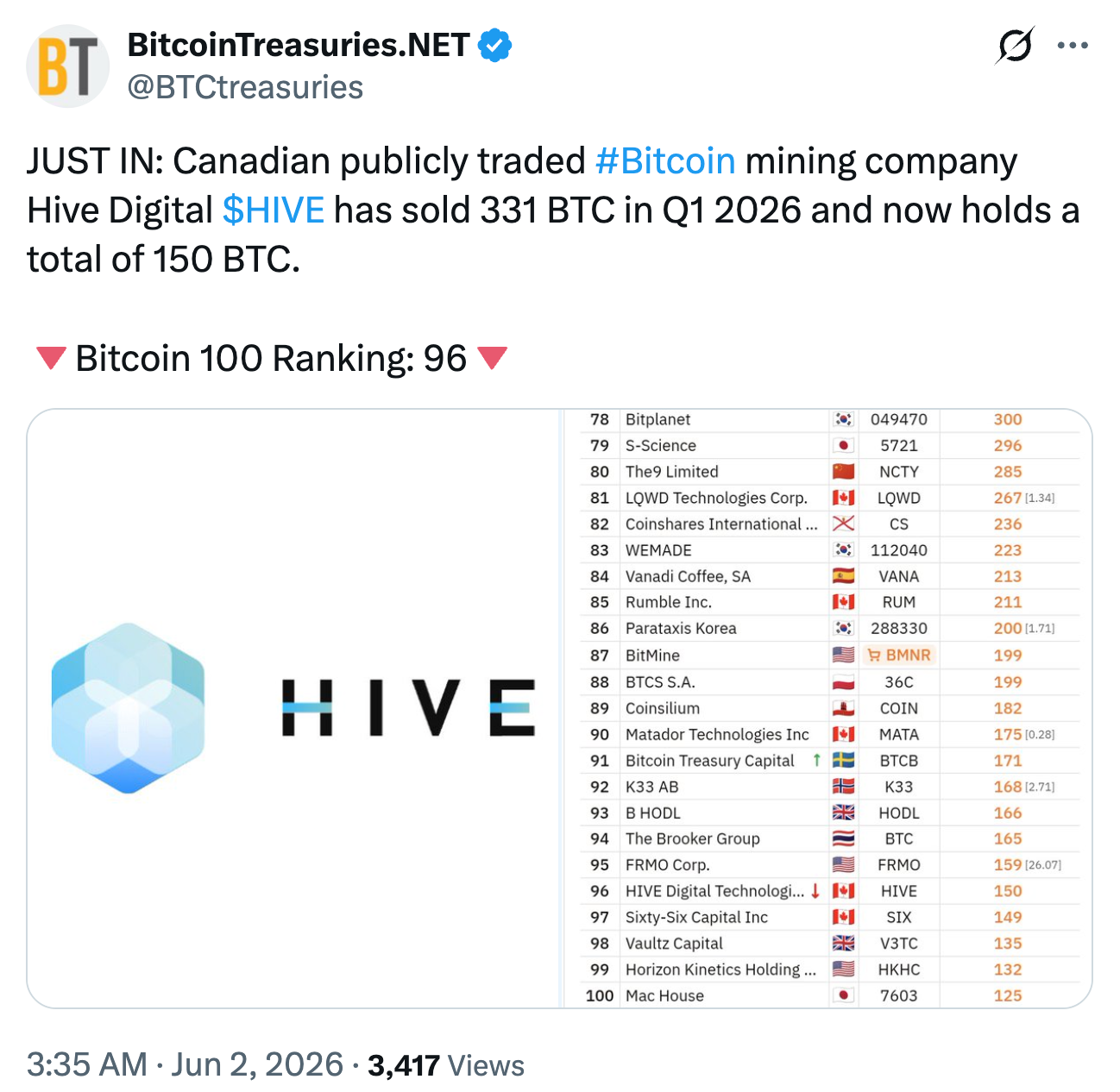
Canadian Bitcoin miner HIVE Digital Technologies’ Bitcoin holdings fell by 331 BTC in the latest quarter, even as the miner reported a sharp rise in annual revenue from Bitcoin mining and high-performance computing (HPC).
The company reported holdings of 150 Bitcoin (BTC) in its fiscal year update on Monday, down from 481 BTC at the end of Q4 2025, according to company figures and CoinGecko data. The 331 BTC reduction represents about $23 million in value at current prices, with Bitcoin trading roughly 21% lower year-to-date.
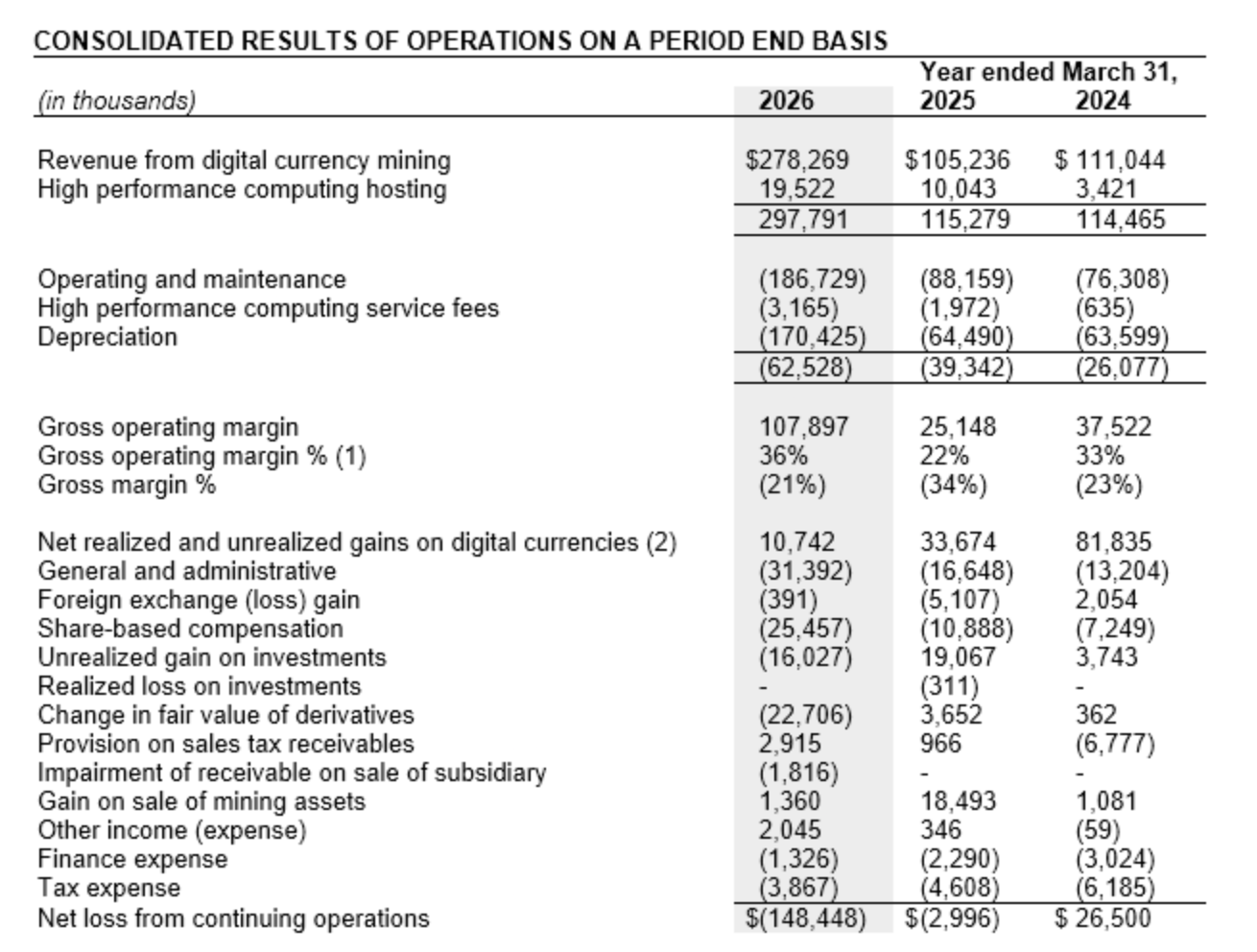
HIVE did not explicitly say it sold Bitcoin. The company mined 2,885 BTC during fiscal 2026 and generated $297.8 million in revenue, up 158% from a year earlier, driven largely by expanded Bitcoin mining capacity and HPC revenue.
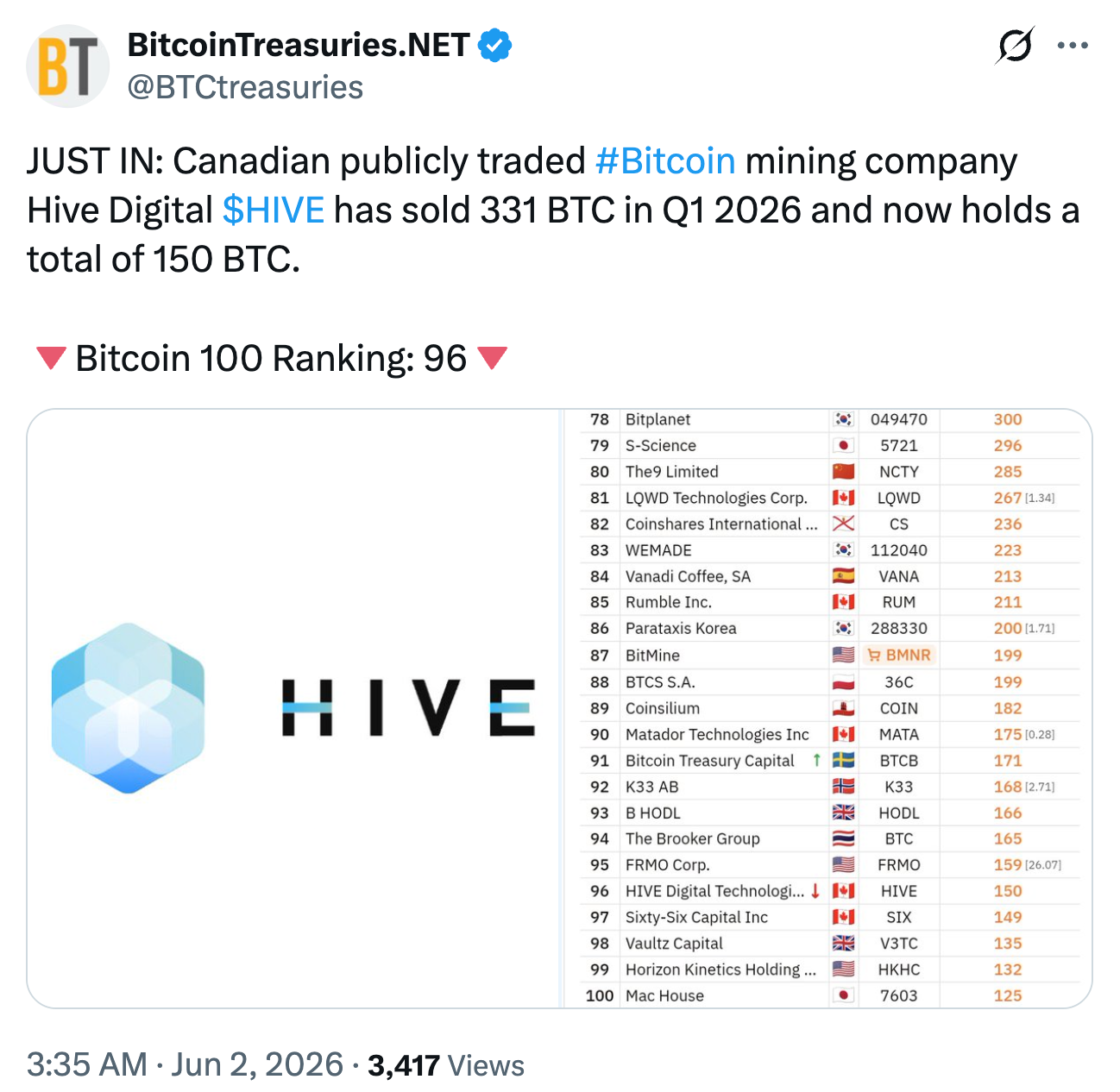
Source: Bitcoin Treasuries
The shrinking Bitcoin treasury highlights how public miners are balancing accumulation against expansion costs as they invest in energy-heavy mining sites and diversify into AI computing infrastructure.
Revenue jumps to $297.8 million as mining drives growth, costs rise
HIVE’s total revenue rose to $297.8 million from $115.3 million a year earlier, with digital currency mining revenue rising to $278.3 million, while HPC contributed $19.5 million, almost doubling year-over-year.
Source: HIVE Digital Technologies
Despite the sharp increase in revenue, rising costs continued to pressure results. Operating and maintenance expenses climbed as HIVE expanded its mining and data center footprint, while depreciation rose to $170.4 million, nearly triple the prior year and one of the largest expenses on the income statement.
Related: TeraWulf acquires Kentucky AI data center site with planned 1 GW capacity
Miner bets on AI alongside Bitcoin
HIVE said its HPC business revenue is up from $10 million a year earlier, as demand for AI computing services increased.
The company said contracted annual recurring revenue from its HPC division reached $35 million by year-end, supported by deployments of Nvidia-powered GPU clusters and new enterprise contracts.
It also highlighted plans for a 320-megawatt AI data center project in the Greater Toronto Area, which it said could eventually host more than 100,000 GPUs.
The expansion underscores a broader trend among public Bitcoin miners, many of whom are seeking new revenue streams from AI and cloud computing as mining economics become more competitive and capital-intensive.
Magazine: HYPE chases $100 target, ETH could dump below $1800: Market Moves
Silver (XAG/USD) was already on soft footing as speculators trimmed their bullish bets, and a fresh Iran escalation has now reignited the oil bid that works against it. Silver price has slipped over 1% day-on-day, at the time of writing.
The metal trades near $74, well off its January record near $121. Two forces are stacked against it, cooling speculative demand and an oil market that just turned higher on Middle East risk.
Speculators Were Already Pulling Back Before the Oil Move
The softness in silver did not start with this week’s headlines. Positioning data showed speculators cutting bullish exposure well before oil moved up over 2% on Iran war escalation.
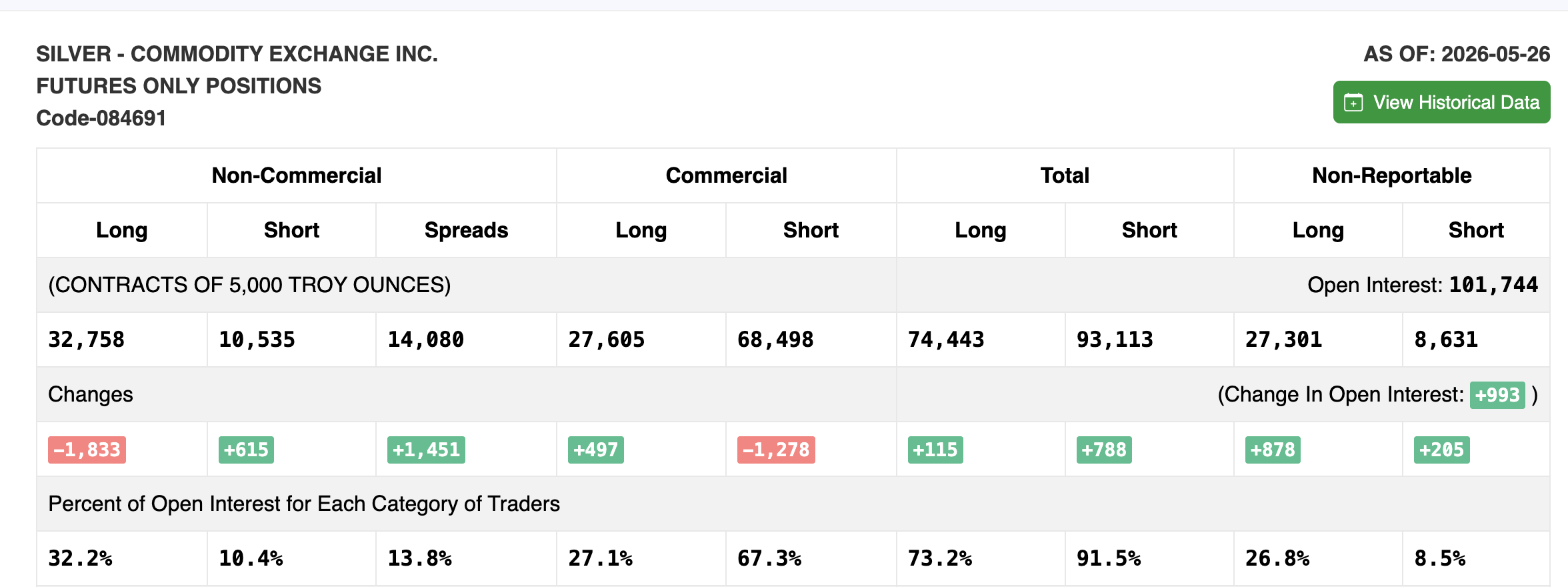
In the COMEX silver Commitments of Traders (COT) report for May 26, large speculators reduced their long bets and added shorts.
Want more insights like this? Sign up for Editor Harsh Notariya’s Daily Newsletter here.
Non-commercial traders, the group that includes funds and other speculators, cut longs by 1,833 contracts and added 615 shorts. That is the profile of a crowd taking money off the table as the Silver prices remain rangebound for quite sometime, down 1% month-on-month.

Commercial hedgers went the other way, trimming shorts by 1,278 and adding 497 longs, so they turned a little less bearish. Total open interest, the number of contracts still live, rose by 993 to about 101,744. The market did not empty out. Positioning simply leaned more cautious.
JPMorgan has said it stays cautious on silver until the froth from the 2025 run shakes out further. The COT positioning shows the same caution.
Then Iran Reignited the Oil Bid, and Silver Trades Against Oil
On Monday, Iranian state media said Tehran had suspended talks with the US. It also vowed to fully close the Strait of Hormuz, which carries about a fifth of the world’s oil. Oil jumped on the news. Crude Oil (WTI) rose more than 5% on June 1, reversing a stretch of declines built on ceasefire hopes. The WTI surge is now over 8%, week-on-week.
That matters for silver because the two move in opposite directions. Their rolling 30-day correlation, a measure of how closely two assets track each other, sits near minus 0.42, firmly negative.

When oil spikes on supply fear, it lifts inflation and rate worries and raises energy costs for industrial buyers. Silver has tended to fall as oil climbs, and the gap is wide. Since early March, crude has gained roughly 28% while silver slipped about 10%.
The late-May truce talk briefly worked the other way. Silver rose on May 29 as oil eased, but Monday’s escalation flipped that.
Cash Sellers Hit Silver While Options Buyers Stayed Long
The pressure carried into the spot and tokenized markets. Silver fell over 1% on 30-day window and showed net selling near $48 million on Hyperliquid, with gold close behind at minus $50 million. Volume in silver ran around $5.3 billion, so the selling came with real flow.

The options market told a different story. On the iShares Silver Trust (SLV), the put-call ratio, which weighs bearish puts against bullish calls, sat at 0.44 by volume and 0.53 by open interest on June 2.

Both readings are well below 1, meaning calls outnumber puts. Options traders kept a bullish lean even as spot sellers pushed the price down.
That split frames the standoff. The cash sellers are reacting to the immediate oil headwind, while the options crowd is paying up for a rebound, in line with the COT’s commercial side. The selling is about the recent hype, but the call buying bets the weakness proves short-lived. One more signal speaks to silver’s longer-term demand.
A Solar-Demand Model Flags Silver at a Rare Discount
The last signal points to silver’s industrial side. A custom Silver vs Solar Lag Model has dropped to about minus 2.77. The tool tracks the gap between silver’s price and a signal built from solar-driven demand.
The model maps onto silver’s big turns. It ran up to its upper band around the January 29 record high above $121. It last bottomed at its floor near minus 3.35 in mid-May 2025, when the silver price sat close to its $32 base. From that floor, the metal ran all the way to the record.
Now the model is back near that floor at minus 2.77, with the silver price around $74. The reading puts the price at a wide discount to what the solar-demand signal implies. It is the same kind of discount that came before the last leg higher, though one signal is not a guarantee.

That discount lines up with the other forward-looking signals. Commercial hedgers trimmed their shorts into May 26, and the SLV options lean call-heavy. Each leans against the speculators cutting longs and the cash sellers reacting to oil.
The discount matters because silver is in short supply. Demand has outrun supply for five years, and 2026 is set to be the sixth. High prices are nudging solar makers to use less silver per panel, so industrial demand should dip about 2% this year. But supply is shrinking too, so the shortage keeps widening.
For now the signals split. Higher oil can keep silver under pressure in the near term. But the shortage, the bullish options, and the cheap model reading suggest the drop may be a pause, not a top.
The post Silver Bleeds $48 Million as Oil Pressure Roars Back appeared first on BeInCrypto.

Bitcoin critic Peter Schiff is back with another bleak BTC call, warning that the asset could collapse below $20,000 once it breaks through the $50,000 level.
He made the prediction with Bitcoin trading at around $67,000, down more than 4% in 24 hours and over 16% across 30 days.
Why Schiff Thinks the Worst Is Still Ahead for BTC
According to Schiff, the real problem for Bitcoin isn’t the price drop itself but rather the mood surrounding the OG cryptocurrency.
“There’s way too much complacency in Bitcoin for the market to be anywhere near a bottom,” he posted on X. “When Bitcoin breaks $50K, it should be a quick fall below $20K.”
The gold advocate believes that drop will be big enough to shake the conviction of many long-term holders, enough for them to “finally throw in the towel.”
Earlier, he had posted, wondering whether a BTC crash would take broader risk assets down with it or whether it would only be confined to digital assets, suggesting that either outcome could push investors toward “value and safety.” And for those that have been listening to him for a long time, that language tracks closely with his longstanding case for gold.
Schiff also once again weighed in on Strategy, targeting its STRC stock. At the time he was writing, it was trading below $96, pushing its current yield to around 12%, which led the economist to argue that if investors lose confidence in the company’s ability to pay that yield, the price would continue to drop, which would force the firm to raise the official coupon to stabilize STRC at its $100 face value, something he described as a “death spiral.”
That’s a pointed critique, considering Strategy recently sold part of its holdings, 32 BTC to be precise, for the first time since 2022, with the $2.5 million earned from the sale earmarked for preferred stock dividends.
Remember, Michael Saylor’s company holds over 843,000 BTC, so for all intents and purposes, that 32 BTC that was sold was almost like a rounding error against its full position, but Schiff seems to be betting that the STRC structure is more fragile than it looks.
What Others Are Saying
Not everyone thinks an almighty BTC drop would shake the confidence of long-term HODLers as Schiff suggested, with crypto commentator Alex Marzell claiming that the only thing a move to $20K would test is his available cash.
Bitget CEO Gracey Chen shared a similar opinion, saying she was waiting to buy Bitcoin near $50,000. According to her, the asset’s long-term health depends on global money printing pushing up commodities, including BTC and gold.
However, she also pointed out that there were a few short-term risks, including CPI pressure and potential rate hikes, as well as possible selling by whales like Strategy and Mt. Gox creditors. Furthermore, she suggested that heavy AI-sector IPOs could drain a lot of liquidity from the market.
Meanwhile, CryptoQuant head of research Julio Moreno said that the overall Bitcoin demand is contracting at a monthly pace of 232,000 BTC, and he added that the correction was down to weakening demand and not stock market or macroeconomic developments as other market watchers have previously suggested.
His outlook matches a recent report from Bitfinex, which said that Bitcoin was entering a “slow bleed” phase that’s being driven by distribution and fading investor conviction.
The post Peter Schiff Warns Bitcoin Could Plunge Below $20K as Complacency Sets In appeared first on CryptoPotato.

Bitcoin is down by 4% today as a fresh quantum computing development from Microsoft reignites one of crypto’s most consequential long-term debates that swing price prediction. Are quantum machines becoming dangerous? Will the industry be ready when they do?
At its annual Build conference, Microsoft unveiled Majorana 2, a topological quantum chip it describes as 1,000 times more reliable than its predecessor, with average qubit lifetimes of 20 seconds and peak lifetimes approaching 1 minute.
The company credited its agentic AI platform, Microsoft Discovery, with accelerating development by automating measurements, identifying materials, and surfacing manufacturing flaws. Microsoft Technical Fellow Chetan Nayak put it plainly: “We’re 1,000 times better.” The company now targets scalable quantum computing by 2029.
That date lands uncomfortably close to timelines already circulating among cryptographers. Will it affect Bitcoin? In a good or bad way, if it will?
Discover: The Best Crypto to Diversify Your Portfolio
Bitcoin Price Prediction: Quantum Risk Overhang
On the long time frame, Bitcoin is consolidating in a well-defined range, with support clustered between $63,000 and $65,000, a zone anchored by prior demand and the 50-day moving average. Resistance sits at the $73,000–$75,000 local high.
We should be watching the $70,000 level closely. A clean breakout above it would expose a run into the high-$70Ks. The same range we flagged as the next meaningful target, driven by ETF inflows and post-halving supply dynamics rather than quantum headlines.
Conversely, a close below $66,000 risks a deeper retrace into the low-$60Ks, where the next significant demand shelf sits.

If macro tailwinds hold, ETF demand absorbs sell pressure, Bitcoin could test $80,000+ by Q3. But if quantum narrative plus macro deterioration triggers a sentiment reset, sub-$65,000 becomes the operative level to watch.
As Forbes analysis notes, the realistic threat window for Bitcoin’s ECDSA signatures runs from the early to mid-2030s. 21Shares research narrows that window to 2029–2035, with the ledger itself secure and only signature schemes at risk. Near-term price is still macro’s game.
Microsoft’s quantum roadmap is a reminder that tech giants are reshaping crypto’s landscape faster than markets expect.
Discover: The Best Token Presales
Bitcoin Hyper Targets Bitcoin Fix as Bitcoin Quantum Threat Snowballs
Bitcoin consolidating under $70,000 is a reasonable outcome, but for investors who entered during this cycle’s earlier legs, the asymmetric upside at the current market cap is shrinking. That dynamic is pushing capital toward earlier-stage infrastructure plays with genuine Bitcoin-native utility.
The quantum narrative adds urgency: if Bitcoin’s base layer faces a decade-long upgrade cycle, the scaling and programmability layer becomes more critical, not less.
Bitcoin Hyper ($HYPER) is positioning directly inside that gap. It is the first-ever Bitcoin Layer 2 with Solana Virtual Machine (SVM) integration, delivering sub-second finality and smart contract execution faster than Solana itself, while anchoring to Bitcoin’s security model via a Decentralized Canonical Bridge for BTC transfers.
The presale has raised $32.7 million at a current price of just $0.013681, with staking available at high APY for early participants. Funding momentum has been consistent, reflecting a genuine appetite for Bitcoin programmability infrastructure.
The post Bitcoin Price Prediction: Microsoft Quantum Breakthrough Could Change Bitcoin’s Future appeared first on Cryptonews.


The long-term value of decentralized finance (DeFi) depends on its ability to transform the back-office operations of global banking institutions rather than providing alternative trading environments, according to asset management and banking executives.
Speaking on a panel at the Proof of Talk conference in Paris, the executives said legacy financial institutions are eager to adopt blockchain technology, but that’s unlikely to occur given the weaknesses in onchain security, especially in bridges that link different blockchains.
In April, breaches were reported in 27 out of 30 days, prompting CertiK CEO Ronghui Gu to describe it as DeFi’s worst month in four years. Drift Protocol and Kelp Dao alone were hacked by North Korean cybercriminals in exploits that drained nearly $600 million from the two lenders.
“I don’t think you see a growth in DeFi until we fix the first problem … which is the hacks,” said Maja Vujinovic, CEO of investment and advisory firm OGroup. “I think it’s an absolute problem until we solve the bridges. I don’t think that DeFi grows outside of the DeFi degen community … until they fix probably a whole stack.”
Her comment echoed Ben Nadereski, co-founder and CEO at Solstice, a Solana-based DeFi yield protocol, who told CoinDesk in an interview that DeFi’s growth is being held back by the onslaught of exploits, a flaw he blamed on developers frequently building innovative code while not paying enough attention to the core responsibilities of managing capital.
Working on a fix
Stéphanie Cabossioras, chief strategy and global policy officer of Societe Generale Forge, said traditional banks are already working to fix these structural gaps.
She pointed to the company’s record of tokenizing structured products and green bonds on public blockchains. To make those digital assets work, she said SG-Forge had to fix the cash settlement layer by developing its own regulated stablecoins, such as EURCV and USDCV.
“At the end of the day, we were stuck because there was only the securities leg on the blockchain, and we had no cash leg on the blockchain,” Cabossioras said. “That’s why we started to issue a stablecoin.”
Institutional clients, Cabossioras said, prefer the safety of a regulated bank over open-source, non-custodial DeFi protocols.
“In everyday life, anybody — individual, medium, or large enterprise — we want to have a trusted party,” Cabossioras stated. “We don’t want to keep our assets in our private wallets, in our safes at home. We want to delegate this peace of mind to a third party. And that’s why custodians or banks still have a future.”
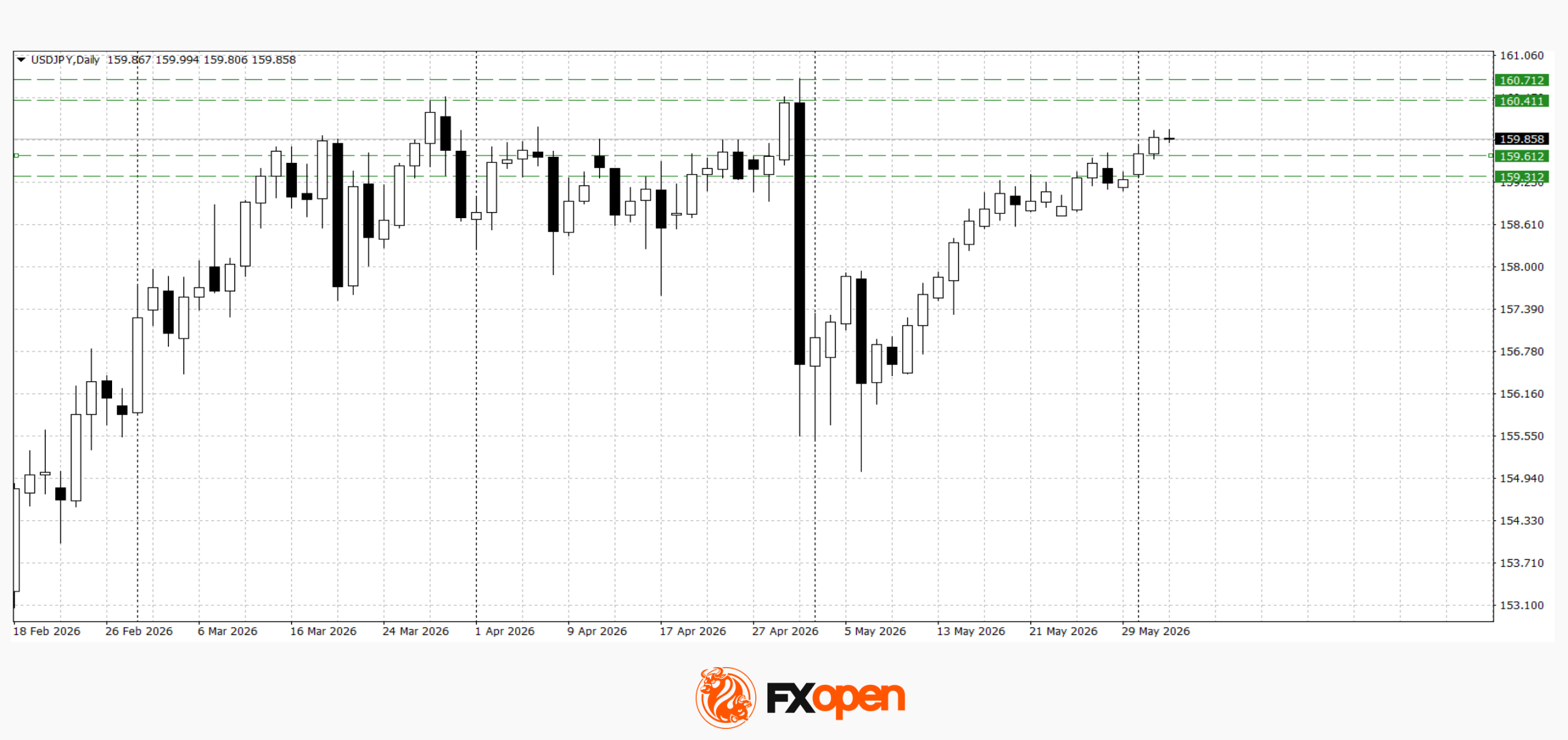
The US dollar is holding on to its recently gained ground following a series of strong macroeconomic releases and a rise in US Treasury yields. Additional support for the greenback comes from resilient inflation readings, expectations that the Federal Reserve will maintain a restrictive policy stance, and cautious investor sentiment ahead of the release of the preliminary ADP employment report. At the same time, market participants continue to monitor oil price dynamics and other economic indicators that could alter perceptions of the health of the US economy.
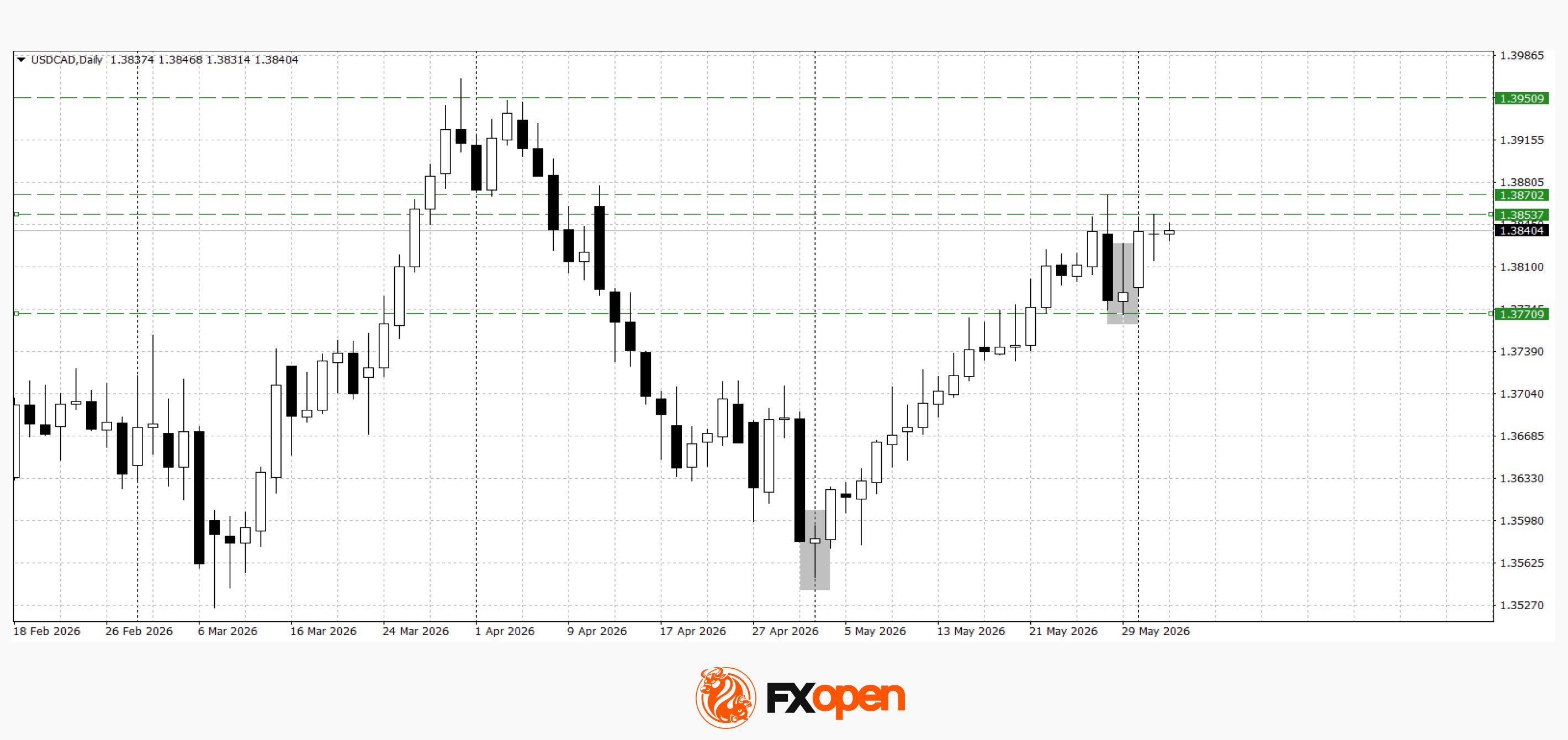
Despite continued demand for the dollar, the next directional move remains uncertain. Both USD/JPY and USD/CAD have reached important technical resistance levels, where either profit-taking and a local correction may emerge, or a fresh bullish impulse could develop if US labour market data come in stronger than expected.
USD/JPY
USD/JPY continues its upward move and has approached a strategic resistance zone near the highs of recent months. Following the recovery from April lows, buyers have almost fully reversed the previous decline; however, price has now entered an area where selling pressure has previously intensified.
Technical analysis of USD/JPY suggests the possibility of a test of the nearest resistance levels at 160.40–160.70. Should the pair establish itself below the 159.30–159.60 range, a broader downward correction may begin.
Key events for USD/JPY:
- today at 11:30 (GMT+3): speech by Bank of Japan Governor Kazuo Ueda;
- today at 15:15 (GMT+3): US ADP Non-Farm Employment Change;
- today at 16:00 (GMT+3): speech by Federal Reserve Vice Chair for Supervision Michael S. Barr.
USD/CAD
USD/CAD has recovered following a corrective decline towards 1.3770. Technical analysis of USD/CAD points to the possibility of a renewed test of the 1.3850–1.3870 area, as a series of bullish candlestick formations has developed on the daily timeframe. The bullish scenario would come into question if the pair were to establish itself decisively below 1.3770.
Key events for USD/CAD:
- today at 15:30 (GMT+3): Canadian labour productivity data;
- today at 17:00 (GMT+3): US ISM Services Purchasing Managers’ Index (PMI);
- today at 17:30 (GMT+3): US crude oil inventories.
Key takeaways
The dollar retains an advantage ahead of the release of preliminary US employment data; however, both USD/JPY and USD/CAD are already trading close to important technical resistance levels. The next directional move will depend on whether the incoming data can confirm the resilience of the US economy. Strong figures could provide the basis for a continuation of dollar strength and a test of fresh highs, while weaker-than-expected results may trigger a correction following the recent appreciation of the US currency.
Trade over 50 forex markets 24 hours a day with FXOpen. Take advantage of low commissions, deep liquidity, and spreads from 0.0 pips (additional fees may apply). Open your FXOpen account now or learn more about trading forex with FXOpen.
This article represents the opinion of the Companies operating under the FXOpen brand only. It is not to be construed as an offer, solicitation, or recommendation with respect to products and services provided by the Companies operating under the FXOpen brand, nor is it to be considered financial advice.

Key Takeaways
- British parliamentary report identifies Palantir dependency as an “unacceptable point of weakness” for national security
- Lawmakers highlight the £330 million ($444 million) NHS data platform agreement as creating dangerous vendor dependency
- Report references Peter Thiel’s political connections and Palantir’s defense sector involvement as incompatible with British principles
- Parliamentary committee recommends activating the 2027 contract exit provision and pursuing domestic alternatives
- Palantir’s British leadership dismissed cancellation calls as “frankly irresponsible”
British lawmakers have issued a sharp rebuke of Palantir’s expanding presence in UK government operations, expressing alarm that reliance on the American data analytics company creates vulnerabilities around sensitive public information.
Palantir Technologies Inc., PLTR
On Wednesday, the Commons Science, Innovation and Technology Committee released a comprehensive 70-page assessment that highlighted Palantir as a concerning case study of excessive dependence on a limited group of American technology vendors. The assessment characterized this dependency as an “unacceptable point of weakness.”
Shares of Palantir (PLTR) drew attention after the parliamentary report emerged, as market participants monitored potential implications from mounting political opposition in a strategically important overseas market.
Central to the committee’s concerns is Palantir’s seven-year National Health Service arrangement valued at £330 million. Secured in 2023, the agreement aims to consolidate healthcare information from throughout the NHS into a unified system enabling medical professionals to make more informed, timely decisions.
According to NHS officials, the partnership has produced “huge benefits for patients,” including accelerated cancer identification and the treatment of thousands of additional patients monthly.
Lawmakers Push for 2027 Contract Termination
Despite these reported advantages, the parliamentary committee is pressing the government to invoke a contractual exit provision available in 2027. The recommendation includes transitioning to a British-based solution or developing an internal capability.
Beyond technical considerations, MPs expressed concerns about aspects of Palantir’s profile and leadership. The assessment referenced co-founder Peter Thiel’s relationships with Donald Trump and his previous critiques of public healthcare systems. Additionally, the report noted Palantir’s contracts providing technology to American defense and immigration enforcement agencies.
The committee concluded these factors constitute a “clear mismatch with UK values” and cautioned that Britain’s digital modernization objectives could be “derailed at any time by a decision taken outside our shores.”
Committee chair Dame Chi Onwurah stated the UK faces serious exposure and advocated for technological independence in essential public service domains.
Company Defends NHS Partnership
Louis Mosley, Palantir’s UK chief executive, responded swiftly to the criticism. In a BBC radio interview, he noted the committee itself had recognized the NHS contract’s positive performance, making termination calls “frankly irresponsible.”
Mosley emphasized that Palantir secured the agreement through a transparent, competitive procurement procedure, and that NHS data governance remains entirely with the health service.
Foxglove, a British advocacy organization that has actively opposed Palantir’s NHS participation, praised the parliamentary findings and urged complete contract termination.
The committee’s assessment also criticized broader government digital initiatives, characterizing the administration’s £45 billion annual savings target through digitalization as “worryingly optimistic.”
Additional recommendations included designating a cabinet-level minister specifically responsible for overseeing digital transformation efforts.
The UK government’s Department of Health and Social Care had not issued a statement in response to the report at press time.
Mastercard has expanded its payment network to support stablecoin settlements across multiple blockchains and beyond traditional banking hours, adding support for six regulated dollar-backed tokens.
Summary
- Mastercard will enable card settlement using regulated stablecoins across multiple blockchain networks, including Ethereum, Solana, and XRP Ledger.
- The company said transactions can be settled during weekends, holidays, and throughout the day while existing payment processes remain in place.
According to a statement released by Mastercard on Wednesday, the company will enable card settlement using Circle’s USDC, Paxos-issued PYUSD, USDG and USDP, Ripple’s RLUSD, and SoFiUSD. The service will operate across Ethereum, Solana, Polygon, Base, Arbitrum, Canton, Tempo, and the XRP Ledger.
Under the rollout, issuers and acquirers will be able to settle transactions during weekends, holidays, and throughout the day instead of relying solely on standard banking schedules. Mastercard said the new functionality will work alongside existing settlement processes rather than replace them.
Among the first institutions expected to support the stablecoin settlement option are ARQ, formerly known as DolarApp, CBW Bank, Cross River, Lead Bank, and Nuvei. Mastercard said the initial deployment will cover parts of the United States and Latin America, with additional expansion planned through 2026.
In its statement, Mastercard said the framework is designed to maintain the same operational standards already used across its network. The company added that security controls, fraud protections, dispute handling procedures, and interoperability features will remain in place as stablecoin settlements are introduced.
Stablecoin strategy gains momentum
Arriving weeks after Mastercard obtained a BitLicense through its subsidiary Mastercard Transaction Services (U.S.) LLC, the latest rollout builds on the company’s effort to integrate regulated digital assets into its payments infrastructure.
As reported in May, the New York State Department of Financial Services granted the license, allowing Mastercard’s subsidiary to conduct virtual currency business activity in New York. Mastercard said at the time that the authorization would support services involving stablecoins and tokenized deposits while operating under the same compliance standards applied to its traditional payments business.
Further investment followed in March when Mastercard reached a definitive agreement to acquire stablecoin infrastructure provider BVNK for up to $1.8 billion. More recently, the company granted a Mastercard Principal Membership to stablecoin card issuer Rain, adding another piece to its digital asset payments strategy.
Elsewhere in the payments industry, competitors are also increasing activity around blockchain-based settlement systems. Visa has continued testing stablecoin-linked settlement programs across multiple blockchain networks, while MoneyGram recently launched its MGUSD stablecoin on Stellar to support its international payments operations.
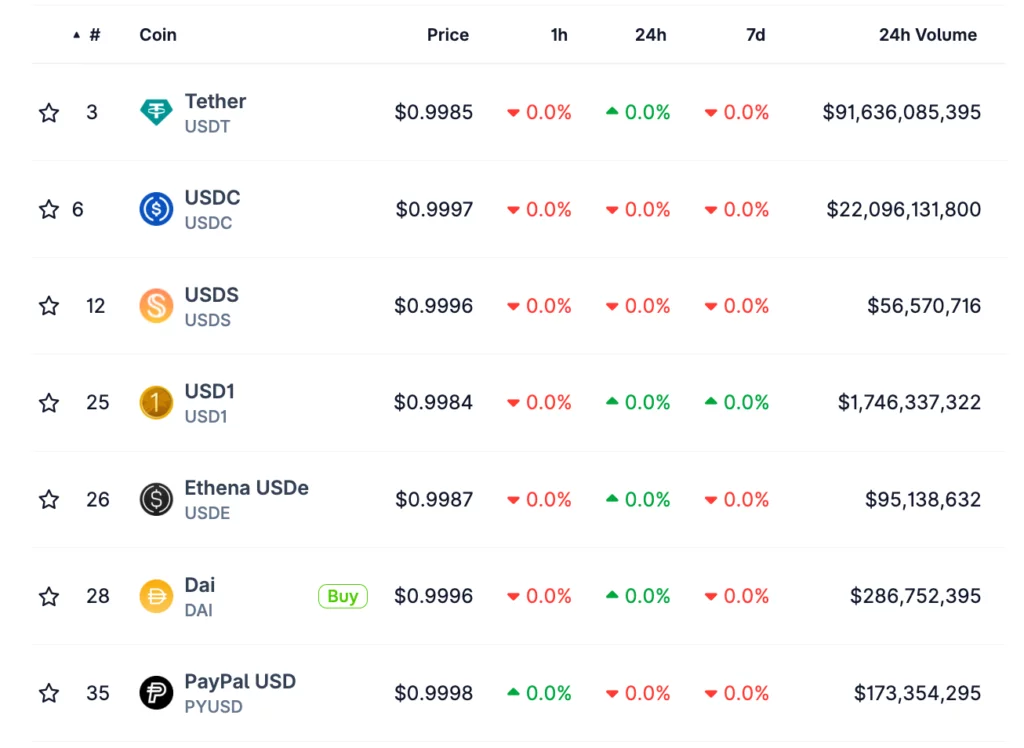
Data from CoinGecko shows the supply of dollar-backed stablecoins is approaching $300 billion.
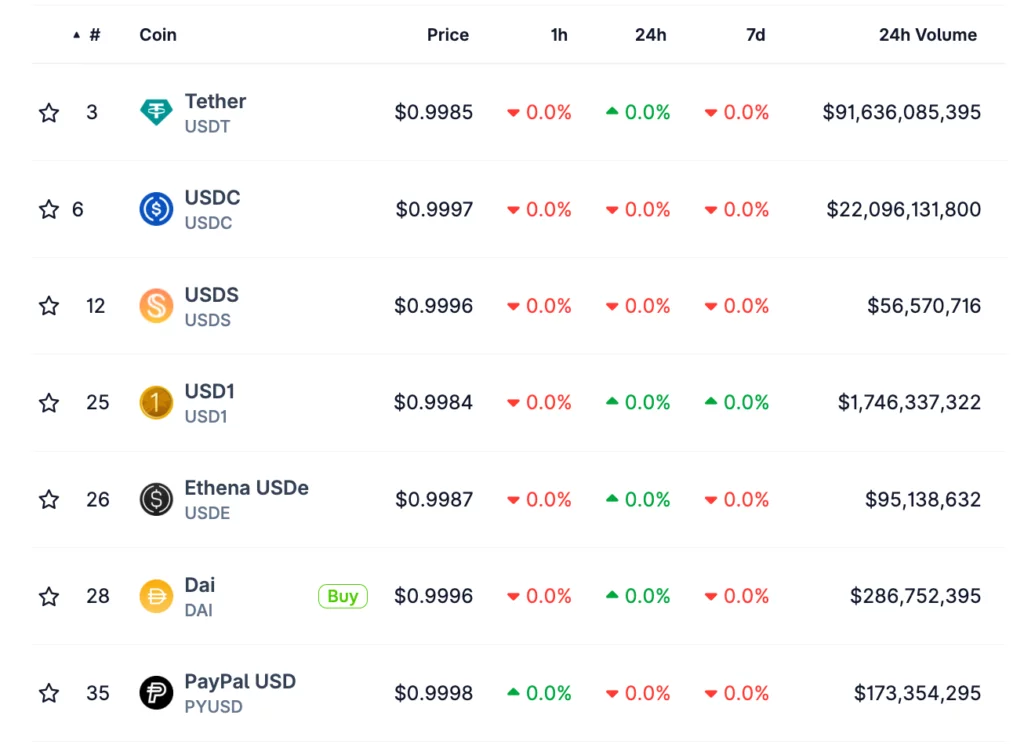
Tether’s USDT remains the largest stablecoin with roughly $188 billion in circulation, while Circle’s USDC follows with approximately $76 billion.
Crypto World
Why is Crypto Going Down? Iran Just Bombed Kuwait’s Airport and Struck the Strait of Hormuz, Bitcoin Is Crashing Toward Critical Support

Crypto crashed overnight as Iranian strikes on Kuwait’s international airport and escalating conflict in the Strait of Hormuz sent risk assets into freefall, with more than $700 million in leveraged long positions forcibly closed in a 12-hour window.
Bitcoin dropped sharply toward critical support levels, dragging the total crypto market cap to $2.31 trillion.
Traders asking why is crypto going down this hard got a brutal, two-part answer: a geopolitical shock and a leverage overhang that was already primed to blow.
The confluence of factors is not subtle. Elevated open interest across perpetual futures markets had been building for weeks, leaving the market structurally vulnerable.
UPDATE: (unconfirmed)
Newly surfaced open-source images and videos document severe damage, raging fires at the fuel depot, and structural interior collapses at Kuwait International Airport Terminal 1 following the recent Iranian drone wave. First responders remain heavily… pic.twitter.com/PslHM6gRMT— X-K (@ConflictRadarME) June 3, 2026
Then Iran bombing Kuwait airport, and the subsequent US military response targeting Qeshm Island in the Strait of Hormuz, provided the exogenous trigger that converted fragile positioning into a full liquidation cascade. Bitcoin had already been slumping on geopolitical tensions and leverage pressure in the sessions leading into this event. This was the match on the gasoline.
Discover: The Best Crypto to Diversify Your Portfolio
Why Is Crypto Going Down? Strait of Hormuz Tensions and Iran Kuwait Airport Bombing Drive Risk-Off Rotation
Iran’s drone strike on Kuwait’s international airport, causing significant building damage, injuries, and the suspension of air traffic on Wednesday morning, was the flashpoint.
Kuwait’s Ministry of Defence spokesman Brigadier General Saud Abdulaziz Al-Otaibi described it as “criminal Iranian aggression.” US Central Command responded with strikes on an Iranian military ground control station on Qeshm Island, deep inside the Strait of Hormuz.
The IRGC warned that “disrupting the security of the Strait of Hormuz will carry a heavy price for the aggressive US military.” Markets heard that threat and repriced risk immediately.
The Strait of Hormuz carries roughly 20–30% of the world’s seaborne oil trade. A sustained disruption there is not a regional story, it is a global energy price event. Oil surged on the escalation news, the US dollar strengthened into safe-haven demand, and Treasuries caught a bid.
That trifecta, higher oil, stronger dollar, bid for bonds, is the classic risk-off rotation that historically drains liquidity from speculative assets. Crypto, despite years of “digital gold” narrative, continues to trade as a high-beta risk asset in moments of genuine geopolitical stress.
The BTC-Nasdaq correlation dominated; the BTC-gold correlation was nowhere to be seen.
The US naval blockade of the Strait of Hormuz, which began on April 13, has already disabled six commercial vessels and redirected 122 others.
The blockade’s latest action, a Hellfire missile fired into the engine room of the Botswana-flagged M/T Lexie after its crew ignored 24 hours of warnings, signals Washington has no intention of backing down.
Ceasefire negotiations between the US and Iran stalled over the weekend, with Iran’s foreign ministry spokesman Esmail Baghaei accusing Washington of “constantly changing its views.” Secretary of State Marco Rubio told Congress bluntly: “The war is over”, but the strikes suggest otherwise.
This is not a de-escalation environment. That is not noise. That is a pattern. The fears of a broader crypto market crash 2026 scenario are not entirely irrational given this backdrop.
Discover: The Best Token Presales
Can Bitcoin Price Recover, or Does the $68,000 Zone Mark a Deeper Break?
The technical damage from this episode is real.
Bitcoin lost the Short-Term Holder Realized Price support, a level that historically marks the dividing line between healthy consolidation and sustained drawdowns.
The $70,000 psychological floor was cracked in the liquidation flush. Total crypto market cap is now testing $2 trillion, a threshold derivatives desks will defend aggressively but one that carries no guarantee.
If US-Iran back-channel talks resume meaningfully, Hormuz shipping risk premiums fade, and ETF inflows return within 48 to 72 hours, Bitcoin reclaims $70,000, shorts get squeezed, and price reprints toward $74,000 to $75,000. That scenario requires de-escalation signals that are not currently visible.
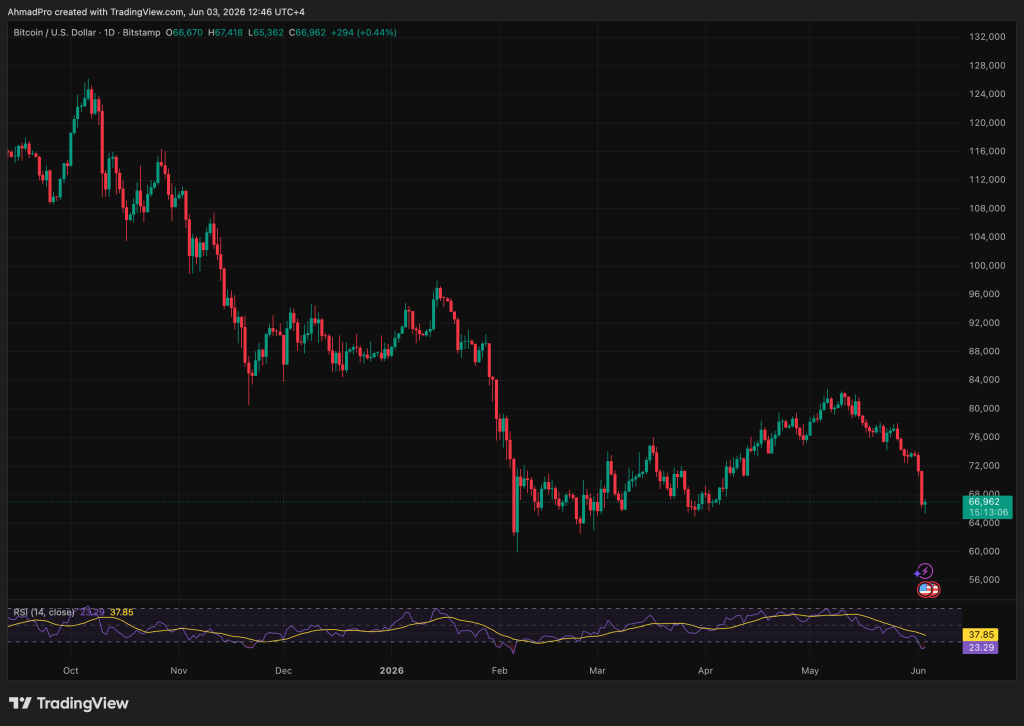
If geopolitical noise persists without further direct escalation, crypto consolidates in the $66,000 to $70,000 range as leveraged positioning resets and macro traders wait on the next US inflation print. The Fed’s higher-for-longer posture limits the upside ceiling even in that scenario.
Further Iranian strikes, a Hormuz shipping incident involving a major tanker, or another upside inflation surprise pushes BTC through $65,000. That breaks the range structure that has held since Q1 2026 and opens a move toward $60,000 to $62,000. This is the scenario traders are quietly stress-testing right now.
The structural read is bearish until $70,000 is reclaimed on a closing basis. Everything below that level is damage control territory.
The post Why is Crypto Going Down? Iran Just Bombed Kuwait’s Airport and Struck the Strait of Hormuz, Bitcoin Is Crashing Toward Critical Support appeared first on Cryptonews.

FINANCIAL MANAGEMENT 2nd SEM BBA FYUGP CALICUT UNIVERSITY EXAM ORIENTED CLASS IMPORTANT QUESTIONS

Man United star Harry Maguire lined up for new job during World Cup after brutal England snub

Opinion: Fracking forecast a split decision



-

 NewsBeat7 days ago
Israel says it has killed new Hamas military leader in Gaza City airstrikes
-

 Tech5 days ago
Waymo dominates autonomous vehicle registrations as Tesla trails behind
-

 News Videos5 days ago
This is BROKEN! INSANE 5x MONEY CAR WASH WEEK! The NEW GTA Online UPDATE Today! (GTA5 New Update)
-
 Tech4 days ago
SpaceX just won a second Golden Dome contract. This one is $4.16 billion.
-

 News Videos5 days ago
SHE IS KILLING XRP!!! WATCH URGENT AND ACT FAST
-
 NewsBeat4 days ago
FIRST NIGHT REVIEW: Take That bring the Circus back to life in spectacular sun-soaked style
-

 Business2 days ago
Jade Biosciences, Inc. (JBIO) Discusses Positive Interim Results From JADE101 Phase I Healthy Volunteer Study and Development Plans Transcript
-

 Tech7 days ago
The Samsung pay deal is the moment Korean unions changed register
-
Crypto World5 days ago
CFTC Has Approved the First Regulated Bitcoin Perpetual Contract in the U.S.
-
 Entertainment7 days ago
The Most Misunderstood Sci-Fi Horror Movie of the Last 10 Years Just Took Over Netflix
-
Crypto World7 days ago
SpaceX’s $2 Trillion IPO: Why Tech Giants Nvidia (NVDA), Apple (AAPL), and Microsoft (MSFT) May Face Pressure
-

 Business4 days ago
Is the Spurs Phenom Already Better Than Prime Diesel?
-
 NewsBeat5 days ago
Novak Djokovic v Joao Fonseca LIVE: French Open latest scores and results after Jannik Sinner’s shocking collapse
-
 Crypto World5 days ago
Snowflake (SNOW) Stock Rallies on Strong Q1 Results and AI Product Growth
-
 Entertainment4 days ago
Weak ‘Supergirl’ Box Office Tracking Amid Milly Alcock Backlash
-

 Business4 days ago
Demand Conditions Improve In Chemicals Sector In April 2026
-
 Crypto World5 days ago
MicroStrategy Moves $30 Million in BTC to Coinbase Prime: Is the Bitcoin Sell-Off Already Here?
-

 Politics4 days ago
The House | Inside Andy Burnham’s Makerfield Campaign: “Nobody Thinks This Is In The Bag”
-

 Tech5 days ago
This Week In Security: Ubiquiti Fixes, And FreeBSD Joins The Club You Don’t Want To Join
-

 Entertainment5 days ago
Maddox Jolie-Pitt Legally Requests to Drop Brad’s Surname
You must be logged in to post a comment Login