Protocol 27 is the final planned upgrade. ESMA registered the whitepaper. But PayPal integration remains unconfirmed, RoboPay is disputed, and PI trades at a fraction of its peak. What is real and what is not.
Every few weeks, a headline declares that Pi Network has secured a partnership that will finally deliver the real world utility its community has been waiting for since the project launched in 2019. In August 2026 alone, reports emerged that PayPal had added PI to its merchant payment program and that RoboPay would integrate PI for AI driven robot service payments. Each announcement triggered a spike in social media activity and a brief uptick in trading volume.
Neither has been confirmed by the parties allegedly involved.
Advertisement
This pattern, in which ecosystem claims outrun verifiable facts, defines the central tension of Pi Network in 2026. The project has real infrastructure. Its protocol upgrades are genuine. Its ESMA whitepaper filing is a matter of public record. But the gap between what the network has built and what its community claims it has partnered with is wide enough to matter.
What the protocol upgrades actually changed
Pi Network’s technical roadmap in 2026 centers on two mandatory upgrades: Protocol 26 and Protocol 27.
Protocol 26 carried a hard deadline of Aug. 11, 2026. All mainnet node operators were required to complete the upgrade or risk disconnection from the network. The upgrade enhanced contract security and state management, laying the groundwork for more complex smart contract interactions on the Pi blockchain.
NEW: Pi Network begins Protocol 26 Mainnet upgrade
The deadline for node operators is August 11 ahead of the final Protocol 27 release pic.twitter.com/F0E4Y95oWm
The Pi Core Team has designated Protocol 27 as the “final planned upgrade” in the current development sequence. That language is significant. It does not mean the network will stop evolving, but it signals that the foundational infrastructure layer is approaching a state the team considers stable enough to support sustained application development.
The node network itself has grown. Pi reports more than 421,000 active nodes, a figure that reflects the network’s distributed validator model. Validators on Pi do not stake tokens in the way Ethereum or Solana validators do. Instead, they run lightweight software that contributes to consensus through Pi’s adaptation of the Stellar Consensus Protocol.
The distinction matters for understanding Pi’s security model. The network trades the economic security guarantees of proof of stake (where validators risk capital) for a broader distribution model (where more participants run nodes at lower cost). Whether that trade off produces sufficient security for high value transactions remains an open question.
Advertisement
The ESMA whitepaper: what it means and what it does not
In 2026, ESMA registered Pi Network’s MiCA whitepaper as entry 549 in its public registry. The filing was submitted by PiBit Ltd, the entity that appears to manage Pi’s European regulatory compliance.
MiCA, the Markets in Crypto Assets regulation, requires crypto asset issuers operating in the European Union to publish a whitepaper that meets specific disclosure standards. Registration of the whitepaper is a procedural step. It means ESMA has received the document and made it publicly available. It does not mean ESMA has reviewed the document for accuracy, endorsed the project, or granted any form of regulatory approval.
The distinction is critical because the Pi community has at times characterized the ESMA registration as an endorsement. It is not. It is closer to a filing requirement, similar to how a company files a prospectus with a securities regulator before the regulator reviews it.
That said, the filing is not trivial. Completing a MiCA compliant whitepaper requires legal and compliance work that many crypto projects have not undertaken. It positions Pi to operate within the EU regulatory framework if and when full authorization is granted. For a project that began as a mobile mining experiment with no clear regulatory strategy, the ESMA filing represents a genuine step forward.
Advertisement
The PayPal question
In mid August 2026, reports circulated that PayPal had added PI to its “Pay with Crypto” program, which allows eligible U.S. merchants to accept cryptocurrency payments. The claim appeared in several crypto news outlets and spread rapidly through Pi community channels.
JUST IN: Pi Network releases Node version 0.6.2 with connectivity upgrades
The update arrives as operational mainnet apps reach 82 toward the 100 milestone pic.twitter.com/YwkxdWdwlm
The evidence does not support the claim as of this writing.
Advertisement
PayPal’s official documentation lists Bitcoin, Ethereum, Litecoin, Bitcoin Cash, and PayPal USD (PYUSD) as supported assets in its crypto payment program. PI is not on that list. PayPal has not issued a press release, blog post, or public statement confirming PI integration.
On the Pi side, PayPal does not appear on the KYB (Know Your Business) verified business list that Pi Network maintains. The KYB list is Pi’s own registry of businesses that have been verified to operate on its mainnet. If PayPal had completed a formal integration, a KYB listing would be expected.
The gap between the claim and the evidence is not unusual in crypto. Unconfirmed partnership reports are common, particularly for projects with large and active communities. But the pattern is worth noting because PayPal integration, if real, would be genuinely transformative for a token trading at $0.09. The fact that it remains unverified after more than a week of circulation suggests that the claim was at best premature and at worst fabricated.
RoboPay and the AI robotics narrative
On Aug. 5, 2026, the Fabric Foundation announced that Pi Network had joined RoboPay as a payment partner. The stated purpose was to enable on chain payments for AI driven robot services and autonomous agent hiring, using PiRC2 smart contracts for recurring and automated settlements.
Advertisement
The announcement painted an ambitious picture: a future in which humans hire robotic services through programmable payment channels on the Pi blockchain. Instead of purchasing a robot, a user would purchase the outcome they need, with payment settled automatically through smart contracts.
The Pi Core Team has not confirmed the partnership.
This is the second high profile ecosystem claim in August 2026 that lacks official confirmation from Pi’s own team. The pattern raises a structural question about Pi’s ecosystem development model. Third party organizations announce integrations. The Pi community amplifies them. Pi’s core team remains silent. The result is a steady stream of partnership news that cannot be independently verified.
Whether the RoboPay integration is real, planned, or aspirational is unclear. What is clear is that the Pi Core Team’s silence does not help its community distinguish between confirmed partnerships and speculative announcements.
Advertisement
The tokenomics problem
PI’s price action in 2026 tells a story that no partnership announcement has been able to change.
The token trades near $0.09, with a market cap hovering around $1 billion. Its 24 hour trading volume sits near $11.5 million, modest for a token in the top 60 by market cap. The most active trading pair is PI/USDT on OKX, with approximately $3.6 million in daily volume.
The deeper issue is supply. Pi has a maximum supply of 100 billion tokens, of which approximately 11 billion are currently in circulation. That means roughly 89% of the total supply has yet to enter the market. As locked tokens vest and new tokens are distributed through mining rewards, the circulating supply will continue to grow.
For PI to reach $1, a target that many community members have discussed publicly, the fully diluted market cap would need to exceed $100 billion. That would place Pi roughly in line with Ethereum’s current market cap. For a network with $11.5 million in daily trading volume, no confirmed major partnerships, and a token economy built on mobile phone mining, that valuation is difficult to justify on fundamentals alone.
Advertisement
The circulating supply dynamic also creates selling pressure. Each new batch of tokens that enters circulation represents potential sell orders from miners who have been accumulating PI since the project’s early days. Unless demand from new buyers matches or exceeds the rate of new supply, the price faces persistent downward pressure.
You might also like:
Advertisement
What the ecosystem actually looks like
Strip away the unconfirmed partnerships and the picture that remains is simpler than the headlines suggest.
Pi Network has a working mainnet with more than 421,000 active nodes. It has completed two major protocol upgrades in 2026. It has filed a MiCA whitepaper with ESMA. It has an ecosystem directory where developers can build and list applications.
JUST IN: Pi Network details Launchpad model for project token launches
Proceeds from Pi go into a liquidity pool with the ecosystem token to bootstrap liquidity pic.twitter.com/88WRoCcNjM
The number of operational mainnet apps is growing but remains modest. Pi’s ecosystem directory includes applications ranging from payment tools to social platforms, but none has achieved the kind of adoption metrics (daily active users, transaction volume, revenue) that characterize successful decentralized applications on more mature blockchains.
The Pi Browser, which serves as the gateway to Web3 applications on the network, provides a curated entry point for users. The App Studio offers development tools for builders. But the developer ecosystem lacks the depth of tooling, documentation, and community support that Ethereum, Solana, or even newer chains like Sui and Aptos provide.
Pi’s differentiation has always been accessibility. Mining on a mobile phone, with no hardware costs and minimal technical knowledge required, created a user base that now numbers in the tens of millions. Whether that user base translates into an economically active network is the question that Protocol 27, the final planned upgrade, is supposed to answer.
What to watch
The aftermath of the credibility gap will play out across several measurable indicators over the coming weeks and months.
Advertisement
Protocol 27 release timeline. This is designated as the final planned upgrade. Its contents and execution will signal whether the Pi Core Team believes the infrastructure layer is ready for sustained application development.
PayPal’s official crypto asset list. If PI appears in PayPal’s next quarterly update to supported assets, the integration is real. If it does not, the community will need to reckon with another unconfirmed claim.
KYB verified business count. Pi maintains its own registry of verified businesses. Growth in confirmed KYB listings, particularly from recognizable brands, would be a more reliable indicator of ecosystem adoption than third party partnership announcements.
Circulating supply growth rate. The pace at which new PI enters circulation relative to trading volume will determine whether selling pressure continues to weigh on the price.
ESMA review outcome. The whitepaper registration is a disclosure step. The next milestone is whether ESMA grants full authorization, which would allow Pi to operate as a regulated crypto asset within the EU.
Read more:
Is Pi Network’s PayPal integration confirmed?
No. As of Aug. 20, 2026, PayPal’s official documentation does not list PI as a supported asset in its “Pay with Crypto” program. PayPal also does not appear on Pi Network’s KYB verified business list. The claim remains unverified.
What is Pi Network’s Protocol 27?
Protocol 27 is designated by the Pi Core Team as the “final planned upgrade” in the current development sequence. It follows Protocol 26, which enhanced contract security and state management. Protocol 27’s full contents have not been publicly detailed.
Advertisement
What does ESMA registration mean for Pi Network?
ESMA registered Pi’s MiCA whitepaper as entry 549, filed by PiBit Ltd. This is a disclosure step required under EU regulations. It does not constitute regulatory approval or endorsement of the project.
How many nodes does Pi Network have?
Pi Network reports more than 421,000 active nodes. These nodes run lightweight consensus software based on Pi’s adaptation of the Stellar Consensus Protocol, rather than staking tokens.
Why is PI’s price near $0.09 despite a large user base?
PI has a maximum supply of 100 billion tokens, of which approximately 11 billion are in circulation. The high maximum supply means that reaching $1 would require a fully diluted market cap exceeding $100 billion. Additionally, daily trading volume near $11.5 million is modest relative to the market cap.
Is the RoboPay partnership with Pi Network confirmed?
The Fabric Foundation announced the partnership on Aug. 5, 2026, but the Pi Core Team has not confirmed it. This follows a pattern in which third parties announce integrations that Pi’s own team has not verified.
Advertisement
How does Pi Network’s consensus mechanism work?
Pi uses an adaptation of the Stellar Consensus Protocol. Validators run lightweight software on mobile phones and computers to contribute to consensus. Unlike proof of stake networks, Pi validators do not stake tokens, trading economic security guarantees for broader participation.
What would it take for PI to reach $1?
At a maximum supply of 100 billion tokens, PI at $1 would require a fully diluted market cap exceeding $100 billion. That would place Pi roughly in line with Ethereum’s current valuation, requiring a level of adoption, utility, and trading volume that the network has not yet achieved. This is educational analysis, not investment advice.
Disclaimer: This article is for informational purposes only and does not constitute financial, investment, or trading advice. Cryptocurrency markets carry substantial risk. Always conduct your own research before making any investment decisions. Published Aug. 21, 2026.
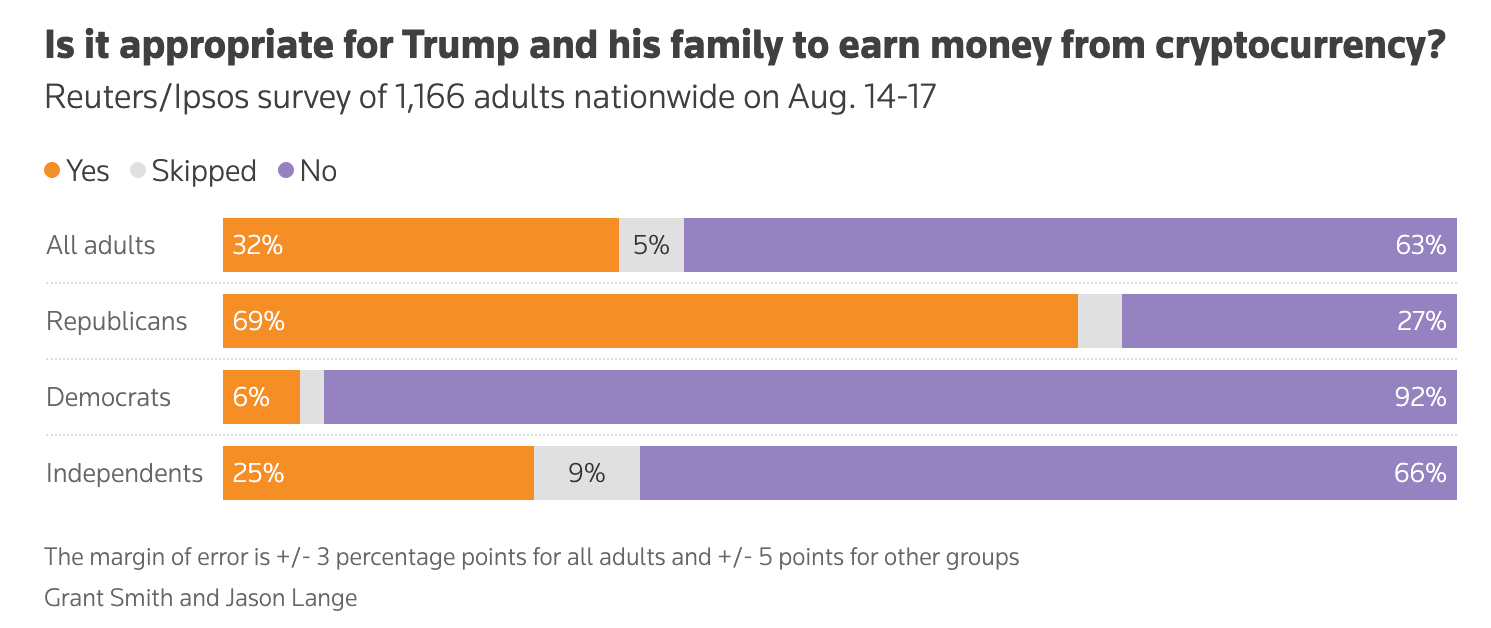
Most Americans view President Donald Trump’s crypto earnings as improper, according to a Reuters/Ipsos poll in which 63% of respondents called the profits his family drew from digital assets inappropriate.
The same survey found that 69% believe his private business interests shape his presidential decisions. Half of Republican respondents shared that view.
Poll Puts Trump’s $1.4 Billion Crypto Income Under Scrutiny
The online survey covered 1,166 US adults between August 14 and August 17. It carried a margin of error of 3 percentage points for all Americans and 5 points for each party group.
About 32% of respondents defended the family’s crypto earnings. Among Republicans, roughly 69% described it as appropriate, while 27% did not.
Advertisement
Americans’ View on Trump’s Crypto Profit. Source: Reuters
The sums involved are large. Trump reported more than $1.4 billion last year from family crypto ventures, according to his financial filings. Those ventures included World Liberty Financial (WLFI) and his self-branded meme coin.
Richard Painter, chief ethics lawyer under President George W. Bush, noted that the mix of business and office has no modern parallel.
“We have seen nothing like this before, even the first Trump administration did not have as many complex business interests as the second,” he said.
White House Rejects Conflict Claims as Midterms Near
White House has repeatedly dismissed the criticism, affirming that independent financial institutions manage the President’s investments and that no conflicts exist.
“There are no conflicts of interest…The President only acts in the best interests of the American public,” White House spokeswoman Anna Kelly said in a statement.
Congressional pressure has grown regardless. Senate Democrats requested committee hearings in July into the national security implications of the President’s crypto holdings.
Advertisement
Token performance complicates the political argument. Official Trump (TRUMP) trades near $1.7, down about 81% over the past year, and Trump-endorsed tokens sit below their pre-endorsement prices.
Official Trump (TRUMP) Price Performance. Source: BeInCrypto Markets
Public dissatisfaction stretches beyond his digital asset ventures. A separate Financial Times poll this month found 53% of registered voters said their finances had worsened under his presidency.
Democrats led Republicans 44% to 39% in that survey. Whether that translates into seats will be settled in November.
This Friday, we examine Ethereum, Ripple, Cardano, Binance Coin, and Hyperliquid in greater detail.
Ethereum (ETH)
In a major reversal, ETH has pumped 27% this week after sentiment turned positive, with Bitcoin leading and pulling most of the market higher. Ethereum shot up from $1,800 and did not stop until the resistance at $2,400.
This is an impressive price action that has reverberated across most altcoins. Now, the ETH price is at a key level. If $2,400 turns into support, and the price makes a higher high, this cryptocurrency will turn bullish for the first time in over a year!
Looking ahead, sellers risk losing control. Bulls are coming back in force, and they are inches away from starting a sustained uptrend. Watch $2,400 and $2,800 as key levels if the rally continues.
Advertisement
Source: TradingView
Ripple (XRP)
XRP painted a monster candle on the weekly chart after a 31% pump! This has completely reversed the losses since June in one week and opens the way for buyers to take over.
At the time of this post, this cryptocurrency is testing the $1.3 resistance. If this fails to hold, the ongoing rally, then XRP has a good shot at $1.6. Such a price would end the downtrend that dominated most of 2026.
Looking ahead, the last time XRP rallied so hard was in 2024, and back then, the price did a 5x in quick succession. While this appears unlikely here, this is an impressive start and could send this cryptocurrency much higher still.
Source: TradingView
Cardano (ADA)
Cardano also had a good week after closing 14% higher. This recent pump reconfirms the bullish trend that started in June and places ADA on a collision course with the resistance at $0.23.
Hopefully, this recent impulse from buyers is exactly what this cryptocurrency needs to break the resistance and return to an uptrend. Still, sellers could return at $0.23, making that a difficult ask.
Looking ahead, Cardano shows promise, and this price action could indicate that the drop under $0.15 may have been the bottom. If so, expect the price to grind higher from here until the end of the year.
Advertisement
Source: TradingView
Binance Coin (BNB)
Binance Coin closed the week 10% higher and is determined to test the resistance at $690. After the price found good support at $580, buyers took over and have not let go ever since.
The biggest challenge right now is to turn $690 into support. That would allow BNB to aim for $900 next and beyond. Nevertheless, sellers could show their face at the key resistance as they did in June when they pushed the price back down.
Looking ahead, the BNB chart is turning bullish with a clear rounded bottom around $550. To confirm this, the price has to make a higher high beyond $750 later on. That implies $690 won’t stop buyers.
Source: TradingView
Hype (HYPE)
Hyperliquid was a major winner this week after closing 30% higher. This impressive performance has taken the price back to the key resistance at $76, which is also the current all-time high.
At the time of this post, buyers appear to hesitate at the ATH and did not make a higher high, at least not yet. Some selling here is normal, and it will be interesting to see if HYPE can break higher or not.
Looking ahead, this most recent price action has placed HYPE in a wide range between the ATH of $76 and support around $50. The price could bounce between these levels a few more times before a decisive breakout.
A Hong Kong appeals court has upheld a 56-month prison term for Ma Zhihao after investigators linked ransom payments from a human trafficking operation to a crypto exchange account registered in his name.
Summary
Hong Kong’s Court of Appeal upheld Ma Zhihao’s 56-month prison sentence.
Police traced 8,127 USDT from a victim’s ransom to an exchange account registered to Ma.
The USDT was converted into about HK$63,000 and transferred to Ma’s HSBC account.
The trafficking network lured victims to Southeast Asia using fake high-paying job offers.
Caixin reported on Aug. 20 that the Hong Kong Court of Appeal rejected Ma’s request for a reduced sentence, leaving intact the punishment imposed over his role in a scheme that lured victims to Southeast Asia with fake job offers before some were confined and forced into scam operations.
Blockchain transaction records became a key part of the prosecution after Hong Kong police traced a ransom paid by the family of one victim. Investigators found that roughly 9,527 Tether (USDT) had been transferred to a cryptocurrency wallet specified by the criminals.
Advertisement
Police then tracked 8,127 USDT from the ransom to an exchange account opened using Ma’s real name and Hong Kong identity documents, according to Caixin. The funds were converted into roughly HK$63,000 and sent to Ma’s personal HSBC bank account.
The Court of Appeal said the transaction trail supported the finding that Ma had participated in the scheme and received proceeds from it. Judges also said his punishment would have been substantially heavier had the District Court not been restricted by its seven-year sentencing limit.
Blockchain records tied the ransom directly to Ma
The case involved five victims who were recruited between 2021 and August 2022 through false employment and business offers circulated on platforms including Facebook, Telegram and Instagram.
Recruiters advertised jobs at Cambodian casinos, assignments involving the purchase and transport of luxury handbags from Thailand, and work carrying expensive watches, according to case details reported by Hong Kong media. Some offers promised payments reaching tens of thousands of Hong Kong dollars.
Advertisement
Once a victim accepted an offer, members of the network helped arrange passports and airline tickets. After arriving in Southeast Asia, victims could instead have their phones and travel documents taken before being moved to compounds controlled by criminal groups.
One 20-year-old victim responded to a Telegram advertisement offering HK$20,000 for travelling to Thailand and buying luxury goods for resale in Hong Kong. After arriving in August 2022, he was transported to Myanmar’s KK Park, where criminals told him that he had been purchased and demanded $20,000 for his release.
His girlfriend eventually transferred more than 9,500 USDT, worth about HK$75,000 at the time, to secure his return. Investigators later followed most of that cryptocurrency through the blockchain to the exchange account associated with Ma.
Advertisement
The transparent transaction history gave police a record connecting the ransom wallet, the exchange account and the subsequent withdrawal into the traditional banking system.
Hong Kong police have since developed more specialized tools for such investigations. As previously covered by crypto.news, the Cyber Security and Technology Crime Bureau unveiled its CryptoTrace system in May 2025 after developing the platform with the University of Hong Kong.
CryptoTrace uses blockchain analytics and transaction visualization to help officers follow suspected illicit funds and identify connections between wallets. Police had already trained frontline officers on the system before its public unveiling, according to the earlier report.
Fake jobs sent victims into Southeast Asian scam compounds
Ma and his associates used several recruitment methods depending on the victim, with high pay serving as a recurring lure.
Advertisement
One man was offered work at a Cambodian casino for $300 per day with accommodation and airfare included. Another victim was persuaded to travel after receiving an offer connected to luxury goods, while a man with mild intellectual disabilities was drawn to Thailand through an online relationship and a promise involving a large cash payment.
Victims who reached the compounds faced different forms of coercion. Court proceedings described confiscated passports, threats, confinement and physical abuse, while some victims were forced to participate in online scams.
The man with an intellectual disability suffered particularly severe treatment after refusing to join fraud operations. Case details presented in Hong Kong court proceedings said he was handcuffed to a bed, subjected to electric shocks and later confined in a cage for several days. His family eventually paid HK$35,000 through Alipay before he was able to return to Hong Kong.
Another victim taken to Cambodia initially refused to conduct online scams, but Ma repeatedly pressured him and threatened the safety of the victim and his family, according to the agreed facts of the case. Cambodian authorities eventually rescued him after his mother contacted Hong Kong law enforcement.
Advertisement
Similar recruitment methods remain in use across Southeast Asian cybercrime compounds. On July 4, an investigation in India was opened after the family of a 24-year-old man said he had accepted a graphic design and data-entry job in Thailand before being taken to a scam compound near the Myanmar border.
Police in that case said the advertised job offered roughly 70,000 Indian rupees a month. After crossing into the compound, the man allegedly had his passport and travel documents confiscated and later told his family that captives were being forced to work long hours in online fraud operations.
Hong Kong human trafficking case followed years of recruitment scams
The Hong Kong prosecution emerged from a wave of cases reported from 2022 onward involving people recruited for supposed jobs in Thailand, Cambodia and other parts of Southeast Asia before being moved into guarded compounds.
Ma and another defendant, Cheung Man-wai, later admitted conspiracy to defraud in connection with the recruitment of five people.
Advertisement
During sentencing in November 2024, the District Court imposed a 56-month prison term on Ma for conspiracy to defraud after using seven years as the starting point before applying a reduction for his guilty plea. He also received a 28-month sentence after admitting a money-laundering charge, bringing his total imprisonment to 84 months, according to local court reporting.
Cheung, whose role was described as less central, received a 36-month prison sentence. The sentencing judge found that he nevertheless knew the operation involved human trafficking when he helped take one of the victims to the airport.
The District Court treated Ma as an important participant in a planned operation connected with an international criminal organization. All five victims eventually returned to Hong Kong after periods of confinement or coercion abroad.
Crypto payments have remained common in investigations involving Southeast Asian trafficking and scam networks. A February 2026 Chainalysis report found that crypto-linked trafficking payments increased 85% in 2025 across services tracked by the blockchain analytics firm, including labor recruiters associated with Southeast Asian scam compounds.
Advertisement
Chainalysis said tracked activity involved hundreds of millions of dollars across identified services, with stablecoins forming part of the payment infrastructure used by criminal networks and related laundering channels.
Authorities continue tracing crypto across scam networks
Law enforcement agencies have increasingly followed cryptocurrency transfers alongside bank accounts and other payment channels when investigating transnational fraud.
A July 2026 INTERPOL operation blocked illicit crypto transfers during a crackdown spanning 97 countries and territories. The operation resulted in 5,811 arrests, more than 31,000 blocked bank accounts and the interception of $293 million in illicit assets.
Thai investigators involved in the operation uncovered a laundering network suspected of processing romance-scam proceeds through cross-chain token swaps. One identified wallet had handled more than $122.5 million, according to INTERPOL data cited in the report.
Advertisement
Authorities identified more than 142,000 victims during the operation and used payment-blocking mechanisms to freeze suspicious fiat and cryptocurrency transfers before some funds could move further through laundering networks.
In Ma’s case, the blockchain trail led investigators from the USDT ransom payment to an exchange account carrying his identity information and then to the HK$63,000 transferred into his HSBC account, evidence the appeals court relied on when rejecting his request for a lighter sentence.
On 19 August, the US Treasury announced that it would double the volume of long-term government bond buybacks. The measure led to a noticeable decline in yields at the longer end of the curve and forms part of the Treasury’s broader efforts to contain pressure on long-term borrowing costs. These efforts include market interventions and calls for the Federal Reserve to expand the limits of the FIMA repo facility.
Lower Treasury yields improve the relative appeal of precious metals, which do not generate interest income, providing direct support for silver. Industrial demand is another important factor. Chinese imports of silver-containing ores rose 62.5% year-on-year in June amid expanding production of solar panels and power-grid equipment.
Technical Analysis of Silver
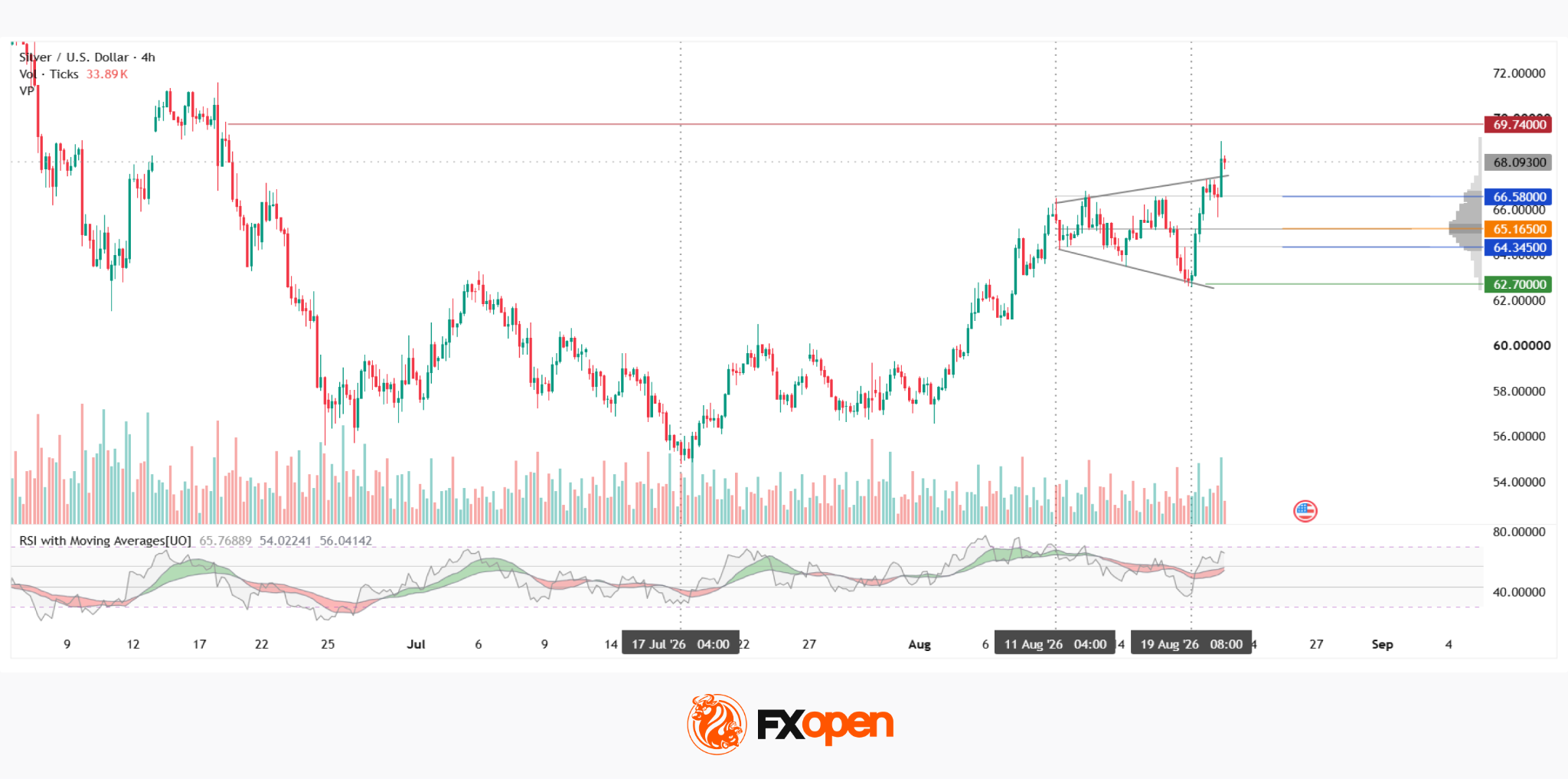
Since 17 July, XAG/USD has been moving within a pronounced uptrend on the four-hour chart. In the upper portion of this advance, a pattern resembling a broadening triangle emerged in mid-August. Unlike a conventional triangle, its boundaries widened rather than converged, reflecting increasing volatility during the consolidation phase.
On 20 August, the price broke above the formation and continued to hold above the current market profile. The breakout candle was accompanied by a noticeable increase in vertical volume compared with the preceding consolidation bars, adding some confirmation to the move.
Following the breakout, silver moved above the profile’s upper boundary at $66.58. If the bullish momentum persists, the next major upside reference is the red resistance level at $69.74.
Advertisement
A return inside the profile would shift attention to the cluster of two important levels: the Point of Control (POC) at $65.165 and the lower profile boundary at $64.345. Their proximity makes this area particularly important for the short-term outlook. If sellers push the price through this cluster, the next potential support could be found around the green level at $62.700.
The RSI + MAs indicator currently shows readings of 66, 56 and 56. The oscillator is trading above the neutral zone, while both moving averages remain below its upper boundary and are only beginning to approach a potential breakout.
Key Takeaways
The breakout above the broadening triangle on increased volume initially points towards further upside, but maintaining prices above the market profile will require additional confirmation.
The $66.58 level is therefore likely to remain important in the near term: holding above it would favour continuation towards $69.74, while a return below the profile could bring the 65.165–64.345 area back into focus.
Advertisement
The broader outlook will also remain sensitive to the direction of US Treasury yields. A continued decline in yields could provide further support for silver, while a renewed rise in long-term yields could limit the metal’s upside.
Start trading commodity CFDs with tight spreads (additional fees may apply). Open your trading account now or learn more about trading commodity CFDs with FXOpen.
This article represents the opinion of the Companies operating under the FXOpen brand only. It is not to be construed as an offer, solicitation, or recommendation with respect to products and services provided by the Companies operating under the FXOpen brand, nor is it to be considered financial advice.
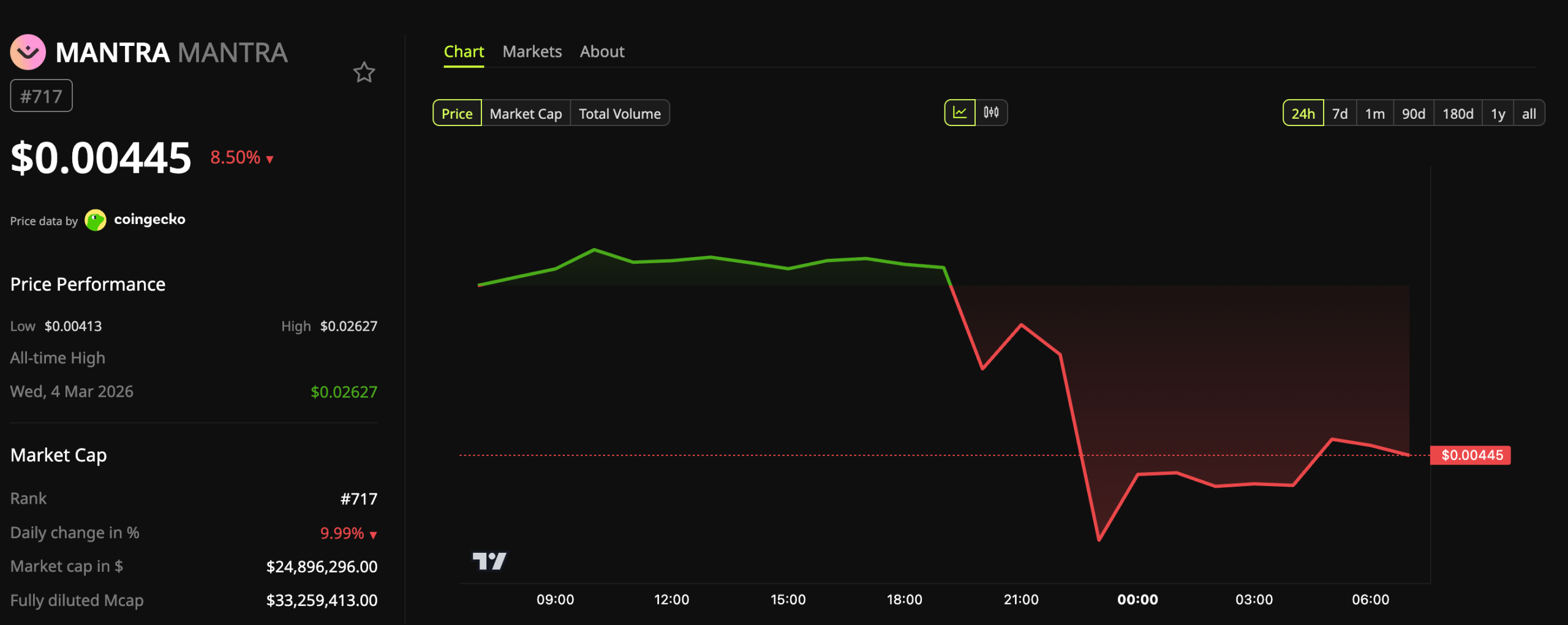
MANTRA (MANTRA) slid to an all-time low of $0.0041 as the project froze its blockchain and said an attacker was targeting a vulnerability in an upstream dependency.
The record low came as the rest of the market climbed, extending a rally that accelerated on Wednesday.
Why MANTRA Halted Its Chain
MANTRA Chain, a Layer 1 blockchain built for tokenizing real-world assets, was halted earlier today. Its initial notice said all endpoints and transactions were frozen.
We’re aware of an incident affecting MANTRA Chain and have halted the chain as a precaution while we investigate. All endpoints and transactions are currently frozen. This means deposits and withdrawals to/from MANTRA Chain are temporarily affected. If you’re unsure how this…
— MANTRA | The EVM L1 for RWAs (@MANTRA_Chain) August 21, 2026
A later update named the cause. The team pointed to an attacker exploiting a vulnerability in an upstream dependency, meaning third-party code the chain relies on rather than software it wrote itself.
“Earlier today, we detected an attacker exploiting a vulnerability in an upstream dependency used by the chain and halted the network as a precaution,” the update read.
MANTRA said it has identified the vulnerability and is now preparing a patch. Its validators and infrastructure remain offline until the upgrade is ready.
“Resuming the network will require a coordinated restart with the wider validator set — we will not resume until the patch is verified and that coordination is in place,” it added.
The team is also tracing where funds moved and has contacted exchange partners. Deposits and withdrawals remain paused at affected venues, and the total scope of the impact remains unconfirmed. The team also warned holders to ignore anyone offering recovery help.
Advertisement
MANTRA Misses a Market-Wide Rally
The incident has also impacted the token. MANTRA changed hands at $0.0044 at press time, down 8.5% on the day.
MANTRA Token Price Performance. Source: BeInCrypto Markets
That slide ran against the broader market. Bitcoin (BTC) topped $75,000 earlier today as short liquidations reached $1.06 billion. Other major cryptocurrencies also traded higher, lifting the total crypto market capitalization by nearly 4% over the past day.
The incident marks the network’s second major crisis in 16 months. Its token, then known as OM, lost nearly 90% of its value in April 2025, wiping out about $5.5 billion in market value in less than an hour.
The project retired the OM ticker this March. A non-dilutive 1:4 split at block 13,000,000 converted each OM into four MANTRA, and the token posted a 37% launch-day rally.
Bitcoin price extended its sharp recovery on Aug. 21, rising above $76,000 for the first time since late May as institutional inflows and improving U.S. liquidity conditions supported the breakout.
Summary
Bitcoin reclaimed $75,000 for the first time since late May after gaining roughly 18% rapidly.
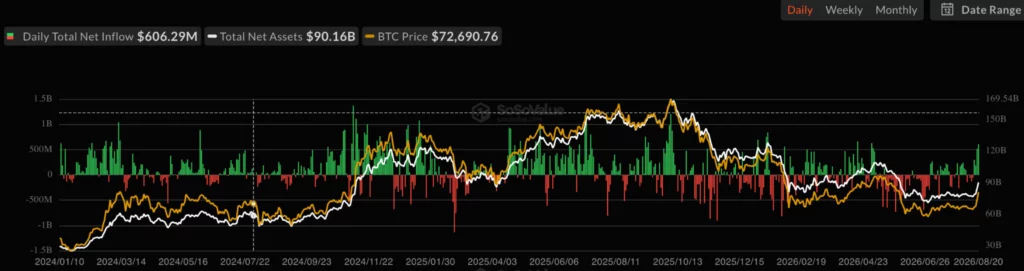
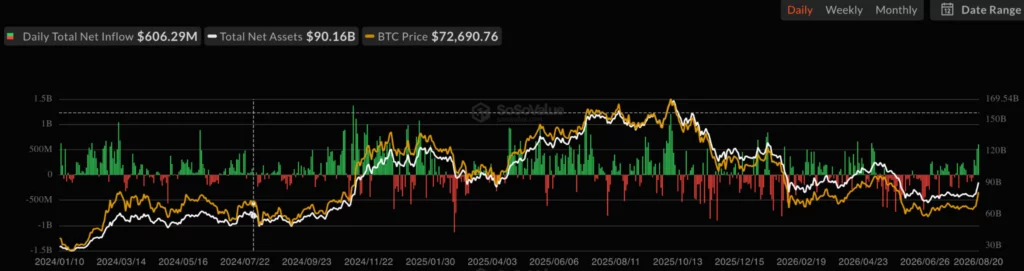
U.S. spot Bitcoin ETFs attracted $606 million on August 20, extending two consecutive inflow sessions.
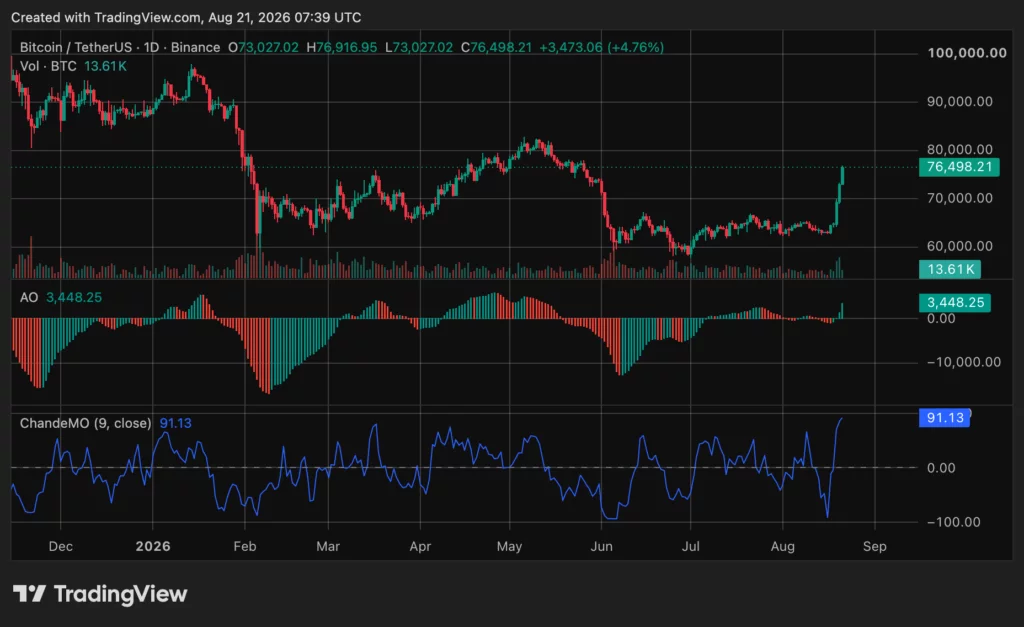
Bitcoin’s daily Awesome Oscillator turned positive while the Chande Momentum Oscillator reached an elevated 91.13.
Treasury will double long-dated debt buybacks to at least $4 billion per operation starting September.
The support zone between $70,000 and $72,000 now separates the breakout from deeper retracement risk.
BTC traded near $76,291, gaining almost 9% over 24 hours and approximately 19% during the previous seven days, according to crypto.news price data. The rally lifted BTC by more than $11,000 in roughly 48 hours.
The move began after BTC rebounded from the $62,000 to $63,000 region and broke through resistance around $65,000. It then cleared $70,000, paused near $72,000 and advanced through $75,000.
Advertisement
Bitcoin price ends weeks of sideways trading
The crypto had spent about six weeks trading inside a narrow range, with repeated attempts to move beyond $65,000 failing. The lack of direction encouraged traders to build bearish positions around the upper boundary.
Momentum changed on Wednesday when BTC climbed through several resistance levels within hours. Forced short covering accelerated the advance as traders bought BTC to close leveraged bearish positions.
As previously reported, almost $3 billion in positions were liquidated as BTC crossed $70,000. Shorts accounted for most of the liquidations, according to CoinGlass data cited by analysts.
Advertisement
The liquidations explain part of the rally’s speed but not necessarily its direction. Spot demand and U.S. exchange traded fund inflows also increased as BTC moved higher.
ETF inflows provide evidence of institutional demand
U.S. spot Bitcoin ETFs recorded approximately $606 million in net inflows on Aug. 20, according to SoSoValue data. The total followed about $517 million of inflows on Aug. 19.
Bitcoin spot ETF net inflow, source: SoSoValue
The two sessions produced more than $1.1 billion in combined net buying. The acceleration suggests institutional investors participated in the breakout rather than leaving the move entirely to derivatives traders covering short positions.
Spot Ether ETFs separately attracted about $221 million on Aug. 20. XRP funds added approximately $13 million, while Solana products received around $15 million.
In related coverage, analysts warned that continued ETF and spot demand will determine whether Bitcoin can establish lasting support above $70,000. Short covering provides temporary buying pressure because it ends once bearish positions have been closed.
Advertisement
The next ETF flow reports will therefore be closely watched. Continued inflows into next week would strengthen the case that institutions are adding exposure after the breakout. A rapid slowdown would leave the advance more dependent on momentum traders.
U.S. Treasury decision improves the liquidity backdrop
The U.S. Treasury Department announced on Aug. 19 that it will at least double the maximum size of liquidity support buybacks for longer dated government securities.
The maximum size will increase from $2 billion to at least $4 billion per operation. The change takes effect on Sept. 9 and will remain in place through Nov. 4, according to the department’s official announcement.
Long term Treasury yields declined after the decision, while the U.S. dollar weakened. Lower bond yields can make volatile assets more attractive because investors receive less income from government securities.
Advertisement
The buybacks should not be described as direct stimulus for Bitcoin. The Treasury said the program is intended to improve liquidity in longer dated bond markets. It does not create central bank money or directly purchase cryptocurrency.
U.S. political developments added to market sentiment. President Donald Trump urged Congress to pass a “fair version” of the Digital Asset Market Clarity Act during an Aug. 19 White House event involving crypto executives and federal regulators.
Trump also discussed the possibility of expanding U.S. Bitcoin holdings. However, the administration has not announced a purchase, funding mechanism or implementation timeline. Any acquisition therefore remains uncertain.
Bitcoin price faces an overheated momentum reading
The daily BTC/USDT chart shows Bitcoin trading well above its former $60,000 to $66,000 consolidation range. Volume near 13,610 BTC was higher than several recent sessions, supporting the breakout.
Advertisement
The Awesome Oscillator stood near 3,448 and moved firmly into positive territory. The reading indicates that short term momentum has strengthened compared with the recent sideways period.
Bitcoin (BTC) price chart, source: crypto.news
The Chande Momentum Oscillator reached approximately 91.13. A reading that elevated signals strong buying pressure, but it also suggests that Bitcoin may be temporarily overheated after its rapid advance.
The earlier breakout placed the $65,000 to $67,000 area in focus as a deeper retest zone. The more immediate support area has since moved toward $70,000 to $72,000.
Holding above that range would preserve the current bullish structure. The next major resistance sits around $80,000 to $82,000, where Bitcoin previously faced selling pressure.
A weekly close above $75,000 would provide stronger confirmation than an intraday move. Failure to hold $70,000 could expose BTC to a larger retracement after an 18% advance in two days.
Advertisement
Disclosure: This article does not represent investment advice. The content and materials featured on this page are for educational purposes only.
It was just days ago when we were speculating whether Ripple’s cross-border token would decisively lose the $1.00 support and how low it could go. Analysts outlined the first targets, ranging from $0.90 down to $0.60.
The situation changed, though, in a very impressive manner. Bitcoin skyrocketed and took the entire market with it. Interestingly, XRP took the main stage yesterday, and it rocketed to $1.30 for the first time in months, after gaining 30% from that low. Here’s what analysts are saying now.
Who Is Driving The Run?
The most obvious answer comes from whales. As reported yesterday, this highly vital part of every token’s ecosystem went on a tear, accumulating more than 300 million tokens in 96 hours, leading to a massive price explosion to $1.30. Before that, they had scooped up another 72 million coins at the end of last week in just a day.
Data shared by Vincent Van Code on X confirms this narrative. The market observer outlined “what is REALLY going on” within the XRP ecosystem, indicating that 53% of all sizeable buy orders were from LARGE players, followed by 35% from medium traders, and small investors accounted for just 12%.
Advertisement
As such, Van Code concluded that “retail is not the driving force of this rally. This is great news.”
Another great XRP graphic to show you what is REALLY going on.
Take a look at the Larege order buys, 53% of all transactions were LARGE, medium 35%, and small only 12%.
This tells us retail is not the driving force of this rally.
The spot XRP ETFs were also in the green for three consecutive days, but the actual inflows are still quite modest compared to what they were in November and December last year. As such, they are probably not the main driver of this recovery.
What’s Next for XRP?
The mind-blowing 30% rally in days has given analysts the confidence to make some major predictions. Crypto Patel outlined a scenario in which he envisions XRP skyrocketing to $10 and noted that it doesn’t sound crazy.
Back in 2017, when the token stood at $0.006, people believed reaching $3 was impossible. Yet, it did it a year later. In 2023, he noted that the majority was against XRP again, calling it dead. Then it posted a massive surge from $0.50 to $2.60 in a month or so. As such, he concluded that the $1.00 dip served as an accumulation zone and “$10-$20 is absolutely on the table.”
Advertisement
Mikybull Crypto predicted that “XRP is about to pull a god candle after this Ichimoku cloud retest,” while CW said the asset has broken through a major resistance level after ending the long downtrend. They noted that the token has begun a “full-fledged uptrend.”
Ripple CEO Brad Garlinghouse is using his company’s own legal bill as evidence that Washington’s approach to digital assets has a direct, measurable cost. Garlinghouse has said Ripple spent roughly $150 million fighting the SEC over more than four years
On the same occasion, Garlinghouse also noted that a majority of the company’s hiring during that stretch happened outside the United States. It’s as proof that regulatory ambiguity pushes capital and jobs offshore, not just headlines into court dockets.
RIPPLE CEO: "The status quo is not good enough." Brad Garlinghouse says Ripple spent MILLIONS fighting the SEC over four years, while 80% of its hiring happened outside the U.S. as a result. He says America needs clear crypto rules to protect users and keep innovation at home… https://t.co/BaNrlR5RZNpic.twitter.com/HwLONKul9y
The SEC sued Ripple, Garlinghouse, and co-founder Chris Larsen in December 2020, alleging the company raised funds through unregistered securities sales of XRP. The case dragged through multiple rulings before both sides filed a joint stipulation dismissing their appeals in August 2025, per the SEC’s own litigation release, leaving a $125,035,150 civil penalty and a registration-related injunction in place.
Advertisement
That outcome distinguished between institutional sales and secondary-market trading of XRP rather than declaring the token categorically exempt from securities law. It’s a nuance that matters when Ripple invokes the case as a template for how crypto assets should be regulated going forward.
Xrp (XRP)
24h7d30d1yAll time
Garlinghouse has previously called the resolution a long overdue surrender by the SEC, arguing the agency pursued the case to intimidate the industry rather than to police fraud.
Selig Declares an End to Regulation by Enforcement
Advertisement
The renewed attention to Ripple’s legal costs surfaced around an August 19 White House innovation meeting that brought crypto executives together with regulators to discuss digital-asset policy and the stalled CLARITY Act. CFTC Chair Michael Selig used the appearance to draw a hard line under the prior enforcement posture.
Selig said, adding that innovators were now being welcomed to the White House instead of being “railroaded to the big house.” He also said additional regulatory roadmap details would follow at the CFTC’s inaugural Innovation Advisory Committee meeting on August 20, whose published agenda covers digital assets, tokenized collateral and emerging financial products.
BREAKING: CFTC Chairman Selig says he “remains hopeful” Congress will get CLARITY to President Trump’s desk and lock in durable crypto rules. “Passing CLARITY is the surest way that we can prevent another Gary Gensler from running a rogue campaign of lawfare.” If the bill… pic.twitter.com/DuyYptBdLe
Garlinghouse, who attended alongside SEC Chair Paul Atkins and executives from Coinbase, Kraken, Gemini, Robinhood, Nasdaq and Intercontinental Exchange, posted his own read on the meeting afterward.
Garlinghouse said, citing a figure of 67 million Americans, or close to one in four people, are now holding crypto. That’s the political backdrop against which he’s positioning Ripple’s litigation history: not as a closed chapter, but as a cautionary case study lawmakers should point to when arguing for a formal SEC regulatory pathway for crypto issuers.
Beyond Ripple and SEC: Why the CLARITY Act Is the Real Stakes
The practical argument underneath Garlinghouse’s comments is that the CLARITY Act would replace the case-by-case litigation model that consumed Ripple legal budget with a defined split of jurisdiction between the SEC and CFTC. That’s the same logic driving industry proposals for a token safe harbor that would let projects raise funds and build networks without facing an enforcement action years into their operating history.
Whether that framework moves through Congress this session remains an open question, and Ripple’s own post-litigation position, including its financial standing after the SEC dispute, will likely stay a reference point in that debate regardless of the outcome.
Selig’s comments suggest the CFTC intends to move on rulemaking with or without a finished statute, but a durable division of authority between regulators still requires legislative action rather than agency posture alone.
Advertisement
For traders, the immediate takeaway isn’t a new legal threat to XRP – the SEC’s case against Ripple is closed, with the penalty and injunction from the district court’s judgment standing as final. The relevant signal is political: a sitting CFTC chair publicly renouncing enforcement-led regulation, with Ripple’s leadership in the room, tightens the odds that market-structure legislation gets prioritized before the next election cycle rather than shelved again.
















 SEC over four years, while 80% of its hiring happened outside the U.S. as a result.









 Fashion7 days ago
 Tech7 days ago
 Sports6 days ago

 Politics6 days ago
 Tech3 days ago
 Business3 days ago
 Crypto World6 days ago
 Crypto World3 days ago
 Tech6 days ago



 Fashion7 days ago
 News Videos1 day ago
 Fashion7 days ago
 Business6 days ago
 Fashion7 days ago
 Business6 days ago
 Crypto World3 days ago
You must be logged in to post a comment Login