

Crypto World
Ripple Price Analysis: XRP Reaches Decision Point After Weeks of Consolidation

Ripple’s XRP has continued trading within a broader bearish market structure despite the recent stabilization around the $1.3 key support zone. While short-term volatility has declined in recent weeks, the asset is now approaching a decisive technical region where the next major directional move could soon emerge.
Ripple Price Analysis: The Daily Chart
On the daily timeframe, XRP is currently facing a strong confluence of resistance levels around the $1.4-$1.45 region. This area includes the 100-day moving average, positioned near $1.4 and aligned with the upper boundary of the long-term descending channel. Such a technical confluence significantly strengthens the importance of this resistance zone and increases the probability of a bearish rejection due to growing seller presence.
The recent recovery attempts have so far lacked sufficient bullish momentum, and failure to reclaim this region could trigger another pullback toward lower support levels around the $1.3 and $1.2 areas. From a broader perspective, only a valid bullish breakout above the descending blue channel on higher timeframes would invalidate the ongoing bearish structure and potentially initiate a sustained bullish rally toward higher resistance zones.

XRP/USDT 4-Hour Chart
On the 4-hour chart, XRP has entered a prolonged consolidation phase, forming a symmetrical triangle pattern. This structure reflects a temporary equilibrium between buyers and sellers, with neither side currently holding a decisive advantage. Typically, such formations lead to strong directional moves once a breakout eventually occurs.
The price has now reached the narrowest section of the triangle around the $1.4-$1.45 range, suggesting that a breakout scenario could unfold in the near term. A bullish breakout above the upper trendline may open the path toward higher resistance regions, while a bearish breakdown below the lower boundary would likely accelerate downside pressure and continue the broader bearish trend.

The post Ripple Price Analysis: XRP Reaches Decision Point After Weeks of Consolidation appeared first on CryptoPotato.


TLDR:
- Bitcoin now sits on institutional balance sheets, signalling a structural shift beyond retail-driven speculation.
- BlackRock, ETFs, and stablecoins mark Wall Street’s deep and deliberate move into the crypto ecosystem.
- Rate cuts, dollar weakness, and fiscal expansion are creating a macro backdrop that favours crypto assets.
- Analysts warn the opportunity window is closing fast as liquidity expands and smart money repositions early.
Crypto institutional adoption is quietly reshaping the financial landscape as liquidity returns and market volatility compresses.
While retail investors remain cautious following the last cycle, smart money is positioning for what analysts describe as one of the decade’s most significant asymmetric opportunities.
The market is transitioning from pure speculation toward infrastructure-driven growth. Stablecoins, tokenisation, ETFs, and AI-crypto integration are at the centre of this structural evolution, pointing to a fundamentally different market than what existed in 2021.
From Speculation to Infrastructure
Bitcoin now sits on institutional balance sheets, a development that would have seemed implausible a few years ago. Ethereum is increasingly described as a financial layer for the internet, with traditional finance giants actively building rails into the crypto ecosystem.
As Crypto Crib noted, “Bitcoin is now sitting on institutional balance sheets. Ethereum is becoming the financial layer of the internet.” This signals a clear shift in how major financial players perceive digital assets.
BlackRock’s entry, the launch of spot ETFs, and the rapid expansion of stablecoins have all contributed to a maturing market structure.
Governments globally are racing to establish regulatory frameworks, while Wall Street continues developing crypto-native products at pace. These are not retail-driven developments — they reflect deliberate institutional strategy.
The focus has moved firmly toward tokenised real-world assets, institutional custody solutions, and global payment rails.
Sovereign demand and pension fund exposure are emerging as themes alongside traditional capital allocation. This changes the risk-reward profile for the asset class in a meaningful way.
Analysts continue pointing toward regulatory clarity, ETF growth, and institutional adoption as major themes heading into the next phase of the cycle.
These are structural tailwinds, not temporary sentiment swings. The foundation being built today is different in character from prior cycles.
Macro Conditions Supporting the Next Phase
The macro backdrop is shifting in ways that historically benefit risk assets, particularly crypto. Rate cuts are increasingly back on the table, dollar weakness is becoming a growing discussion, and fiscal expansion continues accelerating across major economies.
Crypto Crib’s analysis observed that “macro analysts are increasingly highlighting central bank credibility, dollar stability, liquidity conditions and AI-driven speculation as defining themes for crypto markets.”
Bitcoin’s behaviour is changing alongside these macro dynamics. Rather than acting purely as a speculative risk asset, it is increasingly functioning as a global liquidity barometer.
When global liquidity expands, risk assets move first — and Bitcoin appears to be responding to those conditions more consistently than before.
Governments face mounting debt refinancing pressure, which maintains the conditions for continued monetary expansion.
This persistent liquidity backdrop supports the case for assets that sit outside traditional financial systems. Crypto, particularly Bitcoin and Ethereum, benefits from this dynamic structurally.
The opportunity window, however, does not remain open indefinitely. Markets do not wait for maximum certainty.
As the analysis noted, the biggest returns in prior cycles — 2013, 2017, 2020 — were made during periods of disbelief and hesitation, well before mainstream headlines turned euphoric.
If liquidity continues expanding into 2026, the current positioning window may prove shorter than most expect.

TLDR:
- Paris prosecutors opened a judicial probe into X platform over data handling and security claims in France
- Investigation follows skipped voluntary interview by Elon Musk and Linda Yaccarino in April
- Pavel Durov accused French authorities of mirroring privacy violations in platform regulation case
- Charges include data extraction, security failures, and electronic communication secrecy breaches
Paris prosecutors have opened a judicial investigation into the X platform and its leadership over multiple data-related allegations. The case involves Elon Musk and Linda Yaccarino after they skipped a voluntary interview in April.
Authorities cite suspected violations including unlawful data processing, weak security practices, and breaches of electronic communication secrecy. Reactions followed quickly online as Pavel Durov and others framed the probe as a broader clash over platform control.
X Platform Investigation: France Expands Over Data And Security Charges
French prosecutors confirmed a judicial investigation after a May 6 referral initiated proceedings against the X platform.
The Paris Public Prosecutor’s Office confirmed the initiation following formal reports submitted to investigators. The move places X Corp and related entities under formal judicial scrutiny in France.
Authorities listed several charges involving personal data collection, security failures, and extraction from automated systems. The filing also references violations of electronic communication secrecy and alleged fraudulent data system access in organized groups.
These allegations form part of a wider examination of platform data governance practices across automated systems and user data flows.
The case also references violations of electronic communication secrecy and alleged fraudulent data system access in organized groups.
Authorities also cited manipulated or AI-generated content involving sensitive sexual material allegations. The case also covers alleged distribution of synthetic or algorithmically generated sensitive content under AI-assisted moderation systems.
Investigators reportedly seek formal questioning of X Corp, X AI entities, Elon Musk, and Linda Yaccarino. Failure to appear could lead to formal indictments or potential arrest warrants under French procedure.
Judges will assess whether sufficient grounds exist to proceed with formal indictment over platform compliance obligations.
Pavel Durov and Experts React to French Allegations
Pavel Durov responded publicly, accusing French authorities of mirroring the same privacy practices they criticize. He argued the accusations mirror practices attributed to state-level surveillance systems.
Durov’s remarks circulated widely across social media platforms following the announcement. His comments referenced claims of illegal data collection, message access, and automated system exploitation.
He specifically referenced electronic message secrecy and automated data access concerns. He linked the situation to broader debates around encryption and digital privacy.
Accounts supporting X described the case as political pressure on free speech platforms and digital services. The reaction framed the case as broader pressure on decentralized communication platforms.
Observers noted rising tensions between governments and large social media operators.
The discussion intensified after reports highlighted X platform charges and potential legal enforcement actions in France. The reports followed procedural escalation after Musk and Yaccarino skipped earlier questioning.
Legal timelines may extend as investigators evaluate responses from the parties involved.

Crypto sentiment monitoring firm Santiment is flagging a notable shift in the mood around Bitcoin and the broader market. In a Saturday briefing, the analytics team noted that bullish commentary on social channels has surged, creating a ratio of bullish to bearish crypto-related comments of about 1.5 to 1 across a broad sample of active accounts. Santiment cautions that such “confident crowd” rallies can fade, while moves built on skepticism may last longer.
Bitcoin’s price action in this context adds a layer of complexity: the cryptocurrency has climbed about 11.5% over the last 30 days, with trading near $80,628 according to CoinMarketCap data at the time of writing. The juxtaposition of rising prices and mixed sentiment underscores the market’s fragility as traders weigh when to push higher or pull back.
Key takeaways
- Santiment’s bull-to-bear comment ratio sits around 1.5:1, implying crowd confidence that may fade rather than sustain a continuation of gains.
- Bitcoin has gained roughly 11.5% over the past 30 days, trading near $80,628.
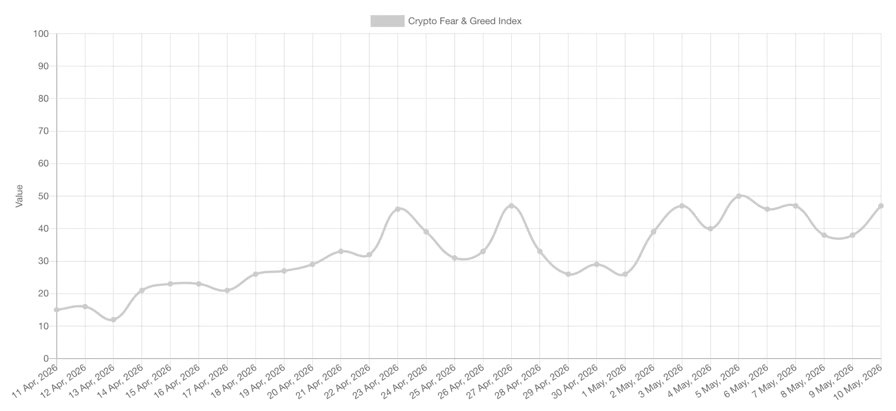
- The Crypto Fear & Greed Index stood at a neutral 47 on Sunday after dipping into Fear territory earlier in the week (38 on Friday).
- On-chain signals show Bitcoin supply on exchanges rising over the last five days after a longer period of decline, suggesting some profit-taking could be at play.
- Analysts are divided: some expect a retracement to $70k–$75k before continuing higher, while others forecast fresh highs toward the $87k–$95k range by June.
Sentiment, price action and the “wall of worry” dynamic
Santiment’s analysis centers on the psychology of crowd behavior in crypto markets. The firm highlighted the classic tension between rallies driven by a confident crowd and those that climb a “wall of worry,” where skepticism persists. In practice, that dynamic can shape how long a move lasts and how durable the momentum proves to be. As Santiment summarized in its weekly note, “Rallies that arrive with a confident crowd tend to fade faster than those climbing a wall of worry. Those climbing skepticism tend to extend.”
The current data show Bitcoin pushing higher in recent weeks, but the broader sentiment signals caution. Bitcoin’s price of around $80,628—the level cited by CoinMarketCap at the time of capture—reflects a market that has traded through a period of volatility, with sentiment oscillating between guarded optimism and cautious restraint.
In this environment, traders are paying close attention to broader sentiment gauges, such as the Crypto Fear & Greed Index. The index settled at a neutral 47 on Sunday after a dip into Fear (38) on Friday, underscoring a market that remains undecided about the next directional move. A neutral reading can tempt both buyers and sellers to test the market, which can lead to choppier price action in the near term.
Santiment described Bitcoin’s immediate path as delicate: the “best-case” scenario for Bitcoin, in their view, would be a shallow pullback to around $75,000 that could flush out late longs, reset sentiment, and lay a healthier foundation for the next leg higher. This kind of consolidation can be healthy if it reduces overheating and builds a base for a more durable breakout—though it also risks chalking up more time in range-bound trading if buyers remain hesitant.
On-chain signals: exchange supply and profit-taking risks
Beyond sentiment, on-chain intelligence offers a more granular read of market activity. Santiment noted a recent uptick in Bitcoin supply on crypto exchanges after a period of decline. The upshift in available supply could reflect holders taking profits at current price levels, or reallocating into other assets, rather than a wholesale shift out of risk assets. In either case, the move to increase exchange balances could temper near-term upside unless buyers step in to absorb the additional supply.
Analysts have offered differing interpretations of how this dynamic will unfold. Some view the rise in exchange supply as a potential short-term pressure that could curb upside unless demand proves resilient. Others see it as a normal countertrend during a renewed rally, where profit-taking and new entries can coexist as participants test the market’s appetite for higher prices.
Forecasts and views from market observers
Not all pundits see a straight-line ascent ahead. Market observer Michael van de Poppe said he would not be surprised to see a retest of the $70,000–$75,000 zone before Bitcoin resumes its upward trajectory. A deeper pullback at that level could flush out late longs and restore balance to speculative positions, potentially setting the stage for a healthier rally if buyers re-enter at those discounted levels.
Meanwhile, crypto analyst Matthew Hyland offered a more bullish timeline, suggesting Bitcoin could reach roughly $87,000 to $95,000 before June. Such a move would imply robust buying interest despite the short-term volatility implied by sentiment indicators and on-chain signals. As always in crypto, the path between here and those targets is not guaranteed, and the trajectory will hinge on how demand behaves in the face of competing signals.
These divergent viewpoints reflect a market that is stretched between the allure of new highs and a degree of caution spelled out by sentiment data and on-chain behavior. The balance of power—between traders who want to chase momentum and those who want to defend against a possible pullback—will continue to define Bitcoin’s near-term course.
For readers tracking market moves, the takeaway is that sentiment alone is not a predictor of immediate direction. The interplay between social chatter, price action, and on-chain behavior—especially exchange supply dynamics—will shape how the next few weeks unfold. With Bitcoin hovering near key psychological levels and traders weighing the risk-reward of adding exposure, the market could swing between patterns of breakout enthusiasm and consolidation that tests those new positions.
What to watch next: the on-chain footprint and whether exchange reserves continue to rise or recede, new confirmations around price support near $75,000, and any macro developments that could tip the balance between bulls and bears. As always, traders should stay nimble, prepared for both sharp upside moves and the potential for temporary retracements as sentiment evolves.
TLDR:
- Ethereum moves toward AI agents replacing static interfaces with modular autonomous blockchain coordination systems
- ZK privacy payments enable secure verification without exposing user data across decentralized AI-driven networks
- Identity frameworks shift to selective disclosure using zero-knowledge proofs for privacy-preserving reputation systems
- Agentic economies may redefine governance and L2 design through AI execution and cryptographic validation models
Ethereum is moving toward an AI agent-driven structure where autonomous systems interact across blockchain layers.
Vitalik Buterin termed this shift a transition from static interfaces to modular agent coordination. Whereby computation and execution are merged into unified decentralized primitives for scalable interaction.
AI Agent Shift Reshapes Ethereum Architecture
AI agents will reduce dependency on single user interfaces by combining multiple blockchain functions simultaneously.
As a result, Ethereum operates as a coordination layer for distributed execution. This structure supports parallel workflows, enabling agents to process transactions, verify data, and interact with smart contracts across ecosystems efficiently.
In addition, latency requirements are evolving within this AI-centered blockchain environment. Fast communication is required for agent-to-agent interactions, while heavier computations may run asynchronously.
Therefore, Ethereum balances real-time execution with deeper analytical processing across decentralized networks. Meanwhile, the traditional operating system metaphor is becoming less relevant as AI tools replace fixed interfaces.
Instead, Ethereum evolves into a modular execution environment. This allows agents to dynamically assemble tools and services across decentralized applications without rigid structural constraints.
ZK Privacy Payments and Decentralized Identity Frameworks
Zero-knowledge technology systems verify transactions without exposing underlying user data. Consequently, AI agents can operate securely while maintaining confidentiality across decentralized financial environments.
This also reduces reliance on centralized data storage and improves trust minimization across blockchain networks and autonomous systems operating at scale.
Additionally, digital identity is being restructured into selective disclosure systems using zero-knowledge proofs. Users can verify only required attributes without exposing full personal histories.
This approach supports reputation building while preserving privacy across decentralized applications and AI-driven interactions. Furthermore, agents may rely on minimal identity proofs during cross-chain transactions to maintain efficiency and security.
Moreover, agentic economies introduce new complexities in governance and public goods funding mechanisms. AI systems combined with cryptographic verification may enable transparent yet privacy-preserving coordination.
This ensures decentralized participation without exposing sensitive decision-making data across networks. Layer two solutions may evolve the Ethereum AI future framework to support secure interactions between agents and users.
This enables seamless value transfer across decentralized applications while preserving confidentiality. As AI adoption expands, Ethereum infrastructure continues adapting to support interoperable and secure economic systems across global networks at scale, efficiently secured.
Crypto World
Strategy CEO Phong Le Reveals the Only Conditions Under Which the Company Will Sell Bitcoin
TLDR:
-
- Strategy will only sell Bitcoin to fund its 11.5% STRC preferred stock dividend or for tax optimization purposes.
- CEO Phong Le says any Bitcoin sale must be accretive, meaning it must grow the Bitcoin per Share metric.
- Strategy holds 818,334 BTC worth over $66 billion, making it the largest public Bitcoin treasury firm.
- Daily Bitcoin trading volume of $60 billion can easily absorb Strategy’s $1 billion annual dividend obligations.
- Strategy will only sell Bitcoin to fund its 11.5% STRC preferred stock dividend or for tax optimization purposes.
Strategy CEO Phong Le has confirmed the company will only sell Bitcoin under very specific financial conditions. Speaking to CNBC, Le said sales would occur to fund the 11.5% dividend on its STRC preferred stock or for tax optimization purposes.
He stressed that any Bitcoin sale must be “accretive” to common shareholders. This comes after Executive Chairman Michael Saylor’s remarks about potential Bitcoin sales stirred speculation across crypto markets.
Le Outlines a Math-Driven Approach to Bitcoin Sales
Strategy’s CEO made clear the company’s decision-making is numbers-based, not sentiment-driven. Le stated, “I believe in math over ideology,” signaling that financial logic guides every move. The company will weigh selling Bitcoin against issuing new stock before making any decision.
The key metric driving this calculation is “Bitcoin per Share.” Strategy only sells Bitcoin when doing so grows that figure for common shareholders. This approach protects shareholder value while keeping the company’s treasury strategy intact.
Le confirmed two specific triggers for a Bitcoin sale: paying the STRC dividend and deferring or offsetting taxes. Outside of these scenarios, the company has no plans to liquidate its holdings. These are narrow, clearly defined conditions.
This disciplined framework stands in contrast to how the broader market interpreted Saylor’s earlier comments. Le’s clarification added needed context to the conversation around Strategy’s Bitcoin treasury management.
Saylor’s Comments and Their Effect on Market Sentiment
Michael Saylor had told investors during an earnings call that the company might sell some Bitcoin periodically. He described the move as a way to “inoculate the market” and demonstrate that such sales are manageable. His words, however, triggered concern among Bitcoin investors about potential selling pressure.
Saylor also said that if Bitcoin appreciates by more than 2.3% annually, Strategy can fund its dividends without selling stock at all.
That would remove the need to dilute common shareholders through new equity issuances. It positions Bitcoin appreciation as the preferred dividend-funding mechanism.
Strategy currently holds 818,334 BTC, worth over $66 billion at current prices. That makes it the largest publicly traded Bitcoin treasury company, according to BitcoinTreasuries data. Any sales from a holder of this size naturally attract attention from the wider market.
Le addressed these concerns directly by pointing to daily Bitcoin trading volumes of around $60 billion. The over $1 billion in annual dividends Strategy owes is small relative to that figure. He argued the market can absorb any sales without notable price movement.
TLDR:
- LayerZero admitted its internal RPC was attacked by the Lazarus Group, exposing a critical security gap.
- Three protocols managing a combined $2B in TVL have confirmed migrations to Chainlink CCIP after the exploit.
- A 1/1 DVN misconfiguration created a single point of failure that left LayerZero vulnerable to attack.
- Major assets like Ethena’s USDe, Etherfi’s weETH, and Bitgo’s WBTC still rely on LayerZero’s OFT standard.
Multiple blockchain protocols are shifting away from LayerZero following a confirmed exploit and a public apology from the team.
Analyst Tom Wan reports that protocols with a combined total value locked (TVL) of approximately $2 billion have announced migrations to Chainlink CCIP.
KelpDAO leads the move with $1.5 billion, followed by SolvProtocol at $600 million and re at $200 million. The shift raises questions about LayerZero’s ability to retain clients.
Major Protocols Move Combined $2B TVL to Chainlink CCIP
The migration comes after LayerZero acknowledged serious security failures in a public statement. The team admitted that an internal RPC node was compromised by North Korea’s Lazarus Group.
More critically, LayerZero confessed to a 1/1 DVN misconfiguration that left the protocol with a single point of failure.
Tom Wan, a well-followed on-chain analyst, flagged the departures on X. He wrote that despite the apology, KelpDAO, SolvProtocol, and re had already announced moves to Chainlink CCIP. His post noted the combined TVL at risk and questioned whether an apology could stop further client losses.
The decision by these three protocols reflects growing concern over cross-chain infrastructure reliability. When a misconfiguration at that level is exposed, trust becomes difficult to rebuild quickly. Protocols managing billions in user funds are understandably cautious after such a disclosure.
LayerZero’s OFT Standard Still Holds Key Assets for Now
Despite the exits, several major token issuers continue to rely on LayerZero’s OFT standard. Ethena’s USDe and sUSDe, Etherfi’s weETH, Tether’s USDT0, Theo’s thBILL, and Bitgo’s WBTC remain on the protocol. These assets represent a substantial portion of cross-chain activity tied to LayerZero.
The retention of these names offers LayerZero some stability in the short term. However, their continued presence does not cancel out the reputational damage caused by the exploit. Any further incidents could accelerate additional departures from the protocol.
Chainlink CCIP, meanwhile, positions itself as a more secure alternative following this episode. The growing list of migrations adds to its credibility as an enterprise-grade cross-chain solution.
Whether this momentum continues will depend largely on LayerZero’s next steps in rebuilding confidence across the industry.
TLDR:
- MSTR shows a 1.53 power-law elasticity to Bitcoin across 71 monthly closes with strong statistical fit
- A 100% BTC move translates to nearly 2.89x MSTR upside under the nonlinear model structure
- Volatility gap is wide, with BTC at 60% and MSTR at 91% over the observed period
- Risk-adjusted returns favor BTC slightly despite MSTR’s higher absolute CAGR performance
A data-driven model shared on social platform X outlines a structural link between MSTR Bitcoin performance and BTC price action. The analysis suggests MicroStrategy’s stock follows a power-law relationship rather than simple leverage.
Since Michael Saylor’s initial Bitcoin accumulation phase, the model estimates a scaling factor of 1.53. The findings position MSTR as a high-beta proxy with amplified upside and deeper downside versus Bitcoin.
MSTR Bitcoin Power Law Model Shows 1.53 Elasticity
The model indicates MSTR does not track Bitcoin linearly, but through a nonlinear elasticity curve. Analyst David describes the relationship as a power-law structure driven by long-term accumulation cycles.
The regression framework is expressed as log(MSTR) = a + 1.53 · log(BTC), based on 71 monthly closes. The dataset reports an R² of 0.91, suggesting strong explanatory power across cycles.
Under this structure, proportional moves in Bitcoin translate into amplified equity reactions in MSTR. A 100% BTC increase implies roughly a 2.89x move in MSTR using the elasticity term 2^1.53.
Downside asymmetry is also embedded in the same model. A 50% BTC decline maps to approximately 0.35x MSTR performance, reflecting a 65% drawdown magnitude.
The structure highlights how volatility compounds through the equity layer rather than remaining proportional to underlying Bitcoin moves.
Risk-Adjusted Returns and Volatility in MSTR Bitcoin Exposure
Performance data shows BTC with a compound annual growth rate of 40.5%, while MSTR records 55.9%. The spread reflects amplified exposure to Bitcoin’s long-term trend.
Volatility diverges significantly between the two assets. BTC registers around 60%, while MSTR reaches 91% based on historical measurements.
Drawdown comparisons also show deeper stress cycles for the equity proxy. Bitcoin’s maximum drawdown stands near -73%, while MSTR extends to roughly -83%.
Risk-adjusted returns narrow the gap between the two. BTC posts a Sharpe ratio of 0.56 compared to 0.49 for MSTR, reflecting higher return per unit of volatility for Bitcoin.
The dataset suggests MSTR behaves as an amplified derivative of Bitcoin exposure rather than a direct substitute.
Crypto bullish chatter on social media has surged to levels that, according to crypto sentiment platform Santiment, could signal the current market uptrend may be short-lived.
“Rallies that arrive with a confident crowd tend to fade faster than those climbing a “wall of worry,” Santiment said in a report published on Saturday. “Those climbing skepticism tend to extend,” Santiment added.
Santiment said the ratio of bullish to bearish crypto-related comments on social media is currently around 1.5 to 1, based on a sample of active crypto accounts tracked across multiple platforms. It comes as Bitcoin (BTC) has increased 11.50% over the past 30 days, trading at $80,628 at the time of publication, according to CoinMarketCap.
A confident market tends to see rallies fade fast
Market participants often watch overall crypto sentiment to gauge whether it may be a good time to buy or sell, or to look for clues about where the market could be headed in the coming weeks.
The Crypto Fear & Greed Index, which tracks overall crypto market sentiment, posted a “Neutral” score of 47 on Sunday after slipping back into “Fear” territory on Thursday, signaling investors are cautious about the crypto market.

The Crypto Fear & Greed Index fell to a “Fear” score of 38 on Friday. Source: alternative.me
Santiment said the best scenario for Bitcoin right now is not to break out further. “The team’s ideal setup is a pullback to $75k that flushes late longs, resets sentiment, and builds a healthier base,” Santiment said.
Bitcoin supply on exchanges rises
Meanwhile, Santiment pointed to a recent increase in Bitcoin supply on crypto exchanges, potentially signaling that holders are viewing current price levels as an opportunity to take profits.
Related: Strike CEO Jack Mallers dismisses idea that Wall Street threatens Bitcoin
“On-chain activity is broadly quiet, but Bitcoin supply on exchanges has ticked up over the past five days after an extended decline. The reversal could indicate early profit-taking,” Santiment said. Analysts are divided on whether it will fall into that price range or continue higher.
MN Trading Capital founder Michael van de Poppe said he “wouldn’t be surprised that we retest lower at $70-75K before we continue to run.”
Crypto analyst Matthew Hyland said that Bitcoin is “likely” to reach between $87,000 and $95,000 before June.
Magazine: XRP ‘probably going to $12,’ Bitcoin ETFs add $1B: Market Moves
TLDR:
- Three major ETH inflows hit Binance between May 6–9, totaling over 439,000 ETH worth roughly $1 billion.
- Each large inflow event occurred during a price correction, pointing to reactive selling rather than planned exits.
- Binance ETH reserves climbed to 3.62 million ETH, accounting for 24.6% of all exchange-held Ethereum.
- Rising reserves and repeated inflow spikes continue to suppress upward momentum, keeping ETH range-bound for weeks.
Ethereum exchange inflows have spiked sharply in early May 2025, drawing attention from on-chain analysts. ETH has remained range-bound between $2,250 and $2,450 for several weeks.
During this period, large transfers to Binance have coincided with price corrections. Analysts are now watching whether these movements reflect broader holder uncertainty or short-term repositioning among larger market participants.
Large ETH Transfers Hit Binance During Price Corrections
On-chain data shows three major Ethereum inflow events on Binance within days of each other. On May 6, approximately 216,152 ETH worth around $511 million moved onto the exchange.
Then on May 8, another 98,552 ETH valued at roughly $224 million followed. Shortly after, on May 9, a third wave of 125,146 ETH worth approximately $288 million was recorded.
Analyst Darkfost noted on X that these transfers rank among the largest inflow events observed since March. Each movement occurred while Ethereum’s price entered a corrective phase.
Some corrections were shallow, while others carried more weight. Still, the timing pattern remained consistent across all three events.
What stands out is that these transfers did not happen during price rallies. Instead, they arrived as ETH pulled back. This behavior points toward reactive selling rather than planned profit-taking by investors.
Such activity suggests that some holders are responding to short-term price pressure. Rather than holding through dips, they appear to be moving assets to exchanges during uncertain moments. This adds selling pressure to an already range-bound market.
Rising Binance ETH Reserves Point to Ongoing Holder Uncertainty
Alongside the inflow spikes, total ETH reserves on Binance have continued to climb. As of the latest data, reserves have reached 3.62 million ETH on the platform. That figure now represents roughly 24.6% of all ETH held across centralized exchanges.
A rising exchange reserve generally means more ETH is available for sale. When reserves grow over time, it often reflects holders moving assets closer to liquid positions. This does not always lead to selling, but it does raise the likelihood of near-term supply pressure.
Darkfost pointed out that this trend may help explain why Ethereum has stayed stuck in its current consolidation range.
With consistent inflows arriving at each price dip, buy-side momentum struggles to build. The balance between buyers and sellers remains fragile.
For now, ETH continues to trade sideways without a clear breakout in either direction. The combination of rising reserves and reactive inflows creates resistance to upward movement. Traders and analysts will likely monitor Binance reserve levels closely in the coming days.
Bitcoin’s price rebounded impressively from the dip to $79,000 on Friday and, although the volatility has remained mostly muted, it managed to climb gradually to $81,000 yesterday.
Most altcoins have turned red on a daily scale after the Saturday gains, but ETH, XRP, and BNB managed to remain above their key respective support levels.
BTC Tapped $81K
The business week began with substantial price volatility for the primary cryptocurrency, which rose past $80,000 on Monday for the first time since late January before it dumped to $78,400 after some reports that Iran had hit a US Navy vessel. However, the attacks were refuted by the US, and BTC quickly reclaimed the $80,000 level.
Moreover, the bulls stepped on the gas pedal in the following couple of days and pushed the asset to a new three-month peak at almost $83,000. After gaining $8,000 in a week or so, bitcoin was due for a correction and slipped to $79,000 on Friday.
Nevertheless, it bounced after that dip and reclaimed $80,000 yesterday after US President Donald Trump announced a three-day ceasefire between Ukraine and Russia. It even reached $81,000 briefly, but couldn’t stay there and now remains inches below that level.
Its market cap remains above $1.610 trillion on CG, while its dominance over the alts is north of 58%.

Alts Retrace
Most altcoins registered impressive gains yesterday, including some double-digit price pumps from mid-cap alts. Now, though, red dominates most charts. ICP and WLFI have dumped the most by 9%, followed by a 7.5% decline from ONDO. ZEC, XLM, LINK, HYPE, DOGE, and ADA are also well in the red.
SOL, BCH, and ETH are with minor gains, while UNI has added 3.5% and now sits above $3.85. Pi Network’s PI token was stopped once again at $0.18 for the second time in the past few weeks. It has now slipped to $0.175 after a 5% weekly decline.
The total crypto market cap has remained close to $2.8 trillion on CG.

The post Pi Network’s PI Token Slips Again as Bitcoin (BTC) Taps $81K: Weekend Watch appeared first on CryptoPotato.

Jeong Sang-bin’s goal lifts St. Louis City past Rapids

Fintech startup Parker files for bankruptcy
Sally Field reveals role she always turns down: 'Didn't like it then, and it doesn't appeal to me now'

Manchester United reach agreement with Casemiro over contract clause amid transfer speculation

US brings back mandatory military draft registration

Steven Gerrard disagrees with Gary Neville over ‘shock’ Chelsea and Arsenal claim | Football


-
 Crypto World2 days ago
HarrisX Poll Found 52% of Registered Voters Support the CLARITY Act
-

 NewsBeat7 days ago
Channel 5 – All Creatures Great and Small series 7 new post
-

 Crypto World3 days ago
Upbit adds B3 Korean won pair as Base token gains Korea access
-

 Tech5 days ago
Image AI models now drive app growth, beating chatbot upgrades
-

 Fashion2 days ago
Weekend Open Thread: Marianne Dress
-
 NewsBeat3 days ago
NCP car park operator enters administration putting 340 UK sites at risk of closure
-
 Business19 hours ago
Ignore market noise, India’s long-term story intact, say D-Street bulls Ramesh Damani and Sunil Singhania
-

 Business7 days ago
Winning Numbers Drawn as Jackpot Resets to $20 Million
-

 Politics1 day ago
Politics Home Article | Starmer Enters The Danger Zone
-

 Entertainment6 days ago
Olivia Wilde Reacts To Viral ‘Corpse’ Comparison
-

 Crypto World6 days ago
BlackRock Buys $284M In Bitcoin On May 1 As The Best Crypto To Invest In For 2026 Sits Below A Pending Binance Listing
-

 Sports6 days ago
Inter Milan Win Serie A Title After Victory Over Parma
-
 Sports7 days ago
IPL 2026: Gujarat Titans opt to bowl vs Punjab Kings; Nishant Sindhu handed debut | Cricket News
-

 Crypto World5 days ago
UAE Free Zone Deploys Blockchain IDs to Verify Registered Firms
-

 Sports7 days ago
Kofi Kingston and Xavier Woods reportedly released by WWE along with others
-
Entertainment6 days ago
Jennifer Lawrence’s Mary Jane Sneakers Are Spring’s It-Girl Shoe
-
 Sports6 days ago
Every word of Arne Slot’s heated rant after Manchester United win vs Liverpool
-

 Politics7 days ago
The Devil Wears Prada 2 Cast: How Do Their Premiere Looks Compare To The Original?
-

 Business7 days ago
Can LeBron James Lead LA Past OKC Without Injured Luka Doncic?
-

 Sports6 days ago
Joel Embiid urges Sixers fans not to sell playoff tickets to Knicks fans
You must be logged in to post a comment Login