The Dolphin Centre, on Horsemarket, said that it would need to carry out disinfection and water treatment to three of the pools, including the main one, the diving pool, and the toddler pool.
During the closure, swimming lessons will continue in the training pool, which hasn’t been impacted by this incident.
Advertisement
The venue said that it hoped to reopen all of the pools by Tuesday (May 12), but that people should check all of the details about reopening on its website.
In a statement online, the Dolphin Centre said: “Due to a faecal incident, the main pool, diving pool and toddler pool are closed to allow for mandatory cleaning, disinfection and water treatment procedures.
“The training pool is unaffected and remains open for swimming lessons.
“We apologise for the inconvenience and appreciate your understanding.
Advertisement
“All pools will reopen on Tuesday. Please visit the website to confirm the time of reopening.”
Wilting in the summer sun, a line of tourists waits to climb Notre Dame cathedral and meet its gargoyles.
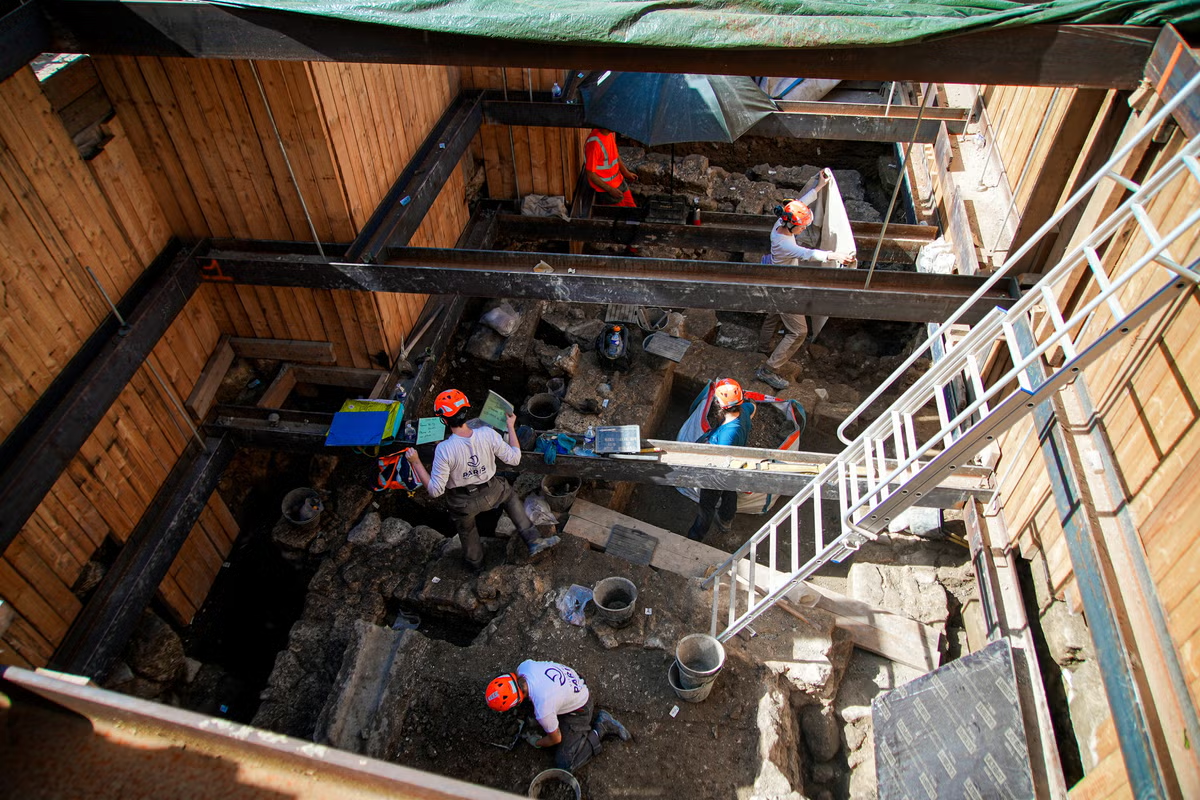
Four meters (13 feet) beneath them, a team of archaeologists is digging the other way — straight down and back in time, to RomanParis 2,000 years ago.
In 2019, fire brought Notre Dame’s spire crashing down as the world watched. The cathedral was rebuilt and reopened in late 2024, and now Paris wants to soften the hot, bare square in front of it with trees and shade.
But in a city this old, the soil cannot be turned until what lies beneath it is excavated, in case it is damaged during works.
Advertisement
So a slice of Notre Dame’s forecourt has become an excavation site — an open pit ringed by barriers and crossed by a wooden walkway, a few steps from the line-up.
A modern Da Vinci Code
French media have dubbed it the “dig of the century.”
“It’s a rare opportunity for us to work on something that’s tangibly going to make a difference to the history of Paris,” Lucie Altenburg, a conservator with the Paris archaeology unit, told The Associated Press.
Advertisement
Among the hundreds of objects already found: a 4th-century coin stamped with the face of the Emperor Constantine, and shards of medieval pottery painted on the inside with marks no expert has yet deciphered — like a modern Da Vinci Code.
“It makes Notre Dame feel alive again,” said Emily Carter, 34, a tourist from Manchester waiting in line with her two children. “You come to see the cathedral, then realize there’s another city under your feet. That’s almost more moving.”
The first traces appear 50 centimeters (20 inches) down; 4 meters (13 feet) lower, the team is still pulling up the past. Some days they fill 15 crates — from ground that has lain untouched for decades.
Ancient cities have archaeologists monitoring digs
Advertisement
This is the bargain in every old city: the past is not in a museum down the street — it is under the street.
Cities rise. Each age builds on the rubble of the last, and the ground climbs with it; in Rome, it has risen about 9 meters (30 feet) since the empire fell in the 5th century AD.
When Athens built its metro for the 2004 Olympics, it set off the largest excavation in Greek history and turned up tens of thousands of objects, now shown in the stations themselves. Paris is no different.
It all comes from the island in the Seine, the Ile de la Cite, where Paris began.
Advertisement
Centuries later, Notre Dame rose on the same ground.
At the cathedral’s birth in 1163, the entire square was packed with medieval houses, split by a single street, said Camille Colonna, the archaeologist leading the dig.
Digging down, her team has reached their cellars — and therefore also the time in history they represent.
Below them lie Merovingian and Carolingian grain pits, from the sixth to the tenth centuries; below those, darker and deeper still, a dense Roman quarter from the fourth and fifth centuries.
Advertisement
Twenty centuries are stacked in 4 meters of earth — or about the height of two-and-a-half Napoleon Bonapartes standing on top of one another.
“Here you can see the layers — medieval Paris, Roman Paris, maybe even before that,” said Yasmine Benali, 22, an archaeology student watching from behind the barriers. “It makes the city feel less like a postcard and more like something still being discovered.”
Coins, ceramics and mysterious markings
The richest finds here come from the foulest place: the deep pits beneath the medieval houses, old latrines that doubled as rubbish dumps.
Advertisement
Out of them the team keeps lifting whole jugs and cups — thrown away centuries ago, yet still intact — among the broken plates and animal bones.
It’s “rare to find complete ceramics,” said Valentine Breloux, an archaeologist with the unit.
Here the soft waste cushioned them, and centuries later they miraculously came up whole.
Then some other objects came that confounded experts. As conservators cleaned what looked like ordinary medieval pottery, they found faint reddish writing painted on the inside — the same mysterious markings on shard after shard.
Advertisement
What they mean has yet to be deciphered.
Of everything she has cleaned from Notre Dame, Breloux said, these are the most “astonishing.”
Coins can help date the layers
The coins came up as black discs, eaten by rust. But under an X-ray, a face returned: it was Constantine, the Roman emperor who ruled in the early 300s AD.
Advertisement
Such objects also “can be invaluable in giving us the date of the (underground) layer,” Altenburg said.
The Roman finds are the ones the archaeologists value most — the deepest, oldest, and least understood. In Roman times, the town was called Lutetia, and its center lay across the river, on the Left Bank.
As the Roman empire collapsed, people pulled back to the Ile de la Cite, where Notre Dame would later rise, and fortified the island with walls of stone taken from earlier buildings.
Colonna’s team found some proof: a Roman doorstep found in the dig, taken from a much bigger building, carried over, turned upside down, and laid in a road as paving.
Advertisement
Paris houses thousands of finds in an archaeology center
Every find leaves the pit and travels north, to the city’s archaeology center — what Colonna calls “a huge archaeological store,” a treasure house of Paris.
For archaeologists, the cathedral dig is a rare treat. In France, like elsewhere, they work only where building work is about to begin — a bit like how industrial quarry workers end up unearthing dinosaur remains.
“This only happens because the city of Paris decided it wanted to beautify the area,” Altenburg said.
Advertisement
The new square should be mostly finished by 2028: a kind of woodland clearing, with 160 new trees and a thin film of water sliding over the stone to cool it in summer — part of how Paris is bracing for ever hotter summers induced by global warming.
The tourists who now wait in the bare sun beneath the gargoyles will, in a few summers, line up in the shade.
The old underground parking lot will reopen as a visitor center looking onto the Seine.
Until then, the Notre Dame team wants to go deeper still — past the Romans, toward whoever came before them, the Gauls who gave the city its first name.
Advertisement
“The hope is that we are able to go back in time even further than we’ve ever been before,” Altenburg said.
Young people in Wales eat takeaways, ready meals and at cafés and restaurants more than any other age group, according to research released today. Of those asked by Public Health Wales, 26% aged between 16 and 29 ate takeaway on two or more days in the last week, compared to 18% of 30 to 49-year-olds, 8% of 50 to 69 year-olds, and 2% of those aged 70 years and over.
Convenience meals can be higher in fat, sugar and salt which can increase the risk of overweight and obesity, which in turn is linked to poorer health outcomes, including heart disease, some cancers and type 2 diabetes.
The experts behind the research say it highlights how unhealthy food environments may be driving poorer diet and increased obesity risk.
Advertisement
Additionally, the survey found that more than half of respondents 57% eat lunch away from home at least sometimes and of these, 60% buy it on the go.
Among young adults who eat lunch away from home, 77% buy it on the go – the highest of any age group to do this.
Differences in portion size behaviours were also reported across the whole sample as nearly a quarter of respondents (24%) said they serve themselves a large portion while over half (53%) said they rarely leave food on their plate, even when they feel full.
Young adults reported serving a large portion the most (35%). This is compared to 32% of 30 to 49-year-olds, 21% of 50 to 69-year-olds, and 12% of those aged 70 years and over.
Advertisement
Overall, the survey found variation in eating behaviours across the population. Young adults, males, people living in the most deprived areas, and people who perceive themselves to be a heavier weight were more likely to report eating behaviours associated with a higher likelihood of living with overweight and obesity, the report found. For our free daily briefing on the biggest issues facing the nation sign up to the Wales Matters newsletter here.
Consultant in public health for Public Health Wales, Dr Ilona Johnson, said: “Overweight and obesity affect over 60% of adults in Wales and young adulthood is when people are most likely to gain weight. What we eat and how much we eat affects our weight.
“This work has found that young adults and those living in more deprived communities face the greatest challenges when it comes to making healthier food choices and the food environments around them are making that harder, not easier to be healthy.
“We know that people want to make better food choices but feel that their environment is working against them. We need to make it easier for people to make healthy choices by providing healthier options.”
Advertisement
Principal public health researcher at Public Health Wales, Dr Catherine Sharp, said: “This research provides robust, Wales‑specific evidence on how food environments and their interactions with our behaviours shape eating patterns across the nation. Understanding how this works in the real world is critical for developing effective policy.
“This research shows where behaviours linked to increased obesity and overweight risk are most prevalent and provides important evidence to support targeted interventions to improve health in Wales.”
The Walking Dead star is leading the cast of Tip Toe, Russell T Davies’ new five-part thriller, which aired last night (May 31) and also features Gabriel Clark from Harwood, best known for playing Ollie Morgan in the Channel 4 soap Hollyoaks, stars as Mickey and Dominic Holmes from Great Lever plays Regime, who is a teacher by day and drag queen by night
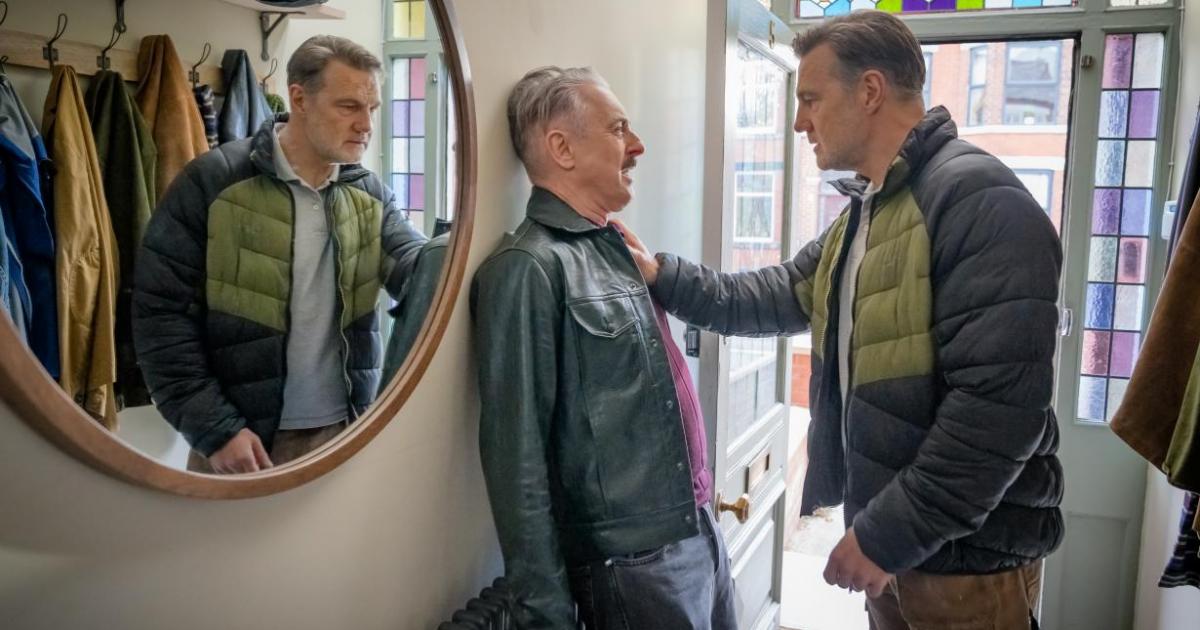
The series follows two neighbours whose relationship deteriorates as increasingly radicalised views drive them apart.
For Morrissey, the drama’s central message is one of empathy and connection in an increasingly polarised world.
“What we can’t have is a binary world of ‘us and them’,” he said.
Advertisement
“There is no ‘us and them’. There’s just us.”
The Liverpool-born actor, known for roles in State Of Play and The Walking Dead, described his character Clive as a man carrying “a lot of darkness inside him”.
He said: “But really, it’s about all of us recognising those moments in ourselves and asking: what are the consequences of my actions, and also my inaction?
“We’re living in a world that’s so polarised and divided, so the question becomes how do we reach out to each other?”
Advertisement
Tip Toe stars Morrissey as Clive and Alan Cumming as Leo, neighbours who have lived side by side in Manchester for almost 15 years before becoming bitter enemies.
Despite Clive’s prejudices and flaws, Morrissey believes the character is ultimately someone in need of community rather than isolation.
“He needs openness, dialogue, neighbours, connection,” he said.
“I don’t have to agree with everybody all the time.
Advertisement
“What I do have to do is respect them, have empathy for them, and want that for others too.”
Davies, whose previous work includes Queer as Folk and It’s A Sin, said the series was inspired by growing concerns about division in society and the role social media plays in fuelling it.
Russell T Davies (Image: Ian West/PA Wire)
He said: “I do think it’s absolutely the fault of this online world, completely.
“Every survey, every crime report, every fact seems to suggest we’re in trouble.”
Advertisement
However, the writer stressed that Tip Toe is not about creating heroes and villains.
“Take Clive: I understand why people read him as hateful, but he’s so much more than that,” Davies said.
“He’s lonely, excluded, angry, scared and also curious.”
Scottish actor Cumming said the story resonated with his own experiences as a gay man.
Advertisement
“I live in a very privileged, liberal queer bubble,” he said.
“But sticking your head above the parapet means that I feel the hatred, or certainly I see it on my phone.”
The actor added that younger members of the LGBTQ+ community have spoken about feeling increasingly anxious in public, even in places traditionally viewed as welcoming and progressive.
“She desperately wanted children but has challenges”
Dear Coleen
I’m a man in my early 40s, divorced with two children, and have been dating my girlfriend for 18 months. She’s 34 and we met online, but the relationship isn’t making me happy any more and I don’t know what to do about it.
Advertisement
I’m the sort of person who likes being in a relationship and I find it hard to end things, even when the situation is toxic. My current girlfriend is perfect in lots of ways – fun, independent and smart – but she wants nothing to do with my kids.
She desperately wanted her own children, but has fertility challenges and the stress of trying for a baby broke up her last relationship.
You’d think she’d be happy that I have kids and would want to get to know them, but she seems to actively dislike them. She never wants to spend time with them, so I don’t see her when they’re with me.
When it’s just the two of us, it’s great, but my kids aren’t going anywhere, so I don’t see how this relationship can work long term. Whenever I try to talk to her about it, she gets defensive and annoyed. What do I do?
Advertisement
Coleen says
I think you know what to do. If she can’t accept your kids, it’s never going to work. I’m not sure that she hates your children – it sounds as if she doesn’t know them very well – but she might feel some jealousy around your relationship with them.
The situation may well trigger sadness because it’s a reminder that she doesn’t have her own children and how badly she still wants to be a mum.
But these are her issues to work through and maybe she’s not ready to be in this type of relationship if she’s carrying lots of unresolved feelings about. So, you need to make it clear that your children are your priority and unless she can get on board, then the relationship has no future.
As much as you like her, even love her, what you feel for her will never compare to the love you have for your kids.
Advertisement
Trust me, they grow up so fast and, before you know it, they’ll be moving out to live their lives independently. Don’t compromise the time you have with them.
If it comes to ending the relationship, there’s no easy way to do it, but you have to think about yourself and definitely about your kids.
Right now, your girlfriend doesn’t seem willing to try.
Get more Daily Record exclusives by signing up for free to Google’s preferred sources. Click HERE.
WASHINGTON (AP) — A Pentagon policy illegally banned transgender troops from military service, a divided panel of federal appeal court judges ruled on Monday in another legal setback for President Donald Trump’s sweeping agenda.
The majority opinion — by a three-judge panel from the U.S. Court of Appeals for the District of Columbia circuit — held that the Trump administration’s policy was designed to exclude people from the military based on their gender identity.
The ban remains in effect. The U.S. Supreme Court allowed the Pentagon to start enforcing it last year, as litigation continues to plays out.
The panel’s new ruling would keep the military from kicking out current service members named in the lawsuit, but wouldn’t allow new transgender recruits to join. The judges put their decision on hold, though, to let the administration seek further review.
Advertisement
The appeals court panel’s 2-1 decision partially upholds a March 2025 ruling by U.S. District Judge Ana Reyes in Washington, D.C. Reyes concluded that Trump’s executive order to exclude transgender troops from military service likely violates their constitutional rights.
The administration appealed after Reyes issued a preliminary injunction requested by attorneys for several transgender people who are active-duty service members and others seeking to join the military. The appeals court’s majority decided that the injunction should be narrowed to the plaintiffs currently serving in the military but not those trying to enlist.
Another lawsuit challenging the ban was filed in Washington state and led to a ruling in favor of the plaintiffs challenging the policy in that case, though it’s been blocked by the Supreme Court.
In January 2025, Trump signed an executive order that claims the sexual identity of transgender service members “conflicts with a soldier’s commitment to an honorable, truthful, and disciplined lifestyle, even in one’s personal life” and is harmful to military readiness.
Advertisement
In response to the order, Defense Secretary Pete Hegseth issued a policy that presumptively disqualifies people with gender dysphoria from military service. Gender dysphoria is the distress that a person feels because their assigned gender and gender identity don’t match. The medical condition has been linked to depression and suicidal thoughts.
The policy “appears to be driven by the bare desire to harm a politically unpopular group: persons who identify as transgender,” Judge Robert Wilkins wrote for the majority. Wilkins was nominated to the court by Democratic President Barack Obama.
Jennifer Levi, senior director of transgender and queer rights at GLAD Law, applauded the ruling.
“Today’s decision is a powerful vindication of the plaintiffs’ extraordinary courage and unwavering commitment to their country,” Levi said.
Advertisement
The Pentagon did not immediately respond to a request for comment. Defense Secretary Pete Hegseth indicated that an appeal was forthcoming in a social media post that used an abbreviation for the Supreme Court: “See you at SCOTUS.”
In a dissenting opinion, Judge Justin Walker said judges lack the power to second-guess the decision to exclude transgender troops.
“We have neither the expertise nor the authority to decide whether the military can exclude the plaintiffs from its ranks. The Constitution assigns that authority to Congress and the Commander in Chief,” wrote Walker, who was nominated by Trump, a Republican.
Judge Judith Rogers, who was nominated by Democratic President Bill Clinton, joined Wilkins’ majority opinion but also partially dissented. Rogers wrote that she would also have allowed new transgender recruits named in the lawsuit to join.
Advertisement
___
Associated Press writer Konstantin Toropin contributed to this report.
Five dead as Russia launches massive overnight attack on Ukraine
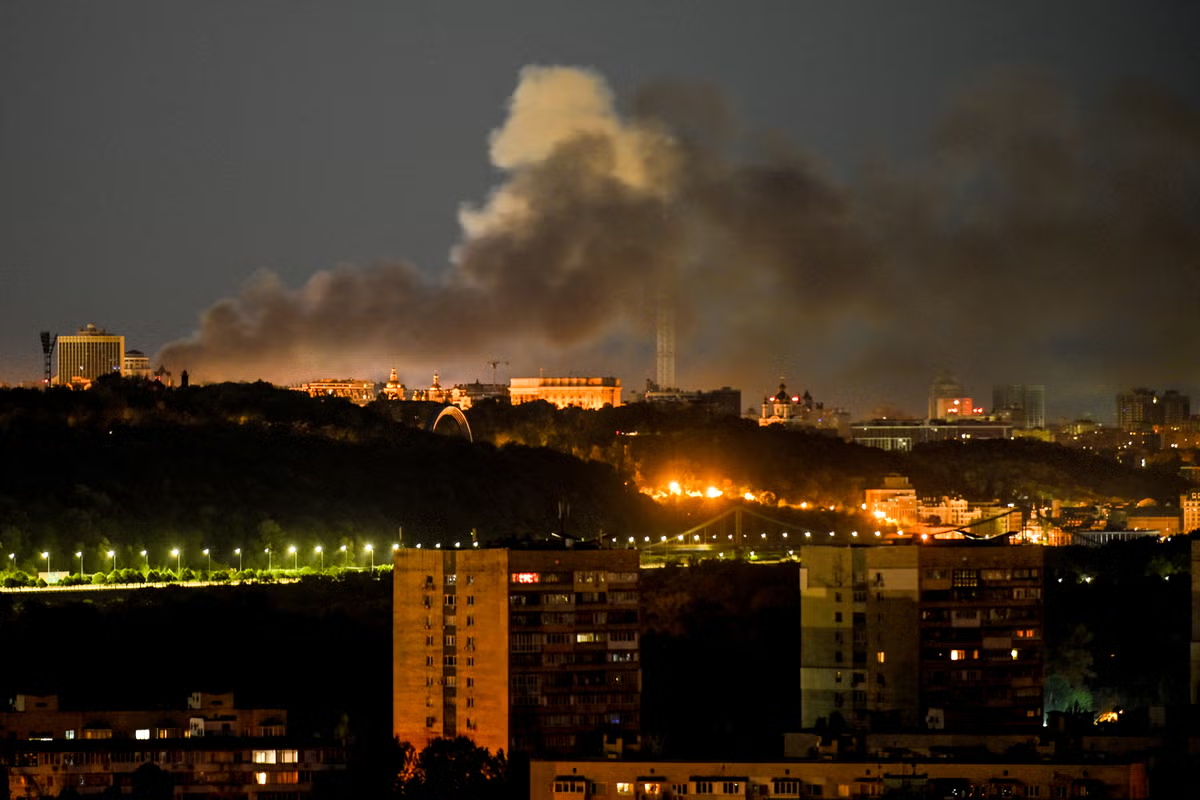
At least five people were killed and dozens were wounded in the early hours today after Russian forces attacked major Ukrainian cities including Kyiv, Dnipro and Kharkiv, officials said.
Most casualties are being reported from Dnipro where regional governor Oleksandr Hanzha said four people were killed and 16 were injured in a brutal attack on a residential area and a children’s playground.
All those injured were hospitalised and reported to be in moderate condition, he said. The official shared photos of heavily damaged residential buildings, burnt-out vehicles and a destroyed playground for children.
In Kyiv, at least one person was killed and 29 others were injured in attacks across the capital, said Tymur Tkachenko, the head of the capital’s military administration.
Advertisement
Kyiv mayor Vitali Klitschko said a suspected missile strike on a 24-storey apartment building triggered a collapse, with people likely trapped under the rubble.
Other buildings, including a nine-storey apartment block, caught fire from suspected missile debris, he said.
“In the Obolon district, cars are burning after being struck by falling missile debris. There are also fires at two locations in open areas, including one near a kindergarten,” Klitschko said.
As of this morning, thousands of residents of Kyiv were taking refuge inside metro stations and other shelters, witnesses said, after air raid warnings that covered much of the country.
Advertisement
Russian missile and drone barrages rocked parts of Ukraine overnight (AFP/Getty)
Arpan Rai2 June 2026 03:56
Ukrainian attacks limit fuel sales in Russia-controlled Sevastopol
Fuel sales in Sevastopol in Russia-controlled Crimea will be limited on Tuesday and authorities are working to resume the sales as usual from Wednesday, Mikhail Razvozhayev, the Russian-backed governor of Sevastopol, said in a Telegram post.
Drivers in Russian-controlled Crimea were grappling with gasoline rationing this week after Ukrainian drone attacks constricted road supplies across south-eastern Ukraine, Reuters witnesses and officials said.
Advertisement
In Sevastopol, the largest city in Crimea and the traditional base of Russia’s Black Sea Fleet, Reuters witnesses reported long queues at filling stations.
Former Ukrainian lawmaker Oleg Tsaryov, a pro-Russian figure, said that the road that connects Crimea to the mainland in the north had been attacked by Ukraine.
“Fuel in Crimea is being sold in limited quantities and via rationing coupons. The reason is Ukrainian drone attacks on fuel trucks on the ‘Novorossiya’ highway – a land corridor linking mainland Russia and Crimea,” Tsaryov said.
People put their names on a list to join the queue for fuel at a gas station after the authorities restricted fuel sales in Sevastopol, Crimea (Reuters)
Arpan Rai2 June 2026 04:14
Advertisement
Russia attacks Ukraine after Zelensky warns of major assault
This morning’s barrage of Russian drones and missiles came just hours after warnings were issued that Moscow was planning a major assault.
Ukrainian president Volodymyr Zelensky on Monday reiterated warnings of a potentially major assault and urged residents to pay special attention to air raid alerts.
“Intelligence warnings regarding Russian strikes remain in effect. A massive strike is possible, they have prepared one,” Zelensky said in his nightly video address.
“Our defenders are ready 24/7 to the fullest extent possible with the supplies currently available,” he said.
Advertisement
Russia last week warned that it intended to launch “systematic strikes” on targets in Kyiv linked to the Ukrainian military as well as decision-making centres, and urged foreigners to leave.
Russian missile strikes buildings in Kyiv (AFP/Getty)
Arpan Rai2 June 2026 04:13
Ukraine secures deal for 20 new fighter jets partly built in UK
Ukraine will significantly bolster its air defence with new Gripen fighter jets from Sweden under a new deal announced by President Volodymyr Zelensky and Swedish Prime Minister Ulf Kristersson.
The deal, unveiled at a joint press conference on Thursday, involves Ukraine purchasing 20 advanced Gripen E models and Sweden donating 16 older C/D variants next year.
Advertisement
The agreement builds on a letter of intent signed last year for Sweden to potentially sell up to 150 Saab Gripen E jets to Kyiv. While Gripen E deliveries are several years away, the immediate provision of C/D models offers a crucial stopgap for Ukraine’s air force, which operates a mix of Soviet-era and Western aircraft.
James Reynolds2 June 2026 04:00
Recap: Kremlin says French seizure of tanker ‘bordering on piracy’ and vows response
The Kremlin said on Monday the French seizure of a Russian-linked tanker was “bordering on piracy” and vowed to respond.
Advertisement
French president Emmanuel Macron said on Sunday that the navy had boarded the sanctioned Tagor oil tanker in the Atlantic Ocean with support of international partners including the UK.
He said the operation took place “in strict compliance with the law of the sea”.
Kremlin spokesperson Dmitry Peskov said Russia considers the move “illegal”, warning that Russia would take measures to ensure the safety of shipping cargo in response.
In February, a Kremlin aide said Russia could deploy its navy to prevent the seizure of its vessels and may retaliate against European shipping if Russian ships are taken.
Advertisement
James Reynolds2 June 2026 03:00
Recap: Russia’s hybrid war in UK akin to ‘state terrorism’ says Poland’s deputy foreign minister
Poland’s deputy foreign minister Radosław Sikorski commiserated that the UK had also been a “victim of Russia’s actions”, declaring the hybrid warfare was akin to “state terrorism.”
He said on Times Radio: “Britain has been magnificent in its support for Ukraine, for many of the same reasons that we are helping Ukraine. You, too, have been a victim of Russia’s actions.
Advertisement
“In fact, the term ‘hybrid war’ does not quite capture it; this has amounted to state terrorism. Your citizens have been murdered by Russian death squads, while in Poland we have faced attempts to derail trains and incursions by Russian drones.
“So even though Russia is geographically further from you than it is from us, I think you feel some of that pressure as well.”
James Reynolds2 June 2026 02:00
Advertisement
Where have peace talks been left?
Peace talks between Russia and Ukraine have been on hold since February, when the United States shifted focus to its new war in the Middle East.
Moscow and Kyiv walked away from talks in Geneva no closer to a deal, as Ukraine suggested the US was unfairly demanding Kyiv alone make concessions to end the war.
Volodymyr Zelensky, the Ukrainian president, said the last round of direct talks had been “difficult” and accused Russia of deliberately stalling, with the issue of territory still in dispute.
What does either side want?
Advertisement
Russia insists on its demands for Ukrainian territory and the withdrawal of forces from its borders.
Ukraine insists it needs clear security guarantees from allies to stop Russia reopening the conflict and says it cannot and will not give up territory sought by Russia.
The lands in the east include industry heavy regions and Ukraine’s belt of ‘fortress cities’ to protect against invasion.
Volodymyr Zelensky said late in April that he was keen to meet with Vladimir Putin, his Russian counterpart, in an effort to restart negotiations.
Advertisement
While Ukraine claimed a string of wins on the ground, Zelensky warned that US attention on the war with Iran was soaking up resources and leaving Ukraine with critical shortages of air defences.
But the Kremlin said Putin would only meet Zelensky in Moscow for the purpose of finalising agreements on the conflict.
Turkey said it was making efforts to restart talks and bring together the leaders, after hosting delegations in July 2025.
Zelensky told CBS on Sunday he wants to press on with talks on securing peace with Russia before the onset of winter to take account of Kyiv’s improved strategic position.
Advertisement
James Reynolds2 June 2026 01:00
Pictured: Aftermath of a Russian drone strike in Ukraine’s Odesa
Communal workers stand at a site of an apartment building and houses damaged by a Russian drone strike (Reuters)
Residents look at houses damaged by a Russian drone strike in Odesa, Ukraine, June 1, 2026 (Reuters)
James Reynolds2 June 2026 00:00
Watch: Ukrainian strike hits oil refinery in Russia’s Saratov region, about 700 kilometers from frontline
Ukrainian strike hits oil refinery in Russia’s Saratov region, about 700 kilometers from frontline
James Reynolds1 June 2026 23:00
Advertisement
What we know about French interception of Russia-linked tanker
French president Emmanuel Macron said on Sunday that the French navy had intercepted a Russia-linked tanker in the Atlantic Ocean.
He said the operation was carried out in conjunction with international partners including the UK.
Macron said the navy had intercepted the sanctioned oil tanker ‘Tagor’, which had sailed from Russia’s Arctic port of Murmansk.
Advertisement
He said the ship was suspected of flying under a false flag. According to MarineTraffic, the 252-metre-long tanker was sailing under a Madagascan flag.
To try to skirt Western sanctions, Russia has relied on old vessels, known as the shadow fleet, to ship its oil and gas.
France and Britain have both vowed to obstruct such vessels as part of a European strategy to combat the oil revenues that help fund Russia’s war efforts in Ukraine.
The Tagor is the fourth sanctioned tanker the French have intercepted.
Advertisement
A French army helicopter flies over the sanctioned Tagor in the Atlantic, on 31 May (AP)
Western sanctions and a small number of interceptions have had little obvious impact on the Russian ‘shadow fleet’ at a time oil prices pushed higher by the Iran war offer tankers a big incentive.
Instead it is the Ukrainian strikes on Russian oil facilities that are stopping Moscow from capitalising on the spike in global fuel prices.
The Kremlin said it considered the move illegal and accused France of an act bordering on international piracy, vowing to respond.
Macron said the operation was carried out in line with maritime law.
Maggie O’Farrell’s exquisite new novel, Land, is a haunting tale of loss, endurance and renewal. Spanning generations and continents, O’Farrell traces the fragile threads that connect people and place: stories half remembered, names erased, objects carried forward like talismans against oblivion, ghosts that haunt the edges of memory, music that conjures grazed fields and the wind-scratched surface of water. Moving between intimacy and sweeping historical change, the novel reveals the land itself as a living archive of rupture, survival, and belonging.
Land begins in 1860s Ireland, on an unnamed “windswept tongue of land” that branches out in the roiling, icy currents of the Atlantic. A gifted mapmaker, Tomás, and his eldest son, Liam, are busily adjusting their chains and surveying poles, taking measure of the land. Tomás is an employee of the Ordnance Survey, dispatched out west to revise barony maps that no longer conform to a landscape ravaged by hunger and emigration.
In the distance, Tomás glimpses a thicket of trees, not knowing that it is a sacred place whose origins reach back to the “beginning of time”. The mysterious woodland is not recorded on any existing map and when Tomás enters the copse to investigate he vanishes only to reappear the following morning, dishevelled but otherwise unharmed.
He does emerge changed, however. The certainty of the surveyor’s world – with its theodolites (a precision instrument used for measuring angles horizontally and vertically), gunter’s chains (a distance-measuring device) and Euclidean faith in point, line, measure, and angle – imploded in the copse. He sees now that mapping is “act of colonisation”, a way of making space legible so that it can be appropriated as property.
The simplified landscape of the usurper – a landscape of estates, courthouses, cathedrals and market squares – yields easily to the neat authority of line and symbol. But what of the rich, sensuous world preserved within the people’s oral traditions? What of the world in which rivers are alive, animals speak, gods and mortals mingle, and death is less an end than a transformation into another form of being? What of the mystical, awe-inspiring and spiritual, and the wisdom kept alive in the lore of the seanchaí (the traditional Irish storyteller)?
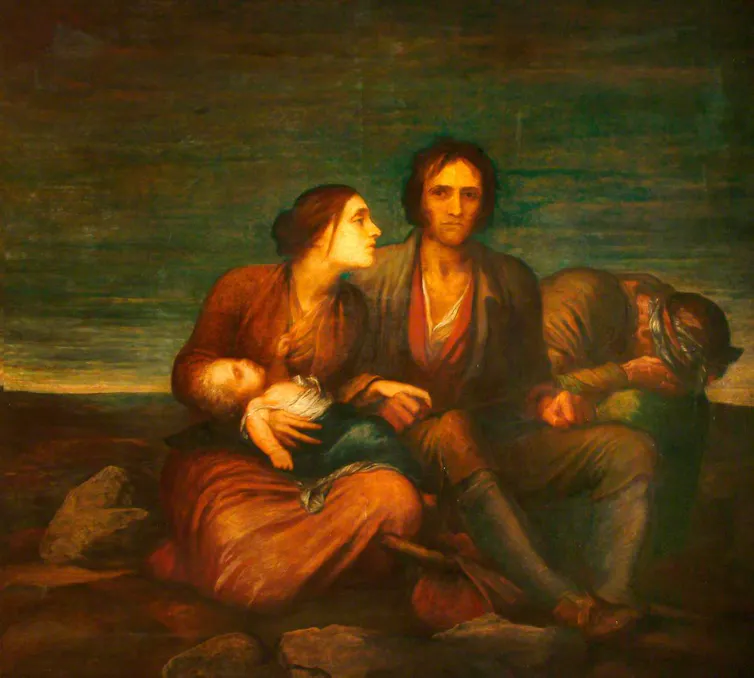
As a scholar of Ireland’s Great Famine, An Gorta Mór, I am aware of how devastating the 1840s were. One million lives were lost to starvation and disease and two million people emigrated in the immediate aftermath.
In a five-year period, between 1845 and 1851, the number of plots under or equal to 1 acre declined by almost 75% and farms between 15 and 30 acres increase by nearly 80%. By the end of the century, the acreage under potatoes and grain had halved as a tillage farming made way for an export-oriented pastoral economy. In 1800, half of Ireland’s population talked in the Irish language. By the end of the 19th century that figure was reduced to 14%. Emigration was the new normal, part and parcel of life-cycle of rural life in Ireland.
This is the context for O’Farrell’s novel: the land was changed utterly. A whole way of life was eroded, and Land imagines what it must have been like to walk among the ruins, to see a agrarian culture collapse, and, for those left behind, to forge a future from remnants.
Tomás vows that he will “never again cede to [the coloniser’s] version of geography, of history, of linguistic and toponym”. With his family’s savings, he purchases a plot of ground next to the copse and moves his family there. He is determined to make a different map of the land, one that will capture not only its physical features – “dolmen, stone cist, tumulus, evicted village, pre-colonial kingdom, and navel” –but the shifting webs of meaning attached to place.
“[It’s] not impossible,” our narrator at one point informs us, “that there are remnants of others here in this place, stray elements or traces of the people who walked this land before.” Ultimately, Land suggests that place is neither neutral nor empty, but always layered with what has been lived, lost and half-forgotten.
The novel resists any neat separation between past and present, “myth” and “fact”, showing instead how meaning endures in material and uncanny forms. Meaning can be found in stone and soil, in buried objects, and in memories that resist erasure. In O’Farrell’s hands, the land is both witness and participant, holding within it the imprint of human experience and the unsettling knowledge that nothing really goes away.
This article features references to books that have been included for editorial reasons, and may contain links to bookshop.org. If you click on one of the links and go on to buy something, The Conversation UK may earn a commission.
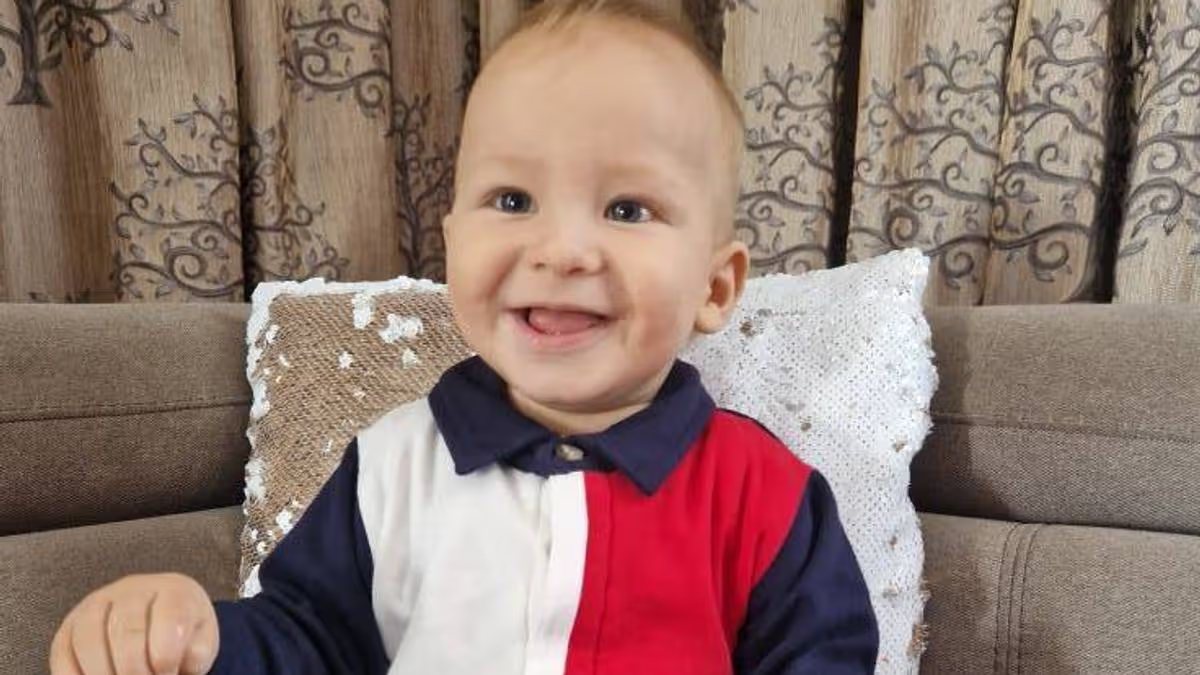
A toddler tragically died after collapsing suddenly on an inflatable slide at a Romanian festival, with an autopsy later revealing a rare, undiagnosed kidney tumour
22:34, 01 Jun 2026Updated 22:34, 01 Jun 2026
A toddler has tragically lost his life after suddenly collapsing on an inflatable slide.
Adelin Florin called out to his mother to observe him leap down the slide moments before he fell. His death was caused by an undetected kidney tumour.
The two year old had been at an annual festival in Romania when the tragedy unfolded. Adelin was playing on the inflatable with his sister and another youngster and had successfully gone down it five or six times.
Advertisement
As he made his way up the steps for another turn, he looked towards his family and shouted “Mummy”. His heartbroken parents described how he then collapsed suddenly as if “cut down by a scythe”.
Paramedics carried out resuscitation at the location and maintained their attempts in the ambulance, but the youngster couldn’t be saved and was tragically declared dead. He died at the festival in Satu Mare, Romania, at approximately 11pm on Friday evening, reports the Mirror.
It was only following a post-mortem examination that it emerged the young lad was battling a rare, aggressive kidney tumour which had grown quickly and displayed no warning signs.
Advertisement
His parents revealed that earlier medical examinations, including abdominal scans, had revealed nothing abnormal.
“He played right until the last moment,” the boy’s father said. “It could have happened at home, on the road, or in his sleep. It was just a matter of time.”
Officials suspended all inflatable attractions and children’s amusements at the festival and cordoned off the relevant section while enquiries were conducted. Authorities confirmed the equipment held valid certifications, yet still initiated a comprehensive review. Prosecutors have launched a culpable homicide inquiry to establish the full circumstances surrounding the incident.
Paediatricians noted that such tumours frequently display no symptoms and are most prevalent in children between the ages of two and three.
Advertisement
Health specialists are calling for yearly examinations, including blood tests, urine analysis and abdominal ultrasounds for young children, to assist in identifying such rare conditions at an earlier stage.
The mother shot her six-day-old baby and two-year-old son as well as her husband before also killing herself in a horrific shooting that has left the neighbourhood ‘heartbroken’
A mother who killed her husband, two young children and then herself has been identified.
Advertisement
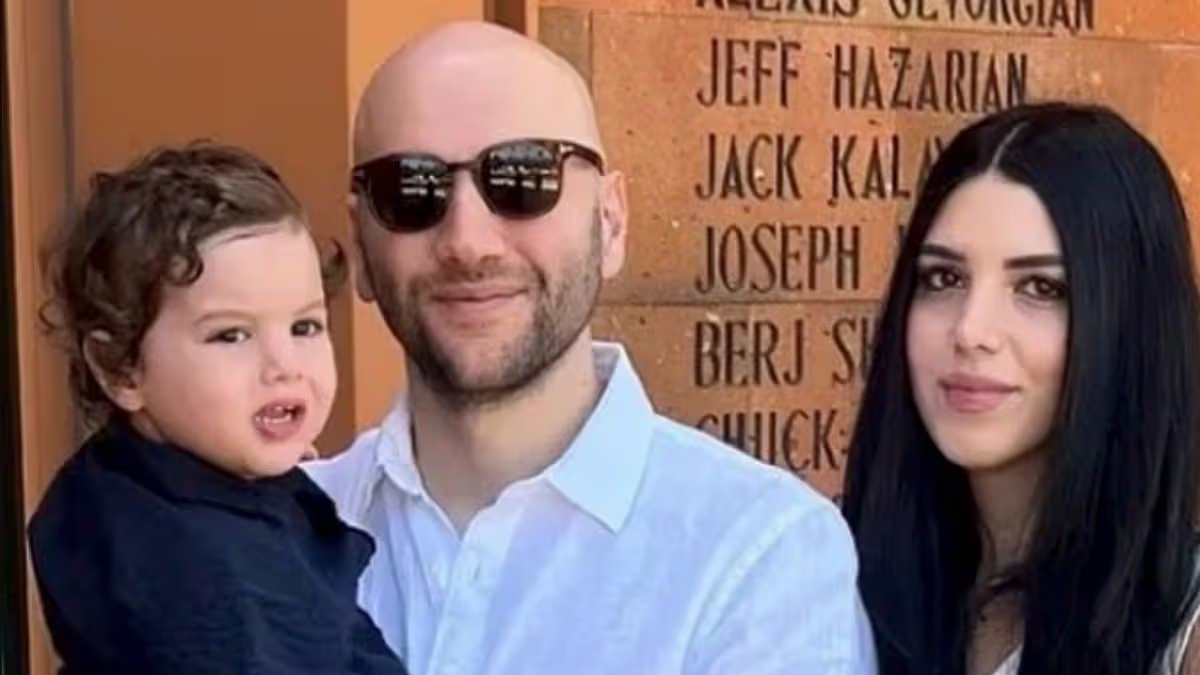
Marine Basmajian, 29, shot and killed her husband Khajag Basmajian, 31, their two-year-old son, and their six-day-old daughter, Alec and Ella, before shooting herself.
The incident took place at around 8pm local time on Wednesday, May 27 the Los Angeles Police Department (LAPD) said.
Officers rushed to the family’s £619,010 home in North Hills after gunshots were heard. It remains unclear what led to the catastrophic incident.
Advertisement
A neighbour expressed how devastated the community is by the shocking news.
“It’s so depressing, it’s so devastating for everyone.” Karen Banuelos told the Los Angeles Times. “To get possessed to do that? It’s just, there’s no words,” she added.
On a GoFundMe page that was created following the deaths Marine has been remembered as a doting mother.
Advertisement
The fundraiser said: “Marine was a caring mother and wife who found comfort in organisation and enjoyed gatherings among her loved ones.”
Her husband Khajaj, a Staff Cloud Platform Engineer at the financial operations software platform BlackLine, was remembered as a “devoted husband, loving father, cherished son, brother, and friend.”
The tribute read: “To know him is to love him. With a beaming smile on his face and a positive outlook on life, he was truly a friend you could count on.”
Advertisement
The page continued to add that the two-year-old Alec was so excited to welcome his new baby sister.
It says: “Alec brought joy and laughter wherever he went. With his bright smile and cheerful eyes taking after his father, he loved his toy vehicles and getting a taste for life one bite at a time (ice cream was his favorite).
“Alec couldn’t wait to meet his baby sister Ella who only lived to see the world Earth side for 6 days,” the fundraiser detailed.
Banuelos recalled hearing a ‘commotion’ but didn’t hear gunfire at the time.
Advertisement
She added that she saw police officers arrive at the family’s home from her window, and saw a family member running out the house in tears.
She explained she found out what happened after the grandfather to the children told one of her neighbours.
Another neighbour, who wished to remain anonymous, added that they never saw the family fighting.
They detailed that they saw Khajag taking out the rubbish at around 7pm, roughly an hour before shots rang out, while she walked her dog.
Advertisement
Another local resident Paula Smith, said she had no idea what was happening at the time.
“We live a few blocks away and we heard all the helicopters last night. We didn’t know what was going on,” she told the local news outlet through tears.
“But to wake up this morning and to hear about this and these kids, it’s really heartbreaking. So go home and love the people you love. If someone is hurting, please reach out. Don’t be ashamed.”
FOXBOROUGH, Mass. (AP) — A.J. Brown is leaving a frustrating experience in Philadelphia for a reunion in New England with his first NFL coach.
The Eagles traded the star receiver to the Patriots on Monday, putting a cap on the long-rumored deal.
The Eagles said they will receive a first-round pick in 2028 and a fifth-round pick in 2027 for the three-time Pro Bowler.
The trade comes after a frustrating 2025 season for Brown in Philadelphia, in which he had grown dispirited with an Eagles offense that played uninspired football at times while the team failed to defend its Super Bowl title.
Advertisement
Still, he posted a message on Instagram shortly after the trade became official Monday of him in an Eagles jersey with his hands making the “heart” symbol. He also posted a few other photos of himself as a kid wearing a Tom Brady Patriots jersey.
Brown played under Vrabel for three seasons after being drafted by the Tennessee Titans in 2019.
Brown, 28, quickly rose to the top receiving option in Philadelphia after being traded by Tennessee to the Eagles in 2022.
He had back-to-back Pro Bowl seasons his first two seasons with the Eagles, catching 88 passes for 1,496 yards and 11 touchdowns in 2022 and 106 passes for 1,456 yards and seven TDs in 2023.
Advertisement
He earned a Super Bowl ring during the 2024 season, but began to grow unhappy last season as the Eagles offense stagnated — leading to a change at offensive coordinator following a wild-card playoff loss to San Francisco last season.
It led to an increase in chatter about the potential for a trade heading into this offseason. It didn’t happen during April’s NFL draft likely because the Eagles would have had about $43 million in dead cap money for 2026 compared to about $16 million this year and $27 million next year if traded after June 1.
Ultimately a high draft pick proved to be enough to persuade them to deal a player of Brown’s caliber.
The Patriots have been viewed as a possible landing spot for Brown since they released receiver Stefon Diggs in March. Diggs led New England with 85 receptions and 1,013 yards receiving with four touchdowns in his only season in New England in 2025, helping the Patriots reach the Super Bowl, where they lost to the Seattle Seahawks.
Advertisement
Diggs’ exit made finding a No. 1 receiving option for quarterback Drake Maye a priority. The Patriots did add former Green Bay Packers receiver Romeo Doubs in free agency. But he doesn’t instantly change an offense the way Brown’s addition could.
Maye acknowledged last week that he was aware of the Brown-to-New England rumors.
“If he ends up being on our team, great. What a great player. And if he doesn’t, we’ve still got to work these guys here,” Maye said. “It’s a tough balance, but I know he’s a phenomenal player.”
Patriots defensive tackle Milton Williams, who was on the Eagles 2024 Super Bowl-winning team with Brown, said the receiver would be a big addition.
Advertisement
“He can definitely help our team,” Williams said. “Great dude. Monster on the field, great in the locker room, holding guys accountable and holding himself accountable. That’s everything you want in a player of his caliber.”
Brown leaves Philadelphia as one of the top receivers in franchise history. He topped 1,000 yards receiving all four seasons with the Eagles. He totaled 339 total receptions and 32 touchdowns and was a crucial member of the two Eagles teams that played in the Super Bowl during his tenure.
Vrabel was entering his second season as coach of the Titans when the team selected Brown in the second round of the 2019 draft.
Brown caught 185 passes for 2,995 yards and 24 touchdowns over the next three years, peaking with a 2020 season in which he earned a Pro Bowl selection after pulling in 70 receptions for 1,075 yards and 11 touchdowns.
Advertisement
But the Titans wound up trading Brown to Philadelphia on the second day of the 2022 draft that April despite having a season left on his rookie deal. The team was adamant that it wasn’t its preference to trade him but felt his asking price for an extension was too high.
Vrabel stated multiple times during that offseason that Brown would be on the roster as long as he was the coach, but the realities of the situation changed things.
“Unfortunately, we understand that if we’re going to be here awhile we’re not going to be able to keep every single player that we draft and develop,” Vrabel said at the time.














































You must be logged in to post a comment Login