




Connect with us

Crypto World

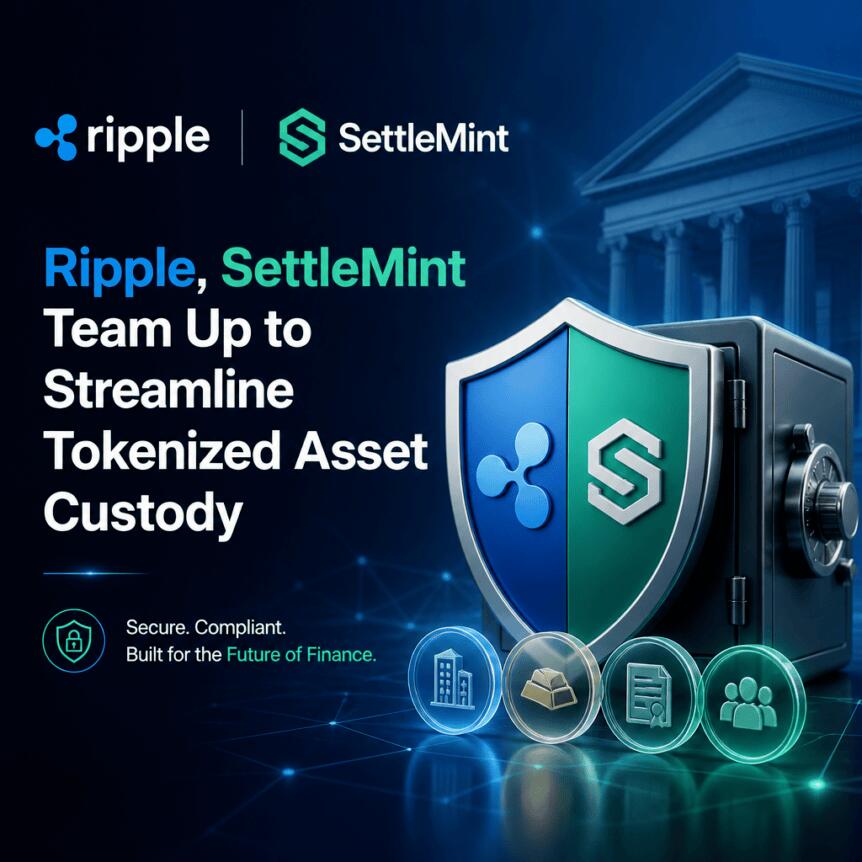
Ripple, SettleMint Team Up to Streamline Tokenized Asset Custody

Published

on

Crypto Breaking News

Ripple and SettleMint unveiled a new partnership on September 1. The deal merges custody, issuance, and lifecycle management into a single platform. Traditional finance firms now gain a simpler path toward digital asset adoption.

A Unified Platform for Institutions

SettleMint announced the collaboration in an official statement this week. The partnership links Ripple Custody with SettleMint’s Digital Asset Lifecycle Platform, known as DALP. Together, the two systems aim to accelerate tokenization adoption across the Asia Pacific region.

Fiona Murray, Ripple’s managing director for Asia Pacific, explained the strategic thinking behind the move. Institutions want to deploy digital assets without juggling separate systems for custody and governance. The combined platform gives them one foundation to build on and expand later.

Adam Popat, CEO of SettleMint, echoed that view in his own remarks. He described global capital markets as shifting fully on-chain in the current moment. As a result, custody and lifecycle management must now function as a single system rather than two.

Advertisement

Ripple’s Broader Institutional Strategy

Ripple continues to expand its custody infrastructure through several additional partnerships. The company has deepened ties with Securosys, Figment, and Chainalysis in recent months. These integrations aim to simplify how institutions secure digital assets, stablecoins, and real-world assets.

Ripple also plans to roll out the XRP Ledger v3.3.0 upgrade soon. The upgrade places tokenized real-world assets at the center of its roadmap. This step reflects Ripple’s wider strategy to court institutional capital through infrastructure improvements.

XRP itself traded higher following the announcement, rising more than one percent within 24 hours. The token moved between $1.36 and $1.40 during that window. Trading volume fell 16 percent, yet CME futures open interest still surpassed figures on Binance.

Regulatory Momentum Fuels Sector Growth

The partnership arrives as regulators reshape the tokenization landscape inside the United States. The SEC introduced tokenization innovation exemptions under the current administration this year. These changes encourage more institutions to seriously explore blockchain-based asset management.

Advertisement

The Depository Trust and Clearing Corporation also plans to launch its own tokenization service. That rollout is scheduled for October and adds further momentum to the sector. Multiple major players now compete to serve rising institutional demand for on-chain assets.

Financial firms increasingly need compliant infrastructure to manage complex ledger configurations safely. Custody providers must now handle growing volumes of tokenized assets without added risk. The Ripple-SettleMint partnership positions both companies to meet that rising demand directly.

Institutions across Asia Pacific stand to benefit most from this streamlined approach. Rather than managing multiple vendors, banks can now consolidate custody and issuance functions. This consolidation may lower operational costs while improving oversight of digital asset holdings.

The tokenization market continues to grow as traditional finance embraces blockchain technology further. Partnerships like this one signal a maturing industry ready for institutional-scale adoption. Ripple and SettleMint now join a growing list of firms building that infrastructure together.

Advertisement

Risk & affiliate notice: Crypto assets are volatile and capital is at risk. This article may contain affiliate links. Read full disclosure

Source link

Continue Reading
Click to comment

You must be logged in to post a comment Login

Leave a Reply

Crypto World

In Nepal’s Tragedy, a Warning for a Warming World

Published

on

In Nepal's Tragedy, a Warning for a Warming World

More than 40 bridges have been destroyed or damaged, and 25 miles of vital roadways have been erased from the map, or buried under thick mud, cutting off remote mountain communities and compounding the rescue effort. At the same time, 69 schools have been damaged or destroyed, affecting 19,000 children, according to the charity Save The Children. At least 65,000 people have been directly affected.

Much of the downstream death toll was the result of poor planning and weak enforcement of zoning laws, which allowed settlements to be built along riverbanks. Yet nothing could have saved the hydropower plants, which Nepal needs both to wean itself off fossil fuels and to sustain its energy exports. Melting glaciers, a consequence of global warming, combined with high seismic activity, make the Himalayas a hotspot for catastrophic disaster risk downstream. 

This is also a lesson for other vulnerable river valleys in Nepal. Four major hydropower plants backed by Indian investments sit in the Arun River basin, directly below Makalu, the world’s fifth highest mountain, at 8,463m, in eastern Nepal. The basin also lies downstream from the Tibetan region of China, where dozens of glacial lakes have swollen in size and could burst at any time. The Arun sits just across the border from the Indian state of Sikkim, where a $1 billion, 1,200-megawatt dam, the Teesta III, was wiped out by a glacial lake outburst in October 2023.

Source link

Advertisement
Continue Reading

Crypto World

Asia Sees Digital Asset Custody Infrastructure Deals from Ripple, Coincheck

Published

on

Asia Sees Digital Asset Custody Infrastructure Deals from Ripple, Coincheck

Blockchain enterprise solutions provider Ripple has partnered with digital asset infrastructure company SettleMint to offer financial institutions solutions for custody, issuance and management of tokenized assets across their full lifecycle.

The strategic partnership will integrate Ripple’s institutional digital asset custody infrastructure, Ripple Custody, and SettleMint’s Digital Asset Lifecycle Platform (DALP) to offer institutions a less complex way to secure digital assets, Ripple announced on Tuesday.

A day earlier, digital asset service provider Coincheck Group partnered with wallet infrastructure provider DFNS to build digital asset wallet technology and custody services in Japan.

DFNS’s wallet-as-a-service offers institutions full transaction lifecycle management, including workflow orchestration and governance controls, under a single platform that supports more than 100 blockchain networks.

Advertisement

Both partnerships are seeking to build more institutional digital asset services to address the infrastructure gap hindering the entry of regulated financial institutions.

The Asia-Pacific region ranked as the fastest-growing area for onchain crypto activity and experienced a 69% year-over-year increase in value received, according to Chainalysis’ 2025 global adoption index.

Many countries in the region are developing their own cryptocurrency regulatory frameworks. In July, Japan’s parliament passed revisions that classify crypto assets as financial assets under Japan’s Financial Instruments and Exchange Act.

Japanese Finance Minister Satsuki Katayama signaled the intent to bring crypto under the same umbrella as traditional finance assets in January, to ensure that citizens will “benefit from digital and blockchain-based assets.” 

Advertisement

Related: Hyperliquid added to Singapore’s Investor Alert List

Cointelegraph is committed to independent, transparent journalism. This news article is produced in accordance with Cointelegraph’s Editorial Policy and aims to provide accurate and timely information. Readers are encouraged to verify information independently.

Source link

Continue Reading

Crypto World

Prediction market traders think job creation rebounded in August

Published

on

Prediction market traders think job creation rebounded in August

A job seeker holds a flyer as they receive information about education careers with the Los Angeles Unified School District while attending a job and resource fair in Los Angeles, California, July 29, 2026.

Patrick T. Fallon | Afp | Getty Images

After a disappointing July payrolls report that showed the economy lost jobs that month, traders on prediction market platforms think August will show a rebound in hiring, though potentially not as strong as economists think. 

Advertisement

Speculators on Kalshi see 50-50 odds that more than 50,000 jobs were created last month. That implies a slightly lower outlook than Dow Jones consensus estimate for 53,000 jobs created in August. 

On the contracts on the market, traders are asked whether they think the U.S. added more than a certain number of jobs in the month. The contracts are resolved using official data from the Bureau of Labor Statistics. 

Prediction market traders on Polymarket give a 48% likelihood the economy created more than 50,000 jobs in August. 

For two months in a row, prediction market traders and economists have overestimated payroll numbers. Both expected job creation numbers in the six figures in June — when they actually came in just below 60,000 — and for the economy to create jobs in July when it ended up losing them. 

Advertisement

Given that, traders on Kalshi see a wide range for a beat or miss. Speculators on the platform see about 1-in-4 odds for a contract that implies the U.S. actually lost jobs last month, and a similar likelihood for another contract that asks if the country created more than 80,000 jobs in the period. 

The August employment reading will be delivered at 8:30 a.m. ET on Friday. 

Disclosure: CNBC and Kalshi have a commercial relationship that includes customer acquisition and a minority investment.

Choose CNBC as your preferred source on Google and never miss a moment from the most trusted name in business news.

Source link

Advertisement
Continue Reading

Crypto World

New Important Ripple (XRP) Partnership Targets Banks and Institutional Clients

Published

on

Ripple Labs and SettleMint have announced a strategic partnership that plugs Ripple Custody into SettleMint’s Digital Asset Lifecycle Platform (DALP), giving regulated financial institutions a single system to custody, issue and manage tokenized assets across their full lifecycle.

Announced from Singapore, the offering has already commenced in Asia, and the companies plan to extend it to other markets as institutional demand develops. Beyond banks, the stack targets market infrastructure operators and sovereign entities, adding compliance, settlement and servicing to the custody and issuance layer so institutions can drop separate vendors for each function.

“Financial institutions across Asia Pacific are putting digital assets to work. They are asking how to do more without stitching together separate solutions for custody, issuance and governance,” said Fiona Murray, Managing Director, Asia Pacific at Ripple.

The Very Lucrative Tokenization Market

The joint release cites Boston Consulting Group’s May 2026 report, “The Future of Digital Assets,” which describes the shift toward digital assets as a fundamental restructuring of financial infrastructure.

BCG projects that tokenized real-world assets could reach $88 trillion by 2035, and estimates that banks failing to adapt could see profits fall by as much as 30% over the same horizon. The release also names RLUSD, Ripple’s stablecoin, and the cryptocurrency XRP as assets underpinning the company’s solutions.

Elsewhere in the region, Ripple piloted RLUSD in Singapore’s central bank sandbox with supply chain finance firm Unloq in March, and its XRP Ledger featured in a cross-border pilot with JPMorgan, Mastercard and Ondo Finance that settled tokenized US Treasuries in under five seconds.

Custody Stack Assembled Through Deals

Ever since it was founded, Ripple has been selling payments, custody, liquidity and treasury infrastructure to banks and payment providers, and has assembled the custody line through a run of transactions. Moreover, Ripple has put its cumulative M&A and corporate venture spending on crypto infrastructure at around $4 billion.

Advertisement

Those include partnerships with Securosys and Figment, an integration with compliance analytics firm Chainalysis, and the acquisition of wallet infrastructure provider Palisade, which added MPC-based key sharding and multi-chain support.

SettleMint supplies the lifecycle side. Headquartered in Leuven, Belgium (though it has offices in the UAE, Singapore and Japan), the company stated that its composable DALP already runs in production and pre-production deployments across North America, Europe, the Middle East and Asia Pacific for banks, market operators and governments.

“Global capital markets are moving fully on-chain, and that shift only works when digital asset custody and lifecycle management operate as one system rather than two,” noted Adam Popat, CEO of SettleMint.

The post New Important Ripple (XRP) Partnership Targets Banks and Institutional Clients appeared first on CryptoPotato.

Advertisement

Source link

Continue Reading

Crypto World

Kalshi Issues First Lifetime Ban for Republican Politician over Insider Bets

Published

on

Kalshi Issues First Lifetime Ban for Republican Politician over Insider Bets

Prediction market platform Kalshi announced action against US House of Representatives candidate Laurie Buckhout and ousted Republican lawmaker George Santos over using insider information for trading on event contracts, in one of the first lifetime bans the company has imposed since its launch in 2021. 

In separate notices of settlement of disciplinary action announced on Friday, Kalshi’s compliance department said it had permanently suspended Santos from trading on the prediction markets platform and imposed a $71,356 penalty. Buckhout received a three-year suspension and a $2,590 penalty.

Both restrictions by Kalshi were made in response to investigations into Santos and Buckhout trading using event contracts that could be manipulated by their own actions. According to the platform, Buckhout, running in North Carolina’s 1st congressional district, “announced her candidacy for public office and was added as a market option for a contract on a North Carolina Congressional election,” while Santos “engaged in trading activity in certain markets related to his attendance at the State of the Union address” in February 2026.

“If a Trader is a decision maker, either directly or indirectly, or has any influence, directly or indirectly, no matter the scale and importance of the influence, on the outcome of the Underlying event of any Contract, that Trader is prohibited from attempting to enter into any trade, either directly or indirectly, on the market in such Contracts,” state Kalshi’s rules.

Advertisement

The actions by the company represented a significant crackdown at a time when prediction market platforms are under scrutiny by state and federal lawmakers over claims that many of the event contracts are susceptible to manipulation. President Donald Trump’s teleprompter operator, Gabriel Perez, was fined $172,000 by federal regulators after trading event contracts on Kalshi related to Trump’s speeches. 

While Kalshi’s compliance department reported that Buckhout “cooperated with the inquiry” and agreed to the three-year trading ban and penalty, the platform made no such statement in Santos’ case suggesting that the former US lawmaker had cooperated with its investigation.

Related: Trump teleprompter operator made $100K betting on Kalshi markets tied to speeches: ABC

Buckhout remains the Republican candidate for North Carolina’s 1st congressional district in the 2026 midterm elections, while Santos, formerly a representative for New York’s 3rd congressional district, was expelled from Congress in December 2023 amid fraud allegations.

Advertisement

In response to the settlement, Santos said in a Monday X post that Kalshi was an “unserious company.” Buckhout reportedly called her actions betting on her own congressional race a “dumb mistake.”

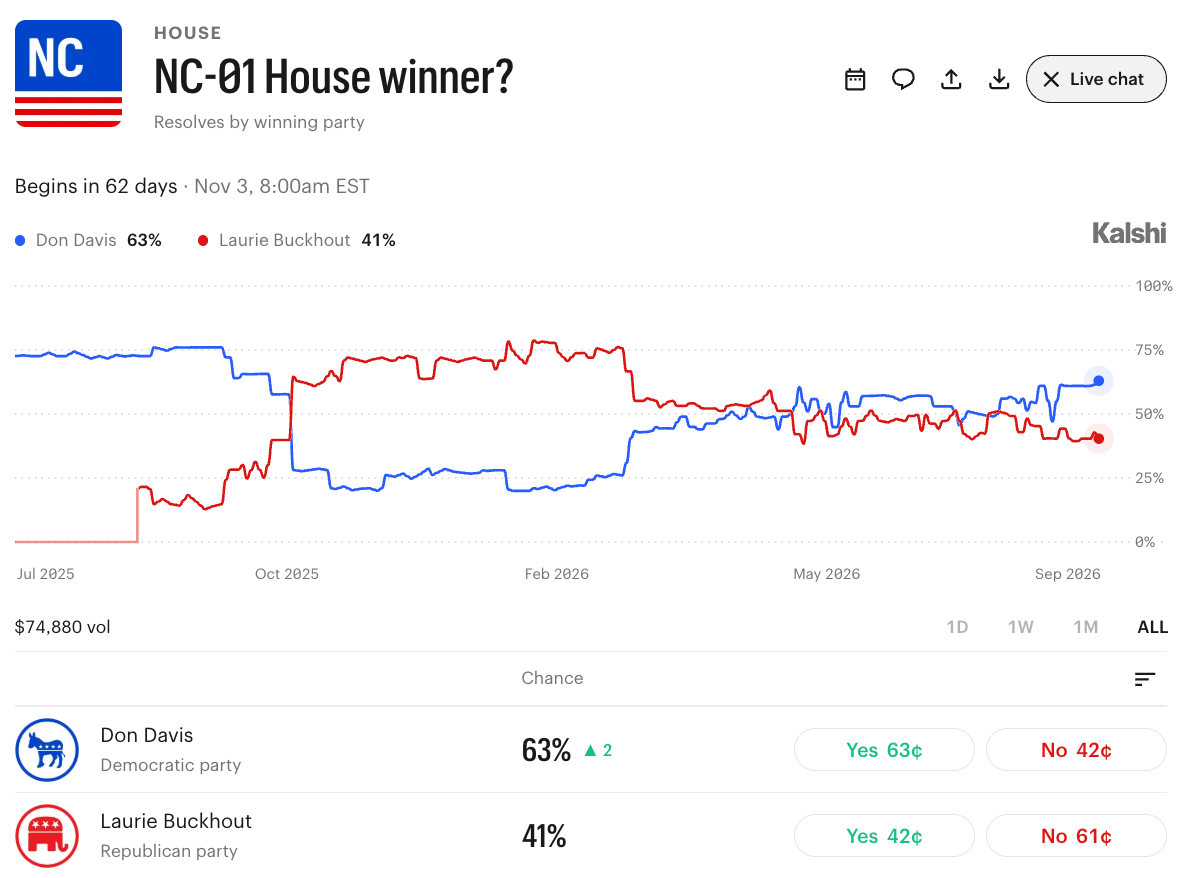
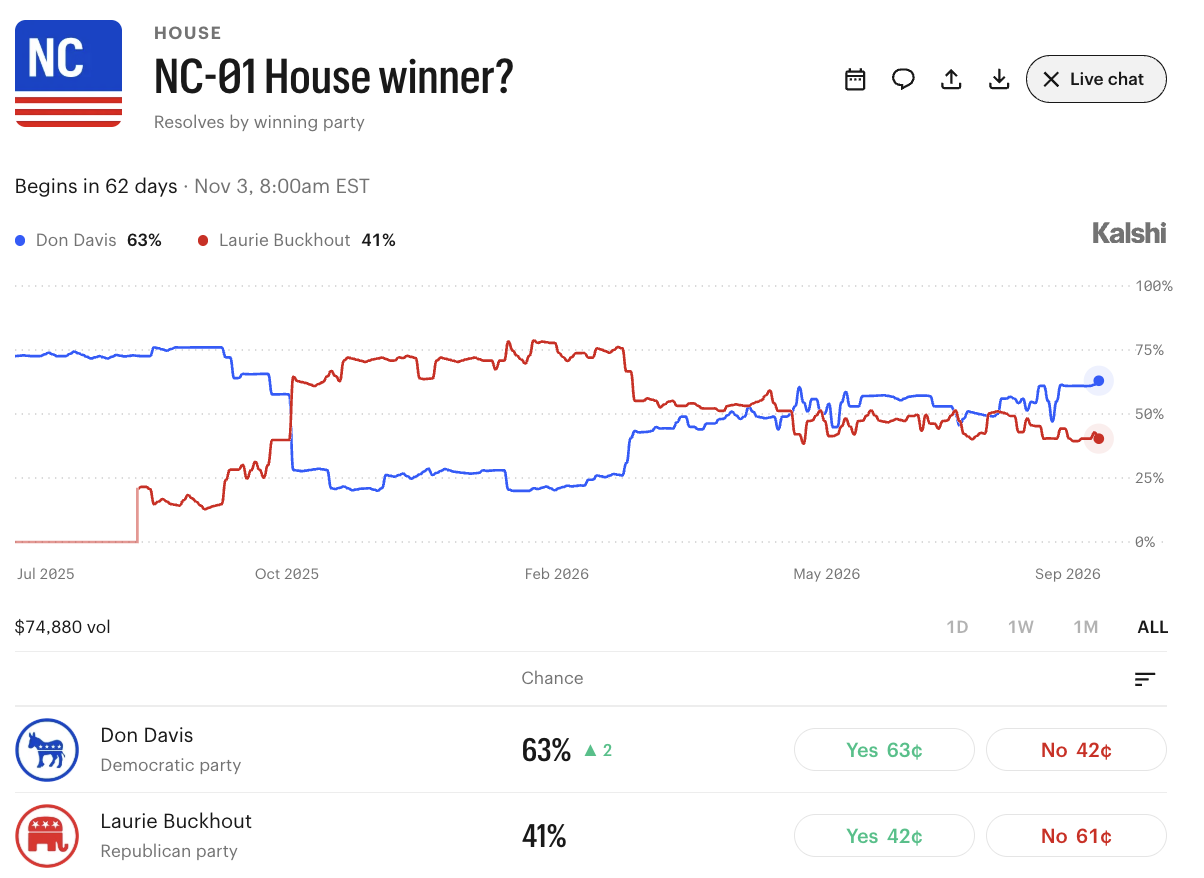
As of Tuesday, Kalshi still listed event contracts related to the outcome of Buckhout’s North Carolina race, giving Democratic incumbent Don Davis a 63% chance over the Republican’s 41%.

Event contract for Laurie Buckhout in North Carolina House race. Source: Kalshi

CFTC taps emergency authority in fed-state prediction markets legal battle

Kalshi and other prediction market platforms like Polymarket face several lawsuits filed by individual US state gaming authorities over allegations the companies are facilitating illegal bets on sporting events. At the same time, the sole commissioner and chair of the US Commodity Futures Trading Commission (CFTC), Michael Selig, claims that the agency has “exclusive jurisdiction” over prediction markets and vowed to take legal action against any state authority challenging this position.

Last month, the CFTC, in a rare move, invoked emergency authority opposing the state of New York attempting to bar Kalshi from offering contracts tied to sports, elections and other events.

Advertisement

Magazine: Does the Bitcoin rally mean we haven’t wasted our lives in crypto?

Source link

Continue Reading

Crypto World

SEC Proposes New Standards for US Transfer Agents

Published

on

SEC Proposes New Standards for US Transfer Agents

The US Securities and Exchange Commission (SEC) has proposed overhauling decades-old rules governing transfer agents as blockchain-based recordkeeping and tokenized securities become more prominent in US markets.

The proposal would update requirements covering registration, recordkeeping, safeguarding and securities transfers, while introducing new rules aimed at risks emerging from increasingly digital and automated market infrastructure.

“Market participants are actively seeking to bring blockchain-native, or ‘onchain’ transfer agents into the U.S. market,” the SEC said, pointing to models for blockchain-based recordkeeping, tokenized fund administration and cross-chain interoperability.

The agency said its existing framework does not adequately address those developments, particularly risks involving cybersecurity, operational resilience and the safeguarding of securities and investor records.

Advertisement

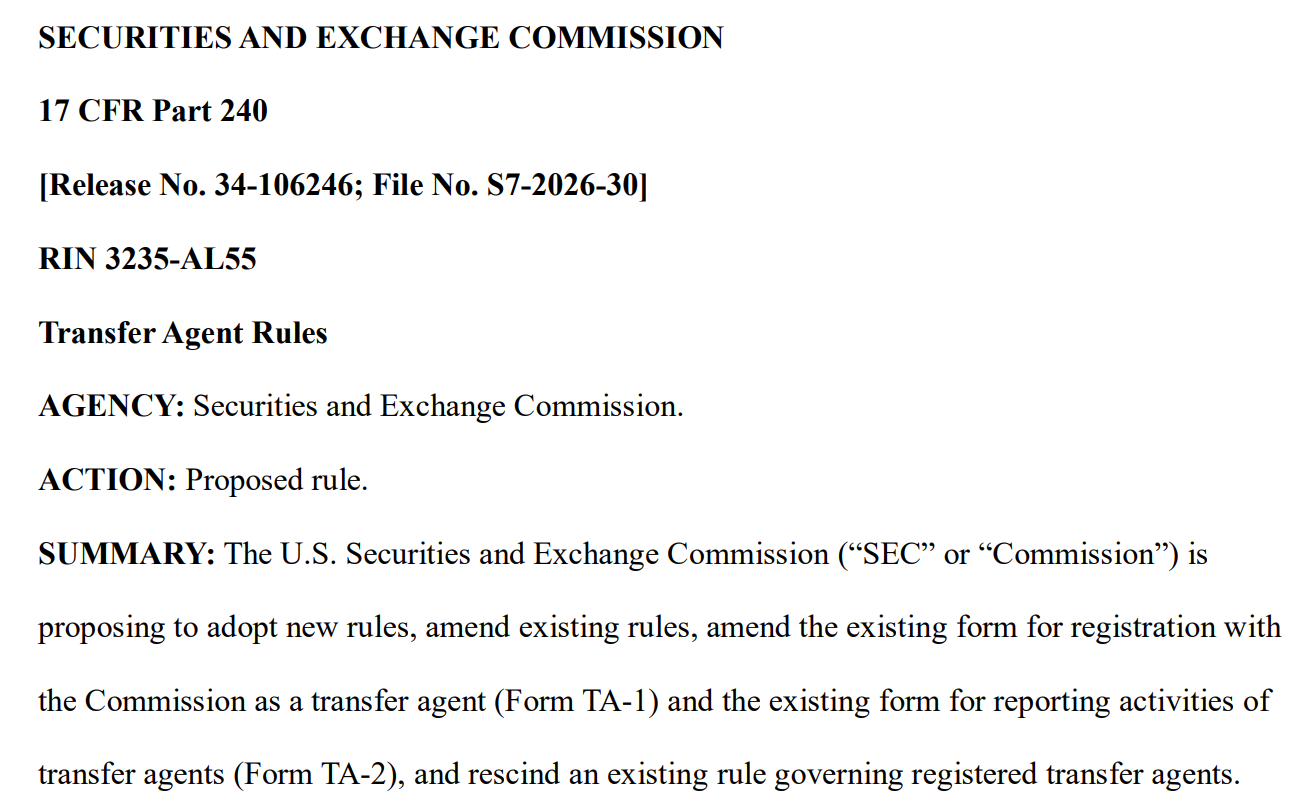
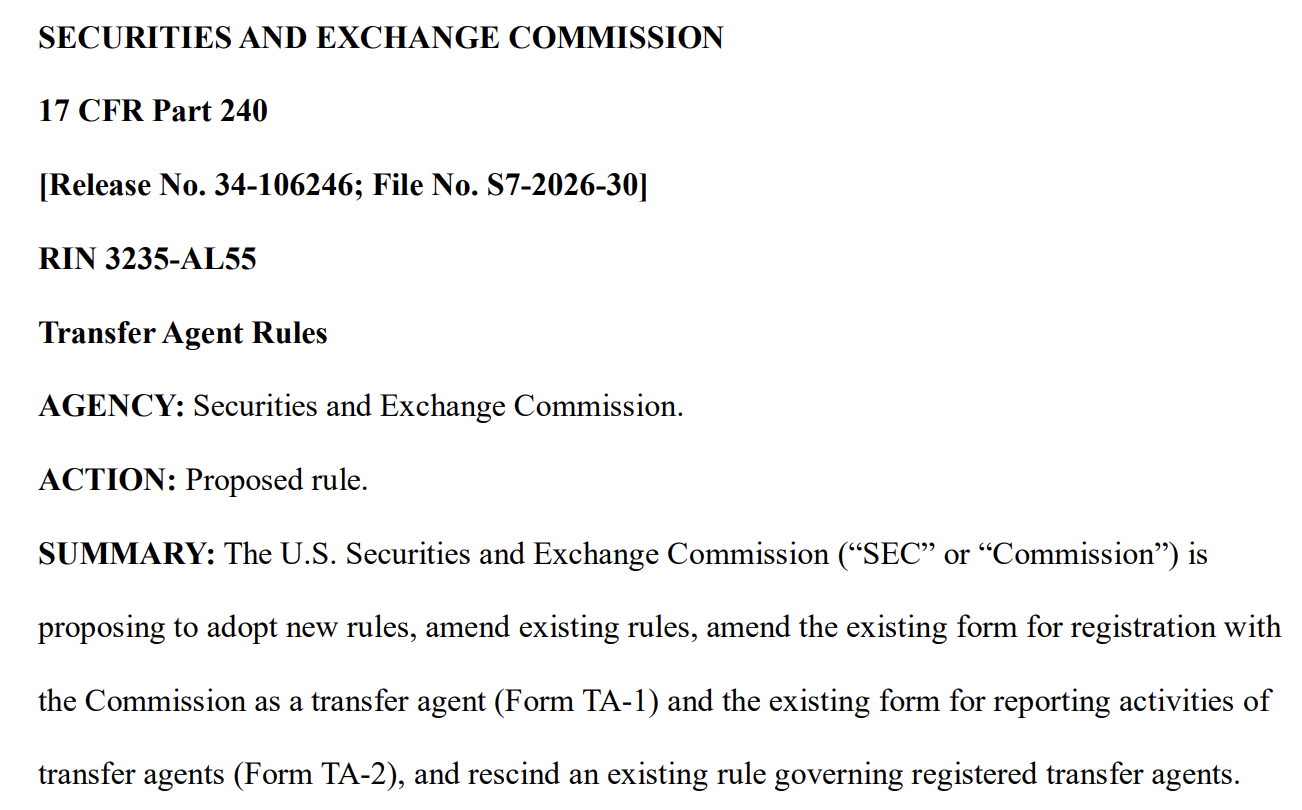
Under the proposal, transfer agents would face expanded reporting requirements and new compliance standards, including rules governing restrictive legends on securities and the use of third-party service providers.

SEC’s proposed Transfer Agent Rules. Source: SEC

The SEC said its transfer agent rules have not been substantively updated since the late 1970s and early 1980s, when the industry still relied heavily on paper certificates and manual recordkeeping.

The regulatory agency is seeking public comment on the proposed changes, with comments due 60 days after the proposal is published in the Federal Register.

Related: CFTC chair says agency will move forward on crypto regulation if CLARITY fails

Advertisement

SEC pursues broader securities rule changes

The SEC is “on a mission to simplify its rules,” according to analysis from law firm Cahill Gordon & Reindel sent to clients on Tuesday.

In May, the SEC proposed three major changes to public-company rules. The proposals would allow companies to opt for semiannual reporting, simplify the existing filer classification system and expand access to streamlined registered securities offerings.

Last week, the SEC sent a proposed overhaul of custody rules for investment advisers and investment companies to the White House for review, with potential changes covering how firms hold crypto assets for clients. The changes could provide clearer standards for how investment advisers and funds custody digital assets while complying with federal securities rules.

Magazine: Does the Bitcoin rally mean we haven’t wasted our lives in crypto?

Advertisement

Source link

Continue Reading

Crypto World

Meet Sean Parnell, Pentagon’s Chief Spokesperson and Army Secretary Contender

Published

on

Meet Sean Parnell, Pentagon's Chief Spokesperson and Army Secretary Contender

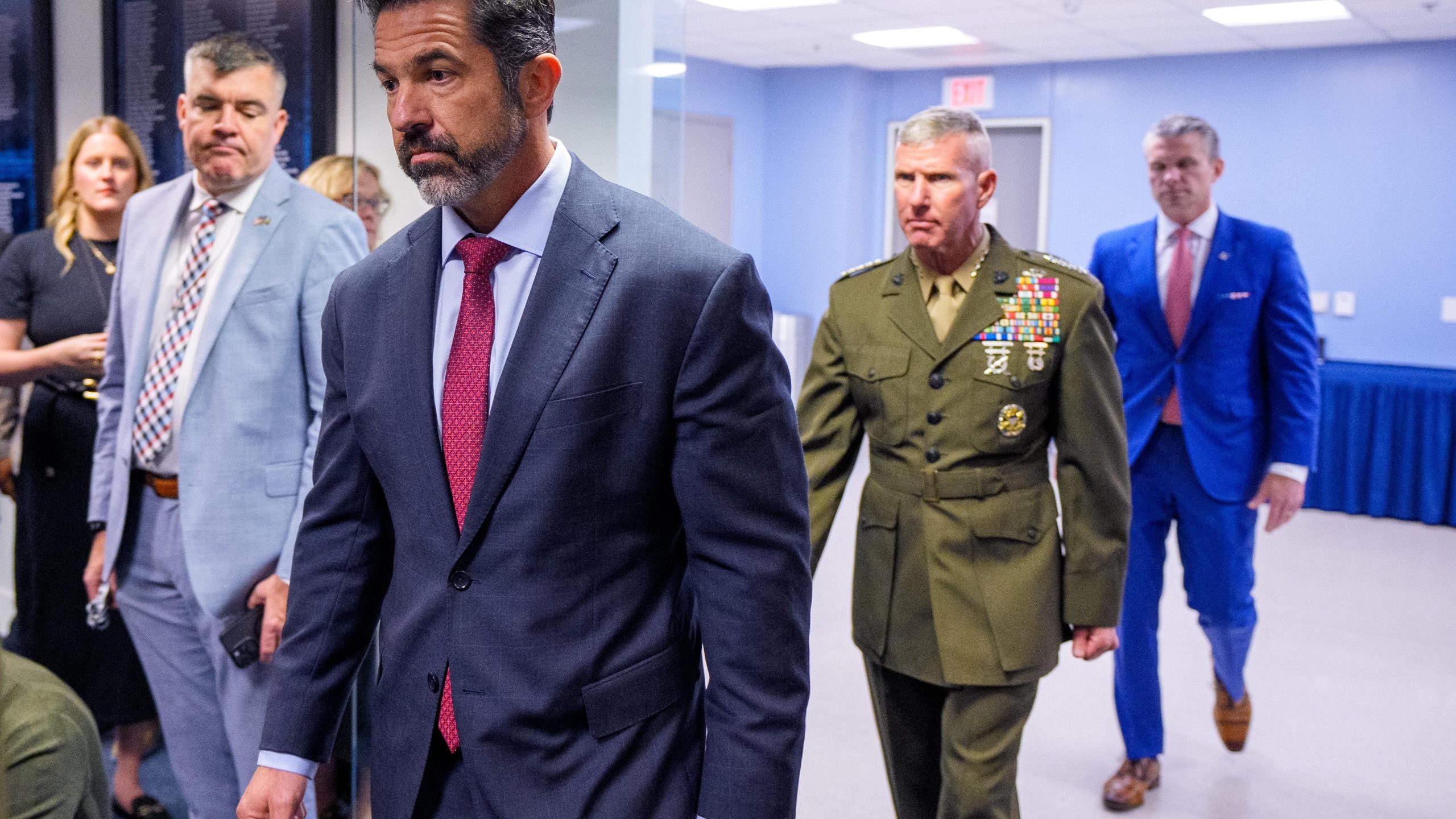
Prior to Army Secretary Dan Driscoll submitting his resignation Monday, Chief Pentagon spokesperson Sean Parnell had been suggested by some close to Defense Secretary Pete Hegseth as a potential replacement for the Senate-confirmed position.

The Hill reported last week that Parnell’s name was being floated, citing two unnamed sources familiar with the matter.

Asked about the reports, a senior Administration official told TIME: “Sean Parnell is 100% focused on the job he was appointed to by President Trump and Secretary Hegseth.”

News of Driscoll’s departure from the role he held for around 18 months came after months of reported tensions with Hegseth and turmoil within the department.

Advertisement

According to the Atlantic, a person familiar with Driscoll’s resignation said he had recently “brought up concerns with the Administration surrounding Army transformation and readiness and Hegseth’s blocking those efforts specifically by firing the generals who were responsible.”

White House spokesperson Anna Kelly did not address the tensions and fallout when approached by TIME, but instead emphasized that the United States Army is “more powerful than ever thanks to [Driscoll’s] work alongside the Commander-in-Chief and Secretary of War.”

Driscoll’s resignation is the latest in a series of high-profile departures within the Pentagon, following the April ouster of the Army’s top uniformed leader, Gen. Randy George, and the June departure of the lead commander in Europe and Africa, Gen. Christopher Donahue.

The Washington Post reported that Hegseth had sought to remove George several times and that Driscoll had previously blocked or delayed those efforts, arguing that George had done nothing wrong and should be judged on merit.

Advertisement

Alongside the reported tensions, Hegseth has also come under serious scrutiny for the duration and mounting cost of the Iran war, which surpassed the six-month mark last week.

“I don’t have any confidence in him anymore. I think he’s all over the place—he’s accelerating the retirement or forcing out some of the most distinguished leaders in the DOD that we have,” Republican Sen. Thom Tillis of North Carolina said in July.

Meanwhile, under Parnell, the Department of Defense has imposed various restrictions limiting journalists’ access in the Pentagon.

In an unprecedented move in June, the department designated its press office a classified area.

Advertisement

“The Pentagon Press Office has been redesignated as a Sensitive Compartmented Information Facility due to speechwriters from the Office of the Secretary of War sharing the facility,” said deputy Pentagon press secretary Joel Valdez. “As a result, journalists will no longer be permitted to enter the office space. There’s nothing controversial about that.”

Now, with talk turning to who may replace Driscoll in the pivotal role of Army Secretary, Parnell’s name continues to be floated. Notably, whoever is selected would need to be confirmed for the position by the Senate. 

Here’s what to know about Parnell, his military record, past controversies, and more.

Parnell is an Afghanistan veteran who penned a memoir on his experience

Advertisement

Parnell arrived in Afghanistan in 2006 and during his 16-month deployment was awarded two Bronze stars and the Purple Heart. He was deployed alongside his platoon, nicknamed the Outlaws.

He returned home with shrapnel in his leg and a brain injury that had left him with vision problems.

Following retirement on medical grounds, he penned a 2012 war story memoir titled Outlaw Platoon, in partnership with author John R. Bruning, detailing his experiences in the region.

Parnell went on to become a senior advisor for the Concerned Veterans of America and is credited with playing a key role in the passage of the Mission Act in 2018 under President Donald Trump, with the goal of delivering care and support for U.S. veterans.

Advertisement

Parnell previously criticized Trump before becoming a staunch supporter

Parnell backed now-Secretary of State Marco Rubio for the 2016 Republican presidential nomination where he faced off against Trump, who went on to win both the nomination and presidency.

According to Parnell, his support for Rubio, who at the time was a Senator in Florida, was cemented by his vocal backing of matters related to Veterans Affairs (VA).

“There are lots of strong options. But if fixing the VA, rebuilding our military, and doing right by our veterans is a top priority for you, then Senator Rubio should be your first and only choice,” Parnell said in a campaign press release.

Advertisement

In a separate interview, he described Rubio as a “unifying voice” who the country “desperately needs” and labeled him “my guy.”

By contrast, Parnell had called out Trump in 2015, referring to his criticism of the late Republican Sen. John McCain, a prisoner of war, as “the height of arrogance,” arguing that Trump had “no clue what our Vietnam POWs endured.”

However, Parnell had a change of heart once Trump took office, stating in a 2019 interview that the President had earned his respect “because he forces us to talk about issues. Political correctness doesn’t allow us to talk about them.”

At the 2020 Republican National Convention, Parnell further praised Trump, insisting he had “unleashed the economic might of this nation like no other President in our history.”

Advertisement

Parnell suspended his campaign for Senate amid abuse allegations

Parnell, after running unsuccessfully for the House in 2020, went on to launch a bid as the GOP Senate candidate in Pennsylvania. He suspended his Trump-backed campaign in November 2021, after losing a fight for custody of his children to his then-estranged wife, who had accused him in court of abuse.

Laurie Snell had alleged that Parnell choked her and injured their children. Parnell vehemently denied the claims.

Snell also testified in court that Parnell had been unfaithful.

Advertisement

Following Trump’s announcement in February 2025 that Parnell was tapped to become chief spokesperson for the Pentagon, some media coverage saw the abuse allegations revisited.

If Parnell were put forward for a Senate-confirmed position in the future, the historical allegations could be brought up in his confirmation hearing.

Source link

Advertisement
Continue Reading

Crypto World

Ethena Expands Ecosystem With Launch of Self-Custodial Money App

Published

on

Ethena (ENA) has officially launched Ethena Pay, a self-custodial money app the project bills as “the internet money neobank,” advertising a 6% dollar savings rate, 5% card cashback.

It even has free transfers across roughly 50 countries at launch. It also comes with dollar savings, card spending, international transfers and free onramps in dollars, pounds and euros, with fiat account numbers tied to self-custodial stablecoin wallets.

Though access starts with 400 early users and expands weekly through a September beta. Notably, Avalanche (AVAX) is the exclusive settlement network, and a feature called Buy Now Pay Never puts savings rewards toward purchases without touching the principal.

Tiers and Caps

As mentioned, Ethena’s card cashback is at a flat 5%. The product page breaks it into tiers: the free Standard plan pays 4% on spending with cashback capped at $100 a month, while the Pro and VIP plans lift the monthly caps to $360 and $1,000, with 5% reserved for the top tier.

Advertisement

Savings follow the same pattern: Standard accounts earn 5%, upper tiers get the advertised 6%, and rewards pay out daily. A footnote says the rates rest on Ethena-reported weekly data and assume no net staking activity during reward vesting.

Users can generate a virtual Visa card in under a minute, spend it at more than 130 million merchants, and add it to Apple Pay, with Google Pay to follow. Third National issues the card under license from Visa, with program management from Signify Holdings, operating as Rain.

Advertisement

The card is not offered to US persons, and users must be 18 to register. Transfers between Ethena Pay users are free, with no monthly account fees, and euro, yen, and Brazilian real accounts are listed as coming soon.

Not a Bank, Though

Ethena Pay Ltd, incorporated in Malta, has clearly stated that it is not a bank, holds no customer funds, and provides fiat account numbers through licensed banking partners, while wallet keys stay with the user behind passkeys and biometrics.

Moreover, the official site flags that balances carry no coverage from the FDIC, the UK’s Financial Services Compensation Scheme or Malta’s depositor scheme, and the savings rate flows from the yield engine behind USDe, Ethena’s synthetic dollar, which has drawn its returns from a crypto basis trade.

USDe’s circulating supply stands near $4.2 billion, per DefiLlama, and Ethena says it has paid holders more than $750 million in rewards on over $30 billion of mints and redemptions. Ethena has widened its lineup before, launching USDtb, a stablecoin backed primarily by BlackRock’s BUIDL fund.

Advertisement

ENA, which recorded its biggest single day of network growth in more than three months in May after Grayscale added the token to its DeFi Fund, traded 8.6% higher on launch day, per CoinGecko.

The post Ethena Expands Ecosystem With Launch of Self-Custodial Money App appeared first on CryptoPotato.

Source link

Advertisement
Continue Reading

Crypto World

Tectonic’s $75M exploit was not an oracle failure, RedStone co-founder says

Published

on

DxSale exploit drains $7.3M in BNB through hidden contract backdoor

RedStone has said Tectonic’s estimated $75 million exploit resulted from weak collateral controls rather than an inaccurate oracle after TONIC’s reported price rose about 100-fold in 20 minutes.

Summary

  • An onchain researcher estimated that the Tectonic exploit affected about $75 million.
  • TONIC’s reported price increased roughly 100 times before the token was supplied as collateral.
  • RedStone said borrow caps tied to executable liquidity could have limited the losses.
  • Cronos has restarted after restoring its chain state to a point before the attack.

RedStone co-founder Marcin Kazmierczak told crypto.news that the oracle accurately reported TONIC’s price in the pool it monitored, but Tectonic allegedly accepted the reading without checking whether the token could be sold at that valuation in meaningful size.

Cronos validators halted block production on Aug. 30 after Tectonic disclosed an incident involving the decentralized lending protocol. Independent researcher Weilin Li estimated that approximately $75 million was affected, although neither Tectonic nor Cronos has confirmed the final loss.

Advertisement

According to Li’s initial analysis, the attacker pushed TONIC’s price about 100 times higher within roughly 20 minutes. The inflated tokens were then supplied to Tectonic as collateral, allowing the attacker to borrow assets with more established liquidity.

TONIC reportedly had a collateral factor of 20%, meaning the protocol allowed users to borrow assets worth up to one-fifth of the collateral’s reported value. Li identified about 364.6 trillion TONIC in the position, which would have needed a reported value of around $375 million to support approximately $75 million in borrowing.

Tectonic oracle reported a manipulated market price

Kazmierczak rejected the idea that the oracle itself necessarily produced incorrect data, drawing a distinction between observing the available market price and deciding whether that price is safe for a lending protocol.

Advertisement

“The oracle wasn’t wrong. It accurately reported the price of TONIC on the pool it was reading from at that moment,” he said.

A thinly traded token can register a high spot price after a limited number of trades, even when the market lacks enough buyers to support large sales at the same level. According to Kazmierczak, Tectonic’s alleged failure was accepting the manipulated price as collateral without testing how much TONIC could actually be sold before its value collapsed.

“Reporting a price and validating that a price is safe to lend against are two different jobs, and Tectonic’s design conflated them.”

The initial Tectonic incident left most of the identified assets on Cronos when validators stopped the chain. Li estimated that about $6 million had reached Ethereum, while roughly $60 million remained at one Cronos address. A second address holding close to $8 million raised his combined estimate to about $75 million.

Funds remaining at identified addresses should not be treated as recovered unless the network, protocol or affected users regain control of them. Cronos and Tectonic had not confirmed Li’s address attribution or asset estimates when the preliminary analysis was published.

Advertisement

Borrow caps could have limited the Tectonic loss

Among the safeguards available to lending protocols, Kazmierczak said borrow caps linked to executable liquidity would have provided the strongest protection. Such a cap limits the total amount users can borrow against an asset based on how much of the collateral could realistically be sold without causing a steep price decline.

“Even if TONIC’s reported price moves 100x, a borrow cap sized to what could realistically be exited without collapsing the market limits the damage regardless of what the price feed says,” he said.

Dynamic collateral factors, price-impact limits and minimum market-depth requirements could also have reduced Tectonic’s exposure, according to Kazmierczak. However, he argued that a properly set borrow cap can contain losses even when another risk parameter fails.

Tectonic apparently lacked those protections, he said, allowing a token with limited liquidity to support borrowing on the basis of a temporarily inflated valuation. Neither Tectonic nor Cronos has released a technical postmortem confirming which controls were active when the incident occurred.

Advertisement

Kazmierczak also cautioned against treating a longer time-weighted average price window as a complete solution. A TWAP calculates an average price across a set period, making brief market moves less influential than they would be under a spot-price feed.

Although longer windows can filter out short-lived price changes, Kazmierczak said protocols must set them according to each asset’s liquidity and trading history. In his assessment, a 100-fold increase in 20 minutes should have raised questions about TONIC’s eligibility as collateral rather than prompting a debate over the ideal averaging period.

“A move like TONIC’s, 100x in 20 minutes, isn’t a volatility event a wider TWAP window would smooth over. It’s a signal the asset shouldn’t have been usable as collateral at any meaningful size in the first place.”

Thin collateral has caused similar DeFi attacks

Tectonic’s reported attack followed an $8.7 million Moonwell exploit on Base on Aug. 27. Security firms said the Moonwell attacker manipulated the collateral value of the relatively illiquid MAMO token before borrowing cbBTC from the protocol’s mBTC market.

Following the incident, Moonwell lowered borrow caps across its Base Core Markets to 1 wei, effectively preventing new loans. It also reduced the supply caps for MAMO and WELL to 1 wei while investigating the transactions.

Advertisement

Kazmierczak compared Tectonic with Mango Markets and Moola Market, two protocols targeted through variations of inflated collateral pricing in October 2022. Mango Markets lost more than $100 million after Avraham Eisenberg increased the value of positions linked to the thinly traded MNGO token and borrowed other assets against them.

The Mango case also provides a U.S. legal example of how difficult it can be to apply existing fraud and commodities laws to automated lending systems. A Manhattan jury convicted Eisenberg in 2024 of commodities fraud, commodities manipulation and wire fraud, but a federal judge vacated the convictions in May 2025 over venue problems and insufficient evidence supporting the wire fraud count.

According to Kazmierczak, protocols repeatedly expose themselves to such attacks because listing a native governance token as collateral can increase its use and help attract deposits. The cost of weak settings may remain hidden until someone tests how the lending market responds to a manipulated token price.

He placed primary responsibility on risk curators and other service providers tasked with setting and maintaining collateral parameters, working alongside protocol developers and oracle providers. Governance participants may approve an asset listing, Kazmierczak said, but many voters lack the market-structure knowledge needed to judge liquidity and price-impact risks.

Advertisement

Cronos restored the chain to its pre-exploit state

Cronos has since restarted network operations after validators restored the blockchain to a point before the Tectonic incident. The network described the halt as an emergency action agreed through validator consensus to protect users.

Restoring the earlier chain state removed transactions recorded after the chosen rollback point from the restarted version of Cronos. Crypto.com CEO Kris Marszalek said the company’s centralized app and exchange continued to operate during the halt and that funds held through those services were unaffected.

Tectonic had asked users not to interact with the lending protocol while its team investigated the incident. Cronos has not published the technical process validators used to select and approve the restored state, while the promised postmortem is expected to address the attack, the emergency halt, and the subsequent restart.

Advertisement

Source link

Continue Reading

Crypto World

Strategy spends $635M buying back STRC as perpetual preferred stock lags $100 par

Published

on

BTC below $72,000 as Strategy sold 32 bitcoin for $2.5 million


STRC trades at $97.34 despite Strategy’s growing repurchases, while SATA’s higher dividend rate has helped it hold its $100 par value.

Source link

Continue Reading

Trending

Copyright © 2025