

Crypto World
Ripple Swell 2026 Sparks Holder Backlash Over RLUSD Priority


The XRP community’s reaction to the Ripple Swell 2026 announcement was immediate and hostile. Retail holders flooded the @RippleSwell reply thread within hours of the announcement. The consistent theme was not excitement about 1,500 attendees or a merged XRPL Apex agenda; it was anger that Ripple’s flagship institutional event appears to be building a case for RLUSD while XRP falls.
The frustration has a specific target as Ripple’s USD-pegged stablecoin is taking up conference oxygen that long-term holders believe should belong to XRP. Community members used language that ranged from sharp to outright furious. The community is even calling Ripple’s leadership out by name, including CEO Brad Garlinghouse.
The underlying accusation is not subtle. Ripple is constructing a regulated institutional business around RLUSD while XRP’s price stagnates and holders are disappointed.
Discover: The Best Token Presales
Swell 2026 Scope: What’s Ripple Actually Doing
Swell 2026 is scheduled for October 27–29 at The Shed in Hudson Yards, New York City, and represents the first time Ripple is folding its developer-focused XRPL Apex summit into the main Swell conference. The combined event is targeting 1,500-plus attendees, 75-plus speakers, and 50-plus sessions across three programmatic stages covering finance, blockchain infrastructure, and digital assets.
Ripple’s stated agenda themes include payments, tokenization, decentralized finance, AI applications, interoperability, and stablecoins. RLUSD’s role in enterprise treasury management and cross-border settlement is a prominent feature of the institutional track.
The XRP Ledger’s milestone of surpassing 4 billion completed transactions is being cited by Garlinghouse as evidence that the network has matured enough for the institutional audience Ripple is targeting.
Garlinghouse framed the moment with deliberate confidence:
“I’ve been in crypto long enough to know when a moment is real”
The statement positions Swell 2026 as a threshold event for institutional crypto adoption, which is accurate as a description of Ripple’s ambition, but says nothing specific about what that adoption means for XRP price or holder value.
Discover: The Best Crypto to Diversify Your Portfolio
XRP Holders Are Not Hiding Their Frustration
The community sentiment is not a fringe reaction. Retail XRP holders expressed a clear and recurring grievance. Ripple is allocating conference prominence to RLUSD and institutional partnerships while XRP’s price continues to underperform relative to the company’s corporate milestones.
The tone in several replies was openly hostile toward Garlinghouse and the Ripple leadership team, with holders describing themselves as investors who have been systematically sidelined.
The token burn argument has re-emerged as a focal point. A portion of the XRP community is pushing for supply reduction as a mechanism to create direct price pressure, a demand that Ripple has consistently declined to act on.

That refusal, combined with a conference agenda that leads with stablecoins and tokenization rather than XRP utility, is being read by holders as a signal about where Ripple’s actual priorities sit.
Community sentiment of this intensity is a legitimate market signal. When the XRP community, historically one of the most vocal and coordinated retail bases in crypto, publicly turns on a Ripple event, it registers in social volume metrics that can suppress short-term buying pressure and amplify sell-side momentum.
Discover: The Best Token Presales
The post Ripple Swell 2026 Sparks Holder Backlash Over RLUSD Priority appeared first on Cryptonews.


Key Takeaways
- Stellantis maintains a 9.5% ownership position in Factorial Energy, a solid-state battery developer based in the United States, with the stake valued at approximately $126 million
- The investment, distributed between Stellantis Ventures and Stellantis Europe, represents about 8.67 million shares in the startup
- Laboratory testing of Factorial’s battery technology demonstrated 375 Wh/kg energy density with charging times of approximately 18 minutes from 15% to 80%
- Real-world road testing has commenced using Factorial’s FEST battery cells installed in a prototype Dodge Charger Daytona vehicle
- Shares of STLAM have plummeted almost 43% year-to-date in 2026, with a recent 3.7% decline following negative news from BMW
An SEC disclosure has revealed that Stellantis maintains a 9.5% ownership stake in Factorial Energy, with the position currently worth approximately $126 million based on present valuations. The investment is distributed across both Stellantis Europe and Stellantis Ventures entities.
The automaker’s initial capital commitment to Factorial dates back to 2021, when Stellantis injected €75 million (approximately $86 million) into the battery technology company. This financial commitment has now transformed into an equity stake, positioning the automotive giant as a significant stakeholder in the emerging technology.
Jon Nelson, who leads Stellantis Financial Services as CEO, has secured a board seat at Factorial, transforming what began as a purely financial transaction into a strategic operational partnership.
The regulatory filing further indicated that Stellantis remains open to expanding its investment in Factorial, characterizing the company as representing a “compelling investment opportunity.”
Factorial has recently launched road testing of its solid-state battery technology in a development version of the Dodge Charger Daytona. This milestone represents the technology’s first deployment in actual driving scenarios beyond controlled laboratory settings.
During lab evaluations, Factorial’s battery cells achieved an energy density measurement of 375 Wh/kg. The cells also demonstrated the capability to charge from 15% to 80% capacity in about 18 minutes — performance metrics that would constitute a significant advancement over existing lithium-ion battery technology if achievable at commercial scale.
Solid-state battery technology offers reduced weight compared to traditional lithium-ion battery packs while promising enhanced driving range, accelerated charging capabilities, superior safety characteristics, and potentially reduced lifecycle costs. The primary obstacle remains manufacturing scalability, a challenge the automotive sector has yet to overcome.
Strategic Rationale Behind Stellantis’ Investment
For Stellantis, the partnership with Factorial represents a component of its comprehensive strategy to maintain competitive positioning in the electric vehicle technology landscape. Industry experts widely regard solid-state batteries as the next transformative advancement in energy storage, making early strategic alliances potentially critical when the technology reaches commercial viability.
The automaker’s approach prioritizes strategic involvement with a promising technology developer rather than attempting full ownership, particularly given Factorial’s demonstrated laboratory achievements and progression toward practical validation.
Share Price Challenges
While the Factorial development offers positive technological prospects for investors to consider, Stellantis shares have experienced significant headwinds throughout 2026. STLAM has declined nearly 43% since the beginning of January.
The latest downturn occurred this week, with shares dropping 3.7%. This decline coincided with a profit warning issued by BMW, which triggered broader selloffs across European automotive stocks.
Stellantis continues to face challenging conditions across its primary geographic markets, with the BMW announcement intensifying existing sector-wide pressures.
The SEC documentation, which officially discloses the Factorial ownership position, was filed on June 19, 2026.

Artificial intelligence (AI) is changing how crypto and traditional markets get traded, yet four leading analysts agree it rewards skill rather than replacing it. The edge in AI in crypto trading still comes from clean data and human judgment.
Charles Edwards of Capriole Investments and Julio Moreno of CryptoQuant call AI an accelerant for serious research. Benjamin Cowen and Michael van de Poppe, speaking on a separate panel, reach the same conclusion from the trading desk.
Four Analysts, One Conclusion
On-chain analytics and AI tools have moved from niche to mainstream across crypto research. Two BeInCrypto panels gathered four analysts who use them every day.
Edwards founded Capriole Investments, a quantitative Bitcoin (BTC) hedge fund. Moreno serves as Head of Research at CryptoQuant. Cowen and van de Poppe are widely followed, independent market analysts.
Speaking at the Market Intelligence Council, Edwards said AI shifts the opportunity toward those who do the work.
“I think AI as well is making that… playing field more opportunistic for certain people.”
On a separate panel, van de Poppe set the limit plainly.
“It’s not going to make you a great trader if you weren’t a good trader in the first place.”
Where AI Already Helps
The clearest gains show up in routine research. AI now compresses tasks that once took hours.
Edwards pointed to faster analysis as the main benefit.
“The tool sets to do that are much more powerful and… it can be done more quickly today with AI.”
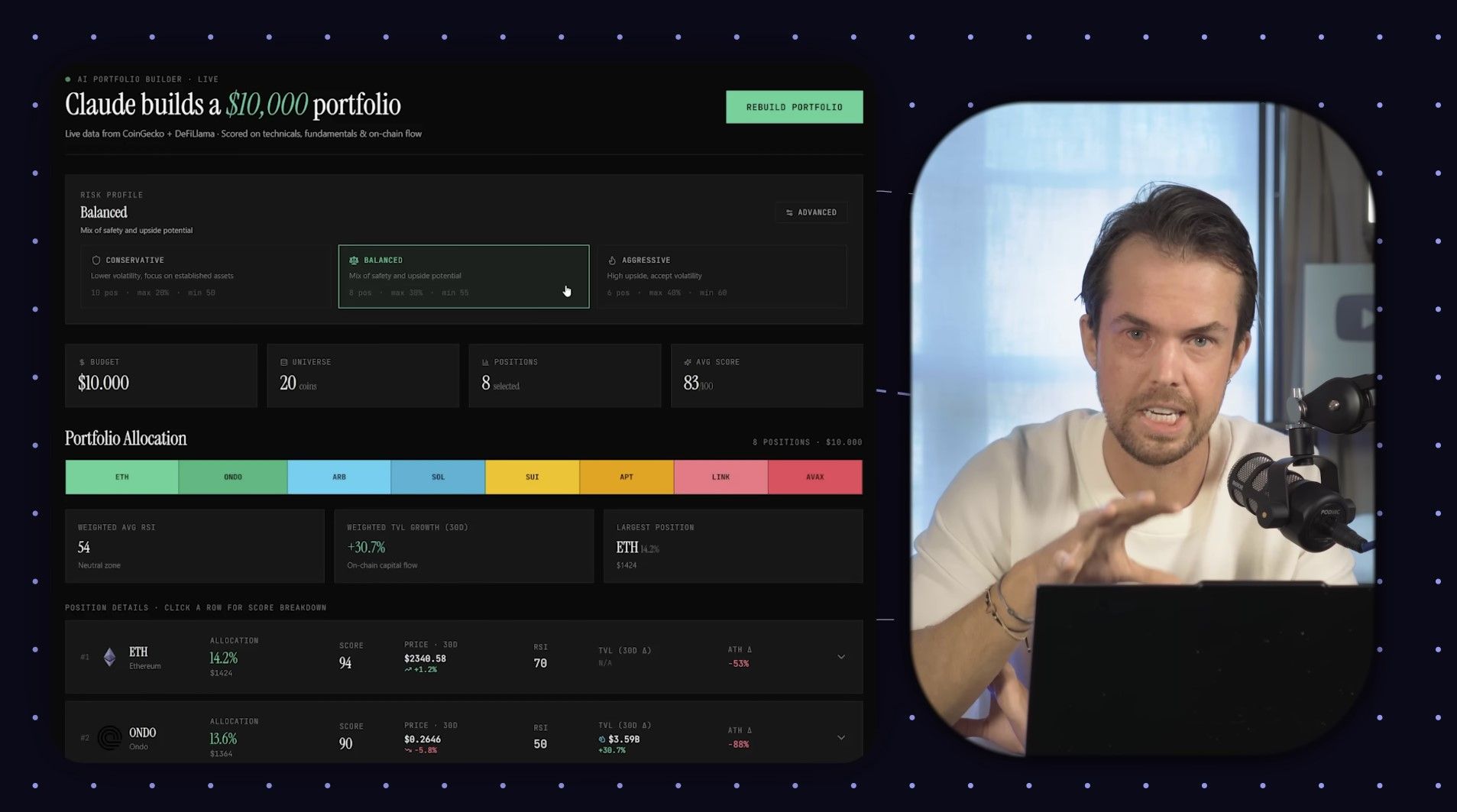
Van de Poppe showed how accessible this has become. He built a sample crypto portfolio using a chatbot and free data feeds. Tools like AI agents now pull live market data on demand.
“You can build a portfolio and a dashboard of cryptocurrencies within five minutes with just free APIs.”

Why AI Still Needs a Human
Speed does not equal skill. Van de Poppe noted that his AI portfolio missed important context.
“It didn’t create a basket of uncorrelated cryptos… it doesn’t have any macros in there.”
He said judgment fills that gap.
“That’s where the human knowledge and experience comes in and the intuition… That the AI agent doesn’t have or the LLM.”
He also warned against treating AI as magic. The tool will not deliver “some sort of magic that creates an infinite money loop.” That caution matches the wider market, where few experts back hands-off trading bots.
Moreno said institutions trust data but keep testing it.
“They do trust it but they verify a lot, and are continuously monitoring if the data remains relevant.”
Inside the Models
Professional funds treat AI as infrastructure, not a crystal ball. Edwards built his firm around large, tested models.
“We build hundreds of metrics and we also use hundreds of other data sources to build out comprehensive models… Combining onchain technicals and macro data for many years to build out trading models.”
Capriole’s Macro Index reflects that approach. The firm combines more than 60 on-chain, macro, and equities metrics into one machine-learning model. Most data platforms publish thousands of metrics, yet models still need careful curation.

Cowen is building his own bot from the ground up.
“Right now all the bot does really is regurgitates things that I say. It’s almost like an AI version of me.”
He avoids training on low-quality AI output to prevent model decay.
“I don’t want it to use AI slop that’s out there to create more AI slop”
Van de Poppe runs his fund the same way. AI writes the base of his trading algorithms, but a human keeps steering it, or it keeps “working on stuff that is wrong for your system.”
The Data Behind the Models
Every model depends on the data beneath it. Moreno gave the sharpest example of a data edge.
“They will trade for example mining stocks instead of waiting for your quarterly report you’re tracking in real time actually what they’re mining.”
Network hashrate offers one such real-time signal. It tracks how much computing power miners commit to Bitcoin each day.

The same method applies to equity exchanges. Bitcoin miner stocks have drawn fresh attention as AI infrastructure spending climbs. Julio Moreno continues:
“Some of the crypto exchanges have also started trading on stock exchange and so you can be monitoring the trading volume to assess the revenues.”
Cowen added that data quality decides the outcome. He values records from before the AI era.
“Data before 2022 in some ways is actually really valuable because it was data before all the AI stuff was even here.”
For institutions and retail traders alike, the lesson holds. AI compresses the work and widens access, but the advantage flows to operators with clean data and the judgment to steer the model. As adoption spreads, that judgment becomes the real differentiator.
The post AI Won’t Make You a Good Trader, But Here’s How the Pros Use It Anyway appeared first on BeInCrypto.
TLDR:
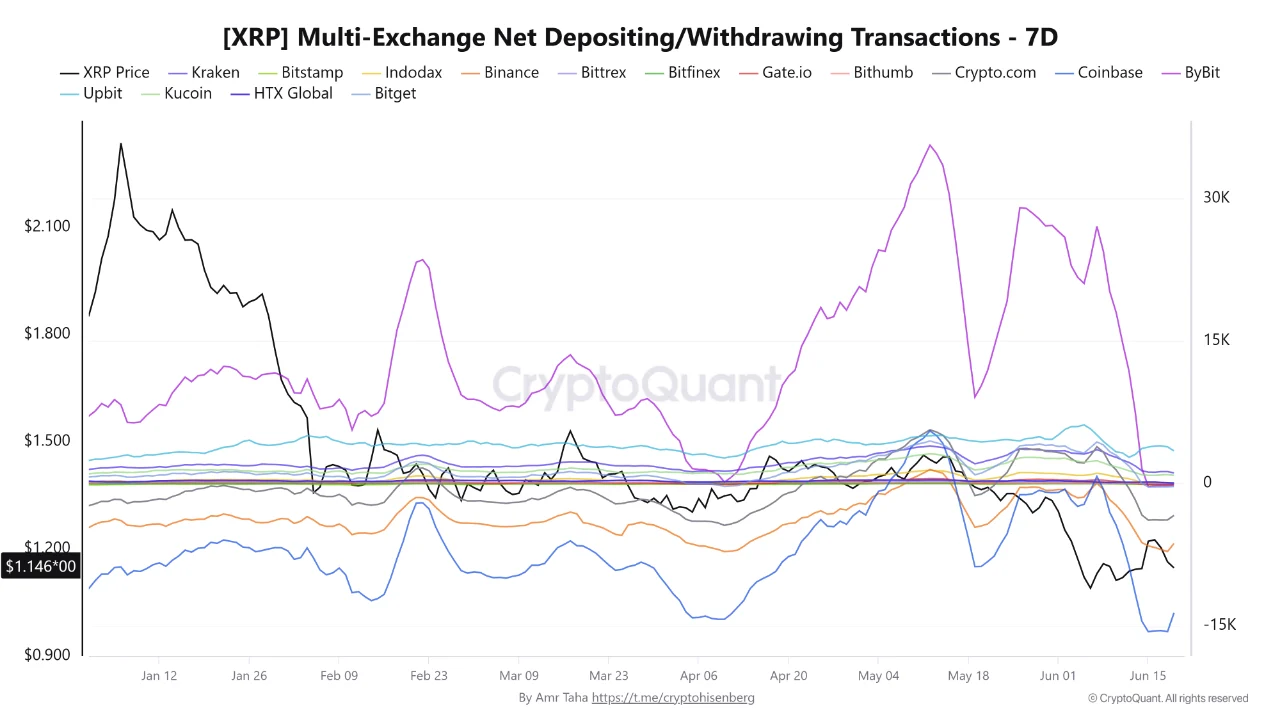
- Coinbase posted a seven-day net reading of -15,500 on June 18, exceeding its April and February lows.
- Binance recorded -7,100 on June 18, near April levels and below its February 14 reading of -5,200.
- Bybit’s net reading collapsed from +27,000 on June 7 to roughly -200 by June 18 in just 11 days.
- Spot XRP ETFs now hold 1.41% of circulating supply after just five outflow days since March 27.
XRP withdrawal activity is again gaining traction across major cryptocurrency exchanges, with fresh on-chain data from June 18 pointing to a notable shift.
Coinbase and Binance both posted deeply negative seven-day net depositing and withdrawing transaction readings.
Meanwhile, Bybit’s unusually large early-June deposit surge has nearly fully reversed. Separately, spot XRP ETFs in the United States continue accumulating supply, now holding over 1.4% of circulating tokens.
Coinbase and Binance Post Negative Net Transaction Readings
Coinbase recorded a seven-day net depositing and withdrawing reading of -15,500 on June 18. That figure fell below its April 9 reading of -14,200 and its February 14 level of -12,300. The move places the current withdrawal dominance at a more extreme rate than either prior episode.
Binance followed the same direction on the same date. Its reading dropped to -7,100, near April levels and below the -5,200 recorded on February 14. That cross-exchange alignment removes any suggestion that the activity is exchange-specific.
Source: Cryptoquant
The metric tracks the net number of depositing versus withdrawing transactions. It does not measure the total XRP volume or dollar value transferred between accounts. Even so, a synchronized drop across two of the largest exchanges carries weight as a behavioral indicator.
The back-to-back negative readings across Coinbase and Binance point to a broader pattern. XRP holders appear to be moving tokens away from centralized venues at a pace that now exceeds prior notable periods this year.
Bybit’s Deposit Surge Collapses While ETF Holdings Pass 1.4% of Supply
Bybit presented the sharpest single-exchange reversal. Its net reading stood at roughly +27,000 on June 7, reflecting an unusually concentrated deposit wave at the time.
By June 18, that figure had fallen to approximately -200, erasing nearly all of the early-June movement within 11 days.
The speed of the reversal at Bybit adds context to the Coinbase and Binance readings. Together, the three data points suggest a coordinated behavioral shift across major XRP trading venues during June. The withdrawal side is reclaiming dominance across different exchange types and geographies.
On the institutional side, spot XRP ETFs in the United States recorded net inflows of approximately $2.82 million on June 15.
Following that session, the suite of Ripple-linked ETF products now holds 1.41% of XRP’s entire circulating supply.
Since March 27, spot XRP ETFs have posted net outflows on just five trading days. That streak reflects sustained institutional demand running alongside the exchange-level withdrawal activity now observed across Coinbase, Binance, and Bybit.

Bitcoin is slipping back toward the $59,000 area after a failed rebound attempt left buyers unable to retake key resistance levels. The move has traders watching the downside closely, particularly as technical signals remain bearish and large pools of liquidations are reported to be concentrated near the yearly low.
At the same time, on-chain flow data suggests one source of immediate sell pressure may be easing: CryptoQuant analysis cited by the article points to a sharp decline in exchange inflows from mid-sized investors across Binance, Coinbase, and Coinbase Prime around June 19.
Key takeaways
- Bitcoin is approaching its yearly low near $59,000 after a recovery attempt stalled below the $67,500–$70,500 fair-value gap.
- Liquidation positioning is reportedly heavy near $59,000 (about $4 billion in leveraged longs), raising the odds of a liquidity-driven push lower before any rebound.
- CryptoQuant data shows mid-sized investor inflows to major exchanges fell across Binance and Coinbase to levels not seen since April 4.
- RSI is reportedly hovering near oversold conditions, which can precede volatility spikes and relief bounces after liquidation events.
Why $59,000 remains the center of attention
The latest price action reflects a stalled attempt to reclaim lost ground. According to the report, BTC failed to reach the daily fair-value gap between $67,500 and $70,500, and sellers regained control around the 50-day and 100-day exponential moving averages—levels described as acting as overhead resistance.
On the four-hour timeframe, the rejection reportedly pushed BTC below an ascending channel, marking a bearish break of structure. With price trading below that channel’s range, traders highlighted internal liquidity support around $60,700 before the market tests the yearly low near $59,000.
What makes the $59,000 zone particularly important is the clustering of leverage. The article cites liquidation data indicating that around $4 billion in cumulative leveraged long positions are concentrated near $59,000. If price trades into that area, forced liquidations can amplify downside moves by triggering additional selling—often referred to by traders as a “liquidity sweep” of trapped positioning.
Beyond that level, the next larger pocket of reported liquidity is near $68,000, where more than $4.75 billion in cumulative positions are said to be clustered. That distribution matters because it frames both the near-term risk (downside flushing into clustered longs) and the potential upside horizon if liquidations exhaust and a rebound takes hold.
Momentum signals: oversold conditions and the case for a bounce
Beyond structure and liquidity, the report also points to momentum indicators moving toward extremes. It notes that the relative strength index (RSI) is hovering near oversold territory. Another drive toward the yearly lows could push RSI below 30, a level that traders frequently associate with elevated odds of a sharp relief reaction after liquidation-driven selling.
Two separate traders emphasized that the market may not simply follow the most obvious liquidity path. Analyst “Killa” suggested Bitcoin could front-run a liquidity pool below $60,000 rather than fully sweeping the wider area. The reasoning, as presented in the article, is that markets sometimes move opposite the level that becomes “crowded attention,” referencing a past example where Bitcoin reportedly front-ran liquidity above $140,000 in October 2025.
Trader “LP” also cautioned against becoming “too bearish” in the immediate term, pointing instead to the possibility of a bottom forming toward late June. Together, these views underscore a key practical takeaway: even when liquidation maps point to downside, the timing of the flush versus the subsequent rebound can be difficult to forecast.
Exchange inflows cool—selling intent appears to ease
While price action and liquidation data focus on what happens when leverage is already positioned, exchange inflows help gauge what capital may be preparing to sell. The article attributes this portion of the story to CryptoQuant analyst Amr Taha, who reported that inflows from mid-sized Bitcoin investors declined simultaneously across Binance, Coinbase, and Coinbase Prime on June 19.
As stated in the report, Binance recorded roughly 3,500 BTC in inflows, Coinbase nearly 3,000 BTC, and Coinbase Prime about 1,700 BTC—described as the lowest readings since April 4. The article frames this as a reduction in near-term sell pressure because exchange inflows are commonly interpreted as a proxy for potential intent to trade or distribute coins.
This doesn’t automatically translate into fresh buying demand. The article’s interpretation is more nuanced: the data suggests mid-sized holders are sending fewer coins to exchanges as Bitcoin trades near the low-$60,000 region. In other words, one category of sell-side pressure may be lighter, even as the market tests a major liquidity concentration near yearly lows.
For traders, the practical implication is that downside moves toward $59,000 could still occur if liquidation incentives outweigh spot supply—especially given the large reported concentration of leveraged longs. But if exchange inflows continue to cool, it may reduce the “fuel” available for follow-through selling after any initial flush.
What to watch next as levels converge
Right now, the market is balancing two competing forces: bearish technical structure and large reported liquidation concentrations on one side, versus cooling mid-sized exchange inflows that could limit how persistently selling pressure builds once the market moves into the yearly-low pocket.
Going forward, traders are likely to focus on whether BTC breaks decisively below the $59,000 area (confirming a liquidity-driven downside move) or instead snaps back quickly—consistent with oversold momentum conditions and the possibility of trapped leverage being cleared without a sustained trend extension. The next key signal will be whether exchange inflows remain subdued as price approaches and potentially revisits these liquidity levels.
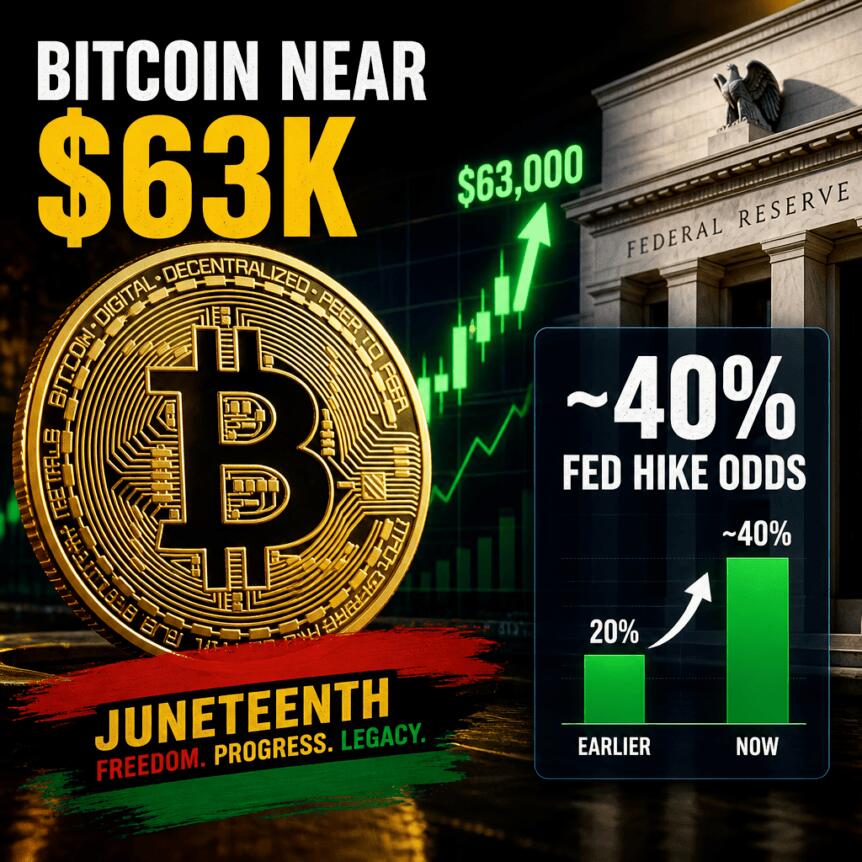
Bitcoin pushed back above $63,000 on Friday as traders digested a mix of macro policy signals and renewed attention on US-Iran tensions. The bounce came after BTC weakened into eight-day lows and then stalled near week-to-date support levels, suggesting the market was still searching for direction rather than building fresh momentum.
Alongside calmer volatility in crypto, attention drifted to the Strait of Hormuz and the implications of a recently signed US-Iran memorandum of understanding—developments that market participants typically treat as a tail-risk driver for risk assets, including Bitcoin.
Key takeaways
- Bitcoin’s rebound above $63,000 lacked follow-through, with BTC still confined to tight intraday ranges after falling to eight-day lows.
- The Federal Reserve’s latest decision was interpreted as broadly hawkish, with CME Group data pricing in close to a 40% chance of a hike at the next FOMC meeting.
- US-Iran tensions remain a live macro concern, with reporting highlighting that traffic through the Strait of Hormuz depends on Iran’s permission.
- One trader framed the current period as potentially leading to a “black swan” event later in the bear-market cycle.
Bitcoin stalls after the Fed’s more hawkish tone
BTC/USD trade activity remained range-bound on lower time frames following a move down to eight-day lows, according to TradingView data referenced by market coverage. Rather than accelerating higher, the market consolidated—an early sign that buyers were not yet confident enough to press beyond recent resistance.
The shift back toward tighter trading conditions followed the Federal Open Market Committee (FOMC) meeting, which was the first for new Fed chair Kevin Warsh. The Fed kept interest rates at current levels and, importantly, did not provide the kind of dovish cues traders had been looking for.
In the Fed’s post-meeting statement, Warsh emphasized that inflation remains above the committee’s 2% goal, noting that supply shocks have contributed to price increases in sectors such as energy. The statement also reiterated that the committee “will deliver price stability,” a message analysts interpreted as less accommodating than some market hopes.
Commentary from trading resource The Kobeissi Letter pointed to a change in how Fed communications may work going forward. The account argued Warsh’s approach was unusual compared with expectations that had him being more aligned with President Donald Trump’s calls for rate cuts, adding that the FOMC statement was also shortened and forward guidance appeared reduced.
In particular, the Kobeissi Letter highlighted a concern that communication could become less informative, arguing that this would increase uncertainty because fewer policy signals would be available to markets.
That uncertainty showed up in rate expectations. CME Group’s FedWatch Tool (as cited in the coverage) indicated markets were pricing in roughly a 40% probability of a rate hike at the next FOMC meeting in late July. In a market that often treats interest-rate direction as a key driver for liquidity and risk appetite, that pricing supports the idea that BTC’s recent weakness and hesitation may be more policy-linked than purely crypto-internal.
US-Iran developments keep geopolitical risk on the board
With US markets closed for the Juneteenth holiday, crypto remained more exposed to global headlines without the usual wall of liquidity from traditional markets. The renewed focus on the US-Iran conflict helped bring the Strait of Hormuz back into the discussion—specifically, whether transit through the narrow waterway will effectively remain controlled by Iran.
Earlier coverage noted that the US and Iran signed a memorandum of understanding (MoU). However, Friday’s commentary suggested the agreement does not remove deeper strategic disagreements. In reporting cited by Kobeissi, traffic through the Strait of Hormuz cannot cross without Iran’s permission.
Kobeissi’s account clarified that while the MoU suggests transit through the Strait of Hormuz would be “free” for the duration of its 60-day term, it does not resolve the broader question of long-term control. The post further concluded that Iran appears to be preparing for longer-term control of Hormuz.
Geopolitical risk typically matters for Bitcoin through a macro channel: tensions can translate into energy price pressure, inflation concerns, and shifts in market risk appetite—each of which can affect the pricing of risk assets.
Supporting that macro linkage, WTI crude oil continued to trade around $75 per barrel after posting its lowest levels since early March, according to the coverage. Even without a dramatic jump in oil at the time, the market’s willingness to track Hormuz-related developments underscores how quickly conditions can change.
Traders look for a “black swan” later in this bear market
As near-term volatility cooled, some market participants began framing what comes next rather than reacting only to today’s price action. Rekt Capital, a trader and analyst cited in the article, suggested that Bitcoin’s more decisive test may not arrive immediately.
In a post on X, Rekt Capital told followers that “there tends to be a Black Swan event in the second half of Bitcoin Bear Markets,” presenting it as a pattern-based lesson rather than a specific forecast of timing or magnitude.
While such commentary cannot be treated as a data-driven prediction, it reflects a broader reality of crypto cycles: markets often experience delayed shocks rather than smooth, linear declines or rebounds. For traders, the practical takeaway is that a quiet patch—especially one following a macro-driven selloff—can sometimes be a pause before a more consequential move.
What to watch from here
Bitcoin’s current range behavior above $63,000 appears closely tied to Fed-driven uncertainty and geopolitical headlines. Traders will likely keep an eye on evolving rate pricing ahead of the late-July FOMC meeting, as well as further developments around Strait of Hormuz transit and oil-market signaling—two factors that can quickly reintroduce volatility if the narrative shifts.
For years, Bitcoin miners were little more than leveraged bets on BTC prices. That’s changing fast. As mining margins tighten and demand for AI computing accelerates, the industry’s biggest players are discovering that access to power and data center infrastructure may be more valuable than hash rate.
That shift gained further validation this week as Nvidia reportedly prepared a $20 billion bond sale to finance the next phase of its AI expansion, reinforcing the multi-year investment cycle that Bitcoin miners are increasingly positioning themselves to serve.
Elsewhere, the tokenized real-world asset market continued to defy the broader crypto downturn, Ripple expanded its African payments push with an investment in Flutterwave and former FTX CEO Sam Bankman-Fried failed to overturn his fraud conviction.
Nvidia’s $20 billion bond offering reinforces Bitcoin miner AI pivot
Nvidia wants to sell $20 billion-worth of bonds to finance the next phase of its AI expansion, reinforcing the growth trend that has prompted Bitcoin miners to pivot toward AI and data center infrastructure.
Bloomberg reported Monday that the chipmaker is pursuing a multi-part bond offering to fund AI-related investments and refinance existing debt. The longest-dated bonds are expected to offer considerably higher yields than comparable US Treasury securities.
The sustained AI buildout has created new opportunities for Bitcoin miners, many of which are repurposing their energy-intensive facilities and power infrastructure for high-performance computing and AI hosting as mining economics remain under pressure. Companies including HIVE Digital, Hut 8, CleanSpark and TeraWulf are increasingly positioning themselves as AI infrastructure providers.
Source: Cointelegraph
Tokenized RWAs defy crypto bear market
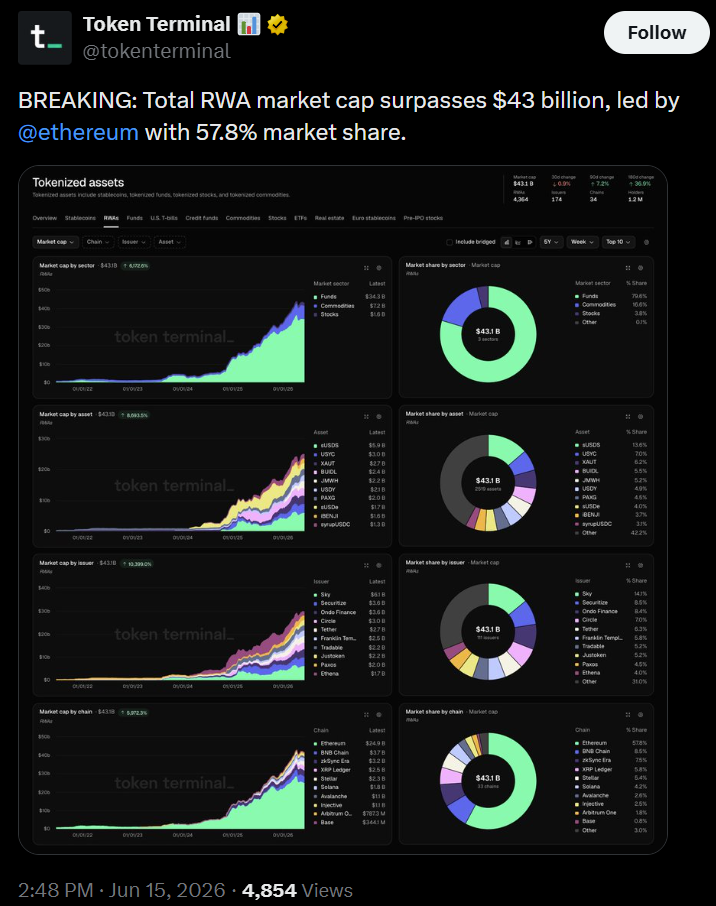
The tokenized real-world asset (RWA) market continues to grow despite broader crypto weakness, with the total value of onchain financial assets surpassing $43 billion — a 37% increase over the past six months, according to Token Terminal.
Tokenized funds make up the overwhelming majority of the RWA market, representing nearly 80% of all onchain financial assets, though commodities and tokenized stocks are gaining traction.
The sector’s momentum comes as major financial institutions forecast significant long-term growth. Standard Chartered expects tokenization to help drive decentralized finance toward a $2.7 trillion market capitalization by 2030, while Citigroup projects tokenized RWAs could reach $5.5 trillion over the same period.
Source: Token Terminal
Ripple invests in African payment company
Ripple has invested an undisclosed amount in Flutterwave, one of Africa’s fastest-growing remittance companies, in a deal that values the fintech startup at $3.3 billion.
The transaction will bring Ripple’s RLUSD stablecoin, Ripple Payments platform and XRP Ledger infrastructure to one of Africa’s largest payment providers, which operates across 35 countries, as blockchain-based remittances continue to gain traction.
The deal marks another step in Ripple’s push to expand its payments network across Africa, where demand for faster and lower-cost cross-border transfers is rapidly increasing. Last October, the company partnered with South Africa’s Absa Bank to provide institutional digital asset custody solutions, further strengthening its presence on the continent.

Source: Flutterwave
Sam Bankman-Fried loses appeal
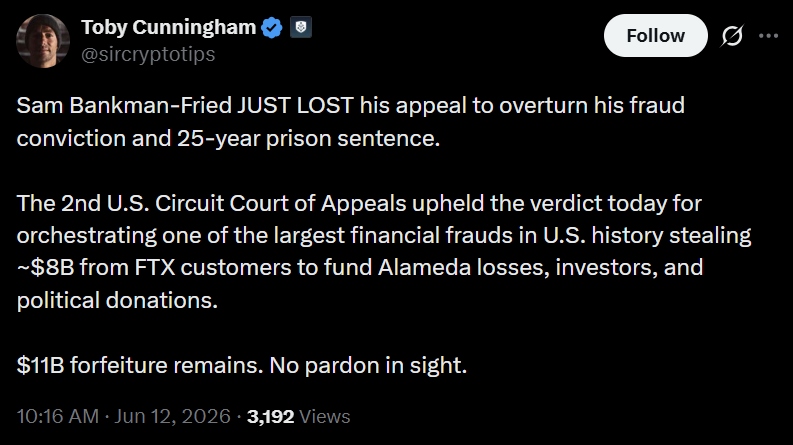
Former FTX CEO Sam Bankman-Fried failed to overturn his fraud conviction after a three-judge appeals panel in Manhattan upheld the verdict, finding that he received a fair trial.
“While he was publicly reassuring customers, investors and regulators that FTX customer funds were safe, he was simultaneously using FTX as his own personal piggy bank, spending customer funds on real estate, political contributions, and investments,” wrote Circuit Judge Barrington Parker.
Bankman-Fried was convicted on fraud and conspiracy charges tied to FTX’s collapse and sentenced to 25 years in prison in 2024. As Cointelegraph reported, he has also formally applied for a presidential pardon from US President Donald Trump, with the request appearing on the Pardon Attorney website in early June.
Source: Toby Cunningham
Crypto Biz is your weekly pulse on the business behind blockchain and crypto, delivered directly to your inbox every Thursday.
Bitcoin (BTC) is once again approaching its yearly low near $59,000 after a failed recovery attempt left bulls unable to reclaim key resistance levels. BTC traders are now anticipating new lows for 2026 as the price drifts back toward a major support zone.
However, exchange inflows from mid-sized investors across Binance and Coinbase recently dropped to their lowest levels since April 4, easing further selling pressure.
Liquidation data also shows more than $4 billion in leveraged positions concentrated near the $59,000 level, a setup that may lead to a downside liquidity sweep before a recovery rally towards the $68,000 range.
Bitcoin traders target liquidity pocket below $59,000
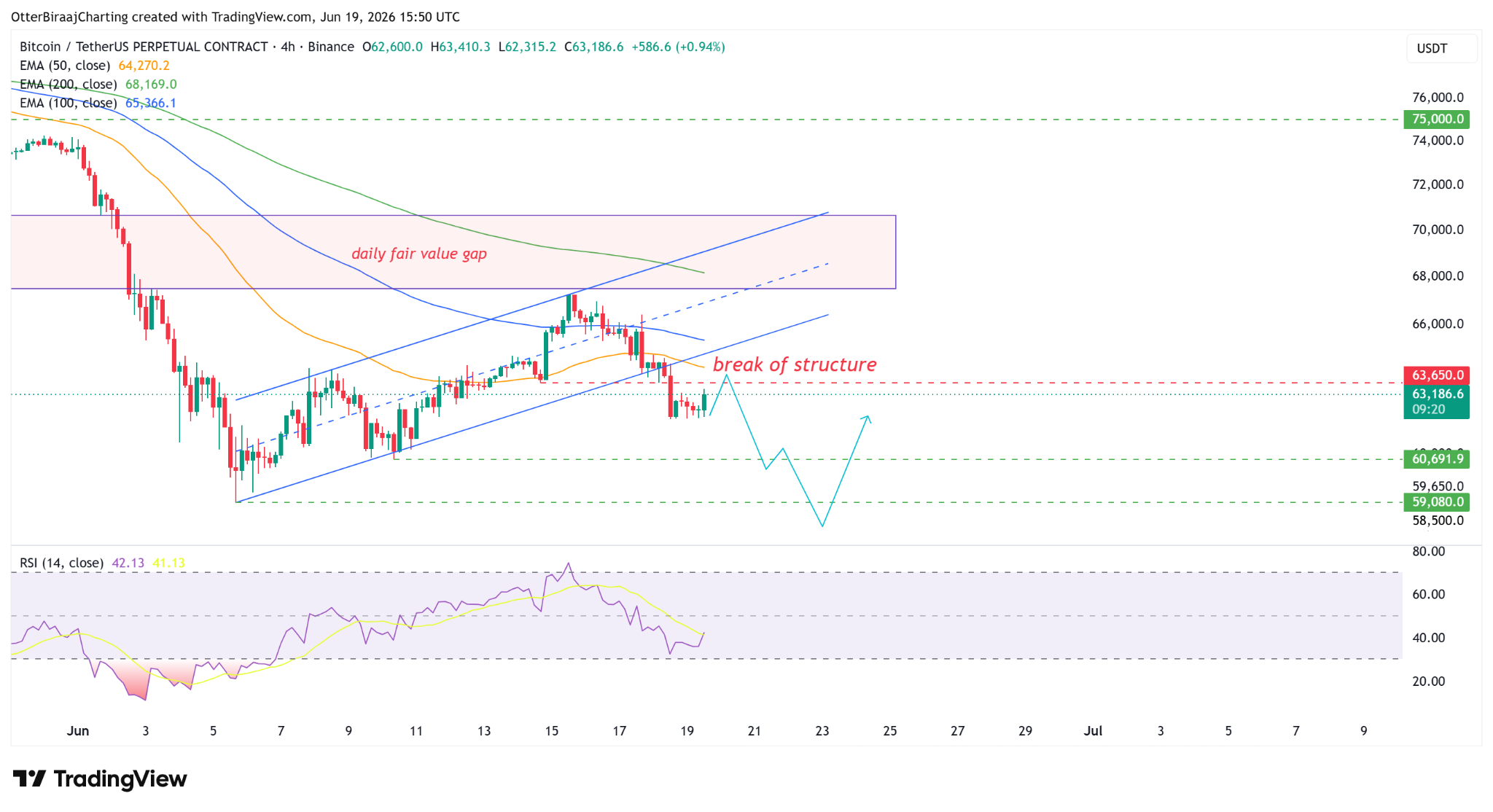
Bitcoin’s recovery attempt stalled before reaching the daily fair-value gap between $67,500 and $70,500. The sellers regained control near the 50-day and 100-day exponential moving averages, which continue to act as overhead resistance.
The rejection pushed BTC below an ascending channel, confirming a bearish break of structure on the four-hour chart. The price is currently trading below the channel range, with internal liquidity support near $60,700 as the next area of interest, followed by the yearly low at $59,000.
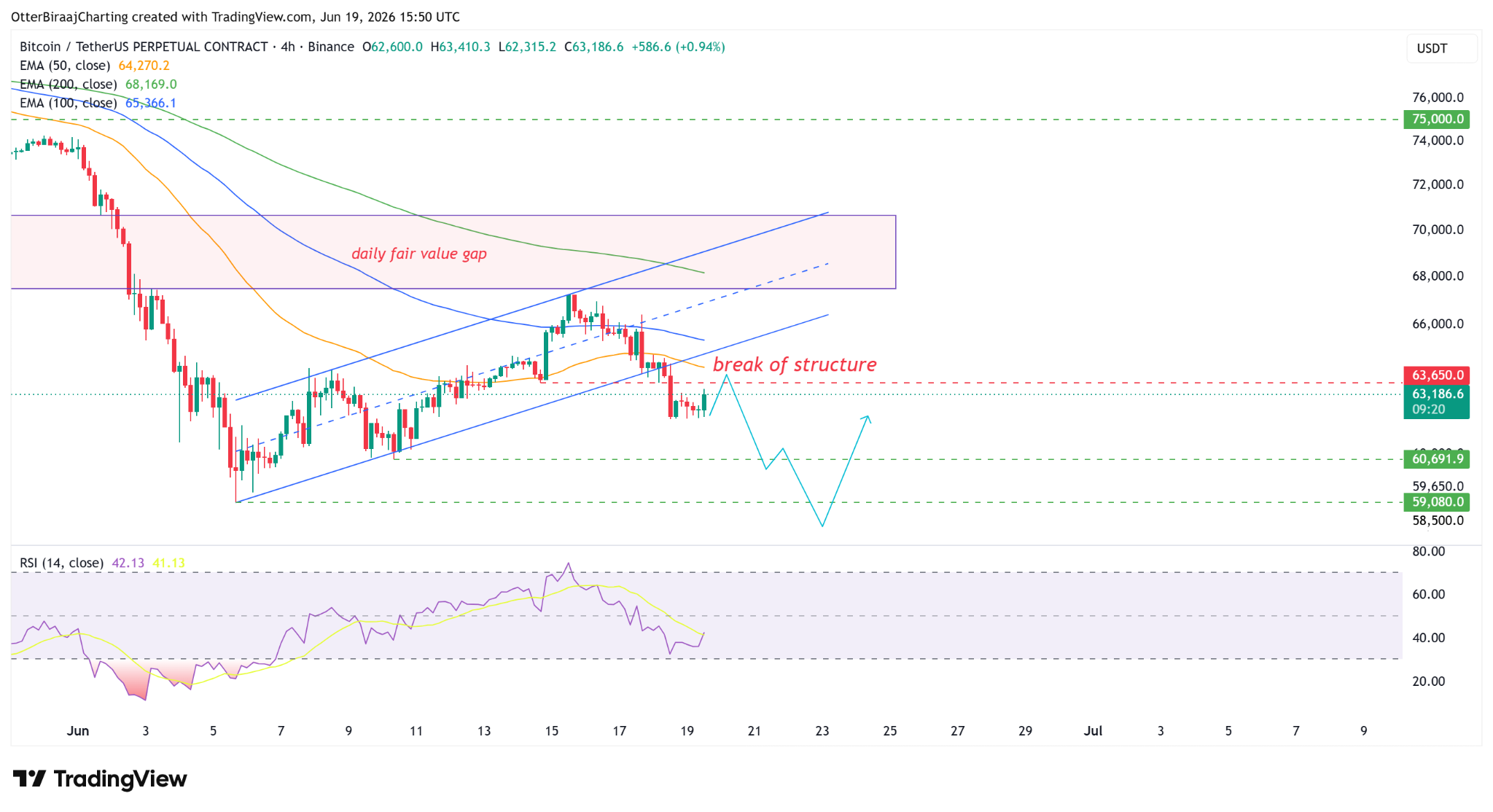
BTC/USD, four-hour chart. Source: Cointelegraph/TradingView
The liquidation data adds weight to that zone. Around $4 billion in cumulative leveraged long positions is concentrated near $59,000. A move into that area could trigger forced selling and flush out late long positions. Beyond that level, the next major liquidity concentration is near $68,000, where more than $4.75 billion in cumulative positions are clustered.
The momentum conditions are also approaching an extreme. The relative strength index (RSI) is hovering near oversold territory. Another push toward yearly lows would likely drive the indicator below 30, a level that may precede a sharp relief bounce after liquidations.
Crypto analyst Killa said Bitcoin could still front-run the liquidity pool below $60,000 rather than fully sweeping it. The trader argued that markets often move in the opposite direction of levels that attract widespread attention, similar to how Bitcoin front-ran liquidity above $140,000 in October 2025.
BTC trader LP also warned against becoming “too bearish here” in the short term, pointing to a potential bottom forming toward late June.
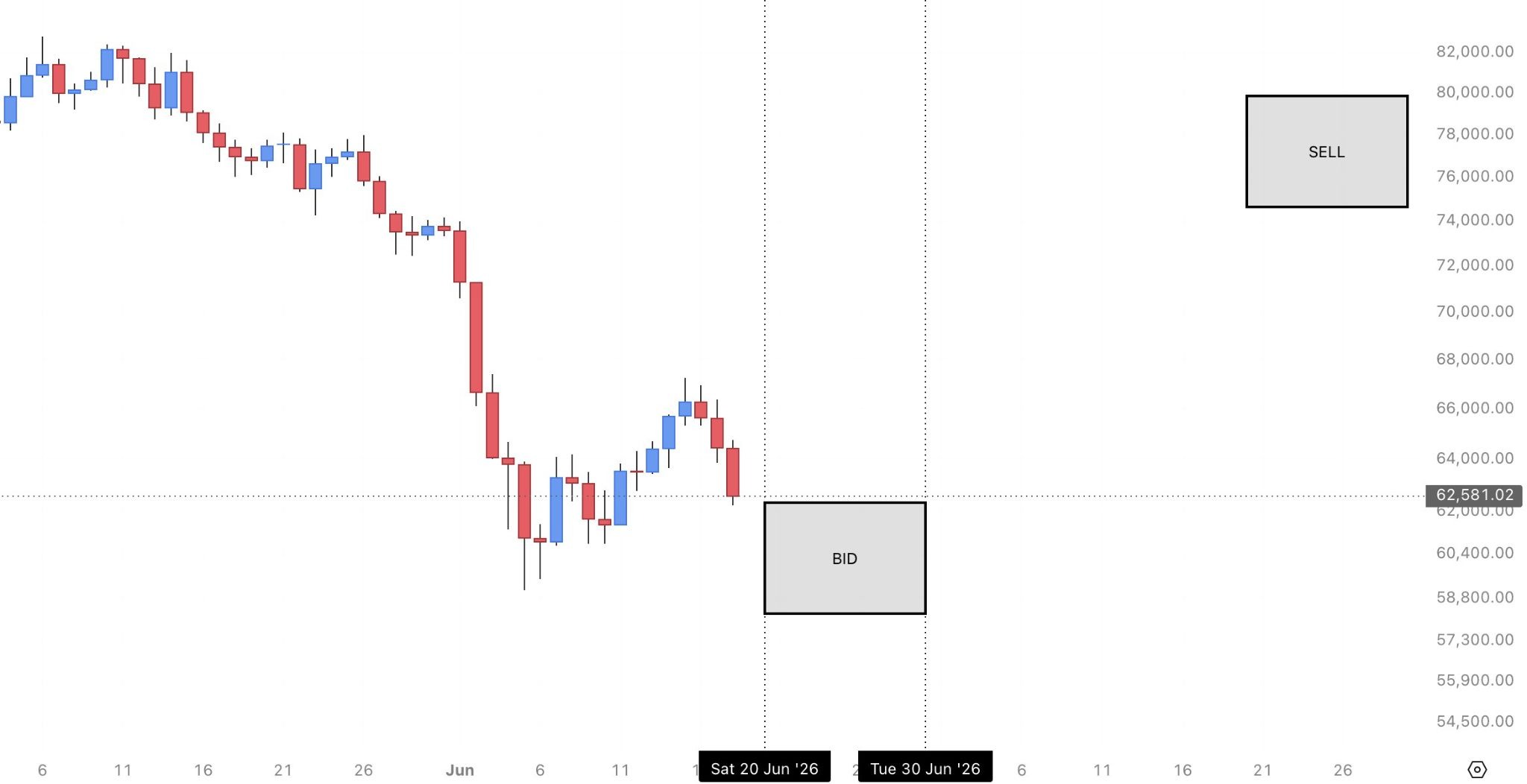
BTC/USD, one-day chart analysis by LP. Source: X
Related: Bitcoin’s deeply discounted versus AI-stocks, but hawkish Fed risk lingers: Bitwise
BTC exchange inflows continue to decline
According to CryptoQuant analyst Amr Taha, inflows from mid-sized Bitcoin investors declined simultaneously across Binance, Coinbase, and Coinbase Prime on June 19. Binance recorded roughly 3,500 BTC in inflows, Coinbase nearly 3,000 BTC, and Coinbase Prime about 1,700 BTC, the lowest readings since April 4.
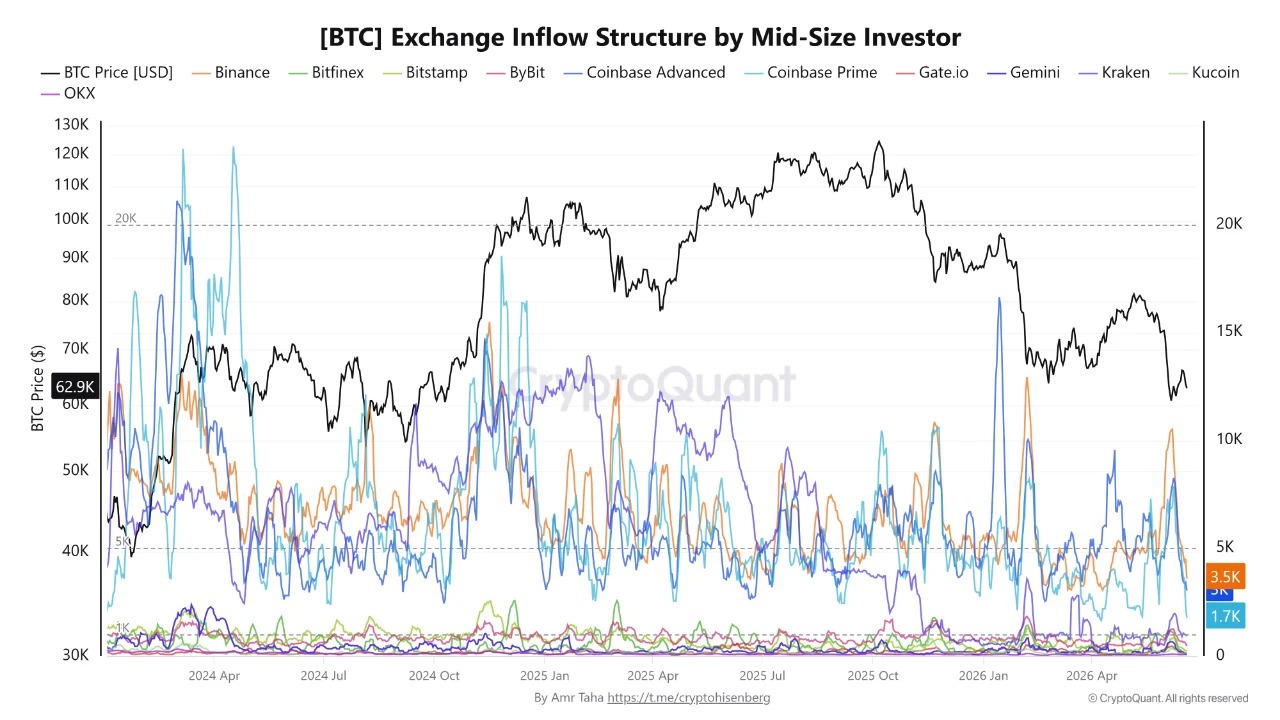
BTC exchange inflow structure by mid-size investors. Source: CryptoQuant
Exchange inflows are commonly tracked as a measure of potential selling intent. Lower deposits mean fewer coins are being positioned for immediate sale. This indicates one source of near-term sell pressure has eased.
The trend does not signal new demand on its own. It shows that mid-sized holders are reducing transfers to trading venues as Bitcoin trades near $62,000. For now, the flow data points to lighter exchange-side pressure even as price tests a major liquidity concentration near yearly lows.
Related: Bitcoin tipped for Q3 ‘macro bottom’ near $50K as major liquidity grab looms
Crypto World
CME Group to Sue CFTC Over Perpetual Futures Approval, Citing Dodd-Frank Swaps Definition


CME Group plans to sue the Commodity Futures Trading Commission over the agency's approval of crypto perpetual futures, the world's largest derivatives exchange operator announced Wednesday evening on CNBC. Outgoing Chief Executive Terrence Duffy said the case would be filed as soon as Thursday and… Read the full story at The Defiant

At the start of June, the two largest cryptocurrencies by market capitalization tumbled to their lowest levels in years. However, many analysts believe the cycle bottoms have not occurred yet.
The big question now appears to be whether Bitcoin (BTC) or Ethereum (ETH) will find its floor first, and here’s the take of one popular market observer.
Is ETH First in Line?
X user Ted argued that the second-biggest cryptocurrency is more likely to bottom before the industry’s undisputed leader. He claimed that most of the downside liquidity has been taken out, projecting a plunge to $1,300-$1,400.
“But after that, upside liquidity will start to look more interesting,” he added.
Shortly after, Ted noted ETH’s drop below the critical $1,700 mark and warned that the asset could post a further 5-6% decline if it doesn’t reclaim this level.
There are plenty of other analysts who believe the worst for Ethereum is ahead. Ali Martinez said the asset is breaking down from its channel and is trading below the 200-hour SMA. That said, he expects a drop toward $1,580.
Niels also claimed that ETH hasn’t bottomed for this cycle, predicting a crash to as low as $1,200 sometime this year. At the same time, they see the current price level as a great buying opportunity.
How About BTC?
Earlier in June, the primary cryptocurrency plummeted to nearly $59,000 for the first time since late 2024. Ted, like many other industry participants, thinks this was not the bottom.
He spotted a massive liquidity cluster around $50,000-$60,000, describing it as the same zone with large BTC buy orders on exchanges. With that in mind, Ted said that the price will likely sink to $50K “with a possible wick.”
X users bee and Crypto Lens have also made bearish forecasts. The former opined that BTC is “on the verge of the final flush,” expecting a drop to $51,000-$52,000, while the latter envisioned a downturn to $43,000 by August this year.
However, it’s not all doom and gloom. Certain factors, such as the declining amount of BTC held on exchanges, suggest a rebound is also possible. As CryptoPotato reported, the figure recently dipped to a six-year low, meaning that investors have abandoned centralized platforms in favor of self-custody, thereby reducing immediate selling pressure.
Meanwhile, whales scooped up more than 30,000 BTC in a week: a strong signal that they are positioning for the next rally and something that could encourage retail investors to jump on the bandwagon, too.
The post Bitcoin (BTC) or Ethereum (ETH): Which Will Bottom First? appeared first on CryptoPotato.

Ethereum may be heading toward a funding crisis that could begin to emerge within the next three to nine months, according to former Ethereum Foundation contributor Trent Van Epps.
In a recent article on X, Van Epps, who recently ended his five-year stint at EF, said the risk is not simply the result of a temporary funding gap but originates from deeper structural changes taking place across the ecosystem.
Funding Crunch
Van Epps spoke about EF’s long-standing philosophy of “Subtraction,” a strategy that aims to gradually reduce the Foundation’s influence and encourage the broader Ethereum community to take on a larger role in supporting the network.
While he said the approach has been successful in conveying that the EF does not want to remain Ethereum’s sole center of power, he believes it has been less effective at ensuring other institutions step in to fill the gaps left behind.
According to Van Epps, the Ethereum Foundation still occupies a unique position within the ecosystem due to factors such as its reputation, historical role in leading the protocol, connection to Ethereum co-founder Vitalik Buterin, ownership of major communication channels and trademarks, as well as its long-standing support of core developers and researchers.
However, he added that one of the Foundation’s most important resources, its treasury, is becoming increasingly constrained.
The EF has spent much of its ETH holdings over the last decade helping bootstrap Ethereum’s growth and has already begun reducing spending to preserve remaining funds. He highlighted the Foundation’s treasury plan announced in June 2025, which outlined a gradual reduction in annual spending from 15% to a 5% endowment-style level by 2030.
Van Epps also pointed to the expiration of Ethereum’s Client Incentive Program (CIP) in April 2026. The four-year initiative provided funding to client teams through staking rewards, and no replacement program has been announced so far.
Shrinking Resources
Based on conversations across Ethereum’s core development community, he said these developments have created a real risk that funding pressures could start building over the coming months. He estimated that maintaining Ethereum’s current development capacity requires roughly $30 million per year to support client teams, researchers, and coordination efforts across the ecosystem.
Without stable funding, Van Epps warned that Ethereum could lose contributors who have accumulated years of critical expertise, which makes it harder to tackle major challenges such as scaling the network and preparing for future threats like quantum computing. According to the former contributor, the consequences of underinvestment may not be immediately visible but could become apparent within the next 12 to 18 months, when reversing the damage would be significantly more difficult and expensive.
Van Epps believes the Ethereum Foundation is unlikely to remain the network’s primary steward over the next decade, as he echoed recent comments from Vitalik Buterin that the organization was never intended to serve as Ethereum’s permanent caretaker. He called for new institutions and sustainable funding mechanisms capable of supporting Ethereum’s long-term development and maintaining the shared resources the ecosystem depends on.
The post Ethereum’s Biggest Risk May Be a Funding Crunch, Former EF Contributor Warns appeared first on CryptoPotato.

Sam Raimi’s New WW2 Thriller Is Officially Coming to Netflix

5 Ways to Make Money in 2026 (with AI)

Democratic socialists are winning major mayor’s races


-

 Business5 days ago
No Jackpot Winner as $257 Million Prize Rolls Over to $269 Million Monday Draw
-
 Crypto World5 days ago
Zimbabwe Requires Crypto Businesses to Register Annually Under New FIU Regulations
-

 Crypto World7 days ago
Bitget enters Argentina’s regulated crypto market through PSAV registration
-

 Tech7 days ago
NanoClaw integrates JFrog registries to secure AI agent downloads
-

 NewsBeat7 days ago
FBI searches office of Ohio voter registration group
-
 Entertainment5 days ago
Matt Damon’s Viral Sci-Fi Thriller Has Taken Over HBO Max
-

 Business5 days ago
Anthropic staff to meet White House officials next week, Axios reports
-

 Tech5 days ago
As AI companies race to go public, who else is along for the ride?
-
 Crypto World5 days ago
Bitcoin could crash to $48,000, if this historical pattern is triggered
-

 Politics5 days ago
“Israel’s” ban on ICRC visits ruled illegal, but Knesset moves to stop them permanently
-
 NewsBeat5 days ago
Warning of disruption as Cardiff Crossrail works to start
-

 News Videos5 days ago
Financial Accounting | Last Day Revision Strategy and Booster | CMA Inter – June 2026
-
 NewsBeat5 days ago
Tributes to former deputy head teacher at Cambridge school among death and funeral notices
-
 NewsBeat5 days ago
what doctors are seeing in ebike crashes
-

 Entertainment6 days ago
Deion Sanders Shares Powerful Post After Viral Advice To Deiondra
-
 Entertainment5 days ago
Kate Middleton Glare Goes Viral After Kids Booed At Royal Event
-

 Crypto World5 days ago
XRP ETFs Outperform As Bitcoin And Ethereum Funds Extend Outflow Trend
-
 Crypto World5 days ago
Market Preview: SpaceX (SPCX) IPO Record, Federal Reserve Meeting, and Iran Nuclear Agreement
-

 Business5 days ago
Invesco Quality Income Fund Q1 2026 Commentary
-

 Tech5 days ago
Over 400 Arch Linux packages compromised to push rootkit, infostealer
You must be logged in to post a comment Login