
Crypto World
Bitcoin Miners Pivot to AI as Tokenized RWAs Surge and Ripple Expands Africa Push


For years, Bitcoin miners were little more than leveraged bets on BTC prices. That’s changing fast. As mining margins tighten and demand for AI computing accelerates, the industry’s biggest players are discovering that access to power and data center infrastructure may be more valuable than hash rate.
That shift gained further validation this week as Nvidia reportedly prepared a $20 billion bond sale to finance the next phase of its AI expansion, reinforcing the multi-year investment cycle that Bitcoin miners are increasingly positioning themselves to serve.
Elsewhere, the tokenized real-world asset market continued to defy the broader crypto downturn, Ripple expanded its African payments push with an investment in Flutterwave and former FTX CEO Sam Bankman-Fried failed to overturn his fraud conviction.
Nvidia’s $20 billion bond offering reinforces Bitcoin miner AI pivot
Nvidia wants to sell $20 billion-worth of bonds to finance the next phase of its AI expansion, reinforcing the growth trend that has prompted Bitcoin miners to pivot toward AI and data center infrastructure.
Bloomberg reported Monday that the chipmaker is pursuing a multi-part bond offering to fund AI-related investments and refinance existing debt. The longest-dated bonds are expected to offer considerably higher yields than comparable US Treasury securities.
The sustained AI buildout has created new opportunities for Bitcoin miners, many of which are repurposing their energy-intensive facilities and power infrastructure for high-performance computing and AI hosting as mining economics remain under pressure. Companies including HIVE Digital, Hut 8, CleanSpark and TeraWulf are increasingly positioning themselves as AI infrastructure providers.

Source: Cointelegraph
Tokenized RWAs defy crypto bear market
The tokenized real-world asset (RWA) market continues to grow despite broader crypto weakness, with the total value of onchain financial assets surpassing $43 billion — a 37% increase over the past six months, according to Token Terminal.
Tokenized funds make up the overwhelming majority of the RWA market, representing nearly 80% of all onchain financial assets, though commodities and tokenized stocks are gaining traction.
The sector’s momentum comes as major financial institutions forecast significant long-term growth. Standard Chartered expects tokenization to help drive decentralized finance toward a $2.7 trillion market capitalization by 2030, while Citigroup projects tokenized RWAs could reach $5.5 trillion over the same period.
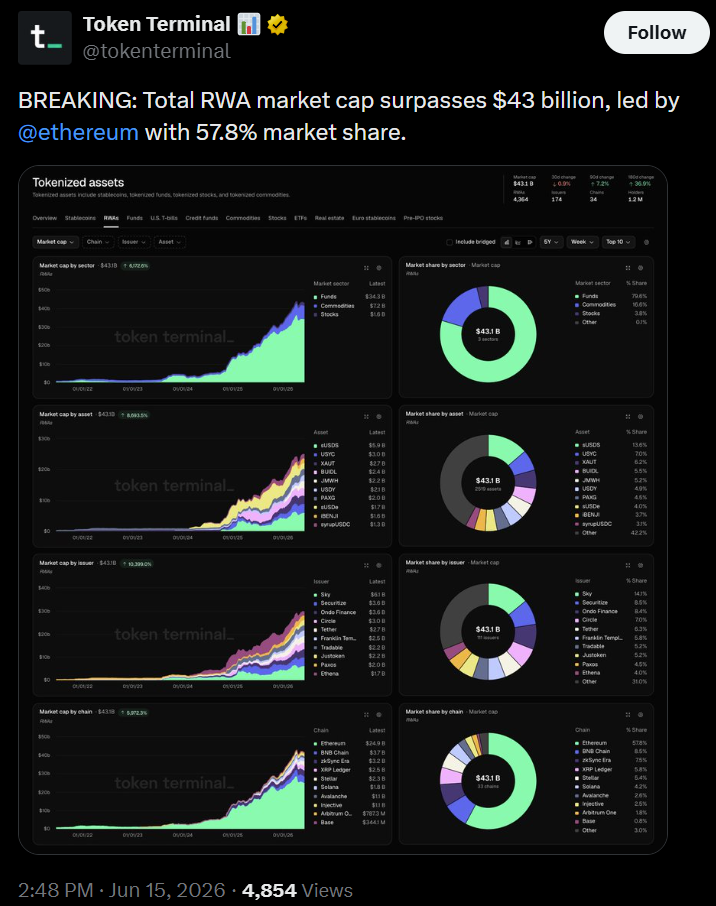
Source: Token Terminal
Ripple invests in African payment company
Ripple has invested an undisclosed amount in Flutterwave, one of Africa’s fastest-growing remittance companies, in a deal that values the fintech startup at $3.3 billion.
The transaction will bring Ripple’s RLUSD stablecoin, Ripple Payments platform and XRP Ledger infrastructure to one of Africa’s largest payment providers, which operates across 35 countries, as blockchain-based remittances continue to gain traction.
The deal marks another step in Ripple’s push to expand its payments network across Africa, where demand for faster and lower-cost cross-border transfers is rapidly increasing. Last October, the company partnered with South Africa’s Absa Bank to provide institutional digital asset custody solutions, further strengthening its presence on the continent.

Source: Flutterwave
Sam Bankman-Fried loses appeal
Former FTX CEO Sam Bankman-Fried failed to overturn his fraud conviction after a three-judge appeals panel in Manhattan upheld the verdict, finding that he received a fair trial.
“While he was publicly reassuring customers, investors and regulators that FTX customer funds were safe, he was simultaneously using FTX as his own personal piggy bank, spending customer funds on real estate, political contributions, and investments,” wrote Circuit Judge Barrington Parker.
Bankman-Fried was convicted on fraud and conspiracy charges tied to FTX’s collapse and sentenced to 25 years in prison in 2024. As Cointelegraph reported, he has also formally applied for a presidential pardon from US President Donald Trump, with the request appearing on the Pardon Attorney website in early June.
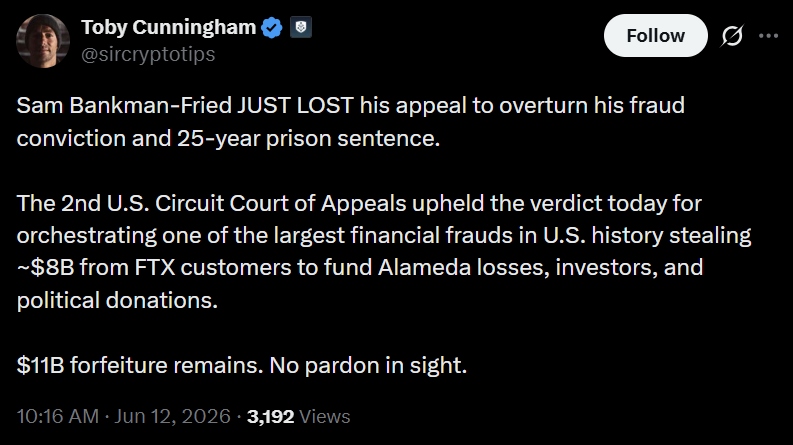
Source: Toby Cunningham
Crypto Biz is your weekly pulse on the business behind blockchain and crypto, delivered directly to your inbox every Thursday.


Ken Griffin’s Citadel has reportedly stepped in to buy a large portion of the publicly traded stock portfolio of Situational Awareness, the hedge fund run by former OpenAI researcher Leopold Aschenbrenner. The deal comes after steep losses tied to last month’s broad selloff in AI-linked equities.
According to the Financial Times, Citadel purchased the discounted portfolio after Situational’s performance deteriorated in July’s AI stock rout. Earlier reporting from The Wall Street Journal indicated Situational fell about 67% during July, even as it was still up roughly 80% for the year at the time of a letter sent to investors.
Key takeaways
- Citadel reportedly bought much of Situational Awareness’s publicly traded equity portfolio after major July losses in AI-linked stocks.
- Reports cite liquidity pressure, including the need to handle lender margin calls, though Reuters could not confirm whether formal margin calls were issued before certain share sales.
- SEC filings show Situational held public stakes in AI-adjacent names such as Sandisk, CoreWeave-related exposure, and Bloom Energy as of March 31, alongside a sizable Bitcoin mining share portfolio.
- It remains unclear which exact holdings were included in the Citadel transaction and whether any of the miner positions were retained.
From AI selloff to portfolio sale
The reported acquisition follows a sharp equity drawdown that hit hedge funds concentrated in AI infrastructure and related trades. The Financial Times said Citadel bought the portfolio at a discount after Situational Awareness suffered heavy losses during July’s AI stock market rout.
The sequence of events described by major outlets suggests liquidity became the limiting factor. The Wall Street Journal reported that Situational needed cash to meet margin calls from its lenders. In that account, the fund agreed late Wednesday to sell $3.5 billion of Anthropic shares to a group led by Greenoaks and Sequoia Capital, but then withdrew from the deal after agreeing terms for a Citadel-led portfolio transaction.
Reuters separately reported that Citadel bought most of Situational’s stock holdings after the AI share rout and described details of the leveraged portfolio and share sales. Reuters also stated it could not determine whether formal margin calls had been issued before the Anthropic-related sale discussions. Reuters added that Situational retained about $10 billion in stocks and private investments, including exposure to Anthropic.
What July losses looked like in holdings
Several stocks connected to Situational Awareness’s portfolio reportedly dropped sharply during July. Yahoo Finance data cited in the coverage shows Sandisk down about 44% for the month even after closing Thursday up 26%. CoreWeave was down nearly 26% in July, while Bloom Energy fell around 32%, according to the same dataset.
While those monthly declines underline how concentrated positions can magnify market stress, they also illustrate why a portfolio sale at “discounted” terms can become attractive to a counterparty—particularly when pricing dislocations occur across an entire thematic trade rather than a single company-specific issue.
SEC filings point to AI infrastructure and Bitcoin mining exposure
Situational Awareness’s U.S. Securities and Exchange Commission filing reportedly shows direct share positions in at least three companies—Sandisk, CoreWeave, and Bloom Energy—as of March 31. The SEC document is used to ground the public-equity portion of the story, including what was held before July’s drawdown.
The same filing also showed approximately $1.11 billion in shares of seven Bitcoin (BTC) mining companies, including Iren, Core Scientific, Riot Platforms, and CleanSpark. Cointelegraph previously reported that the strategy involved miner exposure that could benefit from demand for AI and high-performance computing by repurposing power supplies and data center sites.
In this round of reporting, however, the critical open question for investors is scope: it is not clear which specific stocks were included in the Citadel transaction, and it remains uncertain whether Situational retained any of its Bitcoin miner positions after the sale of the public stock portfolio.
Why the trade may signal shifting leverage risk
Across hedge fund industry coverage, the theme in situations like this is rarely the long-term thesis of an investor—it’s how leverage and collateral requirements interact with fast-moving equity markets. The reporting around margin calls and the need for cash suggests the fund’s ability to keep positions through volatility was constrained.
At the same time, the asymmetry between what is publicly visible and what is financially decisive remains. Reuters’ note that it could not confirm whether formal margin calls had been issued before certain transactions highlights the limits of what outsiders can verify in real time—especially when term sheets, lender discussions, and collateral mechanics are involved.
For readers tracking crypto-adjacent strategies, the story also underscores that “AI” and “crypto infrastructure” exposures are increasingly intertwined. Situational’s reported combination of AI-linked equity holdings and Bitcoin miner stock exposure reflects a broader market reality: demand for power, computing, and deployment of infrastructure can connect traditional equity investing, AI narratives, and crypto mining businesses.
Watch items after the reported deal
Investors should watch for further clarity on which holdings Citadel acquired, whether Situational retained any miner positions, and how the fund’s remaining $10 billion of reported stocks and private investments evolve after July’s volatility. Until additional filings or confirmations arrive, the practical takeaway remains straightforward: when leverage meets thematic drawdowns, portfolio exits can happen quickly—even for funds that may still look strong over a longer time horizon.

The state is seeking at least $36 billion in damages from the prediction market platform it calls an unlicensed gambling operation, and has filed for a temporary restraining order to halt its contracts immediately.
Summary
- New York Attorney General Letitia James and Governor Kathy Hochul sued KalshiEX on July 31, 2026, in New York Supreme Court, Manhattan, seeking at least $36 billion in compensatory damages, triple-gains penalties, and $100,000 per unauthorized sports wagering offer.
- The state simultaneously filed a motion for a temporary restraining order to halt Kalshi’s event contracts in New York immediately, citing ongoing harm to consumers including users under the legal gambling age of 21.
- Kalshi users bet over $1 billion monthly on the platform in 2025, with 90% of that volume on sports, according to figures cited in the AG’s own release, a concentration that makes the bipartisan Senate proposal to ban sports event contracts existential for the business.
- Kalshi, valued at roughly $22 billion with annualized volume of approximately $178 billion, calls the suit “political theater” and argues its CFTC registration as a designated contract market means exclusive federal oversight.
- A bipartisan coalition of 38 state attorneys general has already filed an amicus brief supporting Massachusetts in a parallel case, signaling that the enforcement wave extends far beyond the 13 states with active litigation.
The lawsuit that prediction markets knew was coming
Two days after the Second Circuit denied Kalshi emergency relief on July 29, New York filed the most aggressive state action yet against the prediction market industry. The suit arrived with a coordinated announcement from AG James and Governor Hochul, counts spanning multiple bodies of state law, a $36 billion damages demand, and a motion for an immediate restraining order.
The $36 billion figure, reported by The Block based on the court filings, is roughly 1.6 times Kalshi’s reported valuation. It is the number every major outlet is leading with, and it signals that New York is treating this as a revenue-extraction case, not merely a cease-and-desist.
This piece examines the filing, the legal arguments on both sides, the federal regulator caught between them, and what the case means for an industry now fighting a war on two fronts: in courtrooms and in Congress.
What the complaint actually alleges
The core claim is straightforward: Kalshi is running an unlicensed gambling business in New York.
The AG’s office says the platform lets users place wagers on uncertain future events, from Super Bowl outcomes to reality TV winners to election results, without a Gaming Commission license and without paying state gaming taxes. New York treats these as bets, not derivatives, regardless of Kalshi’s CFTC registration.
The complaint goes further. It alleges Kalshi allows users aged 18 to 20 to place bets, violating New York’s 21-and-older minimum for mobile sports betting. It alleges the platform offered wagers on games involving New York college teams, a separate violation under state law.
The AG’s investigators placed test wagers from New York accounts as evidence: four “Yes” contracts on a UConn-Michigan basketball game at $1.14 in April 2026, and ten contracts on the winner of “Big Brother” in July 2026. Both transactions completed without obstruction.
The filing also introduces a count under the federal Interstate Wire Act, alleging Kalshi used wire communications to transmit bets across state lines. This is significant because it widens the legal exposure beyond state gambling statutes into federal criminal law, giving the state an argument that operates independently of the preemption question. Even if Kalshi’s CFTC registration were found to preempt state gambling law, the Wire Act is a federal statute, and the state is arguing that Kalshi violates it.
The complaint details the investigative methods in unusual specificity. Rather than relying on industry reports or third-party data, the OAG built its case from the inside. Investigators created accounts, placed real wagers, and documented each step. This matters for the TRO motion: the state can present firsthand evidence that illegal gambling is actively occurring in New York, not merely that it could occur.
“Prediction markets like Kalshi are gambling platforms, plain and simple,” James said in a statement accompanying the filing.
Governor Hochul framed the action around consumer protection, saying Kalshi “has chosen to ignore New York’s gaming laws, which exist to protect consumers, prevent problematic gambling, deliver funding for critical public services, and ensure that every company plays by the same rules.” The coordinated announcement from both the AG and the Governor signals that this is not a routine regulatory action. It is a political priority.
The $36 billion in damages and the TRO
New York is not seeking a slap on the wrist. The headline number is at least $36 billion in compensatory damages, pending a full accounting of Kalshi’s operations. The remedies demand:
- A permanent injunction barring Kalshi from operating unlicensed gambling in the state
- A temporary restraining order halting Kalshi’s event contracts in New York immediately
- A full accounting of every customer bet and loss processed through the platform
- Forfeiture and disgorgement of all gains the state deems illegal
- Restitution to affected consumers
- Penalties of three times Kalshi’s gains under Penal Law Section 80.10
- A fine of $100,000 per unauthorized sports wagering offer under the Racing Law
The TRO is the near-term threat. If granted, Kalshi would need to suspend operations in New York while the case proceeds, potentially for years. The triple-damages provision is the long-term one. At $36 billion, New York is claiming a figure that exceeds the platform’s reported valuation of $22 billion by more than 60%.
The per-offer fine structure adds another layer. The AG’s release notes that Kalshi users bet over $1 billion monthly in 2025, with 90% of that volume on sports. Each unauthorized sports offering carries a $100,000 fine under the Racing Law. At that volume, the per-offer penalties alone could produce a figure in the hundreds of millions.
The damages calculation itself reveals the state’s theory of the case. New York is not treating Kalshi as a minor regulatory violator that failed to file paperwork. It is treating Kalshi as a gambling operation that processed billions in unlicensed wagers over multiple years, and it wants the full economic benefit of that activity returned. The $36 billion figure presumably reflects the total volume of wagers placed by New York users, or a substantial fraction of it, multiplied by the treble-damages provision. The final number will depend on the full accounting the state is requesting, but the opening demand is meant to establish the scale of the alleged violation.
The TRO motion deserves separate attention because it operates on a different timeline from the main case. A TRO hearing can happen within days or weeks, while the underlying lawsuit could take years. If New York secures the restraining order, Kalshi faces an immediate operational decision: comply and lose the New York market, or challenge the order and risk contempt proceedings. Either outcome sets a precedent that other states can follow. Michigan and Nevada secured their own TROs through similar procedural mechanisms, and each one reduced Kalshi’s geographic footprint.
The $1 billion monthly number and why it matters
The AG’s release includes a figure that has received less attention than the $36 billion headline: Kalshi users bet over $1 billion every month on the platform in 2025, and 90% of that money went to sports betting.
This is the number that makes the bipartisan Senate proposal to ban CFTC-licensed platforms from offering sports event contracts existential. Sports are not a side product for Kalshi. They are the product. If sports contracts are removed, whether by state enforcement or federal legislation, the platform loses nine-tenths of its recorded consumer activity.
The figure also undercuts Kalshi’s framing of its offerings as sophisticated financial derivatives. A billion dollars a month on the Super Bowl, the NBA, and college basketball looks like a sportsbook by any name. New York is making exactly that argument, and the AG’s investigators have the receipts.
The concentration matters for investors and market participants as well. Kalshi’s $22 billion valuation implies a diversified event-contract platform serving a range of use cases: elections, weather, economics, entertainment. The AG’s data shows something closer to a sports gambling platform with a derivatives label. If the valuation was underwritten on the assumption of product diversity, the 90% sports concentration represents a disclosure risk independent of the legal outcome.
Kalshi’s federal preemption defense
Kalshi’s position rests on a single legal premise: that its 2020 registration with the CFTC as a designated contract market means its event contracts are regulated derivatives under the Commodity Exchange Act, subject to exclusive federal oversight.
The company calls the suit “political theater” and argues states cannot simply shut down a federally licensed exchange. The framing is deliberate. Kalshi wants this treated as a jurisdictional question, not a gambling question.
It is the strongest version of their argument, and it carries legal weight. The CFTC itself has backed the position, filing lawsuits against multiple states and claiming exclusive regulatory authority over prediction markets. On the same day New York filed its suit, the CFTC filed an emergency counter-motion in Manhattan federal court less than one hour before the state complaint dropped, attempting to reassert federal jurisdiction preemptively.
The federal regulator has now challenged state enforcement in at least nine states, including filing suit against Arizona, Connecticut, and Illinois in April 2026. The CFTC is not a passive bystander in this dispute. It is an active combatant on Kalshi’s side.
Why the federal shield is cracking
On July 7, U.S. District Judge Analisa Torres denied Kalshi’s preliminary injunction against New York’s Gaming Commission enforcement. Her reasoning cut directly at the preemption argument.
Torres cited Section 2 of the Commodity Exchange Act, which states the law “shall not supersede or limit the jurisdiction conferred on other regulatory authorities under the laws of the United States or of any state.” She wrote that “Congress did not intend to regulate so broadly as to exclude all state gambling laws from regulating transactions involving swaps.”
Her conclusion was blunt: “There is nothing preventing Kalshi from obtaining a license pursuant to New York law.”
The Second Circuit denied Kalshi emergency relief on July 29. With the appellate safety net gone, the state had a clear path to file.
The Torres ruling matters beyond New York because it provides a template. Other states facing Kalshi’s preemption argument can cite it directly. The decision rejects the premise that CFTC registration creates a blanket exemption from state gambling law, and it does so by citing the Commodity Exchange Act’s own text. Before Torres, Kalshi could argue that no court had squarely addressed the question. That argument is gone.
The legal logic is worth following in detail. Kalshi’s preemption claim rests on the idea that CFTC registration means its products are regulated derivatives, full stop. Torres responded that the Commodity Exchange Act explicitly preserves state jurisdiction, that the products in question resemble gambling under New York law, and that nothing in federal statute prevents Kalshi from obtaining a state gaming license if it wants to operate in New York. The decision does not say Kalshi cannot exist. It says Kalshi cannot avoid state gambling law by pointing to a federal license that, by its own statute’s terms, was never meant to override it.
The Second Circuit’s refusal to grant emergency relief on July 29 reinforced this reasoning. It did not issue a full opinion, but the denial means Kalshi failed to show a likelihood of success on the merits, which is the standard for emergency relief. Two levels of federal courts have now declined to protect the company from state enforcement.
The result is a genuine constitutional question about the boundary between federal commodity regulation and state gambling law. Kalshi needs either a circuit court reversal or Congressional action to restore the shield it thought it had.
The 38-state coalition
The count that matters is not 13 states with active litigation. It is 38.
In April 2026, James joined a bipartisan coalition of 38 state attorneys general filing an amicus brief supporting Massachusetts in its parallel case against Kalshi. The coalition spans from Alabama to Wisconsin, including red states, blue states, and the District of Columbia. The full list: Alabama, Alaska, Arizona, Arkansas, California, Colorado, Connecticut, Delaware, Hawaii, Idaho, Illinois, Iowa, Kansas, Louisiana, Maine, Maryland, Michigan, Minnesota, Mississippi, Nebraska, Nevada, New Jersey, New Mexico, New York, North Carolina, Ohio, Oklahoma, Oregon, Pennsylvania, Rhode Island, South Carolina, South Dakota, Tennessee, Utah, Vermont, Virginia, Wisconsin, and DC.
On the same day the AGs filed, the CFTC filed its own amicus brief at the Massachusetts Supreme Judicial Court asserting exclusive federal jurisdiction, creating a direct confrontation between the federal regulator and a supermajority of state enforcement agencies.
New York is not operating in isolation. The suit fits into a pattern of escalating state enforcement that has accelerated through 2026:
Massachusetts has a court order restricting Kalshi. Polymarket has countersued the state, opening a second front.
Michigan secured a temporary restraining order against the platform under AG Dana Nessel, making it the third state to obtain a court order.
Nevada issued a TRO covering sports, election, and entertainment contracts. Kalshi responded by removing those categories for Nevada users, effectively conceding the state’s authority in practice while contesting it in court.
Washington holds its own court order restricting the platform. The state’s Gambling Commission issued a cease-and-desist, and Kalshi did not challenge it in court.
Wisconsin handed down an adverse ruling the week of July 28, adding another state to the enforcement column in a decision that received less coverage than the New York and Massachusetts actions but follows the same legal reasoning.
New York itself previously sued Coinbase and Gemini in April 2026 on similar prediction-market allegations. That suit broadened the target set beyond pure-play prediction platforms, signaling that New York views any company offering prediction-style products to state residents as subject to gaming law, regardless of whether the company’s primary business is elsewhere.
In Congress, a bipartisan Senate proposal has emerged that would ban CFTC-licensed prediction market platforms from offering sports event contracts, which would remove the category that accounts for 90% of Kalshi’s recorded volume.
The arithmetic that matters
Kalshi’s reported valuation of $22 billion rests on the assumption that its CFTC registration provides a durable regulatory moat. The annualized transaction volume of $178 billion flows through that assumption. If the federal preemption argument fails at the circuit level, the business model does not downgrade gracefully.
The platform cannot operate as a state-licensed gambling business without fundamental changes to its product, its economics, and its user base. State gaming licenses come with specific requirements: age floors (21 in New York for mobile betting), tax obligations, product restrictions, and compliance infrastructure that a CFTC-registered exchange was never built to support.
Nevada’s example is instructive. When the state issued its TRO, Kalshi did not fight to keep sports, election, and entertainment contracts available to Nevada users. It removed them. If that pattern repeats across additional states, the platform’s addressable market contracts with each new enforcement action.
The numbers tell the story in three layers. First, $36 billion in damages sought in New York alone, exceeding the company’s valuation by 60%. Second, 38 state attorneys general aligned against the federal preemption argument, representing a supermajority of American enforcement capacity. Third, 90% of Kalshi’s monthly volume concentrated in sports, the single category most vulnerable to both state enforcement and the pending Senate ban.
The counter-argument deserves its strongest form. Kalshi’s $178 billion in annualized volume proves genuine consumer demand for event contracts. The CFTC registration is not a legal fiction, and federal regulators are actively fighting to preserve federal jurisdiction. The Commodity Exchange Act does grant the CFTC authority over designated contract markets, and a reasonable reading of federal preemption could conclude that state gambling law should not apply to products traded on a federally licensed exchange. If the CFTC prevails at the appellate level, or if Congress acts to clarify federal preemption, the state cases collapse. Kalshi’s appeal of the Torres ruling remains live, and the Second Circuit has not yet ruled on the merits.
There is also a policy argument that Kalshi rarely makes explicitly but that supports its position. Prediction markets have informational value. Research from academic institutions and the CFTC’s own prior statements have recognized that event contracts can produce useful price signals about future events. A state-by-state licensing regime could effectively kill a market structure that regulators, academics, and the public have found valuable for forecasting elections, economic indicators, and policy outcomes.
But the burden has shifted. Two federal courts have declined to protect Kalshi from state enforcement. Thirty-eight attorneys general have aligned against the federal preemption argument. And 90% of Kalshi’s volume is concentrated in sports, the single category most politically vulnerable. The question is no longer whether states can regulate prediction markets. The question is whether Kalshi can find a court that says they cannot.
What to watch
- The TRO hearing in New York Supreme Court. If granted, Kalshi must suspend operations in the state while the case proceeds. The timeline and conditions of this hearing will set the pace for the entire case.
- The Second Circuit appeal of Judge Torres’s July 7 ruling. If the court reverses on federal preemption, the state enforcement wave stalls. If it affirms, expect additional state filings within weeks.
- The CFTC’s emergency motion filed hours before New York’s suit. The federal court’s handling of this motion will signal whether the judiciary treats CFTC registration as a meaningful shield or a regulatory label.
- Congressional action on the bipartisan Senate proposal to ban sports event contracts. At 90% of Kalshi’s volume, this would be a structural blow regardless of court outcomes.
- Kalshi’s operational response in states with active enforcement. Nevada’s pattern, removal of categories rather than legal confrontation, is the leading indicator of how the business adapts under pressure.
What did New York sue Kalshi for?
New York filed a lawsuit alleging Kalshi operates an unlicensed gambling business by offering wagers on sports, entertainment, and election outcomes without a Gaming Commission license and without paying state gaming taxes. The suit includes counts under the state constitution, Penal Law gambling provisions, the Racing Law, and the federal Interstate Wire Act.
How much is New York seeking in damages?
The state is seeking at least $36 billion in compensatory damages, pending a full accounting of Kalshi’s operations. Additional penalties include three times the company’s gains under Penal Law and $100,000 per unauthorized sports wagering offer under the Racing Law.
What is the temporary restraining order?
Alongside the lawsuit, New York filed a motion for a TRO to halt Kalshi’s event contracts in the state immediately while the case proceeds. If granted, Kalshi would need to suspend operations in New York, potentially for years.
What is Kalshi’s defense?
Kalshi argues that its registration with the CFTC as a designated contract market since 2020 means its event contracts fall under exclusive federal oversight and that states cannot regulate them as gambling. The company calls the suit “political theater.”
How did the court rule on federal preemption?
U.S. District Judge Analisa Torres denied Kalshi’s preliminary injunction on July 7, ruling that the Commodity Exchange Act does not prevent states from applying their gambling laws to event contracts. The Second Circuit denied emergency relief on July 29.
How many states are aligned against Kalshi?
A bipartisan coalition of 38 state attorneys general filed an amicus brief supporting Massachusetts in a parallel case. At least five states, Massachusetts, Michigan, Nevada, Washington, and Wisconsin, have active court orders or adverse rulings restricting Kalshi’s operations.
What role is the CFTC playing?
The CFTC has positioned itself as the exclusive federal regulator of prediction markets, filing lawsuits against multiple states and an emergency motion less than one hour before New York’s suit. The agency has challenged state enforcement in at least nine states and filed an amicus brief directly opposing the 38-state attorney general coalition.
Could this lawsuit shut down prediction markets entirely?
The New York case alone would not end the industry, but it tests whether CFTC registration shields platforms from state gambling laws. With 38 attorneys general aligned against the federal preemption argument and 90% of Kalshi’s volume concentrated in sports betting, the combination of state enforcement and the pending Senate ban on sports event contracts could force a fundamental restructuring of the business model. This is educational analysis, not investment advice.
This article is for informational purposes only and does not constitute legal, financial, or investment advice. The information presented reflects the state of events as of July 31, 2026, and may change as legal proceedings develop. Readers should consult qualified professionals before making decisions based on this material.

Japan’s Ministry of Finance confirmed yen buying, dollar selling intervention on July 30, sending USD/JPY sharply lower before the pair recovered later. However, the rebound highlighted how intervention alone struggles to reverse a long-term trend without monetary policy support.
Meanwhile, the Bank of Japan kept its policy rate at 1.0% after its July meeting while maintaining a tightening bias. For crypto, narrowing US-Japan rate differentials and a softer dollar could pressure the yen carry trade, a major funding source for leveraged risk assets, including Bitcoin.
Discover: The Best Token Presales
Yen Intervention Alone Cannot Reverse the Trend
Japan has intervened several times to support the yen over the past two years, including large-scale operations in 2024 and another confirmed move on July 30. Each intervention briefly strengthened the currency before market forces regained control. That pattern reflects the wide interest rate gap between Japan and the United States, which still favors holding dollars over yen.

Reports also suggested Japanese officials remained in close contact with US counterparts during the intervention period. However, there was no confirmation of coordinated intervention with the Federal Reserve or the US Treasury. While comments from US officials acknowledged yen weakness, the operation remained Japan-led rather than a joint currency action.
The quick recovery in USD/JPY after intervention reinforces the structural challenge. With the BoJ holding rates at 1.0%, markets focused instead on Governor Kazuo Ueda’s guidance for future hikes. That outlook, rather than intervention itself, is likely to determine whether the yen can sustain further gains.
Trade Crypto on Bybit and Get a Chance to Win Our $1,000 USDT Airdrop
Why the Yen Carry Trade Matters for Bitcoin
The yen carry trade relies on borrowing low-cost yen and investing in higher-yielding assets. As Japanese rates gradually rise while the Federal Reserve pauses, that advantage becomes smaller. Even so, the US-Japan rate gap remains wide enough to keep the strategy attractive for many investors.
Economists broadly expect the BoJ to continue raising rates cautiously over the coming quarters, although the timing remains uncertain. Some forecasts point to another increase before the year’s end, while others expect policymakers to wait until inflation and wage growth strengthen further. A gradual path would likely produce an orderly carry trade unwind instead of a sudden market shock.

The most relevant comparison remains August 2024, when an unexpected BoJ rate hike contributed to a sharp yen rally and forced investors to unwind leveraged positions. Bitcoin fell alongside equities as funding conditions tightened. Although today’s backdrop shares some similarities, current conditions are less extreme because markets already expect additional tightening.
For Bitcoin, the base case remains a gradual normalization in Japan that creates modest headwinds rather than a major selloff. However, a faster pace of BoJ tightening or another surge in the yen could accelerate deleveraging across crypto markets. That makes Japanese monetary policy an increasingly important macro factor for traders, even if intervention alone is unlikely to change the trend.
Discover: The Best Crypto to Diversify Your Portfolio
The post BoJ Holds at 1% as Yen Intervention Fades: Bitcoin’s Carry Trade Risk Grows appeared first on Cryptonews.


Ken Griffin’s Citadel has bought most of Situational Awareness’ AI stock portfolio at a discount, a move that represents another victory for the billionaire villain of the crypto industry.
Indeed, despite years of criticism about Griffin’s traditional finance tactics, the crypto industry keeps giving him more assets.
From a copy of the US Constitution, payment for order flow, equity in a $40 billion crypto holding company, and a new distressed portfolio of cheap AI stocks, crypto traders are far too willing to further enrich the billionaire CEO.
Margin calls gutted former FTX Future Fund member Leopold Aschenbrenner’s AI hedge fund earlier this week, turning the 25-year-old into a forced seller liquidated under a stack of self-imposed leverage to Griffin’s standing bid.
Griffin, unlike most crypto investors, had plenty of cash amid Aschenbrenner’s distress.
The New York Times reported that Citadel won the overnight auction for Situational Awareness’ AI stocks at a “considerable reduction” to market value.
Crypto has watched this movie before.
Cheap share certificates alongside a cheap US Constitution
When the crypto industry’s people, tokens, or trophies land across the negotiating table from Griffin, more often than not, traders often accept his lowball offer. At the eleventh hour, a little cash is better than nothing at all.
Consider what happened in November 2021 when ConstitutionDAO raised over $40 million of ETH to bid on a physical print of the US Constitution. Over 17,000 donors chipped in at a median of $206 apiece.
Their crowdfunded bid carried a fatal flaw, as Protos noted. Its balance sat on-chain in public view, so rival bidders like Griffin knew precisely where their money to bid would run out.
The DAO also reserved millions for fees and costs that it couldn’t spend on bids.
Griffin won the document at $43.2 million. Sotheby’s irrevocable-bid mechanics trimmed roughly $4.2 million off his final bill. This spring, he bought the only other privately owned first print, cornering the market for the immensely valuable collectible, despite crypto’s attempt to decentralize it.
Thanks for the payment for order flow
Payment for order flow is a predictable profit generator for sophisticated market-makers and quantitative trading companies like Citadel.
Whenever a stock brokerage or similar platform offers commission-free or “$0 fee” trades, they often engage in payment for order flow on the backend.
Citadel Securities has accounted for over 40% of all US payment for order flow in some years, and it’s happy to accept order flow from crypto traders who inefficiently smash buy or sell with “market” orders.
Of course, retail crypto traders also buy stocks and options — the same folks who route even more payment for order flow through Citadel.
On crypto trades, for example, Robinhood discloses that market makers pay it $0.95 per $100 of orders routed. Its SEC filings identify B2C2, Wintermute, and Citadel Securities among the companies paying for order flow.
Read more: Ken Griffin wants the SEC to follow Citadel’s advice about DeFi
Ripple equity, cheaper than its own tokens
Consider another example of Griffin’s one-sided crypto dealings.
In November 2025, Ripple raised $500 million at a $40 billion valuation. Affiliates of Citadel Securities co-led the round.
Although the valuation seemed impressive, Griffin wasn’t taking much risk. In fact, XRP was trading near $2.35 the day of the announcement.
That day, Ripple held roughly 37 billion XRP, a pile worth about $87 billion that day.
In other words, Citadel bought shares in a company valued at less than half its crypto holdings.
In addition to his incredibly discounted valuation, Griffin also received protections from the price risk of XRP itself.
Bloomberg reported the fine print that benefitted Citadel. Absent an IPO or sale within a few years, those Ripple investors would have the right to put their shares back to the company at a positive annual rate of return.
Citadel’s rights also stand ahead of existing shareholders in the event of any liquidation.
In summary, crypto has gifted Ken Griffin and Citadel a cheap portfolio of AI stocks, a cheap Sotheby’s art piece, cheap payments for order flow, and cheap equity at less than half its balance sheet.
Despite describing crypto in October 2021 as a “jihadist call” against the US dollar, it’s been paying him ever since.
Got a tip? Send us an email securely via Protos Leaks. For more informed news and investigations, follow us on X, Bluesky, and Google News, or subscribe to our YouTube channel.

In today’s fast-paced economy, waiting 30, 60, or even 90 days for invoice payments can strain a company’s cash flow. For small and medium-sized businesses (SMBs), delayed payments often mean delayed growth, missed opportunities, and increased reliance on expensive loans.
Blockchain-powered invoice financing is emerging as a modern solution that transforms unpaid invoices into liquid capital while making the financing process faster, more transparent, and significantly more secure.
What Is Invoice Financing?
Invoice financing allows businesses to borrow money against outstanding invoices instead of waiting for customers to pay.
Here’s a simple example:
- A business issues a $50,000 invoice with 60-day payment terms.
- Instead of waiting two months, it receives up to 90% of the invoice value immediately from a financing provider.
- Once the customer pays the invoice, the remaining balance is released after deducting financing fees.
This gives businesses immediate working capital without selling equity or taking on traditional debt.
The Problems With Traditional Invoice Financing
While invoice financing isn’t new, the traditional system has several inefficiencies.
Slow Verification
Financial institutions spend significant time verifying:
- Invoice authenticity
- Customer creditworthiness
- Business ownership
- Payment history
This manual process often delays funding.
Fraud Risks
Invoice fraud remains one of the industry’s biggest concerns.
Examples include:
- Fake invoices
- Duplicate financing
- Altered payment records
- Identity fraud
Because records are stored across multiple databases, detecting fraud isn’t always easy.
High Costs
Banks and factoring companies charge fees to cover operational costs and credit risk.
Smaller businesses frequently pay higher financing rates simply because they lack extensive credit histories.
How Blockchain Changes Everything
Blockchain introduces a shared, immutable ledger where invoices can be securely recorded and verified.
Instead of relying solely on paperwork, participants share a trusted source of truth.
Key benefits include:
Immutable Records
Once an invoice is recorded on-chain, it cannot be secretly altered.
This creates confidence among:
- Lenders
- Suppliers
- Buyers
- Auditors
Instant Verification
Blockchain enables participants to verify invoice ownership almost immediately.
Smart contracts can automatically confirm:
- Invoice creation
- Payment terms
- Due dates
- Financing status
This dramatically reduces manual paperwork.
Reduced Fraud
Every invoice receives a unique blockchain record.
This helps prevent:
- Double financing
- Duplicate invoices
- Unauthorized modifications
The transparent audit trail makes suspicious activity easier to detect.
Faster Settlement
Smart contracts automate funding.
Once financing conditions are met, payments can be released automatically without multiple intermediaries.
Businesses receive working capital much faster.
The Role of Smart Contracts
Smart contracts are self-executing programs stored on blockchain networks.
Instead of requiring manual approval, they automatically execute financing agreements.
For example:
- Supplier uploads invoice.
- Invoice is verified.
- Investor funds the invoice.
- Customer pays invoice.
- Smart contract distributes repayment automatically.
This reduces administrative overhead while minimizing human error.
Tokenizing Invoices
One of blockchain’s most exciting innovations is invoice tokenization.
An invoice can be represented as a digital asset on a blockchain.
This creates several new possibilities:
- Fractional ownership
- Secondary trading
- Global investor participation
- Increased liquidity
Instead of one lender financing an invoice, hundreds of investors could fund portions of it.
This opens invoice financing to decentralized capital markets.
DeFi Meets Invoice Financing
Decentralized Finance (DeFi) extends this concept even further.
Businesses may eventually:
- Tokenize invoices
- Use them as collateral
- Borrow stablecoins instantly
- Repay automatically when invoices settle
Rather than negotiating with a bank, financing could occur through decentralized liquidity pools operating around the clock.
This creates a more accessible financial ecosystem, particularly for underserved markets.
Benefits for Small Businesses
Blockchain-powered invoice financing offers several advantages.
Improved Cash Flow
Businesses gain immediate access to funds needed for:
- Payroll
- Inventory
- Marketing
- Expansion
Lower Costs
Automation reduces operational expenses, potentially lowering financing fees.
Greater Transparency
All financing activity is recorded on a shared ledger, reducing disputes between parties.
Expanded Access
Businesses with limited banking relationships may access financing through blockchain-based marketplaces rather than traditional lenders.
Benefits for Investors
Investors also benefit from blockchain-enabled invoice markets.
Potential advantages include:
- Transparent asset verification
- Automated repayments
- Diversified investment opportunities
- Global access to invoice portfolios
Tokenization may allow investors to purchase small portions of many invoices rather than concentrating risk in a single borrower.
Real-World Use Cases
Several industries stand to benefit significantly.
Manufacturing
Manufacturers often wait months for payment while continuing production.
Invoice financing bridges this gap.
Logistics
Shipping companies can unlock capital tied up in completed deliveries.
Healthcare
Hospitals and clinics frequently experience delayed insurance reimbursements.
Blockchain financing can improve liquidity.
International Trade
Cross-border invoice financing becomes more efficient through shared blockchain records that reduce paperwork and verification delays.
Challenges Ahead
Despite its promise, blockchain-powered invoice financing still faces obstacles.
Regulatory Compliance
Financial regulations differ across countries, requiring platforms to comply with local lending laws.
Digital Identity
Reliable identity verification remains essential to prevent fraud.
Enterprise Adoption
Many businesses continue using legacy accounting systems that require blockchain integration.
Legal Recognition
Some jurisdictions are still developing legal frameworks for tokenized financial assets.
The Future of Invoice Financing
As tokenization, digital identity, stablecoins, and smart contracts mature, invoice financing could become one of blockchain’s most impactful real-world financial applications.
Future platforms may combine:
- AI-powered credit scoring
- Blockchain verification
- Tokenized invoices
- Instant stablecoin settlement
- Global investor marketplaces
The result is a financing ecosystem that is faster, more transparent, and available to businesses regardless of geography.
Conclusion
Blockchain-powered invoice financing reimagines one of business finance’s oldest challenges: waiting to get paid.
By combining immutable records, smart contracts, tokenization, and decentralized liquidity, blockchain has the potential to reduce fraud, accelerate funding, and broaden access to working capital.
For businesses, this means healthier cash flow and greater flexibility. For investors, it unlocks a new class of transparent, income-generating assets. As adoption grows, blockchain may transform invoice financing from a slow, paperwork-heavy process into a seamless digital marketplace that keeps capital moving as quickly as modern commerce demands.
REQUEST AN ARTICLE


Bernstein has maintained its Outperform rating on Robinhood Markets with a $160 price target, saying the company’s crypto business has expanded beyond trading into tokenization and market infrastructure.
Summary
- Bernstein kept its Outperform rating on Robinhood and maintained a $160 price target.
- Robinhood Chain has processed more than $12 billion in DEX volume and over 150 million transactions since launch.
- Rothera has handled more than 3.5 billion contracts and generated $17 million in second quarter revenue.
- Bernstein said tokenized stocks, Robinhood Earn and exchange infrastructure are becoming key drivers of the company’s crypto business.
Bernstein said in a note to clients that Robinhood’s latest crypto products, including Robinhood Chain, tokenized stocks, Bitstamp and Robinhood Earn, are creating new growth opportunities outside its traditional trading business while supporting its long-term investment case.
Robinhood shares closed at $89.84 on Wednesday, the level Bernstein used in calculating about 78% upside to its unchanged $160 target. The stock later fell 3.6% to close at $86.60 on Thursday, implying roughly 85% upside based on the firm’s target price.
Robinhood Chain and tokenized stocks expand crypto business
Among the products highlighted in the report, Bernstein pointed to Robinhood Chain as one of the company’s largest crypto initiatives since entering tokenization. According to the brokerage, the blockchain has processed more than $12 billion in decentralized exchange volume and completed over 150 million transactions since launch.
The report also said Robinhood Earn has accumulated more than $200 million in customer deposits. Meanwhile, tokenized U.S. stocks are now available through Robinhood Wallet in more than 120 countries, extending the company’s reach beyond its core brokerage platform.
Bernstein said the latest developments continue a strategy Robinhood has been building throughout the year. In June, the firm argued that prediction markets had become one of Robinhood’s fastest-growing businesses during the FIFA World Cup, projecting the segment could generate $586 million in revenue in 2026 compared with an estimated $150 million in 2025.
At the time, Bernstein estimated prediction markets could account for about 17% of Robinhood’s transaction-based revenue and around 10% of total company revenue next year, supported by higher customer activity during major sporting events.
Rothera continues to scale prediction markets
Attention in the latest report also turned to Rothera, Robinhood’s exchange, which Bernstein said has continued expanding since going live in June.
According to the analysts, Rothera has processed more than 3.5 billion contracts so far, including 2.1 billion during the second quarter alone. The exchange generated $17 million in second-quarter revenue and has become the third-largest prediction market exchange in the United States, Bernstein said.
The research note said Robinhood expects more prediction-market activity to migrate onto Rothera over time while continuing to distribute event contracts from third-party exchanges. Bernstein added that management also sees the exchange as a potential business-to-business platform for other Futures Commission Merchants in the future.
The brokerage has previously argued that controlling more of the trading stack allows consumer platforms to retain a larger share of transaction economics. In a June research report, Bernstein said companies across crypto, brokerages and sports betting are increasingly combining brokerage, exchange and clearing functions instead of depending on outside providers.
Robinhood’s ownership of Rothera was presented as one example of that trend, alongside similar moves by Coinbase and DraftKings to build or acquire more of their own trading infrastructure.
Bernstein sees infrastructure becoming a competitive advantage
Beyond trading volumes, Bernstein said Robinhood’s strategy increasingly resembles a financial infrastructure business rather than a brokerage focused only on crypto transactions.
The analysts grouped Robinhood Chain, Bitstamp, Robinhood Earn and tokenized stocks as complementary products that could diversify revenue over time. The report follows Bernstein’s earlier research on Coinbase, where the firm argued the exchange was also expanding beyond crypto trading through tokenized equities, prediction markets, blockchain infrastructure and artificial intelligence tools.
While the companies are pursuing different strategies, Bernstein has consistently argued that digital asset platforms are competing to become broader financial marketplaces by adding infrastructure, custody, tokenization and regulated market products alongside traditional crypto services.
According to the analysts, ownership of exchange infrastructure may become increasingly valuable as companies seek to keep more execution and clearing revenue within their own platforms instead of relying on external providers.
Regulatory uncertainty remains part of the investment case
Despite maintaining its positive outlook, Bernstein outlined several risks that could affect Robinhood’s business.
The brokerage said changes affecting payment for order flow remain an important consideration because the model continues to contribute meaningfully to Robinhood’s brokerage operations.
Bernstein also noted that U.S. regulation surrounding digital assets continues to evolve. The analysts said the Securities and Exchange Commission has historically taken a strict approach toward crypto trading platforms, while uncertainty over whether certain digital assets should be classified as securities has yet to be fully resolved.
The report added that the digital asset industry remains in an early stage of development, meaning future regulatory decisions could influence the pace at which companies introduce new crypto products and expand tokenization services.
Even with those risks, Bernstein maintained that Robinhood’s expanding infrastructure business and growing portfolio of tokenized financial products continue to support its Outperform rating and unchanged $160 price target.
Signage at a Jersey Mike’s restaurant in Washington, July 20, 2026.
Graeme Sloan | Bloomberg | Getty Images
Five years after the initial public offering boom of 2021, public markets look a lot different as more companies are choosing to stay private for longer.
In 2021, public markets saw a multitude of companies join the ranks. The Nasdaq said it welcomed 743 IPOs that year, while the New York Stock Exchange said it added more than $1 trillion in new market capitalization, marking the second straight year of record new listings.
The biggest IPOs five years ago spanned a range of industries, including Coinbase, Roblox, Rivian, Warby Parker and more.
According to research from Morningstar, the companies that went public in 2021 raised almost $500 billion — roughly double the number of deals and capital raised in 2020, a year of intense uncertainty amid the pandemic and lowered consumer and investor confidence.
But since then, the IPO market has cooled significantly. Despite a blockbuster IPO from Elon Musk‘s SpaceX, far fewer companies are choosing to go public, and some of the ones that do have struggled to gain momentum in the current conditions.
Two consumer companies, sandwich chain Jersey Mike’s and clothing retailer Reformation, went public on Thursday. Both companies had largely uneventful IPOs, with Reformation remaining essentially flat for the day and Jersey Mike’s opening $2 below its IPO pricing and closing down nearly 6%. They join just a handful of other consumer companies that have gone public in 2026, according to Renaissance, representing a tiny slice of the overall IPO pie.
Experts say there’s a range of reasons why companies are rethinking their liquidity and capital.
“There’s under 4,000 public companies today, whereas 30 years ago, there was just under 8,000,” said Mike Dinsdale, CEO of Powerlaw, a publicly listed fund investing in private companies. “The reason for that, I think, is access to capital, and then the idea that staying private and not having any transparency into what’s happening, and then higher valuations on the public side.”
Dinsdale, who previously held executive positions at DoorDash and DocuSign, said access to capital and liquidity in nonpublic markets, along with the emergence of megafunds, have taken “the need out to rush to go public.”
He added it’s a trend he’s been seeing over the past 30 years, though the acceleration of family office interest in private companies over the past five years has contributed significantly to the trend as the private investment vehicles of the ultrawealthy look for new places to put their money.
Reformation Inc. signage during the company’s initial public offering on the floor of the New York Stock Exchange in New York, July 30, 2026.
Michael Nagle | Bloomberg | Getty Images
Secondary markets
Some of the largest consumer and retail companies have remained private, like Publix Super Markets, Sephora and Chick-fil-A.
According to Sunaina Sinha Haldea, the global head of Private Capital Advisory at Raymond James, private companies are benefitting from the rise of secondary markets.
“The secondaries market is acting as this pressure release valve to this artificial clock of having to go public,” she said. “Nobody has to go public now because of the depth of this private secondaries market.”
Venture capital has also been booming. Jason Yeh, the co-founder of Patron, a venture capital firm investing in consumer companies, told CNBC that the volatility in the public markets coupled with the stagnant performance of public consumer and retail companies has likely added to the hesitation to leave the private sphere.
“There are very large asset managers, hedge funds and other types of investors that want to buy these later-stage stakes in these large companies, and they’re able to push out having to go public longer, and you can get liquidity for earlier stage investors through that,” Yeh said.
His firm has partnered with a number of consumer companies like Sweatpals, Board, System Labs and more. He added that he believes a strong liquidity environment would mean both IPOs and acquisitions become desirable routes.
“It feels like we’re on the cusp of a handful of companies that, theoretically, on paper, should have been able to go public over the last couple of years, but will be going public ideally in the next 12 to 18 months,” Yeh said.
‘The carrot and the stick’
There are still compelling reasons for some companies to go public — an IPO is often a moneymaking move, like it was for SpaceX, which raised tens of billions of dollars when it went public.
“I do think for companies with a really strong business model of generating a lot of cash flow, eventually they will go public,” Yeh said. “Hopefully, the overall macroeconomic conditions are better when that happens, versus doing it into a weaker market.”
One of the biggest incentives to staying private is avoiding the pressure of quarterly earnings, which require revealing numbers to investors and potentially taking a hit from that visibility.
“In general, founders don’t want to go public, the majority don’t, because all of a sudden they have more visibility into what they’re doing,” Powerlaw’s Dinsdale told CNBC. “The public now has access to numbers and it has opinions on what they’re doing versus being more in control.”
To make the IPO market attractive again, he said he believes there needs to be both “the carrot and the stick,” that would make it harder to stay private while also instituting a regulatory legislative change to incentivize going public.
President Donald Trump has floated the idea of ending mandatory quarterly earnings reports, a move that was backed by the Securities and Exchange Commission earlier this year and would allow companies to report only twice a year instead. In a May statement, SEC Chairman Paul Atkins said the current rules have too much “rigidity” for companies and investors.
According to Raymond James’ Sinha Haldea, the regulation that comes with being public is a “headwind” to going down that route.
“If you are a CEO of a fast-growing company and there’s plenty of capital available, and you don’t have to deal with the governance and the reporting structures and the quarterly clock of being a public company, why would you put yourself through that?” Sinha Haldea told CNBC.
Sinha Haldea said it’s both a financial cost and a resource cost to go public rather than staying within the secondary markets and accessing capital that way. But as the milestones for companies begin to get redefined, and IPOs no longer hold quite as much weight, the “why” behind going public in every board room is no longer as simple as it used to be.
For that justification to change, and for more companies to mimic the trend of 2021 markets, she said the “operational burden of being public” has to change first.
“There is a lot of reporting compliance, litigation, dilution of management time that goes into being a public company,” Sinha Haldea said. “That equation needs to change through regulation for the decision between private and public to become more neutral.”


That didn’t happen, and probably catalyzed the closure of those bets during Friday’s 08:00 UTC expiry, which settled BTC and ether (ETH) options worth $10 billion. Notional open interest on the $70,000 call has fallen to $943 million, and on the $72,000 call to $888 million. While still significant, those levels are well below the $60,000 put.
Another interesting data point comes from seasonality. Since 2013, July has produced a median return of 8.61%. The price has risen by 8.9% this month, according to CoinDesk data. So far, so unexciting. But a positive July is usually followed by a negative August, producing a median return of -7.51%.
Median is useful here because it shows the typical outcome without being skewed by unusually large gains or losses that can distort the average. In markets like bitcoin, where a few extreme months can pull the mean up or down, the median often gives a cleaner read on what has happened most often.
That means the mood is bearish for BTC as we head into August. Stay alert!
Read more: For analysis of today’s activity in altcoins and derivatives, see Crypto Markets Today . For a comprehensive list of events this week, see CoinDesk’s “Crypto Week Ahead.”


New York has sued prediction market platform Kalshi, alleging it operates an illegal, unlicensed gambling business by offering event contracts on sports, elections and other outcomes.
The lawsuit seeks to stop Kalshi’s alleged illegal gambling operation in the state, require the company to forfeit illegal gains, pay restitution to users and pay civil penalties equal to three times those gains.
“No matter what they call themselves, prediction markets like Kalshi are gambling platforms, plain and simple,” Attorney General Letitia James said in Friday’s statement. “We are taking them to court to uphold our laws and protect New Yorkers.”
The lawsuit comes after the New York State Gaming Commission issued Kalshi a cease-and-desist order in October 2025, prompting the company to sue the regulator in federal court.
A judge denied Kalshi’s request for a preliminary injunction in July, and an appeals court later rejected its bid to block enforcement while the appeal proceeds.
Kalshi did not immediately respond to Cointelegraph’s request for comment.
CFTC defends federal oversight of prediction markets
The lawsuit adds to an escalating jurisdictional dispute over whether event contracts offered by federally regulated prediction markets are subject to state gambling laws.
Just before New York filed its case, the Commodity Futures Trading Commission (CFTC) filed an emergency motion seeking to block New York’s enforcement efforts, arguing that the state’s actions interfere with the agency’s exclusive authority under the Commodity Exchange Act to regulate designated contract markets like Kalshi.
Related: CFTC issues second warning to prediction markets on cookie-cutter self-certifications
The CFTC has taken similar positions in disputes involving at least nine states, arguing that allowing states to prohibit event contracts listed by federally regulated exchanges would create conflicting state rules and undermine federal commodities regulation.
Prediction markets continue to gain mainstream traction
Prediction markets allow users to buy and sell contracts tied to the outcome of future events, with prices reflecting the market’s estimate of the probability that an event will occur.
Kalshi’s rival, Polymarket, has also faced regulatory scrutiny, with several countries restricting or investigating its operations over gambling and licensing concerns.
Kalshi began expanding into blockchain-based infrastructure in December 2025, launching tokenized prediction markets on Solana and later adding support for multiple blockchain networks.
The broader prediction market sector has also grown alongside major sporting events.
According to analytics firm Chainalysis, blockchain-based prediction markets processed about $20 billion in trading tied to the 2026 FIFA World Cup, with more than 400,000 wallets participating.
Magazine: The 100x obsession: Fundamentals grow in importance as crypto matures
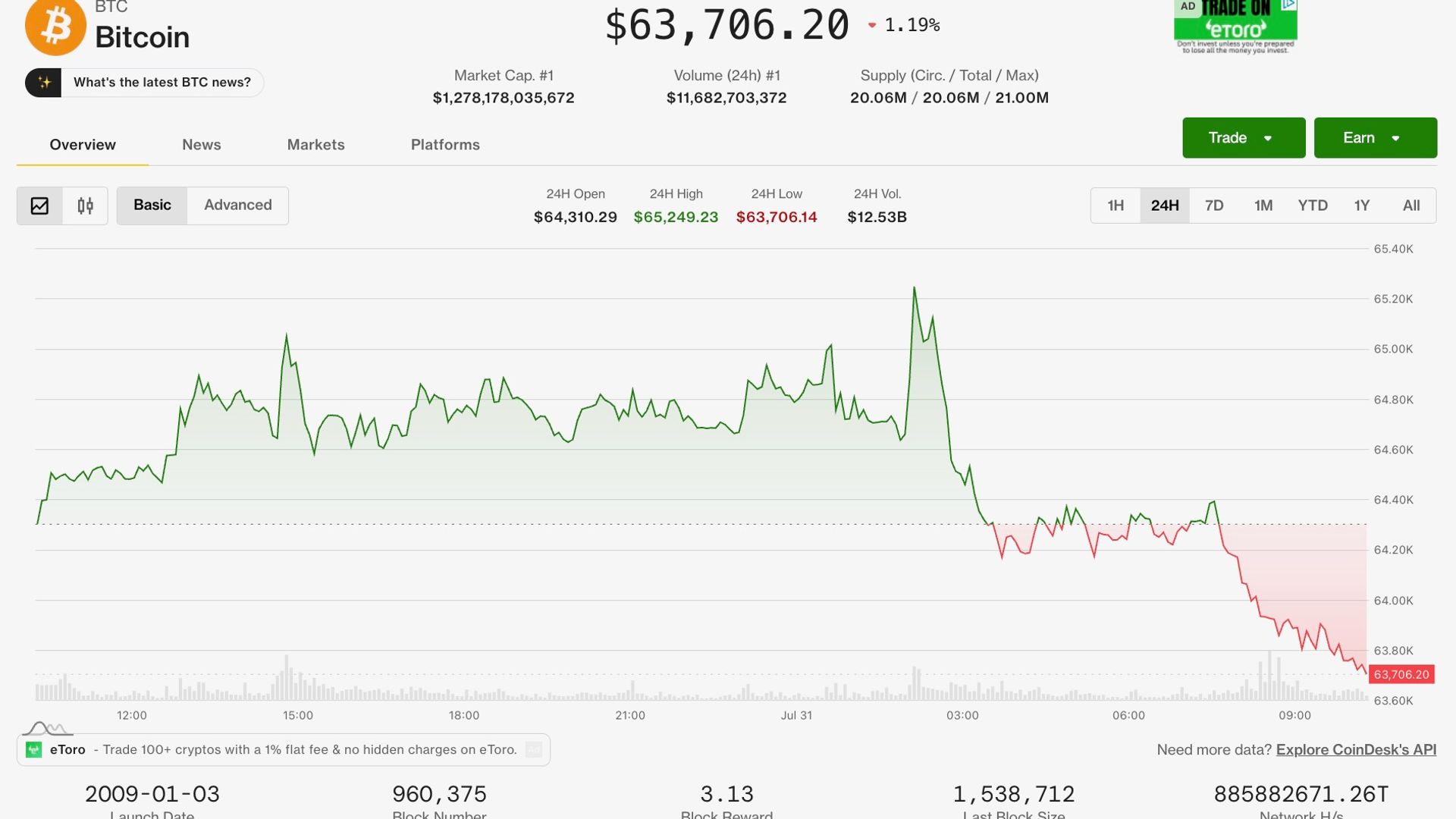
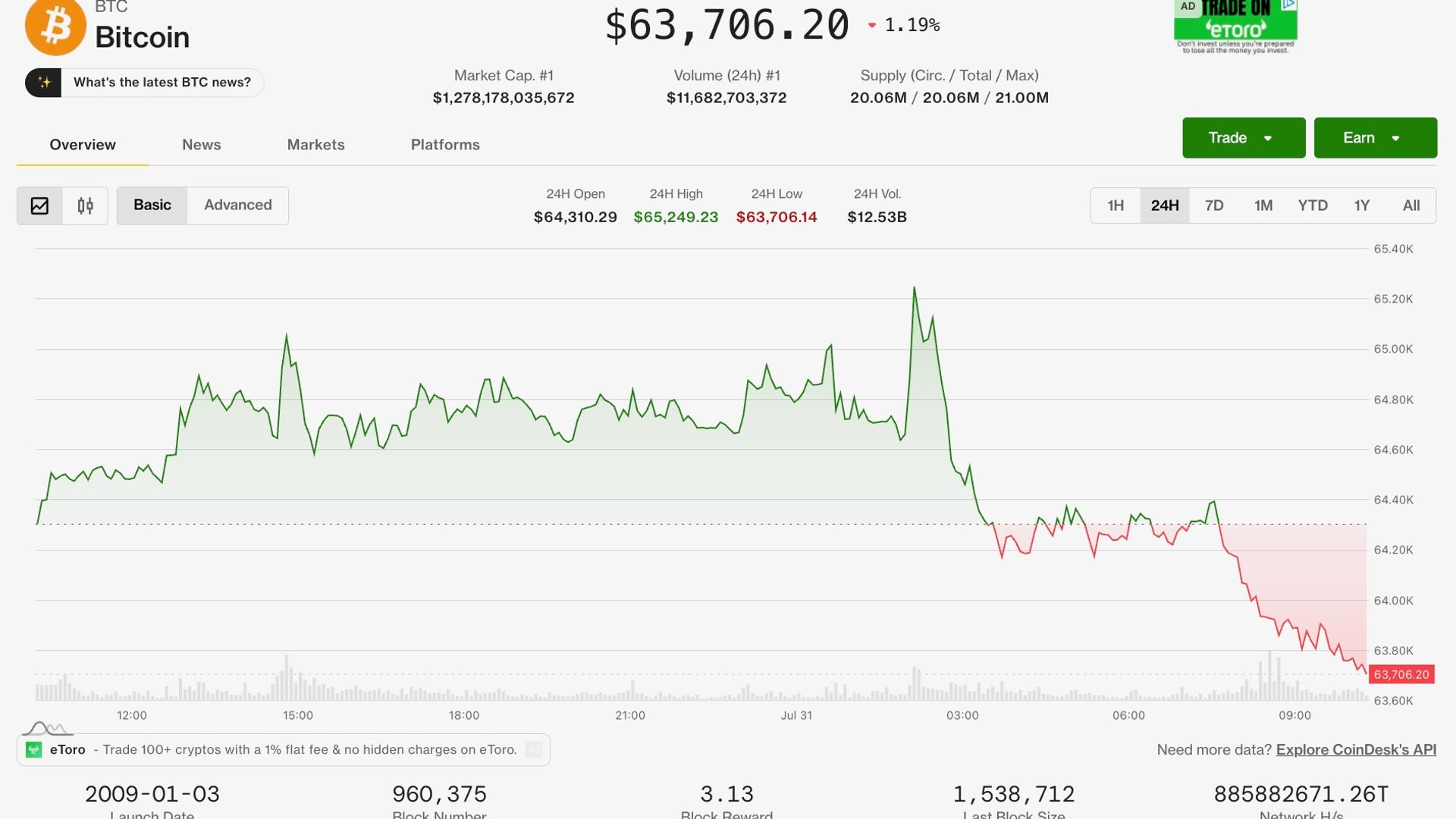
The crypto market is closing out July on the back foot, with bitcoin falling 1.31% since midnight UTC to $63,870 and ether (ETH) dropping 1.40% to $1,890 after struggling to regain the $2,000 level it touched earlier this month.
The performance is diverging from equities, with South Korea’s Kospi surging by more than 15%. Nasdaq 100 and S&P 500 index futures are also in the green.
The conflict in the Middle East and hawkish comments from the Federal Reserve committee have dented crypto’s recovery hopes this week. The CoinDesk 20 Index has dropped 2.34% since midnight Monday, though with a gain of 8.7% since June, it’s still positive for the first month in three and by the most in a year.
Derivatives positioning
- Taker long-short futures volume ratio: As the market wilts, the taker long-short futures market volume ratio continues to lean bearish, suggesting a downside bias. A taker is a market participant who executes an order immediately against an existing order in the book.
- XRP futures open interest rises: XRP’s futures open interest (OI) rose further, extending the three-week upswing to 2.27 billion tokens, the most since late June. The token’s price has declined to $1.07 from $1.13 during the period. A combination of a drop in price alongside a rise in OI is said to confirm the downtrend, a sign traders are shorting the market in anticipation of a deeper price drop.
- BTC in stasis: BTC’s OI remains static at around 750K, as it has all month. That’s a sign traders are unwilling to deploy capital in leveraged products despite signs of stability in the market. It’s no surprise that BTC’s early month bounce from under $58K has stalled in the $62K to $65K range. It’s the same story for ether and Solana.
- UNI’s OI growth: Uniswap’s UNI token is the OI growth leader for the third straight day, rising to 75.80 million UNI, a level last seen Feb. 14. This is a clear sign of investors willing to take on risk in tokens backed by positive newsflow. Recently, BlackRock decided to debut its tokenized Treasury fund on Uniswap.
- Negative cumulative volume delta: Most major tokens, including UNI, have negative 24-hour OI-adjusted cumulative volume delta, a feature consistently observed during sharp downtrends over the past year. A negative CVD means traders are shorting more at market orders than passive limit orders. In other words, bears are being more aggressive.
- Bitcoin implied volatility: Bitcoin’s BVIV, the 30-day implied volatility index, fell to 37%, the lowest since May. These levels have served as floors in recent years, bringing about a bounce in the so-called fear index. Since ETFs debuted in 2024, the BTC price correlation with the BVIV has been negative, meaning any bounce in the BVIV could be accompanied by a fresh decline in the spot price.
- Options open interest: On Deribit, bitcoin and ether options worth $10 billion expired early today. Now the distribution of open interest in remaining expiries that extend all the way to June 2027 shows a $60,000 put as the most popular bet. A put represents a bearish bet on the market.
Token talk
- Uniswap (UNI) was Friday’s standout performing altcoin, rising by 9.30% over 24 hours to $4.41 as it sustains momentum from its Robinhood layer-2 integration announced earlier this month.
- Ethena (ENA) extended its recovery, rising 1.23% since midnight UTC and 4.31% over 24 hours to $0.082, with the token now up significantly from its July lows. Keep in mind it’s still more than 90% below its all-time high.
- Lighter (LIT) fell a further 2.28% as the correction from its July peak deepened, with the token now 20% below the highs it set earlier this month after its 200% rally between May and early July.
- Zcash (ZEC) gave back 2.15% to $459 after a strong run earlier in the week, with the privacy coin sector losing ground on Friday.
- added 0.94% since midnight and 4.09% over 24 hours, quietly extending a recovery that has seen it claw back after June’s 45% plunge.

Citadel Accumulates Most Situational Awareness Portfolio Post AI Selloff

Commerce Department to take equity in seven tech companies on track for funding

KO artist who fought Canelo sets his sights on Chris Eubank Jr


-

 Fashion7 days ago
Weekend Open Thread: Brooks Brothers
-
 Sports5 days ago
Commonwealth Games boxing: Jadumani Singh seals dominant 5-0 win over Pakistan’s Sumama Rehman to enter quarter-finals | Commonwealth Games News
-

 Business2 days ago
Why Trees Belong on the Risk Register
-

 Tech5 days ago
Intel is reversing course and bringing hyper-threading back to its server chips
-

 Crypto World6 days ago
Ripple bought a bank in pieces. The $4 billion audit
-

 Politics4 days ago
Luke Littler dismantles Gerwyn Price to retain title in Blackpool
-
 Entertainment7 days ago
A New Post-Apocalyptic Gundam Anime Series Blasts Into SDCC
-

 Politics3 days ago
The Part of the Electric Transition Nobody Wants to Discuss
-

 News Videos5 days ago
BITCOIN JUST ENTERED THIS CRITICAL ZONE…
-

 Business2 days ago
Major shareholder moves on Canyon
-

 Crypto World5 days ago
XRP Ledger adds $2.6B as RWA inflows rank second
-

 News Videos1 day ago
Bitcoin Enters the 3rd Stage of the Bear Market
-

 Politics5 days ago
Spain sweeps the board at 2026 World Cup with individual awards
-
 Entertainment3 days ago
‘Stargate’ Creator’s New Sci-Fi Series Returns for Season 3 Tomorrow
-

 Entertainment5 days ago
Sara Gilson Killed By Husband After Viral “Pedophile” TikTok Video
-

 Crypto World3 days ago
Kraken Enables Retail Access to Jersey Mike’s IPO via Tokenized Shares
-

 Tech6 days ago
Anthropic launches Claude Opus 5, a cheaper AI model for coding, agents and enterprise workflows
-

 News Videos3 days ago
Claude: Build Financial Dashboards in Minutes (2026)
-

 Tech3 days ago
New macOS Sequoia & Sonoma security updates for older Macs
-

 Politics20 hours ago
Luke Littler’s dominance sparks GOAT debate
You must be logged in to post a comment Login