

Crypto World
Ripple XRP ETF Inflows Near Zero as Institutional Demand and On-Chain Activity Fall Together


U.S. spot Ripple XRP ETFs pulled in just $107,000 on July 10, a number that reads less like a data point and more like a rounding error for a product complex that absorbed over $100 million in a single month two months prior.
Total XRP AUM across the seven funds has slipped below $1 billion to roughly $996 million, ending a run that once looked like one of the more durable institutional accumulation stories in the current crypto ETF cycle.
The question the data forces onto the table is not whether institutional appetite has cooled; it clearly has, but whether this is a pause in a structural allocation thesis or the beginning of a more sustained withdrawal.

The answer matters directly for XRP price, which has so far held above $1 despite both retail and institutional demand drying up simultaneously.
Discover: The Best Token Presales
From $100M Months to Near-Zero: The Flow Reversal in Detail
The deterioration in crypto ETF flows for Ripple XRP has been swift. May 2026 saw the product complex take in well over $100 million for the whole month with money still flowing into the funds week after week.
July has inverted that picture entirely. Several other days this month have recorded flat zero inflows, and July 8 logged $7.29 million in net outflows, one of the largest single-day losses since March 2026.

But the pace of accumulation has decelerated from a structural bid to a near-standstill in the span of six weeks, and the concentration of July’s outflows in a single issuer suggests this may reflect fund-specific redemption pressure rather than a coordinated institutional exit across the board. That distinction is worth tracking as July’s flow data completes.
Discover: The Best Crypto to Diversify Your Portfolio
What Reverses the Trend For Ripple, and What Doesn’t
Ripple’s RLUSD stablecoin is already settling around $2.5 billion in volume on the XRP Ledger, and roughly $4 billion in tokenized real-world assets now live on the network.
Native lending is coming in the ledger’s next major upgrade, and an Ethereum-compatible sidechain is already live. If any of those use cases generate sustained on-chain demand, measurable in active addresses and new wallet growth, not just volume figures, the network activity picture changes, and ETF demand could follow usage signals back into accumulation mode.
If none of those catalysts generate traction, the asset continues drifting sideways, propped up by its large-holder base while institutional allocators wait for clearer confirmation before adding.
The bearish scenario for XRP price is not a sudden collapse; it is a prolonged grind in which the cold-storage support gradually erodes if ETF outflows persist long enough to signal a real shift in institutional conviction rather than a temporary pause.
The broader crypto ETF flow environment matters here, too. If Bitcoin ETF inflows reaccelerate and macro risk appetite improves, XRP ETFs may see renewed inflows as institutional rotation returns.
The July data is a meaningful warning sign, but it is one data point within a product complex that absorbed nearly $1.5 billion in cumulative inflows since launch, and institutional patience has been demonstrated. Whether that patience survives another month of sub-$1.10 prices and dormant on-chain metrics is the question July’s remaining flow data will begin to answer.
Don’t Miss Out on Our $1,000 USDT Airdrop on ByBit
The post Ripple XRP ETF Inflows Near Zero as Institutional Demand and On-Chain Activity Fall Together appeared first on Cryptonews.



Volvo Group has tested a proprietary cryptocurrency as part of an internal blockchain project designed to simplify transactions between the company and its suppliers.
Summary
- Volvo Group tested a proprietary cryptocurrency to simplify supplier transactions inside a closed blockchain network.
- The project remains exploratory, with no timeline announced for full deployment across Volvo’s global operations.
- Blockchain could support supplier payments, product traceability and compliance records without relying on separate databases.
Ivan Branco, Head of Information Management, AI and Analytics at Volvo Group, discussed the project in a recent Cardano Foundation interview. The experiment focused on a closed environment connecting Volvo with material and transport suppliers rather than creating a publicly traded cryptocurrency.
Volvo tests closed blockchain for supplier transactions
Branco said Volvo explored whether blockchain could create a shared transaction system for material suppliers, logistics providers and the company itself. The test included a proprietary cryptocurrency created specifically for the experiment.
“We have done explorations also with certain transport suppliers” to create an enclosed blockchain environment, Branco said. According to the Cardano Foundation’s summary, the project forms part of Volvo’s wider study of how blockchain can solve practical problems in manufacturing and supply chains.
The digital asset could support transactions inside the closed network without depending on a public cryptocurrency. Volvo has not disclosed the token’s technical design, blockchain network or whether the test involved transactions with real economic value.
Traceability and compliance drive wider blockchain interest
Volvo Group is also studying blockchain for supply-chain records and product traceability. Branco pointed to the difficulty of tracking the country of origin of individual components as products move through several suppliers before reaching the company.
Accurate records can become especially important when sanctions or trade restrictions apply. A shared blockchain could give participating companies access to records that are harder to alter while reducing the need to compare information stored across separate systems.
The project could also support product tracking as European companies prepare for wider use of Digital Product Passports. Volvo sees possible uses in areas such as remanufacturing, where companies need reliable information about components throughout a product’s lifecycle.
Earlier Volvo-linked blockchain work focused on cobalt
The latest experiment expands on blockchain work previously associated with Volvo’s automotive businesses. As previously reported by crypto.news, Volvo worked with supply-chain technology company Circulor in 2019 to track cobalt and improve visibility into the mineral’s origin.
That project used blockchain records to help trace cobalt through the supply chain. The system aimed to provide greater information about whether materials came from sources linked to conflict or child labor.
Related blockchain adoption later extended to Polestar. As reported by crypto.news, the Swedish electric vehicle company used blockchain technology to improve cobalt traceability in its battery supply chain.
The proprietary cryptocurrency test takes a different approach. Instead of focusing only on tracking materials, Volvo Group explored whether blockchain could also support transactions and shared records between companies operating within the same supply network.
Project remains experimental
Volvo Group has not announced plans to release the cryptocurrency publicly or deploy the system across its operations. The initiative remains an internal exploration and has not reached industrial-scale use.
Branco also identified several barriers to wider enterprise blockchain adoption, including integration with existing systems, scalability, maintenance and limited understanding of the technology inside companies.
The experiment therefore remains a test of whether a closed blockchain network can reduce complexity between suppliers rather than a move by Volvo into the public cryptocurrency market. The company has not announced a launch date or confirmed whether the proprietary digital asset will move beyond the testing stage.
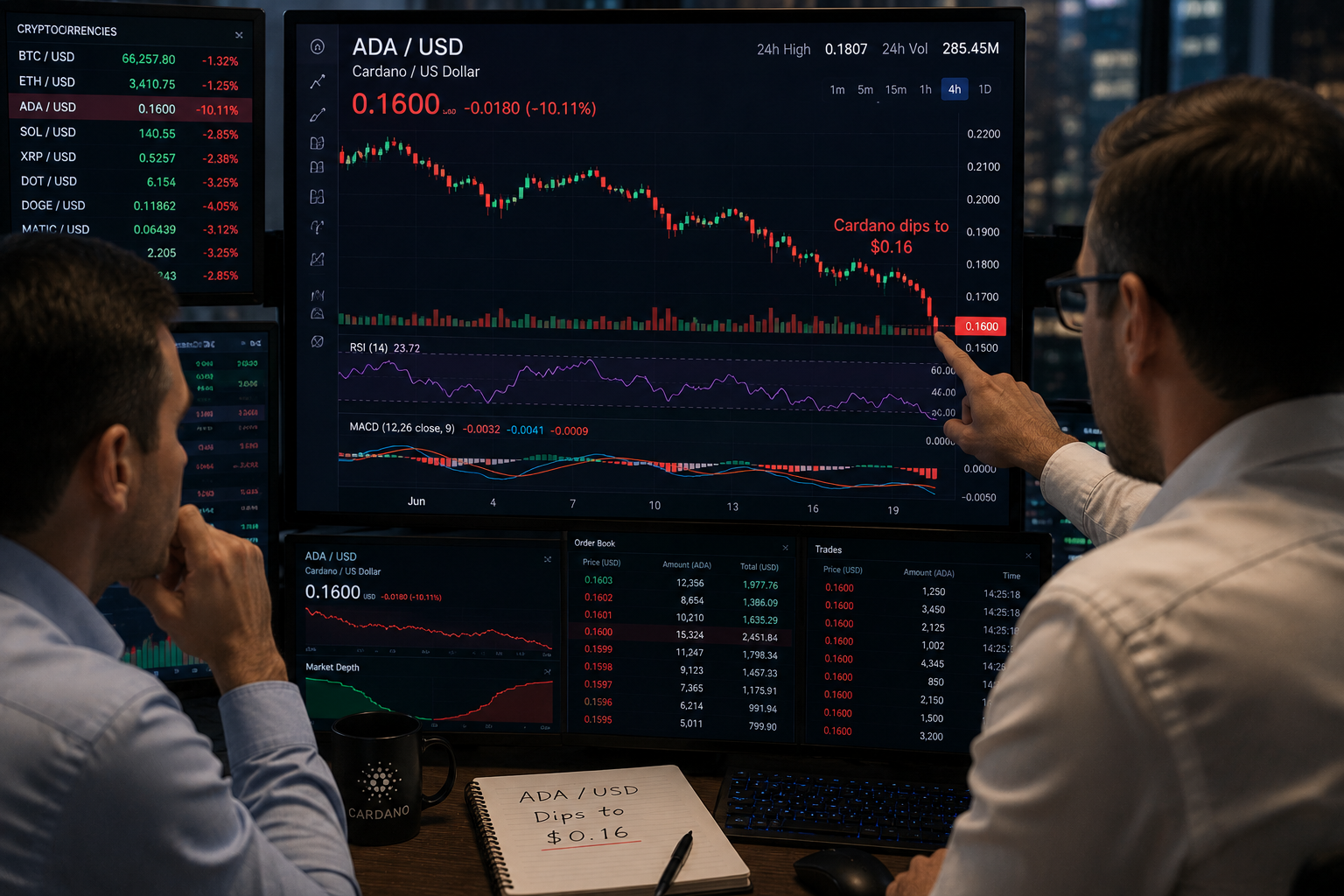

Key takeaways
- Cardano (ADA) traded near $0.161 on Thursday after a slight pullback, while whale wallets continued accumulating tokens.
- Wallets holding 100,000 to 100 million ADA have reached their highest holdings since February 2023, while smaller investors have reduced exposure.
- The upcoming van Rossem hard fork, scheduled for Saturday, could act as a catalyst for ADA’s next move.
Cardano (ADA) edged lower on Thursday, trading around $0.161 after facing mild selling pressure the previous session.
Despite the pullback, on-chain and derivatives data indicate that investor sentiment is gradually improving as large holders continue to accumulate the cryptocurrency ahead of a key network upgrade.
The combination of growing whale activity, strengthening derivatives metrics, and the upcoming van Rossem hard fork has increased expectations that ADA could stage a broader recovery if it breaks key resistance levels.
Whales continue accumulating ADA
On-chain data from Santiment shows a clear divergence between large and small Cardano holders.
Wallets holding between 100,000 and 100 million ADA now collectively own more than 25.65 billion ADA, the highest level since February 2023.
In contrast, wallets holding fewer than 100 ADA have reduced their holdings by roughly 0.7% over the past four months.
The trend suggests institutional investors and high-net-worth holders continue accumulating Cardano while retail investors remain cautious. Historically, sustained whale accumulation has often preceded periods of stronger price performance.
Cardano’s development roadmap also received a boost this week. Intersect, the member-based organization supporting the Cardano ecosystem, confirmed on Wednesday that the van Rossem hard fork will be activated on Saturday following governance ratification earlier this week.
The upgrade introduces new Plutus functionality alongside protocol enhancements designed to improve smart contract performance, developer capabilities, and overall network efficiency.
The hard fork could provide a near-term catalyst by strengthening Cardano’s ecosystem and increasing confidence among developers and investors.
Futures market activity also points to strengthening investor confidence.
According to CoinGlass, Cardano futures Open Interest (OI) has increased from approximately $422 million on Monday to $445 million on Thursday.
Rising Open Interest alongside stabilizing prices generally indicates that fresh capital is entering the market rather than traders simply closing existing positions.
Meanwhile, ADA’s funding rate has turned positive, reaching 0.0042%, suggesting traders holding long positions are once again willing to pay a premium to maintain their exposure.
Positive funding rates typically reflect improving market sentiment and growing expectations for higher prices.
Cardano price forecast: ADA still faces major resistance
Despite improving fundamentals, Cardano remains technically constrained. ADA continues to trade below several major moving averages, preserving the broader bearish market structure.
Cardano remains below the 50-day Exponential Moving Average (EMA) at $0.179, the 100-day EMA ($0.208), and the 200-day EMA ($0.276)
The token is also trading beneath the 23.6% Fibonacci retracement level at $0.173, while the broader downtrend remains intact below the trendline resistance near $0.207.
Momentum indicators present a mixed picture. The Relative Strength Index (RSI) is near 46, indicating neutral momentum without signaling either overbought or oversold conditions.
Meanwhile, the Moving Average Convergence Divergence (MACD) has turned slightly positive, suggesting bearish momentum is easing, although buying pressure remains too weak to confirm a sustained trend reversal.
If bulls regain momentum, the next resistance levels include $0.179 (50-day EMA), $0.207–$0.208 (Trendline resistance and 100-day EMA), and $0.2135 (50% Fibonacci retracement).
A successful break above the $0.207–$0.208 region would significantly improve Cardano’s medium-term outlook.

On the downside, traders should watch the immediate support level at $0.1500. Failure to defend this level could see ADA retest the June 25 swing low of $0.1382.
Cardano’s improving fundamentals are beginning to contrast with its still-cautious technical picture. Whale accumulation, rising Open Interest, and positive funding rates suggest confidence is gradually returning, while the upcoming van Rossem hard fork provides an additional potential catalyst.
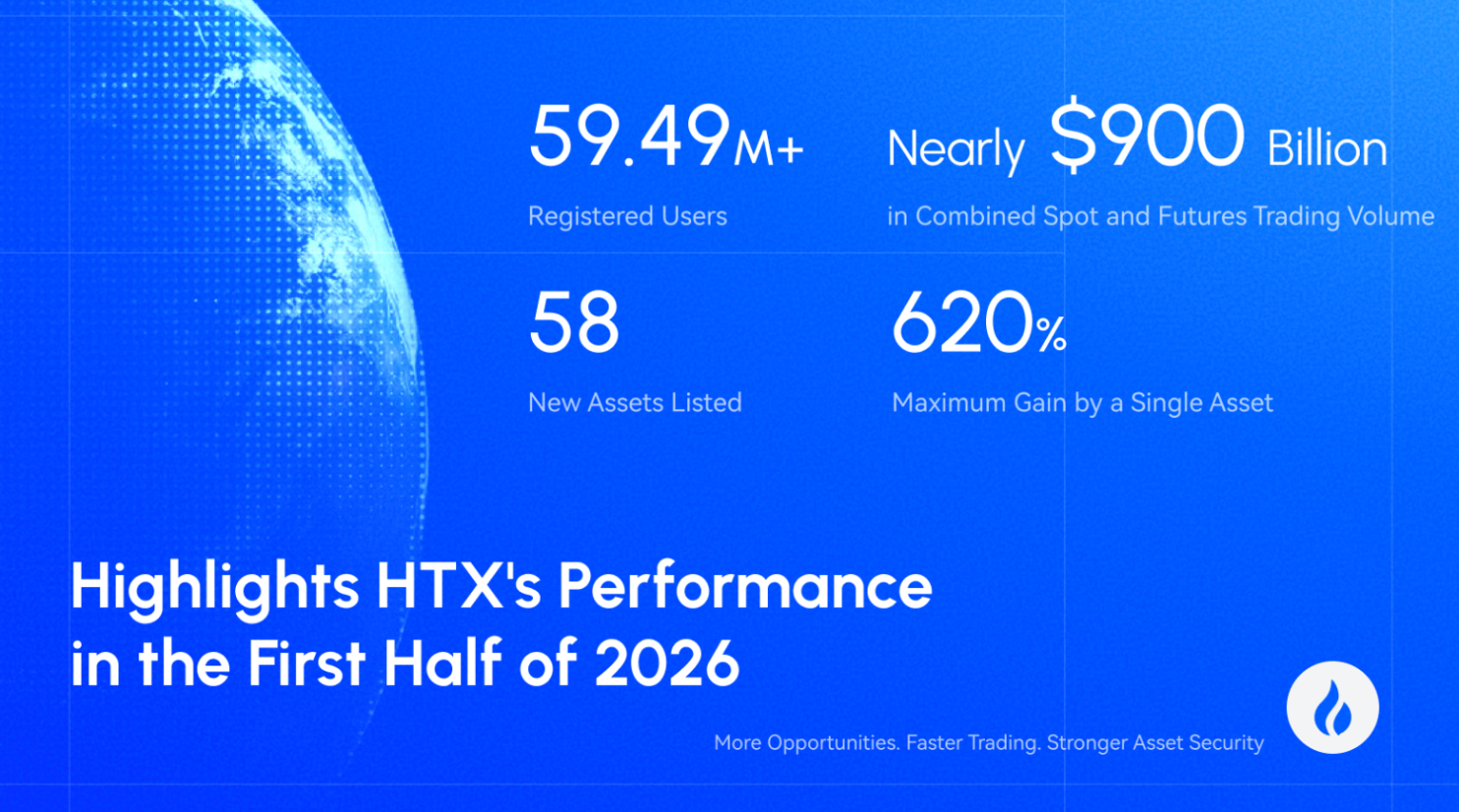
The first half of 2026 has concluded. It was a turbulent six months for the crypto market, marked by rapid sector rotations across AI, RWA, stablecoins, and TradFi. As market opportunities shift rapidly and narratives rise and fall, traders and investors are asking one key question:
Which platform can identify emerging trends first while remaining secure and reliable enough to earn their trust?
For over 59.49 million registered users worldwide, HTX has delivered a compelling half-year performance report. According to DeFiLlama data, HTX repeatedly ranked at the top of the industry for daily and weekly net capital inflows. Concurrently, the platform has continued to advance its global compliance footprint and secured prestigious international accolades, including Best P2P Platform of the Year and Best Web3 Venture Capital Institution of the Year, further strengthening its brand influence. Behind these numbers lies a clear trend: an increasing number of users are choosing HTX as their platform for managing assets, trading, and investing.
Spot Trading Nearing $400 Billion as Trending Assets Deliver Outsized Wealth Effects

For retail investors, the defining characteristic of the market this year has been the accelerating pace of sector rotations. Meme coins give way to AI; AI yields to RWA, BTCFi, stablecoins, and TradFi — with some projects delivering multi-fold returns in a matter of days.
In the first half of the year, HTX carefully selected and listed 58 new assets aligned with market trends, spanning almost every high-conviction sector, including meme coins, AI, RWA, BTCFi, and stablecoins. Guided by the principle of listing what the market demands, HTX rigorously vetted projects to curate high-quality assets with strong wealth creation potential. The Chinese-culture-inspired meme coin “老子” surged 573% after listing, while “我踏马来了” gained 412%. In the AI sector, ELSA delivered an exceptional peak gain of 620%, while BNKR and RIVER climbed 162% and 282%, respectively. For many users, HTX was the first venue where they discovered and purchased these trending tokens.
Equally important has been HTX’s first-mover advantage in listing multiple top-tier assets. Following its joint listing debut, Billions Network (BILL) surpassed a $2 billion market capitalization, delivering a 141% gain. After HTX became the first platform to list CHIP, multiple major exchanges quickly followed. Meanwhile, the jointly launched RWA project BTW recorded a peak gain of 388%, while ZEST climbed 131% after listing. By Q2 2026, as the market’s focus shifted toward narrative-driven sectors such as RWA, AI computing, and stablecoins, HTX stayed ahead of the curve by listing RWA leader RE (up 145%), AI computing project OpenGradient (OPG, up 118%), and MegaETH ecosystem stablecoin CAP, capitalizing on every major market trend. HTX has consistently enforced its delisting mechanism, removing tokens with insufficient liquidity or inactive development teams. This market-based selection approach continuously enhances asset quality, helping direct users’ capital toward projects with genuine value and strong liquidity.
The spot trading data tells an even clearer story. In H1 2026, more than 420,000 users traded spot, generating $379 billion in trading volume. HTX now supports over 612 spot trading pairs, spanning mainstream assets, trending sectors, and high-potential new projects. With deep liquidity, fast execution, and robust security, HTX continues to provide a trusted trading platform for users worldwide. Furthermore, HTX launched its “Predict FIFA World Cup 2026 Matches” campaign and continued to host its flagship Trading Championship series, engaging tens of thousands of active participants. These initiatives transformed trading from a simple execution process into an interactive, reward-rich experience.
Beyond Buying Crypto Assets, HTX Earn Turns Idle Assets Into Continuous Yield

A growing number of users recognize that active trading alone does not maximize capital efficiency. In the first half of the year, HTX Earn saw its subscription user base exceed 120,000, with cumulative subscription volume breaking past $4.1 billion.
Stablecoins remain the most sought-after vehicle. Flexible Earn products for USDT, USDC, and USDD delivered maximum APYs of up to 10%. For trending assets, the platform launched 50 fixed and flexible Earn products offering maximum APYs of 20%, drawing over $500 million in cumulative subscriptions from more than 50,000 participants. For high-net-worth users, HTX introduced the VIP Flexible product, initially offering up to 9% APY on USDT. Combining premium yields with flexible subscription and redemption, it enables large capital allocations to achieve greater capital efficiency. For many long-term holders, assets are no longer left idle waiting for price appreciation — they are generating daily passive income.
Futures traders can also keep their capital actively utilized. Following its upgrade, SmartEarn reached a peak APY of 7.21% and has maintained an average APY of around 2.5% in recent months. More importantly, deposited assets can still be used as margin for futures trading, allowing users to earn yield without missing trading opportunities. In addition, USDD SmartEarn offers an exclusive fixed APY of 4%.
HTX Leads TradFi Integration While AI-Powered Tools Redefine the Trading Experience
A structural trend is taking shape in 2026: crypto-native users increasingly want unified access to both digital assets and global traditional financial instruments. HTX has positioned itself as a first-mover in the TradFi tokenization sector.
In H1 2026, HTX futures trading volume approached $500 billion, while the number of supported trading pairs surpassed 350. Within this lineup, the TradFi sector alone generated over $1.5 billion in trading volume, spanning 129 assets across high-growth sectors such as AI, gold, commodities, U.S. equities, ETFs, aerospace, and new energy. In May 2026, HTX took the lead in listing highly anticipated Pre-IPO assets, including SpaceX, OpenAI, and Anthropic, providing users with a vastly diversified investment suite. Earlier in H1, the platform successfully timed market movements driven by geopolitical tensions and energy constraints, capturing significant volume in cyclical commodities like crude oil, base metals, and natural gas.
Meanwhile, the Futures system has also undergone a comprehensive infrastructure upgrade, introducing new features such as enhanced capital efficiency for Cross Margin, independent leverage for Isolated Margin, Smart Copy Trading, AI Lead Trader Recommendations, Trailing Grid, and Auto-Deposit Margin. These enhancements enable users to trade with greater flexibility and efficiency. For regular users, highly complex strategies are now executed automatically by the product itself. The copy trading division exhibited counter-cyclical growth in H1: the number of lead traders surged 53% quarter-over-quarter, driving lead trading volume up 74%, while follower trading volume jumped 44% over the same period. For users who prefer a hands-off approach, Futures Grid bots recorded $1.18 billion in trading volume in the first half of the year. With Trailing Grid set to launch in early July, the grid will automatically adjust as the market moves, allowing users to trade more efficiently without monitoring the market every day.
In the first half of this year, nearly every core product in the HTX suite received an upgrade. Following app startup speed optimizations, launch speeds improved by over 55% on iOS and approximately 44% on Android, making app opening wait times nearly imperceptible. The platform also introduced professional modules such as the TradFi Market Leaderboards, Tokenomics Displays, and expanded K-line indicators. Most notably, the official launch of the HTX Holo, the platform’s AI-powered trading assistant, has dramatically lowered the barrier to market information. Capable of interpreting market charts, summarizing news feeds, and actively recommending tailored Earn products, it effectively functions as an institutional-grade research assistant embedded directly within the app. Furthermore, a unified Event Center and fully revamped live-streaming rooms were rolled out across the half-year, allowing users to easily participate in platform events.
Global Expansion Continues as HTX DAO Ecosystem Growth and Deflationary Mechanics Advance in Parallel

HTX Research and HTX Ventures continue to serve as the exchange’s strategic watchtower over the digital-asset industry. In the first half of 2026, the team published a total of 6 major research reports centered on core topics such as AI, RWA, stablecoins, TradFi, geopolitics, and the linkage between these themes and the crypto market. These include 2025 Annual Review: Crypto Assets Move Toward Mainstream Adoption, The Rise of Yield-Bearing Currency: How Crypto Neobanks Are Challenging the Traditional Banking Model, RWA Perps: A New Frontier in the On-Chain Expansion of Global Financial Markets, and the Q3 forward-looking report Liquidity Defines Crypto: A New Crypto Order Under Global Liquidity Repricing. The team has not only continued to deliver in-depth research content, but has also built the long-term content brand HTX DeepThink, publishing 73 market insight articles in the first half of the year, along with weekly market reviews to help users establish a clearer investment framework amid complex market conditions.
On the offline front, HTX organized and prepared 17 distinct brand events across the first half of the year, targeting key regions such as Southeast Asia and Turkey. Through industry summits, high-end VIP gala dinners, and regional strategic partnerships, the platform steadily deepened its global brand footprint. Meanwhile, the platform has also won numerous international awards, including Best P2P Platform of the Year and Best Web3 Venture Capital Institution of the Year, further enhancing its brand credibility and industry recognition.
Throughout H1 2026, HTX DAO actively drove the expansion of the $HTX ecosystem while reinforcing its long-term value framework through an open, transparent token deflation mechanism. Official disclosures confirm that HTX DAO successfully completed two major $HTX token burns on January 15 and April 15, 2026. This brings the cumulative total of $HTX burned and pledged to 110.32 trillion tokens to date, representing over 11% of the total token supply and establishing an annualized deflation rate of approximately 5.5%. This persistent mechanism makes $HTX one of the very few governance tokens in the industry to execute a transparent, large-scale, and long-term public token burn strategy. Concurrently, HTX DAO expanded its utility use cases and optimized its community governance framework. This included upgrading membership benefits, broadening yield opportunities, exploring AI × Web3 ecosystems, maintaining community consensus, and fostering developer networks through the Genesis Program, Hackathons, and Grants—effectively connecting developers, protocols, and the community to bolster long-term holder confidence.
45 Consecutive Months of PoR Disclosures, Establishing Security as a Core Competitive Edge

For many users new to the crypto market, security is the top priority, not returns. HTX continuously enhances platform transparency through Merkle Tree Proof of Reserves (PoR). The latest data shows that as of July 1, 2026 (UTC), the reserve ratios of major assets on the platform, including BTC, ETH, TRX, USDs, HTX, XRP, DOGE, and SOL, have all remained above 100%. HTX is committed to a strict 1:1 reserve principle, ensuring user assets can be traded and withdrawn at any time. Crucially, HTX has now publicly disclosed its PoR data for 45 consecutive months, making it one of the earliest and most consistent platforms in the industry to normalize routine reserve disclosures. This framework allows users to view reserves transparently, verify individual assets, and trade with complete peace of mind.
HTX has also pushed forward its global compliance architecture. In H1 2026, HTX advanced its licensing efforts in Kyrgyzstan. Following the acquisition of a No Objection Certificate (NoC) from the Pakistan Virtual Assets Regulatory Authority (PVARA), the platform proceeded with local corporate registration and the application process for a Virtual Asset Service Provider (VASP) license. Meanwhile, HTX continued to align its operations with Dubai’s Virtual Assets Regulatory Authority (VARA) framework, further strengthening its global regulatory foundation.
Evolution from “Trading Exchange” to “Global Digital Asset Service Platform”
A review of the first half of 2026 demonstrates that HTX’s strategic focus extends far beyond mere volume growth. From listing high-potential assets early and maximizing capital efficiency through Earn products to expanding access to global investment opportunities via TradFi, empowering AI-assisted trading, and strengthening global compliance and security, HTX is building a one-stop digital asset service platform spanning trading, Earn, research, asset management, and global investment opportunities.
For users, these developments converge into a tangible improvement in their daily experience: more opportunities, better products, stronger asset security, and more efficient investing. As AI, RWA, stablecoins, TradFi, and other emerging narratives continue to evolve in the second half of 2026, the crypto market will present new growth opportunities. HTX remains committed to anchoring this growth by providing its global user base with richer asset classes, fully optimized product suites, and an expanded international presence.
Markets will always change. But for HTX, the true measure of the road ahead lies in its ability to seize every emerging opportunity while safeguarding users’ assets. That commitment will define HTX’s next chapter.
About HTX
Founded in 2013, HTX has evolved from a virtual asset exchange into a comprehensive ecosystem of blockchain businesses that span digital asset trading, financial derivatives, research, investments, incubation, and other businesses.
As a world-leading gateway to Web3, HTX harbors global capabilities that enable it to provide users with safe and reliable services. Adhering to the growth strategy of “Global Expansion, Thriving Ecosystem, Wealth Effect, Security & Compliance,” HTX is dedicated to providing quality services and values to virtual asset enthusiasts worldwide.
To learn more about HTX, please visit https://www.htx.com/ or HTX Square , and follow HTX on X, Telegram, and Discord. For further inquiries, please contact glo-media@htx-inc.com.
The post HTX H1 2026 Performance Report: Nearly $900 Billion in Trading Volume appeared first on BeInCrypto.
Crypto World
Visa, Stripe and Google join massive open-source project to let AI agents pay each other


The stakes are high because AI agents, which will likely account for a large portion of internet commerce, some of it in the form of tiny micropayments, could completely reshape the web. “It may seem nerdy to care about standards so much, but we have the opportunity to create this truly open public global financial system that everyone can have access to,” Dixon added.
Other premier members of the x402 Foundation include Ripple, Visa, Mastercard, American Express, Stripe, Adyen, Fiserv, Shopify, Google, Amazon Web Services and Cloudflare, alongside Circle, MoonPay and the Solana Foundation.
Coinbase initially shepherded the x402 payment protocol, which takes its name from the “402 payment required” response code built by early World Wide Web architects to allow browsers to pay for content.
However, card payments and the associated fees made micropayments unworkable, and business models on the internet evolved through advertising and subscriptions, leaving the 402 gateway unused.
Bringing x402 under the auspices of the Linux Foundation is exactly the right “open-source playground” required for a collaborative open standard to be built, according to Alin Dragos, senior manager at AWS Payments, who has taken the role of board chairperson to the x402 Foundation.
The plan, Dragos said, is to complement the original design of HTTP, the foundational set of rules that allows web browsers and servers to communicate.
Crypto World
U.S.’ OFAC adds four Iran central bank crypto wallets to sanctions, Tether freezes $131 million of USDT


The U.S. added four crypto wallets linked to the Central Bank of Iran to its sanctions list after a ceasefire agreement between the two countries broke down and air and drone strikes resumed.
The four Tron-blockchain wallets had received more than $165 million in stablecoins, according to Chainalysis. Tether blocked $131 million in USDT held by the accounts, though some of the funds had moved before the freeze.
Sanctioning the wallets gives exchanges, custodians and compliance firms a clear set of addresses to screen for. Iran’s central bank has accumulated at least $507 million in USDT, according to Elliptic, using the token to support the rial.
The U.S. Treasury Department’s Office of Foreign Assets Control (OFAC) has said its published wallet lists are not exhaustive, meaning other addresses controlled by the bank may still qualify as blocked property.
Tuesday’s OFAC update expands on an existing designation rather than imposing new sanctions. The Central Bank of Iran has been blocked under U.S. counterterrorism authorization since 2019 over its support for the Islamic Revolutionary Guard Corps-Qods Force and Hezbollah.
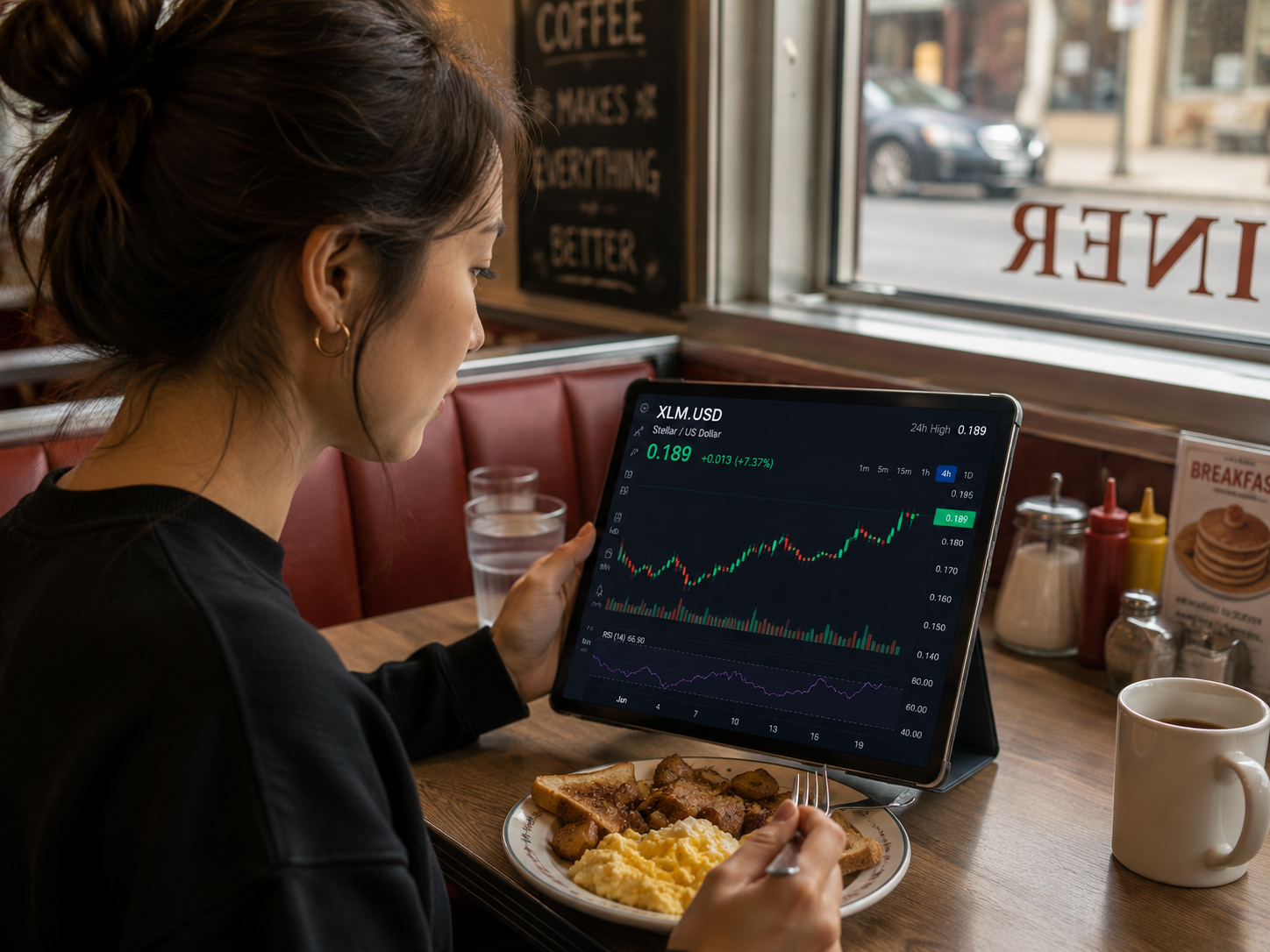

TL;DR
- XLM is trading higher on Thursday after defending key support levels earlier this week.
- Rising Open Interest (OI) and positive funding rates suggest fresh capital is flowing into both markets.
- XLM remains below major resistance levels despite showing signs that bearish momentum is fading.
Stellar’s XLM continues its recovery on Thursday, supported by improving derivatives metrics and stabilizing technical indicators after the cryptocurrency defended key support levels earlier in the week.
Open Interest climbs as traders return
Derivatives data points to renewed confidence among market participants. According to CoinGlass, XLM Open Interest climbed from $153 million on Monday to around $195 million, up 25% in the last 24 hours.
The simultaneous rise in prices and Open Interest suggests fresh capital is entering the market rather than traders simply closing positions. This typically signals strengthening conviction behind the current recovery.
Market sentiment has also improved across perpetual futures markets. XLM recorded positive funding rates after turning positive on Tuesday.
Positive funding rates indicate that traders holding long positions are paying a premium to maintain their exposure, reflecting growing bullish sentiment.
While derivatives indicators have strengthened, on-chain metrics paint a mixed picture. CryptoQuant indicates that XLM continues to experience selling-side dominance across both spot and derivatives markets, suggesting larger traders remain hesitant despite the recent rebound.
This imbalance could limit the pace of any sustained upside move.
XLM technical analysis: Recovery faces multiple technical barriers
Stellar traded around $0.189 on Thursday after bouncing from support near $0.177.
However, XLM continues to trade below the 50-day EMA at $0.190 and the 200-day EMA at $0.196
The token is currently hovering just above its 100-day EMA at $0.187, providing immediate support.
Momentum indicators suggest buyers are gradually returning but remain cautious. The RSI is near 49, reflecting neutral momentum without a clear bullish bias.
Meanwhile, the MACD remains slightly below zero, indicating bearish pressure has weakened but has not fully disappeared.
If the rally persists, the first major resistance lies at the 50-day EMA of $0.190. A decisive break above this level will expose higher hurdles at $0.196 (200-day EMA) and $0.218.
A sustained move above $0.200 would strengthen the case for a broader recovery.
However, if the bearish trend resumes, the bulls would need to instantly defend the $0.187 support level.
Failure to defend this support could see XLM retest lower demand zones at $0.177 and $0.142 in the near term.

XLM is showing encouraging signs of recovery as derivatives activity strengthens and funding rates turn positive.
However, XLM continues to face heavier selling pressure from larger market participants.
Artificial intelligence (AI) agents are posing a challenge to the incumbent global card payments infrastructure that is struggling to process high-frequency micropayments, according to a joint report released by payments giant Visa and investment thesis platform Artemis.
The joint report published Wednesday found that traditional cards were built for human commerce with low-frequency transactions, which is insufficient for AI agents, which need infrastructure with near-zero fees and faster settlement to make agentic micropayments commercially viable.
New infrastructure is increasingly necessary since AI agents crossed a key capability threshold in mid-2025, enabling them to discover unfamiliar APIs, evaluate prices and decide on autonomous payments.
The report found that AI agents are initiating a foundational change in commerce, but the current infrastructure gaps are limiting their mainstream adoption.
Australian crypto exchange Swyftx earlier this week said that AI-enabled microbusinesses could drive an additional $262 billion in stablecoin volume by 2033, via AI-native payments settled in stablecoins, based on an assumed adoption rate of about 33%.
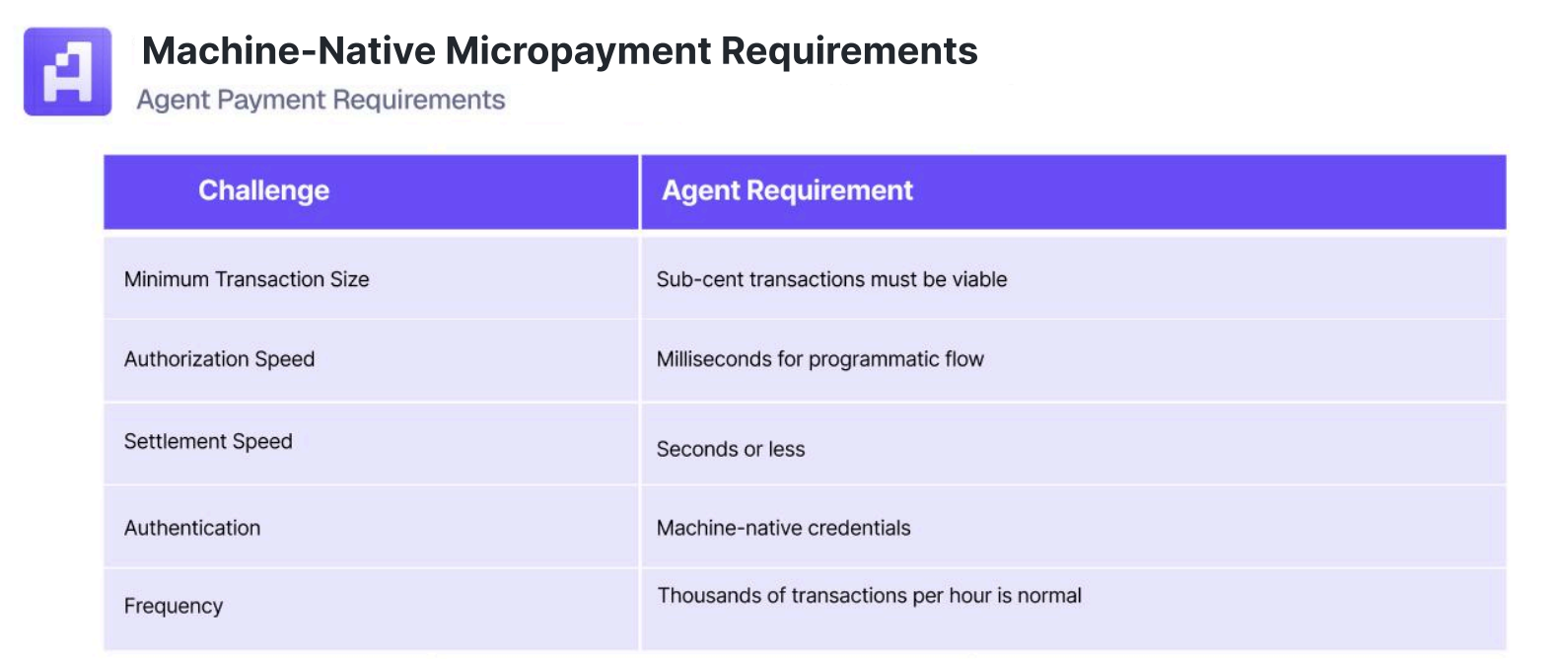
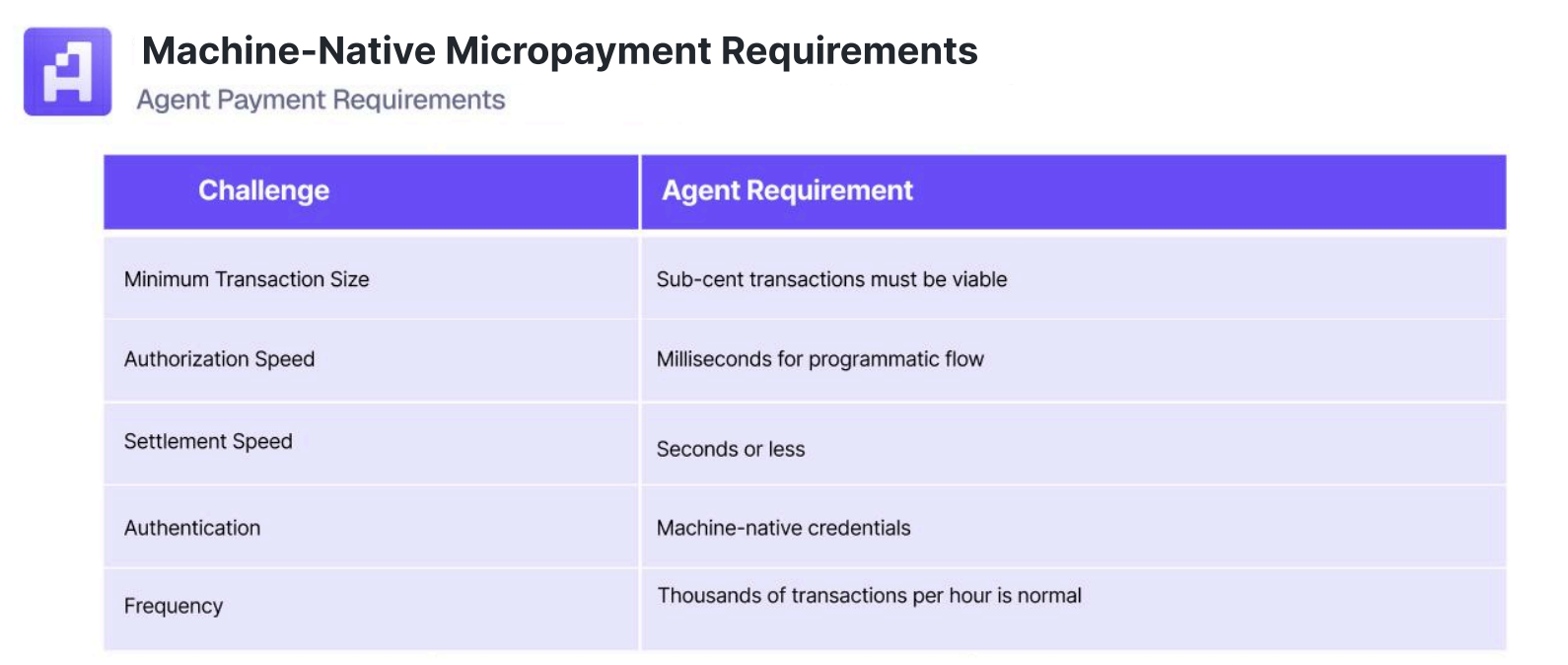
Machine-native micropayment requirements. Source: Artemis, Visa
Some agentic payment standards are already showing signs of user adoption, such as the x402 payment protocol developed by Coinbase.
The x402 prot processed $15 million in adjusted volume across over 109 million adjusted transactions since it was launched in May 2025. It saw a sharp acceleration in October 2025, when the monthly transaction count rose from 40,000 to 3.8 million, leading to 38 million transactions processed in October alone.
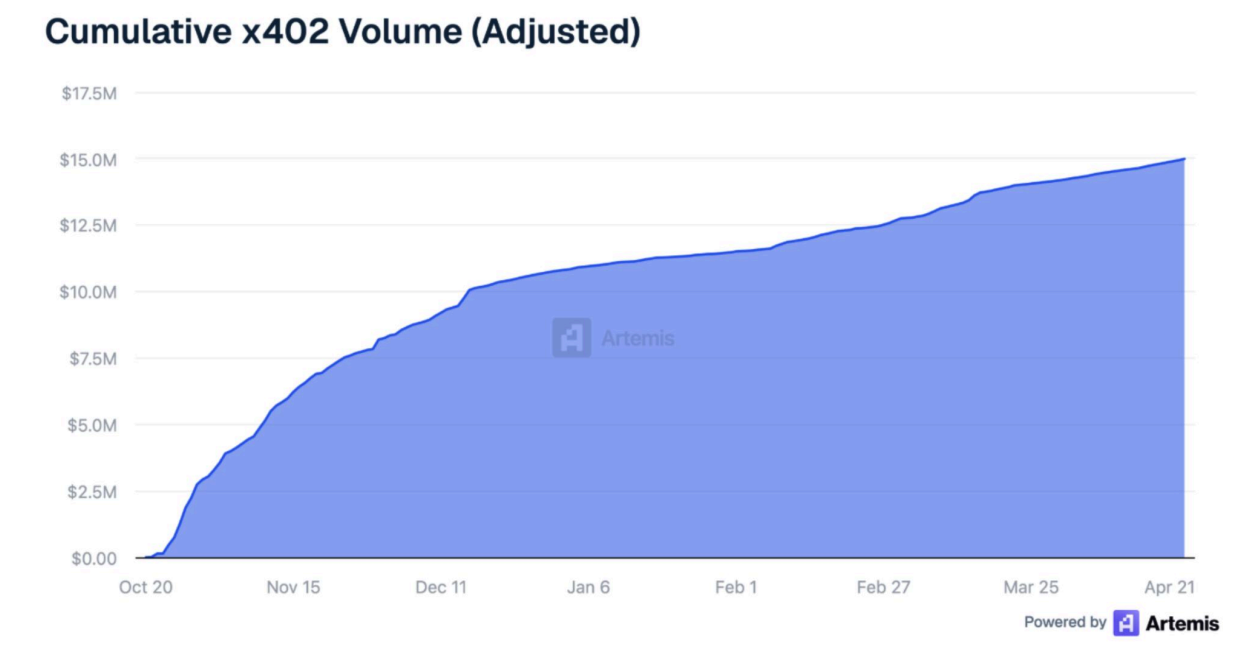
Cumulative adjusted volume on x402 payment protocol. Source: Artemis, Visa
Stablecoins could stoke machine-native micropayments growth
A single machine-payments framework could support both stablecoin and traditional card transactions, Visa and Artemis said, adding:
“The trajectory points toward convergence rather than competition: cards for proxy purchases inside existing merchant networks, stablecoins for machine-native micropayments, and hybrid flows where both are used within the same workflow.”
Related: Stripe, Advent offer $53B to acquire PayPal: Report
The report said that a single machine payment framework can support both stablecoin-based flows and card transactions, creating a path into agentic payment flows for card networks.
It added that Tempo’s Machine Payment Protocol (MPP) now spans both onchain crypto payments and fiat payments via shared payment tokens. Visa said its Card Specification SDK was designed to extend the protocol into card-based agent commerce.
Visa’s crypto division and Stripe-backed Tempo both launched AI tools in March. Visa’s allows AI agents to make same-day payments. That month, Tempo debuted its Machine Payments Protocol, designed to make it easier for AI actors to send and receive money.
Magazine: AI’s power crunch turns Bitcoin miners’ grid access into an asset
Crypto World
Bitcoin retreats from monthly high as Iran attacks U.S. bases and profit-taking sets in
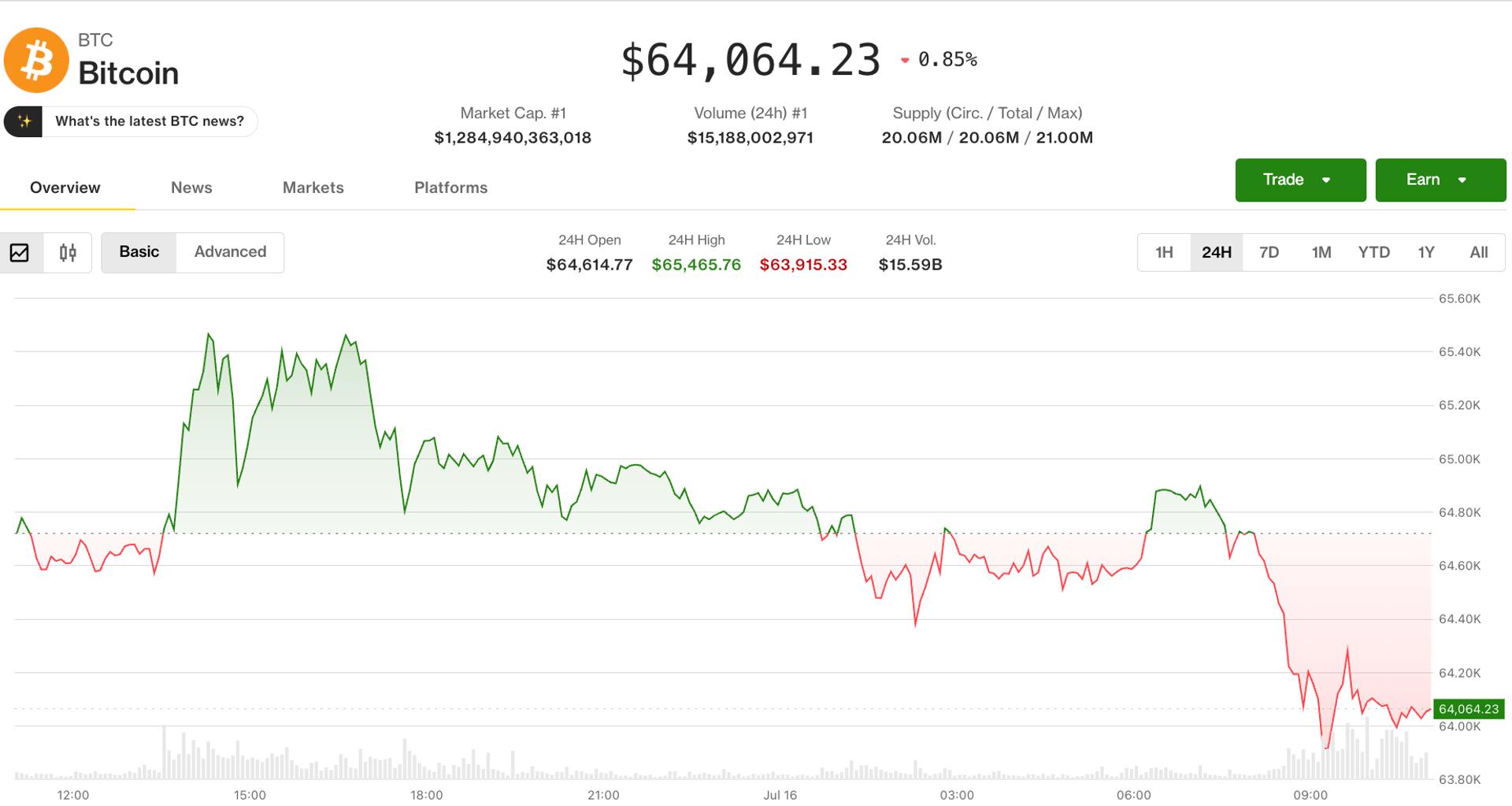
The crypto market is facing a wave of sell pressure with bitcoin and ether (ETH) losing 1.1% and 1.7%, respectively, since midnight UTC.
The shift to the downside comes after bitcoin rose to a monthly high of $65,500 on Wednesday, prompting some traders to take profits.
Altcoins PUMP and ZEC also declined, falling 4.4% each after Tuesday’s strong rallies faded, highlighting a lack of liquidity in both directions.
U.S. equities also lost ground. Futures on tech stock-dominant Nasdaq 100 index retreated by 0.25%, extending a downtrend that began 30 days ago.
One of the main catalysts for price action across all asset classes is the war in Middle East, with Iran launching attacks on U.S. military bases in neighboring Gulf states on Thursday and the U.S. continuing its wave of airstrikes.
Derivatives positioning
- Ether’s price has dropped by 1.7% since midnight UTC, slightly more than the decline in bitcoin. ETH’s underperformance seems driven by bullish plays unwinding rather than aggressive new short selling. That’s evident from the decline in open interest (OI) to 14.35 million ETH from the five-week high of 14.45 million ETH hit Wednesday. Futures tied to BTC show similar dynamics.
- Meanwhile, OI in XRP rose to a 10-day high of 2.21 billion XRP alongside a 0.6% drop in the spot price. This combination is taken to represent a growing bias for bearish exposure, although XRP’s positive funding rates contradict that interpretation. That said, the 24-hour cumulative volume delta (CVD) for XRP is negative, meaning short plays are being executed at market orders rather than passive limit orders.
- Another notable open interest gainer is SUI, the native token of the Sui blockchain. Positions have increased by 15%, although the total OI of 654 million tokens remains in line with levels seen earlier this week. The SUI token has dropped almost 2% over 24 hours.
- Broadly speaking, most coins, except BTC, ETH and XMR, have a negative 24 hour OI-adjusted cumulative volume delta (CVD), a sign of bears leading the price action.
- Bitcoin’s 30-day implied or expected volatility index is up 2% at 38%. Volatility tends to be mean-reverting, and, historically, sub-40% readings have consistently presaged renewed market turbulence.
- In Deribit-listed options, there has been a notable rise in both trading volume and open interest in BTC calls at $70,000 and $72,000 strikes. This likely reflects a large bull call spread that crossed the tape recently. The strategy bets that prices will rally to $72,000 by the end of July.
- In ETH’s case, the end-July expiry call at the $2,300 strike is the most traded bet of the past 24 hours. A call represents a bullish bet on the market.
Token talk
- Artificial intelligence token defied bearish crypto price action on Thursday, rising by 3.5% since midnight as it looks to test the $2.20 level of resistance, which caused a rejection and subsequent drop to $1.85 on July 2.
- The rest of the altcoin market tracked bitcoin and ether, with coins including HYPE, SOL and ENA losing 1.3%-1.8% since midnight while NEAR, JUP and DASH posted steeper losses.
- CoinMarketCap’s “Altcoin Season” indicator is still range-bound, currently at 48/100 after losing its perch at 58/100 on Monday as investors switched focus back to bitcoin.
- One recent area of interest in the altcoin sphere has been memecoins, notably tokens launched on Robinhood’s new blockchain. One, cashcat (CASHCAT), rose from relative obscurity to a $220 million market cap in its first week of Robinhood Chain going live. It has since fallen back to a $91 million market cap despite maintaining around $60 million in daily trading volume.


Visa has outlined how stablecoins and traditional card networks can work together in AI-driven commerce, arguing that low-cost blockchain payments will be critical as software agents begin handling machine-to-machine transactions.
Summary
- Visa and Artemis said stablecoins are better suited for low value AI driven machine payments, while cards remain effective for consumer purchases.
- The report said future agentic commerce will combine card networks and stablecoins instead of treating them as competing payment systems.
- Visa said legal responsibility and payment dispute rules remain unresolved as AI agents begin completing transactions independently.
According to a joint research report released on Wednesday by Visa and blockchain analytics firm Artemis, the rise of agentic commerce will create two distinct payment needs, with existing card networks continuing to support consumer purchases while stablecoins become more practical for frequent low-value payments between software systems.
The report, titled Agentic Payments from the Ground Up, examines how AI agents could independently initiate and complete transactions as they carry out tasks on behalf of users or other software.
Visa and Artemis divided the emerging market into macro-commerce and micro-commerce. Macro-commerce covers consumer-sized purchases, such as booking travel or managing subscriptions, where AI agents act on behalf of people. Micro-commerce involves repeated sub-dollar transactions between software services, including API requests and payments for computing resources.
Stablecoins fit machine-to-machine payments
The report said traditional payment rails remain well suited for larger consumer purchases, but fixed processing costs make very small payments uneconomical. It added that newer blockchain networks have reduced settlement costs to fractions of a cent, making stablecoins a more efficient option for machine-native micropayments.
Rather than replacing existing payment systems, Visa said both technologies are expected to operate together.
“In all likelihood, this won’t come down to a choice between cards and stablecoins. Both will have a place,” the company said. Visa added that cards are suited to purchases within today’s merchant networks, while stablecoins better match machine-native micropayments.
The report said future agentic commerce is likely to combine both payment methods within a single workflow. Under that model, AI agents could use card networks for consumer-facing purchases before relying on stablecoins to settle repeated low-value transactions between software services.
Visa also said the distinction between card-based and crypto-native payment systems is becoming less clear. The report noted that card-focused initiatives such as the Trusted Agent Protocol, Agent Payments Protocol and Visa Intelligent Commerce are adding stablecoin support, while crypto-native projects are incorporating trust and verification features commonly associated with traditional payment infrastructure.
The company said its long-term approach is to combine card-based authorization and security with blockchain-based settlement while allowing both systems to interoperate.
Legal and trust questions remain
Despite the payment advances, Visa said trust remains one of the biggest obstacles to agentic commerce because existing legal and payment systems assume that a human is making purchasing decisions.
The report said current laws do not clearly define responsibility when AI agents complete transactions independently, while chargeback rules and dispute processes were built for human-paced commerce rather than automated systems capable of completing thousands of transactions every hour.
The latest findings build on Visa’s recent work around AI-powered commerce and stablecoins. Earlier this year, the company introduced Visa Intelligent Commerce, an Agentic Directory and Agent Score tools designed to support trusted AI-driven payments. It also announced a partnership with OpenAI to enable secure Visa payments inside agentic commerce experiences.
Stablecoins have become another focus of the company’s payment strategy. In July, Visa joined Mastercard, Coinbase, and more than 140 businesses to launch the Open Standard consortium, which plans to issue the Open USD stablecoin for business payments and settlements. Visa has also continued expanding stablecoin settlement across its network, saying earlier this year that its annualized settlement run rate had reached about $7 billion and that more than 160 stablecoin-linked card programs were live or under development.
The company has also continued linking digital assets with traditional payments. Earlier this week, Visa partnered with HashKey Exchange and Shanghai Commercial Bank to launch a co-branded credit card in Hong Kong that lets eligible users convert card rewards into vouchers redeemable for cryptocurrency purchases or trading fees on the licensed exchange.
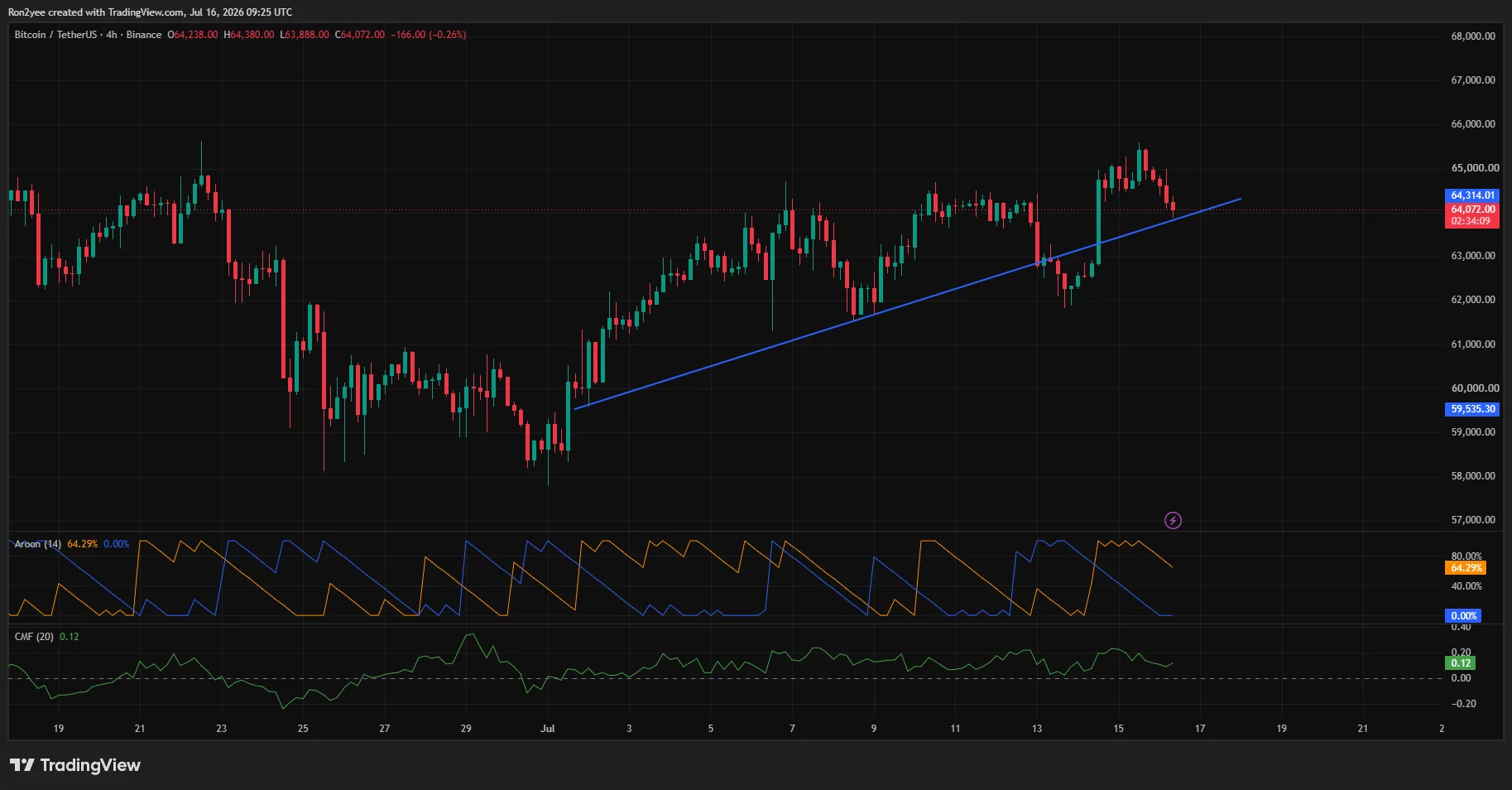
Bitcoin price has retreated after failing to hold above $65,000 despite softer U.S. inflation data, leaving traders split over whether the latest pullback is a pause before another breakout or the start of a deeper correction.
Summary
- Bitcoin price failed to hold above $65K as whale selling and profit-taking capped the CPI-driven rally.
- Long liquidations and dense leverage clusters have shifted focus toward the $63K-$63.8K support zone.
- Analysts say a daily close above $65K is needed to revive bullish momentum and target higher levels.
According to data from crypto.news, Bitcoin (BTC) price climbed to nearly $65,470 after lower-than-expected U.S. CPI and PPI reports strengthened expectations that the Federal Reserve could avoid further policy tightening in the short term.
The rally lost momentum almost immediately as sellers emerged around a major resistance zone, pushing Bitcoin back toward $64,000. Market sentiment has turned cautious as traders weigh improving inflation data against renewed macro and on-chain headwinds.
Glassnode data shows long-term holders used the rally to reduce exposure, with investors who accumulated near last year’s highs selling into strength instead of waiting for higher prices. At the same time, short-term traders and whales locked in profits near resistance, limiting follow-through buying after the inflation-driven move. Spot Bitcoin ETF demand also slowed after several sessions of strong inflows, leaving thinner liquidity during the rejection.
A rapid unwind in derivatives added to the decline. Funding rates had risen across major offshore exchanges as leveraged long positions accumulated before the CPI release. Once Bitcoin slipped below the $64,400 area, automated liquidations accelerated selling pressure and pushed the price toward an intraday low near $63,900.
CoinGlass liquidation data continues to show dense leverage clusters above the market around $65,000-$65,500 and another concentration below $63,000, raising the likelihood of sharp volatility in either direction.
Bitcoin price still holds an uptrend while $63K remains intact
The 4-hour chart shows Bitcoin maintaining an ascending trendline that has supported every major pullback since early July. BTC price briefly broke below the trendline before reclaiming it, but the latest rejection has returned it to that support area around $63,800-$64,000.
Aroon Up remains above 64 while Aroon Down sits near zero, suggesting buyers still control the intermediate trend despite the recent setback. Chaikin Money Flow also remains positive at 0.12, showing capital has not exited the market aggressively.
The daily chart presents a more balanced picture. Bitcoin has struggled to reclaim the 78.6% Fibonacci retracement level near $63,205 on a sustained basis while facing repeated rejection below $65,500.
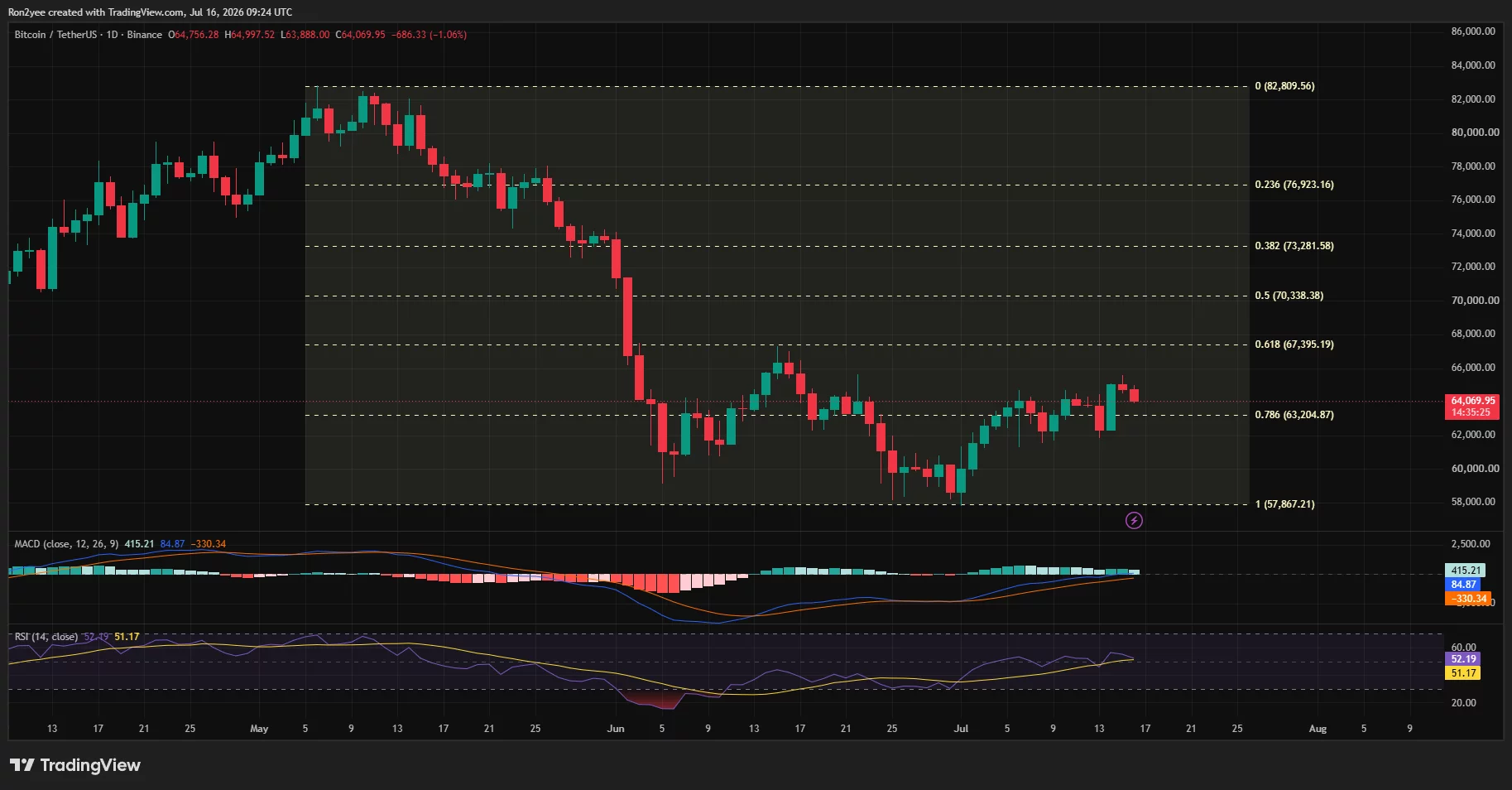
The MACD remains above its signal line, but the histogram has started to flatten, showing upside momentum has slowed. Meanwhile, the RSI hovers around 52, leaving room for another move in either direction without entering overbought or oversold territory.
Commenting on the latest move, analyst Ted Pillows argued that Bitcoin needs stronger confirmation before another leg higher.
“A daily close above $65,000 is needed for strong expansion. Or else, Bitcoin will erase all its short-term gains.”
Trader Lennaert Snyder also believes the rejection does not end the bullish case but requires patience. According to Snyder, the failed breakout near $65,600 leaves more liquidity above current prices, although he expects Bitcoin to first defend the $63,800 region before attempting another advance.
Macro risks and liquidation zones could decide the next move
Several macro risks continue to limit bullish conviction despite softer inflation data. Oil prices have recovered after recent geopolitical tensions involving Iran and the Middle East, raising concerns that inflation could remain elevated later this year. A stronger U.S. Dollar Index has also reduced demand for risk assets, while uncertainty surrounding the distribution of more than 140,000 BTC to Mt. Gox creditors remains a persistent supply overhang.
The technical outlook would weaken if Bitcoin loses the $63,800 support area and closes below the ascending trendline. CoinGlass heatmaps identify heavy liquidation near $63,000 and another cluster around $61,800, making those levels potential downside magnets during a deeper correction.
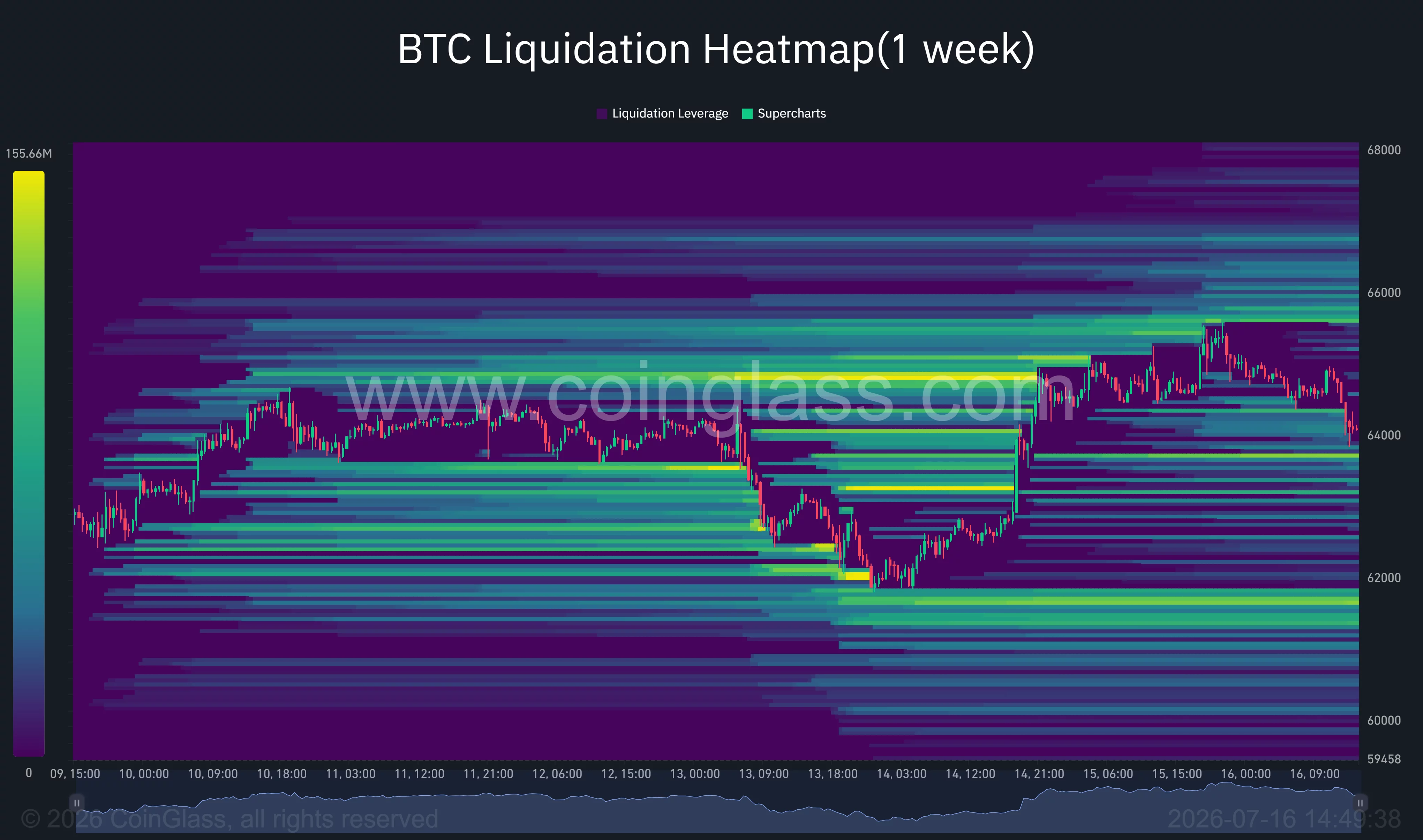
On the upside, reclaiming $65,000 on a daily closing basis would likely expose the $65,500 liquidity pocket before traders begin targeting the $67,000 region.
Disclosure: This article does not represent investment advice. The content and materials featured on this page are for educational purposes only.

York nursery plans to expand blocked by council over noise

what it means for UK SMEs

Iconic Jurassic Park Actor Sam Neill Dead at 79


![MORAD - NO MONEY [VIDEO OFICIAL]](https://wordupnews.com/wp-content/uploads/2026/02/1771006117_maxresdefault-80x80.jpg)

![TORINO & PASHATA - OLD MONEY [OFFICIAL 4K VIDEO]](https://wordupnews.com/wp-content/uploads/2026/05/1779687619_maxresdefault-80x80.jpg)
-

 Fashion5 days ago
Weekend Open Thread: Nutriplenish Leave-In Conditioner
-
 Sports7 days ago
2026 Genesis Scottish Open Thursday TV coverage: Round 1
-

 Sports6 days ago
Super Eagles star Moses Simon opens up on Liverpool transfer regret
-

 Tech7 days ago
Character.AI enters the microdrama arena with its own productions, but there’s a twist
-

 Politics24 hours ago
Young campaigners urge incoming PM to act on outdoor junk food ads
-

 News Videos2 days ago
XRP BOMBSHELL… XRP OMBOARDED FOR TRANSACTIONS!!!
-

 Tech2 days ago
Get Your ESP32 Sunny Side Up With This Solar Dev Board
-

 Tech2 days ago
Dark Secrets Emerge When Jailbreaking LLMs
-
 Entertainment19 hours ago
Disney’s Most Ambitious Failed Star Wars Attraction Is Coming to SDCC
-
 Sports15 hours ago
New Cornerback Enters Vikings Trade Rumor Mill
-

 News Videos3 days ago
how to make coin bank box with cardboard #scienceproject #money #diy #shorts
-
 Tech3 days ago
Cloudflare Precursor Watches Your Mouse and Keyboard To Decide If You Are Human
-
 Entertainment17 hours ago
Vicki Gunvalson Defends Discussing Heather Dubrow’s Money
-
Crypto World2 days ago
Ripple, Coinbase, Circle Join Linux x402 Foundation to Help Shape AI Payments
-

 NewsBeat14 hours ago
Watch: Is Donald Trump facing a popular backlash on immigration?
-

 Sports12 hours ago
Michigan officials not expected to discuss AD Warde Manuel at Thursday meeting
-
 NewsBeat14 hours ago
Firefighters issue update on Dovestone moorland blaze as fire enters fourth day
-

 Business1 day ago
ACCC warns AI could lift insurance costs in risk-prone areas
-

 Entertainment3 days ago
Hollywood’s Biggest Director Just Called Out AI, And It’s Glorious
-

 Tech7 days ago
Claude’s New Reflect Dashboard Wants To Help You Log Off Of Claude
You must be logged in to post a comment Login