
Crypto World
RLUSD lending via Flare, Morpho



Flare’s FXRP token has been approved as collateral in an institutionally curated Morpho vault on Ethereum, letting XRP holders borrow Ripple’s RLUSD stablecoin without selling. It is the first time an XRP-based asset has been accepted in a major on-chain lending market.
Summary
- Flare’s FXRP, a bridged version of XRP on Ethereum, has been approved as collateral in Sentora’s RLUSD Main vault on Morpho, allowing XRP holders to borrow Ripple’s RLUSD stablecoin without selling their tokens.
- The integration is the first time an XRP-based asset has been accepted as collateral in an institutionally curated Ethereum lending market, a milestone for an asset that has been almost entirely absent from DeFi.
- XRP is the fourth largest cryptocurrency by market capitalization at approximately $70 billion, yet its utilization in on-chain lending, borrowing, and liquidity provision has been negligible compared to assets like ETH, WBTC, and stablecoins.
- Ripple has been building RLUSD as an enterprise-focused stablecoin since August 2024, securing NYDFS approval in December 2024 and a Mastercard settlement integration in July 2026.
- The Morpho Blue lending protocol uses isolated markets designed to contain risk if problems arise with a specific collateral asset, a structure that makes it possible to onboard newer assets like FXRP without exposing the broader protocol to systemic risk.
Introduction
XRP is one of the most widely held cryptocurrencies in the world. At roughly $70 billion in market capitalization, it trails only bitcoin, ether, and Tether’s USDT. It has millions of holders, deep liquidity on centralized exchanges, and a history that predates most of the DeFi ecosystem. And yet, until this week, there was no major lending market on Ethereum where XRP holders could borrow against their position.
The reason is infrastructure, not demand. XRP runs on the XRP Ledger, a separate blockchain with its own consensus mechanism and token standard. Ethereum-based DeFi protocols cannot natively interact with XRP. To use XRP in Ethereum lending markets, someone needs to build a bridge, create a wrapped token, and convince a risk team to underwrite it. That process took years for bitcoin (resulting in WBTC), and it has now happened for XRP through Flare’s FXRP token.
On August 3, Flare announced that FXRP has been approved as collateral in Sentora’s RLUSD Main vault on Morpho. XRP holders can now convert their tokens to FXRP, bridge to Ethereum, deposit as collateral, and borrow Ripple’s RLUSD stablecoin. This is not just a technical milestone. It is a test of whether XRP can become a productive DeFi asset after years of sitting idle in wallets.
How the FXRP to RLUSD lending flow works
The process involves four steps, each handled by a different protocol.
Step one: XRP to FXRP conversion. XRP holders convert their native XRP tokens into FXRP, Flare’s bridged representation of XRP. Flare is a layer 1 blockchain that has built cross-chain data infrastructure, including the ability to create asset representations that can move between chains.
Step two: bridge FXRP to Ethereum. The FXRP token is bridged from Flare to Ethereum, where it becomes an ERC-20 token that Ethereum-based protocols can recognize and interact with.
Step three: deposit FXRP as collateral on Morpho. The Ethereum-native FXRP is deposited into Sentora’s RLUSD Main vault on Morpho Blue. Sentora, formerly known as IntoTheBlock, serves as the vault curator, meaning it reviews and approves which assets can be used as collateral. Sentora reviewed FXRP’s market behavior, oracle design, liquidity, and liquidation mechanics before granting approval.
Step four: borrow RLUSD. With FXRP deposited as collateral, the user borrows RLUSD, Ripple’s dollar-pegged stablecoin. The loan is overcollateralized, meaning the value of the FXRP deposit must exceed the value of the RLUSD borrowed. Because this is a loan against collateral and not a sale, the borrower retains exposure to XRP’s price movements.
Flare CEO Hugo Philion described the significance in terms of institutional credibility: “XRP is now collateral that an institutional risk team underwrites on Ethereum mainnet, which is a stronger form of recognition than another bridge listing.”
Why XRP has been absent from DeFi
XRP’s absence from DeFi is not accidental. It reflects three structural factors that have kept the asset isolated from the composable lending and borrowing ecosystem that Ethereum-based tokens take for granted.
Separate blockchain architecture. The XRP Ledger uses a different consensus mechanism (the XRP Ledger Consensus Protocol) and token standard than Ethereum. Unlike ERC-20 tokens, which can be natively deposited into any Ethereum smart contract, XRP requires a bridge and a wrapped representation to interact with Ethereum DeFi. Building that bridge securely takes time and auditing resources. The XRP Ledger was designed for payments, not for programmable smart contracts, which means the tooling and standards that Ethereum DeFi relies on do not exist natively on XRPL.
Regulatory uncertainty. The SEC’s lawsuit against Ripple, filed in December 2020 and not fully resolved until 2024, created a chilling effect on DeFi integration. Protocol teams and vault curators were reluctant to add XRP-based collateral when the token’s regulatory status was unclear. DeFi protocols have their own compliance considerations, and adding a token that the SEC claimed was an unregistered security was a risk most teams chose to avoid. The resolution of that case removed the legal overhang but did not immediately produce DeFi infrastructure.
Limited DeFi ecosystem on XRPL. The XRP Ledger has a built-in decentralized exchange and an automated market maker, but its DeFi ecosystem is small compared to Ethereum, Solana, or even newer L2 networks. Most DeFi activity, lending, borrowing, yield farming, and derivatives, happens on Ethereum and its rollups. For XRP holders to participate, they need to leave the XRPL, which until FXRP was not straightforward. The result is that a $70 billion asset has been almost entirely absent from on-chain credit markets, a gap that is disproportionate to its size and liquidity on centralized venues.
The WBTC parallel
The closest analogy to what Flare is doing with FXRP is Wrapped Bitcoin (WBTC), which has been operating on Ethereum since 2019. WBTC lets bitcoin holders wrap their BTC into an ERC-20 token, deposit it as collateral on Aave, Compound, and MakerDAO, and borrow stablecoins against it.
WBTC demonstrated that non-native assets can become productive DeFi collateral if the bridge is trustworthy and the lending market is deep enough. At its peak, WBTC had over $15 billion in total value locked. It proved that bitcoin holders wanted to borrow against their positions rather than sell.
FXRP aims to replicate this model for XRP. The key differences are scale (WBTC had years of liquidity building, FXRP is just launching) and custody model (WBTC relies on a centralized custodian, BitGo, while Flare uses a decentralized bridge). Whether FXRP achieves WBTC-level adoption depends on whether XRP holders are willing to bridge their tokens and whether additional lending vaults beyond Sentora add FXRP as collateral. The bridging step is a genuine friction point: WBTC holders only needed to interact with a single custodian, while FXRP holders must navigate Flare’s cross-chain infrastructure before reaching Ethereum. Reducing that friction through improved tooling and wallet integrations is as important to adoption as the lending market itself.
What RLUSD is and why it matters here
RLUSD is Ripple’s dollar-pegged stablecoin, designed for enterprise use cases including cross-border payments and institutional settlement. Ripple began testing RLUSD on Ethereum and the XRP Ledger in August 2024 and received approval from the New York Department of Financial Services in December 2024.
RLUSD is not trying to be USDC or USDT. Ripple has positioned it as a compliance-first stablecoin for regulated financial institutions. The Mastercard settlement integration announced in July 2026 is an example: Mastercard will support settlement of regulated stablecoins including RLUSD, USDC, and SoFi’s SoFiUSD. Zand Bank in the UAE began using RLUSD for cross-border payments in early 2026. Ripple has also expanded into Latin America, bringing Bitso’s Mexican peso-backed stablecoin MXNB onto the XRP Ledger in June 2026.
The FXRP/RLUSD lending integration adds a new use case: on-chain borrowing. XRP holders who want dollar liquidity without selling can now borrow RLUSD against their position. If RLUSD is accepted at more venues and payment rails, the utility of borrowing it increases. This creates a flywheel where RLUSD adoption in payments makes RLUSD borrowing more attractive, which drives more FXRP deposits, which deepens the lending market.
The stablecoin landscape itself is shifting rapidly. Circle recently brought USDC to the XRP Ledger, meaning XRPL now supports both RLUSD and USDC natively. This multi-stablecoin approach on XRPL means XRP holders have more options for accessing dollar liquidity, and the FXRP/RLUSD lending market on Ethereum adds yet another path. For Ripple, the strategic play is to make RLUSD the default borrowing currency for XRP-collateralized loans, creating a use case that USDC does not serve.
Why Morpho Blue’s isolated market design matters
Morpho Blue is a lending protocol that uses isolated markets instead of the shared pool model used by Aave and Compound. In a shared pool, all depositors share risk: if one collateral asset fails, losses can spread across the entire protocol. In Morpho Blue’s isolated markets, each collateral-borrow pair operates independently. A problem with FXRP would affect only the FXRP/RLUSD market, not other lending pairs on the protocol.
This design is what made it possible for Sentora to approve FXRP as collateral. A shared pool protocol would likely have rejected a newly bridged token with limited on-chain history. Morpho Blue’s isolation means the risk is contained, and the vault curator (Sentora) bears the responsibility for evaluating it.
Sentora’s CTO Jesus Rodriguez described the approval as a deliberate expansion of on-chain credit: “XRP is one of crypto’s largest and most liquid assets. Yet it remains surprisingly underused in onchain credit. That changes today.” The framing is significant: this is not a DeFi experiment. It is an institutional risk team making a calculated underwriting decision.
The isolation model also creates a natural price discovery mechanism for FXRP risk. Because each vault has its own interest rate curve determined by utilization, lenders are effectively pricing the specific risk of FXRP collateral rather than having that risk diluted across a shared pool. If the market perceives FXRP bridge risk as elevated, rates in FXRP-collateralized vaults will rise relative to vaults backed by native Ethereum assets. This transparency gives both lenders and borrowers real-time information about how the market values the bridge and custody mechanisms that underpin FXRP.
The $70 billion question
XRP has roughly $70 billion in market capitalization. If even 5% of that value migrates into DeFi collateral positions (as happened with bitcoin through WBTC), the result would be $3.5 billion in new collateral available for borrowing. At 10%, it would be $7 billion.
For context, Morpho Blue’s total value locked across all markets is roughly $4 billion. A meaningful flow of XRP into the protocol would make it one of the largest collateral assets on the platform. Whether this happens depends on XRP holder behavior, FXRP bridge trust, and RLUSD utility. But the infrastructure is now in place for the first time.
The peso-backed stablecoin integration on XRPL through Bitso and the USDC expansion to XRP Ledger through Circle show that Ripple is building a multi-stablecoin ecosystem around XRP. The FXRP/RLUSD lending market extends this ecosystem into Ethereum DeFi, bridging two worlds that have historically operated separately.
The comparison to Ethereum’s DeFi trajectory is instructive. When WETH first became available as collateral on Aave and Compound, it took approximately 18 months before the cumulative value locked in ETH-collateralized lending exceeded 5% of ETH’s market capitalization. XRP faces a steeper adoption curve because its holder base skews more retail, with a lower proportion of technically sophisticated users who are comfortable with bridge mechanics and vault management. The institutional channel through Sentora’s curated vaults could accelerate adoption, but institutional allocators typically require six to twelve months of live market data before committing significant capital.
What scale adoption would look like
The WBTC adoption curve provides a template for projecting what FXRP could achieve over a multiyear period. When WBTC launched in January 2019, it began with a few million dollars in total value locked. It took roughly 18 months to reach $1 billion, and another year to reach $10 billion as DeFi activity surged through 2020 and 2021. At its peak in late 2021, WBTC held over $15 billion in total value locked across Aave, Compound, and MakerDAO, representing roughly 1.5% of bitcoin’s market cap at the time.
FXRP starts from a different baseline. XRP has no DeFi history to build on, while WBTC launched when bitcoin holders already understood the concept of using cryptocurrency as collateral and had watched earlier DeFi protocols develop lending markets. But XRP’s size, $70 billion in market capitalization, means even a small adoption rate translates to significant absolute TVL. If FXRP captures 0.5% of XRP market cap in collateral, that is $350 million. At 1%, $700 million. At the WBTC peak rate of roughly 1.5%, it would be more than $1 billion.
For Morpho Blue, these numbers are material. The protocol’s total value locked across all markets is roughly $4 billion. A $500 million FXRP collateral pool would represent more than 10% of Morpho’s total market size, making FXRP a top-tier collateral asset and attracting market makers, liquidation bots, and additional vault curators who see FXRP liquidity as worth their infrastructure investment.
The institutional framing matters here. Sentora’s approval is not just a permission to participate; it is a credentialing signal. DeFi protocols are understandably skeptical of bridged assets because bridge exploits have caused billions in losses. An institutional risk team reviewing oracle design, liquidity profiles, and liquidation mechanics before granting approval lowers the barrier for the second and third curator approvals. Morpho’s isolated market architecture means curators can observe how the FXRP/RLUSD market behaves before committing their own vaults, using Sentora’s early data as evidence.
Ripple’s existing institutional relationships give FXRP a distribution channel that WBTC did not have at launch. RLUSD is already integrated with Mastercard settlement, live in Zand Bank UAE, and present on the XRP Ledger alongside USDC. If Ripple’s enterprise payment partners begin borrowing RLUSD against FXRP positions for working capital or treasury management, the institutional use case extends beyond retail speculation. A $10 million working capital facility backed by XRP collateral, accessed through the FXRP bridge and Morpho, is precisely the kind of product that Ripple’s enterprise sales network can take to existing RLUSD clients. That commercial distribution path distinguishes FXRP from purely retail-driven bridged tokens and gives the collateral market a demand source that does not depend on DeFi sentiment cycles.
The risk of bridge-based DeFi collateral
The FXRP model introduces risks that native Ethereum tokens do not carry. Every step in the flow, XRP to FXRP conversion, bridging from Flare to Ethereum, oracle pricing, and Morpho vault liquidation, represents a potential failure point.
Bridge exploits are the most expensive category of smart contract hacks in crypto history. Cross-chain bridges have caused over $4 billion in losses since 2021, including the Ronin ($624 million), Wormhole ($326 million), and Nomad ($190 million) exploits. Each of these hacks targeted the trust assumptions that allow assets to move between chains. The FXRP bridge uses Flare’s decentralized infrastructure, which is architecturally different from the compromised bridges, but the risk category is the same: any vulnerability in the bridge could result in unbacked FXRP tokens on Ethereum, which would make the Morpho collateral worthless.
Oracle risk is the second concern. The Morpho vault needs an accurate, manipulation-resistant price feed for FXRP to trigger liquidations at the right time. If the oracle diverges from the true market price of XRP, two outcomes are possible: premature liquidations that harm borrowers, or delayed liquidations that leave lenders with bad debt. Sentora reviewed the oracle design before approving FXRP, but the limited on-chain history of the token means the oracle has not been tested under extreme market conditions.
Liquidity risk is the third factor. If a borrower’s FXRP collateral needs to be liquidated, there must be sufficient FXRP liquidity on Ethereum for liquidators to sell the seized tokens. A thin FXRP market could result in liquidators being unable to recover the full value of the loan, creating losses for RLUSD lenders. This is a bootstrapping problem: liquidity improves as adoption grows, but adoption depends on liquidity being sufficient from the start.
Historical precedent suggests bridge exploits follow a pattern. The Ronin bridge lost $625 million in March 2022 when attackers compromised validator keys. The Wormhole bridge lost $320 million a month earlier through a signature verification bypass. In both cases, the underlying assets on the source chain were unaffected, but the wrapped representations on the destination chain became worthless. For FXRP holders using Morpho vaults, a Flare bridge compromise would mean their collateral evaporates while their loan obligations remain. The asymmetry between borrower and lender risk in a bridge failure scenario is one of the least discussed aspects of cross-chain DeFi collateral.
What would invalidate this thesis
The bullish read is that FXRP opens a new chapter for XRP in DeFi. The bearish read is that XRP holders have shown little interest in DeFi historically, and a bridged token on an unfamiliar protocol will not change that behavior.
If FXRP deposits remain below $50 million after six months, the integration was a technical success but a commercial failure. If the FXRP bridge suffers a security incident, trust in the model collapses. If RLUSD itself fails to gain traction beyond a few institutional partnerships, the borrowing side of the market dies. And if XRP’s price drops significantly, FXRP collateral positions get liquidated, creating negative feedback loops that discourage further deposits.
Regulatory risk adds another dimension. If regulators classify FXRP as a derivative or synthetic asset rather than a direct representation of XRP, the compliance burden on institutional vaults could make the product uneconomical. The SEC has not issued guidance on wrapped or bridged tokens as a distinct category, and enforcement actions in adjacent areas suggest the regulatory framework remains uncertain. A single enforcement action against a bridged asset product could freeze institutional participation across the entire category.
What to watch
FXRP total value deposited on Morpho. The single most important metric. If deposits reach $500 million within six months, XRP holders are adopting DeFi collateral use cases. If deposits stall below $100 million, adoption has failed.
RLUSD circulating supply growth. Track whether the lending integration drives new RLUSD minting. If borrowing demand increases RLUSD supply, the flywheel is working.
Additional vault curators adding FXRP. Sentora is the first. If other curators like Gauntlet, Block Analitica, or Steakhouse Financial add FXRP vaults, the collateral is gaining broader institutional acceptance.
Flare bridge security. Any exploit or significant downtime on the FXRP bridge would damage trust in the model. Track audit reports, bridge volume, and incident history.
XRP DeFi TVL relative to market cap. Currently near zero. Bitcoin’s WBTC TVL as a percentage of BTC market cap reached roughly 1.5% at peak. If FXRP reaches even 0.5% of XRP market cap ($350 million), it would represent meaningful DeFi adoption.
—
Frequently asked questions
What is FXRP?
FXRP is Flare’s bridged version of XRP that operates as an ERC-20 token on Ethereum. It allows XRP holders to use their tokens in Ethereum-based DeFi protocols without selling the underlying XRP.
What is RLUSD?
RLUSD is Ripple’s dollar-pegged stablecoin, designed for enterprise use cases including cross-border payments and institutional settlement. It was approved by the New York Department of Financial Services in December 2024 and launched on Ethereum and the XRP Ledger.
How does XRP lending on Morpho work?
XRP holders convert XRP to FXRP on Flare, bridge FXRP to Ethereum, deposit it as collateral in Sentora’s RLUSD vault on Morpho Blue, and borrow RLUSD against their position. The loan is overcollateralized and retains the borrower’s exposure to XRP price movements.
Why has XRP been absent from Ethereum DeFi?
XRP runs on a separate blockchain (the XRP Ledger) that cannot natively interact with Ethereum smart contracts. The SEC lawsuit against Ripple also discouraged DeFi protocol teams from integrating XRP-based assets until the case was resolved.
What is Morpho Blue?
Morpho Blue is a lending protocol that uses isolated markets instead of shared pools. Each collateral-borrow pair operates independently, containing risk and making it possible to onboard newer assets like FXRP without exposing the broader protocol.
How is FXRP different from WBTC?
Both are bridged representations of non-Ethereum assets. WBTC uses a centralized custodian (BitGo) to hold the underlying bitcoin, while FXRP uses Flare’s decentralized bridge. WBTC has years of liquidity history and widespread DeFi integration; FXRP is just launching.
What is Sentora’s role?
Sentora (formerly IntoTheBlock) is the vault curator that reviewed and approved FXRP as collateral for the RLUSD lending market on Morpho. Curators evaluate collateral assets for market behavior, oracle design, liquidity, and liquidation mechanics before granting approval.
Could this model expand to other assets?
Yes. The FXRP/Morpho model could be replicated for other non-Ethereum assets that have large market capitalizations but limited DeFi presence. The success or failure of the FXRP integration will likely influence whether curators approve similar bridged tokens in the future.
Disclaimer: This article is for informational purposes only and does not constitute financial advice. The information presented is based on publicly available reports and announcements as of August 3, 2026. Always conduct your own research before making investment decisions.

Crypto World
Bitcoin Price Prediction: 32,000 Bitcoin Just Hit Exchanges at a Loss in a Single Day, Is a Short-Term Holder Capitulation Signaling the Bottom?
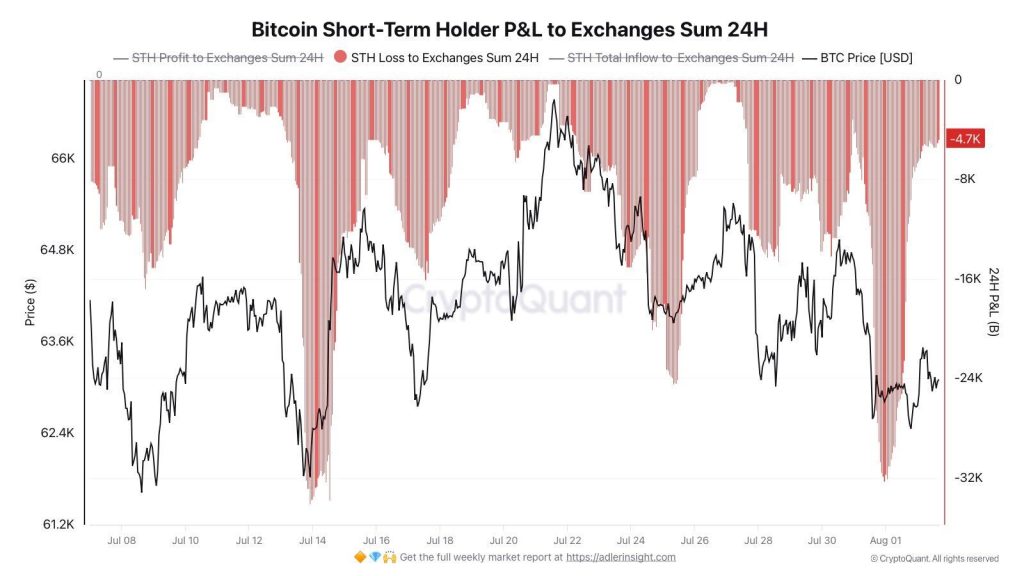
In the latest Bitcoin price prediction, BTC is trading at $63,632.81, down 0.22% on the day, after a brief intraday swing between $63,333 and $64,222 that resolved into a tight consolidation range.
Short-term holders are selling at a loss, and two liquidation clusters flanking the current price suggest the next directional move could be sharp. Which way it breaks is the question every active trader is sitting with right now.
Bitcoin rebounded toward $63,900 on Aug. 3 after briefly touching $62,300, but on-chain data and exchange flow metrics tell a cautious story.
Glassnode’s latest market report flagged persistent net selling and weak spot demand as the primary reasons BTC failed to hold its earlier move above $66,000.

A CryptoQuant chart shared by market observer Whale Factor showed approximately 32,000 BTC being sent to exchanges at a loss in a single day, marking the largest short-term holder capitulation event in 30 days. That’s not noise; that’s structural pressure.
The broader market is range-bound, waiting on macro catalysts, specifically inflation and labor data, while institutional interest remains a background supportive factor without yet translating into sustained spot demand. The macro overhang on Bitcoin’s price structure has persisted since late July and hasn’t cleared.

Bitcoin Price Prediction: Can BTC USD Price Reclaim $65,000 Before the Next Leg?
Bitcoin is trading at $63,632.81, holding just above the 78.6% Fibonacci retracement level at $63,183, a short-term pivot that has defined price action since early July with repeated tests on both sides.
The intraday range of $63,333 to $64,222 reflects compressed volatility, which historically precedes an expansion move rather than an extended sideways drift.
Liquidation clusters sit at both $62,000 and $64,000, creating a mechanical squeeze scenario in either direction. A daily close above $64,000 clears the lower cluster and opens a path toward the mid $60,000s resistance band, with the July peak near $66,900 and the 61.8% Fibonacci level at $67,394 as the next meaningful targets. Neither is close. BTC needs to demonstrate sustained bid absorption first.
A daily close above $64,000 triggers short liquidations and carries momentum toward $66,900. Continued consolidation between $63,183 and $64,000 while awaiting a macro catalyst is the base case.
Loss of $63,183 support exposes BTC to a retest of the $62,000 liquidation cluster and potentially the $60,000 to $61,000 structural zone below.
The 32,000 BTC in exchange inflows at a loss adds a headwind to any recovery attempt. Spot demand needs to absorb that supply before price can trend rather than oscillate. Longer-range price models remain constructive, but the near-term chart is still searching for a floor with conviction.
Bitcoin Hyper Targets Early-Stage Upside While BTC Consolidates
Bitcoin at $63,632 isn’t broken, but it’s not doing much for traders who bought the $66k+ range and are now sitting on paper losses as they wait for the structure to resolve. That’s the environment where early-stage infrastructure plays with defined entry points, starts attracting serious attention (rotation, not panic, there’s a difference).
Bitcoin Hyper ($HYPER) is a Bitcoin Layer 2 that integrates the Solana Virtual Machine, the first of its kind, to deliver sub-second transaction finality atop Bitcoin’s security layer.
The pitch is direct: Bitcoin’s slow throughput, high fees, and limited programmability get solved without abandoning the underlying trust model.
The presale has raised $32,997,972.04 at a current price of $0.0136841, with staking now open to early participants. The project’s decentralized canonical bridge for BTC transfers and SVM-powered smart contract execution are the technical differentiators worth examining. Presales carry inherent execution risk; token delivery and liquidity post-launch are unknowns.
For those running due diligence: Visit Bitcoin Hyper here.
The post Bitcoin Price Prediction: 32,000 Bitcoin Just Hit Exchanges at a Loss in a Single Day, Is a Short-Term Holder Capitulation Signaling the Bottom? appeared first on Cryptonews.

In April, the MLS serving greater Chicagoland worked with the nation’s largest brokerage to expand its private listing network while restricting public visibility of many home listings. A federal court recently issued a temporary restraining order to ensure the Chicago MLS continues to provide fair access.
Chicago should be a warning sign to the rest of the country. If this model spreads, public access to home listings could become a fallback rather than the default. We risk breeding the kind of widespread inequity that harkens back to redlining.
Redlining denied generations of Black families’ equal access to mortgages, investment, and the opportunity to build wealth. During the 1930s, federal programs used maps to gauge and rate neighborhoods for lending risk. Minority neighborhoods were often unjustly marked in red ink as “hazardous,” denying them mortgages and investments. Although outlawed by the Fair Housing Act of 1968, its legacy remains visible today in racial wealth gaps, segregation, and unequal opportunity. Now, a modern form of digital redlining threatens to emerge. This is more than an industry dispute. This is a civil rights issue.
Crypto World
Decentralized API Marketplaces: The Future of Open, Permissionless Digital Infrastructure

Application Programming Interfaces (APIs) are the invisible engines powering today’s digital world. From payment processing and weather forecasts to AI models and blockchain data, APIs allow applications to communicate and exchange information seamlessly. Traditionally, however, API services have been controlled by centralized providers, creating concerns around pricing, censorship, availability, and vendor lock-in.
Decentralized API marketplaces are emerging as a blockchain-powered alternative, allowing developers and businesses to publish, discover, monetize, and consume APIs without relying on a single intermediary. By leveraging smart contracts, decentralized identity, and token-based incentives, these marketplaces aim to create a more open, resilient, and transparent internet economy.
What Is a Decentralized API Marketplace?
A decentralized API marketplace is a blockchain-based platform where developers can offer APIs directly to consumers while maintaining ownership of their services.
Instead of a centralized company managing infrastructure, payments, and access control, smart contracts automate:
- API registration
- Usage tracking
- Payments
- Revenue distribution
- Reputation systems
- Access permissions
The marketplace becomes an open ecosystem where anyone can participate without requiring approval from a central authority.
How It Works
The workflow is surprisingly straightforward.
1. API Providers Publish Services
Developers upload API metadata, pricing models, documentation, and endpoint information.
Examples include:
- AI inference APIs
- Blockchain node access
- Weather data
- Financial market feeds
- Identity verification
- Machine learning services
- Gaming APIs
2. Consumers Discover APIs
Businesses and developers browse available APIs through decentralized registries.
Smart filters can rank APIs by:
- Performance
- Cost
- Reliability
- Community ratings
- Geographic availability
- Response time
3. Smart Contract Payments
Instead of traditional monthly subscriptions, users pay automatically based on actual usage.
Possible payment models include:
- Pay per request
- Pay per second
- Monthly staking
- Subscription NFTs
- Token streaming
- Micropayments
Payments settle directly between users and providers.
4. API Access
Once payment conditions are met, access credentials or decentralized authentication methods grant API usage.
Everything happens without manual approval.
Why Traditional API Platforms Have Limitations
Centralized API providers face several challenges.
Single Points of Failure
If the platform experiences downtime, thousands of applications may stop functioning.
Vendor Lock-In
Developers often become dependent on one provider’s pricing, policies, and infrastructure.
Migrating can become costly.
Limited Monetization
Smaller developers struggle to reach customers because centralized platforms favor established providers.
Geographic Restrictions
Certain services may not be available in every region due to regulations or business decisions.
Platform Fees
Central marketplaces frequently charge significant commissions that reduce developer earnings.
Benefits of Decentralized API Marketplaces
Permissionless Publishing
Anyone can publish an API without seeking approval.
Innovation becomes accessible to independent developers worldwide.
Global Payments
Blockchain enables instant international payments without relying on traditional banking systems.
Developers can monetize services regardless of their location.
Transparent Pricing
Pricing is visible on-chain, reducing hidden fees and unexpected billing changes.
Automated Revenue Distribution
Smart contracts instantly split revenue among contributors, infrastructure providers, and partners.
Better Incentives
Token rewards encourage:
- Reliable uptime
- High-quality documentation
- Fast response times
- Community support
- Honest reviews
Increased Competition
Users gain access to multiple providers offering similar services, encouraging innovation while helping keep costs competitive.
Use Cases
Artificial Intelligence
Developers can publish AI models as APIs and earn revenue for every inference request.
Instead of relying on one AI provider, applications can choose from numerous decentralized options.
Blockchain Infrastructure
Developers often need:
- RPC endpoints
- Node services
- Indexing APIs
- Wallet integrations
Decentralized marketplaces allow infrastructure providers to compete on quality and pricing.
Financial Data
Real-time:
- Stock prices
- Crypto prices
- Commodity feeds
- Forex markets
can all be monetized through decentralized APIs.
IoT Networks
Connected devices can purchase data from other sensors automatically.
Examples include:
- Traffic information
- Environmental monitoring
- Energy grids
- Smart cities
Gaming
Games may purchase:
- Leaderboards
- NFT metadata
- Matchmaking services
- Player statistics
through decentralized APIs.
The Role of Tokens
Many decentralized marketplaces introduce utility tokens that support ecosystem participation.
Tokens may be used for:
- Service payments
- Staking
- Governance
- Reputation systems
- Incentive programs
- Security deposits
- Premium API access
Rather than serving purely speculative purposes, tokens can align incentives between providers and consumers while supporting the long-term sustainability of the marketplace.
Challenges Ahead
Although promising, decentralized API marketplaces still face obstacles.
Scalability
High API volumes require infrastructure capable of handling millions of requests efficiently.
Security
APIs must be protected against:
- Abuse
- Spam
- DDoS attacks
- Fraudulent usage
Service Quality
Maintaining reliable uptime remains critical.
Reputation systems and decentralized monitoring help identify trustworthy providers.
Developer Experience
Traditional API platforms offer mature documentation and tooling.
Decentralized platforms must deliver similarly seamless experiences to encourage adoption.
Regulation
Data privacy, intellectual property, and compliance requirements vary across jurisdictions, requiring thoughtful implementation.
How AI and Blockchain Strengthen the Ecosystem
Artificial intelligence can complement decentralized API marketplaces by:
- Monitoring performance
- Detecting anomalies
- Optimizing routing
- Predicting demand
- Recommending the best providers
- Automating pricing strategies
Combined with blockchain’s transparency and programmable payments, AI can help marketplaces become more efficient, resilient, and user-friendly.
The Road Ahead
As Web3 infrastructure matures, decentralized API marketplaces could become foundational building blocks of the digital economy. Instead of relying on a handful of centralized providers, developers may gain access to a global network of services that compete on quality, reliability, and value.
For startups, this lowers barriers to monetization. For enterprises, it provides greater flexibility and resilience. For independent developers, it opens opportunities to earn directly from their innovations without depending on centralized gatekeepers.
The future of APIs may not belong to a few dominant platforms, but to open marketplaces where services, data, and intelligence flow freely across decentralized networks.
In Summary
Decentralized API marketplaces represent more than a new way to distribute software—they embody a shift toward a more open and collaborative internet. By combining blockchain technology, smart contracts, and token-based incentives, these platforms enable developers to publish services, receive transparent compensation, and reach a global audience without unnecessary intermediaries.
As adoption grows and infrastructure improves, decentralized API marketplaces have the potential to power the next generation of AI, Web3 applications, decentralized finance, gaming, and enterprise software. In a world where digital services increasingly drive economic activity, open API ecosystems could become one of the defining pillars of the decentralized internet.
REQUEST AN ARTICLE
Crypto World
Strategy Hasn’t Bought Bitcoin in 6 Weeks and Just Sold at a Loss Again: What Does Saylor’s New Framework Actually Mean?

In the latest Bitcoin news, Strategy (MSTR) sold 1,638 BTC for approximately $105 million last week, disclosed via an SEC filing dated August 3, 2026, marking the firm’s third discrete Bitcoin disposal of 2026 and its sixth consecutive week without a purchase.
The proceeds, combined with $290.6 million raised through common stock issuance, funded $81.2 million in STRC preferred stock repurchases and added $250 million to Strategy’s USD reserve, pushing that figure to $4 billion.
The average sale price for the latest tranche was roughly $64,000 per BTC, meaningfully below Strategy’s overall average acquisition cost of $75,419.
With 842,138 BTC on the books at a total cost of $63.51 billion, the company is sitting on a paper loss of approximately $10.9 billion at current prices, according to Arkham Research.
MSTR slipped 1.9% in pre-market trading following the disclosure, with Bitcoin near $63,500.
Discover: Get Paid to Be Right, $25 to Start on Kalshi
Bitcoin News: Why Strategy Keeps Selling Below Cost
The mechanics here matter. Strategy finances its Bitcoin treasury through a stack of debt instruments and preferred-stock obligations, STRC, STRK, STRD, STRF, and STRE, all carrying fixed or variable dividends that must be settled in U.S. dollars.
Quarterly preferred dividend costs have surged from $49.1 million a year ago to $400.7 million, according to supplementary research, leaving the firm with no viable alternative to regular cash generation.
To codify this shift, Michael Saylor’s firm introduced the Digital Credit Capital Framework in late June 2026, which explicitly authorizes BTC sales to fund dividends, debt service, and repurchases.
This formalizes what was effectively already happening: Bitcoin is no longer treated as an untouchable reserve but as an active liquidity source. The “never sell” chapter has closed.
The sale proceeds were split between two uses: a portion went directly to STRC dividend payments, and the remainder funded the buyback of 912,143 STRC shares for $81.2 million in aggregate, according to the primary source.
Repurchasing preferred shares below their $100 stated value is arithmetically accretive. Strategy retires $100 of future obligations for less than $100 in cash. The question is whether the pace of buybacks is sufficient to push STRC meaningfully closer to par.

STRC closed July at $89.46, and Strategy confirmed it will hold the annual dividend rate at 12% rather than raise it further, stating it will not recommend an increase until shares trade consistently near $100.
At the current discount, that 12% stated yield translates to an effective yield of roughly 13.4% for buyers in the secondary market – a spread that signals the market still prices in meaningful execution risk on this crypto treasury model.
Strategy’s Q2 results further illustrated the financial pressure, with an $8.22 billion net loss driven largely by unrealized Bitcoin impairments.
Discover: Your Market Calls Are Worth Something. Start With Free $25 on Kalshi
Six Weeks Without a BTC Purchase: What That Signals
The accumulation pause is now the most structurally significant data point that Strategy produces each week. Since early 2020, the company’s identity and a meaningful portion of MSTR’s equity premium over net asset value rested on relentless BTC acquisition.
Six weeks of no purchases, alongside three sales totaling roughly 5,258 BTC and $323 million in proceeds, represents a clean break from that pattern.
All three 2026 disposals have been executed below the $75,419 average cost basis, meaning Strategy is realizing losses on each tranche to service obligations that compound regardless of Bitcoin’s price.
The $4 billion USD reserve, which the company says covers approximately 2.3 years of preferred dividends and interest, provides a buffer, but it also represents capital that is not working in BTC. The opportunity cost calculus cuts both ways: if Bitcoin recovers above $75,000, Strategy’s pause looks costly; if BTC extends its decline, the cash cushion looks prudent.
Strategy remains one of the largest corporate holders of Bitcoin globally despite the reductions, with 842,138 BTC still on its balance sheet. The disposals to date are a small fraction of total holdings, and the firm has not signaled any intent to substantially reduce its BTC position.
What has changed is the framing: Bitcoin is now explicitly a funding source for a complex institutional treasury structure, not simply a one-directional accumulation play.
Discover: Get Paid to Be Right, $25 to Start on Kalshi
Don’t Miss Out on Our $1,000 USDT Airdrop on ByBit
The post Strategy Hasn’t Bought Bitcoin in 6 Weeks and Just Sold at a Loss Again: What Does Saylor’s New Framework Actually Mean? appeared first on Cryptonews.
Crypto World
Ripple Price Analysis: XRP Struggles Against USDT but BTC Pair Paints a Much Bleaker Picture
XRP is still trading within a long-term bearish structure across both its BTC and USDT pairs. Although sellers have slowed their momentum in recent weeks, the price has yet to reclaim any meaningful resistance. This has left the broader trend tilted to the downside. Meanwhile, the current consolidation appears to be taking place at a critical support area that could determine the next major move.
Ripple Price Analysis: The USDT Pair
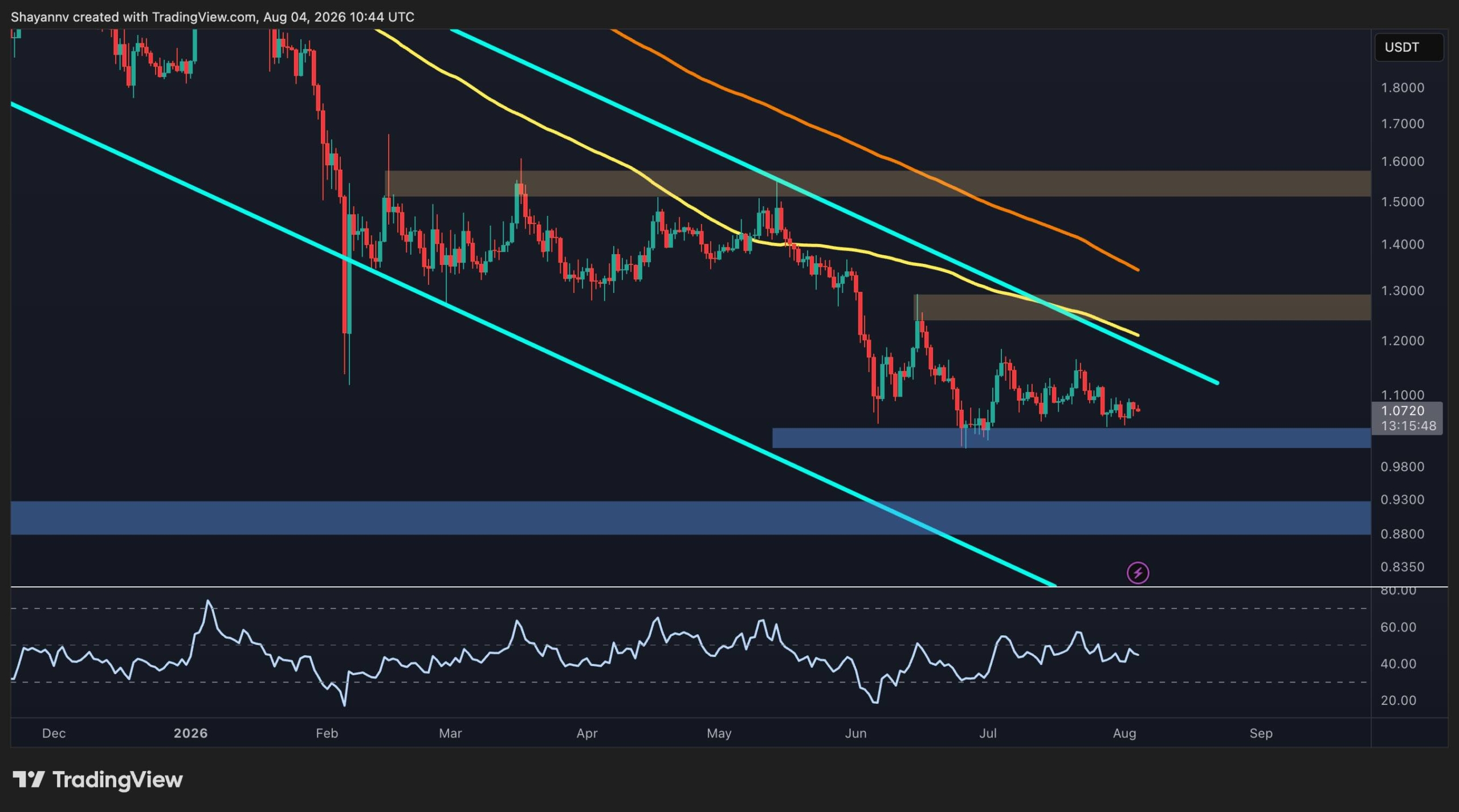
Against USDT, XRP remains confined within a descending channel while trading below both the 100-day and 200-day moving averages, keeping the broader trend bearish. The 100-day MA around $1.20 serves as the first dynamic resistance, while the 200-day MA near $1.35 strengthens the overhead resistance.
The price is holding just above the key $1 support zone, which has repeatedly attracted buyers over the past several weeks. However, the failure to reclaim the channel’s upper boundary or establish higher highs suggests bullish momentum remains limited. A breakdown below $1, on the other hand, could open the door for a decline toward the next major support around $0.90, or even lower.
On the upside, the first resistance lies between $1.25 and $1.30, where horizontal resistance aligns closely with the descending moving averages. A valid breakout above this area would be the first indication of improving momentum, while a broader trend reversal would likely require a break above the $1.50 to $1.55 supply zone.
The BTC Pair
The XRP/BTC pair also remains in a clear downtrend, with the price trading inside a descending channel and again, below both the 100-day and 200-day moving averages. The recent loss of the 1,700 sats support level has shifted market structure further in favor of the sellers, with that area now acting as immediate resistance.
Since breaking below 1,700 sats, XRP has been consolidating without any meaningful bullish momentum, suggesting sellers remain in control. As long as this level caps price action, the pair could extend its decline toward the next major support around 1.500 sats, which coincides with the lower boundary of the large channel.
A recovery above 1,700 sats, however, would be the first sign of improving sentiment, exposing the next resistance levels at 1,900 sats and 2,000 sats. However, until XRP reclaims these levels and breaks above the key moving averages and the descending channel, any rebound is likely to remain corrective rather than signaling a broader trend reversal.

The post Ripple Price Analysis: XRP Struggles Against USDT but BTC Pair Paints a Much Bleaker Picture appeared first on CryptoPotato.
Crypto World
One Company Owns 4.8% of All Ethereum in Circulation: Ethereum Price Prediction Hasn’t Reacted Yet

In the latest Ethereum price prediction, ETH price is trading at $1,852.60, down 0.33% in the last 24 hours, even as one of its largest institutional holders keeps stacking. The gap between that quiet price action and the scale of what’s accumulating beneath it is worth watching closely.
Something is building, and it hasn’t been printed yet.
BitMine Immersion Technologies (BMNR) disclosed last week that it repurchased 4.5 million shares of its common stock, bringing total buybacks since July 1 to 16.1 million shares under a $4 billion authorized repurchase plan.
Simultaneously, the firm acquired 10,399 ETH, lifting total holdings to 5.797 million ETH, equal to 4.8% of ETH’s entire circulating supply.
1/
BitMine provided its latest holdings update for August 3, 2026
$11.3 billion in total crypto + "moonshots":
– 55,797,813 ETH at $1,880 per ETH per ETH (per @coinbase)
– 209 Bitcoin (BTC)
– $180 million stake in Beast Industries @MrBeast
– $61 million stake in Eightco…— Bitmine (NYSE-BMNR) $ETH (@BitMNR) August 3, 2026

BitMine Chairman Thomas Lee noted that ETH outperformed the Nasdaq 100 by 2,500 basis points in July, calling it “the largest outperformance since July 2025.”
The firm’s staked position of 4.917 million ETH is now generating projected annualized staking revenues of $247 million at a 7-day yield of 2.67%. That is a serious institutional position, not a speculative bet. Price action, for now, has not caught up.
With ETH pressing against near-term resistance and macro sentiment still cautious, the technical picture demands a closer look before drawing conclusions.

Discover: Get Paid to Be Right, $25 to Start on Kalshi
Can Ethereum Price Break $2,000 Before the Next Major Catalyst?
Ethereum is trading at $1,852.60, above the key support cluster at $1,747 to $1,805 but still well short of the psychological $2,000 level and the resistance cluster at $1,975 to $2,000.
The 24-hour range of $1,849 to $1,874 reflects tight compression, the kind of coil that resolves sharply in either direction. Volatility sits at roughly 2.79%, consistent with a market waiting for a trigger rather than trending.
The technical mix leans cautious. Coinlore’s short-term indicators show 6 buy versus 7 sell signals, while the Fear and Greed Index sits at 23, extreme fear, a reading that has historically preceded either a flush or a sharp relief rally. The setup is binary. Support to monitor sits at $1,716 and $1,688. First real resistance above the current ETH price is $1,923, then $2,133.

ETH holding above $1,850 and clearing $1,923 on volume targets the CoinCodex projection of $2,722 on the medium-term horizon, a 52% move from current levels. Consolidation continues between $1,750 and $1,975 while the market digests BitMine’s accumulation signals, with no macro catalyst to accelerate; this is the base case. A close below $1,688 reopens the path toward levels that erased the prior recovery leg and test broader conviction.
VanEck’s 2030 base-case target of $11,848 per ETH, built on network revenue fundamentals, remains directionally intact. That is a multi-year thesis, not a week’s trade.
The structural case for ETH value accrual through fee and blob-era dynamics is well documented. The near-term price still needs a catalyst to break out of the range.
Discover: Your Market Calls Are Worth Something. Start With Free $25 on Kalshi
LiquidChain Targets Early-Mover Upside as Ethereum Tests Key Levels
ETH trading sideways at $1,861, while institutions quietly accumulate 4.8% of the supply, is precisely the kind of setup that creates late-entry regret.
For traders who believe in the broader crypto infrastructure thesis but want earlier-stage exposure, the math at the current ETH price is structurally limited; the heavy lifting was done at lower levels. That’s where early-stage infrastructure enters the picture.
LiquidChain (LIQUID) is an L3 infrastructure presale built around a single thesis: fragmented liquidity across Bitcoin, Ethereum, and Solana is the core inefficiency in crypto today.
LiquidChain’s Unified Liquidity Layer fuses BTC, ETH, and SOL ecosystems into a single execution environment with single-step execution and verifiable settlement. Developers deploy once and access all three networks, no bridge hops, no routing overhead.
The presale has raised $929,335.42 with tokens priced at $0.01486. Those are exact figures, not approximations. As with any presale, liquidity at launch is not guaranteed, and early-stage projects carry execution risk. That caveat stands.
Research LiquidChain and assess the risk profile independently before committing capital.
Discover: Get Paid to Be Right, $25 to Start on Kalshi
The post One Company Owns 4.8% of All Ethereum in Circulation: Ethereum Price Prediction Hasn’t Reacted Yet appeared first on Cryptonews.
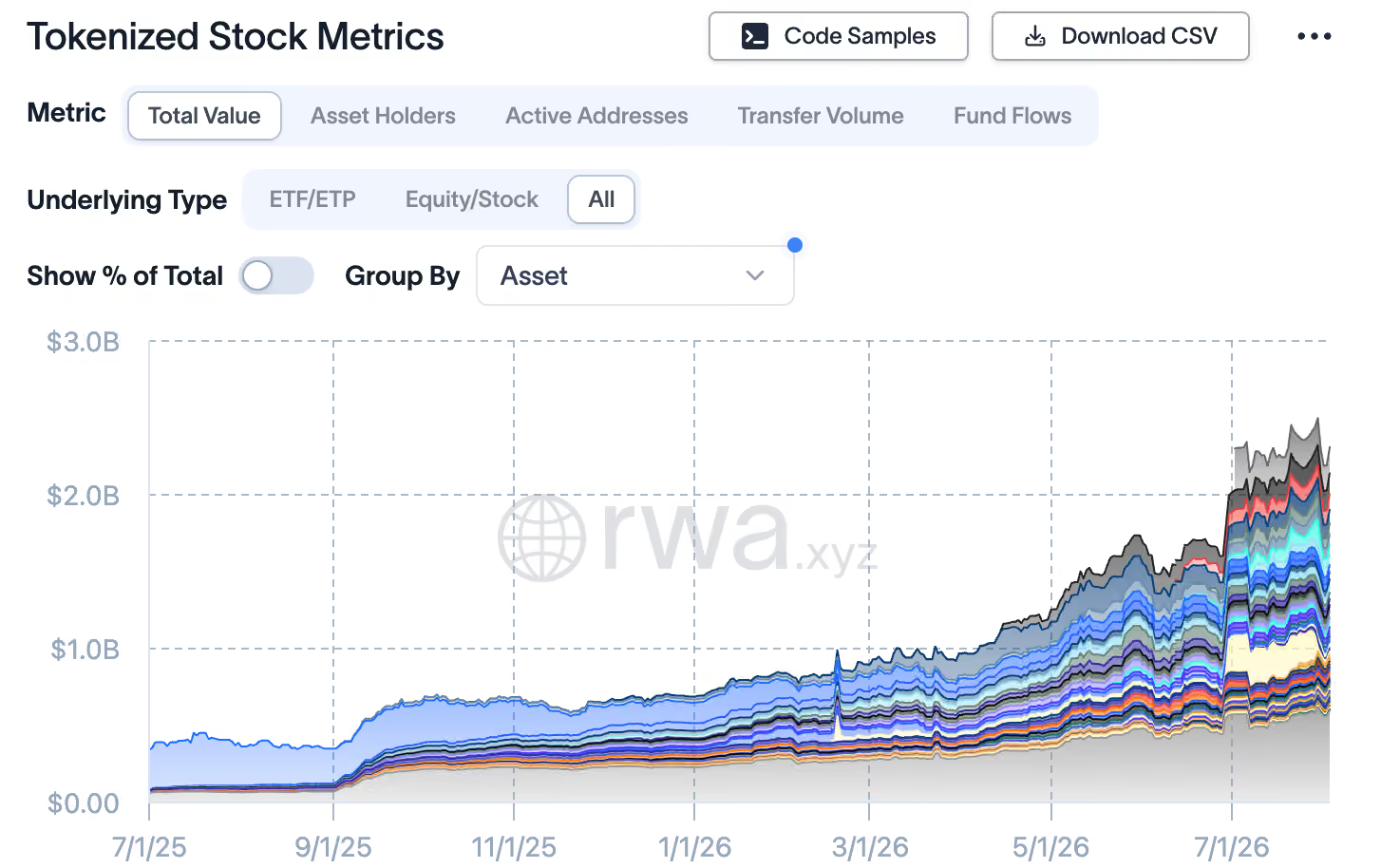
Tokenized equities firm Dinari is bringing its blockchain-based U.S. stock offering to eligible domestic investors, marking an expansion of the custodial tokenization model into the U.S. market.
The company said Tuesday that investors can buy and sell 724 tokenized U.S. stocks, including every company in the S&P 500, using Circle’s USDC stablecoin through self-custody wallets. The stock tokens are available across Ethereum, Arbitrum, Base and Avalanche, with support for Solana and Sei coming “soon,” the firm said.
The offering runs through Dinari’s regulated broker-dealer and transfer agent infrastructure and launches with partners including Circle (CRCL), Stripe-owned Privy, Para and Monaco.
The move comes as tokenized equities emerge as the next battleground in real-world assets. After tokenized U.S. Treasury funds became the first major institutional use case, firms are increasingly turning to public equities, betting blockchain technology can modernize trading, settlement and shareholder recordkeeping. Citi projects tokenized securities could grow into a $5.5 trillion market by 2030.

Competing tokenization models
The space is also splitting into competing models. Robinhood (HOOD) and Kraken parent Payward have expanded tokenized stock offerings outside the U.S. using offshore structures that mirror publicly traded shares.


Crypto infrastructure firm BitGo (BTGO) is set to replace LayerZero with Chainlink as the exclusive cross-chain provider for wrapped bitcoin (WBTC). The move pushes the value covered by announced LayerZero-to-Chainlink migrations to nearly $15 billion.
The move forms part of a migration wave that started following the $292 million exploit of Kelp DAO’s LayerZero-powered bridge earlier this year, which increased scrutiny of LayerZero bridge configurations. Various other projects, including Mantle, Kelp, Lombard, Solv Protocol, Virtuals, Re and Kraken have since announced moves to Chainlink’s CCIP.
WBTC is a tokenized representation of bitcoin designed to track its value. Unlike native bitcoin, it can be used in decentralized finance applications on other blockchains for trading, lending and collateral.
WBTC currently has a market capitalization of about $7.4 billion, according to CoinMarketCap. Adding it to the $7.24 billion covered by earlier migration announcements takes the total funds moving their cross-chain infrastructure to CCIP to roughly $14.6 billion.
BitGo said it will standardize WBTC deployments using Chainlink’s Cross-Chain Token standard and use CCIP by default for future assets it issues.

Texas is moving to scrutinize and potentially slow the expansion of data centers connected to the state’s power grid, a policy shift that could reshape near-term opportunities for some Bitcoin mining operators—but not necessarily disrupt miners with already-approved power arrangements.
On Monday, Governor Greg Abbott directed the Public Utility Commission of Texas and the Electric Reliability Council of Texas (ERCOT) to audit data center projects seeking grid interconnection, according to the governor’s office and reporting from The Texas Tribune. The audit’s duration was not specified, but the move comes as public concern grows about the pace of data center build-out in the state.
Key takeaways
- Abbott ordered an ERCOT and PUCT audit of data center interconnection efforts, with the audit timeline left open.
- Bernstein analysts said most Texas Bitcoin miners are likely insulated because many already hold contracts for approved electric capacity.
- The policy may cool “speculative” data center pipeline activity, potentially increasing the relative value of miners with longer-running infrastructure and community presence.
- Bernstein flagged CleanSpark, Cipher Digital, and Core Scientific as potentially more exposed if future grid-expansion approvals face additional political resistance.
Abbott’s data center audit targets grid connections
The directive issued by Governor Abbott calls for an audit of data centers looking to connect to Texas’s electric grid system. The Public Utility Commission of Texas and ERCOT are the entities tasked with carrying out the review, the governor’s office said. The Texas Tribune reported that the audit follows mounting public backlash related to the speed and scale of data center development across the state.
For the Bitcoin mining industry, the practical question is how much the audit and any resulting moratorium-like effect could delay new interconnection capacity, or complicate the path from pre-development plans to fully grid-connected power.
Why Bernstein expects limited disruption to existing mining contracts
In a note to clients Tuesday, Bernstein analysts said Bitcoin miners operating in Texas are not expected to be materially impacted by the audit and associated approval constraints because most are already covered by agreements for electric capacity that has been approved.
Bernstein’s research team, led by Gautam Chhugani, also argued that even if day-to-day mining operations are largely protected, the audit could still change the investment landscape. The analysts wrote that the process “throttles” the speculative data center pipeline while making “genuine sites with development history more valuable.”
That framing matters because mining economics are highly sensitive to power availability and timing. A pipeline slowdown can increase the scarcity value of projects that already have progress, permitting, and power-related approvals—especially when future grid connection steps become politicized.
Miners Bernstein says may face higher exposure to public opposition
While Bernstein described many existing operations as insulated, it highlighted particular miners it believes could be more affected if political resistance intensifies during ERCOT’s process for converting pipeline assets into grid-connected power capacity.
According to Bernstein, the local operations of Cipher Digital, Core Scientific, and CleanSpark could face the most exposure to future public opposition—particularly in scenarios where ERCOT’s approval path becomes slower or more difficult for projects attempting to turn pipeline capacity into grid-connected power.
Bernstein pointed to the idea that as new moratoriums or state directives reduce fresh capacity entering the approval pipeline, the value of already approved megawatts (MWs) can rise. In that context, the analysts cited IREN as a notable example, stating that its operations are fully ERCOT grid approved. Riot Platforms was also mentioned by Bernstein as having operations that are already ERCOT grid approved.
In other words, the distinction Bernstein emphasized is less about whether mining can continue today, and more about which companies have the most defensible position when approvals are contested and interconnection capacity becomes harder to secure for new or expanding projects.
Investor reaction and company updates as the policy shift lands
The market response to Bernstein’s framing appears to be playing out in trading. Shares of Cipher Digital were down more than 7% in Tuesday’s premarket trading, based on Yahoo Finance data.
Separately, Cipher Digital reported second-quarter 2026 business updates earlier Tuesday, according to the company’s investor communications. In that update, the miner reported a loss of $0.65 per diluted share, widening from a loss of $0.12 per diluted share in the prior year period. While those results are not directly tied to Texas’s grid audit in the coverage, they provide additional context for why investors may be scrutinizing mining operators’ paths to capacity and operational resilience.
What to watch next in Texas’s grid approval process
With Abbott’s directive now in motion, the key variable for investors and operators will be what the audit changes in ERCOT and PUCT decision-making—especially around timelines and the approvals required to move from pipeline plans to grid-connected power. As public pressure remains a live factor in Texas, companies dependent on future capacity expansion may be more exposed than those already secured under approved electric capacity contracts.
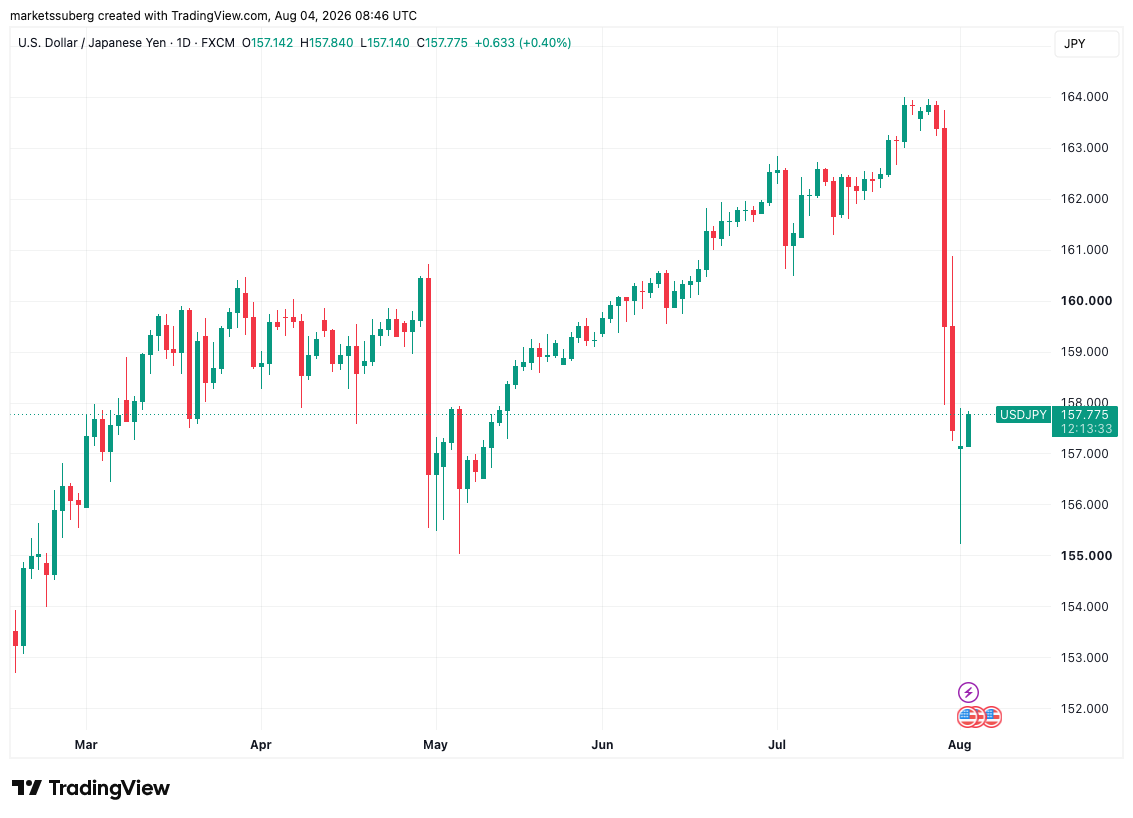
Joint currency interventions in the yen by Japan and the US could ultimately benefit Bitcoin and risk assets.
Key points:
- The first joint intervention in the yen between Japan and the US since the late 1990s could set a precedent for future moves.
- A liquidity crisis tied to the yen carry trade poses questions for Bitcoin (BTC) and risk assets as the two countries attempt a juggling act to stabilize the currency without impairing US Treasury markets.
- Japanese two-year bond yields rose above 1.57% on Monday.
Bessent signals new era of US yen involvement
Washington’s growing coordination with the Bank of Japan (BoJ) points to a potential boost in global dollar liquidity — even as it runs up against a yen carry trade unwind that could squeeze liquidity if it deepens further.
Last week, the US and Japan conducted a rare joint intervention to prop up the yen, which had slid to 40-year lows of 164 per dollar — the first of its kind since 1998. The New York Federal Reserve Bank sold euros, rather than dollars, on behalf of the US Treasury. The sales involved the Exchange Stabilization Fund, or ESF, a stockpile of foreign exchange reserves.
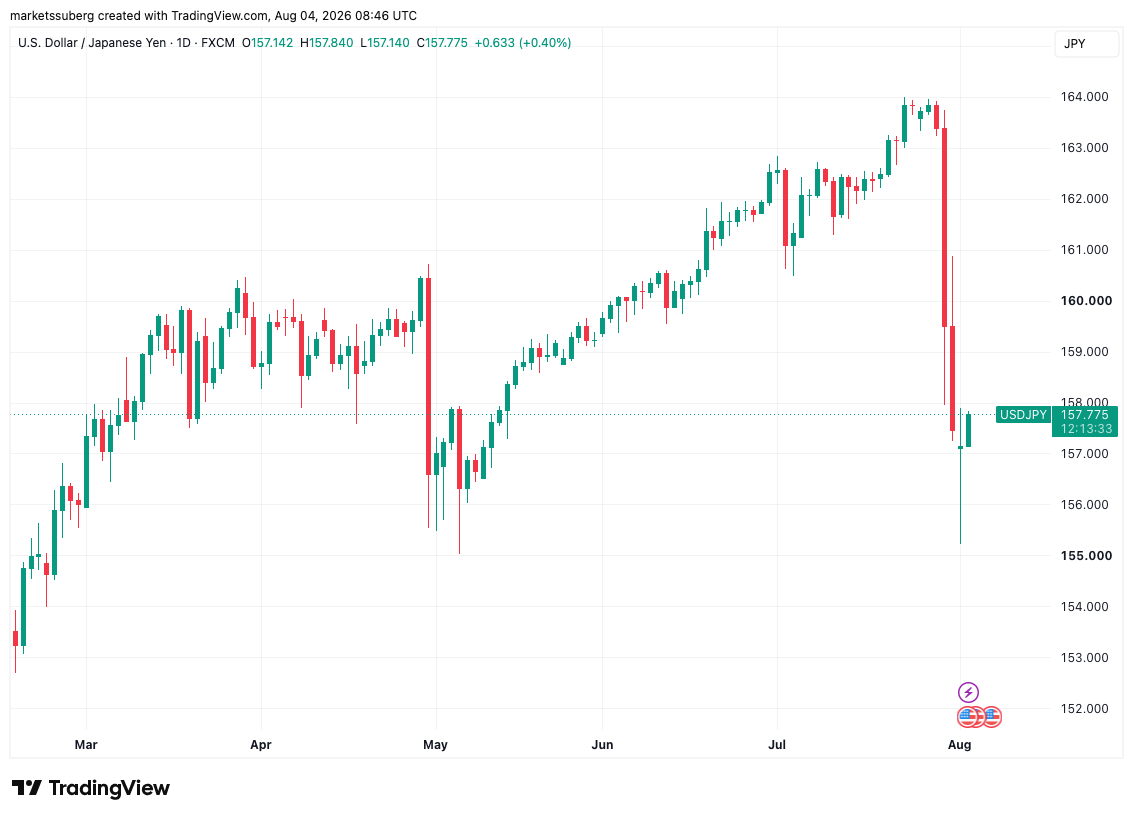
USD/JPY one-day chart for Tuesday. Source: Cointelegraph/TradingView
Subsequently, US Treasury Secretary Scott Bessent publicly placed emphasis on meeting with BoJ Governor Kazuo Ueda at the forthcoming G20 gathering of finance ministers in North Carolina at the end of August.
“Japan’s economy continues to perform well under Prime Minister Takaichi, Governor Ueda, and the Bank of Japan Board, which has demonstrated a strong commitment to monetary and financial stability. We continue to enjoy a strong relationship and close coordination,” he said.
The BoJ is one of the few central banks with access to the Federal Reserve’s Foreign and International Monetary Authorities (FIMA) repo facility, which allows access to dollar liquidity without selling US Treasuries. Japan, as the largest holder of Treasuries, could push up yields should sales accelerate, which would in turn increase borrowing costs for the US government, corporations and consumers alike.
In a subsequent post, Bessent drew attention to FIMA, calling for the facility to be expanded.
“The FIMA Repo Facility is an important backstop. We would encourage it to be upsized in the coming months. We strongly support Japan’s decisive market and monetary steps to correct the substantial undervaluation of the yen,” he continued.
FIMA use sees the Fed provide dollars to foreign institutions, which use Treasurys as collateral, with the result that the facility is positive for dollar liquidity, as it increases the supply of dollars outside the US.
Bitcoin may rise from the yen carry trade’s ashes
Reactions to the move were mixed, with economist Mohamed El-Erian noting that the US government was now bound into coordination with the BoJ going forward.
“Washington has now signed onto a strategy whose ultimate success doesn’t rest in its own hands. Instead, as discussed in previous posts, it hinges on a comprehensive policy alignment in Tokyo among the Bank of Japan, the Ministry of Finance, and the Prime Minister’s Office,” he said.
In Bitcoin circles, too, there were misgivings about the long-term implications of ongoing yen interventions — even if these inadvertently boosted the BTC bull case. Expectations have long anticipated the disintegration of the yen carry trade as the BoJ shifts away from past decades of low interest rates.
This outcome is being spurred on by other aspects of Japan’s own domestic fiscal policy. High government spending has helped government bond yields hit multi-decade highs, and this in turn makes yen funding mechanisms less attractive.
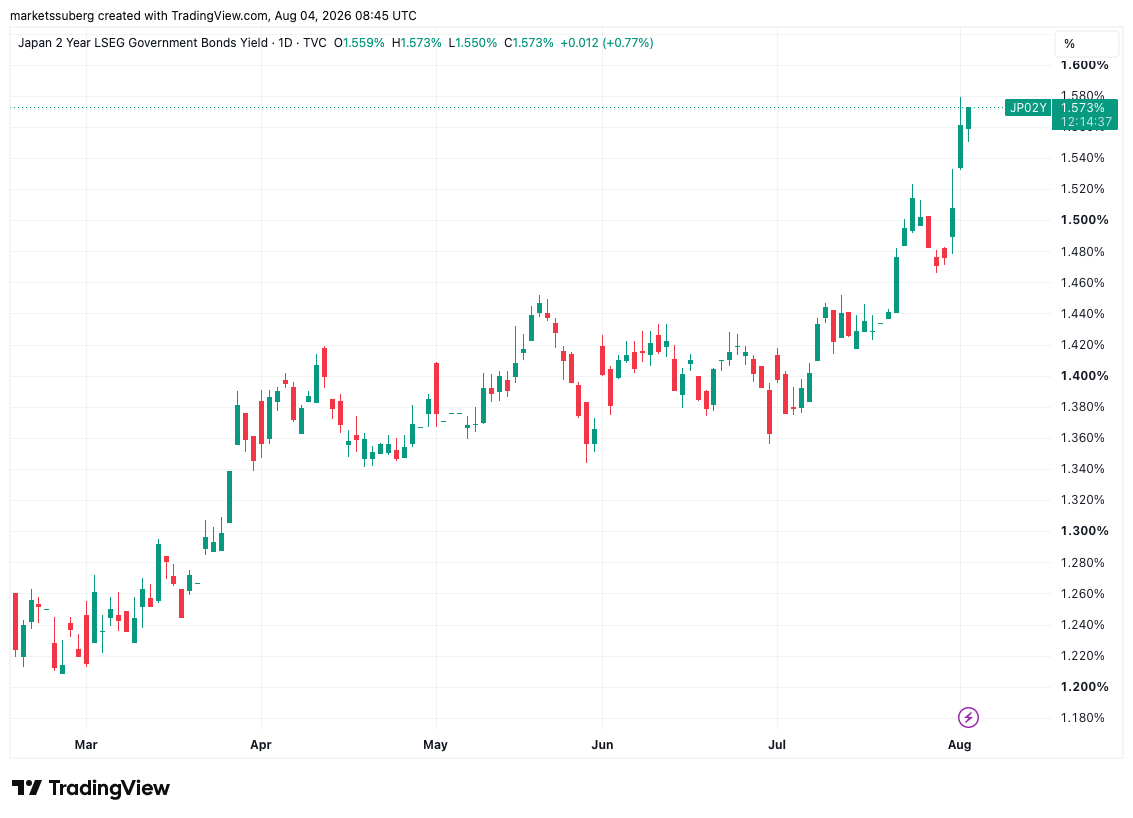
Japan two-year bonds, one-day chart. Source: Cointelegraph/TradingView
Japanese two-year bond yields rose above 1.57% on Monday, a signal that low-interest-rate conditions were coming to an end in advance of market expectations. Japanese investors repatriating capital to take advantage of this sea change in the domestic economy adds to the risk of the carry trade unwinding further.
Magazine: Here’s why the CLARITY Act’s ethics deal may be so hard to reach

Latest after burst main floods Cambridgeshire road causing ‘low water pressure’
Earnings call transcript: Entegris tops Q2 2026 forecasts and shares jump 9%

Bitcoin Price Prediction: 32,000 Bitcoin Just Hit Exchanges at a Loss in a Single Day, Is a Short-Term Holder Capitulation Signaling the Bottom?


-

 Business6 days ago
Why Trees Belong on the Risk Register
-

 Fashion4 days ago
Weekend Open Thread: Wit & Wisdom
-

 Politics4 days ago
Meta enters AI-training agreement with far-right ‘propaganda rag’ Newsmax
-
 Entertainment7 days ago
‘Stargate’ Creator’s New Sci-Fi Series Returns for Season 3 Tomorrow
-

 Crypto World3 days ago
MicroStrategy Post-Earnings CLARITY Act Push Could Add New Catalyst for Its Stock
-

 Politics6 days ago
Reform UK betrays West Mids residents by running from party pledges
-

 Business6 days ago
Major shareholder moves on Canyon
-

 Crypto World3 days ago
XRP Ledger v3.3.0 brings five institutional features
-

 News Videos5 days ago
Bitcoin Enters the 3rd Stage of the Bear Market
-

 Crypto World7 days ago
Kraken Enables Retail Access to Jersey Mike’s IPO via Tokenized Shares
-

 Politics5 days ago
Luke Littler’s dominance sparks GOAT debate
-

 Sports5 days ago
Seema Kaliramna Wins Discus Throw Bronze, Takes India’s CWG Medals Tally To 17
-

 News Videos7 days ago
Claude: Build Financial Dashboards in Minutes (2026)
-

 Crypto World4 days ago
New York sues Kalshi over prediction market gambling
-

 Crypto World2 days ago
Crypto PAC spending tops $2M in Michigan House race
-

 Business7 days ago
Johnson & Johnson agrees to $5.5B settlement over talc cancer claims
-

 Politics2 days ago
Zack Polanski: an incitement to murder Nigel Farage?
-

 Business4 days ago
Trump Announces Hamas Disarmament Agreement as Iran Strikes Kuwait Air Base and US Attacks Pause Overnight
-

 Tech6 days ago
Gemini can now summarize the messiest comment threads in Google Docs
-

 Tech2 days ago
ESET tracks rise in malicious AI skills and adaptable malware
You must be logged in to post a comment Login