
Crypto World
Robinhood Chain could earn $160M in annual fees by 2028

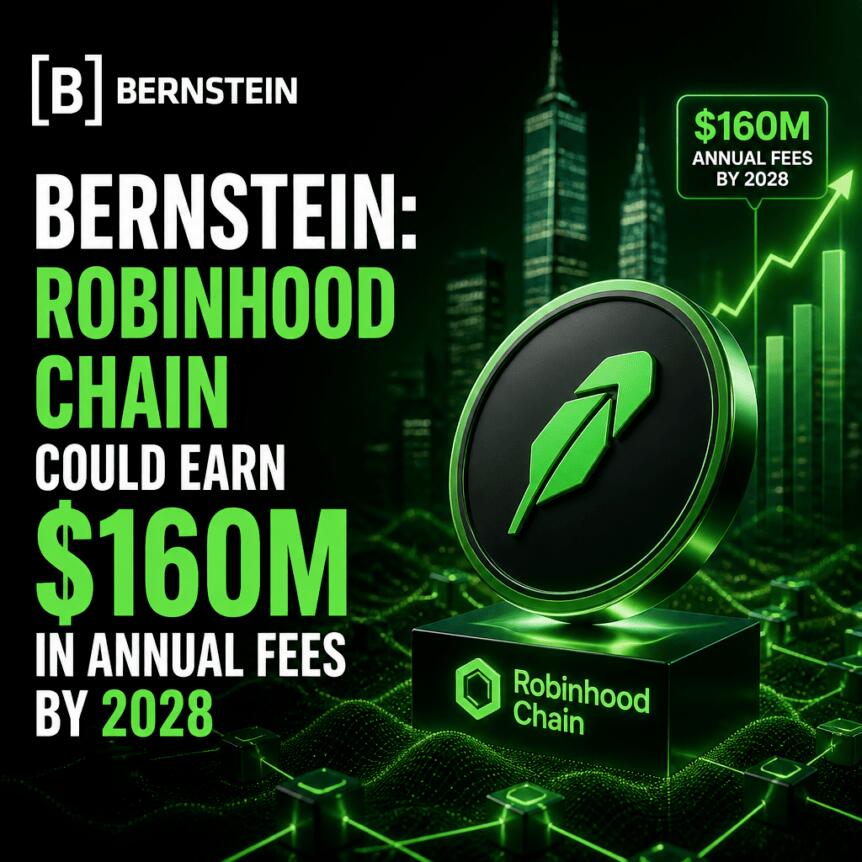
Robinhood’s blockchain network could become a major fee generator, with Bernstein analysts projecting up to $160 million in annual fees by 2028. In a report shared with Cointelegraph on Tuesday, the firm linked that outlook to rising activity around tokenized stock trading on the chain.
While memecoin-related trading dominated the Robinhood network at launch, Bernstein says the mix has shifted quickly: tokenized stock pairs now account for roughly 27% of total trading volume, while native memecoin pairs have fallen to 36% of network activity from 100% at launch on July 1.
Key takeaways
- Bernstein forecasts up to $160M in annual Robinhood chain fees by 2028, citing adoption of tokenized stock trading.
- Tokenized stocks now represent ~27% of trading volume on the network, up from a near absence at launch.
- Memecoin pairs have declined to 36% of activity from 100% at launch, indicating a changing trading mix.
- DefiLlama data shows the network has reached leading daily-fee status, with $2.13M in the past 24 hours.
- Tokenized equity offerings have faced public scrutiny, including criticism from AMC’s CEO.
Tokenized equities drive a changing fee engine
Bernstein’s central argument is that tokenized stock trading demand is becoming self-reinforcing on the Robinhood blockchain. According to the analysts, Uniswap automated market-making pools that pair memecoins with stock tokens can create what they describe as “reflexive demand” for both sides of those markets.
In practical terms, that mechanism matters because fees are typically earned from trading activity across liquid markets. If tokenized stocks continue to attract liquidity and paired trading flows, fee generation can scale beyond the initial wave of memecoin speculation that characterized the network’s early days.
Robinhood chain rises to top daily fees
The performance picture Bernstein references aligns with on-chain fee tracking. In a little over two months since launch, the Robinhood chain has climbed to the top of daily fee rankings, generating $2.13 million over the past 24 hours, according to DefiLlama’s fees by chain data.
That “early leader” status is important for investor expectations because it suggests the network’s revenue engine may be working immediately—rather than remaining a prolonged pilot stage. It also provides a measurable benchmark for comparing fee output with other chains during the same period, even as total market conditions remain variable.
Wall Street raises the bar on Robinhood shares
Bernstein’s Tuesday outlook follows a prior adjustment to its Robinhood valuation. On July 20, the firm raised its price target for Robinhood (HOOD) stock to $160 from $130 per share while maintaining an Outperform rating. That earlier update cited continued progress tied to prediction markets and tokenized equities.
In Tuesday’s premarket, Robinhood shares were little changed at last look, based on Yahoo Finance data referenced by Cointelegraph.
For readers, the key linkage is that Bernstein is framing tokenized assets not as a side experiment, but as a potential contributor to a broader revenue trajectory. If that thesis holds, the fee performance on-chain becomes one of the tangible indicators investors can monitor alongside traditional business metrics.
Tokenized equity controversy resurfaces
Not all reactions to Robinhood’s tokenized stock offerings have been positive. Earlier, Cointelegraph reported criticism from Adam Aron, CEO of AMC Entertainment Holdings, who said the tokenized stocks that provide economic exposure to AMC shares have no affiliation with the company.
Aron described the offering as “outrageous” and said AMC would request an investigation from its outside securities counsel. While the network’s trading mix appears to be evolving in ways Bernstein sees as economically constructive, the regulatory and corporate concerns around tokenized equities remain a clear uncertainty—particularly for issuers whose brand exposure may expand through tokenized wrappers.
That tension matters because it can influence how quickly tokenized stock offerings grow, how exchanges and issuers respond, and whether legal interpretations shift over time.
As the Robinhood chain continues to show high daily fees—backed by DefiLlama’s figures—investors and users will likely watch whether tokenized stock volumes keep expanding and whether the proportion of memecoin pairs keeps sliding further from launch levels. At the same time, the sustainability of tokenized equity activity may depend on how corporate objections and potential investigations develop, which could reshape the pace and scope of tokenized markets.


Traditional digital asset returns often rely on price increases. Whether it’s XRP, BTC, or other crypto assets, prices are influenced by various factors such as market sentiment, liquidity, and policy environment. Therefore, solely relying on price increases for returns carries significant market volatility risk.
Summary
- XRPPower offers short and long term digital asset service plans for XRP, BTC, ETH and USDT holders.
- Some plans advertise potential earnings of up to $50,000, with returns dependent on the selected plan and participation conditions rather than being guaranteed.
- New users receive a $21 registration bonus that can be used for daily contracts, while the platform offers referral rewards of 3% and 2%.
- XRPPower says its system uses AI analysis and automation alongside security measures including 2FA, multi signature wallets and cold and hot wallet management.
Against this backdrop, more and more users are turning to automated trading, AI data analysis, and digital asset service solutions with different timeframes, hoping to manage their digital assets in a more diversified way.
XRPPower has launched new digital asset service options for XRP and BTC holders. Users can explore short-term or long-term plans based on their needs, viewing different timeframes, participation conditions, and related rules.

The platform combines AI intelligent analysis and automation technology to provide users with a more convenient digital service experience. Some plans advertise potential returns of up to $50,000, but actual returns depend on the chosen plan, participation conditions, and actual performance, and do not represent fixed or guaranteed returns.
How can new users get started exploring XRPPower?
1. Create an account
2. Understand smart features
Browse the platform’s automated trading, digital asset services, and other features to view their operation methods, cycles, and participation conditions.
3. View supported assets
Based on the platform’s current availability, understand the supported assets such as XRP, BTC, ETH, and USDT, and confirm the corresponding network and service rules before operating.
4. Choose your service
Users can choose to withdraw their funds or continue purchasing contracts to earn more returns, based on their needs.
Popular profitable contracts for new users
Investment Amount: $1000, Investment Period: 7 days, Daily Return: $13.2, Principal Refund at Maturity: $1000
Investment Amount: $5000, Investment Period: 15 days, Daily Return: $70.5, Principal Refund at Maturity: $5000
Click to view all contract returns
How to achieve long-term returns with zero investment
Additional referral rewards
Log in to your account using your referral code or request link to invite friends and family to join the XRPPower platform and earn permanent rewards of 3% + 2%.
Example description:
(A) User A refers User B to make an additional investment; if B invests $10,000, A will receive a 3% ($300) reward.
(B) User B refers User C to make an additional investment; if C invests $10,000, B will receive a 3% ($300) reward, while A will receive a 2% ($200) second-level referral reward.
XRPPower Intelligent Service System: AI-Powered new experience in digital asset management
With the continuous development of artificial intelligence, automation, and digital asset technologies, users have placed higher demands on the platform’s security, operational efficiency, ease of use, and information transparency. XRPPower continuously promotes technology and service upgrades, exploring the deep integration of AI and digital services.
AI-Powered intelligent analysis enhances service efficiency
XRPPower applies AI data analysis and automation technologies to its platform services. Through intelligent systems, it assists in processing relevant data, analyzing system status, and optimizing operational processes, reducing repetitive manual operations and providing users with a more convenient digital experience.
Multi-Layered security mechanisms strengthen account protection
The platform implements comprehensive security measures across multiple levels, including accounts, data, and networks. These measures encompass SSL/TLS encryption, two-factor authentication (2FA), access control, multi-signature, cold and hot wallet management, DDoS protection, and WAF (Web Application Firewall), continuously strengthening the platform’s overall security capabilities.
Professional management approach continuously optimizes operations
XRPPower pays attention to industry trends in risk management, internal control, and information security, and references publicly available management concepts from international professional organizations such as PwC to continuously improve its internal processes and risk management mechanisms.
It is important to emphasize that referencing publicly available professional concepts does not constitute an audit, certification, or official endorsement of XRPPower by PwC, unless supported by formal publicly available documentation.
Clearer information, enhanced user experience
XRPPower continuously optimizes its platform pages and account functions, providing a clearer display of service content, participation conditions, cycles, rules, and account records. This allows users to easily view relevant information and make informed decisions after fully understanding the service content and risks.
Continuous upgrades, exploring an intelligent future
AI technology is constantly transforming the way services are delivered in the digital asset industry. In the future, XRPPower will continue to advance its technological upgrades around AI intelligent analysis, automated management, security protection, and digital experience, providing global users with a clearer, more convenient, and intelligent digital service environment.
Learn more:https://xrppower.com/
Email: [email protected]


Circle has added upfront fee payments to CCTP Fast Transfer, allowing developers to quote and collect cross-chain USDC fees on the source network while preserving the amount delivered to recipients.
Summary
- CCTP developers can collect Fast Transfer and Forwarding Service fees before a USDC transfer.
- Fees can be paid in USDC or the source blockchain’s native gas token.
- Circle’s Quote API combines supported protocol fees into one signed, time-limited quote.
- Upfront fees require an EVM source chain, although transfers can still end on supported non-EVM networks.
CCTP collects transfer fees before burning USDC
Circle’s official developer documentation says the process begins when an application requests a signed fee quote and submits it with the USDC burn transaction on the source blockchain.
Under the previous payment method, protocol fees could be deducted from the USDC minted for the recipient on the destination network. A user sending a set amount could therefore receive less than the figure entered at the start of the transaction.
The prepaid model separates the transfer amount from the fee. Once the transaction has been submitted, a CCTP smart contract checks the signed quote, collects the payment, and passes the transaction to TokenMessengerV2, which completes the USDC burn.
Circle then verifies the transfer and mints the full stated amount on the destination chain. A person sending 100 USDC, for example, can arrange for the recipient to receive 100 USDC while paying the related protocol charge separately on the originating network.
Developers can use the setup for the Fast Transfer fee, the Forwarding Service fee, or both. Fast Transfer allows USDC to reach another chain before the source transaction reaches full finality, while the Forwarding Service can deliver funds and complete an action on the receiving network.
CCTP itself moves native USDC through a burn-and-mint system. The protocol destroys the tokens on the source chain before issuing the same amount on the destination chain, avoiding the wrapped assets commonly used by conventional bridges.
A cross-chain bridge explainer published by crypto.news in August described CCTP as the largest implementation of this issuer-controlled model. Unlike a general-purpose bridge, the system depends on Circle deploying and operating its infrastructure on every connected network.
Circle Quote API combines two CCTP fees
Through the CCTP Quote API, an application sends the transfer amount, the source and destination domain identifiers, the selected payment token, and the fees it wants priced.
A PRE_FINALITY request covers the Fast Transfer charge, while a FORWARD request covers the Forwarding Service. Developers can place both requests in the same API call rather than calculating and presenting the charges through separate systems.
The response contains the total fee, a breakdown for each service, the payment token, and a signed quote that must accompany the onchain transaction. Circle binds the quote to the specified transfer amount and destination, while Forwarding Service quotes also depend on the destination caller and hook data.
If a developer changes one of the bound values before submitting the transfer, the transaction reverts. Each quote also carries an expiry time or source-chain block limit, requiring the application to obtain a new price when the original offer expires.
Circle’s current documentation lists an approximate two-minute validity period for most supported networks, including Arbitrum, Avalanche, Base, Linea, OP Mainnet, Polygon PoS, Sonic, Unichain and World Chain. Ethereum quotes have an estimated window of two minutes and 30 seconds, although Circle notes that the duration can change.
The signed quote gives the application the exact protocol cost before the burn is submitted. Developers can therefore show the user the transfer amount, fee, and final amount in advance, without estimating separate charges that may be deducted after the USDC reaches another chain.
Users can pay CCTP fees in USDC or native tokens
For payment, developers can select either USDC or the native gas asset of the source blockchain. Native-token payment is the default option, with the quoted amount attached to the transaction as its native value.
Choosing USDC requires the application to enter the stablecoin’s source-chain address in the request. The user must then approve the TokenMessengerWithFees contract to spend both the USDC being transferred and the additional USDC needed for the fee.
Although both amounts come from the sender’s balance in that case, the contract handles them separately. Only the transfer amount enters CCTP’s burn-and-mint process, while the prepaid fee is collected before the burn.
Using a native token can leave the sender’s USDC balance unchanged apart from the amount selected for transfer. The option may suit wallets and applications that already hold gas assets on the originating chain, while USDC payment allows developers to keep the transaction costs denominated in dollars.
For Forwarding Service transactions, the updated contract can also create the required cctp-forward hook automatically when the developer requests a forwarding quote without supplying custom hook data. Applications using custom instructions must submit the same hook data used when obtaining the signed quote.
Circle’s example implementation transfers 10 USDC from Base Sepolia to Arc Testnet and prepays both service fees. The company said developers can follow the same process for eligible EVM source networks and any destination supported by the Forwarding Service.
EVM requirement excludes Solana as a source chain
Upfront fee quotes currently require the transfer to start on an EVM-compatible blockchain. Circle’s API documentation says the source domain must support prepaid fees and meet any additional conditions attached to the requested service.
Fast Transfer quotes are available only when the source blockchain supports faster-than-finality settlement. Similarly, an application can request a forwarding fee only when the destination works with Circle’s Forwarding Service.
Solana cannot act as the source network for an upfront-fee transaction under the current setup because it is not EVM-compatible. Applications can still send USDC to Solana when the selected route and destination service are supported.
CCTP’s network footprint has continued to grow as Circle adds native USDC to more chains. In August, Circle launched CCTP on X Layer, taking the protocol to 26 blockchains while native USDC was available across 36 networks.
For institutional users, Circle connected Gateway with Fireblocks in July, allowing customers to manage a unified USDC balance across supported chains through Fireblocks’ controls, approval systems and transaction records.
American users remain subject to the terms of the platforms and applications through which they access CCTP. Circle’s USDC terms state that its U.S.-issued stablecoin is treated as stored value or prepaid access under applicable state money-transmission laws, while third-party support for USDC does not constitute Circle’s approval of that service.
Bitcoin dipped below $80,000 as strong US jobs data raises the chances of another interest rate hike. Markets now put the odds of a Federal Reserve rate hike on September 16 at about 60%.
According to the recent Bitfinex Alpha report, the US added 162,000 jobs in August, while unemployment stayed at 4.1%. The data suggests the labor market remains strong, giving the Fed less reason to rush into cutting rates.
Strong Jobs Data Puts Bitcoin to the Test
The strong jobs report pushed two-year US Treasury yields above 4.34% as markets adjusted their expectations for the Fed. Higher rates can put pressure on Bitcoin because safer assets such as government bonds become more attractive.
Even so, Bitcoin held up for a while despite pressure. So far, it reached $82,400 on September 3 before pulling back and has since traded between roughly $77,200 and $82,100.
Meanwhile, the cryptocurrency remains about 42% above its July low. US spot Bitcoin ETFs have also continued to attract demand, recording nearly $1 billion in net inflows last week.
ETF Demand and Inflation Could Set the Next Move
Analysts at Bitfinex said this week’s inflation report will be an important test for Bitcoin. They are watching whether ETF demand can remain strong even while short-term interest rates stay high.
If ETF buying continues under those conditions, Bitfinex believes high rates may no longer be the main factor limiting Bitcoin’s recovery. A sustained flow of money into the ETFs could support Bitcoin if other market conditions remain favorable.
Bitcoin also faces a potential selling hurdle as more than 71% of its supply is currently in profit. That figure is approaching the historical average of 74.7%, a level Bitcoin has previously moved above during shifts from weaker markets to stronger ones.
For now, Bitcoin remains between $77,200 and $82,100 as markets wait for fresh inflation data. A weekly close above $82,100 could strengthen the recovery, while hotter inflation could increase pressure on the Fed to raise rates.
The post Bitcoin Calms Below $80K as Fed Hike Odds Climb: Bitfinex Alpha appeared first on CryptoPotato.
StablecoinX appointed former Franklin Templeton digital asset executive Christopher Jensen as CEO, putting him in charge of the largest corporate holder of Ethena’s ENA token.
Jensen succeeds Ted Chen, who led StablecoinX through its public listing in June and will remain chairman of the company’s board.
StablecoinX, which trades on Nasdaq under the ticker USDE, is a publicly listed company focused on the Ethena ecosystem. Ethena issues USDe, a synthetic dollar that ranks as the fifth-largest stablecoin with nearly $4.4 billion in circulation, according to DefiLlama data. ENA, Ethena’s governance token, gives holders voting rights over changes to the protocol.
StablecoinX holds about 3.03 billion ENA tokens, roughly 20% of the token’s total supply, which the company says makes it ENA’s largest corporate holder.
Before joining StablecoinX, Jensen was a portfolio manager and director of digital asset research at Franklin Templeton, where he helped build the firm’s digital asset group after its launch in 2018. The asset manager’s blockchain venture fund participated in Ethena’s seed round, giving Jensen exposure to the protocol from its early stages.
The appointment comes about a week after Ethena launched Ethena Pay, a self-custodial app that lets users spend, save and transfer its USDe synthetic dollar.
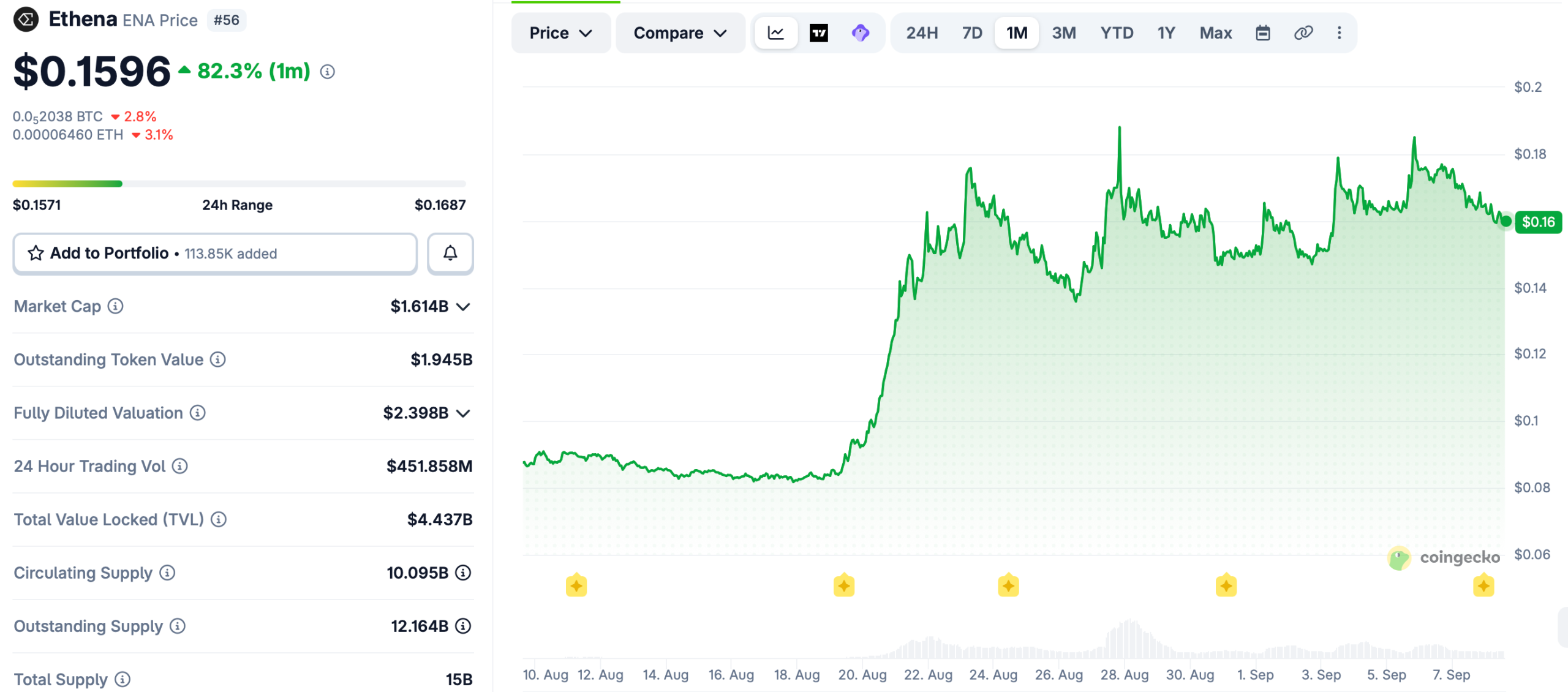
The ENA token remains down about 20% year to date but has rebounded sharply in recent weeks, gaining more than 80% over the past month to trade around $0.16, according to CoinGecko.
ENA token price over the past month. Source: CoinGecko
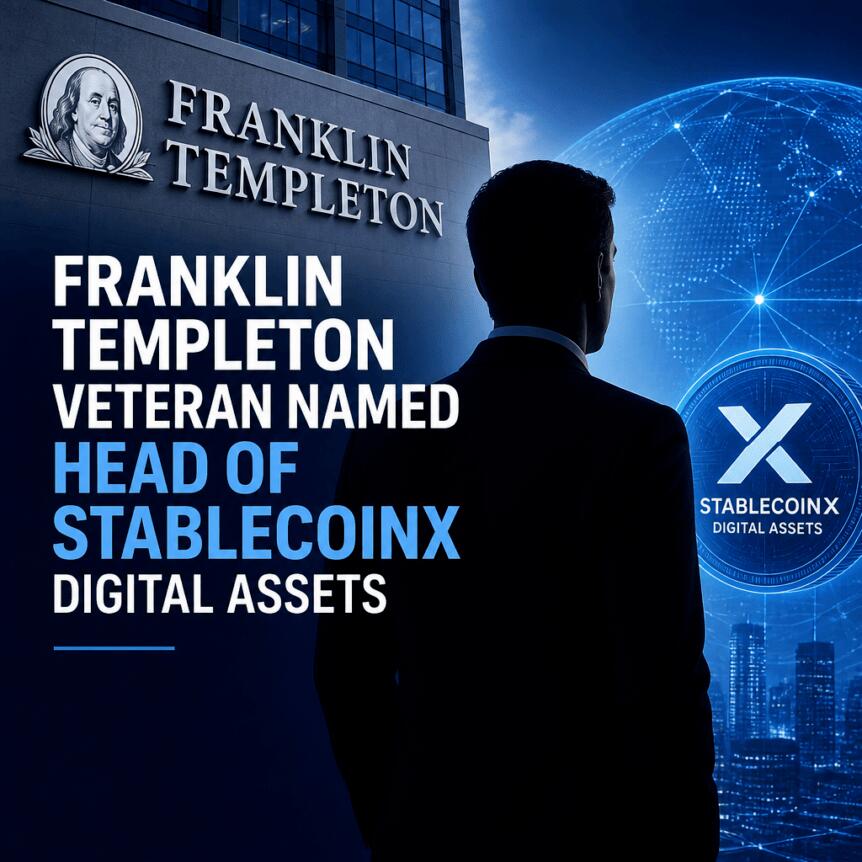
StablecoinX, the Nasdaq-listed company focused on the Ethena ecosystem, has named Christopher Jensen as its new chief executive officer. Jensen, formerly with Franklin Templeton’s digital assets team, will lead the firm’s management of ENA, Ethena’s governance token.
The appointment replaces Ted Chen, who guided StablecoinX through its June public listing and will continue to serve as chairman of the board. The CEO change places further emphasis on StablecoinX’s role as one of the largest institutional holders of ENA at a time when Ethena-related products are expanding.
Key takeaways
- StablecoinX appoints Christopher Jensen as CEO, tasked with running a major corporate stake in ENA.
- Ted Chen steps down as CEO but remains chairman after leading the firm through its Nasdaq listing in June.
- StablecoinX says it holds ~3.03 billion ENA tokens—about 20% of total supply—making it ENA’s largest corporate holder.
- Jensen’s background includes building Franklin Templeton’s digital asset group after its 2018 launch.
- The move follows Ethena Pay’s launch, a week after the self-custodial USDe spending and transfer app went live in dozens of countries.
What the leadership change signals for ENA holders
StablecoinX’s CEO transition matters because ENA is not a passive asset position. Ethena’s governance token provides voting rights over protocol changes, meaning large holders can influence how the system evolves. By placing Jensen at the helm, StablecoinX is effectively doubling down on governance-related oversight and strategic decision-making around Ethena’s broader roadmap.
According to the company, StablecoinX holds roughly 3.03 billion ENA tokens—around 20% of the token’s total supply—positioning it as ENA’s largest corporate holder. That concentration is precisely why governance outcomes attract attention from investors: changes to voting parameters, incentive structures, or protocol governance mechanisms can impact long-term token dynamics.
From Franklin Templeton to StablecoinX’s Nasdaq spot
Jensen joins StablecoinX after a long tenure at Franklin Templeton’s digital asset organization. The asset manager launched its digital asset group in 2018, and the report notes that Jensen helped build it, eventually serving as a portfolio manager and director of digital asset research.
StablecoinX’s appointment also highlights a direct connection between traditional asset management and Ethena’s early development. The report states that Franklin Templeton’s blockchain venture fund participated in Ethena’s seed round, giving Jensen exposure to the protocol before it became widely discussed across decentralized finance.
StablecoinX, meanwhile, trades on Nasdaq under the ticker USDE. The company is described as publicly listed and focused on the Ethena ecosystem, where Ethena issues USDe—an engineered, synthetic dollar that is reported to rank among the largest stablecoins. DefiLlama data cited in the article places USDe as the fifth-largest stablecoin by circulation, with nearly $4.4 billion in supply.
Why this comes right after Ethena Pay’s rollout
The leadership change arrives about a week after Ethena introduced Ethena Pay, a self-custodial app enabling users to spend, save, and transfer USDe. Earlier coverage linked to the appointment notes the product launch across 48 countries, expanding USDe’s utility beyond trading and custody into more everyday payment use cases.
While a CEO appointment is not automatically tied to product launches, the timing suggests a coordinated push toward ecosystem growth. For ENA holders and watchers, the practical question is whether the expansion of USDe on the consumer-facing side will translate into broader network participation—potentially affecting liquidity, adoption, and ultimately governance priorities.
Token performance: rebound alongside ecosystem momentum
The report also notes that ENA has been volatile. It remains down about 20% year to date, but has rebounded sharply in recent weeks—gaining more than 80% over the past month to trade around $0.16, according to CoinGecko.
That rebound matters for market participants because it often changes the attention placed on governance assets. When liquidity and sentiment shift, it can increase the number of participants monitoring governance votes, proposals, or shifts in token utilities. Still, the article does not attribute ENA’s price movement directly to StablecoinX’s leadership change, so investors should treat the correlation as circumstantial rather than causal.
What’s clear from the underlying facts is that StablecoinX’s governance exposure is large, and Ethena’s product expansion is ongoing. Together, those developments can affect how ENA is perceived—whether primarily as a governance instrument held by institutions, or as a token positioned for broader ecosystem activity driven by USDe utility.
Looking ahead, readers should watch for how Jensen’s strategy influences StablecoinX’s engagement with Ethena governance, as well as whether Ethena Pay’s rollout leads to measurable increases in USDe usage and participation across the ecosystem. The exact impact on ENA will likely depend on governance decisions and adoption metrics rather than any single corporate appointment.
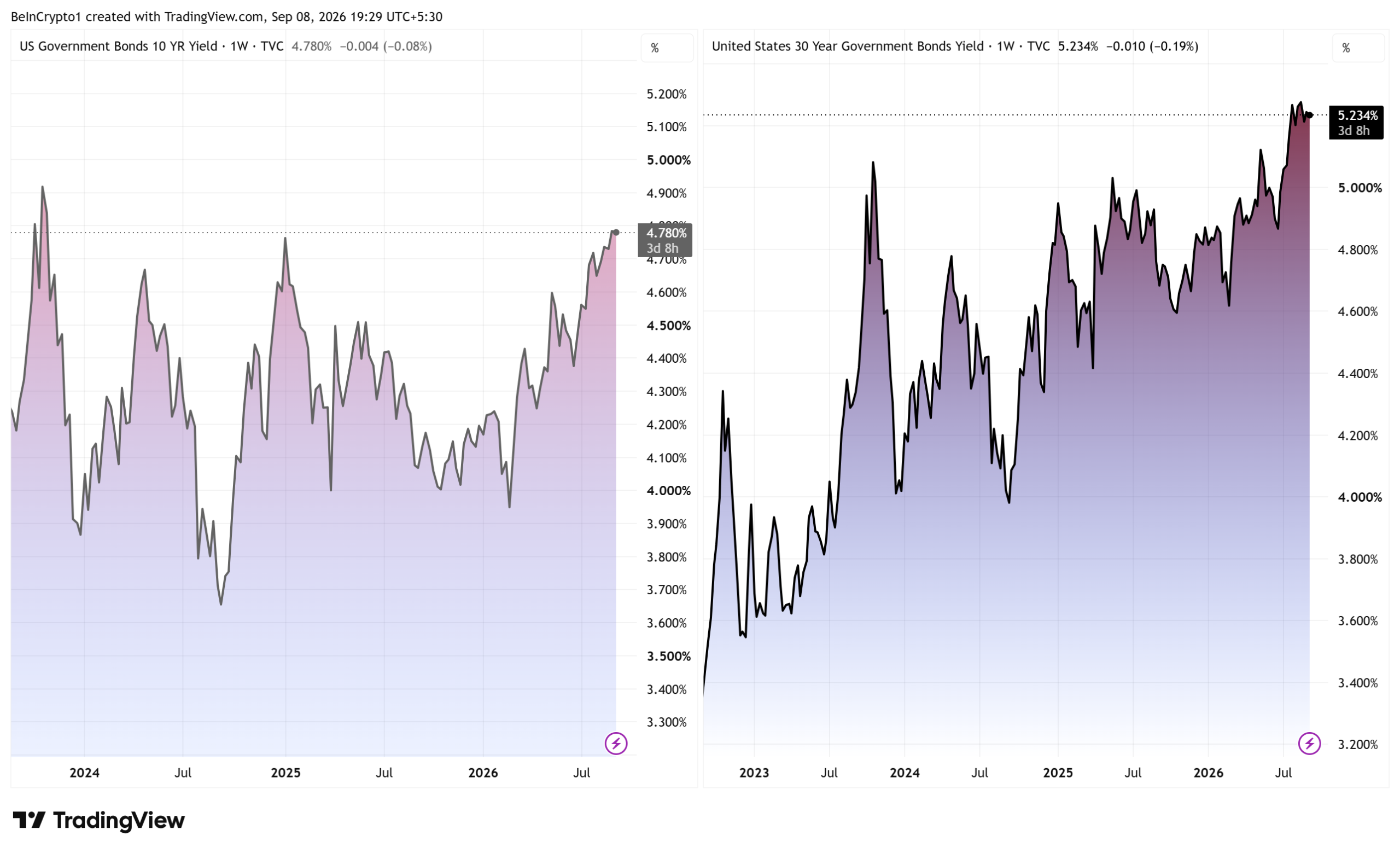
Anyone who bought long US government bonds 10 years ago has lost money. Not after inflation. Before it. In 223 years of records, that has happened only once before.
Long Treasury bonds lost roughly 2% a year over the decade to August 2026, Bank of America data shows. The last stretch this bad ended in 1803, when Washington borrowed to buy Louisiana.
The Safest Trade in the World Just Broke
The math is such that bond pays a fixed coupon. Nothing more. On this day in 2016, the 30-year Treasury paid 2.32%, according to Treasury Department records. That was the whole prize.
Then inflation arrived, the Federal Reserve hiked, and yields climbed. Prices fell far enough to swallow the coupon.
The record starts in 1793 and holds 2,771 monthly readings, compiled by Santa Clara University finance professor Edward McQuarrie. Negative 10-year returns appear in 25 of those months. Bianco Research counts 24 of them in the current run.
“Bonds WERE the worst investment in American history. It says nothing about what they do next,” wrote Jim Bianco, founder of Bianco Research.
Follow us on X to get the latest news as it happens
Bitcoin Now Has a Rival It Never Had
The starting yield is the tell, as it has set most of the following decade’s return across this data, by Bianco Research’s reading. Buy at 2% and you earn about 2%. Buy at 5.25% and history points near 5%.
That is the part Bitcoin has never faced. The Fed cut rates to near zero on December 16, 2008. Bitcoin’s first block arrived 18 days later.
Cheap money was the water it swam in. Now the 10-year Treasury yields 4.80% and the 30-year pays 5.25%, both as of Tuesday.

Bitcoin pays nothing. It trades near $77,934, down about 2% and well below its 2025 record. BeInCrypto flagged the squeeze last week, when global bond yields hit levels last seen in 2008.
The Uncomfortable Part
The twist is that the wreckage that makes bonds attractive is the same wreckage Bitcoin buyers cite.
Yields are high because Washington borrows on a scale that unsettles lenders. Federal debt hit $40.1 trillion on September 3, Treasury figures show, and the $40 trillion debt pile grows with every auction. Oil above $100 keeps inflation sticky.
The money is not leaving either. US spot Bitcoin funds pulled in $987.7 million in the week to September 4, Farside data shows, and Bitcoin ETF inflows beat every rival crypto fund. Polymarket traders price a September rate hike at 52%.
Bitcoin was easy to hold when cash paid nothing. The question now is whether it can beat 5% a year for a decade. Friday’s inflation data starts the answer.
The post US Bonds Suffer Worst Decade in 223 Years: What It Means for Bitcoin appeared first on BeInCrypto.


Hedge-fund manager Brian Kelly has his staff working 24/7, yet his payroll costs are a fraction of what they once were.
That’s because Kelly — who previously ran a cryptocurrency hedge fund — created his new trading firm, Bracket22, to be powered entirely by agentic artificial intelligence.
“I used to have about seven or eight employees all around the world. A lot of them were based in New York,” Kelly told CNBC. “Between their salaries and compute and healthcare and everything like that, my payroll was well into the millions of dollars per year.”
Factoring in things such as office space and bonuses, Kelly estimated his total labor-related costs before he began using AI were roughly $5 million a year.
“Now, when I’m using AI, I run somewhere around [$30,000] to $40,000 a year, total. And that’s with every AI agent, that’s with all my compute, that’s with everything I need to completely replicate a hedge fund … with AI,” he said.
Bracket22 is a stark example of a growing reality on Wall Street as firms test the benefits and limits of AI in finance.

JPMorgan Chase CEO Jamie Dimon said in February the tech was already reshaping his workforce and that his bank had “huge redeployment” plans for its employees. The company plans to launch AI agents later this year that it has said can work autonomously for hours at a time.
Morgan Stanley is similarly funneling some work to AI.
There has been some hesitation, though. A Goldman Sachs partner, for example, recently warned of the dangers in letting AI erode bankers’ reasoning skills.
Kelly — a former trader on CNBC’s “Fast Money” — closed his cryptocurrency hedge fund in early 2025. Later that year, he began testing out uses of artificial intelligence. Bracket22 invests only Kelly’s own capital and trades cryptocurrencies, stocks and commodities.
Brian Kelly founded Bracket22, a trading firm powered entirely by agentic AI.
CNBC
Kelly introduced CNBC to several of his AI agents, each with its own distinct role. A bot called “Steffi” is in charge of technical analysis. “Desmond” handles quantitative strategies, and “Houston” is, fittingly, mission control and pulls all the pieces together.
“I’ve crafted each of these agents to be a specialist in their field,” Kelly said. “I wanted to isolate them and I wanted to get their unbiased view on what I’m doing.”
“And then I use my human judgment and human insight to make the final decision,” he added.
Kelly said he would estimate he’s “at least 10 times more productive” with his agents. And while he’s replaced his staff with AI, he said the real opportunity lies in augmenting human workforces.
“If you take a staff of 100, [with AI] you’ve got a staff of a thousand,” he said. “It’s not necessarily just, hey, you can replace everybody with AI agents. You can make your existing employees at least 10 times — maybe more — more productive.”

BitMine Immersion Technologies has purchased 28,086 ETH worth about $70.1 million, raising its Ethereum treasury to 5.93 million tokens as Chairman Tom Lee predicts further gains for the asset.
Summary
- BitMine acquired 28,086 ETH last week, lifting its holdings to 5,929,198 tokens.
- The company now owns 4.9% of Ethereum’s estimated 122 million-token supply.
- More than 5.06 million ETH is staked, with projected annual revenue of $330 million.
- Tom Lee cited U.S. crypto legislation, tokenization, and blockchain-based AI as possible market catalysts.
BitMine’s Ethereum treasury has reached 5.93 million ETH
BitMine said in a Sep. 8 treasury update that it held 5,929,198 ETH as of Sep. 7, following the purchase of 28,086 tokens during the previous week.
Using the company’s reference price of $2,495, the latest acquisition was worth approximately $70.1 million. Its entire Ethereum position carried a value of about $14.79 billion at the same price, although the balance-sheet value will change alongside ETH.
“Over the past week, we acquired 28,086 ETH,” Lee said.
The purchase extended a run that began when BitMine adopted its Ethereum treasury strategy on June 30, 2025. According to Lee, the company has added ETH every week since the plan started.
As crypto.news reported on Aug. 31, BitMine had previously added 53,501 ETH, taking its balance to 5,901,112 tokens. Earlier weekly purchases included 9,926 ETH during the period ending Aug. 16 and another 32,447 ETH in the following update.
Based on the 122 million ETH supply used in the latest announcement, BitMine now controls about 4.9% of all tokens. The company said it has completed 97% of its plan to own 5% of the supply, a target it calls the “Alchemy of 5%.”
Reaching exactly 5% under the company’s current supply estimate would require approximately 6.1 million ETH. BitMine therefore remains about 170,802 ETH below that level, though the required amount can change as Ethereum’s total supply moves.
Beyond Ethereum, the Sep. 7 balance sheet included 211 Bitcoin, $593 million in cash and marketable securities, a $180 million stake in Beast Industries, and a $91 million investment in Eightco Holdings. BitMine valued its combined crypto, cash, securities, and strategic investments at $15.7 billion.
Staked ETH could generate $330 million per year
Alongside its weekly purchases, BitMine reported that 5,067,309 ETH had been placed into staking through its Made in America Validator Network and external staking partners. The staked position was worth roughly $12.6 billion at the company’s reference price and represented about 85% of its Ethereum holdings.
Management estimated annualized staking revenue of approximately $330 million based on a seven-day annualized yield of 2.61%. If BitMine eventually stakes its full ETH balance through MAVAN and partner validators, the company projects annual rewards of about $386 million under the same yield assumption.
Both figures are projections rather than fixed revenue. Ethereum staking returns can change with network participation, validator performance, protocol rules, and the market price of ETH.
BitMine launched MAVAN earlier in 2026 to support its own treasury. According to the latest announcement, the platform has since expanded its services to institutional investors, custodians, and other Ethereum market participants.
Staking has already become an important source of operating revenue for the company. A previous treasury report showed that BitMine earned $45.7 million from staking and validation during the three months ended May 31, accounting for about 98% of its reported $46.5 million in quarterly revenue.
The same income stream supports BitMine’s preferred-stock structure. Its 9.50% Series A Perpetual Preferred Stock trades on the New York Stock Exchange under the BMNP ticker, while Lee has previously said staking income could help fund preferred-share dividend payments.
Tom Lee sees tokenization and AI supporting Ethereum
While BitMine continued buying, Lee maintained his bullish view on Ethereum and other large cryptocurrencies. He said ETH had been the best-performing macro asset during the third quarter through Sep. 4, beating the S&P 500 by 5,430 basis points.
Lee also identified ETH, Bitcoin, and Solana as the three strongest-performing assets since June 30. Based on that performance, he argued that institutional fund managers may consider increasing their exposure to digital assets, though the statement represents his market view rather than confirmed purchasing activity.
“We believe there are multiple positive catalysts as we head into the final months of 2026,” Lee said.
Among the factors named by Lee were an expected mid-September vote on the CLARITY Act, renewed crypto purchases by South Korean investors, financial-asset tokenization, and the use of blockchain networks by AI agents. The announced timing of the congressional vote was presented by Lee and should not be treated as a guaranteed legislative schedule.
Lee expects tokenization and AI-related activity to increase the use of Ethereum compared with Bitcoin. In August, he also linked Ethereum demand to the same two sectors while predicting that ETH would outperform Bitcoin during the current market cycle.
According to his framework, initial coin offerings supported Ethereum during the 2017–2018 cycle, NFTs drove activity in 2020–2021, and stablecoins played a central role in 2025. Lee believes tokenized assets and blockchain-based AI agents could serve a similar role during the next period of ETH growth.
Ethereum’s recent price performance has added support to his case. During the week ending Aug. 24, ETH gained 29.3%, compared with a 21.4% increase for Bitcoin over the same period.
Tom DeMark, founder of DeMark Analytics and an adviser to BitMine, offered a separate technical view in the company’s update. He said ETH traded sideways through August without breaking lower, allowing a 12-day bearish signal to expire.
“We believe this further supports the continuation of the prior uptrend,” DeMark said, adding that the sharp one-day rally in the previous week may have provided a preview of the move he expects next. His assessment remains a forecast and does not guarantee another ETH rally.
BMNR gives U.S. investors indirect Ethereum exposure
For U.S. investors, BitMine provides publicly traded exposure to a company whose balance sheet is largely tied to Ethereum. Fundstrat reported in August that BMNR had an 80% correlation with ETH in its comparison of 17 large-cap crypto-linked stocks, though the firm did not disclose the measurement period used for the calculation.
BMNR has gained 99% during the third quarter, according to BitMine, making it the fourth-best-performing stock in the Russell 1000 during that period. The index itself gained 3%, while four crypto-related companies ranked among its 21 strongest performers, the company said.
BitMine entered the Russell 1000 large-cap index on June 26. According to Fundstrat data cited by the company, BMNR recorded an average daily trading volume of $1.1 billion during the five sessions ending Sep. 4, ranking 81st among 5,704 U.S.-listed stocks.
The company’s figures show that BMNR’s exposure extends beyond changes in the ETH price because staking income, operating expenses, financing decisions, and its other investments can also affect the stock. Its $15.7 billion reported asset total included the Beast Industries and Eightco positions as well as cash, Bitcoin, and marketable securities.
BitMine also said its Ethereum holdings made it the world’s largest corporate ETH treasury and the second-largest cryptocurrency treasury overall, behind Strategy. The company cited Strategy’s reported balance of 840,447 BTC, valued at approximately $66 billion.


Cointelegraph is committed to providing independent, high-quality journalism across the crypto, blockchain, AI, and fintech industries.
All news, reviews, and analyses are produced with full journalistic independence and integrity. For more details on our standards and processes, please read our Editorial Policy.

The campaign runs through September 28, 2026, with separate reward pools for new users and eligible futures traders.
Zoomex, a cryptocurrency exchange focused on derivatives trading, is running an ETH airdrop campaign with a total reward pool of 10 ETH, allocating 3 ETH to new-user rewards and 7 ETH to futures trading rewards.
The campaign began on August 28, 2026, at 11:00 UTC, and will end on September 28, 2026, at 11:00 UTC. Participation is tied to deposit and trading requirements rather than registration alone. Each reward pool has its own eligibility criteria, and participants must meet the applicable conditions to qualify for reward distribution.
New-User Reward Pool: 3 ETH
According to Zoomex’s campaign announcement, eligible new users must deposit at least 100 USDT and reach a trading volume of at least 10,000 USDT to qualify for the 3 ETH new-user reward pool, subject to the campaign rules.
This pool requires participants to complete both deposit and futures trading tasks. New-user eligibility, qualifying deposit and trading-volume calculations, individual reward amounts, and claiming requirements are governed by the full terms on the campaign page.
Futures Trading Reward Pool: 7 ETH
Eligible users who reach a cumulative futures trading volume of at least 100,000 USDT during the campaign can qualify for the 7 ETH futures trading reward pool.
Rewards are distributed in proportion to each participant’s share of total qualifying trading volume, with an individual reward cap of USD 100 worth of ETH.
Meeting the trading-volume threshold does not guarantee the maximum reward. Each participant’s actual allocation depends on their share of qualifying trading volume and the campaign rules. The USD 100 figure is the per-user limit for this pool, not a fixed payout.
The campaign uses ETH as the reward asset across two separate pools for new-user and futures trading tasks. Participants should review the eligibility criteria, activity calculation methods, and reward limits before trading. Rewards should remain secondary to individual trading decisions, rather than a reason to increase trading activity solely to meet a qualifying threshold.
Full terms and participation details are available on the official Zoomex ETH airdrop campaign page.
About Zoomex
Founded in 2021, Zoomex is a global cryptocurrency trading platform focused on derivatives trading, serving users across 35+ countries and regions with over 3 million users. Built for traders who value speed, clarity, and control, Zoomex combines high-performance trading, clear asset and order displays, transparent fee and rule mechanisms, and a continuously developing trust framework, including Hacken security audits, Proof of Reserves, Security & Transparency, and Compliance Information, to provide users with a clearer and more efficient trading environment.
Beyond trading, Zoomex also builds a more refined brand experience through its partnerships with Haas F1 Team, World Cup-winning goalkeeper Emiliano Martínez, and selected collaborations in tennis. Zoomex brings the values of speed, precision, discipline, fair competition, and rule-based execution from elite sports into the derivatives trading experience, aligning its brand expression with its product experience.
At Zoomex: Easy to Use. Transparent balance. Fair access to your earnings.
The post Zoomex Launches 10 ETH Airdrop, Allocating 7 ETH to Futures Trading Rewards appeared first on BeInCrypto.

‘False’ Charley Hull story shut down by her Solheim Cup captains

GL.iNet Beryl 7 Wi-Fi 7 travel router review

IF YOU MADE IT THIS FAR YOU WILL GET RICH! – SHOULD YOU HOLD ONLY XRP OR DIVERSIFY?


-
 Tech11 hours ago
Memory prices are slowing because buyers ran out of money
-

 NewsBeat9 hours ago
England up in reading, maths and science rankings as Scotland and Wales dip
-

 Business13 hours ago
Egyptian TV Presenter Sarah Khalifa, 11 Others Sentenced To Death In Major Drug Trafficking Case In Cairo
-
 Tech13 hours ago
Strong Password Policy and Password Manager Guide
-
 Crypto World13 hours ago
Visa expands stablecoin card network to 160 programs
-
 NewsBeat8 hours ago
Tehran’s assertive rhetoric signals a new and dangerous phase in conflict
-

 Politics8 hours ago
The Ultimate September Reset Guide: How To Refresh Your Mind And Life This Autumn
-

 Tech7 hours ago
Google’s revived nuclear power plant gets $1.9B loan from US government
-

 Business10 hours ago
US-Canada tariffs: Canada braces for prolonged trade war as counter-tariffs on US take effect
-

 Tech7 hours ago
ESP32-P4 Powers Video Alarm Clock
-
 Business7 hours ago
Copper hits record high, UltraTech’s Ultravolt on the offensive: A double whammy for cable makers in FY27?
-

 Business12 hours ago
Claim Your Share Of $50 Million Disney Streaming Price Settlement By Sept. 8 Tonight
-

 Business8 hours ago
Corning Stock Climbs On Multibillion-Dollar Verizon Network Deal
-
Crypto World7 hours ago
Zcash (ZEC) Rockets 2,200% as Privacy Coins Become Crypto’s Biggest Outlier
-

 Business13 hours ago
model backs CBD drinks brand
-
 Sports12 hours ago
Phones confiscated, players sent home: Pakistan’s England tour turmoil revives memories of Mohammad Amir, Salman Butt and Mohammad Asif’s 2010 Lord’s spot-fixing scandal | Cricket News
-
 Fashion8 hours ago
New tops for women from EGO
-
 Sports8 hours ago
There’s only one Ricky Hatton – Special Edition on sale now
-

 Entertainment7 hours ago
You Can See Everything Trailer Reveals A24’s Elizabeth Holmes Documentary
-

 Politics7 hours ago
The reason why sweatshirts have a V under the collar
You must be logged in to post a comment Login